
David Axon Images (Jocelyn Hill Victoria BC)
Author: Stephen Weller
Title: The Beginning
Scripture Reference: Mark 1:1; John 1:1-18
Context:
Mark 1:1 and John 1:1–18 together introduce Jesus from two complementary vantage points—one rooted in history, the other in eternity. Mark opens with a bold declaration that the story he is about to tell is “the beginning of the gospel of Jesus Christ, the Son of God,” signaling that God’s long-promised salvation is now breaking into human history through the Messiah. John, however, begins before history itself, revealing that Jesus is the eternal Word who was with God and who was God, the Creator through whom all things were made. John’s prologue unfolds the themes of life, light, revelation, rejection, and grace, culminating in the astonishing truth that the eternal Word became flesh and dwelt among us. Together, these passages frame Jesus as both the divine, preexistent Son and the Messiah entering the world to bring God’s saving purpose to fulfillment.
Event Narrative:
The narrative for this section was obtained from two texts, using the highlighted material shown below. The selection was determined by Jerry Peyton and copyrighted in 2015 by Jerry Peyton and Biblical Studies Press L.L.C.
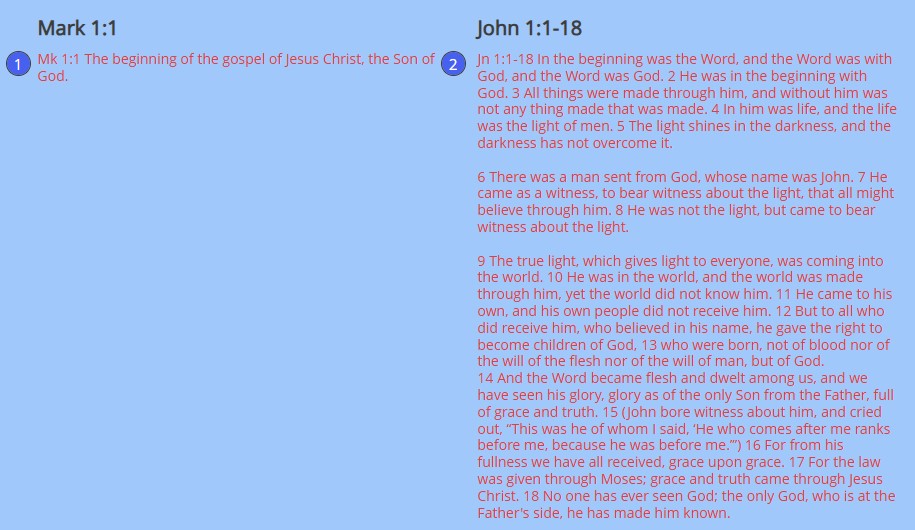
From the above worksheet photos, following the numbers and the text in red, the following narrative is produced.
Mk 1:1 The beginning of the gospel of Jesus Christ, the Son of God.
Jn 1:1 In the beginning was the Word, and the Word was with God, and the Word was God. 2 He was in the beginning with God. 3 All things were made through him, and without him there was not anything made that was made. 4 In him was life, and the life was the light of men. 5 The light shines in the darkness, and the darkness has not overcome it.
6 There was a man sent from God, whose name was John. 7 He came as a witness, to bear witness about the light, that all might believe through him. 8 He was not the light but came to bear witness about the light. 9 The true light, which gives light to everyone, was coming into the world.
10 He was in the world, and the world was made through him, yet the world did not know him. 11 He came to his own, and his own people did not receive him. 12 But to all who did receive him, who believed in his name, he gave the right to become children of God, 13 who were born, not of blood nor of the will of the flesh nor of the will of man, but of God.
14 And the Word became flesh and dwelt among us, and we have seen his glory, glory as of the only Son from the Father, full of grace and truth. 15 (John bore witness about him, and cried out, “This was he of whom I said, ‘He who comes after me ranks before me, because he was before me.’”)
16 For from his fullness we have all received, grace upon grace. 17 For the law was given through Moses; grace and truth came through Jesus Christ. 18 No one has ever seen God; the only God, who is at the Father’s side, he has made him known.
Bible Lessons for this event:
- H003 The Beginning (Mark 1:1; John 1:1-3)
- H004 The Word (John 1:1-3)
- H005 In Him was Life (John 1:4)
- H006 Light and Life – Death and Darkness (John 1:5)
- H007 A Man Sent from God (John 1:6-8)
- H008 The True Light (John 1:9-10)
- H009 The Right to become Children of God (John 1:11-13)
- H010 The Word became Flesh (John 1:14)
- H011 Grace Upon Grace (John 1:15-16)
Event Summary:
This event opens with Jesus being described as the eternal word who was with God and who was God. He is the one who made all things and is the source of life and light for humanity. His light shines in the darkness, and the darkness cannot overcome it.
John the Baptist is introduced as being sent by God to testify about the light (Jesus), so that people might believe through his witness. John himself was not the light but was a witness to the light. That true light was Jesus, who was coming into the world. Although He created the world, the world did not recognize Him. Even His own people (the Jewish nation) did not accept Him. To all who received Jesus and believed in His name, He gave the right to become children of God. This spiritual rebirth is not through human effort but through God’s initiative.
For our benefit, the Word became flesh and lived among us as the person of Jesus Christ, who displayed God’s glory, full of grace and truth. John the Baptist speaks of this Jesus as surpassing him because his preexistence. From the fullness of Jesus, humanity receives grace upon grace. While the law was given through Moses, grace and truth came through Jesus Christ, highlighting the superiority of the new covenant in Christ. Jesus is the ultimate revelation of God to humanity.
Understanding and Application:
MARK 1:1
“The beginning of the gospel of Jesus Christ, the Son of God.”
Discussion Questions with Answers
1. Why does Mark emphasize “the beginning of the gospel” in his opening line?
- Answer: Mark signals that what follows is the unfolding of God’s long-promised salvation breaking into history through Jesus. “Gospel” refers to the “good news,” showing that Jesus’ life and ministry are the starting point of God’s climactic redemptive work.
2. What is the significance of calling Jesus “the Christ”?
- Answer: “Christ” means “Messiah” or “Anointed One.” Mark immediately identifies Jesus as the long-awaited Davidic King who fulfills Old Testament promises. This sets the theological identity of Jesus before any narrative events occur.
3. Why does Mark begin by declaring Jesus “the Son of God”?
- Answer: Mark wants his readers to interpret the entire Gospel through the lens of Jesus’ divine identity. Jesus is not merely a prophet; He is God’s unique Son who has authority, power, and the right to inaugurate the kingdom of God.
4. How does Mark 1:1 prepare readers for the rest of the Gospel?
- Answer: It functions as a title sentence: everything that follows—Jesus’ teaching, miracles, suffering, death, and resurrection—reveals the identity and mission of the Messiah, the Son of God. The narrative proves what the opening statement proclaims.
JOHN 1:1–18
The Prologue of John’s Gospel: the eternal Word, the Light, the incarnate Son.
Discussion Questions with Answers
1. What does John mean when he calls Jesus “the Word” (Logos) in verse 1?
- Answer: “Word” communicates both revelation and creation. Jesus is God’s ultimate self-expression—His perfect communication to humanity. As the eternal Logos, Jesus reveals God’s character and will, and through Him all things were made.
2. How do we know from John 1:1 that Jesus is fully God?
- Answer: John states, “the Word was with God” (distinct in person) and “the Word was God” (sharing God’s nature). This affirms both the deity of Christ and His personal distinction from the Father—core truths of Trinitarian theology.
3. What does it mean that “in Him was life, and the life was the light of men” (v. 4)?
- Answer: Jesus is the source of both physical and spiritual life. His life illuminates truth, exposes darkness, and reveals the path to salvation. He is the light that enables humanity to see God clearly.
4. Why does John contrast light and darkness in verses 4–5?
- Answer: “Light” symbolizes truth, holiness, and revelation; “darkness” symbolizes ignorance, sin, and opposition. John shows that although darkness resists God’s light, it cannot overcome it. Christ’s victory is certain.
5. What is the role of John the Baptist in verses 6–8?
- Answer: John the Baptist is a witness, not the Light. His mission is to testify about Jesus so people might believe. The emphasis is that salvation comes through Christ, not through religious leaders.
6. What does it mean that the world “did not know” and “did not receive” Him (vv. 10–11)?
- Answer: Although Jesus created the world, humanity failed to recognize Him due to spiritual blindness and hardened hearts. Even His own covenant people largely rejected Him, fulfilling prophetic expectation.
7. According to verse 12, what does it mean to “receive” Jesus?
- Answer: To receive Him means to believe in His name—to trust His identity and work. Those who believe are given the right to become children of God, experiencing a spiritual rebirth that comes only from God.
8. What is the significance of “the Word became flesh” (v. 14)?
- Answer: This is the miracle of the incarnation: the eternal Son of God took on human nature. He didn’t merely appear as human; He truly became human to dwell among us, reveal the Father, and accomplish redemption.
9. How is Jesus described as full of “grace and truth”?
- Answer: Grace refers to God’s unmerited favor; truth refers to God’s faithfulness and revelation. Jesus fully embodies both—He brings salvation (grace) and perfectly reveals God as He is (truth).
10. What does “from His fullness we have all received, grace upon grace” (v. 16) mean?
- Answer: Believers receive an unending supply of God’s grace through Christ—grace for salvation, grace for sanctification, grace for perseverance. The phrase pictures wave after wave of grace overflowing from Christ’s fullness.
11. How does John contrast Moses and Jesus in verse 17?
- Answer: The law, given through Moses, revealed God’s standards but could not save. Jesus brings the fullness of grace and truth, providing what the law pointed toward—complete salvation and the full revelation of God.
12. According to verse 18, how does Jesus make the Father known?
- Answer: Jesus, the “only God” who is “at the Father’s side,” perfectly reveals the unseen God. He interprets, explains, and displays the Father because He shares the Father’s nature and has intimate fellowship with Him.
 Anchor My Faith
Leave a comment