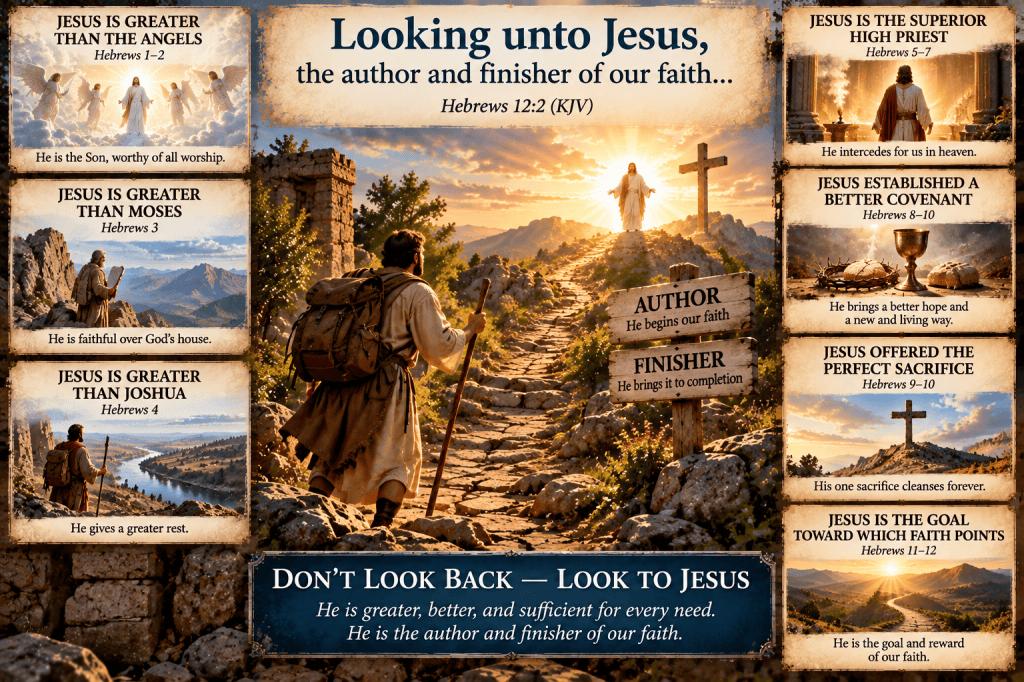
image Hebrews
A Study of Hebrews
Author and Facilitator: Stephen Weller
105 Lessons
95,461 words, 505 minutes is equivalent to 8 hours and 25 minutes read time.
Page Index
- Introduction
- Chapter 1 – The Son Superior to Angels
- Chapter 2 – The Son Made Like Us
- Chapter 3 – Jesus Greater Than Moses
- Chapter 4 – Entering God’s Rest
- Chapter 5 – The Priesthood of Christ
- Chapter 6 – A Call to Maturity and Assurance
- Chapter 7 – Melchizedek and the Superior Priesthood
- Chapter 8 – The Better Covenant
- Chapter 9 – The Better Sanctuary and Sacrifice
- Chapter 10 – The Perfect Sacrifice and Persevering Faith
- Chapter 11 – The Hall of Faith
- Chapter 12 – Run the Race with Endurance
- Chapter 13 – Living Out the Faith
Introduction
Bible Project – Introduction to Hebrews
Context
Context of Hebrews
The book of Hebrews was written to a community of believers who were facing pressure, hardship, and spiritual weariness. Although the author and original recipients are not specifically identified, the letter clearly addresses Christians who possessed a strong knowledge of the Old Testament, the priesthood, the sacrificial system, and Israel’s covenant history. They had previously endured suffering for their faith (Hebrews 10:32–34), but some were now becoming discouraged and were in danger of drifting away, neglecting their salvation, or turning back from their confession of Christ (Hebrews 2:1–3; 3:12–14; 10:35–39). Hebrews was therefore written both to encourage perseverance and to demonstrate the absolute supremacy and sufficiency of Jesus Christ. Jesus is presented as greater than the prophets, angels, Moses, Joshua, and the Levitical priesthood. He is the eternal Son of God, the perfect High Priest, and the mediator of the new covenant whose once-for-all sacrifice accomplished what the repeated sacrifices of the old covenant could never accomplish (Hebrews 1:1–4; 4:14–16; 7:23–28; 9:11–15; 10:10–14). Drawing extensively from the Old Testament, Hebrews explains that the tabernacle, priesthood, sacrifices, and covenant institutions pointed forward to their fulfillment in Christ. Throughout the book, profound teaching about Christ is joined with serious warnings against unbelief and repeated calls to faith, endurance, and spiritual maturity. The message reaches its practical climax in Hebrews 11–12, where examples of persevering faith lead believers to “run with endurance the race that is set before us, looking to Jesus” (Hebrews 12:1–2). Thus, Hebrews calls believers not to retreat when faith becomes difficult, but to hold firmly to Christ, draw near to God with confidence, encourage one another, and live faithfully in light of the unshakable kingdom they have received.
Major Themes
Major Themes of Hebrews
The book of Hebrews presents Jesus Christ as the supreme and final revelation of God and shows that the new covenant established through His sacrificial death is superior to everything that preceded it. The letter repeatedly calls believers to persevere in faith, draw near to God through Christ, and remain faithful because of who Christ is and what He has accomplished.
1. The Supremacy of Jesus Christ
The central theme of Hebrews is the absolute supremacy of Christ. Jesus is greater than the prophets, angels, Moses, Joshua, and the Levitical priesthood. He is the Son through whom God created the world and the One who perfectly reveals God’s nature (Hebrews 1:1–4).
2. Jesus Christ as the Great High Priest
Hebrews uniquely emphasizes Jesus as the believer’s great High Priest. Unlike earthly priests, Christ is sinless, eternal, and able to represent His people perfectly before God. Because He experienced human weakness and temptation without sinning, believers may approach Him confidently for mercy and grace (Hebrews 4:14–16).
3. The New Covenant
Jesus is the mediator of a better covenant, established on better promises (Hebrews 8:6). The old covenant anticipated what God would ultimately accomplish through Christ. Under the new covenant, God’s law is written upon the hearts of His people, their sins are forgiven, and they may know God personally (Hebrews 8:8–12).
4. Christ’s Once-for-All Sacrifice
The repeated sacrifices of the Old Testament could not permanently remove sin. Jesus offered Himself once for all, providing a complete and sufficient sacrifice for sin (Hebrews 9:11–14; 10:10–14). His finished work means that no additional sacrifice for sin is necessary.
5. Christ’s Superior Priesthood
Jesus’ priesthood is described as being “after the order of Melchizedek” rather than according to the Levitical priesthood (Hebrews 5:6; 7:17). His priesthood is permanent because He lives forever. Therefore, He is always able to intercede for those who come to God through Him (Hebrews 7:23–25).
6. Access to God Through Christ
Because of Christ’s sacrifice and priestly ministry, believers have direct access to God. Hebrews calls Christians to “draw near with a true heart in full assurance of faith” (Hebrews 10:22). The barrier created by sin has been dealt with through the blood of Christ.
7. Faith
Hebrews presents faith as confident trust in God’s promises even when their fulfillment cannot yet be seen. Hebrews 11 illustrates this truth through Abel, Enoch, Noah, Abraham, Sarah, Moses, and many others. Their lives demonstrate that genuine faith trusts God and acts upon His promises.
8. Perseverance in the Christian Life
Believers are repeatedly encouraged to hold fast, endure hardship, and continue faithfully in Christ. The Christian life is pictured as a race requiring endurance, with believers fixing their eyes upon Jesus, “the founder and perfecter of our faith” (Hebrews 12:1–2).
9. Warnings Against Falling Away
Hebrews contains several serious warning passages (Hebrews 2:1–4; 3:7–19; 5:11–6:12; 10:26–39; 12:25–29). These warnings emphasize the danger of neglecting God’s salvation, hardening the heart, drifting away, and deliberately turning from the truth. They function alongside strong encouragements to perseverance and faithfulness.
10. Jesus as the Perfect Revelation of God
God spoke throughout history through the prophets, but He has now spoken decisively through His Son (Hebrews 1:1–2). Jesus is not merely another messenger from God; He is “the radiance of the glory of God and the exact imprint of his nature” (Hebrews 1:3).
11. The Fulfillment of the Old Testament
Hebrews demonstrates that the Old Testament institutions were preparing the way for Christ. The tabernacle, priesthood, sacrifices, covenant, Sabbath rest, and sacrificial blood all point beyond themselves toward the greater reality fulfilled in Jesus (Hebrews 8–10).
12. The Importance of Christ’s Blood
Blood is a major theological theme throughout Hebrews. Under the old covenant, sacrificial blood provided ceremonial cleansing, but the blood of Christ accomplishes something far greater: it cleanses the conscience and provides eternal redemption (Hebrews 9:12–14, 22; 10:19; 12:24).
13. God’s Promised Rest
Drawing from Israel’s experience in the wilderness, Hebrews teaches that God’s promise of rest remains open to His people. Israel’s unbelief prevented a generation from entering the Promised Land, providing a warning against unbelief and an invitation to enter God’s rest through faith (Hebrews 3:7–4:11).
14. God’s Discipline of His Children
Hardship is not necessarily evidence of God’s absence. Hebrews 12 teaches that God disciplines His children as a loving Father, using difficulties to produce holiness and spiritual maturity (Hebrews 12:5–11).
15. The Unshakable Kingdom
Hebrews contrasts the temporary things of this world with God’s eternal kingdom. Everything that can be shaken will ultimately pass away, but believers are receiving “a kingdom that cannot be shaken” (Hebrews 12:28). This eternal hope calls God’s people to gratitude, reverence, and worship.
16. Christian Community and Mutual Encouragement
Perseverance is not intended to occur in isolation. Believers are commanded to encourage one another, stir one another toward love and good works, and continue gathering together (Hebrews 3:12–13; 10:24–25). Christian fellowship is presented as an important safeguard against spiritual drift.
17. Hope Anchored in God’s Faithfulness
Christian hope rests upon God’s unchanging character and promises. Hebrews describes this hope as “a sure and steadfast anchor of the soul” (Hebrews 6:19). Because God is faithful and Christ has entered God’s presence on behalf of His people, believers can remain confident even during uncertainty and suffering.
18. Jesus Christ Is Unchanging
Hebrews concludes its presentation of Christ’s supremacy with the enduring declaration: “Jesus Christ is the same yesterday and today and forever” (Hebrews 13:8). His unchanging nature provides stability for believers in a changing world.
Central Theme of Hebrews:
Jesus Christ is supreme and sufficient. Through His once-for-all sacrifice and eternal High Priestly ministry, He has established the better covenant, opened the way into God’s presence, and given His people every reason to persevere in faith until the end.
Chapter 1 – The Son Superior to Angels
Chapter Introduction
Introduction to Hebrews 1
Hebrews 1 opens with a majestic declaration of the supremacy of Jesus Christ, presenting Him as God’s final and fullest revelation to humanity. While God formerly spoke to His people through the prophets in many times and various ways, He has now spoken through His Son, whom He appointed heir of all things and through whom He created the world. Jesus is revealed not merely as another messenger from God, but as the radiant expression of God’s glory and the exact imprint of His nature, sustaining all creation by His powerful word. After accomplishing purification for sins, Christ sat down at the right hand of the Majesty on high, demonstrating the completeness of His redemptive work and His exalted position. The remainder of the chapter establishes that the Son is far superior to the angels, using Old Testament Scripture to show His unique identity, eternal kingship, divine authority, and unchanging nature. Hebrews 1 therefore lays the foundation for the entire book: Jesus Christ is supreme, God’s revelation in Him is decisive, and His person and work demand our complete attention, faith, and allegiance.
Bible Lessons
1.1 Hebrews Introduction to Hebrews
It was common practice when writing a letter to identify who wrote it and to whom it was being sent, but not in the case of Hebrews. With a title of “Hebrews” it is assumed that the original recipients were Jewish Christians. As for the author, there has been much speculation with Barnabas or especially Paul being at the top of the list. However, there is significant style differenced when comparing to Paul’s identified letters. Other names that have been suggested are, Clement, Luke, or Apollos, but the consensus is “We do not know, only God does.”
From Hebrews 13:19, we see that the author personally knew those he was writing to. Hebrews 13:23 suggest a mutual friend in Timothy and suggest to me that Paul was possibly the author of Hebrews. Hebrews 10:32 – 34 suggest a time of persecution with some of them spending time in prison. As in Paul’s letters to various churches, there is also a problem here with false teachers (See 13:9). It appears that the audience was made up of Jewish Christians as well as Gentiles who had previously been drawn to the Jewish religion.
It is assumed that this letter was written in the first century, probably before A.D 70. The mention of Timothy in 13:23 helps establish the date of its writing. The date is also influenced by the many references to the Jewish sacrificial system as if it were a present reality, which would not seem likely if the date was after the destruction of temple in A. s. 70.
We see from the opening of Hebrews that the theme is about superiority of Jesus Christ when compared to angels, priests, or old covenant institution. There is the encouragement to hold on to one’s faith and not turn away from one’s salvation when times become difficult.
When comparing this book with the various letters in the New Testament, we find it is very different than the letters of other authors. The fact that Hebrews ends with a greeting suggest that it was also a letter. Many think Hebrews was a single sermon that took the form of a letter.
This sermonic letter contained strong encouragement to endure persecution and not leave the faith. It seems that some were not in regular church attendance maybe due to persecution and were encouraged to return.
I look forward to our study of Hebrews. I am sure we will find it different from other letters we have studies because of all the Old Testament references and especially the reference to temple sacrifices. Without further comment, let us begin our study with the next lesson.
1.2 Hebrews 1:1-4, Summary of the Son’s Person and Work
1:1 Long ago, at many times and in many ways, God spoke to our fathers by the prophets, 2 but in these last days he has spoken to us by his Son, whom he appointed the heir of all things, through whom also he created the world. 3 He is the radiance of the glory of God and the exact imprint of his nature, and he upholds the universe by the word of his power. After making purification for sins, he sat down at the right hand of the Majesty on high, 4 having become as much superior to angels as the name he has inherited is more excellent than theirs. (Hebrews 1:1 – 4 ESV)
In the previous lesson we introduced Hebrews and with this lesson we will begin our study of the main body of this letter.
This writing opens more like it were a sermon and not a letter, as there is no initial greeting, as with other letters, but instead it opens with a summary of who Jesus is (1:1 – 4). The first thing we notice is a division between the Old Testament and the New Testament. Long ago, in Old Testament times, God spoke to the Jewish fathers by the prophets at many different times and in many ways. In this way God provided material for prophetic and the historical books of the Old Testament. Included with these prophets would be Moses and David (cf. Deuteronomy 18:15; Acts 1:16, 3:22, 4:25, 7:37, 26:22). “Our fathers” refers to the Old Testament Patriarchs (cf. Hebrews 3:9; 8:9), whom the author considers his audience’s spiritual forebears. After the writing of Hebrews, it is recognized that no more books or letters are needed to explain what God has done through his Son. Hebrews would complete the cannon of Scripture. Believers have all they need to know God and how he wants us to live. It is now our task to apply his word to our lives and share this information with others as we wait the return of Jesus Christ.
1:1 mentioned “long ago” (Old Testament Times) while 1:2 looks to the right of the time scale to the “last days” (New Testament times) when God spoke to us by his Son, “[Who] was foreknown before the foundation of the world but was made manifest in the last times for the sake of you who through him are believers in God, who raised him from the dead and gave him glory, so that your faith and hope are in God.” (1 Peter 1:20 – 21 ESV). He came and sacrificed himself to take away our sin (See Hebrews 9:26). It was pointed out in Matthew 14:33 that the disciples who were in the boat during the storm understood that Jesus was the Son of God.
God’s Son has been “appointed heir of all things.” That inheritance is what he receives from his Father and includes all of creation by virtue that he is superior to everyone else (1:4). The fact that the world was created through him qualifies him for the inheritance. “All things were made through him, and without him was not anything made that was made” (John 1:3 ESV). “For by him all things were created, in heaven and on earth, visible and invisible, whether thrones or dominions or rulers or authorities—all things were created through him and for him” (Colossians 1:16 ESV).
The author next describes Jesus Christ as “the radiance of the glory of God” (1:3). Glory is often used to describe the splendor, holiness, and majesty of God. Metaphorically it is viewed as light, for example in Isaiah 60:1 ESV: “Arise, shine, for your light has come, and the glory of the Lord has risen upon you.”; in Isaiah 60:9 ESV: “The sun shall be no more your light by day, nor for brightness shall the moon give you light; but the Lord will be your everlasting light, and your God will be your glory.”; and in 2 Corinthians 4:4 – 6 ESV: “In their case the god of this world has blinded the minds of the unbelievers, to keep them from seeing the light of the gospel of the glory of Christ, who is the image of God. For what we proclaim is not ourselves, but Jesus Christ as Lord, with ourselves as your servants for Jesus’ sake. For God, who said, “Let light shine out of darkness,” has shone in our hearts to give the light of the knowledge of the glory of God in the face of Jesus Christ.” In his glorified state, Jesus Christ is that glorious light of God.
Let us take a break here and finish the paragraph in the next lesson.
1.3 Hebrews 1:1-4, Descriptions of Jesus Christ
1:1 Long ago, at many times and in many ways, God spoke to our fathers by the prophets, 2 but in these last days he has spoken to us by his Son, whom he appointed the heir of all things, through whom also he created the world. 3 He is the radiance of the glory of God and the exact imprint of his nature, and he upholds the universe by the word of his power. After making purification for sins, he sat down at the right hand of the Majesty on high, 4 having become as much superior to angels as the name he has inherited is more excellent than theirs. (Hebrews 1:1 – 4 ESV)
In the previous lesson we began our study of the Son’s person and work. In this lesson we will continue that study.
The author next describes Jesus Christ as “the exact imprint of his nature” (1:3). “In the beginning was the Word, and the Word was with God, and the Word was God. He was in the beginning with God. All things were made through him, and without him was not anything made that was made. And the Word became flesh and dwelt among us, and we have seen his glory, glory as of the only Son from the Father, full of grace and truth.” (John 1:1 – 3, 14 ESV), therefore, Jesus Christ is God. (cf. John 1:18; 10:30; 17:21; Philippians 2:5 – 6; Colossians 2:9 – 10). The Son is identical is substance to God, being himself fully God. He is exactly like the Father and taking on a body of flesh as Jesus simply provides him the ability for direct communication with us. It also provided him the ability to be our perfect sacrifice for our sin problem.
The author next describes Jesus Christ as “[upholding] the universe by the word of his power” (1:3). “He is before all things, and in him all things hold together” (Colossians 1:17 ESV). If he is before all things, then he would have to be eternal. To hold all things together implies that Jesus Christ has the power to sustain and to prevent breakdown. Things are kept in their present state: their existence, order, and arrangement continue by his power. To uphold the universe is to sustain it.
The author next describes Jesus Christ as “making purification for sins” (1:3). “How much more will the blood of Christ, who through the eternal Spirit offered himself without blemish to God, purify our conscience from dead works to serve the living God” (Hebrews 9:14 ESV). As a sacrifice, Jesus Christ was different than the sacrifice of animals which had to be repeated over and over. “He entered once for all into the holy places, not by means of the blood of goats and calves but by means of his own blood, thus securing an eternal redemption” (Hebrews 9:12 ESV). It is his blood that cleanses us from all sin (See 1 John 1:7). After his resurrection, Jesus Christ “was taken up into heaven and sat down at the right hand of God” (Mark 16:19 SV). “From now on the Son of Man shall be seated at the right hand of the power of God” (Luke 22:69 ESV).
The main theme of chapters 1 and 2 is announced in the statement: “Jesus is superior to angels” (1:4). In the Old Testament, angels were known to appear in human form to minister before the throne of God, to guide and protect humans, and to reveal the Mosaic law (See Hebrews 1:7; 2:2; 12:22; 13:2). In comparison to these angels, Jesus Christ was seen as superior because of his name being “Son” (1:5). That name points out a more intimate relationship to God the Father than the angels have, and thus implies a greater inheritance. In John 16:15, Jesus said, “All that the Father has is mine.” Jesus Christ is “far above all rule and authority and power and dominion, and above every name that is named, not only in this age but also in the one to come” (Ephesians 1:21 ESV). God has “highly exalted him and bestowed on him the name that is above every name” (Philippians 2:9 ESV). “And there is salvation in no one else, for there is no other name under heaven given among men by which we must be saved” (Acts 4:12 ESV).
What a tremendous opening to what appears to be an exciting study.
1.4 Hebrews 1:5-6, My Son Is Greater Than Angels – 1
1:5 For to which of the angels did God ever say, “You are my Son, today I have begotten you”? Or again, “I will be to him a father, and he shall be to me a son”? 6 And again, when he brings the firstborn into the world, he says, “Let all God’s angels worship him.” (Hebrews 1:5 – 6 ESV)
With the previous two lessons we covered a summary of the Son’s person and work. With this lesson we begin the paragraph that gives evidence of Christ’s status as a Son. This is accomplished by looking at a chain of Old Testament quotation that show that Jesus Christ is superior to angels.
The first Old Testament quotation is from Psalm 2:7 ESV: “You are my Son, today I have begotten you.” God never referred to an angel as his Son, who we know as the Messiah or the Anointed One (Psalm 2:2). As God’s Son he is King over all (Psalm 2:6 – 8).
What is the meaning of “today I have begotten you?” Does only begotten Son mean Jesus was created? No, it does not. If he is before all things, then he would have to be eternal (Colossians 1:17). For clarity, look at Isaiah 9:6 ESV: “For to us a child is born, to us a son is given.” Jesus is the child, the body the Son took on through a virgin birth. “In the beginning was the Word, and the Word was with God, and the Word was God. He was in the beginning with God. All things were made through him, and without him was not anything made that was made” (John 1:1 – 3 ESV). The Son was in the beginning with God, and he was God and therefore he was not created. The Son took on a body (See John 1:14), who we know as Jesus.
“I will be to him a father, and he shall be to me a son” was a quotation from 2 Samuel 7:15 (cf. 2 Chronicles 17:13). We find this quotation in Hebrews 5:5, Acts 13:33, and Psalm 2:7. This statement is declared to King David concerning his covenant heir, whom God will designate as his own “Son.” Reference is made to Psalm 89:26 – 27 ESV: “He shall cry to me, ‘You are my Father, my God, and the Rock of my salvation.’ And I will make him the firstborn, the highest of the kings of the earth.” The phrase “You are my Father” links back to 2 Samuel 7:14. “the Rock of my salvation” links back to Psalm 18:2. “I will make him the first born” has reference back to Exodus 4:22 where “firstborn” is applied to Israel, but then in Romans 8:29, the reference is to being “firstborn among many brothers.” In Colossians 1:15 ESV: “He is the image of the invisible God, the firstborn of all creation.” Colossians 1:18 adds “the firstborn from the dead.” God’s Son took on human flesh through a virgin birth and became Jesus, the image of the invisible God. He lived a perfect life under the law, becoming our Passover Lamb, he took our sin and died in our place on the cross providing for our salvation. Rising from the dead he provided for our resurrection. Then, we who are being born again become a new creation in Christ and become those who he became the “firstborn of many brothers.” The statement “I will be to him a father, and he shall be to me a son” is fulfilled in the Father’s Son who was the firstborn of a kingdom of believers who were conformed into the image of the Son.
As that firstborn, in 1:6, comes into the world as our savior and redeemer, “Let all God’s angels worship him.” This quotation is created by combining the themes from Deuteronomy 32:43 and Psalm 97:7 in which angels are referred to as “gods” but they do not have the rights of God’s Son. The task of angels is to worship the Son thus being subordinate to him. Since only God is to be worshipped, this is further evidence that the “Son” is fully deity.
We will break here and continue in the next lesson.
1.5 Hebrews 1:7-9, My Son Is Greater Than Angels – 2
1:7 Of the angels he says, “He makes his angels winds, and his ministers a flame of fire.” 8 But of the Son he says, “Your throne, O God, is forever and ever, the scepter of uprightness is the scepter of your kingdom. 9 You have loved righteousness and hated wickedness; therefore God, your God, has anointed you with the oil of gladness beyond your companions.” (Hebrews 1:7 – 9 ESV)
In the previous lesson we looked at several Old Testament quotations. In this lesson we will look at a few more.
The statement “He makes his angels winds, and his ministers a flame of fire” is from Psalm 104:4. Psalm 104 is titled “O Lord My God, You are Very Great” and points to the Lord as creator and sustainer of all things, including angels. These angels are his “messengers” and “ministers” (Psalm 104:4). These angels sometimes use “wind” and “fire” to do their work. Since this Psalm designates the Lord as sustainer, it implies that the splendor of the angels is also the result of the Lord’s creative hand, and thus the Son is greater than the angels.
The statement “Your throne, O God, is forever and ever, the scepter of uprightness is the scepter of your kingdom. You have loved righteousness and hated wickedness; therefore God, your God, has anointed you with the oil of gladness beyond your companions.” is from Psalm 45:6 – 7. Psalm 45 is a Psalm extoling the Davidic king. Looking at the genealogy of Jesus Christ in Matthew 1:1 – 17, we find that Jesus is an offspring in the line with Abraham and David, and as believers we are offspring of Abraham through Jesus Christ.
It was not by any work that Abraham did that he became righteous, but it was his belief in God that was counted to him as righteousness (See Genesis 15:6). It is through faith, not by works that one becomes righteous. Righteousness is a gift given by God, like receiving the “robe of righteousness,” of Isaiah 61:10, that one is to put on. Before our salvation we are described as “children of wrath” (See Ephesians 2:3), “but God, being rich in mercy, because of the great love with which he loved us, even when we were dead in our trespasses, made us alive together with Christ” (Ephesians 2:4 – 5 ESV).
David was a great king, but his descendent, Jesus Christ was the King of kings and Lord of lords (See 1 Timothy 6:15). A king had a scepter which was a rod or staff, adorned with gold and jewels to indicate his authority. In 1:8, Jesus is described as God who has an eternal throne, who has a scepter of uprightness (righteousness) and those who through faith are born again receive his righteousness and become the promised offspring of Abraham and eternal members of God’s kingdom.
Jesus Christ “loved righteousness and hated wickedness” and so loved us that he took our sin and died on the cross to remove our wickedness and cloth us with his righteousness, and as a result God “anointed [him] with the oil of gladness beyond [his] companions” (1:9). This anointing with the oil of gladness was prophesied in Isaiah 61:1; 3 ESV: “The Spirit of the Lord God is upon me, because the Lord has anointed me to bring good news to the poor; he has sent me to bind up the brokenhearted, to proclaim liberty to the captives, and the opening of the prison to those who are bound; to grant to those who mourn in Zion— to give them a beautiful headdress instead of ashes, the oil of gladness instead of mourning, the garment of praise instead of a faint spirit; that they may be called oaks of righteousness, the planting of the Lord, that he may be glorified.”
Jesus Christ is described as King of kings and has an eternal throne from which he rules with a scepter of righteousness, an eternal kingdom of believers who are clothed with his righteousness. What angel can possibly claim to be greater than this. Lucifer tried and it did not go well with him.
1.6 Hebrews 1:10-14, My Son Is Greater Than Creation
1:10 And, “You, Lord, laid the foundation of the earth in the beginning, and the heavens are the work of your hands; 11 they will perish, but you remain; they will all wear out like a garment, 12 like a robe you will roll them up, like a garment they will be changed. But you are the same, and your years will have no end.” 13 And to which of the angels has he ever said, “Sit at my right hand until I make your enemies a footstool for your feet”? 14 Are they not all ministering spirits sent out to serve for the sake of those who are to inherit salvation? (Hebrews 1:10 – 14 ESV)
In the previous lesson we looked at the Son, his throne, his kingdom, and his scepter. In this lesson we will see how Jesus Christ is greater than creation and that he will sit at the right hand of God and who will make his enemies a footstool for his feet.
The statement “You, Lord, laid the foundation of the earth in the beginning, and the heavens are the work of your hands; they will perish, but you remain; they will all wear out like a garment, like a robe you will roll them up, like a garment they will be changed. But you are the same, and your years will have no end” (1:10 – 12), is a quote from Psalm 102:25 – 27.
After pointing out the deity of Jesus Christ in 1:8 – 9, the author of Hebrews then connects God’s Son to Psalms 102:25 – 27. “Of old you laid the foundation of the earth” (Psalm 102:25a; 1:10a). “In the beginning, God created the heavens and the earth” (Genesis 1:1 ESV), the creation of the world. “Thus, the heavens and the earth were finished, and all the host of them. And on the seventh day God finished his work that he had done, and he rested on the seventh day from all his work that he had done.” (Genesis 2:1 – 2 ESV).
“And the heavens are the work of your hands” (Psalm 102:25b; 1:10b). “For all the gods of the peoples are worthless idols, but the Lord made the heavens” (Psalm 96:5 ESV). “May you be blessed by the Lord, who made heaven and earth” (Psalm 115:15 ESV). “Thus says God, the Lord, who created the heavens and stretched them out, who spread out the earth and what comes from it, who gives breath to the people on it and spirit to those who walk in it” (Isaiah 42:5 ESV). “Thus says the Lord, your Redeemer, who formed you from the womb: “I am the Lord, who made all things, who alone stretched out the heavens, who spread out the earth by myself” (Isaiah 44:24 ESV). “It is he who made the earth by his power, who established the world by his wisdom, and by his understanding stretched out the heavens” (Jeremiah 10:12 ESV).
The earth and the heavens are the work of his hands; “they will perish, but you remain; they will all wear out like a garment, like a robe you will roll them up, like a garment they will be changed” (Hebrews 1:11 – 12a). “The sky vanished like a scroll that is being rolled up, and every mountain and island was removed from its place” (Revelation 6:14 ESV). “Then I saw a new heaven and a new earth, for the first heaven and the first earth had passed away, and the sea was no more. … He will wipe away every tear from their eyes, and death shall be no more, neither shall there be mourning, nor crying, nor pain anymore, for the former things have passed away” (Revelation 21:1, 4 ESV). Jesus Christ created the first heavens and earth, but they were corrupted by sin. In time they will pass away to be replaced by new that will be perfect and eternal. Through this the Son will remain the same, and his years will have no end, for he is eternal.
The statement “Sit at my right hand until I make your enemies a footstool for your feet” is a quote from Psalm 110:1). This verse in cited in several places in the New Testament and shows the importance of the Old Testament as a foundation to the New Testament. The phrase “Sit at my right hand” is cited in Matthew 22:44, Mark 12:36, Luke 20:42 – 43, and Acts 2:34 – 35. The phrase “until I make your enemies your footstool” is referenced in Hebrews 10:13, 1 Corinthians 15:25, Ephesians 1:22, Hebrews 2:8, 1 Peter 3:22, Psalm 8:6, Psalm 18:38, and Joshua 10:24.
To end this paragraph, the author brings the focus back to angles and refers to them as ministering spirits who are sent out to serve for the sake of those who are to inherit salvation. Those whom God has chosen for salvation, he assigns angels to watch over them, to insure they will live to hear the gospel and be prepared to be born again to obtain salvation. One day as an early teen I was standing in the utility room attached to our farmhouse, looking out a window. In a playful mood, my younger sister picks up my dad’s rifle and aims it at the back of my head from about fifteen feet away and pulls the trigger. I can still hear the bullet zing past my ear and through the window. The angel assigned to me did his job that day allowing me to later inherit salvation.
Questions with Answers
Questions of understanding with extended answers
1. How does Hebrews 1 describe the way God has revealed Himself?
Answer:
Hebrews begins by contrasting God’s revelation in the past with His revelation through Jesus Christ. In earlier times, God spoke “at many times and in many ways” through the prophets (Hebrews 1:1). These revelations were genuine and authoritative, but they pointed forward to something greater. In “these last days,” God has spoken through His Son (Hebrews 1:2). Jesus is not simply another prophet in a long line of messengers. He is the Son through whom God has given His climactic revelation. To know Christ is therefore to encounter the fullest revelation of God’s character, purpose, and saving work.
2. What does Hebrews 1:2 teach about the identity and authority of Jesus?
Answer:
Hebrews 1:2 presents Jesus as the Son whom God has “appointed the heir of all things” and through whom He “created the world.” These descriptions establish Christ’s extraordinary authority. As heir, everything ultimately belongs to Him; as the One through whom creation came into existence, He existed before His earthly life and stands above creation rather than merely being part of it. The chapter immediately establishes that Jesus is far more than a human teacher or religious leader. He is the eternal Son with divine authority over all things.
3. What does it mean that Jesus is “the radiance of the glory of God”?
Answer:
Hebrews 1:3 teaches that Jesus perfectly reveals God’s glory. Radiance cannot be separated from the glory from which it shines; similarly, the Son uniquely makes the glory of God known. Jesus does not merely reflect God in the limited way that faithful human beings may reflect His character. He possesses a unique relationship with the Father and reveals God to humanity. When we look at the person, character, and work of Christ, we see the glory of God made known.
4. What does the phrase “the exact imprint of his nature” teach about Christ?
Answer:
This phrase emphasizes the perfect correspondence between the Son and the nature of God. Jesus is not merely similar to God or a partial representation of Him. Hebrews presents Him as the exact expression of God’s nature. Together with the statement that He is the “radiance of the glory of God,” this provides one of the New Testament’s strong declarations concerning the divine identity of Christ. The Son perfectly reveals who God is because He shares uniquely in the divine nature.
5. What does Jesus continually do for creation?
Answer:
Hebrews 1:3 says that Christ “upholds the universe by the word of his power.” His relationship to creation did not end when creation came into existence. The Son continues to sustain it. Everything remains dependent upon His sovereign power. This presents Jesus not only as the agent of creation but also as its continual sustainer. The universe is neither independent of God nor beyond His control.
6. What central saving work of Christ is mentioned in Hebrews 1:3?
Answer:
The writer says that Jesus made “purification for sins.” This brief statement anticipates one of the great themes developed throughout Hebrews: Christ’s sacrificial work deals decisively with human sin. Later chapters explain how Jesus serves as the perfect High Priest and offers Himself as the sufficient sacrifice. Even in the opening paragraph, therefore, Hebrews joins Christ’s divine greatness with His saving mission. The One through whom the universe was created is also the One who acted to cleanse sinners.
7. What is significant about Jesus sitting “at the right hand of the Majesty on high”?
Answer:
Sitting at God’s right hand signifies honor, authority, victory, and completed work. Hebrews draws upon Psalm 110:1 to describe the exalted position of Christ. Jesus accomplished purification for sins and then took His place at the right hand of God. Unlike priests whose sacrifices had to be repeatedly offered, Christ’s sacrificial work is sufficient. His enthronement also declares that He reigns with divine authority and possesses a position no angel can claim.
8. Why does Hebrews 1 emphasize that Jesus is superior to angels?
Answer:
Angels held an important place in Jewish understanding as heavenly servants and messengers of God. Hebrews establishes immediately that, however glorious angels may be, the Son occupies an entirely different and superior position. Jesus possesses the name “Son,” receives worship, reigns eternally, participated in creation, and sits at God’s right hand. Angels, by contrast, are servants sent by God. The comparison magnifies Christ and prepares readers to understand why His revelation and salvation must receive their fullest attention.
9. What distinction does Hebrews 1:5 make between Jesus and the angels?
Answer:
The writer asks, “For to which of the angels did God ever say, ‘You are my Son’?” The expected answer is: none. Angels are created servants of God; Jesus is uniquely the Son. The writer supports this distinction by quoting Old Testament passages concerning the Son’s unique relationship with the Father. Christ therefore does not belong to the same category as angels. His sonship establishes His unique identity and authority.
10. What does Hebrews 1:6 teach about the relationship between angels and Jesus?
Answer:
Hebrews 1:6 declares, “Let all God’s angels worship him.” Rather than Jesus worshiping alongside the angels, the angels themselves are commanded to worship Him. This dramatically establishes His supremacy. Angels are glorious heavenly beings, but they remain worshipers and servants. Christ is the One whom they worship. The verse therefore contributes to the chapter’s larger presentation of Jesus as possessing divine honor and authority.
11. How are angels described in Hebrews 1:7 and 1:14?
Answer:
Angels are described as God’s servants and “ministering spirits sent out to serve for the sake of those who are to inherit salvation.” Their role is honorable but subordinate. They carry out God’s purposes rather than rule alongside the Son as equals. This distinction is important: Christ reigns; angels serve. Christ is the heir; angels minister on behalf of those who will inherit salvation.
12. What does Hebrews 1:8–9 teach about the reign of the Son?
Answer:
The Son’s throne is described as lasting “forever and ever,” and righteousness characterizes His kingdom. His rule is not temporary, unstable, or corrupted by injustice. He “loved righteousness and hated wickedness.” Hebrews therefore presents Christ as the eternal righteous King. His kingdom reflects His own character: holiness, righteousness, and justice.
13. What does Hebrews 1:10–12 reveal about Jesus and creation?
Answer:
These verses contrast the permanence of the Son with the temporary nature of creation. The heavens and earth are described as the work of His hands. Creation will grow old “like a garment,” but the Son remains. Hebrews 1:12 concludes, “You are the same, and your years will have no end.” Everything created is subject to change, but Christ remains eternally unchanged. His permanence provides a foundation for the believer’s confidence in Him.
14. Why is Hebrews 1:13 important to the chapter’s argument?
Answer:
Hebrews again contrasts Christ with the angels by asking whether God ever said to an angel, “Sit at my right hand until I make your enemies a footstool for your feet.” Again, the answer is no. The quotation from Psalm 110:1 identifies the Son as the enthroned ruler whose enemies will ultimately be placed under His authority. Angels stand as servants; Christ sits enthroned as King. The verse brings together His exaltation, authority, and ultimate victory.
15. What does Hebrews 1 teach about the believer’s relationship to angels?
Answer:
Hebrews does not encourage believers to seek, worship, or focus their faith upon angels. Instead, angels are described as servants whom God sends “for the sake of those who are to inherit salvation” (Hebrews 1:14). The believer’s attention is directed toward Christ. Angels participate in God’s purposes, but Jesus is the Savior, King, Creator, and Son. The chapter therefore keeps Christ—not heavenly beings—at the center of faith.
16. What major truths about Jesus are established in Hebrews 1?
Answer:
Hebrews 1 presents an extraordinary portrait of Christ. He is God’s Son, heir of all things, agent of creation, radiance of God’s glory, exact imprint of God’s nature, sustainer of the universe, purifier of sins, exalted King, object of angelic worship, righteous ruler, eternal Lord, and sovereign over His enemies. These truths establish the foundation for the entire book of Hebrews. Everything that follows—the superiority of Christ’s priesthood, covenant, sacrifice, and salvation—rests upon the greatness of His person.
17. What is the central message of Hebrews 1?
Answer:
The central message is the absolute supremacy and sufficiency of Jesus Christ. God has spoken decisively through His Son, and that Son stands above prophets, angels, and all creation. He reveals God perfectly, sustains all things, provides purification for sin, and reigns eternally at God’s right hand. Hebrews begins by directing the reader’s attention upward to the greatness of Christ because understanding who Jesus is provides the foundation for understanding everything He has accomplished.
Chapter 2 – The Son Made Like Us
Chapter Introduction
Introduction to Hebrews 2
Hebrews 2 builds upon the opening chapter’s declaration of the supremacy of Jesus Christ by emphasizing both the seriousness of responding to His salvation and the necessity of His becoming fully human. The chapter begins with a solemn warning not to “drift away” from the truth that believers have heard, reminding readers that the salvation announced by the Lord must not be neglected. The writer then explains that although Jesus was “made lower than the angels” for a little while, He willingly entered humanity so that through His suffering and death He might be crowned with glory and honor and bring many sons to glory. By sharing in flesh and blood, Christ was able to defeat the power of death, deliver those enslaved by the fear of death, and become a merciful and faithful high priest who makes propitiation for the sins of His people. Hebrews 2 therefore presents Jesus as both the victorious Son of God and the compassionate Savior who fully identifies with humanity; because He Himself suffered when tempted, He is able to help those who are being tempted.
Bible Lessons
2.1 Hebrews 2:1-4, Do Not Reject Salvation
2:1 Therefore we must pay much closer attention to what we have heard, lest we drift away from it. 2 For since the message declared by angels proved to be reliable, and every transgression or disobedience received a just retribution, 3 how shall we escape if we neglect such a great salvation? It was declared at first by the Lord, and it was attested to us by those who heard, 4 while God also bore witness by signs and wonders and various miracles and by gifts of the Holy Spirit distributed according to his will. (Hebrews 2:1 – 4 ESV)
In the previous lesson we found that the Son was greater than creation. With this lesson we will cover a very short one lesson section which warns against neglecting salvation.
The “therefore” points us back to chapter 1 and the supremacy of God’s Son over the angels and over creation. In addition to this material there is much we have heard from the prophets of the Old Testament. We have the law that shows we are all guilty and if justice were served, we would all spend an eternity apart from the benefits of God and under his curse. The law cannot save us but can show us our need for a savior, and with the Son being given by God as our sacrifice, his death and resurrection provides for that salvation for those who believe. Once we hear the message of salvation, we must respond through belief and not drift away from the message and remain on the path to eternal destruction.
When the Jews were preparing to stone Steven (See Acts 7), he spoke of these Jews being “stiff-necked people, uncircumcised in heart and ears, you always resist the Holy Spirit. As your fathers did, so do you. Which of the prophets did your fathers not persecute? And they killed those who announced beforehand the coming of the Righteous One, whom you have now betrayed and murdered, you who received the law as delivered by angels and did not keep it” (Acts 7:51 – 53 ESV). The message these Jews heard was reliable, but they chose to reject it and destroyed the one who could set them free from the law of sin and death. They rose to persecute anyone who would embrace the message of salvation by grace through faith. That persecution began with Steven and spread to other believers.
Let us be careful that we not drift away from the message we have heard and shame our savior, or not respond to the message and find salvation. The message was reliable, but so is the promise that every transgression or disobedience will receive a just retribution. Later in Hebrews 10:28, we will be told that anyone who sets aside the law of Moses dies without mercy. Examples are given in Numbers 15:30 – Numbers 15:31, Deuteronomy 4:3, Deuteronomy 17:2, Deuteronomy 17:5, Deuteronomy 17:12, and Deuteronomy 27:26.
The author asks a question that everyone should seriously consider before death comes to them. That question is: How do you expect to escape judgment if you neglect such a great salvation? If one dies without mercy who sets aside the law of Moses, then how much worse punishment might you deserve if you trample underfoot the Son of God and profane the blood of the covenant? (See Hebrews 10:28 – 29). Jesus addresses this issue of invitation in the parable of the wedding feast in Matthew 22:1 – 14. Many were invited but the invitations were ignored by many, and others abused the messengers and even killed some.
That message of salvation was first spoken to us in these last days by God’s Son. Those who heard the message and believed, “went out and preached everywhere, while the Lord worked with them and confirmed the message by accompanying signs” (Mark 16:20 ESV, cf. Luke 1:2). Peter, in his sermon at Pentecost, said, “Men of Israel, hear these words: Jesus of Nazareth, a man attested to you by God with mighty works and wonders and signs that God did through him in your midst, as you yourselves know” (Acts 2:22 ESV). Even the apostles were able to do many wonders and signs to verify their message (See Acts 2:43). Even believers received power in the form of gifts (1 Corinthians 12:4, 11). These gifts were given according to their need in ministry, according to the purpose of his will (Ephesians 1:5).
Let us not neglect the gift of salvation and once born again, let us not neglect to do the work assigned to us (Ephesians 2:10). For the past twenty years of retirement, I have been able to focus on ministry with time in China and writing bible lessons, almost completely covering the New Testament, and have found life to be full, meaningful, and exciting; a real adventure.
2.2 Hebrews 2:5-9, Provision for Our salvation
2:5 For it was not to angels that God subjected the world to come, of which we are speaking. 6 It has been testified somewhere, “What is man, that you are mindful of him, or the son of man, that you care for him? 7 You made him for a little while lower than the angels; you have crowned him with glory and honor, 8 putting everything in subjection under his feet.” Now in putting everything in subjection to him, he left nothing outside his control. At present, we do not yet see everything in subjection to him. 9 But we see him who for a little while was made lower than the angels, namely Jesus, crowned with glory and honor because of the suffering of death, so that by the grace of God he might taste death for everyone. (Hebrews 2:5 – 9 ESV)
With the following lesson we covered the warning against neglecting salvation. With this lesson we begin a section devoted to the founder of our salvation.
The “For” that begins 2:5, continues the argument from 1:5 – 14 and 2:2 – 4, and in 1:6 presents a superior Son of man who was given responsibilities for worldwide rule. Those responsibilities were not given to angels. Who is this Son of man? The author quotes from Psalm 8:4 – 6 to begin to answer that question.
“What is man, that you are mindful of him” reminds us to look at Genesis 8:1 when “God remembered Noah and all the beasts and all the livestock that were with him in the ark. And God made a wind blow over the earth, and the waters subsided.” and God brought him and the animals back from the ark to the earth again to live.
“The son of man, that you care for him” is referenced in Psalm 80:17 ESV: “Let your hand be on the man of your right hand, the son of man whom you have made strong for yourself!” God has some special plans for this son of man that the author is introducing to us.
“You made him for a little while lower that the angels” refers to the time when the Son came to earth and took on human flesh through a virgin birth to become Jesus (cf. John 1:1 – 2, 14). We will see later that this body was necessary for the purpose of the Son becoming our sacrifice to purchase our salvation.
“You have crowned him with glory and honor” refers to the time after he died on the cross for our sin and then rose from the dead and ascended into heaven. When the Son came to take on a body of flesh and live with us, he laid aside his glory and honor, which God restored when he ascended back to heaven.
“Putting everything in subjection to him” is a reminder to look at Matthew 18:18 where Jesus said, “All authority in heaven and on earth has been given to me.” There are many references we could look at, but we will look at just one: “I saw in the night visions, and behold, with the clouds of heaven there came one like a son of man, and he came to the Ancient of Days and was presented before him. And to him was given dominion and glory and a kingdom, that all peoples, nations, and languages should serve him; his dominion is an everlasting dominion, which shall not pass away, and his kingdom one that shall not be destroyed.” (Daniel 7:13 – 14 ESV).
If everything is put in subjection to him, then nothing will be left outside of his control. At the time this was being written, the author did not see everything under his control yet. What was seen was a man who for a little while was made lower than the angels, who we know as Jesus, who ascended into heaven to be crowned with glory and honor because of his suffering of death on a cross to purchase our salvation. His death was an act of God’s grace towards us who had such a dire need.
2.3 Hebrews 2:10-13, His Brothers and Sisters
2:10 For it was fitting that he, for whom and by whom all things exist, in bringing many sons to glory, should make the founder of their salvation perfect through suffering. 11 For he who sanctifies and those who are sanctified all have one source. That is why he is not ashamed to call them brothers, 12 saying, “I will tell of your name to my brothers; in the midst of the congregation, I will sing your praise.” 13 And again, “I will put my trust in him.” And again, “Behold, I and the children God has given me.” (Hebrews 2:10 – 13 ESV)
In the previous lesson we learned that God’s Son needed a body of flesh through a virgin birth, so that as a man he could live a perfect life under the law and then take our sin and die on a cross in our place, providing for our salvation. It was during this time that he was seen as lower than the angels, but after finishing his assigned work on the cross he died but three days later, he rose from the dead and ascended into heaven to be crowned with glory and honor. In this lesson we will learn of the results of his provision for our salvation.
“For it was fitting,” yes “it was necessary that the Christ should suffer these things” (Luke 24:26 ESV) to provide for our salvation. “He” refers to the Son who took on a body of flesh, who we know as Jesus. “For from him and through him and to him are all things” (Romans 11:36, cf. Colossians 1:16 – 17).
In providing for our salvation, he brought many sons to glory: “And those whom he predestined he also called, and those whom he called he also justified, and those whom he justified he also glorified” (Romans 8:30 ESV). Those “sons” he brings to glory are those who through grace by faith are born again.
To be the founder of our salvation, the Son had to live as a man among us, live a perfect life under the law, take our sin, die on a cross, and then rise from the dead. “Being made perfect, he became the source of eternal salvation to all who obey him” (Hebrews 5:9 ESV) as their Lord. He was made perfect or verified his perfection through suffering, just as we are through our suffering (cf. James 1:2 – 4; Romans 5:3 – 5).
To be sanctified is to be set apart from sin to be made holy. To be released from our sin required the shedding of his blood because according to the law “without the shedding of blood there is no forgiveness of sins” (Hebrews 9:22 ESV). “He who sanctifies” is Jesus Christ, who makes his people holy through his blood (See Hebrews 13:12). “Those who are sanctified” are the true followers of Jesus Christ, who are made holy by his sacrifice (See Hebrews 10:10, 14; 13:12).
We now come to a problem; the meaning of “one source” at the end of 2:11. Based on Hebrews 2:2 – 18, some interpreters think the “one source” is the common humanity shared by Jesus and those being saved, or possibly to their common descent from Abraham. Other interpreters think the “one source” refers to God the Father, which “is why he is not ashamed to call them brothers” since they have a common Father and are members of the same family.
“I will tell of your name to my brothers; in the midst of the congregation, I will sing your praise.” is a quote from Psalm 22:22. Reading through that Psalm, one cannot help noticing that verse 1 and verses 16 – 18, refer to the death of Jesus, while verses 19 – 24, refer to his resurrection with the scene in heaven where Jesus Christ calls his followers together to join with him in worship.
In 2:13 we find the word “again” used twice, and each time it refers to the author point out something. The first “again” indicates a continuation from 2:12 and then points to what Jesus Christ says, which is, “I will put my trust in him” or “I will be confident in him” (NET). The “I” is Jesus Christ and the “him” is the Father. The second “again” points to a phrase quoted from Isaiah 8:18 ESV: “Behold, I and the children God has given me.” The “I” is Jesus Christ, and the “children of God” are those who are chosen by the Father, caused to be born again, and then given to Jesus Christ.
2.4 Hebrews 2:14-16, The Son Took on a Body of Flesh
2:14 Since therefore the children share in flesh and blood, he himself likewise partook of the same things, that through death he might destroy the one who has the power of death, that is, the devil, 15 and deliver all those who through fear of death were subject to lifelong slavery. 16 For surely it is not angels that he helps, but he helps the offspring of Abraham. (Hebrews 2:14 – 16 ESV)
In the previous lesson, Jesus Christ suffered death on a cross to provide salvation for many that he identifies with as brothers and sisters. In this lesson we find Jesus Christ being referred to as a “merciful and faithful high priest.”
Since it is humans who are in bondage to sin and death and in need of a savior, that savior must be a human savior; that is, he must be fully human like us (share our flesh and blood) but untouched by sin; that is, he must live a perfect life under the law. Christ, as the Word (See John 1:1 – 2) has become flesh (See John 1:14) and by living a perfect life under the law, he was then “through death” able to “destroy the one who has the power of death, that is, the devil.”
Through death – “When the perishable puts on the imperishable, and the mortal puts on immortality, then shall come to pass the saying that is written: “Death is swallowed up in victory. O death, where is your victory? O death, where is your sting?” The sting of death is sin, and the power of sin is the law “(1 Corinthians 15:54 – 56 ESV).
Destroy the one who has the power of death – By cleansing those who are born again of their sin, Jesus Christ destroyed the death grip the devil had on them before salvation. “Whoever makes a practice of sinning is of the devil, for the devil has been sinning from the beginning. The reason the Son of God appeared was to destroy the works of the devil” (1 John 3:8 ESV).
By destroying the death grip the devil had on those who are now born again, Jesus Christ was able to “deliver all those who through fear of death were subject to lifelong slavery” (2:15). “See now that I, even I, am he, and there is no god beside me; I kill, and I make alive; I wound, and I heal; and there is none that can deliver out of my hand (Deuteronomy 32:39 ESV). “When I saw him, I fell at his feet as though dead. But he laid his right hand on me, saying, “Fear not, I am the first and the last, and the living one. I died, and behold I am alive forevermore, and I have the keys of Death and Hades (Revelation 1:17 – 18 ESV).
Jesus Christ came and took on a body of flesh, lived a perfect life under the law, took our sin, and went to the cross and died in our place, not to help angels, but to help the offspring of Abraham (2:16). When Lucifer rebelled against God, one third of the angels rebelled with him and will spend an eternity apart from God under his punishment. Each angel made their own decision without any opportunity to be redeemed. There is no help for them. The physical offspring of Abraham were lost because of the choice Adam made. Jesus Christ was an offspring of Abraham and through his sacrifice an opportunity was provided to become spiritual offspring of Abraham through being born again by grace through faith. The faith of Abraham resulted in his righteousness, and in like manner our faith results in our righteousness. The Son cannot help the angels, but through his sacrifice he was able to help the offspring of Abraham.
We will take a break here and finish the paragraph in the next lesson.
2.5 Hebrews 2:17-18, A Merciful and Faithful High Priest
2:17 Therefore he had to be made like his brothers in every respect, so that he might become a merciful and faithful high priest in the service of God, to make propitiation for the sins of the people. 18 For because he himself has suffered when tempted, he is able to help those who are being tempted. (Hebrews 2:17 – 18 ESB)
In the previous lesson we ran out of space and time and decided to add some detail in covering 2:17 – 18 and write another lesson.
To provide this help, the Son had to take on a body of flesh like those he wants to help. He “emptied himself, by taking the form of a servant, being born in the likeness of men” (Philippians 2:7 ESV). There are three things in this verse we should look at: (1) Emptied himself, (2) Taking the form of a servant, and (3) Born in the likeness of men.
(1) Emptied himself – “For you know the grace of our Lord Jesus Christ, that though he was rich, yet for your sake he became poor, so that you by his poverty might become rich.” (2 Corinthians 8:9 ESV); “For he was crucified in weakness but lives by the power of God. For we also are weak in him, but in dealing with you we will live with him by the power of God.” (2 Corinthians 13:4 ESV); And he said to them, “Elijah does come first to restore all things. And how is it written of the Son of Man that he should suffer many things and be treated with contempt.” (Mark 9:12 ESV). These three verses show the sacrifice the Son made to provide for our salvation. He did so much for us, but what are we doing for him?
(2) Taking the form of a servant – “Behold my servant, whom I uphold, my chosen, in whom my soul delights; I have put my Spirit upon him; he will bring forth justice to the nations.” (Isaiah 42:1 ESV); “It shall not be so among you. But whoever would be great among you must be your servant, and whoever would be first among you must be your slave, even as the Son of Man came not to be served but to serve, and to give his life as a ransom for many.” (Matthew 20:26 – 28 ESV). The Son emptied himself and took the form of a servant as a man by being born in the likeness of men.
(3) Born in the likeness of men – Three verse we should look at here: “For God has done what the law, weakened by the flesh, could not do. By sending his own Son in the likeness of sinful flesh and for sin, he condemned sin in the flesh,” (Romans 8:3 ESV); “But when the fullness of time had come, God sent forth his Son, born of woman, born under the law, (Galatians 4:4 ESV); “And the Word became flesh and dwelt among us, and we have seen his glory, glory as of the only Son from the Father, full of grace and truth” (John 1:14 ESV).
Because of what the Son did, he becomes a “merciful and faithful high priest in the service of God.” There are three references we should at least read that pertain to him being our high priest: (1) “For we do not have a high priest who is unable to sympathize with our weaknesses, but one who in every respect has been tempted as we are, yet without sin. Let us then with confidence draw near to the throne of grace, that we may receive mercy and find grace to help in time of need.” (Hebrews 4:15 – 16 ESV); (2) “He can deal gently with the ignorant and wayward, since he himself is beset with weakness.” (Hebrews 5:2 ESV); (3) “In the days of his flesh, Jesus offered up prayers and supplications, with loud cries and tears, to him who was able to save him from death, and he was heard because of his reverence. Although he was a son, he learned obedience through what he suffered.” (Hebrews 5:7 – 8 ESV). As a high priest he can identify with our needs, and he makes propitiation for our sins.
Propitiation is the act of averting the wrath of God by offering him a gift. It is doing something to earn forgiveness or redemption. For example, a child may have broken a neighbor’s window while playing ball and offers to mow the neighbor’s lawn for a certain length of time. Here in our verse, we sinned against God and in our place Jesus Christ steps in and takes our sin and dies in our place. This act of propitiation allows God to extend forgiveness to us.
Something that is constantly besetting us is temptation and often it results in sin. Jesus Christ was also tempted as we are, but he never sinned (See Hebrews 4:15). Jesus knows human spiritual infirmities since he experienced the full range of temptations while on earth, and now he can help those who are being tempted.
Questions with Answers
Questions of understanding with extended answers
1. Why does Hebrews 2 begin with a warning to “pay much closer attention” to what believers have heard?
Answer:
Hebrews 2:1 warns believers to pay careful attention to the message of salvation so that they do not “drift away from it.” The picture is of something slowly moving away from a secure position. Spiritual drifting often occurs gradually through neglect rather than through an intentional rejection of God. Because Hebrews 1 established the supreme greatness of Christ, Hebrews 2 emphasizes that His message deserves the believer’s fullest attention. The warning teaches that Christians must continually hold firmly to the truth they have received rather than becoming spiritually careless or indifferent.
2. Why is neglecting salvation presented as such a serious matter?
Answer:
Hebrews 2:2–3 argues from the lesser to the greater. If the message delivered through angels carried consequences when it was disobeyed, then rejecting or neglecting the salvation announced through the Lord Himself is even more serious. The author asks, “how shall we escape if we neglect such a great salvation?” Salvation is “great” because of the greatness of the One who provides it, the terrible condition from which sinners are rescued, and the eternal blessings believers receive through Christ. The passage therefore calls for more than simply knowing the gospel; it calls for faithfully responding to it.
3. How was the message of salvation confirmed?
Answer:
According to Hebrews 2:3–4, salvation was first declared by the Lord and then confirmed by those who heard Him. God Himself also testified to the truth of their message through “signs and wonders and various miracles and by gifts of the Holy Spirit distributed according to his will.” The gospel was therefore not presented merely as human philosophy or speculation. God authenticated the apostolic testimony through supernatural works that demonstrated His involvement in the proclamation of Christ.
4. What does Hebrews 2 teach about humanity’s intended place in God’s creation?
Answer:
Hebrews 2:5–8 draws from Psalm 8 to describe humanity’s God-given dignity and responsibility. Human beings were created “a little lower than the angels” and crowned “with glory and honor.” God intended humanity to exercise dominion over His creation. Yet the writer acknowledges that this purpose is not presently seen in its fullness: “At present, we do not yet see everything in subjection to him.” Sin has disrupted humanity’s proper relationship with God and creation. The passage prepares the reader to see how God’s original purpose for humanity is ultimately fulfilled through Jesus.
5. What is the significance of the statement, “But we see him who for a little while was made lower than the angels, namely Jesus”?
Answer:
Hebrews 2:9 turns attention from humanity’s failure to Christ’s accomplishment. Jesus, the eternal Son presented as greater than the angels in Hebrews 1, willingly entered humanity and accepted a position “lower than the angels” for a time. He experienced genuine human life and ultimately death. Yet because of His suffering and death, He is now “crowned with glory and honor.” Where fallen humanity failed to fulfill God’s intended purpose, Jesus—the perfect representative Man—succeeded.
6. What does it mean that Jesus tasted death “for everyone”?
Answer:
Hebrews 2:9 points directly to the sacrificial nature of Christ’s death. Jesus willingly experienced death so that salvation could be provided for sinful humanity. His death was not merely the tragic conclusion of His earthly ministry; it was central to God’s saving purpose. The expression emphasizes the reality of His death and the gracious character of His sacrifice. The One who possessed eternal glory willingly entered the human condition and endured death for the sake of those He came to save.
7. How could Jesus be “made perfect through suffering” if He was already sinless?
Answer:
Hebrews 2:10 does not mean that Jesus was morally imperfect and needed correction. Scripture presents Christ as sinless. Rather, “made perfect” refers to being fully fitted or completed for His role as the Savior of His people. By experiencing suffering, temptation, rejection, and death as a genuine human being, Jesus completely fulfilled the mission the Father gave Him. His suffering demonstrated His perfect obedience and qualified Him experientially to serve as the compassionate Savior and High Priest described later in Hebrews.
8. Why does Jesus call believers His “brothers”?
Answer:
Hebrews 2:11–13 emphasizes the remarkable identification of Christ with those He saves. “He who sanctifies and those who are sanctified all have one source,” and therefore Jesus “is not ashamed to call them brothers.” The eternal Son entered humanity so completely that those who belong to Him are described as members of His family. This does not diminish Christ’s divine identity; rather, it magnifies His grace. The glorious Son described in Hebrews 1 willingly identifies Himself with redeemed human beings.
9. Why was it necessary for Jesus to share in “flesh and blood”?
Answer:
Hebrews 2:14 explains that because human beings possess flesh and blood, Christ likewise shared in humanity. The incarnation was necessary for His saving mission because He came to defeat death through His own death. As God the Son, He could not die in His divine nature; by becoming truly human, He could experience death on humanity’s behalf. The incarnation and crucifixion are therefore inseparably connected: Christ became human so that He could die, and He died so that He could deliver His people.
10. In what sense did Jesus destroy “the one who has the power of death, that is, the devil”?
Answer:
Hebrews 2:14 does not teach that Satan ceased to exist at Christ’s death. Rather, through His death and resurrection, Jesus broke the devil’s condemning power over those who belong to Him. Satan’s power is associated with sin, accusation, and the fear of death. Christ dealt decisively with sin through His sacrifice and conquered death through His resurrection. Therefore, the devil can no longer use death as the ultimate weapon against those whose lives are secure in Christ.
11. How does Christ free people from the fear of death?
Answer:
Hebrews 2:15 describes people who “through fear of death were subject to lifelong slavery.” Death naturally produces fear because it confronts humanity with mortality and judgment. Christ changes the believer’s relationship to death because He has already entered death and emerged victorious. For the Christian, physical death remains real, but it no longer has the final word. Because Christ lives, those who belong to Him possess the hope of resurrection and eternal life. The believer can therefore face death with confidence in Christ rather than bondage to fear.
12. Why does Hebrews emphasize that Jesus helps “the offspring of Abraham” rather than angels?
Answer:
Hebrews 2:16 emphasizes that Christ’s saving mission was directed toward humanity. The reference to Abraham’s offspring fits the biblical story of God’s covenant promises and, in the broader New Testament teaching, includes those who share Abraham’s faith. Jesus did not assume an angelic nature to redeem fallen angels; He became human to save human beings. This further explains why His genuine humanity was essential to His mission.
13. Why did Jesus have to be made like His brothers “in every respect”?
Answer:
Hebrews 2:17 explains that Christ’s genuine humanity enabled Him to become “a merciful and faithful high priest in the service of God.” Jesus did not merely appear human; He truly entered human existence. He experienced weakness, suffering, temptation, sorrow, and death while remaining without sin. Because He fully shared the human condition, He can perfectly represent His people before God. His humanity makes His priestly ministry both representative and compassionate.
14. What does it mean that Jesus made “propitiation for the sins of the people”?
Answer:
Propitiation refers to Christ’s sacrificial work in dealing with sin and satisfying the righteous demands of God’s holiness and justice. Sin creates genuine guilt before a holy God, and that guilt cannot simply be ignored. Jesus dealt with it through His sacrificial death. Hebrews will develop this truth extensively when discussing Christ’s priesthood and sacrifice. Hebrews 2:17 therefore introduces one of the book’s central themes: Jesus is both the High Priest who offers the sacrifice and ultimately the sacrifice through which reconciliation with God is accomplished.
15. How can Jesus help believers when they are tempted?
Answer:
Hebrews 2:18 gives a deeply encouraging conclusion: “For because he himself has suffered when tempted, he is able to help those who are being tempted.” Jesus understands temptation not merely through divine knowledge but through genuine human experience. He experienced temptation and suffering without yielding to sin. Consequently, believers approach a Savior who understands the reality of their struggles. Christ is not distant from human weakness; He is able to provide mercy, strength, and help to those who turn to Him.
16. What is the central message of Hebrews 2?
Answer:
Hebrews 2 presents Jesus as the divine Son who willingly became fully human in order to accomplish humanity’s salvation. He entered our condition, suffered, faced temptation, tasted death, defeated the power of death, freed His people from its fear, made propitiation for their sins, and became their merciful and faithful High Priest. The chapter therefore moves from a serious warning—do not neglect so great a salvation—to profound assurance: the Savior who accomplished our salvation understands our weakness and is able to help us.
Central Truth: Hebrews 2 reveals that Jesus became like us so that He could die for us, defeat the power of death, reconcile us to God, and faithfully help us in our weakness.
Jesus Greater Than Moses
Chapter Introduction
Introduction to Hebrews 3
Hebrews 3 calls believers to consider carefully the greatness and faithfulness of Jesus Christ while warning against the danger of an unbelieving and hardened heart. The chapter begins by comparing Jesus with Moses, one of the most honored figures in Israel’s history. Moses was faithful as a servant in God’s house, but Jesus is greater because He is the Son over God’s house and the One through whom all things were established. The writer then turns to Israel’s wilderness experience, drawing from Psalm 95 to show how a generation that witnessed God’s mighty works nevertheless hardened their hearts, rebelled, and failed to enter His rest because of unbelief. Their failure becomes a solemn warning for believers: hearing God’s voice must be accompanied by faith, obedience, and perseverance. Hebrews 3 therefore encourages Christians to hold firmly to their confidence in Christ, encourage one another continually, and guard their hearts against the gradual deceitfulness of sin. The chapter emphasizes that genuine faith does not merely begin with Christ but continues steadfastly in trusting Him to the end.
Bible Lessons
3.1 Hebrews 3:1-2, Consider Jesus
3:1 Therefore, holy brothers, you who share in a heavenly calling, consider Jesus, the apostle and high priest of our confession, 2 who was faithful to him who appointed him, just as Moses also was faithful in all God’s house. (Hebrews 3:1 – 2 ESV)
With the previous lesson we finished the first major section of Hebrews, a section in which Jesus Christ was found to be greater than angels. With this lesson we begin a very long major section in which we find Jesus to be superior to the Mosaic Law. We first find Jesus to be greater that Moses, who gave the Mosaic Law.
“Therefore” points back to Jesus’ high priesthood (2:17). “Holy brothers” refer to born again believers, as the author warns them to take care not to allow an evil, unbelieving heart to develop, leading them to fall away from the living God (See Hebrews 3:12). These holy brothers and sisters share in a “heavenly calling” which would relate to Paul’s encouragement “to walk in a manner worthy of the calling to which you have been called” (Ephesians 4:1). To walk in a worthy manner includes pressing forward, possibly against some form of resistance, towards the goal for the prize of the upward call of God in Christ Jesus (See Philippians 3:14). Our heavenly calling is to result is a form of intentional living that fulfills God’s will for our lives. As we press on towards the goal, we are to “consider Jesus, the apostle and high priest of our confession.”
Jesus, whom we are to consider, is first described as “an apostle” which means one who is sent out with a message (See John 13:16). Jesus came proclaiming the good news of God which was primarily about the kingdom of God as evidence in such references as Matthew 4:23; 9:35; 24:14; Mark 1:14 – 15; Luke 4:43; 8:1; 16:16 – 17. This message of good news which the Father gave through Jesus Christ, was about his kingdom being established on earth when Jesus returns.
Jesus in next described as “a high priest” which was first applied to him in Hebrews 2:17 ESV: “so that he might become a merciful and faithful high priest in the service of God, to make propitiation for the sins of the people.” The transition from law to grace meant that the high priest serving under the law would no longer be needed as Jesus would take their place under grace. By becoming our high priest, Jesus becomes our access to God. Being a man like us, except for sin, he understood our weaknesses and our temptations (See Hebrews 4:14 – 16). He is also able to provide for our need of salvation by becoming our perfect sacrifice (See Hebrews 7:25 – 27).
As we come to understand and embrace the message Jesus came proclaiming, and accept, by faith, his finished work on the cross, we form a “confession” or a statement that we proclaim to others as we live out Matthew 28:19 – 20.
Both Jesus and Moses were faithful is fulfilling their God appointed roles. Jesus made propitiation for the sins of the people (Hebrews 2:17). “Moses was faithful in all God’s house as a servant, to testify to the things that were to be spoken later” (Hebrews 3:5 ESV; cf. Numbers 12:7).
3.2 Hebrews 3:3-6, Jesus Is Greater Than Moses
3:3 For Jesus has been counted worthy of more glory than Moses—as much more glory as the builder of a house has more honor than the house itself. 4 (For every house is built by someone, but the builder of all things is God.) 5 Now Moses was faithful in all God’s house as a servant, to testify to the things that were to be spoken later, 6 but Christ is faithful over God’s house as a son. And we are his house, if indeed we hold fast our confidence and our boasting in our hope. (Hebrews 3:3 – 6 ESV)
In the previous lesson we spent some time considering Jesus as an apostle and as a high priest. In this lesson we will see why Jesus is considered greater than Moses.
Concerning “glory” we have already looked at two examples of the glory of Jesus: (1) “He is the radiance of the glory of God and the exact imprint of his nature, and he upholds the universe by the word of his power. After making purification for sins, he sat down at the right hand of the Majesty on high” (Hebrews 1:3 ESV), and (2) “But we see him who for a little while was made lower than the angels, namely Jesus, crowned with glory and honor because of the suffering of death, so that by the grace of God he might taste death for everyone.” (Hebrews 2:9 ESV). Glory for Moses was related to his faithfulness in following God’s redemptive plan in the exodus and in recording the law.
The author now introduces a house analogy to show that Jesus is greater than Moses. Over the course of my lifetime, my job required me to change locations, and each time I did, I designed and built the house we lived in. I was greater than any house I designed and built, as the houses were a product of my ability to design and build. On a much bigger scale, God is the builder of all things and thus he is greater than what he produced. Part of what God built was you and me as believers, for we are his workmanship, created in Christ Jesus (Ephesians 2:10).
“Now Moses was faithful in all God’s house” was also mentioned in 3:2 and is a quote from Numbers 12:7. In God’s house, Moses was faithful as a servant, but in God’s house Christ is faithful as a son, and since a son is greater than a servant, Jesus Christ is greater than Moses. Now Moses was faithful to testify of things that were to come. In Deuteronomy 18:15, Moses said that God would raise up a prophet like him from among their brothers, who they are to listen to. Then in Deuteronomy 18:18 – 19, Moses said that God would put words in this prophet’s mouth, and he shall speak as he is commanded, but there will be those who will not listen.
This house that the son is faithful in is defined to be those who are born again believers. We “are God’s temple and God’s Spirit dwells in us” (1 Corinthians 3:16 ESV). We are members of this temple if we hold fast to our confidence in the son. We share in Christ if we hold our original confidence to the end (See Hebrews 3:14) and as we do, we have full assurance of hope until the end (See Hebrews 6:11). As we hold to our confidence of salvation and assurance of hope, we are to learn God’s statues and keep them to the end (Psalm 119:33), and as we do, we will be hated for his name’s sake, but if we endure to the end we will be saved (Matthew 10:22). The one who conquers and keeps his works until the end will receive authority over nations (Revelation 2:26). This does not imply the possibility of loss of salvation but does imply that we must take seriously our walk with the Lord, for if we do not then we may find ourselves among those found in Matthew 7:21 – 23 who thought they were saved but, in the end, Jesus Christ declared to them, “I never knew you; depart from me you workers of lawlessness.”
3.3 Hebrews 3:7-11, Do Not Harden Your Hearts
3:7 Therefore, as the Holy Spirit says, “Today, if you hear his voice, 8 do not harden your hearts as in the rebellion, on the day of testing in the wilderness, 9 where your fathers put me to the test and saw my works for forty years. 10 Therefore I was provoked with that generation, and said, ‘They always go astray in their heart; they have not known my ways.’ 11 As I swore in my wrath, ‘They shall not enter my rest.” (Hebrews 3:7 – 11 ESV)
In the previous two lessons we looked at what made Jesus greater than Moses. With this lesson we begin a longer section in which we will learn about rest for the people of God.
Having just established that Jesus Christ is greater than Moses, the Holy Spirit enters the picture with a warning for us today to not act as the people did in Moses’ day. Moses was faithful as a servant, but the people who were with him in the wilderness were not faithful to the Lord who had just rescued them from Egypt and protected them from Pharaoh’s army by delivering them through the Red Sea. They allowed their hearts to harden and not learn what God was teaching them during their forty years in the wilderness. Stephen summarized this during his speech before being stoned, when he said: “This man led them out, performing wonders and signs in Egypt and at the Red Sea and in the wilderness for forty years” (Acts 7:36 ESV).
Today, harden, and rebellion, is a word combination found in several places in Scripture. For example, in Hebrews 3:15 ESV: “Today, if you hear his voice, do not harden your hearts as in the rebellion.”; in Hebrews 4:7 ESV: “Today if you hear his voice, do not harden your hearts.”; in Psalm 95:7 – 11 ESV: “For he is our God, and we are the people of his pasture, and the sheep of his hand. Today, if you hear his voice, do not harden your hearts, as at Meribah, as on the day at Massah in the wilderness, when your fathers put me to the test and put me to the proof, though they had seen my work. For forty years I loathed that generation and said, “They are a people who go astray in their heart, and they have not known my ways.” Therefore, I swore in my wrath, “They shall not enter my rest.”
Looking at our passage, 3:7 – 11, we find that it is a quote from Psalm 95:7 – 11. We could end this lesson at this point, but we will consider several references related to this quote.
“For he is our God” – As we learn about God and walk with him, we are to “tell the next generation that this God, our God forever and ever. He will guide us forever.” (Psalm 48:13 – 14 ESV).
“Today if you hear his voice” – After leaving Egypt and passing through the Red Sea, after seeing God’s glory and signs he did, they put him “to the test these ten times and have not obeyed my voice.” (Numbers 14:22 ESV). How are we different today? Do we know God, and do we honor him as God and give thanks to him or do we turn away from him? (See Romans 1:21).
“Do not harden your hearts” – “Blessed is the one who fears the Lord always, but whoever hardens his heart will fall into calamity” (Proverbs 28:14 ESV). We are not to allow our hearts to harden, but as believers we are to “work out our salvation with fear and trembling” (See Philippians 2:12).
“For forty years I loathed that generation” – “[Moses] led them out, performing wonders and signs in Egypt and at the Red Sea and in the wilderness for forty years” (Acts 7:26 ESV). God put up with them the whole time (Acts 13:18), those who provoked him for forty years, whose bodies fell in the wilderness (Hebrews 3:17). “Remember and do not forget how you provoked the Lord your God to wrath in the wilderness. From the day you came out of the land of Egypt until you came to this place, you have been rebellious against the Lord” (Deuteronomy 9:7 ESV). That was how they treated God, but what about us? How do we treat God for all that he has done for us?
“They are a people who go astray in their heart, and they have not known my ways” – “Oh, that my people would listen to me, [and] would walk in my ways” (Psalm 81:13 ESV). Do we spend time in God’s word and then walk in his ways?
3.4 Hebrews 3:12-15, Salvation Is Secure
3:12 Take care, brothers, lest there be in any of you an evil, unbelieving heart, leading you to fall away from the living God. 13 But exhort one another every day, as long as it is called “today,” that none of you may be hardened by the deceitfulness of sin. 14 For we have come to share in Christ, if indeed we hold our original confidence firm to the end. 15 As it is said, “Today, if you hear his voice, do not harden your hearts as in the rebellion.” (Hebrews 3:12 – 15 ESV)
In the previous lesson we took some time to look at Psalm 95:7 – 11 and asked some questions about our relationship and walk with the Lord. In this lesson we are warned to take care that we do not fall away from the living God.
Notice that the author is addressing believers (brothers) and warning them about something that could happen to them if they do not take care with their walk with the Lord. By not paying attention, our “great enemy, the devil” may find a way to tempt us with sin’s deceitfulness (See 1 Peter 5:8; Hebrews 3:13). Deceiving us, as he did Eve in the garden, we may taste what the devil is offering us and as we do an evil, unbelieving heart begins to form, and as it does it leads us away from the living God to the one who can seriously harm us.
Jesus illustrated this falling away in the parable of farmer scattering seed in Luke 8:4 – 15. In that parable four conditions were described. The first three appear to represent the unsaved, while the fourth represents the one that is saved and is taking care in how he walks. In that case the seed falls on fertile soil and produces a crop that is a hundred times as much as had been planted. If for illustration we consider the second condition to be believers, we have seed being sown in soil filled with rocks. That seed “represent those who hear the message and receive it with joy. But since they don’t have deep roots, they believe for a while, then they fall away when they face temptation” (See Luke 8:13). We as believers need to take care to maintain good soil and the right amount of moisture to encourage a good crop and not be tempted to fall away.
To prevent us from falling away, we must “consider how to stir up one another to love and good works, not neglect our meeting together” (See Hebrews 10:24 – 25) but come together and “exhort one another every day” (3:13).
Evidence of our salvation is our ability to endure to the end, to “hold fast the confession of our hope without wavering” (Hebrews 10:23). We are to hold fast to the word we have heard (See 1 Corinthians 15:2). Is it possible to lose our salvation if we do not hold fast to the end? Scripture is clear that it is not possible to lose our salvation: “My sheep hear my voice, and I know them, and they follow me. I give them eternal life, and they will never perish, and no one will snatch them out of my hand. My Father, who has given them to me, is greater than all, and no one is able to snatch them out of the Father’s hand” (John 10:27 – 29 ESV).
Other verses to consider are as follows: God chose us before the foundation of the world (Ephesians 1:4) and “My sheep hear my voice, and I know them, and they follow me. I give them eternal life, and they will never perish, and no one will snatch them out of my hand. My Father, who has given them to me, is greater than all, and no one is able to snatch them out of the Father’s hand” (John 6:39 – 40 ESV). “Who shall separate us from the love of Christ? Shall tribulation, or distress, or persecution, or famine, or nakedness, or danger, or sword? For I am sure that neither death nor life, nor angels nor rulers, nor things present nor things to come, nor powers, nor height nor depth, nor anything else in all creation, will be able to separate us from the love of God in Christ Jesus our Lord” (Romans 8:35, 38 – 39 ESV). “And I am sure of this, that he who began a good work in you will bring it to completion at the day of Jesus Christ (Philippians 1:6 ESV). “Blessed be the God and Father of our Lord Jesus Christ! According to his great mercy, he has caused us to be born again to a living hope through the resurrection of Jesus Christ from the dead to an inheritance that is imperishable, undefiled, and unfading, kept in heaven for you, who by God’s power are being guarded through faith for a salvation ready to be revealed in the last time” (1 Peter 1:3 – 5 ESV).
If we have heard his voice and we do harden our hearts, that is evidence that we were not believers to begin with. There are many people among us who think they are saved but they are merely religious and not in a personal relationship with the Lord. They are the ones in Matthew 7:21 – 23 who the Lord said, “I never knew you, depart from me, you workers of lawlessness.”
3.5 Hebrews 3:16-19, Rebellion Led to Death
3:16 For who were those who heard and yet rebelled? Was it not all those who left Egypt led by Moses? 17 And with whom was he provoked for forty years? Was it not with those who sinned, whose bodies fell in the wilderness? 18 And to whom did he swear that they would not enter his rest, but to those who were disobedient? 19 So we see that they were unable to enter because of unbelief. (Hebrews 3:16 – 19 ESV)
In the previous lesson we were warned not to fall away, but we were also assured that we cannot lose our salvation once we are born again. In this lesson we will look once again at those who rebelled in the wilderness.
Those who heard God and saw his miracles were those he delivered from Egypt, those who were led out by Moses. Once is the wilderness, they found conditions a bit challenging “And all the people of Israel grumbled against Moses and Aaron. The whole congregation said to them, “Would that we had died in the land of Egypt! Or would that we had died in this wilderness!” (Numbers 14:2 ESV). “And the Lord heard your words and was angered, and he swore, ‘Not one of these men of this evil generation shall see the good land that I swore to give to your fathers.” (Deuteronomy 1:34 – 35 ESV)
There were two exceptions to the “all” promised in Deuteronomy 1:34 – 35: “But my servant Caleb, because he has a different spirit and has followed me fully, I will bring into the land into which he went, and his descendants shall possess it.” (Numbers 14:24 ESV); “not one shall come into the land where I swore that I would make you dwell, except Caleb the son of Jephunneh and Joshua the son of Nun” (Numbers 14:30 ESV).
They did not have to be in the wilderness for forty years but because of the disobedience of those who came out of Egypt, they had to wait for that generation to die and be replaced by the next generation who would be taken into the promise land by Joshua (3:17). Almost from the day they left Egypt, they started grumbling about something. They seemed blind to what God was doing and going to provide for them, and instead focused on the hardship and dangers of the journey. Even the miracle at the Red Sea did not soften their hearts toward God. They were more concerned about their own personal desires than to learn from God and prepare to enter the promise land by faith. As a result, they failed to enter and because of their disobedience, God chose to keep them from the promise land. For Adam it was just the opposite. They were in the garden and because of their disobedience they were driven out.
Because of disobedience that produced sin, Adam was removed from the garden, those who came out from Egypt were prevented from entering the promise land, and today unbelievers in rejecting the gift of salvation are prevented from entering heaven. Faith is required to obtain righteousness and without it we are not able to enter God’s rest but must remain in the wilderness and suffer great loss.
Questions with Answers
Questions of understanding with extended answers
1. Why does Hebrews 3 begin by telling believers to “consider Jesus”?
Answer: Hebrews 3:1 calls believers “holy brothers” who share in a heavenly calling and urges them to “consider Jesus, the apostle and high priest of our confession.” To “consider” Jesus means more than briefly thinking about Him; it means fixing our attention on who He is and what He has accomplished. Jesus is called the Apostle because He was sent from God to reveal God and accomplish His saving mission. He is called the High Priest because He represents His people before God and provides the sacrifice necessary for their reconciliation with Him. The Christian life remains centered on Christ from beginning to end.
2. In what ways are Jesus and Moses compared in Hebrews 3:2–6?
Answer: Both Jesus and Moses were faithful in the responsibilities God gave them. Moses held an extraordinary place in Israel’s history as the servant through whom God delivered His people and gave His law. Yet Jesus is worthy of greater glory because Moses served within God’s house, while Christ is the Son over God’s house. Moses faithfully testified to what God would later reveal, but Jesus is the fulfillment toward which Moses’ ministry pointed. The comparison honors Moses while establishing the absolute superiority of Christ.
3. What does the illustration of the builder and the house teach about Jesus?
Answer: Hebrews 3:3–4 explains that the builder of a house deserves greater honor than the house itself, and ultimately “the builder of all things is God.” Moses was part of God’s household and served faithfully within it. Christ, however, occupies the position of the Son over the household. The illustration emphasizes that Jesus is not simply another servant in God’s redemptive plan. His authority and glory surpass those of even the greatest Old Testament servants.
4. What is “God’s house” in Hebrews 3:6?
Answer: God’s house refers to God’s people, not a physical building. Hebrews says, “And we are his house, if indeed we hold fast our confidence and our boasting in our hope.” Under the old covenant, Moses served among God’s covenant people. Under the new covenant, Christ presides as Son over God’s household. Those who truly belong to Christ demonstrate the reality of their faith by continuing to trust Him. Perseverance does not earn salvation; rather, enduring faith demonstrates the genuineness of one’s relationship with Christ.
5. Why does Hebrews 3 quote Psalm 95?
Answer: Hebrews 3:7–11 uses Psalm 95 to remind believers of Israel’s rebellion in the wilderness. Although Israel had witnessed God’s mighty works, many hardened their hearts, tested God, and refused to trust Him. As a result, God declared, “They shall not enter my rest.” The writer applies this historical warning directly to his readers. Israel’s failure was not merely ancient history; it provides a spiritual warning about the danger of hearing God’s Word while refusing to respond to it in faith and obedience.
6. What does it mean to “harden your hearts”?
Answer: A hardened heart becomes resistant to God’s voice. Hebrews connects hardness with rebellion, unbelief, and disobedience. Israel repeatedly experienced God’s provision and witnessed His power, yet continued to distrust Him when difficulties arose. Hardening usually develops through repeated resistance rather than appearing suddenly. Each refusal to trust or obey God can make further resistance easier. Therefore, when God speaks through His Word, the proper response is humble faith and willing obedience.
7. Why is the word “Today” so important in Hebrews 3?
Answer: “Today” emphasizes the urgency of responding to God while the opportunity remains. Hebrews 3:7 says, “Today, if you hear his voice, do not harden your hearts.” The writer repeats this idea in verse 15. Faith must not continually postpone obedience until some future time. God’s Word demands a present response. Yesterday’s faithfulness cannot replace today’s trust, and tomorrow should not become an excuse for today’s disobedience.
8. What warning is given in Hebrews 3:12?
Answer: The writer warns, “Take care, brothers, lest there be in any of you an evil, unbelieving heart, leading you to fall away from the living God.” The fundamental danger exposed in this chapter is unbelief. Israel’s outward rebellion grew from inward distrust of God. Therefore, believers are commanded to examine their hearts carefully. Spiritual danger begins when a person stops trusting God’s character, promises, and Word and begins moving away from Him.
9. How can believers help one another avoid hardened hearts?
Answer: Hebrews 3:13 commands believers to “exhort one another every day.” Christianity is not designed to be lived entirely in isolation. Christians strengthen one another through encouragement, correction, prayer, Scripture, fellowship, and reminders of God’s faithfulness. This mutual encouragement is especially necessary because sin is deceptive. Sin frequently presents itself as desirable, harmless, or reasonable while hiding its destructive consequences. Faithful Christian fellowship helps expose that deception and encourages continued trust in Christ.
10. What is meant by “the deceitfulness of sin”?
Answer: Sin deceives by promising what it cannot ultimately provide. It may promise pleasure, freedom, security, control, or satisfaction while concealing its spiritual consequences. Israel’s wilderness generation repeatedly acted as though turning away from God’s direction would improve their situation, even though God had already demonstrated His faithfulness. Hebrews warns that continued surrender to sin can gradually harden the heart until resistance to God seems normal. The remedy is continued exposure to God’s truth and encouragement from other believers.
11. What does Hebrews 3:14 mean when it says believers must “hold our original confidence firm to the end”?
Answer: Hebrews connects genuine participation in Christ with persevering faith. The verse does not teach that Christians save themselves by maintaining sufficient effort. Rather, perseverance reveals the reality of genuine faith. The faith that truly embraces Christ continues depending upon Christ. Throughout Hebrews, believers are repeatedly encouraged not to abandon their confidence when they encounter hardship, temptation, or opposition.
12. Who were the people who rebelled against God?
Answer: Hebrews 3:16 points out that those who rebelled were the very people whom Moses had led out of Egypt. They had personally experienced God’s deliverance from slavery, witnessed His power, and received His provision. Yet experiencing God’s blessings did not automatically produce faithful hearts. Their example demonstrates that exposure to God’s works and knowledge of His truth must be accompanied by genuine faith.
13. Why was God angry with the wilderness generation for forty years?
Answer: God’s anger was directed against persistent sin and unbelief. Israel repeatedly distrusted God despite overwhelming evidence of His faithfulness. Their rebellion was not simply an isolated mistake but a continuing pattern of refusing to trust and obey Him. Consequently, the generation that rebelled in the wilderness died there rather than entering the Promised Land. God’s response demonstrates both the seriousness of unbelief and the holiness of His character.
14. What is the connection between unbelief and disobedience in Hebrews 3?
Answer: Hebrews closely connects the two. Verse 18 describes those who failed to enter God’s rest as disobedient, while verse 19 concludes that “they were unable to enter because of unbelief.” Their outward disobedience revealed their inward unbelief. Biblical faith is therefore more than intellectual agreement with facts about God. Genuine trust in God produces a willingness to follow Him. Persistent disobedience can reveal a deeper refusal to trust what God has said.
15. What does Hebrews 3 teach about the importance of perseverance?
Answer: Hebrews 3 presents perseverance as an essential characteristic of genuine faith. Believers are called to hold firmly to their confidence, guard themselves against unbelief, encourage one another, resist sin’s deception, and continue responding to God’s voice. The wilderness generation provides the negative example: they began the journey but repeatedly refused to trust God. Hebrews therefore directs believers away from spiritual complacency and toward continuing dependence upon Christ.
16. What is the central message of Hebrews 3?
Answer: Hebrews 3 combines a glorious truth with a serious warning: Jesus Christ is greater than Moses, so those who belong to Him must continue trusting Him and must not harden their hearts through unbelief. The chapter begins by directing attention toward Christ and then uses Israel’s wilderness rebellion to demonstrate the danger of turning away from God. Its message can be summarized by the repeated appeal: hear God’s voice today, trust Christ, encourage one another, and hold firmly to faith in Him.
Chapter 4 – Entering God’s Rest
Chapter Introduction
Introduction to Hebrews 4
Hebrews 4 continues the warning and encouragement begun in the previous chapter by calling believers to enter the rest that God provides through faith. Using Israel’s failure to enter the Promised Land because of unbelief as a solemn example, the chapter teaches that God’s promised rest remains available to those who hear His Word and respond with faith and obedience. The writer emphasizes the living and penetrating power of God’s Word, which exposes the thoughts and intentions of the heart and reminds believers that nothing is hidden from God. The chapter then turns from warning to profound encouragement by presenting Jesus as our great High Priest, who has passed through the heavens and understands human weakness because He was tempted in every respect as we are, yet without sin. Because of Christ’s perfect priesthood, believers are invited to draw near to the throne of grace with confidence, where they may receive mercy and find grace to help in every time of need. Hebrews 4 therefore brings together the themes of faith, obedience, God’s rest, the searching power of Scripture, and confident access to God through Jesus Christ.
Bible Lessons
4.1 Hebrews 4:1-5, The Promise of Rest Still Stands
4:1 Therefore, while the promise of entering his rest still stands, let us fear lest any of you should seem to have failed to reach it. 2 For good news came to us just as to them, but the message they heard did not benefit them, because they were not united by faith with those who listened. 3 For we who have believed enter that rest, as he has said, “As I swore in my wrath, ‘They shall not enter my rest,’” although his works were finished from the foundation of the world. 4 For he has somewhere spoken of the seventh day in this way: “And God rested on the seventh day from all his works.” 5 And again in this passage he said, “They shall not enter my rest.” (Hebrews 4:1 – 5 ESV)
In the previous lesson we looked at the outcome of those who were delivered from bondage in Egypt and their demise because of their disobedience to God. In this lesson we will see that the promise of entering his rest still stand for those of faith.
“Therefore” points back to 3:7 – 11 and 16 – 19 and connects them to 4:2 – 10, and it also connects 3:12 – 14 with 4:1 – 2 and 11 – 13. Those being led out of Egypt failed to enter the promise land and thus God’s rest and as punishment that generation would die in the wilderness, but the promise of entering God’s rest still stands for those of the next generation and for us today. However, a warning is given about possible failure to enter his rest.
This rest that we can enter is mainly in the future but in some measure can be entered into in this life. The author of Hebrews speaks of God resting on the seventh day of creation. Under the law that sabbath day of rest was important to provide physical rest for those, both animals and people, who worked the previous six days. As believers, we have been redeemed from the curse of the law and set free from the bondage of sin and death. That provides a partial rest for us and is suggested by Jesus in Matthew 11:28 – 30 ESV: “Come to me, all who labor and are heavy laden, and I will give you rest. Take my yoke upon you, and learn from me, for I am gentle and lowly in heart, and you will find rest for your souls. For my yoke is easy, and my burden is light.” When we cross the border from this life into the next, then we will have entered the fullness of God’s Sabbath rest.
What is the meaning of “let us fear?” Proverbs 1:7 (ESV) tells us that “the fear of the Lord is the beginning of knowledge” and Proverbs 8:13 (ESV) adds, “The fear of the Lord is hatred of evil. Pride and arrogance and the way of evil and perverted speech I hate.” In Matthew 10:28 (ESV), Jesus said that we are to “fear him who can destroy both soul and body in hell.” This fear is like the fear we have when we are driving too fast or doing something that one in authority might call us into question for. It is a respect for authority that produces an encouragement for us to do what is right. In this case it hopefully will encourage us to seek salvation.
Those who were led from bondage in Egypt heard the good news from God, but they responded in disobedience and refused to unite by faith to those who listened (4:2). As a result, the good news did not benefit them, as God did not allow them to enter his rest. We who have believed have entered that rest in the same way as we have entered salvation. Both will be fully realized when we reach heaven.
Consider the following example of uniting something by faith. If you are anxious about something, God has a recommendation for you. “Do not be anxious about anything, but in everything by prayer and supplication with thanksgiving let your requests be made known to God. And the peace of God, which surpasses all understanding, will guard your hearts and your minds in Christ Jesus.” (Philippians 4:6 – 7 ESV). If your faith does not unite your anxiety with this solution, then you will continue to suffer, but if through practice your faith has grown in this application, then there is benefit for you. We suffer so much needlessly because we have not taken the time to learn about all the things God can do for us and practice doing them. You cannot expect to play a musical instrument without practice, and neither can you expect to overcome anxiety, or some other problem, without knowing and practicing God’s solution.
We will take a break here and cover 4:3 – 5 in the nest lesson.
4.2 Hebrews 4:3-5, Faith Provides Rest
4:3 For we who have believed enter that rest, as he has said, “As I swore in my wrath, ‘They shall not enter my rest,’” although his works were finished from the foundation of the world. 4 For he has somewhere spoken of the seventh day in this way: “And God rested on the seventh day from all his works.” 5 And again in this passage he said, “They shall not enter my rest.” (Hebrews 4:3 – 5 ESV)
In the previous lesson we looked at this rest that God has promised that remains for us. In this lesson we have some interpretation to figure out.
As we have already seen, faith is required to enter God’s rest which is the same faith that provides us with salvation. “For by grace you have been saved through faith. And this is not your own doing; it is the gift of God, not a result of works, so that no one may boast” (Ephesians 2:8 – 9 ESV). We are saved from bondage to sin and death and can enter into his rest.
“As I swore in my wrath, ‘They shall not enter my rest,’” is the last verse of Psalm 95, and so we need to look at the context to understand the meaning. Verse 95:6 – 7 (ESV) is the faith part: “Oh come, let us worship and bow down; let us kneel before the Lord, our Maker! For he is our God, and we are the people of his pasture, and the sheep of his hand.” This is for us if by faith we accept this gift from God. If we hear his voice but harden our hearts and not obey the message, then the gift of salvation is not ours and we are left under the curse of the law and will not enter his rest. We will be left working to try to keep the law to become righteous before God.
Initially, God rested on the seventh day after six days of creation (See Genesis 2:2). God worked and then rested. We worked to satisfy the law, but God showed mercy and by grace through faith, he made rest available for us. Those in the wilderness heard the message but they rejected it and missed the opportunity for salvation and God’s rest.
If you have read these lessons or opened the link to the Romans Road, you know the message of salvation. If you harden your heart and reject the message your eternal address will not be heaven and you will not enter his rest.
4.3 Hebrews 4:6-10, God’s Rest Is Still Available
4:6 Since therefore it remains for some to enter it, and those who formerly received the good news failed to enter because of disobedience, 7 again he appoints a certain day, “Today,” saying through David so long afterward, in the words already quoted, “Today, if you hear his voice, do not harden your hearts.”
4:8 For if Joshua had given them rest, God would not have spoken of another day later on. 9 So then, there remains a Sabbath rest for the people of God, 10 for whoever has entered God’s rest has also rested from his works as God did from his. (Hebrews 4:6 – 10 ESV)
In the previous lesson by looking at the context of Psalm 95, we were able to understand what the author of Hebrews was saying. In this lesson we will again emphasize the importance of responding to the message of good news with faith.
“Since therefore” points back to 3:15 – 19 and 4:2 – 5 and 4:6 – 7 it draws a summary of those verses, which includes an opportunity for some to enter God’s rest. Those who heard the good news were the ones who were enslaved in Egypt who Moses led out on a journey, under God’s guidance, to the promise land. Along the way, God place them in some difficult situations, gave them instructions, and delivered them through many trials, but these people were so self-focused that God’s miracles were ignored and the message from God was not received with faith and thus did not benefit them (Hebrews 4:2) and so their hearts were hardened and as a result they failed to enter the promise land because of disobedience.
4:7 is a verse of encouragement as God appoints a certain day, referred to as “Today” from Psalm 95:7 – 8, which provides believers the possibility of entering even now in a partial way into the end time rest and blessing that the exodus generation missed. Reference to David is made because he authored Psalm 95 and provides this encouragement to enter God’s rest. If you are unsaved and hear his voice, believe his message, and find salvation and his rest. Do not harden your heart and continue through life on the road to destruction. If you have not yet made this most important decision of your life, then please click on this link.
After forty years, the exodus generation had died, and the next generation was ready to enter the promise land under the leadership of Joshua (See Joshua 1 – 4). Entering the promise land did not provide them with God’s rest because of the sin of the exodus generation. It was like Adam’s sin that affected all humans from that time on. In Psalm 95, the time of “today” is after the time when Joshua entered the promise land, so the “long afterward” of Hebrews 4:7 was a distant time like today. “So then, there remains a Sabbath rest for the people of God” even for us today.
Whoever enters God’s rest by grace through faith, has rested from his works as God did from his. God worked for six days creating everything and then rested on the seventh. We have been working to satisfy the law, but when we received grace, we rested from our works.
4.4 Hebrews 4:11-13, The Word of God is Living and Active
4:11 Let us therefore strive to enter that rest, so that no one may fall by the same sort of disobedience. 12 For the word of God is living and active, sharper than any two-edged sword, piercing to the division of soul and of spirit, of joints and of marrow, and discerning the thoughts and intentions of the heart. 13 And no creature is hidden from his sight, but all are naked and exposed to the eyes of him to whom we must give account. (Hebrews 4:11 – 13 ESV)
In the previous lesson we learned that God’s rest was still available for us today. In this lesson we are again reminded to enter God’s rest if we have not done so yet.
Therefore, points back to the conclusion of 4:9 – 10, and then here in 4:11 we are instructed to enter that rest if we have not done so yet. The author of Hebrews does not want anyone to fail to enter God’s rest by being disobedient as were the generation that was led out from slavery in Egypt. Unbelievers today are slaves to sin, but through obedience to the message of the good news of the gospel, they can find salvation and God’s rest.
In Hebrews 13:7 (ESV), the “word of God” is used in the context of salvation: “Remember your leaders, those who spoke to you the word of God. Consider the outcome of their way of life and imitate their faith.” Peter makes it even clearer in 1 Peter 1:23 ESV: “since you have been born again, not of perishable seed but of imperishable, through the living and abiding word of God.” However, here the “word” is described with four action words: (1) Living, (2) Active, (3) Piercing, and (4) Discerning.
(1) Living – “In the beginning was the Word, and the Word was with God, and the Word was God. He was in the beginning with God. And the Word became flesh and dwelt among us, and we have seen his glory, glory as of the only Son from the Father, full of grace and truth.” (John 1:1, 2, 14 ESV). The Word was God who took on a body of flesh through a virgin birth. In John 6:63 (ESV), Jesus said, “The words that I have spoken to you are spirit and life.” In the parable of the Sower, Jesus compared God’s Word to seed (See Matthew 13:19) which contains life that can produce a plant and more seed. (See 1 Peter 1:23 above).
(2) Active – “Is not my word like fire, declares the Lord, and like a hammer that breaks the rock in pieces” (Jeremiah 23:29 ESV). “And we also thank God constantly for this, that when you received the word of God, which you heard from us, you accepted it not as the word of men but as what it really is, the word of God, which is at work in you believers.” (1 Thessalonians 2:13 ESV).
(3) Piercing – The “piercing” word is described as being “sharper than any two-edged sword” and so it can easily pierce. The phrase “piercing to the division of soul and of spirit, of joints and of marrow” is not clearly understood. 1 Thessalonians 5:23 indicates that a person is made up of three parts: “spirit and soul and body.” If the soul is separated from the body, the body dies. Maybe the word of God is like a sword that can cut and produced death. “I was once alive apart from the law, but when the commandment came, sin came alive, and I died” (Romans 7:9 ESV). The word of God has the power of destroying the hopes of the sinner; cutting him down under conviction; and prostrating him as if a sword had pierced his heart. Such a sword would seem to penetrate even the joints and marrow of the body. It would separate the joints, and pierce through the very bones to the marrow. A similar effect, Paul says, is produced by truth. It seems to penetrate the very essence of the soul and lay it all open to the view.
(4) Discerning – The word of God has the ability of bringing into view the thoughts and intent of the heart. Paul said, “if it had not been for the law, I would not have known sin. For I would not have known what it is to covet if the law had not said, “You shall not covet.”” The word is like a mirror that can show you what you are like. (See James 1:23 – 24).
Nothing is hidden from the Lord, but all are naked and exposed to the eyes of him to whom we must give account (4:13). Consider the following: “For the eyes of the Lord run to and fro throughout the whole earth, to give strong support to those whose heart is blameless toward him.” (2 Chronicles 16:9 ESV). “For his eyes are on the ways of a man, and he sees all his steps” (Job 34:21 ESV). “The Lord looks down from heaven; he sees all the children of man; from where he sits enthroned, he looks out on all the inhabitants of the earth, he who fashions the hearts of them all and observes all their deeds” (Psalm 33:13 – 15 ESV).
4.5 Hebrews 4:14-16, Jesus as Great High Priest
4:14 Since then we have a great high priest who has passed through the heavens, Jesus, the Son of God, let us hold fast our confession. 15 For we do not have a high priest who is unable to sympathize with our weaknesses, but one who in every respect has been tempted as we are, yet without sin. 16 Let us then with confidence draw near to the throne of grace, that we may receive mercy and find grace to help in time of need. (Hebrews 4:14 – 16 ESV)
In the previous lesson we saw that the word of God is living and active. With this lesson we begin a new section that refers to Jesus being a great high priest.
“Since” points back to 2:17 (ESV), where the role of high priest was announced for Jesus: “Therefore he had to be made like his brothers in every respect, so that he might become a merciful and faithful high priest in the service of God, to make propitiation for the sins of the people.” Using what was announced in 2:17 – 3:12, the author of Hebrews now calls for Christians to be faithful in their walk with the Lord, based on the role of Jesus as their holy and sympathetic high priest, who was appointed by God his Father to suffer so that others could receive the gift of eternal life.
The Son of God spoke the universe into existence and then “passed through the heavens” (See Ephesians 4:10) and took on a body of flesh through a virgin birth to become a man known as Jesus, who is fully God (Son of God) and fully man (Jesus), who we refer to as the Son of man. Knowing that we have such a great high priest, “let us hold fast our confession.”
To “hold fast” continues the theme started in 2:1 and then mentioned again in Hebrews 3:6, 12 – 14, and 4:11: In 2:1 ESV: “Therefore we must pay much closer attention to what we have heard, lest we drift away from it.”; In 3:6 ESV: “but Christ is faithful over God’s house as a son. And we are his house, if indeed we hold fast our confidence and our boasting in our hope.”; In 3:12 – 14 ESV: “Take care, brothers, lest there be in any of you an evil, unbelieving heart, leading you to fall away from the living God. But exhort one another every day, as long as it is called “today,” that none of you may be hardened by the deceitfulness of sin. For we have come to share in Christ, if indeed we hold our original confidence firm to the end.”; In 4:11 ESV: “Let us therefore strive to enter that rest, so that no one may fall by the same sort of disobedience.”
Reviewing all the English translations of 4:14 we find some translations replace “hold fast our confession” with “hold fast our profession” and the ERV used the phrase “let us continue to express our faith in him.” The GW translation uses “hold on to our declaration of faith” and the NLT uses “hold firmly to what we believe.” When something is not clear or understood from one translation it is often helpful to see what other translator say. At this link you will find sixty translations to look at. At the sight you can change the reference to any single verse. If you select more than one verse you will get those verses only is the translation you were originally using.
This is a good place to break. We will cover 4:15 – 16 in the next lesson.
4.6 Hebrews 4:15-16, Characteristics of Our High Priest
4:15 For we do not have a high priest who is unable to sympathize with our weaknesses, but one who in every respect has been tempted as we are, yet without sin. 16 Let us then with confidence draw near to the throne of grace, that we may receive mercy and find grace to help in time of need. (Hebrews 4:15 – 16 ESV)
In the previous lesson we took more time than planned to look at Jesus being our great high priest. In this lesson we will look at what he experienced and how that should affect our confidence.
By taking on a body of flesh, Jesus suffered greatly at the hands of sinners who could not stand one so righteous who claimed his Father was God. As a human he suffered in the same way all others did. He knew what it was like to be tempted and to suffer in serving God. He knew of our weaknesses and was able to sympathize with us as a result. He was “made like his brothers in every respect, so that he might become a merciful and faithful high priest in the service of God, to make propitiation for the sins of the people. For because he himself has suffered when tempted, he is able to help those who are being tempted.” (Hebrews 2:17 – 18 ESV).
During his time on earth as a man, he was without sin and was able to become our sacrifice to bear our sins to provide for our salvation (See Hebrews 9:28). “He committed no sin, neither was deceit found in his mouth” (1 Peter 2:22 ESV). “You know that he appeared in order to take away sins, and in him there is no sin” (1 John 3:5 ESV). “For it was indeed fitting that we should have such a high priest, holy, innocent, unstained, separated from sinners, and exalted above the heavens” (Hebrews 7:26 ESV).
Knowing what he experienced, especially when being scourged then nailed to a cross to die and taking our sin to provide for our salvation, we then should have confidence to draw near to the throne of grace, to approach God. Being clothed with the garments of salvation and covered with the robe of righteousness we have been made right to stand before God (See Isaiah 61:10). Being washed clean of our sin, we now have confidence to enter the holy place by the blood of Jesus (See Hebrews 10:19). It was our faith in Jesus Christ that provides us with boldness to come before the throne of grace, that we may receive mercy and find grace to help in time of need.
The confidence we have in him provides us with the ability to speak before someone of great rank or power. It provides us the ability to come before God and speak plainly and honestly with appropriate reverence without fear of reprisal. When we sin, we can bring our sin and confess it and find him faithful to forgive us our sin and cleanse us from all unrighteousness (See 1 John 1:9).
Questions with Answers
Questions of understanding with extended answers
1. What is the central warning of Hebrews 4:1–2?
Answer:
Hebrews 4 begins with a warning not to miss the rest God has promised. Israel heard the good news of God’s promise, yet many failed to enter because they did not respond with faith. The writer applies this lesson to his readers: hearing God’s Word is not enough by itself. God’s promises must be received by faith. The passage therefore calls believers to take God seriously, trust what He has said, and persevere in faith rather than repeating Israel’s unbelief.
2. What does the “rest” of God mean in Hebrews 4?
Answer:
God’s rest has several interconnected dimensions. It looks back to God resting after creation, recalls Israel’s promised rest in Canaan, and points beyond both to the greater spiritual rest God provides for His people. This rest is ultimately found through trusting God and His saving work. Hebrews teaches that the promise remains open: “there remains a Sabbath rest for the people of God” (Hebrews 4:9, ESV). Thus, God’s rest includes present confidence in Him while also anticipating the complete and eternal rest His people will enjoy in His presence.
3. Why did many Israelites fail to enter God’s rest?
Answer:
Their fundamental problem was unbelief. Although they witnessed God’s power and received His promises, they refused to trust Him sufficiently to obey Him. Hebrews 4 continues the argument of Hebrews 3, where the wilderness generation becomes a warning against hardened hearts. Their experience demonstrates that unbelief is not merely intellectual doubt; it reveals itself through disobedience. Genuine faith trusts God enough to follow where He leads.
4. What does Hebrews 4:3 mean when it says, “we who have believed enter that rest”?
Answer:
The verse emphasizes the connection between faith and God’s rest. Those who believe cease depending upon themselves and place their confidence in God and His promises. For Christians, this finds its fullest meaning in Christ and His completed work of salvation. Believers can rest in what God has accomplished rather than attempting to establish their own standing before Him. At the same time, they continue looking forward to the final fulfillment of God’s promised rest.
5. Why does Hebrews 4 refer to God resting on the seventh day?
Answer:
The writer reaches back to Genesis 2:2 to show that the idea of God’s rest existed long before Israel entered Canaan. God completed His work of creation and rested, establishing a pattern of completed work and rest. By connecting God’s rest with creation, Hebrews demonstrates that the promised rest is larger than Israel’s possession of the Promised Land. God has always intended His people to share in the blessing and security of His completed work.
6. Why does the writer mention Joshua in Hebrews 4:8?
Answer:
Joshua successfully led Israel into the Promised Land, but that historical event did not completely fulfill God’s promise of rest. The writer points out that God later spoke through David about another “Today,” showing that a greater rest still remained. Canaan was therefore a real fulfillment of God’s promise, but it also pointed toward something greater. The ultimate rest God offers cannot be reduced to a geographical location; it is the enduring rest God provides for His people.
7. What is meant by “there remains a Sabbath rest for the people of God” in Hebrews 4:9?
Answer:
This statement announces that God’s promise has not expired. The Sabbath imagery communicates completion, peace, fellowship with God, and freedom from striving to accomplish what only God can provide. Christians experience this rest now through faith, but its fullness remains ahead. The verse therefore carries both present and future significance: believers rest in God’s saving work today while anticipating the complete rest of God’s eternal kingdom.
8. How can Hebrews 4:11 tell believers to “strive to enter that rest”?
Answer:
At first this sounds contradictory—how can someone strive to rest? The striving described here is not an attempt to earn salvation through human effort. Rather, it is diligent perseverance in faith. Israel’s example shows that people can hear God’s promises yet turn away through unbelief. Believers are therefore called to remain watchful, obedient, and steadfast. The effort is directed toward continuing faithfully in trust rather than becoming spiritually careless.
9. What does Hebrews 4:12 teach about the Word of God?
Answer:
God’s Word is described as “living and active, sharper than any two-edged sword” (ESV). Scripture is not merely ancient information; God uses His Word to penetrate deeply into human hearts. It exposes thoughts, motives, attitudes, and intentions that may remain hidden from other people and even inadequately understood by ourselves. The Word confronts us with God’s truth and reveals whether our response to Him is characterized by genuine faith and obedience.
10. What does it mean that God’s Word discerns “the thoughts and intentions of the heart”?
Answer:
God is concerned not only with outward behavior but also with what produces that behavior. His Word reaches beneath appearances and exposes motives, desires, beliefs, and intentions. A person may appear obedient externally while harboring unbelief, pride, or rebellion internally. Scripture brings these hidden realities into the light so that they can be recognized and brought before God. This makes God’s Word both searching and transformative.
11. How does Hebrews 4:13 expand upon the teaching about God’s Word?
Answer:
Verse 13 moves from the penetrating power of God’s Word to the all-seeing knowledge of God Himself. Nothing in creation is hidden from His sight. Every thought, action, motive, and intention is fully known to Him. The statement that everyone must “give account” emphasizes personal accountability before God. This truth gives urgency to the chapter’s warning: unbelief cannot ultimately be concealed behind outward religious activity.
12. Why does Hebrews 4 suddenly turn to Jesus as the great high priest?
Answer:
After emphasizing God’s searching Word and humanity’s accountability before Him, the chapter might leave the reader feeling exposed and helpless. The writer therefore directs attention to Jesus. The God who knows us completely has also provided a great high priest who represents His people before Him. Jesus is not merely the one before whom our hearts are exposed; He is also the Savior through whom sinners can confidently approach God.
13. What is significant about Jesus having “passed through the heavens”?
Answer:
The expression emphasizes the greatness and exaltation of Christ’s priesthood. Israel’s high priest entered the earthly Most Holy Place, but Jesus has entered the heavenly presence of God. His priesthood therefore surpasses the Old Testament priesthood. Because Jesus, the Son of God, has entered God’s presence on behalf of His people, believers are commanded to “hold fast our confession” (Hebrews 4:14, ESV).
14. How can Jesus sympathize with human weakness?
Answer:
Jesus truly experienced human life and temptation. Hebrews 4:15 teaches that He was “in every respect” tempted as we are, yet without sin. His sinlessness does not make Him distant from human struggles; rather, He understands temptation fully because He endured it without surrendering to it. Christians therefore approach a Savior who understands weakness, suffering, pressure, and temptation from genuine human experience.
15. Why is the statement “yet without sin” essential to understanding Jesus as our high priest?
Answer:
Jesus can represent sinners precisely because He Himself is without sin. Unlike the Old Testament priests, He does not need a sacrifice for His own sins. He experienced temptation without yielding to it and therefore stands uniquely qualified to represent sinful humanity before a holy God. His sinlessness is essential to His ability to offer Himself as the perfect sacrifice and serve as the believer’s great high priest.
16. What is the “throne of grace” in Hebrews 4:16?
Answer:
The expression presents a remarkable picture of access to God. Because of Christ’s high-priestly ministry, God’s throne is approached by believers as a place where grace and mercy are available. The holy God before whom everything is exposed is also the gracious God who welcomes His people through Christ. The throne that could represent judgment becomes, for those approaching through Jesus, a throne of grace.
17. Why can believers approach God “with confidence”?
Answer:
Their confidence does not arise from personal goodness, spiritual achievement, or freedom from failure. It rests upon Jesus Christ, their great high priest. Because He represents them before God, believers do not need to hide from God when they struggle or fail. They are invited to come to Him. Christian confidence in prayer is therefore Christ-centered rather than self-centered.
18. What do believers receive when they approach the throne of grace?
Answer:
Hebrews 4:16 identifies two gifts: mercy and grace. Mercy addresses our need as weak and sinful people; grace provides God’s undeserved favor and help. The verse specifically promises “grace to help in time of need” (ESV). Rather than withdrawing from God during weakness, temptation, or difficulty, believers are encouraged to draw near to Him precisely because they need His help.
19. How do the warning and encouragement portions of Hebrews 4 fit together?
Answer:
The chapter holds two truths together. First, believers must take unbelief seriously, because God’s Word exposes the heart and everyone is accountable before Him. Second, believers need not respond to that truth with hopelessness, because God has provided Jesus as their great high priest. The searching Word reveals our need; Christ provides the way to God. Hebrews therefore combines a serious call to perseverance with a powerful invitation to grace.
20. What is the primary message believers should take from Hebrews 4?
Answer:
Hebrews 4 calls believers to trust God, persevere in faith, submit to His Word, hold firmly to their confession of Christ, and confidently seek God’s grace. Israel’s unbelief warns against turning away from God, while Jesus’ high-priestly ministry provides strong encouragement to remain faithful. God’s promised rest remains before His people, His Word searches their hearts, and His Son provides access to His presence. Therefore, believers are called not to retreat from God in weakness but to draw near to Him through Christ, trusting that they will “receive mercy and find grace to help in time of need” (Hebrews 4:16, ESV).
Chapter 5 – The Priesthood of Christ
Chapter Introduction
Introduction to Hebrews 5
Hebrews 5 develops the truth that Jesus Christ is the perfect and divinely appointed High Priest who represents His people before God. The chapter begins by describing the qualifications and responsibilities of the Old Testament high priest, who was chosen from among men, appointed by God, and able to deal gently with those who were ignorant and wayward because he himself shared in human weakness. The writer then shows how Christ fulfills and surpasses this priestly pattern: He did not exalt Himself to the position but was appointed by the Father, and through His suffering and obedience He became “the source of eternal salvation to all who obey him” (Hebrews 5:9, ESV). Jesus is further identified as a priest “after the order of Melchizedek,” introducing a theme that will be developed more fully in Hebrews 7. The chapter closes with a serious warning concerning spiritual immaturity. Although the readers should have grown sufficiently to teach others, they still needed the elementary truths of God’s Word. Hebrews 5 therefore joins two important truths: the perfection of Christ’s priesthood and the believer’s responsibility to mature in understanding, discernment, and faithful obedience.
Bible Lessons
5.1 Hebrews 5:1-4, High Priests Are Called by God
5:1 For every high priest chosen from among men is appointed to act on behalf of men in relation to God, to offer gifts and sacrifices for sins. 2 He can deal gently with the ignorant and wayward since he himself is beset with weakness. 3 Because of this he is obligated to offer sacrifice for his own sins just as he does for those of the people. 4 And no one takes this honor for himself, but only when called by God, just as Aaron was. (Hebrews 5:1 – 4 ESV)
In the previous lesson we saw that Jesus suffered as we do and was able to sympathize with our weakness and to provide us with confidence to approach the throne of grace to receive mercy and find grace to help in time of need. In this lesson we will see what a high priest can do for us.
We saw in the previous two lessons that high priests are human and understand human weaknesses (4:15). They are chosen from among men and are appointed to fulfill the role of communicating between God and man. They are also required to make offerings for sin, both ours and theirs, and thus it is “necessary for the priest to have something to offer” (Hebrews 8:3). In Hebrews 9:12 – 14, the author compares what Jesus and a high priest have to offer and what they accomplish: “[Jesus Christ] entered once for all into the holy places, not by means of the blood of goats and calves but by means of his own blood, thus securing an eternal redemption. For if the blood of goats and bulls, and the sprinkling of defiled persons with the ashes of a heifer, sanctify for the purification of the flesh, how much more will the blood of Christ, who through the eternal Spirit offered himself without blemish to God, purify our conscience from dead works to serve the living God.”
Being chosen from among men, high priests are human and understand human temptations and weaknesses (5:1 – 2). High priests are chosen to offer up sacrifices for the sins of others as well as theirs (5:1, 3). No one can choose this honor of being a high priest as it is only by being called by God, just as Aaron and those who followed him were (5:4). God instructed Moses to bring Aaron his brother, and his sons to serve as priests (Exodus 28:1). Then in Exodus 29:1 – 46, Instructions were given to consecrate them as priest. This criterion was fulfilled by Jesus (5:5 – 10) with one difference. He had lived a perfect life under the law and thus was free from sin and as a result, he did not need a sacrifice for himself (7:26 – 28), and thus he could take our sin and offer himself in our place to provide for our salvation.
5.2 Hebrews 5:5-6, Jesus Christ Appointed as High Priest by God
5:5 So also Christ did not exalt himself to be made a high priest, but was appointed by him who said to him, “You are my Son, today I have begotten you”; 6 as he says also in another place, “You are a priest forever, after the order of Melchizedek.” (Hebrews 5:5 – 6 ESV)
In the previous lesson we learned that to be a high priest, one must be a man and called by God, just as the disciples were called. This was true of Jesus, but with a great difference. Since he was without sin, he would be a priest forever after the order of Melchizedek, which we will learn a small amount about in this lesson.
In John 8:54 (ESV), Jesus said, “If I glorify myself, my glory is nothing. It is my Father who glorifies me, of whom you say, ‘He is our God.’” It was God the Father that appointed Jesus to be high priest. “For every high priest chosen from among men is appointed to act on behalf of men in relation to God, to offer gifts and sacrifices for sins. And no one takes this honor for himself, but only when called by God, just as Aaron was.” (5:1, 4).
“You are my Son, today I have begotten you” was first mentioned in 1:5 and was quoted from Psalm 2:7. The author then follows that quote with a quote from Psalm 110:4 in which Jesus Christ as priest is compared to Melchizedek. In a few days we will study Hebrews 7 and will look at the priestly order of Melchizedek (7:1 – 10) and then in 7:11 – 18, Jesus will be compared to Melchizedek.
As a point of review, that fact that the Son was begotten does not imply that he did not exist at one time. The Son has always existed as is demonstrated in John 1:1 – 2 ESV: “In the beginning was the Word, and the Word was with God, and the Word was God. He was in the beginning with God.” It is a poetic expression reflecting the unique relationship of the Son to God.
When we get to Hebrews 7, we will see that Melchizedek is described to be “without father or mother or genealogy, having neither beginning of days nor end of life, but resembling the Son of God he continues a priest forever.” (7:3 ESV). The Order of Melchizedek is an archaic priesthood that continues to elude history. Its principles have permeated human cultures all over the globe, yet its origin remains unknown. He is further described as king of righteousness and king of peace (7:2). Further comments will be left until we study chapter 7.
5.3 Hebrews 5:7, The Suffering of Jesus
5:7 In the days of his flesh, Jesus offered up prayers and supplications, with loud cries and tears, to him who was able to save him from death, and he was heard because of his reverence. (Hebrews 5:7 ESV)
In the following lesson we saw that God appointed Jesus to be high priest forever after the order of Melchizedek, which we will learn more about when we study chapter 7. In this lesson we will learn some interesting things about Jesus.
“In the days of his flesh” refer to the time the Son of God lived on earth as the Son of man, who we know as Jesus, who “offered up prayers and supplications.” His offering up prayers and supplications reminds me of “offering up prayer and supplication” when we are anxious (Philippians 4:6 – 7 ESV). A time when he might experience some anxiety would be at Gethsemane. We witness this in the following references: In Matthew 26:39 ESV: “And going a little farther he fell on his face and prayed, saying, “My Father, if it be possible, let this cup pass from me; nevertheless, not as I will, but as you will.”; In Matthew 26:44 ESV: “So, leaving them again, he went away and prayed for the third time, saying the same words again.”; In Mark 14:36 ESV: “And he said, “Abba, Father, all things are possible for you. Remove this cup from me. Yet not what I will, but what you will.””; In Mark 14:39 ESV: “And again he went away and prayed, saying the same words.”; In Luke 22:41 ESV: “And he withdrew from them about a stone’s throw, and knelt down and prayed.”; In Luke 22:44 ESV: “And being in agony he prayed more earnestly; and his sweat became like great drops of blood falling down to the ground.”
Those prayers and supplications were “with loud cries and tears.” We find this prophesied of Jesus in Psalm 22:1 – 2 ESV: “My God, my God, why have you forsaken me? Why are you so far from saving me, from the words of my groaning? O my God, I cry by day, but you do not answer, and by night, but I find no rest.” Then about the ninth hour, Jesus cried out with a loud voice, saying, “Eli, Eli, lema sabachthani?” that is, “My God, my God, why have you forsaken me?” In Matthew 27:50 we find him “crying out again with a loud voice and yielding up his spirit.”
He cried out “to him who was able to save him from death.” Following his death, three days later, God raised him from the dead. It was his resurrection that saved him from death, and he will raise us from the dead also.
“He was heard because of his reverence” describes a reverent regard or fear in the presence of God. “Blessed is the one who fears the Lord always, but whoever hardens his heart will fall into calamity” (Proverbs 28:14 ESV).
I originally covered 5:7 – 10 as one lesson but seeing that it was rather long and since this is a good break point, we will stop here and finish in the next lesson.
5.4 Hebrews 5:8-10, The Importance of Obedience
5:8 Although he was a son, he learned obedience through what he suffered. 9 And being made perfect, he became the source of eternal salvation to all who obey him, 10 being designated by God a high priest after the order of Melchizedek. (Hebrews 5:8 – 10 ESV)
It was my intention to cover 5:7 – 10 in the previous lesson, but it was felt that each phrase in 5:7 needed to be explained, and as a result, we ran out of space to cover 5:8 – 10. Those verses will be covered in this lesson. In the previous lesson we looked at the time of suffering Jesus experienced in the garden at Gethsemane. In this lesson we will spend our time looking at the obedience of Jesus and then at our obedience.
In Hebrews 1:2 (ESV), we read: “these last days he has spoken to us by his Son, whom he appointed the heir of all things, through whom also he created the world.” As God’s Son, how did he learn obedience through what he suffered? This son “being found in human form, . . . humbled himself by becoming obedient to the point of death, even death on a cross” (Philippians 2:8 ESV). The Son in taking on a body of flesh became a man like us only born without sin. From his virgin birth to his death on the cross, as a man he obeyed the law perfectly, even though times of great trial, especially at Gethsemane. Through his trials he learned firsthand what our experience was like. In this way he understood the difficulty to be obedient and not sin.
“He was made perfect” does not suggest that he was born imperfect and had to somehow become perfect. As a child, Jesus was not lacking in any godly character quality. What he was lacking was the full experience of having lived a perfect human life. “Being made perfect” was the process of living each day without sin up through his death on the cross. Being able to accomplish that qualified him to be our Passover Lamb, our perfect sacrifice and “source of eternal salvation to all who obey him.”
How does obedience determine our salvation? Is not our salvation by grace through faith and not of works? Salvation cannot be obtained by works as it is a gift from God (Ephesians 2:8 – 9), but one who is truly saved will validate it by his works of obedience. Obedience is a certain result of salvation, not its source. One may pray the sinner’s prayer and be told that they are now born again, but if they do not demonstrate their salvation through their obedience to the end of their life, then they did not actually have salvation. God is the source of our salvation; it is a gift from him. Evidence of that gift is our obedience to the Lord and his word.
In 5:4 – 5, God appointed Jesus Christ to be a high priest, and said, “You are my Son, today I have begotten you.” (5:5; cf. Psalm 2:7). In this context, “begotten” means appointed to be my “High Priest.” His order of high priest was after the order of Melchizedek. We opened a discussion of this in our study of 5:6 and said we would look at it more fully when we study chapter 7, therefore will have to wait a little longer.
5.5 Hebrews 5:11-14, Their Lack of Spiritual Growth
5:11 About this we have much to say, and it is hard to explain, since you have become dull of hearing. 12 For though by this time you ought to be teachers, you need someone to teach you again the basic principles of the oracles of God. You need milk, not solid food, 13 for everyone who lives on milk is unskilled in the word of righteousness, since he is a child. 14 But solid food is for the mature, for those who have their powers of discernment trained by constant practice to distinguish good from evil. (Hebrews 5:11 – 14 ESV)
With the previous lesson we finished the section in which Jesus was appointed by God to be a high priest. With this lesson we open a section warning us against apostasy.
The author has been presenting information about the role of Jesus as high priest and in this section, he interrupts that presentation to warn against apostasy. He feels it is time to challenge the reader to mature further in his or her faith. He rebukes them in 5:11 – 14 for their lack of maturity and then in 6:1 – 3, he lists some things they should already know but do not. Then in 6:4 – 8 he warns them of the danger of falling away from the faith, but he is confident that they will not (6:9 – 10). In 6:11 – 12, he again encourages their perseverance.
The author does often encourage his readers (See 6:9 – 10 and 10:32 – 34), here he has much he wants to say to them but finds it difficult because they have become “dull of hearing.” Peter speaks about some things that Paul teaches as “being hard to understand” (which I also agree) and those who are dull of hearing, “those who are ignorant and unstable twist [it] to their own destruction” (2 Peter 3:16). Such things that are hard to understand is the order of Melchizedek, which will be explained in chapter 7, but now they are not ready to hear the explanation because they are “dull of hearing.”
In 5:12 – 14, the author rebukes his readers for their immaturity and tells them that by now they should know enough to teach others, but he finds them in need of being taught again the basic principles of the oracles of God. In his frustration over their immaturity, he accuses them of needing a diet of milk and not solid food and points out that those on a diet of milk are unskilled in the word of righteousness, since they are still children in the faith. In 1 Corinthians, Paul saw the same problem and said to them, “I fed you with milk, not solid food, for you were not ready for it (1 Corinthians 3:2 ESV) for in his opinion they were still a child in the faith. (Similar topics and wording lead one to think the author of Hebrews is Paul).
In contrast, those who are mature can handle solid food, “those who have their powers of discernment trained by constant practice to distinguish good from evil” (5:14). In Ephesians 4:13, Paul speaks of the importance of advancing to “the unity of the faith and of the knowledge of the Son of God, to mature manhood, to the measure of the stature of the fullness of Christ.”
This understanding or discernment is referenced in Genesis 3:22 in relationship to knowing good and evil”; in 1 Kings 3:9 to discern good and evil for the purpose of leading the people; in Isaiah 7:15 to have the ability to “refuse evil and chose good.”
Questions with Answers
Questions of understanding with extended answers
1. What is the primary subject of Hebrews 5?
Answer:
Hebrews 5 focuses primarily on Jesus Christ as our great High Priest. The chapter explains the qualifications and responsibilities of an earthly high priest and then shows how Christ perfectly fulfills the role. Jesus was appointed by God, understands human weakness, offered Himself in complete obedience, and became the source of eternal salvation for those who obey Him. The chapter concludes with a warning that spiritual immaturity can prevent believers from understanding deeper truths about Christ.
2. What responsibilities did an earthly high priest have?
Hebrews 5:1
Answer:
The high priest was chosen from among men and appointed to represent people before God. His responsibility was to offer gifts and sacrifices for sins. He served as a mediator between sinful humanity and a holy God. This Old Testament priesthood prepares the reader to understand the greater priesthood of Jesus Christ, who represents His people before God perfectly and permanently.
3. Why could the earthly high priest deal gently with those who sinned?
Hebrews 5:2–3
Answer:
The earthly high priest could show compassion because he himself was weak and sinful. He understood temptation and failure because he experienced them personally. His own sinfulness meant that he had to offer sacrifices not only for the people but also for himself. Jesus, however, is greater: He understands human weakness because He truly became human and experienced temptation, yet He remained without sin.
4. How did a person become high priest?
Hebrews 5:4
Answer:
The office of high priest was not something a person could legitimately claim for himself. He had to be called by God, just as Aaron was. This establishes an important principle for the argument that follows: true priesthood comes through divine appointment rather than human ambition. The writer then applies this principle directly to Christ.
5. Did Jesus appoint Himself as High Priest?
Hebrews 5:5–6
Answer:
No. Christ did not glorify Himself by assuming the position of High Priest. God appointed Him. Hebrews supports this by drawing from Psalm 2:7 and Psalm 110:4. Jesus is both God’s Son and the divinely appointed Priest. His priesthood therefore rests upon God’s declaration and authority.
6. What does it mean that Jesus is “a priest forever, after the order of Melchizedek”?
Hebrews 5:6
Answer:
Jesus’ priesthood is different from the Levitical priesthood associated with Aaron. Hebrews introduces Melchizedek here and develops the subject much more fully in Hebrews 7. The important point in Hebrews 5 is that Christ possesses a priesthood established by God that is not dependent upon descent from Aaron. Unlike earthly priests whose ministries ended in death, Christ’s priesthood is permanent and eternal.
7. What does Hebrews 5:7 reveal about Jesus’ humanity?
Answer:
Jesus experienced genuine human suffering. He prayed with “loud cries and tears” to the Father, demonstrating that His humanity was real rather than merely outward in appearance. His suffering, particularly as He approached the cross, was profound. Yet in His suffering He continued to depend upon and submit Himself to the Father. Jesus therefore understands the suffering and weakness experienced by those He represents.
8. What does it mean that Jesus “was heard because of his reverence”?
Hebrews 5:7
Answer:
Being heard does not mean that Jesus was spared from death on the cross. Rather, the Father heard and answered Him according to the divine purpose. Jesus willingly submitted to the Father’s will, passed through death, and was raised to life. His prayer demonstrates reverent submission: He entrusted Himself completely to the Father even when obedience required suffering.
9. How could Jesus “learn obedience” if He was already the sinless Son of God?
Hebrews 5:8
Answer:
Jesus did not learn obedience by moving from disobedience to obedience. Scripture presents Him as sinless. Rather, as the incarnate Son, He experienced obedience through suffering. He knew obedience perfectly, but in His humanity He lived it out under increasingly difficult circumstances. His obedience ultimately led Him to the cross. Thus, Christ demonstrated perfect submission to the Father through what He suffered.
10. What does Hebrews mean when it says that Jesus was “made perfect”?
Hebrews 5:9
Answer:
This does not suggest that Jesus had previously been morally imperfect. The idea is that He was brought to the completion or fulfillment of His appointed mission. Through His incarnation, suffering, obedience, death, and ultimately His exaltation, Jesus fully accomplished the work necessary for His role as Savior and High Priest. His saving mission reached its intended goal.
11. How is Jesus “the source of eternal salvation”?
Hebrews 5:9
Answer:
Jesus does not merely provide temporary relief from sin; He provides eternal salvation. Through His obedient sacrifice, He accomplished what repeated animal sacrifices could never accomplish permanently. Salvation originates in God’s grace and is accomplished through Christ. Because His priesthood and saving work are enduring, the salvation He provides is eternal.
12. What does the phrase “to all who obey him” mean?
Hebrews 5:9
Answer:
The statement connects genuine faith with a life that responds to Christ. Hebrews does not present obedience as a human achievement that earns salvation. Rather, obedience reflects a believing response to the Son. Throughout Hebrews, faith is not merely intellectual agreement; genuine trust in Christ perseveres, listens to God’s Word, and responds to Him faithfully.
13. Why does the writer suddenly change direction in Hebrews 5:11?
Answer:
After introducing Christ’s priesthood according to the order of Melchizedek, the writer pauses because his readers are having difficulty understanding deeper spiritual truths. The problem is not that the teaching is impossible to understand, but that they have become “dull of hearing.” Their spiritual condition is hindering their ability to receive further instruction.
14. What does it mean to become “dull of hearing”?
Hebrews 5:11
Answer:
To be dull of hearing means to become spiritually sluggish or unresponsive toward God’s truth. The readers had apparently received substantial teaching, yet they were not progressing as they should. The warning shows that spiritual understanding requires continued attentiveness to God’s Word. Hearing biblical truth repeatedly without responding to it can result in stagnation rather than maturity.
15. Why does the writer say that they should have become teachers?
Hebrews 5:12
Answer:
Enough time had passed that the readers should have developed greater spiritual understanding and been capable of helping others understand God’s truth. Instead, they still needed instruction in elementary principles. The writer is emphasizing that spiritual growth should accompany time and exposure to God’s Word. Christians are not intended merely to accumulate information but to mature until they can strengthen and instruct others.
16. What is the difference between “milk” and “solid food”?
Hebrews 5:12–14
Answer:
“Milk” represents elementary instruction appropriate for those who are still spiritually immature, while “solid food” represents deeper understanding appropriate for mature believers. The problem is not that basic truths are unimportant—they remain foundational. The problem occurs when believers never build upon those foundations and grow toward a fuller understanding of Christ and His Word.
17. How does spiritual maturity develop?
Hebrews 5:14
Answer:
Spiritual maturity develops through the continual application of God’s truth. Mature believers have their “powers of discernment trained by constant practice to distinguish good from evil.” The language suggests exercise and training. Biblical knowledge must be practiced, applied, and lived. As believers repeatedly submit their thinking and conduct to God’s Word, their ability to recognize what is spiritually right and wrong becomes increasingly developed.
18. What connection does Hebrews 5 make between spiritual maturity and discernment?
Answer:
The chapter shows that discernment is one of the results of spiritual maturity. Mature believers increasingly learn to evaluate ideas, choices, and conduct according to God’s truth. This discernment does not develop merely through age or the accumulation of information. It develops as God’s Word is understood and consistently practiced.
19. What does Hebrews 5 teach us about Jesus as our High Priest?
Answer:
Jesus is uniquely qualified to represent His people before God. He was appointed by the Father, truly shared in human experience, endured suffering, demonstrated perfect obedience, accomplished eternal salvation, and possesses a priesthood established by God. Unlike earthly high priests, He does not need a sacrifice for His own sins. His perfect obedience and completed saving work make Him the sufficient and enduring High Priest for His people.
20. What is the central challenge of Hebrews 5 for believers today?
Answer:
Hebrews 5 calls believers to look to Christ as their perfect High Priest and continue growing toward spiritual maturity. The first part of the chapter directs attention upward to Christ—His appointment, suffering, obedience, and saving work. The second part turns attention toward the believer’s response. Those who have received God’s truth should not remain spiritually immature but should continue learning, practicing, discerning, and growing. The chapter therefore joins two important truths: Christ has perfectly accomplished the work of salvation, and His people are called to mature in their understanding and faithful response to Him.
Chapter 6 – A Call to Maturity and Assurance
Chapter Introduction
Introduction to Hebrews 6
Hebrews 6 continues the writer’s urgent call for spiritual maturity, challenging believers to move beyond the foundational teachings of the faith and press forward toward a deeper, steadfast walk with Christ. The chapter contains one of Scripture’s strongest warnings against turning away after receiving profound exposure to the blessings and truth of God, emphasizing the seriousness of perseverance in faith. Yet the warning is followed by strong encouragement: the writer expresses confidence that his readers will demonstrate the fruit that accompanies salvation and reminds them that God does not overlook their faithful service and love for His people. The chapter concludes by grounding Christian assurance not in human strength but in the unchanging character and promise of God. His purpose cannot fail, His oath provides strong encouragement, and the hope He gives is described as “a sure and steadfast anchor of the soul” (Hebrews 6:19, ESV). Jesus, our eternal High Priest in the order of Melchizedek, has entered God’s presence as our forerunner, securing the believer’s hope and providing a firm foundation for enduring faith.
Bible Lessons
6.1 Hebrews 6:1-3, The Need of Maturity
6:1 Therefore let us leave the elementary doctrine of Christ and go on to maturity, not laying again a foundation of repentance from dead works and of faith toward God, 2 and of instruction about washings, the laying on of hands, the resurrection of the dead, and eternal judgment. 3 And this we will do if God permits. (Hebrews 6:1 – 3 ESV)
In the previous lesson we witnessed the author rebuking his readers for their spiritual immaturity. In this lesson we begin with a list of some things they should already know.
“Therefore” points back to the previous material in which the author was concerned over their lack of spiritual growth. Looking at 6:1 – 2, one notices three paired examples of doctrine.
(1) Repentance from dead works – faith toward God: To receive salvation, one must be convicted of their sin and see their need of salvation. One must also realize that salvation cannot be obtained through works because it is impossible for one to keep the law perfectly during a whole lifetime. “All have sinned and fall short of the glory of God” (Romans 3:23 ESV). “For the wages of sin is death, but the free gift of God is eternal life in Christ Jesus our Lord” (Romans 6:23 ESV). “For by grace you have been saved through faith. And this is not your own doing; it is the gift of God, not a result of works, so that no one may boast” (Ephesians 2:8 – 9 ESV). We are to repent from our dead works in trying to be righteous enough to be accepted by God and humbly yield ourselves to God’s mercy and accept salvation by grace through faith.
(2) Washings – laying on of hands: Washings being plural suggest a comparison between Jewish purification rites and Christian baptism. The purification ritual is generally a form of water-based ritual washing in Judaism for removal of any ritual impurity, sometimes requiring just washing of the hands, and at other times requiring full immersion. In Acts 19:4 – 5 (ESV), Paul said, “John baptized with the baptism of repentance, telling the people to believe in the one who was to come after him, that is, Jesus.” On hearing this, they were baptized in the name of the Lord Jesus.”
The laying on of hands might be related to what happened when the apostles laid their hands on those who were being baptized in Acts. For example, in Acts 8:14 – 17 ESV: “Now when the apostles at Jerusalem heard that Samaria had received the word of God, they sent to them Peter and John, who came down and prayed for them that they might receive the Holy Spirit, for he had not yet fallen on any of them, but they had only been baptized in the name of the Lord Jesus. Then they laid their hands on them and they received the Holy Spirit.”; in Acts 19:5 – 6 ESV: “On hearing this, they were baptized in the name of the Lord Jesus. And when Paul had laid his hands on them, the Holy Spirit came on them, and they began speaking in tongues and prophesying.” It may also refer to the laying on of hands during prayers for healing and during commissioning of individuals for ministry.
(3) Resurrection – eternal judgment: As believers, we have a future hope of being resurrected, and there being an eternal judgment for all people. “The times of ignorance God overlooked, but now he commands all people everywhere to repent, because he has fixed a day on which he will judge the world in righteousness by a man whom he has appointed; and of this he has given assurance to all by raising him from the dead.” (Acts 17:30 – 31 ESV). “And he commanded us to preach to the people and to testify that he is the one appointed by God to be judge of the living and the dead.” (Acts 10:42 ESV).
“And this we will do if God permits” (6:3). Hebrews 6:1–3 is the author’s answer to the problem posed at the end of chapter 5. The readers are spiritually immature, and so there is a good chance they will miss the deeper meanings which the book of Hebrews means to explore.
6.2 Hebrews 6:4-6, Five Conditions to Consider
6:4 For it is impossible, in the case of those who have once been enlightened, who have tasted the heavenly gift, and have shared in the Holy Spirit, 5 and have tasted the goodness of the word of God and the powers of the age to come, 6 and then have fallen away, to restore them again to repentance, since they are crucifying once again the Son of God to their own harm and holding him up to contempt. (Hebrews 6:4 – 6 ESV)
In the previous lesson we looked at the author’s answer to the problem posed at the end of chapter 5. The readers are spiritually immature, and so there is a good chance they will miss the deeper meanings which the book of Hebrews means to explore. In this lesson, which is long, we will look at a warning that has different interruptions, so my interruption may be different than yours. The disagreement centers around the question of whether the people spoken of in 6:4 – 6 were born again believers. If one has been enlightened, has tasted the heavenly gift, has shared in the Holy Spirit, has tasted the goodness of the word of God, and has tasted the powers of the age to come, would that not imply that the person was a born-again believer? Can I suggest that it does not?
There are five conditions listed we need to consider. They are: (1) Has been enlightened, (2) Has tasted the heavenly gift, (3) Has shared in the Holy Spirit, (4) Has tasted the goodness of the word of God, and (5) Has tasted the powers of the age to come. As we look at these five conditions, I have a specific person in mind who I worked with for several years before he and his wife became missionaries that I financially supported. I even traveled halfway around the world to visit them on the field.
(1) Has been enlightened – If one does a search of the Bible looking for the word “enlighten” if will be found only four times; three times as enlightened and once as enlightening. The four references are Psalm 19:8, Ephesians 1:18, Hebrews 6:4, and Hebrews 10:32. When searching for “What does the Bible say about enlightenment, one gets the following definition: “Enlightenment is the intellectual and moral effect produced in the spiritual experience of believers by the reception of the Christian revelation. Objectively, it is called ‘the light of the knowledge of the glory of God in the face of Jesus Christ.’” “For God who said, “Light will shine out of darkness,” is the one who has shined in our hearts for the enlightenment of the knowledge of the glory of God in the face of Christ” (2 Corinthians 4:6 LEB). At this point one can argue that being enlightened implies salvation, but another can argue that it does not imply salvation but only the knowledge of salvation. The person has not yet accepted the gift of salvation but may confess that they have.
(2) Has tasted the heavenly gift – If you are preparing food, you may taste it to see if it needs more seasoning; you sample it and may reject it at that point. Maybe you hear the words of eternal life and maybe even go to a Bible college to study and maybe you even go to the mission field, but you have not yet accepted the gift of salvation. The Jews were God’s chosen people and were given a revelation from God which included examples of righteousness being the result of faith, not works. When Jesus came, most of the Jews tasted the heavenly gift through their thinking, but the taste was bitter to them, and they rejected it.
Doing a search using this link provides 34 references. Psalm 34:8 (ESV) was of interest: “Oh, taste and see that the Lord is good! Blessed is the man who takes refuge in him.” One can taste of the Lord’s goodness, but we are blessed only if we take refuge in him through salvation. On the cross, Jesus was offered wine mixed with gall, but when he tasted it, he would not drink (Matthew 27:34).
(3) Has shared in the Holy Spirit – The word “shared” is a critical word to consider. It does not say, “Has received the Holy Spirit. To “receive” the Spirit implies being born again, where “shared” in the Spirit might mean something like the laying on of hands in the Christian community, or possibly they witnessed a miracle, or a sign or wonder.
(4) Has tasted the goodness of the word of God – Under point (2), taste was in relation to “the heavenly gift” while here it is in relation to “the goodness of the word of God.” These people have heard the truth explained and maybe have gone to Bible college and studied it, like the Pharisees did, but have not come to the point of experiencing the salvation it offers.
(5) Has tasted the powers of the age to come – The age to come is “When the perishable puts on the imperishable, and the mortal puts on immortality” (1 Corinthians 15:54 ESV). It is when there is no sickness or sin. It is a time when we will experience the fullness of the power of the Spirit. One who has tasted of the powers of the age to come are those who have lived among true believers and have witnessed the power of the Spirit in their lives.
I am convinced that it is possible for a person to satisfy the five conditions listed above and not be a born-again believer. For several years I worked with a person in software development who had graduated from Bible college and at the time claimed he was a believer and was married to a professing Christian who wanted to go to the mission field to translate the Bible into an unwritten language. Just before I retired, they had finished raising support and left to enroll in their language studies.
In the next lesson we will pick up our study at 6:6 and continue with comments about my friend.
6.3 Hebrews 6:4-6, What Is Impossible?
6:4 For it is impossible, in the case of those who have once been enlightened, who have tasted the heavenly gift, and have shared in the Holy Spirit, 5 and have tasted the goodness of the word of God and the powers of the age to come, 6 and then have fallen away, to restore them again to repentance, since they are crucifying once again the Son of God to their own harm and holding him up to contempt. (Hebrews 6:4 – 6 ESV)
In the previous lesson we covered five conditions and concluded that they could be experienced by a person who is not a born-again believer and introduced a coworker who convinced us that he was a believer. In this lesson we will consider the outcome of a person who does experience those five conditions and then decides not to embrace them.
6:4 begins with “For it is impossible” to highlight something that cannot be done or accomplished. That impossibility is related to the five conditions we studied in the previous lesson. If a person has experienced those five things and then decides that he or she does not want to accept the gift of salvation and have a personal relationship with the Lord, then it will be impossible to have another opportunity to accept the gift of salvation.
To “fall away” after experiencing the five conditions involves a sustained, committed rejection of Jesus Christ and a departure from the Christian community. To “restore” means coming back to repent of their sin and accepting the gift of salvation. I believe the context implies that any past repentance was merely outward and not heartfelt.
An incident happened on the mission field that caused my friend and his family to leave their work of developing a written language and return to the states. Upon returning my friend announced that he was not a man but a woman, reported his faith as fake for the purpose of marriage and acceptance to the mission field with his wife. His announcement resulted in a divorce and the loss of a job teaching language. He soon changed his name to a female name and had physical changed made to his body. Most of his support team felt betrayed that such a brilliant linguist who had such potential could hurt so many by not walking in the truth. In falling away from experiencing the five conditions, he has hardened his heart against the gospel and has no desire of repentance. My experience with him has confirmed my belief that the five conditions do not imply that the person was born-again.
The reason the author of Hebrews gives for this impossibility for restoration is that in falling away, the person treats God’s Son with such serious rejection that it is as if the person wanted again to put Jesus Christ back on the cross and crucify him once more. After such a public, shameful display of rejection there can be no return. The person was given the opportunity to taste and see that the Lord was good and lived in such a way that others believed he was truly saved. This shameful act of not living in truth and holding the Lord up in contempt sealed his eternal address, leaving no opportunity to change it.
6.4 Hebrews 6:7-8, An Agricultural Example
6:7 For land that has drunk the rain that often falls on it and produces a crop useful to those for whose sake it is cultivated, receives a blessing from God. 8 But if it bears thorns and thistles, it is worthless and near to being cursed, and its end is to be burned. (Hebrews 6:7 – 8 ESV)
In the previous lesson we finished covering 6:4 – 6 and included an example of a person who I believed experienced the five conditions, covered in that lesson, for many years and then rejected what he tasted and fell away. In this lesson we will cover 6:7 – 8.
The author uses an agricultural example to illustrate what falling away is like. As 6:4 – 6 is open to various interruptions, so is 6:7 – 8, because of an unclear meaning of the phrase “near to being cursed, and its end is to be burned.” Since weed seeds are always present in the soil, the land will naturally produce weeds when the soil is warm and moist enough, and if not cultivated out they will cover the land. To produce a crop useful to the owner of the land proper cultivation will be required to control the weeds and allow the crop to grow.
If cultivation is not done as needed the thorns and thistles which are hardier than the crop will crowd it out and the crop will be worthless to the owner. If the land is laid waste by thorns and thistles, at the end of the season when plant life has dried down, it may be set on fire to clear the land to then start the new season by tilling the land to prepare for the new crop.
Because of Adam’s disobedience, God said to him, “Because you have listened to the voice of your wife and have eaten of the tree of which I commanded you, ‘You shall not eat of it,’ cursed is the ground because of you; in pain you shall eat of it all the days of your life; thorns and thistles it shall bring forth for you; and you shall eat the plants of the field” (Genesis 3:17 – 18 ESV). This explains why there are “thorns and thistles” and why they are dominant.
“The Lord could no longer bear your evil deeds and the abominations that you committed. Therefore, your land has become a desolation and a waste and a curse, without inhabitant, as it is this day” (Jeremiah 44:22 ESV). I think of the false life my friend was living, in the previous lesson, and how his life became “a desolation and a waste and a curse.”
“A man had a fig tree planted in his vineyard, and he came seeking fruit on it and found none. And he said to the vinedresser, ‘Look, for three years now I have come seeking fruit on this fig tree, and I find none. Cut it down. Why should it use up the ground?’ And he answered him, ‘Sir, let it alone this year also, until I dig around it and put on manure. Then if it should bear fruit next year, well and good; but if not, you can cut it down.’” In some ways my friend was like that fig tree that produced no spiritual fruit, and the time came when God exposed him for who he was and he, and in a way was cut down. I just checked Facebook to see what kind of pictures and text he was posting, and each time I do I turn away with a grieving heart, for one day he will experience God’s burning curse and he will be at the wrong eternal address.
“For behold, the day is coming, burning like an oven, when all the arrogant and all evildoers will be stubble. The day that is coming shall set them ablaze, says the Lord of hosts, so that it will leave them neither root nor branch” (Malachi 4:1 ESV). “If anyone does not abide in me, he is thrown away like a branch and withers; and the branches are gathered, thrown into the fire, and burned. If you abide in me, and my words abide in you, ask whatever you wish, and it will be done for you” (John 15:6 – 7 ESV).
To experience the five conditions of 6:4 – 6 as an unbeliever and not accept the gift of salvation will at some point leads to judgment that is irreversible, as it has been with my friend.
6.5 Hebrews 6:9-12, Full Insurance of Hope
6:9 Though we speak in this way, yet in your case, beloved, we feel sure of better things—things that belong to salvation. 10 For God is not unjust so as to overlook your work and the love that you have shown for his name in serving the saints, as you still do. 11 And we desire each one of you to show the same earnestness to have the full assurance of hope until the end, 12 so that you may not be sluggish, but imitators of those who through faith and patience inherit the promises. (Hebrews 6:9 – 12 ESV)
In the previous example we struggled with the agricultural example presented by the author and closed the lesson with some final thoughts about my friend that so deeply grieves my heart to see how sin overcame and destroyed one who had such potential in serving God. In this lesson the author of Hebrews sees salvation in the lives of many of his readers but warns others of possibly needing salvation.
Following the dire warning of 6:4 – 8, the author has reason to believe in the salvation of many in his audience by his statement in Hebrews 10: “But recall the former days when, after you were enlightened, you endured a hard struggle with sufferings, sometimes being publicly exposed to reproach and affliction, and sometimes being partners with those so treated. For you had compassion on those in prison, and you joyfully accepted the plundering of your property, since you knew that you yourselves had a better possession and an abiding one” (Hebrews 10:32 – 34 ESV); also “But we are not of those who shrink back and are destroyed, but of those who have faith and preserve their souls” (Hebrews 10:39 ESV). There are two groups referenced here: (1) those who experienced the five conditions and accepted the gift of salvation, and (2) those who turned away and rejected the offer of grace. The author “feels sure of better things” among them; things that pertain to salvation and not rejection.
In 6:10, two reasons are given for the author’s confidence: (1) the fruit of their good works, and (2) their love shown in his name in serving the saints. God is not unjust and will reward them for their good works as shown in the following references: In Proverbs 19:17 ESV: “Whoever is generous to the poor lends to the Lord, and he will repay him for his deed.”; in Matthew 10:42 ESV: “And whoever gives one of these little ones even a cup of cold water because he is a disciple, truly, I say to you, he will by no means lose his reward.”; in Matthew 25:40 ESV: “And the King will answer them, ‘Truly, I say to you, as you did it to one of the least of these my brothers, you did it to me.’”
The entire letter of Hebrews relates to warning its readers of the importance of earnestly persevering to the end and not giving up along the way, but the focus of the warning is given in 6:4 – 8. To maintain this perseverance, one needs hope as outlined by both Paul and Peter. For example, in Romans 5:2 – 5 ESV: “Through him we have also obtained access by faith into this grace in which we stand, and we rejoice in hope of the glory of God. Not only that, but we rejoice in our sufferings, knowing that suffering produces endurance, and endurance produces character, and character produces hope, and hope does not put us to shame, because God’s love has been poured into our hearts through the Holy Spirit who has been given to us.”; in 1 Peter 1:3 – 6 ESV: “Blessed be the God and Father of our Lord Jesus Christ! According to his great mercy, he has caused us to be born again to a living hope through the resurrection of Jesus Christ from the dead to an inheritance that is imperishable, undefiled, and unfading, kept in heaven for you, who by God’s power are being guarded through faith for a salvation ready to be revealed in the last time. In this you rejoice, though now for a little while, if necessary, you have been grieved by various trials.”
Without the stimulus of hope there is the possibility of becoming “sluggish” and not pressing on with endurance to imitate “those who through faith and patience inherit the promise.” This condition of being “sluggish” is described in 5:11 being “dull of hearing.” In our next lesson we will look at one of these imitators in the person of Abraham. We will cover others when we study chapter 11, and then in 13:7 we will look at church leaders. Those who persevere through faith and patience are the ones who will inherit the promises included in our salvation.
6.6 Hebrews 6:13-20, God’s Promise to Abraham
6:13 For when God made a promise to Abraham, since he had no one greater by whom to swear, he swore by himself, 14 saying, “Surely I will bless you and multiply you.” 15 And thus Abraham, having patiently waited, obtained the promise. 16 For people swear by something greater than themselves, and in all their disputes an oath is final for confirmation. 17 So when God desired to show more convincingly to the heirs of the promise the unchangeable character of his purpose, he guaranteed it with an oath, 18 so that by two unchangeable things, in which it is impossible for God to lie, we who have fled for refuge might have strong encouragement to hold fast to the hope set before us. 19 We have this as a sure and steadfast anchor of the soul, a hope that enters into the inner place behind the curtain, 20 where Jesus has gone as a forerunner on our behalf, having become a high priest forever after the order of Melchizedek. (Hebrews 6:13 – 20 ESV)
With the previous lesson we finished an important section about being warned against apostasy and was encouraged not to be sluggish but to be imitators of those who through faith and patience inherit the promises. With this lesson we begin a short section in which we look at the certainty of God’s promises.
Reading through 6:13 – 20 we find three possible sections: (1) The promise to Abraham (6:13 – 15), (2) God’s promises are guaranteed by his character (6:16 – 18), and (3) The promise of salvation and hope in Jesus Christ (6:19 – 20).
(1) The promise to Abraham (6:13 – 15) – God made more than one promise to Abraham, for example, in Genesis 12:1 – 3, God promised to make of Abraham a great nation, to bless him, and to make his name great. In Genesis 17:1 – 11, God made a promise of a covenant between him and Abraham, that he would multiply him greatly, that he would be the father of a multitude of nations, that he would be fruitful, and that kings would come from him. God promised to give to him and his offspring all the land of Canaan. Each male would carry a sign of the covenant by being circumcised in the flesh of their foreskins. God also promised that he and his wife Sarah would have a son who they were to name Isaac. In Genesis 22:16 – 18, God promised Abraham that he would multiply his offspring as the stars of heaven and as the sand of the seas because of his faithfulness. Hebrews 6:14 was quoted from Genesis 22:17.
Since God had no one greater by whom to swear, he swore by himself; He pledged by oath upon his own character. Then in Genesis 22:16 – 18 (ESV), God said, “By myself I have sworn, declares the Lord, because you have done this and have not withheld your son, your only son, I will surely bless you, and I will surely multiply your offspring as the stars of heaven and as the sand that is on the seashore. And your offspring shall possess the gate of his enemies, and in your offspring shall all the nations of the earth be blessed, because you have obeyed my voice.”
“And thus Abraham, having patiently waited for 25 years, obtained the promise” (6:15), which was the birth of Isaac. Abram (Abraham) and Lot departed from Haran in obedience to God (Genesis 12:4) and then when Abraham was 100 years old, Isaac was born to him; the Son of promise. Abraham did not live long enough for the remaining promises to be fulfilled, but today as people are born again the number of offspring for Abraham continue to increase.
We need to take a break here and will continue in the next lesson.
6.7 Hebrews 6:16-18, The Promises of God Are Guaranteed by His Character
6:16 For people swear by something greater than themselves, and in all their disputes an oath is final for confirmation. 17 So when God desired to show more convincingly to the heirs of the promise the unchangeable character of his purpose, he guaranteed it with an oath, 18 so that by two unchangeable things, in which it is impossible for God to lie, we who have fled for refuge might have strong encouragement to hold fast to the hope set before us. (Hebrews 6:16 – 18 ESV)
In the previous lesson we looked at the promises God made to Abraham and the certainty that they would be fulfilled. In this lesson we begin by looking further at the certainty that God will fulfill the promises he makes.
(2) God’s promises are guaranteed by his character (6:16 – 18) – The ATS Bible Dictionary defines “oath” as “A solemn affirmation accompanied by an appeal to the Supreme Being.” It is a sworn statement to certify that something is true, or a solemn promise that a person will or will not do a certain thing. To make this promise binding, God allows one making the promise to swear by his name.
When God makes a promise, he backs it up with two unchangeable things which are his promise and his oath that he will do what he promised. God is holy in character and does not lie, and so the announcement of any promise he makes is sure. In Psalm 110:4, in speaking of Jesus Christ, we read, “The Lord has sworn and will not change his mind.” “Many are the plans in the mind of a man, but it is the purpose of the Lord that will stand” Proverbs 19:21 ESV).
When God make a promise and we know it is impossible for God to lie, that gives us strong encouragement to hold fast to the hope that is before us when things become difficult for us. This encouragement is referred to in 1 Peter 1:3 – 5 ESV: “Blessed be the God and Father of our Lord Jesus Christ! According to his great mercy, he has caused us to be born again to a living hope through the resurrection of Jesus Christ from the dead to an inheritance that is imperishable, undefiled, and unfading, kept in heaven for you, who by God’s power are being guarded through faith for a salvation ready to be revealed in the last time.”
When God makes a promise, we know he will keep it. Consider the promise God made to Abraham about having a child in his old age who would be named Isaac (See Genesis 17:15, 19, 21; 21). Time passed and then “The Lord visited Sarah as he had said, and the Lord did to Sarah as he had promised (See Genesis 21:1 ESV; cf. Genesis 21:3 – 5, 8, 12). “After these things God tested Abraham and said to him, “Abraham!” And he said, “Here I am.” He said, “Take your son, your only son Isaac, whom you love, and go to the land of Moriah, and offer him there as a burnt offering on one of the mountains of which I shall tell you.” So, Abraham rose early in the morning, saddled his donkey, and took two of his young men with him, and his son Isaac. And he cut the wood for the burnt offering and arose and went to the place of which God had told him. (See Genesis 22:1 – 3 ESV).
What is Abraham supposed to do? Isaac was the promise child and if Abraham obeys God, then how can God keep his promise? Abraham must obey God and leave the problem of God keeping his promise in his hands. Once Abraham raised his knife to kill Isaac, God stopped him, knowing he would be obedient and provided a substitute for the offering, thus keeping his promise to Abraham. That which seemed impossible, God overcame to remain faithful. Seeing this, we are “encouraged to hold fast to the hope that is before us.”
We need to take a break here and will continue in the next lesson.
6.8 Hebrews 6:19-20, Four Things to Consider
6:19 We have this as a sure and steadfast anchor of the soul, a hope that enters into the inner place behind the curtain, 20 where Jesus has gone as a forerunner on our behalf, having become a high priest forever after the order of Melchizedek. (Hebrews 6:19 – 20 ESV)
In the previous lesson we saw that the promises God makes are guaranteed by his character. In this lesson we will look at the promise of salvation and hope that is in Jesus Christ.
(3) The promise of salvation and hope in Jesus Christ (6:19 – 20) – In these two verses there are four things we should focus on. They are: (1) Our sure and steadfast anchor of the soul, (2) A hope that enters the inner place behind the curtain, (3) Jesus as our forerunner, and (4) Jesus as our high priest forever after the order of Melchizedek. We will cover these four points in three lessons. The first point will be covered in this lesson and the second point in the next. Points three and four will be covered in the third lesson, which will be another short lesson.
(1) Our sure and steadfast anchor of the soul – On the top right of this web post page, you will find the question: To What Is Your Faith Anchored? An anchor is used to secure a thing to something that is immovable. An anchor may be used to secure a ship to the ocean floor to keep it from drifting off to possible destruction. The soul is like that ship that needs to be anchored to something secure to keep it from drifting away from the truth. From our studies over the past several years, and especially from our study so far in Hebrews, we find the best place to anchor our souls is to the person of Jesus Christ. He is the author of our faith (Hebrews 12:2), our great high priest (Hebrews 4:14-16), and he is the Son of God who came and took on a body of flesh through a virgin birth to become a man, who lived a perfect life under the law to become our Passover Lamb, and taking our sin upon him, he went to the cross and died in our place to provide for our salvation. Because of whom he is and what he has done, he is our sure and steadfast anchor for our soul. That anchor is next described as hope. It is a living hope “to an inheritance that is imperishable, undefiled, and unfading, kept in heaven for you, who by God’s power are being guarded through faith for a salvation ready to be revealed in the last time” (1 Peter 1:4 – 5 ESV).
As mentioned above, we will break here, and cover point two in the next lesson.
6.9 Hebrews 6:19-20, Our Hope
6:19 We have this as a sure and steadfast anchor of the soul, a hope that enters into the inner place behind the curtain, 20 where Jesus has gone as a forerunner on our behalf, having become a high priest forever after the order of Melchizedek. (Hebrews 6:19 – 20 ESV)
In the previous lesson we covered only point (1) to leave room to cover point (2) in this lesson.
(2) A hope that enters the inner place behind the curtain – Once a year, when God appears in a cloud over the mercy seat (Leviticus 16:2), Aaron shall properly bathe and dress himself (Leviticus 16:4) and prepare and offer various sacrifices (Leviticus 16:5 – 14). “Then he shall kill the goat of the sin offering that is for the people and bring its blood inside the veil and do with its blood as he did with the blood of the bull, sprinkling it over the mercy seat and in front of the mercy seat. Thus, he shall make atonement for the Holy Place, because of the uncleannesses of the people of Israel and because of their transgressions, all their sins. And so, he shall do for the tent of meeting, which dwells with them in the midst of their uncleannesses. No one may be in the tent of meeting from the time he enters to make atonement in the Holy Place until he comes out and has made atonement for himself and for his house and for all the assembly of Israel. Then he shall go out to the altar that is before the Lord and make atonement for it and shall take some of the blood of the bull and some of the blood of the goat and put it on the horns of the altar all around. And he shall sprinkle some of the blood on it with his finger seven times, and cleanse it and consecrate it from the uncleannesses of the people of Israel.” (Leviticus 16:15 – 19 ESV).
This curtain is the veil in the tabernacle or temple separating the inner place, referred to as the “Most Holy place” in Hebrews 9:3, from the rest of the tabernacle/temple. The curtain (veil) shall be made of blue and purple and scarlet yarns and fine twined linen. It shall be made with cherubim skillfully worked into it. (See Exodus 26:31). This curtain was of great strength but on the day that Jesus died there was an earthquake, and the curtain of the temple was torn in two, from the top to bottom (See Matthew 27:51). Once a year the high priest could go into the most holy place and make an offering for the sins of the people, but now, though the death and resurrection of Jesus Christ, “we have confidence to enter the holy places by the blood of Jesus, by the new and living way that he opened for us through the curtain, that is, through his flesh, and since we have a great priest over the house of God, let us draw near with a true heart in full assurance of faith, with our hearts sprinkled clean from an evil conscience and our bodies washed with pure water.” (Hebrews 10:19 – 22 ESV).
Jesus was our perfect sacrifice and just once he shed his blood to cover our sins and opened the most holy place to us. Jesus provided for us through his sacrifice a hope that allows us into that which is most holy. We look forward with much anticipation to study of Hebrews 10, where we will cover more of the details of this. Because of what Jesus accomplished for us, he is seen as our forerunner, which we will look at in the next lesson.
6.10 Hebrews 6:19-20, Our Forerunner
6:19 We have this as a sure and steadfast anchor of the soul, a hope that enters into the inner place behind the curtain, 20 where Jesus has gone as a forerunner on our behalf, having become a high priest forever after the order of Melchizedek. (Hebrews 6:19 – 20 ESV)
In the previous lesson we looked at our hope. In this lesson we will consider Jesus as our forerunner and our high priest.
(3) Jesus as our forerunner – The Jews had a high priest that could go behind the curtain once a year, but when the time was right, God sent his Son, who came and took on a body of flesh through a virgin birth. Being like us, but without sin, he became out high priest and taking our sin he was nailed to a cross and died in our place, justifying us before God and redeeming us from the curse of the law and setting us free from the bondage of sin and death. Through his death, he opened the veil allowing us to draw near to God. We now “have confidence to enter the holy places by the blood of Jesus, by the new and living way that he opened for us through the curtain, that is, through his flesh” (Hebrews 10:19 – 20 ESV).
In this context the word “forerunner” signifies one who comes in advance to a place where the rest are to follow. Not only did he open the holy place to us who follow him, but as our forerunner he also has gone before us into heaven to prepare a place for us. In Old Testament times the high priest was a representative, not a forerunner, because he could not lead the people into the holy of holies with him. As a forerunner, wherever Jesus goes, we can follow him. He goes before us to prepare the way for us, to open the gates of heaven by his atoning blood and priestly intercession. As believers, we are led into full fellowship with God through Jesus Christ.
(4) Jesus as our high priest forever after the order of Melchizedek – There are eleven places in the ESV Bible where the name “Melchizedek” is found. The first reference is Genesis 14:17 where Abram (Abraham) is blessed by Melchizedek. Then in 14:18, Melchizedek is described as king of Salem and a priest of the most high God. A careful translation reveals that Melchizedek is also is a king of righteousness and a king of peace. It appears that Melchizedek is a real person, but he is without father or mother or genealogy, having neither beginning of days nor end of life, but resembling the Son of God he continues a priest forever.
Melchizedek is found in eight places in the New Testament and all of them are in Hebrews. Out first encounter is in 5:6 and then in 5:10, and in both cases the name is related to Jesus being a priest. The last five occurrences are in chapter 7. 7:1 and 7:10 relate to Abraham and Melchizedek and 7:11, 15, and 17 is Jesus being compared to Melchizedek.
Questions with Answers
Questions of understanding with extended answers
1. What is the main emphasis of Hebrews 6?
Answer:
Hebrews 6 urges believers to press forward toward spiritual maturity, take seriously the danger of turning away from Christ, and remain steadfast in faith and hope. The chapter begins by calling Christians to move beyond foundational teachings and grow toward maturity (Hebrews 6:1–3). It then contains one of Scripture’s strongest warnings concerning apostasy (vv. 4–8). Yet the writer follows this warning with encouragement, expressing confidence that his readers demonstrate things that “belong to salvation” (v. 9). The chapter concludes by grounding Christian assurance in the unchanging character and promises of God, presenting Jesus as the believer’s secure and eternal High Priest.
2. What does it mean to “leave the elementary doctrine of Christ and go on to maturity” in Hebrews 6:1?
Answer:
The writer is not telling believers to abandon the foundational truths of Christianity. Rather, they are to build upon them. Just as a foundation is essential to a building but is not the completed structure, foundational biblical truths are meant to support continued spiritual growth. Christians should increasingly understand who Christ is, what He has accomplished, and how His truth transforms their lives. Spiritual maturity involves moving from simply knowing basic truths to applying them faithfully and understanding more deeply the person and work of Christ.
3. What foundational teachings are mentioned in Hebrews 6:1–2?
Answer:
The writer identifies six foundational subjects: repentance from dead works, faith toward God, instruction about washings, the laying on of hands, the resurrection of the dead, and eternal judgment. These subjects concern humanity’s response to God, ceremonial and community practices, and the realities of resurrection and final judgment. The writer assumes that these foundational matters have already been taught. His purpose is not to minimize them but to encourage his readers to progress into a fuller understanding of Christ and the implications of the gospel.
4. Why does Hebrews 6:3 say, “And this we will do if God permits”?
Answer:
This statement recognizes that spiritual growth ultimately depends upon God. Believers are responsible to pursue maturity, but their growth is not achieved independently of divine grace. The phrase reflects humility and dependence: the writer intends to lead his readers forward, but he recognizes God’s sovereign authority over their lives and spiritual development. Christian maturity therefore combines diligent obedience with dependence upon God.
5. Why are Hebrews 6:4–6 considered such difficult and serious verses?
Answer:
These verses describe people who have been “enlightened,” have “tasted the heavenly gift,” have “shared in the Holy Spirit,” and have experienced “the goodness of the word of God and the powers of the age to come,” yet subsequently “have fallen away.” Christians have historically differed over precisely how these descriptions relate to salvation and perseverance. Some understand the passage as describing people deeply exposed to and participating in the blessings of the Christian community without possessing saving faith; others understand it as a warning describing apostasy in terms intended to emphasize the necessity of perseverance. Whatever interpretation is adopted, the central warning is unmistakable: rejecting Christ after receiving extraordinary exposure to His truth is an exceedingly serious matter.
6. What does the phrase “restore them again to repentance” mean in Hebrews 6:6?
Answer:
The writer describes the dreadful condition of deliberately repudiating Christ after experiencing the blessings associated with His gospel. To reject Christ is to reject the only Savior and the only sacrifice capable of dealing with sin. The passage is not intended to teach that a struggling believer who sins, doubts, or temporarily wanders can never repent. Scripture repeatedly calls wandering believers to return to God. Rather, Hebrews describes a decisive turning away that treats the Son of God with contempt, figuratively “crucifying once again the Son of God” and holding Him up to contempt.
7. What does the illustration of the land in Hebrews 6:7–8 teach?
Answer:
The same rain falls upon two pieces of land, but their responses reveal their character. One produces a useful crop and receives blessing; the other produces “thorns and thistles.” The illustration emphasizes that spiritual privilege should produce spiritual fruit. Exposure to God’s truth is not an end in itself. The appropriate response to God’s grace is faith, obedience, perseverance, and fruitfulness. The imagery also recalls the biblical principle that a person’s response eventually reveals what is present within.
8. Why does the tone change dramatically in Hebrews 6:9?
Answer:
After giving a severe warning, the writer says, “Though we speak in this way, yet in your case, beloved, we feel sure of better things—things that belong to salvation.” He does not want faithful believers to mistake the warning for a declaration that they have already been condemned. He sees evidence of God’s work in their lives. The change in tone demonstrates an important pastoral balance: Scripture’s warnings should be taken seriously, but believers should also be encouraged by genuine evidence of faith and God’s faithfulness.
9. What evidence of genuine faith does the writer recognize in Hebrews 6:10?
Answer:
The writer points specifically to their work, love for God’s name, and service to the saints. Their actions do not earn salvation; rather, they provide visible evidence of their devotion to God. Their love for God has expressed itself through practical service to other believers. Furthermore, God has not overlooked their faithful service. The verse encourages Christians that acts of love performed for God’s glory are known and remembered by Him.
10. What does Hebrews 6:11–12 teach about perseverance?
Answer:
Believers are called to maintain earnestness, hope, faith, and patience. The writer does not want them to become “sluggish.” Instead, they should imitate those “who through faith and patience inherit the promises.” Biblical faith is therefore not merely a momentary profession; it is characterized by continuing trust in God. Patience is especially important because God’s promises are not always fulfilled according to our preferred timetable. Faith trusts God’s word while patience waits for His fulfillment.
11. Why is Abraham presented as an example in Hebrews 6:13–15?
Answer:
Abraham demonstrates what it means to trust God’s promise patiently. God promised to bless and multiply him, but Abraham had to wait for the fulfillment of that promise. Verse 15 summarizes the lesson: “And thus Abraham, having patiently waited, obtained the promise.” Abraham’s experience reminds believers that delay does not mean that God has forgotten His word. God’s promises rest upon His faithfulness rather than human circumstances.
12. Why did God confirm His promise with an oath?
Answer:
Hebrews 6:16–18 explains that God graciously provided additional assurance to the “heirs of the promise.” God’s word alone is completely trustworthy, because God cannot lie. Nevertheless, He confirmed His promise with an oath so that His people might have “strong encouragement.” The emphasis is therefore not upon weakness in God’s promise but upon the extraordinary lengths to which God goes to reassure His people. His promise and oath point believers toward the absolute reliability of His purpose.
13. What are the “two unchangeable things” mentioned in Hebrews 6:18?
Answer:
The immediate context points to God’s promise and His oath. Both rest upon God’s unchanging character, and “it is impossible for God to lie.” Christian hope therefore does not rest primarily upon changing emotions, circumstances, or human ability. It rests upon the character and word of God. Because God Himself is trustworthy, believers have strong encouragement to hold firmly to the hope He has placed before them.
14. What does it mean that believers have “fled for refuge” in Hebrews 6:18?
Answer:
The expression presents a vivid picture of people fleeing from danger to a place of safety. Spiritually, believers have fled to God’s saving promise fulfilled in Christ and have taken hold of the hope offered through Him. The language may recall the Old Testament cities of refuge, although the writer’s principal emphasis is upon finding security in God’s promise. The Christian’s refuge is ultimately not a place but the salvation God provides through Jesus Christ.
15. What does Hebrews 6:19 mean when it calls hope “a sure and steadfast anchor of the soul”?
Answer:
An anchor keeps a ship secure when surrounding waters are unstable. In the same way, Christian hope provides stability amid life’s uncertainties because its security lies outside the believer—in God’s promise and Christ’s finished work. This hope is described as both “sure and steadfast.” It is not wishful thinking about an uncertain future; it is confident expectation grounded in God’s faithfulness. When circumstances change, God’s promises remain unchanged.
16. What does it mean that this hope “enters into the inner place behind the curtain”?
Answer:
The imagery comes from the Most Holy Place in the tabernacle, where the high priest entered into God’s presence. Earlier under the old covenant, access was restricted. Hebrews teaches that Jesus has entered God’s heavenly presence on behalf of His people. Therefore, the believer’s hope reaches into the very presence of God. The anchor is secure because it is attached, figuratively speaking, not to earthly circumstances but to the heavenly sanctuary where Christ has entered for His people.
17. Why is Jesus called a “forerunner” in Hebrews 6:20?
Answer:
A forerunner is someone who goes ahead of others, preparing the way for those who will follow. Jesus has entered God’s presence “on our behalf.” His entrance is therefore connected with the future entrance of His people. This is stronger imagery than simply saying that Jesus has gone to heaven. He has gone ahead as the representative and High Priest of those who belong to Him. The believer’s hope is secure because Christ is already where God’s people ultimately hope to be.
18. Why does Hebrews 6 conclude by identifying Jesus as “a high priest forever after the order of Melchizedek”?
Answer:
This statement connects the chapter to the extended discussion of Christ’s priesthood that follows in Hebrews 7. Unlike the temporary priesthood associated with the descendants of Aaron, Christ’s priesthood is permanent and eternal. Jesus continually represents His people before God. Therefore, the chapter ends not with the believer’s ability to hold onto God, but with the enduring priestly ministry of Christ. The warning to persevere is ultimately accompanied by a powerful reason for hope: Jesus Christ is the believer’s eternal High Priest.
19. How do the warning and encouragement in Hebrews 6 fit together?
Answer:
They work together to call believers to serious, persevering faith. Hebrews does not encourage complacency; turning away from Christ is treated with tremendous seriousness. At the same time, the writer does not leave believers frightened and uncertain. He points them toward evidence of God’s work in their lives, God’s remembrance of their loving service, God’s unchangeable promise, and Christ’s eternal priesthood. The warning urges believers not to turn back, while the promises give them every reason to continue forward.
20. What central truth should believers take from Hebrews 6?
Answer:
Hebrews 6 calls believers to move forward in spiritual maturity and hold firmly to the hope found in Christ. God’s promises are trustworthy because God’s character is unchanging. Christians may face seasons of waiting, difficulty, temptation, and uncertainty, but their hope is anchored beyond their circumstances in the presence of God, where Jesus has already entered on their behalf. Thus, the chapter combines a serious call to perseverance with profound assurance: the God who made the promise cannot lie, and Jesus Christ remains the eternal High Priest of His people.
Chapter 7 – Melchizedek and the Superior Priesthood
Chapter Introduction
Introduction to Hebrews 7
Hebrews 7 presents Jesus Christ as the perfect and eternal High Priest, demonstrating that His priesthood is superior to the Levitical priesthood established under the Law of Moses. The chapter begins with Melchizedek, the mysterious king of Salem and priest of God Most High who blessed Abraham and received a tenth from him. The author uses Melchizedek as a biblical pattern pointing forward to Christ, whose priesthood does not depend upon ancestry from Levi but rests upon the power of an indestructible life. Because the Levitical priesthood could not bring perfection, God established a better priesthood and, with it, a better hope through which believers draw near to Him. Unlike the former priests, who were prevented by death from continuing in office and who repeatedly offered sacrifices for their own sins and the sins of the people, Jesus lives forever, possesses an unchangeable priesthood, and offered Himself once for all. Hebrews 7 therefore assures believers that Christ is completely sufficient as their High Priest: “Consequently, he is able to save to the uttermost those who draw near to God through him, since he always lives to make intercession for them” (Hebrews 7:25, ESV).
Bible Lessons
7.1 Hebrews 7:1-3, Who Is Melchizedek
7:1 For this Melchizedek, king of Salem, priest of the Most High God, met Abraham returning from the slaughter of the kings and blessed him, 2 and to him Abraham apportioned a tenth part of everything. He is first, by translation of his name, king of righteousness, and then he is also king of Salem, that is, king of peace. 3 He is without father or mother or genealogy, having neither beginning of days nor end of life, but resembling the Son of God he continues a priest forever. (Hebrews 7:1 – 3 ESV)
With the previous lesson we finished the section about the certainty of God’s promises. With this lesson we begin a new section about the priestly order of Melchizedek. This lesson is rather long, but I think it is important that it remain as one lesson.
The first mention of Melchizedek in Hebrews occurred in 5:6, where Jesus Christ was referred to as “a priest forever after the order of Melchizedek,” a quote from Psalm 110:4. This quote was repeated in 5:10 and 6:20. Here in 7:1 – 2 We have information that was summarized from an incident recorded in Genesis 14:18 – 20 ESV: “And Melchizedek king of Salem brought out bread and wine. (He was priest of God Most High.) And he blessed him and said, “Blessed be Abram (Abraham) by God Most High, Possessor of heaven and earth; and blessed be God Most High, who has delivered your enemies into your hand!” And Abram gave him a tenth of everything.”
It is time for us to try to answer the question, “Who was Melchizedek?” Looking at the quote above from Genesis 14:18 – 20, we find he was the king of Salem, which is an abbreviated form of Jerusalem (Jeru Salem). He was also described as “priest of God Most High” in Genesis 14:18. Though not mentioned by name, Melchizedek shows up rather mysteriously in Genesis 14:17 ESV: “After [Abraham’s] return from the defeat of Chedorlaomer and the kings who were with him, the king of Sodom (Melchizedek) went out to meet [Abraham] at the Valley of Shaveh (that is, the King’s Valley).” Melchizedek brought out bread and wine and he blessed Abraham and praised God for giving Abraham his victory. Abraham then gave Melchizedek a tithe, or a tenth, of all the items he had obtained from his victory. Giving this tithe, Abraham was recognizing Melchizedek as a priest who ranked higher than he.
We do not find Melchizedek mentioned again in the Old Testament until we come to Psalm 110, where David presents Melchizedek as a type of Christ in verse 4 (ESV) by saying, “The Lord has sworn and will not change his mind, “You are a priest forever after the order of Melchizedek.”” Then in Hebrews 5:6, 10, and 6:20, we meet Melchizedek again. The author of Hebrews mentions some interesting things about Melchizedek in 7:1 – 10. In 7:2, Melchizedek is referred to as “king of righteousness, and then he is also king of Salem, that is king of peace.” He is also described as being “without father or mother or genealogy, having neither beginning of days nor end of life, but resembling the Son of God he continues a priest forever.”
We have a problem presented in 6:20, we need to look at. It is mentioned there that Jesus is a “forerunner on our behalf, having become a high priest forever after the order of Melchizedek.” The use of the word “order” would suggest a succession of priests, but there are none mentioned from Melchizedek to Jesus Christ. This could indicate that Melchizedek and Jesus Christ are the same person and thus the “order” is eternally vested in Jesus Christ and him alone.
No human can remain a priest forever and since Melchizedek had no “father or mother or genealogy, having neither beginning of days nor end of life” it appears that Melchizedek would be a theophany of the Son of God. (A theophany is a visible manifestation of God to humans.) If Melchizedek represents a theophany in Genesis 14, then it was the Son of God that came and gave his blessing to Abraham (See Genesis 14:17 – 19), appearing as the king of righteousness (See Revelation 19:11, 16), the king of peace (See Isaiah 9:6), and the mediator between God and man (See 1 Timothy 2:5).
This sudden appearance and disappearance of Melchizedek in the Bible seems to serve the purpose of adding detail to Psalm 110:4 in paving the way to better see the role of Jesus Christ and who he really is. I find it interesting to go back to the genealogy of Jesus Christ given in Matthew 1:1 – 17 and then to the birth of Jesus Christ in Matthew 1:18 – 25) and realize that the Son of God put on a temporary body of flesh as Melchizedek and then later taking on a body of flesh through a virgin birth as Jesus. In this way the characteristics used to describe Melchizedek in Genesis 14, transfer seamlessly to the person of Jesus Christ in Matthew. It is further interesting how the genealogy of Jesus in Matthew starts with Abraham, who spent time with Melchizedek, and moves in time to where Melchizedek appears again, this time as Jesus, thus Melchizedek and Jesus are both the flesh appearances of the Son of God. The Son of God was sent first as Melchizedek, as a forerunner to Jesus, who fulfilled the characteristics of Melchizedek and then as our forerunner, Jesus lived a perfect life in the flesh and went to the cross and died in our place to provide for our salvation.
7.2 Hebrews 7:4-10, The Greatness of the Priesthood of Melchizedek
7:4 See how great this man was to whom Abraham the patriarch gave a tenth of the spoils! 5 And those descendants of Levi who receive the priestly office have a commandment in the law to take tithes from the people, that is, from their brothers, though these also are descended from Abraham. 6 But this man who does not have his descent from them received tithes from Abraham and blessed him who had the promises. 7 It is beyond dispute that the inferior is blessed by the superior. 8 In the one case tithes are received by mortal men, but in the other case, by one of whom it is testified that he lives. 9 One might even say that Levi himself, who receives tithes, paid tithes through Abraham, 10 for he was still in the loins of his ancestor when Melchizedek met him. (Hebrews 7:4 – 10 ESV)
In the previous lesson we concluded that Melchizedek was the Son of God in a temporary body of flesh who later put on a body of flesh as Jesus for the purpose of revealing the gospel to us and validating it by taking our sin and then dying on the cross in our place to provide for our salvation. In this lesson we have another challenging passage to look at.
The man to whom the author of Hebrews is referring to is Melchizedek, who we learned from the previous lesson was the Son of God. After defeating Chedorlaomer and the kings who were with him, Abraham gave a tenth of the spoils to Melchizedek (7:4, cf. Genesis 14:20). Abraham was referred to, in 7:4, as a patriarch which means “father of a nation of people,” and in this case all Israel can trace its linage through Abraham.
The Mosaic law commands the people of Israel to support the financial needs of the Levitical priesthood: “To the Levites I have given every tithe in Israel for an inheritance, in return for their service that they do, their service in the tent of meeting, so that the people of Israel do not come near the tent of meeting, lest they bear sin and die. But the Levites shall do the service of the tent of meeting, and they shall bear their iniquity. It shall be a perpetual statute throughout your generations, and among the people of Israel they shall have no inheritance. For the tithe of the people of Israel, which they present as a contribution to the Lord, I have given to the Levites for an inheritance. Therefore, I have said of them that they shall have no inheritance among the people of Israel” (Numbers 18:21 – 24 ESV).
Melchizedek does not have his descent from Abraham, as he is without father or mother or genealogy, having neither beginning of days nor end of life (See Hebrews 7:3), but he receives a tithe from Abraham, and in return is blessed by him. The promise mentioned here refer to the saying, “Surely I will bless you and multiply you” (See Hebrews 6:14).
In 7:7, the inferior is Abraham, and the superior is Melchizedek, thus the Melchizedek priesthood is superior to Abraham and all his descendants. Levi is an offspring of Abraham and just as he shares Abraham’s promises, he also, through Abraham, paid a tenth to Melchizedek, implying that Levitical priesthood is inferior to the Melchizedek priesthood.
Abram, who later was named Abraham (See Genesis 17:5), is first mentioned in Genesis 11:26 and then much later in Genesis 29:34, when Levi was born. Abraham met Melchizedek in Genesis 14:17 before Levi was born. Since he had not been born yet he is considered to be in the loins of his ancestor Abraham when Abraham meets Melchizedek. As a result, when Abraham pays tithes to Melchizedek, in a way Levi also paid tithes. It is like saying that you and I were in the loins of Adam when he sinned and as a result we also sinned, which we still do. The author of Hebrews is saying all of this to show that the priesthood of Melchizedek is greater than the priesthood of Levi because Levi indirectly paid a tithe to him. Since Jesus and Melchizedek are both the Son of God, then the priesthood of Jesus Christ is greater, which we will look at in the next lesson.
7.3 Hebrews 7:11, The Need of a Greater Priest
7:11 Now if perfection had been attainable through the Levitical priesthood (for under it the people received the law), what further need would there have been for another priest to arise after the order of Melchizedek, rather than one named after the order of Aaron? (Hebrews 7:11 ESV)
In the previous lesson we added to the conclusion of the lesson before it the fact that the priesthood of Melchizedek was greater than the Levitical priesthood and since Melchizedek and Christ were the same person, then the priesthood of Jesus Christ was greater than the Levitical priesthood. In this lesson we start a new section in which the author of Hebrews spends more time comparing Jesus to Melchizedek.
As we look at 7:11, one might ask the question, “What is the purpose of the Mosaic law?” A common answer that is given is, “It shows a person their need of a savior.” Let us consider a few verses that will give us a fuller picture of the purpose of the law. The points listed below are three of the major ones.
“Speak to all the congregation of the people of Israel and say to them, you shall be holy, for I the Lord your God am holy.” (Leviticus 19:2 ESV). “Consecrate yourselves, therefore, and be holy, for I am the Lord your God. Keep my statutes and do them; I am the Lord who sanctifies you.” (Leviticus 20:7 – 8 ESV). If one can perfectly keep the law, then one would be perfect and holy as God is.
“Now therefore, if you will indeed obey my voice and keep my covenant, you shall be my treasured possession among all peoples, for all the earth is mine” (Exodus 19:5 ESV). The covenant contained the Levitical priesthood and the Mosaic law and was a foreshadowing of the New, a foundation of what was to come through the person of Jesus Christ. The law pointed forward to a Messiah or a Savior. Those who made a practice of being obedient were set apart with the distinction of being more like God.
The law shows that “all have sinned and fall short of the glory of God” (Romans 3:23 ESV). Even though the law was holy (See Romans 7:12), it did not provide salvation for those who embraced it, “For by works of the law no human being will be justified in his sight, since through the law comes knowledge of sin” (Romans 3:20 ESV). “No one will be declared righteous in God’s sight by the works of the law” (Romans 3:20 NIV).
The Levitical priesthood, also known as the Aaronic Priesthood, oversaw the ceremonies of the tabernacle, including the Mosaic law of sacrifice. These sacrifices that were offered were only temporary and had to be repeated as they could not produce perfection for those giving the sacrifice. For that to happen there would have to be a priest who could offer himself as a perfect sacrifice that would produce the needed perfection. That priest would have to rise after the order of Melchizedek, rather than one named after the order of Aaron. That priest, you have guessed by now, is Jesus Christ.
7.4 Hebrews 7:12-14, A Major Change
7:12 For when there is a change in the priesthood, there is necessarily a change in the law as well. 13 For the one of whom these things are spoken belonged to another tribe, from which no one has ever served at the altar. 14 For it is evident that our Lord was descended from Judah, and in connection with that tribe Moses said nothing about priests. (Hebrews 7:12 – 14 ESV)
In the previous lesson we arrived at the conclusion that a greater priest than those of the Levitical priesthood needed to be found if we are to obtain the needed perfection. In this lesson we will consider the qualifications of Jesus Christ as that priest. It will be a short lesson because for better clarity, we need to cover one paragraph at a time.
The Mosaic law required a succession of priests, all of which descended from Levi. Since Jesus is not a descendent of Levi, and is a priest forever, it means that there must be a change in the law as well. The change to a non-Levitical priesthood provides strong evidence that the Mosaic covenant (the “old covenant”) is no longer in effect.
Jesus was from the tribe of Judah, from which no one has ever served at the altar, but he qualifies because he is the Davidic Messiah, called both Lord and priest after the messianic priestly order of Melchizedek.
The Old Testament presented the Messiah as coming from the tribe of Judah and was admitted by the Jews as so. This is evident from such references as Genesis 49:10; Isaiah 11:1; Micah 5:2; Matthew 2:6. It was understood that there was to be a change of some kind in the office of the priesthood, since it was declared in Psalm 110 that the Messiah was to be a priest. Since Moses said nothing about a priest coming from the tribe of Judah this change of the priesthood from the tribe of Levi to the tribe of Judah is like the change from law to grace. It is a major change that took many Jews a long time to understand and accept.
7.5 Hebrews 7:15-17, The Need of an Eternal Priest
7:15 This becomes even more evident when another priest arises in the likeness of Melchizedek, 16 who has become a priest, not on the basis of a legal requirement concerning bodily descent, but by the power of an indestructible life. 17 For it is witnessed of him, “You are a priest forever, after the order of Melchizedek.” (Hebrews 7:15 – 17 ESV)
In the previous lesson we understood that the Mosaic law required a succession of priests, all of which descended from Levi. Psalm 110 indicated a new priesthood after the order of Melchizedek, was coming in the person of Jesus Christ, and that his priesthood would be eternal. His genealogy traces him to the tribe of Judah as the Messiah, but as a priest after the order of Melchizedek, he was not to be from any tribe as he had no beginning or ending. For a new order of priesthood to happen the Mosaic law had to be replaced by another law, the law of grace. In this lesson we will look further at this change of priesthood.
The Levitical priests were people like us and all faced death like we do, but Psalm 110:4 declared a priest to come that would be everlasting. In the fulness of time, Jesus was virgin born from the seed of God and identified with the tribe of Judah. Looking at John 1:1 – 3 and 14, we see that the Son of God came and took on a body of flesh, who we know as Jesus. Because of his virgin birth, Jesus was unique; He was the Son of Man, who was truly man and truly God.
Jesus lived a perfect life under the law and then surrendered his life on a cross, but he overcame death and rose three days later. The fact that Jesus Christ had no beginning (See John 1:1 – 2, 14) and no ending (See Acts 2:32), indicates that he was of the likeness of Melchizedek, that his priesthood was eternal.
The Levitical priests became priests according to the law and was external, rather than spiritual, according to the flesh. It related more to the outward observances of the law than to the keeping of the heart. This was the nature of the Mosaic ritual that was observed, but it did not provide salvation, it only pointed to the need of salvation. These outward observances of the law needed to be replaced by something man did not strive to accomplish, but by something that God would provide. Under the law, man strove to earn sufficient righteousness to be accepted by God. This amount of righteousness could not possibly meet the requirements of a holy God. Man cannot earn his way into heaven. Righteousness must come from a different source, and as shown by Abraham, that righteousness came through faith, not through works.
“But now the righteousness of God has been manifested apart from the law, although the Law and the Prophets bear witness to it—the righteousness of God through faith in Jesus Christ for all who believe. For there is no distinction: for all have sinned and fall short of the glory of God, and are justified by his grace as a gift, through the redemption that is in Christ Jesus, whom God put forward as a propitiation by his blood, to be received by faith” (Romans 3:21 – 25 ESV). “But God, being rich in mercy, because of the great love with which he loved us, even when we were dead in our trespasses, made us alive together with Christ. For by grace, you have been saved through faith. And this is not your own doing; it is the gift of God, not a result of works, so that no one may boast” (Ephesians 2:4 – 5, 8 – 9 ESV). It is not by our works to satisfy the law that we become perfect, but it through the work of the Spirit in a life that is eternal.
This is all accomplished because the Son of God came and took on a body of flesh, lived a perfect life, gave himself as a sacrifice for our sin on a cross, and then rose from the dead to become our priest forever, after the order of Melchizedek.
7.6 Hebrews 7:18-19, Former Commandment
7:18 For on the one hand, a former commandment is set aside because of its weakness and uselessness 19 (for the law made nothing perfect); but on the other hand, a better hope is introduced, through which we draw near to God. (Hebrews 7:18 – 19 ESV)
In the previous lesson we looked at reasons for a change in priesthood from that which was temporal to that which is eternal. In this lesson we will find the law to be weak and useless, and then in the next lesson a better hope in introduced than the law has to offer.
We have just two verses to look at today with verse 7:18 looking at the “former commandment” and verse 7:19 looking at a “better hope.” The first is described as weak and useless while the second is described as strong and useful.
The former commandment relates to the office of priests, or to the ceremonial rites in general. This does not include the moral law. The basic need of humans was their need of salvation, as “all have sinned and fall short of the glory of God” (Romans 3:23 ESV). The law could only point out our sin, but it had no power to accomplish what was necessary in providing for our salvation. The law being weak and useless demonstrated the need of something better that had the power of salvation. The law did not provide a way of removing our guilt and it did not provide peace to our conscience and it did not produce perfection: “Now if perfection had been attainable through the Levitical priesthood (for under it the people received the law), what further need would there have been for another priest to arise after the order of Melchizedek, rather than one named after the order of Aaron?” (Hebrews 7:11 ESV). Because of the failure of the law, it was to be replaced by a better plan.
I do not very often refer to Message translation because it is more of a commentary than a translation, but as I thought about this verse, I checked the list of all English translations (https://www.biblegateway.com/verse/en/Hebrews%2010:1) and happen to notice the following: “The old plan was only a hint of the good things in the new plan. Since that old “law plan” wasn’t complete in itself, it couldn’t complete those who followed it. No matter how many sacrifices were offered year after year, they never added up to a complete solution. If they had, the worshipers would have gone blissfully on their way, no longer dragged down by their sins. But instead of removing awareness of sin, when those animal sacrifices were repeated over and over, they actually heightened awareness and guilt. The plain fact is that bull and goat blood can’t get rid of sin. That is what is meant by this prophecy, put in the mouth of Christ: You don’t want sacrifices and offerings year after year; you’ve prepared a body for me for a sacrifice. It’s not fragrance and smoke from the altar that whet your appetite. So, I said, “I’m here to do it your way, O God, the way it’s described in your Book.” When he said, “You don’t want sacrifices and offerings,” he was referring to practices according to the old plan. When he added, “I’m here to do it your way,” he set aside the first in order to enact the new plan—God’s way—by which we are made fit for God by the once-for-all sacrifice of Jesus” (Hebrews 10:1 MSG).
We will take a break here and cover 7:19 in the next lesson.
7.7 Hebrews 7:18-19, Better Hope
7:18 For on the one hand, a former commandment is set aside because of its weakness and uselessness 19 (for the law made nothing perfect); but on the other hand, a better hope is introduced, through which we draw near to God. (Hebrews 7:18 – 19 ESV)
In the previous lesson we covered 7:18 and look at the failure of the “former commandment.” In this lesson we will cover 7:19 and look at a “better hope.”
Since the “law made nothing perfect” it was time to introduce hope. “For God so loved the world, that he gave his only Son” (John 3:16 a and b) as a sacrifice to provide for our salvation. The Son of God came and took on a body of flesh through a virgin birth and lived a perfect life as a man under the law, and becoming our Passover Lamb, he took our sin and went to the cross and died in our place, justifying us before God, and by his blood he redeemed us from the curse of the law and set us free from the bondage of sin and death. Then we come to Ephesians 2 and our hope grows with the statement: “But God, being rich in mercy, because of the great love with which he loved us, even when we were dead in our trespasses, made us alive together with Christ. For by grace, you have been saved through faith. And this is not your own doing; it is the gift of God, not a result of works, so that no one may boast. For we are his workmanship, created in Christ Jesus for good works, which God prepared beforehand, that we should walk in them” (Ephesians 2:4 – 5; 8 – 10 ESV).
When we are born again, we are in Christ and are a new creature formed by the workmanship of God. The old has passed away and the new come.” (See Ephesians 2:10 and 2 Corinthians 5:17). At the time of being born again, or born spiritually, we become a temple of the Holy Spirit, who dwells within us (See 1 Corinthians 6:19). Being born spiritually and having the Spirit, we are on a journey to perfection that the law could not produce. That perfection will be complete at our resurrection.
This new plan provides the believer with hope that Peter speaks of in 1 Peter: “Blessed be the God and Father of our Lord Jesus Christ! According to his great mercy, he has caused us to be born again to a living hope through the resurrection of Jesus Christ from the dead to an inheritance that is imperishable, undefiled, and unfading, kept in heaven for you, who by God’s power are being guarded through faith for a salvation ready to be revealed in the last time” (1 Peter 1:3 – 5 ESV).
Do not miss out on this new plan, but with confidence draw near to the throne of grace, that you may receive mercy and find grace to help in time of need (See Hebrews 4:16).
7.8 Hebrews 7:20-22, A Better Covenant
7:20 And it was not without an oath. For those who formerly became priests were made such without an oath, 21 but this one was made a priest with an oath by the one who said to him: “The Lord has sworn and will not change his mind, ‘You are a priest forever.’” 22 This makes Jesus the guarantor of a better covenant. (Hebrews 7:20 – 22 ESV)
In the previous lesson we covered 7:19 and looked at a “better hope.” In this lesson we will find that Jesus is the guarantor of a better covenant.
The Levitical priesthood was established by God, with the intentions that it would be replaced by something better in the future. The Levitical priests inherited their roles without taking an oath. Priests were priests because they were of the tribe of Levi (See Numbers 3:5–10). Those priests can serve only until they die (See Hebrews 7:23), and they are also sinners like us (See Hebrews 7:27).
Psalm 110:4 (ESV) states: “The Lord has sworn and will not change his mind, ‘You are a priest forever after the order of Melchizedek.’” This new priesthood contains only one priest, who has no beginning or ending, he is eternal, and is established by oath (Psalm 110:4). Jesus Christ “has become a priest, not on the basis of a legal requirement concerning bodily descent, but by the power of an indestructible life” (Hebrews 7:16 ESV) and he is without sin: “For we do not have a high priest who is unable to sympathize with our weaknesses, but one who in every respect has been tempted as we are, yet without sin.” (Hebrews 4:15 ESV) and “He has no need, like those high priests, to offer sacrifices daily, first for his own sins and then for those of the people, since he did this once for all when he offered up himself.” (Hebrews 7:27 ESV).
Therefore, the priesthood of Jesus rests securely on God’s promised oath as seen in Psalm 110:4 (cf. Hebrews 6:13 – 20). Because of the unique characteristics of Jesus Christ, his priesthood establishes a new and better covenant, one that is superior to the Mosaic covenant. The Levitical priesthood was good, but the priesthood of Jesus was perfect.
The purpose of the book of Hebrews is to reassure persecuted Christians that Jesus Christ, and not the Old Testament Law, is God’s ultimate plan for our salvation. Even though the Old Testament law could only show us our sin and could not provide for our salvation, it was not “bad,” since it was part of God’s plan to point mankind towards Jesus Christ (Galatians 3:19—4:7). The covenant established by Jesus is “perfect” where the Old Covenant was not. This is key to the author’s purpose of encouraging Jewish Christians not to retreat under pressure to return to the flawed and limited system of Judaism.
7.9 Hebrews 7:23-25, One Priest Verses Many
7:23 The former priests were many in number, because they were prevented by death from continuing in office, 24 but he holds his priesthood permanently, because he continues forever. 25 Consequently, he is able to save to the uttermost those who draw near to God through him, since he always lives to make intercession for them. (Hebrews 7:23 – 25 ESV)
In the previous lesson the author of Hebrews again made it clear that the priesthood of Jesus was superior to the Levitical priesthood. In this lesson the comparison continues.
Under the Levitical priesthood, there were many priests because of their mortality. Their death prevented them from continuing in office. In contrast to that, Jesus holds his priesthood permanently, because he continues forever. The Levitical priests were appointed in their weakness as high priests (7:28), but in Psalm 110:4, the Son was appointed by God with an oath that he would be made perfect and would be a priest forever after the order of Melchizedek.
Under the law, the priests were not able to provide salvation. Only they could draw near to God by going into the holy place, as they could not take any in with them. The Son of God came and took on a body of flesh through a virgin birth and as Jesus he lived a perfect life under the law and became our Passover Lamb and taking our sin upon him, he went to the cross as our perfect sacrifice, and dying in our place he provided the way for us to draw near to God. Jesus said, “I am the way, and the truth, and the life. No one comes to the Father except through me” (John 14:6 ESV).
The Levitical priest went into the holy place that was made with hands, but Jesus Christ went into heaven to appear in the presence of God on our behalf (Hebrews 9:24 ESV). So, who can condemn us, “Christ Jesus is the one who died—more than that, who was raised—who is at the right hand of God, who indeed is interceding for us?” (Romans 8:34 ESV). Since Jesus Christ has gone before us to intercede before God on our behalf, we then can have great confidence that we will never perish. In fact, while we live here on earth, we can know that all things we experience in our lives will work together for good (See Romans 8:28). The Father will always respond to his Son on our behalf.
7.10 Hebrews 7:26-28, We Have a Perfect High Priest
7:26 For it was indeed fitting that we should have such a high priest, holy, innocent, unstained, separated from sinners, and exalted above the heavens. 27 He has no need, like those high priests, to offer sacrifices daily, first for his own sins and then for those of the people, since he did this once for all when he offered up himself. 28 For the law appoints men in their weakness as high priests, but the word of the oath, which came later than the law, appoints a Son who has been made perfect forever. (Hebrews 7:26 – 28 ESV)
In the previous lesson we looked at the ability Jesus Christ had to provide for our salvation and thus he was greater than the Levitical priests. In this lesson we will see another advantage Jesus has over the Levitical priests.
From the comparisons we have studies in Hebrews it makes sense that God’s ultimate plan for our salvation would involve a high priest who is eternal, exalted, and without sin. We began chapter 7 by looking at the order of Melchizedek and then we looked at a comparison between Jesus and Melchizedek, which then led to a comparison between Jesus and the Levitical priesthood. We noticed that the Levitical priests were many because they all faced death, but Jesus was eternal. The priesthood of Jesus was promised with an oath by God, the Levitical priests were not. The Levitical priests had to offer sacrifices for their sin, but Jesus did not because he was without sin. The annual sacrifice of the Levitical priests was no match to the single sacrifice of Jesus on the cross.
Based on these comparisons, we find Jesus to be the perfect, complete fulfillment of God’s promised role of high priest. The fact that Jesus is holy, innocent, unstained, separated from sinners, and exalted above the heavens, sets him apart from those serving under the Old Covenant. Since Jesus was sinless, he had no need, like those high priests, to offer sacrifices daily, first for his own sins and then for those of the people, since he did this once for all when he offered up himself.
In 7:18 – 19, we found the law to be weak and useless because it was unable to make anything perfect. All it was able to do was to show that we were all sinners. As a result of mortality, the Levitical “priests were many in number, because they were prevented by death from continuing in office” (Hebrews 7:23 – 24). However, God made an oath (See Psalm 110:4) promising to provide an eternal high priest (cf. Hebrews 7:20 – 22). This oath was made through David after the Mosaic law was in place and sets aside the previous Mosaic priesthood by appointing the messianic Son of God. In Hebrews 1:1 – 14 we looked at the supremacy of God’s Son and then in 5:5 – 10 we saw his appointment as an eternal high priest.
The phrase made perfect forever, at the end of 7:28, does not mean the Son was at any time imperfect and had to become perfect. It means that as he endured suffering, he remained perfect and did not sin. Imagine the strength it took to not sin when Jesus was being scourged and then being nailed to the cross to die. But more than that, think of a holy Son of God, who never knew sin, taking our sin and being rejected by his Father. Through all this Jesus Christ never sin but remained perfect forever.
Questions with Answers
Questions of understanding with extended answers
1. Who was Melchizedek, and why is he important to the argument in Hebrews 7?
Answer:
Melchizedek was the king of Salem and “priest of the Most High God” who met Abraham after Abraham returned from defeating the kings (Genesis 14:18–20). Abraham gave him a tenth of the spoils, and Melchizedek blessed Abraham. Hebrews emphasizes that Scripture records no genealogy, birth, or death for Melchizedek. The writer is not necessarily saying that Melchizedek literally had no parents or never died; rather, the Genesis account presents his priesthood without the genealogical qualifications that characterized the Levitical priesthood. In this way, Melchizedek serves as a biblical pattern pointing forward to Christ, whose priesthood does not depend upon descent from Levi and whose priestly ministry continues forever.
2. Why does Hebrews emphasize that Abraham gave Melchizedek a tenth of the spoils?
Answer:
Abraham’s tithe demonstrates Melchizedek’s greatness and supports the writer’s argument that Melchizedek’s priesthood is superior to the Levitical priesthood. Abraham was the patriarch from whom Levi and the Levitical priests would eventually descend, yet Abraham willingly gave a tenth to Melchizedek. Hebrews reasons that, in a representative sense, Levi was still “in the loins of his ancestor” when Abraham honored Melchizedek. Therefore, the priesthood represented by Melchizedek stands above the priesthood that would later come through Levi. This prepares the reader to understand why Christ’s priesthood, which is “after the order of Melchizedek,” is greater than the Levitical priesthood.
3. What does Melchizedek’s blessing of Abraham demonstrate?
Answer:
Melchizedek blessed Abraham after Abraham’s victory. Hebrews 7:7 explains the significance: “It is beyond dispute that the inferior is blessed by the superior.” Abraham had received God’s promises and occupied an extraordinary place in God’s redemptive plan, yet he received a blessing from Melchizedek. The writer uses this fact to establish Melchizedek’s elevated position. The point ultimately concerns Christ: if Melchizedek’s priesthood was greater than the Levitical order, then Christ’s eternal priesthood according to that order is also superior to the priesthood established under the Mosaic covenant.
4. Why was another priesthood necessary if God had already established the Levitical priesthood?
Answer:
Hebrews 7:11 asks whether perfection could have been attained through the Levitical priesthood. The implied answer is no. The Levitical system was established by God and served His purposes, but it was not His final provision for humanity’s sin. Its priests died and had to be replaced, and its sacrifices had to be offered repeatedly. Psalm 110:4 had already spoken prophetically of another priest who would arise “after the order of Melchizedek.” The promise of another priesthood showed that the Levitical priesthood was temporary and anticipatory. Jesus fulfills what the earlier priesthood could only foreshadow.
5. What does Hebrews mean when it says, “when there is a change in the priesthood, there is necessarily a change in the law as well”?
Answer:
Under the Mosaic law, priests came from the tribe of Levi and specifically from the descendants of Aaron. Jesus, however, came from the tribe of Judah, a tribe from which Moses said nothing concerning priests. Therefore, Jesus could not serve as a priest according to the Levitical regulations. His priesthood belongs to an entirely different order—the order of Melchizedek. Hebrews is demonstrating that the coming of Christ brings a fundamental transition in God’s covenant administration. The former priestly system has fulfilled its preparatory purpose, and Christ now serves as the permanent and superior High Priest.
6. On what basis did Jesus become a priest?
Answer:
Jesus did not become a priest because of physical descent from Levi. Hebrews 7:16 says He became a priest “by the power of an indestructible life.” His qualification rests in who He is and in His resurrection life rather than in human ancestry. Psalm 110:4 provides the divine declaration: “You are a priest forever, after the order of Melchizedek.” Jesus’ resurrection demonstrates that death cannot terminate His priestly ministry. Unlike the Levitical priests, whose service ended when they died, Christ lives forever and therefore possesses an eternal priesthood.
7. Why does Hebrews 7 call the former commandment “weak and useless”?
Answer:
Hebrews is not saying that God’s law was sinful or without purpose. The verse explains the specific limitation: “the law made nothing perfect” (Hebrews 7:19). The Mosaic system could reveal God’s holiness, expose sin, regulate Israel’s worship, and point toward the coming Messiah, but it could not provide the final and complete solution for sin. Its weakness concerned what it could accomplish for sinful humanity. Christ accomplishes what the former system could not—He provides complete access to God through His once-for-all sacrifice and continuing priestly ministry.
8. What is the “better hope” introduced through Jesus?
Answer:
Hebrews 7:19 declares that “a better hope is introduced, through which we draw near to God.” The better hope is grounded in Christ and His completed saving work. Under the old covenant, access to God’s presence was restricted and mediated through priests and sacrifices. Through Jesus, believers may draw near to God because their High Priest has dealt decisively with sin. Christian hope therefore rests not in repeated sacrifices or human religious achievement but in the finished work and continuing intercession of Jesus Christ.
9. Why is God’s oath concerning Jesus’ priesthood important?
Answer:
The Levitical priests entered their office according to the law, but Christ’s priesthood was confirmed by God’s oath. Hebrews quotes Psalm 110:4: “The Lord has sworn and will not change his mind, ‘You are a priest forever.’” God’s oath emphasizes the certainty, permanence, and divine authority of Christ’s priesthood. It cannot be overturned or transferred to another priest. Because God Himself established Christ as the eternal High Priest, believers can have complete confidence that His priestly ministry will never fail.
10. What does it mean that Jesus is “the guarantor of a better covenant”?
Answer:
A guarantor provides assurance that an obligation will be fulfilled. Jesus Himself guarantees the better covenant because its effectiveness rests upon His person and work. The old covenant depended upon a priesthood composed of mortal men and involved sacrifices that had to be continually repeated. The new covenant rests upon the eternal Son of God and His sufficient sacrifice. Jesus guarantees that God’s covenant promises will be accomplished because He has dealt with sin and continues forever as the believer’s High Priest.
11. Why were there many priests under the old covenant but only one permanent High Priest in the new covenant?
Answer:
Hebrews 7:23–24 explains that there were many Levitical priests because death prevented any one of them from continuing indefinitely. Every priest eventually died and another had to take his place. Jesus is fundamentally different: “he continues forever” and therefore “holds his priesthood permanently.” There is no succession of high priests in Christ’s order because Jesus never needs to be replaced. His resurrection and eternal life guarantee that His priestly ministry continues without interruption.
12. What does Hebrews 7:25 mean when it says that Jesus is able to “save to the uttermost”?
Answer:
The phrase emphasizes the completeness and permanence of Christ’s saving work. Jesus does not provide a partial, temporary, or uncertain salvation. He is able to save completely “those who draw near to God through him.” The reason given is especially encouraging: “he always lives to make intercession for them.” The believer’s security rests not merely upon something Jesus accomplished in the past but also upon the reality that the risen Christ continually represents His people before the Father. His saving ministry cannot be interrupted because His life and priesthood never end.
13. What does it mean that Jesus “makes intercession” for believers?
Answer:
Intercession describes Christ’s continuing priestly ministry on behalf of His people. Having offered Himself as the sufficient sacrifice for sin, Jesus now lives in God’s presence as the believer’s eternal High Priest. His intercession should not be understood as though the Father were unwilling to save and Jesus had to persuade Him. Rather, the Father and Son are united in the work of redemption. Christ’s continuing presence before the Father testifies to the effectiveness of His completed sacrifice. Because the risen Christ represents His people continually, they may approach God with confidence.
14. How is Jesus morally qualified to be our High Priest?
Answer:
Hebrews 7:26 describes Jesus as “holy, innocent, unstained, separated from sinners, and exalted above the heavens.” Unlike every human priest, Jesus possesses no sin for which He must make atonement. He is completely holy and morally pure. Although He identified with sinners and ministered among them, He never participated in their sin. His sinlessness uniquely qualifies Him to serve as both the perfect High Priest and the perfect sacrifice.
15. How is Jesus’ sacrifice different from the sacrifices offered by the Levitical high priests?
Answer:
The Levitical high priests repeatedly offered sacrifices, first concerning their own sins and then concerning the sins of the people. Jesus had no sin of His own requiring sacrifice. Instead, “he did this once for all when he offered up himself” (Hebrews 7:27). Jesus is therefore both the High Priest who offers the sacrifice and the sacrifice that is offered. His death does not need to be repeated because it completely accomplishes what the repeated sacrifices of the old covenant anticipated.
16. What contrast does Hebrews 7:28 make between the Levitical priests and Jesus?
Answer:
The law appointed men as high priests who were characterized by human weakness, but God’s oath appointed His Son, “who has been made perfect forever.” The contrast summarizes the chapter. The Levitical priests were mortal, imperfect, temporary, and repeatedly replaced. Jesus is the eternal Son, perfectly qualified, permanently appointed, and forever sufficient. The old priesthood pointed beyond itself to the One who could truly and permanently bring God’s people into His presence.
17. What is the central truth Hebrews 7 teaches about Jesus Christ?
Answer:
Hebrews 7 presents Jesus as the perfect, permanent, and eternal High Priest. His priesthood is greater than the Levitical priesthood because it rests upon God’s oath, the power of His indestructible life, His sinless character, and His once-for-all sacrifice. He never dies, never needs to be replaced, and never needs to repeat His sacrifice. Therefore, those who come to God through Him have a High Priest whose saving and interceding ministry will never end.
18. What assurance should believers receive from Hebrews 7?
Answer:
Hebrews 7 gives believers profound assurance because salvation ultimately rests upon Christ rather than upon human strength or religious performance. Jesus has offered the sufficient sacrifice, risen from the dead, entered God’s presence, and remains there as the believer’s eternal High Priest. The heart of that assurance is Hebrews 7:25: Christ “is able to save to the uttermost those who draw near to God through him.” Because Jesus lives forever, His priesthood continues forever; because His priesthood continues forever, His people may continually draw near to God with confidence.
Chapter 8 – The Better Covenant
Chapter Introduction
Introduction to Hebrews 8
Hebrews 8 marks a major turning point in the letter by bringing the discussion of Jesus as our great High Priest to its central truth: Jesus ministers as the perfect High Priest of a better covenant. Unlike the earthly priests who served in a tabernacle that was only a “copy and shadow of the heavenly things” (Hebrews 8:5), Christ ministers in the true heavenly sanctuary at the right hand of God. His ministry is superior because He is the mediator of a better covenant, established on better promises (Hebrews 8:6). Quoting Jeremiah 31:31–34, the writer explains that the old covenant anticipated a new covenant in which God would write His laws upon the hearts of His people, establish an intimate relationship with them, and remember their sins no more. Hebrews 8 therefore directs our attention away from an external system of priests, sacrifices, and regulations and toward the completed and sufficient work of Christ. Through Jesus, believers have a covenant founded upon God’s grace, transforming the heart and providing the forgiveness that the old covenant pointed toward but could not ultimately accomplish.
Bible Lessons
8.1 Hebrews 8:1-2, The Main Point of Hebrews
8:1 Now the point in what we are saying is this: we have such a high priest, one who is seated at the right hand of the throne of the Majesty in heaven, 2 a minister in the holy places, in the true tent that the Lord set up, not man. (Hebrews 8:1 – 2 ESV)
With the previous lesson we finished the section in which Jesus was compared to Melchizedek. With this lesson we begin the section in which the author of Hebrews considers Jesus to be a high priest of a better covenant than the old Mosaic covenant.
Instead of saying “Therefore” the author said, “Now the point in what we are saying is this” as a way of stressing the main point of Hebrews: Christians have a high priest who has provided us with salvation and guaranteed it by his ascension and now being seated at God’s right hand. Support for this is found in the following: In Hebrews 1:3 ESV: “He is the radiance of the glory of God and the exact imprint of his nature, and he upholds the universe by the word of his power. After making purification for sins, he sat down at the right hand of the Majesty on high.”; In Hebrews 1:13 ESV: “And to which of the angels has he ever said, “Sit at my right hand until I make your enemies a footstool for your feet”?”; In Hebrews 10:12 ESV: “But when Christ had offered for all time a single sacrifice for sins, he sat down at the right hand of God.”; In Hebrews 12:2 ESV: “looking to Jesus, the founder and perfecter of our faith, who for the joy that was set before him endured the cross, despising the shame, and is seated at the right hand of the throne of God.”
“The throne of the Majesty in heaven” is an allusion to Psalm 110:1 ESV: “The Lord says to my Lord: ‘Sit at my right hand, until I make your enemies your footstool.’” And to which of the angels has he ever said, ‘Sit at my right hand until I make your enemies a footstool for your feet.?’” (Hebrews 1:13 ESV). Seated at the righthand of God, Jesus Christ serves as a minister in the holy places, in the true tent that the Lord set up, not man.
This “holy places” refers to the “Holy Place” in 9:2 and the “Most Holy Place” (literally “Holy of Holies”) in 9:3. It is referenced in Exodus 26:33 – 34 ESV: “And you shall hang the veil from the clasps and bring the ark of the testimony in there within the veil. And the veil shall separate for you the Holy Place from the Most Holy. You shall put the mercy seat on the ark of the testimony in the Most Holy Place.” There was a holy place in the temple in Jerusalem (See Acts 21:28). Here in 8:2 the author is speaking of the actual heavenly “holy places,” which is better than anything on earth. The heavenly holy place is the area before the very throne of God himself. This is where Jesus Christ is currently ministering.
From Hebrews 9:11 – 12 and 24, the true tent refers to heaven: “But when Christ appeared as a high priest of the good things that have come, then through the greater and more perfect tent (not made with hands, that is, not of this creation) he entered once for all into the holy places, not by means of the blood of goats and calves but by means of his own blood, thus securing an eternal redemption.” (Hebrews 9:11 – 12 ESV) and: “For Christ has entered, not into holy places made with hands, which are copies of the true things, but into heaven itself, now to appear in the presence of God on our behalf. (Hebrews 9:24 ESV).
At the end of 8:2, the holy place is in the true tent that the Lord set up, not man. Being set up by the Lord, implies a permanent dwelling in heaven. The meaning seems to be that heaven has been prepared by God himself, and that whatever is necessary to make it an appropriate place for the divine majesty has been done by him. To that glorious dwelling the Redeemer has been received, and there he performs the office of high priest on behalf of man. How he does this will be covered in the remainder of this chapter and chapters 9 and 10.
8.2 Hebrews 8:3-7, A Copy and Shadow of Heavenly Things
8:3 For every high priest is appointed to offer gifts and sacrifices; thus, it is necessary for this priest also to have something to offer. 4 Now if he were on earth, he would not be a priest at all, since there are priests who offer gifts according to the law. 5 They serve a copy and shadow of the heavenly things. For when Moses was about to erect the tent, he was instructed by God, saying, “See that you make everything according to the pattern that was shown you on the mountain.” 6 But as it is, Christ has obtained a ministry that is as much more excellent than the old as the covenant he mediates is better, since it is enacted on better promises. 7 For if that first covenant had been faultless, there would have been no occasion to look for a second. (Hebrews 8:3 – 7 ESV)
In the previous lesson the author of Hebrews stressed that the main point of Hebrews was that Christians have a high priest who has provided us with salvation and guaranteed it by his ascension and now being seated at God’s right hand. In this lesson we will see that the things the priests did on earth served as a copy and shadow of the heavenly things.
“For every high priest chosen from among men is appointed to act on behalf of men in relation to God, to offer gifts and sacrifices for sins” (Hebrews 5:1 ESV). However, these gifts and sacrifices “cannot perfect the conscience of the worshiper” (9:9), and they must be repeated, and they cannot take away sins (See 10:13). As high priest, Jesus must also have something to offer for the sins of the people.
“[Jesus] entered once for all into the holy places, not by means of the blood of goats and calves but by means of his own blood, thus securing an eternal redemption. For if the blood of goats and bulls, and the sprinkling of defiled persons with the ashes of a heifer, sanctify for the purification of the flesh, how much more will the blood of Christ, who through the eternal Spirit offered himself without blemish to God, purify our conscience from dead works to serve the living God.” (9:12 – 14 ESV).
“But when Christ had offered for all time a single sacrifice for sins, he sat down at the right hand of God, waiting from that time until his enemies should be made a footstool for his feet. For by a single offering, he has perfected for all time those who are being sanctified” (10:12 – 14 ESV).
This offering that Jesus made of himself could not be made on earth because he was not a Levitical priest as required by the law. Jesus died on the cross, but at that instant his sacrifice was offered in the holy place in heaven (8:4).
The earthly tabernacle (the tent), in which the Levitical priesthood served was a copy and shadow of the heavenly things. For when Moses was about to erect the tent, he was instructed by God, saying, “See that you make everything according to the pattern that was shown you on the mountain.” In 9:23, we will find that these copies will have to be purified by certain rites (See 9:23).
“For since the law has but a shadow of the good things to come instead of the true form of these realities, it can never, by the same sacrifices that are continually offered every year, make perfect those who draw near” (10:1) “These are a shadow of the things to come, but the substance belongs to Christ” (Colossians 2:17 ESV).
At the end of 8:5 is a quote taken from Exodus 25:40 ESV: “And see that you make them after the pattern for them, which is being shown you on the mountain.” On several occasions, God has given instructions to show how to make or do things (See Exodus 25:9, Exodus 26:30, Exodus 27:8, Numbers 8:4, Acts 7:44, Hebrews 8:5, 1 Chronicles 28:11, 1 Chronicles 28:19).
Just as the Levitical priest had a ministry, so did Jesus Christ, but his was much more excellent than theirs under the old covenant. “Behold, the days are coming, declares the Lord, when I will establish a new covenant with the house of Israel and with the house of Judah” (Hebrews 8:8 ESV). “In speaking of a new covenant, he makes the first one obsolete. And what is becoming obsolete and growing old is ready to vanish away” (Hebrews 8:13 ESV). It is this new covenant that Jesus will be the mediator of. Those who are called under this new covenant may receive the promised eternal inheritance, since a death has occurred (the death of Jesus) that redeems them from the transgressions committed under the first covenant (See Hebrews 9:15).
Those better promises spoken of at the end of 8:6 are given in 8:8 – 12 and will be covered in the next lesson.
In past lessons we saw again and again the faults of the first covenant and knew there was a better covenant coming with the appearance of Jesus Christ. Under the old covenant the pattern of sacrifice, priesthood, and the promise of salvation in Jesus Christ. Under the old covenant it was impossible to obtain perfection. The law could not produce that. Perfection could only come under grace by faith is what God provides through Jesus Christ.
8.3 Hebrews 8:8-13, The Quote from Jeremiah
8:8 For he finds fault with them when he says: “Behold, the days are coming, declares the Lord, when I will establish a new covenant with the house of Israel and with the house of Judah, 9 not like the covenant that I made with their fathers on the day when I took them by the hand to bring them out of the land of Egypt. For they did not continue in my covenant, and so I showed no concern for them, declares the Lord. 10 For this is the covenant that I will make with the house of Israel after those days, declares the Lord: I will put my laws into their minds, and write them on their hearts, and I will be their God, and they shall be my people. 11 And they shall not teach, each one his neighbor and each one his brother, saying, ‘Know the Lord,’ for they shall all know me, from the least of them to the greatest. 12 For I will be merciful toward their iniquities, and I will remember their sins no more.” 13 In speaking of a new covenant, he makes the first one obsolete. And what is becoming obsolete and growing old is ready to vanish away. (Hebrews 8:8 – 13 ESV)
In the previous lesson we saw that the old covenant contained elements that served as a copy and shadow of heavenly things to come. In this lesson we will look at the better promises mentioned at the end of the previous lesson.
It is God who finds fault with sinful people for the failure of the first covenant. Then the author of Hebrews quotes from Jeremiah 31:31 – 34 to support several arguments that he has made in Hebrews. That quote found in 8:8 – 12 can be divided into five parts: (1) Behold the days are coming, (2) A new covenant will be established, (3) Unlike the old covenant, (4) The laws will be internal, and (5) God will be merciful.
(1) Behold the days are coming – Yes, the days are coming and have come when the Son of God came and introduced a new covenant of grace. As mentioned above, the first covenant failed because of sin which produced death. As a result of sin, it was impossible to keep the law and thus salvation was impossible. Because of the “weakness and uselessness” (See Hebrews 7:18) of the old covenant, it needed to be set aside and replaced with a new covenant which had the power to provide salvation. The old covenant is described in 2 Corinthians 3:6 as a letter that kills, but the new covenant contains the Spirit that gives life. That was made possible because of the blood that was poured out on the cross (See Luke 22:20).
(2) A new covenant will be established – The new covenant was established at the coming of Jesus Christ and was first between the Father and the Son. God told Jesus if he would go to earth in the likeness of flesh (Romans 8:3) and go to the cross for the sins of mankind (1 Peter 3:18), God would forgive the sins of anyone who accepts Jesus Christ as Lord and Savior (John 1:12, Romans 4:4-5, Romans 5:1, Romans 10:13). Secondly, the new covenant was between God and the followers of Jesus Christ. Under the new covenant we can go directly to God through Jesus Christ and obtain forgiveness of our sin and have our fellowship with him restored. Jesus Christ is the mediator of this “new covenant, so that those who are called may receive the promised eternal inheritance, since a death has occurred that redeems them from the transgressions committed under the first covenant” (Hebrews 9:15).
(3) Unlike the old covenant – The first or old covenant was between a holy God and sinful man. This covenant was designed to result in life but because of man’s sin it resulted in death. As a result, the old covenant revealed that something better was needed, one that would succeed. This one will succeed because it does not rely on us but on Jesus Christ living a perfect life under the law, then going to the cross he took our sin and died in our place making payment for our sin. Because of this sacrifice God was then able to forgive and justifying all who put their faith in Jesus. “All have sinned and fall short of the glory of God, and are justified by his grace as a gift, through the redemption that is in Christ Jesus” (Romans 3:23 – 24 ESV). This covenant cannot fail because both Jesus Christ and God lived up to their side of the contract. The old covenant could only point out our sin, but the new covered our sin and provided eternal life for those with faith in Jesus Christ.
We will break here and cover points 4 and 5 in the next lesson.
8.4 Hebrews 8:8-13, The Mercy of God
8:8 For he finds fault with them when he says: “Behold, the days are coming, declares the Lord, when I will establish a new covenant with the house of Israel and with the house of Judah, 9 not like the covenant that I made with their fathers on the day when I took them by the hand to bring them out of the land of Egypt. For they did not continue in my covenant, and so I showed no concern for them, declares the Lord. 10 For this is the covenant that I will make with the house of Israel after those days, declares the Lord: I will put my laws into their minds, and write them on their hearts, and I will be their God, and they shall be my people. 11 And they shall not teach, each one his neighbor and each one his brother, saying, ‘Know the Lord,’ for they shall all know me, from the least of them to the greatest. 12 For I will be merciful toward their iniquities, and I will remember their sins no more.” 13 In speaking of a new covenant, he makes the first one obsolete. And what is becoming obsolete and growing old is ready to vanish away. (Hebrews 8:8 – 13 ESV)
In the previous lesson we listed five points we wanted to cover from the quote found in 8:8 – 12. Those five points were: (1) Behold the days are coming, (2) A new covenant will be established, (3) Unlike the old covenant, (4) The laws will be internal, and (5) God will be merciful. We covered the first three in the previous lesson and will cover the last two in this lesson.
(4) The laws will be internal – Under the old covenant the law was written on tablets of stone, to be perfectly obeyed to stand before God in righteousness. Under the new covenant, God will put his laws into our minds, and will write them on our hearts, and he will be our God, and we shall be his people (See Jeremiah 31:33). The context of the Jeremiah passage pertains to the Jewish people of the house of Israel, but since it was quoted in Hebrews, it also pertains to us. At the time of spiritual birth, God’s law becomes part of us, and the Spirit comes to live within us to provide the power to live out that law. During our remaining time on earth in our sinful flesh, there will be struggles between the Spirit and our sinful will as God conforms us into the image of his Son: “For those whom he foreknew he also predestined to be conformed to the image of his Son, in order that he might be the firstborn among many brothers” (Romans 8:29). Following physical death, we will be eternal perfect like Jesus Christ.
(5) God will be merciful – First, with the Jewish people in mind, and then us, God will be merciful toward our iniquities, and will remember our sin no more. In Ephesians 2:1 – 3 (ESV), we are described as children of wrath: “And you were dead in the trespasses and sins in which you once walked, following the course of this world, following the prince of the power of the air, the spirit that is now at work in the sons of disobedience—among whom we all once lived in the passions of our flesh, carrying out the desires of the body and the mind, and were by nature children of wrath, like the rest of mankind.
But God sees our desperate need and provides help in the form of mercy and grace. “But God, being rich in mercy, because of the great love with which he loved us, even when we were dead in our trespasses, made us alive together with Christ—by grace you have been saved—and raised us up with him and seated us with him in the heavenly places in Christ Jesus, so that in the coming ages he might show the immeasurable riches of his grace in kindness toward us in Christ Jesus. For by grace, you have been saved through faith. And this is not your own doing; it is the gift of God, not a result of works, so that no one may boast. For we are his workmanship, created in Christ Jesus for good works, which God prepared beforehand, that we should walk in them.” (Ephesians 2:4 – 10 ESV).
8.5 Hebrews 8:13, The Old Covenant
8:13 In speaking of a new covenant, he makes the first one obsolete. And what is becoming obsolete and growing old is ready to vanish away. (Hebrews 8:13 ESV)
In the previous lesson we finished covering the five points of the Jeremiah Quote, leaving 8:13 to be covered in this lesson.
The new covenant makes the first one old or “obsolete” and “ready to vanish away.” A fitting way to finish our study of Hebrews 8:8 – 13 is to look at 2 Corinthians 5:17 ESV: “Therefore, if anyone is in Christ, he is a new creation. The old has passed away; behold, the new has come.” There are three things we should look at in this verse: (1) In Christ, (2) A new creation, and (3) The old has passed away; behold the new has come.
(1) In Christ – The word “in” suggest that something is or appears to be enclosed or surrounded by something else. That might lead a person to ask how a person can be inside or surrounded by another person? Maybe “in Christ” means something different. Looking at various translations of 2 Corinthians 5:17 provides some help. For example, AMP adds “[that is, grafted in, joined to Him by faith in Him as Savior]”; CEV says, “belongs to Christ” and “united to” CJB; “a believer in Christ” NOG.
Along with these different translations, John adds the word “abide” in front of “in” in John 15:4 – 5 ESV: “Abide in me, and I in you. As the branch cannot bear fruit by itself, unless it abides in the vine, neither can you, unless you abide in me. I am the vine; you are the branches. Whoever abides in me and I in him, he it is that bears much fruit, for apart from me you can do nothing.” In this context, abide is to accept or act in accordance with the will of Christ.
Maybe it would help to look at what is associated with “in Christ.” For example, faith in Christ (Acts 24:24); redemption in Christ (Romans 3:24); alive to God in Christ (Romans 6:11); eternal life in Christ (Romans 6:23); free in Christ (Romans 8:2); truth in Christ (Romans 9:1); sanctified in Christ 1 Corinthians 1:2); a new creation in Christ (2 Corinthians 5:17); hope in Christ (Ephesians 1:12); created in Christ (Ephesians 2:10); brothers in Christ (Colossians 1:2); grace that is in Christ (2 Timothy 2:1); salvation that is in Christ (2 Timothy 2:10). Therefore, being in Christ implies certain characteristics of that person.
When we are born again the Spirit comes to live in us (1 Corinthians 3:16). A great mystery is “Christ in you the hope of glory (Colossians 1:27). Remember that God is spirit in three persons, Father, Son, and Spirit. The Spirit is being clothed with believers, and the Son came and took on a body through a virgin birth. We are made up of body, soul, and spirit. Those who are born again are spiritually alive. The Spirit lives in us, the Son is in us as a spirit, and we as a spirit are in God. To be in Christ implies that we are born again and thus spiritually alive, and just as the Spirit and the Son can dwell in us, we can dwell within them.
(2) A new creation – Every person except Jesus who is born into this world is born spiritually dead and only “By grace you have been saved through faith. And this is not your own doing; it is the gift of God, not a result of works, so that no one may boast.” (Ephesians 2:8 – 9 ESV).
The Bible says that becoming a new creation is what happens when you receive salvation. It is when your dead spirit comes alive. The new spirit is created in righteousness and true holiness. (Ephesians 4:24). You become one spirit with God (1 Corinthians 6:17).
(3) The old has passed away; behold the new has come – Once we become a new creation, we enter a transition period when we are to put away sinful things and put on the new self, created after the likeness of God in true righteousness and holiness. It is a time of sanctification when we are to work out our salvation with fear and trembling (See Philippians 2:12).
Questions with Answers
Questions of understanding with extended answers
1. What is the central message of Hebrews 8?
Answer:
Hebrews 8 emphasizes that Jesus Christ is the superior High Priest who ministers under a superior covenant. The chapter brings together themes developed throughout Hebrews: Christ is seated at the right hand of God, He ministers in the true heavenly sanctuary, and He mediates the new covenant promised by God. The earthly priesthood and tabernacle served an important purpose, but they were shadows pointing toward the greater reality accomplished through Christ. The chapter therefore moves the reader from the temporary patterns of the old covenant to the lasting spiritual realities of the new covenant.
2. Why is it significant that Jesus is seated at the right hand of God? — Hebrews 8:1
Answer:
Jesus being seated “at the right hand of the throne of the Majesty in heaven” demonstrates His exalted position, divine authority, and completed sacrificial work. The priests under the old covenant continually performed their ministry because sacrifices had to be offered repeatedly. Christ, however, accomplished what those sacrifices could never permanently accomplish. His position at God’s right hand shows that His priesthood is not merely earthly but heavenly. The believer’s High Priest therefore stands in the very presence of God with supreme authority and provides a secure basis for approaching God.
3. What is the “true tent” in which Christ ministers? — Hebrews 8:2
Answer:
The “true tent” refers to the heavenly sanctuary established by God rather than the earthly tabernacle constructed by human hands. The earthly tabernacle was real and divinely ordained, but it was designed to represent a greater heavenly reality. Christ’s priestly ministry does not take place within a temporary earthly structure. He ministers in God’s very presence. This contrast reinforces one of Hebrews’ central teachings: the earthly system pointed beyond itself to the greater and permanent ministry of Christ.
4. Why does Hebrews 8 compare the earthly tabernacle with a “copy and shadow” of heavenly things? — Hebrews 8:5
Answer:
God instructed Moses to construct the tabernacle according to the pattern shown to him on the mountain. Therefore, the tabernacle and its priestly ceremonies were never intended to be the ultimate fulfillment of God’s redemptive plan. They were visible representations that taught Israel about God’s holiness, humanity’s sinfulness, sacrifice, priesthood, and access to God. A shadow reveals the shape of something greater but is not the reality itself. In the same way, the earthly tabernacle anticipated the greater heavenly ministry fulfilled in Jesus Christ.
5. In what way has Christ obtained a more excellent ministry? — Hebrews 8:6
Answer:
Christ’s ministry is “more excellent” because He mediates “a better covenant, which is enacted on better promises.” His priesthood is superior because it brings the believer into a relationship with God that the old covenant anticipated but could not itself fully accomplish. Jesus does not merely administer ceremonial sacrifices; He is the Mediator through whom God’s promised redemption is realized. The superiority of His ministry rests upon who He is, what He has accomplished, and the new covenant He mediates.
6. Does Hebrews 8 teach that God’s first covenant was a mistake? — Hebrews 8:7–8
Answer:
No. The old covenant was given by God and served His intended purposes. Hebrews identifies the problem particularly with the people: “For he finds fault with them.” Israel repeatedly failed to remain faithful to the covenant. The law could reveal God’s righteous standard and expose human sin, but sinful people could not produce covenant faithfulness merely through external commands. The need for a new covenant therefore reveals not a failure in God’s plan, but humanity’s need for a deeper work of divine grace.
7. Why does Hebrews 8 quote Jeremiah 31:31–34?
Answer:
The quotation demonstrates that the promise of a new covenant originated with God long before the coming of Christ. Jeremiah spoke to Israel and Judah of a future covenant unlike the covenant made when God brought Israel out of Egypt. By quoting Jeremiah, Hebrews shows that the Old Testament itself anticipated a new stage in God’s covenant purposes. The coming of Christ is therefore presented not as an abandonment of God’s earlier revelation but as the fulfillment of what God had already promised.
8. What makes the new covenant different from the covenant made at the time of the Exodus? — Hebrews 8:9–10
Answer:
The old covenant included God’s law given externally to Israel, while the new covenant promises an inward work of God: “I will put my laws into their minds, and write them on their hearts.” The emphasis shifts from merely possessing God’s commands to experiencing an inward transformation that produces a desire to know and obey Him. God does not lower His righteous standard; rather, He works within His people so that their relationship with Him becomes deeply personal and transformative.
9. What does it mean that God will put His laws into their minds and write them on their hearts? — Hebrews 8:10
Answer:
This language describes internal spiritual transformation. God’s truth is not intended merely to remain written on tablets, scrolls, or pages. It is to shape the believer’s thinking, desires, priorities, and conduct. The mind points to understanding God’s truth, while the heart represents the inner person from which desires and decisions arise. Under the new covenant, obedience is increasingly produced from a transformed relationship with God rather than merely through external regulation.
10. What is the significance of the statement, “I will be their God, and they shall be my people”? — Hebrews 8:10
Answer:
This statement expresses the heart of covenant relationship. God’s purpose is not merely to establish rules but to bring people into fellowship with Himself. Throughout Scripture, this covenant language describes belonging, relationship, faithfulness, and divine care. Through the new covenant mediated by Christ, believers are brought into a restored relationship with God. Christianity, therefore, is more than adherence to religious practices; at its center is knowing and belonging to God.
11. What does “they shall all know me” mean? — Hebrews 8:11
Answer:
To “know” God means more than possessing information about Him. It describes a genuine relationship with Him. Under the new covenant, knowledge of God is not restricted to a special priestly class that alone can approach Him on behalf of everyone else. Through Christ, God’s people have direct covenant access to Him. From “the least of them to the greatest,” God’s people may know Him personally. This does not eliminate the need for biblical teaching; rather, it emphasizes that every member of the new-covenant community is invited into a genuine relationship with God.
12. Why is forgiveness so important to the new covenant? — Hebrews 8:12
Answer:
Forgiveness addresses the fundamental barrier between sinful humanity and a holy God. God promises, “I will be merciful toward their iniquities, and I will remember their sins no more.” The new covenant rests upon God’s mercy rather than human merit. Hebrews will later explain how Christ’s sacrifice provides the basis for this forgiveness. Because Jesus deals decisively with sin, believers do not have to live under the burden of attempting to earn acceptance with God. Forgiveness becomes a foundational blessing of the covenant Christ mediates.
13. What does God mean when He says He will “remember their sins no more”? — Hebrews 8:12
Answer:
This does not imply that God literally loses knowledge of past sins. Rather, it means that He chooses not to hold forgiven sins against His people in judgment. The language describes complete covenant forgiveness. Through Christ’s sacrificial work, sin is dealt with so that it no longer stands as the condemning barrier between God and those who belong to Him. This provides believers with profound assurance: their relationship with God rests upon His mercy and Christ’s sufficient work rather than upon their ability to erase their own failures.
14. What does Hebrews 8:13 mean when it says that the first covenant became obsolete?
Answer:
By announcing a “new covenant,” God indicated that the former covenant would not remain the final arrangement governing His covenant people. Its priesthood, sacrifices, sanctuary, and ceremonial structure pointed forward to something greater. With Christ’s superior priesthood and the establishment of the new covenant, those earlier arrangements had fulfilled their preparatory role. Hebrews describes them as “obsolete” and “growing old” because the reality to which they pointed had arrived in Christ.
15. What does Hebrews 8 teach believers about their relationship with God today?
Answer:
Hebrews 8 teaches believers that their relationship with God rests upon Jesus Christ and the new covenant He mediates. Christ is their heavenly High Priest; God’s truth is intended to transform their minds and hearts; they may genuinely know God; and their sins can be forgiven through God’s mercy. The believer therefore does not approach God on the basis of personal achievement or religious ceremony. Confidence before God rests upon the superior ministry of Christ and the better promises of the new covenant.
16. What is the great truth that should be remembered from Hebrews 8?
Answer:
The great truth of Hebrews 8 is that Jesus Christ provides what the old covenant anticipated: direct access to God, inward transformation, personal knowledge of God, and complete forgiveness of sin through a better covenant. The earthly sanctuary pointed toward the heavenly one, the earthly priests pointed toward the perfect High Priest, and the old covenant anticipated the new covenant. Everything ultimately directs attention to Christ, who now ministers for His people in the presence of God.
Chapter 9 – The Better Sanctuary and Sacrifice
Chapter Introduction
Introduction to Hebrews 9
Hebrews 9 turns from the structure and worship of the old covenant tabernacle to the superior ministry and sacrifice of Jesus Christ. The chapter describes the earthly sanctuary, its furnishings, and the priestly rituals established under the Mosaic covenant, emphasizing that access to God was restricted and that repeated sacrifices could not fully cleanse the conscience of the worshiper. Against this background, Christ is presented as the greater High Priest who entered the true heavenly sanctuary, not with the blood of goats and calves, but with His own blood, securing eternal redemption for His people. His death establishes the new covenant, provides genuine cleansing from sin, and accomplishes what the old sacrificial system could only anticipate. Hebrews 9 therefore directs the reader from the temporary shadows of the old covenant to their fulfillment in Christ, whose once-for-all sacrifice removes sin and gives believers confident hope as they await His return.
Bible Lessons
9.1 Hebrews 9:1-5, The Tabernacle Furnishings
9:1 Now even the first covenant had regulations for worship and an earthly place of holiness. 2 For a tent was prepared, the first section, in which were the lampstand and the table and the bread of the Presence. It is called the Holy Place. 3 Behind the second curtain was a second section called the Most Holy Place, 4 having the golden altar of incense and the ark of the covenant covered on all sides with gold, in which was a golden urn holding the manna, and Aaron’s staff that budded, and the tablets of the covenant. 5 Above it were the cherubim of glory overshadowing the mercy seat. Of these things we cannot now speak in detail. (Hebrews 9:1 – 5 ESV)
With the previous lesson we finished the section devoted to considering Jesus as a high priest of a better covenant than the first, which was found to be weak and uselessness. With this lesson we begin a short section which describes the Old Testament tabernacle, its furnishings, and its worship practices. Looking at a description of the first covenant provides the needed background to better understand the discussion of the new covenant in the next section of study.
Looking back to 7:11, the author indicates that God had always intended to replace the Levitical system of priests and temple sacrifices with a single priest after the order of Melchizedek, rather than one named after the order of Aaron. In this section we will see how the elements of the old covenant serve as symbols of the ministry of Jesus Christ. The author begins with a review of the components of the temple and the sacrificial system, while also explaining how those elements are imperfect and flawed. Since the writer’s intent is to explain the meaning of these articles, not their exact arrangement, the description is intentionally brief (See Hebrews 9:5).
We see from 9:1 that the first covenant had regulations governing how to worship God and where to approach God in holiness. In Exodus 25:8, God instructs them to make a sanctuary so that he may dwell in their midst.
The tabernacle was an elaborate tent used for worship and is briefly described in Exodus 16:1 as having “ten curtains of fine twined linen and blue and purple and scarlet yarns; you shall make them with cherubim skillfully worked into them.” (cf. Exodus 25:9 and 26:1 – 17). The tabernacle is divided into two sections and the items found in each are listed. The items found in the first section, the “Holy Place,” were “the lampstand and the table and the bread of the Presence” (9:2). The items found in the second section, the “Most Holy Place” which was found behind the second curtain, were “the golden altar of incense and the ark of the covenant covered on all sides with gold, in which was a golden urn holding the manna, and Aaron’s staff that budded, and the tablets of the covenant. Above it the cherubim of glory overshadowing the mercy seat” (9:4 – 5). We will look at the seven items that were listed.
(1) The golden altar of incense – The altar of incense is described in Exodus 30:1 – 10, and in 30:6, we are told that it is placed in front of the veil. That would place it in the Holy Place not in the Most Holy Place. There it was tended daily by the priest (30:7 – 8) not just once a year. Hebrews 9:3 – 4 would seem to imply that the altar of incense was inside the Most Holy Place, but the author of Hebrews would know that was not true, and so it is believed he is simply saying that the altar incense was closely tied in its function to the Most Holy Place, so that it “belonged to” the Most Holy Place, for as the incense burned, the smoke would drift into the Most Holy Place.
(2) The ark of the covenant – The ark of the covenant is described in Exodus 25:10 – 22). The ark was made of acacia wood and was two cubits and a half in length, in breadth, and in height (25:10). The ark was located within the veil, which would place it within the Most Holy Place.
(3) The golden urn holding the manna – The urn holding an omer of manna was in the ark of the covenant (Exodus 16:33 – 34).
(4) Aaron’s staff that budded – Numbers 16 describes a rebelling that broke out against Moses and Aaron, causing God’s wrath to come against the rebels in the form of a deadly plague. Moses instructed Aaron, saying: “Take your censer, and put fire on it from off the altar and lay incense on it and carry it quickly to the congregation and make atonement for them, for wrath has gone out from the Lord; the plague has begun.” (Numbers 16:46 ESV). The plague was stopped, and God then instructed Moses to obtain a staff from each of the father’s houses, twelve staffs, and write their names on each and place them in the tent of meeting. The next day, Moses found that Aaron’s staff had budded thus showing the rebels that Aaron was God’s choice. Moses was then instructed to take Aaron’s staff and placed it in the ark of the covenant.
I think we should take a break here and finish the remaining three points in the next lesson.
9.2 Hebrews 9:1-5, The Remaining Three Items
9:1 Now even the first covenant had regulations for worship and an earthly place of holiness. 2 For a tent was prepared, the first section, in which were the lampstand and the table and the bread of the Presence. It is called the Holy Place. 3 Behind the second curtain was a second section called the Most Holy Place, 4 having the golden altar of incense and the ark of the covenant covered on all sides with gold, in which was a golden urn holding the manna, and Aaron’s staff that budded, and the tablets of the covenant. 5 Above it were the cherubim of glory overshadowing the mercy seat. Of these things we cannot now speak in detail. (Hebrews 9:1 – 5 ESV)
In the previous lesson we covered the first four points about the tabernacle. In this lesson we will finish the remaining three.
(5) The tablets of the covenant – The tablets of the covenant are the two tablets of stone that contain the ten commandments. In Exodus 34:1, 4 (ESV) the Lord said to Moses, “Cut for yourself two tablets of stone like the first, and I will write on the tablets the words that were on the first tablets, which you broke. So, Moses cut two tablets of stone like the first. And he rose early in the morning and went up on Mount Sinai, as the Lord had commanded him, and took in his hand two tablets of stone.” “So, he was there with the Lord forty days and forty nights. He neither ate bread nor drank water. And he wrote on the tablets the words of the covenant, the Ten Commandments.” (Exodus 34:28 ESV). When Moses came down from Mount Sinai, with the two tablets of the testimony, he put them in the ark that he had made (See Exodus 34:29 and Deuteronomy 10:5). “There was nothing in the ark except the two tablets of stone that Moses put there at Horeb, where the Lord made a covenant with the people of Israel, when they came out of the land of Egypt” (1 Kings 8:9 ESV).
(6) The cherubim of glory – From Exodus 25:18 – 22 (ESV), we learn about the cherubim of Glory: “And you shall make two cherubim of gold; of hammered work shall you make them, on the two ends of the mercy seat. Make one cherub on the one end, and one cherub on the other end. Of one piece with the mercy seat shall you make the cherubim on its two ends. The cherubim shall spread out their wings above, overshadowing the mercy seat with their wings, their faces one to another; toward the mercy seat shall the faces of the cherubim be. And you shall put the mercy seat on the top of the ark, and in the ark, you shall put the testimony that I shall give you. There I will meet with you, and from above the mercy seat, from between the two cherubim that are on the ark of the testimony, I will speak with you about all that I will give you in commandment for the people of Israel.” “Then the priests brought the ark of the covenant of the Lord to its place in the inner sanctuary of the house, in the Most Holy Place, underneath the wings of the cherubim. For the cherubim spread out their wings over the place of the ark, so that the cherubim overshadowed the ark and its poles.” (1 Kings 8:6 – 7 ESV).
(7) The mercy seat – To learn about the mercy seat we need to look again at Exodus 25:18 – 22 found in (6) above.
Of these seven things we briefly covered above, the writer of Hebrews says, “we cannot now speak in detail, and so we will conclude our lesson at this point.
9.3 Hebrews 9:6-10, The Rules for Worship
9:6 These preparations having thus been made, the priests go regularly into the first section, performing their ritual duties, 7 but into the second only the high priest goes, and he but once a year, and not without taking blood, which he offers for himself and for the unintentional sins of the people. 8 By this the Holy Spirit indicates that the way into the holy places is not yet opened as long as the first section is still standing 9 (which is symbolic for the present age). According to this arrangement, gifts and sacrifices are offered that cannot perfect the conscience of the worshiper, 10 but deal only with food and drink and various washings, regulations for the body imposed until the time of reformation. (Hebrews 9:6 – 10 ESV)
In the previous two lessons we looked briefly at a description of the tabernacle and are now ready, in this lesson, to look at the worship that took place therein.
It was only the Levitical priest that could go regularly into the first section (behind the first curtain), the Holy Place, to perform ritual duties. Those duties included setting the bread of the Presence on the table (Exodus 25:30), burning fragrant incense and dressing the lamps (Exodus 30:7 – 8), and to make a food offering to the Lord: “two male lambs a year old without blemish, day by day, as a regular offering” (Numbers 28:3 ESV).
Once a year, on the Day of Atonement, described in Leviticus 16, a very detailed procedure was to be followed to cover the sins of the high priest and the people. It was a day when God appeared in a cloud over the mercy seat (16:2). It was a time when the high priest, Aaron, had to properly prepare himself, sacrifices must be selected and their blood used in a particular manner to cover the sins of the high priest and the unintentional sins of the people. Those unintentional sins are different that deliberate sins. Those unintentional sins are described in Leviticus 4 and are sins that simply occur from our sinful nature maybe because of carelessness.
At this time in history, only the high priest and on the Day of Atonement, could come into the presence of God and only in the way described. This procedure was commanded by God to show the spiritual separation of man from God because of his sin and as long as the Holy Place is still standing this procedure must be followed. Only the priest could enter the Holy Place and only the high priest could enter the Most Holy Place and only once a year. As long as the veil remained in place, people could not come directly before God. However, one day Jesus as the High Priest will enter the Most Holy Place and the blood applied will not be that of animals but will be his blood, and at the time it is offered the veil will be torn allowing people direct access to God through Jesus Christ (See Matthew 27:50 – 51).
The “present age” of 9:9 refers to the time of the animal sacrifices when man was separated from God, with the path to the holy places closed off. The gifts and sacrifices that were offered then could not bring sanctification to the soul nor could it bring the fulness of God’s peace into the inner life of the worshipper (See Hebrews 7:18 – 19 and 10:1 – 2). The new covenant initiated by Jesus Christ would overcome this. It will be a time when God will put his laws into our minds and write them on our hearts and he will be our God and we shall be his people (See Hebrews 8:10 – 12). Then the blood of Jesus Christ will purify our conscience from dead works to serve the living God (See Hebrews 9:14). It will be a time when in full assurance of faith, our hearts will be sprinkled clean from an evil conscience and our bodies washed with pure water (See Hebrews 10:22).
In the beginning Old Testament books, we find teachings about clean and unclean foods (See Leviticus 11:1 – 47), sacrificial food and drink offerings (See Numbers 28), and ritual purification washings (cf. Exodus 19:14; 40:12 – 15; Numbers 6:5 – 7; Leviticus 6:27; 11:24 – 28; 13:6, 58; 14:8 – 9, 43 – 47; 15:16 – 18; 16:26 – 28; 17:15; Numbers 19:10, 21; 31:24; etc.). These external, imperfect rituals of the old covenant would give way to the perfect, written-on-the-heart salvation offered through Jesus Christ (Hebrews 8:10).
9.4 Hebrews 9:11-14, Jesus Christ Is the Greater Sacrifice
9:11 But when Christ appeared as a high priest of the good things that have come, then through the greater and more perfect tent (not made with hands, that is, not of this creation) 12 he entered once for all into the holy places, not by means of the blood of goats and calves but by means of his own blood, thus securing an eternal redemption. 13 For if the blood of goats and bulls, and the sprinkling of defiled persons with the ashes of a heifer, sanctify for the purification of the flesh, 14 how much more will the blood of Christ, who through the eternal Spirit offered himself without blemish to God, purify our conscience from dead works to serve the living God. (Hebrews 9:11 – 14 ESV)
With the previous lesson we finished looking at various aspects of the earthly Holy Place. With this lesson we begin a section devoted to the redemption that is available through the blood of Jesus Christ.
“But” transitions us from the old covenant that was flawed in that it could not provide salvation for those found to be dead in their sin, to the new covenant that brought the law from being written on slabs of stone to being written on our hearts by the appearance of Jesus Christ. We will look at this regeneration that comes through Jesus Christ in verses 9:11 – 28. Under the old covenant (9:1 – 10), animal sacrifices had to be continually offered to cover sin, but with the high priesthood of Jesus Christ, the single superior sacrifice of the blood of Jesus Christ in a superior heavenly tabernacle brought complete forgiveness of sins, eternal salvation, purified conscience, and direct access to God.
At the appointed time, Christ appeared as a priest forever after the order of Melchizedek (Psalm 110:4) and clothed himself with a human body through a virgin birth, and then living a perfect life under the law as the Son of Man, he became our Passover Lamb and took our sin upon him and going to the cross as our perfect sacrifice, he died in our place, and through his death, he justified us before God and redeemed us from the curse of the law and set us free from the law of sin and death. His sacrifice was not made in a tent made with hands, but through a greater and more perfect tent, not of this creation. That “more perfect tent” was the area that surrounds God’s presence in heaven and is not a literal tabernacle at all. It was not “an earthly place of holiness” (Hebrews 9:1) but was heavenly.
Jesus Christ entered once for all, “not into a holy place made with hands, which are copies of the true things, but into heaven itself, now to appear in the presence of God on our behalf” (Hebrews 9:24). He entered the holy place, “not by means of the blood of goats and calves, “For it is impossible for the blood of bulls and goats to take away sins” (Hebrews 10:4 ESV), but by means of his own blood, thus securing our eternal redemption. Our redemption was obtained because he became our ransom (Job 33:24) by purchasing us with his blood (Galatians 3:13 – 15).
The author then looks back to the old covenant and reminds us of how “the blood of goats and bulls (See Leviticus 16:14 – 16), and the sprinkling of defiled persons with the ashes of a heifer (See Numbers 19:2, 17 – 18)” was practiced at that time to “sanctify them so that they are outwardly clean” (9:13 NIV). If that practice performed again and again produced those results, then the author states, “how much more will the blood of Christ, who through the eternal Spirit offered himself without blemish to God, purify our conscience from dead works to serve the living God” (9:14).
When Jesus entered the holy places by means of his own blood, he secured our eternal redemption (9:12). His blood cleanses us from all sin (See 1 John 1:7). It was in that blood that our robes were made white (Revelation 7:14). The Lord took our filthy garments of self-righteousness and replaced them with garments of salvation and robes of righteousness (See Isaiah 61:10).
Jesus Christ was without blemish, he was our perfect sacrifice, and he offered himself to God, and in so doing he purified our conscience from dead works to serve the living God. “Let us draw near with a true heart in full assurance of faith, with our hearts sprinkled clean from an evil conscience and our bodies washed with pure water” (Hebrews 10:22 ESV). As Paul said in Romans 6:13 ESV: “Do not present your members to sin as instruments for unrighteousness but present yourselves to God as those who have been brought from death to life, and your members to God as instruments for righteousness.” Let us “live for the rest of the time in the flesh no longer for human passions but for the will of God” (1 Peter 4:2 ESV).
9.5 Hebrews 9:15-17, The Mediator of a New Covenant
9:15 Therefore he is the mediator of a new covenant, so that those who are called may receive the promised eternal inheritance, since a death has occurred that redeems them from the transgressions committed under the first covenant. 16 For where a will is involved, the death of the one who made it must be established. 17 For a will takes effect only at death, since it is not in force as long as the one who made it is alive. (Hebrews 9:15 – 17 ESV)
In the previous lesson we saw how much greater the sacrifice of Jesus Christ was as compared to the sacrifices of animals. Because of the sacrifice of himself, Jesus Christ becomes the mediator of a new covenant. We will begin our study of that in this lesson.
“Therefore” points us back to the previous paragraph where it was shown that Jesus Christ was a superior sacrifice as compared to animal sacrifices. That superiority makes him a mediator of a new covenant. Reading through 9:15, we find six things we need to look at. They are (1) Mediator, (2) New covenant, (3) Those who are called, (4) Promised eternal inheritance, (5) Redeems them from transgressions, and (6) First covenant.
(1) Mediator – A person who attempts to make people involved in a conflict come to an agreement. “The one whom he chooses he will bring near to him” (Numbers 16:5 ESV). If God did not do what he does for us, we would never draw near to him (See John 6:44). His work enables us to come into his presence. Coming near to God is a priest’s calling. Jesus Christ is our Mediator (See I Timothy 2:5), the connection, the bridge, between God and us. (Also see Hebrews 8:6).
(2) New covenant – (See Hebrews 8:6 – 13). Jesus Christ mediates the new covenant first by revealing it (See Hebrews 1:2) and then by serving as its priest who offers himself in sacrifice (See Hebrews 9:11 – 14).
(3) Those who are called – This is reference to God’s elective call to salvation. Verses to think about are Romans 8:28 – 30 ESV: “And we know that for those who love God all things work together for good, for those who are called according to his purpose. For those whom he foreknew he also predestined to be conformed to the image of his Son, in order that he might be the firstborn among many brothers. And those whom he predestined he also called, and those whom he called he also justified, and those whom he justified he also glorified.”; 1 Thessalonians 5:24 ESV: “He who calls you is faithful; he will surely do it.”; 2 Timothy 1:9 ESV: “who saved us and called us to a holy calling, not because of our works but because of his own purpose and grace, which he gave us in Christ Jesus before the ages began.”; 1 Peter 5:10 ESV: “And after you have suffered a little while, the God of all grace, who has called you to his eternal glory in Christ, will himself restore, confirm, strengthen, and establish you.”; 2 Peter 1:10 ESV: “Therefore, brothers, be all the more diligent to confirm your calling and election, for if you practice these qualities you will never fall.”
Look again at the first reference under this point and notice five words that form a sequence of work that God does on our behalf. Those five words are, “foreknowledge, predestined, called, justified, and glorified.” Those words were covered in our study of Romans and can be found in lessons RM058 – RM060. You can find lesson RM058 using this link.
(4) Promised eternal inheritance – In the theological sense, to inherit means to “receive an irrevocable gift” with an emphasis on the special relationship between the benefactor and the recipients. Peter spoke of this inheritance in 1 Peter 1:3 – 5 ESV: “Blessed be the God and Father of our Lord Jesus Christ! According to his great mercy, he has caused us to be born again to a living hope through the resurrection of Jesus Christ from the dead to an inheritance that is imperishable, undefiled, and unfading, kept in heaven for you, who by God’s power are being guarded through faith for a salvation ready to be revealed in the last time.” These verses in 1 Peter were covered in our study of 1 Peter and can be found at this link.
(5) Redeems them from transgressions – Our redemption came at the cost of his blood: “he entered once for all into the holy places, not by means of the blood of goats and calves but by means of his own blood, thus securing an eternal redemption.” Hebrews 9:12 ESV). The penalty of sin is death and Jesus Christ having lived a perfect life under the law was then able to die in our place, a topic that will be looked at in 9:16 – 29).
(6) First covenant – The first covenant, which was flawed, was the Mosaic covenant which “had regulations for worship and an earthly place of holiness. (9:1).
The word “will” (ESV) is translated “testament” in KJV and “covenant” in NASB. In this context it means that certain legal agreements take effect only upon the death of the one who wrote the will, referenced in both 9:16 and 17. Therefore, the institution of the new covenant actually took place at the time of the death of Jesus Christ.
9.6 Hebrews 9:18-22, Blood and Forgiveness
9:18 Therefore not even the first covenant was inaugurated without blood. 19 For when every commandment of the law had been declared by Moses to all the people, he took the blood of calves and goats, with water and scarlet wool and hyssop, and sprinkled both the book itself and all the people, 20 saying, “This is the blood of the covenant that God commanded for you.” 21 And in the same way he sprinkled with the blood both the tent and all the vessels used in worship. 22 Indeed, under the law almost everything is purified with blood, and without the shedding of blood there is no forgiveness of sins. (Hebrews 9:18 – 22 ESV)
In the previous lesson we looked at six terms associated with 9:15. We begin this lesson by realizing that both the old covenant as well as the new required the shedding of blood. With the first covenant it was the blood of animals and with the new it was the blood of Jesus Christ.
Verse 9:18 begins with “therefore” and points us back to 9:16 – 17 where it was pointed out that a covenant is not established, or cannot begin, until a death has occurred. Under the old covenant the physical aspects were meant to be symbols of the new covenant, but those symbols had limitations to be overcome by the sacrifice of Jesus Christ under the new covenant. Then the outcome would not be temporary and limited but would instead be perfect and eternal. What the author of Hebrews has been pointing out is that the blood of animals could only accomplish limited atonement for sin. That did not mean that those animal sacrifices were worthless, but it did mean that the sacrifice of Jesus Christ, who through a virgin birth became fully human, was able to accomplish what animal sacrifices could not.
9:18 – 21 looks back to the very beginning of the old covenant, when Moses first introduced God’s commands to the people. The expressions found in 9:19 have created problems for commentators because there is no direct reference in the Old Testament for them. The context of 9:19 is connected to the time of the ratification of the covenant but only part of what follows in 9:19 is found there. Possibly some of what is mentioned has been passed down by tradition.
The blood mentioned in 9:20, is the blood by which the covenant was ratified. In Exodus 24:6 – 8, Moses was inaugurating the old covenant and used the expression the “blood of the covenant.” In Matthew 26:28, Jesus was inaugurating the new covenant, during the Last Supper, and also used the expression the “blood of the covenant.” In this verse (9:20) the idea is being developed and is completed in 9:22 that blood is a necessary component of forgiveness.
In 9:19 the blood was sprinkled on the book and on all the people, then in 9:21 the blood was sprinkled on both the tent and all the vessels used in worship. This sprinkling of blood was to purify the items used or the people in attendance. 9:18 – 21 indicates the need, under the Mosaic law, of purification of the people of God and his sanctuary by the sprinkling of the sacrificial blood. Under the law it was required that these sacrifices continue on behalf of the people (Hebrews 9:7). (We will look further at this when we cover 10:1 – 4). This shedding of blood is required because the life of the flesh is in the blood and is given on the altar to make atonement for our souls, for it is the blood that makes atonement by the life given (See Leviticus 17:11). However, these Old Testament sacrifices are given as types of the greater, and perfect sacrifice to come when Jesus Christ offers himself on the cross.
9.7 Hebrews 9:23-28, The Better Sacrifice of Jesus Christ
9:23 Thus it was necessary for the copies of the heavenly things to be purified with these rites, but the heavenly things themselves with better sacrifices than these. 24 For Christ has entered, not into holy places made with hands, which are copies of the true things, but into heaven itself, now to appear in the presence of God on our behalf. 25 Nor was it to offer himself repeatedly, as the high priest enters the holy places every year with blood not his own, 26 for then he would have had to suffer repeatedly since the foundation of the world. But as it is, he has appeared once for all at the end of the ages to put away sin by the sacrifice of himself. 27 And just as it is appointed for man to die once, and after that comes judgment, 28 so Christ, having been offered once to bear the sins of many, will appear a second time, not to deal with sin but to save those who are eagerly waiting for him. (Hebrews 9:23 – 28 ESV)
In the previous lesson we looked at the importance of the shedding of blood for the forgiveness of sins. Under the Mosaic law it began with the sprinkling of the blood of animal sacrifices. In this lesson, Jesus Christ comes and on the cross he sheds his blood as the perfect sacrifice and then appears in the presence of God on our behalf.
The author describes these things being used as copies, or a “shadow of heavenly things” (Hebrews 8:5), that must be purified with these rites by being sprinkled with blood. Care had to be taken to be sure that everything was made according to the pattern that was shown Moses on the mountain (Hebrews 8:5). The Mosaic tabernacle and vessels that were purified were patterned after greater heavenly realities which represent the very presence of God. These heavenly realities also required to be purified with blood, the blood of Jesus Christ that was shed on the cross.
Now that we have covered the “copies of the heavenly things” we come to the “heavenly things themselves.” The Son of God comes and takes on a body of flesh through a virgin birth and then lives a perfect life under the law, and taking out sin, he (Jesus Christ) goes to the cross and dies in our place. The blood of his sacrifice was not taken into a holy place made with hands by a Levitical priest, but was taken by him as the high priest, after the order of Melchizedek, into heaven itself to appear in the presence of God on our behalf. Jesus Christ died on the cross but three days later he rose from the dead and is at the right hand of God where he intercedes for us (Romans 8:34). Because of his death and resurrection, he is ab le to save those who draw near to God through him, since he always lives to make intercession for them” (See Hebrews 7:25).
The Levitical priest had to offer sacrifices repeatedly, and the high priest had to enter the holy place every year with a blood sacrifice of animals, but Jesus Christ entered the holy place in heaven with his own blood just once because his sacrifice was superior as it was perfect. “[Jesus Christ] appear in order to take away sins, and in him there is no sin” (1 John 3:5 ESV). He offered himself once and for all (cf. Hebrews 9:12; 7:27; 10:10; 1 Peter 3:18). His appearance at the end of the age is understood to be the time inaugurated by the sacrifice of Jesus Christ on the cross even though it waits its consummation at Christ’s return (9:28).
In 9:27 the author indicates that each person physically born will live only once. There is only one physical death (See Genesis 3:19), and after that comes judgment (See Matthew 16:27). There are, however, two different judgments for two groups of people. For believers, there is the judgment seat of Christ (See 2 Corinthians 5:10) where rewards are determined based on what he or she did in this life. For unbelievers, there is the great white throne judgment (See Revelation 20:11 – 15) that determines their suffering in the lake of fire.
Just as man dies once and then faces judgment, Jesus Christ “suffered once for the sins, the righteous for the unrighteous, that he might bring us to God, being put to death in the flesh but made alive in the spirit” (1 Peter 3:18 ESV). “For even the Son of Man came not to be served but to serve, and to give his life as a ransom for many” (Mark 10:45 ESV). At the first coming of Jesus Christ, he provided for our salvation. On his second coming he will save those who are eagerly waiting for him; those “waiting for [their] blessed hope, the appearing of the glory of our great God and Savior Jesus Christ” (Titus 2:13 ESV). “It will be said on that day, ‘Behold, this is our God; we have waited for him, that he might save us. This is the Lord; we have waited for him; let us be glad and rejoice in his salvation.’” (Isaiah 25:9 ESV).
Questions with Answers
Questions of understanding with extended answers
1. What was the purpose of the earthly tabernacle described in Hebrews 9:1–5?
Answer:
The earthly tabernacle was the God-appointed place of worship under the old covenant. It contained the Holy Place and the Most Holy Place, along with sacred objects associated with Israel’s worship and covenant relationship with God. Its arrangement emphasized both God’s holiness and humanity’s limited access to His presence. The tabernacle was not the final reality, however; it served as a pattern pointing forward to the greater work accomplished by Christ.
2. What did the priests’ repeated entrance into the tabernacle demonstrate?
Answer:
Hebrews 9:6 explains that the priests regularly entered the first section of the tabernacle to perform their duties. Their repeated service showed that the old covenant system required continual ministry. No single sacrifice permanently dealt with sin. The repetition itself pointed to the need for something greater—a sacrifice capable of accomplishing once and for all what the old system could only portray symbolically.
3. Why could only the high priest enter the Most Holy Place?
Answer:
Only the high priest could enter the Most Holy Place, and he did so only once each year on the Day of Atonement. He entered with sacrificial blood offered for himself and for the sins of the people. This restricted access demonstrated the seriousness of sin and the holiness of God. Hebrews uses this arrangement to show that unrestricted access into God’s presence had not yet been opened under the old covenant.
4. What limitation of the old covenant worship is identified in Hebrews 9:9–10?
Answer:
The gifts, sacrifices, ceremonial washings, and regulations of the old covenant could not “perfect the conscience of the worshiper.” They provided ceremonial cleansing and maintained Israel’s covenant worship, but they could not completely cleanse the inner person from the guilt and defilement of sin. They were temporary provisions imposed until the coming of the greater order established through Christ.
5. How is Christ presented as the greater High Priest in Hebrews 9:11–12?
Answer:
Jesus entered a “greater and more perfect tent” that was not made with human hands. Unlike the earthly high priest, Christ did not enter with the blood of sacrificed animals. He entered through His own blood and secured “an eternal redemption.” The contrast is central to the chapter: the old priests entered repeatedly with another creature’s blood, while Jesus entered once with His own blood and accomplished redemption of eternal significance.
6. Why is the blood of Christ superior to the blood of animals?
Answer:
Animal sacrifices provided ceremonial purification under the old covenant, but Christ’s sacrifice reaches far deeper. Hebrews 9:14 teaches that the blood of Christ purifies the conscience “from dead works to serve the living God.” Jesus offered Himself “without blemish to God” through the eternal Spirit. His sacrifice deals not merely with outward ceremonial uncleanness but with the guilt of sin itself, making genuine fellowship with and service to God possible.
7. What does it mean that Christ is the mediator of a new covenant?
Answer:
As mediator, Jesus stands at the center of the new covenant established between God and His redeemed people. His death provides redemption from transgressions and secures the promised eternal inheritance for those who are called. The blessings of the new covenant therefore rest not upon repeated human religious efforts but upon Christ’s completed redemptive work.
8. Why does Hebrews 9 place such strong emphasis on blood?
Answer:
Blood represents life given in sacrifice. Under the old covenant, God established sacrificial blood as part of the means by which purification and forgiveness were represented. Hebrews 9:22 summarizes the principle: “without the shedding of blood there is no forgiveness of sins.” The old sacrifices anticipated the ultimate sacrifice of Christ, who gave His own life to deal decisively with sin.
9. How did the old covenant sacrifices point forward to Christ?
Answer:
The earthly sanctuary and its sacrifices were “copies of the heavenly things” and therefore served as shadows or representations of greater spiritual realities. The high priest, the sanctuary, the sacrificial blood, and the Day of Atonement all anticipated Christ’s saving work. Jesus fulfills what these ceremonies pictured: He is the true High Priest who offers the sufficient sacrifice and enters the true heavenly presence of God.
10. Why did Christ not need to offer Himself repeatedly?
Answer:
Christ’s sacrifice was completely sufficient. Unlike the high priest who entered the Most Holy Place year after year with blood that was not his own, Jesus offered Himself once. Hebrews 9:26 says that Christ appeared “once for all at the end of the ages to put away sin by the sacrifice of himself.” Because His sacrifice truly accomplishes what the old sacrifices could only anticipate, repetition is unnecessary.
11. What does Hebrews 9:27 teach about death and judgment?
Answer:
Hebrews 9:27 states, “it is appointed for man to die once, and after that comes judgment.” Physical death is not presented as the end of human accountability. Every person ultimately stands before God. The verse also strengthens the chapter’s comparison with Christ: just as human beings die once, Christ was offered once to bear the sins of many. His death was a decisive, unrepeatable event.
12. What does it mean that Christ was offered “to bear the sins of many”?
Answer:
This language describes Christ’s substitutionary work. Jesus did not die because of sins of His own; He offered Himself on behalf of sinners. He bore the judgment associated with sin so that those who trust in Him may receive forgiveness and reconciliation with God. The expression also recalls the Old Testament picture of the suffering servant who bears the sins of others.
13. What will happen when Christ appears a second time?
Answer:
Hebrews 9:28 distinguishes Christ’s first coming from His second. At His first coming, He offered Himself to deal with sin. At His second appearance, He will come “not to deal with sin but to save those who are eagerly waiting for him.” His return will bring the saving work He has already accomplished to its final fulfillment for His people.
14. What does Hebrews 9 teach about the believer’s conscience?
Answer:
One of the chapter’s important contrasts concerns inward cleansing. Old covenant sacrifices could address ceremonial uncleanness, but Christ’s blood cleanses the conscience from dead works. The believer no longer approaches God relying upon repeated sacrifices to address guilt. Because Christ has provided effective atonement, the believer can approach God with confidence and serve Him from a conscience cleansed through Christ’s finished work.
15. What is the central message of Hebrews 9?
Answer:
Hebrews 9 teaches that Jesus Christ is the perfect High Priest whose once-for-all sacrifice accomplishes what the old covenant sacrificial system could never permanently achieve. The earthly tabernacle, priesthood, and sacrifices pointed forward to Him. Through His own blood, Christ secured eternal redemption, cleanses the conscience, mediates the new covenant, provides forgiveness, and gives believers confident hope as they await His return.
Key Truth: The movement of Hebrews 9 is from shadow to reality, repeated sacrifice to one perfect sacrifice, limited access to confident access, outward cleansing to cleansed conscience, and temporary provision to eternal redemption. Jesus did not merely improve the old sacrificial system—He fulfilled what it anticipated through His once-for-all sacrifice.
Chapter 10 – The Perfect Sacrifice and Persevering Faith
Chapter Introduction
Introduction to Hebrews 10
Hebrews 10 brings the message of Christ’s superior sacrifice to its powerful conclusion and then turns that truth toward the believer’s daily life. The chapter contrasts the repeated sacrifices of the Old Testament law, which could never fully remove sin, with the once-for-all sacrifice of Jesus Christ, whose offering provides complete and lasting forgiveness for those who are sanctified. Because Christ has opened a new and living way into God’s presence, believers are called to draw near to God with sincere faith, hold firmly to the hope they confess, and encourage one another toward love and good works. The chapter also contains a serious warning against deliberately rejecting the truth after receiving knowledge of it, emphasizing the gravity of turning away from Christ. Yet Hebrews 10 closes with encouragement, reminding believers of their former endurance through suffering and urging them not to abandon their confidence but to persevere in faith, trusting God’s promises and looking forward to the fulfillment of His salvation.
Bible Lessons
10.1 Hebrews 10:1-4, The Weakness of Animal Sacrifices
10:1 For since the law has but a shadow of the good things to come instead of the true form of these realities, it can never, by the same sacrifices that are continually offered every year, make perfect those who draw near. 2 Otherwise, would they not have ceased to be offered, since the worshipers, having once been cleansed, would no longer have any consciousness of sins? 3 But in these sacrifices, there is a reminder of sins every year. 4 For it is impossible for the blood of bulls and goats to take away sins. (Hebrews 10:1 – 4 ESV)
In the previous lesson Jesus Christ became our perfect sacrifice and then entered “into heaven itself, now to appear in the presence of God on our behalf” (9:24), but one day he will appear a second time “to save those who are eagerly waiting for him” (9:28). With this lesson we begin chapter 10 and a new section, that covers verses 1 – 18, with the topic of Jesus Christ suffering once for all people who are his.
“For” that begins 10:1 introduces a summary of what we have been studying. The “for” points us to the law to be seen as a shadow of good things to come. During the time of Moses, God instructed him how to set up things to be used in offering sacrifices and how to offer the sacrifices but was told that these things and procedures only serve as a copy and a shadow of heavenly things to come (See Hebrews 8:5). The substance of these heavenly things belongs to and will be fulfilled in Jesus Christ (See Colossians 2:17).
Those good things to come are greater and more perfect, not made with hands and therefore not of this creation, will exist because of Jesus Christ at the time be becomes our perfect high priest after the order of Melchizedek. The reality of those things and procedures set up by Moses, was the requirement of repetition. Those sacrifices had to be offered every year as they could not perfect the conscience of the worshiper; those who draw near.
Because those sacrifices could not make perfect those who draw near, they had to be replaced with something that was better, something that would cleanse the conscience of the worshipper and remove from them “any consciousness of sin.” In this life, as believers, we are always conscience of our sin and the effects of the sins of others, but in heaven, where sin does not exist, we will not be consciousness of ever committing sin because our lives will be perfect.
When offering the yearly sacrifice, worshippers are reminded of their sins. Even the high priest had to offer a sacrifice for his sins before he could enter the holy of holies and offer the sacrifice for the people (See Hebrews 9:7). Having to offer the sacrifice each year, they realized that it was “impossible for the blood of bulls and goats to take away sins” (10:4). There had to be a more perfect sacrifice, one that will arrive in the next lesson in the person of Jesus Christ.
10.2 Hebrews 10:5-7, Obedience Is Better Than Sacrifices and Offerings
10:5 Consequently, when Christ came into the world, he said, “Sacrifices and offerings you have not desired, but a body have you prepared for me; 6 in burnt offerings and sin offerings you have taken no pleasure. 7 Then I said, ‘Behold, I have come to do your will, O God, as it is written of me in the scroll of the book.’” (Hebrews 10:5 – 7 ESV)
In the previous lesson we once again looked at the failure of the Mosaic system of sacrifices to make worshippers perfect, and as a result, sacrifices had to be made every year. In this lesson, Jesus Christ comes to remedy the situation.
“Consequently” points back to 10:1 – 4, where we saw the inadequacies of animal sacrifices to make one perfect. As a result of those inadequacies, God sent his Son into the world to become a sacrifice for our sin. Since the current “sacrifices and offerings” were not adequate, they were no longer desired and were to be replaced by God’s Son. To be our sacrifice, God prepared a body for him through a virgin birth, and he became the Son of Man, and then living a perfect life under the law, he was then qualified to become our sacrifice that was pleasing to God; a sacrifice he could take pleasure in because of what would be accomplished.
In obedience, the Son of God came into the world, put on a body prepared for him, and was willing to suffer and die on a cross to provide for our salvation. Jesus Christ, who never tasted sin and for an eternity past had enjoyed a loving relationship with his Father, now hangs on a cross, and covered with our sin, cries out in horrible anguish, “My God, my God, why have you forsaken me?” (Matthew 27:46 ESV). And then “Jesus cried out again with a loud voice and yielded up his spirit.” (Matthew 27:50). The sacrifice was made and accepted by God on our behalf. With that acceptance came God’s forgiveness for our sin and his gift of salvation.
We could end this lesson at this point, but it seems worthwhile to spend some time on this quote taken from Psalm 40:6 – 8. There are four things we will look at.
(1) Sacrifices and offerings you have not desired – Several places in the Old Testament this was pointed out, so it did not come as a surprise in Hebrews. We see this in Psalm 51:16 ESV: “For you will not delight in sacrifice, or I would give it; you will not be pleased with a burnt offering.” In 1 Samuel 15:22 we find a comparison made between obedience and burnt offerings and sacrifices. Then in Proverbs 21:3 ESV: “To do righteousness and justice is more acceptable to the Lord than sacrifice.”
(2) In the scroll of the book it is written of me – Jesus said, “These are my words that I spoke to you while I was still with you, that everything written about me in the Law of Moses and the Prophets, and the Psalms must be fulfilled.” (Luke 24:44 ESV).
(3) I delight to do your will, O my God – With David can we say, “I will delight in your statutes; I will not forget your word” (Psalm 119:16 ESV); “Your testimonies are my delight; they are my counselors” (Psalm 119:24 ESV); “Lead me in the path of your commandments, for I delight in it”; “If your law had not been my delight, I would have perished in my affliction” (Psalm 119:92 ESV). It was the desire of Jesus Christ to do God’s will, for in John 4:34, he said,” My food is to do the will of him who sent me and to accomplish his work.” Is that your desire?
(4) Your law in within my heart – “The law of God is in his heart; his steps do not slip.” Under the law, the law was written on stone, but under grace God wrote the law on our hearts (Psalm 40:8 ESV). We can enforce that by storing up his word in our hearts, so that we might not sin against him (Psalm 119:11). Can we say with Paul, “I delight in the law of God, in my inner being” (Romans 7:22 ESV)?
10.3 Hebrews10:8-10, The Old Is Replaced by the New
10:8 When he said above, “You have neither desired nor taken pleasure in sacrifices and offerings and burnt offerings and sin offerings” (these are offered according to the law), 9 then he added, “Behold, I have come to do your will.” He does away with the first in order to establish the second. 10 And by that will we have been sanctified through the offering of the body of Jesus Christ once for all. (Hebrews 10:8 – 10 ESV)
In the previous lesson the Son of God came and took on a body of flesh to become our sacrifice. In this lesson we will see that Jesus Christ came to do away with the first in order to establish the second.
“When he said above” is reference to 10:5, from where the quote was taken that is now stated here in 10:8. God gave the law through Moses knowing that sinful man would not be able to keep it. Its purpose was to indicate God’s standard, to show that we all fall short of God’s standard, and that we need a savior. Because of our sin and the demands of the law, God provided a system of sacrifices and procedures as a temporary means of covering our sin. However, God did not desire, nor did he take pleasure in these sacrifices and offerings because he knew that they could not save anyone. It was obedience God wanted all along, not sacrifices to cover disobedience. In place of these sacrifices and offerings, that were God’s will during the time of the Mosaic covenant was in force, God had plans to send his Son as the perfect sacrifice. Beginning with Adam, man has been disobedient, but the Son of God came to do his Father’s will.
The sacrifices and offerings of the old covenant will be done away with and replaced with a single sacrifice of the death of Jesus Christ on the cross. At that time the old covenant is done away with and replaced with a new covenant under which Christians will not have to offer animal sacrifices and keep other ceremonial parts of the Old Testament laws. In place of these, Jesus Christ offered his body once and for all who are his followers. We covered this in Hebrews 10:5. When Jesus Christ came into the world, God prepared a body for him, so that he could offer it as a perfect sacrifice on behalf of us. A onetime offer that provides us with an eternal benefit. This offering is not repeated, but the remembrance of it is repeated as the Lord’s supper (See Matthew 26:26; Mark 14:22; Luke 22:19; 1 Corinthians 11:24).
The animal sacrifices could not make us holy because it could not cause one to be born spiritually. The sacrifice of Jesus Christ came with the added feature of a resurrection to become a new creature in Christ (See Ephesians 2:10; 2 Corinthians 5:17; cf. Galatians 2:20). Being a new creature, we have spiritual life and the indwelling presence of the Spirit, who guides us in the process of working out our salvation, a process known as sanctification.
10.4 Hebrews 10:11-14, The Last Enemy
10:11 And every priest stands daily at his service, offering repeatedly the same sacrifices, which can never take away sins. 12 But when Christ had offered for all time a single sacrifice for sins, he sat down at the right hand of God, 13 waiting from that time until his enemies should be made a footstool for his feet. 14 For by a single offering he has perfected for all time those who are being sanctified. (Hebrews 10:11 – 14 ESV)
In the previous lesson we witnessed the old covenant being replaced with the new as a result of the death and resurrection of Jesus Christ. In this lesson we will look at what happened to Jesus Christ after his sacrifice.
The paragraph opens with the author looking back to the old covenant and summarizes its weakness. We see the repetitive nature with the priests standing daily at his service offering the same sacrifice day after day. It is like having a garden. One goes out and removes the weeds and then returns in a day or two goes back and find the weeds have returned. The sacrifice offered can cover one’s sins, but more will come.
The daily offering is spoken of in Numbers 28:3 ESV: “And you shall say to them, This is the food offering that you shall offer to the Lord: two male lambs a year old without blemish, day by day, as a regular offering.” The sacrifice must be made day by day. Even the high priest must enter the Most Holy Place once a year to offer a sacrifice for the unintentional sins of the people (See Hebrews 9:7). “It is impossible for the blood of bulls and goats to take away sins” (Hebrews 10:4 ESV).
Over and over, like the offering of the sacrifice, the author of Hebrews continues to remind us of the failure of the old covenant and the need of a new one that will once and for all deal with the penalty of sin. The solution is found following the “But” of 10:12, when the Son of God comes and takes on a body of flesh through a virgin birth and then lives a perfect life under the law to become our Passover Lamb, and taking our sin upon him, he goes to the cross and dies in our place, and through his death, he justifies us before God and redeems us from the curse of the law, setting us free from the bondage of sin and death. Jesus Christ, as our great high priest, enters the Most Holy Place with the sacrifice of himself and then sits down at the right hand of God (See Hebrews 1:3; Mark 16:19). He does not continue to stand as if to offer more. That one sacrifice of himself was all that was required.
Jesus Christ is currently seated at the right hand of God, waiting “until his enemies should be made a footstool for his feet” (Cited from Psalm 110:1). Who are these enemies? One commentator says, “The enemies of the Redeemer are Satan, the wicked of the earth, and all the evil passions of the heart. The idea is, that all things are yet to be made subject to his will – either by a cheerful and cordial submission to his authority, or by being crushed beneath his power. The Redeemer, having performed his great work of redemption by giving himself as a sacrifice on the cross, is represented now as calmly waiting until this glorious triumph is achieved, and this promise is fulfilled. We are not to suppose that he is inactive, or that he takes no share in the agency by which this is to be done. but the meaning is, that he looks to the certain fulfillment of the promise.” (See link). 1 Corinthians 15:26 indicates the last enemy to be destroyed is death.
Where the offering of the blood of animals could not make one perfect, the single offering of Jesus Christ of himself could perfect for all time those who are being sanctified. This does not imply that at the time of being born again one becomes sinless from then on. It means that Jesus Christ has earned their perfection and has put into motion the process in this life of being conformed into the image of God’s Son (See Romans 8:29) through the process of sanctification. Once our bodies are resurrected that process will be complete.
10.5 Hebrews 10:15-18, Our Sin Is No Longer Remembered
10:15 And the Holy Spirit also bears witness to us; for after saying, 16 “This is the covenant that I will make with them after those days, declares the Lord: I will put my laws on their hearts, and write them on their minds,” 17 then he adds, “I will remember their sins and their lawless deeds no more.” 18 Where there is forgiveness of these, there is no longer any offering for sin. (Hebrews 10:15 – 18 ESV)
In the previous lesson we saw that by a single offering God perfected for all time those who by grace through faith have been born again. In this lesson we are given a summary of the new covenant and find the law being written on our hearts and on our minds.
We have seen in our studies that the new covenant was promised by God and was supported by references to such figures as Melchizedek (See Hebrews 7:11 – 17), David (See Psalm 110:4), and prophets such as Jeremiah (See Hebrews 8:7 – 13). Because of these references and others, 10:15 points out that it is the Holy Spirit who speaks to us, and in 10:16, he speaks to us again through Jeremiah 31:33 about a change found in the new covenant.
While the old covenant was external and dependent on written laws, the new covenant is internal and is written on the hearts and minds of believers. In addition to having the law within, we also have the Spirit to guide us in applying the law and in living it out. The Spirit is constantly at work in conforming us into the image of God’s Son (Romans 8:29 – 30 ESV: “For those whom he foreknew he also predestined to be conformed to the image of his Son, in order that he might be the firstborn among many brothers. And those whom he predestined he also called, and those whom he called he also justified, and those whom he justified he also glorified.”
The single sacrificial offering was eternal and covered our sin, past, present, and future, providing complete forgiveness, and as a result, God can say “I will remember their sins and their lawless deeds no more.” (Jeremiah 31:34). Because of this complete forgiveness there is no longer the need for further offerings for our sin. The single once-for-all sacrifice of Jesus Christ for our sin actually cleansed us from the inside, not merely covering our sin for a short while as under the old covenant.
10.6 Hebrews 10:19-25, Our Confidence
10:19 Therefore, brothers, since we have confidence to enter the holy places by the blood of Jesus, 20 by the new and living way that he opened for us through the curtain, that is, through his flesh, 21 and since we have a great priest over the house of God, 22 let us draw near with a true heart in full assurance of faith, with our hearts sprinkled clean from an evil conscience and our bodies washed with pure water. 23 Let us hold fast the confession of our hope without wavering, for he who promised is faithful. 24 And let us consider how to stir up one another to love and good works, 25 not neglecting to meet together, as is the habit of some, but encouraging one another, and all the more as you see the Day drawing near. (Hebrews 10:19 – 25 ESV)
With the previous lesson we completed the major section about Jesus being superior to the Mosaic law. With this lesson we begin the last major section of study before the concluding exhortations and remarks. This major section is a call to faith and endurance and begins with a minor section about the full assurance of faith that we need.
“Therefore” points back to the arguments about Jesus being superior to anything related to the old covenant, and as a result we can have full assurance of faith to draw near to God (10:19 – 25) and not shrink back from following him (10:26 – 39). Because of the work Jesus Christ did as a priest, he established the privilege of access to God for us and as a result we should approach God faithfully to maintain our confidence, and to encourage others.
Bases on the previous arguments that we have studied, we should by now have confidence to enter the holy places by the blood of Jesus, places reserved for only the Levitical priests in the past. Because of the sacrifice Jesus made for us, we are now able to follow him into the holy places (See Hebrews 9:12, 24). Our confidence to do so is based on the saving work of Jesus Christ (See Hebrews 3:6; 4:16; 10:35) that provided for our redemption through his blood (See Hebrews 9:11 – 14).
Under the old covenant, priests would enter through the curtain to come before God, but under the new covenant a new way is opened up for us to come before God. Jesus said, “I am the door. If anyone enters by me, he will be saved and will go in and out and find pasture” (John 10:9 ESV). Jesus also said, “I am the way, and the truth, and the life. No one comes to the Father except through me” (John 14:6 ESV).
Under the new covenant the way to God is “new” as it does not require the regular sacrifice of animals but instead requires faith in what Jesus Christ did for us by offering himself as our sacrifice. It is a “living way” because Jesus rose from the dead and is alive seated at the right hand of God, and by his sacrifice we were made alive to forever be with him. Through his sanctifying work the curtain was opened for us to enter. That curtain that we enter through is his flesh. Just as the curtain was torn as Jesus died on the cross, the flesh of Jesus was torn through his sacrifice, providing our access to God.
As we have seen in our study of Hebrews 5:5 – 40 and 7:11 – 8:7, we have a great priest over the house of God (See Hebrews 3:1 – 6). “We are his house if we hold fast our confidence and our boasting in our hope” (3:6). As a result of having such a great high priest we are to “draw near” (10:22), “hold fast” (10:23), and “consider how” (10:24 – 25). These three “Let us” exhortations will be considered in the next lesson.
10.7 Hebrews 10:22, Draw Near
10:22 let us draw near with a true heart in full assurance of faith, with our hearts sprinkled clean from an evil conscience and our bodies washed with pure water. (Hebrews 10:22 ESV)
In the previous lesson we looked at why we should have confidence to enter the holy place and then running out of time and space, we ended that lesson with three exhortations to consider in three additional lessons. Those three exhortations are: (1) “draw near” (10:22), (2) “hold fast” (10:23), and (3) “consider how” (10:24 – 25).
(1) Let us “draw near” with a true heart in full assurance of faith, with our hearts sprinkled clean from an evil conscience and our bodies washed with pure water (10:22).
Since we have confidence to enter the holy places by the blood of Jesus, let us not hold back but act faithfully and draw near to God with a true heart in full assurance of faith. A true heart is one that longs to live wholly for God, that gladly gives up everything that it may live for him. It is one that yields itself in obedience to the Lord. A full assurance of faith is a faith in God which leaves no room for doubt.
We are to draw near with our hearts sprinkled clean from an evil conscience, that is, we are to “cleanse ourselves from every defilement of body and spirit, bringing holiness to completion in the fear of God” (2 Corinthians 7:1 ESV). By faith we believe that the blood of Jesus Christ that was offered on our behalf will purify our conscience from dead works to serve the living God (See Hebrews 9:14).
We are to draw near with bodies washed with pure water. The Jews had a practice of washing their hands in a certain way before they could eat, this statement does not mean that we need to take a good shower before coming before God. As believers we were washed, we were sanctified, we were justified in the name of the Lord Jesus Christ (See 1 Corinthians 6:11). “He saved us, not because of works done by us in righteousness, but according to his own mercy, by the washing of regeneration and renewal of the Holy Spirit” (Titus 3:5 ESV). Being washed with pure water can refer to the “washing of regeneration.” Ephesians 5:26 refers to being cleansed by the washing of water with the word. This is a metaphor that implies the need of the word for spiritual cleansing. God does not work apart from his word. Jesus told his disciples that they were clean because of the word that he spoke to them (See John 15:3). If we are to be cleansed from our evil way of life, we will need to spend time learning the word and applying it to our lives (See 2 Timothy 2:15).
We will take a lesson break here and continue with the second exhortation in the next lesson.
10.8 Hebrews 10:23, Hold Fast
10:23 Let us hold fast the confession of our hope without wavering, for he who promised is faithful. (Hebrews 10:23 ESV)
In the previous lesson we covered the first of three exhortations, which are: (1) “draw near” (10:22), (2) “hold fast” (10:23), and (3) “consider how” (10:24 – 25). In this lesson we will cover the second.
(2) Let us “hold fast” the confession of our hope without wavering, for he who promised is faithful (10:23).
The exhortation to “draw near” is then followed by the exhortation to “hold fast.” The process of drawing near is an ongoing process in a believer’s life that we refer to as sanctification. It is that process of being conformed into the image of God’s Son (See Romans 8:29). There are steps of growth as the word of God is learned and lived out in our lives, but as we reach these growth points, there can be the temptation to relax a bit and maybe become distracted by a call from the world. We must always stand guard and “hold fast” to the spiritual growth that has occurred. In particular, we are to hold fast to the confession of our hope without wavering.
In this context, “confession” is a statement affirming, or announcing, or proclaiming something that we hope for. That “something” is related to our “great high priest who has passed through the heavens, Jesus, the Son of God” (See Hebrews 4:14 ESV). He came and took on a body of flesh to become our sacrifice for our sin and made provision for our salvation that will be complete when he returns to resurrect our bodies. In this life we can experience being born again and the presence of the Spirit, but by faith we hope for the resurrection which we are yet to experience.
Peter speaks of that hope in 1 Peter 1:3 – 5 ESV: “Blessed be the God and Father of our Lord Jesus Christ! According to his great mercy, he has caused us to be born again to a living hope through the resurrection of Jesus Christ from the dead to an inheritance that is imperishable, undefiled, and unfading, kept in heaven for you, who by God’s power are being guarded through faith for a salvation ready to be revealed in the last time.” An inheritance is something we receive, and in this case, it is described as being “imperishable, undefiled, and unfading.” To be “imperishable” is to be eternal. We are to be raised imperishable (cf. 1 Corinthians 9:25; 15:42; 15:50; 15:52 – 54), and so, part of that inheritance would be our resurrected body. The inheritance we receive will complete our salvation and fully prepare us for eternity.
Through the process of sanctification, we grow in the anticipation of that hope and confess this to others, and when we are faced with trials or especially persecution for our faith, we are not to waver but continue to walk by faith with him who is faithful. “God is faithful, by whom you were called into the fellowship of his Son, Jesus Christ our Lord” (1 Corinthians 1:9 ESV).
Therefore, let us draw near and then hold fast and “Be sober-minded; be watchful. Your adversary the devil prowls around like a roaring lion, seeking someone to devour” (1 Peter 5:8 ESV).
10.9 Hebrews 10:24-25, Consider How
10:24 And let us consider how to stir up one another to love and good works, 25 not neglecting to meet together, as is the habit of some, but encouraging one another, and all the more as you see the Day drawing near. (Hebrews 10:24 – 25 ESV)
In the previous lesson we covered the second of three exhortations, which were: (1) “draw near” (10:22), (2) “hold fast” (10:23), and (3) “consider how” (10:24 – 25). In this lesson we will cover the last one.
(3) Let us “consider how” to stir up one another to love and good works, not neglecting to meet together, as is the habit of some, but encouraging one another, and all the more as you see the Day drawing near (10:24 – 25).
The author of Hebrews has challenged us to draw near with a true heart in full assurance of faith, with our hearts sprinkled clean from an evil conscience and our bodies washed with pure water, and to hold fast the confession of our hope without wavering, for he who promised is faithful. Now our focus turns to others, as we are to consider how to stir up one another to love and good works, not neglecting to meet together, as is the habit of some, but encouraging one another, and all the more as you see the Day drawing near.
To consider is to give serious thought about something. In this context that something relates to influencing the behavior of those we worship with. How can we by our words and actions encourage, or stir up, to provoke, others to experience greater love for one another and be involved in doing more good works (services), especially those things that have eternal benefits.
If we are “to stir up one another to love and good works,” we will have to meet with them, and so, we must “not neglect to meet together” in community. When Jesus came, he presented a gospel of good news about our salvation that was made available as a gift by grace through faith, and he validated it by his death on a cross and then his resurrection from the dead. When alive, Jesus said that we would experience persecution, which we have seen in our study of the New Testament. Surely these believers were experiencing some form of persecution for which they needed encouragement. Maybe some were staying isolated to avoid persecution, but to be spiritually healthy they needed to assemble for encouragement.
For us in the US, persecution has not been a problem because, I believe, we have become so much like the world that we lack the righteousness that would provoke them to react against us. During the COVID crisis the government mandated the closure of churches and almost without exception, we yielded without any resistance and sat home by ourselves and watched on television. The constitution allowed us to assemble, and God commanded us to meet, but we disobeyed God and obeyed the government as they took away our freedom under the constitution to assemble. You may say we did it for health reasons then let me ask why believers assemble together in other countries at the risk of their lives. There were times when I served in China that I met in underground schools or in secret places to teach the Bible. Was there a chance I might have gotten arrested? Yes, and I almost did.
“The Day drawing near” refers to the time when Jesus Christ returns in judgment (See Hebrews 9:28; 10:37). For the believer it will be the time when “one’s work will become manifest, for the Day will disclose it, because it will be revealed by fire, and the fire will test what sort of work each one has done” (1 Corinthians 3:13 ESV). As we see from Matthew 24, the time leading up to the Lord’s return will be a very difficult time and is a time when it will be important to meet to encourage one another.
10.10 Hebrews 10:26-27, Do Not Sin Deliberately
10:26 For if we go on sinning deliberately after receiving the knowledge of the truth, there no longer remains a sacrifice for sins, 27 but a fearful expectation of judgment, and a fury of fire that will consume the adversaries. (Hebrews 10:26 – 27 ESV)
In the previous lesson we finished the third of three exhortations, those being: (1) “draw near” (10:22), (2) “hold fast” (10:23), and (3) “consider how” (10:24 – 25). In this lesson the author of Hebrews considers the seriousness of continuing to sin deliberately.
From time to time, we encounter a passage that does not have a clear interpretation. The warning in 10:26 – 27 either applies to saved Christians who suffer punishment for their disobedience, or those who were never truly saved in the first place, and who experience particular wrath for so blatantly rejecting Christ. As an interpreter, when I look at the expression “after receiving the knowledge of the truth,” I must decide if the author has in view a believer or one who is not. My position is that the person is found within a Christian community and has heard (has received) the truth of the gospel but has not accepted it and been born again. I spoke strongly of this when we covered Hebrews 6:4 – 6 in lesson HEB030.
These people who have heard the truth and “go on sinning deliberately” suggest to me that they are people who are not Christian and never have been. These are like the ones described in 6:4 – 6 ESV: “For it is impossible, in the case of those who have once been enlightened, who have tasted the heavenly gift, and have shared in the Holy Spirit, and have tasted the goodness of the word of God and the powers of the age to come, and then have fallen away, to restore them again to repentance, since they are crucifying once again the Son of God to their own harm and holding him up to contempt.” These people may be like those described in Matthew 7:21 – 23, who assumed they were saved but the Lord declared to them, “I never knew you; depart from me, you workers of lawlessness.”
Through their deliberate sin, there comes a time when there no longer remains a sacrifice for sins for them. Their hearts remain hardened, and they lose the ability to come to repentance. I have a friend who has clearly heard the truth numerous times, but when the opportunity is given to accept the gift of salvation, he finds it impossible to accept it. For people like this all that remains for them is “a fearful expectation of judgment, and a fury of fire that will consume.” “And just as it is appointed for man to die once, and after that comes judgment, so Christ, having been offered once to bear the sins of many, will appear a second time, not to deal with sin but to save those who are eagerly waiting for him” (Hebrews 9:27 – 28 ESV). All people face judgment and apart from the sacrifice of Jesus Christ there is no hope but to receive eternal damnation.
I believe the purpose of these two verses is to call those foreknown (See Romans 8:29 – 30) to faith, obedience, and perseverance. These people must look at their lives and see if there is evidence of fruit that shows if they are truly saved.
10.11 Hebrews 10:28-31, Much Worse Punishment
10:28 Anyone who has set aside the law of Moses dies without mercy on the evidence of two or three witnesses. 29 How much worse punishment, do you think, will be deserved by the one who has trampled underfoot the Son of God, and has profaned the blood of the covenant by which he was sanctified, and has outraged the Spirit of grace? 30 For we know him who said, “Vengeance is mine; I will repay.” And again, “The Lord will judge his people.” 31 It is a fearful thing to fall into the hands of the living God. (Hebrews 10:28 – 31 ESV)
In the previous lesson we considered the seriousness of going on sinning deliberately after receiving the knowledge of the truth. In this lesson we will look at the serious judgment that can be expected by those who profane the blood of the covenant.
Under the Mosaic law, the death penalty comes upon those who curse God or blaspheme the name of the Lord (See Leviticus 24:13 – 16). Anyone who serves or worships other gods shall be stoned to death (See Deuteronomy 17:2 – 7). Under the new covenant, judgment can be expected to be even stronger. Under the old covenant one dies without mercy on the evidenced of two or three witnesses, so then, how much worse punishment can be expected under the new covenant?
One must be careful not to have an evil, unbelieving heart, that would lead them to fall away from the living God (See Hebrews 3:12), for to fall away from the living God is to fall into his hands and that is a fearful thing (Hebrews 10:31) that you do not want to experience. The one who has deliberately, consciously, and persistently turned away from the living God can expect the judgment the author describes next.
The person in view for such judgment is guilty of three things: (1) Trampled underfoot the Son of God, (2) Profaned the blood of the covenant by which one is sanctified, and (3) Has outraged the Spirit of grace.
(1) Trampled underfoot the Son of God – This expression is taken either from the custom of ancient conquerors who were accustomed to tread on the necks of their enemies in token of their being subdued, or from the fact that people tread on what they despise and scorn. Those who view the Son of God as their enemy who they despise, and scorn are guilty of “trampling underfoot the Son of God.”
(2) Profaned the blood of the covenant by which one is sanctified – It is the blood of Jesus that makes God’s covenant eternal and absolute. It is something that we can depend on because it depends on God and not on anything that we do. It is that blood of Jesus that is our assurance that God means what he says. Because of that blood, provision has been made for our salvation, and to profane the blood, to defile it or to treat it contemptuously, is to invite God’s wrath in judgment.
(3) Has outraged the Spirit of grace – To outrage the Spirit is to do something that would cause him grief (See Ephesians 4:30). Our rebellion can grieve the Spirit (See Isaiah 63:10) and our resistance (See Acts 7:51). Looking at all English translations, we find a variety of words used in place of “outrage” that might provide some insight. Such words include, despised, despite, insulted, insults, and scorn. Insulted and outrage top the list in usage.
Those who sin, God will judge; even his own people he will judge. In Romans 12:19, Paul warned us to never avenge ourselves, but to leave it to the wrath of God, and then he quotes from Deuteronomy 32:35 saying, “Vengeance is mine, I will repay, says the Lord.” Those who suffer under persecution have reported that if they turn their need of justice over to God, he provides them with the ability to love and forgive those who are causing them to suffer. One must be careful not to fall into the hands of the living God because of their sin.
10.12 Hebrews 10:32-39, Enduring Persecution
10:32 But recall the former days when, after you were enlightened, you endured a hard struggle with sufferings, 33 sometimes being publicly exposed to reproach and affliction, and sometimes being partners with those so treated. 34 For you had compassion on those in prison, and you joyfully accepted the plundering of your property, since you knew that you yourselves had a better possession and an abiding one. 35 Therefore do not throw away your confidence, which has a great reward. 36 For you have need of endurance, so that when you have done the will of God you may receive what is promised. 37 For, “Yet a little while, and the coming one will come and will not delay; 38 but my righteous one shall live by faith, and if he shrinks back, my soul has no pleasure in him.” 39 But we are not of those who shrink back and are destroyed, but of those who have faith and preserve their souls. (Hebrews 10:32 – 39 ESV)
In the previous lesson we looked at three points of sin one was to be careful not to commit because of the serious judgment to follow. With this lesson we start with another verse that causes trouble because of the word “enlightened.” Does it imply believers or those who have heard the truth and are acting as though they are saved but actually are not.
The tension in this paragraph comes from being “enlightened” and then possibly shrinking back and being destroyed. My belief is if one shrinks back and ends up being destroyed, that one was only living like a believer but was not really saved. I mentioned an example of my friend, when we covered 6:4 – 6, who lived in this way for years, going to Bible college and to the mission field, and then one day returning from the mission field declaring that he was a woman and never was a believer. This was truly a shock to his support team who had faithfully supported him and his family for years. In the process he loses his wife and kids and leaves the translation work unfinished in the field.
Of my friend, I could say to him as the author of Hebrews says here, “recall the former days when, after you were enlightened, you endured a hard struggle with sufferings.” In the case of my friend, my heart is so deeply grieved because he threw away his confidence and shrank back from God and is clearly on the path to destruction.
Those who were enlightened, whether a born-again believer or one who is identifying with believers and displaying an outward form of belief, but is not truly a believer, may suffer in various ways. The list includes public reproach and affliction. That may come in the form of criticism or censure and may result in being imprisoned. At first, they had compassion on those in prison but eventually that also became their place of residence. Their property was plundered but they were able to joyfully accept that because they knew they had a better possession waiting for them. One that was enduring, and unshakable.
Verse 35 begins with “Therefore” which indicates that what we covered before it will be used to exhort us to do something or to draw an important summary. The exhortation is in the expression “do not throw away your confidence,” a confidence that has been formed by the arguments and comparisons presented by the author thus far. The important summary is stated in 10:35 – 36, which summarize the fundamental message of the book of Hebrews.
10:32 – 34 indicates persecution that the readers have endured and maybe feel somewhat overwhelmed from. However, based on the overwhelming evidence of who Jesus Christ is and what he has accomplished for us, we must not allow our confidence in him to wane because that confidence comes with great reward. The reward that I look forward to with a living hope is my “inheritance that is imperishable, undefiled, and unfading, kept in heaven for [me], who by God’s power [is] being guarded through faith for [my] salvation” (1 Peter 1:4 – 5 ESV).
Let us take a lesson break at this point and continue in the next lesson.
10.13 Hebrews 10:35-36, Do Not Throw Away Your Confidence
10:35 Therefore do not throw away your confidence, which has a great reward. 36 For you have need of endurance, so that when you have done the will of God you may receive what is promised. (Hebrews 10:35 – 36 ESV)
In the previous lesson we learned that those who the author of Hebrews was writing to were experiencing persecution and were now being encouraged to endure suffering and not throw away their confidence they had in the person of Jesus Christ and what he had accomplished for them. In this lesson we will continue looking at 10:35 – 36, which summarizes the fundamental message of the book of Hebrews.
In the previous lesson we looked at our confidence in the Lord and we saw growing exhaustion amongst believers because of persecution. The author was encouraging them to hold onto their confidence, because it has great reward, and exercise endurance to do the will of God so that they may receive the promised reward. There are three things we should look at in this statement in 10:36: (1) The need of endurance, (2) Doing God’s will, and (3) Receive what is promised.
(1) The need of endurance – When I was younger, I ran in many road races and really enjoyed the competition because I had developed endurance through much hard work. In Romans 5:3 – 4, Paul explained that suffering produces endurance, and the benefit of endurance was character and hope. That suffering reminds me of all the running I did every day to build endurance and maintain it. Jesus said, “By your endurance you will gain your lives” (Luke 21:19 ESV). In other words, you will be enabled to partake of the full benefits of final salvation in the end times. We do not produce endurance alone. Paul says in Colossians 1:11 that God strengthens us “with all power, according to his glorious might, for all endurance and patience with joy.” Like my road races, the Christian life is like a race we run. Paul said, “let us run with endurance the race that is set before us” (Hebrews 12:1 ESV). In James 1:3, James wrote, “the testing of your faith produces steadfastness” (ESV), or “endurance” in many translations and “patience” in others. In Revelation 2:2; 2:19; and 3:10,” patient endurance is used together. As believers, we need to be careful to put forth effort to maintain and increase our level of endurance to insure we finish the race well.
(2) Doing God’s will – That endurance is to be focused in doing God’s will. The author of Hebrews summaries this well, in the benediction, in 13:20 – 21 ESV “Now may the God of peace who brought again from the dead our Lord Jesus, the great shepherd of the sheep, by the blood of the eternal covenant, equip you with everything good that you may do his will, working in us that which is pleasing in his sight, through Jesus Christ, to whom be glory forever and ever. Amen.”
(3) Receive what is promised – That which is promised is our salvation (cf. Hebrews 4:1; 6:12; 8:6; 9:15).
Let us take a lesson break at this point and finish the paragraph and the chapter with the next lesson.
10.14 Hebrews 10:37-39, Be Careful Not to Shrink Back
10:37 For, “Yet a little while, and the coming one will come and will not delay; 38 but my righteous one shall live by faith, and if he shrinks back, my soul has no pleasure in him.” 39 But we are not of those who shrink back and are destroyed, but of those who have faith and preserve their souls. (Hebrews 10:37 – 39 ESV)
In the previous lesson we looked at the three things stated in 10:35 – 36. Those three things were: (1) The need of endurance, (2) Doing God’s will, and (3) Receive what is promised. In this lesson we are to patiently wait for deliverance from persecution and not shrink back from running the race with endurance.
It appears that 10:37 – 38 is a loose paraphrase of Habakkuk 2:3 – 4, Isaiah 26:20 – 21, and Haggai 2:6, and encourages perseverance and announces that the wait for the end of persecution will be short. The expression, “For, ‘Yet a little while’” seems to be an allusion to what Jesus said in John 16:16 ESV: “A little while, and you will see me no longer; and again, a little while, and you will see me.” Or more probably it may be to Habakkuk 2:3 ESV: “For still the vision awaits its appointed time; it hastens to the end—it will not lie. If it seems slow, wait for it; it will surely come; it will not delay.” The idea being conveyed appears to mean that the time of their deliverance from their trials was not far away.
“The coming one will come and will not delay” is not clear. The reference here is, most likely, to the Messiah, but what “coming” is more uncertain. According to Matthew 24 is the idea that the Messiah, who was coming to destroy Jerusalem, and to overthrow the Jewish power, would soon do this. In this way he would end their persecutions and trials, as the power of the Jewish people to afflict them would be at an end. This possible coming deliverance is an encouragement to continue to endure until relief comes.
While they endure, those who are God’s people, his righteous ones, are to live by faith and not shrink back. This is an encouragement today for those who face persecution to not shrink back but to live by faith until the end. Those who lack endurance and shrink back causes displeasure for God. Those who shrink back are not living by faith and implies that they are not saved, and as a result they will be destroyed. The ASV is easier to understand: “But we are not of them that shrink back unto perdition; but of them that have faith unto the saving of the soul” (10:39).
Questions with Answers
Questions of understanding with extended answers
1. Why does Hebrews 10 describe the law as “a shadow of the good things to come” rather than their true form?
Answer: Hebrews 10:1 explains that the Old Testament sacrificial system pointed beyond itself to something greater. The sacrifices, priests, tabernacle, and Day of Atonement ceremonies were real provisions established by God, but they anticipated the complete work of Christ. They could demonstrate the seriousness of sin and the need for atonement, but they could not permanently perfect those who approached God. Jesus is the fulfillment toward which these shadows pointed. What the sacrifices pictured repeatedly, Christ accomplished completely through His once-for-all sacrifice.
2. Why were the repeated animal sacrifices unable to take away sins permanently?
Answer: Hebrews 10:2–4 emphasizes that the continual repetition of sacrifices demonstrated their limitations. If they had completely removed sin, there would have been no need to keep offering them. Instead, they served as a continuing reminder of sin. The blood of bulls and goats could not provide the final cleansing humanity needed. Their purpose was preparatory and symbolic, pointing forward to Christ, whose sacrifice possesses the power and sufficiency necessary to deal decisively with sin.
3. What does Hebrews 10:5–10 teach about Christ coming to do the will of God?
Answer: Drawing from Psalm 40, Hebrews presents Jesus as the obedient Son who came to accomplish God’s redemptive purpose. The emphasis moves from repeated sacrifices to Christ’s willing obedience: “Behold, I have come to do your will.” Jesus did what the former sacrifices could never accomplish. Through the offering of His body, believers have been sanctified “once for all” (Hebrews 10:10). Salvation therefore rests not upon humanity repeatedly attempting to remove guilt, but upon Christ’s completed obedience and sacrifice.
4. What is the significance of the contrast between the standing priests and the seated Christ?
Answer: Hebrews 10:11–14 presents a powerful contrast. The Old Testament priest stood daily because his sacrificial work was never finished. Jesus, however, offered “a single sacrifice for sins” and then “sat down at the right hand of God.” His sitting signifies the completion and sufficiency of His sacrificial work. There is no additional sacrifice required to complete what Jesus accomplished. His one offering is sufficient for those who are being sanctified.
5. What does Hebrews 10:14 mean when it says Christ has “perfected for all time those who are being sanctified”?
Answer: This verse brings together the believer’s completed standing in Christ and the continuing work of sanctification. Through Christ’s sacrifice, believers possess a secure standing before God that does not depend upon repeated sacrifices. At the same time, they “are being sanctified,” indicating God’s continuing work of transforming them into lives increasingly characterized by holiness and obedience. Thus, Hebrews presents salvation as involving both the decisive accomplishment of Christ and the continuing transformation of His people.
6. How does the Holy Spirit testify to the effectiveness of Christ’s sacrifice?
Answer: Hebrews 10:15–17 quotes the new covenant promise from Jeremiah 31:33–34. God promises to place His laws within His people and write them upon their hearts. Most strikingly, He declares, “I will remember their sins and their lawless deeds no more.” The writer identifies this Old Testament promise as the testimony of the Holy Spirit. Christ’s sacrifice brings the promised new covenant reality in which God’s people receive inward transformation and genuine forgiveness.
7. Why does Hebrews 10:18 say there is no longer any offering for sin?
Answer: Where sins have truly been forgiven, another sacrifice is unnecessary. Hebrews is not saying that sin no longer matters; rather, it declares that Christ’s sacrifice does not need to be supplemented or repeated. The sacrificial system anticipated a final sacrifice, and Jesus provided it. His death therefore marks the fulfillment of the old sacrificial order and establishes the basis upon which believers may confidently approach God.
8. What does it mean that believers have confidence to enter the holy places by the blood of Jesus?
Answer: Under the old covenant, access to the Most Holy Place was severely restricted, with the high priest entering only under prescribed conditions. Hebrews 10:19–22 declares that Christ has opened access to God’s presence for His people. This confidence does not arise from personal goodness or worthiness but from “the blood of Jesus.” Because Christ is both the sufficient sacrifice and the great High Priest, believers may draw near to God “with a true heart in full assurance of faith.”
9. What is the “new and living way” opened through Christ?
Answer: Hebrews 10:20 describes the access to God made possible through Jesus as “the new and living way.” It is new in contrast to the former system of repeated sacrifices and restricted access, and it is living because believers approach God through the risen and living Christ. Jesus has opened the way into God’s presence through His sacrificial death, represented in the passage by the imagery of the curtain and His flesh.
10. What three responses does Hebrews 10:22–25 call believers to make?
Answer: The passage gives three closely related exhortations: draw near, hold fast, and consider one another. First, believers are to draw near to God in sincere faith because Christ has provided access to Him. Second, they are to “hold fast the confession of our hope without wavering” because God is faithful. Third, they are to consider how to encourage fellow believers toward “love and good works.” Christian faith therefore involves communion with God, perseverance in hope, and active participation in the spiritual lives of other believers.
11. Why is meeting together with other believers important according to Hebrews 10:24–25?
Answer: Christian fellowship is presented as an important means of mutual encouragement and perseverance. Believers are commanded not to neglect meeting together but to encourage one another. The purpose extends beyond simply attending a gathering; Christians are to “stir up one another to love and good works.” Fellowship provides opportunities to strengthen faith, encourage obedience, and help one another remain steadfast, especially as “the Day” of Christ’s return approaches.
12. What is the warning about deliberate sin in Hebrews 10:26–31 intended to communicate?
Answer: This is one of Hebrews’ strongest warnings against apostasy. The context concerns someone who has received “the knowledge of the truth” yet deliberately rejects Christ and His sacrifice. The point is not that a believer who commits any intentional sin can never be forgiven. Rather, the warning concerns persistent, defiant repudiation of the only sacrifice capable of providing forgiveness. If Christ’s sacrifice is rejected, there is no alternative sacrifice to which a person can turn.
13. Why does rejecting Christ’s sacrifice carry such serious consequences?
Answer: Hebrews 10:28–31 reasons from the lesser to the greater. If deliberate rejection of God’s law under the old covenant brought serious consequences, rejection of God’s Son is even more serious. The passage describes apostasy as trampling underfoot the Son of God, profaning the blood of the covenant, and insulting the Spirit of grace. These expressions demonstrate that rejecting the gospel is not merely rejecting an idea; it is rejecting God’s gracious provision of salvation in His Son.
14. What does the statement “It is a fearful thing to fall into the hands of the living God” teach about God?
Answer: Hebrews 10:31 emphasizes God’s holiness and justice. The same God who graciously provides salvation through Christ also judges persistent rebellion against Him. Hebrews therefore refuses to separate God’s grace from His holiness. The seriousness of judgment magnifies the greatness of the salvation God has provided. Believers are encouraged to treasure Christ rather than treat His sacrifice lightly.
15. Why does the writer remind his readers of their earlier suffering?
Answer: Hebrews 10:32–34 calls the readers to remember how they had previously endured suffering after receiving the gospel. They experienced public reproach, affliction, identification with imprisoned believers, and even the loss of possessions. Yet they endured because they knew they possessed “a better possession and an abiding one.” Remembering God’s faithfulness and their earlier perseverance was intended to strengthen them against abandoning their confidence during their present difficulties.
16. What enabled these believers to accept the loss of their property joyfully?
Answer: Their perspective was shaped by eternity. Hebrews 10:34 says they knew they had “a better possession and an abiding one.” Their earthly possessions could be taken from them, but their inheritance in Christ could not. This does not mean the losses were painless; rather, their confidence in God’s eternal promises enabled them to place temporary possessions within the larger perspective of everlasting treasure.
17. Why are believers told not to throw away their confidence?
Answer: Hebrews 10:35–36 connects confidence with endurance. The readers had already demonstrated faithfulness under suffering, but they needed continued perseverance. They were not to abandon their trust in Christ because God’s promises had not changed. Endurance means continuing to trust and obey God even when the fulfillment of His promises is not immediately visible. Their confidence rests ultimately upon God’s faithfulness rather than favorable circumstances.
18. What role does endurance play in the Christian life according to Hebrews 10:36?
Answer: Endurance is the continuing expression of faith while waiting for God’s promises to be fulfilled. The Christian life is not presented merely as beginning in faith but continuing in faith. Difficulties, opposition, delay, and suffering test whether believers will continue trusting God. Hebrews therefore repeatedly calls Christians to perseverance—not as an attempt to earn salvation, but as the ongoing response of faith to God’s promises in Christ.
19. What does “the righteous one shall live by faith” mean in Hebrews 10:38?
Answer: Drawing from Habakkuk 2:3–4, Hebrews emphasizes that God’s people live by continuing trust in Him. Faith looks beyond present circumstances and rests upon God’s character and promises. The surrounding context particularly emphasizes perseverance. Rather than drawing back when circumstances become difficult, God’s people are called to continue trusting Him while awaiting the fulfillment of His promises.
20. What is the central message of Hebrews 10?
Answer: Hebrews 10 declares the complete sufficiency of Jesus Christ’s sacrifice and calls believers to persevering faith because of it. Christ offered Himself once for all, accomplished what repeated animal sacrifices could never accomplish, and opened the way into God’s presence. Therefore believers can draw near to God, hold firmly to their hope, encourage one another, and endure suffering with confidence. The chapter combines tremendous assurance with a serious warning: because Jesus is God’s final and sufficient sacrifice for sin, believers should treasure Him, trust Him, and refuse to turn away from Him.
Summary Truth
Because Jesus Christ offered the perfect sacrifice for sin once for all, believers can confidently draw near to God, faithfully hold fast to their hope, encourage one another in love, and persevere in faith until Christ returns.
Chapter 11 – The Hall of Faith
Chapter Introduction
Introduction to Hebrews 11
Hebrews 11 is one of Scripture’s great declarations of faith, showing what it means to trust God when His promises have not yet been fully seen or received. Following the call to live by faith in Hebrews 10:38–39, the chapter begins by describing faith as “the assurance of things hoped for, the conviction of things not seen” (Hebrews 11:1, ESV). The writer then traces faith throughout biblical history, beginning with Abel, Enoch, and Noah and continuing through Abraham, Sarah, Isaac, Jacob, Joseph, Moses, Rahab, and many others. These men and women faced uncertainty, hardship, opposition, suffering, and even death, yet they trusted the character and promises of God. Some experienced remarkable victories and deliverance, while others endured persecution without receiving earthly relief, demonstrating that genuine faith is not measured by immediate circumstances or visible success. Hebrews 11 ultimately teaches that faith rests confidently in who God is, obeys what God commands, perseveres when His promises seem distant, and looks beyond this present life to the greater fulfillment God has prepared for His people.
Bible Lessons
11.1 Hebrews11:1-3, Our Faith (Hebrews
11:1 Now faith is the assurance of things hoped for, the conviction of things not seen. 2 For by it the people of old received their commendation. 3 By faith we understand that the universe was created by the word of God, so that what is seen was not made out of things that are visible. (Hebrews 11:1 – 3 ESV)
With the previous lesson we finished the section covering the full assurance of faith and we also finished covering chapter 10. With this lesson we begin chapter 11 which is titled “By Faith.” In this chapter faith is defined and numerous examples of people who lived by faith are given.
Chapter 11 opens with a verse that is often quoted as a definition of faith, but without any reference to the context in which the verse is found. Since the verse begins with “Now” we need to look back and see what led up to the need of faith. In 10:1 – 18, the author of Hebrews finished describing why the new covenant in Jesus Christ was superior to the old covenant of animal sacrifices. This was followed with the importance of exercising a full assurance of faith and concluded with a reassuring reminder not to “shrink back,” but to “have faith” (Hebrews 10:39). Following this command to not shrink back but to exercise faith is the definition of faith which is meant to tie that command to the examples given later on. It is also important to remember that these people were living under persecution and thus the need of endurance with faith to press on to something that is better. Faith provides them with the assurance of obtaining that which they hope for which at the present cannot be seen.
Things that are hoped for that are not seen vary greatly based on need. Here in the west, faith is primarily associated with salvation and then secondarily with our walk with the Lord. When living under persecution, faith with endurance is so important when suffering and even facing death. I am so thankful to have served in Asia and seen persecution up close and seen how faith motivated their lives. That which is hoped for that is not seen varies from person to person based upon their conditions. At one time in Asia, I found myself in an impossible situation and had no idea how I would ever meet an unidentified person in an airport at a specific place and time with now a cancelled plane ticket. The miracle that unfolded changed my life and my view of faith as later that day, God delivered me, under the cover of darkness, to an underground school to teach the following day as scheduled. (For a Bible study on 11:1, please use this link.
The “it” refers to faith and the “people of old” refer especially to those listed later in chapter 11 who walked by faith. Their faith was not a blind assumption or belief in an intellectual sense, but a choice to follow God with confidence, even when they did not fully know what lay ahead. These “people of old” who lived by faith received their commendation in the form of a good testimony from God. When we look at these people, we will find that the author does not focus on their failings, since his goal is to illustrate what faith looks like and then connect these people of faith to the “cloud of witnesses” of Hebrews 12:1.
The author then gives an example of faith in relation to the formation of the universe. At one time it was not seen and then God spoke the universe into existence out of that which was not seen. Do we have faith to believe that? If not, then how can we have faith to believe that Jesus Christ is the image of a God we cannot see? Do we have the faith to believe that one day we will see heaven in a perfect body that we now cannot see? Do we have faith to believe the promises of God and receive what he promises that we cannot now see? The author of Hebrews has been providing arguments to help build our faith in Jesus Christ so that when the going gets difficult we will endure by faith and not shrink back and be destroyed. By our faith we will preserve our souls (10 :39).
11.2 Hebrews 11:4-7, The Faith of Abel
11:4 By faith Abel offered to God a more acceptable sacrifice than Cain, through which he was commended as righteous, God commending him by accepting his gifts. And through his faith, though he died, he still speaks. 5 By faith Enoch was taken up so that he should not see death, and he was not found, because God had taken him. Now before he was taken, he was commended as having pleased God. 6 And without faith it is impossible to please him, for whoever would draw near to God must believe that he exists and that he rewards those who seek him. 7 By faith Noah, being warned by God concerning events as yet unseen, in reverent fear constructed an ark for the saving of his household. By this he condemned the world and became an heir of the righteousness that comes by faith. (Hebrews 11:4 – 7 ESV)
In the previous lesson we looked at faith and its context. In this lesson we begin to look at people of faith, of which we find 16 listed: (1) Abel, (2) Enoch, (3) Noah, (4) Abraham, (5) Sarah, (6) Isaac, (7) Jacob, (8) Joseph, (9) Moses, (10) Rahab, (11) Gideon, (12) Barak (13) Samson, (14) Jephthah, (15) David, and (16) Samuel.
(1) Abel – We first meet Cain and Abel, the first two children of Eve, in Genesis 4:1 – 2. Cain was described as a worker of the ground and Abel as keeper of sheep. In the course of time both Cain and Abel brought an offering to the Lord. Cain brought an offering of the fruit of the ground and Abel brought a fat portion from a firstborn sheep. God accepted the offering from Abel but rejected the offering from Cain causing him to become very angry. God warned him about his anger and explained that sin was crouching at the door and its desire is contrary to him, and that he must rule over it. He did not and when an opportunity presented itself, Cain rose up and killed Abel (See Genesis 4:3 – 9).
I believe we need to look back to Adam’s sin and pick up the narrative in Genesis 3:1 – 13. Once Adam eats the fruit from the forbidden tree in the garden, he and Eve became self-conscience of their nakedness, and they made loincloths out of fig leaves to cover their private parts. When God shows up their emotions were like nothing they ever experienced before, and the discipline given out we experience even to this day. I wanted to present this back story to lead up to Genesis 3:21 ESV: “And the Lord God made for Adam and for his wife garments of skins and clothed them.” God sacrificed an animal to provide an acceptable covering for Adam and Eve. Their sin required the life of an animal and begins the pattern for covering sin in the Old Testament.
Returning to Cain and Abel, Abel followed the pattern God started with Adam, and sacrifice the firstborn from his flock for his possible sin. That sacrifice was accepted by God and commended as righteousness. In anger, Cain does not offer the blood of an animal but instead kills Abel, spilling his blood. In Hebrews 12:24 the author of Hebrews compares the blood of Jesus as being better that the blood of Abel. The blood of Abel cries out a curse for vengeance, but the blood of Jesus brings forgiveness and atonement.
The faith Abel demonstrated in offering his sacrifice points to our faith in the sacrifice of Jesus Christ for our sin.
11.3 Hebrews 11:4-7, The Faith of Enoch and Noah
11:4 By faith Abel offered to God a more acceptable sacrifice than Cain, through which he was commended as righteous, God commending him by accepting his gifts. And through his faith, though he died, he still speaks. 5 By faith Enoch was taken up so that he should not see death, and he was not found, because God had taken him. Now before he was taken, he was commended as having pleased God. 6 And without faith it is impossible to please him, for whoever would draw near to God must believe that he exists and that he rewards those who seek him. 7 By faith Noah, being warned by God concerning events as yet unseen, in reverent fear constructed an ark for the saving of his household. By this he condemned the world and became an heir of the righteousness that comes by faith. (Hebrews 11:4 – 7 ESV)
In the previous lesson we looked at the faith of Abel. In this lesson we will cover the faith of Enoch and Noah.
(2) Enoch – Next on the list is Enoch. His backstory is found in Genesis 5:21 – 24 ESV: “When Enoch had lived 65 years, he fathered Methuselah. Enoch walked with God after he fathered Methuselah 300 years and had other sons and daughters. Thus, all the days of Enoch were 365 years. Enoch walked with God, and he was not, for God took him.” Twice in this short passage, is the expression, “Enock walked with God.”
By faith Enoch walked with God and did not shrink back as some did in Hebrews 10:38. As a result he was seen by God as a righteous one who lived by faith and was taken up so that he should not see death. This reminds me of 1 Thessalonians 4:17 ESV: “Then we who are alive, who are left, will be caught up together with them in the clouds to meet the Lord in the air, and so we will always be with the Lord.”
Enoch believed that God existed, and he walked with him by faith, and drew near to him, believing that God would reward him. That reward was to be raised up in the end to be with God forever, just as we will be raised up to be with God forever. Like Enoch, we must demonstrate our righteousness by living by faith (Hebrews 10:38 – 39).
(3) Noah – Third on the list is Noah. His backstory is found in Genesis 6:9 – 9:9:29. “Noah was a righteous man, blameless in his generation. Noah walked with God.” (Genesis 6:9 ESV) just as Enoch did. The wickedness of man was great on the earth, and “the Lord said, ‘I will blot out man whom I have created from the face of the land, man and animals and creeping things and birds of the heavens, for I am sorry that I have made them.’ But Noah found favor in the eyes of the Lord.” (Genesis 6:7 – 8 ESV), and as a result, the Lord instructed Noah to make an ark of gopher wood. Then when finished he was to get on the ark along with his wife and sons and their wives, and of every living thing of all flesh, he was to bring two of every sort into the ark to keep them alive with him. They are to be male and female. There were other instructions which Noah did (See Genesis 6:19 – 22).
The ark was constructed and loaded just as the rain started and the flood came and took them away from other people and animals. For forty days it rained, and the waters prevailed on the earth 150 days (See Genesis 7). The water then continued to recede, and the ark finally settled back on the earth and God instructed everyone to get off (See Genesis 8). God then gave final instructions (See Genesis 9:1 – 19).
With Abel, faith was related to sacrifice, with Enoch it was related to walking with God, and with Noah it is related to obedience. Noah had faith to obey God and do what was asked of him. By his obedience he condemned the world and became an heir of the righteousness that comes by faith.
11.4 Hebrews 11:8-12, Abraham and Sarah
11:8 By faith Abraham obeyed when he was called to go out to a place that he was to receive as an inheritance. And he went out, not knowing where he was going. 9 By faith he went to live in the land of promise, as in a foreign land, living in tents with Isaac and Jacob, heirs with him of the same promise. 10 For he was looking forward to the city that has foundations, whose designer and builder is God. 11 By faith Sarah herself received power to conceive, even when she was past the age, since she considered him faithful who had promised. 12 Therefore from one man, and him as good as dead, were born descendants as many as the stars of heaven and as many as the innumerable grains of sand by the seashore. (Hebrews 11:8 – 12 ESV)
In the previous two lessons we looked at the faith of Abel, Enoch, and Noah. In this lesson we will look at the next two on the list of those who demonstrated living by faith. They are (4) Abraham and (5) Sarah.
(4) Abraham – The life of Abraham begins with the name “Abram” in Genesis 11:26 as the first son of Terah. In 11:27 Abram takes Sarai, who we know as Sarah in Hebrews, as his wife. God then enters the picture and speaks to Abram and says, “Go from your country and your kindred and your father’s house to the land that I will show you” (Genesis 12:1 ESV). Starting at this point the life of Abram (Abraham) is described in Genesis 12:1 – 25:10.
“Now the Lord said to Abram, ‘Go from your country and your kindred and your father’s house to the land that I will show you. And I will make of you a great nation, and I will bless you and make your name great, so that you will be a blessing. I will bless those who bless you, and him who dishonors you I will curse, and in you all the families of the earth shall be blessed.’ So, Abram went, as the Lord had told him, and Lot went him.” (Genesis 12:1 – 4 ESV; cf. Hebrews 11:8). Besides Lot there was “Sarai his wife, and Lot his brother’s son, and all their possessions that they had gathered, and the people that they had acquired in Haran” (Genesis 12:5 ESV).
When they left, they did not know where they were going, but “by faith he went to live in the land of promise” (Hebrews 11:9), and there the Lord appeared to Abram and said, “To your offspring I will give this land.” (Genesis 12:7 ESV). That land of promise was the inheritance they were to receive. Living in tents, they traveled from place to place and maintained a relationship with God (See Genesis 12:8; 13:3; 13:18; 18:1, 9).
In Genesis 17:5, God renamed Abram to “Abraham” and in 17:15 Sarai was renamed “Sarah.” Then in 17:16 – 21 God announced that Sarah would have a son, and in 21:1 – 7 the child arrives and was named Isaac. He grows up and takes Rebekah as his wife and she gave birth to Esau and Jacob (See Genesis 25:19 – 28). As they lived in tents, it appears that God was impressing on Abraham to “look forward to a city that has foundations, whose designer and builder is God” (Hebrews 11:10). We will learn more about this city when we come to 11:13 – 16; 12:22-24; 13:13-14.
(5) Sarah – “By faith Sarah herself received power to conceive, even when she was past the age, since she considered him faithful who had promised” (11:11). In addition to the above references see Genesis 18:11 – 14. When Sarah gave birth to the promised child, Isaac, she was 91 years old, and Abraham was 100. That was clearly a miracle.
“Therefore, from one man, and him as good as dead, were born descendants as many as the stars of heaven and as many as the innumerable grains of sand by the seashore” (11:12; See Genesis 22:17).
By faith Abraham obeyed when he was called (11:8) and by faith he went to live in the land of promise (11:9), and by faith Sarah received power to conceive (11:11). We will see more of their faith as we cover 11:13 – 22.
11.5 Hebrews 11:13-16, Faith Did Not Provide
11:13 These all died in faith, not having received the things promised, but having seen them and greeted them from afar, and having acknowledged that they were strangers and exiles on the earth. 14 For people who speak thus make it clear that they are seeking a homeland. 15 If they had been thinking of that land from which they had gone out, they would have had opportunity to return. 16 But as it is, they desire a better country, that is, a heavenly one. Therefore, God is not ashamed to be called their God, for he has prepared for them a city. (Hebrews 11:13 – 16 ESV)
In the previous lesson we witnessed the faith of Abraham and Sarah at work through obedience and in believing. In this lesson we will see that our faith does not always produce what we hoped for in our lifetime.
“These all died in faith” refer to Abel, Enoch, Noah, Abraham, and Sarah. Special examples of those who did not receive the things promised were Abraham and Sarah. They were called to a promise land and promised innumerable offspring, but they experienced these promises only while living nomadically in a land not wholly theirs, with only one son that was theirs. Abraham was looking forward to a city with foundations and to the day that Jesus Christ would come (See John 8:56). Jesus said, “many prophets and righteous people longed to see what you see, and did not see it, and to hear what you hear, and did not hear it” (Matthew 13:17 ESV).
While on earth they were “strangers and exiles” (11:13). We see this especially in Genesis 23:4 ESV: “I am a sojourner and foreigner among you; give me property among you for a burying place, that I may bury my dead out of my sight.”; in Exodus 2:22 ESV: “She gave birth to a son, and he called his name Gershom, for he said, “I have been a sojourner in a foreign land.”; in Leviticus 25:23 ESV: “The land shall not be sold in perpetuity, for the land is mine. For you are strangers and sojourners with me.”
The physical reality for the descendants of Abraham was applied spiritually in the Psalms. For example, Psalms 39:12 ESV: “Hear my prayer, O Lord, and give ear to my cry; hold not your peace at my tears! For I am a sojourner with you, a guest, like all my fathers.”; also Psalms 119:19 ESV: “I am a sojourner on the earth; hide not your commandments from me!”
These people of faith were seeking a better heavenly country, which would be their homeland. If it was an earthly homeland that Abraham was looking for, he could have returned to Haran, but he continued to follow the leading of God and focused on his promises to him. “But as it is, they desire a better country, that is, a heavenly one” (11:16).
Because of their faith in a future heavenly place, “God [was] not ashamed to be called their God,” (See Genesis 26:24; 28:13; Exodus 3:6; 4:5, Hebrews 2:11) and “he has prepared for them a city” (11:16; See Hebrews 11:10; Matthew 25:34; John 14:2).
11.6 Hebrews 11:17-22, The Sacrifice of Isaac
11:17 By faith Abraham, when he was tested, offered up Isaac, and he who had received the promises was in the act of offering up his only son, 18 of whom it was said, “Through Isaac shall your offspring be named.” 19 He considered that God was able even to raise him from the dead, from which, figuratively speaking, he did receive him back. 20 By faith Isaac invoked future blessings on Jacob and Esau. 21 By faith Jacob, when dying, blessed each of the sons of Joseph, bowing in worship over the head of his staff. 22 By faith Joseph, at the end of his life, made mention of the exodus of the Israelites and gave directions concerning his bones. (Hebrews 11:17 – 22 ESV)
In the previous lesson those who were described as having faith all died in faith, not having received the things that were promised. Unless the Lord returns before we die, we will also die in faith before seeing our heavenly residence. In his word, God has made promises that we will not realize this side of death. In this lesson Abraham will find himself in what appears to be an impossible situation and will have to make an important decision.
God promised Abraham and Sarah that she would give birth to a son (See Genesis 17:16 – 19). Then in Genesis 21:1 – 7 the promised child is born and named Isaac. When about 18 to 20 years old, maybe younger, God arrives on the scene and said to Abraham, “Take your son, your only son Isaac, whom you love, and go to the land of Moriah, and offer him there as a burnt offering on one of the mountains of which I shall tell you.” (Genesis 22: 2 ESV). What does Abraham do? The promise of a great population through Abraham can be realized only if Isaac lives and God who made the promise now gives orders to offer the promised son as a burnt offering.
God gave the order, “So Abraham rose early in the morning, saddled his donkey, and took two of his young men with him, and his son Isaac. And he cut the wood for the burnt offering and arose and went to the place of which God had told him. On the third day Abraham lifted up his eyes and saw the place from afar.” (Genesis 22:3 – 4 ESV). He then gives instruction to the two young men to stay with the donkey. He then instructs Isaac to carry the wood for the offering and he takes the fire and the knife, and they went to where the offering was to take place (See Genesis 22:5 – 6).
On the way, Isaac realizes they had forgotten a very important item and said to his dad, “Behold, the fire and the wood, but where is the lamb for a burnt offering?” (Genesis 22:7). Abraham, the man of faith, replies, “God will provide for himself the lamb for a burnt offering, my son.” (Genesis 22:8 ESV). When they arrive at the designated location, “Abraham built the altar there and laid the wood in order and bound Isaac his son and laid him on the altar, on top of the wood. Then Abraham reached out his hand and took the knife to slaughter his son.” (Genesis 22:9 – 10 ESV). If this were a western TV serial, the music volume would increase and the caption “To be continued” would show on the screen and everyone would groan. How would you feel and what would be your thoughts if you were Isaac and you saw your dad raise the knife in determination over you to kill you? Surely, this will be a life changing experience for Isaac! What was Abraham feeling and thinking at this point?
Since I am a western author, I will freeze the scene with the knife ready to produce blood from an incent victim by an order from God. Think ahead and replace Isaac with Jesus Christ and again God orders the death of an innocent victim, his only Son.
TO BE CONTINUED!
11.7 Hebrews 11:17-22, The Substitute
11:17 By faith Abraham, when he was tested, offered up Isaac, and he who had received the promises was in the act of offering up his only son, 18 of whom it was said, “Through Isaac shall your offspring be named.” 19 He considered that God was able even to raise him from the dead, from which, figuratively speaking, he did receive him back. 20 By faith Isaac invoked future blessings on Jacob and Esau. 21 By faith Jacob, when dying, blessed each of the sons of Joseph, bowing in worship over the head of his staff. 22 By faith Joseph, at the end of his life, made mention of the exodus of the Israelites and gave directions concerning his bones. (Hebrews 11:17 – 22 ESV)
We ended the previous lesson with Abraham ready to plunge his knife into the heart of his son Isaac producing strong emotions and unknown thoughts on the part of both Abraham and Isaac. As we open this lesson, we learn that Abraham considered that God could raise Isaac from the dead to keep his promise. Now ready to slaughter his son, the angel of the Lord called to him from heaven and said, “Abraham, Abraham!” And he said, “Here I am.” He said, “Do not lay your hand on the boy or do anything to him, for now I know that you fear God, seeing you have not withheld your son, your only son, from me.” (Genesis 22:11 – 12 ESV). At that point, Abraham sees a ram caught in a thicket by his horns, who will now become a substitute sacrifice in place of Isaac, just as Jesus becomes our substitute sacrifice and dies in our place. Figuratively speaking, Abraham did receive Isaac back from the dead.
“The angel of the Lord calls Abraham a second time and says, “By myself I have sworn, declares the Lord, because you have done this and have not withheld your son, your only son, I will surely bless you, and I will surely multiply your offspring as the stars of heaven and as the sand that is on the seashore. And your offspring shall possess the gate of his enemies, and in your offspring shall all the nations of the earth be blessed, because you have obeyed my voice.” So, Abraham returned to his young men with Isaac, and they arose and went together to Beersheba. And Abraham lived at Beersheba.” (Genesis 22:15 – 19 ESV).
(6) Isaac – By faith Isaac invoked future blessings on Jacob and Esau (Genesis 27:1 – 45).
Jacob – “May God give you of the dew of heaven and of the fatness of the earth and plenty of grain and wine. Let peoples serve you, and nations bow down to you. Be lord over your brothers and may your mother’s sons bow down to you. Cursed be everyone who curses you and blessed be everyone who blesses you!” (Genesis 27:28 – 29 ESV).
Esau – “Behold, away from the fatness of the earth shall your dwelling be, and away from the dew of heaven on high. By your sword you shall live, and you shall serve your brother; but when you grow restless you shall break his yoke from your neck.” (Genesis 27:39 – 40 ESV).
(7) Jacob – By faith Jacob, when dying, blessed each of the sons of Joseph (Genesis 48:8 – 22). When blessing Manasseh and Ephraim, Jacob crosses his hands and puts his right hand on the head of Ephraim, the youngest, and his left hand on the head of Manasseh and said that the younger brother shall be greater that the older and his offspring shall become a multitude of nations. Thus, the promise continues through Jacob the youngest.
(8) Joseph – By faith Joseph, at the end of his life, made mention of the exodus of the Israelites and gave directions concerning his bones. “And Joseph said to his brothers, “I am about to die, but God will visit you and bring you up out of this land to the land that he swore to Abraham, to Isaac, and to Jacob.” Then Joseph made the sons of Israel swear, saying, “God will surely visit you, and you shall carry up my bones from here.”” (Genesis 50:24 – 25 ESV). Then in Exodus 13:19, “Moses took the bones of Joseph with him, for Joseph had made the sons of Israel solemnly swear, saying, “God will surely visit you, and you shall carry up my bones with you from here.””
11.8 Hebrews 11:23-28, The Faith of Moses
11:23 By faith Moses, when he was born, was hidden for three months by his parents, because they saw that the child was beautiful, and they were not afraid of the king’s edict. 24 By faith Moses, when he was grown up, refused to be called the son of Pharaoh’s daughter, 25 choosing rather to be mistreated with the people of God than to enjoy the fleeting pleasures of sin. 26 He considered the reproach of Christ greater wealth than the treasures of Egypt, for he was looking to the reward. 27 By faith he left Egypt, not being afraid of the anger of the king, for he endured as seeing him who is invisible. 28 By faith he kept the Passover and sprinkled the blood, so that the Destroyer of the firstborn might not touch them. (Hebrews 11:23 – 28 ESV)
In the previous lesson God seemed to create an impossible situation by requesting Abraham to sacrifice his son of promise. If he sacrifices Isaac, then the promised offspring increase would be impossible. If he does not sacrifice Isaac then, he would be disobeying God and thus committing a sin. The solution really is simple; obey God and let him worry about the promise he made. So, by faith Abraham goes to offer up Isaac and God provides, at the last second, a substitute to take the place of his son.
(9) Moses – In this lesson we come to the next person of faith, who is Moses. The details of 11:23 are found in Exodus 2:1 – 10. The king’s edict was an order given to those who serve as a midwife to the Hebrew women. If a son is born it is to be killed but if a girl she can live (See Exodus 1:16). “Every son that is born to the Hebrews you shall cast into the Nile, but you shall let every daughter live” (Exodus 1:22 ESV). Like Isaac, Moses lives through the death sentence as the adopted son of Pharaoh’s daughter.
As an adult serving Pharaoh, Moses learns that he was a Hebrew and when seeing one being mistreated, he comes to her rescue and his actions results in him fleeing from Pharaoh and going to the land of Midian, where he ends up caring for sheep for many days (See Hebrews 11:24; Exodus 2:11 – 22). As a Hebrew, Moses could have chosen to harden his heart towards his people and enjoy the temporary pleasures of sin in Egypt, but he chose rather to be mistreated with the people of God (11:25). “For a day in your courts is better than a thousand elsewhere. I would rather be a doorkeeper in the house of my God than dwell in the tents of wickedness” (Psalm 84:10 ESV).
There is a good possibility that Moses knew more about Israel’s history and the promises of God than many of his peers, because of his training. It is likely that such knowledge may have encouraged Moses to prefer his Hebrew people over the culture of Egypt. Instead of remaining in the Egyptian palace, enjoying the lavish lifestyle of an Egyptian noble, Moses considered the promises God had made to Israel more valuable, and chose to identify with them, instead. As an act of faith, Moses chose to favor the “reproach of Christ” by identifying with God’s chosen people. Thus, he was foreshadowing those who would bear the “reproach of Christ” after the earthly ministry of Jesus.
Choosing to identify with the persecuted nation of Israel, instead of his adoptive people, he drew the wrath of Pharaoh, and so, by faith, not being afraid of the anger of the king, he sought after him who was invisible. This leaving Egypt would be in reference to him leading the people out of Egypt not his initial departure from Egypt after killing an abusive taskmaster who was beating a Hebrew slave.
The Passover spoken of here is described in Exodus 12:1 – 32. Each clan was to select and kill the Passover lamb and “take a bunch of hyssop and dip it in the blood that is in the basin and touch the lintel and the two doorposts with the blood that is in the basin. None of you shall go out of the door of his house until the morning. For the Lord will pass through to strike the Egyptians, and when he sees the blood on the lintel and on the two doorposts, the Lord will pass over the door and will not allow the destroyer to enter your houses to strike you” (Exodus 12:22 – 23 ESV). By faith, Moses, and those with him did this and the Destroyer of the firstborn passed over them during the night. This action of Moses, during this first Passover, demonstrated his trusting obedience to God. This is another occasion when God presented a scenario with consequences, and instructions, but no absolute proof or many details. The experience Moses has had with God was sufficient for him to trust God in this life and death situation. Their obedience led to exactly the results God had promised in sparing their first born but taking the lives of all firstborns of the Egyptians, including Pharaoh’s firstborn son.
11.9 Hebrews 11:29-31, The Red Sea Crossing
11:29 By faith the people crossed the Red Sea as on dry land, but the Egyptians, when they attempted to do the same, were drowned. 30 By faith the walls of Jericho fell down after they had been encircled for seven days. 31 By faith Rahab the prostitute did not perish with those who were disobedient, because she had given a friendly welcome to the spies. (Hebrews 11:29 – 31 ESV)
In the previous lesson we watched as Moses exercised faith and refused to be called the son of Pharaoh’s daughter and he left behind the treasures and sins of Egypt and went to the land of Midian. By faith, after being groomed by God by caring for sheep, Moses returned to Egypt to be used by God to deliver the Hebrew people held in bondage.
This paragraph presents three expressions of faith to cover: (1) By faith the people crossed the Red Sea as on dry land, (2) By faith the walls of Jericho fell down after they had been encircled for seven days, and (3) By faith Rahab the prostitute did not perish with those who were disobedient. We will devote a lesson to each of the three points.
(1) By faith the people crossed the Red Sea as on dry land – The crossing of the Red Sea is covered in Exodus 14:1 – 31, which has been divided into eight paragraphs: (a) The trap, (b) The pursuit, (c) Panic, (d) Directions given, (e) A guard set, (f) The Red Sea parts, (g) The Red Sea closes, and (h) Salvation.
(a The trap – The Lord instructs Moses to lead the people of Israel to the shore of the Red Sea, in an area where the land rises on both the left and the right, forming a trap on three sides. A report is delivered to Pharaoh explaining the trap the people of Israel have gotten into. The Lord then hardens Pharaoh’s heart, and he makes plans to go with his army and capture the people and bring them back into bondage, but the Lord has set this up to get glory over Pharaoh and all his host, and the Egyptians shall know that I am the Lord. Leading the people of Israel into a trap, God gives them a promise of deliverance. (See Exodus 14:1 – 4)
(b) The pursuit – With his heart hardened by God, Pharaoh makes ready his chariot and taking his army, consisting of six hundred chosen chariots and all the other chariots of Egypt with officers over all of them, he pursues after the people of Israel, and overtakes them encamped at the sea. (See Exodus 14:5 – 9)
(c) Panic – The people of Israel soon realized that Pharaoh was approaching, they feared greatly for their lives, and cried out to the Lord, saying to Moses, “Is it because there are no graves in Egypt that you have taken us away to die in the wilderness? What have you done to us in bringing us out of Egypt? Is not this what we said to you in Egypt: ‘Leave us alone that we may serve the Egyptians’? For it would have been better for us to serve the Egyptians than to die in the wilderness.” (Exodus 14:11 – 12). God had promised them that he would protect them and deliver them, but they did not believe. That unbelief will continue to surface and will one day result in that generation dying in the wilderness. In faith, Moses speaks up and reminds them of God’s promise and tells them to be silent and watch God deliver them. (See Exodus 14:10 – 14)
(d) Directions given – God then instructs Moses to direct the people to move forward toward the sea and as they move, he is to lift up his staff and stretch out his hand over the sea and divide it, so that the people of Israel can go across on dry ground. God also tells Moses that he will again harden Pharaoh’s heart, resulting in his army being sent in after them, allowing God to destroy them. (See Exodus 14:15 – 18)
(e) A guard set – The angel of the Lord, who was leading the people of Israel out from Egypt, now as a pillar of cloud of darkness, goes and stands between the people of Israel and Pharaoh’s army. At night the cloud lit up and kept the army away from the people of Israel. (See Exodus 14:19 – 20).
(f) The Red Sea parts – Moses stretches out his hand over the sea and God parts the sea and dries the seabed and the people move forward on dry ground with the army being held in check by the angel of the Lord until all had passed on into the sea. At just the right time, the angel of the Lord allows Pharaoh’s army to enter the sea in pursuit. They would all enter just as all the people of Israel arrived safely on shore and then Pharaoh’s worse nightmare began to happen as the dry seabed began to get soggy. (See Exodus 14:21 – 25)
(g) The Red Sea closes – Now on the other shore of the Red Sea, God instructs Moses to again stretch out his hand over the sea causing the water to come upon Pharaoh’s army, destroying them. (See Exodus 14:26 – 29)
(h) Salvation – As promised, the Lord saved Israel that day from the hand of the Egyptians and saw the great power that the Lord used against the Egyptians, resulting in the people now fearing the Lord and not the Egyptians. For now, they believed in the Lord and in his servant Moses, but that would soon change. (See Exodus 14:30 – 31)
Through the faith of Moses, God delivered the people of Israel safely on the other side of the Red Sea.
11.10 Hebrews 11:30, The Walls of Jericho
In the previous lesson, the Lord promised Moses and the people of Israel that he would safely get them across the Red Sea. Then overcoming the fear of the people and the aggression of Pharaoh’s army, he fulfilled his promise. In this lesson we will look at another example of faith in action.
The paragraph defined by verses 29 – 31 was divided into three expressions of faith: (1) By faith the people crossed the Red Sea as on dry land, (2) By faith the walls of Jericho fell down after they had been encircled for seven days, and (3) By faith Rahab the prostitute did not perish with those who were disobedient. In this lesson we will cover the second expression of faith.
(2) By faith the walls of Jericho fell down after they had been encircled for seven days – After the death of Moses, God selected Joshua to lead the people of Israel over the Jordan River and into the promise land. God promised to be with him and instructed him to meditate on the Book of the Law and be careful to follow its instruction, and to be strong and courageous, and to not be frightened or dismayed (See Joshua 1:1 – 9).
In preparing to invade the promise land, Joshua sends two men to spy out the land, especially Jericho. It appears that God guides these two men to the house of a prostitute whose name was Rahab, who hides them from being found by the search party sent out by the king. Before the two men went to sleep on the roof of her home, she goes to them, not for sinful reasons, but to strike a deal with them. What she negotiated and her faith will be covered in the next lesson (See Joshua 2:1 – 21)
The two spies gather valuable information and return to Joshua and the people of Israel with a good report (See Joshua 2:22 – 24). Hearing this, Joshua rose early in the morning and led the people from Shittim to the Jordan and lodged there. The following day plans were laid out and the people crossed on dry land just as they crossed the Red Sea (see Joshua 3:1 – 17). To commemorate the crossing of the river, twelve memorial stones were to be taken from the riverbed, one for each tribe, and set up as a memorial (See Joshua 4:1 – 14).
Now across the Jordan and in the promise land, God instructed the new generation to be circumcised as that practice had not been done while living in the wilderness. They remained camped there in Gilgal until they were healed and then they kept the Passover on the fourteenth day of the month in the evening on the plains of Jericho. Joshua and the people then move closer to Jericho where Joshua meets the commander of the Lord’s army (See Joshua 5:1 – 15).
Having this brief backstory, we are now ready to briefly look at Hebrews 11:30 and the faith associated with the walls of Jericho falling down. When they arrive at Jericho, they find the city very secure, surrounded by mighty walls. But God informs Joshua that he has given the city into his hand, and then gives the plan that must be followed: “You shall march around the city, all the men of war going around the city once. Thus, shall you do for six days. Seven priests shall bear seven trumpets of rams’ horns before the ark. On the seventh day you shall march around the city seven times, and the priests shall blow the trumpets. And when they make a long blast with the ram’s horn, when you hear the sound of the trumpet, then all the people shall shout with a great shout, and the wall of the city will fall down flat, and the people shall go up, everyone straight before him.” (Joshua 6:3 – 5 ESV).
Joshua and the people were obedient, even though this seemed silly, and with the onlookers on the walls thinking that Joshua and his army had lost their minds until the trumpet sounded and the people shouted, and the walls fell down and the people went up into the city and captured it. God promised he would deliver the city into their hands, but they had to believe in God’s plan, and by faith they obeyed to see the results. Their faith paid off and was recorded in Hebrews 11:30.
11.11 Hebrews 11:31, The Faith of Rahab
11:31 By faith Rahab the prostitute did not perish with those who were disobedient, because she had given a friendly welcome to the spies. (Hebrews 11:31 ESV)
In the previous lesson we saw faith at work resulting in the walls of Jericho falling down and the city being captured. In this lesson we will cover the third expression of faith found in the paragraph defined by Hebrews 11:29 – 31. The three expressions of faith were: (1) By faith the people crossed the Red Sea as on dry land, (2) By faith the walls of Jericho fell down after they had been encircled for seven days, and (3) By faith Rahab the prostitute did not perish with those who were disobedient. This third point contains the tenth name in our list of 16 people of faith.
(3)(10) Rahab – By faith Rahab the prostitute did not perish with those who were disobedient – Let us go back to Joshua 2:8 and see what Rahab did.
“Before the men lay down, she came up to them on the roof and said to the men, ‘I know that the Lord has given you the land, and that the fear of you has fallen upon us, and that all the inhabitants of the land melt away before you. For we have heard how the Lord dried up the water of the Red Sea before you when you came out of Egypt, and what you did to the two kings of the Amorites who were beyond the Jordan, to Sihon and Og, whom you devoted to destruction. And as soon as we heard it, our hearts melted, and there was no spirit left in any man because of you, for the Lord your God, he is God in the heavens above and on the earth beneath. Now then, please swear to me by the Lord that, as I have dealt kindly with you, you also will deal kindly with my father’s house, and give me a sure sign that you will save alive my father and mother, my brothers, and sisters, and all who belong to them, and deliver our lives from death.’ And the men said to her, ‘Our life for yours even to death! If you do not tell this business of ours, then when the Lord gives us the land we will deal kindly and faithfully with you.’” (Joshua 2:8 – 14 ESV).
The two spies then gave her instructions that she had to follow by faith for her protection and deliverance. Then she let them down by a rope through the window, for her house was built into the city wall, so that she lived in the wall (See Joshua 2:15 – 21). The two men then went to the hill country and waited for three days and then returned to Joshua with a good report (See Joshua 2:22 – 24).
Going back to the previous lesson we left Jericho just as the trumpet was blown and the people shouted and the walls fell down flat, and “the people went up into the city, every man straight before him, and they captured the city. Then they devoted all in the city to destruction, both men and women, young and old, oxen, sheep, and donkeys, with the edge of the sword” (Joshua 6:20 – 21 ESV). However, because of Rahab’s faith, she and those who were with her in her house were protected from harm as her part of the wall remained upright (See Joshua 6:17).
Joshua gives instructions to the two men who had spied out the land, saying, “Go into the prostitute’s house and bring out from there the woman and all who belong to her, as you swore to her” (Joshua 6:22 ESV). In obedience, they went and brought out Rahab and those who were with her (See Joshua 6:23).
As a point of interest, we find the expression “Salmon the father of Boaz by Rahab” (Matthew 1:5). Was this the same Rahab as here in Joshua? Most commentators think so, but not all according to this quote from (https://www.hope-of-israel.org/RahabtheHarlot.html): “Let us go a step further and assume for a moment that Salmon did indeed marry Rahab the harlot within a year or so of the fall of Jericho — and that Boaz was born a year or so after that. If such were the case, then Boaz would have been about 115 years old when he married Ruth! On the other hand, if we assume that Rahab was about 30 years of age when Jericho fell (and that Salmon did not marry her until 30 years or more later) then not only would Rahab have been at least 60 years of age and no longer able to bear children, but Boaz — even if born 30 years after the fall of Jericho — would still have been 85 years of age when he married Ruth.”
11.12 Hebrews 11:32, The Faith of Gideon
11:32 And what more shall I say? For time would fail me to tell of Gideon, Barak, Samson, Jephthah, of David and Samuel and the prophets. (Hebrews 11:32 ESV)
In the previous lesson we covered the faith of Rahab. In this lesson we will look at the faith of Gideon.
(11) Gideon – “The people of Israel did what was evil in the sight of the Lord, and the Lord gave them into the hand of Midian seven years. And Israel was brought very low because of Midian. And the people of Israel cried out for help to the Lord. When the people of Israel cried out to the Lord on account of the Midianites, the Lord sent [Gideon] to the people of Israel.” (See Judges 6:1 – 10).
An angel of the Lord meets with Gideon and instructs him to take his father’s bull and a second bull seven years old and pull down the altar of Baal that his father had and cut down the Asherah that was beside it. Then he was to build an altar to the Lord and take the second bull and offer it as a burnt offering with the wood of the Asherah. Gideon obeyed and took ten servants and did the work at night because of fear (See Judges 6:11 – 27).
Destroying the altar of Baal got Gideon in much trouble as all the Midianites and the Amalekites and the people of the East came together and crossed the Jordan and encamped in the Valley of Jezreel. To oppose this army, the Spirit of the Lord form an army from the people of Manasseh, Asher, Zebulun, and Naphtali, and placed them under the leadership of Gideon. At this point Gideon was lacking in faith and sought a sign from God to insure their success, which God gave, known as the sign of the fleece (See Judges 6:28 – 40).
Gideon and his army take their position and the Lord shows up tells Gideon that his army is too large and gives instructions to reduce the size to only 300 men. The Lord then gives a dream to the enemy and allows Gideon to learn of it and its interpretation. As a result, he worships the Lord, knowing that he had given the host of Midian into their hands. Gideon then goes to the 300 and divides them into three companies and put trumpets into the hands of all of them and empty jars, with torches inside the jars. He then said to them, “Look at me, and do likewise. When I come to the outskirts of the camp, do as I do. When I blow the trumpet, I and all who are with me, then blow the trumpets also on every side of all the camp and shout, ‘For the Lord and for Gideon.’” When the 300 blew their trumpets, “the Lord set every man’s sword against his comrade and against all the army” and they fled. (See Judges 7:1 – 25).
There is more we could say about Gideon (See Judges 8) but what has been presented thus far demonstrates Gideon’s faith in God to obey his instructions and be used to deliver the people of Israel from their enslavement by the Midianites.
11.13 Hebrews 11:32, The Faith of Barak
11:32 And what more shall I say? For time would fail me to tell of Gideon, Barak, Samson, Jephthah, of David and Samuel and the prophets. (Hebrews 11:32 ESV)
In the previous lesson we looked at the faith of Gideon in believing God and obeying his instructions in delivering the people of Israel from their enslavement by the Midianites. In this lesson we will look at the faith of Barak.
(12) Barak – “And the people of Israel again did what was evil in the sight of the Lord after Ehud died. And the Lord sold them into the hand of Jabin king of Canaan, who reigned in Hazor. Then the people of Israel cried out to the Lord for help, for he had 900 chariots of iron, and he oppressed the people of Israel cruelly for twenty years.” (Judges 4:1, 2a, 3 ESV). At the time, Deborah, a prophetess, was judging Israel. She summoned Barak and said to him, “Has not the Lord, the God of Israel, commanded you, ‘Go, gather your men at Mount Tabor.’” Barak went and called out 10,000 from the people of Naphtali and the people of Zebulun, and they confronted Sisera who had 900 chariots of iron, and a great army.
The Lord took charge and routed Sisera and all his chariots and all his army before Barak by the edge of the sword. Barak pursued the chariots and the army, and all the army of Sisera fell by the edge of the sword; not a man was left except Sisera who had gotten down from his chariot and fled away on foot to the tent of Jael. Jael assured Sisera that he was safe with her but when he falls asleep, she took a tent peg and a hammer and went softly to him and drove the peg into his temple until it went down into the ground. When Barak returned from pursuing the chariots and the army, Jael went out to meet him and said to him, “Come, and I will show you the man whom you are seeking.” So, he went into her tent, and there lay Sisera dead, with the tent peg in his temple.
With the army of Sisera destroyed, God then subdued Jabin the king of Canaan before the people of Israel and they pressed harder and harder against Jabin the king of Canaan, until they destroyed Jabin king of Canaan. This provided the land with rest for forty years. (See Judges 4:1 – 24; 5:31c).
The faith of Barak was in believing that God would use him to deliver the people of Israel from Sisera and his army and then from Jabin the king of Canaan.
11.14 Hebrews 11:32, The Faith of Samson
11:32 And what more shall I say? For time would fail me to tell of Gideon, Barak, Samson, Jephthah, of David and Samuel and the prophets. (Hebrews 11:32 ESV)
In the previous lesson we looked at the faith of Barak in believing God and obeying his instructions in delivering the people of Israel from their enslavement by the Canaanites. In this lesson we will look at the faith of Samson.
(13) Samson – “And the people of Israel again did what was evil in the sight of the Lord, so the Lord gave them into the hand of the Philistines for forty years” (Judges 13:1 ESV). There is a pattern here. When there is peace, it seems that the people of Israel abuse their freedom and slip into sin, and as punishment the Lord allows an enemy to overpower them and make life hard for them. When they come to their senses and cry out to the Lord for forgiveness and deliverance, he provides a man of faith to deliver them.
At this time, we find the people of Israel enslaved by the Philistines. But the Lord again comes to their rescue and chooses the wife of Manoah, who was barren and had no children, and announces that she would bear a child, who was to be raised as Nazirite to God from the womb, who God would use to begin to save Israel from the hand of the Philistines. The woman gives birth to a son, who was named Samson. As he grew up the Lord blessed him, and the Spirit of the Lord began to stir in him.
Samson falls in love with Timnah, a daughter of the Philistines, and marries her. There were thirty young men present and Samson gives them a riddle and explains that if they can solve it, he would give them each a change of clothes, but if not, they would give him thirty changes of clothes. They could not solve the riddle, so they threatened Timnah, and she convinced Samson to tell her, and then she told the thirty men. This greatly angered Samson so he kills thirty men. He also leaves his wife in hot anger and goes back to his father, and Samson’s wife was given in marriage to another man.
After some days, at the time of wheat harvest, Samson returns to get his wife but found her not available and so using 300 foxes with a burning touch attached to each tail he turns them loose in the fields of standing grain and they do serious damage, which causes the Philistines to come and burn his wife and her father. In great anger Samson kills 1000 men of the Philistines with the jawbone of a donkey. Because of this great victory, Samson judged Israel for the next twenty years.
Samson then gets involved with Delilah, who the Philistines used to find out Samson’s strength. Learning what it was they were able to capture Samson, and putting out his eyes, they enslaved him, but as his hair grew back, his strength returned. The Philistines were not aware of this and when the lords of the Philistines gathered to offer a great sacrifice to Dagon their god and to rejoice, they called Samson that he may entertain them. They made him stand between two pillars, and “Samson said to the young man who held him by the hand, “Let me feel the pillars on which the house rests, that I may lean against them.” Now the house was full of men and women. All the lords of the Philistines were there, and on the roof, there were about 3,000 men and women, who looked on while Samson entertained.” (Judges 16:26 – 27 ESV).
“Then Samson called to the Lord and said, “O Lord God, please remember me and please strengthen me only this once, O God, that I may be avenged on the Philistines for my two eyes.” And Samson grasped the two middle pillars on which the house rested, and he leaned his weight against them, his right hand on the one and his left hand on the other. And Samson said, “Let me die with the Philistines.” Then he bowed with all his strength, and the house fell upon the lords and upon all the people who were in it. So, the dead whom he killed at his death were more than those whom he had killed during his life.” (Judges 16:28 – 30 ESV). Samson believed that God would give him the strength once more to bring about another victory.
11.15 Hebrews 11:32, The Faith of Jephthah
11:32 And what more shall I say? For time would fail me to tell of Gideon, Barak, Samson, Jephthah, of David and Samuel and the prophets. (Hebrews 11:32 ESV)
In the previous lesson we looked at the faith of Samson in believing that God would give him the strength once more to bring about another victory over the Philistines. In this lesson we will look at the faith of Jephthah.
(14) Jephthah – Jephthah was the son of a prostitute. His father was Gilead whose wife also bore him sons. Jephthah grew up as a mighty warrior, but being a half-brother, his brothers drove him away from the family and the inheritance. He went and lived in the land of Tob and collected worthless fellows around him, but unlike David who also attracted worthless fellows, Jephthah was not a good leader of his followers and as a result God did not raise him up as he did David.
After a time, the Ammonites made war against Israel and when they did, the elders of Gilead sent for Jephthah, saying to him, “Come and be our leader, that we may fight against the Ammonites.” Jephthah agreed to come and lead the fight against the Ammonites, and if the Lord gives them over to me, I will then become your head over the people.
Messages were exchanged between Jephthah and the king of the Ammonites over their reason why they were upset with Israel and planned to attack them. Their reasons were based on false information about past events, but like today, that did not matter and planned further aggression.
“Then the Spirit of the Lord was upon Jephthah, and he passed through Gilead and Manasseh and passed on to Mizpah of Gilead, and from Mizpah of Gilead he passed on to the Ammonites. And Jephthah made a vow to the Lord and said, “If you will give the Ammonites into my hand, then whatever comes out from the doors of my house to meet me when I return in peace from the Ammonites shall be the Lord’s, and I will offer it up for a burnt offering.” So, Jephthah crossed over to the Ammonites to fight against them, and the Lord gave them into his hand. And he struck them from Aroer to the neighborhood of Minnith, twenty cities, and as far as Abel-keramim, with a great blow. So, the Ammonites were subdued before the people of Israel.” (Judges 11:29 – 33 ESV).
Jephthah believed that God would use him to defeat the Ammonites, which he did. That belief resulted in him being placed in Hebrews 11. However, his sin of making a vow to sacrifice whatever comes out of the doors of his house when he returns from victory resulted in the sacrifice of his daughter and only child, who had come out to meet him with tambourines and with dances. He had expected that an animal would come out. Keeping his vow, she was first allowed two months of freedom, and then she was sacrificed.
“Jephthah judged Israel six years. Then Jephthah the Gileadite died and was buried in his city in Gilead” (Judges 12:7 ESV).
11.16 Hebrews 11:32, The Faith of David
11:32 And what more shall I say? For time would fail me to tell of Gideon, Barak, Samson, Jephthah, of David and Samuel and the prophets. (Hebrews 11:32 ESV)
In the previous lesson we looked at the faith of Jephthah as he subdued the Ammonites. In this lesson we will look briefly at the faith of David.
(15) David – We find the genealogy of David in Ruth 4:18 – 22 ESV: “Now these are the generations of Perez: Perez fathered Hezron, Hezron fathered Ram, Ram fathered Amminadab, Amminadab fathered Nahshon, Nahshon fathered Salmon, Salmon fathered Boaz, Boaz fathered Obed, Obed fathered Jesse, and Jesse fathered David.”
David was a man of contrasts. At times he was single-mindedly devoted to God, yet at other times he failed miserably, committing some of the most serious sins recorded in the Old Testament. David was courageous and strong in battle, trusting in God for protection. He remained loyal to King Saul, despite Saul’s crazed pursuit. Throughout his entire life, David loved God deeply and passionately.
Doing a search for David yields 935 references in the ESV of the Bible and is found in 18 books of the Old Testament. That provides a large source of material to consider when thinking about the faith of David.
As a teenager, David used to tend his father’s sheep at Bethlehem and there his faith in God grew and then one day we saw it in action when David was sent to check on his brothers as they fought against the Philistines. While there, Goliath came up out of the ranks of the Philistines and spoke the same words as before and David heard him. David wanted to know why someone did not destroy him and goes to get permission from Saul to fight him. He said to Saul, “Let no man’s heart fail because of him. Your servant will go and fight with this Philistine.” (1 Samuel 17:32 ESV). David told Saul that he was not afraid: “Your servant used to keep sheep for his father. And when there came a lion, or a bear, and took a lamb from the flock, I went after him and struck him and delivered it out of his mouth. And if he arose against me, I caught him by his beard and struck him and killed him. Your servant has struck down both lions and bears, and this uncircumcised Philistine shall be like one of them, for he has defied the armies of the living God.” (1 Samuel 17:34 – 36 ESV).
David was given permission to go and fight Goliath and taking only his sling and five stone and going in the name of the Lord he runs towards the giant and slings a stone into his forehead and brings him down and taking the giants sword he cuts off his head.
This was one of the acts of faith on the part of David. Others would follow as the Lord was with him (See 1 Samuel 18:14, 28). Several times in 1 Samuel, David had opportunity to kill Saul, but he did not. One such case is recorded in 1 Samuel 26 when David and Abishai crept into the camp of Saul and came to Saul as he was sleeping. Abishai wanted to kill him, but David trusted in God’s timing and would not allow him, saying, “Do not destroy him, for who can put out his hand against the Lord’s anointed and be guiltless? As the Lord lives, the Lord will strike him, or his day will come to die, or he will go down into battle and perish” (1 Samuel 26:9 – 10 ESV). That time came and is recorded in 2 Samuel 1:1 – 16.
With Saul dead, David was anointed king of Judah (See 2 Samuel 2:1 – 4), and then in 2 Samuel 5:1 – 5, David was made king over the tribes of Israel. When the Philistines heard that David had been anointed king over Israel, they were determined to search him out and destroy him, but David inquired of the Lord and asked if he should go up against the Philistines. The Lord responds, saying, “Go up, for I will certainly give the Philistines into your hand” (2 Samuel 5:19). David believed the Lord and went and defeated them (See 2 Samuel 5:22 – 25).
There are other examples of David’s faith, but what we have covered is sufficient to see why David was included in Hebrews 11.
11.17 Hebrews 11:32, The Faith of Samuel
11:32 And what more shall I say? For time would fail me to tell of Gideon, Barak, Samson, Jephthah, of David and Samuel and the prophets. (Hebrews 11:32 ESV)
In the previous lesson we lifted out some examples of David’s faith from a large source of Scripture devoted to him. In this lesson we will conclude the list of people of faith found in Hebrews 11. That person is Samuel.
(16) Samuel – Elkanah had two wives, Peninnah and Hannah. Peninnah had children, but Hannah had no children, and Peninnah would provoke her grievously to irritate her, because the Lord had closed her womb. Hannah was at the temple one day praying. “She was deeply distressed and prayed to the Lord and wept bitterly. And she vowed a vow and said, ‘O Lord of hosts, if you will indeed look on the affliction of your servant and remember me and not forget your servant, but will give to your servant a son, then I will give him to the Lord all the days of his life, and no razor shall touch his head.’” (1 Samuel 1:10 – 11 ESV). She and her husband return home and in due time Hannah conceived and bore a son, and she called his name Samuel, for she said, “I have asked for him from the Lord.” (See 1 Samuel 1:19 – 20).
Toward the end of the period of the judges of Israel, the roughly 300 years between Joshua and King Saul, God began preparing a child who would have profound leadership skills and spiritual steadfastness to judge Israel.
We see that God has his hand on Samuel as he is an answer to the prayers of Hannah who was barren. The name given to her miracle son was Samuel which means “name of God.” His linage places him in the tribe of Levi which qualifies his to serve in the temple. However, the book of Judges tells us about twelve judges and 1 Samuel 7:6, 15 – 17 indicates that he was the last one as the judges were replaced with kings. The first two being Saul and David, who Saul anoints. During this transition from judges to kings, Samuel transitions from judge to prophet, being the first after Moses. Samuel is also a priest as he served in the temple offering sacrifices on behalf of the people and offers intercessory prayers to God for them (See 1 Samuel 7:9). Like Samson, Samuel was a Nazarite dedicated to the Lord as a child (See 1 Samuel 1:11). It is interesting to note that Samuel is the only ghost we meet in the Bible, who is called up by a witch at the request of Saul (See 1 Samuel 28). Samuel was a man of prayer and was ranked along with Moses and Aaron (See Psalm 99:6).
Reading through 1 Samuel, we find that he was a man who listened to God, believed him, and obeyed him. That began at an early age when as a child, God called him by name and Samuel replied, “Here I am, for you called me” (1 Samuel 3:6).
11.18 Hebrews 11:33-40, Final Details of Hebrews 11
11:33 who through faith conquered kingdoms, enforced justice, obtained promises, stopped the mouths of lions, 34 quenched the power of fire, escaped the edge of the sword, were made strong out of weakness, became mighty in war, put foreign armies to flight. 35 Women received back their dead by resurrection. Some were tortured, refusing to accept release, so that they might rise again to a better life. 36 Others suffered mocking and flogging, and even chains and imprisonment. 37 They were stoned, they were sawn in two, they were killed with the sword. They went about in skins of sheep and goats, destitute, afflicted, mistreated— 38 of whom the world was not worthy—wandering about in deserts and mountains, and in dens and caves of the earth.
11:39 And all these, though commended through their faith, did not receive what was promised, 40 since God had provided something better for us, that apart from us they should not be made perfect. (Hebrews 11:33 – 40 ESV)
With the previous lesson we finished the list of sixteen people of faith. In this lesson we will cover the things people of faith accomplished and how some suffered. This lesson is primarily an index of references to document the things mentioned in 11:33 – 38.
11:32 – 38 list things people of faith did or experienced. This would include people not listed among the sixteen. People like Elijah, Elisha, Isaiah, Jeremiah, etc.
(1) Conquered kingdoms – Moses (Exodus 14:26 – 29); Joshua (Joshua 6:3 – 5); Gideon (Judges 7:1 – 25); Barak (Judges 4:1 – 24; 5:31c); Samson (Judges 16:28 – 30); Jephthah (Judges 11:29 – 33); David (2 Samuel 5:19 – 25)
(2) Enforced justice – The judges, prophets and good kings all had a hand in enforcing justice.
(3) Obtained promises – All these, though commended through their faith, did not receive what was promised, since God has provided something better for us, that apart from us they should not be made perfect.
(4) stopped the mouths of lions – Samson (Judges 14:6); David (1 Samuel 17:35); Daniel (Daniel 6:22)
(5) quenched the power of fire – Shadrach, Meshach, and Abednego (Daniel 3:19 – 25)
(6) escaped the edge of the sword – No reference
(7) were made strong out of weakness – No reference but mentioned by Paul in 2 Corinthians 12:10.
(8) became mighty in war – Gideon (Judges 7:19 – 23); David (1 Samuel 17:51; 2 Samuel 12:26 – 29)
(9) put foreign armies to flight – Gideon (Judges 7:19 – 23); David (1 Samuel 17:51; 2 Samuel 12:26 – 29)
(10) Women received back their dead by resurrection – 1 Kings 17:17 – 24); 2 Kings 4:32 – 37
Some were
(11) tortured, refusing to accept release, so that they might rise again to a better life.
Others suffered
(12) mocking – No reference
(13) flogging – Jeremiah (Jeremiah 20:2; 37:15)
(14) chains – Joseph (Genesis 39:20); Jeremiah (Jeremiah 20:2; 37:15)
(15) imprisonment – Joseph (Genesis 39:20); Jeremiah (Jeremiah 20:2; 37:15)
(16) stoned – Naboth (1 Kings 21:13); Zechariah (2 Chronicles 24:23 – 24)
(17) sawn in two – No reference
(18) killed with the sword – Prophets of God (1 Kings 19:10); Uriah (Jeremiah 26:20 – 23)
They went about
(19) in skins of sheep and goats – Elijah (2 Kings 1:8)
(20) destitute – No reference
(21) afflicted – No reference
(22) mistreated – No reference
They wandered about
(23) in deserts – No reference
(24) in mountains – No reference
(25) in dens – No reference
(26) In caves – David (1 Samuel 22:1); Prophets of God (1 Kings 18:4)
Questions with Answers
Questions of understanding with extended answers
1. How does Hebrews 11 define faith?
Answer:
Hebrews 11:1 describes faith as “the assurance of things hoped for, the conviction of things not seen.” Biblical faith is more than optimism or simply believing that something good will happen. It is confident trust in God—His character, His promises, and His faithfulness—even when the fulfillment of His promises cannot yet be seen. Faith rests on the certainty of who God is rather than on visible circumstances. The men and women in Hebrews 11 demonstrate this kind of faith by ordering their lives around what God had said, even when they could not see the final outcome.
2. Why is faith essential to pleasing God?
Answer:
Hebrews 11:6 declares that “without faith it is impossible to please him.” Anyone who draws near to God must believe that He exists and that He rewards those who seek Him. Faith is essential because a relationship with God requires trusting Him. Genuine faith does not merely acknowledge God’s existence; it seeks Him, depends upon Him, and responds obediently to His Word. Throughout Hebrews 11, faith becomes visible through action. The faithful trusted God enough to live according to His promises.
3. What does Abel teach us about faith?
Answer:
Abel demonstrates that faith affects how a person approaches God. Hebrews 11:4 says that “by faith Abel offered to God a more acceptable sacrifice than Cain.” Abel’s offering expressed genuine faith and resulted in God’s commendation of him as righteous. Although Abel died, his example continues to speak. His life reminds believers that genuine worship flows from a heart of faith and that God’s approval is more important than earthly recognition or longevity.
4. What can believers learn from Enoch’s example?
Answer:
Enoch demonstrates a life characterized by fellowship with and trust in God. Hebrews 11:5 explains that Enoch was taken up so that he would not see death and that before he was taken, “he was commended as having pleased God.” His example leads directly into the declaration of verse 6 that without faith it is impossible to please God. Enoch therefore illustrates that faith is not merely something exercised during extraordinary crises; it is a continuing way of living in relationship with God.
5. How did Noah demonstrate faith before the flood?
Answer:
Noah believed God’s warning concerning events that had never yet been seen. Hebrews 11:7 says that Noah, “being warned by God concerning events as yet unseen, in reverent fear constructed an ark for the saving of his household.” Noah’s faith produced obedience. Building the ark required sustained trust in God’s Word despite the absence of visible evidence that the flood was coming. Noah teaches that genuine faith takes God’s warnings seriously and obeys Him before circumstances confirm what He has said.
6. What made Abraham such an important example of faith?
Answer:
Abraham repeatedly trusted God when he did not know how God’s promises would be fulfilled. He left his homeland without knowing exactly where he was going, lived as a foreigner in the land God had promised him, and waited for the city “whose designer and builder is God” (Hebrews 11:10). Later, Abraham was willing to offer Isaac because he trusted God’s promise so completely that he reasoned God could even raise Isaac from the dead. Abraham’s faith demonstrates confidence in God’s promises even when obedience appears to place those very promises in jeopardy.
7. What does Sarah’s experience teach about God’s faithfulness?
Answer:
Hebrews 11:11 emphasizes that Sarah ultimately regarded the One who had promised as faithful. Humanly speaking, Abraham and Sarah were beyond the normal age of having children, yet God’s promise did not depend upon human ability. Isaac’s birth demonstrated that God’s power is sufficient to accomplish what He promises. Faith therefore looks beyond human limitations to the faithfulness and power of God.
8. What does it mean that the patriarchs were “strangers and exiles on the earth”?
Answer:
Abraham, Isaac, and Jacob lived in the Promised Land without possessing the complete inheritance God had promised. Hebrews 11:13 says they acknowledged that they were “strangers and exiles on the earth.” Their ultimate hope extended beyond earthly territory to “a better country, that is, a heavenly one” (v. 16). Their example teaches believers not to treat this present world as their final home. Faith looks beyond temporary circumstances toward the eternal inheritance God has prepared for His people.
9. Why is Abraham’s willingness to offer Isaac such a powerful demonstration of faith?
Answer:
Isaac was the son through whom God had specifically promised to continue Abraham’s offspring. God’s command to offer Isaac therefore appeared, from a human perspective, incompatible with His earlier promise. Yet Hebrews 11:19 explains that Abraham “considered that God was able even to raise him from the dead.” Abraham did not know exactly how God would resolve the apparent contradiction, but he trusted that God could not fail to keep His promise. Mature faith does not require knowing how God will work; it rests in the certainty that God will remain faithful.
10. How did Isaac, Jacob, and Joseph demonstrate faith concerning the future?
Answer:
Each man looked beyond his immediate circumstances and trusted what God had promised concerning future generations. Isaac blessed Jacob and Esau regarding things to come. Jacob blessed Joseph’s sons as he approached death. Joseph spoke about Israel’s future exodus from Egypt and gave instructions concerning his bones. Their faith demonstrates that God’s promises extend beyond one person’s lifetime. Faith can confidently prepare for a future fulfillment that the believer may never personally live to see.
11. What does the faith of Moses’ parents teach about fearing God rather than people?
Answer:
Moses’ parents hid him for three months after his birth despite Pharaoh’s command concerning Hebrew male children. Hebrews 11:23 says “they were not afraid of the king’s edict.” Their faith did not mean that Pharaoh lacked power; rather, their confidence in God was greater than their fear of earthly authority. Their example shows that faith can produce courage when obedience to God carries genuine personal risk.
12. Why did Moses choose mistreatment with God’s people rather than the privileges of Egypt?
Answer:
Moses understood that temporary earthly privilege could not compare with belonging to God’s covenant people. Hebrews 11:25 says he chose “rather to be mistreated with the people of God than to enjoy the fleeting pleasures of sin.” He looked beyond immediate comfort toward God’s reward. Moses demonstrates one of faith’s most important perspectives: faith evaluates life according to eternal values rather than temporary benefits.
13. How did faith affect Israel’s deliverance from Egypt?
Answer:
Hebrews 11 recalls several events surrounding Israel’s deliverance. Moses kept the Passover and applied the blood as God commanded. The Israelites crossed the Red Sea on dry land, while the pursuing Egyptians were overwhelmed. Later, the walls of Jericho fell after Israel obeyed God’s unusual instructions and marched around them for seven days. In each event, deliverance depended upon trusting God’s Word enough to obey Him. Faith acted before the promised result became visible.
14. Why is Rahab included among the examples of faith?
Answer:
Rahab was a Gentile woman living in Jericho, yet she believed in the God of Israel and welcomed the Israelite spies peacefully. Hebrews 11:31 says that by faith she “did not perish with those who were disobedient.” Her inclusion demonstrates that faith is not restricted by nationality, social standing, or personal history. God receives those who turn to Him in faith, and genuine faith produces actions consistent with that trust.
15. Why does the writer suddenly begin listing many people rather than describing each one in detail?
Answer:
In Hebrews 11:32 the writer says that time would fail him to tell of Gideon, Barak, Samson, Jephthah, David, Samuel, and the prophets. The shortened presentation emphasizes that the examples already discussed are only a small portion of the history of faith. God’s people repeatedly faced circumstances requiring them to trust Him. Faith was not an isolated characteristic of a few extraordinary individuals; it runs throughout the history of God’s redemptive work.
16. Does faith always result in earthly victory and deliverance?
Answer:
No. This is one of the most important truths in Hebrews 11. Verses 33–35 describe people who conquered kingdoms, escaped the sword, became mighty in war, and received their dead back by resurrection. But beginning in the latter part of verse 35, others were tortured, mocked, imprisoned, mistreated, and killed. Both groups are presented as people of faith. Therefore, faith cannot be measured by whether circumstances turn out favorably. Sometimes God delivers His people from suffering; at other times He sustains them through suffering. Faith trusts God in either circumstance.
17. What does Hebrews 11 teach about suffering for one’s faith?
Answer:
The chapter presents suffering not as evidence that faith has failed but sometimes as the very setting in which faith is most clearly demonstrated. Some believers refused deliverance because they looked forward to “a better resurrection” (v. 35). Their hope extended beyond physical survival to God’s eternal promises. Faith can therefore remain steadfast even when obedience costs comfort, freedom, possessions, or life itself.
18. What does the statement “of whom the world was not worthy” mean?
Answer:
Hebrews 11:38 reverses the world’s judgment of God’s suffering people. They wandered through deserts, mountains, caves, and dens, appearing insignificant and rejected by society. Yet God viewed them differently. Their true worth was not determined by wealth, status, security, or public acceptance but by their relationship with Him. The statement reminds believers that God’s evaluation of a faithful life may be radically different from the world’s evaluation.
19. Why did these faithful people not receive everything that had been promised during their lifetimes?
Answer:
Hebrews 11:39 says that although they “were commended through their faith,” they “did not receive what was promised.” They experienced portions of God’s promises, but the full realization of God’s redemptive plan awaited something greater. Verse 40 explains that “God had provided something better for us.” Their lives were part of a larger story that ultimately reaches its fulfillment through Christ and the salvation He provides. Their faith therefore looked forward to promises whose complete fulfillment extended beyond their own generation.
20. What is the central lesson of Hebrews 11 for believers today?
Answer:
Hebrews 11 teaches that faith means trusting God enough to live according to His promises even when their fulfillment cannot yet be seen. Abel worshiped by faith, Noah built by faith, Abraham went by faith, Moses chose by faith, Israel crossed by faith, and countless others endured suffering by faith. Their circumstances differed dramatically, but the foundation remained the same: they believed God was faithful.
The chapter therefore does not primarily teach believers to imitate extraordinary human heroes. It calls them to trust the extraordinarily faithful God whom those people trusted. Hebrews 11 prepares the reader for Hebrews 12:1–2, where believers are called to run their own race with endurance while “looking to Jesus, the founder and perfecter of our faith.” Faith looks backward at God’s proven faithfulness, lives obediently in the present, and looks forward confidently to the fulfillment of God’s promises.
Chapter 12 – Run the Race with Endurance
Chapter Introduction
Introduction to Hebrews 12
Hebrews 12 calls believers to persevere faithfully in the Christian life by fixing their eyes on Jesus, following the examples of faith presented in Hebrews 11. The Christian journey is pictured as a race requiring endurance, discipline, and freedom from anything that hinders spiritual progress. Jesus stands at the center as “the founder and perfecter of our faith” (Hebrews 12:2), whose endurance of the cross provides both the supreme example and the foundation for faithful perseverance. The chapter also explains that God’s discipline is an expression of His fatherly love, intended to produce holiness and righteousness in His children. Believers are therefore urged to pursue peace and holiness, guard against bitterness and spiritual carelessness, and recognize the greatness of the covenant they have received through Christ. By contrasting the fear associated with Mount Sinai with the joyful privileges of Mount Zion and the heavenly Jerusalem, Hebrews 12 emphasizes the superiority of the new covenant and concludes with a solemn call to listen to God, worship Him with reverence and awe, and remain steadfast in His unshakable kingdom.
Bible Lessons
12.1 Hebrews 12:1-2, A Great Cloud of Witnesses
12:1 Therefore, since we are surrounded by so great a cloud of witnesses, let us also lay aside every weight, and sin which clings so closely, and let us run with endurance the race that is set before us, 2 looking to Jesus, the founder and perfecter of our faith, who for the joy that was set before him endured the cross, despising the shame, and is seated at the right hand of the throne of God. (Hebrews 12:1 – 2 ESV)
With the previous lesson we finished up the details of Hebrews 11 and completed the section titled “By Faith.” With this lesson we begin chapter 12 and will cover a one lesson section about Jesus being the founder and perfecter of our faith.
Having just covered a great list of people of faith who experienced various degrees of oppression and considering the suffering of Jesus because of the hostilities brought against him, the author of Hebrews instructs and encourages Christians how to face the challenges that lay ahead.
This “great cloud of witnesses” are the “heroes of the faith” that were covered in chapter 11 as indicated by the therefore that begins 12:1. What might be the meaning of witness in this context? It could mean a witness to their faith by their actions and their words. It could also mean that they are now watching us as believers live out our lives of faith. It is true that the general meaning of witness would be words and action lived out, but the word “surrounded” suggest that these witnesses are watching us from heaven as we run the race that is set before us.
We are now instructed how to run that race that is being watched from heaven. Four suggestions are given: (1) Lay aside every weight, (2) Lay aside the sin which clings so closely, (3) Run with endurance, and (4) Look to Jesus, the founder and perfecter of our faith.
(1) Lay aside every weight – When running a race, one wants to run with as little weight as possible. This would include the weight of clothing and especially the weight of your shoes, but it could include excess body fat that requires extra effort to carry. As a believer, we are to remove those things or activities that consume time and energy and thus hinders us from running a good race.
(2) Lay aside the sin which clings so closely – Paul gets to the root of this in Ephesians 4:22 ESV: “Put off your old self, which belongs to your former manner of life and is corrupt through deceitful desires.” The sin that was part of our old nature is so hard to remove, some of which may still be hanging on at the point of our death. We are to continually put forth effort to live out Galatians 2:20 ESV: “I have been crucified with Christ. It is no longer I who live, but Christ who lives in me. And the life I now live in the flesh I live by faith in the Son of God, who loved me and gave himself for me.”
(3) Run with endurance – “Do you not know that in a race all the runners run, but only one receives the prize? So run that you may obtain it” (1 Corinthians 9:24 ESV). “For you have need of endurance, so that when you have done the will of God you may receive what is promised” (Hebrews 10:36 ESV). As a long-distance runner, I know the suffering I experience in building my endurance for races (cf. Romans 5:3 – 5; James 1:2 – 4).
(4) Look to Jesus, the founder and perfecter of our faith – It was Jesus Christ who lived a perfect life and took our sin and went to the cross and died in our place, justifying us before God and redeeming us from the curse of the law. As the founder of our faith, he can be seen as either the originator of our faith or as our leader. Through the Spirit, he is at work with us in our sanctification.
His sacrifice cost him his life and the agony leading up to it can be seen at the Mount of Olives (See Luke 22:39 – 46), but to have an eternal relationship with us and the associated joy he would experience with us, he was willing to endure the suffering of the cross and despise the shame of hanging naked and dying in public while being mocked. His death, however, was not the end, as the grave and death could not hold him, as in three days, he rose from the dead and is now seated at the right hand of the throne of God.
12.2 Hebrews 12:3-6, Discipline Out of Love for Our Benefit
12:3 Consider him who endured from sinners such hostility against himself, so that you may not grow weary or fainthearted. 4 In your struggle against sin you have not yet resisted to the point of shedding your blood. 5 And have you forgotten the exhortation that addresses you as sons? “My son, do not regard lightly the discipline of the Lord, nor be weary when reproved by him. 6 For the Lord disciplines the one he loves and chastises every son whom he receives.” (Hebrews 12:3 – 6 ESV)
With the previous lesson we covered the short section about Jesus being the founder and perfector of our faith. With this lesson we will begin a longer section about being careful not to grow weary as we run the race set before us.
“Consider him” refers back to 12:2 where Jesus is introduced as the “founder and perfecter of our faith.” Through his suffering, death, and resurrection he provided for our salvation and is the basis of our faith, but through our life as believers, we need to grow in the Lord. That growth is not done alone but involves the work of the Spirit (See 1 Corinthians 3:6 – 7).
Just as Jesus endured the cross to provide for our salvation (12:1), we are to endure the race that is set before us (12:2). Jesus suffered from the hostilities against him by sinners, as did his followers (See 10:32 – 34). We are to consider those who endured suffering in the past, and as they watch us from heaven, we must not disappoint them by growing weary or fainthearted.
The blood that Jesus shed redeemed us from the curse of the law and set us free from the bondage of sin and death (Romans 6:18). Jesus has assured our resurrection at death, and even though we continue to sin, sin is no longer our master. As we run the race that is set before us, our struggle will be against our temptation to sin. As we look at believers who live in countries of persecution, we see some who struggle to the point of actually shedding blood. Those the author of Hebrews is writing to are suffering persecution, but at the time they were not suffering martyrdom, and thus their struggle was primarily against their own sin nature.
12:5 – 6 is cited from Proverbs 3:11 – 12 where God is viewed as speaking through the proverb. He sees us as sons just as we are sons of our fathers. We know that our fathers disciplined us for our benefit because of their love for us. Being sons of God, we should expect him to discipline us for our benefit because of his love for us. Knowing that he loves us and cares for us, we should not regard lightly his discipline, and become weary when he reproves us. We must remember Romans 8:29 ESV: “For those whom he foreknew he also predestined to be conformed to the image of his Son.” God has made a promise that he will conform us and that will be done through his discipline and chastisement, so let us not resist him, but instead obey his directions.
12.3 Hebrews 12:7-11, The Importance of Discipline
12:7 It is for discipline that you have to endure. God is treating you as sons. For what son is there whom his father does not discipline? 8 If you are left without discipline, in which all have participated, then you are illegitimate children and not sons. 9 Besides this, we have had earthly fathers who disciplined us, and we respected them. Shall we not much more be subject to the Father of spirits and live? 10 For they disciplined us for a short time as it seemed best to them, but he disciplines us for our good, that we may share his holiness. 11 For the moment all discipline seems painful rather than pleasant, but later it yields the peaceful fruit of righteousness to those who have been trained by it. (Hebrews 12:7 – 11 ESV)
In the previous lesson we were told that life as a believer will not be easy because of our struggle against sin and because of the discipline of God for our benefit, “For the Lord disciplines the one he loves and chastises every son whom he receives.” In this lesson we continue the focus, in 12:7 – 8, on the importance and value of God’s discipline.
In Proverbs 3:11 – 12 we saw that a truly loving father, like God, uses “discipline” for a child, which is not a sign of hate, but of love. We are to endure God’s discipline because it is for our benefit. He disciplines us because he is treating us as sons who he loves very much. In seeking a “yes” answer, the author of Hebrews then asks, “For what son is there whom his father does not discipline?” Surely, a father who loves his son will discipline him when needed to establish a desired behavior.
If a loving father disciplines, or trains, his children then it stands to reason that those who do not experience any form of “discipline” are the equivalent of an illegitimate child. We must be very careful not to equate discipline with suffering from persecution, and then conclude that we are not saved if we are not suffering. 12:9 is about God disciplining us in order to live lives that are more holy and righteous. A person who is not saved, and thus illegitimate, will not be disciplined by God because they are not his children. If one sins and does not experience conviction or discipline of any kind, then one cannot claim to have salvation. When we as believers go astray, our loving Father will correct us with some form of discipline.
Loving discipline generates respect toward the one who is disciplining because we know it is being done for our good. When God disciplines us, should that not result in greater respect and in greater submission to our heavenly Father? Our earthly fathers disciplined us for a short time, while we were growing up, as it seemed best to them, but God disciplines us for our good, that we may share his holiness.
No one enjoys being disciplined as it tends to be painful rather than pleasant. As I think back in my life, I can see those times when I was being disciplined by God for something that I had done that displeased him. Those were painful times, but they were also growth times when the peaceful fruit of righteousness was being formed in my life. James mentions this in James 3:17 – 18 ESV: “But the wisdom from above is first pure, then peaceable, gentle, open to reason, full of mercy and good fruits, impartial and sincere. And a harvest of righteousness is sown in peace by those who make peace.” It is in this direction that God’s discipline is moving us. How is God training you through his discipline?
12.4 Hebrews 12:12-17, Exhortations 1 – 3
12:7 It is for discipline that you have to endure. God is treating you as sons. For what son is there whom his father does not discipline? 8 If you are left without discipline, in which all have participated, then you are illegitimate children and not sons. 9 Besides this, we have had earthly fathers who disciplined us, and we respected them. Shall we not much more be subject to the Father of spirits and live? 10 For they disciplined us for a short time as it seemed best to them, but he disciplines us for our good, that we may share his holiness. 11 For the moment all discipline seems painful rather than pleasant, but later it yields the peaceful fruit of righteousness to those who have been trained by it. (Hebrews 12:7 – 11 ESV)
In the previous lesson we were told that life as a believer will not be easy because of our struggle against sin and because of the discipline of God for our benefit, “For the Lord disciplines the one he loves and chastises every son whom he receives.” In this lesson we continue the focus, in 12:7 – 8, on the importance and value of God’s discipline.
In Proverbs 3:11 – 12 we saw that a truly loving father, like God, uses “discipline” for a child, which is not a sign of hate, but of love. We are to endure God’s discipline because it is for our benefit. He disciplines us because he is treating us as sons who he loves very much. In seeking a “yes” answer, the author of Hebrews then asks, “For what son is there whom his father does not discipline?” Surely, a father who loves his son will discipline him when needed to establish a desired behavior.
If a loving father disciplines, or trains, his children then it stands to reason that those who do not experience any form of “discipline” are the equivalent of an illegitimate child. We must be very careful not to equate discipline with suffering from persecution, and then conclude that we are not saved if we are not suffering. 12:9 is about God disciplining us in order to live lives that are more holy and righteous. A person who is not saved, and thus illegitimate, will not be disciplined by God because they are not his children. If one sins and does not experience conviction or discipline of any kind, then one cannot claim to have salvation. When we as believers go astray, our loving Father will correct us with some form of discipline.
Loving discipline generates respect toward the one who is disciplining because we know it is being done for our good. When God disciplines us, should that not result in greater respect and in greater submission to our heavenly Father? Our earthly fathers disciplined us for a short time, while we were growing up, as it seemed best to them, but God disciplines us for our good, that we may share his holiness.
No one enjoys being disciplined as it tends to be painful rather than pleasant. As I think back in my life, I can see those times when I was being disciplined by God for something that I had done that displeased him. Those were painful times, but they were also growth times when the peaceful fruit of righteousness was being formed in my life. James mentions this in James 3:17 – 18 ESV: “But the wisdom from above is first pure, then peaceable, gentle, open to reason, full of mercy and good fruits, impartial and sincere. And a harvest of righteousness is sown in peace by those who make peace.” It is in this direction that God’s discipline is moving us. How is God training you through his discipline?
12.5 Hebrews 12:14-17, Exhortations 4 – 7
12:14 Strive for peace with everyone, and for the holiness without which no one will see the Lord. 15 See to it that no one fails to obtain the grace of God; that no “root of bitterness” springs up and causes trouble, and by it many become defiled; 16 that no one is sexually immoral or unholy like Esau, who sold his birthright for a single meal. 17 For you know that afterward, when he desired to inherit the blessing, he was rejected, for he found no chance to repent, though he sought it with tears. (Hebrews 12:14 – 17 ESV)
In the previous lesson we covered the first three of seven exhortations. Those exhortations were: (1) Lift up your drooping hands, (2) Strengthen your weak knees, (3) Make straight paths for your feet, (4) Strive for peace with everyone, (5) Strive for holiness, (6) Obtain the grace of God, and (7) Do not be sexually immoral or unholy. In this lesson we will finish covering the list.
(4) Strive for peace with everyone – As Paul closes 2 Corinthians, he tells his readers to “Aim for restoration, comfort one another, agree with one another, live in peace; and the God of love and peace will be with you.” (13:11 ESV) In Romans 14:19 (ESV) he says, “So then let us pursue what makes for peace and for mutual upbuilding.” Just before that in Romans 12:18 (ESV), Paul said, “If possible, so far as it depends on you, live peaceably with all.” And finally in Psalm 34:14 ESV: “Turn away from evil and do good; seek peace and pursue it.”
(5) Strive for holiness – “God has not called us for impurity, but in holiness” (1 Thessalonians 4:7 ESV). Holiness is important, for the pure in heart are the ones who shall see God (See Matthew 5:8). Let us remember “that everyone who is sexually immoral or impure, or who is covetous (that is, an idolater), has no inheritance in the kingdom of Christ and God” (Ephesians 5:5 ESV).
(6) Obtain the grace of God – How important God’s grace is, for without it, just like weeds spring up in unwanted places, the root of bitterness will spring up and cause trouble, and by it many will become defiled.” Moses speaks of this as “a root bearing poisonous and bitter fruit” (Deuteronomy 19:18 ESV). Do you know a bitter person? The solution is God’s grace.
(7) Do not be sexually immoral or unholy – Expanding (5) we are told to not be sexually immoral, that is, we are to “Let marriage be held in honor among all, and let the marriage bed be undefiled, for God will judge the sexually immoral and adulterous” Hebrews 14:4 ESV).
Here Esau is deemed unholy due to his treating his birthright as profane: “Jacob said, “Swear to me now.” So, he swore to him and sold his birthright to Jacob. Then Jacob gave Esau bread and lentil stew, and he ate and drank and rose and went his way. Thus, Esau despised his birthright.” (Genesis 25:33 – 34 ESV). Esau had an inheritance and with a pledge he gives it up.
After some time had passed, he realized what he had done, and when he desired to inherit the blessing, he was rejected. “As soon as Esau heard the words of his father, he cried out with an exceedingly great and bitter cry and said to his father, “Bless me, even me also, O my father!” But he said, “Your brother came deceitfully, and he has taken away your blessing.” Esau said, “Is he not rightly named Jacob? For he has cheated me these two times. He took away my birthright, and behold, now he has taken away my blessing.” Then he said, “Have you not reserved a blessing for me?” Isaac answered and said to Esau, “Behold, I have made him lord over you, and all his brothers I have given to him for servants, and with grain and wine I have sustained him. What then can I do for you, my son?” Esau said to his father, “Have you but one blessing, my father? Bless me, even me also, O my father.” And Esau lifted up his voice and wept.” (Genesis 27:34 – 38 ESV).
It was wrong for Esau to give up his inheritance, and it was wrong for Jacob to deceive Isaac, but maybe God allowed this because of the pledge made by Esau. As believers, we have an inheritance (See 1 Peter 1:3 – 7) and if it were possible to give it up then it would be impossible to get it back (See Hebrews 6:4 – 5) no matter how much we desired it.
12.6 Hebrews 12:18-21, God at Mount Sinai
12:18 For you have not come to what may be touched, a blazing fire and darkness and gloom and a tempest 19 and the sound of a trumpet and a voice whose words made the hearers beg that no further messages be spoken to them. 20 For they could not endure the order that was given, “If even a beast touches the mountain, it shall be stoned.” 21 Indeed, so terrifying was the sight that Moses said, “I tremble with fear.” (Hebrews 12:18 – 21 ESV)
With the previous lesson we finished the section devoted to being careful not to become weary when running the race set before us. With this lesson we will begin another short section about a kingdom that cannot be broken.
The “For you have come” that begins 12:18 and the “But you have come” that begins 12:22 divides our text into two parts and represents two different locations. The first is the experience Israel had at Mount Sinai and the second relate to believers coming “to Mount Zion and to the city of the living God, the heavenly Jerusalem” (12:22).
Things that “may be touched” refers to physical things that are mentioned and are found in Exodus 19:12 – 25 and 20:18 – 21. It is important that we look at this reference and make some comments.
“And you shall set limits for the people all around, saying, ‘Take care not to go up into the mountain or touch the edge of it. Whoever touches the mountain shall be put to death. No hand shall touch him, but he shall be stoned or shot; whether beast or man, he shall not live.’ When the trumpet sounds a long blast, they shall come up to the mountain.” So, Moses went down from the mountain to the people and consecrated the people; and they washed their garments. And he said to the people, “Be ready for the third day; do not go near a woman.” (Exodus 19:12 – 15 ESV).
God’s presence makes the mountain holy and thus it is off limits and is not to be touched by sinful people or animals. Any person or animal who crosses an invisible line at the base of the mountain is to be killed. Even to come up near the base of the mountain required preparation. This is going to be an important meeting between God and the people.
“On the morning of the third day there were thunders and lightnings and a thick cloud on the mountain and a very loud trumpet blast, so that all the people in the camp trembled. Then Moses brought the people out of the camp to meet God, and they took their stand at the foot of the mountain. Now Mount Sinai was wrapped in smoke because the Lord had descended on it in fire. The smoke of it went up like the smoke of a kiln, and the whole mountain trembled greatly. And as the sound of the trumpet grew louder and louder, Moses spoke, and God answered him in thunder. The Lord came down on Mount Sinai, to the top of the mountain. And the Lord called Moses to the top of the mountain, and Moses went up.” (Exodus 19:16 – 20 ESV).
The people were consecrated, and their garments were washed, and then on the third day there was thunder and lightning and a loud trumpet blast from the mountain and the people in the camp trembled with fear. “It is time to go and meet with God,” says Moses, and he and the people go to the base of the mountain where Moses speaks to God, and God answers him with a voice of thunder, instructing him to come up to the top of the mountain.
“And the Lord said to Moses, “Go down and warn the people, lest they break through to the Lord to look and many of them perish. Also let the priests who come near to the Lord consecrate themselves, lest the Lord break out against them.” And Moses said to the Lord, “The people cannot come up to Mount Sinai, for you yourself warned us, saying, ‘Set limits around the mountain and consecrate it.’” And the Lord said to him, “Go down, and come up bringing Aaron with you. But do not let the priests and the people break through to come up to the Lord, lest he break out against them.” So, Moses went down to the people and told them.” (Exodus 19:21 – 25 ESV).
At the top of the mountain, God gives further instruction to Moses, and he goes down to the people and tells them. Between this paragraph and the next, is the giving of the ten commands (Exodus 20:1 – 17).
“Now when all the people saw the thunder and the flashes of lightning and the sound of the trumpet and the mountain smoking, the people were afraid and trembled, and they stood far off and said to Moses, “You speak to us, and we will listen; but do not let God speak to us, lest we die.” Moses said to the people, “Do not fear, for God has come to test you, that the fear of him may be before you, that you may not sin.” The people stood far off, while Moses drew near to the thick darkness where God was.” (Exodus 20:18 – 21 ESV).
I present this material to give background for 12:18 – 21. When sinful people approach a holy God, one becomes very aware of his awesome power and find it to be a fearful thing. The day lost sinful people stand before God at the great white throne in judgment, will be a day of terror. It seems that today people experience greater fear in being stopped by the police for speeding that they do in disobeying God. It is my prayer that this lesson will encourage you to have greater respect for the holy God that we serve.
12.7 Hebrews 12:22-24, God at Mount Zion
12:22 But you have come to Mount Zion and to the city of the living God, the heavenly Jerusalem, and to innumerable angels in festal gathering, 23 and to the assembly of the firstborn who are enrolled in heaven, and to God, the judge of all, and to the spirits of the righteous made perfect, 24 and to Jesus, the mediator of a new covenant, and to the sprinkled blood that speaks a better word than the blood of Abel. (Hebrews 12:22 – 24 ESV)
The focus of the previous lesson was the old covenant, whose roots go back to the time of Abraham, the forefather of Israel. The covenant was initiated by God with Abraham in which he promised to make a nation from his descendants. It is these descendants that we found entering into a covenant with God at Mount Sinai. In Exodus 19:9 – 20, we find the incident being accompanied by a fearsome display of God’s power and authority. Out of that display came a warning from God explaining that anything that touches this holy mountain must die. The sight and sound of things on the mountain were so terrifying that even Moses, who was invited to come to the mountain, trembled with fear. The purpose of this experience is to show that a better way to approach God than by the law is needed.
In this lesson the focus shifts from Mount Sinai on earth to Mount Zion and to the city of the living God in heaven, and from the old covenant to the new. 12:22 begins to describe how we as believers are to approach the new covenant. The nation of Israel approached Mount Sinai with fear and trembling, but we are invited to come to Mount Zion, and to the city of the living God, the heavenly Jerusalem where we will find innumerable angels in a festal gathering. Much time could be spent looking at references related to “Mount Zion,” “city of the living God,” and the “heavenly Jerusalem.” These terms are featured heavily in end-times prophecy. Mount Zion is often used as a reference to the hill where the temple of Jerusalem stood. It is also used as a reference to the city of Jerusalem itself. As we see in this verse, Mount Zion can also refer to the heavenly Jerusalem, or the New Jerusalem (See Revelation 21:1 – 4).
Rather than going to a smoking, flaming, forbidden mountain, we who have faith in Jesus Christ, are going to the Jerusalem located in heaven. There we will find a festal gathering of innumerable angels, and the assembly of the firstborn, who are followers of Jesus Christ the “firstborn.” There we will be with God, described in 12:23, as the judge of all. As believers we are not judged for our sin as are unbelievers before the great white throne. Our sin was taken by Jesus Christ, leaving us to come before the judgment seat of Christ to determine our rewards.
The spirits of the righteous that were made perfect is reference to the spirits of the old and new covenants who have been made holy by the blood of Jesus Christ. The goal of Jesus Christ was to take those dead in their sin and conform them into his likeness by making us perfect.
12:24 indicates that we will be coming face to face with Jesus, who is the mediator of the new covenant (See Hebrews 8:6 and 9:15). We come to “the sprinkled blood that speaks a better word than the blood of Abel.” The blood of Able cries out for a curse for vengeance (See Genesis 4:10 – 11; cf. Hebrews 11:4), but the blood of Jesus brings forgiveness and atonement.
For a review of the “sprinkled blood” please refer to previous lessons in which we covered Hebrews 9:11 – 14; 24 – 28; 10:19, 22, 29. These verses can be found at this link. The lessons can be located in chapters 9 and 10 above.
12.8 Hebrews 12:25-29, A Warning
12:25 See that you do not refuse him who is speaking. For if they did not escape when they refused him who warned them on earth, much less will we escape if we reject him who warns from heaven. 26 At that time his voice shook the earth, but now he has promised, “Yet once more I will shake not only the earth but also the heavens.” 27 This phrase, “Yet once more,” indicates the removal of things that are shaken—that is, things that have been made—in order that the things that cannot be shaken may remain. 28 Therefore let us be grateful for receiving a kingdom that cannot be shaken, and thus let us offer to God acceptable worship, with reverence and awe, 29 for our God is a consuming fire. (Hebrews 12:25 – 29 ESV)
In the previous two lessons we had a comparison of the old covenant and the new in terms of how each was presented. The old covenant was meant to teach something about the holiness of God, and our inability to live up to his perfection, and was presented with fire, smoke, lightening, thunder, and warnings at Mount Sinai (See Exodus 19:9–20). In contrast, the new covenant in Christ removes the barrier created by our sin (See Hebrews 9:24) and allows us to approach God (See Hebrews 4:16) thanks to Christ’s work as our mediator (See Hebrews 12:24). In this lesson we will return to a warning.
“See that you do not refuse,” or that you do not reject or disregard the instruction given. At this point in our context, the one speaking is God, often in the person of Jesus Christ, who is speaking from within the gospel under this new covenant. On Mount Sinai, God spoke among lightnings, thunder, and clouds, but now he speaks a message of mercy at his invitations and tender appeals. Under the new covenant, when God speaks, he speaks by his Son, Jesus Christ (See Hebrews 1:2).
“They did not escape” applies to the exodus generation who were disobedient and perished in the wilderness during their forty years of wanderings. God instructed them how to live so as to enter the promise land, but they rejected God’s instruction and perished. Under the new covenant, God gives us instruction for our salvation, and if we reject it, we will likewise perish and not enter heaven, our promise land.
When God spoke from Mount Sinai, “his voice shook the earth, but now he has promised, ‘Yet once more I will shake not only the earth but also the heavens.’” (12:26). That shaking that will take place is God’s judgment. The purpose of that shaking is to remove anything that can be shaken. For example, when an earthquake shakes the earth, buildings that were built tend to fall down. When God does the shaking, anything that remains can stay forever.
One thing that cannot be shaken is the kingdom of God that is being formed under the new covenant. That kingdom of God’s chosen ones, united by faith to Jesus Christ, cannot be shaken and will exist forever. Daniel speaks of this: “And in the days of those kings the God of heaven will set up a kingdom that shall never be destroyed, nor shall the kingdom be left to another people. It shall break in pieces all these kingdoms and bring them to an end, and it shall stand forever” (Daniel 2:44 ESV). Knowing that it will remain, each one should respond to God’s invitation and accept the gift of salvation and enter the kingdom, and offer to God acceptable worship, with reverence and awe.
“God is a consuming fire” is a quote from Deuteronomy 4:24 and is applied in 2 Thessalonians 1:8 ESV: “in flaming fire, inflicting vengeance on those who do not know God and on those who do not obey the gospel of our Lord Jesus.” “For those who are self-seeking and do not obey the truth, but obey unrighteousness, there will be wrath and fury” (Romans 2:8 ESV).
This brings us to the end of chapter 12 and the main body of Hebrews. With the next lesson we will start chapter 13 and begin looking at the author’s concluding exhortations and remarks. That means we are about six or so lessons from the end of an eight-year study through the entire New Testament.
Questions with Answers
Questions of understanding with extended answers
1. What central picture does Hebrews 12:1 use to describe the Christian life?
Answer:
Hebrews 12:1 describes the Christian life as a race that requires endurance. The believers addressed in Hebrews are surrounded by a “great cloud of witnesses,” referring back to the faithful men and women described in Hebrews 11. Their lives testify that God is trustworthy and that faith perseveres even when His promises are not immediately fulfilled. Christians are therefore called to lay aside every hindrance and “the sin which clings so closely” so they can faithfully run the course God has placed before them. The emphasis is not on speed but on perseverance—continuing faithfully until the race is completed.
2. What does it mean to look to Jesus as we run the race of faith? — Hebrews 12:2–3
Answer:
Looking to Jesus means making Him the central focus, example, and source of strength for the Christian life. Jesus is described as “the founder and perfecter of our faith.” He endured the cross, despised its shame, and is now seated at the right hand of God. When believers become weary or discouraged, they are to “consider him” and remember what Christ endured. His suffering demonstrates that present hardship does not mean God has abandoned His purposes. Fixing our attention on Christ gives us strength to continue when circumstances tempt us to give up.
3. Why does Hebrews 12 tell believers to lay aside both “every weight” and sin?
Answer:
Not everything that hinders spiritual growth is necessarily sinful. A “weight” can represent anything that unnecessarily slows our pursuit of Christ, while sin directly entangles us and interferes with obedience. The imagery is that of a runner removing anything that would impede movement. Christians should therefore examine not only obvious sins but also habits, priorities, distractions, and attachments that make faithful obedience more difficult. The question is not merely, “Is this sinful?” but also, “Does this help me run faithfully toward Christ?”
4. How should Christians understand God’s discipline? — Hebrews 12:4–11
Answer:
Hebrews teaches that God’s discipline should be understood as evidence of His fatherly love, not His rejection. The chapter quotes Proverbs 3:11–12 to remind believers that a loving father corrects his children. God’s discipline may be painful rather than pleasant in the moment, but His purpose is spiritual growth: “that we may share his holiness.” According to Hebrews 12:11, discipline eventually produces “the peaceful fruit of righteousness” in those who have been trained by it. Therefore, hardship under God’s fatherly training should lead believers toward maturity, holiness, and deeper trust.
5. What encouragement is given to believers who have become spiritually weary? — Hebrews 12:12–13
Answer:
The command to “lift your drooping hands and strengthen your weak knees” is a call to renewed spiritual courage. Difficulties can leave believers tired, discouraged, and tempted to stop pursuing faithfulness. Hebrews calls them instead to strengthen themselves and continue walking in the path God has established. There is also a community dimension: believers should pursue a straight path so that those who are spiritually weak may be strengthened rather than further injured. Christian perseverance is therefore both personal and communal.
6. Why are believers commanded to pursue peace and holiness? — Hebrews 12:14
Answer:
Peace concerns the believer’s relationships with others, while holiness concerns the believer’s relationship with God and conformity to His character. Christians are not merely to admire these qualities; they are instructed to strive for them. Holiness is especially important because salvation brings a person into a life increasingly set apart for God. The statement that “without which no one will see the Lord” underscores that genuine faith is not indifferent toward holiness. A life transformed by God’s grace increasingly desires what pleases Him.
7. What warning is contained in the example of Esau? — Hebrews 12:15–17
Answer:
Esau serves as a warning against exchanging something of lasting spiritual value for immediate satisfaction. Genesis records that Esau sold his birthright for a meal. Hebrews emphasizes the seriousness of treating sacred privileges casually. His example warns believers against allowing temporary desires, pressures, or pleasures to outweigh eternal realities. Faith recognizes that God’s promises are infinitely more valuable than whatever immediate advantage sin or unbelief may offer.
8. What is the contrast between Mount Sinai and Mount Zion? — Hebrews 12:18–24
Answer:
Mount Sinai represents the terrifying manifestation of God’s holiness when the law was given under the old covenant. Hebrews recalls the fire, darkness, trumpet blast, and fear surrounding Sinai. Mount Zion, however, represents the believer’s access to God through the new covenant established by Jesus Christ. Believers have come to “the city of the living God,” the heavenly Jerusalem, and to “Jesus, the mediator of a new covenant.” The contrast does not suggest that God has become less holy; rather, sinners can now approach the holy God because Christ’s sacrifice has provided reconciliation.
9. What is significant about “the sprinkled blood” of Jesus? — Hebrews 12:24
Answer:
The sprinkled blood points to Christ’s sacrificial death and the cleansing and reconciliation accomplished through it. Hebrews says that Jesus’ blood “speaks a better word than the blood of Abel.” Abel’s shed blood cried out from the ground in connection with injustice and judgment, while Christ’s blood speaks of forgiveness, redemption, and reconciliation for those who come to God through Him. This reinforces one of Hebrews’ central themes: Jesus’ sacrifice is superior and sufficient.
10. Why does Hebrews 12:25 warn, “See that you do not refuse him who is speaking”?
Answer:
Throughout Hebrews, God has spoken decisively through His Son. Therefore, hearing God’s truth brings responsibility. The Israelites who rejected God’s revelation under the old covenant experienced judgment; Hebrews argues that rejecting the greater revelation given through Christ is even more serious. The warning calls believers to respond to God’s Word with faith, obedience, and perseverance rather than indifference or unbelief.
11. What does the “shaking” described in Hebrews 12:26–27 represent?
Answer:
The shaking emphasizes God’s ultimate removal of everything temporary and created that cannot endure His final judgment. Hebrews contrasts these things with realities that “cannot be shaken.” Human achievements, possessions, institutions, and earthly securities are temporary, but God’s kingdom is permanent. The passage therefore challenges believers to build their lives around eternal realities rather than placing ultimate confidence in things that will eventually pass away.
12. What does it mean that believers are receiving “a kingdom that cannot be shaken”? — Hebrews 12:28
Answer:
God’s kingdom is permanent because it rests upon God’s sovereign rule rather than unstable human circumstances. Governments change, possessions disappear, bodies grow weak, and earthly circumstances can change suddenly, but God’s reign and promises remain secure. Christians therefore possess a hope that does not depend upon the stability of this world. This assurance gives believers reason to persevere even when everything around them seems uncertain.
13. How should believers respond to receiving this unshakable kingdom?
Answer:
Hebrews 12:28 says, “let us be grateful.” Gratitude should then produce worship and obedient service: “let us offer to God acceptable worship, with reverence and awe.” Grace does not lead believers to treat God casually; rather, understanding what God has given through Christ should deepen reverence for Him. Christian worship therefore combines joyful gratitude with profound respect for God’s holiness and majesty.
14. What does the statement “our God is a consuming fire” teach about God? — Hebrews 12:29
Answer:
This statement emphasizes God’s absolute holiness and His judgment against sin. The God approached through Jesus Christ is the same holy God revealed throughout Scripture. The new covenant provides confident access to God, but it does not diminish His holiness. Christians therefore approach God with both confidence and reverence—confidence because Christ has opened the way into God’s presence, and reverence because the One they worship remains infinitely holy.
15. What is the overall message of Hebrews 12?
Answer:
Hebrews 12 calls believers to enduring faith centered on Jesus. They are to run the race faithfully, remove spiritual hindrances, endure God’s loving discipline, pursue peace and holiness, value eternal blessings above temporary desires, listen carefully to God’s voice, and worship Him with gratitude and reverence. The chapter moves from the picture of a difficult race to the assurance of an unshakable kingdom. Its encouragement is powerful: keep looking to Jesus, keep running faithfully, and do not abandon what God has promised, because everything earthly may be shaken, but His kingdom never will be.
Chapter 13 – Living Out the Faith
Chapter Introduction
Introduction to Hebrews 13
Hebrews 13 brings the letter’s rich teaching about the supremacy of Christ and the perseverance of faith into the practical realities of everyday Christian living. Having shown that believers have received an unshakable kingdom through Jesus Christ, the writer concludes by describing what a life shaped by that truth should look like. Christians are called to demonstrate brotherly love, hospitality, compassion for those who suffer, faithfulness in marriage, and contentment rather than the love of money. They are also encouraged to remember faithful spiritual leaders, resist strange teachings, willingly identify with Christ even when it brings reproach, and continually offer God sacrifices of praise and good works. At the center of these instructions stands the reassuring declaration that “Jesus Christ is the same yesterday and today and forever” (Hebrews 13:8, ESV). The chapter closes with a call to obedience, prayer, and confidence in the God of peace, who equips His people through Jesus Christ to do His will. Hebrews 13 therefore shows that genuine faith is not merely something Christians believe—it is a Christ-centered faith expressed through love, holiness, worship, service, endurance, and faithful obedience.
Bible Lessons
13.1 Hebrews 13:1-6, Exhortations
13:1 Let brotherly love continue. 2 Do not neglect to show hospitality to strangers, for thereby some have entertained angels unawares. 3 Remember those who are in prison, as though in prison with them, and those who are mistreated, since you also are in the body. 4 Let marriage be held in honor among all, and let the marriage bed be undefiled, for God will judge the sexually immoral and adulterous. 5 Keep your life free from love of money, and be content with what you have, for he has said, “I will never leave you nor forsake you.” 6 So we can confidently say, “The Lord is my helper; I will not fear; what can man do to me?” (Hebrews 13:1 – 6 ESV)
With the previous lesson we finished chapter 12 and also the major section on the call to faith and endurance. With this lesson we begin chapter 13 and the major section about the author’s concluding exhortations and remarks. This major section contains three minor sections: (A) Sacrifices Pleasing to God (13:1 – 19), (B) Benediction (13:20 – 21), and (C) Final Greeting (13:22 – 25).
“For by grace you have been saved through faith” (Ephesians 2:8a) and are born again and the Spirit comes to dwell with us. The fruit of the Spirit is love, and thus we could say that if one has faith then that one will bear the fruit of love as evidence. As a result, we find such verses as Romans 12:10 ESV “Love one another with brotherly affection.”; 1 Thessalonians 4:9 ESV: “you have been taught by God to love one another.”; 1 Peter 1:22 ESV: “love one another earnestly from a pure heart.”; 1 John 3:10 ESV: “whoever does not practice righteousness is not of God, nor is the one who does not love his brother.”; 1 John 4:21 ESV: “whoever loves God must also love his brother.”
Travel is very different today than it was in those days. Today we have various facilities that makes travel safe and satisfying, but then travel was difficult, and inns could be dangerous. As a result, several authors of letters in the New Testament encouraged one to show hospitality to strangers (See Romans 12:13; 1 Timothy 3:2; 5:10; Titus 1:8; 1 Peter 4:9 as examples). Jesus spoke of this in Matthew 25:35 ESV: “For I was hungry, and you gave me food, I was thirsty, and you gave me drink, I was a stranger and you welcomed me.” Some, when showing hospitality, entertained angels unawares. Examples of this can be found in Genesis 18:1 – 15 and also in Judges 6:11 – 24).
We are to remember believers who are in prison (See Acts 28:14 – 15) and those who are mistreated or persecuted for their faith. We are not to avoid them out of shame or fear. To “remember” them implies an active response to their needs. The church has the responsibility to care for those who are being persecuted because we are members of that body with them. Paul spoke at length about there being one body with many parts in 1 Corinthians 12:12 – 26. So, when one part has a need, other parts are to step up and help meet that need.
The next exhortation concerns sexual activity and indicates that the only place that it is not sin is in marriage between a married man and woman. To take that stand today will place one is serious tension with the world view on the subject. Going back to the Old Testament we find sexually immoral and adulterous people. By many it is seen as a source of pleasure, not as an expression of love within marriage, and as a result there are form of sickness, unwanted pregnancies, and aborted babies by the millions. For an evening of pleasure with Bathsheba, it resulted in David having Bathsheba’s husband killed and many problems in his own family. Worldometer reported over 42 million abortions in the world in 2020, far surpassing the totals of people who perished as a result of the world’s leading causes of death. Recently the world news has been focused on COVID deaths, but nothing is reported on abortion deaths.
The next exhortation relates to the love of money not to the amount you have acquired. Those who love money always feel the need for more. They are not content with what they have and live in fear of losing what they have. Pressure to gain more and fear of losing what you have does not produce a healthy satisfied lifestyle but being content with what you have is best. Paul had a healthy view: “I know what it is to be in need, and I know what it is to have plenty. I have learned the secret of being content in any and every situation, whether well fed or hungry, whether living in plenty or in want” (Philippians 4:12 NIV).
13:5 – 6 applies to more than just financial needs but also to persecution. No matter what our need, and some will die in their need, “The Lord is our helper.” Our relief may not come, but we are not to fear because even if we die, heaven is our destination.
13.2 Hebrews 13:7-16, Six Things to Consider
13:7 Remember your leaders, those who spoke to you the word of God. Consider the outcome of their way of life and imitate their faith. 8 Jesus Christ is the same yesterday and today and forever. 9 Do not be led away by diverse and strange teachings, for it is good for the heart to be strengthened by grace, not by foods, which have not benefited those devoted to them. 10 We have an altar from which those who serve the tent have no right to eat. 11 For the bodies of those animals whose blood is brought into the holy places by the high priest as a sacrifice for sin are burned outside the camp. 12 So Jesus also suffered outside the gate in order to sanctify the people through his own blood. 13 Therefore let us go to him outside the camp and bear the reproach he endured. 14 For here we have no lasting city, but we seek the city that is to come. 15 Through him then let us continually offer up a sacrifice of praise to God, that is, the fruit of lips that acknowledge his name. 16 Do not neglect to do good and to share what you have, for such sacrifices are pleasing to God. (Hebrews 13:7 – 16 ESV)
In the previous lesson we looked at several exhortations given by the author of Hebrews that were aimed at Christian behavior and followed major themes found in the rest of the New Testament. In this lesson we are presented with six things of a more theological nature to consider. They are (1) Remember your leaders, (2) Remember Jesus, (3) Do not be led away, (4) Outside the gate, (5) Go to Jesus, and (6) The sacrifice of praise.
(1) Remember your leaders – This might be a call for cooperation under the spiritual guidance of those leaders, similar to what Paul expressed to Timothy: “Let the elders who rule well be considered worthy of double honor, especially those who labor in preaching and teaching” (1 Timothy 5:17 ESV) and Titus: “Remind them to be submissive to rulers and authorities, to be obedient, to be ready for every good work” (Titus 3:1 ESV). However, considering that chapter 11 gave an extended list of figures who attained victory through faith, despite persecution then the ideas of remembrance, outcomes, and imitations seem to relate to this great cloud of witnesses (Hebrews 12:1). Our context suggests that we remember the specific spiritual leaders in our lives, and their examples, when living out the Christian life.
(2) Remember Jesus – That is Jesus Christ the Messiah who is eternally trustworthy in his position as high priest and as the Son of God. Yesterday he was active in creation (See Hebrews 1:2 – 4), today he is offering salvation (See Hebrews 4:7 – 10), and forever he reigns (Hebrews 10:12).
(3) Do not be led away – We are not to allow false teachers to lead us into heresy, which in our context seem to be about foods. We have encountered this in previous studies. For example, In Romans 14:17 ESV: “For the kingdom of God is not a matter of eating and drinking but of righteousness and peace and joy in the Holy Spirit.”; in Colossians 2:16 – 17 ESV: “Therefore let no one pass judgment on you in questions of food and drink, or with regard to a festival or a new moon or a Sabbath. These are a shadow of the things to come, but the substance belongs to Christ.”; in 1 Timothy 4:3 ESV: “who forbid marriage and require abstinence from foods that God created to be received with thanksgiving by those who believe and know the truth.”
Foods are required to nourish the body, but they are of no spiritual value. It is grace that truly nourishes the heart. Then coming to 13:10, we have tension between the old covenant and the new. There are some who insist on pursuing salvation through the old covenant and as a result they have no right to the benefits of the altar of the new covenant. Any work on our part towards our salvation removes from us any benefit from grace. Grace is no longer grace when we try to include works.
Under the old covenant, the blood of sacrificed animals, that were burned outside the camp, was brought into the holy places by the high priest as a sacrifice for sin. No matter how sincere those are who put their rust in rituals, sacraments, or adherence to a moral code, those who “serve the tent” are not justified before God.
(4) Outside the gate – Just as the animals were sacrificed outside the gate, so Jesus also suffered outside the gate in order to sanctify the people through his own blood (13:12). This reference is to Calvary, located outside the gate of Jerusalem. The suffering of Jesus and his death resulted in making his people holy; it resulted in their sanctification, since his blood provided forgiveness and atonement (See Hebrews 9:11 – 14).
Let us take a break here and cover (5) and (6) in the next lesson.
13.3 Hebrews 13:13-16, Let Us Go to Jesus
13:13 Therefore let us go to him outside the camp and bear the reproach he endured. 14 For here we have no lasting city, but we seek the city that is to come. 15 Through him then let us continually offer up a sacrifice of praise to God, that is, the fruit of lips that acknowledge his name. 16 Do not neglect to do good and to share what you have, for such sacrifices are pleasing to God. (Hebrews 13:13 – 16 ESV)
In the previous lesson we covered the first four of six things the author of Hebrews exhorted us to consider. Those things are (1) Remember your leaders, (2) Remember Jesus, (3) Do not be led away, (4) Outside the gate, (5) Go to Jesus, and (6) The sacrifice of praise. In this lesson we will cover the remaining two.
(5) Go to Jesus – We are to identify with the death and resurrection of Jesus and so we must go outside the camp and bear the reproach he endured. Symbolically we must be crucified with Jesus Christ. When we suffer with him, we are crucified with him (See Galatians 2:20). We are to leave behind our love for this world and desire for its pleasures and for its approval, and instead embrace the reproaches of Jesus Christ with his shame. We should be motivated by the fact that there is nothing lasting here on earth, and thus seek the eternal city that is to come.
(6) The sacrifice of praise – As followers of Jesus Christ, we are to continually offer up a sacrifice of praise to God. That is a concept that is repeatedly found in the Psalms (See Psalm 50:14, 23; 107:22; 116:17). Our offering is not a sacrificial animal but the verbal praise of God’s name: “Therefore let us be grateful for receiving a kingdom that cannot be shaken, and thus let us offer to God acceptable worship, with reverence and awe, for our God is a consuming fire” (Hebrews 12:28 – 29 ESV; cf. Leviticus 7:12, Psalm 107:22, Psalm 116:17). From our lips are to come words of fruit that acknowledge his name. James reminds us that from the mouth can come both blessing and cursing, so let that not be (See James 3:10).
When we think of all that God has done for us, let us not neglect to do good and to share what you have, for such sacrifices are pleasing to God (13:16). We are to “contribute to the needs of the saints and seek to show hospitality” (Romans 12:13 ESV).
What are these sacrifices that are pleasing to God? Consider Micah 6:7 – 8 for example: “Will the Lord be pleased with thousands of rams, with ten thousands of rivers of oil? Shall I give my firstborn for my transgression, the fruit of my body for the sin of my soul? He has told you, O man, what is good; and what does the Lord require of you but to do justice, and to love kindness, and to walk humbly with your God?” Our sacrifice is to do justice, love kindness, and to walk humbly with our God.
13.4 Hebrews 13:17-19, Obey and Pray
13:17 Obey your leaders and submit to them, for they are keeping watch over your souls, as those who will have to give an account. Let them do this with joy and not with groaning, for that would be of no advantage to you.
13:18 Pray for us, for we are sure that we have a clear conscience, desiring to act honorably in all things. 19 I urge you the more earnestly to do this in order that I may be restored to you the sooner. (Hebrews 13:17 – 19 ESV)
In the previous lesson we finished a list of six things to consider. In this lesson we are urged to obey our leaders.
In 13:7 we were told to remember our leaders and now we are instructed to obey, to submit to our spiritual leaders. When we covered the letters of Titus, 1 Timothy, and 2 Timothy, we found lists of stringent requirements applied to those who claim to teach the Word of God. It was also pointed out in James 3:1 that any who teach will be judged by a higher standard than others because they know more (See Hebrews 2:1–4; 10:29; Luke 12:47–48) and they greatly influence others in their walk with Jesus Christ (See Mark 9:42; 2 Peter 2:1–3).
These spiritual leaders have a difficult job keeping watch over our souls. Like the watchman for the house of Israel, whenever they hear a word from God’s mouth, they shall give a warning (See Ezekiel 3:17). These leaders will have to give an account to God for how well they cared for the flock assigned to them. I often think of the responsibility I have in posting these Bible lessons every day for the past eight years. It is my prayer that I have not mislead anyone in their walk with the Lord.
As leaders we are instructed to do the work assigned to us with joy and not with groaning, for there is no gain for us who groan over our responsibility. I find the work of preparing these lessons to be a source of great joy as the Spirit opens the word to me. With Paul, it is my prayer that “I may finish my course and the ministry that I received from the Lord Jesus, to testify to the gospel of the grace of God” (Acts 20:24 ESV).
When I read 13:17 – 19, I see the writing style of Paul, but it is only speculation that he was the author of Hebrews. Here the author request prayer for himself and his ministry partners, that they would maintain a clear conscience and act honorably in all things. Paul spoke of serving with a clear conscience in Acts 24:16, 2 Corinthians 1:12, and 2 Timothy 1:3.
In 13:19, the author appeals to his readers to pray for restoration. He also desires the ability to visit these persecuted believers once again. Such wording lends weight to the belief that Paul wrote this letter, since he often expressed a desire to see those to whom he wrote letters. During Paul’s imprisonment in Rome, he was not able to travel to visit those churches he wrote letters to. That desire to visit this body of believers again is being expressed by the author of Hebrews, whoever that was.
13.5 Hebrews 13:20-21, The Benediction
13:20 Now may the God of peace who brought again from the dead our Lord Jesus, the great shepherd of the sheep, by the blood of the eternal covenant, 21 equip you with everything good that you may do his will, working in us that which is pleasing in his sight, through Jesus Christ, to whom be glory forever and ever. Amen. (Hebrews 13:20 – 21 ESV)
With the previous lesson we finished covering the authors concluding exhortations and remarks. With this lesson we will cover the benediction of this letter to persecuted Jewish Christians. This benediction echoes several of the highlights from this letter of Hebrews.
The expression “the God of peace” in 13:20 is an expression Paul used in his letters (See 1 Thessalonians 5:23, Philippians 4:7, and Romans 15:33 as examples).
In the days of his flesh, Jesus offered up prayers and supplications, with loud cries and tears, to God who was able to raise him from the dead by the power of an indestructible life (See Hebrews 5:7; 7:16; Acts2:24).
The great shepherd of the sheep is spoken of in Isaiah 63:11, who came as Jesus Christ to lay down his life for the sheep (See John 10:1 – 18; cf. 1 Peter 2:25; 5:4).
“The blood of the eternal covenant” is the sacrificial blood shed by Jesus that was the ransom price to redeem us from the curse of the law. The blood of animals under the old covenant had to be repeated again and again, but the blood of Jesus was a onetime offer and not only covered our sin but resulted in eternal life for those who believed in and followed Jesus Christ.
We are saved by grace through faith (See Ephesians 2:8 – 9) and become a new creature in Christ (See 2 Corinthians 5:17), created for good works, which God prepared beforehand (See Ephesians 2:10). To do our assigned work, God has equipped us with everything we need, and as we are busy doing his will, he is at work in us, conforming us into the image of his Son (See Romans 8:29). All that God does is being done through Jesus Christ, to whom be glory forever and ever.
13.6 Hebrews 13:22-24, The Final Greeting
13:22 I appeal to you, brothers, bear with my word of exhortation, for I have written to you briefly. 23 You should know that our brother Timothy has been released, with whom I shall see you if he comes soon. 24 Greet all your leaders and all the saints. Those who come from Italy send you greetings. 25 Grace be with all of you. (Hebrews 13:22 – 25 ESV)
With the previous lesson we covered the benediction of Hebrews. With this lesson we will cover the final greeting and end another great study.
The author appeals to them to consider his words of exhortation that he has previously written. For examples, see Hebrews 3:13 and 10:25.
13:23 is my last opportunity to suggest that the author of Hebrews is Paul. I know scholars differ in their opinion of who wrote the book of Hebrews, but the author most commonly attributed to this letter is the apostle Paul, and references such as 13:23 are among the reasons why. Timothy was a student and friend of Paul (1 Timothy 1:1–2) who travelled with him on his missionary journeys. Eventually, Timothy was left in charge of a series of churches, during one of Paul’s terms in prison. At the end of his life, sensing his impending execution, Paul wrote his last words recorded in the New Testament, the letter of 2 Timothy.
It is understood that Timothy was released from a Roman prison. This would make sense, given the history of Paul and his traveling companions. If Paul were the author, it is possible that Timothy is bringing this letter of Hebrews to these Jewish Christians.
Like Paul’s letters, this one ends with a series of greetings. First, greet your leaders that you are to be in submission to, and second, greet all the saints. “Those who come from Italy” has several possible interpretations and so I will not mention the speculations.
“Grace be with you all” is how Paul ended several of his letters. (See Titus 3:15; Ephesians 6:24; Colossians 4:18; 1 Timothy 6:21; 2 Timothy4:22). Maybe this is one of his letters.
This brings us to the end of Hebrews and the end of our study of the New Testament which we started on Sunday, February 22, 2015, which was about seven years and seven months ago. Some details of this project and future work will be presented in the next post.
Questions with Answers
Questions of understanding with extended answers
1. What does Hebrews 13:1 teach about relationships among believers?
Answer:
Hebrews 13:1 commands, “Let brotherly love continue.” The word “continue” indicates that Christian love is not meant to be occasional or dependent upon circumstances. Believers are members of God’s family and should demonstrate enduring affection, concern, patience, and practical care for one another. Throughout Hebrews, Christians have been encouraged to persevere in faith; here, that perseverance is expressed through continuing love. Genuine faith in Christ should become visible in the way believers treat one another.
2. Why does the writer emphasize hospitality in Hebrews 13:2?
Answer:
Hospitality is a practical expression of brotherly love. The writer reminds believers that “some have entertained angels unawares,” recalling biblical occasions when people welcomed strangers who were actually heavenly messengers, such as Abraham in Genesis 18. The point is not that Christians should expect every stranger to be an angel, but that they should willingly show kindness without knowing beforehand what significance their hospitality may have. God values acts of generosity that are offered freely and faithfully.
3. How should Christians respond to believers who are imprisoned or mistreated according to Hebrews 13:3?
Answer:
Christians are instructed to remember prisoners and those who are mistreated as though they were suffering alongside them. In the context of Hebrews, this likely included believers imprisoned or persecuted because of their faith. Christians are not to distance themselves from suffering members of Christ’s body. Instead, compassion should lead to prayer, encouragement, assistance, and identification with them. The verse reminds believers that they themselves are physically vulnerable and therefore should respond to the suffering of others with genuine empathy.
4. What does Hebrews 13:4 teach about marriage and sexual purity?
Answer:
Hebrews declares that marriage is to “be held in honor among all” and that the marriage bed must remain undefiled. Marriage is presented as an honorable covenant that should be respected and protected. Sexual intimacy belongs within the marriage relationship, while sexual immorality and adultery violate God’s design. The warning that God will judge sexual immorality demonstrates that sexual conduct is not merely a private matter of personal preference; believers are accountable to God for living according to His standards of holiness and faithfulness.
5. What is the relationship between contentment and trust in God in Hebrews 13:5–6?
Answer:
Believers are told to keep their lives free from the love of money and to “be content with what you have.” The foundation for this contentment is God’s promise: “I will never leave you nor forsake you.” Christian contentment therefore rests not primarily upon possessions but upon God’s presence. Because God remains with His people, they can confidently say, “The Lord is my helper; I will not fear.” The passage redirects security away from wealth and circumstances toward the faithful presence and provision of God.
6. Why are believers told to remember their spiritual leaders in Hebrews 13:7?
Answer:
Believers are instructed to remember those who taught them the Word of God, to consider the outcome of their lives, and to imitate their faith. The emphasis is not on blindly imitating personalities but on following examples of proven faithfulness. A godly teacher’s life should demonstrate that the truth proclaimed from Scripture has also shaped the teacher’s conduct. Christians can learn from faithful believers who have persevered and whose lives demonstrate confidence in God.
7. What is the significance of the statement, “Jesus Christ is the same yesterday and today and forever” in Hebrews 13:8?
Answer:
This declaration emphasizes the unchanging identity, character, and faithfulness of Jesus Christ. Human leaders come and go, circumstances change, and unfamiliar teachings arise, but Christ remains constant. This truth provides stability for believers. The Jesus in whom earlier generations trusted remains the same Savior and Lord for believers today and forever. Therefore, Christian confidence rests not upon changing circumstances or religious innovations but upon the unchanging Christ.
8. What warning is given about strange teachings in Hebrews 13:9?
Answer:
Believers are warned not to be “led away by diverse and strange teachings.” Their hearts are to be strengthened by grace rather than by regulations concerning foods. The writer contrasts the sufficiency of God’s grace with religious practices that cannot provide spiritual security or maturity. Because Christ and His saving work are sufficient, believers should carefully evaluate teaching and refuse doctrines that move them away from dependence upon Christ and grace.
9. What does the imagery of the altar and Jesus suffering “outside the gate” teach in Hebrews 13:10–12?
Answer:
The writer draws upon the Old Testament sacrificial system, particularly the Day of Atonement, when the bodies of certain sacrificial animals were burned outside the camp. Jesus likewise suffered outside Jerusalem’s gate. The comparison emphasizes that the Old Testament sacrifices anticipated the greater and final work accomplished by Christ. Jesus suffered to sanctify His people “through his own blood.” His sacrifice accomplishes what the repeated sacrifices of the old covenant could only foreshadow.
10. What does it mean to “go to him outside the camp” in Hebrews 13:13?
Answer:
Going to Jesus “outside the camp” means willingly identifying with Christ even when doing so brings rejection, disgrace, or suffering. Jesus was rejected and suffered outside the city, and His followers must be willing to share the reproach associated with belonging to Him. The Christian life is therefore not built around gaining the world’s approval. Loyalty to Christ takes precedence over social acceptance, comfort, or religious traditions that would draw believers away from Him.
11. How does Hebrews 13:14 affect the Christian’s perspective on this present world?
Answer:
The writer explains, “For here we have no lasting city, but we seek the city that is to come.” Christians recognize that their present earthly circumstances are temporary. Their ultimate citizenship and hope lie in God’s promised future kingdom. This does not mean believers neglect their responsibilities in the present world; rather, they live faithfully without treating earthly possessions, achievements, institutions, or security as permanent. Their deepest hope is directed toward the eternal inheritance God has prepared.
12. What sacrifices should Christians offer to God according to Hebrews 13:15–16?
Answer:
Because Christ has offered the decisive sacrifice for sin, believers respond with sacrifices of praise and obedient living. They are continually to offer “a sacrifice of praise to God,” described as “the fruit of lips that acknowledge his name.” They must also “do good and to share what you have.” Worship therefore involves both words and actions. Praise offered to God and generosity shown toward others are both pleasing sacrifices arising from a life transformed by Christ.
13. What responsibility do believers have toward their spiritual leaders according to Hebrews 13:17?
Answer:
Believers are instructed to obey and submit to faithful spiritual leaders because these leaders “are keeping watch over your souls, as those who will have to give an account.” Spiritual leadership therefore carries serious responsibility before God. Leaders are accountable for their care of God’s people, while believers are encouraged to cooperate with faithful biblical leadership. The relationship should allow leaders to serve “with joy and not with groaning,” benefiting the entire congregation.
14. Why does the writer request prayer in Hebrews 13:18–19?
Answer:
The request demonstrates that even mature Christian leaders depend upon the prayers of other believers. The writer expresses confidence in having a clear conscience and a desire to act honorably, yet still asks for prayer that he might be restored to his readers soon. Prayer is therefore not merely something leaders offer for others; leaders themselves need the intercession of God’s people. Christian ministry is carried out through mutual dependence upon God.
15. What important truths about God and Christ appear in the benediction of Hebrews 13:20–21?
Answer:
The benediction identifies God as “the God of peace” who “brought again from the dead our Lord Jesus.” Jesus is described as “the great shepherd of the sheep,” and His saving work is connected with “the blood of the eternal covenant.” The prayer then asks God to equip believers “with everything good” so they may accomplish His will. The Christian life therefore begins, continues, and reaches maturity through God’s work. The same God who raised Christ also works within His people, enabling them to live lives pleasing to Him.
16. What does the expression “the blood of the eternal covenant” reveal about Christ’s work?
Answer:
This expression points to the lasting effectiveness of Christ’s sacrificial death. Earlier portions of Hebrews explain that the sacrifices of the old covenant had to be offered repeatedly, while Jesus offered Himself once for all. His blood establishes a covenant that does not need to be replaced by another. The salvation secured through Christ is therefore grounded in His completed and sufficient sacrifice and in God’s enduring covenant faithfulness.
17. What does Hebrews 13:21 teach about the source of Christian obedience?
Answer:
The writer asks God to equip believers with everything necessary to do His will, “working in us that which is pleasing in his sight, through Jesus Christ.” Christian obedience is therefore not presented merely as human determination. God actively works within His people so that they can live according to His purposes. Believers are responsible to obey, but they do so while depending upon God’s gracious work within them through Jesus Christ.
18. Why does the writer call Hebrews a “word of exhortation” in Hebrews 13:22?
Answer:
The description helps explain the purpose of the entire book. Hebrews is not merely a theological explanation of Christ’s superiority; it is an appeal for believers to respond to those truths with persevering faith. Its teaching about Christ’s priesthood, sacrifice, covenant, and supremacy is repeatedly accompanied by warnings and encouragements. Theology is intended to produce perseverance, worship, obedience, and confidence in God.
19. What do the closing references to Timothy and other believers reveal about the early church?
Answer:
The references show that Hebrews was written within a network of real Christian relationships. Timothy was known among the believers, Christian leaders were recognized, and greetings were exchanged among congregations and believers in different regions. Christianity was not practiced merely as an individual faith; believers understood themselves as members of a larger community united by Christ.
20. How does Hebrews 13 bring the message of the entire book to a practical conclusion?
Answer:
Hebrews 13 demonstrates what life should look like for people who believe the great truths presented throughout Hebrews. Because Jesus is the perfect High Priest who offered the sufficient sacrifice and established the eternal covenant, believers are called to live differently. They are to practice brotherly love, hospitality, compassion, marital faithfulness, contentment, sound doctrine, generosity, worship, respect for faithful leadership, prayer, and perseverance. The chapter shows that confidence in Christ is not merely theological knowledge; it produces a transformed way of life.
Summary Understanding
Hebrews 13 moves from the supremacy and sufficiency of Christ taught throughout the book to the daily life that should result from faith in Him. The unchanging Jesus Christ stands at the center of the chapter. Because believers belong to Him and possess an eternal hope, they can love others, remain content, resist false teaching, endure reproach, worship God, do good, support faithful leadership, and depend upon God to equip them for His will. Hebrews therefore concludes where its message has continually pointed: hold firmly to Christ, live faithfully because of Christ, and trust God to complete His work in you.

