
A Study of Romans
Author and Facilitator: Stephen Weller
115 Lessons (Index of Original lessons)
106,092 words, 561 minutes read time.
Page Index
- Introduction
- Chapter 1 – The Gospel and the Need for Righteousness
- Chapter 2 – God’s Righteous Judgment
- Chapter 3 – All Have Sinned, Justification by Faith
- Chapter 4 – Abraham Justified by Faith
- Chapter 5 – Peace with God through Christ
- Chapter 6 – Dead to Sin, Alive to God
- Chapter 7 – The Struggle with Sin and the Law
- Chapter 8 – Life in the Spirit and Assurance
- Chapter 9 – God’s Sovereign Purpose in Election
- Chapter 10 – The Message of Salvation through Faith
- Chapter 11 – God’s Faithfulness to Israel
- Chapter 12 – A Living Sacrifice and True Worship
- Chapter 13 – Submission to Authority and Love Fulfilled
- Chapter 14 – Liberty, Conscience, and Mutual Encouragement
- Chapter 15 – Unity in Christ and Paul’s Ministry Plans
- Chapter 16 – Commendations and Final Exhortations
Introduction
Bible Project – Introduction to Romans 1-4
Bible Project – Introduction to Romans 5-16
Context
Paul’s letter to the Romans was written during the latter part of his third missionary journey, most likely from Corinth around A.D. 56–57. Unlike many of Paul’s other letters, Romans was not written to address a specific crisis or church controversy. Instead, it presents the most complete and systematic explanation of the gospel found in the New Testament. Paul had not yet visited the church in Rome, but he longed to encourage its believers, strengthen their understanding of the faith, and prepare them for his planned missionary journey to Spain (Romans 1:10–15; 15:22–29).
The church in Rome was likely established by Jewish pilgrims who had been present in Jerusalem on the Day of Pentecost (Acts 2:10) and later returned to Rome with the message of Christ. Over time, Gentile believers were added to the fellowship. During the reign of Emperor Claudius, many Jews were expelled from Rome (Acts 18:2), leaving the predominantly Gentile believers to lead the churches. When the Jewish Christians returned after Claudius’ death, differences in background, traditions, and views concerning the Mosaic Law created tensions between Jewish and Gentile believers. Paul addressed these issues by demonstrating that both Jews and Gentiles stand equally guilty before God, are justified only through faith in Jesus Christ, and are united together as one people in Christ.
The central theme of Romans is the righteousness of God revealed through the gospel. Paul begins by showing the universal sinfulness of humanity, proving that no one can be declared righteous through keeping the Law. He then explains God’s gracious provision of salvation through the death and resurrection of Jesus Christ. Those who place their faith in Christ are justified, declared righteous before God, and receive peace with Him. Paul continues by describing the believer’s new life through the Holy Spirit, the assurance of salvation, victory over sin, and the certainty of God’s eternal purposes.
Chapters 9–11 address the important question of Israel’s place in God’s redemptive plan. Paul explains that God’s promises have not failed despite Israel’s widespread rejection of the Messiah. God’s sovereign purposes continue, and He will ultimately fulfill His covenant promises while extending salvation to the Gentiles. These chapters reveal both God’s justice and His mercy in carrying out His plan of redemption.
The final chapters (12–16) emphasize the practical application of the gospel. Paul calls believers to present themselves as living sacrifices, to exercise their spiritual gifts in humble service, to love sincerely, to submit to governing authorities, to pursue peace within the church, and to welcome one another despite differences over matters of personal conviction. The gospel not only changes a person’s standing before God but also transforms daily relationships, attitudes, and conduct.
Romans serves as the theological foundation of the Christian faith. It explains humanity’s greatest problem, sin, and God’s perfect solution through Jesus Christ. Throughout church history, Romans has profoundly influenced Christian doctrine and spiritual renewal, helping believers understand salvation by grace through faith, the work of the Holy Spirit, the certainty of God’s promises, and the practical implications of living as citizens of God’s kingdom. The letter remains one of the clearest and most comprehensive presentations of the gospel ever written, calling every believer to trust completely in Christ and to live in grateful obedience to the God who justifies the ungodly.
Major Themes
1. The Righteousness of God
The central theme of Romans is the righteousness of God revealed through Jesus Christ. God’s righteousness is demonstrated in His perfect justice, faithfulness to His promises, and gracious provision of salvation. Through the gospel, God declares sinners righteous because of Christ’s finished work, not because of their own efforts.
Key Verses: Romans 1:16–17; Romans 3:21–26
2. Salvation by Grace Through Faith
Paul emphasizes that salvation is God’s gift, received by faith alone. No one can earn God’s favor through good works or religious observance. Both Jews and Gentiles are saved by trusting in Jesus Christ.
Key Verses: Romans 3:28; Romans 4:3–5; Romans 5:1
3. The Universal Sinfulness of Humanity
Romans teaches that every person has sinned and falls short of God’s glory. Neither moral living, religious heritage, nor obedience to the Law can remove guilt before God. Humanity’s greatest need is redemption.
Key Verses: Romans 3:9–23; Romans 5:12
4. Justification by Faith
Justification is God’s legal declaration that believers are righteous because of Christ’s sacrifice. This standing before God is based entirely on faith and not human merit.
Key Verses: Romans 3:24–26; Romans 5:1–2
5. Redemption Through Jesus Christ
Jesus’ death and resurrection accomplished redemption by paying the penalty for sin. His sacrifice satisfied God’s justice while displaying His mercy toward sinners.
Key Verses: Romans 3:24–25; Romans 5:6–11
6. Freedom from the Power of Sin
Believers are united with Christ in His death and resurrection. Sin no longer has dominion over those who belong to Christ, and they are called to live new lives of holiness.
Key Verses: Romans 6:1–14; Romans 6:22–23
7. The Believer’s New Life in the Holy Spirit
The Holy Spirit empowers believers to overcome sin, assures them of their adoption into God’s family, and helps them grow in spiritual maturity. The Spirit also intercedes for believers according to God’s will.
Key Verses: Romans 8:1–17; Romans 8:26–27
8. Assurance of Salvation
Romans offers believers confidence that nothing can separate them from God’s love in Christ. God’s saving work is secure because it depends on His faithfulness rather than human ability.
Key Verses: Romans 8:28–39
9. God’s Sovereignty
God rules over history and accomplishes His purposes according to His perfect wisdom. His sovereign plan includes both His dealings with Israel and His gracious salvation of the Gentiles.
Key Verses: Romans 9:14–24; Romans 11:33–36
10. Israel and God’s Faithfulness
Paul explains that God has not abandoned His covenant people. Although many Israelites rejected Christ, God preserves a faithful remnant and will ultimately fulfill His promises to Israel.
Key Verses: Romans 9–11; Romans 11:25–29
11. The Unity of Jews and Gentiles in Christ
The gospel removes barriers between Jews and Gentiles. All believers stand on equal footing before God through faith, forming one body united in Christ.
Key Verses: Romans 3:29–30; Romans 10:12–13; Romans 15:5–7
12. Sanctification
God not only justifies believers but also transforms them. The Christian life is one of continual growth in holiness as believers yield themselves to God and are renewed by His Spirit.
Key Verses: Romans 6:19–22; Romans 12:1–2
13. Life of Practical Christian Living
The gospel changes everyday life. Paul instructs believers to offer themselves as living sacrifices, practice humility, use their spiritual gifts faithfully, and demonstrate genuine love toward others.
Key Verses: Romans 12:1–21
14. Love Fulfills the Law
Love is the practical expression of God’s righteousness. Believers fulfill the intent of God’s Law by loving one another as Christ has loved them.
Key Verses: Romans 13:8–10
15. Submission to Governing Authorities
God establishes civil authorities to maintain order. Christians are called to respect lawful government, pay taxes, and live as responsible citizens while remaining faithful to God above all.
Key Verses: Romans 13:1–7
16. Christian Liberty and Mutual Acceptance
Believers should exercise their freedom in Christ with love and consideration for fellow Christians. Rather than judging one another over disputable matters, they should pursue peace and mutual edification.
Key Verses: Romans 14:1–23; Romans 15:1–7
17. The Mission of the Gospel
Paul highlights God’s desire for the gospel to reach all nations. Every believer shares in the mission of proclaiming Christ so that people everywhere may come to saving faith.
Key Verses: Romans 1:5; Romans 10:13–17; Romans 15:20–21
18. The Glory and Wisdom of God
Romans concludes by praising God’s infinite wisdom, knowledge, and sovereign purposes. All creation exists for His glory, and every aspect of salvation points back to Him.
Key Verses: Romans 11:33–36; Romans 16:25–27
Chapter 1 – The Gospel and the Need for Righteousness
Chapter Index
- Chapter Introduction
- Bible Lessons
- 1.1 Romans Introduction to Romans
- 1.2 Romans 1:1, Paul’s Three Claims
- 1.3 Romans 1:1-4, Jesus Is the Center of the Gospel
- 1.4 Romans 1:5-7, Obedience of Faith
- 1.5 Romans 1:8-15, Why Paul Wants to Go to Rome
- 1.6 Romans 1:16-17, The Hidden Power of the Gospel
- 1.7 Romans 1:18, The Wrath of God
- 1.8 Romans 1:19-23, Their Rejection of God
- 1.9 Romans 1:24-25, God’s First Response to Rejection
- 1.10 Romans 1:26-27, Dishonorable Passions
- 1.11 Romans 1:28-32, Filled with All Manner of Unrighteousness
- Chapter Questions
Chapter Introduction
Romans 1 serves as the powerful opening to Paul’s greatest theological letter, introducing the gospel as the supreme revelation of God’s saving righteousness. Writing to believers in Rome whom he had not yet visited, Paul expresses his desire to encourage them and to proclaim the message of salvation that is available to all who believe, both Jew and Gentile. The chapter begins with Paul’s greeting and his declaration that he is unashamed of the gospel because it is the power of God for salvation. From there, he presents humanity’s desperate spiritual condition, explaining how people rejected the knowledge of God that was clearly revealed through creation and instead exchanged the truth for idolatry and sinful desires. As a result, God gave them over to the consequences of their rebellion, demonstrating His righteous judgment against ungodliness and unrighteousness. Romans 1 establishes the foundational truth that every person stands accountable before a holy God and prepares the reader for Paul’s unfolding argument that justification comes only through faith in Jesus Christ rather than through human effort or religious works. It sets the stage for the rest of Romans by revealing both humanity’s need for salvation and God’s gracious provision through the gospel.
Bible Lessons
1.1 Romans Introduction to Romans
With this lesson we begin our verse-by-verse study of Romans, which was a letter written by Paul to the Christian church in Rome. It was probably written in A.D. 57, while he was in Corinth, on his third missionary journey (Acts 20:2 – 3). Paul had traveled there to pick up the money that had been gathered for the churches in Jerusalem and Judah and needed to deliver it to Jerusalem (Romans 15:19 – 32; Acts 19:21). After traveling to Jerusalem, he planned to travel to Rome and then on to Spain. Paul wrote the letter before going to Jerusalem and probably had Phoebe take the letter to Rome for him (Romans 16:1 – 2).
The theme of Romans could be stated as: “the righteousness of God is available to everyone who comes to Jesus Christ through faith (Romans 1:16 – 17). The theme verse might be Romans 8:38 – 39 ESV: “For I am sure that neither death nor life, nor angels nor rulers, nor things present nor things to come, nor powers, nor height nor depth, nor anything else in all creation, will be able to separate us from the love of God in Christ Jesus our Lord.”
Like the earlier letters of Paul that we have covered, he may have written this letter to address particular issues of concern in the Roman church. As we study Romans we will find a tension between Jews and Gentiles and between law and grace.
It is not clear when or who established the church. It probably began as a church containing both Jews and Gentiles, but because of a misunderstanding on the part of Claudius, he expelled all Jews from Rome. This allowed the church to grow as primarily a church of Gentiles. With the passing of time, Jews began to return to Rome and to the church, resulting in tension building.
Paul’s letter was also to encourage the growth of the church as he wanted it to become a base of Christian emphasis in the region and possibly a church to support Pauls efforts in Spain and other areas.
We could include comments about the ancient city of Rome and how it affected believers and we could list key themes found in the letter, but we will leave the background of the city to be found in other sources and the themes will become known as we study them. Return tomorrow and we will look at Paul’s greeting to the believers in the church in Rome.
1.2 Romans 1:1, Paul’s Three Claims
1:1 Paul, a servant of Christ Jesus, called to be an apostle, set apart for the gospel of God, (Romans 1:1 ESV)
In the previous lesson we introduced the letter of Romans. In this lesson we will begin our study of the greeting to those at the church in Rome.
Since Paul had not been to Rome, he wanted to be sure they knew who he was and what the gospel was that he was proclaiming. He first mentions three things about himself: (1) he is a servant of Christ Jesus, (2) he was called to be an apostle, and (3) he was set apart for the gospel of God.
Paul here is the Saul we met in the early part of Acts. In Acts 13:9 we learned that Saul was also called Paul. One reason for the two names is that Saul is the Hebrew name and Paul is the Roman name. Since this letter is being written to Romans the name Paul was used. In our culture we place the name of who wrote the letter at the end of the letter, but it was their custom to place the name first.
(1) Paul describes himself first as a servant of Jesus Christ. He also does this in Colossians 4:12, Philippians 1:1, and in 1 Timothy 4:6. “Servant” can also mean “a slave or bondservant, someone who sets aside all rights of his own to serve another.” Because of our current meaning of slave, we often use the word servant instead, but it does not capture the meaning of the Greek word from which it comes. At the time of Paul, slaves were purchased or born into a slave family and served the master until they died or until the master decided to free them. Even if the master decided to free them, some wanted to continue to serve them. As servants of Jesus Christ, we were bought with a high price (1 Corinthians 6:20; Galatians 3:13 – 14), and those who come to know Him desire to abandon all rights to Him and choose to serve Him faithfully (Galatians 2:20). As his servants, we seek to do his will and bring glory and honor to him. We must die to self and find ways to bring pleasure to our Lord. As we seek first his kingdom and his righteousness, he will provide all our needs (Matthew 6:33; Philippians 4:19).
(2) Paul refers to himself as apostle of Jesus Christ. In the day when he was known as Saul, he went to the high priest breathing threats and murder, and asked for letters to the synagogues at Damascus, so that if he found any belonging to the Way, men or women, he might bring them bound to Jerusalem. On the way he tripped over Proverbs 16:9 (ESV) which says, “The heart of man plans his way, but the Lord establishes his steps.” With a blinding light from heaven, the Lord brings him to his knees and instructs him to continue on to Damascus and wait for further instruction. In Damascus, the Lord calls Ananias in a vision and instructs him to go to Saul and lay his hands on him so that he might regain his sight (Acts 9:12). The Lord also tells Ananias to not be afraid of Saul because “he is a chosen instrument of mine to carry my name before the Gentiles and kings and the children of Israel” (Acts 9:15 ESV). This was his call to apostleship.
(3) Paul says he was set apart for the gospel of God. Paul went to the church in Antioch, and “while they were worshiping the Lord and fasting, the Holy Spirit said, ‘Set apart for me Barnabas and Saul for the work to which I have called them,’ and after fasting and praying they laid their hands on them and sent them off” (Acts 13:2) “to proclaim the word of God” (Acts 13:5).
1.3 Romans 1:1-4, Jesus Is the Center of the Gospel
1:1 Paul, a servant of Christ Jesus, called to be an apostle, set apart for the gospel of God, 2 which he promised beforehand through his prophets in the holy Scriptures, 3 concerning his Son, who was descended from David according to the flesh 4 and was declared to be the Son of God in power according to the Spirit of holiness by his resurrection from the dead, Jesus Christ our Lord, (Romans 1:1 – 4 ESV)
In the previous lesson we looked at three claims Paul made about himself: (1) he is a servant of Christ Jesus, (2) he was called to be an apostle, and (3) he was set apart for the gospel of God. In this lesson our focus in on who the “Son” is.
After identifying himself, Paul then describes what he calls “the gospel of God” (1:2 – 4). This gospel was promised beforehand through his prophets in the holy Scriptures, so it was not made up by Paul. A prototype of the gospel is seen way back at the time of Cain and Abel. It was time for an offering and Cain, being a worker of the ground, brought to the “Lord an offering from the fruit of the ground” (Genesis 4:3). Able had a flock of sheep and “brought to the Lord of the firstborn of his flock and of their fat portions” (Genesis 4:4). “The Lord had regard for Abel and his offering, but for Cain and his offering he had no regard” (Genesis 4:4 – 5). What we see here is the penalty of sin being death requiring a living sacrifice. This shows up again when God told Abraham to sacrifice his beloved son, Isaac (Genesis 22:2). Abraham took Isaac and went to the place appointed by God and prepared to offer his son, but God intervened and offered a ram to be sacrificed as a substitute (Genesis 22:9 – 14). This of course is a picture of Jesus Christ being offered as our substitute to cover our sin, and so clearly seen in Isaiah 53.
Paul now brings the focus on Jesus as a descendent from David. Matthew, in his genealogy, refers to Jesus Christ as “the son of David” and “the son of Abraham” (Matthew 1:1). Using the title “son of David” would indicate a royal origin for Jesus. Using the title “son of Abraham” would indicate that Jesus was an Israelite. The use of the word “son” in each case refers to the idea of descendant. Matthew traces the line first from Abraham to Jesse the father of David the king, and then continues on from David to Joseph the husband of Mary, of whom Jesus was born, who is called Christ (Genesis 1:2 – 16). On Paul’s missionary journeys he would speak to the Jews first and reason from the scriptures, which they knew, showing evidence that Jesus Christ must suffer and die and rise again from the dead. Jesus was the perfect sacrifice their sacrifices pointed to that permanently covered all our sin.
Paul further pointed out that the holy Scriptures declared Jesus Christ to be the Son of God in power according to the Spirit of holiness. This was validated by his resurrection from the dead. This Jesus that the Scriptures speak of is the center of the gospel and as a result one must answer the crucial question Jesus asked his disciples, “But who do you say that I am?” (Matthew 16:15). If Jesus is who He claimed to be and who the Scriptures present Him to be, then he is Lord of all and we must bow before Him.
1.4 Romans 1:5-7, Obedience of Faith
1:5 through whom we have received grace and apostleship to bring about the obedience of faith for the sake of his name among all the nations, 6 including you who are called to belong to Jesus Christ, 7 To all those in Rome who are loved by God and called to be saints: Grace to you and peace from God our Father and the Lord Jesus Christ. (Romans 1:5 – 7 ESV)
In the previous lesson we considered who Jesus was and his relationship to the gospel. In this lesson, Paul explains that he was given grace and authority as an apostle to take the gospel to the nations (Gentiles) and encourage obedience of faith.
Paul indicates two things God provided him that was needed for him to bring about the obedience of faith in the gospel. From God, grace was required, “For by grace you have been saved through faith. And this is not your own doing; it is the gift of God, not a result of works, so that no one may boast.” (Ephesians 2:8 – 9 ESV). God chose Paul and gave him authority as an apostle to present the gospel in the power of the Spirit. The first step in one’s spiritual journey is “saving faith.”
The second step is about one’s obedience of faith. Once a person is born-again, then comes the working out of one’s salvation (Philippians 2:12 – 13). We are chosen by God and brought to salvation for the purpose of doing good works, “which God prepared beforehand, that we should walk in them” (Ephesians 2:10 ESV). Our obedience in doing this good work is for the sake of his name not ours. What we do as a new creature in Christ is to bring glory and honor and thanksgiving to God. Our obedience of faith in serving him is to take precedence over our desires for comfort, security, and safety. We are to go and make disciples (Matthew 28:19) and in the process we may face persecution and suffer for our faith. Jesus suffered and died for our salvation. Are we willing to suffer and possibly die as so many now are in countries of persecution to walk in obedience of faith to bring glory and honor to his name?
Paul then addresses all those in Rome who are loved by God and called to be saints. When it comes to love it was God who first loved us (1 John 4:19), and “while we were still sinners, Christ died for us” (Romans 5:8). Because of his love for us “he chose us in him before the foundation of the world” (Ephesians 1:4 ESV). “But God, being rich in mercy, because of the great love with which he loved us, even when we were dead in our trespasses, made us alive together with Christ” (Ephesians 2:4 – 5 ESV). He called us to be saints, to live lives of holiness and righteousness before him.
Paul then prays that grace and peace from God our Father and the Lord Jesus Christ will be upon them. Grace is first needed for salvation, and then when we live out life, grace will be needed to get us through. When Paul was going through a difficult time in his life, God said to him, “’My grace is sufficient for you, for my power is made perfect in weakness.’ Therefore, I will boast all the more gladly of my weaknesses, so that the power of Christ may rest upon me.” (2 Corinthians 12:9 ESV).
Trials are part of life and often produce anxiety. When that happens immediately take a Philippians 4:6 – 7 “ESV pill” and restore your peace: “do not be anxious about anything, but in everything by prayer and supplication with thanksgiving let your requests be made known to God. And the peace of God, which surpasses all understanding, will guard your hearts and your minds in Christ Jesus.”
1.5 Romans 1:8-15, Why Paul Wants to Go to Rome
1:8 First, I thank my God through Jesus Christ for all of you, because your faith is proclaimed in all the world. 9 For God is my witness, whom I serve with my spirit in the gospel of his Son, that without ceasing I mention you 10 always in my prayers, asking that somehow by God’s will, I may now at last succeed in coming to you. 11 For I long to see you, that I may impart to you some spiritual gift to strengthen you— 12 that is, that we may be mutually encouraged by each other’s faith, both yours and mine. 13 I do not want you to be unaware, brothers, that I have often intended to come to you (but thus far have been prevented), in order that I may reap some harvest among you as well as among the rest of the Gentiles. 14 I am under obligation both to Greeks and to barbarians, both to the wise and to the foolish. 15 So I am eager to preach the gospel to you also who are in Rome. (Romans 1:8 – 15 ESV)
In the previous lesson, Paul stated that he received grace and authority as an apostle to equip him to proclaim the gospel and encourage obedience of faith. In this lesson, Paul expresses his desire to go to Rome.
Paul then follows his greeting with a thanksgiving, which he did in 1 Corinthians 1:1 – 9, Philippians 1:1 – 8, Colossians 1:1 – 8, 1 Thessalonians 1:1 – 2, 2 Thessalonians 1:1 – 3, 2 Timothy 1:1 – 3, and Philemon 1:1 – 4. He tells them that he gives thanks to God through Jesus Christ for a goal of his that is being fulfilled by their sharing of their faith with others. The implication is that believers are sharing the gospel not only with fellow Jews but also with Gentiles.
To indicate that Paul is serious about anything he says to them, he appeals to God to hold him accountable if he says anything false to them. He wants them to understand that he really does regularly pray for them. He always prays that somehow by God’s will, he will soon be able to visit them.
He wants to visit them, not only to have fellowship with them, but to impart to them some spiritual gift that would strengthen them. The text does not seem to suggest imparting a gift like those described in the Corinthian church, but means he desires to exercise his position as an apostle to further established the gospel there and to confirm their hope. He expected that his preaching of the gospel would be the means of confirming them in the faith; and he desired to be the means of doing it. He also wanted to visit them for the encouragement they would also be to him.
Paul goes on to say that he wants them to understand that he had often intended to come to them but has been prevented. Being prevented from coming would suggest some force like possibly satanic forces. He really wants to come to reap some harvest among them as he has been doing among Gentiles elsewhere. He assures them that he is under obligation imposed by Jesus Christ to preach to those who spoke Greek and lived in the Greek culture, as well as those outside the Greet culture, those they describes as “barbarians.”
Referring to both the wise and the foolish has to do with how the Greeks viewed themselves as compared to those who were not Greek. The Greeks esteemed themselves to be wise and boasted of their wisdom, and as they did, they looked down on those who were not Greek and regarded them to be ignorant and unpolished. They saw themselves as learned and others as unlearned. Paul said that he was under obligation to preach to the Greeks as well as to those they consider lower class than themselves.
Paul tells them that he is eager to preach the gospel to them who are already believers implies more to the gospel that just salvation. Once a person is saved it is important that the believer grows in the faith. Paul wants to come and through his preaching, encourage that spiritual growth.
1.6 Romans 1:16-17, The Hidden Power of the Gospel
1:16 For I am not ashamed of the gospel, for it is the power of God for salvation to everyone who believes, to the Jew first and also to the Greek. 17 For in it the righteousness of God is revealed from faith for faith, as it is written, “The righteous shall live by faith.” (Romans 1:16 – 17 ESV)
In the previous lesson Paul gives his reasons for wanting to come to them in Rome. In this lesson, Paul speaks of his relationship to the gospel and its importance.
With such pride in themselves, one might think the Romans would be tempted to shrink away from a gospel that was centered on a crucified carpenter of a murdered Galilean. This possibility does not concern Paul because of the importance of the gospel, and that it contains the power of God for salvation to everyone who believes. The gospel means “good news” because it contains the power to set a person free from the curse of sin and death. The law was only able to point out that the wage of sin is death and that all have sinned, but it had no power to save. The gospel, on the other hand, contained grace and when united with faith had the power to provide spiritual life. Since the gospel contained the power of God for salvation to everyone who believed, Paul was not ashamed to preach it no matter what a person thought. It was a gospel that was delivered first to the Jew but because of their rejection it was then taken to the Gentile, which would include the “Greek.”
(After writing this lesson I could not stop thinking about the word “shame” found in the word “ashamed” of 1:16, so I decided to edit in this paragraph.) Paul said he was not “ashamed” of the gospel when around those who might ridicule him. The reason was because he had experience the power of God for salvation in the gospel. Jesus endured the cross, despising the shame because of the joy that was set before him (Hebrews 12:2). The emotion of shame did not hold back either men. Paul knew the power of God for salvation the gospel contained, and Jesus knew the joy his death would bring him. Both may have experienced the human emotion of shame but both knew what lay the other side of shame. Have we experienced the power of the gospel to impel us to the other side of shame or do we allow shame to distance us from sharing the gospel or being associated with Jesus around certain people?
Those who see Jesus as simply a crucified carpenter of a murdered Galilean, miss the point that Jesus is the Son of God, who became the Son of Man by taking on a body of human flesh through a virgin birth. As the Son of Man (fully God and fully Man) he lived a perfect life under the law to become our Passover Lamb, to take our sin and then dying in our place, and through that death he provided for our forgiveness, justified us before God, and redeemed us from the curse of the law. Because of his resurrection he provided for our resurrection, causing that which was perishable to be raised imperishable through being born again, and then given to that one who is now spiritually alive is the Holy Spirit who provides us with the power to live holy and righteous lives in a sinful world.
Hidden within the gospel is the power of God that is released through faith. That power provides salvation for the one who believes and comes in humility relying on God to provide it as a gift. In order to be accepted by God, one must be able to stand before him as before a judge and be examined and be declared righteous. The source of that righteousness is God, “For he has clothed me with the garments of salvation; he has covered me with the robe of righteousness” (Isaiah 61:10 ESV).
Because of Adam’s disobedience, we have a sin problem, but because of Jesus Christ we can become righteous: “For if, because of one man’s trespass, death reigned through that one man, much more will those who receive the abundance of grace and the free gift of righteousness reign in life through the one-man Jesus Christ” (Romans 5:17 ESV). We cannot establish our own righteousness but must submit to God’s righteousness (Romans 10:3). In order to possess the righteousness of God we must possess the righteousness that only God can provide through the person of Jesus Christ. His death and resurrection was required to provide an account where we through faith could withdraw the needed righteousness.
The righteousness of God is the key to salvation and those who obtain it through faith know the power of God in personal salvation, and know they are right before God. Those who do not have that righteousness are lost and must stand before God in judgment. Be sure you have obtained that needed righteousness from God. It is provided as a gift because Jesus Christ made the purchase for us.
1.7 Romans 1:18, The Wrath of God
1:18 For the wrath of God is revealed from heaven against all ungodliness and unrighteousness of men, who by their unrighteousness suppress the truth. (Romans 1:18 ESV)
In the previous lesson we looked at the power of God for salvation that is embedded in the gospel that Paul is not ashamed of. In this lesson we begin our study of the wrath of God against all ungodliness and unrighteousness of men.
As we begin this section one should read 1:18 – 32 to see the overall context, and as these verses are read one is sadden by how sin has destroyed what God created. This section presents one of the most perceptive analysis of human nature, its sin, guilt, and judgments. As one reads the Bible one can see God as a two-sided coin. On one side we find the love of God and on the other side the wrath of God. God’s wrath is revealed from heaven because of the ungodliness and unrighteousness of men.
When one thinks of the theme of justification (to be made right before God), one must first show that humans have a need before a remedy is offered. In 1:18 – 32, Paul will make it clear that humans have a need that must be met if they are to be accepted by God. Four times in 1:18 – 23 the word “For” is used to point back to what came previous. The first “For” points back to 1:16 – 17 in which it was pointed out that the gospel is “the power of God for salvation to everyone who believes.” That gospel is a revelation of righteousness that has power against the revelation of wrath that is on the whole world. The gospel is an expression of God’s love, a love that hates evil enough to bring his wrath against that evil. That wrath is expressed in 1:24 – 32, when three times we find the expression “God gave them up” to cultivate their sinful ways and allow the consequences to play out in judgment against them. (verses 24, 26, and 28).
What is it that upsets God so much that would prompt him to wrath? It is the “ungodliness and unrighteousness of men, who by their unrighteousness suppress the truth.” Jesus said that human response is to first be toward God and then toward mankind: “You shall love the Lord your God with all your heart and with all your soul and with all your mind. This is the great and first commandment. And a second is like it: You shall love your neighbor as yourself. On these two commandments depends all the Law and the Prophets.” (Matthew 22:37 – 40 ESV). By turning our focus away from God, we turn away from truth and reap the harvest of our sin, becoming “children of wrath” (Ephesians 2:3). God created us in his image to first bring glory and honor and thanksgiving in our worship of him and then to have holy and right relationships with mankind. To turn from God is to turn to that which opposes God and is an insult to God for all he has sacrificed for us.
The presence of truth illuminates their sin and causes discomfort, resulting in effort to suppress the truth by persecuting those embrace it. Truth provides freedom but when suppressed it allows one to be enslaved to their sin, resulting in their death.
1.8 Romans 1:19-23, Their Rejection of God
1:19 For what can be known about God is plain to them, because God has shown it to them. 20 For his invisible attributes, namely, his eternal power and divine nature, have been clearly perceived, ever since the creation of the world, in the things that have been made. So, they are without excuse. 21 For although they knew God, they did not honor him as God or give thanks to him, but they became futile in their thinking, and their foolish hearts were darkened. 22 Claiming to be wise, they became fools, 23 and exchanged the glory of the immortal God for images resembling mortal man and birds and animals and creeping things. (Romans 1:19 – 23 ESV)
In the previous lesson we managed to cover only one verse because of all it contained. In this lesson it will be pointed out that mankind has no excuse for not knowing God.
We come to the second “For” of four, which points back to our turning away from God to embrace our sin. Knowing God is important and what they needed to know was not hidden but is in plain sight, because God has shown it to them.
Choosing to reject what God has made plain to them brings us to the third “For” of four, which affirms that God has revealed himself to them. Paul mentions two invisible attributes of God that are revealed, which are “his eternal power and diving nature.” His eternal power conveys the idea of his eternal existence and his omnipotence. His divine nature relates to his divine attributes and suggest the revelation of his majesty and glory. These attributes became evident in creation and can be clearly perceived by anyone who is willing to look. God has not hidden himself from them, so they are without excuse. Even though the complexity of creation requires an intelligent designer, they ignore what is clear and speculate that everything simply evolved out of nothing, without God’s intelligence and power.
God has made himself visible through his creation, so they are without excuse, which leads us to the last “For” of this paragraph. With this revelation before them, how did humans respond? God was clearly evident before them and so they knew God, but they also realized that if they recognized what they saw as God’s handywork, then they would have to submit to his authority. Thinking of the implications of recognizing God, they chose not to honor him as God or to give thanks to him. Their choice to distance themselves from God set in motion a downward spiral for their lives. Their rejection affected their minds and their hearts. Their thinking became futile and as one listens to them express their thoughts, one could conclude that their thinking was fruitless, useless, vain, or pointless. This becomes clear when listening to people express their thoughts or beliefs today. God created man with the light of clear understanding in his heart, but in turning from God it caused their hearts to become darkened.
Now with damaged minds, they claim to be wise, but their behavior shows them to be fools. Instead of worshiping God, who created a perfect environment for them to live in, they chose to worship created things. They chose to turn from that which was incorruptible to that which was corruptible. They refused to accept that which was eternal and opted for that which was temporal. They embraced that which was earthly and fleshly instead of the living God.
There is so much that can be discovered in what God created to encourage our knowledge and worship of him, but in their refusal to honor God and give thanks to him, they slip deeper and deeper into darkness which will one day result in the release of God’s wrath as described in the book of Revelation.
1.9 Romans 1:24-25, God’s First Response to Rejection
1:24 Therefore God gave them up in the lusts of their hearts to impurity, to the dishonoring of their bodies among themselves, 25 because they exchanged the truth about God for a lie and worshiped and served the creature rather than the Creator, who is blessed forever! Amen. (Romans 1:24 – 25 ESV)
In the previous lesson we looked at the revelation of God in his creation and man’s rejection of what was clearly displayed before them and saw how that affected their minds and their hearts. In this lesson we will look at the first of God’s responses to their rejection.
“Therefore” makes a connection to what we just covered, which was their sin of rejecting the revelation of God seen plainly in his creation. As a result of their rejection, they have distanced themselves from the kindness of God’s grace and his wonderful provision for them. Their rejection of God results in God’s decision to “give them up” and let them go their own way and see what happens apart from his provision.
What does “God gave them up” mean? Does it simply mean that God withdrew from the wicked the restraining force of his providence and common grace, or does it include more? With three specific “give them up” statements, there is the sense that God may be adding direction to their sin. In this case it was in the direction of lusts of their hearts to impurity, to the dishonoring of their bodies among themselves. Before looking at these two conditions, it must be pointed out that God does not coerce humans or entice or compel to evil. Turning from God is a sin and in judgment god gives direction to their sin.
God is holy and he is pure. To withdraw from that which is holy, from the worship of God leads to that which is impure, the lusts of their hearts. They can either seek God in purity or follow the lusts of their hearts to impurity which involves some form of unnatural sexual practices. This could include the desire of sensuality or sex outside of marriage, the unnatural sexual relationship of women with women and men with men, and possibility the confusion of their sexual identity. As the church moves away from God towards the world this sin is becoming more prevalent within the church.
Withdrawing from God not only affects the heart, but it also affects the mind. God is the source of truth (John 14:6) and to turn from him, to reject him, is to turn from and reject truth. Setting aside truth opens our minds to that which is false, which moves us closer to the devil and his deception. One who does not embrace truth will by default, embrace lies and will worship and serve the creature rather than the Creator.
Can a loving God really give up mankind to judgment? On the cross, Jesus cried out, “My God, my God, why have you forsaken me?” (Matthew 27:46 ESV). If the Father can forsake his beloved Son who took our sin upon him, he can surely give up sinful people to judgment.
1.10 Romans 1:26-27, Dishonorable Passions
1:26 For this reason God gave them up to dishonorable passions. For their women exchanged natural relations for those that are contrary to nature; 27 and the men likewise gave up natural relations with women and were consumed with passion for one another, men committing shameless acts with men and receiving in themselves the due penalty for their error. (Romans 1:26 – 27 ESV)
In the previous lesson we covered the first of three “God gave them up” statements. In this lesson we will look at the second statement.
“For this reason,” points back to 1:24 – 25 and how turning from God can affect the heart and the mind. Here in 1:26 – 27, Paul expands on how the heart is affected. In 1:24, “God gave them up in the lusts of their hearts to impurity.” That impurity is described here in 1:26 as “dishonorable passions.” Those “dishonorable passions” are then described in how men and women related to one another.
God created the bodies of men and women to have sexual relations within marriage for the purpose of population growth as well as pleasure. He designed their bodies to be able to connect to become one for the purpose of conception. Pleasure was to be a fringe benefit of proper relationships. However, the lusts of their hearts for more pleasure drove them to dishonorable passions and took sex beyond marriage and on to unnatural relationships.
Giving up natural relationships between men and women, their sin drove them to that which was unnatural. Both men and women were consumed with passion for relationships with those of the same sex. Being “consumed with passion” suggest a powerful but destructive inward desire. A passion for God and that which is holy is replaced with a passion for one another in sinful acts which leads to destruction.
In 1:18, Paul said, “I am not ashamed of the gospel, for it is the power of God for salvation to everyone who believes.” These who have turned from God are not ashamed of their unnatural behavior and exposes them to some possible harm to their physical bodies as well as eternal destruction for their souls.
In Philippians 2:12, Paul said, “work out your salvation with fear and trembling” and if we do not we open ourselves to possibly drifting away from God and maybe find ourselves living out the lust of our hearts, bringing shame to our Lord and Savior. As believers we have been redeemed, but we must not forget that our bodies have not been resurrected yet, and as a result our hearts can still deceive us and lusts can still form within them, producing desire that gives birth to sin (James 1:15).
1.11 Romans 1:28-32, Filled with All Manner of Unrighteousness
1:28 And since they did not see fit to acknowledge God, God gave them up to a debased mind to do what ought not to be done. 29 They were filled with all manner of unrighteousness, evil, covetousness, malice. They are full of envy, murder, strife, deceit, maliciousness. They are gossips, 30 slanderers, haters of God, insolent, haughty, boastful, inventors of evil, disobedient to parents, 31 foolish, faithless, heartless, ruthless. 32 Though they know God’s righteous decree that those who practice such things deserve to die, they not only do them but give approval to those who practice them. (Romans 1:28 – 32 ESV)
When one rejects God, it affects their heart and their mind. Lust forms in the heart and the mind opens to accept that which is false. In the previous lesson we saw that lust that was forming was lived out in dishonorable passions, which were expressed in unnatural relationships between the sexes. In this lesson we will look at the outcome when the mind begins to embrace that which is false.
“For although they knew God, they did not honor him as God or give thanks to him, but they became futile in their thinking” (1:21) and “they exchanged the truth about God for a lie” (1:25) and “since they did not see fit to acknowledge God, God gave them up to a debased mind to do what ought not to be done.” (1:28). With corrupted minds their sexual sins now expand into new areas of unrighteousness. They are described as being “filled with all manner of unrighteousness.” These unrighteous people are described as “evil, covetousness, malice, full of envy, murder, strife, deceit, maliciousness, gossips, slanderers, haters of God, insolent, haughty, boastful, inventors of evil, disobedient to parents, foolish, faithless, heartless, and ruthless. The implication is that the things listed were so common or abounded among them to such an extent that they were said to be “full” of it. It was like saying of the little boy, “he was full of mischief.” In other words, “he continued to misbehave.”
Many of these descriptions are easily understood, while others are less used and may need some explanation. My original plan was to briefly define each but decided to allow the reader look up those not understood.
Since God has plainly revealed himself, people know God’s righteous decree at least in an instinctive way and do not generally sin in innocent ignorance, and thus they deserve to die as a penalty of their sin. Not only do these people practice sin but they give approval of others in their sin. As they join together that may help them feel better about the evil they are doing.
Questions with Answers
1. What is the main purpose of Paul’s letter to the Romans?
Answer:
Paul wrote Romans to present a clear and comprehensive explanation of the gospel of Jesus Christ. He desired to strengthen the believers in Rome, unify Jewish and Gentile Christians under the truth of salvation by faith, and prepare the church to partner with him in taking the gospel to Spain. Romans reveals God’s righteousness, humanity’s need for salvation, and God’s gracious provision through Christ.
2. Why does Paul begin the letter by identifying himself as a servant and apostle of Jesus Christ?
Answer:
Paul introduces himself as “a servant of Christ Jesus, called to be an apostle, set apart for the gospel of God” (Romans 1:1). This establishes both his humility and his authority. As Christ’s servant, Paul belongs entirely to the Lord. As an apostle, he carries Christ’s authority to teach God’s truth. His calling reminds readers that the gospel originates with God rather than human wisdom.
3. How does Paul describe the gospel in the opening verses?
Answer:
Paul explains that the gospel was promised beforehand through the prophets in the Scriptures and centers on God’s Son, Jesus Christ. Jesus descended from David according to His humanity and was declared to be the powerful Son of God through His resurrection. The gospel is not a new invention but the fulfillment of God’s eternal plan of redemption.
4. What was Paul’s attitude toward the believers in Rome?
Answer:
Paul deeply loved the Roman Christians even though he had never visited them. He continually prayed for them, thanked God for their growing faith, and longed to see them so they could encourage one another. His concern demonstrates the importance of Christian fellowship, prayer, and mutual spiritual encouragement within the body of Christ.
5. Why had Paul not yet visited Rome?
Answer:
Paul explains that he had often intended to come but had been prevented. His missionary work had occupied him in regions where Christ had not yet been preached. Nevertheless, he remained eager to visit Rome to strengthen the believers and to receive encouragement from them as well.
6. What does Paul mean when he says he is “under obligation” to Greeks and barbarians?
Answer:
Paul recognized that God had entrusted him with the gospel for all people, regardless of culture, education, or social status. “Greeks” represented the educated and cultured world, while “barbarians” referred to those outside Greek culture. Paul understood that every person deserves the opportunity to hear the message of salvation.
7. Why is Paul “not ashamed of the gospel”?
Answer:
Paul boldly declares that he is not ashamed because the gospel is “the power of God for salvation to everyone who believes” (Romans 1:16). Unlike human philosophies, the gospel transforms lives, forgives sin, and grants eternal life. Its power comes from God Himself, making it worthy of complete confidence regardless of opposition or persecution.
8. What does Romans 1:17 mean when it says, “The righteous shall live by faith”?
Answer:
This verse teaches that people are declared righteous before God through faith rather than by works or religious performance. Quoting Habakkuk 2:4, Paul emphasizes that faith has always been God’s way of relating to His people. The Christian life begins, continues, and ends by trusting in God’s grace through Jesus Christ.
9. What is meant by “the righteousness of God” being revealed?
Answer:
God’s righteousness refers to both His perfect holy character and His gracious way of declaring sinners righteous through faith in Christ. The gospel reveals how God can remain perfectly just while also forgiving those who trust in Jesus because Christ paid the penalty for sin.
10. Why does Paul begin discussing God’s wrath immediately after presenting the gospel?
Answer:
Before people can appreciate the good news, they must understand the bad news. God’s wrath is His holy and righteous response to sin. Paul explains humanity’s sinful condition to show why every person desperately needs the salvation offered through Jesus Christ.
11. How has God revealed Himself to all people?
Answer:
Paul teaches that God’s invisible qualities—His eternal power and divine nature—are clearly seen through creation. The created world testifies to the existence and greatness of its Creator. Therefore, people cannot honestly claim complete ignorance of God because His handiwork continually points to Him.
12. What does Paul mean when he says people are “without excuse”?
Answer:
Because God has revealed Himself through creation and through the human conscience, every person possesses enough knowledge to recognize that God exists. Humanity’s problem is not a lack of evidence but a refusal to honor and thank God as Creator. This rejection leaves people accountable before Him.
13. How did humanity’s rejection of God affect their thinking?
Answer:
Paul explains that when people refused to glorify God, their thinking became futile and their hearts were darkened. Rejecting God’s truth inevitably affects both the mind and the heart, leading to spiritual blindness and moral confusion. Sin distorts the ability to discern truth.
14. What is the great exchange described in Romans 1?
Answer:
Paul describes several tragic exchanges:
- People exchanged God’s glory for idols.
- They exchanged God’s truth for lies.
- They exchanged God’s design for sinful desires.
Each exchange demonstrates humanity’s tendency to replace the Creator with created things. Idolatry always leads to spiritual and moral decline.
15. What does it mean that “God gave them over”?
Answer:
Three times Paul states that God “gave them over” to their sinful desires. This does not mean God caused people to sin. Rather, He allowed those who persistently rejected Him to experience the consequences of their own choices. Divine judgment often involves allowing sin to produce its destructive results.
16. Why does Paul include such a long list of sins at the end of the chapter?
Answer:
The list demonstrates that sin affects every area of human life—thoughts, relationships, speech, attitudes, and actions. Paul’s purpose is not to single out one particular sin but to reveal the universal corruption of humanity apart from God. Every person stands in need of God’s grace.
17. What does Romans 1 teach about idolatry?
Answer:
Idolatry is placing anything above God in one’s life. While ancient people often worshiped physical idols, modern idolatry includes elevating wealth, pleasure, success, power, relationships, or self above God. Whenever people worship created things instead of the Creator, spiritual decline follows.
18. How does Romans 1 prepare readers for the rest of the book?
Answer:
Romans 1 establishes two foundational truths: the greatness of the gospel and the seriousness of human sin. The chapter begins with the hope of salvation but concludes by demonstrating humanity’s desperate need for it. Chapters 2 and 3 continue proving that both Gentiles and Jews are sinners before revealing the glorious solution found through faith in Jesus Christ.
19. What practical lessons can Christians learn from Romans 1?
Answer:
Romans 1 teaches believers to boldly proclaim the gospel without shame, remain thankful to God, worship the Creator rather than created things, recognize the seriousness of sin, trust in God’s righteousness through faith, and understand that only the gospel has the power to transform lives. It also reminds Christians that all people need the message of salvation regardless of background or culture.
20. What is the central message of Romans 1?
Answer:
The central message of Romans 1 is that God has revealed Himself through creation and supremely through the gospel of Jesus Christ. Although humanity has rejected God and fallen into sin, God offers His righteousness as a gift to everyone who believes. The chapter contrasts mankind’s rebellion with God’s gracious provision of salvation, preparing the foundation for the entire book of Romans.
Chapter 2 – God’s Righteous Judgment
Chapter Index
- Chapter Introduction
- Bible Lessons
- 2.1 Romans 2:1-3, All Are Guilty
- 2.2 Romans 2:4-5, God’s Kindness to Our Repentance
- 2.3 Romans 2:6-11, Judged According to Your Works
- 2.4 Romans 2:12-16, God Judges the Secrets of Men by Christ Jesus
- 2.5 Romans 2:17-18, Five Privileges Relative to the Jews
- 2.6 Romans 2:19-20, Five Privileges Relative to Others
- 2.7 Romans 2:21-24, The Practice of the Jews
- 2.8 Romans 2:25-29, The Position of the Jews
- Chapter Questions
Chapter Introduction
Romans 2 continues Paul’s carefully constructed argument demonstrating humanity’s universal need for God’s righteousness. After exposing the obvious sins of the Gentile world in Romans 1, Paul now turns his attention to those who consider themselves morally upright or religiously privileged, particularly the Jews who possessed God’s Law. Paul warns against self-righteous judgment, emphasizing that God’s judgment is impartial and based on truth rather than outward appearance, religious heritage, or knowledge alone. He teaches that merely hearing the Law is not enough; true righteousness is demonstrated through obedience flowing from a transformed heart. The chapter culminates by redefining what it means to be a true Jew, declaring that genuine covenant membership is marked not by external circumcision but by an inward circumcision of the heart accomplished by the Holy Spirit. Romans 2 prepares the way for Paul’s conclusion in Romans 3 that both Jews and Gentiles alike stand guilty before God and are in equal need of salvation through Jesus Christ
Bible Lessons
2.1 Romans 2:1-3, All Are Guilty
2:1 Therefore you have no excuse, O man, every one of you who judges. For in passing judgment on another you condemn yourself, because you, the judge, practice the very same things. 2 We know that the judgment of God rightly falls on those who practice such things. 3 Do you suppose, O man—you who judge those who practice such things and yet do them yourself—that you will escape the judgment of God? 4 Or do you presume on the riches of his kindness and forbearance and patience, not knowing that God’s kindness is meant to lead you to repentance? 5 But because of your hard and impenitent heart you are storing up wrath for yourself on the day of wrath when God’s righteous judgment will be revealed. (Romans 2:1 – 5 ESV)
When people fail to acknowledge God, he gives them up to a debased mind which opens the door to the practice of sin, like those Paul listed. In this lesson we are warned not to judge someone else
“Therefore” points back to chapter one where it was made clear that God has revealed himself through his creation and all that we need to know about him can be plainly seen. “His invisible attributes, namely, his eternal power and divine nature, have been clearly perceived, ever since the creation of the world, in the things that have been made. So, they are without excuse. For although they knew God, they did not honor him as God or give thanks to him, but they became futile in their thinking, and their foolish hearts were darkened. It is no different today. With all that scientists are discovering, to ignore an intelligent designer and creator and believe that everything came into existence from nothing all by itself, is to not acknowledge God. We have no reason to not believe there is a God who designed and created everything.
Chapter one continues to describe what happens when one refuses to acknowledge God and honor him as God and give thanks to him. Turning from God, affects their hearts and their minds. Their hearts become dark without spiritual life and their minds are unable to think clearly without God’s truth enlightening it.
People know that those who sin are worthy of death, but as they judges others they fail to consider their own sin. This was a real problem for the Jews who thought themselves to be righteous for having and observing the law and then condemning the Gentile for being lost sinners to avoid. As they passed judgment on others, they passed judgment on themselves, for Jesus said, “For with the judgment you pronounce you will be judged, and with the measure you use it will be measured to you. Why do you see the speck that is in your brother’s eye, but do not notice the log that is in your own eye? Or how can you say to your brother, ‘Let me take the speck out of your eye,’ when there is the log in your own eye? You hypocrite, first take the log out of your own eye, and then you will see clearly to take the speck out of your brother’s eye.” (Matthew 7:2 – 5 ESV). If we are willing to look at our own lives, we will find that we practice the same things we condemn others of doing. Maybe they commit murder, but do we hate someone. Remember what John said? “Everyone who hates his brother is a murderer” (1 John 3:15). We may see their outward behavior, but what about that which is unseen within our hearts?
Verse 2 implies that each one of us has been created with a sense of right and wrong and as a result we know it is right for God to judge those who practice those things listed in 1:29 – 31. Having the law, the Jews would understand the truth of God’s judgment, especially as it applies to others. With their focus on their perceived acts of self-righteousness, they seem to ignore their practice of the same things. Paul then makes an appeal to their common sense. Do you, being a Jew, think you will escape the judgment of God and not be judged for your own sin? A crime is a crime no matter who commits it, and it will be judged.
We will take a break here and finish the paragraph in the next lesson.
2.2 Romans 2:4-5, God’s Kindness to Our Repentance
2:1 Therefore you have no excuse, O man, every one of you who judges. For in passing judgment on another you condemn yourself, because you, the judge, practice the very same things. 2 We know that the judgment of God rightly falls on those who practice such things. 3 Do you suppose, O man—you who judge those who practice such things and yet do them yourself—that you will escape the judgment of God? 4 Or do you presume on the riches of his kindness and forbearance and patience, not knowing that God’s kindness is meant to lead you to repentance? 5 But because of your hard and impenitent heart you are storing up wrath for yourself on the day of wrath when God’s righteous judgment will be revealed. (Romans 2:1 – 5 ESV)
In the previous lesson we saw how easy it is to judge others for their sin and ignore the fact that we are also guilty. The Jews, who had the law, found it easy to judge others, especially the Gentile, of their sin, while they saw themselves as righteous. Paul pointed out that they were just as guilty as those who did not have the law. In this lesson a presumption is considered.
The Jew seeing themselves as God’s chosen people may be making an assumption that blinds them to an important truth. They may have assumed that their covenant relationship with God may in some way shield them from judgment. They may have arrived at that conclusion because of the kindness and forbearance and patience they experienced from God, but the purpose of that kindness was meant to lead them to repentance. They misunderstood that kindness to be God’s acceptance of them and as a result, they felt they had no need to trust in Jesus Christ. It will be Paul’s challenge to help them overcome their misunderstanding.
Paul can sometimes come on pretty strong and use some pretty harsh words with 2:5 being an example. He declares them to have hearts that were hard and impenitent, not soft, humble, and repentant of their sin, seeking forgiveness. Because of the condition of their hearts, Paul tells them they are storing up wrath for themselves to be experienced on the day when God’s righteous judgments will be revealed.
How can one be judged according to his works and also be justified apart from his works? In one case we are under the law and the other we are under grace. Here Paul is not expounding the gospel, but the law. Under the law, judgment is according to one’s works, and life is according to works, “For all who rely on works of the law are under a curse; for it is written, “Cursed be everyone who does not abide by all things written in the Book of the Law and do them.” Now it is evident that no one is justified before God by the law, for “The righteous shall live by faith.” But the law is not of faith, rather “The one who does them shall live by them.”” (Galatians 3:10 – 12 ESV).
The law can only condemn, “For by works of the law no human being will be justified in his sight, since through the law comes knowledge of sin” (Romans 3:20 ESV). It has no power to save one from their sin. If we are to obtain justification it will have to come apart from the law. Under the law all will be found guilty, so another way must be found if we are to be justified. That way is by grace through faith, for we “are justified by his grace as a gift, through the redemption that is in Christ Jesus, whom God put forward as a propitiation by his blood, to be received by faith” (Romans 3:24 ESV). “We know that a person is not justified by works of the law but through faith in Jesus Christ, so we also have believed in Christ Jesus, in order to be justified by faith in Christ and not by works of the law, because by works of the law no one will be justified” (Galatians 2:16 ESV). “But God, being rich in mercy, because of the great love with which he loved us, even when we were dead in our trespasses, made us alive together with Christ. For by grace, you have been saved through faith. And this is not your own doing; it is the gift of God, not a result of works, so that no one may boast.” (Ephesians 2:4 – 5; 8 – 9 ESV).
2.3 Romans 2:6-11, Judged According to Your Works
2:6 He will render to each one according to his works: 7 to those who by patience in well-doing seek for glory and honor and immortality, he will give eternal life; 8 but for those who are self-seeking and do not obey the truth, but obey unrighteousness, there will be wrath and fury. 9 There will be tribulation and distress for every human being who does evil, the Jew first and also the Greek, 10 but glory and honor and peace for everyone who does good, the Jew first and also the Greek. 11 For God shows no partiality. (Romans 2:6 – 11 ESV)
In the previous lesson we learned that God may show us kindness, not because he approves our behavior, but because he desires to lead us to repentance. In this lesson we must face the fact that God will render to each one according to his works.
Work is an activity that involves mental or physical effort for the purpose of achieving a desired result. That work could be what we do in an attempt to satisfy the law or it could be that which we do that shows evidence of our salvation under grace. Under the law we work in an attempt to justify ourselves before God. Under grace we are justified by faith and our work is focused on bearing much fruit to God’s glory. If our work is under the law then we will be judged by the law and will be found guilty at the great white throne, but if our work in under grace then we will be judged at the judgment seat of Christ and will be rewarded for that which we have done in bearing fruit. How God renders to us according to our works will be determined according to whether we are under the law or under grace.
What we do with our lives is open before God. He has access to our heart and mind, for in Jeremiah 17:10 (ESV), he says, “I the Lord search the heart and test the mind, to give every man according to his ways, according to the fruit of his deeds.” Are we working for ourselves in an attempt to justify ourselves before God, or are we working for the Lord in an attempt to build up the kingdom of God? One day “the Son of Man is going to come with his angels in the glory of his Father, and then he will repay each person according to what he has done” (Matthew 16:27 ESV).
In 2:7 – 8, Paul lays out the two groups of people mentioned above, who are either under the law or under grace. Those under grace are the ones “who, hearing the word, hold it fast in an honest and good heart, bear fruit with patience” (Luke 8:15 ESV). These are the ones who “seek for glory and honor and immortality” through faith in the Lord Jesus Christ and receive the gift of eternal life. “But God, being rich in mercy, because of the great love with which he loved us, even when we were dead in our trespasses, made us alive together with Christ, for by grace you have been saved through faith. And this is not your own doing; it is the gift of God, not a result of works, so that no one may boast.” (Ephesians 2:4 – 5; 8 – 9 ESV).
Those under the law are those who are self-seeking, who do not obey the truth but instead obey unrighteousness. Jesus said, “I am the way, and the truth, and the life. No one comes to the Father except through me” (John 14:6 ESV). “In the beginning was the Word, and the Word was with God, and the Word was God. He was in the beginning with God. And the Word became flesh and dwelt among us, and we have seen his glory, glory as of the only Son from the Father, full of grace and truth.” (John 1:1 – 2; 14 ESV). Jesus is the Word and thus the source of truth and it instructs us to come to him to find our way to the Father and to find eternal life.
Those who are self-seeking do not obey this truth or acknowledge God and as a result he gives them over to obey unrighteousness (Romans 1:28 – 31). In their obedience to unrighteousness, they become slaves of sin (Romans 6:16 – 18), and because of their disobedience the wrath of God will come upon them (Ephesians 5:6). “The soul who sins shall die. The son shall not suffer for the iniquity of the father, nor the father suffer for the iniquity of the son. The righteousness of the righteous shall be upon himself, and the wickedness of the wicked shall be upon himself.” (Ezekiel 18:20 ESV).
In 2:9 – 10, Paul is looking ahead to the time of judgment and following. That conclusion is based on the fact that “all who desire to live a godly life in Christ Jesus will be persecuted” (2 Timothy 3:12 ESV). Thus, they along with the ones who do evil will suffer tribulation. Those who do evil have an eternal address in the lake of fire and will experience tribulation and distress for an eternity, but those who obey the truth and do good, who obey righteousness, will be born again and will experience glory and honor and peace with God for an eternity. This applies to the Jew first and also the Greek or the Gentile. It does not matter who you are, but it does matter what your relationship with Jesus Christ is. You either reject him and reject truth or by faith you accept him and walk in the light of the truth.
2.4 Romans 2:12-16, God Judges the Secrets of Men by Christ Jesus
2:12 For all who have sinned without the law will also perish without the law, and all who have sinned under the law will be judged by the law. 13 For it is not the hearers of the law who are righteous before God, but the doers of the law who will be justified. 14 For when Gentiles, who do not have the law, by nature do what the law requires, they are a law to themselves, even though they do not have the law. 15 They show that the work of the law is written on their hearts, while their conscience also bears witness, and their conflicting thoughts accuse or even excuse them 16 on that day when, according to my gospel, God judges the secrets of men by Christ Jesus. (Romans 2:12 – 16 ESV)
With the previous lesson we finished the section about God’s righteous judgments. We saw that sin will be judged and those who sin are storing up wrath for themselves on the day of wrath when God’s righteous judgment will be revealed (Romans 2:5), but for those who embrace the truth and by grace through faith are born again, God takes his wrath from them and places it on Jesus Christ and provides them with glory and honor and peace with God for an eternity. With this lesson we begin a new section about God’s judgment in relationship to the law.
Verse 2:12 identifies two groups of people: (1) those who are without the law or are not under the law and (2) those who are under the law. It does not matter if you are under the law or not, you will be judged by the standard that relates to you. The Jews, who are under the law, will be judged by the law, but the Gentiles who are not under the law, will be judged by their sin.
Having the law and hearing the law does not make one righteous before God. To be righteous, one must be a doer of the law. James says we must “be doers of the word, and not hearers only, deceiving yourselves. For if anyone is a hearer of the word and not a doer, he is like a man who looks intently at his natural face in a mirror.” (James 1:22 – 23 ESV). Jesus said, “Everyone then who hears these words of mine and does them will be like a wise man who built his house on the rock. And the rain fell, and the floods came, and the winds blew and beat on that house, but it did not fall, because it had been founded on the rock. And everyone who hears these words of mine and does not do them will be like a foolish man who built his house on the sand. And the rain fell, and the floods came, and the winds blew and beat against that house, and it fell, and great was the fall of it.” (Matthew 7:24 – 27 ESV). Are you justified before God? Check your works and see if they describe you as a doer of the law.
The “for” that begins 2:14, looks back not to 2:13 but to 2:12 where it is stated that all have sinned, whether under the law or not. The Jews were given a written law by which they are judged and the Gentiles, who do not have a written law, by nature do what the law requires. Gentiles do certain things, like honoring their parents, paying their debts, and being kind to the poor, things found in the written law. In a sense, the law was written on their hearts, and their conscience and their works bore witness of that. At the time of creation, the law written on their hearts was perfect, but due to the fall the conscience is now less than an infallible guide.
Verse 2:16 completes 2:12 by saying, “on that day when, according to [Paul’s] gospel, God judges the secrets of men by Christ Jesus.” 2:13 – 15 forms a parenthesis to indicate that people are to be judged by the light they have. God’s judgment will be just and will judge the secrets of their hearts through Jesus Christ on a future day. This a problem for the Jews because if Jesus is able to judge the secrets of men, then he must have infinite knowledge and, therefore he must be God. Jesus spoke of this judgment in John 5:21 – 22 ESV: “For as the Father raises the dead and gives them life, so also the Son gives life to whom he will. For the Father judges no one but has given all judgment to the Son.” Paul said in Acts 17:30 – 31 ESV: “The times of ignorance God overlooked, but now he commands all people everywhere to repent, because he has fixed a day on which he will judge the world in righteousness by a man whom he has appointed; and of this he has given assurance to all by raising him from the dead.” In 1 Corinthians 4:5 (ESV), we read: “Therefore do not pronounce judgment before the time, before the Lord comes, who will bring to light the things now hidden in darkness and will disclose the purposes of the heart. Then each one will receive his commendation from God.”
2.5 Romans 2:17-18, Five Privileges Relative to the Jews
2:17 But if you call yourself a Jew and rely on the law and boast in God 18 and know his will and approve what is excellent, because you are instructed from the law. (Romans 2:17 – 18 ESV)
In the previous lesson it was pointed that all will be judged, those under the law and those without the law, by the Lord Jesus Christ. In the next two paragraphs, Paul expands on the peril of the Jews, who are guilty of thinking too highly of themselves and too poorly of others. As a result, they stand in great jeopardy before God. In 2:17 – 20, Paul points out five privileges relative to the Jew and five privileges relative to others. Then in 2:21 – 24 we find that their practices do not match their privileges. Finally, in 2:25 – 29, it is pointed out that God honors inward spirituality, not outward religion that the Jews were guilty of. In this lesson we will look at the five privileges relative to the Jews.
In 2:17 – 18, Paul lists five privileges that relate to the Jews: (1) they call themselves Jews, (2) they rely on the law, (3) they boast in God, (4) they know God’s will, and (5) they approve what is excellent.
(1) They called themselves “Jews” and regarded it as a name of honor because of their connection to Abrham: “We ourselves are Jews by birth and not Gentile sinners” (Galatians 2:15 ESV). They saw themselves as having special favors because of being special people of God.
(2) They relied on the law suggest a sense of trusting or leaning upon it for acceptance or favor from God. They felt that simply having possession of, not necessarily the doing of it, provided their salvation. They believed that by having the law, it set them apart from others, and provided them with acceptance and favor with God.
(3) They boasted in God, saying that he was their God and not the God of anyone else. In a way this is true because God is revealing to them the coming Messiah that will come through them. However, when Jesus arrives, he begins to emphasize that God is for more than just the Jew and includes just those who are born again. When Paul was chosen by the Lord to be an apostle to the Gentile, the Jews had great difficulty in understanding this and accepting it.
(4) Having the law, they possessed the will of God and should know it and obey it and that would distinguish them from other nations.
(5) Having the law provided them with the capacity to appreciate moral distinctions. Having that capacity does not make it easy for them to see their own need. We, who have the Scriptures, and are born again as God’s chosen, also have difficulty seeing our sin and doing something about it.
In the next lesson we will look at the five privileges relative to others.
2.6 Romans 2:19-20, Five Privileges Relative to Others
2:19 and if you are sure that you yourself are a guide to the blind, a light to those who are in darkness, 20 an instructor of the foolish, a teacher of children, having in the law the embodiment of knowledge and truth. (Romans 2:19 – 20 ESV)
In the previous lesson we looked at the five privileges Paul listed that were relative to the Jews. In this lesson we will look at five privileges that were relative to others.
The five privileges Paul list that are relative to others are (1) they were blind, (2) they were in darkness, (3) they were foolish, (4) they were children, and (5) they lacked true knowledge. These are referred to as privileges because the Jews were given the resources to meet those conditions.
(1) Since God has revealed himself to them and given them the law, the Jews had the capacity to be a guide to those who were spiritually blind to the truth. They were qualified to instruct the ignorant who made up the pagan world, but in Matthew 15:14, Jesus refers to them as blind guides leading the blind. Later in Matthew 23:15, Jesus has some very harsh words to describe the Jews: “Woe to you, scribes and Pharisees, hypocrites! For you travel across sea and land to make a single proselyte, and when he becomes a proselyte, you make him twice as much a child of hell as yourselves.” (Matthew 23:15 ESV).
(2) God had given the Jews a light to walk by, to share with those who were in darkness. In Isaiah 49:6, God said he would make them “as a light for the nations, that my salvation may reach to the end of the earth.” It was through them that Jesus would come and “In him was life, and the life was the light of men. The light shines in the darkness, and the darkness has not overcome it.” (John 1:4 – 5 ESV). In rejecting Jesus, they forfeited their opportunity to bring the light to those in darkness.
(3) “Foolish” is used in various ways in Scripture. It is foolish to think there is no God (Psalm 14:1), “For what can be known about God is plain to them, because God has shown it to them” (Romans 1:19 ESV). The foolish is reckless and careless and is one quick temper (Proverbs 14:16 – 17). The foolish is crooked in his speech (Proverbs 19:1) and is disobedient to parents (Proverbs 15:5). Foolishness brings one’s way to ruin (Proverbs 19:3). Foolishness leads to sin (Proverbs 24:9). To the one who is perishing the word of the cross is seen as foolishness (1 Corinthians 1:18). The Jews were given what was needed to instruct the foolish but again and again, Jesus evaluated them as foolish, unable to instruct the foolish.
(4) Those who did not have the law and a revelation from God were seen as children. They were seen as ignorant as children. Jesus saw the Jews as blind guides (Matthew 15:14; 23:16; 23:24). Those who were not Jews were seen as children because of their ignorance, but the Jews were ignorant concerning what God has given them.
(5) The Gentiles were seen to lack true knowledge. The Jews may have had the appearance of godliness, but they were unable to display power from what God had given them (2 Timothy 3:5). The Jews could also be seen as lacking true knowledge because they failed to share what God had given them to others as commanded. They rebelled to the point of crucifying Jesus.
All around us are the unsaved just as they were around the Jews. They were given the resources to reach out and instruct those in need but they failed. As believers we also have been given the needed resources to reach out to the unsaved. How well are we doing? It is our privilege to share the gospel with others and make disciples among them but are we?
2.7 Romans 2:21-24, The Practice of the Jews
2:21 you then who teach others, do you not teach yourself? While you preach against stealing, do you steal? 22 You who say that one must not commit adultery, do you commit adultery? You who abhor idols, do you rob temples? 23 You who boast in the law dishonor God by breaking the law. 24 For, as it is written, “The name of God is blasphemed among the Gentiles because of you.” (Romans 2:21 – 24 ESV)
In the previous lesson we considered the five privileges related to those who were not Jews. They were referred to as privileges because the Jews had the resources to meet those needs others had. In this lesson we will look at the practice of the Jews.
In 2:21 – 23, Paul list five practices of the Jews: (1) their teaching, (2) their preaching, (3) their relationship to adultery, (4) their relationship to idols, and (5) their relationship to God. As I think about these five practices, I am reminded about the sin of David with Bathsheba and God sending Nathan to David, and he said to him, “There were two men in a certain city, the one rich and the other poor. The rich man had very many flocks and herds, but the poor man had nothing but one little ewe lamb, which he had bought. And he brought it up, and it grew up with him and with his children. It used to eat of his morsel and drink from his cup and lie in his arms, and it was like a daughter to him. Now there came a traveler to the rich man, and he was unwilling to take one of his own flock or herd to prepare for the guest who had come to him, but he took the poor man’s lamb and prepared it for the man who had come to him.” Then David’s anger was greatly kindled against the man, and he said to Nathan, “As the Lord lives, the man who has done this deserves to die, and he shall restore the lamb fourfold, because he did this thing, and because he had no pity.” Nathan then said to David, “You are the man!” (2 Samuel 12:1 – 6 ESV). The Jews were like David, who saw the sin in another but not in his own life. The questions Paul asks the Jews apply to us as well.
(1) When you teach others, do you also learn and apply what you are teaching to yourself. With the many Bible lessons, I have written and the classes I have taught, how big a gap is there between what I teach and how I live. We need to keep that gap as small as possible.
(2) If you preach against a certain sin like stealing, do you steal? Stop and seriously think about small things you have taken. You may not steal something big but what about something small?
(3) If you judge others for committing adultery, have you ever looked at another or thought about another in ways that are not pure? Jesus said, “everyone who looks at a woman with lustful intent has already committed adultery with her in his heart” (Matthew 5:28 ESV).
(4) The question about idols and temples is not clear but I do have an idea. Clearly the Jews have taken a stand against idols unbelievers have in their temples but is there something in their lives that draws their worship. In the west, believers restrain themselves because of their idols of comfort, security, and safety and as a result our nation is being destroyed. The idea of robbing temples may refer to withholding their offerings as they teach that one should give in support of God’s work.
(5) You who boast in the law (the word), are you obedient to it, and if not do you not dishonor God? It is very possible that at the judgment seat of Christ when a believers works are tested in the fire that the test will involve the word of God as the standard and one’s obedience to it. For example, “Be diligent to present yourself approved to God as a worker who does not need to be ashamed, accurately handling the word of truth (2 Timothy 2:15 NASB). How diligent are you?
When we, as a Jew or as a believer, do not live out how we expect others to live; when we do not live up to what we know or teach or preach to others, then we are living as a hypocrite and as a result the name of God is blasphemed among the unsaved. By our pretensions and hypocrisy do we not cause the unbeliever to speak slanderously of our God? How we live before others determines what others think of our God!
2.8 Romans 2:25-29, The Position of the Jews
2:25 For circumcision indeed is of value if you obey the law, but if you break the law, your circumcision becomes uncircumcision. 26 So, if a man who is uncircumcised keeps the precepts of the law, will not his uncircumcision be regarded as circumcision? 27 Then he who is physically uncircumcised but keeps the law will condemn you who have the written code and circumcision but break the law. 28 For no one is a Jew who is merely one outwardly, nor is circumcision outward and physical. 29 But a Jew is one inwardly, and circumcision is a matter of the heart, by the Spirit, not by the letter. His praise is not from man but from God. (Romans 2:25 – 29 ESV)
In the previous lesson Paul pointed out the hypocrisy of the Jews and we applied it to our lives. In this lesson Paul looks at the position of the Jews concerning circumcision.
When looking at Deuteronomy 10:16; Jeremiah 4:4; 9:25 – 26 and Acts 7:51, one sees that circumcision is a sign of a reality which relates to one’s heart. One may be circumcised in the flesh but if the foreskin of the heart has not been removed then the reality of circumcision is invalidated. One is to be circumcised to the Lord by removing the foreskin of the heart (Jeremiah 4:4). If one is circumcised merely in the flesh and the heart remains uncircumcised then the Lord will punish (Jeremiah 9:25 – 26).
For the Jew, circumcision is of no value if they do not obey the law. If they break the law, then their circumcision becomes uncircumcision. In Old Testament times it was important to be circumcised but in New Testament times when the church includes both Jew and Gentile, the ordinance of circumcision becomes incidental. It may be practice (Acts 16:3) but it is not required (Galatians 2:3).
In 2:26 – 27, Paul considers one who is uncircumcised and keeps the precepts of the law. Should he not be regarded as being circumcised? The one who is physically uncircumcised but keeps the law will condemn the one who has the law and does not keep it.
To be a real Jew requires more than just being one outwardly because God desires worship that has its source and motivation in a heart that is in a right relationship to him through the Spirit. One can be religious and perform certain rites without seeking forgiveness for their sin as a perversion of the human heart. Just as a Jew in not one merely outwardly, circumcision is not merely outward and physical.
In 2:29, Paul in conclusion states that a real Jew is one inwardly and that circumcision is a matter of the heart, by the Spirit, not by the letter. Circumcision of the flesh is something one can do on another, but circumcision of the heart is something only God can perform. Deuteronomy 30:6 (ESV) states that “the Lord your God will circumcise your heart and the heart of your offspring, so that you will love the Lord your God with all your heart and with all your soul, that you may live.” This is possible by God’s grace through faith.
As we come to the end of chapter 2, we see that its main thrust is the importance of living out the truth, not merely saying you have the truth. Let us be very careful that we do not fall into the trap illustrated by Matthew 7:21 – 23 ESV: “Not everyone who says to me, ‘Lord, Lord,’ will enter the kingdom of heaven, but the one who does the will of my Father who is in heaven. On that day many will say to me, ‘Lord, Lord, did we not prophesy in your name, and cast out demons in your name, and do many mighty works in your name?’ And then will I declare to them, ‘I never knew you; depart from me, you workers of lawlessness.’” Paul provides the requirement that is needed in Ephesians 2:8 – 9 ESV: “For by grace you have been saved through faith. And this is not your own doing; it is the gift of God, not a result of works, so that no one may boast.”
Questions with Answers
1. What is the main message Paul communicates in Romans 2?
Answer:
The main message of Romans 2 is that God’s judgment is righteous and impartial. Paul teaches that all people, whether Jews who possess the Law or Gentiles who do not, are accountable before God. Possessing religious knowledge, traditions, or outward signs of faith does not make a person righteous. God looks at the heart and judges according to truth, revealing that everyone needs the righteousness that comes through faith in Jesus Christ.
2. Why does Paul warn people not to judge others in Romans 2:1-3?
Answer:
Paul warns against judging others because those who condemn others while practicing similar sins are also guilty before God. A person may recognize wrongdoing in someone else but fail to examine their own life. God’s judgment is different from human judgment because God sees the complete truth of a person’s thoughts, motives, and actions.
Paul’s point is not that believers should never recognize sin, but that no one should stand as a self-righteous judge. Every person is dependent on God’s mercy and grace.
3. What does Paul mean by saying that God’s kindness is meant to lead people to repentance (Romans 2:4)?
Answer:
Paul explains that God’s patience and kindness are not signs that He ignores sin. Instead, His mercy gives people time and opportunity to turn away from sin and return to Him. God delays judgment because He desires repentance and restoration.
This verse reminds believers that God’s grace should produce humility and gratitude, not pride or continued rebellion. Recognizing God’s patience should motivate a person to seek transformation.
4. How does Romans 2:5 describe the danger of a hardened heart?
Answer:
Romans 2:5 teaches that a stubborn and unrepentant heart stores up judgment for the day when God’s righteous judgment is revealed. A hardened heart becomes increasingly resistant to God’s truth and refuses to respond to His grace.
Paul emphasizes that people are responsible for how they respond to God. Rejecting God’s patience does not remove accountability; it increases a person’s responsibility because they have ignored His invitation to repent.
5. What does Paul mean when he says God “will render to each one according to his works” (Romans 2:6)?
Answer:
Paul teaches that God’s judgment is perfectly fair because He considers each person’s actions. Works do not earn salvation, but they reveal the condition of a person’s heart and the reality of their relationship with God.
Those who genuinely belong to God will demonstrate their faith through obedience, while those who reject God reveal their rebellion through their actions. God’s judgment is based on truth, not appearances or outward claims.
6. How does Romans 2:7-10 describe the difference between those who seek God and those who reject Him?
Answer:
Paul describes two different responses to God:
- Those who seek God, pursue righteousness, and endure in doing good will receive eternal life.
- Those who reject truth, follow selfish desires, and pursue evil will experience judgment.
Paul is showing that God recognizes genuine faithfulness and also sees rebellion. The passage emphasizes that God does not judge based on status, reputation, or religious identity but on the true condition of the person.
7. What does Romans 2:11 teach about God’s character?
Answer:
Romans 2:11 states, “For God shows no partiality.” This means God does not favor one group of people over another. He does not judge based on nationality, social position, religious background, or privilege.
The Jews had received the Law and God’s covenant promises, but this did not exempt them from accountability. Gentiles without the Law were also accountable because God’s standard applies equally to everyone.
8. Why were the Jews especially accountable according to Romans 2:12-16?
Answer:
The Jews were especially accountable because they had received God’s written Law. They possessed knowledge of God’s commands and were responsible for obeying them. However, merely hearing or possessing the Law did not make them righteous.
Paul explains that true obedience matters more than religious privilege. The Gentiles who respond rightly to God demonstrate that God’s moral law is also written on their hearts through conscience.
9. What does Paul mean by saying Gentiles have “the work of the law written on their hearts” (Romans 2:15)?
Answer:
Paul means that God has given all people a moral awareness that recognizes basic ideas of right and wrong. Even those who do not possess the written Law of Moses have a conscience that bears witness to God’s moral standards.
This does not mean people naturally know everything about God’s commands, but it shows that humanity has an inner awareness of accountability before God.
10. How does Paul challenge Jewish confidence in their religious identity in Romans 2:17-24?
Answer:
Paul challenges Jews who trusted in their possession of the Law, their teaching role, and their religious heritage while failing to obey God themselves. They taught others but did not practice what they taught.
Paul’s message is that religious knowledge without obedience is hypocrisy. A person can know Scripture, teach truth, and appear spiritual while still needing God’s transforming grace.
11. Why does Paul say circumcision is valuable only if a person keeps the Law (Romans 2:25)?
Answer:
Circumcision was the physical sign of God’s covenant with Israel, but Paul explains that the outward sign had meaning only when accompanied by genuine obedience and faithfulness to God.
A physical mark could not replace a changed heart. God desires inward devotion rather than merely outward religious symbols.
12. What is the difference between outward and inward circumcision in Romans 2:28-29?
Answer:
Paul explains that true spiritual identity is not determined merely by outward religious practices. A true follower of God has a transformed heart—a life changed by the Spirit of God.
“Inward circumcision” represents the removal of sin and rebellion from the heart. God’s approval comes not from human praise or religious appearance but from a heart devoted to Him.
13. What major spiritual lesson does Romans 2 teach about human righteousness?
Answer:
Romans 2 teaches that human righteousness is insufficient. Religious knowledge, heritage, traditions, and outward actions cannot make a person right with God. Every person must honestly examine their heart and recognize their need for God’s mercy.
The chapter prepares the way for Paul’s later teaching in Romans that righteousness comes through faith in Jesus Christ, not through human achievement.
14. How should Romans 2 influence the way Christians view others?
Answer:
Romans 2 should produce humility, compassion, and patience. Since all people stand accountable before God, Christians should avoid pride and self-righteousness. Instead of condemning others, believers should point people toward the same grace they themselves have received.
The chapter reminds Christians that transformation begins in the heart and that God alone is the perfect judge.
15. What is a key verse that summarizes Romans 2?
Answer:
Romans 2:11 (ESV)
“For God shows no partiality.”
This verse summarizes Paul’s teaching that God’s judgment is fair, impartial, and based on truth. No person can rely on privilege, heritage, or outward religion. Everyone stands equally before God and needs His grace.
Chapter 3 – All Have Sinned, Justification by Faith
Chapter Index
- Chapter Introduction
- Bible Lessons
- 3.1 Romans 3:1-2, A Question About Advantage
- 3.2 Romans 3:3-4, A Question About Faithfulness
- 3.3 Romans 3:5-8, Two Questions About Our Sin
- 3.4 Romans 3:9-18, A Question About Indictment
- 3.5 Romans 3:19-20, All Have Sinned
- 3.6 Romans 3:21-22, Our Redeemer
- 3.7 Romans 3:23-25, Justified by Grace Through Faith
- 3.8 Romans 3:27-31, God Provided Righteousness for All Through Faith
- Chapter Questions
Chapter Introduction
Romans 3 brings Paul’s opening argument about humanity’s spiritual condition to its climax. After showing that the Gentile world stands guilty before God (Romans 1) and that the Jewish people are equally accountable despite possessing the Law (Romans 2), Paul now declares that every person is under the power of sin. No one can be justified by works of the Law because the Law reveals sin rather than removes it. Against this dark backdrop, Paul unveils one of the greatest truths in Scripture: God’s righteousness has been revealed through faith in Jesus Christ. Salvation is offered as a free gift of grace, made possible through Christ’s sacrificial death, and received by faith rather than human effort. This chapter establishes the foundation of the gospel by demonstrating that all people are equally in need of salvation and that God justifies sinners while remaining perfectly just. Romans 3 therefore stands as one of the clearest and most powerful presentations of the doctrine of justification by faith, highlighting both the holiness of God and the immeasurable grace available to all who believe in Jesus Christ.
Bible Lessons
3.1 Romans 3:1-2, A Question About Advantage
3:1 Then what advantage has the Jew? Or what is the value of circumcision? 2 Much in every way. To begin with, the Jews were entrusted with the oracles of God. (Romans 3:1 – 2 ESV)
With the previous lesson we finished chapter 2 which emphasized the importance of living out the truth not just saying you have it. With this lesson we begin chapter 3 in which Paul raises several questions: (1) What is the advantage of the Jew (3:1), (2) What if some do not have faith (3:3), (3) Is God unjust (3:5), (4) Am I still condemned as a sinner (3:7 – 8a), and (5) What shall we conclude (3:9). We will probably devote at least a lesson to each question. In this lesson we will look at advantage and value in connection to the Jew: “What advantage has the Jew? Or what is the value of circumcision?”
(1) Question: Paul has made it clear to the Jews that they will be judged on the same principles as the Gentiles because they too are sinners. The Jews clearly saw themselves as better than the Gentile because of God’s revelation to them, the law they received, and the promises of blessing God made to the nation of Israel. However, Paul pointed out to them that their behavior was inconsistent with the privileges and promises God had granted to them. Does the fact that God had chosen them and made a covenant with them affect their stand before God or does it include something else?
It is clear that God had set them apart from other nations or people and when one compares them with others there is a sense of superiority that cannot be denied. The very act of circumcision identified them as a people with a relationship to Abraham. Physically, circumcision identified them to the law and marked them as being different than others. It appears that the questions of 3:1 is asking if the Abrahamic covenant is still in force since the Jews have turned against the promised Messiah, denounced him, and crucified him, and then persecuting those who follow Jesus Christ. This persecution was clearly seen by the stoning of Stephen and Saul’s determination to round up all Christians and imprison or kill them.
Following their rejection of Jesus Christ and the gospel he brought, God chose another group of people who were born again and had received the Spirit. These people came together to form churches which included both Jew and Gentile. With the presence of the church, Paul then asks, “What advantage has the Jew? Or what is the value of circumcision?”
(1) Answer: To the question of “What advantage has the Jew or what is the value of circumcision,” Paul responds with “Much in every way.” The question now before us is, what is the meaning of “Much in every way.” Paul then points to the “oracles of God” to find the answer. What do the “oracles of God” refer to?
One might think those oracles to be the Old Testament in general, but considering the arrival of their promised Messiah, it would seem more reasonable to see the oracles of God as those special and particular truths found in the Old Testament that were fulfilled in the ministry of Jesus Christ. These oracles that were given to Israel were not for them to own but were committed or entrusted to them and came with a commission to reach others with the message of salvation. God blessed the Jews with his revelation, but they were to go and bless others with what they had received. Isaiah spoke of God’s chosen servant in Isaiah 42:1 – 7 and in Acts 15:13 – 18, is a report of how the blessing was expanding to include Gentiles.
As I think back to our studies of the gospels and then Acts, we see key Jews who moved the blessing out to others. Three Jews that stand out are Jesus Christ, Paul, and Peter. Jesus introduced the gospel and validated it through his death and resurrection, Paul was chosen by the Lord to be an apostle to the Gentile, and Peter was overseer of the church as it started in Jerusalem.
The advantage or value of the Jew was that God chose them and used them, even in their unbelief to bring the oracles of God about the coming of Jesus Christ to others. This was not accomplished by the Jews in general, but there were some Jews that rose from them that did carry the oracles of God concerning salvation to others. Two in particular, as mentioned above, were Paul and Peter.
3.2 Romans 3:3-4, A Question About Faithfulness
3:3 What if some were unfaithful? Does their faithlessness nullify the faithfulness of God? 4 By no means! Let God be true though everyone were a liar, as it is written, “That you may be justified in your words, and prevail when you are judged.” (Romans 3:3 – 4 ESV)
In the previous lesson Paul pointed out the advantage or value of the Jew by God choosing them and using them to bring his blessing to the world. Even out of unbelief, from the nation of Israel came two people like Peter and Paul who carried the blessing given by God to Israel to the people of the world. In this lesson we will look at the Jew’s unfaithfulness and its implications.
(2) Question: What if some were unfaithful? Does their faithlessness nullify the faithfulness of God? An imaginary objector might admit that Israel was given the oracles of God, but since they fell into disobedience and rejected God’s promises, does that not effectively annul them? Does not their faithlessness nullify the faithfulness of God? If God has given them a promise of doing something through them and they refuse to accept the promise and allow God to use them to fulfill it, does that not imply that God is unfaithful? Paul says by no means. If God makes a promise that he is going to do something, will he do it even if there is opposition?
(2) Answer: If God makes a promise he will keep it. He made a promise through Abraham to bring to salvation a great multitude and he will keep his promise. It does not matter what kind of opposition is raised against God, he will be found faithful. People can say whatever they want against God, but God is faithful and will be found true to his word. Israel took a stand against God’s promises, but God raised up several out of their unbelief and kept his promise and then turned to judge Israel for their disobedience.
3.3 Romans 3:5-8, Two Questions About Our Sin
3:5 But if our unrighteousness serves to show the righteousness of God, what shall we say? That God is unrighteous to inflict wrath on us? (I speak in a human way.) 6 By no means! For then how could God judge the world? 7 But if through my lie God’s truth abounds to his glory, why am I still being condemned as a sinner? 8 And why not do evil that good may come? —as some people slanderously charge us with saying. Their condemnation is just. (Romans 3:5 – 8 ESV)
In the previous lesson we saw God’s faithfulness in the face of the unfaithful nation of Israel. In this lesson we will consider questions 3 and 4 as outlined in lesson RM019.
(3) Question: The “but” of 3:5 introduces an “imaginary objector” who raises a question about the unrighteousness of Israel. That unrighteousness is their sin of failing to believe the promises God gave them concerning salvation. The Jews are considered unrighteous because they would not accept God’s promises and fulfill them. In spite of their rejection, God remains faithful and fulfills the promises without their help. Since God does not break his promises because of their unrighteousness, he remains righteous by fulfilling his promises without them. Since God’s righteousness remains in the face of their unrighteousness, the objector argues that since their sin did not cause God to be unrighteous, then God would be unrighteous to inflict wrath on them. Since their sin did not diminish God’s righteousness, then the objector argues, they should not be punished.
(3) Answer: To that reasoning, Paul responds emphatically with, “By no means!” Their unwillingness to accept the promises and be used to carry them out is their sin and remains their sin in spite of the fact that it did not negatively affect God’s righteousness but in fact showcased it. Paul reasons, if their sin were not to be judged then how could God judge the sin of the world that did not diminish God’s righteousness? Our sin in no way diminishes God’s righteousness and must be judged.
This thinking is developed further with the next question.
(4) Question: “If through my lie God’s truth abounds to his glory, why am I still being condemned as a sinner? If my sin results in God’s truth showcasing his glory then why should I be condemned as a sinner? Is it not a good thing to do that which will abound to or showcase God’s glory? If human sinfulness demonstrates God to be completely righteous then should we not keep on sinning?
(4) Answer: Sin is sin, no matter how God may benefit from it, and must be judged. Those who sin, Paul says, “Their condemnation is just.” The Jews who thought they were excused from judgment and free to judge the Gentiles, were overlooking the justice of God. This takes us back to 2:1 – 2 (ESV) where Paul said, “Therefore you have no excuse, O man, every one of you who judges. For in passing judgment on another you condemn yourself, because you, the judge, practice the very same things. We know that the judgment of God rightly falls on those who practice such things.”
3.4 Romans 3:9-18, A Question About Indictment
3:9 What then? Are we Jews any better off? No, not at all. For we have already charged that all, both Jews and Greeks, are under sin, 10 as it is written: “None is righteous, no, not one; 11 no one understands; no one seeks for God. 12 All have turned aside; together they have become worthless; no one does good, not even one.” 13 “Their throat is an open grave; they use their tongues to deceive.” “The venom of asps is under their lips.” 14 “Their mouth is full of curses and bitterness.” 15 “Their feet are swift to shed blood; 16 in their paths are ruin and misery, 17 and the way of peace they have not known.” 18 “There is no fear of God before their eyes. (Romans 3:9 – 18 ESV)
In the previous lesson a conclusion was finally arrived at: God was seen as righteous but also a God of justice. Therefore, the one who sins will be judged. This lesson presents the indictment that all are under sin and provides evidence for that indictment.
Question 5: It is clear that the Jews are guilty of sin, and if we are honest and look at our lives, we would have to conclude that we are also guilty. That is the implication of 3:9 and is clearer in translations that do not include the word “Jew” in the question “Are we Jews any better off?” The ESV translation includes “Jew” to make the connection back to previous study, where it was shown that the Jew was not better off than the Gentile they condemned. Further in the verse, the statement, “both Jews and Greeks, are under sin” would include us.
Answer 5: Paul did conclude that the Jews were better than the Gentiles in a limited sense as the promise of a Messiah and a kingdom belongs to them and they were guaranteed that Israel would experience a grand future. However, individuals among the Jews as well as the Gentiles who sin were equally guilty and would be so judged.
Whether Jew or Gentile, “all are under sin.” In 3:10 we have the accusation that “None is righteous, no, not one.” We all stand before God guilty and condemned. In chapter 2, Paul laid the groundwork to show that all are guilty of sin. Now in 3:10 – 12, Paul’s focus is on the sinfulness of every human being and refers to Psalm 14:1 – 3 to obtain three phrases: (1) “there is none who does good” (14:1), (2) “no one understand; no one seeks after God.” (14:2), and (3) “all have turned aside; there is none who does good, not even one” (14:3). The implication is that no person on his own seeks for God or does anything worthy of salvation. Paul is not saying that people do not do good things but their actions before salvation do not count because they are stained by their sin. The things they do are not done for God’s glory and so do not come from faith. Even though these people are aware of God, “they did not honor him as God or give thanks to him, but they became futile in their thinking, and their foolish hearts were darkened” (Romans 1:21 ESV). Whatever they do if it does not proceed from faith it is sin (Romans 14:23).
In 3:13 – 14, Paul looks at their words to show that they demonstrate the wickedness of their hearts. “Their throat is an open grave” comes from Psalm 5:9 and exposes the corruption found in the person’s heart, and from that heart come the desire to deceive others with their words. “Their tongue is sharp as a serpent’s and under their lips is the venom of asps” (Psalm 140:3 ESV). Their words penetrate others like the venom of asps when they sting. “His mouth is filled with cursing and deceit and oppression; under his tongue are mischief and iniquity” (Psalm 10:7 ESV). Before salvation, the mouth is enslaved by a tongue that “is set on fire by hell” (James 3:6) and is thus “full of curses and bitterness.”
In 3:15 – 17, Paul turns his focus from a person’s words to their actions and quotes from Isaiah 59:7 – 8 ESV: “Their feet run to evil, and they are swift to shed innocent blood; their thoughts are thoughts of iniquity; desolation and destruction are in their highways. The way of peace they do not know, and there is no justice in their paths; they have made their roads crooked; no one who treads on them knows peace.” One need only to look around them or listen to the nightly news to see this unfold before their eyes. Sinners forge a path of destruction, leaving behind them devastation, ruin, and misery. These are the ones who bring disorder and confusion into the world. In contrast to this, Jesus Christ comes “to give light to those who sit in darkness and in the shadow of death, to guide our feet into the ways of peace.” (Luke 1:79 ESV).
Verse 3:18 is a direct quote from the last part of Psalm 36:1 and indicates that sinners are not restrained from evil because they do not fear judgment from God for their evil. Having no fear of God, whose invisible attributes have been clearly perceived, ever since the creation of the world (1:20) they do not honor God or give thanks to him (1:21), God gives them up dishonorable passions (1:26) and to a debased mind (1:28).
3.5 Romans 3:19-20, All Have Sinned
3:19 Now we know that whatever the law says it speaks to those who are under the law, so that every mouth may be stopped, and the whole world may be held accountable to God. 20 For by works of the law no human being will be justified in his sight, since through the law comes knowledge of sin. (Romans 3:19 – 20 ESV)
In the previous lesson it was made clear that among us there is no one who is righteous or understands or seeks for God (3:10 – 11). “All are under sin” (3:9), “none is righteous” (3:10), “no one does good” (3:12), with their words they “deceive” (3:13), and with their actions they “are swift to shed blood” (3:15) creating “ruin and misery” (3:16). In this lesson the law speaks up and condemns those who sin.
Having been indicted for our sin and been given evidence for our indictment, Paul is ready to present his conclusion of the section. In his conclusion he brings forth the purpose of the law which is to lead us to salvation. The law spoken of here is more than the Mosaic law and refers to the entire Old Testament. This conclusion is based on the fact that Paul draws quotes from books like the Psalms and Isaiah. That law is clear in indicating that all are sinners and will be held accountable to God.
A key point to see here is that God chose a people, revealed himself to them and blessed them with a promise of a coming Messiah and a kingdom. In spite of this revelation and blessing, they chose to turn from God and reject his promise and go their own way. For their sin of disobedience, they will be held accountable.
If a chosen people chose to turn from God then what chance is there for the whole world in following after God? Is it not reasonable to conclude that the whole world will be brought under the judgment of God, “For all have sinned and fall short of the glory of God” (Romans 3:23 ESV).
The law represents the holiness of God, and to obey it perfectly would make one holy as God is holy. When the Son of God came and took on a body of human flesh through a virgin birth, he demonstrated that he was God by living a perfect life under the law and became our perfect sacrifice to cover our sin. Then by grace through faith we were born again and at that time our hearts become sensitive to the sin the law exposes.
In 3:20, we find a weakness in the law. Try has hard as one might, it will be found impossible to keep the law perfectly. The law can only give knowledge of one’s sin. It does not have the power to prevent sin or to provide salvation. Unless God intervenes, one’s eternal address is not to a desirable vacation spot.
We will leave this lesson knowing that through the law comes the knowledge of sin not salvation. We will have to wait for Jesus to come and makes the call to repentance (Luke 5:32) and provides the means of forgiveness.
3.6 Romans 3:21-22, Our Redeemer
3:21 But now the righteousness of God has been manifested apart from the law, although the Law and the Prophets bear witness to it— 22 the righteousness of God through faith in Jesus Christ for all who believe. For there is no distinction: (Romans 3:21 – 22 ESV)
With the previous lesson we concluded the section providing the evidence that no one is righteous, for all have sinned. With this lesson we begin a new section in which God provides us with the righteousness that the law could not. We will find that righteousness is available by grace through faith, not by the works of the law.
From our studies of chapters 1 and 2 of Romans, Paul has shown that all mankind, bot Jew and Gentile, are infected with a fatal disease called sin which makes us nearly blind to our condition. If we do not realize that we are wretched, pitiable, poor, blind, and naked (Revelation 3:17) we will never do anything to improve our condition.
Our text opens with “But now” which looks back to the sinful condition we find ourselves in and suggest there is a solution. No matter how hard we try, we cannot achieve a righteous condition under the law that will allow us to come before God. There has to be a manifestation of righteousness apart from the law that we can receive that will make us right before God. In the back corner of our mind, we seem to remember placing the statement: “For I am not ashamed of the gospel, for it is the power of God for salvation to everyone who believes, to the Jew first and also to the Greek. For in it the righteousness of God is revealed from faith for faith, as it is written, ‘The righteous shall live by faith.’” (Romans 1:16 – 17 ESV). It was Habakkuk who pointed out that “the righteous shall live by faith” (Habakkuk 2:4) and that no one is justified before God by the law (Galatians 3:11). The righteousness we require is apart from the law and is obtained from somewhere by faith.
The Old testament lays out the case that all have sinned and thus live in a state of unrighteousness before God. The wage of our sin death, but do not despair, for the Old Testament also lays out the coming of a Redeemer who can purchase us out of our condition back to a righteous state. This is first seen in Genesis 15:6 ESV: “And he believed the Lord, and he counted it to him as righteousness.” Hope continues to build, for in Psalm 32:1 – 2 (ESV) is found: “Blessed is the one whose transgression is forgiven, whose sin is covered. Blessed is the man against whom the Lord counts no iniquity, and in whose spirit there is no deceit.” There is a provision for forgiveness, a covering of our sin, the removing of our iniquity and deceit. Isaiah speaks of a” stone, a tested stone, a precious cornerstone, of a sure foundation” (Isaiah 28:16). Then in Isaiah 59:20 that precious tested cornerstone is seen as a Redeemer. The book of Ruth illustrates the work of a redeemer. Finally, Habakkuk makes a connection to that Redeemer through faith (Habakkuk 2:4).
A right standing with God is not possible under the law through works but is available to all who believe in the redemption provided by Jesus Christ. Later in Romans 4:5 (ESV), Paul states: “And to the one who does not work but believes in him who justifies the ungodly, his faith is counted as righteousness.” Then later, Paul writes to Timothy and reminds him that “from childhood you have been acquainted with the sacred writings, which are able to make you wise for salvation through faith in Christ Jesus” (2 Timothy 3:15 ESV). Jesus came and took on a body of flesh through a virgin birth and then lived a perfect life under the law to become the perfect sacrifice necessary to redeem us, whether Jew or Gentile. Faith in him as our redeemer places us in a right position before God.
3.7 Romans 3:23-25, Justified by Grace Through Faith
3:23 for all have sinned and fall short of the glory of God, 24 and are justified by his grace as a gift, through the redemption that is in Christ Jesus, 25 whom God put forward as a propitiation by his blood, to be received by faith. This was to show God’s righteousness, because in his divine forbearance he had passed over former sins. 26 It was to show his righteousness at the present time, so that he might be just and the justifier of the one who has faith in Jesus. (Romans 3:23 – 26 ESV)
In the previous lesson God provides a Redeemer, in the person of his Son, to provide for us the needed righteousness for us to stand before him. Through faith in this Redeemer, we are justified before God. In this lesson, Paul gives a description of justification.
Problem: “All have sinned and fall short of the glory of God.” There are none who are righteous (Romans 3:10), and their penalty is death (Romans 6:23).
Solution: We “are justified by his grace as a gift, through the redemption that is in Christ Jesus, whom God put forward as a propitiation by his blood, to be received by faith” (3:24 – 25).
In the above solution are two words that we need to clearly understand. The first is “justified” and the second is “propitiation”. To be “justified” is to be “declared righteous”. The sense of this is seen in Deuteronomy 25:1 ESV: “If there is a dispute between men and they come into court and the judges decide between them, acquitting the innocent and condemning the guilty.” If the penalty of our sin is taken away by a redeemer then we are seen as innocent and are justified (made right) before God. Under the law, Jesus was declared innocent, and since he did not have to die for his own sin, he was able to die for us to remove our debt.
The second word is “propitiation” which has two parts to it which involve appeasing the wrath of God and being reconciled to him. To “appease” is to relieve or satisfy a demand someone has. In this case God demands justice and needs to be satisfied. To “reconcile” is to restore friendly relationships, especially with God who has pronounced a death sentence for us. For Jesus to be the propitiation for our sins (1 John 2:2), he must appease God and reconcile us to him. He appeases God by dying in our place thus removing our guilt. He reconciles us before God by restoring our righteousness. The cost for Jesus to do this, to redeem us, was the shedding of his blood on the cross, “for without the shedding of blood there is no forgiveness of sins” (Hebrews 9:22 ESV). It is through grace by faith that we are able to embrace this solution to our sin problem.
Now that our problem has been solved through faith in Jesus Christ and his finished work of redemption on the cross, we are faced with what is the meaning of the statement, “This was to show God’s righteousness, because in his divine forbearance he had passed over former sins.” There is a difference of opinion over its meaning. My thoughts on this relate to those living in the old Testament who lived and sinned under the law and kept on living. What about the wage of sin being death? Why did people keep on living and sinning? What about the justice of God? How could a holy God tolerate human sin without inflicting punishment on human beings immediately? Paul’s answer was that God first looked at the cross of Christ where he would make full payment for the guilt of sin by dying in place of the sinner. Looking forward to that propitiation, allowed God to overlook the sin that was occurring, giving the impression that he was passing over sin and not demonstrating justice. God knew those past sins would be covered in the future.
For those who were alive at “the present time” Jesus Christ died for them. Those in the past looked ahead to the cross and by faith in a coming Redeemer, their sin was covered. Those in the future, you and me, we look back to the cross and see the sacrifice Jesus Christ made and by faith our sins are covered. At the cross of Jesus Christ, we find a meeting of God’s justice and his love. Out of his love for us, God provider a redeemer who became a propitiation by his blood, and in his death God’s demand for justice was met. God had come to the people, now the problem is to get people to come to God and be reconciled.
3.8 Romans 3:27-31, God Provided Righteousness for All Through Faith
3:27 Then what becomes of our boasting? It is excluded. By what kind of law? By a law of works? No, but by the law of faith. 28 For we hold that one is justified by faith apart from works of the law. 29 Or is God the God of Jews only? Is he not the God of Gentiles also? Yes, of Gentiles also, 30 since God is one—who will justify the circumcised by faith and the uncircumcised through faith. 31 Do we then overthrow the law by this faith? By no means! On the contrary, we uphold the law. (Romans 3:27 – 31 ESV)
In the previous lesson we saw that by God’s grace we are justified by faith through the redemption that Jesus Christ provided, when through his blood he became a propitiation for us before God. At the cross of Jesus Christ, God’s demand for justice and his love for us came together and sins past, present, and future were covered. In this lesson we will see the power of the law of faith over the works of the law.
If our salvation is the result of grace through faith and not by works of the law, then Paul asks them what becomes of their boasting? Since salvation is through faith and not works, one cannot boast before God. The one who boasts is looking inward to the man and announces what he has accomplished, but the one who exercises faith is looking upward to God and sees what he has done for man. So, by what kind of law are we saved? Not by the law of works but by the law of faith. Thus, one is justified by faith and not by the works of the law.
God chose a people, the Jew, and gave them the law which man was not able to keep. God then chose a people and gave them the law of faith and the Holy Spirit to enable them to keep the law. This faith we need in order to be justified must also be a gift from God, as suggested by 1 Corinthians 3:4 by the question, “What do you have that you did not receive?” This gift is even clearer in Ephesians 2:8 – 9 ESV: “For by grace you have been saved through faith. And this is not your own doing; it is the gift of God, not a result of works, so that no one may boast.”
In 3:28, Paul points out that “one is justified by faith” not because of faith. To be justified because of faith would imply that faith is the cause of justification not the means of it. Faith does not save us, it is Jesus Christ who saves us through faith. It was not faith that died but Christ who died and through faith in that death and resurrection we are saved.
The Jews would agree that God is the God of all people in the sense that he is their creator, ruler, and judge, but they would resist the idea that he is also gracious and merciful to all people. They would point to verses like Exodus 20:2 which says, “I am the Lord your God” and not include others. Paul, says, God’s divine purpose was to bring mercy and grace to all people. He will justify the circumcised by faith and he will also justify the uncircumcised by faith, that is both the Jew and the Gentile. Jesus Christ died not just for the Jew but for also for the Gentile. Anyone can find forgiveness through faith in the blood of Jesus Christ. There is only one method of salvation and that is justification by faith, and that includes all people.
It has become clear that human obedience to the law cannot save one because it cannot be kept perfectly. It can only point to the need of justification from an outside source. One cannot earn their own righteousness, but instead must be received it as a gift from God through faith in death and resurrection of Jesus Christ. This righteousness obtained from Jesus Christ through faith does not overthrow the law but instead fulfills or upholds the law. Through Jesus Christ the law is satisfied for us.
Questions with Answers
1. What advantage did the Jews have according to Romans 3:1–2?
Answer:
Paul explains that the Jewish people had significant spiritual advantages because they were entrusted with the “oracles of God,” meaning the revealed Word of God. They received God’s law, His promises, His covenant relationship, and the Scriptures that revealed His character and plan of redemption. However, these privileges did not automatically make them righteous before God. Their responsibility was greater because they had received greater revelation.
The passage teaches that possessing God’s truth is a blessing, but it also carries the responsibility of responding faithfully to that truth. Knowledge of Scripture alone does not save; it must lead to faith and obedience.
2. How does Paul answer the question of whether Jewish unbelief cancels God’s faithfulness (Romans 3:3–4)?
Answer:
Paul strongly declares that human unfaithfulness cannot cancel God’s faithfulness. Even if some people reject God, He remains completely trustworthy and true. Paul quotes Psalm 51:4 to emphasize that God is always proven right in His judgments.
This teaches that God’s character does not depend on human response. People may fail, misunderstand, or reject Him, but God’s promises and purposes remain secure. His righteousness is rooted in who He is, not in human behavior.
3. What false argument does Paul address about sin and God’s righteousness (Romans 3:5–8)?
Answer:
Some people argued that if human sin highlights God’s righteousness, then God should not judge sinners because their sin somehow brings glory to Him. Paul rejects this reasoning completely. He explains that God’s justice requires Him to judge evil, and people cannot use God’s goodness as an excuse to continue sinning.
The principle is that God can bring good results out of human failure, but that never makes sin acceptable. The existence of redemption does not justify rebellion.
4. What conclusion does Paul reach about all people in Romans 3:9–12?
Answer:
Paul concludes that both Jews and Gentiles are under the power of sin. No group can claim spiritual superiority because all humanity has been affected by sin. He quotes several Old Testament passages to show that “none is righteous, no, not one.”
This does not mean that every person is equally evil in every action. Rather, it means that every person has a sinful nature and falls short of God’s perfect standard. Humanity’s greatest need is not self-improvement but redemption through God’s grace.
5. What does Paul mean when he says, “There is none righteous, no, not one” (Romans 3:10)?
Answer:
Paul means that no human being can achieve righteousness before God through personal goodness or religious effort. God’s standard is perfect holiness, and every person falls short of that standard.
This verse removes human pride and points people toward dependence on God. Salvation cannot come from comparing ourselves with others because the true comparison is against God’s righteousness. Only through God’s provision can people be declared righteous.
6. How does Romans 3:13–18 describe the effects of sin in human life?
Answer:
Paul describes sin as affecting every part of humanity, including speech, actions, attitudes, and relationships. He uses images from the Old Testament to show that sin corrupts communication (“their throat is an open grave”), behavior (“their feet are swift to shed blood”), and their relationship with God (“there is no fear of God before their eyes”).
Sin is not merely a list of wrong actions; it is a condition of the heart that influences how people think, speak, and live. The root problem is humanity’s separation from God.
7. What purpose does the Law serve according to Romans 3:19–20?
Answer:
Paul explains that the Law reveals humanity’s guilt before God. The Law does not provide a way for people to become righteous because no one can perfectly obey it. Instead, it exposes sin and shows people their need for a Savior.
The Law functions like a mirror: it reveals what is wrong but cannot fix the problem. It points people toward God’s mercy by showing that salvation must come from outside ourselves.
8. What new revelation does Paul introduce in Romans 3:21–22?
Answer:
Paul announces that God’s righteousness has been revealed apart from the Law, although it is witnessed by the Law and the Prophets. This righteousness comes through faith in Jesus Christ for all who believe.
The great truth of the gospel is that people do not earn righteousness; God provides it. Through faith in Christ, believers receive a righteousness that comes from God rather than from human achievement.
9. What does Paul mean by “all have sinned and fall short of the glory of God” (Romans 3:23)?
Answer:
Paul states a universal truth: every person has sinned and failed to live according to God’s perfect glory. Humanity’s problem is not limited to certain groups or especially sinful individuals; everyone needs God’s forgiveness.
“Falling short of God’s glory” means failing to reflect His holiness, goodness, and righteousness as we were created to do. This verse explains why salvation is necessary for every person.
10. How are people justified according to Romans 3:24?
Answer:
Paul teaches that people are “justified by his grace as a gift, through the redemption that is in Christ Jesus.” Justification means that God declares sinners righteous, not because they have earned it, but because of His grace.
The basis of justification is Christ’s sacrifice. Jesus paid the price for sin and provided redemption for those who trust in Him. Salvation is therefore a gift received by faith, not a reward earned by works.
11. What does Romans 3:25–26 teach about Jesus’ sacrifice?
Answer:
Paul explains that God presented Jesus as a sacrifice of atonement through faith in His blood. Jesus’ death demonstrated both God’s justice and His mercy. God did not simply ignore sin; He dealt with it through Christ’s sacrifice.
The cross reveals the perfect balance of God’s character. He remains righteous because sin is judged, and He demonstrates love because sinners are offered forgiveness.
12. Why does Paul say boasting is excluded (Romans 3:27–28)?
Answer:
Paul explains that salvation by faith eliminates human pride because no one can claim credit for earning righteousness. If salvation depended on works, people could boast about their achievements. But because salvation is a gift from God, all glory belongs to Him.
Faith does not produce arrogance; it produces humility, gratitude, and worship.
13. Does justification by faith mean the Law is abolished (Romans 3:31)?
Answer:
No. Paul says, “By no means! On the contrary, we uphold the law.” The gospel does not destroy the purpose of God’s Law; it fulfills it. The Law reveals God’s holiness, exposes sin, and points toward Christ.
Through faith, believers understand the true purpose of the Law and seek to live in obedience from a transformed heart rather than attempting to earn salvation.
Summary Understanding of Romans 3
Romans 3 presents one of the clearest explanations of the human condition and God’s plan of salvation. Paul shows that every person—Jew and Gentile alike—is guilty before God because all have sinned. The Law reveals humanity’s need but cannot provide salvation. The answer is found in Jesus Christ, whose sacrifice provides redemption and whose righteousness is received through faith. Romans 3 moves the reader from human failure to divine grace, declaring that salvation is entirely a work of God.
Key Verse:
Romans 3:23–24 (ESV)
“for all have sinned and fall short of the glory of God, and are justified by his grace as a gift, through the redemption that is in Christ Jesus.”
Chapter 4 – Abraham Justified by Faith
Chapter Index
Chapter Introduction
Romans 4 demonstrates that salvation has always been by faith and not by human effort or obedience to the Law. Building on the truth that all people are justified by faith apart from works (Romans 3:21–31), Paul turns to Abraham, the father of the Jewish nation, and David, Israel’s great king, to prove that this has been God’s plan from the beginning. Abraham was declared righteous because he believed God before he was circumcised and centuries before the Law of Moses was given, making him the spiritual father of all who believe, whether Jew or Gentile. David likewise celebrated the blessedness of the person whose sins are forgiven apart from works. Throughout the chapter, Paul emphasizes that God’s promises are received through faith in His grace rather than through human achievement. Abraham’s unwavering trust in God’s promise, even when circumstances seemed impossible, serves as a model for every believer. The chapter concludes by pointing to Jesus Christ, who was delivered over for our sins and raised for our justification, showing that the same faith that justified Abraham now justifies all who place their trust in the risen Savior.
Bible Lessons
4.1 Romans 4:1-4, How Was Abraham Justified?
4:1 What then shall we say was gained by Abraham, our forefather according to the flesh? 2 For if Abraham was justified by works, he has something to boast about, but not before God. 3 For what does the Scripture say? “Abraham believed God, and it was counted to him as righteousness.” (Romans 4:1 – 3 ESV)
With the previous lesson we finished Paul’s presentation that the righteousness of God is obtained through faith, not through works of the law. With this lesson we begin our study of Abraham and his relationship to justification. Paul has chosen him to illustrate that justification is by faith alone on the principle of grace alone.
It is important that we look the background of Abraham. We first met Abraham as “Abram” in Genesis 11:27 ESV: “Now these are the generations of Terah. Terah fathered Abram, Nahor, and Haran; and Haran fathered Lot.” The three sons of Terah married. Haran’s wife bore a son named Lot but Abram’s wife Sarai remained childless (Genesis 11:27 – 30). “Terah took Abram his son and Lot the son of Haron, his grandson, and Sarai his daughter-in-law, his son Abram’s wife, and they went forth together from Ur of the Chaldeans to go into the land of Canaan, but when they came to Haran, they settled there.” (Genesis 11:31 ESV).
Time passes and life goes on as usual, but then God enters the picture and speaks to Abram and instructs him to “Go from your country and your kindred and your father’s house to the land that I will show you. And I will make of you a great nation, and I will bless you and make your name great, so that you will be a blessing. I will bless those who bless you, and him who dishonors you I will curse, and in you all the families of the earth shall be blessed.” (Genesis 12:1 – 3 ESV).
Abram, at the time a pagan, obeys God, putting into motion a series of events, taking us to Genesis 17 where at the age of 99, God meets with him and makes a covenant with him and renames him “Abraham” (Genesis 17:1 – 8). God then changes Sarai’s name to “Sarah” and makes the promise that she will give birth to a son (Genesis 17:15 – 16).
More time passes and life goes on and a miracle happens and Sarah does gives birth to Isaac (Genesis 21:1 – 7). Time continues pass and the child grows and then God shows up again and stirs up life again for Abraham. God said to Abraham, “Take your son, your only son Isaac, whom you love, and go to the land of Moriah, and offer him there as a burnt offering on one of the mountains of which I shall tell you.” (Genesis 22:2 ESV). This command creates what seems to be an impossible situation. God had promised Abraham that through Isaac he would produce a great nation, but now he is requiring the death of the son of promise.
By faith Abraham lets God worry about keeping his promise and obeys the command and goes to offer Isaac as a sacrifice (Genesis 22:3 – 10). As Abraham reached out his hand and took the knife to slaughter his son the angel of the Lord intervenes and supplies a ram in place of Isaac (Genesis 22:11 – 13).
Returning to our text, Paul raises the question about a possible gain for Abraham according to the flesh. Did his willingness to take Isaac and offer him as a sacrifice justify him before God? If so then he has something to boast about, but not before God because the Scripture says, “Abraham believed God, and it was counted to him as righteousness.” (Romans 4:3; Genesis 15:6). It was not the work that produced justification, but his faith in God’s provision as he worked.
4.2 Romans 4:4-8, Work and Faith
4:4 Now to the one who works, his wages are not counted as a gift but as his due. 5 And to the one who does not work but believes in him who justifies the ungodly, his faith is counted as righteousness, 6 just as David also speaks of the blessing of the one to whom God counts righteousness apart from works: 7 “Blessed are those whose lawless deeds are forgiven, and whose sins are covered; 8 blessed is the man against whom the Lord will not count his sin.” (Romans 4:4 – 8 ESV)
In the previous lesson we needed to find out who Abraham was and how he was justified. It was fun going back to Genesis and obtaining the needed backstory for the point Paul was making. It is my prayer that someday I might be able to write lessons over the book of Genesis. Leaving my dreams and getting back to this lesson where we learn that work before faith does not count for much but work after faith does.
Paul gives an example of one who has a job and works. For the work he does he is paid a wage that he is due. No matter how much he works and earns it will never be enough to purchase his salvation. Then there is the one who does not work but believes that through the work of Jesus Christ our salvation was paid for and is available as a gift in the form of righteousness that makes us right before God. Jesus Christ earned righteousness for us and paid our debt. The idea is expressed in a letter to Philemon about Onesimus. Paul said to Philemon, “If [Onesimus] has wronged you at all, or owes you anything, charge that to my account” (Philemon 1:18 ESV). Paul did not owe Philemon anything but asked him to charge to his account anything that Onesimus owed, and Paul would pay it. That is known as “imputing” . . . when one has nothing to use in payment and God puts in the righteousness of Jesus Christ. In this way we are cleared of guilt and debt. Abraham was singled out by Paul as one who did not work for his righteousness, but instead believed.
Paul next turns to David, not for another example, but as being in agreement with Abraham. The example is found in Psalm 32, but with a difference. With Abraham is the imputing of righteousness and with David it is the non-imputation of sin, or forgiveness.
The Psalm begins with “Blessed is the one whose transgression is forgiven, whose sin is covered. Blessed is the man against whom the Lord counts no iniquity, and in whose spirit there is no deceit” (Psalm 34:1 – 2 ESV). One’s sin was covered by someone else. In place of work is the “acknowledgment of sin” and “confession of transgressions” which prompts God to forgive the iniquity of one’s sin (Psalm 34:5), and to surround that one who trusts in the Lord with his steadfast love (Psalms 34:10). David spoke of the blessing of the one to whom God counted righteous as a result of faith apart from works. What a blessing it is for” the man against whom the Lord will not count his sin.”
Has your sin been covered by the blood of Jesus Christ or does God still require your death to cover your sin. If your life is required then you have no hope. If you believe Jesus died in your place then you will not experience a second death and will be able to stand before God justified and clothed in righteousness. “It is by grace that you have been saved through faith. It is not your own doing but is the gift of God. It is not a result of works, so that you have nothing to boast about.” (Ephesians 2:8 – 9 my paraphrase).
4.3 Romans 4:9-12, Faith Leads to Righteousness
4:9 Is this blessing then only for the circumcised, or also for the uncircumcised? For we say that faith was counted to Abraham as righteousness. 10 How then was it counted to him? Was it before or after he had been circumcised? It was not after, but before he was circumcised. 11 He received the sign of circumcision as a seal of the righteousness that he had by faith while he was still uncircumcised. The purpose was to make him the father of all who believe without being circumcised, so that righteousness would be counted to them as well, 12 and to make him the father of the circumcised who are not merely circumcised but who also walk in the footsteps of the faith that our father Abraham had before he was circumcised. (Romans 4:9 – 12 ESV)
In the previous lesson we looked at the example of Onesimus and David in connection with the word “impute”. The lesson ended with the statement, “Blessed is the man against whom the Lord will not count his sin.” In this lesson Paul raises the question if that blessing applies only for the circumcised, or also for the uncircumcised?
The above question is raised because Abraham, along with his offspring, were required by God to be circumcised. Does this then restrict the blessing to only the circumcised? Paul then asks a question about timing. Was Abraham seen as righteous before or after he was circumcised? The command from God for circumcision came after Abraham was declared righteous and was to be seen as a sign and seal of the righteousness that he had by faith while he was still uncircumcised. Circumcision does not save. It is a shadow of something to come.
Since faith resulted in righteousness before circumcision, Paul argues that anyone can exercise faith and receive righteousness. From Abraham through Isaac, God promised to produce a great multitude of people to be identified by circumcision. It was God’s intent that they would follow in the footsteps of Abrham and seek righteousness through faith. Remembering what we learned in 3:11, that “no one understands; no one seeks God” it will be easy to see that a great portion of the offspring would go through life without exercising faith to obtain a right standing before God.
God provided a substitute in place of Isaac to be able to keep his promise and in the process tested Abraham’s faith. That substitute was a foreshadow of Jesus, who would become our substitute. The circumcision required of Abraham was a foreshadow of our circumcision of the heart to follow our faith in Jesus Christ. In reality it was impossible for people before the cross to understand. There were those who God chose for a special purpose who he gave understanding to, just as he gives understanding to those he chooses today to have faith in Jesus Christ. In the process of God revealing his love, mercy, and grace, there will be the cost of many lost souls. At times I find it difficult to reconcile the revelation of God’s love against the eternal suffering of those lost souls.
The companion of love is sacrifice which is accompanied with various degrees of suffering. With the revealing of love comes sacrifice. God so loved the world that he was willing to sacrifice his only Son. Our love for God and others comes with sacrifice. Consider those who give their lives in countries of persecution out of their love for Jesus Christ and his word. Those who turn from God’s love will suffer for an eternity. What an enormous cost there is associated with love.
As a take-a-way from this lesson, are you willing to walk in the footsteps of faith and be able to stand before God in righteousness before justice is served and you are condemned guilty and sent to the lake of fire for a time that has no end? Many still believe they can work and earn enough wage to purchase their salvation ticket but they will find in the end that their debt was too great. Please exercise faith and stop working yourself to death.
4.4 Romans 4:13-15, Who Becomes an Heir
4:13 For the promise to Abraham and his offspring that he would be heir of the world did not come through the law but through the righteousness of faith. 14 For if it is the adherents of the law who are to be the heirs, faith is null and the promise is void. 15 For the law brings wrath, but where there is no law there is no transgression. (Romans 4:13 – 15 ESV)
In the previous lesson we noticed that the command from God for circumcision came after Abraham was declared righteous and was to be seen as a sign and seal of the righteousness that he had by faith while he was still uncircumcised. Circumcision does not save. It is a shadow of something to come. Since faith resulted in righteousness before circumcision, Paul argues that anyone can exercise faith and receive righteousness. In this lesson we will see that the fulfilment of the promise made to Abraham did not come through the law but through the righteousness of faith.
The promise to Abraham is found in Genesis 12:1 – 3 ESV: “. . . 2 And I will make of you a great nation, and I will bless you and make your name great, so that you will be a blessing. . .” As time passed, God added details to the promise to where it became a promise of blessing and redemption. Along the way Isaac, the promised child was born and grew into a fine young lad, but then one day God commands Abraham to take the child and sacrifice him, which would nullify God’s promise. In order to keep the promise, God provided a substitute to use in place of Isaac thus preventing his death.
The first animal sacrifice was made by God when their skins were needed for a covering for Adam and Eve after they sinned. (Genesis 3:21). Animals were next used by Noah as a burnt offering to the Lord after the flood (Genesis 8:20 – 21). In Leviticus, the use of animals as a sacrifice for sin was developed, to be replaced by the sacrifice of God’s Son as our redeemer, which brings us back to 4:13 and the phrase “and his offspring.” Paul points out in Galatians 3:16 that “offspring” was used in 4:13, not “offsprings” which would refer to many. Paul points out that “the offspring” was Jesus Christ, whose linage can be traced back to Abraham. It is to Jesus Christ and his born-again followers that the promise of being heir of the world was made. That promise did not come through the law but through the righteousness of faith. The law had the ability to reveal sin but could not save us from the wrath of God. Faith, on the other hand, provides one with righteousness as a gift from God.
Faith and the law are opposites just as light and darkness are. If you bring in light, darkness leaves, but if light leaves then comes darkness. Faith (grace) and law (work) cannot exist together. It is one or the other. When one adds work to grace, grace is no more. It is one or the other, not both. Paul points out that if adherents of the law can be heirs, then faith is not required.
In 4:15, Paul points out that since humans cannot keep the law they face God’s wrath and thus cannot be heirs. The implication that follows in 4:15 is that the Jews had the written law and therefore had greater responsibility for their sin than did one who did not have the law. We have the entire Bible and thus have an even greater responsibility for our sin. For those who through faith are truly born again will with Jesus Christ be heirs.
4.5 Romans 4:16-17, He Who Gives Life to the Dead
5:15 But the free gift is not like the trespass. For if many died through one man’s trespass, much more have the grace of God and the free gift by the grace of that one-man Jesus Christ abounded for many. 16 And the free gift is not like the result of that one man’s sin. For the judgment following one trespass brought condemnation, but the free gift following many trespasses brought justification. 17 For if, because of one man’s trespass, death reigned through that one man, much more will those who receive the abundance of grace and the free gift of righteousness reign in life through the one-man Jesus Christ. (Romans 5:15 – 17 ESV)
In the previous lesson we looked at Adam’s contribution of death to all people. In this lesson we will begin our study of life that is available through Jesus Christ.
Paul begins by stating there is a difference between the free gift of God’s righteousness and the sin of Adam. With Adam, one sin resulted in the death of many. With Jesus Christ, one individual was responsible for the gracious gift of righteousness from God. One sin resulted in the death of many, but one individual provided the gift of righteousness for many. Adam’s sin produced death, but Jesus Christ did more than restore what was lost by Adam. Jesus Christ restored man to the condition of Adam before the fall but added something more. He was given through the grace of God, a free gift of righteousness that gave him a righteous and holy position before God that will never change. In other words, the restored person was given back more than was lost, but as we will see, that came with a price.
Many died through the sin of one person and many were restored, but we must be clear that the “many” who died is not the same as the “many” who were restored. The many who were restored were fewer than those who died, as not all were restored and that is the cost mentioned above. The free gift is not like the result of one man’s sin in which all die. The gift is not given to all. The one sin was followed by judgment in which all were condemned, but following many trespasses came justification as a free gift. Since justification is a free gift it does not have to be given to all who sinned.
In 5:17, it is clear that through the sin of one man, death would come to all. It is also made clear that “the abundance of grace and the free gift of righteousness reign in life through the one-man Jesus Christ,” but only for those who receive the gift by grace. What determines who receives the gift? A clear answer is given by Paul in Ephesians 2:8 – 9 ESV: “For by grace you have been saved through faith. And this is not your own doing; it is the gift of God, not a result of works, so that no one may boast.” Only those who exhibit faith will receive the gift. This could raise the question in the minds of some about where that faith came from that some have and others do not. That is a question that will have to wait for another time.
4.6 Romans 4:18-25, Growing Stronger in Faith
4:18 In hope he believed against hope, that he should become the father of many nations, as he had been told, “So shall your offspring be.” 19 He did not weaken in faith when he considered his own body, which was as good as dead (since he was about a hundred years old), or when he considered the barrenness of Sarah’s womb. 20 No unbelief made him waver concerning the promise of God, but he grew strong in his faith as he gave glory to God, 21 fully convinced that God was able to do what he had promised. 22 That is why his faith was “counted to him as righteousness.” 23 But the words “it was counted to him” were not written for his sake alone, 24 but for ours also. It will be counted to us who believe in him who raised from the dead Jesus our Lord, 25 who was delivered up for our trespasses and raised for our justification. (Romans 4:18 – 25 ESV)
In the previous lesson we saw that God gives life to the dead and calls into existence the things that did not exist. We saw that applied to the creation of the heavens and the earth, to life that was brought from Sarah’s dead womb, and our spiritual life and resurrection from the dead. In this lesson we will see more details of the role faith played in Abraham’s life.
The expression “against hope” points to the fact that he and Sarah were both beyond the ability to have children. Against that hope, Abraham looked at God and in him he had hope that he had the power to deliver on his promise of a child through whom he would become the father of many nations. From Abraham would come a nation of physical people, but through a particular offspring named Jesus Christ, there would be spiritual offspring that would be found in “many nations.”
As Abraham and Sarah waited for a child, Abraham’s faith did not weaker each time he considered his own body and that of Sarah, both of which were as good as dead. As they tried to have children, Sarah remained barren (4:19), but Abraham continued to believe in the promise God had made to him, and giving glory to God, his faith grew (4:20). Abraham was fully convinced that God was able to do what he had promised (4:21). It is that kind of faith in God that was “counted to him as righteousness” (4:22).
Paul next points out our need for such faith. Abraham’s faith was counted to him as righteousness also applies to us. Our faith in Abraham’s God is also counted for our righteousness (4:23 – 24a). Abraham’s faith was in God, but now the focus is made more clear. Our faith is narrowed down to the Son of God, Jesus Christ, who died for our sin and was raised from the dead. Faith in his death and resurrection provides us with righteousness, justification before God, and redemption from the curse of the law.
God so loved the world that he gave his only Son as a sacrifice for our trespasses. The Son of God came and humbled himself taking on a body of human flesh through a virgin birth and then living a perfect life under the law, he became our Passover Lamb, taking our sin upon him, and going to the cross he drank the cup of God’s wrath and died in our place, and through that death, he provided for our justification and redemption. This is all available to us by grace through faith as a gift from God. Any addition of works nullifies grace, leaving us under the curse of the law. Do not continue to work yourself into death, but rest in Jesus Christ and exercise faith to received God’s gift of salvation.
Questions with Answers
1. Why does Paul use Abraham as an example in explaining justification by faith?
Answer:
Paul uses Abraham because Abraham was the great patriarch of Israel and was highly respected by the Jewish people. If Abraham, the father of the Jewish nation, was declared righteous by faith rather than by works or obedience to the Law, then the same principle applies to all people. Paul points back to Genesis 15:6, where Scripture says, “Abraham believed God, and it was counted to him as righteousness.” Abraham’s relationship with God was established through faith before the Law of Moses was ever given.
This demonstrates that righteousness has always been based on trusting God’s promise rather than earning God’s favor through human effort. Abraham’s example shows that salvation is a gift of God’s grace received through faith.
2. What does Paul mean when he says Abraham had nothing to boast about before God?
Answer:
Paul explains that if Abraham had earned righteousness through his works, he would have had reason to boast. However, Scripture teaches that Abraham was counted righteous because he believed God. His righteousness was not a reward for something he accomplished but a gift received through faith.
Human achievements, religious practices, and moral efforts cannot place God in our debt. Salvation cannot be earned because no person can perfectly satisfy God’s standard of holiness. Abraham’s righteousness came from depending on God rather than depending on himself.
3. How does Paul use the example of wages to explain grace?
Answer:
Paul compares wages and gifts. When a worker receives payment, the payment is owed because the worker earned it. It is not a gift. However, God’s declaration of righteousness is not something people earn; it is something God graciously gives to those who trust Him.
Paul’s point is that salvation is not a transaction where people perform good works and God owes them eternal life. Instead, God provides righteousness as a gift through faith in Him. This removes human pride and places the focus entirely on God’s grace.
4. What is the significance of David describing the blessing of forgiveness in Psalm 32:1-2?
Answer:
David understood that the greatest blessing was not human achievement but God’s forgiveness. Paul quotes David to show that even in the Old Testament, righteousness involved God forgiving sin and crediting righteousness apart from works.
The forgiven person is blessed because God removes the guilt of sin rather than counting sin against them. This reveals that salvation has always involved God’s mercy and grace. Both Abraham and David demonstrate that people are made right with God because of what God does, not because of what they accomplish.
Romans 4:9-12 — Abraham Was Justified Before Circumcision
5. Why does Paul emphasize that Abraham was declared righteous before he was circumcised?
Answer:
Paul emphasizes this point because some Jewish believers believed circumcision was necessary for a person to truly belong to God. Paul shows that Abraham was already considered righteous before receiving circumcision as a sign of the covenant.
Circumcision was a symbol of faith, not the cause of faith. Abraham’s righteousness came through believing God’s promise. Therefore, Abraham became the father of all who believe, whether they are Jewish or Gentile.
This teaches that outward religious signs cannot replace genuine faith. A person’s relationship with God is based on faith in God’s promise.
6. How can Abraham be called the father of both Jews and Gentiles who believe?
Answer:
Abraham is the spiritual father of all who trust God because he demonstrated the pattern of faith. Jews who believe follow Abraham’s example, but Gentiles who believe also share in Abraham’s spiritual heritage.
God’s promise to Abraham was always intended to bless all nations. Through faith, people from every background become part of God’s family. The unity of believers is not based on ethnicity, culture, or religious traditions but on faith in God’s promise.
Romans 4:13-17 — The Promise Comes Through Faith
7. Why does Paul say the promise to Abraham did not come through the Law?
Answer:
Paul explains that Abraham received God’s promise before the Law existed. The promise that Abraham would become the heir of the world was based on God’s grace and Abraham’s faith, not on obedience to the Law.
If receiving God’s promise depended on perfectly keeping the Law, then the promise would be impossible because human beings are sinful and unable to achieve perfect righteousness. Instead, God designed salvation around faith so that it would depend on His grace.
8. How does the Law bring about wrath according to Paul?
Answer:
The Law reveals God’s holy standard and exposes human sinfulness. It shows people what righteousness looks like, but it also reveals how far humanity falls short.
The Law itself is good, but sinful people cannot perfectly obey it. Therefore, the Law demonstrates humanity’s need for God’s mercy and points people toward the necessity of faith and grace.
9. Why is faith necessary for salvation to be by grace?
Answer:
Faith allows salvation to remain a gift from God rather than a human accomplishment. If salvation depended on human effort, only those who could meet the standard would receive it. But because salvation comes through faith, God’s promise is available to all who trust Him.
Faith does not earn salvation; it receives salvation. It acknowledges human dependence on God and recognizes that only God can provide righteousness.
Romans 4:18-22 — Abraham’s Faith in God’s Promise
10. How did Abraham demonstrate faith when God’s promise seemed impossible?
Answer:
Abraham believed God’s promise that he would become the father of many nations even though he and Sarah were very old and naturally unable to have children. He trusted God’s power rather than focusing only on human circumstances.
Abraham’s faith was not based on ignoring reality but on believing that God was greater than the limitations of human ability. He trusted the character and faithfulness of the One who made the promise.
11. What does it mean that Abraham “gave glory to God” through his faith?
Answer:
Abraham honored God by believing that God was able to accomplish what He promised. His faith declared that God was trustworthy, powerful, and faithful.
When believers trust God in difficult circumstances, they also glorify Him. Faith recognizes that God’s promises are greater than present circumstances and that His purposes will ultimately be fulfilled.
12. Why was Abraham’s faith counted as righteousness?
Answer:
Abraham’s faith was counted as righteousness because he trusted God’s promise. His faith demonstrated that he depended on God rather than on his own ability.
This does not mean Abraham was perfect. He had failures and moments of doubt. However, the direction of his life was marked by trust in God. God graciously credited righteousness to Abraham because of his faith.
Romans 4:23-25 — The Application for Believers Today
13. Why was Abraham’s story written for future generations?
Answer:
Paul explains that Abraham’s story was not only about Abraham. It was recorded to teach future believers how people are made right with God.
The same God who counted Abraham righteous through faith offers righteousness to all who believe in Him. Scripture connects Abraham’s experience with every believer’s experience of salvation through faith in Jesus Christ.
14. What does Paul mean by believing in “Him who raised Jesus our Lord from the dead”?
Answer:
Christian faith centers on trusting God’s greatest act of redemption: the resurrection of Jesus Christ. The resurrection proves that Jesus conquered sin and death and confirms God’s promise of salvation.
Believing in Jesus means trusting that His death paid the penalty for sin and that His resurrection provides new life for those who believe. Just as Abraham trusted God’s promise, Christians trust God’s promise fulfilled through Christ.
15. How does Jesus’ death and resurrection relate to justification?
Answer:
Jesus was delivered over to death because of humanity’s sins, taking upon Himself the judgment that sinners deserved. His resurrection demonstrated that the sacrifice was accepted and that sin and death had been defeated.
Through Christ, God provides forgiveness and righteousness to those who believe. Justification is not based on human achievement but on God’s completed work through Jesus.
Summary Understanding of Romans 4
Romans 4 teaches that righteousness has always come through faith in God’s promise, not through human works or religious rituals. Abraham was declared righteous because he believed God, and this same principle applies to all who trust in Jesus Christ. Salvation is a gift of grace, received through faith, and secured by the death and resurrection of Christ.
Key Verse:
Romans 4:3 (ESV) — “For what does the Scripture say? ‘Abraham believed God, and it was counted to him as righteousness.’”
Chapter 5 – Peace with God through Christ
Chapter Index
Chapter Introduction
Romans 5 marks a pivotal transition in Paul’s letter, moving from the believer’s justification by faith (Romans 3–4) to the rich blessings and assurance that flow from being declared righteous before God. Having established that salvation comes by grace through faith apart from works, Paul now explains the results of that justification: peace with God, access into His grace, hope in His glory, and the assurance of His love demonstrated through the sacrifice of Christ. The chapter also contrasts the devastating consequences of Adam’s sin with the overflowing grace and life made available through Jesus Christ, the “last Adam.” Through this comparison, Paul reveals that while sin brought condemnation and death to humanity, Christ’s obedience provides righteousness, reconciliation, and eternal life to all who trust in Him. Romans 5 therefore serves as a bridge between the doctrine of salvation by faith and the practical implications of living as those who have been reconciled to God, emphasizing the certainty, security, and triumph of God’s grace over sin.
Bible Lessons
5.1 Romans 5:1-5, Rejoice in Suffering
5:1 Therefore, since we have been justified by faith, we have peace with God through our Lord Jesus Christ. 2 Through him we have also obtained access by faith into this grace in which we stand, and we rejoice in hope of the glory of God. 3 Not only that, but we rejoice in our sufferings, knowing that suffering produces endurance, 4 and endurance produces character, and character produces hope, 5 and hope does not put us to shame, because God’s love has been poured into our hearts through the Holy Spirit who has been given to us. (Romans 5:1 – 5 ESV)
With the previous lesson we finished a major section that focused on God’s righteousness. With this lesson we begin a new major section, covering chapters 5 through 8, which considers hope as a result of righteousness by faith. In this lesson we begin the section covering the topic of “peace with God comes through faith.”
“Therefore” reaches back to our studies on “being justified by faith” and now gives a benefit of that justification. Before faith, all we could do was to work to keep the law which we found to be impossible. God knew that without his help, we would remain under the curse of the law, and so the Father sent his Son to take on human flesh through a virgin birth and then living a perfect life under the law became our sacrifice to take our sin and die in our place. His death paid the price of redemption and provided for us an object for our faith. Faith in Jesus Christ as our Redeemer provides payment for our debt incurred under the law, removing our guilt and legally making us right before God. Faith in this Redeemer justified us, or made us right before God, and in so doing provided peace with God. That peace came by faith through belief in the Lord Jesus Christ.
Through faith in Jesus Christ, we obtain access into his grace in which we stand, a grace sufficient for all our needs (2 Corinthians 12:9). It is by that grace that we have been saved through faith (cf. Ephesians 2:8).
Out of God’s love for us, he chose us and then because of his great mercy, he caused us to be born again, and then from the kindness of his grace, he adopted us into his family as a child of his. As a result of the work of faith, mercy came and prevented us from receiving the death we deserved. Then grace came and gave us eternal life which we did not deserve. Because of faith we stand securely in his grace and we rejoice in hope of the glory of God.
Peter states that we are born again to a living hope. “Blessed be the God and Father of our Lord Jesus Christ! According to his great mercy, he has caused us to be born again to a living hope through the resurrection of Jesus Christ from the dead to an inheritance that is imperishable, undefiled, and unfading, kept in heaven for you, who by God’s power is being guarded through faith for a salvation ready to be revealed in the last time. In this you rejoice, though now for a little while, if necessary, you have been grieved by various trials.” (1 Peter 1:3 – 6 ESV).
Both Paul and Peter speak of rejoicing in our sufferings. Since we have been chosen out of the world, Jesus said the world would hate us (John 15:18 – 19). That hate results in our suffering, but since as born-again believers, we have the Spirit and his fruit is love with the first characteristic being joy. Joy is not dependent on some external happening but on God’s love. Therefore, we are able to rejoice in our suffering, but for what purpose? Paul mentions three things: (1) endurance, (2) character, and (3) hope.
Let us take a break at this point and devote the next lesson to understanding this pattern of spiritual growth in a person of faith.
5.2 Romans 5:3-5, Rejoicing in Our Suffering
5:3 Not only that, but we rejoice in our sufferings, knowing that suffering produces endurance, 4 and endurance produces character, and character produces hope, 5 and hope does not put us to shame, because God’s love has been poured into our hearts through the Holy Spirit who has been given to us. (Romans 5:3 – 5 ESV)
In the previous lesson we ended on the idea of “rejoicing in our sufferings” and noted that the ability to rejoice was a characteristic of God’s love and not on some external event. It was also mentioned that there was a purpose to our suffering and mentioned three things we needed to consider. They were: (1) endurance, (2) character, and (3) hope. In this lesson we will look at those three words.
In this pattern of spiritual growth that Paul is laying out, it begins with the knowledge that suffering produces endurance, or “tribulation worketh patience” (KJV), or “tribulation produces perseverance” (NKJV). It is tribulation that produces suffering and then suffering produces “patience” (KJV) or “perseverance” (NKJV), or “endurance” (ESV). God may allow the devil to bring tribulation upon us as a test of our love for him but in the process God will use that tribulation for our growth and his glory. (cf. Job 1:6 – 12).
As tribulation tries to separate us from God’s love, we have a promise from him: “Who shall separate us from the love of Christ? Shall tribulation, or distress, or persecution, or famine, or nakedness, or danger, or sword? As it is written, “For your sake we are being killed all the day long; we are regarded as sheep to be slaughtered.” No, in all these things we are more than conquerors through him who loved us. For I am sure that neither death nor life, nor angels nor rulers, nor things present nor things to come, nor powers, nor height nor depth, nor anything else in all creation, will be able to separate us from the love of God in Christ Jesus our Lord.” (Romans 8:35 – 39 ESV). As we go through a time of tribulation we have the promise that God’s grace will be sufficient for us (2 Corinthians 12:9).
When tribulation comes it takes hold of us and will not let us go, leaving us no choice but to patiently wait it out while perseverance or endurance forms. When that suffering appears, we have a choice in how we respond. We can see it as an opportunity and apply Philippians 4:6 – 7 and experience the peace of God which will guard our hearts and minds, or we can see suffering as an inconvenience in our lives and become upset.
As endurance forms it has an effect in which Christ-like character is produced. Out of God’s love for us, he chose us and caused us to be born again and being foreknown by him he promises he will conform us into the image of his Son (Romans 8:29). That conforming process requires a shaping force which is tribulation, the pain, or cost, of which is suffering. Tribulation is described as a fiery trial by Peter in 1 Peter 4:12 in which we are in a crucible and the fire burns off aspects of the old nature, refining us to be more like Jesus.
As we see that Christ-like character forming in us as evidence of our salvation, it produces hope of his glory (5:2). What is this hope like? It is not a wishful like hope the world embraces but is a confident expectation of good things to come. It is from God through grace (2 Thessalonians 2:16). It is based on the gospel (Colossians 1:23). This hope from God is sustained by God through the Scriptures (Romans 15:4). What are we actually hoping for? We are waiting for “the appearing of the glory of our great God and Savior Jesus Christ” (Titus 2:13), the “adoption as sons, the redemption of our bodies” (Romans 8:23), “the consummation of our righteousness (Galatians 5:5), and “an inheritance that is imperishable, undefiled, and unfading, kept in heaven for [us]” (1 Peter 1:3 – 4) to name four.
As we embrace a confident expectation of these things by our love for the Lord and our obedience to his word, we are not put to shame. John tells us to abide in him, to draw life from him in bearing fruit, “so that when he appears we may have confidence and not shrink from him in shame at his coming” (1 John 2:28). If we are living in sin when he appears, will we not be ashamed to come and stand before him? If we are living out the hope we embrace, we will not be put to shame and God’s love that is poured into our hearts through the Holy Spirit will be actively expressing itself through the characteristics of “joy, peace, patience, kindness, goodness, faithfulness, gentleness, [and] self-control” (Galatians 5:22 – 23 ESV).
In the western church we need to better understand the benefits of suffering in promoting spiritual growth. Suffering is a necessary price to spiritual growth. To say it is not, is to reject what Paul, Peter, and John have written about giving thanks and rejoicing when trials and tribulations show up. The cost is suffering, but things of great value come at a high price. Consider the suffering and death of Jesus on the cross.
5.3 Romans 5:6-11, Our Reconciliation
5:6 For while we were still weak, at the right time Christ died for the ungodly. 7 For one will scarcely die for a righteous person—though perhaps for a good person one would dare even to die— 8 but God shows his love for us in that while we were still sinners, Christ died for us. 9 Since, therefore, we have now been justified by his blood, much more shall we be saved by him from the wrath of God. 10 For if while we were enemies we were reconciled to God by the death of his Son, much more, now that we are reconciled, shall we be saved by his life. 11 More than that, we also rejoice in God through our Lord Jesus Christ, through whom we have now received reconciliation. (Romans 5:6 – 11 ESV)
The previous lesson was rather long but it was best to cover the pattern of spiritual growth laid out in 5:3 – 5 in one lesson. In this lesson we will look at the death of Christ for the ungodly.
The “for” of 5:6 looks back to God’s love of 5:5 and relates it to the work of Christ on the cross. Out of God’s love through the sacrifice of his Son, salvation was made available to us at a time when we were “still weak” (ESV); “still helpless” (NET); “yet without strength” (KJV); “still powerless” (NIV) to do anything about our problem of sin. “At the right time” or as Paul says in Galatians 4:4, “in the fulness of time” Christ came and took on a body of flesh through a virgin birth and lived a perfect life under the law, becoming our Passover Lamb, taking our sin, and going to the cross he drank the cup of God’s wrath and died in our place; we who were described as the ungodly.
Jesus Christ lived a sinless life and was thus able to serve as a substitute to die for one who was ungodly. Paul suggests that perhaps a person would die for a righteous moral person or even a person who has done much good, but to die for an evil person, no way!. Because of God’s love, a love that is willing to sacrifice for the needs of another, “while we were still sinners, Christ died for us.” We were not just sinners, we had no desire for God and were his enemies, but God wanted to make a way for them to come to him in righteousness. The blood that Jesus Christ shed provided justification for those who would come and be saved from the wrath of God.
Since no one understands or seeks God; all turning aside becoming worthless. God would have to intervene. Our coming to salvation did not depend on human will or exertion, but on God who has mercy (Romans 9:16). “We were born, not of blood nor of the will of the flesh nor of the will of man, but of God” (John 1:13 ESV). God would have to choose us and cause us to be born again. “But God, being rich in mercy, because of the great love with which he loved us, even when we were dead in our trespasses, made us alive together with Christ—by grace you have been saved” (Ephesians 2:4 – 5 ESV).
Now that reconciliation has been made available through the death of Jesus Christ, one more piece is needed. There must be a resurrection to raise us from death to life. Jesus Christ died but was then raised from the dead, and in him we who believe and are born again will also be resurrected, thus we are saved by his life.
Once living under the wrath of God, through the death and resurrection of Jesus Christ, we now rejoice in God through our Lord Jesus Christ. What started with justification will one day come to completion when we are united with our resurrected glorified bodies and stand before him to receive our inheritance and not his wrath. What a day of rejoicing that will be. It was Jesus Christ who absorbed the wrath of God in our place, who made it possible for us to be with God forever and be embraced by his love and grace forever.
5.4 Romans 5:12, Adam’s Sin Infected All Humans
5:12 Therefore, just as sin came into the world through one man, and death through sin, and so death spread to all men because all sinned— (Romans 5:12 ESV)
With the previous lesson we finished the section devoted to obtaining peace with God through faith. With this lesson we begin a new section devoted to the concept of death being found in Adam and life being found in Jesus Christ.
The “Therefore” that begins 5:12, stands as a connection between 5:1 – 11 and 5:12 – 21. In 5:1 – 11 it was established that salvation came by one man, Jesus Christ. In 5:12 it is pointed out that by one man sin came into the world. By the man we know as the first Adam came sin and death to all. By the man we know as the second Adam came the righteous of life.
Before we go any further, we should introduce the word “imputation” in connection to these two representative men. To impute is to set to one’s account, or to reckon something to a person. In the Bible there are three acts of imputation: (1) the imputation of Adam’s sin to the whole human race, (2) the imputation of the sin of the elect to Jesus Christ, and (3) the imputation of the righteousness of God to the elect.
(1) The imputation of Adam’s sin to the whole human race is what 5:12 is referring to. Because of the disobedience of one man, death came through sin, and that death spread to all men because all who were offspring of Adam carried the infection of his sin. From one man came death that caused all to die.
(2) The imputation of the sin of the elect to Jesus Christ infected him resulting in his death on the cross. “For our sake he made him to be sin who knew no sin, so that in him we might become the righteousness of God” (2 Corinthians 5:21 ESV). “Christ redeemed us from the curse of the law by becoming a curse for us—for it is written, “Cursed is everyone who is hanged on a tree” (Galatians 3:13 ESV).
(3) The imputation of the righteousness of God to the elect overcomes the infection of sin and resulting death. We “are justified by his grace as a gift, through the redemption that is in Christ Jesus, whom God put forward as a propitiation by his blood, to be received by faith. This was to show God’s righteousness, because in his divine forbearance he had passed over former sins. It was to show his righteousness at the present time, so that he might be just and the justifier of the one who has faith in Jesus” (Romans 3:24 – 25 ESV). (Also see Romans 4:1 – 8).
Did sin exist before Adam sinned? Who came into the garden to tempt Eve? The serpent who is referred to as the dragon in Revelation: “And the great dragon was thrown down, that ancient serpent, who is called the devil and Satan, the deceiver of the whole world—he was thrown down to the earth, and his angels were thrown down with him” (Revelation 12:9 ESV. “And he seized the dragon, that ancient serpent, who is the devil and Satan, and bound him for a thousand years” (Revelation 20:2 ESV). It appears that the infection of sin had already come into God’s creation through the pride and fall of Lucifer.
We will break at this point and cover 5:13 – 14 in the next lesson.
5.5 Romans 5:12-14, Why Death Before the Mosaic Law?
5:12 Therefore, just as sin came into the world through one man, and death through sin, and so death spread to all men because all sinned— 13 for sin indeed was in the world before the law was given, but sin is not counted where there is no law. 14 Yet death reigned from Adam to Moses, even over those whose sinning was not like the transgression of Adam, who was a type of the one who was to come. (Romans 5:12 – 14 ESV)
In the previous lesson we saw that sin came into the world through one man, Adam, and infected all humans from that point on. In previous lessons we learned that righteousness was made available through one man, Jesus Christ. Realizing this we looked at the word “impute” in relation to these two men. Through Adam, sin was imputed to all humans. The sin of the elect was then imputed to Jesus Christ and then through Jesus Christ righteousness was imputed to the elect.
When Adam sinned, he died spiritually and eventually he died physically. As a result of his spiritual death all of his offspring, both immediate and future, would be born spiritually dead and all will die physically. All die because all have sinned (5:12), but all die because one sinned (5:13 – 19). The sin of all is therefore the sin of one, as it came from one. It was that first sin of Adam, not his future sins or even the sin of Eve, that was imputed to all. All have sinned in Adam, our representative. He is the source of our sin and as his offspring, we are all infected.
When Lucifer sinned, his sin did not impute to all angels. Each was responsible for their sin and as a result they have no representative for salvation. Adam’s sin was imputed to all and thus we are found spiritually dead due to no fault of our own and as a result we can obtain spiritual life through the merit of a representative, not through our own merit.
Before the law was given, sin was in the world because of Adam’s one sin, not because of our personal sin. Before the law existed to be broken, sin existed because of Adam’s one sin. Sin existed in the world before the law and therefore cannot be counted, but yet people were dying. They were dying under the first law given to Adam in the garden of Eden: “You may surely eat of every tree of the garden, but of the tree of the knowledge of good and evil you shall not eat, for in the day that you eat of it you shall surely die (Genesis 2:16 – 17 ESV), as will all of his offspring.
Consider the people who lived after Adam and before the law. They are part of the “all” who sinned of 5:12. They were under the law given to Adam and thus sin was imputed to them. They all died yet none of them broke the law given to Adam, but they did! Since Adam was their representative, his sin was imputed to them, and based on that death would come to them. This would seem to include even those who die in infancy because spiritual and physical death was imputed to all.
We come to the final statement of 5:14, which connects our sin to one man, Adam, to what is to follow in future lessons. Adam is an example, or type, of Christ in the sense of being a representative. Adam brought death to all while Jesus Christ brought life to the elect. In the first Adam was death, but in the second Adam there was life. These are the two representative men that we will consider in the next lesson.
5.6 Romans 5:15-17, Not All Are Restored
5:15 But the free gift is not like the trespass. For if many died through one man’s trespass, much more have the grace of God and the free gift by the grace of that one-man Jesus Christ abounded for many. 16 And the free gift is not like the result of that one man’s sin. For the judgment following one trespass brought condemnation, but the free gift following many trespasses brought justification. 17 For if, because of one man’s trespass, death reigned through that one man, much more will those who receive the abundance of grace and the free gift of righteousness reign in life through the one-man Jesus Christ. (Romans 5:15 – 17 ESV)
In the previous lesson we looked at Adam’s contribution of death to all people. In this lesson we will begin our study of life that is available through Jesus Christ.
Paul begins by stating there is a difference between the free gift of God’s righteousness and the sin of Adam. With Adam, one sin resulted in the death of many. With Jesus Christ, one individual was responsible for the gracious gift of righteousness from God. One sin resulted in the death of many, but one individual provided the gift of righteousness for many. Adam’s sin produced death, but Jesus Christ did more than restore what was lost by Adam. Jesus Christ restored man to the condition of Adam before the fall but added something more. He was given through the grace of God, a free gift of righteousness that gave him a righteous and holy position before God that will never change. In other words, the restored person was given back more than was lost, but as we will see, that came with a price.
Many died through the sin of one person and many were restored, but we must be clear that the “many” who died is not the same as the “many” who were restored. The many who were restored were fewer than those who died, as not all were restored and that is the cost mentioned above. The free gift is not like the result of one man’s sin in which all die. The gift is not given to all. The one sin was followed by judgment in which all were condemned, but following many trespasses came justification as a free gift. Since justification is a free gift it does not have to be given to all who sinned.
In 5:17, it is clear that through the sin of one man, death would come to all. It is also made clear that “the abundance of grace and the free gift of righteousness reign in life through the one-man Jesus Christ,” but only for those who receive the gift by grace. What determines who receives the gift? A clear answer is given by Paul in Ephesians 2:8 – 9 ESV: “For by grace you have been saved through faith. And this is not your own doing; it is the gift of God, not a result of works, so that no one may boast.” Only those who exhibit faith will receive the gift. This could raise the question in the minds of some about where that faith came from that some have and others do not. That is a question that will have to wait for another time.
5.7 Romans 5:18-21, Life in Christ
5:18 Therefore, as one trespass led to condemnation for all men, so one act of righteousness leads to justification and life for all men. 19 For as by the one man’s disobedience the many were made sinners, so by the one man’s obedience the many will be made righteous. 20 Now the law came in to increase the trespass, but where sin increased, grace abounded all the more, 21 so that, as sin reigned in death, grace also might reign through righteousness leading to eternal life through Jesus Christ our Lord. (Romans 5:18 – 21 ESV)
In the previous lesson we concluded that the one sin of Adam caused all to die but that the free gift of righteousness from God through Jesus Christ was not given to all but to only those who demonstrated faith. In this lesson we again face the issue of law verses grace.
“Therefore” points back to 5:12 where it is stated that “sin came into the world through one man, and death through sin, and so death spread to all men because all sinned.” Paul picks that up here by saying, “one trespass led to condemnation for all men.” Having made that connection to the “one trespass,” Paul now considers, as a comparison, the “one act of righteousness” that leads to justification and life. That one act of righteousness refers to the atoning death of Jesus Christ on the cross. (To atone is to make amends, as for an offense of another.)
That one act of righteousness leads to justification and life for “all men.” We already established the fact that not all men receive the free gift, so what does Paul mean here by “all men”? Looking back to 5:17, it is stated that “those who receive the abundance of grace and the free gift of righteousness reign in life through the one-man Jesus Christ.” The “all men” would be those who received “the abundance of grace and the free gift of righteousness.” In 1 Corinthians 15:22, Paul uses the same wording: “For as in Adam all die, so also in Christ shall all be made alive.” In both cases the “all men” is reduced to a smaller number by the fact that not all exercise faith, only those who are found to be “in Christ.” Justification is to make right before God and results in a righteous status that provides life for the person of faith.
The “For” of 5:19 introduces another summary of the relationship between Adam and disobedience, and Jesus Christ and obedience. It was through the disobedience of one man that many were made sinners, but through the obedience of one man, many will be made righteous. The act of disobedience and obedience relate to the will of God. Adam disobeyed while Jesus Christ obeyed.
When the law was given by God it resulted in an increase in trespass because of all the things it said one could or could not do. As sin increased because of breaking the law, grace increased, in fact “grace abounded all the more” for those of faith. The law was given to point out man’s sin but provided no provision to overcome it. Try as hard as one can to live under the law only leads to failure, but for those of faith, God provides forgiveness and the ability to move on with life. “As Charles Spurgeon said, ‘The Law is a storm that wrecks your hopes of self-salvation, but at the same time washes you up on the Rock of Ages, not only rescued, but restored and raised to the side of the Eternal God.’” (Quoted in Johnson, Discovering Romans, p96)
This brings us to the end of chapter 5, which began with a note of security in the statement, “Therefore, since we have been justified through faith, we have peace with God through our Lord Jesus Christ, through whom we have gained access by faith into this grace in which we now stand. And we boast in the hope of the glory of God” (5:1 – 2 ESV). Here in verse 5:21, it ends on the fact that we have “eternal life through Jesus Christ our Lord.”
Questions with Answers
1. What is the main message of Romans 5?
Answer:
The main message of Romans 5 is that through faith in Jesus Christ, believers receive peace with God, a new standing of grace, and the hope of eternal life. Paul explains that salvation is not based on human effort or obedience to the Law but is a gift that comes through Christ’s sacrificial death. He contrasts Adam’s sin, which brought condemnation and death into the world, with Christ’s obedience, which brings righteousness and life to all who believe.
Romans 5 reveals the depth of God’s love: while humanity was still sinful and separated from Him, Christ died for us. This chapter moves from justification by faith to the assurance that God’s grace is greater than sin and that believers can live with confidence in God’s saving work.
2. What does it mean that we have been “justified by faith” (Romans 5:1)?
Answer:
To be justified means to be declared righteous before God. Paul teaches that believers are not made right with God because of their own goodness, religious works, or ability to keep the Law. Instead, God declares them righteous because they place their faith in Jesus Christ and trust in His completed work on the cross.
Justification changes our relationship with God. Before Christ, sin created hostility and separation between humanity and God. Through faith in Christ, believers receive forgiveness and are brought into peace with God. This peace is not merely an emotional feeling but a restored relationship in which believers are no longer enemies of God but His children.
3. What kind of peace does Jesus provide according to Romans 5:1?
Answer:
The peace Jesus provides is the reconciliation between sinful humanity and a holy God. Sin created a barrier that humans could not remove on their own, but Christ’s death paid the penalty for sin and opened the way for restored fellowship with God.
This peace means believers no longer need to live under fear of God’s judgment. Instead, they can approach Him with confidence, knowing they have been forgiven and accepted through Christ. This peace becomes the foundation for a life of trust, worship, and obedience.
4. What does Paul mean when he says believers “have access by faith into this grace in which we stand” (Romans 5:2)?
Answer:
Paul describes salvation as entering into a permanent position of God’s grace. Through faith in Christ, believers are given continual access to God’s favor, mercy, and presence. Grace is not simply God’s forgiveness at the beginning of the Christian life; it is the foundation on which believers continue to stand every day.
This means Christians do not depend on their own strength or perfection but rely on God’s sustaining grace. Their relationship with God is secure because it is based on His faithfulness rather than human achievement.
5. Why can believers rejoice in suffering according to Romans 5:3–5?
Answer:
Paul explains that suffering can produce spiritual growth when believers trust God through difficult circumstances. Suffering develops endurance, endurance builds character, and character strengthens hope.
Paul does not say suffering is good in itself, but that God can use suffering to transform believers. Trials teach dependence on God, strengthen faith, and reveal His faithfulness. Through the Holy Spirit, believers experience God’s love even during hardship, giving them a hope that will not disappoint.
6. How does God demonstrate His love for us according to Romans 5:8?
Answer:
God demonstrates His love by sending Christ to die for sinners. The remarkable truth Paul emphasizes is that Jesus did not die for people who were already righteous or deserving. He died for those who were still separated from God and unable to save themselves.
This verse reveals the unconditional nature of God’s love. God’s love is not based on our performance, goodness, or worthiness. It begins with His character and His desire to restore humanity to Himself.
7. Why is Christ’s death such a powerful demonstration of God’s love?
Answer:
Christ’s death demonstrates God’s love because Jesus willingly took the punishment that sinners deserved. The holy Son of God gave Himself so that those who were guilty could be forgiven and restored.
The cross shows both the seriousness of sin and the greatness of grace. God did not ignore sin; He dealt with it through the sacrifice of His Son. At the same time, He provided a way for sinners to receive mercy and new life.
8. What does Paul mean by being “saved by his life” in Romans 5:10?
Answer:
Paul explains that if Christ’s death reconciled believers to God, then His resurrected life assures their continued salvation. Jesus is not only the One who paid for sin; He is also the living Lord who intercedes for and sustains His people.
Salvation includes more than forgiveness of past sins. Through Christ’s living presence, believers receive ongoing spiritual strength, guidance, and the promise of final victory over sin and death.
9. What comparison does Paul make between Adam and Christ in Romans 5:12–19?
Answer:
Paul contrasts Adam, whose disobedience brought sin and death into the world, with Christ, whose obedience brings righteousness and life. Adam represents humanity’s fall, while Christ represents the beginning of a redeemed humanity.
Through Adam, sin entered the human condition and affected everyone. Through Christ, God offers forgiveness and restoration to everyone who believes. The contrast shows that Christ’s work is far greater than Adam’s failure.
10. How did Adam’s sin affect all humanity?
Answer:
Adam’s sin introduced sin and death into the world. Because Adam was the representative head of humanity, his rebellion affected the entire human race. Sin became a universal problem, and death became the consequence of sin.
Paul’s point is not that people are guilty because of Adam’s specific action alone, but that humanity shares in the broken condition that began with Adam. Every person has sinned and needs the salvation that only Christ provides.
11. How is Jesus different from Adam?
Answer:
Adam’s disobedience brought condemnation and death, but Jesus’ obedience brought justification and life. Adam’s choice turned humanity away from God, while Christ’s sacrifice opened the way back to God.
Adam acted in rebellion, but Jesus acted in obedience. Adam brought ruin through one sinful act, but Christ brought redemption through His righteous life and sacrificial death.
12. What does Romans 5:20 mean when it says, “where sin increased, grace abounded all the more”?
Answer:
Paul teaches that God’s grace is greater than human sin. The Law revealed the seriousness and abundance of sin by making people aware of their failure to meet God’s standard. However, sin’s increase did not overpower God’s ability to forgive.
Grace does not mean sin is unimportant. Instead, it means God’s mercy is powerful enough to overcome even the greatest human failure. Through Christ, believers receive forgiveness that is greater than their sin.
13. Does God’s grace give people permission to continue sinning?
Answer:
No. Paul’s message in Romans 5 is not that believers should continue in sin because grace is available. Instead, grace transforms believers and leads them toward a new life of obedience.
God’s grace does not encourage sin; it breaks sin’s power. Those who understand the cost of Christ’s sacrifice desire to honor Him with their lives.
14. What hope does Romans 5 give believers?
Answer:
Romans 5 gives believers the hope that their relationship with God is secure through Jesus Christ. They can face suffering with confidence, knowing that God is working in them and that His love will never fail.
This hope is based not on circumstances but on God’s promises. Because Christ has defeated sin and death, believers can look forward to eternal life and complete restoration with God.
15. What are the major spiritual lessons from Romans 5?
Answer:
Romans 5 teaches several foundational truths:
- Faith brings peace with God.
Believers are justified and reconciled through Christ. - God’s grace sustains believers.
Christians stand securely in God’s favor. - Suffering can produce spiritual maturity.
God uses trials to strengthen faith and develop character. - God’s love is demonstrated through Christ’s sacrifice.
Jesus died for sinners who could not save themselves. - Christ is greater than Adam.
Adam brought sin and death, but Jesus brings righteousness and life. - Grace is greater than sin.
No human failure is greater than God’s ability to redeem.
Romans 5 is therefore a chapter of assurance: believers are not only forgiven but are invited into a restored relationship with God, sustained by His grace, and secured by the victory of Jesus Christ.
Chapter 6 – Dead to Sin, Alive to God
Chapter Index
Chapter Introduction
Romans 6 marks a major turning point in Paul’s letter as he moves from explaining how believers are justified by faith to describing how justified believers are to live. Having proclaimed that God’s grace is greater than human sin, Paul addresses a critical question: Does abundant grace give Christians permission to continue sinning? His answer is an emphatic “By no means!” Through the imagery of baptism, Paul teaches that believers have been united with Christ in His death, burial, and resurrection. The old sinful self has been crucified with Christ, breaking sin’s dominion and making possible a new life characterized by righteousness and obedience. Rather than being slaves to sin, Christians are now servants of God, empowered by His grace to pursue holiness. Romans 6 emphasizes that salvation is not merely forgiveness from the penalty of sin but also deliverance from its power, calling every believer to live in the freedom and victory that Christ has secured.
Bible Lessons
6.1 Romans 6:1-4, Should We Continue In Sin?
6:1 What shall we say then? Are we to continue in sin that grace may abound? 2 By no means! How can we who died to sin still live in it? 3 Do you not know that all of us who have been baptized into Christ Jesus were baptized into his death? 4 We were buried therefore with him by baptism into death, in order that, just as Christ was raised from the dead by the glory of the Father, we too might walk in newness of life. (Romans 6:1 – 4 ESV)
With the previous lesson we finished chapter 5 and the section about death in Adam and life in Christ. With this lesson we begin chapter 6 and the section about being dead to sin and alive to God.
As we read through chapter 6 we notice it is divided into two sections, each introduced by a question. In 6:1 we find the question: “Are we to continue in sin that grace may abound?” That question is answered by what follows in 6:2 – 14. Then in 6:15 we find the second question: “Are we to sin because we are not under law but under grace?” That question is answered by what follows in 6:15c – 23.
The first question relates to the fact that by grace we get something for nothing and where sin increases, grace abounds. Then why should we not sin more and enjoy it so grace can abound even more? In that case would not God get more glory through our sin by his covering of our sin. This brings us to Paul’s question: “Are we to continue in sin that grace may abound?”
The question Paul is asking arises out of a misunderstanding of 5:20 – 21, which reads: “Now the law came in to increase the trespass, but where sin increased, grace abounded all the more, so that, as sin reigned in death, grace also might reign through righteousness leading to eternal life through Jesus Christ our Lord.” With the increase of sin, that came from the giving of the law, came more grace, and since grace is free and is a good thing, then why should we not continue to enjoy sin? To that question Paul emphatically says, “By no means!” and gives the reason in the form of another question: “How can we who died to sin still live in it?” In other words, to do so in unthinkable as Scripture does not support under any condition that we sin.
How and when did we die to sin? That question will not be fully answered until we finish our study of chapter 6. Verses we will study that relate to this question are as follows: “For we know that our old self was crucified with him so that the body ruled by sin might be done away with, that we should no longer be slaves to sin” (6:6 ESV); “The death he died, he died to sin once for all; but the life he lives, he lives to God” (6:10 ESV); “In the same way, count yourselves dead to sin but alive to God in Christ Jesus” (6:11 ESV); and “You have been set free from sin and have become slaves to righteousness” (6:18 ESV). Additional verses are found at 8:13 ESV: “For if you live according to the flesh, you will die; but if by the Spirit you put to death the misdeeds of the body, you will live.”; Colossians 3:3 ESV: “For you died, and your life is now hidden with Christ in God.”; and 1 Peter 2:24 ESV: “He himself bore our sins” in his body on the cross, so that we might die to sins and live for righteousness; “by his wounds you have been healed.”
Not only did Jesus Christ die for our sin but also for our desire to sin. If we keep on living in sin, it is evidence that we are not a believer. When Jesus Christ was crucified we died with him, just as he was resurrected so shall we be resurrected. Thus, “the life I now live in the flesh I live by faith in the Son of God, who loved me and gave himself for me.” (Galatians 2:20 ESV).
The old way of life was to live in sin, but the new way of life is to allow Jesus Christ to live through us by the Spirit.
6.2 Romans 6:5-11, Dead to Sin and Alive to God
6:5 For if we have been united with him in a death like his, we shall certainly be united with him in a resurrection like his. 6 We know that our old self was crucified with him in order that the body of sin might be brought to nothing, so that we would no longer be enslaved to sin. 7 For one who has died has been set free from sin. 8 Now if we have died with Christ, we believe that we will also live with him. 9 We know that Christ, being raised from the dead, will never die again; death no longer has dominion over him. 10 For the death he died he died to sin, once for all, but the life he lives he lives to God. 11 So you also must consider yourselves dead to sin and alive to God in Christ Jesus. (Romans 6:5 – 11 ESV)
In the previous lesson we covered Paul’s argument that we are not to continue in sin so that grace may abound and thus possibly bring glory to God. In this lesson Paul gives more reasons why we are not to continue in sin.
The “For” beginning 6:5 looks back to 6:3 – 4 where, if we have been baptized into Christ Jesus (placed in Jesus Christ by faith) then we were also baptized into his death and thus buried with him. Then when Jesus Christ was raised from the dead, we too will be raised to walk in newness of life. Then in verse 5 comes the conclusion to the statements of 6:3 – 4: “If we have been united with him in a death like his, we shall certainly be united with him in a resurrection like his.”
In order to walk in newness of life, we must first die to our old self. Being crucified with Christ provides the death required for our sin according to the law. His crucifixion and our relationship to it by faith removes the penalty of our sin and bring our sin to nothing by removing our enslavement to it. As a result of being justified through the death of Jesus Christ, we are no longer to be enslaved to sin. If we, by faith, died with Christ, we are then free from sin (6:7).
Having considered the death side of the issue of sin, we need to look at the resurrection side. If through faith “we have died with Christ” then by faith, “we believe we shall also live with him.” (6:8). By faith we were crucified with Christ, then by faith we will be resurrected with him. Jesus Christ was raised from the dead and will never die again as death no longer has dominion over him (6:9).
Our sin required our death but Jesus Christ being sinless too our sin and died in our place, but he was able to defeat both sin and death and rose from the dead to live to God. By faith in what Jesus Christ did for us, we must consider ourselves dead to sin and alive to God in Christ Jesus.
Before faith in Jesus Christ, we lived under the controlling power of sin. Faith provided, through the provision of Jesus Christ, a release from the enslavement of sin, thus we are considered dead to sin; dead to its power to enslave. We are thus able to live to please God, but with difficulty as we will see in the next lesson.
6.3 Romans 6:12-14, Maintain Control Over Sin
6:12 Let not sin therefore reign in your mortal body, to make you obey its passions. 13 Do not present your members to sin as instruments for unrighteousness but present yourselves to God as those who have been brought from death to life, and your members to God as instruments for righteousness. 14 For sin will have no dominion over you since you are not under law but under grace. (Romans 6:12 – 14 ESV)
In the previous lesson we looked at our identify with Jesus Christ concerning our death and resurrection and saw that we had been set free from the bondage of sin. That freedom comes with a choice to yield to sin or to resist when temptation comes. In this lesson we will take under consideration the need to resist temptation to sin.
Being crucified with Jesus Christ by faith, we have come to the end of our old life. Our debt due to sin under the law has been paid by the death of Jesus Christ, and a new life has begun. That life is to demonstrate our deliverance from the bondage of sin. Because of the sacrifice Jesus Christ made on our behalf, we are obligated to not let sin reign in our mortal body. We are not to allow it to make us obey its passions again.
Some translations begin 6:13 with “Therefore” to link the command in the previous verse to instruction in how to obey that command. We are not to “present [our] members to sin as instruments for unrighteousness.” We are not to yield to temptation when it shows up, but to turn away and move on to holy and righteous living. We are not to yield to temptation and sin, but instead, we are to present ourselves to God as those who have been brought from death to life. People of death are those who are unsaved and under the bondage and curse of sin. People of life are those who are alive spiritually and have been delivered from the bondage of sin and are to present themselves to God on a continual basis as instruments for righteousness.
Paul is not saying we will live a life of perfection because in 1 John 3:9 (ESV) we read: “No one born of God makes a practice of sinning, for God’s seed abides in him; and he cannot keep on sinning, because he has been born of God.” Unfortunately, we will sin at times because in 1 John 1:8 – 10 (ESV), we read: “If we say we have no sin, we deceive ourselves, and the truth is not in us. If we confess our sins, he is faithful and just to forgive us our sins and to cleanse us from all unrighteousness. If we say we have not sinned, we make him a liar, and his word is not in us.” We are not to yield to temptation; to be lured and enticed by our own desires, because “desire when it has conceived gives birth to sin, and sin when it is fully grown brings forth death” (James 1:15 ESV).
Under the law we are condemned as sinners and find ourselves slaves to sin, being under its bondage, but through faith in Jesus Christ, we are under grace which provides us with the power and the desire to live a holy life. Paul says, in Colossians 3:1 – 3 ESV: “If then you have been raised with Christ, seek the things that are above, where Christ is, seated at the right hand of God. Set your minds on things that are above, not on things that are on earth. For you have died, and your life is hidden with Christ in God.” Since we are under grace, sin will not have dominion over us as it did when we lived under the law.
6.4 Romans 6:15-19, Does Grace Allow Us to Sin
6:15 What then? Are we to sin because we are not under law but under grace? By no means! 16 Do you not know that if you present yourselves to anyone as obedient slaves, you are slaves of the one whom you obey, either of sin, which leads to death, or of obedience, which leads to righteousness? 17 But thanks be to God, that you who were once slaves of sin have become obedient from the heart to the standard of teaching to which you were committed, 18 and, having been set free from sin, have become slaves of righteousness. 19 I am speaking in human terms, because of your natural limitations. For just as you once presented your members as slaves to impurity and to lawlessness leading to more lawlessness, so now present your members as slaves to righteousness leading to sanctification. (Romans 6:15 – 19 ESV)
With the previous lesson we completed the answer to the question Paul asked in 6:1: “Are we to continue in sin that grace may abound?” In short the answer is “Absolutely not!” With this lesson we come to the second question, raised in 6:15: “Are we to sin because we are not under law but under grace? Paul’s first answer to that question is, “By no means!” and then proceeds to give two more answers to his question.
The second answer is found in 6:16, and is in the form of a question: “Do you not know that if you present yourselves to anyone as obedient slaves, you are slaves of the one whom you obey, either of sin, which leads to death, or of obedience, which leads to righteousness?” His question is one they knows the answer to because of the amount of slavery that existed at the time. His question is about presenting themselves to someone as obedient slaves. When they do that their obedience makes them a slave. Paul then replaces the person they are enslaved to, in his example, with sin. If they are obedient to sin it will lead to death (James 1:14 – 15), or on the other hand, if they are obedient to God it will lead to righteousness. The point being made is that one can serve only one master, not both.
What did Paul mean by the statement that obeying sin leads to death. Scripture does not teach, although some believe it does, that one can lose their salvation. Sinning leads one in the direction of death and away from the benefits provided by God’s grace. At one time when serving as a teaching elder in a church, we had to discipline a believer who was misusing insurance payments to his benefit. His refusal to respond to the steps of discipline finally ended up in his death in a motorcycle accident. Those who continue to live in sin will one day stand before God in judgment, either at the judgment seat of Christ as believers, resulting in loss of reward, or at the great white throne as unbelievers, resulting in punishment.
We now come to the third answer, which simply stated is, as believers, we are slaves to righteousness. True believers will never live as slaves to sin because God caused us to be born spiritually which transforms the heart to seek after the righteousness of God, not the pleasures of sin. Having been set free from sin, we express our thanks to God by becoming slaves of righteousness and enjoy the benefits of the kindness of God’s grace.
In 6:19, Paul gives a warning. Our spiritual birth and heart transformation took place in our physical sinful body which still looks to the pleasures sin has to offer. Being crucified with Jesus Christ (Galatians 2:20) is a process that will continue until be die physically. This is seen in the fact that we are to carry our cross daily (Luke 14:27) as we work out our salvation (Philippians 2:12 – 13) through the process of sanctification (Romans 6:22).
Paul said, “You were dead in the trespasses and sins in which you once walked, following the course of this world, following the prince of the power of the air, the spirit that is now at work in the sons of disobedience— among whom we all once lived in the passions of our flesh, carrying out the desires of the body and the mind, and were by nature children of wrath, like the rest of mankind. But God, being rich in mercy, because of the great love with which he loved us, even when we were dead in our trespasses, made us alive together with Christ—by grace you have been saved.” (Ephesians 2:1 – 5 ESV).
We once presented our members as slaves to impurity and to lawlessness leading to more lawlessness, but God intervened (Ephesians 2:4) and now we are to present our members as slaves to righteousness leading to sanctification (being set apart for a sacred purpose).
6.5 Romans 6:20-23, The Free Gift of God
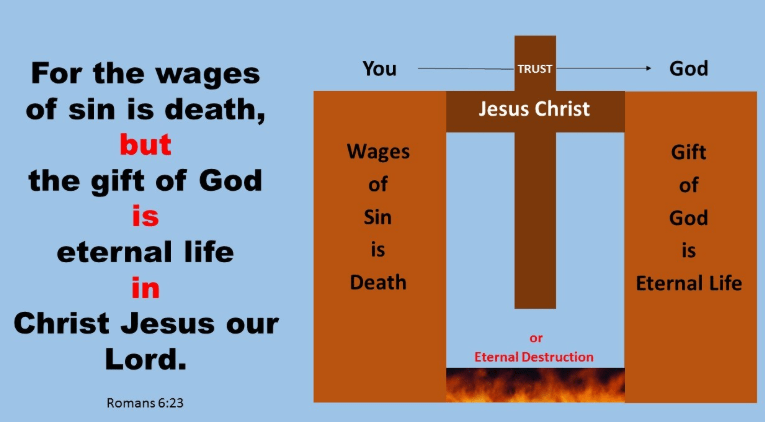
6:20 For when you were slaves of sin, you were free in regard to righteousness. 21 But what fruit were you getting at that time from the things of which you are now ashamed? For the end of those things is death. 22 But now that you have been set free from sin and have become slaves of God, the fruit you get leads to sanctification and its end, eternal life. 23 For the wages of sin is death, but the free gift of God is eternal life in Christ Jesus our Lord. (Romans 6:20 – 23 ESV)
In the previous lesson we looked at the three answers Paul gave to the question, “Are we to sin because we are not under law but under grace? We did not quite finish the third answer but will finish it in this lesson.
The “For” beginning 6:20 points back to where we left off in our discussion of the third answer. When we were unbelievers we were slaves of sin and free in regard to righteousness; it had no claim on you or was not a part of you. As unbelievers what kind of fruit was your life producing by the things you were doing, things you are now ashamed of, things that lead to death. As an unbeliever we do not abide in Jesus Christ and thus we are unable to produce fruit (John 15:4).
As a believer we are in Jesus Christ and have been set free from sin and now are salves of God and being in Christ we bear fruit that leads to our sanctification and its end, eternal life. In 1 Corinthians 7:22, Paul refers to our being slaves of God as being a bondservant of Christ, and as bondservants of Christ, we are doing the will of God from the heart (Ephesians 6:6).
We now come to another well-known verse found on the Romans road and used by many in sharing their faith. An example of the Romans road is found at this link . The cover photo is a diagram of Romans 6:23 I worked up for use in a Bible lesson one day. It can be easily sketched out on a napkin or a paper towel or a scrap piece of paper.
For emphasis you can lay the verse out using “but” “is” and “in” as separators for emphasis. The diagram has a “You” side and a “God” side, and in between is the means of going from the “wrong” side (left) to be on to the “right” side. Staying on the wrong side or death side, results in eternal destruction, but by putting your trust in Jesus Christ, you are provided a bridge to the God side and the gift of eternal life.
In Genesis 2:17, God instructed Adam not to “eat from the tree of the knowledge of good and evil, for when you eat from it you will certainly die.” Breaking that law would lead to death for Adam and through imputation would infect all future humans. All would be born spiritually dead and would eventually die physically, but God intervened and through the death and resurrection of his Son Jesus Christ provided the means of salvation (Ephesians 2:1 – 9). That salvation provides spiritual birth and the gift of eternal life for those who trust in Jesus Christ.
There is a poem I heard some 55 years ago that I have never forgotten. It is titled “The Bridge Builder” by Will Allen Dromgoole and can be found at this link . The bridge in the poem reminds me of the bridge Jesus built for us and is a reminder to me to be like the old man. Below is a copy of that poem.
An old man going a lone highway,
Came, at the evening cold and gray,
To a chasm vast and deep and wide.
Through which was flowing a sullen tide.
The old man crossed in the twilight dim,
The sullen stream had no fear for him;
But he turned when safe on the other side
And built a bridge to span the tide.
“Old man,” said a fellow pilgrim near,
“You are wasting your strength with building here;
Your journey will end with the ending day,
You never again will pass this way;
You’ve crossed the chasm, deep and wide,
Why build this bridge at evening tide?”
The builder lifted his old gray head;
“Good friend, in the path I have come,” he said,
“There followed after me to-day
A youth whose feet must pass this way.
This chasm that has been as naught to me.
To that fair-haired youth may a pitfall be;
He, too, must cross in the twilight dim;
Good friend, I am building this bridge for him!”
Questions with Answers
1. What question does Paul address at the beginning of Romans 6, and why is it important?
Answer:
Paul begins Romans 6 by addressing a misunderstanding about grace: “Are we to continue in sin that grace may abound?” (Romans 6:1). Some might wrongly conclude that since God forgives sin through His grace, believers are free to continue living sinful lives. Paul strongly rejects this idea with the response, “By no means!” (Romans 6:2).
The importance of this question is that it clarifies the relationship between salvation and obedience. Grace does not give believers permission to sin; instead, grace transforms the believer’s relationship with sin. Those who have received Christ have entered into a new life where sin no longer has the same authority or control. Salvation is not merely forgiveness from past sins—it is a spiritual transformation that leads to a changed life.
2. What does Paul mean when he says believers have “died to sin”?
Answer:
When Paul says, “We have died to sin” (Romans 6:2), he is describing the believer’s new identity through union with Christ. This does not mean Christians never commit sinful acts or experience temptation. Rather, it means that sin is no longer the ruling power over their lives.
Through faith in Christ, believers are united with Jesus in His death. Just as Christ died and broke the power of death, believers have died to their former life controlled by sin. The old self, which was enslaved to sinful desires, has been crucified with Christ. The believer now has the ability, through the Holy Spirit, to resist sin and live according to God’s will.
3. How does baptism illustrate the believer’s relationship with Christ?
Answer:
Paul explains that believers who are baptized into Christ Jesus are baptized into His death (Romans 6:3-4). Baptism symbolizes the believer’s identification with Christ’s death, burial, and resurrection.
Going under the water represents being buried with Christ—the old sinful way of life has been put to death. Rising from the water represents being raised to a new life empowered by Christ’s resurrection. Baptism does not merely represent a religious ceremony; it pictures a profound spiritual reality: those who belong to Christ have been given a new beginning.
The purpose of this new life is that believers “might walk in newness of life” (Romans 6:4). Christianity is not simply about receiving forgiveness; it is about becoming a new person who lives differently because of Christ.
4. What does Paul mean by saying the believer’s “old self was crucified with Him”?
Answer:
Paul writes, “We know that our old self was crucified with him in order that the body of sin might be brought to nothing” (Romans 6:6). The “old self” refers to the person we were before Christ—the person dominated by sin and separated from God.
Through Christ’s death, the believer’s former identity has been broken. Sin may still tempt and influence, but it no longer owns the believer. The purpose of this transformation is that believers would no longer be enslaved to sin.
Paul is teaching that salvation involves both a change in position and a change in practice. God declares believers righteous through Christ, and He also begins the process of making them increasingly righteous in their daily lives.
5. Why does Paul say, “Consider yourselves dead to sin and alive to God”?
Answer:
Romans 6:11 says, “So you also must consider yourselves dead to sin and alive to God in Christ Jesus.” The word “consider” means to recognize, believe, or count something as true.
Paul is calling believers to understand and embrace their new identity. They are no longer defined by their past failures, sinful desires, or old patterns of life. Because they belong to Christ, they should see themselves as people who have been freed from sin’s control and who now live for God.
This is a matter of faith and daily decision. Believers must continually remind themselves that sin is no longer their master and that Christ is now their Lord.
6. How can believers prevent sin from ruling over them?
Answer:
Paul commands believers, “Let not sin therefore reign in your mortal body, to make you obey its passions” (Romans 6:12). While sin remains a present reality, believers are no longer powerless against it.
To prevent sin from ruling, believers must:
- Recognize their new identity in Christ.
- Refuse to surrender their bodies and desires to sinful practices.
- Present themselves to God as instruments of righteousness.
- Depend on the Holy Spirit for strength and guidance.
Paul emphasizes that victory over sin is not achieved through human effort alone but through the power of God working within those who belong to Christ.
7. What does Paul mean when he says believers should present themselves as “instruments of righteousness”?
Answer:
Romans 6:13 says, “Present yourselves to God as those who have been brought from death to life, and your members to God as instruments for righteousness.”
The word “instruments” can refer to tools or weapons. Paul is saying that every part of a believer’s life—thoughts, words, actions, abilities, and resources—should be placed under God’s control.
Before salvation, people presented themselves to sin and selfish desires. After salvation, they are called to offer themselves to God for His purposes. A transformed life is one where God uses the believer as a means of displaying His righteousness in the world.
8. What does Paul mean when he says believers are “not under law but under grace”?
Answer:
Romans 6:14 says, “For sin will have no dominion over you, since you are not under law but under grace.”
Being under the law means being under a system where people attempt to achieve righteousness through obedience to commands but are unable to overcome sin’s power. The law reveals sin but does not provide the power to defeat it.
Being under grace means that believers are saved by God’s undeserved favor through Christ and are empowered by the Holy Spirit to live differently. Grace does not weaken obedience; it creates the desire and ability to obey God from a transformed heart.
9. How does Paul explain the difference between being slaves to sin and slaves to righteousness?
Answer:
Paul uses the image of slavery to describe human devotion and obedience. Before Christ, people were enslaved to sin, meaning sin controlled their desires, decisions, and actions. However, through Christ, believers have been set free from sin’s authority and have become servants of righteousness.
Paul explains that everyone serves something. There is no true neutrality. A person either gives themselves to sin, which leads to death, or to obedience to God, which leads to righteousness.
The difference is that slavery to sin produces shame and death, while service to God produces holiness and eternal life.
10. Why does Paul say the outcome of sin is death, but the gift of God is eternal life?
Answer:
Romans 6:23 summarizes the entire chapter: “For the wages of sin is death, but the free gift of God is eternal life in Christ Jesus our Lord.”
Sin earns a payment, and that payment is death—spiritual separation from God and ultimately eternal judgment. Death is not something God arbitrarily imposes; it is the natural consequence of rebellion against the source of life.
In contrast, eternal life is not something people earn. It is a gift from God received through Jesus Christ. While sin pays wages, God gives grace. This verse captures the central message of the gospel: humanity’s greatest need is answered not by human achievement but by God’s saving work through Christ.
Summary Understanding of Romans 6
Romans 6 teaches that salvation through Jesus Christ brings a complete change in identity. Believers are united with Christ in His death and resurrection, freeing them from sin’s authority and enabling them to live a new life devoted to God. Grace is not a license to continue in sin; it is the power that transforms people from slaves of sin into servants of righteousness. The believer’s calling is to recognize their new identity, resist sin’s rule, and offer their entire life to God for His purposes.
Chapter 7 – The Struggle with Sin and the Law
Chapter Index
Chapter Introduction
Romans 7 explains the believer’s relationship to the Law and the ongoing struggle with sin. Building on the truths of justification by faith (Romans 1–5) and the believer’s union with Christ (Romans 6), Paul demonstrates that Christians have died to the Law through the body of Christ so that they may belong to Him and bear fruit for God. The Law itself is holy, righteous, and good, but it cannot save or sanctify because it exposes sin rather than removing it. Paul vividly describes the inner conflict between the desire to obey God and the power of the sinful nature, revealing humanity’s inability to achieve righteousness through personal effort. The chapter reaches its climax with Paul’s cry for deliverance, pointing readers away from self-reliance and toward the victory that comes only through Jesus Christ. Romans 7 prepares the way for the triumphant message of Romans 8, where Paul reveals the power of the Holy Spirit to accomplish what the Law could never do.
Bible Lessons
7.1 Romans 7:1-3, The Marriage Illustration
7:1 Or do you not know, brothers—for I am speaking to those who know the law—that the law is binding on a person only as long as he lives? 2 For a married woman is bound by law to her husband while he lives, but if her husband dies she is released from the law of marriage. 3 Accordingly, she will be called an adulteress if she lives with another man while her husband is alive. But if her husband dies, she is free from that law, and if she marries another man she is not an adulteress. (Romans 7:1 – 3 ESV)
We ended the previous lesson with a link to the Roman’s road and a favorite poem of mine, titled, “The Bridge Builder” by Will Allen Dromgoole. Those links were prompted by Romans 6:23 ESV: “For the wages of sin is death, but the free gift of God is eternal life in Christ Jesus our Lord.” With this lesson we begin a new section about being released from the law.
“Or do you not know, brothers” suggest an alternative to something that was said in the proceeding chapter. The alternative draws a parallel to marriage and makes a connection with 6:14 – 15 where Paul states that as believers we are not under the law because we have died with Jesus Christ. So, how does this draw a parallel with marriage?
In Genesis 1:28, God said to the couple he just created in his own image, “Be fruitful and multiply and fill the earth and subdue it.” A man and a woman marry and the natural result is to produce children as a means of propagating the race. There is to be a similar aim in the spiritual life in which we have established a relationship with God as the Bride of Christ. That spiritual life begins with a courtship that is carried on by the Spirit as seen in 2 Corinthians 11:2 ESV: “For I feel a divine jealousy for you, since I betrothed you to one husband, to present you as a pure virgin to Christ.” That courtship extends into marriage as seen in Romans 7:4 ESV: “Likewise, my brothers, you also have died to the law through the body of Christ, so that you may belong to another, to him who has been raised from the dead, in order that we may bear fruit for God.” That marriage relationship between the believer and Jesus Christ is to bear fruit for God is the form of spiritual offspring (Romans 7:4).
As long as the husband or wife lives they are bound to each other. Paul points out that those who know the law, which here refers to the Mosaic law that God gave to Moses on Mount Sinai, knows that the law is binding on them as long as they live, just as “a married woman is bound by law to her husband while he lives, but if her husband dies she is released from the law of marriage.” Paul is drawing a connection between the man in the marriage who ages and dies and the unsaved man under the law. When the unsaved man dies he is free from the binding of the law. Going back to Romans 6:6 (ESV), Paul said, “We know that our old self was crucified with him in order that the body of sin might be brought to nothing, so that we would no longer be enslaved to sin.” When we are crucified with Jesus Christ, the old self is considered dead and thus is no longer bound by the law and are no longer slaves to sin.
Going back to the marriage, if the woman goes and live with another man while her husband is still alive, she is called an adulteress. “But if her husband dies, she is free, and if she marries another man she is not an adulteress.” Now consider the marriage of the believer with Jesus Christ. Being dead to the law we are free to be joined to Jesus Christ and enjoy living under grace, but it we go back and live as the man under the law, then we are considered an adulteress.
Let us try to make this clearer by looking at Galatians 2:20 ESV: “I have been crucified with Christ. It is no longer I who live, but Christ who lives in me. And the life I now live in the flesh I live by faith in the Son of God, who loved me and gave himself for me.” The “she” of 7:1 is the believer or the “I” of Galatians 2:20 who was crucified. Having died to the law (being crucified with Christ) “she” is free to have a relationship with grace and is now bound by the law of grace. If “she” (the believer) goes back to the law, “she” is considered an adulteress.
7.2 Romans 7:4-6, Released from the Law
7:4 Likewise, my brothers, you also have died to the law through the body of Christ, so that you may belong to another, to him who has been raised from the dead, in order that we may bear fruit for God. 5 For while we were living in the flesh, our sinful passions, aroused by the law, were at work in our members to bear fruit for death. 6 But now we are released from the law, having died to that which held us captive, so that we serve in the new way of the Spirit and not in the old way of the written code. (Romans 7:4 – 6 ESV)
In the previous lesson we looked at an illustration that drew a parallel with marriage and ones relationship between law and grace. In a marriage a man and woman are bound under the law until one dies. The unbeliever is bound to the law until death or is crucified with Jesus Christ by faith. Having died with Jesus Christ, the unbeliever now as a believer is free of the law and is in relationship with Jesus Christ and is bound to the law of grace. In this lesson, Paul applies the marriage illustration of the previous lesson.
In the illustration Paul gave in 7:1 – 3 of the husband dying, thus freeing the wife to marry another (7:2 – 3), he now applies that principle here in 7:4 – 6, in which the believer dies to the law through being crucified with Jesus Christ and is free to now be bound to the law of grace. As believers we “have died to the law through the body of Christ, so that [we] may belong to another.” The “another” takes on two form through the illustration. In one sense it is the law of grace verses the Mosaic law, and in another sense it is the person of Jesus Christ who represents grace. Having died with Christ and been raised with him, we now belong to him and are bound to the law of grace.
The purpose of the marriage relationship, whether it be physical or spiritual, is to produce offspring. In Genesis 1:28, God told Adam and Eve to “Be fruitful and multiply and fill the earth.” God told Abraham that he would multiply his “offspring” as the stars of heaven (Genesis 22:17). God made a promise to David that he would raise up his “offspring” to establish a kingdom (2 Samuel 7:12). Then finally from Abraham through David we come to Jesus Christ the “offspring” from which will come many spiritually born who will populate the kingdom of God. That population is the fruit we are to bear for God in our relationship with Jesus Christ.
In 7:5, Paul returns to his illustration at the time when we were unbelievers, living in the flesh, living out our sinful passions. Being under the law, which had no ability to help us, it simply made it clear that we were bearing fruit, not for righteousness, but for death. But, in 7:6, as believers, we are released from the law through being crucified with Jesus Christ, so that we can “serve in the new way of the Spirit and not in the old way of the written code.”
When living in the flesh, we were passionate about living our sin as we were a slave of sin under the law. Now that we are free of that master, we are bound to another master and became a slave of righteousness under the law of grace, the written code of the gospel. Since our spiritual birth took place within this body of flesh, it became clear very quickly that our flesh was not happy about the new spiritual person living within. Until death the flesh will be tempted to sin while the spirit will desire righteousness. In future lessons Paul will address that conflict.
7.3 Romans 7:7-12, The Law Is Not Sin but Is Holy
7:7 What then shall we say? That the law is sin? By no means! Yet if it had not been for the law, I would not have known sin. For I would not have known what it is to covet if the law had not said, “You shall not covet.” 8 But sin, seizing an opportunity through the commandment, produced in me all kinds of covetousness. For apart from the law, sin lies dead. 9 I was once alive apart from the law, but when the commandment came, sin came alive and I died. 10 The very commandment that promised life proved to be death to me. 11 For sin, seizing an opportunity through the commandment, deceived me and through it killed me. 12 So the law is holy, and the commandment is holy and righteous and good. Romans 7:7 – 12 ESV)
In the previous lesson we came to realize that being released from the law of sin and death and transferred to the law of righteousness and life came with a problem. When we were crucified with Christ our flesh continued to live and in it a new creature in Christ was formed. Bringing spiritual life into sinful flesh and not into a resurrected body will result in tension over who is in control. Paul will have this tension in mind as we work our way to the end of chapter 8.
In Romans 6:1 – 14, Paul pointed out that believers died to sin in the death of Jesus Christ, and then in Romans 7:1 – 6, he pointed out that we died to the Mosaic law and thus were released from it. If we died to sin and also died to the law, then might some conclude that the law is sin? In 7:7, Paul answers such a possible conclusion with a definite answer: “By no means!”
The law was given to expose sin and with it comes our sinful nature. One could understand that breaking the law was sin, but to understand that we have a sinful nature that desires to rebel against the law and sin is a more difficult matter to comprehend and would have to come by way of experience. Paul then gives an example of the tenth commandment: “You shall not covet” (Exodus 20:17). Maybe one thinks it is natural to desire something that belongs to another, but when that one reads in the law, “You shall not covet” then that one realizes, to covet is sin. That realization often stimulates a negative reaction. For example, when a child is told not to touch something, that makes the child aware of that something and is then determined to touch it when given a chance.
In 7:8, Paul said that when he knew he should not covet, sin looked for an opportunity, as a result of knowing the law, to covet. In fact, it produced all kinds of covetousness. Before the law, sin lies dead. Because of our fallen nature, when sin sees the law it goes wild and hurries into rebellion and wickedness. “For while we were living in the flesh, our sinful passions, aroused by the law, were at work in our members to bear fruit for death.” (7:5).
Before I became a believer I was physically alive and went about life unaware of my sin because it was not yet active within me, as I was not yet convicted as a sinner and was without remorse, enjoying my unbelieving life. But then one day through a Christian film, the law was made known to me, and that which was inactive in me became active, and I realized that I was dead in my sin, that I was spiritually dead. Before the law, death was already in me, but the law produced a consciousness of that death. At that awareness sin became alive in me and I died.
The commandment that was to produce life, simply made me aware of my spiritual death. Knowing the law, sin seized the opportunity through the commandment, to deceive me, and instead of providing life it killed me. The law cannot pardon my sin, it can only curse and condemn me, for, “Cursed be everyone who does not abide by all things written in the Book of the Law and do them.” (Galatians 3:10 ESV). I found that instead of the law removing my sin, it stirred it up and exasperated it.
Looking back to 7:7 we see the question, “Is the law sin?” In 7:12, Paul answers by saying, “the law is holy, and the commandment is holy and righteous and good.” The law is not sin. It simply reveals that man in a sinner. The law is holy in that it reflects God’s standard and points out our sin or lack of righteousness before God.
7.4 Romans 7:13-15, The Struggle between the Law of Sin and the Law of God
7:13 Did that which is good, then, bring death to me? By no means! It was sin, producing death in me through what is good, in order that sin might be shown to be sin, and through the commandment might become sinful beyond measure. 14 For we know that the law is spiritual, but I am of the flesh, sold under sin. 15 For I do not understand my own actions. For I do not do what I want, but I do the very thing I hate. 16 Now if I do what I do not want, I agree with the law, that it is good. 17 So now it is no longer I who do it, but sin that dwells within me. 18 For I know that nothing good dwells in me, that is, in my flesh. For I have the desire to do what is right, but not the ability to carry it out. 19 For I do not do the good I want, but the evil I do not want is what I keep on doing. 20 Now if I do what I do not want, it is no longer I who do it, but sin that dwells within me.
7:21 So I find it to be a law that when I want to do right, evil lies close at hand. 22 For I delight in the law of God, in my inner being, 23 but I see in my members another law waging war against the law of my mind and making me captive to the law of sin that dwells in my members. 24 Wretched man that I am! Who will deliver me from this body of death? 25 Thanks be to God through Jesus Christ our Lord! So then, I myself serve the law of God with my mind, but with my flesh I serve the law of sin. (Romans 7:13 – 25 ESV)
In the previous lesson, Paul presented a question and then proceeded to answer it. The question: “Was the law sin?” He then demonstrated that the sin was with us and then states his answer to the question. The answer: “The law is holy.” As in the previous lesson, we begin this lesson with another question and seek to answer it.
Since the law was not sin and was instead holy, then the question about that which was good producing death. Was the holy law causing our death? Paul answers this question with the same answer he first gave: “By no means!” It was not the law that was producing death, it was our sin.
Before we go any further we need to bring clarity to the state of the person we are talking about. Is the person unsaved or saved? Some say, unsaved, but I side with those who say the person is saved. In past lessons we have progressed through the doctrine of sin and justification to the doctrine of sanctification. Therefore, this section would relate to the believer’s experience, which is supported by 7:18, in which Paul says, “For I have the desire to do what is right, but not the ability to carry it out.” The unsaved does not have the desire to do what is right because they are enslaved to sin. What we have before us in 7:13 – 25, is a picture of a believer who is struggling between the law of sin and the law of God.
Before we look at the details of 7:14 – 25, we need to see an overall picture. Notice that verse 17 and 20 end with the same statement: “but sin that dwells within me.” That essentially divided 7:14 – 20 into two parts: 7:14 – 17 and 7:18 – 20. Verses 21 – 25 then relate to these two parts. Notice a similar condition in the three parts. Verses 14, 18, and 21 relate to a condition of the flesh and the power of sin over it. Verses 15 – 16, 19, and 22 – 23 expresses a conflict that rages within a saved person between doing that which is right and ending up doing what is wrong. Verses 17, 20, and 25 end each section with the reason for failure. It is because of sin that dwells within that we serve.
Looking at 7:14 – 17, we see that a believer of his own strength does not have the ability to stand against the power of sin that dwells within. Even though the law is holy and is spiritual and is good, and one has the desire to do what is right, it is not possible because that one is of the flesh sold under sin. There has to be a resource from outside the person that is to come in to tip the balance in favor of doing what is desired and is right.
Looking at 7:18 – 20, things get worse for the believer now confesses that nothing good dwells within and goes so far to say that when desiring to do good, evil is done instead.
In both of these two sections, one gets the impression of a divided person. Clearly there is the desire to do good but there is present a force that overrides the desire and results in evil being done.
Looking at 7:21 – 25, things begin to improve by recognizing there are two laws at work. There is the law that resides in the flesh and when the desire to do good surfaces, it rises to the occasion with evil close at hand. Since the believer has been born again there is a new creature, an “inner being” that dwells within this body of flesh. In that inner being is found the “law of God” or the “law of the mind” in 7:23.
Paul speaks of “another law” that wages war against the law of his mind. There are just two laws in view here: (1) the law of sin or the “another law” and (2) the law of God or the “law of the mind.” Recognizing these two laws and the power of the law of sin that dwell in his body of flesh, Paul confesses his wretched condition and asks who can deliver him from the body of death that holds him prisoner. He then realizes that God can through the person of Jesus Christ our Lord.
So far in this passage, that deliverance has not been realized, so until it is, Paul realizes that he faces a struggle. For with his mind, he will serve the law of God and with his flesh he will serve the law of sin. Then in the next lesson the Spirit enters the picture and things begin to brighten up.
Questions with Answers
1. What illustration does Paul use in Romans 7:1–6 to explain the believer’s relationship to the Law?
Answer:
Paul uses the illustration of marriage and death to explain that believers have been released from their former relationship to the Law through their union with Christ. A married woman is bound to her husband as long as he lives, but if he dies, she is free to marry another. In the same way, believers have “died” to the Law through the death of Christ so that they may belong to Christ and bear fruit for God.
Paul is not saying that God’s Law was sinful or worthless. Rather, he explains that the Law revealed sin but could not provide the power to overcome sin. Through Christ, believers are no longer seeking righteousness through obedience to the Law but now live in the new life of the Spirit.
Key Understanding:
The Law exposes sin, but Christ provides freedom from sin’s condemnation and power.
2. Why does Paul say believers have died to the Law through Christ?
Answer:
Paul explains that believers died to the Law so they could belong to Christ and serve God in a new way. Before faith in Christ, people were under the authority of the Law and were condemned because they could not perfectly obey it. Through Christ’s death, believers are released from that old relationship and are now united with the risen Christ.
Paul contrasts two ways of living:
- The old way: Trying to obey God through external rules and human effort.
- The new way: Serving God through the transforming power of the Holy Spirit.
This does not mean Christians are free to ignore God’s commands. Instead, they now obey from a changed heart rather than from obligation alone.
Key Understanding:
Christ does not remove God’s standards; He changes the believer’s heart so obedience flows from love and the Spirit.
3. What role does the Law play according to Romans 7:7–13?
Answer:
Paul teaches that the Law itself is holy, righteous, and good. The problem is not the Law; the problem is human sinfulness. The Law reveals what sin is by showing God’s righteous standards. Paul uses the example of coveting: without the commandment against coveting, he would not have understood the seriousness of that desire.
However, sin uses the commandment as an opportunity to produce rebellion. Human nature often responds to restrictions by wanting what is forbidden. The Law reveals sin but does not have the power to remove sin.
Paul’s point is that the Law serves an important purpose: it exposes humanity’s need for salvation.
Key Understanding:
The Law is like a mirror—it shows the problem but cannot fix the person looking into it.
4. What does Paul mean when he says, “I do not do the good I want, but the evil I do not want is what I keep on doing” (Romans 7:19)?
Answer:
Paul describes the inner conflict experienced by a person who desires to please God but struggles against the power of sin. He recognizes that knowing what is right does not automatically give him the ability to do it.
This passage reveals the reality of spiritual struggle. Even believers who love God can experience tension between their desire to obey God and the remaining influence of sinful nature.
Paul is not describing a person who does not care about righteousness. Rather, he describes someone who deeply desires holiness but recognizes that human effort alone cannot overcome sin.
Key Understanding:
The Christian life includes a battle between the desire to honor God and the continuing presence of sin.
5. What does Paul mean by “sin that dwells in me” (Romans 7:17, 20)?
Answer:
Paul is describing the presence of sin within human nature. Even after salvation, believers still live in a fallen world and continue to experience temptation and weakness. Sin is not merely an outside influence; it affects human thoughts, desires, and actions.
Paul does not excuse sinful behavior by saying, “Sin made me do it.” Instead, he acknowledges the seriousness of sin’s power and the need for God’s grace.
This truth prepares the way for Romans 8, where Paul explains that the Holy Spirit provides the power to live victoriously over sin.
Key Understanding:
Believers are saved from sin’s penalty immediately, but the struggle against sin’s influence continues throughout life.
6. What internal conflict does Paul describe in Romans 7:21–23?
Answer:
Paul describes a conflict between his desire to obey God’s Law and the sinful tendencies that remain within him. He says he delights in God’s Law “in my inner being,” but he sees another force at work that opposes his desire to obey.
This conflict shows that spiritual growth is not automatic or effortless. A believer may love God sincerely while still facing struggles with temptation, selfishness, pride, anger, or other sins.
The Christian life is not a life without struggle; it is a life where the believer learns dependence upon God’s power.
Key Understanding:
Spiritual maturity is not measured by the absence of struggle but by increasing dependence on Christ.
7. Why does Paul cry out, “Wretched man that I am! Who will deliver me from this body of death?” (Romans 7:24)?
Answer:
Paul’s cry expresses his recognition that human effort cannot rescue him from the power of sin. After describing his struggle, he realizes that the answer cannot come from himself. He needs a Deliverer.
The phrase “body of death” points to the reality of human weakness and the effects of sin that remain until believers receive final redemption. Paul’s question leads immediately to the answer: Jesus Christ.
Paul is not left hopeless. His despair turns into thanksgiving because God has provided salvation through Christ.
Key Understanding:
The answer to the struggle with sin is not greater human effort but the saving power of Jesus Christ.
8. How does Paul answer his own question about deliverance from sin?
Answer:
Paul answers, “Thanks be to God through Jesus Christ our Lord!” (Romans 7:25). Jesus is the One who delivers believers from sin’s power and condemnation.
Paul acknowledges the ongoing struggle: with his mind he desires to serve God, but his flesh continues to struggle with sin. This tension is resolved more fully in Romans 8, where Paul explains the Spirit’s role in empowering believers.
The Christian life is not based on personal strength but on the victory accomplished through Christ.
Key Understanding:
Victory over sin comes through Christ, not through human determination alone.
9. Is Romans 7 describing Paul before becoming a Christian or his experience as a believer?
Answer:
Christians have discussed this question for centuries. Some believe Paul is describing his life before Christ because he speaks about being under the Law and unable to overcome sin. Others believe he is describing the ongoing struggle of a believer because he delights in God’s Law and desires to do what is right.
A balanced understanding recognizes that Romans 7 describes the universal human struggle with sin and prepares the reader for the victory described in Romans 8. Whether focusing on Paul before or after conversion, the central message remains the same: human effort cannot defeat sin; only God’s grace through Christ can.
Key Understanding:
Romans 7 reveals the struggle; Romans 8 reveals the Spirit-powered victory.
10. What are the major lessons believers should learn from Romans 7?
Answer:
Romans 7 teaches several important truths:
- The Law reveals sin but cannot save.
God’s commands show His holiness and expose human failure. - Sin is powerful and affects every person.
Even those who desire to obey God experience spiritual conflict. - Human effort alone is insufficient.
Determination and knowledge cannot overcome sin’s power. - Believers need Christ every day.
Salvation is not only about forgiveness of past sins but also dependence on Christ for present victory. - The Holy Spirit provides the power for transformation.
Romans 7 leads naturally into Romans 8, where life in the Spirit is explained.
Key Understanding:
Romans 7 teaches humility: we cannot conquer sin by ourselves; we must continually rely on Jesus Christ.
Summary Theme of Romans 7:
“The struggle with sin reveals our need for the saving power of Jesus Christ.”
Summary Paragraph:
Romans 7 explains the believer’s relationship to the Law, the purpose of God’s commandments, and the ongoing struggle with sin. Paul shows that the Law is holy because it reveals God’s standards, but it cannot provide the power needed to overcome sin. The human heart desires righteousness yet struggles against sinful desires. Paul’s cry for deliverance points to the central truth of the chapter: victory does not come through human effort but through Jesus Christ. Romans 7 prepares believers to understand the Spirit-filled life described in Romans 8.
Chapter 8 – Life in the Spirit and Assurance
Chapter Index
- Chapter Introduction
- Bible Lessons
- 8.1 Romans 8:1, Now No Condemnation
- 8.2 Romans 8:2-4, Two Reasons for Not Being Condemned
- 8.3 Romans 8:5-8, What Do We Live According To?
- 8.4 Romans 8:9-11, Does the Spirit of God Dwell in You?
- 8.5 Romans 8:12-17, Three Reasons to Live According to the Spirit
- 8.6 Romans 8:18-22, The Groaning of Creation
- 8.7 Romans 8:23-25, The Groaning of God’s People
- 8.8 Romans 8:26-28, The Groaning of the Spirit
- 8.9 Romans 8:28-30, Foreknowledge
- 8.10 Romans 8:29-30, Predestined
- 8.11 Romans 8:30, Called, Justified, and Glorified
- 8.12 Romans 8:31-32, God Is for Us
- 8.13 Romans 8:33-35, Who Is Able to Bring Charges Against Us
- 8.14 Romans 8:36-39, Conquerors Through Jesus Christ
- Chapter Questions
Chapter Introduction
Romans 8 stands as one of the most encouraging and triumphant chapters in all of Scripture, revealing the fullness of the believer’s life in Christ through the power of the Holy Spirit. After describing humanity’s struggle with sin in the previous chapter, the Apostle Paul now proclaims the glorious truth that there is “no condemnation” for those who belong to Christ Jesus. The chapter explains how the Holy Spirit empowers believers to live victoriously, assures them of their identity as God’s children, and strengthens them through suffering while they await the complete redemption of creation. Paul also emphasizes God’s sovereign purpose in conforming His people to the image of Christ and concludes with one of the Bible’s greatest declarations of assurance, affirming that nothing can separate believers from the love of God in Christ Jesus. Romans 8 is therefore a chapter of hope, confidence, and eternal security, inviting Christians to live by the Spirit, rest in God’s promises, and rejoice in the certainty of His unfailing love.
Bible Lessons
8.1 Romans 8:1, Now No Condemnation
8:1 There is therefore now no condemnation for those who are in Christ Jesus. (Romans 8:1 ESV)
The previous lesson was rather long because so many verses went together as a unit. With that lesson we finished the section on law and sin. With this lesson things brighten up in our struggle between the law sin and the law of God as the Spirit shows up and provides the help we need to overcome the law of sin and properly respond to the law of God.
Chapter 8 begins with “There is therefore now” with the “therefore now” indicating an important summary and conclusion to previous material. Using the footnote for 8:1 of the ESV Study Bible as a guide, we will try to adequately indicate what the summary and conclusion pertains to.
Going back to the previous lesson we will begin by looking at 7:23 – 25 ESV: “23 but I see in my members another law waging war against the law of my mind and making me captive to the law of sin that dwells in my members. 24 Wretched man that I am! Who will deliver me from this body of death? 25 Thanks be to God through Jesus Christ our Lord! So then, I myself serve the law of God with my mind, but with my flesh I serve the law of sin.” The “therefore” points to “Jesus Christ our Lord” who will provide us with victory over the condemnation of the law of sin that has enslaved us.
We need to look back further to 7:6 ESV: “But now we are released from the law, having died to that which held us captive, so that we serve in the new way of the Spirit and not in the old way of the written code.” It was the law that held us captive and only through death can we find release. That death comes by faith in being crucified with Jesus Christ. Being released from the law through death, the opportunity to “serve in the new way of the Spirit” becomes an option.
But to “serve in the new way of the Spirit” seems to point back a larger body of material that started with 3:21 in which “the righteousness of God has been manifested apart from the law” and extends through 5:21. That section of material opens with 3:21 – 30 developing the concept of the righteousness of God coming through faith. Then in chapter 4, Abraham is used as an example of “justification by faith.” God had promised he and Sarah a child through whom would come many nations, but there was a very big problem. Both Abraham and Sarah were well beyond the age to have children, but by faith Abraham clung to the promise and “grew strong in his faith as he gave glory to God” (4:20 ESV). This faith was counted to him as righteousness (4:22). “Having been justified by faith, [he and] we have peace with God through our Lord Jesus Christ (5:1 ESV). Sin that causes us so many problems came into being through one man, Adam, and infected all mankind, but through one man, Jesus Christ, comes the free gift of righteousness by grace (5:17).
This brings us back to the “now” of 8:1 and its connection to the “now” of 7:6. There is “now no condemnation for those who are in Christ Jesus” (8:1) because we are “now released form the law, having died to that which held us captive (7:6). Because of what Jesus Christ did, we are now justified before God, or are in right standing before him and are united with Jesus Christ.
The “no condemnation” of 8:1 echoes the conclusion stated in 5:1 ESV: “Therefore . . . we have peace with God through our Lord Jesus Christ.” However, this statement points back to 1:16 – 17 ESV: “For I am not ashamed of the gospel, for it is the power of God for salvation to everyone who believes, to the Jew first and also to the Greek. For in it the righteousness of God is revealed from faith for faith, as it is written, ‘The righteous shall live by faith.’” which underscores the implications of the gospel. There is “no condemnation” for the believer because God has condemned sin in the flesh by sending his own Son (8:3) to pay the penalty for sin through his death on the cross.
8.2 Romans 8:2-4, Two Reasons for Not Being Condemned
8:2 For the law of the Spirit of life has set you free in Christ Jesus from the law of sin and death. 3 For God has done what the law, weakened by the flesh, could not do. By sending his own Son in the likeness of sinful flesh and for sin, he condemned sin in the flesh, 4 in order that the righteous requirement of the law might be fulfilled in us, who walk not according to the flesh but according to the Spirit. (Romans 8:2 – 4 ESV)
Having worked our way through the “therefore now” of 8:1 in the previous lesson, we are now ready, in this lesson, to consider life in the Spirit.
The “for” of 8:2 introduces us to the first reason there is “no condemnation” to those who are in Jesus Christ. “The first man Adam became a living being [but] the last Adam became a life-giving spirit” (1 Corinthians 15:45 ESV). Through faith in the death and resurrection of Jesus Christ, one is born again and receives the Spirit of life who sets us free from the law of sin and death. The growth in sanctification through the work of the Spirit in the life of the believer provides evidence of the “no condemnation” of 8:1. Our salvation, obtained through faith in Jesus Christ, provides us with deliverance from the penalty of sin (death), and from the power of sin in our daily life. It is this power from the Spirit that supports the “law of my mind” (7:23). He does what we are unable to do ourselves.
The “for” of 8:3 introduces us to the second reason there is “no condemnation” to those who are in Jesus Christ. It is because of the sacrificial work of Jesus Christ. His death on the cross to cover the penalty of sin provided us freedom from our sin, past, present, and future. This redemptive act provided the Spirit the opportunity to do his work in our sanctification. Because of the weakness of our flesh, we were unable to satisfy the law as Jesus Christ did, and because of the continued weakness of our flesh after redemption, we needed the infusion of power provided by the indwelling Spirit.
Through the death and resurrection of Jesus Christ, sin was condemned in the flesh (8:3), “in order that the righteous requirement of the law might be fulfilled in us, who walk not according to the flesh but according to the Spirit” (8:4). Jesus Christ removed the barrier sin produced, providing an opportunity for those who choose to walk not according to the desires of the flesh, but to walk according to the desires of the Spirit. That opportunity is for us to experience the righteous requirements of the law being fulfilled in us. “I have been crucified with Christ. It is no longer I who live, but Christ who lives in me. And the life I now live in the flesh I live by faith in the Son of God, who loved me and gave himself for me” (Galatians 2:20 ESV). This does not imply that we live sinless lives, but victorious lives.
Verse five begins with “for” as did verse 2 and 3, as will verses 6 and 7. This “for” provides a good break point to result in two short lessons instead of one long one.
8.3 Romans 8:5-8, What Do We Live According To?
8:5 For those who live according to the flesh set their minds on the things of the flesh, but those who live according to the Spirit set their minds on the things of the Spirit. 6 For to set the mind on the flesh is death, but to set the mind on the Spirit is life and peace. 7 For the mind that is set on the flesh is hostile to God, for it does not submit to God’s law; indeed, it cannot. 8 Those, who are in the flesh, cannot please God. (Romans 8:5 – 8 ESV)
In the previous lesson we considered two reasons for the “no condemned” of 8:1. In this lesson we will consider reasons for the believer to walk after the Spirit.
The “For” that begins 8:5, points back to the last phrase of 8:4: “who walk not according to the flesh but according to the Spirit.” Those who do walk or “live according to the flesh” set their minds on the things of the flesh and exist only for the flesh. This would then describe unbelievers. In contrast to this are believers who live according to the Spirit, who set their minds on the things of the Spirit and would be inclined to holiness. As an unbeliever your mind would be set on the things of the flesh and would in accordance with the desires of the flesh and would be inclined to unholiness.
Those who set their minds of the flesh will reap death, but those whose minds are set on the things of the Spirit will experience life and peace which are the effects of justification and sanctification that are at work within the believer.
The mind set on the flesh is “hostile to God” but friends with the world. “Whoever wishes to be a friend of the world makes himself an enemy of God” (James 4:4 ESV). Such a person “does not submit to God’s law” because he cannot (cf. Romans 3:10 – 12. “The natural person does not accept the things of the Spirit of God, for they are folly (or foreign) to him, and he is not able to understand them because they are spiritually discerned” (1 Corinthians 2:14 ESV). Without the Spirit to give understanding, the unsaved person is essentially a deaf person and is unable to hear the voice of God in the Word. Such a person who is “hostile to God” clearly “cannot please God” as they seek to please only themselves. Such a person does not have faith in God, “And without faith it is impossible to please him, for whoever would draw near to God must believe that he exists and that he rewards those who seek him.” (Hebrews 11:6 ESV). As long as your mind is set on the things of the flesh there is no opportunity to exercise faith. You can exercise faith only after the Spirit infuses you with new life in Jesus Christ, as 1 John 5:1 implies that belief follows being born of God. When a person dead in sin is given new life, that life in turn manifests itself in saving faith through the gospel.
8.4 Romans 8:9-11, Does the Spirit of God Dwell in You?
8:9 You, however, are not in the flesh but in the Spirit, if in fact the Spirit of God dwells in you. Anyone who does not have the Spirit of Christ does not belong to him. 10 But if Christ is in you, although the body is dead because of sin, the Spirit is life because of righteousness. 11 If the Spirit of him who raised Jesus from the dead dwells in you, he who raised Christ Jesus from the dead will also give life to your mortal bodies through his Spirit who dwells in you. (Romans 8:9 – 11 ESV)
In the previous lesson we considered those who are unsaved and live according to the flesh and have set their minds on the things of the flesh. They are hostile to God and will not submit to God’s law and will experience eternal death. In contrast to this, believers live according to the Spirit and have set their minds on the things of the Spirit and experience eternal life and peace. In this lesson we will look further at the importance of having the Spirit of God dwelling us.
Back in 7:24, Paul asked the question, “Wretched man that I am! Who will deliver me from this body of death?” In 8:9 – 11 that question is finally answered. That deliverance is obtained when the Spirit comes to indwell a person at the time of spiritual birth.
In 8:9, Paul directs his comment to believers and states that they are “not in the flesh but in the Spirit.” That is true only if the Spirit dwells in them, for if one does not have the Spirit that one does not belong to Jesus Christ. Notice that sometimes Paul says, “Spirit of God” and another time “Spirit of Christ.” That usage shows that Christ and God share the same status.
Evidence that you belong to Christ is possession of the Spirit, for without his presence a person is not a believer. At spiritual birth we become God’s temple (cf. 1 Corinthians 3:16; 6:19), a dwelling place for the Spirit. Paul often refers to this indwelling as “Christ in you.” In Galatians 2:20 is the same expression: “I have been crucified with Christ. It is no longer I who live, but Christ who lives in me. And the life I now live in the flesh I live by faith in the Son of God, who loved me and gave himself for me.” This can be somewhat confusing when saying both the Spirit and Christ are in us. Does this mean they are the same, that there is no difference between them as some ancient heresies suggest? No, they are unique persons but both God and the role they play in the life of the believer is different. Christ is in authority over us and the Spirit is our interface to that authority. Christ is in us in that his will is carried out through the Spirit who lives within us, kind of like our nervous system with Christ being our head.
Reference to “the body is dead because of sin” indicates that our physical bodies will one day die to be replace by new bodies at the resurrection. The presence of the Spirit within believers is a testimony of our new life we can enjoy because of the righteousness God has given to us who believe and are born again.
It was the power of the Spirit who raised Jesus Christ from the dead, and since he dwells is us, he will raise us from the dead and give life to our mortal bodies. At that time the power of indwelling sin and physical death is destroyed as the body is resurrected, completing our salvation. Yes, we are God’s children and when Christ appears, through the work and power of the Spirit, we shall be like him, because we shall see him as he is (1 John 3:2).
8.5 Romans 8:12-17, Three Reasons to Live According to the Spirit
8:12 So then, brothers, we are debtors, not to the flesh, to live according to the flesh. 13 For if you live according to the flesh you will die, but if by the Spirit you put to death the deeds of the body, you will live. 14 For all who are led by the Spirit of God are sons of God. 15 For you did not receive the spirit of slavery to fall back into fear, but you have received the Spirit of adoption as sons, by whom we cry, “Abba! Father!” 16 The Spirit himself bears witness with our spirit that we are children of God, 17 and if children, then heirs—heirs of God and fellow heirs with Christ, provided we suffer with him in order that we may also be glorified with him. (Romans 8:12 – 17 ESV)
With the previous lesson we completed the section about life in the Spirit. With this lesson we will cover a short section devoted to being heirs with Christ.
“So then” looks back to the statement “he who raised Christ Jesus from the dead will also give life to your mortal bodies through his Spirit who dwells in you” and then draws the conclusion that “we are debtors, not to the flesh, to live according to the flesh. There is no obligation to sin, only to live according to righteousness. Paul again states “For if you live according to the flesh you will die, but if by the Spirit and put to death the deeds of the body, you will live.” One who is a true believer will persevere in righteousness as the goal of his life, while the unbeliever will live in sin. A believer is not alone in his perseverance of righteousness, as the indwelling Spirit works to suppress and destroy the power of sin in one’s life. This leading of the Spirit of God validates that as believers we are sons of God.
The “For” that begins 8:15 provides evidence that we are sons of God. As sons of God, we do not have the spirit of slavery and thus fall back into fear. On the contrary, we received the Spirit of adoption as sons. When we received the Spirit at the time of being born again, we were adopted as sons, and as “sons, God has sent the Spirit of his Son into our hearts, crying, ‘Abba! Father!’” (Galatians 4:6 ESV).
8:12 – 13 suggest that we as believers have an obligation to the Spirit by reason of righteousness. 8:14 – 15 suggest the obligation is because of sonship. 8:16 – 17 now suggest a third reason, and that of inheritance. “The Spirit himself bears witness with our spirit that we are children of God.” The Spirit living in our hearts is a guarantee that we are God’s children (cf. 2 Corinthians 1:22; 5:5). As God’s children we are sealed with the promised Holy Spirit, “who is the guarantee of our inheritance until we acquire possession of it, to the praise of his glory.” (Ephesians 1:13 – 14).
If we are his children, then we are heirs, heirs of God and fellow heirs with Christ. Being heirs of God follows being sons of God, just as suffering is followed by glorification. To suffer for being a Christian is not very well understood in the west but is a daily experience for many in other parts of the world. Peter has an excellent comment about this, which I will quote as fitting way to end this lesson.
“Blessed be the God and Father of our Lord Jesus Christ! According to his great mercy, he has caused us to be born again to a living hope through the resurrection of Jesus Christ from the dead to an inheritance that is imperishable, undefiled, and unfading, kept in heaven for you, who by God’s power are being guarded through faith for a salvation ready to be revealed in the last time. In this you rejoice, though now for a little while, if necessary, you have been grieved by various trials, so that the tested genuineness of your faith—more precious than gold that perishes though it is tested by fire—may be found to result in praise and glory and honor at the revelation of Jesus Christ. Though you have not seen him, you love him. Though you do not now see him, you believe in him and rejoice with joy that is inexpressible and filled with glory, obtaining the outcome of your faith, the salvation of your souls.” (1 Peter 1:3 – 9 ESV).
8.6 Romans 8:18-22, The Groaning of Creation
8:18 For I consider that the sufferings of this present time are not worth comparing with the glory that is to be revealed to us. 19 For the creation waits with eager longing for the revealing of the sons of God. 20 For the creation was subjected to futility, not willingly, but because of him who subjected it, in hope 21 that the creation itself will be set free from its bondage to corruption and obtain the freedom of the glory of the children of God. 22 For we know that the whole creation has been groaning together in the pains of childbirth until now. (Romans 8:18 – 22 ESV)
With the previous lesson we covered a short section in which we looked at three reasons why we as believers are to live according to the Spirit. Those reasons are: (1) because of the gift of his righteousness, (2) because we have been adopted as sons of God, and (3) because we are heirs with Jesus Christ. With this lesson we begin a new section about our future glory as believers.
The “For” that begins 8:18 and this section, points back to the suffering and glory mentioned at the end of the last lesson. Paul now draws a relationship between the two. Having spent an extended length of time serving in Asia, I bring an understanding to 8:18 that greatly helps me understand what Paul is saying. Paul is thinking about his suffering resulting from serving Jesus Christ. I think about the suffering I witnessed and learned about while serving in Asia and how it can affect life in serious ways. Paul then thinks about the glory he will experience after his death and resurrection. Jesus suffered and died for us and as a result many in other cultures see it as an honor to suffer and even die to serve him. Considering his suffering, and then considering the hope of what is to come, Paul says there is no question as to which is the greatest. Suffering, even if it included torture and even death, lasts for a very short time when compared to the glory we will experience for an eternity in the presence of God.
Paul then looks at the first of three examples about groaning: (1) The groaning of creation (8:19 – 22), (2) the groaning of God’s children (8:23 – 25), and (3) the groaning of the Spirit (26 – 27).
(1) The groaning of creation – Paul treats creation as if it were a person in order to emphasize the wonder of the future glory of God’s sons. He speaks of creation eagerly waiting, longing for the revealing of the sons of God. What will that glory be like!
When Adam sinned, it not only affected him and all of future mankind, but the created world was also affected being subjected to futility. As I work to maintain my garden and lawns, I am constantly aware of that futility in the form of weeds and pests of various kinds. The weeds have greater endurance that the vegetables they try to overcome and the pests seem to ignore the weeds and feast on my tender plants (cf. Genesis 3:17 – 19). Creation longs to be set free from its bondage to corruption, as it is not free to produce all it was designed to produce and glorify God in the fullest possible way. It has been hindered from its full expression because of sin. When glory is revealed to the sons of God, creation will be restored to its original intent in glorifying God. To this day, the whole creation has been groaning as in the pain of childbirth and it longs for that birth to be complete.
Let us take a lesson break at this point and cover point 2 in the next lesson and point 3 in the one to follow that lesson.
8.7 Romans 8:23-25, The Groaning of God’s People
8:23 And not only the creation, but we ourselves, who have the firstfruits of the Spirit, groan inwardly as we wait eagerly for adoption as sons, the redemption of our bodies. 24 For in this hope we were saved. Now hope that is seen is not hope. For who hopes for what he sees? 25 But if we hope for what we do not see, we wait for it with patience. (Romans 8:23 – 25 ESV)
In the previous lesson it was pointed out that suffering was no match when compared to the glory that will be revealed to the sons of God. We also covered the first of three points related to groaning. In this lesson we will cover the second point.
(2) The groaning of God’s children – Just as creation looks ahead with longing to the time when it can fully glorify God as it was original designed to do, we as God’s people look ahead to the time when our bodies will be redeemed as they are raised from the dead and our salvation is complete. We now have the firstfruits of the Spirit which is a sample of what is yet to come. The fruit of the Spirit is love with it characteristics of “joy, peace, patience, kindness, goodness, faithfulness, gentleness, [and] self-control” (Galatians 5:22 – 23 ESV). These characteristics are available to us today to use in our relationships, but one day they will be a description of how we live by the Spirit.
This groaning goes on inwardly on a daily basis when I move about. How I long for that day when all suffering is eliminated, but for now I rejoice in my suffering with my brothers and sisters who suffer so greatly under persecution. They and I eagerly wait for that day when our adoption as sons is complete at the redemption of our bodies. As we suffer we can enjoy the fruit of the Spirit, but one day we will be able to fully enjoy life with the Spirit because then there will be no effects of sin to dilute it.
It is for this hope of being fully holy and righteous like God that we were saved. Concerning this hope, Paul says, “Now hope that is seen is not hope.” If you already have that which you really wanted, then there is nothing to hope for, but since we do not yet have our redeemed bodies and our salvation is not yet complete, we hope for the final product that we now do not see. When that day comes, hope will be replaced with sight and rejoicing, but in the meantime, we hope for what we do not see and we wait for it with patience.
This brings us to the end of our second kind of groaning. In the next lesson we will look at the third and last, which is the groaning of the Spirit.
8.8 Romans 8:26-28, The Groaning of the Spirit
8:26 Likewise the Spirit helps us in our weakness. For we do not know what to pray for as we ought, but the Spirit himself intercedes for us with groanings too deep for words. 27 And he who searches hearts knows what the mind of the Spirit is, because the Spirit intercedes for the saints according to the will of God. 28 And we know that for those who love God all things work together for good, for those who are called according to his purpose. (Romans 8:26 – 28 ESV)
In the previous lesson we covered the groaning of God’s people and in this lesson we will look at the groaning of the Spirit.
(3) The groaning of the Spirit – This weakness Paul speaks of here would be in relationship to our difficulty in overcoming the effects of indwelling sin. In 7:24, Paul says, “Wretched man that I am! Who will deliver me from this body of death? It is the Spirit, who lives with us, who helps us overcome this weakness.
In addition to our weakness, “we do not know what to pray for as we ought.” Again, the Spirit comes to our rescue and intercedes for us with groanings too deep for words. This does not imply speaking in tongues because what Paul is teaching here applies to all believers and according to 1 Corinthians 12:27 – 31 not all believers speak in tongues.
The disciples asked Jesus to teach them how to pray. He taught them to pray “Our Father.” We are to direct our prayers to the Father who answers them. Jesus prayed to the Father throughout the gospels and now on our behalf the Spirit prays to the Father. We are to come long side the Spirit and Jesus and with them pray to our Father. The Spirit and Jesus are both God, but we are not and so we need the help of the Spirit to intercede on our behalf. Whatever the Spirit prays it will be answered in the affirmative because he always prays according “to the will of God” (8:27), but what is his will?
According to 8:28, the will of God is to take all circumstances and use them for the purpose of producing good on our behalf. In 8:28 there are three things we need to look at. They are (1) those who love God, (2) what is the good that is produced, and (3) the meaning of called according to his purpose.
(1) Those who love God – In the end times the love of many will grow cold because of the effect of the increase in lawlessness. In the letter John wrote to the church in Ephesus, he said, “But I have this against you, that you have abandoned the love you had at first” (Revelation 2:4 ESV). The implication is that as our love for the Lord and his word decrease things may not work out as they might otherwise. As one’s love decreases our protection to sin decreases allowing judgment against us to increase.
(2) What is the good that is produced – That good may not, in fact most likely, will not be what we consider being good. We may see “good” as that which enhances our comfort, security, and safety. It may include seeing justice executed against those who are in some way harming us. It may be seen as receiving better health or less trials, but as time passes we may come to realize things are not working out for our good as we had hoped. The good that is produced in seen in the next point as being according to God’s purpose not our expectation. A difficult example of this for the western believer to comprehend is the statement in Revelation 14:13 ESV: “And I heard a voice from heaven saying, “Write this: Blessed are the dead who die in the Lord from now on.” “Blessed indeed,” says the Spirit, “that they may rest from their labors, for their deeds follow them!”” Do you see the possibility of dying for your faith as working together for good?
(3) The meaning of called according to his purpose – We “were called into the fellowship of his Son, Jesus Christ” (1 Corinthians 1:9 ESV); We were called to peace (1 Corinthians 7:15); We are to lead the life that the Lord has assigned to us and to which God has called us (1 Corinthians 7:17); We are to walk in a manner worthy of the calling to which you have been called (Ephesians 4:1); and we are called to be holy (2 Timothy 1:9). More specifically we find that purpose in our assigned work: “For we are his workmanship, created in Christ Jesus for good works, which God prepared beforehand, that we should walk in them” (Ephesians 2:10 ESV).
What is the level of our love for the Lord and how well are we doing in fulfilling his purpose for our lives. We were called to serve him, not to serve ourselves.
Verses 29 and 30 are connected to verse 28 by the word “For” in 8:29, but we will need to cover them in the next lesson.
8.9 Romans 8:28-30, Foreknowledge
8:28 And we know that for those who love God all things work together for good, for those who are called according to his purpose. 29 For those whom he foreknew he also predestined to be conformed to the image of his Son, in order that he might be the firstborn among many brothers. 30 And those whom he predestined he also called, and those whom he called he also justified, and those whom he justified he also glorified. (Romans 8:28 – 30 ESV)
In the previous lesson we covered the third groaning and then detailed out the three parts of 8:28. In this lesson we will look at some things that have been promised to those who were called according to his purpose.
God has called forth a people for a purpose, and for those he called, all things will work together for good. The assurance of that happening is provided by 8:29 – 30, which begins with the word “For” at the beginning of 8:29. Notice the progression from foreknowledge, to predestined, to called, to justified, to glorified.
Foreknowledge – What is the meaning of foreknowledge? Does it mean that God chose us on the bases of what we would do or was his choice made on reasons other than how we would respond? Consider Genesis 4:1 ESV: “Now Adam knew Eve his wife, and she conceived and bore Cain.” Here the “knew” was related to intimacy. In Genesis 18:19 it simply meant to choose: “For I have chosen him, that he may command his children and his household after him to keep the way of the Lord by doing righteousness and justice, so that the Lord may bring to Abraham what he has promised him.” Considering these two verses suggest an intimate choosing beforehand and is supported by the fact that those he foreknew, he predestined or predetermined the outcome. God’s foreknowledge was not based on what we would do, but on God’s plans for us, “For we are his workmanship, created in Christ Jesus for good works, which God prepared beforehand, that we should walk in them” (Ephesians 2:10 ESV). God determined beforehand what we were to do, not what we would decide to do. God’s choice is never based on what we can do for him, but rather he chooses us and assigns to us what we are to do for him.
Notice that foreknowledge is the first of five divine acts or sovereign works of God. This suggest that foreknowledge is related to God will and actions, not on man’s work or belief. It is not we who are making the choice but God in his sovereign will. God chooses sinners and calls them according to his purpose to accomplish a work for him. This is enforced by Ephesians 1:5, 9, and 11.
Ephesians 1:5 ESV: “he predestined us for adoption to himself as sons through Jesus Christ, according to the purpose of his will.” We did not chose to become his sons, he chose according to the purpose of his will and he predestined, or predetermined, that he would adopt us. It would be like us going to an orphanage and choosing a child for adoption. The child has no choice in the matter. Was it fair to the other children that we chose one of them?
Ephesians 1:9 ESV: “making known to us the mystery of his will, according to his purpose, which he set forth in Christ.” As part of this foreknowledge will be our learning about the mystery of his will as it relates to Jesus Christ. God has a plan for those he calls to become his children.
Ephesians 1:11 ESV: “In him we have obtained an inheritance, having been predestined according to the purpose of him who works all things according to the counsel of his will.” God has plans for those he calls for this life, but he also has made arrangements for an incredible gift in the next life in the form of an inheritance.
In the next lesson we will move on to the next word in the string of five divine acts or sovereign works of God.
8.10 Romans 8:29-30, Predestined
8:29 For those whom he foreknew he also predestined to be conformed to the image of his Son, in order that he might be the firstborn among many brothers. 30 And those whom he predestined he also called, and those whom he called he also justified, and those whom he justified he also glorified. (Romans 8:29 – 30 ESV)
In the previous lesson we looked at the meaning of foreknowledge. In this lesson we will look at the next word in a string of five divine acts or sovereign works of God, the word predestined.
Predestined – To Predestine is to predetermine that something is going to happen. In this case, God has predetermined that those he called he would conform to the image of his Son. When we look back to Romans 3:11 and see that “no one seeks for God,” so if anyone is going to be saved God was going to have to step in and cause some to be born again. “But God, being rich in mercy, because of the great love with which he loved us, even when we were dead in our trespasses, made us alive together with Christ” (Ephesians 2:4 – 5 ESV). On the road to Damascus, Paul was not seeking God but was seeking to destroy those who believed, but God had chosen Paul and interrupts his journey of madness and totally changed the direction was going with his life. God interrupted my life one night as a teen and touched my life to the point where I could not resist falling to my knees and surrendering to him.
Before the foundation of the world, God determined those he wanted (Ephesians 1:4) and recorded their names in the Lamb’s book of life (Revelation 17:8), and when the time was right, he caused them to be born again (1 Peter 1:3) and gave the promise that he would conform them to the image of his Son (Romans 8:29). That process of being conformed does not come without pain, but as Paul said, “the sufferings of this present time are not worth comparing with the glory that is to be revealed to us” (Romans 8:18 ESV). Those God chose he determined that they would be like his beloved Son (Romans 8:29).
We who wanted nothing to do with God (Romans 3:11), God chooses and goes about the process of change to conform us to the likeness of Jesus Christ. That conformity results in God becoming every believers Father and Jesus becoming every believers brother. All that are selected, God makes into a family, knit together by the Spirit to become one marvelous body of believers, called the body of Christ. Jesus will have many siblings in this family God is forming, but of these Jesus Christ is the preeminent one, who is referred to as the firstborn among many brothers and sisters.
God chose his Son and asked him to go and take on a body of human flesh and be the firstborn of many God would choose and cause to be born again to become family members in the likeness of Jesus Christ. What a magnificent work of God this family will be to his glory. What an eternal blessing it is to have been chosen and conformed into the image of Jesus Christ to enjoy the kindness of his grace for an eternity. Anyone who “desires” God will have an opportunity to be part of this family.
8.11 Romans 8:30, Called, Justified, and Glorified
8:30 And those whom he predestined he also called, and those whom he called he also justified, and those whom he justified he also glorified. (Romans 8:30 ESV)
In the previous lesson we looked at the meaning of predestined. In this lesson we will look at the last three words in a string of five divine acts or sovereign works of God, the words called, justified, and glorified.
Called – Jesus made it clear that we were to “Go into all the world and preach the gospel to every creature” (Mark 16:15), to “make disciples of all the nations, baptizing them in the name of the Father and of the Son and of the Holy Spirit, teaching them to observe all things that I have commanded you” (Matthew 28:19 – 20 ESV). This process is referred to as the general call of God to believe in the Lord Jesus Christ. It is a call that is to go out to as many as possible in the hope that those who hear would believe, but from experience it is seen that the message of hope will usually be rejected by sinners.
In addition to the general call, there is the effectual call, in which God brings unbelievers to faith in Jesus Christ and the gospel. An effectual call is one which cannot be resisted, as was the call made to Paul on the road to Damacus and the call God made to me. This call is part of the activity of God to insure that Christ did not die in vain. Paul told the members of the church in Thessalonica to always give thanks because God chose them as the firstfruits to be saved, through sanctification by the Spirit in belief in the truth (cf. 2 Thessalonians 2:13 – 14).
Justified – To justify is to be made right or to be “declared righteous” before God. Isaiah said the Lord “has clothed me with the garments of salvation; he has covered me with the robe of righteousness” (Isaiah 61:10). In obedience to the Father, the Son came to earth and took on a body of human flesh through a virgin birth and then lived a perfect life under the law to become the righteousness one who could die for our sin and in exchange impute his righteousness to us. It is that imputed righteousness that justifies us before God. Our sin was credited to the righteous one who could take it and die, and it was his righteousness that was credited to us to replace our sin. “For our sake he made him to be sin who knew no sin, so that in him we might become the righteousness of God” (2 Corinthians 5:21 ESV). The appearance here is that Jesus was treated on the cross as if he was the sinner, and that we the sinner was treated as if we had obeyed the law perfectly. To confirm that this exchange actually took place, God raised Jesus from the dead. His resurrection proves that Jesus was able to take our sin and dispose of it. If he could not rise from the dead, then our bondage to sin and death would have remained.
Glorified – Those who God called, he justified and those whom he justified he also glorified. The call was made to sinners and their sin had to be removed and replaced with righteousness before they could come before God. Jesus Christ steps into the picture and through his death and resurrection he took our sin and exchanged it with his righteousness. But there is still a problem. We still have a body of flesh that is mortal that needs to be upgraded to one that is immortal. Out physical death eliminates our mortal bodies and then our resurrection provides us with a perfect immortal body in which we can be made glorious.
“We are his workmanship, crated in Christ Jesus” (Ephesians 2:10 ESV). We are born spiritually, transformed into the image of Christ, and given a resurrected body, resulting in making us beautiful to reflect the beauty of our creator. Jesus Christ is the template from which our glory is designed. We are to look like him, to reflect his beauty and glory. That is being glorified.
8.12 Romans 8:31-32, God Is for Us
8:31 What then shall we say to these things? If God is for us, who can be against us? 32 He who did not spare his own Son but gave him up for us all, how will he not also with him graciously give us all things? (Romans 8:31 – 32 ESV)
In the previous lesson we finished looking at the string of five divine acts or sovereign works of God: foreknowledge, predestined, called, justified, and glorified. With that lesson we also finished the section about our future glory. With this lesson we begin a new section about God’s everlasting love.
Paul opens this section with the question, “What then shall we say to these things?” What are “these things” he is referring to? Three times in Romans 1 it is pointed out that God gave up people to their sin: “God gave them up in the lusts of their hearts to impurity, to the dishonoring of their bodies among themselves” (1:24); “God gave them up to dishonorable passions. For their women exchanged natural relations for those that are contrary to nature” (1:26); and “God gave them up to a debased mind to do what ought not to be done” (1:28).
God had to do something about this problem of sin if anyone was to be saved, so he decides to “give up his Son” (8:32) by having him take on a body of human flesh and live a perfect life under the law. This would enable him to take our sin and go to the cross and die in our place and then impute his righteousness to us. With the payment made by our savior’s blood, forgiveness was now available. This sacrifice allowed God to implement a string of five divine acts or sovereign works of God. It is these divine acts of foreknowledge, predestined, called, justified, and glorified that Paul is referring to in his opening question.
If God has done all of this for sinful people it is clear that God is for us, and since he is then who can be against us? This does not imply that Christians do not have adversaries. We do and Paul points some of them out in 8:35 – 39, to be covered in a future lesson. For now, we need to return to the sacrifice God made of his Son for our salvation.
God sacrificing his own Son indicates how important our salvation is to him and how much he loves us and how great his desire for us is. If he is so willing to sacrifice this much for us to have eternal life then should we not expect him to provide all we need for godly living? Out of his love God chose us and because of his great mercy he caused us to be born again and then out of the kindness of his grace he adopted us into his family as his children. As his children, he will graciously give us all things.
Salvation requires three important things to happen: (1) The Father must call us to salvation, we will not come on our own because no one seeks God (Romans 3:11). “[We] were born, not of blood nor of the will of the flesh nor of the will of man, but of God” (John 1:13 ESV). “So, then it depends not on human will or exertion, but on God, who has mercy” (Romans 9:16 ESV).
(2) The Son must redeem us, as we cannot redeem ourselves. To redeem is to purchase back and “In him we have redemption through his blood, the forgiveness of our trespasses, according to the riches of his grace” (Ephesians 1:7 ESV). Our redemption was secured “with the precious blood of Christ, like that of a lamb without blemish or spot” (1 Peter 1:19 ESV).
(3) The Spirit must apply that redemption to us all. Who is the “us all” Paul is speaking of? Does it refer to all sinners or to a smaller group? It is the Spirit’s work to bring salvation to the elect and so the “us all” would refer to just the elect. Those are the ones Jesus died for; the ones whose sins he took to the cross.
Now that our salvation is secure, Paul asks the question, “Who shall bring any charge against God’s elect?” (8:33). We will begin with that question in the next lesson.
8.13 Romans 8:33-35, Who Is Able to Bring Charges Against Us
8:33 Who shall bring any charge against God’s elect? It is God who justifies. 34 Who is to condemn? Christ Jesus is the one who died—more than that, who was raised—who is at the right hand of God, who indeed is interceding for us. 35 Who shall separate us from the love of Christ? Shall tribulation, or distress, or persecution, or famine, or nakedness, or danger, or sword? (Romans 8:33 – 35 ESV)
In the previous lesson we looked at our sin problem and what the Father, Son, and Spirit did to secure our salvation. In this lesson we will find some who are upset with these people God has chosen and infused with spiritual life.
Looking back across the material covered to this point in Romans, one finds the topics of righteousness and justification occupy Paul’s teaching from Romans 1:1 – 5:11. Paul points out in Romans 1:16 – 17 that he is “not ashamed of the gospel, for it is the power of God for salvation to everyone who believes, to the Jew first and also to the Greek. For in it the righteousness of God is revealed from faith for faith, as it is written, ‘The righteous shall live by faith.’” Righteousness is then in the forefront of Paul’s teaching up to chapter 4 where justification in introduced. Is justification by works or by faith? With examples, Paul shows that our justification is by faith (5:1). Since it is God who justifies, not our works, then to bring charges against God’s elect is to bring charges against God.
The topic of justification was considered in 8:33 and found to span Romans 1:1 – 5:11 from which we learned that “It is God who Justifies.” However, our justification by God was made possible by the sacrifice of Jesus Christ. Picking up where we left off with Romans 5:12 and extending through 8:17, Paul lays out the importance of the death and resurrection of Jesus Christ and out need to walk by faith with him. Since Jesus Christ satisfied the requirements of the law concerning our sin, then no one can condemn us and anyone who does bring charges against us, we have Jesus Christ in heaven interceding for us.
It was out of God’s love for us that he put into motion five sovereign works, described with the words foreknowledge, predestined, called, justified, and glorified. God chose sinners and took them through the process of being conformed into the image of Jesus Christ. In order to do that, God had to pay the ultimate price, which was the blood of his sacrificed Son. If God was willing to do that for us, he surely will not allow anyone or anything from separating us from the love Christ has for us.
Paul then list seven possible things that might try to draw us away from God: (1) tribulation, (2) distress, (3) persecution, (4) famine, (5) nakedness, (6) danger, or (7) sword.
(1) Tribulation – Some form of pressure that comes against us arising from some external cause, often referred to as trials. Tribulation may represent that which brings more severe suffering than trials.
(2) Distress – As trials and tribulations come upon us they cause distress in the form of fear and anxiety because a person does not know what to do to find relief.
(3) Persecution – Jesus taught that we would experience persecution in various forms as people vent their hate for God against followers of Jesus Christ (Matthew 5:11). “Indeed, all who desire to live a godly life in Christ Jesus will be persecuted” (2 Timothy 3:12 ESV).
(4) Famine – Those persecuted may be driven from their homes and jobs and find themselves unable to obtain sufficient food.
(5) Nakedness – Those being persecuted may not be able to properly cover themselves.
(6) Danger – Those being persecuted live in constant danger, not knowing when they will be attacked again.
(7) Sword – The sword of persecution may rise up against them and drive them away or even take their lives.
No matter how difficult life becomes as a result of those who hate God, taking out taking out their vengeance against us, God has us covered even if it means our death.
8.14 Romans 8:36-39, Conquerors Through Jesus Christ
8:36 As it is written, “For your sake we are being killed all the day long; we are regarded as sheep to be slaughtered.”
8:37 No, in all these things we are more than conquerors through him who loved us. 38 For I am sure that neither death nor life, nor angels nor rulers, nor things present nor things to come, nor powers, 39 nor height nor depth, nor anything else in all creation, will be able to separate us from the love of God in Christ Jesus our Lord. (Romans 8:36 – 39 ESV)
In the previous lesson we concluded that persecution may rise up against up but it will be unable to separate us from God’s love. In this lesson we will find that we are more than conquerors through him who loved us.
The previous lesson ended by looking at the question, “Shall tribulation, or distress, or persecution, or famine, or nakedness, or danger, or sword” separate us from the love of Christ? (8:35). Paul answers that question in 8:37 with a resounding “No.” In between the question and the answer, Paul inserts a quote from Psalm 44:22. The quote does not refer to Christians but to God’s people who have suffered some great calamity. It does have application to Christians as it relates to our suffering under persecution. As we remain faithful to our Lord under persecution there will be many who will sacrifice their lives in the process. We become like sheep to be slaughtered.
With that little digression, we are ready to look at why Paul answered his question about persecution separating us from God’s love with a “no.” Notice that his response includes the fact that as we remain under persecution, not away from persecution, we are more than conquerors through him who loved us. There is no promise that we will not experience such things. We realize that when looking at believers who live in countries of persecution today. However, there is a promise from the Lord Jesus that we will not be overwhelmed by things that come against us. This victory over persecution is only possible through the Lord, but with him we have victory even if it results in death because we have victory over death.
Paul then describes various things that may try to separate us from the love of God in Christ Jesus our Lord. He lists five general categories: (1) death or life, (2) angels or rulers, (3) things present or things to come, (4) height or depth, and (5) anything else in all of creation.
(1) Death or life – The fear of death in any form due to persecution, the pain of torture that may lead to death, or death from being attacked with weapons. Under persecution our persecutors may allow us to live if we yield to their conditions, but we will choose to die instead. “For whoever would save his life will lose it, but whoever loses his life for my sake will find it” (Matthew 16:25 ESV).
(2) Angels or rulers – Angels used in this context would refer to fallen angels or evil spirits that will do their best to draw us away from following the Lord through various temptations or pressures. Rulers would refer to evil leaders of government that hate Jesus Christ and his followers and do their best to eliminate them or their influence.
(3) Things present or things to come – Those current tribulations and persecutions that we may be now subject to. As we watch events unfold today, we know there are many trials and tribulations that are about to come upon us.
(4) Height or depth – There are no forces or powers above us or below us that will be successful in separating us from the love of God.
(5) Anything else in all of creation – Just to be sure Paul has covered everything, he adds “if there is anything else” it will not be able to draw us away either.
“For those whom [God] foreknew he also predestined to be conformed to the image of his Son, in order that he might be the firstborn among many brothers. And those whom he predestined he also called, and those whom he called he also justified, and those whom he justified he also glorified. With all that God has done for us there is no way he will allow anything or anyone to break us away from his love for us. We are secure in the Lord Jesus Christ.
Questions with Answers
1. What is the significance of the statement, “There is therefore now no condemnation for those who are in Christ Jesus” (Romans 8:1)?
Answer:
Romans 8 begins with one of the greatest declarations of hope in Scripture. Because of the work of Jesus Christ, believers are no longer under God’s judgment for their sin. The word “therefore” connects this truth to everything Paul has explained about justification by faith and the struggle with sin described in Romans 7.
This does not mean believers never fail or struggle with sin. Instead, it means that the final verdict over their lives has already been declared: they are forgiven, accepted, and secure in Christ. Jesus took the condemnation that sinners deserved, and believers receive the righteousness that belongs to Him.
This verse establishes the foundation for the rest of Romans 8: the Christian life is not lived under fear of punishment but through the freedom and assurance of God’s grace.
2. What does Paul mean by the “law of the Spirit of life” and how does it set believers free (Romans 8:2)?
Answer:
The “law of the Spirit of life” refers to the transforming power of the Holy Spirit working through the believer. Paul contrasts this with the “law of sin and death,” which describes humanity’s inability to overcome sin through human effort or religious rules.
The Holy Spirit accomplishes what the law could not do because of human weakness. The Old Testament law revealed God’s standard of righteousness, but it could not change sinful hearts. Through Christ, the Spirit now lives within believers, providing power to resist sin, grow in holiness, and live according to God’s will.
Freedom in Christ is not merely freedom from something—sin and condemnation—but freedom for something—the ability to live a life pleasing to God.
3. Why could the law not accomplish salvation, and how did God solve this problem (Romans 8:3–4)?
Answer:
The law itself was holy and good, but humanity’s sinful nature prevented people from perfectly obeying it. The problem was not God’s law but human sinfulness.
God solved this problem by sending His Son, Jesus Christ, “in the likeness of sinful flesh” to deal with sin. Jesus became the perfect sacrifice, taking upon Himself the judgment that sin deserved. Through His death and resurrection, the righteous requirements of the law are fulfilled in those who walk according to the Spirit.
Salvation is therefore not achieved by human performance but received through God’s grace and transformed through the Spirit’s work.
4. What is the difference between living according to the flesh and living according to the Spirit (Romans 8:5–8)?
Answer:
Living according to the flesh means allowing the sinful nature to control one’s thoughts, desires, and actions. It represents life centered on self rather than God. The result is spiritual death because the flesh is opposed to God’s purposes.
Living according to the Spirit means that a person’s mind and heart are directed toward God. The Spirit produces new desires, obedience, and spiritual life.
Paul is not describing two levels of Christian commitment but two different directions of life. Those who belong to Christ are called to continually surrender their thoughts and actions to the Spirit rather than being controlled by sinful desires.
5. What does it mean that the Spirit of God dwells in believers (Romans 8:9–11)?
Answer:
The presence of the Holy Spirit is one of the defining marks of belonging to Christ. The Spirit is not merely an influence or a feeling; He is God’s personal presence within believers.
The Spirit gives spiritual life, helps believers understand God’s truth, strengthens them against sin, and assures them of their relationship with God. Paul also points to the future hope of resurrection: the same Spirit who raised Jesus from the dead will one day give life to believers’ mortal bodies.
The Christian life is therefore not lived by human strength alone but through the power and presence of God within.
6. What does Paul mean when he says, “If by the Spirit you put to death the deeds of the body, you will live” (Romans 8:13)?
Answer:
Paul teaches that believers have a responsibility to actively reject sinful behaviors and desires. The phrase “put to death” means to continually fight against sin rather than allowing it to control life.
However, this struggle is accomplished “by the Spirit.” Christians do not overcome sin through willpower alone. The Holy Spirit provides the strength, conviction, and transformation needed for spiritual victory.
Sanctification is a partnership between God’s power and human obedience. Believers must surrender to the Spirit and actively pursue holiness.
7. What does it mean that believers are “led by the Spirit of God” and are “sons of God” (Romans 8:14)?
Answer:
Being led by the Spirit means that believers are guided, transformed, and directed by God rather than controlled by their sinful nature. The Spirit produces obedience, spiritual growth, and a desire to follow God’s ways.
Paul connects this Spirit-led life with adoption. Believers are not merely servants of God; they are His children. Through Christ, Christians receive a new identity and relationship with God as their Father.
This adoption brings security, belonging, and the promise of an eternal inheritance with Christ.
8. Why does Paul say believers cry, “Abba! Father!” (Romans 8:15–16)?
Answer:
“Abba” is an intimate term expressing closeness and trust. Paul uses it to describe the relationship believers now have with God through the Holy Spirit.
Before Christ, people were separated from God by sin and lived under fear. Through adoption, believers approach God as a loving Father who knows, accepts, and cares for them.
The Holy Spirit confirms within believers that they truly belong to God. This inner testimony gives assurance that they are God’s children.
9. What does Paul mean by saying believers are “heirs of God and fellow heirs with Christ” (Romans 8:17)?
Answer:
An heir receives what belongs to the family. Because believers have been adopted into God’s family, they share in the inheritance promised through Christ.
Paul acknowledges that this inheritance involves both present suffering and future glory. Following Christ may bring hardship, rejection, and sacrifice, but these temporary struggles cannot compare with the eternal blessings God has prepared.
Christian suffering does not mean God has abandoned His children. Instead, suffering is part of the journey toward eternal glory with Christ.
10. Why does Paul say creation is “groaning” and waiting for redemption (Romans 8:18–22)?
Answer:
Paul explains that the effects of sin extend beyond humanity to the entire created world. Because of the Fall, creation experiences decay, suffering, and brokenness.
However, creation is pictured as waiting eagerly for the day when God will restore all things. Just as believers look forward to resurrection, creation looks forward to renewal.
This passage reminds Christians that God’s plan is not only to save individuals but also to restore His entire creation.
11. What does Paul mean when he says believers also “groan inwardly” as they wait for redemption (Romans 8:23–25)?
Answer:
Believers experience a tension between the present reality of life in a broken world and the future hope of complete redemption. Christians have received the Holy Spirit as a guarantee of what is to come, but they still experience suffering, weakness, and the effects of sin.
The hope Paul describes is not wishful thinking. Biblical hope is confident expectation based on God’s promises. Believers patiently wait for the final redemption of their bodies and the fulfillment of God’s eternal plan.
12. How does the Holy Spirit help believers in their weakness (Romans 8:26–27)?
Answer:
The Holy Spirit helps believers when they do not know how to pray or what to pray. In moments of suffering, confusion, or weakness, the Spirit intercedes according to God’s perfect will.
This passage provides great comfort because it shows that prayer does not depend on human ability alone. Even when words fail, God understands the deepest needs of His children.
The Spirit’s intercession demonstrates the personal care and involvement of God in the lives of believers.
13. What does Romans 8:28 mean when it says, “All things work together for good”?
Answer:
Romans 8:28 does not mean that every event is good or that believers will avoid hardship. Instead, it means God is powerful enough to use every circumstance—even suffering and difficulty—to accomplish His purposes.
The “good” Paul describes is explained in the next verse: believers are being shaped into the image of Christ. God’s ultimate purpose is not merely comfort or success but transformation into Christlikeness.
This promise gives believers confidence that nothing in their lives is wasted when placed in God’s hands.
14. What does it mean that God “foreknew,” “predestined,” “called,” “justified,” and “glorified” believers (Romans 8:29–30)?
Answer:
Paul describes God’s complete plan of salvation from beginning to end. God’s foreknowledge refers to His loving purpose toward His people. Those whom He calls, He also justifies through faith in Christ, and those He justifies He will ultimately glorify.
The sequence shows the security of God’s saving work. Salvation is not dependent on human strength alone but rests on God’s faithfulness.
The believer’s future glory is so certain that Paul speaks of it as already accomplished.
15. Why can believers have confidence that God is for them (Romans 8:31)?
Answer:
Paul asks, “If God is for us, who can be against us?” This does not mean Christians will never face opposition. Instead, it means no enemy or circumstance can overcome God’s purpose for His children.
The greatest proof that God is for believers is that He gave His own Son for them. If God has already provided salvation through Christ, believers can trust Him with every other need.
16. How does Christ’s intercession give believers security (Romans 8:33–34)?
Answer:
Paul explains that no accusation can ultimately stand against God’s chosen people because Christ has paid for their sin. Jesus died, rose again, and now intercedes for believers at the right hand of God.
The believer’s security rests not in personal perfection but in Christ’s finished work and ongoing ministry.
Jesus is both the Savior who died for believers and the Advocate who continues to represent them before the Father.
17. What is the meaning of Romans 8:35–39, and why is it one of the greatest passages of assurance in Scripture?
Answer:
Paul declares that nothing can separate believers from the love of God in Christ Jesus. He lists suffering, hardship, persecution, danger, and even death as realities believers may face, but none of them can overcome God’s love.
The foundation of Christian confidence is not changing circumstances but the unchanging character of God. Because Christ has conquered sin and death, believers can face every challenge knowing they are eternally loved and secure.
Romans 8 ends with one of Scripture’s greatest declarations: God’s love is stronger than anything in creation.
Summary Theme of Romans 8
Life in the Spirit: Freedom, Adoption, Hope, and Eternal Security in Christ
Romans 8 presents the victorious Christian life made possible through Jesus Christ and the Holy Spirit. Believers are freed from condemnation, empowered to overcome sin, adopted as God’s children, strengthened through suffering, assured of God’s purpose, and secured by an unbreakable love that nothing can separate.
Chapter 9 – God’s Sovereign Purpose in Election
Chapter Index
- Chapter Introduction
- Bible Lessons
- 9.1 Romans 9:1-5, Eight Reasons for Paul’s Grief
- 9.2 Romans 9:6-9, Isaac, the Child of Promise by Grace
- 9.3 Romans 9:10-13, Jacob Chosen Over Esau
- 9.4 Romans 9:14-18, Is There Injustice on God’s Part?
- 9.5 Romans 9:19-21, God’s Will
- 9.6 Romans 9:22-26, Vessels of Mercy
- 9.7 Romans 9:27-29, Only a Remnant Are Saved
- 9.8 Romans 9:30-33, Righteousness by Faith Not by Works
- Chapter Questions
Chapter Introduction
Romans 9 marks the beginning of a new section in Paul’s letter, shifting from the assurance of salvation in Christ (Romans 5–8) to the question of God’s faithfulness to Israel. Paul begins by expressing deep sorrow over the unbelief of many of his fellow Jews, even wishing that he himself could be cut off from Christ if it would bring them to salvation. He then explains that God’s promises have not failed because true membership among God’s people has always been based on His sovereign purpose rather than physical descent alone. Using examples such as Isaac instead of Ishmael, Jacob instead of Esau, and Pharaoh’s hardened heart, Paul demonstrates that God’s mercy and justice are exercised according to His perfect will. While emphasizing God’s sovereign right to accomplish His redemptive plan, the chapter also prepares for the discussion in Romans 10 and 11, where Paul explains Israel’s responsibility to respond in faith and God’s continuing purpose for His chosen people. Romans 9 ultimately highlights the greatness of God’s mercy, the certainty of His promises, and His sovereign authority over salvation history.
Bible Lessons
9.1 Romans 9:1-5, Eight Reasons for Paul’s Grief
9:1 I am speaking the truth in Christ—I am not lying; my conscience bears me witness in the Holy Spirit— 2 that I have great sorrow and unceasing anguish in my heart. 3 For I could wish that I myself were accursed and cut off from Christ for the sake of my brothers, my kinsmen according to the flesh. 4 They are Israelites, and to them belong the adoption, the glory, the covenants, the giving of the law, the worship, and the promises. 5 To them belong the patriarchs, and from their race, according to the flesh, is the Christ, who is God over all, blessed forever. Amen. (Romans 9:1 – 5 ESV)
With the previous lesson we finished the minor section about God’s everlasting love for us. That lesson also concluded the major section about our hope as a result of God’s provision of righteousness by faith. With this lesson we begin a new major section devoted to the study of God’s righteousness to Israel and to the Gentiles. That section will cover 9:1 – 11:36.
The gospel that Paul is not ashamed of is the power of God for salvation to everyone who believes (1:16) is here declared to be true. All that Paul has said is true as his conscience bears him witness in the Holy Spirit (9:1). Concerning this gospel, Paul has great sorrow and unceasing anguish in his heart because his fellow Jews have failed to embrace this offer of God’s grace. Paul also experienced pain in his heart because the Jews he grew up with and was educated with, hated him for embracing the gospel of Jesus Christ. For example, in Acts 22:22 ESV: “Up to this word they listened to him. Then they raised their voices and said, “Away with such a fellow from the earth! For he should not be allowed to live.”
As an indication of how strongly Paul felt about his brothers accepting the gospel he was preaching, he uses a hyperbole and said, “I could wish that I myself were accursed and cut off from Christ for the sake of my brothers, my kinsmen according to the flesh” (9:3). What an expression of desire to win them to Jesus Christ.
As Paul grieves over Israel’s failure to accept the gospel, he then gives justification for his emotion toward them. In 9:4 – 5, he lists eight justifications or reasons: (1) the adoption, (2) the glory, (3) the covenants, (4) the giving of the law, (5) the worship, (6) the promises, (7) the patriarchs, and (8) the Messiah.
(1) The adoption – They were God’s chosen people: “For you are a people holy to the Lord your God. The Lord your God has chosen you to be a people for his treasured possession, out of all the peoples who are on the face of the earth” (Deuteronomy 7:6 ESV).
(2) The glory – God’s divine presence was with them when they left Egypt (Exodus 13:21 – 22) and came to rest over the ark in the first temple (Exodus 25:22).
(3) The covenants – A study of the Old Testament reveals various compacts or promises which had been made from time to time with Abraham, Isaac, and Jacob, and with the nation. These were pledges made to Israel for divine protection.
(4) The giving of the law – The law spoken of here was that which was given on Mount Sinai and described in Exodus 20. “[God] declares his word to Jacob, his statutes and rules to Israel” (Psalm 147:19 ESV).
(5) The worship – Their worship was unique with the temple services with the priesthood and the offerings with its beautiful liturgy, which they regarded with pride. This all pointed to the ministry of the Lord Jesus Christ.
(6) The promises – The overwhelming promise God made to Israel was the coming of a Messiah, and next to that was the promise of the spread of the true religion from them as a nation.
(7) The patriarchs – Those patriarchs would include such people as Abraham, Isaac, Jacob, Joseph, and Moses. Along with those we should include all of those included in the “Hall of Faith” given in Hebrews 11:1 – 12:2).
(8) The Messiah – The supreme privilege for Israel was that the Messiah would come from them. He would be unique as he would have an earthly mother and a heavenly father (Matthew 1:18 – 25), which would result in him being known as the Son of Man, fully man and fully God. Isaiah describes him as follows: “For to us a child is born, to us a son is given; and the government shall be upon his shoulder, and his name shall be called Wonderful Counselor, Mighty God, Everlasting Father, Prince of Peace” (Isaiah 9:6 ESV).
9.2 Romans 9:6-9, Isaac, the Child of Promise by Grace
9:6 But it is not as though the word of God has failed. For not all who are descended from Israel belong to Israel, 7 and not all are children of Abraham because they are his offspring, but “Through Isaac shall your offspring be named.” 8 This means that it is not the children of the flesh who are the children of God, but the children of the promise are counted as offspring. 9 For this is what the promise said: “About this time next year I will return, and Sarah shall have a son.” (Romans 9:6 – 9 ESV)
In the previous lesson we looked at eight reasons why Paul had such strong feelings about Israel and his Jewish brothers. Even though the nation of Israel rejected Jesus Christ as their Messiah along with the gospel he proclaimed, Paul points out, in this lesson, that the word of God had not failed.
The word of God did not fail, it was the Jews who failed to read the Scriptures properly. The Jews were so focused on the law and attempting to obtain their salvation by keeping it that they missed the principle of grace that was at work among them. They also did not realize that not all of them would be saved, only a portion of them. Just as today there are the elect and the nonelected.
Paul is giving an example of the two groups among Israel. “Not all who are descended from Israel belong to Israel” takes into account the idea of salvation. All are physical descendants but not all belong to the true Israel that represents those who have salvation. Physically they are all children of Abraham but not all of them are born spiritually and thus not considered Abraham’s spiritual offspring. A true offspring of Abraham is a believer “who also walk in the footsteps of the faith that our father Abraham had before he was circumcised” (Romans 4:12 ESV).
According to Genesis 21:12, God told Abraham that it would be through Isaac that his offspring would be named or called. Paul told the Galatians “if you are Christ’s, then you are Abrham’s offspring, heirs according to promise” (Galatians 3:29 ESV). It is not the children of the flesh who are children of God but the children of promise, those who live by faith. The promise that was made to Abraham was that he would be the father of many nations: “Behold, my covenant is with you, and you shall be the father of a multitude of nations” (Genesis 17:4 ESV). That promise made to Abraham applies to all that walk by faith in the Lord Jesus Christ. He is the “offspring” of Abraham from which come people of faith that will populate all these nations. The children of promise are all those who God foreknew, predestined, called, justified, and will when Jesus Christ returns glorify in our resurrected body (Romans 8:29 – 30). These are spiritual people “who were born, not of blood nor of the will of the flesh nor of the will of man, but of God” (John 1:13 ESV).
The “promise” of verse 9:9 is a word for grace in that a promise was made to Abrahan and Sarah that she would bear a son in their old age beyond the age of childbearing. She did not necessarily deserve a child but as an act of grace to satisfy the promise, God provided her with a son, Isaac. When God makes a promise it will be fulfilled by an act of grace. Abraham tried to fulfill the promise by giving birth to a son, Ishmael, through Sarah’s servant, Hagar. Ishmael was not the child of promise. His birth was not of grace but of sin. Ishmael was the result of the work of man, but Isaac was the result of God’s grace.
I really do not want to break at this point, but to continue would make a very long lesson. In the next lesson we will pick up at 9:10 with the birth of Rebekah’s twins.
9.3 Romans 9:10-13, Jacob Chosen Over Esau
9:10 And not only so, but also when Rebekah had conceived children by one man, our forefather Isaac, 11 though they were not yet born and had done nothing either good or bad—in order that God’s purpose of election might continue, not because of works but because of him who calls— 12 she was told, “The older will serve the younger.” 13 As it is written, “Jacob I loved, but Esau I hated.” (Romans 9:10 – 13 ESV)
In the previous lesson we witnessed an act of God’s grace when he provided Isaac as a son for Sarah in her old age. God rejected the work of Abraham in producing what he thought should be the child of promise, Ishamel, and chose Isaac, a child provided by grace through God’s will. In this lesson we will witness more of God’s sovereign will when he provides Rebekah with twins and chooses the youngest through which election would continue.
The child of promise, Isaac, takes Rebekah as his wife and she gives birth to twin sons, Esau and Jacob. These were legitimate sons of Isaac, with Esau being the firstborn. Before they were born, God chose the youngest, Jacob, through which the election might continue. This choice was not based on anything that either would do, it was the sovereign choice of God. According to eastern culture, the election should continue through the oldest, but as in the case of Ishmael and Isaac, God chose the youngest. God’s choice of Jacob was made known to Rebekah when he said to her, “The older will serve the younger.” (Genesis 25:23).
Before covering 9:13, I would like to look further at the fact that the ultimate choice is that of God, who freely chooses, like the author who chooses what to write in a novel he is producing. If God does not choose beforehand but looks to see what people will do, then he is not God because he needed to see what people would do before making a choice, he needed to gain in knowledge. Not making sovereign choices also violates the series of five word given in 8:29 – 30: “foreknew, predestined, called, justified, and glorified.” God elects those whom he has purposed to save through faith in Jesus Christ. Mankind who do not seek God (Romans 3:11) require God to choose those he desired to fulfill his purpose. A great example of this is God’s selection of Paul on the road to Damascus to imprison believers.
According to my Bible, election is not determined by man’s will. “It depends not on human will or exertion but on God, who has mercy” (Romans 9:16 ESV). It does not depend on human works. “[God] saved us and called us to a holy calling, not because of our works but because of his own purpose and grace, which he gave us in Christ Jesus before the ages began” (2 Timothy 1:9 ESV). It does not depend on human choice. “Even as he chose us in him before the foundation of the world, that we should be holy and blameless before him” (Ephesians 1:4 ESV).
God’s election is determined by the good pleasure of his divine will. We see this in the following three references: Ephesians 1:5 ESV: “he predestined us for adoption to himself as sons through Jesus Christ, according to the purpose of his will.”; Ephesians 1:11 ESV: “In him we have obtained an inheritance, having been predestined according to the purpose of him who works all things according to the counsel of his will.”; and 2 Timothy 1:9 ESV: “[God] saved us and called us to a holy calling, not because of our works but because of his own purpose and grace, which he gave us in Christ Jesus before the ages began.” It is clear from these verses that faith is the effect of God’s election, not basis for it. However, I believe that anyone who seeks God will not be ejected.
Now we come to 9:13 and the meaning of “Jacob I loved, but Esau I hated.” This statement comes from Malachi 1:2 – 3 ESV: ““I have loved you,” says the Lord. But you say, “How have you loved us?” “Is not Esau Jacob’s brother?” declares the Lord. “Yet I have loved Jacob but Esau I have hated. The purpose of this statement is to show God’s love for the nation of Israel, which came through God’s choice of Jacob. Because of God’s love for the world, he was willing to send his Son as a sacrifice for our salvation, but for those he chose from the world he had an even greater love. Likewise, God had a greater love for Israel than for the world. Not only was there a difference of love between Jacob who he chose and Esau who he passed over, but there was a difference of love between Israel who he chose and the other nations who he passed over. The same is true for those he chooses for salvation. His love for them is greater than his love for those in the world he passes over. The idea of hating Esau is to love him less that he loves Jacob.
9.4 Romans 9:14-18, Is There Injustice on God’s Part?
9:14 What shall we say then? Is there injustice on God’s part? By no means! 15 For he says to Moses, “I will have mercy on whom I have mercy, and I will have compassion on whom I have compassion.” 16 So then it depends not on human will or exertion, but on God, who has mercy. 17 For the Scripture says to Pharaoh, “For this very purpose I have raised you up, that I might show my power in you, and that my name might be proclaimed in all the earth.” 18 So then he has mercy on whomever he wills, and he hardens whomever he wills. (Romans 9:14 – 18 ESV)
In the previous lesson we again saw God’s sovereign will at work. In the case of Abraham, he tried to fulfill God’s promise by giving birth to a son, Ishmael, through Sarah’s servant, Hagar. Ishmael was not the child of promise. His birth was not by grace but of sin. Ishmael was the result of the work of man, but Isaac was the result of God’s grace. Isaac married Rebekah and later in life she gave birth to twin boys, Esau and Jacob. According to eastern culture, the election should continue through the oldest, but as in the case of Ishmael and Isaac, God chose the youngest.
Since God chose Jacob over Esau before they were born, not waiting to see what they would accomplish, would that not be considered injustice on God’s part? Paul says, “By no means!” Consider an example in relationship to our salvation. All humans are born physically with a sin problem and according to Romans 3:11, no one cares about seeking God. If anyone is to be saved, God is going to have to touch their life in some way. It is clear that no one deserves to be saved, for under the law all deserve eternal death because of their sin against a holy God. Is God just in choosing one for salvation and passing over another? Should he not choose all or none? The salvation of anyone is the result of God’s mercy, for God said to Moses, “I will make all my goodness pass before you and will proclaim before you my name ‘The Lord.’ And I will be gracious to whom I will be gracious and will show mercy on whom I will show mercy.” (Exodus 33:19 ESV). The conclusion is that it does not depend on man’s desire or effort, but on the effort of God for one to be saved (9:16). Jesus made this very clear in John 6:44 ESV: “No one can come to me unless the Father who sent me draws him. And I will raise him up on the last day.” So, in the case of Jacob and Esau, God was free and just to choose Jacob over Esau.
An author who writes a novel is free to assign any purpose to his characters that he desires. In like manner God has the right to determine how he will use people to accomplish his purpose. Paul then gives the example of Pharaoh: “Then the Lord said to Moses, “Rise up early in the morning and present yourself before Pharaoh and say to him, ‘Thus says the Lord, the God of the Hebrews, “Let my people go, that they may serve me. For this time, I will send all my plagues on you yourself, and on your servants and your people, so that you may know that there is none like me in all the earth. For by now I could have put out my hand and struck you and your people with pestilence, and you would have been cut off from the earth. But for this purpose, I have raised you up, to show you my power, so that my name may be proclaimed in all the earth.” (Exodus 9:13 – 16 ESV).
God did not choose Pharaoh for salvation but instead to fulfill a purpose. God tells Pharaoh, “For this purpose I have raised you up, to show you my power, so that my name may be proclaimed in all the earth. Like me and you, Pharaoh does not deserve salvation. In his case God passes over him in regards to salvation but chooses to use him to fulfill a purpose. Pharaoh’s resistance provided God an opportunity to show his power through the plagues and thus proclaim his name in all the earth.
We then conclude that God is free to show mercy on whoever he wills, and he can harden the hearts of whomever he wills. This is God’s creation and he is free to do what he wills. He is like the author who is writing the novel. He chooses the story line and the outcome. We are at his mercy, but thankfully that mercy is connected to love and goodness.
9.5 Romans 9:19-21, God’s Will
9:19 You will say to me then, “Why does he still find fault? For who can resist his will?” 20 But who are you, O man, to answer back to God? Will what is molded say to its molder, “Why have you made me like this?” 21 Has the potter no right over the clay, to make out of the same lump one vessel for honorable use and another for dishonorable use? (Romans 9:19 – 21 ESV)
In the previous lesson we considered God’s justice in relation to his choice and use of people. Is there injustice on God’s part when he chooses one for salvation and skips over another, or when he chooses to use a person like Pharaoh to further his purpose? In this lesson we will look further into the implications of God’s will over our lives.
Up to this point we have been considering God’s will over us. If God shows mercy to some and chooses them for salvation, and for those he withholds his mercy and hardens whomever he pleases, then one might ask the question, “How can he find us guilty or find fault with us?” When God exercises his sovereign will, who is able to resist it?
Looking at 9:20 – 26, I am reminded again of the author who when writing a novel is free to create characters that say and do things in living out a storyline that holds the reader’s attention to the very last page. There is not a single character in the book that can complain to the author for the role he or she was given. The same is true here with God as the author. Under his sovereign will, who is able to answer back to God. “Will what is molded say to its molder, ‘Why have you made me like this?’” “Has the potter no right over the clay, to make out of the same lump one vessel for honorable use and another for dishonorable use?” (9:20 – 21; cf. Jeremiah 18:1 – 6). Job did his best to complain to God for his suffering but in the end when God shows up and asks Job a few questions, Job could not answer as he was so overwhelmed by God’s presence.
In 9:21, the use of the expression “one vessel for honorable use and another for dishonorable use” in this context refers to those who are saved and to those who are not. Underlying this choice by God as to who will become which kind of vessel is the fact, that has been established, that all are guilty of sin (Romans 3:23; 6:23). All deserve to die but blessed are those to whom God shows mercy.
In Ephesians 2:1 – 3, Paul describes the deplorable condition of mankind and concludes that we are by nature “children of wrath” who are here in 9:22 referred to as “vessels of wrath prepared for destruction.” In the beginning God created man in his image (Genesis 1:27) and placed him under a single law. He was not to eat from the tree of the knowledge of good and evil (Genesis 2:17). Man’s disobedience was not caused by God but was allowed to happen resulting is the creation of vessels of dishonor or of wrath. God does ordain all that happens but he himself does not sin and is not morally responsible for sin.
As one reads the novel referenced above, it appears that the characters have free will in expressing their lives. Do we not experience that element of free will in our lives? We are free to make plans but through circumstances, God may alter those plans to keep us within certain boundaries.
We need to take a break at this point and will continue in the next lesson with 9:22.
9.6 Romans 9:22-26, Vessels of Mercy
9:22 What if God, desiring to show his wrath and to make known his power, has endured with much patience vessels of wrath prepared for destruction, 23 in order to make known the riches of his glory for vessels of mercy, which he has prepared beforehand for glory— 24 even us whom he has called, not from the Jews only but also from the Gentiles? 25 As indeed he says in Hosea, “Those who were not my people I will call ‘my people,’ and her who was not beloved I will call ‘beloved.’” 26 “And in the very place where it was said to them, ‘You are not my people,’ there they will be called ‘sons of the living God.’” (Romans 9:22 – 26 ESV)
In the previous lesson we continued to look at God’s will over our lives. In this lesson we will consider God’s patience with vessels of wrath.
Looking at 9:22, is God not free to choose some of these vessels of wrath to make known his power, to use them to make known the riches of his glory for vessels of mercy? There are two major elements on display here: wrath and mercy. Sin provokes God’s wrath and in contrast there is God’s mercy that emanates from his marvelous love and grace.
God has endured and is still enduring today these vessels of wrath with patience as they oppose him and his work. God is patient with them to allow time for those he has chosen to be vessels of mercy to be physically born. Those vessels of mercy he foreknew and “those whom he foreknew he also predestined to be conformed to the image of his Son. And those whom he predestined he also called, and those whom he called he also justified, and those whom he justified he also glorified.” (Romans 8:29 – 30 ESV). In the beginning all the vessels of mercy were known as the author who knew all the characters he would have in his book. Those God foreknew were sinners and needed a major upgrade to make them acceptable to him. Through the sacrifice of his Son, they were justified and born again. As they lived God was at work conforming them into the image of his Son. Then after their physical death, when the Lord returns their bodies will be resurrected and glorified, completing the process. When all these vessels of mercy are in place, then God’s patience will run out and he will pour out his wrath upon them (cf. Revelation 16).
These vessels of mercy have been called from among the Jews and the Gentiles. Those whom God called were by nature “children of wrath” (Ephesians 2:3), “but God, being rich in mercy, because of the great love with which he loved us, even when we were dead in our trespasses, made us alive together with Christ.” (Ephesians 2:4 – 5 ESV). Hosea referred to them as not God’s people and were not beloved, but through God’s work they became God’s people and will be called beloved (9:25). In fact, they will be called the “sons of the living God” as a result of being born again.
9.7 Romans 9:27-29, Only a Remnant Are Saved
9:27 And Isaiah cries out concerning Israel: “Though the number of the sons of Israel be as the sand of the sea, only a remnant of them will be saved, 28 for the Lord will carry out his sentence upon the earth fully and without delay.” 29 And as Isaiah predicted, “If the Lord of hosts had not left us offspring, we would have been like Sodom and become like Gomorrah.” (Romans 9:27 – 29 ESV)
In the previous lesson we saw how God took a people who were not his people and extended grace to them and did a work in their lives, resulting in them being called “sons of the living God (9:26). Over the time of human history there will be billions of people all born spiritually dead because of sin. From this enormous pool of humanity, God foreknew those he would call to himself. It would be seen as a remnant of the total population. In this lesson, Paul narrows the population pool down to just the nation of Israel and reaches back to Isaiah to make a point concerning their salvation.
“For though your people Israel, be as the sand of the sea, only a remnant of them will return. Destruction is decreed, overflowing with righteousness. For the Lord God of hosts will make a full end, as decreed, in the midst of all the earth.” (Isaiah 10:22 – 23 ESV). From this quote, Paul comments: “Though the number of the sons of Israel be as the sand of the sea, only a remnant of them will be saved” (9:27).
This is supported by a similar statement made by Hosea: “Yet the number of the children of Israel shall be like the sand of the sea, which cannot be measured or numbered. And in the place where it was said to them, “You are not my people,” it shall be said to them, “Children of the living God.”” (Hosea 1:10 ESV). Those who in the beginning were not God’s people will become children of the living God through the will and work of God.
The remnant that will be saved were chosen by grace, “For by grace you have been saved through faith. And this is not your own doing; it is the gift of God, not a result of works, so that no one may boast.” (Ephesians 2:8 – 9 ESV). If a remnant had not been saved then Israel would have become been like Sodom and Gomorrah (Isaiah 1:9). Just as God carried out his sentence against Sodom and Gomorrah, he will one day “carry out his sentence upon the earth fully and without delay” (9:28).
God will take his stand against sin and if he had allowed justice to run its course there would be no one who would find salvation. For Sodom and Gomorrah, justice was allowed to run its course leaving no survivors but from the world, God chose to save some for his glory.
9.8 Romans 9:30-33, Righteousness by Faith Not by Works
9:30 What shall we say, then? That Gentiles who did not pursue righteousness have attained it, that is, a righteousness that is by faith; 31 but that Israel who pursued a law that would lead to righteousness did not succeed in reaching that law. 32 Why? Because they did not pursue it by faith, but as if it were based on works. They have stumbled over the stumbling stone, 33 as it is written, “Behold, I am laying in Zion a stone of stumbling, and a rock of offense; and whoever believes in him will not be put to shame.” (Romans 9:30 – 33 ESV)
With the previous lesson we finished the section about God’s sovereign choice in selecting a people for salvation. With this lesson we begin a short section about Israel’s unbelief.
We have seen that we are saved by divine grace. Those who are passed over are lost by reason of their sin. No one, either Jew or Gentile sought God but salvation came to both groups. Paul points out that the Gentiles, who did not pursue righteousness have attained it. The implication is that God initiated the work of salvation among the Gentiles before they began to seek him. I can testify of his work in my life before he caused me to be born again.
The Jews, who were God’s chosen people, did not find the righteousness of God by faith because they sought it by works trying to keep the law. They assumed that through their work they could become righteousness enough to be accepted by God, but they failed to achieve it. When Jesus arrived and claimed he was the perfect sacrifice to cover their sin, and that by grace through faith they could obtain God’s righteousness and obtain salvation. To them salvation could not be a free gift, so they rejected Jesus Christ and his offer of grace and remained dead in their sin.
The Jew could not see in their Scripture that their Messiah would come first as a suffering servant (Isaiah 53) to establish a kingdom of born-again believers and then later he would return with those believers and establish his kingdom here on earth. To them Jesus became a stumbling stone, a rock of offense to them that tripped them up. They sought the righteousness of God through the works of the law not by faith. They were unable to see or accept the fact that salvation required there be a substitute, who was able to take our penalty on himself and in exchange provide us with eternal life. Anyone who believes Jesus to be that substitute will find salvation and they will not be put to shame when he returns in judgment.
Questions with Answers
1. Why does Paul begin Romans 9 by expressing deep sorrow for Israel?
Answer:
Paul begins Romans 9 by expressing his great sorrow and anguish because many of his fellow Israelites had rejected Jesus Christ as the Messiah. He says that he has “great sorrow and unceasing anguish” in his heart because Israel, the nation chosen by God, had not embraced the fulfillment of God’s promises through Christ.
Paul’s grief is especially meaningful because he himself was a Jew who once opposed Christ. His concern is not anger or condemnation toward Israel but a deep love for his people. He even says he could wish himself “accursed and cut off from Christ” for their sake (Romans 9:3), showing the depth of his compassion.
Paul’s sorrow also introduces one of the major questions of Romans 9–11: Has God failed in His promises to Israel? Paul explains that God’s word has not failed because God’s purposes have always been based on His sovereign grace, not merely human ancestry.
2. What privileges did Israel receive according to Romans 9:4–5?
Answer:
Paul lists several extraordinary privileges that belonged to Israel:
- Adoption: Israel was chosen as God’s special people.
- Glory: God’s presence was revealed among Israel, especially through the tabernacle and temple.
- Covenants: God established His promises with Israel through figures such as Abraham, Moses, and David.
- Giving of the Law: Israel received God’s revealed instruction through Moses.
- Worship: The sacrificial system and priesthood pointed toward humanity’s need for redemption.
- Promises: God promised the coming Messiah and His kingdom.
- The Patriarchs: Israel descended from Abraham, Isaac, and Jacob.
- The Messiah: Jesus Christ came physically from Israel’s lineage.
Paul emphasizes that Israel’s rejection of Christ does not erase the blessings God gave them. Instead, these privileges demonstrate the faithfulness of God and the seriousness of their responsibility.
3. What does Paul mean when he says, “Not all who are descended from Israel belong to Israel” (Romans 9:6)?
Answer:
Paul explains that physical ancestry alone does not determine membership in God’s true covenant family. Being a descendant of Abraham does not automatically mean a person belongs to God spiritually.
Paul uses examples from Israel’s history to show that God’s promise has always operated through His chosen purpose:
- Abraham had two sons, Ishmael and Isaac, but God’s covenant promise continued through Isaac.
- Isaac had two sons, Esau and Jacob, but God’s covenant purpose continued through Jacob.
Paul’s point is that God’s people have always been identified by God’s promise and grace, not simply by human heritage.
This principle applies to the church as well: true faith is not based on outward identity but on a genuine relationship with God through Christ.
4. What lesson does Paul teach through the lives of Isaac and Ishmael?
Answer:
The story of Isaac and Ishmael demonstrates that God’s promises are fulfilled according to His purpose rather than human effort or natural circumstances.
Ishmael was Abraham’s son through Hagar, but Isaac was the child God promised through Sarah. Isaac’s birth was a miracle because Abraham and Sarah were beyond normal childbearing years.
Paul uses this example to show that God’s plan is based on His promise. Salvation is not something people achieve through human ability or ancestry; it is a gift that comes through God’s grace.
The lesson is that God’s work often begins where human strength ends. He brings about His purposes through His own power.
5. Why does Paul discuss Jacob and Esau in Romans 9:10–13?
Answer:
Paul uses Jacob and Esau to explain God’s sovereign choice. Before the twins were born, God said, “The older will serve the younger” (Romans 9:12).
Paul emphasizes that God’s purpose was established before Jacob or Esau had done anything good or bad. This demonstrates that God’s calling is not based on human achievement but on His gracious purpose.
This passage does not mean that God acts unfairly or arbitrarily. Rather, it teaches that God’s plans are greater than human understanding. God is not obligated to save anyone, yet He chooses to show mercy and grace.
The broader message is that salvation begins with God’s initiative, not human effort.
6. How does Paul respond to the question, “Is there injustice on God’s part?” (Romans 9:14)?
Answer:
Paul strongly answers, “By no means!” God is never unjust. Paul explains that God told Moses, “I will have mercy on whom I have mercy, and I will have compassion on whom I have compassion” (Romans 9:15).
God’s mercy is not something humans earn or demand. If salvation depended entirely on human effort, no one could be saved. Instead, God’s mercy demonstrates His kindness and grace.
Paul’s argument is that God’s justice means He always acts according to His perfect character. Humans may not always understand His ways, but God’s decisions are always righteous.
7. What does Romans 9 teach about God’s mercy?
Answer:
Romans 9 teaches that mercy originates with God. Paul writes, “So then it depends not on human will or exertion, but on God, who has mercy” (Romans 9:16).
This does not remove human responsibility. Scripture consistently teaches that people are called to repent, believe, and follow God. However, Paul emphasizes that salvation is ultimately a work of God’s grace.
God’s mercy reveals:
- His compassion toward sinners.
- His patience toward those who resist Him.
- His power to transform lives.
- His freedom to accomplish His purposes.
The proper response to God’s mercy is humility, gratitude, and worship.
8. What does Paul teach through the example of Pharaoh?
Answer:
Paul refers to Pharaoh in Egypt, saying that God raised him up to demonstrate His power and proclaim His name throughout the earth (Romans 9:17).
Pharaoh repeatedly hardened his heart against God and refused to release Israel. God used Pharaoh’s rebellion to display His power through the Exodus.
The lesson is that human rebellion cannot ultimately defeat God’s purposes. Even opposition against God can become an opportunity for God to reveal His glory.
However, this passage should not be understood as saying God forces people to sin. Pharaoh willingly resisted God, and God used that resistance within His larger plan.
9. What does Paul mean by the image of the potter and the clay (Romans 9:20–24)?
Answer:
Paul uses the image of a potter shaping clay to illustrate God’s authority as Creator.
Just as a potter has the right to shape clay according to his purpose, God has authority over His creation. Humans are not in a position to judge God’s wisdom or goodness.
The image teaches:
- God is sovereign.
- God’s purposes are wise.
- Humans are dependent upon Him.
- God has the right to show mercy and patience.
The proper response is not pride but humility before the Creator.
10. How does Romans 9 explain that salvation is available to Gentiles?
Answer:
Paul explains that God’s plan always included bringing salvation to the Gentiles. He quotes the prophets Hosea and Isaiah to show that this was not a new idea.
God promised that those who were not originally His people would become His people through faith.
This reveals that salvation has never been limited to ethnic Israel. God’s plan through Christ was always to bring redemption to people from every nation.
The church is a testimony to God’s worldwide purpose of salvation.
11. Why did Israel fail to obtain righteousness while Gentiles did?
Answer:
Paul explains that Israel pursued righteousness through works of the law rather than through faith (Romans 9:31–32).
The problem was not the Law itself. God’s Law was holy and good. The problem was that many Israelites misunderstood its purpose. They attempted to earn righteousness instead of recognizing their need for God’s grace.
The Gentiles, who did not have the Law, received righteousness because they came to God through faith in Christ.
The lesson is that salvation cannot be achieved through human effort. It must be received through faith.
12. What does Paul mean when he says Christ is “a stumbling block” (Romans 9:33)?
Answer:
Many Israelites stumbled because they expected the Messiah to bring political victory and earthly power. Instead, Jesus came as a suffering Savior who died on the cross.
The cross challenged human expectations because it revealed that salvation comes through humility, sacrifice, and faith.
Jesus became the cornerstone for those who believe but a stumbling block for those who reject Him.
Paul’s message is that God’s way of salvation may challenge human thinking, but it is the only true path to righteousness.
Summary Understanding of Romans 9
Romans 9 teaches that God’s promises have not failed. God has always worked through His sovereign grace and His purposes rather than human ancestry, effort, or achievement. Paul explains that God chose Israel for His purposes, yet salvation ultimately comes through faith in Christ. God’s mercy extends beyond Israel to all nations, demonstrating His plan to redeem people throughout the world.
The central lesson of Romans 9 is:
God is faithful, God is sovereign, and salvation is a gift of His mercy received through faith in Jesus Christ.
Chapter 10 – The Message of Salvation through Faith
Chapter Index
Chapter Introduction
Romans 10 continues Paul’s explanation of God’s plan of salvation by shifting the focus from God’s sovereign purposes to humanity’s responsibility to respond in faith. Having expressed his deep sorrow for Israel’s unbelief in the previous chapter, Paul now explains that Israel’s failure was not due to a lack of opportunity but because many sought righteousness through works of the Law rather than through faith in Jesus Christ. He emphasizes that Christ has fulfilled the Law and made righteousness available to everyone who believes, whether Jew or Gentile. The chapter reaches its climax with the well-known declaration that salvation comes through confessing Jesus as Lord and believing that God raised Him from the dead. Paul also stresses the vital importance of preaching the gospel so that people may hear, believe, and call upon the name of the Lord. Although Israel heard God’s message, many rejected it, fulfilling the words of the prophets. Romans 10 presents a powerful call to faith in Christ and highlights both God’s gracious offer of salvation to all people and the Church’s responsibility to proclaim the good news to the world.
Bible Lessons
10.1 Romans 10:1-4, The Need of God’s Righteousness
10:1 Brothers, my heart’s desire and prayer to God for them is that they may be saved. 2 For I bear them witness that they have a zeal for God, but not according to knowledge. 3 For, being ignorant of the righteousness of God, and seeking to establish their own, they did not submit to God’s righteousness. 4 For Christ is the end of the law for righteousness to everyone who believes. (Romans 10:1 – 4 ESV)
In the previous lesson we saw the inability of the Jew to accept God’s righteousness through faith and not by the work of the law. In this lesson we will see Paul’s desire for his brethren to be saved.
Throughout chapter 9, Paul has stressed God’s divine role in our salvation. We saw this illustrated in the five acts of God as expressed with the five words, foreknowledge, predestination, called, justified, and glorified. Of those five the believer has experienced the first four, with the last taking place when we return with the Lord and our bodies are resurrected, allowing us to experience glorification. This emphasis divine sovereignty does not stand alone but must be accompanied by human responsibility, As God does his part we must do our part and respond to his message of grace.
Since Paul is a Jew he naturally would be concerned about the salvation of his own flesh and blood. It is his prayer to God that they may be saved. Paul expressed great sorrow and unceasing anguish in his heart for them in 9:1 – 5. In spite of all God had done for them and the privileges they had, so few had come to salvation. Instead of accepting Jesus Christ as their Messiah and responding to his message of grace, they rejected him and crucified him.
Paul speaks of his desire for them to be saved because they have a zeal for God but it is works based and not based on faith. Their attitude was if we do the best we can then surely God will accept us. One may believe but it is important what one believes in. You may believe in that which is false and be left in the bondage of sin and death, or one may believe in the truth and be set free. The only source of salvation is the Lord Jesus Christ because he is the only one who was able to die as a substitute in our place for our sin.
In 10:3a – b, Paul explains their error. They had great zeal in attempting to establish their own righteousness by good works before God, which blinded them to the need to receive as a free gift, the righteousness of God. They could not accept the fact that they were sinners and guilty under the law and that their good works could not overcome the verdict of death. They were not willing to see that it was impossible for religious, zealous people to be saved without a Redemer. They believed they could stand on their own efforts. “If righteousness were through the law, then Christ died for no purpose” (Galatians 2:21 ESV). They were not willing to submit to God’s righteousness but instead hung onto their own righteousness. They were not willing to accept imputed righteousness from God as a gift and instead sought to elevate their own righteousness, which would always come short of being enough.
The statement Paul makes about Christ being “the end of the law” has caused some disagreement on interpretation. There are several views of interruption but the one most common is to see “end” in the sense bringing something to a conclusion, to finish its usefulness. The purpose of the law was to show that people were sinners but could so nothing to resolve the problem. “For all who rely on works of the law are under a curse; for it is written, “Cursed be everyone who does not abide by all things written in the Book of the Law and do them.” Now it is evident that no one is justified before God by the law, for “The righteous shall live by faith.” But the law is not of faith, rather “The one who does them shall live by them.”” (Galatians 3:10 – 12 ESV). The righteousness they need is available only in Jesus Christ as a result of his sacrifice. What the law could not provide, Jesus did and in that sense he satisfied the law by providing the righteousness it could not provide.
10.2 Romans 10:5-8, The Righteousness of Faith
10:5 For Moses writes about the righteousness that is based on the law, that the person who does the commandments shall live by them. 6 But the righteousness based on faith says, “Do not say in your heart, ‘Who will ascend into heaven?’” (that is, to bring Christ down) 7 “or ‘Who will descend into the abyss?’” (that is, to bring Christ up from the dead). 8 But what does it say? “The word is near you, in your mouth and in your heart” (that is, the word of faith that we proclaim) (Romans 10:5 – 8 ESV)
With the previous lesson we finished the short section about Israel’s unbelief. With this lesson we begin a section that points out that the message of salvation is for all.
As we look at the Jews rejection of Jesus Christ and his message of grace, we need to remember what the Jews learned from Moses. In Leviticus 18:5 (ESV) we heard God say through Moses, “You shall therefore keep my statutes and my rules; if a person does them, he shall live by them: I am the Lord.” They were conditioned by this to see obedience to the law leading to acceptance by God. Obeying this command does lead to righteousness but to what is required for salvation. The righteousness that relates to the law is a righteousness of human works. The righteousness that comes from the law cannot save us. It must be the righteousness which comes from God through faith in Jesus Christ (cf. Philippians 3:9). Even if a man could keep the law perfectly, that would not be sufficient because of the fall of Adam. Jesus did not have an earthly father, so he was not born in sin spiritually dead.
The purpose of the law was to bring each person to the knowledge of their sin and their need of someone to come to their rescue. This brings us to 10:6 – 8 which makes reference to Deuteronomy 30:10 – 14. The purpose of these verses is to point out the nearness of grace. In contrast to the work the law requires, grace comes by faith. Someone does not have to go to heaven to bring Christ down because he has already come and paid the price of our salvation through his death. No one has to go down to the abyss to bring Christ up because he already rose from the grave to overcome death.
Salvation is not by human works (10:6) or by any human addition to what Christ has already done (10:7). Salvation is not something we can put forth effort to obtain as it is available only by grace through faith as a gift. That grace is as near as the word of faith that is being proclaimed. Salvation does not require works. It simply requires that we believe and accept the righteousness obtained by Jesus Christ through faith.
In 10:8, Paul points out three things: (1) The word is near you, (2) It is in your mouth, and (3) It is in your heart.
(1) The word is near to you – This doctrine of grace through faith that is being presented is not difficult to be understood and embraced and it is easy to obtain.
(2) It is in your mouth – The gospel is already so familiar and so well understood that it was actually in their mouth as part of their language and conversation. Not only did Moses speak of grace, but the facts were well known because of the preaching of the apostles and part of everyday conversation and thought.
(3) It is in your heart – The doctrines of Moses were already in the people’s minds and were a subject of meditation and reflection. This was also true of the doctrine requiring faith in Christ as it was already among them by the preaching of the apostles.
10.3 Romans 10:9-13, Gaining Salvation
10:9 because, if you confess with your mouth that Jesus is Lord and believe in your heart that God raised him from the dead, you will be saved. 10 For with the heart one believes and is justified, and with the mouth one confesses and is saved. 11 For the Scripture says, “Everyone who believes in him will not be put to shame.” 12 For there is no distinction between Jew and Greek; for the same Lord is Lord of all, bestowing his riches on all who call on him. 13 For “everyone who calls on the name of the Lord will be saved.” (Romans 10:9 – 13 ESV)
In the previous lesson we reviewed the fact that Christ has come from heaven and taken on a body of human flesh and lived a perfect life under the law. He then took our sin and went to the cross and died in our place to provide our salvation. It was also pointed out that he rose from the grave to overcome death. In this lesson we will learn how to obtain salvation.
The word “because” continues the thought from the previous lesson about the word of faith being close to us. Paul then points out two things that are essential for our salvation: (1) confession with the mouth that Jesus is Lord and (2) belief in the heart that God raised Jesus Christ from the dead. Truly doing these two things will insure one salvation.
(1) Confession with the mount that Jesus is Lord – This confession is not seen as a work we do that merits justification. It is seen as outward evidence of an inward faith. It often confirms that faith to the one making the confession. These are not just spoken words that one might say in a prayer, but words from the heart that express conviction of what is being confessed. The confession is to indicate that Jesus is indeed the Son of God who the Father sent to take on a body of human flesh, live a perfect life under the law, and taking our sin he died in our place. This confession recognizes the sacrifice of Jesus Christ.
(2) Belief in the heart that God raised Jesus Christ from the dead – This is not simply a belief in Jesus being raised from the dead as a one-time event but is to include an understanding of his death. His death was the death of a sin bearing sacrifice to cover the penalty of our sin. Jesus, who committed no sin died in our place to free us from the bondage of sin and death. His resurrection provided proof that he had overcome death and showed the Father’s approval of the work Jesus Christ did. His resurrection also confirms his promise that he is able and will resurrect our bodies when he returns. Salvation is not some intellectual agreement that takes place in the mind but requires a deep inward trust in the inward being of the person. Unfortunately, many are pressured to pray the sinners prayer to be saved, but if that prayer is only words in the mind and not a deep conviction of the heart, then salvation was not obtained.
Everyone who believes as expressed above will not be put to shame. This shame is in reference to the return of Jesus Christ in the end-time. John says, “And now, little children, abide in him, so that when he appears we may have confidence and not shrink from him in shame at his coming” (1 John 2:28 ESV). At his coming there will be two groups of people: those who are saved and those who are not. Those who stand before the Lord without their garment of salvation will experience shame as they are sent to hell.
Salvation shows no distinction as it is available to both the Jew and the Gentile, referred to here as “Greeks.” God will not prevent anyone from receiving the gift of salvation if they call on the name of the Lord in believing faith.
10.4 Romans 10:14-17, The Process of Evangelization
10:14 How then will they call on him in whom they have not believed? And how are they to believe in him of whom they have never heard? And how are they to hear without someone preaching? 15 And how are they to preach unless they are sent? As it is written, “How beautiful are the feet of those who preach the good news!” 16 But they have not all obeyed the gospel. For Isaiah says, “Lord, who has believed what he has heard from us?” 17 So faith comes from hearing, and hearing through the word of Christ. (Romans 10:14 – 17 ESV)
In the previous lesson we covered the conditions for salvation. In this lesson we will look at the importance of proclaiming the gospel.
Carefully read 10:14 – 15 and notice there are five steps in the process of evangelization: (1) a messenger must be sent, (2) the messenger must preach, (3) the messenger must be heard, (4) the need to believe, and (5) the invocation.
(1) A messenger must be sent – In the previous lesson, Paul explained the means of salvation. He said, “If you confess with your mouth that Jesus is Lord and believe in your heart that God raised him from the dead, you will be saved. For with the heart, one believes and is justified, and with the mouth one confesses and is saved” (10:9 – 10 ESV). If one is to believe and confess, that one must first hear the message, but to hear the message requires one to proclaim the message. That messenger must be sent and must go (10:15).
(2) The messenger must preach – The messenger may be sent and when he arrives he must proclaim the message (10:14) or no one will know what to believe in. “Go into all the world and proclaim the gospel to the whole creation” (Mark 16:15 ESV).
(3) The messenger must be heard – The messenger must have an audience to hear (10:14) the message and as they listen they must come to an understanding.
(4) The need to believe – There must be a response to their understanding. They may understand that they are sinners and in need of a savior and just walk away without doing anything about their condition, or they might become convicted and from the heart believe (10:14).
(5) The invocation – After proclaiming the message, the messenger must provide an opportunity for the one listening to respond by calling on the Lord who has the gift of salvation (10:14).
Paul then draws our focus on those who go to preach by quoting from Isaiah 52:7 ESV: “How beautiful upon the mountains are the feet of him who brings good news, who publishes peace, who brings good news of happiness, who publishes salvation, who says to Zion, “Your God reigns.”” Jesus gave the command to his disciples and thus to us to “Go therefore and make disciples of all nations, baptizing them in the name of the Father and of the Son and of the Holy Spirit, teaching them to observe all that I have commanded you” (Matthew 28:19 – 20 ESV).
We know that not all who hear the gospel will respond to it favorably. Most will refer to the message as foolishness (1 Corinthians 1:18) and walk away, but others whose names were written in the Lamb’s book of life will believe and call on him who has life.
In summary of the five-above steps, Paul then points out that faith to believe comes from hearing, and hearing through the word of Christ. Hearing the gospel in necessary for salvation, but is it sufficient? One can hear the message over and over but unless one responds with personal trust in the Lord Jesus Christ and his sacrifice on the cross, salvation will not become a personal experience.
10.5 Romans 10:18-21, Israel Rejects the Gospel
10:18 But I ask, have they not heard? Indeed, they have, for “Their voice has gone out to all the earth, and their words to the ends of the world.”
10:19 But I ask, did Israel not understand? First Moses says, “I will make you jealous of those who are not a nation; with a foolish nation I will make you angry.”
10:20 Then Isaiah is so bold as to say, “I have been found by those who did not seek me; I have shown myself to those who did not ask for me.”
10:21 But of Israel he says, “All day long I have held out my hands to a disobedient and contrary people.” (Romans 10:18 – 21 ESV)
In the previous lesson we looked at the five steps of evangelization. In this lesson we will look at Israel and her hearing and knowing the gospel.
Verse 10:18 opens with a question about whether Israel heard the gospel. Paul responds with “Indeed, they have.” Paul then quotes Psalm 19:4, which in its context refers to general revelation. Paul applies it in a figurative way to the proclamation of the gospel to emphasize that the Jews have heard the gospel because it has gone “to the ends of the world” (10:18) to include even the Gentiles.
Verse 10:19 opens with a question about Israel’s understanding of the gospel. Paul then quotes from what Moses said in Deuteronomy 32:21 ESV: “They have made me jealous with what is no god; they have provoked me to anger with their idols. So, I will make them jealous with those who are no people; I will provoke them to anger with a foolish nation.” Israel has turned away from God to become like the nations around them and has provoked God to anger with their idols. What God had delivered to Israel, they rejected and sinned against God, so God will take the gospel to the Gentiles and provoke the Jews to jealousy. This will increase their anger against God which they demonstrate against the prophets, Jesus Christ, the disciples, and those who believe.
In 10:20, Paul turns to Isaiah 65:1 ESV: “I was ready to be sought by those who did not ask for me; I was ready to be found by those who did not seek me. I said, “Here I am, here I am,” to a nation that was not called by my name.” Because of Israel’s rejection, through Isaiah, God said he would turn to the Gentiles and show himself to them.
Paul then ends the chapter with a quote from Isaiah 65:2 ESV: “I spread out my hands all the day to a rebellious people, who walk in a way that is not good, following their own devices.” What a remarkable summary this verse is of God’s unwearied love for Israel. In spite of their rejection of the Gospel, God continues to love them and pleads with them as he has to this day.
Questions with Answers
1. What was Paul’s heartfelt desire and prayer for Israel in Romans 10:1?
Answer:
Paul expressed that his deepest desire was for Israel to be saved. Although many Israelites had a strong religious devotion, they did not possess a correct understanding of God’s way of salvation. Paul’s prayer reveals his love for his people even though many had rejected Christ. His concern was not merely that Israel lacked religious commitment, but that their commitment was directed in the wrong way. True faith must be based on God’s revealed truth rather than human effort or tradition.
Paul’s example teaches believers that concern for those who are spiritually lost should lead to prayer, compassion, and a desire for their salvation rather than judgment or criticism.
2. What problem did Paul identify regarding Israel’s pursuit of righteousness?
Answer:
Paul explained that Israel had a zeal for God but lacked knowledge and understanding. They attempted to establish their own righteousness rather than submitting to the righteousness that comes from God through faith in Christ (Romans 10:2–3).
The Israelites often depended on obedience to the Law as a means of becoming acceptable before God. However, the Law was never intended to be a system by which people could earn salvation. It was designed to reveal sin and point people toward their need for a Savior. Their problem was not a lack of effort, but a misunderstanding of God’s plan.
This passage reminds believers that sincere devotion alone is not enough. A person can be deeply religious and still miss God’s gift of righteousness if faith is not centered on Jesus Christ.
3. What does Paul mean when he says, “Christ is the end of the law for righteousness to everyone who believes” (Romans 10:4)?
Answer:
Paul means that Christ fulfilled the purpose and goal of the Law. The Law revealed God’s holiness, exposed human sin, and pointed forward to the coming Messiah. Jesus perfectly fulfilled the Law through His sinless life, sacrificial death, and resurrection.
Through Christ, people no longer seek righteousness by attempting to achieve perfect obedience to the Law. Instead, righteousness is received through faith in Jesus. Christ brought the Law’s purpose to completion by providing the righteousness that humans could never obtain on their own.
This does not mean the Law was abolished or meaningless. Rather, its ultimate purpose was fulfilled in Christ.
4. What contrast does Paul make between righteousness based on the Law and righteousness based on faith?
Answer:
Paul contrasts two approaches to righteousness. The first depends on human achievement—trying to obey enough commands to become acceptable to God. The second depends on God’s grace—trusting in Christ and receiving righteousness as a gift.
In Romans 10:5–8, Paul refers to Moses and explains that righteousness through faith is not something distant or impossible to obtain. God has brought salvation near through Christ. People do not need to ascend into heaven to bring Christ down or descend into the depths to bring Him up. God has already provided salvation through Jesus.
The message of faith is accessible to all who will receive it.
5. What does Paul mean by “the word of faith” that he preached (Romans 10:8)?
Answer:
“The word of faith” refers to the message of the gospel—the good news that salvation comes through trusting in Jesus Christ. It is the message that Jesus died for sin, was buried, and was raised from the dead so that those who believe may receive forgiveness and eternal life.
The gospel is not hidden or reserved for a select group of people. God has made His salvation message available to everyone. The response required is faith—a genuine trust in Christ as Savior and Lord.
6. What two responses are necessary for salvation according to Romans 10:9–10?
Answer:
Paul identifies two connected responses:
- Confess with your mouth that Jesus is Lord.
- Believe in your heart that God raised Him from the dead.
Confession recognizes Jesus’ authority and publicly identifies a person with Him. Belief involves genuine trust and reliance on Christ’s resurrection as the foundation of salvation.
Paul emphasizes that salvation involves both the heart and the outward life. True faith is not merely intellectual agreement; it produces a transformed life that openly acknowledges Jesus as Lord.
7. Why is the resurrection of Jesus central to saving faith?
Answer:
The resurrection proves that Jesus is the Son of God and that His sacrifice for sin was accepted by the Father. Without the resurrection, Jesus would have been only another teacher or martyr. The resurrection confirms His victory over sin and death.
When believers trust that God raised Jesus from the dead, they are trusting in the completed work of Christ. The resurrection gives believers confidence that their sins are forgiven and that they also have the hope of eternal life.
8. What does Paul mean when he says, “Everyone who believes in him will not be put to shame” (Romans 10:11)?
Answer:
Paul teaches that anyone who places their faith in Christ will never be disappointed or rejected by God. Salvation through Jesus is completely reliable because it depends on God’s faithfulness rather than human ability.
This promise removes the distinction between groups of people. Whether Jew or Gentile, educated or uneducated, wealthy or poor, all who trust in Christ receive the same salvation.
God’s offer of grace is universal.
9. What does Paul mean by saying there is “no distinction between Jew and Greek” (Romans 10:12)?
Answer:
Paul explains that salvation is available equally to all people. The Jewish people had received God’s promises and Scripture, but Gentiles were also welcomed into God’s family through faith in Christ.
This truth reflects the fulfillment of God’s promise to bless all nations through Abraham’s descendants. The gospel removes human barriers and creates one people united by faith in Jesus.
The church is not built on ethnic background, social status, or personal achievement, but on faith in Christ.
10. Why does Paul emphasize the importance of preaching the gospel in Romans 10:14–15?
Answer:
Paul presents a chain of God’s plan for bringing people to salvation:
- People cannot believe unless they hear.
- They cannot hear without someone proclaiming the message.
- The message must be proclaimed by those who are sent.
God chooses to spread the gospel through His people. Believers have the privilege and responsibility of sharing the message of Christ with others.
Paul quotes Isaiah: “How beautiful are the feet of those who preach the good news.” This highlights the value God places on those who faithfully carry His message.
11. Why did many Israelites reject the message of Christ even though they heard it?
Answer:
Paul explains that hearing the message does not automatically produce faith. Many Israelites heard the gospel but rejected it because their hearts were hardened. They depended on their own righteousness rather than accepting God’s righteousness through Christ.
Paul points out that Israel’s rejection was not because God failed to reveal Himself. They had received God’s Word through Scripture and through the proclamation of the gospel. Their response was a matter of unbelief.
This teaches that people must respond personally to God’s invitation.
12. What does Paul mean when he says, “Faith comes from hearing, and hearing through the word of Christ” (Romans 10:17)?
Answer:
Paul teaches that faith is awakened and strengthened through hearing the message about Christ. God uses the proclamation of His Word to reveal truth, convict hearts, and draw people toward salvation.
Faith is not created by human effort alone. It is a response to God’s revealed truth. Therefore, Scripture and the teaching of Christ are essential for spiritual growth.
This verse emphasizes the importance of reading, teaching, and sharing God’s Word.
13. How does Romans 10 demonstrate both God’s desire for salvation and humanity’s responsibility?
Answer:
Romans 10 shows that God has made salvation available to all through Jesus Christ. The message is near, clear, and accessible. God desires people to come to Him through faith.
At the same time, people have the responsibility to hear, believe, confess, and follow Christ. God provides the way of salvation, but individuals must respond.
The chapter balances God’s grace with human responsibility.
14. What is the central message of Romans 10?
Answer:
The central message of Romans 10 is that salvation comes through faith in Jesus Christ, not through human effort or religious achievement. Christ has fulfilled the Law, and God offers righteousness freely to everyone who believes.
Paul’s message is that the gospel is available to all people. Those who believe in their hearts and confess Jesus as Lord receive salvation, while those who reject God’s righteousness remain separated from Him.
Romans 10 calls believers to trust Christ completely and faithfully share His message with others.
Key Verse:
Romans 10:9 (ESV)
“Because, if you confess with your mouth that Jesus is Lord and believe in your heart that God raised him from the dead, you will be saved.”
Chapter 11 – God’s Faithfulness to Israel
Chapter Index
Chapter Introduction
Romans 11 brings Paul’s discussion of Israel’s place in God’s redemptive plan to its climactic conclusion. After explaining Israel’s widespread rejection of the Messiah in chapters 9 and 10, Paul now answers the important question of whether God has permanently rejected His chosen people. With a resounding “By no means!” Paul demonstrates that God has preserved a faithful remnant of believing Jews, is using Israel’s temporary unbelief to bring salvation to the Gentiles, and has promised a future restoration of Israel according to His covenant faithfulness. Using the illustration of an olive tree, Paul teaches that believing Gentiles have been graciously grafted into God’s covenant blessings and therefore must remain humble rather than boast over unbelieving Israel. The chapter concludes with one of the most magnificent doxologies in Scripture, praising God’s infinite wisdom, knowledge, and sovereign purposes that transcend human understanding. Romans 11 emphasizes God’s unwavering faithfulness, the unity of His plan of salvation for both Jews and Gentiles, and the certainty that His redemptive purposes will ultimately accomplish His perfect will.
Bible Lessons
11.1 Romans 11:1-6, God’s Remnant
11:1 I ask, then, has God rejected his people? By no means! For I myself am an Israelite, a descendant of Abraham, a member of the tribe of Benjamin. 2 God has not rejected his people whom he foreknew. Do you not know what the Scripture says of Elijah, how he appeals to God against Israel? 3 “Lord, they have killed your prophets, they have demolished your altars, and I alone am left, and they seek my life.” 4 But what is God’s reply to him? “I have kept for myself seven thousand men who have not bowed the knee to Baal.” 5 So too at the present time there is a remnant, chosen by grace. 6 But if it is by grace, it is no longer on the basis of works; otherwise, grace would no longer be grace. (Romans 11:1 – 6 ESV)
In the previous lesson we looked at Israels rejection of the Gospel and God’s continued patience with them. We also finished the section about the gospel being for all people not just the Jews. With this lesson we start another short section with its focus on the remnant of Israel.
Since the majority of Israel has failed to believe, does this imply that God has rejected his people. Paul responds with the emphatic statement “By no means!” and then gives himself as an example of a remnant that embraced the gospel. Paul identifies himself as an Israelite, a descendant of Abraham, and a member of the tribe of Benjamin (cf. 2 Corinthians 11:22; Philippians 3:5).
In the beginning, God knew who he would chose for salvation. During the time Paul is referring to only a remnant would be saved, but much later in history, after the time of the Gentiles, there would be many saved. To illustrate that there was a remnant, Paul gives an example of Elijah, found at 1 Kings 19:10 – 18 ESV: “He said, “I have been very jealous for the Lord, the God of hosts. For the people of Israel have forsaken your covenant, thrown down your altars, and killed your prophets with the sword, and I, even I only, am left, and they seek my life, to take it away.” And he said, “Go out and stand on the mount before the Lord.” And behold, the Lord passed by, and a great and strong wind tore the mountains and broke in pieces the rocks before the Lord, but the Lord was not in the wind. And after the wind an earthquake, but the Lord was not in the earthquake. And after the earthquake a fire, but the Lord was not in the fire. And after the fire the sound of a low whisper. And when Elijah heard it, he wrapped his face in his cloak and went out and stood at the entrance of the cave. And behold, there came a voice to him and said, “What are you doing here, Elijah?” He said, “I have been very jealous for the Lord, the God of hosts. For the people of Israel have forsaken your covenant, thrown down your altars, and killed your prophets with the sword, and I, even I only, am left, and they seek my life, to take it away.” And the Lord said to him, “Go, return on your way to the wilderness of Damascus. And when you arrive, you shall anoint Hazael to be king over Syria. And Jehu the son of Nimshi you shall anoint to be king over Israel, and Elisha the son of Shaphat of Abel-meholah you shall anoint to be prophet in your place. And the one who escapes from the sword of Hazael shall Jehu put to death, and the one who escapes from the sword of Jehu shall Elisha put to death. Yet I will leave seven thousand in Israel, all the knees that have not bowed to Baal, and every mouth that has not kissed him.””
As there was a remnant at the time of Elijah, there was a remnant of Jewish converts at the time of Paul, who were chosen by grace. Whether it was at the time of Elijah or Paul or at some other time in which there was apostasy, God will always maintain a remnant of believers. God foreknew those who would make up the remnant and by grace through faith they would be born again at the appropriate time. Since the remnant is an act of God’s grace, their salvation is not based on works, otherwise grace would not be grace. God’s grace is free and is the product of the sovereign love of almighty God. We know God is not through with Israel as he has been saving Jewish people throughout history and will continue to do so.
11.2 Romans 11:7-10, Hearts Were Hardened
11:7 What then? Israel failed to obtain what it was seeking. The elect obtained it, but the rest were hardened, 8 as it is written, “God gave them a spirit of stupor, eyes that would not see and ears that would not hear, down to this very day.”
11:9 And David says, “Let their table become a snare and a trap, a stumbling block and a retribution for them; 10 let their eyes be darkened so that they cannot see and bend their backs forever.” (Romans 11:7 – 10 ESV)
In the previous lesson it was pointed out that during any period of apostasy, God will always maintain a remnant of believers. With this lesson we will finish up the section about the remnant of Israel and see what God does with those who are not part of the remnant.
From the human side, the nation of Israel failed to obtain the righteousness it was seeking, but those who were chosen by God obtained God’s righteousness by grace through faith. Those who rejected God’s grace were hardened like when God hardened Pharaoh’s heart at the time of the exodus. Paul refers to this hardening of the Jews in 2 Corinthians 3:14 ESV: “But their minds were hardened. For to this day, when they read the old covenant, that same veil remains unlifted, because only through Christ is it taken away.” God is the agent of our salvation, but he is also the agent of hardening. God is sovereign and he has a plan he is unfolding. God does not prevent anyone who seeks God from obtaining salvation. The problem is without God’s call no one would seek God (cf. Romans 3:11).
Paul then turns to Isaiah 29:10, Deuteronomy 29:4, Isaiah 43:8, Jeremiah 5:21, and Ezekiel 12:2 to form the statement “God gave them a spirit of stupor, eyes that would not see and ears that would not hear, down to this very day.” (11:8). Jesus spoke of this in Mark 4:12 and John 12:40.
Those who persecuted David are the forerunners of those who occupied Israel at the time of Jesus and who nailed him to a cross. David asks God to “Let their table become a snare and a trap, a stumbling block and a retribution for them; let their eyes be darkened so that they cannot see and bend their backs forever.” (11:9 – 10). The words that Paul put in David’s mouth came from Psalm 69:22 – 23 ESV: “Let their own table before them become a snare; and when they are at peace, let it become a trap. Let their eyes be darkened, so that they cannot see, and make their loins tremble continually.”
This hardening was becoming apparent when we covered Romans 1:18 – 32 and noted three times when God gave up those who turned away from him. As we leave the Bible closed today is not God giving us up to the world? What a blessing these past seven years of study have been as we have worked our way through the New Testament in the order it was written.
11.3 Romans 11:11-12, Israel Stumbled
11:11 So I ask, did they stumble in order that they might fall? By no means! Rather, through their trespass salvation has come to the Gentiles, so as to make Israel jealous. 12 Now if their trespass means riches for the world, and if their failure means riches for the Gentiles, how much more will their full inclusion mean! (Romans 11:11 – 12 ESV)
In the previous lesson we witnesses God decision to harden the hearts of those who rejected him. With that lesson we will also finished the short section on the remnant of Israel. With this lesson we begin the section about grafting in Gentiles.
This lesson opens with a rather interesting question about stumbling and falling. One gets the impression that they were tripped so that they would stumble, but Paul responds with “By no means!” We have seen that statement several times in past lessons and could not resist doing a search to see how many times Paul used that response in Romans, and found it was ten times. As I reviewed those ten verses I found what he said after each was very interesting and points out the range of material Paul covered.
Before we look at what “stumble in order that they might fall” means, we need to identify who the “they” are who stumbled. Looking back to 11:7 will help: “What then? Israel failed to obtain what it was seeking. The elect obtained it, but the rest were hardened.” The fact that Israel failed to obtain what it was seeking is making reference to Israel as a whole corporate, ethnic Israel taken as a people who failed to obtain right-standing with God, but notice that the elect obtained it, but the rest were hardened. “The rest” are treated by Paul as corporate Israel, who failed to obtain a right standing with God and ended up being hardened. This hardening is the “stumbling” of 11:11.
Looking at 11:8 – 9 helps us even more: “God gave them a spirit of stupor, eyes that would not see and ears that would not hear, down to this very day.” and “Let their table become a snare and a trap, a stumbling block and a retribution for them.” God is going to allow them to stumble over their bountiful table and be burdened by the law for generations until the hardening is removed. That hardening will be removed after “the fullness of the Gentiles has come in” (11:25). Until that time, “let their eyes be darkened so that they cannot see and bend their backs forever” (11:10).
From this we can conclude that “they” refers to corporate, ethnic Israel as a whole, who will find themselves in an ongoing condition or hardness and lostness and as a result they are “accursed and cut off from Christ” (9:3). Their trespass that resulted in their hardening, God will use as an opportunity to bring salvation to the Gentiles (11:11). As the Jews see the growth of salvation and riches among the Gentiles it will eventually result in making Israel jealous.
The stumbling of the Jews led to lostness and judgment for some generations of Israel, but it opened the door for the Gentiles and when their fullness has come, God will save all of Israel, which includes both the Jewish remnant plus the hardened majority.
11.4 Romans 11:13-16, Paul the Apostle to the Gentiles
11:13 Now I am speaking to you Gentiles. Inasmuch then as I am an apostle to the Gentiles, I magnify my ministry 14 in order somehow to make my fellow Jews jealous, and thus save some of them. 15 For if their rejection means the reconciliation of the world, what will their acceptance mean but life from the dead? 16 If the dough offered as firstfruits is holy, so is the whole lump, and if the root is holy, so are the branches. (Romans 11:13 – 16 ESV)
In the previous lesson we looked at the meaning of “they stumble in order that they might fall.” In this lesson, Paul has some words for the Gentiles.
Paul describes himself as an apostle to the Gentiles. The twelve disciples, who became apostles in Acts (except Judas who hung himself), were chosen by Jesus. As Paul “approached Damascus, and suddenly a light from heaven shone around him. And falling to the ground, he heard a voice saying to him, “Saul, Saul, why are you persecuting me?” And he said, “Who are you, Lord?” And he said, “I am Jesus, whom you are persecuting. But rise and enter the city, and you will be told what you are to do”” (Acts 9:3 – 6 ESV). Like the disciples, Jesus chooses Saul who later we know as Paul. Then in Damascus, the Lord tells Ananias not to fear Saul, “for he is a chosen instrument of mine to carry my name before the Gentiles and kings and the children of Israel.” (Acts 9:15 ESV).
Paul says that he “magnifies his ministry in order somehow to make my fellow Jews jealous, and thus save some of them.” As a minister, one is not to magnify himself but his ministry. Of himself, Paul says, “I am the very least of all the saints, this grace was given, to preach to the Gentiles the unsearchable riches of Christ” (Ephesians 3:8 ESV). It is the ministry that is important, not the minister (cf. 1 Corinthians 1:4 – 9). It was of great importance to Paul that he preach the Gospel to the Gentiles so that the barrier between the Gentiles and the Jews might be broken down and as they see the gospel grow among the Gentiles, maybe through being jealous some might come to salvation.
If the rejection of the gospel of grace by the majority of Jews results in many Gentiles of the world being reconciled to God through Jesus Christ then the acceptance of the Jews in large numbers in the future would bring about the final resurrection at the end of history. These large numbers are referred to as the “inclusion” of 11:12.
Paul then gives two examples to illustrate the same truth. The first illustration refers to bread: “If the dough offered as firstfruits is holy, so is the whole lump.” The second illustration refers to a plant: “If the root is holy, so are the branches.” What does the firstfruits and the root represent? Looking ahead to 11:17 and 11:19 suggest that the branches refer to the nation of Israel. Thus, the lump would also probably refer to Israel. Looking at Numbers 15:17 – 21, we find that a cake made from the dough of the first-ground flour that came from the threshing floor was to be offered to God. The presentation of the cake would hallowed the whole baking that would follow. The idea is that the consecration of the firstfruits, or root, is transmitted to the lump or the branches.
If the dough is the firstfruits of the whole lump, then what is the firstfruits of the root that makes the branches holy? Some say the firstfruits refer to Christ and others say it refers to the remnant. The commentary titled “Discovering Romans” by S. Lewis Johnson Jr. suggest the best choice would be Abraham and the patriarchs. “The point of the verse, then, is that the initial consecration to God of the patriarchs by the choice of Abraham (cf. Deut. 7:8-9; Luke 1:55) in making them natural branches is the basis of his expectation of restoration. The Abrahamic covenant, lying in the background of the apostle’s words and thoughts, being unconditional in nature (cf. Gen. 15:7-21), is the ground of the assurance of Israel’s future blessing.”
11.5 Romans 11:17-24, Branches Grafted In
11:17 But if some of the branches were broken off, and you, although a wild olive shoot, were grafted in among the others and now share in the nourishing root of the olive tree, 18 do not be arrogant toward the branches. If you are, remember it is not you who support the root, but the root that supports you. 19 Then you will say, “Branches were broken off so that I might be grafted in.” 20 That is true. They were broken off because of their unbelief, but you stand fast through faith. So do not become proud, but fear. 21 For if God did not spare the natural branches, neither will he spare you. 22 Note then the kindness and the severity of God: severity toward those who have fallen, but God’s kindness to you, provided you continue in his kindness. Otherwise, you too will be cut off. 23 And even they, if they do not continue in their unbelief, will be grafted in, for God has the power to graft them in again. 24 For if you were cut from what is by nature a wild olive tree, and grafted, contrary to nature, into a cultivated olive tree, how much more will these, the natural branches, be grafted back into their own olive tree. (Romans 11:17 – 24 ESV)
In the previous lesson we checked out Paul’s apostleship and then struggled with what he meant as he spoke to the Gentiles about the Jews. In this lesson we will look at branches being broken off and other branches being grafted in.
In 11:17 – 24, Paul gives more detail about the root and its branches. Looking at Jeremiah 11:16 – 19 and Hosea 14:6 – 7, one can conclude that the “olive tree” refers to believers. The branches that are broken off would refer to some of the natural descendants of Abraham who were unfruitful because of unbelief and sin. The branches that are grafted in would refer to Gentile believers. To these Gentile branches, Paul gives a warning concerning the Jewish branches that have fallen.
It is human nature to become proud of triumphing over someone and boast about gained privileges. Paul points out the danger of these grafted in Gentiles exalting over the fallen Jews and cautions them against it. These grafted in branches are now drawing life from this new tree and should not boast against its branches. If they are arrogant toward the branches, Paul reminds them that it is not they who supports the root, but the root that supports them.
It is true that Jewish branches were broken off so that Gentile branches might be grafted in, and that might justify some ground of exultation. In reality, the Jewish branches were not broken off to make room for Gentiles but because of their unbelief. God then used that open space to graft in Gentiles and they are able to remain in that space because they “stand fast through faith” (11:20). Paul tells them to beware, “For if God did not spare the natural branches, neither will he spare you” (11:21).
In 11:22, Paul reminds them of the kindness and the severity of God. He showed severity towards those who had fallen but to the Gentile he has shown kindness as long as they continue in his kindness. If they do not, then they will be cut off as the unbelieving Jews were. Then in 11:23, Paul reminds the Gentiles that if the Jews do not continue in their unbelief, God has the power to graft them back in.
Finally, in 11:24, Paul reminds the Gentile that they were cut off from what is by nature a wild olive tree. God brought them from a condition that was one of enmity and hostility towards him and introduced them to a state of favor with him, by grafting them in contrary to nature, into a cultivated olive tree. If God did that for the Gentiles, how much more likely is he to graft the natural branches back into their own olive tree if they should believe.
The Gentile should be thankful that there was space provided for then on the cultivated olive tree because of Israel’s unfaithfulness. They should not think that their being grafted in was due to something they did, but instead to the kindness and grace of God.
11.6 Romans 11:25-26, A Mystery
11:25 Lest you be wise in your own sight, I do not want you to be unaware of this mystery, brothers: a partial hardening has come upon Israel, until the fullness of the Gentiles has come in. 26 And in this way all Israel will be saved, as it is written, “The Deliverer will come from Zion, he will banish ungodliness from Jacob”; 27 “and this will be my covenant with them when I take away their sins.” (Romans 11:25 – 27 ESV)
With the previous lesson we finished the short section about the Gentiles being grafted into the cultivated olive tree in the space provide by the unfaithful Jewish branches being broken off. With this lesson we begin the section about the mystery of Israel’s salvation.
Paul is now speaking to believers and gives a warning and speaks of a mystery. The context is about Jews who through unbelief were branches broken off allowing space for Gentiles to be grafted in. Paul warns these grafted in believers to not think they understand why God had rejected the Jews and then to assume that they as Gentiles had somehow managed through their own skill and genius to be grafted in.
Paul speaks of this process as a mystery. This does not imply that this something that is hard to understand but instead is something that God had hidden from us until the time was right for it to be revealed. The time is now right and God is making the mystery known through Paul. Looking at the remainder of 11:25, we find this mystery has three parts: (1) at this time in history a partial hardening has come upon the majority of Israel, (2) there will be a remnant of Jews coming to salvation throughout history, and (3) at a future time God will do a new work and save all Israel (11:26).
The statement “in this way all Israel will be saved” has several interpretations by various scholars. The ESV footnote for 11:26 lists three: “(1) the salvation of the church of Jesus Christ, both Jews and Gentiles, throughout history; or (2) the saving of a remnant of Jews throughout history; or (3) the salvation of the end time generation of the Jewish people in the future.” Reasons are given why (1) and (2) should be excluded, leaving (3) as the correct interpretation based on the context of the passage.
The statement mentions “all Israel will be saved.” Some interpreters question if “all” refers to every Jew or to a very large number, at least a majority. One can speculate but to no avail, so let’s wait and see.
The statement at the end of 11:26 is constructed from various sources. “The Deliverer” who comes from Zion is most likely Jesus Christ and based on 1 Thessalonians 1:10 it is most likely that the great deliverance of the Jews will occur near or at the second coming. This full salvation of Israel would fulfill the covenant promise God made to them to save his people and to forgive their sins.
11.7 Romans 11:33-36, The Majesty of God
11:33 Oh, the depth of the riches and wisdom and knowledge of God! How unsearchable are his judgments and how inscrutable his ways! 34 “For who has known the mind of the Lord, or who has been his counselor?” 35 “Or who has given a gift to him that he might be repaid?”
11:36 For from him and through him and to him are all things. To him be glory forever. Amen. (Romans 11:33 – 36 ESV)
In the previous lesson we looked at the meaning of the gifts and calling of God as applied to this context. In this lesson we will finish up Paul’s discussion concerning the mystery of Israel’s salvation.
Paul opens 11:33 with three subjects of admiration: (1) the depth of riches, (2) the depth of wisdom, and (3) the depth of knowledge. Before looking at these three subjects the question we need to first answer is the meaning of the word “depth.” In the Scriptures the word “depth” refers to anything vast and incomprehensible. In Psalm 36:6, God’s “judgments are like the great deep” or the unfathomable depths of the ocean. In 1 Corinthians 2:10, Paul says, “these things God has revealed to us through the Spirit. For the Spirit searches everything, even the depths of God.” “The depths of God” are indescribably deep.
(1) The depth of riches – In Romans 11:12, “riches” refers to the abundant blessings and mercies which God has blessed sinful people with through the gospel. These blessings were vast and wonderful and would include such things as the forgiveness of sin (cf. Ephesians 1:7), a living hope (cf. 1 Peter 1:3), and the peace of the gospel (cf. Ephesians 6:15).
(2) The depth of wisdom – Wisdom is the ability to think and act using knowledge, experience, understanding, common sense and insight. It is choosing the best means to accomplish the best ends. With God the best end was the use of mercy to save people by grace and not by their own works (cf. Romans 11:32). That wisdom resulted in “For by grace you have been saved through faith. And this is not your own doing; it is the gift of God, not a result of works, so that no one may boast.” (Ephesians 2:8 – 9 ESV).
(3) The depth of knowledge – That knowledge is seen as foreknowledge (cf. Romans 8:28, Acts 2:23, 1 Peter 1:2) or omniscience of God. In Romans 8:29 – 30, Paul described five acts or works of God in relation to the people he created and who disobeyed him. Those acts or works were denoted with the words foreknowledge, predestined, called, justified, and glorified. Foreknowledge relates to who he chooses for salvation; predestined was a promise to be conformed into the likeness of Jesus Christ; called relates to the time in history when we would be born physically and then when we would be born spiritually; justified relates to the death and resurrection of Jesus Christ to provide us with God’s righteousness; and glorified relates to the time when we will receive our resurrected bodies and fully experience Christ’s glory.
The word “unsearchable” relates to that which cannot be investigated or fully understood. According to Moses, “The secret things belong to the Lord our God, but the things that are revealed belong to us and to our children forever, that we may do all the words of this law” (Deuteronomy 29:29 ESV). Human beings simply lack the capacity to understand why God decides what He does. God’s ways are said to be inscrutable, like a code we cannot break. An example of that which is unsearchable or inscrutable is the “mind of the Lord.” Who can possibly know his mind or even attempt to give him advice. In 1 Corinthians 2:16, Paul says, “Who has understood the mind of the Lord so as to instruct him?” but then he continues to say, “But we have the mind of Christ.” Indeed, we have a mystery here.
God is all things in all places and so that puts him in a position where we are unable to give him a gift or repay him for anything he has done for us, “For from him and through him and to him are all things” (11:36; cf. 1 Corinthians 8:6 and Colossians 1:16).
“To him be glory forever. Amen.” was frequently used in letters in the New Testament. For example, Paul used this in 16:27; Ephesians 3:21; Philippians 4:20; 1 Timothy 1:17. Peter used this in 1 Peter 4:11 and 2 Peter 3:18. Jude used it in Jude 25 and John used it in Revelation 1:6 and 5:13.
Questions with Answers
1. What question does Paul ask at the beginning of Romans 11, and how does he answer it?
Answer:
Paul asks, “Has God rejected his people?” (Romans 11:1). He answers emphatically, “By no means!” Paul explains that God has not abandoned Israel. He himself is an Israelite, a descendant of Abraham and from the tribe of Benjamin, and his own salvation is evidence that God continues to work among His chosen people.
Paul reminds his readers that throughout Israel’s history, God has always preserved a faithful remnant. Even during the days of Elijah, when it appeared that all Israel had turned away from God, the Lord had kept seven thousand people who had not bowed to Baal (Romans 11:2–4). The existence of this remnant demonstrates God’s faithfulness and His continuing purposes for Israel.
2. What does Paul mean by the “remnant chosen by grace”?
Answer:
The “remnant chosen by grace” refers to those Israelites who have responded to God through faith rather than relying on their ancestry or works (Romans 11:5–6). Paul teaches that salvation has always been based on God’s grace, not human achievement.
A remnant is a smaller group preserved from a larger population. Throughout Scripture, God repeatedly preserved a faithful group through whom He continued His covenant purposes. The ultimate example is Jesus Christ, through whom God brings salvation to both Jews and Gentiles.
Paul emphasizes that if salvation depended on human works, grace would no longer be grace. God’s mercy is the foundation of salvation, and human pride has no place in receiving it.
3. Why did many Israelites fail to receive salvation through Christ?
Answer:
Paul explains that many Israelites pursued righteousness through their own efforts rather than through faith in God’s promised Messiah (Romans 9:30–33; 11:7–10). They sought to establish their own righteousness and did not recognize that Jesus was the fulfillment of God’s promises.
Their rejection was not because God’s Word had failed, but because many became hardened in unbelief. Paul quotes passages from the Old Testament showing that spiritual blindness and hardness of heart had occurred before in Israel’s history.
However, Paul does not present this hardening as the final word. God’s purpose includes both judgment and mercy, and He continues to call people back to Himself.
4. How did Israel’s rejection of Christ become a blessing to the Gentiles?
Answer:
Paul explains that Israel’s rejection of the Messiah opened the door for the Gentiles to receive the gospel (Romans 11:11–12). Through Israel’s stumbling, salvation came to the nations.
This does not mean Israel’s failure was God’s desire, but rather that God sovereignly worked through their rejection to accomplish His larger plan of redemption. The gospel, which came through Israel’s Scriptures, prophets, and Messiah, was extended to all peoples.
Paul also points forward, saying that if Israel’s rejection brought such blessing to the world, then their future restoration will bring even greater blessing.
5. What warning does Paul give Gentile believers?
Answer:
Paul warns Gentile believers not to become arrogant toward Israel (Romans 11:17–21). He uses the illustration of an olive tree: some natural branches (Israelites) were broken off because of unbelief, and wild olive branches (Gentiles) were grafted in.
The Gentiles should not boast because they do not support the root; rather, the root supports them. The root represents God’s covenant promises and purposes established through Israel.
Paul reminds Gentile believers that they stand by faith, not by superiority. If God did not spare unbelieving branches, Gentile believers should remain humble and faithful.
6. What does the olive tree illustration teach about God’s relationship with Jews and Gentiles?
Answer:
The olive tree illustrates that God has one unified plan of salvation centered on faith in Him. Jews and Gentiles are not saved through different paths; both are brought into God’s family through faith.
The natural branches represent Israel, the people who received God’s covenant promises. The wild branches represent Gentiles who were brought into God’s covenant blessings through Christ.
The illustration teaches several truths:
- God remains faithful to His promises.
- Salvation is available to all who believe.
- No group has reason for pride.
- God desires restoration and unity among His people.
7. What does Paul mean when he says, “All Israel will be saved”?
Answer:
Romans 11:26 states, “And in this way all Israel will be saved.” This statement has been understood in several ways, but Paul’s main point is that God has not abandoned Israel and that His covenant purposes will ultimately be fulfilled.
Paul describes a future work of God in which Israel will experience salvation through the Messiah. This does not necessarily mean every individual Israelite will automatically be saved, but that God will bring about a significant turning of Israel toward Christ.
The promise is grounded not in human faithfulness but in God’s mercy and His covenant promises.
8. How does Paul describe God’s character in Romans 11:33–36?
Answer:
Paul responds to God’s mysterious plan with worship:
“Oh, the depth of the riches and wisdom and knowledge of God!” (Romans 11:33)
Paul recognizes that God’s ways are beyond human understanding. God’s plan includes Israel, the Gentiles, judgment, mercy, and redemption, all working together for His glory.
Paul emphasizes:
- God’s wisdom is beyond human wisdom.
- God’s decisions are righteous.
- God is the source, sustainer, and goal of all things.
Romans 11 ends not with confusion but with praise because God’s sovereignty can be trusted even when His methods are difficult to understand.
9. How do God’s mercy and justice work together in Romans 11?
Answer:
Romans 11 shows that God is both just and merciful. He judged Israel’s unbelief by allowing them to experience spiritual consequences, but He also continues to extend mercy and promises restoration.
Paul writes:
“Note then the kindness and the severity of God” (Romans 11:22).
God’s kindness is seen in His offer of salvation, while His severity is seen in His judgment of unbelief. These truths remind believers that God’s grace should produce humility, gratitude, and faithful obedience.
10. What is the main lesson Romans 11 teaches about God’s faithfulness?
Answer:
The central lesson of Romans 11 is that God keeps His promises. Human failure does not cancel God’s purposes. Israel’s rejection of Christ did not defeat God’s plan; instead, God used even human rebellion to accomplish His redemptive work.
Romans 11 teaches that:
- God has not forgotten Israel.
- God welcomes Gentiles through faith.
- Salvation is by grace alone.
- Believers should live with humility.
- God’s ultimate purpose is to show mercy and bring glory to Himself.
Romans 11 invites believers to trust the wisdom of God, remain humble before Him, and worship the One whose plans are perfect.
11. How should Romans 11 influence the way Christians view other believers?
Answer:
Romans 11 teaches that believers should reject pride and embrace humility. Gentile Christians are not superior to Jewish believers, and Jewish believers are not superior because of ancestry. All believers stand before God because of His grace.
The chapter encourages Christians to:
- Appreciate the Jewish roots of the Christian faith.
- Avoid attitudes of superiority or replacement.
- Celebrate God’s mercy toward all people.
- Pray for others to know Christ.
The church is called to reflect God’s grace by showing humility, unity, and love.
12. What is the ultimate purpose of God’s plan according to Romans 11?
Answer:
The ultimate purpose of God’s plan is His glory. Paul concludes that everything comes from God, exists through God, and returns to God:
“For from him and through him and to him are all things. To him be glory forever. Amen.” (Romans 11:36)
God’s plan of salvation is not ultimately about human achievement but about revealing His mercy, wisdom, and faithfulness. Romans 11 calls believers to move from seeking complete understanding of God’s ways to trusting and worshiping the God who is always faithful.
Chapter 12 – A Living Sacrifice and True Worship
Chapter Index
- Chapter Introduction
- Bible Lessons
- 12.1 Romans 12:1-2, Called to Be a Living Sacrifice
- 12.2 Romans 12:1-2, Be Transformed
- 12.3 Romans 12:3-4, The Importance of Humility
- 12.4 Romans 12:5-8, Use the Gifts We Are Given
- 12.5 Romans 12:9-13, Marks of the True Christian
- 12.6 Romans 12:9-13, Love, Honor, and Zeal
- 12.7 Romans 12:9-13, Be Fervent, Serve, Rejoice and Patience
- 12.8 Romans 12:9-13, Hold Fast to What Is Good
- 12.9 Romans 12:14-21, Bless Those Who Persecute You
- 12.10 Romans 12:16, Live in Harmony with One Another
- 12.11 Romans 12:17-19, Never Avenge Yourself
- 12.12 Romans 12:20-21, Overcome Evil with Good
- Chapter Questions
Chapter Introduction
Romans 12 marks a major turning point in Paul’s letter, shifting from the rich theological truths of God’s saving grace (Romans 1–11) to the practical responsibilities of living as a follower of Christ. Having explained humanity’s need for salvation, justification by faith, sanctification, God’s sovereignty, and His plan for Israel and the Gentiles, Paul now calls believers to respond by offering themselves completely to God. The Christian life is presented as an act of continual worship, characterized by a transformed mind rather than conformity to the values of the world. This inward transformation is then expressed outwardly through humble service, faithful use of spiritual gifts, sincere love, godly relationships, submission to God’s justice, and peaceful living with others. Romans 12 demonstrates that genuine faith is not merely a matter of belief but is revealed through a life that reflects the character of Christ in every relationship and circumstance.
Bible Lessons
12.1 Romans 12:1-2, Called to Be a Living Sacrifice
12:1 I appeal to you therefore, brothers, by the mercies of God, to present your bodies as a living sacrifice, holy and acceptable to God, which is your spiritual worship. 2 Do not be conformed to this world, but be transformed by the renewal of your mind, that by testing you may discern what is the will of God, what is good and acceptable and perfect. (Romans 12:1 – 2 ESV)
With the previous lesson we finished the major section about God’s righteousness to Israel and to the Gentiles. Going back to chapter 1, we covered the greeting and Paul’s longing to go to Rome, and then we came to a key statement that we have held before us as we worked our way through the eleven chapters that brought us to chapter 12. That statement was: “For I am not ashamed of the gospel, for it is the power of God for salvation to everyone who believes, to the Jew first and also to the Greek. For in it the righteousness of God is revealed from faith for faith, as it is written, ‘The righteous shall live by faith.’” (1:16 – 17 ESV). With this lesson we begin a new major section about God’s righteousness in everyday life. The theme of the righteousness of God is still in view but the focus shifts to our daily activities.
The “therefore” of 12:1 points back and includes everything from 1:18 – 11:36. Paul is now making an appeal that is based on the arguments he presented in previous material, to believers in Rome. He makes his appeal “by the mercies of God.” God’s mercy is the motivation for his appeal. God extended mercy to us who were “children of wrath” (Ephesians 2:3), dead in our trespasses (Ephesians 2:5), and because of his love for us, he “made us alive together with Christ—by grace you have been saved” (Ephesians 2:5). Because of his provision of salvation through the sacrifice of his Son, Paul now appeals to us “to present [our] bodies as a living sacrifice, holy and acceptable to God, which is [our] spiritual worship.”
Giving our bodies “as a living sacrifice” draws on the sacrificial language of the Old Testament and implies that we may be called upon to experience suffering in our lives as believers. Jesus said, “If they persecuted me, they will also persecute you” (John 15:20). One does not have to look far to see this persecution today and I believe it will not be too long before we will begin to experience it here in the west in some form.
Paul is looking at the slain sacrifices of the Old Testament and thinking about the fact that we have “been crucified with Christ. It is no longer I who live, but Christ who lives in me. And the life I now live in the flesh I live by faith in the Son of God, who loved me and gave himself for me.” (Galatians 2:20 ESV). As Christ lives in me, I am required to take up my cross daily and follow him (cf. Luke 9:23).
We who were once dead in our trespasses have by grace through faith been made alive and therefore are seen as a “living sacrifice.” The fact that we are a “living sacrifice” implies that we will not be put to death as the Old Testament sacrifices were because Jesus Christ died in our place. Through the provision of Jesus Christ, we have been made holy and acceptable to God. God’s righteousness has been imputed to us. Those Old Testament sacrifices went to their death against their will, but we are to voluntarily give ourselves to him. We are to be a gift freely given to him in the form of spiritual worship. That worship is to be of our minds and hearts with undivided attention. “God is spirit, and those who worship him must worship in spirit and truth” (John 4:24 ESV).
12.2 Romans 12:1-2, Be Transformed
12:1 I appeal to you therefore, brothers, by the mercies of God, to present your bodies as a living sacrifice, holy and acceptable to God, which is your spiritual worship. 2 Do not be conformed to this world, but be transformed by the renewal of your mind, that by testing you may discern what is the will of God, what is good and acceptable and perfect. (Romans 12:1 – 2 ESV)
In the previous lesson we looked at Paul’s appeal to present our bodies as a living sacrifice. In this lesson we will look at not being conformed to this world but being transformed by the renewal of our mind.
As a “living sacrifice” we are to maintain the state of being holy and acceptable to God, and to do that, Paul says, “Do not be conformed to this world, but be transformed by the renewal of your mind” (11:2). Today, as during the time of Paul, the world constantly applies pressure to draw believers away from Jesus Christ and the word of God. Today believers are more likely to pick up a devotional instead of the Bible to obtain spiritual input. The Bible instructs us to “Be diligent to present yourself approved to God as a worker who does not need to be ashamed, accurately handling the word of truth” (2 Timothy 2:15 NASB). How diligent are you in your study of the Bible?
As the world continues to draw us, to attempt to conform us to its standards, we are to counter that through transforming our inner life. This reminds me of Matthew 12:43 – 45 ESV: “When the unclean spirit has gone out of a person, it passes through waterless places seeking rest, but finds none. Then it says, ‘I will return to my house from which I came.’ And when it comes, it finds the house empty, swept, and put in order. Then it goes and brings with it seven other spirits more evil than itself, and they enter and dwell there, and the last state of that person is worse than the first. So also, will it be with this evil generation.” We can resist conforming, but as in the above example, we will fail unless there is internal growth.
To transform is to change into something different. In 2 Corinthians 3:18, Paul speaks of “beholding the glory of the Lord” and then “being transformed into the same image from one degree of glory to another.” Our transformation is to be towards being like Jesus Christ. In Romans 8:29, Paul spoke of “being conformed into the image of Christ.” For this transformation to take place, our minds will have to be renewed. A mind that is being renewed is becoming more and more like the mind of Christ, and for that to happen we will have to study the word of God. How Jesus Christ thinks, we are to think and since the word is Christ (John 1:1 – 2) we will find out how he thinks from the word. If our minds are to be renewed, we must learn and apply the word of God to our lives.
As we study the word we must test it out in our lives to learn how it works. We are to become skilled in its use and as we succeed and at times fail in its application, we grow in discerning the will of God. As we grow in our experience with the word, we learn God’s will and find it to be good and acceptable and perfect.
The word of God is essential for spiritual growth and without that growth we will not come to know its importance in our lives and we will waist our lives being friends with the world. Keep in mind that one day each believer will have to appear before the judgment seat of Christ and have what we did in life evaluated (cf. 2 Corinthians 5:10). What we have done will be tested by fire to determine what was good (cf. 1 Corinthians 3:10 – 15). How does the fire determine what to burn? Might that be determined by how your life filters through the word, and that which is filtered out as not being good is burned. If we are not living by the word there might not be much left for your reward. To live by the word, we must make it part of our lives and live by it.
12.3 Romans 12:3-4, The Importance of Humility
12:3 For by the grace given to me I say to everyone among you not to think of himself more highly than he ought to think, but to think with sober judgment, each according to the measure of faith that God has assigned. 4 For as in one body we have many members, and the members do not all have the same function, (Romans 12:3 – 4 ESV)
In the previous lesson we looked at the importance of not being conformed to this world. In this lesson we will look at the importance of walking by faith.
This grace Paul speaks of receiving is described in 1:1 – 5 ESV: “Paul, a servant of Christ Jesus, called to be an apostle, set apart for the gospel of God, which he promised beforehand through his prophets in the holy Scriptures, concerning his Son, who was descended from David according to the flesh and was declared to be the Son of God in power according to the Spirit of holiness by his resurrection from the dead, Jesus Christ our Lord, through whom we have received grace and apostleship to bring about the obedience of faith for the sake of his name among all the nations.” It was through the Lord Jesus Christ that Paul “received grace and apostleship to bring about the obedience of faith for the sake of his name among all the nations.”
With the authority of an apostle, Paul says to everyone at the church in Rome “not to think of himself more highly than he ought to think, but to think with sober judgment, each according to the measure of faith that God has assigned.” Since this exhortation is directed “to everyone” it would include believers as well as unbelievers.
In Matthew 11:29, Jesus pointed out that he was gently and lowly (humble) in heart, and then in Matthew 18:4, using a child as an example, he said, “Whoever humbles himself like this child is the greatest in the kingdom of heaven.” It is easy to become proud of one’s accomplishments and to inflate what was done with excess words and thus “to think of himself more highly than he ought to think.” We are not to think that way, “but to think with sober (or thoughtful) judgment.” God provides each believer a measure of faith to accomplish his assigned work. Our work does not count for much. It is the work of faith that accomplished much because that work bears fruit. There were times when I was serving in China that I found myself in impossible situations and only by faith did I see God provide a way through the situation. The more we walk by faith, the more we will see God working through us. Our pride is to be in what God accomplishes, not what we can do in our own strength.
Paul then introduces a body that is made up of many members. This body is often referred to as the body of Christ or the bride of Christ. The body is thus a group of believers who through faith in Jesus Christ have been born again and have the Holy Spirit dwelling within. As believers, we have a need for one another, in fact, we are told in Hebrews 10:25 to meet together to encourage one another, especially during difficult times. Each member of the body has a different function to meet different situations that occur. God gives to each member certain gifts to enable that one to accomplish certain functions, and as we all work together in harmony we are able to accomplish much for the kingdom of God.
12.4 Romans 12:5-8, Use the Gifts We Are Given
12:5 so we, though many, are one body in Christ, and individually members one of another. 6 Having gifts that differ according to the grace given to us, let us use them: if prophecy, in proportion to our faith; 7 if service, in our serving; the one who teaches, in his teaching; 8 the one who exhorts, in his exhortation; the one who contributes, in generosity; the one who leads, with zeal; the one who does acts of mercy, with cheerfulness. (Romans 12:5 – 8 ESV)
In the previous lesson we considered the importance of distinguishing between our work and the work of faith. We can become proud of our own accomplishments and miss out on all that we could do if we were to humbly walk by faith. The concept of a body of many members was presented and the different functions of its members was introduced. In this lesson we will look at the gifts God gives to the members that set each apart from another in what they can accomplish.
In 1 Corinthians 12:12 – 31, Paul spoke of the body being one but having many members, and each member is important and has a special function in the body. The many members refer to believers who have lived in the past, in the present, and in the future. We are numerous as individuals, but we are united together to serve our Lord. As one body, we are in Christ, or joined to Christ, as our head. In Ephesians 1:22 – 23,
Paul describes Christ as head over all things to the church, which is his body. This union of Christians to Christ is the most tender and interesting of any in this world, but no more mysterious than what binds friend to friend, children to parents, or husbands to their wives. In Ephesians 5:23 – 23, Paul draws a comparison between Christ as head of the church, the body of believers, and the husband as head of the wife.
God has given gifts to the members of the body “that differ according to the grace given.” These gifts are mentioned by Paul in 1 Corinthians 12:7 – 10; 12:28; Ephesians 4:11, as well as here in 12:6 – 8. These gifts include, apostles, prophesy, prophets, ability to distinguish between spirits, utterance of wisdom, teaching, utterance of knowledge, shepherds, exhorting, working of miracles, gifts of healing, service, helping, leading, administrating, various kinds of tongues, interpretation of tongues, giving, faith, and mercy. The list shows a wide range of gifts to meet the needs of the body in developing the kingdom of God.
12:7 – 8 makes an important point. Whatever gift you have been given, you are to use it in doing the work God has assigned to you to do (cf. Ephesians 2:10). Paul gives six examples of application. His examples include serving, teaching, exhortation, giving, leading, and showing mercy. Those who have been so gifted are to use them to the glory of God.
There is a time when these gifts are to be used and to a certain extent. Notice it is in accordance with the grace given and in proportion to our faith. The extent that we can use a gift is determined on how much faith God has given at the time. We are to use these gifts under the guidance of the Holy Spirit, for he is the one who empowers these gifts. God has chosen us, and he has determined how he will use us in his service. These gifts simply label the kind of work God has chosen to do through us.
At the end 12:8 is the statement, “the one who does acts of mercy, with cheerfulness.” This is a reminder of the importance of our attitude when he chooses to use us. This reminds me of the pillar of cloud by day and the pillar of fire by night that led the Israelites through the wilderness. When the pillar moved the people were to move. When the Spirit moves, we are to be ready to move without grumbling or complaining, as the Israelites often did, and allow God to use our gift to accomplish a task. As he uses us, we need to be sensitive to the Spirit’s leading and not lag behind or run ahead. He knows the proper timing and the extent to which the gift is to be used.
12.5 Romans 12:9-13, Marks of the True Christian
12:9 Let love be genuine. Abhor what is evil; hold fast to what is good. 10 Love one another with brotherly affection. Outdo one another in showing honor. 11 Do not be slothful in zeal, be fervent in spirit, serve the Lord. 12 Rejoice in hope, be patient in tribulation, be constant in prayer. 13 Contribute to the needs of the saints and seek to show hospitality. (Romans 12:9 – 13 ESV)
With the previous lesson we finished the short section about the gifts of grace that are given to members of the body. With this lesson we begin another short section, which covers the marks of the true Christians as demonstrated by our behavior.
Looking at the two remaining paragraphs of chapter 12, we find a description of the kind of life that is pleasing to God. Narrowing our focus to 12:9 – 13, we find thirteen exhortations: (1) Let love be genuine, (2) Abhor what is evil, (3) Hold fast to what is good, (4) Love one another with brotherly affection, (5) Outdo one another in showing honor, (6) Do not be slothful in zeal, (7) Be fervent in spirit, (8) Serve the Lord, (9) Rejoice in hope, (10) Be patient in tribulation, (11) Be constant in prayer, (12) Contribute to the needs of the saints, and (13) Seek to show hospitality.
As you read this list of exhortations, how was your life changed? It probably wasn’t because you pressed on to finish your assigned reading for the day. If these exhortations are to change your life you must stop and consider each and understand what it is asking you to do and then prayerfully seeking to apply it to your life. Let us take some time and consider each of these exhortations.
(1) Let love be genuine – It is to be without hypocrisy. In 1 Corinthians 12:27 – 31, Paul gives a list of spiritual gifts, but then at the end of 12:31, he states that he will show us a still more excellent way. Then in 1 Corinthians 13:1 – 12, he speaks about the way of love and then in 13:13, he says, “So now faith, hope, and love abide, these three; but the greatest of these is love.” Paul transitioned from the gifts to love and here in Romans 13, he does the same thing. Romans 13:6 – 8 was about gifts and then in 13:9 he lists the first exhortation and says that love should be genuine or without hypocrisy.
Hypocrisy is a condition in which the words of praise we speak are not connected to an internal heart praise. Jesus illustrated this in Matthew 15:7 – 8 when he spoke about Isaiah’s prophecy about the Jews. Isaiah said, “This people honor me with their lips, but their heart is far from me.” If we tend to put up a moral, external front to hide our sin that would be hypocrisy. Another example of hypocrisy is found in Luke 6:42 ESV: “How can you say to your brother, ‘Brother, let me take out the speck that is in your eye,’ when you yourself do not see the log that is in your own eye? You hypocrite, first take the log out of your own eye, and then you will see clearly to take out the speck that is in your brother’s eye.” If you point out a problem in someone else but do not confess the problems in your own life, then you are being a hypocrite. So, love is to be genuine and thus it must be free of hypocrisy.
(2) Abhor what is evil – 13:9 began with the most important and that was a love that is genuine. Love can be described by the characteristics of “joy, peace, patience, kindness, goodness, faithfulness, gentleness, [and] self-control” (Galatians 5:22 – 23 ESV). Just before this description of love is a list of the works of the flesh (Galatians 5:19 – 21). Love is to hate or “abhor” this list of evil.
In his word, God makes it very clear what is good and what is evil. It is not something we decide. It is something we must align our hearts to. To what are our passions connected to? If we yield to the desires of the body and the mind, we are then by nature children of wrath and are dead in our sin Ephesians 2:1 – 3). If our love is genuine, we will abhor that which is evil.
(3) Hold fast to what is good – If we abhor what is evil then we must hold fast to what is good. It is to be one or the other, not a mixture, as Paul uses two strong verbs: “abhor” and “hold fast” when describing our response. It is impossible to hold fast to good while at the same time entertain some form of evil. We are not just to avoid evil, we are to hate evil, and we are not just to choose good, we are to embrace it, to love it.
When we are born into this world, we are spiritually dead with a heart condition to love the evil and hate the good. To obey Paul’s exhortation, we must somehow reverse this love connection. That is accomplished by being born again and receiving the Holy Spirit who has the power to change our lives. In the process of being born again, I am being “crucified with Christ. It is no longer I who live, but Christ who lives in me. And the life I now live in the flesh I live by faith in the Son of God, who loved me and gave himself for me” (Galatians 2:20 ESV). As Christ lives in me, the Spirit brings about this transition, providing us with the ability to hold fast to what is good and to abhor what is evil. Genuine love is to hold fast to what is good and abhor what is evil. It cannot be one or the other but must be both at the same time.
We need to break here and continue in the next lesson.
12.6 Romans 12:9-13, Love, Honor, and Zeal
12:9 Let love be genuine. Abhor what is evil; hold fast to what is good. 10 Love one another with brotherly affection. Outdo one another in showing honor. 11 Do not be slothful in zeal, be fervent in spirit, serve the Lord. 12 Rejoice in hope, be patient in tribulation, be constant in prayer. 13 Contribute to the needs of the saints and seek to show hospitality. (Romans 12:9 – 13 ESV)
In the previous lesson we introduced a list of thirteen exhortations, or commands, and covered the first three. In this lesson we will cover the next three. The thirteen exhortations are: (1) Let love be genuine, (2) Abhor what is evil, (3) Hold fast to what is good, (4) Love one another with brotherly affection, (5) Outdo one another in showing honor, (6) Do not be slothful in zeal, (7) Be fervent in spirit, (8) Serve the Lord, (9) Rejoice in hope, (10) Be patient in tribulation, (11) Be constant in prayer, (12) Contribute to the needs of the saints, and (13) Seek to show hospitality.
(4) Love one another with brotherly affection – The word “brotherly” suggest a family is in focus. We should first consider love within a family in which there are tender affection toward each other in family love. This love of affection arises through natural attachment, not only with family members like a newborn child, but with maybe with a dog, a favorite article of clothing or a place you enjoy going to. What Paul has in mind here are those tender affections that are found between precious family members. Peter speaks of a sincere brotherly love in which we “love one another earnestly from a pure heart” (1 Peter 1:22).
Affection is a feeling, so how can God command us to have a certain feeling. He can command how we ought to feel. For example, “rejoice in the Lord” (Philippians 4:4); “weep with those who weep” (Romans 12:15); “be thankful” (Colossians 3:15); “Be wretched and mourn and weep. Let your laughter be turned to mourning and your joy to gloom.” (James 4:9); “rejoice in our suffering” (Romans 5:3). God does command how we are to feel and most times it is not easy to have those feelings, but we are accountable for our feelings.
The control of our feelings is very important because, like the tongue, when they are out of control much harm can result as it opens the door to the sinful works of the flesh. Just as uncontrolled feelings can harm a marriage or a family unit, they can also cause much harm in the body of Christ. The control of these feelings is part of spiritual growth and requires the Spirit’s power, keeping our eyes focused on heavenly reality and not on earthly frustrations, and spend time with the Lord and his word. We all need to be more diligent in how we manage our feelings. We need to learn how to love one another with brotherly affection, especially those who rub us the wrong way.
(5) Outdo one another in showing honor – It is natural to seek honor for ourselves, not in showing honor to others. In 13:7, Paul speaks of paying to others what we owe them and gives four examples: (1) taxes to whom taxes are owed, (2) revenue to whom revenue is owed, (3) respect to whom respect is owed, and (3) honor to whom honor is owed. To place honor alongside taxes, suggest the importance of showing honor. If one does not pay that one will be in trouble with the one you owe taxes to, and so not to show honor when appropriate would seem to get one in trouble with God as if we were withholding honor from him. In Philippians 2:3, Paul instructs us to count others more significant that ourselves, and thus to honor them when honor is due. If that was not sufficient to get one’s attention, Peter instructs us to honor everyone (1 Peter 2:17).
Whether we show respect to someone or honor them, by being kind to them we have the intention of promoting happiness within the Christian community. The spirit of the world is to seek honor for ourselves, but in so doing the level of envy, selfish ambition, and dissatisfaction rise instead of contentment, harmony, love, and order in the community. If we were to put the interest of others ahead of ours (Philippians 2:4) there would be much less crime, strife, discord, and malice among us. To show honor and respect would bring order and beauty to the church as it would make every person willing to occupy the place God had designed for them and not desire the place occupied by someone else.
(6) Do not be slothful in zeal – To understand this exhortation, we need to understand the meaning of slothful and zeal. Zeal can be expressed with synonyms such as passion, enthusiasm, and intensity. Such words suggest the importance of something and the desire to spend time and energy in doing that which is important. To be “slothful” is to be slow, idle, lack of urgency to do something. It would be the opposite of the servant who was given five talents and went at once and traded with them and made five talents more (Matthew 25:16). To be slothful would be more like the servant that went out and buried the talent in the ground until his master came back. That servant was not willing to work to make more for his master. How excited are you in doing the work God assigned to you (Ephesians 2:10) or in showing respect and honor to whom it is due?
We need to take another break and continue with the next lesson.
12.7 Romans 12:9-13, Be Fervent, Serve, Rejoice and Patience
12:9 Let love be genuine. Abhor what is evil; hold fast to what is good. 10 Love one another with brotherly affection. Outdo one another in showing honor. 11 Do not be slothful in zeal, be fervent in spirit, serve the Lord. 12 Rejoice in hope, be patient in tribulation, be constant in prayer. 13 Contribute to the needs of the saints and seek to show hospitality. (Romans 12:9 – 13 ESV)
In the previous lesson we covered exhortations four through six. In this lesson we will cover the next four. The thirteen exhortations are: (1) Let love be genuine, (2) Abhor what is evil, (3) Hold fast to what is good, (4) Love one another with brotherly affection, (5) Outdo one another in showing honor, (6) Do not be slothful in zeal, (7) Be fervent in spirit, (8) Serve the Lord, (9) Rejoice in hope, (10) Be patient in tribulation, (11) Be constant in prayer, (12) Contribute to the needs of the saints, and (13) Seek to show hospitality.
(7) Be fervent in spirit – Slothfulness is to be replaced with fervency of spirit. Being “fervent in spirit” was a characteristic of Apollos, a native of Alexandria, who came to Ephesus. He was an eloquent man, competent in the Scriptures, and had been instructed in the gospel (cf. Acts 18:24 – 28). With the understanding he had at the time he was described as “fervent in spirit” to teach others. It might be said that he was boiling over with desire to accomplish work for the kingdom. He was not lazy or had a lack of desire to serve the Lord. He was not like stagnant water. How fervent are you in serving the Lord, even if it is inconvenient or uncomfortable, even if you are persecuted for doing it?
(8) Serve the Lord – Being fervent in spirit is to be directed towards serving the Lord. In Acts 20:10, Paul describes that we are to serve the Lord “with all humility and with tears and with trials.” We are not to serve to seek glory from people and we are to serve with gentleness (cf. 1 Thessalonians 2:6 – 7). In Ephesians 4:2, Paul describes our service to be with humility, gentleness, patience, bearing with one another in love. That service may face much affliction and anguish of heart and include many tears (cf. 2 Corinthians 2:4).
The tendency today is to become deeply engaged in our worldly employment and leave little time or thought about serving the Lord. With our focus on comfort, safety, and security, we may find it to be convenient to not serve as it may involve risk and possibly not be safe and could lead to discomfort. How true this would be in countries of persecution, but for us it is just inconvenient.
(9) Rejoice in hope – As we serve the Lord, we are to rejoice in hope. We have been “born again to a living hope through the resurrection of Jesus Christ from the dead to an inheritance that is imperishable, undefiled, and unfading, kept in heaven for you, who by God’s power are being guarded through faith for a salvation ready to be revealed in the last time. In this you rejoice, though now for a little while, if necessary, you have been grieved by various trials” (1 Peter 1:3 – 6 ESV). If we experience various trials as we serve the Lord, we are not to back off and maintain our comfort but are to press on and rejoice in the fact that we are counted worthy to suffer. Our focus is not to be on our trials in serving that produce suffering but on that imperishable inheritance that is ours in heaven.
(10) Be patient in tribulation – Those trials Peter speaks of may escalate into what Paul refers to here as tribulation. “Through [Jesus Christ] we have obtained access into this grace in which we now stand, and as a result, we rejoice in hope of the glory of God. Not only that, but we rejoice in our sufferings, knowing that suffering produces endurance, and endurance produces character, and character produces hope, and hope does not put us to shame, because God’s love has been poured into our hearts through the Holy Spirit who has been given to us.” (Romans 5:2 – 5 ESV). James tells us to “Count it all joy, my brothers, when you meet trials of various kinds, for you know that the testing of your faith produces steadfastness. And let steadfastness have its full effect, that you may be perfect and complete, lacking in nothing.” (James 1:2 – 4 ESV). Paul tells us that “suffering produces endurance” while James says that “faith produces steadfastness.” Whether it be “endurance” (stamina) or “steadfastness” (persistence) both require patience over time. Tribulation produces suffering and if suffering is to produce endurance it will require time. Allowing for the required time will require us to be patient.
We are going to need one more lesson to finish the list of thirteen exhortations.
12.8 Romans 12:9-13, Hold Fast to What Is Good
12:9 Let love be genuine. Abhor what is evil; hold fast to what is good. 10 Love one another with brotherly affection. Outdo one another in showing honor. 11 Do not be slothful in zeal, be fervent in spirit, serve the Lord. 12 Rejoice in hope, be patient in tribulation, be constant in prayer. 13 Contribute to the needs of the saints and seek to show hospitality. (Romans 12:9 – 13 ESV)
In the previous lesson we covered exhortations seven through ten. In this lesson we will cover the remaining three. The thirteen exhortations are: (1) Let love be genuine, (2) Abhor what is evil, (3) Hold fast to what is good, (4) Love one another with brotherly affection, (5) Outdo one another in showing honor, (6) Do not be slothful in zeal, (7) Be fervent in spirit, (8) Serve the Lord, (9) Rejoice in hope, (10) Be patient in tribulation, (11) Be constant in prayer, (12) Contribute to the needs of the saints, and (13) Seek to show hospitality.
(11) Be constant in prayer – As we serve the Lord or face tribulation, we will need more than our own resources and must seek guidance and power from the Holy Spirit which we have access to through prayer. The steadfastness that the testing of our faith produces is to be applied to prayer. Paul tells us to “Continue steadfast in prayer, being watchful in it with thanksgiving” (Colossians 4:2 ESV). The Scriptures are an amazing resource to draw upon for all kind of needs, but if we do not study the word, we will not know what is available and if we do not practice applying it to meet our needs then it will be of little value to us. When we study the word and see what is available, we can then ask for faith to apply it and for the Holy Spirit to empower it into our lives. I am continually amazed at how useful and affective God’s word is in practical living, but I also know, from experience, that diligence of study and practice of application was necessary before I became skilled is using the Scriptures as tools in my hands.
(12) Contribute to the needs of the saints – A good verse to start with is Philippians 2:4 ESV: “Let each of you look not only to his own interests, but also to the interests of others.” It is easy to spend our resources on ourselves and not help other believers who have needs. This is especially true when those needs are out of sight by being in countries of persecution where believers have all kinds of needs. There is an old saying, “out of sight, out of mind.” We soon forget people or things that are no longer visible or present and focus on ourselves.
In Jerusalem and throughout Judea there was a feminine that produced a great need within the emerging church. As Paul traveled, he continually worked at gathering a collection for these needy saints. When I served in Asia, I became acquainted with such needs and saw the importance of helping to meet those needs where possible. God saw our need of salvation and he was willing to sacrifice his Son to meet our need. Should we not at least do something?
(13) Seek to show hospitality – Jesus said, “For I was hungry, and you gave me food, I was thirsty, and you gave me drink, I was a stranger and you welcomed me” (Matthew 25:35 ESV). I spent six months of each of six years in Wuhan, China teaching Bible lessons. For the first two years I had my own apartment and during that time I did some English conversation work at a Christian coffee shop where I became acquainted with a small group of high school students. One of them became a close friend and wanted to return with me to the states to study. This desire resulted in me meeting her parents and becoming good friends with them. It was agreed that if she could get a visa, she would return with me at the end of her senior year and live with my wife and I to learn about our culture before attending college in the fall.
With her coming to the states that left her room open at her parents’ home. They asked me to give up my apartment and live with them. For the next four years they insisted on providing my room and board as a gesture of hospitality. I traveled with them and saw things and learned things that other western visitors did not have access to. Today their daughter is married and has two children and lives about fifteen minutes from my home. Her parents often come to visit providing me the opportunity to personally stay in touch with them. Their showing hospitality changed my life and theirs. We can show hospitality in a variety of ways and should make effort to do so.
Finally, we reached the end of the list of exhortations. However, if we have the courage to read the next paragraph, we will find another list of exhortations or commands to cover.
12.9 Romans 12:14-21, Bless Those Who Persecute You
12:14 Bless those who persecute you; bless and do not curse them. 15 Rejoice with those who rejoice, weep with those who weep. 16 Live in harmony with one another. Do not be haughty but associate with the lowly. Never be wise in your own sight. 17 Repay no one evil for evil but give thought to do what is honorable in the sight of all. 18 If possible, so far as it depends on you, live peaceably with all. 19 Beloved, never avenge yourselves, but leave it to the wrath of God, for it is written, “Vengeance is mine, I will repay, says the Lord.” 20 To the contrary, “if your enemy is hungry, feed him; if he is thirsty, give him something to drink; for by so doing, you will heap burning coals on his head.” 21 Do not be overcome by evil, but overcome evil with good. (Romans 12:14 – 21 ESV)
With the previous lesson we managed to complete our list of thirteen exhortations or commands. We could again break this paragraph down into a list of eleven exhortations but because of how they relate I find it will be best not to work on each exhortation but on each verse. Looking ahead to chapter 13 and 14, we find many more exhortations and as a result progress will show down as the lesson count grows.
I believe 12:14 and 12:15 go together as under persecution there is both rejoicing and weeping. We will begin by asking why there is persecution? To answer that we will create a backstory and then continue with our lesson.
On the sixth day of creation, God said, “Let us make man in our image, after our likeness” (Genesis 1:26 ESV). From that man (Adam), God took a rib and formed woman (Eve) (Genesis 2:21 – 22), and then he instructed Adam, saying, “You may surely eat of every tree of the garden, but of the tree of the knowledge of good and evil you shall not eat, for in the day that you eat of it you shall surely die” (Genesis 2:16 – 17 ESV). Maybe, out of curiosity, Eve goes to check the tree with the forbidden fruit, and a serpent shows up in a timely fashion and persuades her to sample the fruit. She does and found it tasty and gives some to Adam and he disobeys God and samples it (Genesis 3:6) and when he did, they both died spiritually and will now experience firsthand what God meant by evil. Their spiritual death was passed down from generation to generation to this day. Out of that spiritual depravity comes persecution against that which is good, which Paul speaks of here.
Since those who persecute are created in the image of God, and since God so loved the world, he sent his only Son to become our perfect sacrifice to redeem us from the curse of the law, we are to love all people, friends, and enemies, as God does, and as God blessed us through his sacrifice, we are to bless those who persecute us.
It is natural to want to curse those that cause us to suffer, but on the cross Jesus asked the Father to forgive those who nailed him to it. As followers of Jesus, we are to likewise forgive our enemies and leave the desire to curse in God’s hands. In our study of Revelation, we witnessed God’s judgments building up to where in chapter 16, God curses the unsaved by pouring out his wrath upon them. Leaving judgment in the hands of God, we are set free to bless those who persecute us. This freedom places us in a very critical spot in life. What we do with this freedom is determined by the condition of our heart. One who is not born again will be lacking the Holy Spirit and thus his power to act in a supernatural way, not in the way of the flesh.
What is our attitude to be towards those who persecute us? Do we want to see them destroyed or do we want to see something good for them? Because of our sin, God could have allowed us to suffer eternal death, but instead he asked his Son to suffer and die in our place, so that we could enjoy the benefits of salvation. Do we want that kind of outcome for those who persecute us, or would we rather see them destroyed and not have an opportunity to enjoy the benefits of salvation? Paul tells us we are to bless and not curse them. Our willingness to bless and not curse them is evidence of a radical change in our heart because of being born again through faith.
Against this backdrop of persecution, think about those who suffer for their faith and remember that together, we make up the body of Christ. If I should hit my finger with a hammer, my whole body is aware of the pain. If someone is imprisoned for their witness, we should all weep together for them. If their witness is real, they will most likely look for opportunities to continue to witness and may lead someone in prison to salvation. When this occurs, there will be rejoicing. There may be weeping because of being in prison, but at the same time there is rejoicing because the work of ministry among prisoners. If our attitude is to curse those who persecute us, then we forfeit the opportunity of reaching out to them with the blessing of the gospel of salvation and as a result we show disrespect on behalf of the sacrifice God made for us.
12.10 Romans 12:16, Live in Harmony with One Another
12:16 Live in harmony with one another. Do not be haughty but associate with the lowly. Never be wise in your own sight. (Romans 12:16 ESV)
In the previous lesson we looked at our attitude towards those who persecute us and then considered the connection to weeping and rejoicing. In this lesson we will move on to the next verse and consider what it means to live in harmony with one another.
We have determined that a radical heart change must take place if we are to bless those who persecute us and desire good for them. It will also be required if we are to live in harmony with one another because the “one another” includes the lowly, which we may have formed negative opinions about.
To “live in harmony with one another” does not imply that we agree with them on all things. We can have differences, like being pre-trib or not, and still experience harmony. From a musical point of view, harmony is “the combination of simultaneously sounded musical notes to produce chords and chord progressions having a pleasing effect” (Oxford Languages). Harmony is the sound of things that go together well, like how we talk and relate to one another when there is disagreement, it is when two people can live together and not fight. This harmony is to be extended into the social, racial, and political arena. It is also to be “with the lowly.”
Before we consider the group that we might label “the lowly” let us look at what might result in the lack of harmony. When we think more highly of ourselves than we should (Romans 12:3); when we occupy ourselves with things too great and too marvelous (Psalm 131:1); when we seek great things for ourselves (Jeremiah 45:5); when we look out for our own personal interest and not the interest of others (Philippians 2:4); jealousy and selfish ambition (James 3:16). Paul tells us to “not be haughty.” Haughty is “arrogantly superior and disdainful” (Oxford Languages). It is having or showing an attitude of superiority and contempt for people. A haughty person acts superior and looks down on others. Those we might look down on Paul refers here to “the lowly.”
Being haughty is a heart problem that believers are to eliminate from their lives and as they experience this heart transformation it will open them up to the ability to associate with the lowly without feeling contaminated by them. This was a problem with the Jews. They looked down on the Gentile as sinners to be avoided as contact with them would make them unclean. As a result, they failed to deliver to them the way of salvation. If we in our arrogance avoid the lowly then how will they hear the gospel and find salvation?
We find ourselves between two groups of people that we may desire to stay away from: those who persecute us and the lowly. Each group needs to her the gospel just like we did. Jesus died for sinners and chose us to touch their lives for him with the good news of salvation. However, if we wish to remain wise in our own sight, as the Jews did, we will fail, as they did, to obey God and work to bring them into fellowship with us.
12.11 Romans 12:17-19, Never Avenge Yourself
12:17 Repay no one evil for evil but give thought to do what is honorable in the sight of all. 18 If possible, so far as it depends on you, live peaceably with all. 19 Beloved, never avenge yourselves, but leave it to the wrath of God, for it is written, “Vengeance is mine, I will repay, says the Lord.” (Romans 12:17 – 19 ESV)
In the previous lesson we look at the importance of living in harmony with one another. In this lesson we reach back to those who persecute us and see the importance of not repaying evil for evil.
In 12:14, we were told to “Bless those who persecute you; bless and do not curse them” and now Paul extends his exhortation to include all people, that is, anyone who might bring some form of evil against you. In 12:14 it was natural to want to curse those who persecute you and here in 12:17 it is natural to want to repay with some form of evil, but if you do does that not make you a sinner like the one who hurt you? Paul tells us to change the focus of our thoughts from some form of evil in return, to think about what we could do in return that would “be honorable in the sight of all.”
This is an allusion to what Jesus taught in Matthew 5:39 ESV: “Do not resist the one who is evil. But if anyone slaps you on the right cheek, turn to him the other also.” The world hated Jesus and the world will hate us as his representatives and so Paul is asking us to not respond back in kind. Our respond is to be a moral response and do what is right in the eyes of everybody.
Paul understands that it is not always possible to “live peaceably with all,” even when we do our best to do what is right because peace is based on both that which is objective and subjective. From the objective standpoint, the Christian cannot be at peace with the world as it hated Jesus Christ and now after crucifying him it has turned its attention on us and will not relax until it has eliminated all of us. Jesus said, “Do not think that I have come to bring peace to the earth. I have not come to bring peace, but a sword” (Matthew 10:24 ESV). The objective standpoint is from the side of the world, but the subjective standpoint is from our side, and we are not to give any occasion for conflict. If a quarrel occurs, let us be sure it did not originate from us but from the other side.
We began this lesson with instruction to “repay no one evil for evil.” That is, we are never to avenge ourselves, like do not curse those who persecute you (cf. 12:14). We are to leave vengeance to the wrath of God, for it is written, “Vengeance is mine, I will repay, says the Lord.” This quote was drawn from Deuteronomy 21:35 ESV: “Vengeance is mine, and recompense, for the time when their foot shall slip; for the day of their calamity is at hand, and their doom comes swiftly.” The Father has given all judgment to the Lord: “For the Father judges no one but has given all judgment to the Son.” (John 5:22 ESV). Therefore, we are not to judge the wrong against us and repay evil for evil but leave the need of justice with the Lord.
12.12 Romans 12:20-21, Overcome Evil with Good
12:20 To the contrary, “if your enemy is hungry, feed him; if he is thirsty, give him something to drink; for by so doing, you will heap burning coals on his head.” 21 Do not be overcome by evil, but overcome evil with good. (Romans 12:20 – 21 ESV)
In the previous lesson we covered the importance of not repaying evil for evil and instead doing what is honorable in the sight of all. We also need to live peaceably with all if possible and leave vengeance with God. In this lesson we look at overcoming evil with doing good, especially towards our enemy.
“To the contrary” points back our need to leave vengeance with the Lord and instead we are to consider the needs of our enemy. Are they hungry? If so, then we should feed them. Are they thirsty? If so, then give them something to drink. If you do these things “you will heap burning coals upon his head.”
Verse 12:20 is almost a direct quote from Proverbs 25:21 – 22 ESV: “If your enemy is hungry, give him bread to eat, and if he is thirsty, give him water to drink, for you will heap burning coals on his head, and the Lord will reward you.” There is a difference of interpretation over the meaning of heaping burning coals on the heads of the enemy. Some see it as an act of punishment and not an act of kindness. The ESV footnote takes the position of seeing it as punishment and document their position very well. I would like to suggest another possibility. In that culture it would be an act of kindness to provide some coals from your fire and give to one who needs to start a fire to cook over or to keep warm. Those coals would be put in a container and carried on the head. Providing food and drink is an act of kindness like providing coals to start one’s fire.
In the law we find the following instruction: “If you meet your enemy’s ox or his donkey going astray, you shall bring it back to him. If you see the donkey of one who hates you lying down under its burden, you shall refrain from leaving him with it; you shall rescue it with him” (Exodus 23:4 – 5 ESV). Another act of kindness towards our enemy is found in 2 Kings 6:22 ESV: “You shall not strike them down. Would you strike down those whom you have taken captive with your sword and with your bow? Set bread and water before them, that they may eat and drink and go to their master.” Your act of kindness may begin to remove some of the dislike from your enemy. Jesus picks up on this and said, “Love your enemies, do good to those who hate you” (Luke 6:27 ESV). Believers are set apart from the world by being spiritually alive and as a result their behavior towards their enemies is to be different, in fact at times radically different.
We come to 12:21 and to Paul’s final admonition, which is related to how we treat our enemy, in which he instructs us to “not be overcome by evil but overcome evil with good.” If we treat the enemy well, we in the end may gain a friend. The more friends we can make the less of an enemy we should have. In this way evil will be overcome by our doing good.
As we look back over this chapter it appears that a person must experience a change of heart through a spiritual birth before it is possible to do things right. Proper behavior can only proceed from a heart that is spiritually alive and under the influence of the Holy Spirit. Being able to live out the instruction given in 12:3 – 21 can occur only if 12:1 – 2 takes place first.
Questions with Answers
1. What does Paul mean when he urges believers to present their bodies as a “living sacrifice” (Romans 12:1)?
Answer:
Paul is calling believers to respond to God’s mercy by offering their entire lives to Him. In the Old Testament, sacrifices involved bringing an animal to the altar and giving it completely to God. Paul uses this imagery to describe a new kind of worship: not the sacrifice of a dead animal, but the daily surrender of a living person.
A “living sacrifice” means that believers willingly place their thoughts, desires, decisions, abilities, and actions under God’s authority. This sacrifice is “holy” because God has set believers apart for Himself, and it is “acceptable” because it reflects a life transformed by gratitude for God’s grace.
Paul teaches that true worship is not limited to songs, prayers, or religious activities. Worship is expressed through the way believers live every day. A life surrendered to God becomes an offering that honors Him.
2. What does Paul mean by “do not be conformed to this world, but be transformed by the renewal of your mind” (Romans 12:2)?
Answer:
Paul contrasts two opposing influences: the patterns of the world and the transforming work of God. To be “conformed” means to be shaped or molded by outside pressures. The world seeks to influence people’s values, priorities, desires, and understanding of success. Paul warns believers not to allow worldly thinking to determine how they live.
Instead, believers are to be “transformed” through the renewal of their minds. This transformation comes through God’s Word, the work of the Holy Spirit, prayer, and growing knowledge of God’s character. As the mind changes, attitudes, choices, and behaviors begin to change.
The renewed mind enables believers to recognize and follow “the will of God,” which Paul describes as good, acceptable, and perfect. Spiritual transformation begins internally and becomes visible through outward actions.
3. Why does Paul warn believers not to think of themselves more highly than they ought (Romans 12:3)?
Answer:
Paul addresses the danger of pride within the body of Christ. Every believer has received grace from God, and no person has reason to boast. Spiritual gifts, abilities, knowledge, and opportunities are not earned through personal superiority; they are gifts from God.
Paul encourages believers to have a realistic and humble view of themselves. Humility does not mean having a poor opinion of oneself; rather, it means recognizing that everything one has comes from God and should be used for His purposes.
A humble believer understands both personal value and personal dependence on God. This attitude creates unity because people stop competing for recognition and begin serving one another.
4. What illustration does Paul use to describe the relationship between believers in the church (Romans 12:4-5)?
Answer:
Paul uses the illustration of a human body. Just as a physical body has many parts with different functions, the church is made up of many believers with different gifts and responsibilities.
Each part of the body is important, but no part can function independently. The eye cannot replace the hand, and the hand cannot replace the foot. Likewise, believers need one another and are called to work together.
This picture teaches unity without requiring uniformity. God does not give every believer the same abilities or calling. Instead, He creates diversity so that the entire body of Christ can accomplish His purposes.
5. What are spiritual gifts, and why does Paul emphasize using them faithfully (Romans 12:6-8)?
Answer:
Spiritual gifts are abilities given by God’s grace for the purpose of serving others and strengthening the church. Paul lists several gifts, including prophecy, service, teaching, encouragement, giving, leadership, and acts of mercy.
Paul emphasizes that gifts should be used according to the grace God has given. A person should not neglect their gift, use it selfishly, or compare it with someone else’s gift.
The purpose of spiritual gifts is not personal recognition but the building up of God’s people. When believers faithfully use their gifts, the church becomes stronger and God receives glory.
6. How does Romans 12 describe the character of genuine Christian love (Romans 12:9-13)?
Answer:
Paul describes love as sincere, active, and practical. Genuine Christian love is not merely an emotion or a statement; it is demonstrated through actions and attitudes.
Paul teaches believers to:
- Hate what is evil and hold tightly to what is good.
- Show brotherly affection toward one another.
- Honor others above themselves.
- Serve the Lord with commitment and enthusiasm.
- Remain patient during difficulties.
- Help those in need.
- Practice hospitality.
Christian love reflects God’s own character. It seeks the good of others and places their needs ahead of personal comfort or recognition.
7. How should believers respond when they face persecution or opposition (Romans 12:14)?
Answer:
Paul commands believers to “bless those who persecute you; bless and do not curse.” This teaching reflects the example of Jesus, who responded to hatred with love and prayed for those who crucified Him.
The natural human response to mistreatment is anger, retaliation, or bitterness. However, followers of Christ are called to respond differently because they have experienced God’s mercy.
Blessing those who oppose us does not mean approving of evil or ignoring injustice. It means refusing to allow hatred to control our hearts and choosing to reflect God’s grace instead.
8. What does Paul mean when he says believers should “rejoice with those who rejoice, weep with those who weep” (Romans 12:15)?
Answer:
Paul teaches believers to develop genuine compassion and empathy toward others. A loving Christian does not become jealous when others experience success or happiness, nor does he ignore the suffering of others.
Rejoicing with others requires humility because it means celebrating someone else’s blessings without comparison. Weeping with others requires compassion because it means entering into another person’s pain.
This verse describes the kind of community God desires: one where people genuinely share one another’s joys and burdens.
9. What does Paul mean by “live in harmony with one another” (Romans 12:16)?
Answer:
Living in harmony means pursuing unity, humility, and peace within relationships. Paul warns against pride, favoritism, and seeking status. Instead, believers should associate with people of all backgrounds and avoid thinking they are superior.
The church is strengthened when believers value one another, listen to one another, and serve together. Harmony does not mean everyone agrees on every detail, but it means believers remain united in love and purpose.
10. Why does Paul command believers not to repay evil for evil (Romans 12:17-21)?
Answer:
Paul teaches that vengeance belongs to God, not to believers. When someone wrongs us, our natural desire may be to seek revenge. However, revenge often creates a cycle of bitterness and conflict.
Instead, believers are instructed to overcome evil with good. Paul quotes the Old Testament teaching that God will judge rightly, allowing believers to release the desire for personal retaliation.
Responding with kindness toward enemies demonstrates the transforming power of the gospel. It reflects God’s mercy, who showed love toward sinners even when they opposed Him.
11. How does Romans 12 summarize the life God desires from His people?
Answer:
Romans 12 presents the picture of a transformed life. A believer who has experienced God’s mercy should:
- Surrender completely to God.
- Allow the mind to be renewed.
- Live humbly.
- Use spiritual gifts faithfully.
- Love sincerely.
- Serve others.
- Pursue peace.
- Respond to evil with goodness.
Paul moves from theology to practical living. The grace received from God should produce a visible change in how believers think, relate to others, and respond to the world.
12. What is the central message of Romans 12?
Answer:
The central message of Romans 12 is that those who have received God’s mercy are called to live transformed lives that reflect His character.
Paul explains that salvation is not only about being forgiven; it is about becoming a new person who belongs fully to God. A transformed believer no longer lives according to selfish desires but becomes a servant who loves God and others.
Romans 12 challenges Christians to move from simply knowing about God to demonstrating God’s love through daily actions. It is a chapter about surrender, transformation, service, and Christlike living.
Chapter 13 – Submission to Authority and Love Fulfilled
Chapter Index
Chapter Introduction
Romans 13 continues Paul’s practical instruction on how believers are to live as transformed followers of Christ in the world. Having called Christians to present themselves as living sacrifices (Romans 12:1–2) and to demonstrate genuine love toward one another, Paul now applies these principles to three important areas of life: the believer’s relationship to governing authorities, the obligation to love others, and the urgency of living in light of Christ’s coming. Paul teaches that civil authorities are established by God to promote order and restrain evil, so Christians should be known for respect, obedience, and responsible citizenship whenever doing so does not require disobedience to God. He then declares that love is the fulfillment of God’s moral law, emphasizing that genuine love seeks the good of others rather than harm. Finally, Paul urges believers to awaken from spiritual complacency because salvation’s final fulfillment is drawing nearer. They are to cast off the deeds of darkness, put on the armor of light, and “put on the Lord Jesus Christ,” living holy and honorable lives as they await His return. Romans 13 therefore presents a powerful picture of Christian conduct that reflects God’s authority, demonstrates Christlike love, and lives with an eternal perspective.
Bible Lessons
13.1 Romans 13:1, Obey Governing Authorities
13:1 Let every person be subject to the governing authorities. For there is no authority except from God, and those that exist have been instituted by God. (Romans 13:1 ESV)
With the previous lesson we came to the end of a challenging chapter covering the marks of a true Christians. Those marks were possible only if 12:1 – 2 took place first. With this lesson we will begin a short section that relates to our submission to authorities.
Paul begins the section by addressing “every person” which would seem to include both believers and unbelievers, but especially believers. We are to “be subject to the governing authorities.” To “be subject to” would generally mean to obey governing authorities because they have been instituted by God. However, we must see what Paul is presenting here as a general principle because there are other passages where God approves our disobedience when their instruction would require us to disobey God. Consider the following examples.
Exodus 1:17 ESV: “But the midwives feared God and did not do as the king of Egypt commanded them, but let the male children live.”; Esther 4:16 ESV: “Go, gather all the Jews to be found in Susa, and hold a fast on my behalf, and do not eat or drink for three days, night or day. I and my young women will also fast as you do. Then I will go to the king, though it is against the law, and if I perish, I perish.”; In Daniel 3:12 – 18, Shadrach, Meshach, and Abednego refused to worship the golden image of Nebuchadnezzar and for their disobedience they were thrown into the burning fiery furnace.; Acts 5:29 ESV: “But Peter and the apostles answered, ‘We must obey God rather than men.’”
There were times when God raised up leaders to take a stand against evil rulers and deliver his people who were being held in bondage. We see examples of this when Moses was called upon to lead God’s people out of Egypt, then during a difficult time in the history of Israel, God raised up judges who saved them out of the hand of those who plundered them (cf. Judges 2:16). Consider other examples found in Hebrews 11:32 – 34 ESV: “And what more shall I say? For time would fail me to tell of Gideon, Barak, Samson, Jephthah, of David and Samuel and the prophets— who through faith conquered kingdoms, enforced justice, obtained promises, stopped the mouths of lions, quenched the power of fire, escaped the edge of the sword, were made strong out of weakness, became mighty in war, put foreign armies to flight.”
God may use these governing authorities that he establishes as a blessing for the people being governed or he may install evil authorities as a means of disciplining of a disobedient people. As members of the western church become more and more friendly with the world and fail to maintain a close servant relationship with the Lord, we are finding more and more evil leaders infiltrating our government as a form of judgment against us. Two Scriptural examples of this are seen in 2 Chronicles 25:20 ESV: “But Amaziah would not listen, for it was of God, in order that he might give them into the hand of their enemies, because they had sought the gods of Edom.” and 2 Chronicles 32:24 – 25 ESV: “In those days Hezekiah became sick and was at the point of death, and he prayed to the Lord, and he answered him and gave him a sign. But Hezekiah did not make return according to the benefit done to him, for his heart was proud. Therefore, wrath came upon him and Judah and Jerusalem.”
13.2 Romans 13:2-7, Obey That Which God Has Established
13:2 Therefore whoever resists the authorities resists what God has appointed, and those who resist will incur judgment. 3 For rulers are not a terror to good conduct, but too bad. Would you have no fear of the one who is in authority? Then do what is good, and you will receive his approval, 4 for he is God’s servant for your good. But if you do wrong, be afraid, for he does not bear the sword in vain. For he is the servant of God, an avenger who carries out God’s wrath on the wrongdoer. 5 Therefore one must be in subjection, not only to avoid God’s wrath but also for the sake of conscience. 6 For because of this you also pay taxes, for the authorities are ministers of God, attending to this very thing. 7 Pay to all what is owed to them: taxes to whom taxes are owed, revenue to whom revenue is owed, respect to whom respect is owed, honor to whom honor is owed. (Romans 13:2 – 7 ESV)
In the previous lesson we saw that God establishes governing authorities for the purpose of blessing or discipline of the people under authority. In this lesson we will see the importance of obeying that which God has established.
In 13:2 – 6, Paul gives several reasons why we should submit to governing authorities. The first reason given for not resisting is because these authorities have been appointed by God, and if we do resist them, we will incur his judgment (13:2).
The second reason is related to the purpose of governing authorities. In general, they are a great blessing from God in the control of evil. Without this control evil would run rampant, resulting in anarchy. Unless God is using them for the purpose of our discipline, it is a good thing to obey them, for in doing so we will receive their approval (13:3), for he is God’s servant for our good. However, if we do not obey a good governing authority, then we should be afraid because God has provided him with a sword to maintain order. He has been appointed by God as his servant, “an avenger who carries out God’s wrath on the wrongdoer” (13:4).
The third reason is for sake of conscience. To maintain a clear conscience, one must take care to avoid offenses towards God and men. One who transgresses the laws of government, not only expose themselves to the penalties assigned by the statutes, but also to guilt in their own consciences, because they sin against God (13:5).
The fourth reason is because it is the right thing to do. The “for because” 13:6 begins with points back to “the sake of conscience” and then points to four things we should do: (1) paying of taxes, (2) paying of revenue, (3) showing of respect, and (4) honoring.
(1) paying of taxes – We may think that our taxes are not being spent wisely and therefore we should not pay them. Government was established by God and its service, whether we agree with some of it or not, is to be supported with our taxes and for conscience’s sake must be paid.
(2) paying of revenue – These revenues would include paying various government charges that may be assessed for various reasons.
(3) showing of respect – Even though some of our government leaders are considered evil, as were some of the leaders within the Roman empire, we must show respect to those leaders placed there by God.
(4) honoring – We need to honor them because of their position, even if their lives are not fully admirable.
13.3 Romans 13:8-14, Fulfilling the Law Through Love
13:8 Owe no one anything, except to love each other, for the one who loves another has fulfilled the law. 9 For the commandments, “You shall not commit adultery, You shall not murder, You shall not steal, You shall not covet,” and any other commandment, are summed up in this word: “You shall love your neighbor as yourself.” 10 Love does no wrong to a neighbor; therefore, love is the fulfilling of the law. (Romans 13:8 – 10 ESV)
With the previous lesson we finished the short section on our submission to governing authorities. With this lesson we begin another short section with the focus on fulfilling the law through love. Five commands are listed from the Mosaic law that we are to obey. These five commands are: (1) we are not to commit adultery, (2) we are not to murder, (3) we are not to steal, (4) we are not to cover, and (5) we are to love.
The paragraph begins and ends with the importance of love with four “You shall not” sandwiched in between. We will cover the four negative commands first.
(1) We are not to commit adultery – This is stated in Exodus 20:14 and Deuteronomy 5:18. Examples and application of this command are found at Leviticus 18:20, Deuteronomy 22:22, Proverbs 6:32, 1 Corinthians 6:9, and Hebrews 13:4. Jesus cites it in Matthew 5:27. The command as referenced in Exodus 20:14 pertains to the physical act but that is extended to the heart by Jesus in Matthew 5:28 ESV: “But I say to you that everyone who looks at a woman with lustful intent has already committed adultery with her in his heart.”
(2) We are not to murder – This is stated in Exodus 20:13 and Deuteronomy 5:17. As in the case of adultery, murder referenced in the law relates to the physical act but is also extended to the heart by his statement, “But I say to you that everyone who is angry with his brother will be liable to judgment” (Matthew 5:22 ESV). John makes this matter of the heart very clear by his statement, “Everyone who hates his brother is a murderer, and you know that no murderer has eternal life abiding in him” (1 John 3:15 ESV).
(3) We are not to steal – This is stated in Leviticus 19:11. Jesus refers to this in Matthew 19:18. In what little ways have you stolen?
(4) We are not to covet – This is referenced in Exodus 20:17 and is followed by several examples, such as your neighbor’s house, your neighbor’s wife, your neighbor’s male and female servants, or his ox, or donkey, or anything else that he has. Jesus refers to this in Luke 12:15 ESV: “Take care, and be on your guard against all covetousness, for one’s life does not consist in the abundance of his possessions.”
(5) We are to love – Having briefly covered the four negative commands, we need to look at love, which bookends them. The left bookend states, “Owe no one anything, except to love each other, for the one who loves another has fulfilled the law” (13:8). The right bookend indicates that those four commands plus any others are summed up in the statement, “You shall love your neighbor as yourself.” as “Love does no wrong to a neighbor; therefore, love is the fulfilling of the law (13:9 – 10).
“Owe no one anything” looks back to 13:7 in which Paul said, “Pay to all what is owed to them: taxes to whom taxes are owed, revenue to whom revenue is owed, respect to whom respect is owed, honor to whom honor is owed.” This does not prohibit one from borrowing but it must be paid back. Any debt one has must be paid back, with one exception which is to love each other. That is a debt that one never ceases to pay back because out need to love never ends. It is love that binds everything together in perfect harmony (Colossians 3:14) and results in fulfilling the law.
That love with which we are to love one another is to be of the same strength as the love we have for ourselves (cf. Leviticus 19:18). This command to “love your neighbor as yourself” is found nine times in the ESV Bible. In Mark 12:30 – 31 that love is linked to love for God. But what is that love? “In this is love, not that we have loved God but that he loved us and sent his Son to be the propitiation for our sins” (1 John 4:10 ESV). God loves us with a deep unconditional love. Knowing that God loves us, we can then draw on that source in our love of others. But first we must love ourselves with that love. We hear so much about dying to self that we forget that Jesus died for us allowing us to love ourselves. As we love ourselves with that love, we then understand how to love our neighbor with that same love.
13.4 Romans 13:11-14, Wake from Sleep
13:11 Besides this you know the time, that the hour has come for you to wake from sleep. For salvation is nearer to us now than when we first believed. 12 The night is far gone; the day is at hand. So then let us cast off the works of darkness and put on the armor of light. 13 Let us walk properly as in the daytime, not in orgies and drunkenness, not in sexual immorality and sensuality, not in quarreling and jealousy. 14 But put on the Lord Jesus Christ, and make no provision for the flesh, to gratify its desires. (Romans 13:11 – 14 ESV)
In the previous lesson we looked specifically at four negative commands and then focused on the importance of loving our neighbor. In this lesson we are to wake up and be sure we have salvation.
“Besides this” that 13:11 begins with is not clear but possibly points back to the motivation of love that has been before us in chapters 12 and 13. In 1 Corinthians 16:14 ESV, Paul said, “Let all you do be done in love.” In chapter 12 for example, “Let love be genuine” (12:9); “Love one another with brotherly affection” (12:10); “Bless those who persecute you” (12:14); “Repay no one evil for evil” (12:17); “Beloved, never avenge yourselves” (12:19); “if your enemy is hungry, feed him; if he is thirsty, give him something to drink” (12:20); “overcome evil with good (12:21), and then in 13:8, “Owe no one anything, except to love each other, for the one who loves another has fulfilled the law.”
All that we do is to be motivated by love, but now Paul suggests there is another motivation and that is “you know the time.” As we look around us and listen to the news, we realize how close the Lord’s return is. How does knowing the time motivate us to love? Let us look at “this time” that motivates love. “The hour has come for you to wake from sleep. For salvation is nearer to us now than when we first believed. The night is far gone; the day is at hand.” (13:11 – 12a).
Paul begins chapters 12 with the statement, “Do not be conformed to this world, but be transformed by the renewal of your mind, that by testing you may discern what is the will of God, what is good and acceptable and perfect” (12:2 ESV), and here at the end of chapter 13 he says, “you know the time, that the hour has come.” (13:11). The time has come when the present age has fallen into a sinful spiritual darkness that is dominated by Satan who is described as the ruler of this world (John 12:31). We are to understand the evil of the present time and not conform to it but be transformed in our behavior by the renewing of our minds.
In Luke 22:53, Jesus spoke of the hour and the power of darkness. In John 3:19, Jesus indicates that he as Light has come into the world, but men loved darkness rather than the Light, for their deeds were evil. It is that spiritual darkness that we find ourselves in as unbelievers, and now that time is growing short and judgment is about to come upon the world, it is time for unbelievers to wake up and find salvation. It is a time for believers to also wake up and realize that their walk with the Lord has been rather weak. Are we really prepared to meet him and have our works tested by fire? This evil age is quickly coming to its judgment time as “the night is far gone.” “Day is at hand” as the return of the Lord is very near.
What is the meaning of, “For salvation is nearer to us now than when we first believed” (13:11)? Salvation is past, present, and future. There was a time in the past when we as believers were born again. At that time our sins were forgiven, our guilt removed, we were justified (made right before God), and are no longer condemned. During the present time we are to work out our own salvation with fear and trembling (Philippians 2:12 – 13). This is known as the time of our sanctification, a time of spiritual growth. In the future when the Lord returns, we will receive our resurrected bodies, completing our salvation.
The night of spiritual darkness is far gone, and day is at hand, so let us make sure our minds are renewed and that we are motivated out of love to seek those who are lost and make disciples out of them.
13.5 Romans 13:11-14, Walk Properly
13:11 Besides this you know the time, that the hour has come for you to wake from sleep. For salvation is nearer to us now than when we first believed. 12 The night is far gone; the day is at hand. So then let us cast off the works of darkness and put on the armor of light. 13 Let us walk properly as in the daytime, not in orgies and drunkenness, not in sexual immorality and sensuality, not in quarreling and jealousy. 14 But put on the Lord Jesus Christ, and make no provision for the flesh, to gratify its desires. (Romans 13:11 – 14 ESV)
In the previous lesson we looked at how knowing the time becomes a motivation to love. In this lesson we will consider how that motivation translates into proper behavior.
13:11 – 12b suggest that knowing the time is a motivation to love people the way we should. Now that “the day is at hand” verses 13:12c – 13 give three exhortations we are to follow: (1) we are to “cast off the works of darkness,” (2) we are to “put on the armor of light,” and (3) we are to “walk properly as in the daytime.”
(1) Cast off the works of darkness – The works of darkness characterize the old life that we are to replace with the new self. Paul speaks of this in Ephesians 4:17 – 19, 22 – 24 ESV: “Now this I say and testify in the Lord, that you must no longer walk as the Gentiles do, in the futility of their minds. They are darkened in their understanding, alienated from the life of God because of the ignorance that is in them, due to their hardness of heart. They have become callous and have given themselves up to sensuality, greedy to practice every kind of impurity. Put off your old self, which belongs to your former manner of life and is corrupt through deceitful desires, and to be renewed in the spirit of your minds, and to put on the new self, created after the likeness of God in true righteousness and holiness.”
(2) Put on the armor of light – “Armor” was considered an instrument of war and include things like the helmet, sword, shield, etc. (Ephesians 6:11 – 17). These instruments are equated to “aids” in the New Testament, which the Christian has for his defense against spiritual warfare. From the above reference this would include such things as truth, righteousness, faith, hope, etc. It is called “the armor of light” because it is not to accomplish any work of darkness or crime. It is associated with one who seeks to live a holy and righteous life. These are referred to as “children of light” or “children of the day.” (1 Thessalonians 5:5). We are to be children like those Paul describes in Ephesians 4:11 – 17.
(3) Walk properly as in the daytime – To walk properly is to walk as children of light in which our actions are seen and known. We are not to engage in those things people tend to do under the cover of darkness. We are not to engage in things like orgies and drunkenness, sexual immorality, and sensuality, and in quarreling and jealousy.
What we are to do is to “put on the Lord Jesus Christ, and make no provision for the flesh, to gratify its desires” (13:14). To “put on” suggest the idea of putting on an article of clothing. To put on a person is foreign to our culture but suggest a close relationship to the person and a display of that person’s characteristics. To “put on Christ” suggest that we are to live a Christ-like life. To do that, we must “make no provision for the flesh” to express itself in sinful behavior. If we live in this fallen body of flesh, its passions will wage war against our soul (cf. 1 Peter 2:11). To resist these passions, one must “walk by the Spirit” (cf. Galatians 5:16).
Questions with Answers
1. What responsibility does Romans 13:1–7 teach believers have toward governing authorities?
Answer:
Romans 13:1–7 teaches that believers are to recognize that human authorities exist under the sovereignty of God. Paul writes that “there is no authority except from God,” meaning that God allows governments to exist to maintain order, restrain evil, and promote justice in society. Christians are called to respect governing authorities, obey lawful commands, and recognize the role of government as part of God’s providential order.
This does not mean that every action of a government is approved by God or that believers must obey commands that directly contradict God’s Word. Throughout Scripture, believers such as Daniel, Shadrach, Meshach, Abednego, Peter, and John demonstrated that obedience to God takes priority when human authorities demand disobedience to God. However, the normal posture of Christians should be one of respect, cooperation, and peaceful citizenship rather than rebellion or hostility.
Paul’s teaching also reminds believers that government leaders are accountable to God. Authority is not given for personal power or oppression but for the protection and good of society. Those who govern are called to be “God’s servants” who punish wrongdoing and encourage what is right.
2. Why does Paul describe government authorities as “God’s servants” in Romans 13:4?
Answer:
Paul describes governing authorities as “God’s servants” because even imperfect governments can serve a purpose within God’s plan. Government has the responsibility to maintain justice, protect citizens, and restrain evil. The authority to enforce laws and punish wrongdoing is not merely a human invention but is part of God’s design for an orderly society.
The phrase does not mean that every ruler is righteous or that every government action is automatically godly. History contains many examples of corrupt rulers. Instead, Paul is explaining the function God has assigned to government. When authorities uphold justice, they fulfill a role that reflects God’s concern for righteousness and peace.
This teaching challenges believers to view government through a biblical lens. Christians should pray for leaders, participate responsibly in society, and seek the good of their communities while remembering that their ultimate citizenship is in God’s kingdom.
3. What does Romans 13:8 mean when Paul says, “Owe no one anything, except to love each other”?
Answer:
Romans 13:8 emphasizes that love is the continuing obligation every believer carries toward others. Paul is not simply giving financial advice about debt; he is pointing to the deeper responsibility of Christian love. While debts may eventually be paid, the obligation to love others never ends.
Love fulfills God’s moral law because genuine love seeks the good of others. A person who truly loves will not murder, steal, commit adultery, lie, or harm another person. Instead, love motivates obedience to God’s commands because it reflects God’s own character.
Paul connects Christian maturity with a life that continually expresses love. Believers are never finished growing in love because there are always opportunities to serve, forgive, encourage, and demonstrate God’s grace to others.
4. How does love fulfill the law according to Romans 13:9–10?
Answer:
Paul explains that the commandments against adultery, murder, stealing, and coveting are summarized in the command: “You shall love your neighbor as yourself.” Love fulfills the law because God’s commands are designed to protect relationships and promote human flourishing.
A person who truly loves another person will not seek to harm them. Love prevents selfish actions because it places the needs and well-being of others ahead of personal desires. Therefore, love is not a replacement for obedience but the motivation and completion of obedience.
Jesus taught the same principle when He identified the two greatest commandments: love God and love your neighbor. Christian love is not merely an emotion or feeling; it is a commitment to act in ways that honor God and bless others.
5. What does Paul mean by saying, “The night is far gone; the day is at hand” in Romans 13:11–12?
Answer:
Paul uses the contrast between night and day to describe the believer’s spiritual situation. “Night” represents the present age of sin, darkness, and separation from God, while “day” represents the coming fullness of God’s kingdom and the return of Christ.
Because Christ’s return is certain, believers should live with spiritual urgency. Paul calls Christians to “wake from sleep,” meaning they should not live carelessly or allow themselves to become spiritually inactive. The awareness that Christ may return should motivate believers toward holiness, faithfulness, and obedience.
This passage reminds Christians that life is temporary and that every day is an opportunity to reflect Christ. Believers are called to live differently from the world, preparing themselves for the coming kingdom of God.
6. What does it mean to “put on the Lord Jesus Christ” in Romans 13:14?
Answer:
To “put on the Lord Jesus Christ” means to intentionally take on the character, attitudes, and actions of Jesus. Just as clothing identifies a person outwardly, a believer’s life should visibly reflect Christ inwardly.
Putting on Christ involves living with humility, love, purity, compassion, forgiveness, and obedience. It means allowing Jesus to shape our thoughts, desires, decisions, and relationships. Paul contrasts this with making “provision for the flesh,” which refers to feeding sinful desires and allowing selfishness to control our lives.
This command is a call to daily transformation. Christians do not merely believe in Christ; they are called to become increasingly like Him through the work of the Holy Spirit.
7. Why does Paul warn believers not to make “provision for the flesh” in Romans 13:14?
Answer:
Paul warns believers not to make provision for the flesh because sinful desires can easily gain control when they are intentionally encouraged. The “flesh” refers to the fallen human nature that is drawn toward selfishness, pride, temptation, and rebellion against God.
Paul is not saying that Christians will never struggle with temptation. Instead, he teaches that believers should avoid creating opportunities for sin to grow. This includes removing influences, habits, and environments that weaken spiritual commitment.
The Christian life requires active dependence on God. Believers must choose daily to pursue righteousness rather than satisfy sinful desires. By “putting on Christ,” Christians find the strength to overcome the pull of the flesh.
8. How does Romans 13 connect Christian faith with everyday life?
Answer:
Romans 13 shows that faith in Christ affects every area of life. Paul addresses relationships with government, neighbors, personal morality, and spiritual readiness. Christianity is not limited to worship gatherings or private beliefs; it shapes how believers live in society.
Christians demonstrate their faith through respectful citizenship, loving relationships, moral integrity, and a life that reflects Christ’s character. Paul’s teaching shows that spiritual transformation should produce visible changes in behavior.
Romans 13 challenges believers to ask whether their daily lives demonstrate the reality of Christ living within them. Faith is expressed through actions that honor God and bless others.
9. What is the central message of Romans 13?
Answer:
The central message of Romans 13 is that believers are called to live transformed lives that reflect God’s authority, love, and coming kingdom. Christians should honor governing authorities, fulfill their obligation of love toward others, and live with spiritual readiness because Christ will return.
Paul presents the Christian life as one of faithful obedience. Believers are not called merely to avoid sin but to actively “put on Christ” and display His character in every aspect of life.
Romans 13 reminds Christians that their lives are a testimony. Through obedience, love, and holiness, believers demonstrate the reality of God’s kingdom in a world still marked by darkness.
Chapter 14 – Liberty, Conscience, and Mutual Encouragement
Chapter Index
Chapter Introduction
Romans 14 addresses the importance of Christian unity amid differences in personal convictions. Writing to a diverse church composed of both Jewish and Gentile believers, Paul explains how Christians should respond when fellow believers hold different views on matters that are not essential to the gospel, such as dietary practices and the observance of special days. Rather than judging or despising one another, believers are called to recognize that each person stands before the Lord and is accountable to Him alone. Paul emphasizes that the kingdom of God is not centered on external regulations but on “righteousness and peace and joy in the Holy Spirit” (Romans 14:17). Christian freedom must always be exercised with love, seeking to build up others rather than causing them to stumble. The chapter teaches that mature faith is demonstrated not by insisting on personal rights but by willingly limiting one’s liberty for the spiritual good of fellow believers, thereby preserving the unity and testimony of the body of Christ.
Bible Lessons
14.1 Romans 14:1-4, Eat or Abstain
14:1 As for the one who is weak in faith, welcome him, but not to quarrel over opinions. 2 One person believes he may eat anything, while the weak person eats only vegetables. 3 Let not the one who eats despise the one who abstains and let not the one who abstains pass judgment on the one who eats, for God has welcomed him. 4 Who are you to pass judgment on the servant of another? It is before his own master that he stands or falls. And he will be upheld, for the Lord is able to make him stand. (Romans 14:1 – 4 ESV)
With the previous lesson we finished the section which covered the importance of love in relationship to fulfilling the law. With this lesson we begin two sections which relates to a call for mutual acceptance between the strong and the weak. The first of these two sections points out the importance of not passing judgment on one another. The second cautions us to not cause another to stumble.
As I read the opening phrase of 14:1, about “the one who is weak in faith,” my mind immediately went back to our study of 1 Corinthians, and to the section about meat offered to idols. In 1 Corinthians 8:9 – 11 ESV, Paul says to “take care that this right of yours does not somehow become a stumbling block to the weak. For if anyone sees you who have knowledge eating in an idol’s temple, will he not be encouraged, if his conscience is weak, to eat food offered to idols? And so, by your knowledge this weak person is destroyed, the brother for whom Christ died.”
The one who is mature in their faith knows that it is ok to eat in the temple and to eat meat that has been offered to idols. The new believer, who use to eat meat offered to idols as an act of worship is yet unable to disconnect the eating of this meat with worship and thus does not understand why the mature believer is not committing an act of idol worship by his eating. Paul is instructing those who are strong in their faith to welcome the one who is still weak in their faith, and not quarrel with him about it but to help him come to a more mature understanding.
14:3 – 4 presents a two-sided rule in which the strong are not to despise the weak in faith for their lack of understanding. On the other hand, the weak are not to judge the strong in faith for their freedom to eat that which was offered to idols. This freedom to eat that the strong in faith have, is seen by the weak as rebellion against the standards of divine teaching when they eat. When serving in China I also had a food problem to deal with. The couple I lived with often served dog as their meat of choice. I quickly learned to understand their position and enjoyed some tasty meals. Here in the west, dogs are seen as pets, not just another animal to eat.
Christianity is grounded on our faith in the atoning work of Jesus Christ, not in our commitment to human conscience. The weak has a delicate conscience that the strong is to recognize and protect. Because of his lack of understand, the weak must not judge the strong as the Lord has accepted him.
14:4 seems to have the weak in faith person in view. Paul warns him to not pass judgment on the servant of another. The master in view here is the Lord Jesus Christ and the strong are serving him. The strong stand or fall before God, and they will stand righteous before God on the last day because God will provide them with grace to stand.
The example I used from 1 Corinthians could be many other examples in which those strong in the faith have gain certain freedoms that are not yet understood by the new Christian. Both the weak and the strong must be careful in how they relate to each other. The strong need to help the weak understand the freedoms and the weak are to grow in their faith to obtain those freedoms for themselves.
14.2 Romans 14:5-9, Honor and Thanks to God
14:5 One person esteems one day as better than another, while another esteems all days alike. Each one should be fully convinced in his own mind. 6 The one who observes the day, observes it in honor of the Lord. The one who eats, eats in honor of the Lord, since he gives thanks to God, while the one who abstains, abstains in honor of the Lord and gives thanks to God. 7 For none of us lives to himself, and none of us dies to himself. 8 For if we live, we live to the Lord, and if we die, we die to the Lord. So then, whether we live or whether we die, we are the Lord’s. 9 For to this end Christ died and lived again, that he might be Lord both of the dead and of the living. (Romans 14:5 – 9 ESV)
In the previous lesson we drew on an example from 1 Corinthians 8:9 – 11 to illustrate how the freedoms of the strong of faith can damage the faith of the weak who does not yet understand those freedoms, and how the weak who do not understand the freedoms of the strong can wrongly judge them for their freedoms. In this lesson we are faced with a difference of opinion between people that can cause conflict. However, before God, each difference is accepted.
Whether to eat meat that was offered to idols was one problem, but another problem related to the importance of certain days. An example of this would be the Jewish Sabbath which was very important to them. The new Christian who is yet weak in faith would tend to see the sabbath as a special day, but the strong of faith have come to see it like any other day. Both views are acceptable, allowing each person to follow their own conscience. Paul, who was trained under the law, now as a believer has come to the place where the Sabbath is no longer a binding commitment but a matter of personal choice.
Unlike the other nine commandments, the Sabbath seems to be part of the “ceremonial laws” along with laws about sacrifices and dietary laws. These ceremonial laws were no longer binding on new believers, but concerning the Sabbath, it is still wise to take regular time of rest from work, allowing time to assemble for worship. In Hebrews 10:24 – 25 ESV, we are commanded to “consider how to stir up one another to love and good works, not neglecting to meet together, as is the habit of some, but encouraging one another, and all the more as you see the Day drawing near.”
14:6 brings to us an important principle. Whether one observes a particular day as special, or who eats all foods, or who abstains from certain foods, each is to do it in honor of the Lord and give thanks to God. We must not violate our conscience on this matter, and whatever the choice, honor and thanks must be directed to God.
Looking at 14:7 – 9, we can conclude that since Jesus Christ purchased our salvation with his blood, we belong to him. We “have been crucified with Christ. It is no longer [we] who live, but Christ who lives in [us]. And the life [we] now live in the flesh [we] live by faith in the Son of God, who loved [us] and gave himself for [us].” (Galatians 2:20). “Whether we live or whether we die, we are the Lord’s.” Remember that Jesus Christ died for our sins and then rose from the dead and as a result he is Lord of both the dead and the living.
14.3 Romans 14:10-12 The Judgment Seat of God
14:10 Why do you pass judgment on your brother? Or you, why do you despise your brother? For we will all stand before the judgment seat of God; 11 for it is written, “As I live, says the Lord, every knee shall bow to me, and every tongue shall confess to God.” 12 So then each of us will give an account of himself to God. (Romans 14:10 – 12 ESV)
In the previous lesson we saw that whatever one’s view was concerning days and what we eat, that person’s choice must be done with the giving of honor and thanks to God. In this lesson Paul points out that all believers will stand before the judgment seat of God.
In the context of this section, Paul is saying the weak of faith should not judge the strong, and the strong should not despise the weak. After instructing both groups, Paul then points out that we will all stand before the judgment seat of God. It is not our responsibility to judge others, but it is our responsibility to love one another (John 13:34). “We must all appear before the judgment seat of Christ, so that each one may receive what is due for what he has done in the body, whether good or evil” (2 Corinthians 5:10 ESV). This underscores the principle that present day behavior has eternal consequences. Those who appear before this judgment are all believers for their names are recorded in the Lamb’s book of life.
There are two views about the purpose of this judgment: (1) Its purpose is to determine the measure of reward the believer will receive in the age to come and (2) Its purpose is to demonstrate evidence by our work of faith that we are really saved. I do not think it one view or the other, but both views. The first view will provide public evidence to indicate the measure of reward based on our obedience of faith. The second view will provide public evidence that our faith is real. In either view it is important that we live in such a way today that we are gathering evidence for reward and that our faith is genuine.
14:11 Paul broadens the view to include all people. This is made clear in Isaiah 45:23 ESV: “By myself I have sworn; from my mouth has gone out in righteousness a word that shall not return: ‘To me every knee shall bow, every tongue shall swear allegiance.” Every human has a choice. They can come by faith and bow before the Lord and confess allegiance to him or that can reject him and then in the final judgment they will be brought before him, unclothed with the garments of salvation and the robe of righteousness, and in that naked state God’s glory will overwhelm them and they will bow before him. Both the saved and the unsaved will come for judgment, believers before the judgment seat of Christ and unbelievers before the great white throne.
All believers have been justified by faith alone, but what they do with their lives after salvation will be evaluated. Did they live to serve God or themselves? “For we must all appear before the judgment seat of Christ, so that each one may receive what is due for what he has done in the body, whether good or evil.” (2 Corinthians 5:10 ESV; cf. 1 Corinthians 3:10 – 17).
14.4 Romans 14:13-19, Righteous, Peace, and Joy
14:13 Therefore let us not pass judgment on one another any longer, but rather decide never to put a stumbling block or hindrance in the way of a brother. 14 I know and am persuaded in the Lord Jesus that nothing is unclean in itself, but it is unclean for anyone who thinks it unclean. 15 For if your brother is grieved by what you eat, you are no longer walking in love. By what you eat, do not destroy the one for whom Christ died. 16 So do not let what you regard as good be spoken of as evil. 17 For the kingdom of God is not a matter of eating and drinking but of righteousness and peace and joy in the Holy Spirit. 18 Whoever thus serves Christ is acceptable to God and approved by men. 19 So then let us pursue what makes for peace and for mutual upbuilding. (Romans 14:13 – 19 ESV)
In the previous lesson we looked at the statement made by Isaiah that every knee shall bow to the Lord and every tongue shall confess to God. In this lesson we will continue the theme of not passing judgment on anyone.
“Therefore” of 14:13 points back to the previous material of chapter 14 and then indicates that what follows is an application of it. That application is, “Let us not pass judgment on one another any longer, but rather decide never to put a stumbling block or hindrance in the way of a brother.”
The Jews had laws about eating meat. It could only come from certain animals and must not include blood. When Jews or Gentiles became believers there were questions of freedom regarding old laws and customs. This question of freedom was brought before the Jerusalem council. After intense debate a conclusion was reached which stated that they were “to abstain from the things polluted by idols, and from sexual immorality, and from what has been strangled, and from blood.” (Acts 15:20 ESV). In that day it was nearly impossible to purchase meat that had not been dedicated to deity. Paul is trying to help them decide what to do and that they are not to judge those who make different choices.
Paul then stresses the point for them to stop passing judgment over what can be eaten and instead make up their minds to never put a stumbling block or hindrance in the way of a brother. This is a serious matter as Paul points out in 14:20 – 21 ESV: “Do not, for the sake of food, destroy the work of God. Everything is indeed clean, but it is wrong for anyone to make another stumble by what he eats. It is good not to eat meat or drink wine or do anything that causes your brother to stumble.”
Paul is persuaded in the Lord Jesus that nothing is unclean in itself, but it is unclean for anyone who thinks it is unclean. In China condensed blood was eaten as a form of meat, but for me I saw it as unclean and chose to avoid it. I pointed out from Scripture why I felt that way and they understood my position and refrained from serving it if I was eating with them.
When the weak of faith are present do not cause grief for them by what you eat. In so doing it is possible that you could destroy the faith of a brother or sister and that would not be showing love towards them. God has provided through the sacrifice of his Son the gifts of righteousness, peace, and joy. As we embrace these our bodily appetites become secondary. Let us be careful that what we regard as good be spoken of as evil by one who does not understand our freedom.
Showing this kind of love for the weak is serving God and is acceptable to God and approved by men. It is our responsibility to encourage one another (cf. Hebrews 10:25) and pursue what makes for peace and for mutual upbuilding.
14.5 Romans 14:20-23, Do Not Cause Your Brother to Stumble
14:20 Do not, for the sake of food, destroy the work of God. Everything is indeed clean, but it is wrong for anyone to make another stumble by what he eats. 21 It is good not to eat meat or drink wine or do anything that causes your brother to stumble. 22 The faith that you have, keep between yourself and God. Blessed is the one who has no reason to pass judgment on himself for what he approves. 23 But whoever has doubts is condemned if he eats, because the eating is not from faith. For whatever does not proceed from faith is sin. (Romans 14:20 – 23 ESV)
In the previous lesson we looked at the importance of not passing judgment but instead pursuing what makes for peace and for mutual upbuilding. In this lesson we see that Paul continues to pursue what we should eat or not eat and before whom.
It is the strong in faith that know that everything is clean, and to them Paul says to them, “Do not, for the sake of food, destroy the work of God.” The “work of God” is the salvation of those described as weak in faith. The strong know it is ok to eat meat offered to idols, but those just saved do not yet understand and think they are worshiping idols by doing so. It is wrong for the strong to eat meat offered to idols if it causes the weak in faith who do not yet understand to stumble in their fragile faith. It does not matter if it is meat or wine or anything else that could cause our brother to stumble, we should refrain in their presence.
“The faith that they have” refers to the faith that they may eat anything. Paul is not asking them to surrender their convictions, but to behave in a way that does not injure the faith of others, for in doing so they will bring judgment upon themselves. The strong of faith who approves of eating meat offered to idols has no reason to pass judgment on himself if he does not cause another to stumble.
If a person has doubts, he is condemned if he eats. When in China I had doubts about eating condensed blood of animals, based on Acts 15:29, and so I had to refrain. I would be condemned if I ate because of by doubt because it would not be from faith, and whatever does not proceed from faith is sin. It is by our faith that we can glorify God by trusting in him. God promised Abraham that he and Sarah would have a child when both were beyond the age of producing children, but “No unbelief made him waver concerning the promise of God, but he grew strong in his faith as he gave glory to God, fully convinced that God was able to do what he had promised” (Romans 4:20 – 21 ESV). A lack of faith in what God can do dishonors him and is sin.
Questions with Answers
1. What issue is Paul addressing in Romans 14?
Answer:
Paul is addressing disagreements among believers about matters that are not central to the gospel but involve personal convictions, especially questions about food and special days. Some believers, often called the “weak” in faith, felt restricted by certain practices and avoided particular foods or observed certain days as especially holy. Other believers, considered “strong,” understood their freedom in Christ and recognized that these matters were not requirements for salvation.
Paul’s concern is not deciding who is right about these personal practices, but teaching believers how to live together in unity. The kingdom of God is not built on winning arguments about secondary issues; it is built on righteousness, peace, and joy in the Holy Spirit.
Key Insight:
Spiritual maturity is demonstrated not only by knowing what is permitted but also by loving others who may not share the same convictions.
2. Why does Paul warn believers not to judge one another?
Answer:
Paul warns believers not to judge one another because every servant ultimately answers to the Lord, not to other believers. In Romans 14:4, Paul asks, “Who are you to pass judgment on the servant of another?” The person who belongs to Christ is accountable to Christ.
Judgment often occurs when believers assume their personal convictions are the only acceptable standard of faithfulness. Paul reminds the church that God has the power to strengthen and sustain each believer according to His purposes.
This does not mean believers should ignore sin or reject biblical truth. Rather, it means believers should not condemn others over areas where Scripture allows freedom and where sincere Christians may differ.
Key Insight:
God is the final Judge of His servants, and believers should leave ultimate judgment in His hands.
3. What does Paul mean when he says, “One person esteems one day as better than another, while another esteems all days alike” (Romans 14:5)?
Answer:
Paul is referring to differences in personal convictions about religious observances. Some Jewish believers continued to honor certain days because of their background in the Old Testament law. Other believers understood that Christ had fulfilled the law and that every day belonged equally to God.
Paul teaches that each believer should be fully convinced in their own mind and act according to their faith before God. The important issue is not whether someone observes a day or does not observe it, but whether their actions are done with a sincere desire to honor the Lord.
Key Insight:
God values a sincere heart that seeks to honor Him more than uniformity in every personal practice.
4. What principle does Paul give regarding eating and drinking?
Answer:
Paul teaches that food and drink themselves are not the measure of spiritual faithfulness. A believer who eats certain foods with thanksgiving honors God, and a believer who abstains from those foods with thanksgiving also honors God.
The issue is not the food but the attitude of the heart. Paul emphasizes that believers should not use their freedom in a way that causes another believer to stumble.
Christian liberty is not merely the right to do something; it is the responsibility to use freedom in love.
Key Insight:
Freedom in Christ should always be guided by love for others.
5. What does Paul mean by saying, “None of us lives to himself, and none of us dies to himself” (Romans 14:7)?
Answer:
Paul is teaching that believers are connected to Christ and to one another. Our lives are not lived independently from God’s purposes or from the impact we have on others.
Every decision a Christian makes has spiritual significance because believers represent Christ. Our choices, attitudes, and behaviors influence those around us. Therefore, believers should consider how their actions affect the faith and growth of others.
Paul reminds the church that whether we live or die, we belong to the Lord.
Key Insight:
A Christ-centered life recognizes that our choices affect both our relationship with God and our influence on others.
6. Why does Paul say that Christ died and rose again?
Answer:
Paul explains that Christ died and rose again so that He might become Lord of both the living and the dead. Jesus’ authority extends over every believer, regardless of personal convictions about disputable matters.
Because Christ is Lord, believers should not live as though they are the ultimate authority over themselves or others. Instead, they should submit their lives to Christ and allow Him to guide their actions.
The cross reminds believers that they belong to Jesus, and His resurrection confirms His authority over all.
Key Insight:
When Christ is Lord, believers should focus less on controlling others and more on faithfully following Him.
7. What does Paul mean when he says, “Each of us will give an account of himself to God” (Romans 14:12)?
Answer:
Paul reminds believers that every person will stand before God and answer for their own life. Since God is the ultimate Judge, believers should be careful not to take His place by condemning others.
This truth encourages personal responsibility. Instead of focusing on another believer’s choices, Christians should examine their own hearts, motives, and actions before God.
The coming judgment should motivate humility, compassion, and faithfulness.
Key Insight:
Believers should spend more time examining their own walk with God than criticizing the walk of others.
8. How can a believer cause another believer to stumble?
Answer:
A believer causes another to stumble when they use their freedom in a way that pressures, confuses, or harms the faith of another Christian. Paul says that if food causes a brother or sister to fall, he would choose not to eat that food rather than damage their faith.
The issue is not that the action itself is sinful, but that love requires believers to consider the spiritual well-being of others.
Christian maturity asks not only, “Is this allowed?” but also, “Will this help someone grow closer to Christ?”
Key Insight:
Love willingly limits personal freedom when necessary to strengthen another believer.
9. What does Paul mean by “the kingdom of God is not a matter of eating and drinking but of righteousness and peace and joy in the Holy Spirit” (Romans 14:17)?
Answer:
Paul identifies the true priorities of God’s kingdom. Christianity is not primarily about external practices, traditions, or personal preferences. It is about transformed lives marked by righteousness, peace, and joy through the Holy Spirit.
Righteousness reflects a life aligned with God’s will. Peace reflects harmony with God and others. Joy reflects the spiritual confidence and hope believers have through Christ.
Paul redirects the church from arguments about temporary matters to the eternal realities of God’s kingdom.
Key Insight:
The evidence of God’s work in a believer’s life is seen in spiritual fruit, not merely religious practices.
10. How should believers pursue peace and mutual growth?
Answer:
Paul instructs believers to pursue what makes for peace and mutual upbuilding. The goal of Christian relationships should be encouragement, strengthening, and spiritual growth.
This requires humility, patience, and a willingness to set aside personal preferences for the sake of unity. Believers should avoid creating unnecessary conflicts over issues where Scripture allows freedom.
A church becomes stronger when believers use their differences as opportunities to demonstrate grace rather than division.
Key Insight:
The goal of Christian fellowship is not proving who is right but helping one another become more like Christ.
11. What does Romans 14 teach about Christian liberty?
Answer:
Romans 14 teaches that Christian liberty is a gift from God but must be exercised responsibly. Freedom in Christ does not mean believers may live selfishly or ignore the needs of others.
True liberty is controlled by love. The mature believer understands that surrendering a personal preference can be an act of worship when it protects another person’s faith.
Paul’s teaching balances two truths: believers are free in Christ, but believers are also servants of Christ.
Key Insight:
The highest expression of Christian freedom is choosing love over personal preference.
12. What is the main lesson of Romans 14 for the church today?
Answer:
The main lesson of Romans 14 is that unity in Christ is more important than agreement on every secondary issue. Churches often face disagreements over traditions, practices, worship styles, and personal convictions. Paul teaches that these differences should not become barriers to fellowship.
Believers should hold firmly to essential truths of the faith while extending grace in areas where sincere Christians may disagree.
Romans 14 calls the church to become a community where truth and love work together.
Key Insight:
A mature church is not one where everyone thinks alike, but one where everyone loves like Christ.
Summary Theme of Romans 14:
“Living in Unity Through Love: Honoring Christ Above Personal Convictions”
Summary Statement:
Romans 14 teaches that believers must balance conviction with compassion. While Christians should stand firmly on the truths of Scripture, they should also extend grace toward fellow believers in areas of personal conviction. The ultimate measure of spiritual maturity is not how strongly we defend our freedoms, but how faithfully we love and build up others for the glory of Christ.
Chapter 15 – Unity in Christ and Paul’s Ministry Plans
Chapter Index
Chapter Introduction
Romans 15 continues Paul’s practical application of the gospel by calling believers to live in unity, love, and mutual encouragement. Building on the previous chapter’s teaching about accepting those who are weak in faith, Paul urges Christians to follow the example of Christ, who did not please Himself but willingly bore the burdens of others for the glory of God. He reminds both Jewish and Gentile believers that God’s plan of salvation has always included all nations, fulfilling the promises made through the Scriptures. The chapter concludes with Paul sharing his missionary vision, explaining his desire to preach the gospel where Christ has not yet been named, his plans to visit Rome on his way to Spain, and his request for the church’s prayers as he prepares to deliver financial assistance to the believers in Jerusalem. Throughout the chapter, Paul emphasizes that the gospel not only reconciles sinners to God but also unites God’s people in joyful worship, loving service, and a shared mission to proclaim Christ to the ends of the earth.
Bible Lessons
15.1 Romans 15:1-7, The Scriptures Provide Hope
15:1 We who are strong have an obligation to bear with the failings of the weak, and not to please ourselves. 2 Let each of us please his neighbor for his good, to build him up. 3 For Christ did not please himself, but as it is written, “The reproaches of those who reproached you fell on me.” 4 For whatever was written in former days was written for our instruction, that through endurance and through the encouragement of the Scriptures we might have hope. 5 May the God of endurance and encouragement grant you to live in such harmony with one another, in accord with Christ Jesus, 6 that together you may with one voice glorify the God and Father of our Lord Jesus Christ. 7 Therefore welcome one another as Christ has welcomed you, for the glory of God. (Romans 15:1 – 7 ESV)
With the previous lesson we finished chapter 14, but Paul was not finished giving instruction concerning the relationship between the strong and weak in faith. In this lesson he transitions to the example of Christ.
It is the responsibility of the weak in faith to grow in strength, and it is the responsibility of the strong to encourage them in that growth. If the strong continue to yield to the weak without helping them understand their freedom in Christ, then their growth will be much more difficult. It would be easy to please ourselves in our freedom, but we are instructed to “look not only to [our] interest, but also to the interest of others” (Philippians 2:4 ESV) and here that means we work towards pleasing our neighbor for his good, to build them up. We are instructed to love one another just as Jesus Christ loved us (John 13:35), and the love Jesus had for us was a sacrificial love, “For Christ did not please himself” but was willing to humble himself by taking on a body of human flesh and then living a perfect life under the law, he became our Passover Lamb and took our sin and went to the cross and drank the cup of God’s wrath (Matthew 26:38) and died in our place and through that death he justified us before God and redeemed us from the curse of the law and set us free from the bondage of sin and death. That cup of wrath represented the horrible suffering Jesus endured on the cross, especially when our sin was placed on him. Those reproaches that fell on him was for our benefit.
Whatever was written in former days would include the entire Old Testament in which God revealed more and more about himself, his plan for our salvation, and the restoration of the universe. All that is written was written for our instruction and encouragement. Those words are God’s words that he wisely directed to be written by various authors of the Bible, not only for their purpose at the time but for us today and into the future. His end time prophecies are unfolding before our eyes today.
As most believers suffer under persecution the Scriptures provide us with hope. “According to his great mercy, he has caused us to be born again to a living hope through the resurrection of Jesus Christ from the dead to an inheritance that is imperishable, undefiled, and unfading, kept in heaven for you, who by God’s power are being guarded through faith for a salvation ready to be revealed in the last time. In this you rejoice, though now for a little while, if necessary, you have been grieved by various trials.’ (1 Peter 1:3 – 6 ESV).
Looking back to the material we have been studying, Paul remarks, “May the God of endurance and encouragement grant you to live in such harmony with one another, in accord with Christ Jesus” (15:5). If all Christians would imitate the example of Christ, and follow his instructions, there would be no contentions among them. Jesus spoke of this unity in his prayer: “I do not ask for these only, but also for those who will believe in me through their word, that they may all be one, just as you, Father, are in me, and I in you, that they also may be in us, so that the world may believe that you have sent me. The glory that you have given me I have given to them, that they may be one even as we are one, I in them and you in me, that they may become perfectly one, so that the world may know that you sent me and loved them even as you loved me.” (John 17:20 – 23 ESV).
As we come together in unity, we “with one voice glorify the God and Father of our Lord Jesus Christ” (15:6). We are to set aside our differences and welcome one another as Jesus Christ has welcomed us, for the glory of God.
15.2 Romans 15:8-13, Christ, the Hope of Both the Jews and Gentiles
15:8 For I tell you that Christ became a servant to the circumcised to show God’s truthfulness, in order to confirm the promises given to the patriarchs, 9 and in order that the Gentiles might glorify God for his mercy. As it is written, “Therefore I will praise you among the Gentiles, and sing to your name.” 10 And again it is said, “Rejoice, O Gentiles, with his people.” 11 And again, “Praise the Lord, all you Gentiles, and let all the peoples extol him.” 12 And again Isaiah says, “The root of Jesse will come, even he who arises to rule the Gentiles; in him will the Gentiles hope.” 13 May the God of hope fill you with all joy and peace in believing, so that by the power of the Holy Spirit you may abound in hope. (Romans 15:8 – 13 ESV)
In the previous lesson we transitioned to Jesus Christ who set the example for us. Jesus Christ did not please himself but was willing to suffer and die for us. We should therefore set aside our own interest and consider the interest of others. In this lesson we will see that Christ is the hope of both Jews and Gentiles.
When Christ the Messiah came in the person of Jesus, he was born a Jew, was circumcised, came “to” that nation, and died in their midst, without having gone himself to any other people. “He became a servant to the circumcised to show God’s truthfulness in fulfilling his saving promises to them. Jesus said, “I was sent only to the lost sheep of the house of Israel” (Matthew 15:24 ESV) and coming to them “his own people did not receive him” (John 1:11 ESV).
Jesus came “in order to confirm the promises given to the patriarchs.” We looked at that when we covered Romans 4:16 ESV: “That is why it depends on faith, in order that the promise may rest on grace and be guaranteed to all his offspring—not only to the adherent of the law but also to the one who shares the faith of Abraham, who is the father of us all.” Salvation was not just for the Jew but for all who shares the faith of Abraham. Abraham produced offspring but there was one who was special, and it was through his sacrifice that justification by faith was established that provided salvation by grace through faith for both the Jew and the Gentile (Romans 3:29). Those were born again became a great population that spread to all nations and languages and people. Through Jesus Christ, God showed mercy in order that the Gentile might glorify God.
In 15:9 – 12, Paul quotes from various passages in the Old Testament. “Therefore, I will praise you among the Gentiles, and sing to your name.” is cited from 2 Samuel 22:50 and Psalm 18:49. “Rejoice, O Gentiles, with his people.” is cited from Deuteronomy 32:34. “Praise the Lord, all you Gentiles, and let all the peoples extol him.” is cited from Psalm 117:1. and “The root of Jesse will come, even he who arises to rule the Gentiles; in him will the Gentiles hope.” is cited from Isaiah 11:10, Isaiah 11:1, and Matthew 12:21. These references emphasize the inclusion of the Gentile into the people of God along with the Jew. Thinking back through our study of Romans, we find the emphases on the inclusion of the Gentile as part of God’s saving plan.
15:13 brings us to the end of Paul’s argument of the entire letter for the union of the Jews and Gentiles in Christ with the tracing of all the blessings to “joy and peace in believing.” His arguments began in Romans 1:16 – 17 (ESV) with the statement, “For I am not ashamed of the gospel, for it is the power of God for salvation to everyone who believes, to the Jew first and also to the Greek. For in it the righteousness of God is revealed from faith for faith, as it is written, ‘The righteous shall live by faith.’” (cf. 5:1 – 11). At the end of 5:13, Paul prays that they may abound in hope, not through our strength but by the power of the Spirit. “When [we] heard the word of truth, the gospel of [our] salvation, and believed in him, [we] were sealed with the promised Holy Spirit, who is the guarantee of our inheritance until we acquire possession of it, to the praise of his glory.” (Ephesians 1:13 – 14 ESV).
15.3 Romans 15:14-21, Encouragement to Church in Rome
15:14 I am satisfied about you, my brothers, that you yourselves are full of goodness, filled with all knowledge and able to instruct one another. 15 But on some points, I have written to you very boldly by way of reminder, because of the grace given me by God 16 to be a minister of Christ Jesus to the Gentiles in the priestly service of the gospel of God, so that the offering of the Gentiles may be acceptable, sanctified by the Holy Spirit. 17 In Christ Jesus, then, I have reason to be proud of my work for God. 18 For I will not venture to speak of anything except what Christ has accomplished through me to bring the Gentiles to obedience—by word and deed, 19 by the power of signs and wonders, by the power of the Spirit of God—so that from Jerusalem and all the way around to Illyricum I have fulfilled the ministry of the gospel of Christ; 20 and thus I make it my ambition to preach the gospel, not where Christ has already been named, lest I build on someone else’s foundation, 21 but as it is written, “Those who have never been told of him will see, and those who have never heard will understand.” (Romans 15:14 – 21 ESV)
With the previous lesson we finished a major section about God’s righteousness in everyday life. That lesson also ended Paul’s arguments that God had included the Gentiles along with the Jews to receive salvation through faith in Jesus Christ. With this lesson we begin a new major section that covers the extension of God’s righteousness through Paul’s ministry. This section will take us right up to the final three verses of Romans, which is the final summary of the gospel of righteousness.
In general, Paul was satisfied with their spiritual progress as he describes them as being “full of goodness, filled with all knowledge and able to instruct one another.” They already knew the truths in the letter, but there were some points that Paul wrote in “bold print” as a reminder to grow in those areas.
Paul claims that God chose him to be a minister of Jesus Christ to the Gentiles, to provide a priestly service of the gospel of God by the grace given to him by God. This ministry would result in an offering of Gentiles to God. This refers to their salvation through the ministry of Paul. It is an offering described to be acceptable to God and sanctified, or set apart, by the Holy Spirit (15:16). Because of this offering of Gentile converts, Paul says he has reason to be proud of his work for God (15:17), but Paul then states that he would not boast of anything except what Christ had accomplished through him to bring the Gentiles to obedience (15:18). It was not Paul that accomplished the work, but by word and deed, which included Paul’s preaching about Jesus Christ and his actions that accompanied those words.
Paul then refers to “the power of signs and wonders, which refers to the miracles that accompanied Paul’s preaching of the gospel throughout his ministry. In the formative days of the church, God often accompanied preaching with his power to show the divine origin and truth of the gospel, and his mercy and love for the people. The power of these signs and wonders was by the power of the Spirit of God and as a result they gained the attention of the people. We saw this in Acts 4:30 ESV: “while you stretch out your hand to heal, and signs and wonders are performed through the name of your holy servant Jesus.”; in Acts 14:3 ESV: “So they remained for a long time, speaking boldly for the Lord, who bore witness to the word of his grace, granting signs and wonders to be done by their hands.”; in Acts 15:12 ESV: “And all the assembly fell silent, and they listened to Barnabas and Paul as they related what signs and wonders God had done through them among the Gentiles.”; and in Hebrews 2:4 ESV: “while God also bore witness by signs and wonders and various miracles.”
As a result of this preaching, from Jerusalem and all the way around to Illyricum, accompanied by the power of signs and wonders, Paul states that he has fulfilled the ministry of the gospel of Christ. It was Paul’s intention not to enter areas in which someone has already laid a gospel foundation, but to go to those areas yet unreached. He wanted to go and tell them what they have not yet heard so that they would see and understand and find salvation.
15.4 Romans 15:22-29, Taking the Collection to Jerusalem
15:22 This is the reason why I have so often been hindered from coming to you. 23 But now, since I no longer have any room for work in these regions, and since I have longed for many years to come to you, 24 I hope to see you in passing as I go to Spain, and to be helped on my journey there by you once I have enjoyed your company for a while. 25 At present, however, I am going to Jerusalem bringing aid to the saints. 26 For Macedonia and Achaia have been pleased to make some contribution for the poor among the saints at Jerusalem. 27 For they were pleased to do it, and indeed they owe it to them. For if the Gentiles have come to share in their spiritual blessings, they ought also to be of service to them in material blessings. 28 When therefore I have completed this and have delivered to them what has been collected, I will leave for Spain by way of you. 29 I know that when I come to you, I will come in the fullness of the blessing of Christ. (Romans 15:22 – 29 ESV)
In the previous lesson we covered a rather long passage about the ministry of Paul to the Gentiles. In this less we will cover another long passage about Paul’s plan to visit Rome. As Paul traveled, he would learn of these unreached areas and stop there and preach the gospel and as a result this produced a hinderance of him going to them in Rome (15:22).
Paul has come to the place in his ministry where he feels his work in the east has come to an end, so he hopes to go farther west to the area of Spain to minister and on the way there he plans to stop in Rome (15:23). As he travels west, he would like the church in Rome to help with his expenses after he has enjoyed their company for a while (15:24).
First, Paul needs to go to Jerusalem to bring an offering he has collected for them from Macedonia and Achaia. That offering was to help the poor among the saints in Jerusalem (15:25 – 26). An example of this collection is found in 1 Corinthians 16:1 – 4 ESV: “Now concerning the collection for the saints: as I directed the churches of Galatia, so you also are to do. On the first day of every week, each of you is to put something aside and store it up, as he may prosper, so that there will be no collecting when I come. And when I arrive, I will send those whom you accredit by letter to carry your gift to Jerusalem. If it seems advisable that I should go also, they will accompany me.” (cf. 2 Corinthians 8 – 9).
Believers in Macedonia and Achaia were pleased to make the contribution to them because Gentiles there had come to share in their spiritual blessings, so they ought also to be of service to them in material blessings (15:27). They were in debt to Jewish believers because they are enjoying the spiritual blessings from them, and this offering was their way to cover that debt.
Once Paul delivers this contribution to the church in Jerusalem, he planned to go to Rome and then on to Spain. Those plans did not work out because when he arrived in Jerusalem he was imprisoned. He did realize his plan to come to Rome (Acts 22 – 28), but not in the way he intended, since he arrived there as a prisoner. Writing to them before he knows he would be a prisoner, he tells them that when he comes, he knows that he will come in the fullness of the blessing of Christ (15:29).
15.5 Romans 15:31-31, Request for Prayer
15:30 I appeal to you, brothers, by our Lord Jesus Christ and by the love of the Spirit, to strive together with me in your prayers to God on my behalf, 31 that I may be delivered from the unbelievers in Judea, and that my service for Jerusalem may be acceptable to the saints, 32 so that by God’s will, I may come to you with joy and be refreshed in your company. 33 May the God of peace be with you all. Amen. (Romans 15:30 – 33 ESV)
In the previous lesson, Paul believed he would be coming to them and would come in the fullness of the blessing of Christ. In this lesson, Paul appeals to them to strive together with him in prayer to God on his behalf.
As one reads 15:30 – 31, it appears that Paul is concerned about his safety in going back to Jerusalem. There appears to be a group of unbelieving Jews in Judea, especially in Jerusalem, that are upset with Paul and may have plans to harm him when he comes. With that concern in mind, Paul request that believers in Rome strive together in prayer on his behalf.
He appeals to them “by our Lord Jesus Christ and by the love of the Spirit.” “By our Lord Jesus Christ” probably refers to their love and regard for Jesus Christ, and as a result to promote his honor and glory by extending his kingdom among people. Paul desires to be protected from these unbelieving Jews, that he might promote honor and glory of Jesus Christ among the Gentiles. The fruit of the Spirit is love (See Galatians 5:22), which occupies every believer. Paul is asking for that love to be produced in the hearts of all who are friends of God. Paul is appealing to them to manifest that love by praying for him.
15:31 suggest two parts to Paul request for prayer: (1) to be delivered from the unbelieving Jews in Judea and (2) that his service for Jerusalem may be acceptable to the saints. It appears that the first request was not granted because shortly after arriving in Jerusalem, Paul was arrested (See Acts 21:27 – 36). But in a way his prayer was answered because the Jews desired to put him to death (Acts 22 – 28), but their desire was frustrated and Paul did end up going to Rome as a prisoner, not as he had planned. The second request appears to have been answered as the contribution was accepted to the saints there.
It was clearly Paul’s desire to safely deliver the contribution and then travel to Rome to be with them. He did make it to Rome but not as he planned. As mentioned above he was arrested and taken to Rome as a prisoner. I am sure Paul arrived with joy in his heart because that joy is not based on external circumstances but on the fruit of the Spirit. That fruit is love and a characteristic of that love in “joy.” I believe there were some who were able to visit him in Rome that did refresh him (See Acts 28:15 – 16).
At this point, Paul closes the formal part of his letter, leaving personal greetings and final instructions to follow. He closes this part of his letter with the statement, “May the God of peace be with you all. Amen.” This was a common expression used by Paul in closing his letters (cf. 2 Corinthians 13:11, Philippians 4:9, 1 Thessalonians 5:23, and 2 Thessalonians 3:16).
Questions with Answers
1. What does Paul mean when he says that the strong should bear with the weaknesses of the weak (Romans 15:1–2)?
Answer:
Paul teaches that Christian maturity is demonstrated not by demanding personal freedom but by using that freedom to serve others. The “strong” refers to believers who understand their freedom in Christ, while the “weak” refers to believers whose consciences are more limited because of their background, traditions, or spiritual understanding. Instead of pleasing themselves, mature believers should consider how their actions affect others and seek to build them up in faith.
This principle reflects the example of Christ, who did not live for His own comfort but willingly endured suffering for the salvation of others. Christian freedom is never meant to become a reason for pride or division; it is a tool for love, encouragement, and spiritual growth.
2. How does Jesus serve as the ultimate example for believers in Romans 15:3–4?
Answer:
Paul quotes Psalm 69:9 to show that Christ endured rejection and suffering because He was committed to fulfilling God’s will rather than seeking His own comfort. Jesus willingly accepted the insults, opposition, and suffering that came with His mission to redeem humanity.
Paul then explains that the Scriptures were written to give believers endurance and hope. The example of Christ and the testimony of Scripture remind believers that God’s purposes often involve perseverance through difficulties. Through Scripture, Christians receive encouragement, strength, and confidence that God remains faithful.
3. Why does Paul pray that believers would live in harmony with one another (Romans 15:5–6)?
Answer:
Paul recognizes that unity among believers does not come naturally; it requires God’s work in their hearts. He prays that God would give them the same attitude of humility, patience, and love demonstrated by Christ.
The purpose of this unity is not merely peaceful relationships but a unified witness that brings glory to God. When believers from different backgrounds worship together in harmony, they demonstrate the transforming power of the gospel. Unity allows the church to reflect God’s character to the world.
4. Why does Paul emphasize that Jewish and Gentile believers should welcome one another (Romans 15:7–12)?
Answer:
The early church struggled with divisions between Jewish believers who valued their traditions and Gentile believers who came to faith without following Jewish customs. Paul explains that Christ came to serve both groups and unite them into one family.
Jesus fulfilled God’s promises to Israel while also extending salvation to the Gentiles. Paul quotes several Old Testament passages showing that God always intended His salvation to reach all nations. Therefore, believers should welcome one another because Christ has already welcomed them.
5. What is the significance of Paul’s statement that the Gentiles should glorify God for His mercy (Romans 15:9)?
Answer:
Paul highlights that salvation is ultimately a demonstration of God’s mercy. The inclusion of Gentiles in God’s covenant people was not based on their achievement or worthiness but on God’s gracious plan.
The gospel reveals that God’s mercy extends beyond human boundaries of nationality, culture, and background. The church becomes a testimony that God’s salvation is available to all who believe. The proper response to God’s mercy is worship, gratitude, and a life that reflects His grace.
6. What does Paul mean when he describes the gospel as the “ministry of Christ Jesus to the Gentiles” (Romans 15:16)?
Answer:
Paul describes his calling as a priestly ministry in which he presents the Gentiles as an offering acceptable to God through the Holy Spirit. He is not suggesting that Gentiles are a sacrifice for sin; rather, he is describing the act of bringing people into a relationship with God.
Paul viewed his missionary work as serving God by proclaiming the gospel and helping people become devoted followers of Christ. His ministry was not about personal recognition but about making Christ known and seeing lives transformed by the Spirit.
7. Why did Paul say he preached where Christ was not already known (Romans 15:20–21)?
Answer:
Paul understood his mission as taking the gospel to places where people had not yet heard about Christ. His desire was to establish new churches and expand the kingdom of God into unreached areas.
This reflects the missionary heart of the New Testament. The gospel was never intended to remain limited to one people group or location. Paul’s vision demonstrates the urgency of sharing Christ with those who have never encountered the message of salvation.
8. Why was Paul planning to travel to Rome and then to Spain (Romans 15:22–24)?
Answer:
Paul had completed much of his missionary work in the eastern regions of the Roman Empire and desired to continue westward. He hoped to visit the believers in Rome, receive their encouragement and support, and then continue his mission to Spain.
Rome was strategically important because it was a major center of influence. A strong Christian community there could help spread the gospel throughout the empire. Paul’s plans reveal his passion for reaching new people while strengthening existing believers.
9. Why was Paul collecting an offering for the believers in Jerusalem (Romans 15:25–27)?
Answer:
Paul was carrying financial support from Gentile churches to help Jewish believers in Jerusalem who were experiencing hardship. He viewed this gift as an expression of gratitude and spiritual unity.
The Gentile believers had received spiritual blessings through the Jewish people, including the Scriptures, the promises of God, and the Messiah. Therefore, Paul taught that it was appropriate for Gentile Christians to share material blessings with Jewish believers in need.
This offering demonstrated that the gospel creates a family where believers care for one another regardless of cultural background.
10. What does Paul mean when he asks believers to pray for him (Romans 15:30–32)?
Answer:
Paul asks for prayer concerning three specific needs: protection from unbelievers in Judea, acceptance of his ministry by the believers in Jerusalem, and a joyful opportunity to visit Rome.
Paul understood that ministry requires spiritual strength and divine protection. Even though he was a great apostle, he depended on the prayers and partnership of other believers. His request shows humility and reminds Christians that prayer is an essential part of advancing God’s work.
11. What does Romans 15 teach about the relationship between Christian freedom and Christian responsibility?
Answer:
Romans 15 teaches that freedom in Christ must always be guided by love. Believers are not called simply to ask, “What am I allowed to do?” but rather, “How can my choices honor God and help others grow?”
Christian maturity means willingly setting aside personal preferences when they could harm another believer’s faith. True freedom is not self-centered independence but the ability to serve others without being controlled by selfish desires.
12. What are the major lessons from Romans 15 for the church today?
Answer:
Romans 15 provides several important lessons:
- Christians should pursue unity: Differences in background or traditions should not divide those who belong to Christ.
- Strong believers should serve weaker believers: Spiritual maturity is shown through humility and love.
- The gospel is for all people: God’s salvation crosses cultural, ethnic, and social boundaries.
- Believers should support one another: Practical care demonstrates the reality of Christian fellowship.
- Mission remains central: Christians are called to make Christ known where He is not yet recognized.
Romans 15 presents the church as a united family whose purpose is to glorify God by reflecting Christ’s love and extending His message to the world.
Chapter 16 – Commendations and Final Exhortations
Chapter Index
Chapter Introduction
Romans 16 serves as Paul’s personal conclusion to his letter, revealing the deep relationships that supported the growth of the early church. After presenting the profound theological truths of salvation, justification by faith, sanctification, God’s sovereign plan for Israel, and practical Christian living, Paul closes by commending faithful believers, expressing gratitude for their service, warning against those who create division through false teaching, and offering a final doxology of praise to God. The chapter reminds readers that the gospel is not merely a theological message, but a living reality expressed through committed relationships, humble service, and united fellowship among God’s people. Paul’s many personal greetings demonstrate that every believer, whether well-known or largely unnoticed, has an important place in Christ’s body. The letter concludes by directing all glory to God, whose eternal plan of redemption has now been fully revealed through Jesus Christ and proclaimed to all nations, calling people everywhere to the obedience that comes through faith.
Bible Lessons
16.1 Romans 16:1-5, Greetings to Coworkers – 1
16:1 I commend to you our sister Phoebe, a servant of the church at Cenchreae, 2 that you may welcome her in the Lord in a way worthy of the saints and help her in whatever she may need from you, for she has been a patron of many and of myself as well. 3 Greet Prisca and Aquila, my fellow workers in Christ Jesus, 4 who risked their necks for my life, to whom not only I give thanks, but all the churches of the Gentiles give thanks as well. 5 Also greet the church in their house. Greet my beloved Epaenetus, who was the first convert to Christ in Asia. (Romans 16:1 – 5 ESV)
In the previous lesson, Paul brought the formal part of his letter to a conclusion by requesting their prayer for him as he goes to Jerusalem to deliver the collection that was taken up for the Jerusalem church. As Paul did with most of his letters, he closed with, “May the God of peace be with you all.” In this lesson we begin the list of those he knows in Rome there who are involved in ministry.
The first on the list is Phoebe, a servant of the church at Cenchreae, a port town 6.5 miles east of Corinth. This is the only place her name appears in the New Testament. Cenchreae occurs here and in Acts 18:18 where Paul had to “cut his hair, for he for he was under vow.” It is thought that she brought the gospel to Rome. It is not clear what being a “servant” meant. Was she a servant in a general sense or was she a deacon? Regardless of her position, Paul asks that they welcome her in the Lord in a way worthy of the saints and help her in whatever she may need from you, for she has been a patron of many and of myself as well. As a patron, she probably provided financial assistance and hospitality.
Next on the list is Prisca and Aquila. We find them mentioned here in 16:3 but also in 1 Corinthians 16:19 and in 2 Timothy 4:19. Prisca was not always known by that name, for we find in Acts 18:2, 18, and 26 the name Priscilla. We first met her as Priscilla at the time when Paul left Athens and went to Corinth. There he found a Jew named Aquila, a native of Pontus, who had recently come from Italy with his wife Priscilla, because Claudius had commanded all Jews to leave Rome. Paul went to see them because Aquila and he were both tentmakers and he ended up staying with them and working with them (See Acts 18:1 – 3). Paul stays with them for many days and then set sail for Syria taking Priscilla and Aquila with him (Acts 18:18). Coming to Ephesus, Paul leaves them there and sails on to Caesarea (Acts 18:22). Back in Ephesus a Jew named Apollos arrives and begins speaking boldly in synagogue about Jesus but he did not know about the baptism of the Holy Spirit, so Priscilla and Aquila took him aside and explained to him the way of God more accurately (Acts 18:24 – 26). The only other information given in the New Testament use the names “Prisca and Aquila” and are mentioned in the greetings of three of Paul’s letters (cf. Romans 16:3, 1 Corinthians 16:19 and 2 Timothy 4:19). It was mentioned in I Corinthians 16:19 that Prisca and Aquila had a church meeting at their home. Paul further adds here in Romans 16:3 – 5 that they risked their necks for Paul, “to whom not only I give thanks, but all the churches of the Gentiles give thanks as well. Paul also mentions the church in their house.
At the end of 16:5, Paul mentions “Epaenetus.” Here in 16:5 is the only place he is mentioned in the New Testament. We know he was beloved by Paul and was his first convert to Christ in Asia.
16.2 Romans 16:6-16, Greetings to Coworkers – 2
16:6 Greet Mary, who has worked hard for you. 7 Greet Andronicus and Junia, my kinsmen and my fellow prisoners. They are well known to the apostles, and they were in Christ before me. 8 Greet Ampliatus, my beloved in the Lord. 9 Greet Urbanus, our fellow worker in Christ, and my beloved Stachys. 10 Greet Apelles, who is approved in Christ. Greet those who belong to the family of Aristobulus. 11 Greet my kinsman Herodion. Greet those in the Lord who belong to the family of Narcissus. 12 Greet those workers in the Lord, Tryphaena and Tryphosa. Greet the beloved Persis, who has worked hard in the Lord. 13 Greet Rufus, chosen in the Lord; also, his mother, who has been a mother to me as well. 14 Greet Asyncritus, Phlegon, Hermes, Patrobas, Hermas, and the brothers who are with them. 15 Greet Philologus, Julia, Nereus and his sister, and Olympas, and all the saints who are with them. 16 Greet one another with a holy kiss. All the churches of Christ greet you. (Romans 16:6 – 16 ESV)
In the previous lesson, Paul mentioned Phoebe, Prisca (Priscilla) and Aquila, and Epaenetus. In this lesson we will continue to work through the list of names.
Next on the list is Mary. All we know about her is mentioned here. She was honorably mentioned for her hard work. Paul had probably met people like Mary in Greece who labored with him and now they had moved to Rome.
Andronicus and Junia are described as kinsmen which would make them Jews, possibly remote relatives of Paul. They may have been a husband-and-wife ministry team. However, there is some debate about whether Junia is a man or a woman because in Greek that name could represent either. They served prison time with Paul, which might suggest they were both men. They were well known to the apostles and had become believers before Paul did. This is the only place these two are mentioned in the New Testament.
Ampliatus is mentioned only here in the New Testament and is described by Paul as “my beloved in the Lord.
Urbanus is mentioned only here in the New Testament and is described as a fellow worker in Christ.
Stachys is mentioned only here in the New Testament and is described as my beloved.
Apelles is mentioned only here in the New Testament and is approved in Christ. He had faced challenges as a believer and had proven himself.
Next Paul mentions the family of Narcissus but says nothing about them. That family is not mentioned anywhere else in the New Testament.
Tryphaena and Tryphosa are next mentioned and described as workers in the Lord. They are mentioned only here in the New Testament.
Persis is mentioned next and is described as a hard worker in the Lord. As a point of possible interest, when searching for Persis in the bible, I received twenty-two hits. Of those references, I found that all except Romans 16:12, referred to parts of different words. For example, “persis” is the beginning of “persistent.”
Rufus and his mother are next on Paul’s list. He was described as chosen in the Lord. The name also occurs in Mark 15:21 ESV: “And they compelled a passerby, Simon of Cyrene, who was coming in from the country, the father of Alexander and Rufus, to carry his cross.” It is thus possible that he the son of Simon of Cyrene. It appears that Rufus’s mother ministered significantly to Paul.
Then with two groups of names Paul completes his list. The first group includes Asyncritus, Phlegon, Hermes, Patrobas, Hermas, and the brothers who are with them. The second group includes Philologus, Julia, Nereus and his sister, and Olympas, and all the saints who are with them.
Having completed his list of people to greet, Paul then concludes with how to greet them. “Greet one another with a holy kiss.” This was to signify a warm affection for one another and with kindness and love. The “holy kiss” was a practice found particularly in eastern nations. The word “holy” is used here to express the intension that it was to be an expression of “Christian” affection and to be kept free of any improper intension.
“All the churches of Christ” would refer to the churches in the vicinity of the place where the apostle wrote this Epistle, probably the churches particularly in Achaia.
16.3 Romans 16:17-23, The Appeal
16:17 I appeal to you, brothers, to watch out for those who cause divisions and create obstacles contrary to the doctrine that you have been taught; avoid them. 18 For such persons do not serve our Lord Christ, but their own appetites, and by smooth talk and flattery they deceive the hearts of the naive. 19 For your obedience is known to all, so that I rejoice over you, but I want you to be wise as to what is good and innocent as to what is evil. 20 The God of peace will soon crush Satan under your feet. The grace of our Lord Jesus Christ be with you.
16:21 Timothy, my fellow worker, greets you; so, do Lucius and Jason and Sosipater, my kinsmen.
16:22 I Tertius, who wrote this letter, greet you in the Lord.
16:23 Gaius, who is host to me and to the whole church, greets you. Erastus, the city treasurer, and our brother Quartus, greet you. (Romans 16:17 – 23 ESV)
With the previous lesson we finished the list of people Paul wanted the church in Rome to greet. With this lesson we cover a short section devoted to Paul’s final instructions and greetings.
In 16:17 – 18, Paul refers to the theme of false teaching that can cause divisions and create obstacles contrary to the doctrine that they had been taught. These false teachers were seen as false prophets in Jeremiah’s day: “And the Lord said to me: ‘The prophets are prophesying lies in my name. I did not send them, nor did I command them or speak to them. They are prophesying to you a lying vision, worthless divination, and the deceit of their own minds.’” Jesus spoke of them in Matthew 7:15 ESV: “Beware of false prophets, who come to you in sheep’s clothing but inwardly are ravenous wolves.” Today is no exception, as there are false teachers and divisive people who are attractive in speech and are motivated in their own selfish desires amongst us, so we must be alert. We need to test what such people say against the Scriptures so not to be deceived by them.
Paul then points out to believers in Rome that their obedience to the Lord is known to all and as a result Paul can rejoice over them. However, he instructs them to be wise as to what is good and innocent to what is evil. That is real good advice to us today.
16:20 refers to Genesis 3:15 ESV: “I will put enmity between you and the woman, and between your offspring and her offspring; he shall bruise your head, and you shall bruise his heel.” God is speaking to the serpent, who had just successfully encouraged Adam and Eve to eat the forbidden fruit, describing his sentence in verses 14 and 15. In verse 14, God began his curse on both the serpent and on Satan, who took the serpent’s form or body. In this verse his curse is focused entirely on Satan. God promises to make enemies of Satan and the woman and allow that to continue through all generations.
The offspring of Eve includes all of humanity up to this day. The offspring of Satan is thought to include all the fallen angels, demons, who will follow him. However, John 8:44 suggest that Satan’s offspring may also include those people who come to believe and practice his lies. God tells Satan that a particular offspring of the woman will crush, or bruise, Satan’s head, and Satan would strike or bruise his heel. This is understood to be reference to Christ, the Son of God, whose heel Satan will bruise, but Christ will bruise or crush the head of Satan. Satan would damage Christ, but Jesus Christ would have the ultimate victory on behalf of humanity and those who belong to Christ will celebrate that victory with him for eternity. Satan has been an enemy of humanity since the beginning, but his time is coming to an end.
Paul then closes his instruction to them with the statement, “The grace of our Lord Jesus Christ be with you.” Grace is unmerited mercy (favor) that God gave to humanity by sending his Son, Jesus Christ, to die on a cross. God continues to show the kindness of his grace to his children, and it is this kindness that Paul is praying for them to experience.
Final greetings include Timothy, Paul’s fellow worker, along with Lucius and Jason and Sosipater, who are described as fellow Jews serving with Paul.
It appears that Paul dictated his letter to Tertius, who wrote down the letter. He also greets them in the Lord.
Paul then wraps up his greeting by mentioning Gaius, who was host to Paul and to the whole church. The last two names mentioned are Erastus the city treasure and brother Quartus.
16.4 Romans 16:25-27, The Wise Plan of Salvation
16:25 Now to him who is able to strengthen you according to my gospel and the preaching of Jesus Christ, according to the revelation of the mystery that was kept secret for long ages 26 but has now been disclosed and through the prophetic writings has been made known to all nations, according to the command of the eternal God, to bring about the obedience of faith— 27 to the only wise God be glory forevermore through Jesus Christ! Amen. (Romans 16:25 – 27 ESV)
With the previous lesson we came to the end of Paul’s greetings and are ready to look at Paul’s doxology to his letter.
This doxology is one long sentence and is like a hymn or song of praise to God. The doxology begins with the statement “to him who is able” and then describes what God has done and is doing in and through the gospel of Jesus Christ.
Paul first reminds believers in Rome that God can strengthen them by or through the gospel and the preaching of Jesus Christ. Reference to the gospel being Paul’s refers to the gospel he mentions in 1:16 ESV: “For I am not ashamed of the gospel, for it is the power of God for salvation to everyone who believes, to the Jew first and to the Greek. For in it the righteousness of God is revealed from faith for faith, as it is written, ‘The righteous shall live by faith.’” This is the gospel he has consistently preached and has presented in this letter to the Romans. It is the final word on what is true about Jesus Christ. This is a gospel of good news in which all who exercise faith in Jesus Christ can be forgiven and receive a righteousness from God that cannot be attained in any other way (cf. Romans 3:23, 6:23, and 10:9 – 12). Paul describes this great truth as a “mystery that was kept secret for long ages.” Not until the coming of Jesus Christ in the flesh was this gospel fully understood, and even then, it was rejected by many.
The gospel was not only a mystery that has been revealed but also a prophecy that has been fulfilled. These prophetic writings would refer to the Old Testament references that pointed to the truth about Jesus Christ. This truth has been made known to all nations of the world. The truth about salvation through faith in Jesus is available to be understood and believed by everyone everywhere but that requires someone who understands the languages of the nations to take the gospel to them. It seems that God commanded this revelation to happen at a particular time in history and at the same time he commanded Paul and others to take the gospel to all nations through the world. God gave that command in Matthew 28:18 – 20 through Jesus Christ.
This brings us to the last verse of Romans, which is the main point of the doxology. This salvation the gospel speaks of was planned before man ever sinned by a “wise God,” and he deserves glory forevermore from those he provided salvation for. Giving glory to God is to be the focus of every Christian and the joy of their hearts.
Having arrived at the end of Romans, the next letter in the timeline is Ephesians, Paul’s first prison letter, which we will begin with the next lesson.
Questions with Answers
1. Why does Paul begin Romans 16 by introducing Phoebe, and what does this reveal about her role in the early church?
Answer:
Paul begins Romans 16 by commending Phoebe, a servant of the church at Cenchreae, and asking the believers in Rome to receive her warmly and assist her in whatever she needs. Phoebe was likely the person entrusted to carry Paul’s letter from Corinth to Rome. Paul describes her as a “servant” (Greek diakonos) and a “helper of many,” including himself.
This introduction reveals that women played significant roles in the ministry of the early church. Phoebe was trusted, respected, and recognized as someone who faithfully served God’s people. Paul’s commendation shows that Christian ministry is not based on status or position but on faithfulness, service, and commitment to the work of Christ.
2. What can we learn from Paul’s greetings to the believers in Rome?
Answer:
Paul’s long list of greetings demonstrates the importance of personal relationships within the body of Christ. He mentions more than two dozen individuals and groups, recognizing their labor, sacrifice, and faithfulness.
Paul does not view the church as merely an organization but as a family of believers who serve together. He remembers people such as Priscilla and Aquila, who risked their lives for him, and others who worked hard in the Lord. These greetings remind believers that every act of service matters to God, even when it is unseen or unrecognized by others.
3. What does the example of Priscilla and Aquila teach about Christian service?
Answer:
Priscilla and Aquila were a faithful husband-and-wife ministry team who had worked alongside Paul. They had previously helped teach Apollos more accurately about the way of God and had risked their lives for Paul’s sake.
Their example shows that ministry can be a shared calling within a family. They used their home, resources, knowledge, and courage to advance the gospel. Their lives demonstrate that effective ministry often happens through ordinary believers who willingly open their lives to serve Christ and others.
4. Why does Paul warn the Roman believers about those who cause divisions and create obstacles?
Answer:
Paul warns the church to watch out for people who create divisions and teach contrary to the doctrine they had received. Such individuals were focused on their own desires rather than serving Christ.
This warning shows that protecting the truth of the gospel is an important responsibility of every church. Unity does not mean accepting false teaching or ignoring harmful behavior. True Christian unity is built upon faithfulness to God’s Word and humility before Christ.
5. What does Paul mean when he says, “I want you to be wise as to what is good and innocent as to what is evil”?
Answer:
Paul encourages believers to develop spiritual wisdom and moral discernment. Christians should understand what honors God and actively pursue what is good while avoiding participation in evil.
This does not mean believers should be unaware of the realities of sin, but rather that their lives should be shaped by righteousness instead of being controlled by evil influences. Paul’s instruction calls believers to have a mind trained by God’s truth and a heart committed to holiness.
6. What promise does Paul give regarding Satan’s defeat?
Answer:
Paul writes, “The God of peace will soon crush Satan under your feet” (Romans 16:20). This statement points to the ultimate victory of God over Satan and all forces opposed to His purposes.
Although believers may experience spiritual battles, they can live with confidence because Christ has already defeated sin, death, and Satan through His resurrection. The victory belongs to God, and believers share in that victory through their relationship with Christ.
7. Why does Paul include greetings from his companions at the end of the letter?
Answer:
Paul includes greetings from Timothy, Tertius (who wrote the letter as Paul dictated it), and others who were with him. These greetings remind readers that the letter was not produced in isolation but came from a community of believers working together.
The gospel advances through cooperation among God’s people. Paul’s ministry involved many helpers, showing that God often accomplishes His purposes through relationships, teamwork, and mutual encouragement.
8. What is the significance of Paul’s closing doxology in Romans 16:25–27?
Answer:
Paul ends Romans with a powerful declaration of praise to God, who is able to strengthen believers according to the gospel of Jesus Christ. He describes the mystery of salvation, once hidden but now revealed to all nations according to God’s command.
This closing brings together the major themes of Romans: God’s plan of salvation, the fulfillment of His promises, the inclusion of both Jews and Gentiles, and the call for all nations to respond in obedient faith. Paul’s final focus is not on himself or human achievement but on the glory, wisdom, and eternal purpose of God.
9. How does Romans 16 demonstrate the importance of unity among believers?
Answer:
Romans 16 shows unity through diversity. The people Paul greets come from different backgrounds, social positions, and experiences, yet they are united through their faith in Christ.
The church included Jews and Gentiles, men and women, leaders and servants, but all were part of God’s family. Their unity was not based on similarity but on their shared relationship with Jesus. This provides a model for churches today to value every believer and work together for the advancement of the gospel.
10. What major lesson does Romans 16 teach about living as a follower of Christ?
Answer:
Romans 16 teaches that faithful Christian living involves serving others, protecting the truth, maintaining unity, and giving glory to God. The chapter reminds believers that Christianity is not simply a set of beliefs but a transformed way of life expressed through relationships and service.
Paul’s final words show that the gospel produces a community where people love one another, encourage one another, and work together to fulfill God’s mission. The ultimate purpose of every believer is captured in Paul’s closing words: “To the only wise God be glory forevermore through Jesus Christ!” (Romans 16:27).

