
A Study of John
Author and Facilitator: Stephen Weller
342 Lessons (Index to Original Lessons)
245,478 words, 1,299 minutes = 3 Hours & 19 Minutes read time
Page Index
- Introduction
- Chapter 1 – The Word Made Flesh
- Chapter 2 – Signs That Reveal His Glory
- Chapter 3 – You Must Be Born Again
- Chapter 4 – Living Water for a Thirsty Soul
- Chapter 5 – The Son Gives Life
- Chapter 6 – The Bread of Life
- Chapter 7 – Rivers of Living Water
- Chapter 8 – The Light of the World
- Chapter 9 – The Healing of the Man Born Blind
- Chapter 10 – The Good Shepherd
- Chapter 11 – The Resurrection and the Life
- Chapter 12 – The Hour Has Come
- Chapter 13 – The Servant King
- Chapter 14 – The Way, the Truth, and the Life
- Chapter 15 – The True Vine
- Chapter 16 – The Spirit Will Guide You
- Chapter 17 – The High Priestly Prayer
- Chapter 18 – The Arrest and Trials of Jesus
- Chapter 19 – The Crucifixion of the King
- Chapter 20 – The Resurrection of Jesus
- Chapter 21 – Breakfast on the Shore and Peter’s Restoration
Introduction
Bible Project – Introduction to John 1-12
Bible Project – Introduction to John 13-21
Context
Context for the Gospel of John
The Gospel of John presents Jesus Christ as the eternal Son of God who became flesh so that people might believe in Him and receive eternal life. Traditionally attributed to the apostle John, the son of Zebedee and one of Jesus’ closest disciples, the Gospel reflects the testimony of an eyewitness who personally knew Jesus and witnessed His ministry, death, and resurrection. While Matthew, Mark, and Luke share many common events and teachings, John approaches the life of Jesus from a distinctive theological perspective, emphasizing His divine identity, His relationship with the Father, and the necessity of believing in Him. John begins not with Jesus’ birth but with His eternal existence: “In the beginning was the Word, and the Word was with God, and the Word was God” (John 1:1). Throughout the Gospel, selected signs—including turning water into wine, healing the sick, feeding the five thousand, giving sight to the blind, and raising Lazarus from the dead—reveal who Jesus is and call people to faith. These signs are accompanied by Jesus’ profound teachings and His “I am” declarations, which identify Him as the bread of life, the light of the world, the good shepherd, the resurrection and the life, the way, the truth, and the life, and the true vine. John devotes substantial attention to Jesus’ final hours with His disciples, His crucifixion, and His resurrection, demonstrating that the cross is not a defeat but the fulfillment of God’s saving purpose. John explicitly states the purpose of his Gospel near its conclusion: “these are written so that you may believe that Jesus is the Christ, the Son of God, and that by believing you may have life in his name” (John 20:31). Thus, the Gospel of John is both a historical testimony concerning Jesus and a carefully constructed invitation to recognize His divine identity, trust in Him as Savior and Lord, and receive the eternal life that He alone gives.
Major Themes
Major themes found in the Gospel of John
The Gospel of John presents Jesus Christ as the eternal Son of God who entered the world so that people might believe in Him and receive eternal life. John develops several interconnected themes that reveal who Jesus is, why He came, and what it means to follow Him.
1. Jesus Christ Is the Eternal Son of God
John begins by identifying Jesus as the eternal Word who existed with God and was God before creation. Jesus is not merely a teacher, prophet, or miracle worker; He is God the Son who entered human history.
Key Verses: John 1:1–3; 1:14; 5:18; 10:30; 20:28
2. The Incarnation — The Word Became Flesh
The eternal Word became truly human and lived among humanity. Through the incarnation, the invisible God made Himself known in the person of Jesus Christ. Jesus reveals God’s glory, grace, and truth.
Key Verses: John 1:14; 1:18; 14:9
3. Belief in Jesus Christ
Belief is one of John’s dominant themes. The Gospel repeatedly calls people to respond personally to Jesus. John’s stated purpose for writing is that readers may believe that Jesus is the Christ, the Son of God.
Key Verses: John 1:12; 3:16; 6:29; 11:25–27; 20:30–31
4. Eternal Life
Eternal life is God’s gift to those who believe in Christ. John presents eternal life not merely as life after death but as a present relationship with God that begins when a person believes and continues forever.
Key Verses: John 3:16; 5:24; 6:40; 10:28; 17:3
5. Jesus as the Revealer of the Father
Jesus came to make the Father known. His words, works, character, and mission reveal what God is like. To know Jesus is to know the Father who sent Him.
Key Verses: John 1:18; 5:19–23; 8:19; 10:30; 14:7–11
6. The Signs of Jesus
John carefully selects miraculous signs that reveal Jesus’ identity and glory. These include turning water into wine, healing the sick, feeding the five thousand, walking on water, giving sight to the blind, and raising Lazarus. The signs are intended to lead people beyond the miracle itself to faith in Christ.
Key Verses: John 2:11; 4:54; 6:14; 9:3–5; 11:40–44; 20:30–31
7. The “I Am” Statements
Jesus repeatedly uses “I am” declarations to reveal His identity and His relationship to humanity’s deepest spiritual needs. He identifies Himself as the Bread of Life, Light of the World, Door, Good Shepherd, Resurrection and Life, Way and Truth and Life, and True Vine.
Key Verses: John 6:35; 8:12; 10:7–11; 11:25; 14:6; 15:1
8. Light and Darkness
John uses light and darkness to portray the spiritual conflict between truth and unbelief. Jesus is the Light who enters a darkened world, revealing God and exposing sin. People demonstrate their spiritual condition by how they respond to that Light.
Key Verses: John 1:4–5; 3:19–21; 8:12; 12:35–36
9. Truth
Jesus reveals divine truth because He comes from the Father and is Himself “the truth.” His followers are called to know, obey, and live according to that truth.
Key Verses: John 1:14; 8:31–32; 14:6; 17:17
10. Love
Love stands at the center of God’s relationship with humanity and the disciples’ relationship with one another. God’s love is demonstrated supremely in sending His Son, while Christ’s sacrificial love becomes the pattern for Christian discipleship.
Key Verses: John 3:16; 13:34–35; 15:9–13; 17:23–26
11. The Holy Spirit
Jesus promises that after His departure the Father will send the Holy Spirit, whom Jesus calls the Helper and the Spirit of Truth. The Spirit will remain with believers, teach them, remind them of Jesus’ words, testify about Christ, and guide them into truth.
Key Verses: John 3:5–8; 14:16–17; 14:26; 15:26; 16:7–15
12. Abiding in Christ
Christian discipleship involves an ongoing relationship with Jesus. Through the image of the vine and branches, Jesus teaches that spiritual fruitfulness depends upon remaining in fellowship with Him.
Key Verses: John 8:31; 15:1–11
13. Opposition, Unbelief, and Spiritual Blindness
Although Jesus provides abundant evidence of His identity, many reject Him. John contrasts belief with unbelief and shows that rejection of Christ often results from spiritual blindness, pride, fear, or love of human approval.
Key Verses: John 1:10–11; 3:19–20; 5:39–40; 9:39–41; 12:37–43
14. The Cross as Jesus’ Hour of Glory
Throughout John, Jesus speaks of His coming “hour.” The cross is not portrayed merely as tragedy or defeat but as the fulfillment of His mission and the moment in which His sacrificial love and obedience to the Father are displayed.
Key Verses: John 3:14–17; 10:17–18; 12:23–33; 17:1; 19:30
15. The Resurrection and Victory of Christ
The resurrection confirms Jesus’ identity and demonstrates His victory over death. The risen Christ appears to His disciples, strengthens their faith, and commissions them for continued ministry.
Key Verses: John 2:19–22; 11:25–26; 20:1–29
16. Witness and Testimony
John repeatedly presents witnesses who testify to Jesus’ identity, including John the Baptist, Jesus’ works, the Scriptures, the Father, the Holy Spirit, and the disciples themselves. Their testimony calls the reader to make a decision about Christ.
Key Verses: John 1:6–8; 5:31–39; 15:26–27; 19:35; 21:24
17. Discipleship and Mission
Those who believe in Jesus are called not only to receive life but also to follow Him, love one another, bear fruit, and continue His mission in the world.
Key Verses: John 8:31–32; 13:34–35; 15:8; 17:18; 20:21
Central Theme of John
All of these themes converge in John’s explicit statement of purpose:
John 20:30–31 — John wrote so that people would believe that Jesus is the Christ, the Son of God, and through believing have life in His name.
Thus, the Gospel of John moves through a powerful progression:
Jesus is revealed → His identity is demonstrated → people are called to believe → believers receive eternal life → believers abide in Christ and become His witnesses.
Chapter 1 – The Word Made Flesh
Chapter Introduction
Introduction to Chapter 1
John 1 opens the Gospel by directing the reader beyond the earthly ministry of Jesus to His eternal existence and divine identity. Before describing Jesus’ birth, miracles, teachings, death, and resurrection, John establishes who He truly is: the eternal Word who was with God and who is God, through whom all things were created. The chapter then reveals that this divine Word became flesh and lived among humanity, making the invisible God known and bringing grace and truth. John the Baptist appears as God’s appointed witness, preparing people to recognize Jesus as the Lamb of God and the Son of God. As the chapter progresses, Jesus begins calling His first disciples, inviting them not merely to hear about Him but to come, see, and follow Him. John 1 therefore serves as a theological foundation for the entire Gospel, presenting Jesus as the eternal Creator, the source of life and light, the incarnate Word, the promised Messiah, and the One through whom people can know God and become His children.
Bible Lessons
1.1 John, Introduction to the Gospel of John
With this lesson we will begin a new series of lessons from the Gospel of John. We will first look at some high points of the gospel. It was written to help those who read or heard it being read believe who Jesus Christ is and gain eternal life as a result.
From John 15:6, “If anyone does not abide in me, he is thrown away like a branch and withers; and the branches are gathered, thrown into the fire, and burned.” we learn of the importance of an abiding relationship with Jesus Christ. And in John 8:31, Jesus said, “If you abide in my word, you are truly my disciples.”
The Gospel of John was “written so that [we] may believe that Jesus is the Christ, the Son of God, and that by believing [we] may have life in his name” (John 20:31). John wants to awaken faith in unbelievers and to sustain faith in believers and thus lead both in the direction of eternal life.
The Gospel of John is an eyewitness account of one who loved Jesus deeply and who lived with him for three years. John, also known as the disciple, whom Jesus loved, wrote as a divinely inspired witness to the events of Jesus life and what they meant for our understanding. This inspiration is from the Holy Spirit “whom the Father will send in my name, he will teach you all things and bring to your remembrance all that I have said to you” (John 14:26). John’s Gospel is therefore the inspired word of God.
Prayer
Father, I pray that this series of lessons from the Gospel of John would be used by the Holy Spirit as a witness of the Gospel to unbelievers and as an encouragement for believers to grow spiritually.
1.2 John 1:1-3, The Word Became Flesh
Let us begin at the beginning of the Gospel of John and consider the term “Word” that is found in the opening verse.
“1 In the beginning was the Word, and the Word was with God, and the Word was fully God. 2 The Word was with God in the beginning. 3 All things were created by him, and apart from him not one thing was created that has been created.” (John 1:1 – 3 NET).
To gain an understanding of the term “Word” we need to look at John 1:14, “And the Word became flesh and dwelt among us, and we have seen his glory, glory as of the only Son from the Father, full of grace and truth” (ESV). In this verse John tells us that the Word is Jesus the Son from the Father.” Since Jesus is the Word we see from verse 1 that he existed in the beginning with God and was fully God. John had three years to figure out who Jesus really was. He experienced him as fully human and gradually came to understand that he was also fully God. He was the Son of God. It is this Jesus who existed with God before anything was created because we see from verse 3 that “All things were created by him, and apart from him not one thing was created that has been created.” John states his understanding in these verses and then takes the remainder of the book to help us understand.
Prayer
Father, thank you for sending us your Son to live among us here on earth as the person known as Jesus, as a way of providing us with a greater revelation of yourself. Thank you, Lord, for your obedience in leaving your glory in heaven to come and live a perfect life among us sinful people and then to be nailed to the cross to die in our place to pay the penalty for our sin.
1.3 John 1:1-3, His Infinite Majesty
“1 In the beginning was the Word, and the Word was with God, and the Word was fully God. 2 The Word was with God in the beginning. 3 All things were created by him, and apart from him not one thing was created that has been created.” (John 1:1 – 3 NET).
Opening the Gospel of John by identifying Jesus as God, provides the reader with a much clearer understanding of the actions and sayings of Jesus in his relationship to his Father. By knowing that Jesus is God helps us understand the plan of salvation Jesus was providing for us by his life on earth, his death on the cross in our place, and his resurrection from the dead.
John tells us who Jesus is up front and then as a firsthand witness tells us how Jesus lived to demonstrate who he was and what his mission was. As we read this gospel we are to remember that Jesus Christ was with God and that he was God and that he came and lived to lay down his life for us (John 15:13). If we miss up front who Jesus is, we will miss the eternal benefit to be gained from this book.
Prayer
Father, thank you for choosing me and giving to me an understanding of who Jesus is. Lord, thank you for dying for my sin and providing me with the gift of eternal life. Father, thank you for causing me to be born spiritually and making me part of your family. Only through the person of Jesus Christ does one have access to God. Father, thank you for providing me with that access.
1.4 John 1:1-3, The Word
“1 In the beginning was the Word, and the Word was with God, and the Word was fully God. 2 The Word was with God in the beginning. 3 All things were created by him, and apart from him not one thing was created that has been created.” (John 1:1 – 3 NET).
Why did John call Jesus “the Word”? Consider the following verses. “Jesus said to him, “I am the way, and the truth, and the life” (John 14:6a). “For this purpose, I was born and for this purpose I have come into the world—to bear witness to the truth” (John 18:37). “So, Jesus said to the Jews who had believed him, ‘If you abide in my word, you are truly my disciples’” (John 8:31). “If you abide in me, and my words abide in you, ask . . .” (John 15:7). Looking at John 1:14, “the Word became flesh and dwelt among us” and that flesh we know as Jesus.
Jesus said he was the truth and came to bear witness of the truth. The works he did was a witness of that truth. A true disciple abides in his word, but that disciple is to also abide in him. The words Jesus spoke and the life he lived provide us with knowledge of and an understanding of God. As you study the Gospel of John you find that Jesus and the Word are inseparable. They are the same and so John begins his gospel by calling Jesus the Word. This relationship is further enforced in Hebrews 1:1 – 2 where God tells us that he spoke to us by his Son. In Revelation 19:13 we read, “He [Jesus] is clothed in a robe dipped in blood, and the name by which he is called is The Word of God” (Revelation 19:13). Jesus is the “Word”, the eternal God who is the source of absolute truth.
Prayer
Father, how awesome it is to grow in relationship to Jesus Christ. The freedom one gains by learning about him and becoming more like him in relationship with him. As the source of truth your words to me are true. As the source of life you gave me life. As the source of light you removed my darkness. As the source of love you are overcoming anger and resentment in me, allowing me to love those who are unlovable. As God, my Lord, my savior and my redeemer, you provide meaning and purpose to my life. For this I give thanks.
1.5 John 1:1-3, Observations
“1 In the beginning was the Word, and the Word was with God, and the Word was fully God. 2 The Word was with God in the beginning. 3 All things were created by him, and apart from him not one thing was created that has been created.” (John 1:1 – 3 NET).
One more lesson is needed before we leave these verses. In the beginning was Jesus, who John identified as the Word. He was in the beginning in Genesis 1:1 with God and by him was everything created. Jesus was not some created being because he existed as God before anything was created.
“The Word was fully God” and became flesh and lived among us and as he did, he demonstrated his divine nature and confessed that he was one with the Father and able to forgive sin (Luke 5:21). The scribes and the Pharisees claimed he was speaking blasphemies and sought to have him killed.
The Word was God and was with God and came to dwell with us as a man as the image of God. As God he is one with the Father but yet he is distinct as the Son of God. Later we will add the Holy Spirit and then we will have three Persons, but one divine Essence.
This Jesus who John experienced as God in the flesh is the one who created all things. Here is the creator of the universe living among the disciple to die in our place for our sin so that we might have a relationship and peace with God. It is so important that we get our minds around this truth that Jesus is God, equal with the Father and the Holy Spirit because here lies the source of our salvation.
Prayer
Father, I am so thankful that in Jesus, the Son of God, all the fullness of God was pleased to dwell, and that through him all things are being reconciled to himself, whether on earth or in heaven, making peace by the blood of his cross (Colossians 1:19, 20). Thank you for restoring my relationship with you through Jesus and providing peace for a troubled heart. Thank you for the living hope I have of one day being conformed into the image of your Son.
1.6 John 1:4, In Him Was Life
In him was life, and the life was the light of men. John 1:4
As we read ahead, we must stop at John 1:4 and consider some additional information about Jesus Christ. John has referred to him as the Word who existed in the beginning with God and who himself was God who created everything that was created. As the Son of God he took his place among men through a virgin birth. He was fully God and fully human. Now John identifies the source of life to be in him: “In him was life, and the life was the light of mankind.”
“In him was life” and since Jesus existed in the beginning with God before anything else existed but God, we know that life then existed before anything was created. Jesus, a living person, said, “I and the Father are one” (John 10:30) and have always existed. This means that God is a living person who has no beginning, who has always existed as a person. God, as an intelligent being, designed a universe and as the source of life infused that life into his creation and as an image of himself, he created man. But mankind sinned and God’s creature was now flawed. Jesus, God’s Son, entered his creation in a body of flesh to reflect a true image of God and provide a way for sinful, broken people to be restored to a perfect holy and righteous state forever with God.
This life that is in him does provide physical life, but it is much more than that. Physical life is temporary, but the life that exists in him is eternal life, it is spiritual life. For us to live forever we must have this life. Jesus said, “Truly, truly, I say to you, whoever hears my word and believes him who sent me has eternal life. He does not come into judgment but has passed from death to life” (John 5:25 ESV). To escape judgment for our sin we must come to Jesus and receive as a gift this spiritual life. Jesus came that we may have life and have it abundantly (John 10:10). “God gave us eternal life, and this life is in his Son. Whoever has the Son has life; whoever does not have the Son of God does not have life” (1 John 5:11 – 12 ESV).
In John 1:4, John continues by telling us that this “life was the light of mankind.” Next time we will see why this is important.
Prayer
Lord, I knew absolutely the moment I believed and accepted the gift of life from you that it was real. Just as there is a clear difference between physical life and death, there is also a very clear difference between spiritual life and spiritual death. Once I received this gift of life, as I was born spiritually, I knew because my life changed and has been changing ever since. I long for that day when my work will be done here on earth and when I have finally been conformed into the image of Christ and will be able to stand face to face before you and see you as you really are. Lord, what an awesome thing it is to experience this living hope, especially when life gets ugly as it does for believers under persecution or those with a terminal illness or some other fiery trial.
1.7 John 1:4, Life Produces Light
“In him was life, and the life was the light of mankind” (John 1:4 NET). As part of creation Adam was created and given life and became an image of God. But this life was the light of mankind. It removed darkness and gave one the ability to see, but to see what? Consider the following: “But even if our gospel is veiled, it is veiled only to those who are perishing, among whom the god of this age has blinded the minds of those who do not believe so they would not see the light of the glorious gospel of Christ, who is the image of God” (2 Corinthians 4:3 – 4 NET).
As the image of God, Adam was created with this life that was in Jesus, the Son of God. This life provided Adam with the ability to see by removing darkness. This light gives understanding to the minds of those who believe and have the Son of God living within. At creation God gave Adam freedom of choice and placed a test before him. He was not to eat of the fruit of the tree of good and evil. If he did, he would die. As the story goes, Satan shows up and convinces Eve that she would be more like God if she ate the fruit. Both she and Adam ate, and their minds were blinded to the light of the glorious gospel of Christ. All future offspring would now be born lacking spiritual life and thus lacking light that would allow them to understand spiritual things. Without this light no one has the ability to understand; no one desires to seek for God (Romans 3:11).
Consider the apostle Paul. Breathing threats and murder against the disciples of the Lord, he was headed toward Damascus when “suddenly a light from heaven shone around him. And falling to the ground he heard a voice saying to him, ‘Saul, Saul, why are you persecuting me?’ And he said, ‘Who are you, Lord?’ And he said, ‘I am Jesus, whom you are persecuting’” (Acts 9:3 – 5 ESV). That light from God removed enough spiritual blindness to allow Paul, called Saul at the time, to understand things he never could before. This work of God in his life completely changed the direction of Paul’s life. Without this life and the light it provides, a person remains in spiritual death and darkness.
Prayer
Father, I am so very thankful that you chose a sinner like me to enlighten my desire to understand the gospel of Christ. Thank you for causing me to be born again; to experience eternal life and to understand spiritual things. Thank you for adopting me into the family of God to enjoy an eternal relationship of love with you and the body of believers. Thank you for causing Jesus to be my life and my light of understanding.
1.8 John 1:1-15 John the Witness
It is time for me to write another lesson. As I sit here looking at John 1, I realize slow progress, but I also saw something that I had not taken time to think about before. I was listening to a sermon one night by John Piper and remembered some comments he made about how chapter 1 was structured. As I now look at chapter 1, I notice that verses 1 – 5 are about Jesus being the Word, God, creator, life and light. If you jump down a bit, you will find that verses 9 – 13 discuss the entry of this light into the world that was created by the Word and find those in the world did not receiving him. Then verse 14 reaches back to the Word in verse 1 as the left bookend and here defines Jesus as the right bookend. Verse 16 – 18 then indicates that grace and truth also come from Jesus.
Inserted within those 18 verses are two interruptions. Inserted in the section on light (verses 4 – 9) is the introduction of a person named John. We learn that he was a man sent from God as a witness about this light that is coming into the world. The idea is introduced that this light will provide an avenue of belief for those who come to its source. It is also made clear that John is not the one with the light, but simply a witness about the light.
The next interruption is so abrupt that verse 15 is place within parenthesis in the ESV translation. After being told that the Word became flesh in verse 14, John cries out that he is not the one, but that he who is coming is much greater than he.
By inserting these two interruptions, the apostle John indicates the importance of our witness to the world concerning the person of Jesus Christ. As God sent Jesus to provide the way of salvation, he also sends us as witnesses of this gospel of salvation to the lost world.
Prayer
Father, you have made it clear to us the importance of our witness. The joy that has been mine over the years in sharing my faith in different parts of the world, especially in China has been such a blessing. I pray that what I write in the social media would be of help and encouragement to those who stop and read. It is such a joy to study your word, apply it to my life and share my findings with others.
1.9 A Personal Note
I had the opportunity to spend some quiet time with the Lord this afternoon as I began walking again following recovery from foot surgery. As I walked my thoughts were about the lessons I have written from the Gospel of John. I realized the joy that was growing in my heart as I prayerfully dug deeper and deeper into the text. I also experienced a greater sense of spiritual life and a greater brightness in my life. I realized that the Word is God, the Son of God, who became flesh and dwelt among us as Jesus Christ was becoming more meaningful to me. As I studies the Word I was learning more about Jesus and as a result was abiding more deeply in him and as a branch that is attached to the vine, I was drawing greater life from him and thus more light.
As I study the Word it is like sitting down to a great meal and since the Word and Jesus are the same it reminds me of a passage in John 6:53 – 56, which reads, “53 So Jesus said to them, “Truly, truly, I say to you, unless you eat the flesh of the Son of Man and drink his blood, you have no life in you. 54 Whoever feeds on my flesh and drinks my blood has eternal life, and I will raise him up on the last day. 55 For my flesh is true food, and my blood is true drink. 56 Whoever feeds on my flesh and drinks my blood abides in me, and I in him” (ESV).
As God the Word is living and as I make it part of me through study it is like I am feeding on his flesh and drinking his life blood. He becomes one with me and I with him. Becoming one with him, his life becomes mine and the light of his glory fills my heart with understanding because he is the source of truth. I know and fully believe who he is and who I am in him. As I thought about this as I walked along, I nearly exploded with the sense of God living within me.
Prayer
Lord, as I feast on your Word through study I am deeply touched by your life and the light of its glory. Joy fills my heart as understanding deepens and the desire for more continues to grow. Life with you clears my focus as the things of this world become more like clutter that one needs to discard. Father, you knew that mankind would turn away from you in disobedience, but instead of turning away from us you were willing to pay the ultimate price to redeem back to you those who believe and accepted your perfect sacrifice in the person of your beloved Son. Father, only by giving my life completely to you can I even begin to thank you enough for what Jesus has done for me.
1.10 John 1:9-13, Those Who Receive
Consider a meal of a burger, chips and a drink you grab at a drive thru as you hurry on your way. Consider another meal where you sit down with close friends at a well-prepared menu of several courses and enjoy an extended time of food and conversation. We can approach the Bible in the same way. We can read a short passage without much thought, or we can sit down, take time and prayerfully with God chew on the richness of flavor and enjoy the stimulating pleasure it has to offer. I am finding such richness as we spend time on short text here in John.
Consider the following passage: 9 “The true light, which gives light to everyone, was coming into the world. 10 He was in the world, and the world was made through him, yet the world did not know him. 11 He came to his own, and his own people did not receive him. 12 But to all who did receive him, who believed in his name, he gave the right to become children of God, 13 who were born, not of blood nor of the will of the flesh nor of the will of man, but of God” (John 1:9 – 13 ESV).
The world in which we live was perfectly created by Jesus. Mankind was given a choice to walk with God or to walk by himself. As we all know from experience we chose to walk apart from God and experienced spiritual death and its darkness. Jesus, the Word, the Son of God, entered into this world he created through a virgin birth. In the womb of a woman, God entered into the formation of a human to be born physically and spiritually alive. This child, we call Jesus, was fully God and fully man. This union, in the womb of Mary, defies understanding, but in this manner true light came into the world to provide a way to bring God and man back together. As Jesus matured into a man and explained his origin and his mission to those around him, he was not understood and was not received by the very people God had chosen to work through. In our sinful state there are none who can understand; there are none who seeks for God (Romans 3:11). Here God was standing in their midst, and they did not receive him.
If sinful people are unwilling to seek God, then how is it possible for anyone to turn to God. Consider Paul on the road to Damascus, filled with intent to destroy Christians. But along the way Jesus intercepts him and reveals to him who he really is and in that instant Paul’s life completely changes. It was God’s will that Paul would become a key messenger of the Gospel. It was God that chose me and brought me to my knees before him as a teenager. It is God who chooses us like we might go to an orphanage to choose a child to adopt. Is it fair that some never get adopted? Is it fair that God chooses some and not others? Remember, we are all dead in our sin and deserve eternal separation from God.
Those who are chosen by the will of God (verse 13) are the ones who receive the true light and are then able to receive him, to believe in his name, and have the right to become children of God. To say that everyone is given enough light to make a choice conflicts with the text that it is by the will of God. I personally know it was not me who initially chose God where some of my close friends didn’t. It was God who chose me.
Prayer
Father, I know that according to your foreknowledge I was chosen and according to your great mercy you cause me to be born again to a living hope (1 Peter 1:1 – 3 NASB). Thank you that Jesus was obedient to your will to enter into his creation, to live and then to die on the cross to provide access to life and the light of understanding. Father thank you for giving to me through the work of Jesus Christ, the right to become a child of yours. Thank you for the kindness of your grace while through discipline you are conforming me into the image of your Son. Lord, it is so hard to stop listing what I am thankful for, but space requires that I do. In love, a most thankful child.
1.11 John 1:16-18, Grace Upon Grace
It is clear that Jesus is a unique central figure in history. He has no beginning and has always existed with God as God. In him was life and from that life comes light that illuminates our understanding. He is the Word that has come as a true image of God to show us what the Father is like. Out of obedience to his Father, Jesus came as God to live a perfect life and die for our sin in our place.
Consider John 1:16 – 18 which reads, “16 For from his fullness we have all received, grace upon grace. 17 For the law was given through Moses; grace and truth came through Jesus Christ. 18 No one has ever seen God; the only God, who is at the Father’s side, he has made him known” (ESC).
Jesus stands as a lighthouse, illuminated with his glory that all true faith is focused on. Before him God chose Moses and through him the law was given. This law described how people where to live to maintain a relationship with God. It provided knowledge of sin and a method of sacrificing animals to cover that sin. The law pointed toward a perfect sacrifice that would be sufficient to cover sin without being repeated. That perfect sacrifice was to be their Messiah, the person of Jesus. During the time of the law the grace of God was making preparations for the needed sacrifice.
The stage was set and Jesus with all the fullness of God entered flesh through a woman. He was to be the perfect sacrifice that people seeking God would come to for salvation. His death paid the penalty of our sin, his resurrection overcame the power of death, and for those who came to him he provided life and the light of understanding. Jesus stood as the pivot point in history to which people now look back to by faith for their salvation. It is this Jesus who was at the Father’s side who has made him known to us. It is through Jesus Christ that grace and truth came to us. Jesus said, “I am the way, and the truth, and the life. No one comes to the Father except through me” (John 14:6 ESV).
Jesus is the source of all we need to live in perfect union with God for eternity. He is the source of all we need to overcome death and darkness of sin during our earthly life. As the source of life and his indwelling presence his grace is more than sufficient for all our needs. He is the one who has made know the Father to us and provided all we need to be able one day to behold his glory.
Prayer
Lord, from your fullness by grace through faith I am made complete. You are the only source of life and in union with you through spiritual birth my life is not barren but bears fruit to your honor and glory. The fruit on the tree in the garden was eaten and your light in us went out as promised, but through great sacrifice the kindness of your grace provided a way for us to bear fruit. Thank you for turning the light on inside me. Help me find others now in darkness. Empower these lessons to that end.
1.12 John 1:19-28, Who Am I
The next section includes John 1:19 – 28 and covers the testimony of John the Baptist. There are two thoughts we will look at in this section. In this lesson we will consider the position of John in relation to Jesus. In the next lesson we will acquire more information about Jesus.
The Jews sent priests and Levites from Jerusalem to ask John who he was (v19). John confessed, “I am not the Christ” (v20). Not satisfied they asked him, “What then? Are you Elijah?” He said, “I am not.” “Are you the Prophet?” And he answered, “No.” (v21). Still not satisfied they said to him, “Who are you?” and “What do you say about yourself? (v22). John replied, “I am the voice of one crying out in the wilderness, ‘Make straight the way of the Lord,’ as the prophet Isaiah said” (v23). If you are simply a voice crying out in the wilderness “Then why are you baptizing?” they asked (v25). John answered, “I baptize with water, but among you stands one you do not know, even he who comes after me, the strap of whose sandal I am not worthy to untie” (1:26 – 27).
The Jews wanted to determine if John was someone important, maybe even the Christ the coming Messiah. But John was not ashamed to say that he was just a voice of one crying out in the wilderness, pointing to someone else who is so much more important. So important that John felt he wasn’t even qualified as a servant to untie his sandals. John draws no importance to himself and points others to the central figure of history, the Word incarnate in flesh as Jesus. John sets an example for us as Christians that we are to see ourselves for what Jesus has done for us and point others to him. Don’t think that the job of a witness is not important. Jesus said, “I tell you, among those born of women none is greater than John. Yet the one who is least in the kingdom of God is greater than he” (Luke 7:28 ESV).
Prayer
Father, how difficult it is to develop the humble posture of John the Baptist. Father, you know the world puts a great premium in being proud, in drawing attention to one’s accomplishments. Thank you for teaching me the importance of being humble and meek. I know you are not finished with me yet, but I am enjoying the peace and joy there is when my focus is on you. Lord, I find great excitement when I turn my life over to you and allow you to use me, to work through me. Humbling myself under your mighty hand and watching you work, I find that I am being lifted up in the sight of others because of the work you are doing in and through me. Lord, I know you are at work building your kingdom and being part of that work through union with Jesus Christ is so exciting. Thank you for choosing me and causing me to be part of your life and work.
1.13 John 1:26-27, Three Testimonies
When John the Baptist identified himself as “the voice of one crying out in the wilderness”, he was identifying with the voice that cries in Isaiah 40:3, which reads, “A voice cries: ‘In the wilderness prepare the way of the LORD; make straight in the desert a highway for our God” (ESV). Isaiah was prophesying the coming of Yahweh, Jehovah, the God of creation. John now stands up and announces that he is that voice and that God is now here among us as a man who is more than anyone has ever dreamed.
When asked why he was baptizing, “John answered them, ‘I baptize with water, but among you stands one you do not know, even he who comes after me, the strap of whose sandal I am not worthy to untie’” (1:26 – 27 ESV). John is making it clear that the one comes baptizes with the Holy Spirit, which is much superior to his baptizing with water. John baptizing with water is a witness to a baptism that is eternally superior, performed by one infinitely superior to him.
Looking ahead to verses 29 – 30, John links a most important feature of the one he announced in verse 15 where he cries out, “This was he of whom I said, ‘He who comes after me ranks before me, because he was before me.’” Verses 29 – 30 reads, “The next day he saw Jesus coming toward him, and said, ‘Behold, the Lamb of God, who takes away the sin of the world! This is he of whom I said, “After me comes a man who ranks before me, because he was before me”’” (ESV). John sees Jesus and says, “Behold, the Lamb of God, who takes away the sin of the world!” Only God can take away sin and as God Jesus is infinitely superior to John and existed as God before John but was born as a man after John.
Prayer
Father, as I think about John the Baptist and see that you chose him to make preparations for the coming of Jesus, to be a witness of him, and to perform the activity of water baptism as a pointer of something greater that was to come, I realize that you chose me, caused me to be born again for the purpose of obeying your will. Father, as I prepare these lessons, I am overwhelmed by your love for me and the sacrifice you were willing to make to establish an eternal relationship with me. The benefits of your grace that are provided for me cause the offerings of this world to pail into insignificants. Strengthen me to live out this reality.
1.14 John 1:29-31, The Lamb of God
In this lesson we will look more closely at John 1:29 – 31, which reads, 29 “The next day he saw Jesus coming toward him, and said, “Behold, the Lamb of God, who takes away the sin of the world! 30 This is he of whom I said, ‘After me comes a man who ranks before me, because he was before me.’ 31 I myself did not know him, but for this purpose I came baptizing with water, that he might be revealed to Israel.”” (ESV).
If we identify day one as the day Jews sent priests and Levites to ask John some questions, then this lesson takes place on day two. On this “next day” John sees Jesus coming toward him, and he said, “Behold, the Lamb of God, who takes away the sin of the world!” As God prepared the way for our salvation, he used the lamb as a symbol of a coming sacrifice that would be sufficient to cover our sin. Other animals were also sacrificed to cover sin, but the lamb became the symbol of what God was going to provide. This illustration was enhanced when God asked Abraham to sacrifice his son Isaac as proof of his love for God. Abraham took Isaac and went to the place God had directed, placed him on the altar and was about to kill him when God stopped him and provided a ram as a substitute (Genesis 22). When John sees Jesus as the Lamb of God, he sees God’s substitute for us who will die for our sin.
Elizabeth, the wife of a certain priest named Zacharias, became pregnant in her old age with John the Baptist. Elizabeth was six months pregnant at the conception of Jesus. Both John and Jesus were miracle babies because Elizabeth was beyond childbearing and Jesus was virgin born. Physically, Jesus was born after John, but John said that he ranks [existed] before him. Connect this with John’s statement of not being worthy of undoing the straps on the sandals of Jesus clearly identifies him with the Word who was God.
Since Mary and Elizabeth knew each other, I am sure Jesus and John must have. For John to say that he did not know or recognize him suggest that John didn’t know Jesus was the Lamb of God as a boy any more than John knew he would be preaching and baptizing people later in life. God chose John and prepared him for his assignment as the son of a priest. At a particular time, God made him aware of his assignment like God made Paul aware of his assignment. God made it clear to me that I was to serve him over an eight-year period in China. God has a way of motivating the people he chooses to do the work he assigns to them. Many of us would experience much less suffering if we understood that and cooperated with him.
God chose John to be a witness, to stimulate interest, to get people thinking about something big that was about to happen. As people heard and began to understand they testified of their commitment through water baptism. God wanted all of this activity to draw the attention of people for the entrance of Jesus, the Lamb of God.
Prayer
Father, what joy it gives me to study deeply your word and see how wonderfully it unveils the mystery of knowing you and showing me that I am unable to live a life of meaning and purpose without your provision. Lord, the world displays its glamor and with persuasion entices us to join its party. But within the pages of your word, the Book of Life, are hidden treasures that are hungered for by the one seeking righteousness. There in its pages I learn that all my needs can be met in the One called the Word. Only in Jesus Christ is my life complete. Saying thank you doesn’t seem sufficient for your wonderful provision.
1.15 John 1:35-39, A Transition
Our lesson today will cover the text from John 1:35 – 39. The event we will look at takes place on the “next day”, the day after Jesus was baptized by John, which would be the third day in our sequence of days. We find “John was standing with two of his disciples” (v35) and as he looked, he saw Jesus walk by and he said, “Behold, the Lamb of God!” (v36). This declaration is not new material, but a repeat of 1:29, and is probably made to draw the focus of John’s two disciples to Jesus.
With the attention of John’s two disciples on Jesus and his identity as the “Lamb of God” in their minds, notice what happens in v37. “The two disciples heard him say this, and they followed Jesus.” Why do you think they followed Jesus? Do you suppose God prompted them to follow for some reason? Jesus now becomes involved by turning around and seeing them following and he said to them, “What are you seeking?” By asking this question, Jesus is encouraging their level of commitment in following him. He wants to draw them in closer. Their response was, “Rabbi” (which means Teacher), “where are you staying?” (v38). The disciples are seeking to establish a place where they could find him in the future. I believe they are interested in spending more time with Jesus to maybe learn more about him. Jesus responds to their question by inviting them to come with him and see where he was staying. “So, they came and saw where he was staying, and they stayed with him that day, for it was about the tenth hour” (v39).
Don’t miss the importance of this simple passage. John has been gradually introducing a special type of person who has a very unusual connection to God. At a particular point in this growth of understanding, John declares, “This is the Lamb of God.” and encourages his disciples to want more. A connection is established with Jesus and growth in a relationship continues. This is effective witness. In a careful manner information about Jesus in presented, leading in growth of relationship. Sometime in the future that growth will reach the point where it is time for spiritual birth. It is a natural process of relationship growth. It is not a debate to convince the mind. Without the heart being prepared by God a mind yielding to pressure does not result in a spiritual birth as many in the western church may think.
Prayer
Father, I find it is so easy to read over verses like these and simply see a story unfolding, but when I stop and ask you what is being said, I find a message that speaks to my heart. Father, I see here the beginning of the idea that salvation is connected to a relationship with Jesus not in obedience to an external law. Lord, it is essential that I understand the richness and the depth of life that is being developed by you in this chapter. Father, how thankful I am that you chose to draw me to you through Jesus and then to give me this understanding.
1.16 John 1:40-42, We Have Found the Messiah
Our lesson today will cover the text from John 1:40 – 42 (ESV): “40 One of the two who heard John speak and followed Jesus was Andrew, Simon Peter’s brother. 41 He first found his own brother Simon and said to him, “We have found the Messiah” (which means Christ). 42 He brought him to Jesus. Jesus looked at him and said, “You are Simon the son of John. You shall be called Cephas” (which means Peter)” and takes place on the same day as our last lesson. One of the two disciples that heard John declare of Jesus, “The Lamb of God” and left to follow him was Andrew. At this point we don’t know the name of the second disciple. We also don’t know what happened when the two disciples began their conversation with Jesus. I think Andrew suspected something unique about Jesus and wanted his brother Simon to be with him. Simon may have been close by, and he went to get him. When he found Simon he said to him, “We have found the Messiah” (v41). Simon then accompanied Andrew, and they went to join Jesus and the other disciple of John.
There are three interesting things we should look at here. First, Andrew is the first person to be mentioned in our study so far to proselytize another regarding Jesus. This is the beginning of a movement in which those identifying with Jesus go and tell others about him and bring them to him. It is a movement that Jesus will develop during his stay on earth, and it is a movement that continues today that you and I should be active in.
The second interesting thing is what was the understanding of Andrew when he told Simon, “We have found the Messiah.”? As we look ahead over the next three years it becomes clear that the disciples of Jesus did not understand this until after they met Jesus after his resurrection. Think about when you first became believers and was born again. If we continue to grow in our relationship as we walk with Jesus and if we spend time in the Word on a regular basis, then our understanding of the Lord will be much more mature at the end of our lives. We found Jesus, maybe many years ago, but now we know so much more about him. Andrew was then just discovering something that was unique to him and he wanted to share this.
The third interesting thing comes from verse 42. “Andrew brought Simon to Jesus. Jesus looked at him and said, ‘You are Simon, the son of John. You will be called Cephas’ (which is translated Peter)” (NET). Jesus looks at Simon and knew the assignment that had been designed for him. It is an assignment that God, in his sovereignty, had prepared a long time ago when he chose Simon for a particular task. In like manner, I believe God has chosen each one of us and given to us an assignment to accomplish with him during our lifetime. How clear is your focus on that assignment? What is your experience in your partnership with Jesus Christ in doing this assignment?
Prayer
Father, I have been a believer for over 60 years and as I look back across my life, I can clearly see your hand at work in it. Lord, forgive me for being so slow to understand this working partnership with you in carrying out my assignment. The more I understand this partnership and surrender my life into your hands the more exciting is the work we are doing together. Before I took pride in my accomplishments, but with you in control, life is so much fuller and so much richer. Thank you for the transformation you are carrying out in my life.
1.17 John 1:43-46, Jesus Calls Philip
Our lesson today will cover the text from John 1:43 – 46 (ESV): “43 The next day Jesus decided to go to Galilee. He found Philip and said to him, “Follow me.” 44 Now Philip was from Bethsaida, the city of Andrew and Peter. 45 Philip found Nathanael and said to him, “We have found him of whom Moses in the Law and also the prophets wrote, Jesus of Nazareth, the son of Joseph.” 46 Nathanael said to him, “Can anything good come out of Nazareth?” Philip said to him, “Come and see.”” and takes place on the next day, which is day four if you are keeping track of the days for some reason. On this “next day Jesus decided to go to Galilee” (v43). No reason is given here for why Jesus wanted to go there, but he probably wanted to attend the wedding at Cana, which is about a two-day journey away. Probably before Jesus left “He found Philip and said to him, ‘Follow me.’” (v43). “Now Philip was from Bethsaida, the city of Andrew and Peter” (v44). Andrew and Peter are brothers and probably friends with Philip since they are from the same city. Philip wanted to take Nathanael along and so he goes to him “and told him, ‘We have found the one Moses wrote about in the law, and the prophets also wrote about—Jesus of Nazareth, the son of Joseph’” (v45).
I had to stop and review what I was writing and realized that of the five Philip was the only one directly asked by Jesus to join him. Andrew who left John and followed Jesus went and got his brother Simon Peter. Philip went and got Nathanael. No name was given for the other disciple of John and no indication given that he continued to follow. Do we have a problem here? When I looked at the other gospels it was clear that Andrew and Peter were at their boat fishing when Jesus called them to follow. What do we do with this difference? What is the focus of the authors at this time? Until today I have not, in 60 years, noticed this difference because I was focused on the general development by the authors. The selection of the disciples was minor compared to the entrance of God in the flesh and what that meant. If several people saw an accident would their reports about it be the same or contain some differences?
Philips statement to Nathanael caused him to reply, “Can anything good come out of Nazareth?” Philip replied, “Come and see.” (v46). Making such a negative statement after such a declaration by Philip would indicate the possibility tension between Bethsaida and Nazareth. Seeing things differently and tension between different groups of people is human. What is important is what Jesus says to Nathanael when he meets him. That will be our next lesson.
Prayer
Father, I found this to be a hard lesson to write. I feel like I can’t find the good stuff to make a sandwich with. One slice of bread is the announcement of the “Lamb of God” and the other slice will be the first miracle of Jesus at the wedding in Cana. I believe the next lesson will help when I look at the conversation between Jesus and Nathanael. Father, thank you for the hard times because they cause me to draw closer and think more deeply.
1.18 John 1:47-51, Conversation Between Jesus and Nathanael
Our lesson today will cover the text from John 1:47 – 51 (ESV): “47 Jesus saw Nathanael coming toward him and said of him, “Behold, an Israelite indeed, in whom there is no deceit!” 48 Nathanael said to him, “How do you know me?” Jesus answered him, “Before Philip called you, when you were under the fig tree, I saw you.” 49 Nathanael answered him, “Rabbi, you are the Son of God! You are the King of Israel!” 50 Jesus answered him, “Because I said to you, ‘I saw you under the fig tree,’ do you believe? You will see greater things than these.” 51 And he said to him, “Truly, truly, I say to you, you will see heaven opened, and the angels of God ascending and descending on the Son of Man.”” and covers the conversation between Jesus and Nathanael.
In our last lesson, Jesus asked Philip to follow him, and Philip went to get Nathanael. When Jesus saw him coming toward him, he exclaimed, “Look, a true Israelite in whom there is no deceit!” (v47). Before Jesus met Nathanael, he knew what he was like inside. Jesus, being God, knows each one of us just as well. He knows our every thought. This statement from Jesus surprises Nathanael and he asked Jesus, “How do you know me?” (v48). Jesus replied, “Before Philip called you, when you were under the fig tree, I saw you.” Nathanael was out of sight but yet Jesus knew where he was.
It would have been helpful if Jesus had also informed us as to what he was doing there. Since the shade of a fig tree is often used as a place for teaching or studying and because of Nathanael’s next comment it is speculated that he was thinking about the Messiah who was to come. Nathanael answered him, “Rabbi, you are the Son of God! You are the King of Israel!” (v49).
I am sure Nathanael had been doing a lot of thinking and when Jesus expressed his knowledge of what he was like on the inside and where he was when Phillip called him, he declares two aspects of Jesus: “Son of God” and “King of Israel.” It is not clear at this point how much Nathanael understood, but in the time spent with Jesus as a disciple he would learn much more. Jesus then said, “Because I told you that I saw you under the fig tree, do you believe? You will see greater things than these.” (v50). Jesus acknowledges Nathanael’s statement and then implies that this is just the beginning of what he will experience in the days to come.
Jesus continues by saying, “I tell all of you the solemn truth—you will see heaven opened and the angels of God ascending and descending on the Son of Man” (v51). Jesus identifies himself as the “Son of Man,” which has its origin in Daniel 7:13 – 14. His claim as the Son of Man is a huge claim considering what Daniel had to say about him in his night vision: “And with the clouds of the sky one like a son of man was approaching. He went up to the Ancient of Days and was escorted before him. To him was given ruling authority, honor, and sovereignty. All peoples, nations, and language groups were serving him. His authority is eternal and will not pass away. His kingdom will not be destroyed” (NET). How will Jesus convince people that this is who he is? Has he convinced you?
Prayer
Father, there is so much to think about in this lesson and how it applies to my life. To think of Jesus as the eternal Son of God who entered his creation through a woman to live as a perfect man, to die for my sin and to overcome death. To think of Jesus as a King who is forming a kingdom that I will exist in forever. To think of Jesus as the Son of Man with his heavenly origin and divine authority. Father, the draw of the world to its pleasures and glamor is strong but so shallow and short lived. What I find here is so deep and rich and will last forever. Thank you for choosing me to share it with you.
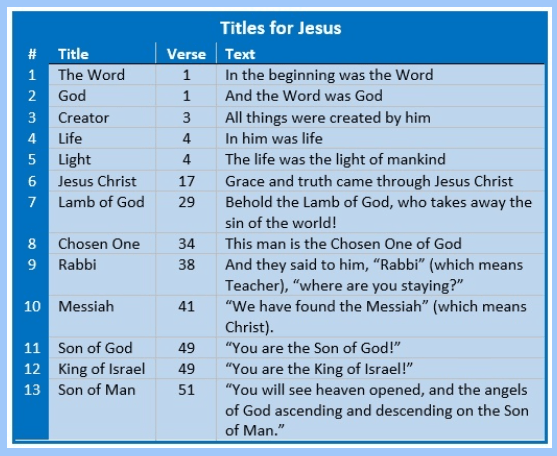
1.19 John 1:1-51, Thirteen Titles for Jesus
As we worked our way through the first chapter of the Gospel of John, we were introduced to at least thirteen titles or names for Jesus. Titles are important because they tell you something about that person. As Jesus identified with those titles, people would have feelings about it. Those that God gave understanding to through faith were attracted to him, but others, for various reasons, became upset to the point of having him nailed to a cross.
In the chart below the thirteen titles are listed along with the verse number and the text they were found in.
Prayer
Father, as I look at these titles, I think about what they have come to mean to me over many years as a child of yours. Lord, you are a personal living God that I have a relationship with. As creator of all things, you are my source of life, light of understanding, grace and truth. As the Father has chosen you to be my Savior, he has chosen me to be your witness. I come before you in humility and meekness, awed by your mighty eternal presence. To think that you have made me a member of your eternal kingdom of light and love leaves me without proper words to speak in appreciation.
Questions with Answers
Select to see questions with answers
1. What does John mean when he calls Jesus “the Word” in John 1:1?
Answer:
John introduces Jesus as “the Word” to reveal that He is God’s ultimate self-revelation. Just as words communicate thoughts and character, Jesus perfectly reveals who God is. John declares that the Word existed “in the beginning,” was “with God,” and “was God.” Jesus therefore did not begin His existence at Bethlehem. He is eternal, personally distinct from the Father, yet fully divine. This opening deliberately echoes Genesis 1:1 and places Jesus before creation itself. Everything that follows in the Gospel must be understood in light of this foundational truth: Jesus Christ is the eternal Son of God.
2. What does John 1 teach about Jesus’ role in creation?
Answer:
John states that “all things were made through him” and that nothing created came into existence apart from Him (John 1:3). Jesus is therefore not part of creation; He is the divine Creator through whom creation came into being. This reinforces the declaration of verse 1 that the Word is God. The One who later entered the world as a human being is the same One through whom the world itself was made.
3. Why are “life” and “light” important descriptions of Jesus?
Answer:
John 1:4 says that in Christ “was life, and the life was the light of men.” These two images become important themes throughout John’s Gospel. Jesus possesses life in Himself and gives both physical and eternal life. Light represents God’s truth, holiness, revelation, and salvation entering a world darkened by sin. The darkness cannot overcome the light (John 1:5). Christ therefore does more than teach people how to find life and light—He Himself is their source.
4. What was John the Baptist’s purpose according to John 1:6–8?
Answer:
John the Baptist was sent by God to bear witness to Jesus so that people might believe through his testimony. John carefully distinguishes the witness from the One to whom he bears witness: John “was not the light.” His ministry was preparatory. He directed attention away from himself and toward Christ. This becomes especially clear when he later declares, “Behold, the Lamb of God!” (John 1:29). John models faithful Christian witness: the messenger’s purpose is to point people to Jesus rather than draw attention to himself.
5. Why did the world fail to recognize and receive Jesus?
Answer:
John 1:10–11 describes a tragic irony. The world was made through Christ, yet the world did not know Him. Even “his own” did not receive Him. This rejection demonstrates the spiritual blindness produced by sin. Jesus came as the promised Messiah, yet many of those who possessed the Scriptures and awaited God’s promises rejected the One to whom those promises pointed. John’s Gospel will repeatedly contrast belief and unbelief as people encounter Jesus.
6. What happens to those who receive Christ and believe in His name?
Answer:
John 1:12 teaches that those who receive Christ and believe in His name are given “the right to become children of God.” Salvation brings a new relationship with God. Believers are not merely forgiven sinners; they are welcomed into God’s family. Verse 13 emphasizes that this spiritual birth does not result from ancestry, human effort, or human decision alone, but ultimately from God. This introduces the theme of the new birth that Jesus explains more fully to Nicodemus in John 3.
7. What is the significance of the statement, “the Word became flesh”?
Answer:
John 1:14 describes the incarnation: the eternal Son of God truly became human without ceasing to be God. Jesus did not merely appear human; He entered human history and lived among humanity. John says that the Word “dwelt among us,” language that recalls God’s presence in the tabernacle among Israel. In Jesus, God’s presence has come personally among His people. The disciples did not encounter merely a teacher or prophet—they saw the glory of God’s unique Son, “full of grace and truth.”
8. What does John 1:18 teach about Jesus’ relationship with the Father?
Answer:
John explains that although no one has seen God in His fullness, Jesus has made Him known. Because the Son has an eternal and intimate relationship with the Father, He uniquely reveals Him. To know Jesus is therefore to encounter the clearest revelation of God’s character. Throughout John’s Gospel, Jesus’ words, actions, compassion, holiness, authority, and sacrificial love reveal the Father.
9. Why did John the Baptist deny being the Christ, Elijah, or “the Prophet”?
Answer:
Religious leaders wanted to determine John’s identity and authority. John refused titles that would distract from his God-given mission. Instead, he identified himself with Isaiah 40:3 as “the voice of one crying out in the wilderness, ‘Make straight the way of the Lord.’” John understood himself as a forerunner preparing people for the Messiah. His humility becomes particularly striking because his ministry was attracting significant attention, yet he consistently redirected that attention toward Christ.
10. Why does John call Jesus “the Lamb of God”?
Answer:
John’s declaration in John 1:29—“Behold, the Lamb of God, who takes away the sin of the world!”—points toward Jesus’ sacrificial death. The image recalls the Old Testament sacrificial system and God’s provision of sacrifice for sin. It may also evoke the Passover lamb and Isaiah’s suffering servant who is compared to a lamb led to slaughter. Jesus came not merely to teach about sin but to deal decisively with it through His sacrificial death.
11. What evidence did John the Baptist receive that Jesus was the Son of God?
Answer:
John testified that God had told him he would recognize the Messiah when he saw the Spirit descend and remain upon Him. John witnessed this happen to Jesus and consequently declared, “this is the Son of God” (John 1:34). His testimony was therefore based upon God’s revelation rather than personal speculation. The Spirit’s presence also identified Jesus as the One who would “baptize with the Holy Spirit.”
12. Why did two of John the Baptist’s disciples begin following Jesus?
Answer:
When John declared Jesus to be “the Lamb of God,” two of his disciples followed Jesus. This shows that John’s ministry was accomplishing its intended purpose: his followers were being directed toward Christ. Jesus then invited them to “Come and you will see” (John 1:39). Their encounter with Him began a relationship that transformed their lives. John presents discipleship as more than accepting information about Jesus; it involves personally following, knowing, and remaining with Him.
13. What can we learn from Andrew bringing Simon Peter to Jesus?
Answer:
After encountering Jesus, Andrew immediately found his brother Simon and told him, “We have found the Messiah” (John 1:41). He then brought Simon to Jesus. Andrew demonstrates one of the simplest patterns of evangelism in Scripture: encounter Christ, recognize who He is, tell someone else, and bring that person to Him. Andrew could not have known how significantly Peter would later be used by God. Faithful witness may have consequences far beyond what the witness can foresee.
14. Why did Jesus give Simon the name Cephas, or Peter?
Answer:
When Jesus met Simon, He declared that he would be called Cephas, which John explains means Peter. The new name pointed toward what Jesus intended to make of him. At this moment Simon was far from the mature apostle he would eventually become. He would display courage and weakness, insight and misunderstanding, faith and failure. Yet Jesus saw not only who Simon was but who he would become through God’s transforming work. Discipleship involves Christ reshaping the lives of those who follow Him.
15. What is significant about Jesus’ simple command to Philip, “Follow me”?
Answer:
Jesus’ command in John 1:43 summarizes the essence of discipleship. Christianity is fundamentally a call to follow Christ. Philip responded to that call and immediately sought Nathanael, telling him that they had found the One about whom Moses and the prophets had written. Philip’s response demonstrates that following Jesus naturally leads to telling others about Him.
16. Why was Nathanael skeptical about Jesus?
Answer:
When Philip identified Jesus as being from Nazareth, Nathanael responded, “Can anything good come out of Nazareth?” (John 1:46). Nazareth was an insignificant Galilean village and did not fit Nathanael’s expectations concerning the Messiah. His reaction illustrates how preconceived assumptions can prevent people from recognizing God’s work. Philip did not engage him in a prolonged argument. Instead, he offered the simple invitation, “Come and see.”
17. How did Jesus overcome Nathanael’s skepticism?
Answer:
Jesus demonstrated supernatural knowledge of Nathanael, describing his character and revealing that He had seen him under the fig tree before Philip called him. Nathanael realized that Jesus possessed knowledge that could not be explained naturally. His skepticism quickly became confession: “Rabbi, you are the Son of God! You are the King of Israel!” (John 1:49). His response illustrates one of John’s central purposes—encounters with Jesus should lead people toward recognition of His true identity and faith in Him.
18. What does Jesus mean by the angels ascending and descending on the Son of Man?
Answer:
Jesus’ statement in John 1:51 recalls Jacob’s dream in Genesis 28:10–17, where Jacob saw a ladder between heaven and earth with angels ascending and descending upon it. Jesus applies that imagery to Himself. He is the true connection between heaven and earth—the One through whom humanity comes to God and through whom God reveals Himself to humanity. Jesus is therefore greater than the ladder Jacob saw; He is the divine-human mediator whom the vision anticipated.
19. What major titles for Jesus appear throughout John 1?
Answer:
John 1 presents an extraordinary collection of titles and descriptions of Jesus. He is the Word, God, Creator, Life, Light, the only Son, Lord, Jesus Christ, the Lamb of God, the Son of God, Rabbi, Messiah, the One foretold by Moses and the prophets, the King of Israel, and the Son of Man. Together these titles establish the identity that the remainder of John’s Gospel will progressively demonstrate. John does not allow Jesus to be understood merely as a moral teacher. He is the eternal God who became man, God’s promised Messiah, the sacrificial Lamb, and the King worthy of faith and allegiance.
20. What is the central message of John 1?
Answer:
The central message is that the eternal Son of God entered His creation as Jesus Christ so that people might know God, receive salvation, and become His children through faith. The chapter moves from Christ’s eternal existence to His incarnation, from John the Baptist’s testimony to the first disciples’ personal encounters with Him. Each section answers the same fundamental question: Who is Jesus? John 1 declares that He is the eternal Word who was with God and was God, the Creator who became flesh, the Lamb who takes away sin, the promised Messiah, the Son of God, and the King whom people are called to follow.
Chapter 2 – Signs That Reveal His Glory
Chapter Introduction
Introduction to Chapter 2
John 2 reveals the beginning of Jesus’ public ministry through two significant events that demonstrate His divine authority and point to His true identity. At the wedding at Cana, Jesus performs His first recorded sign by turning water into wine, revealing His glory and strengthening the faith of His disciples. He then travels to Jerusalem, where He cleanses the temple, confronting those who had turned His Father’s house into a place of commerce. When challenged about His authority, Jesus points ahead to His death and resurrection by speaking of the destruction and raising of the temple of His body. Together, these events show that Jesus came not merely to perform miracles but to bring something new and greater: He provides what human effort cannot supply, possesses authority over true worship, and ultimately becomes the means through which people come into the presence of God. John 2 therefore moves the reader from the revelation of Christ’s glory at Cana to the declaration of His authority in Jerusalem, preparing the way for the growing signs, teachings, faith, and opposition that will characterize His ministry.
Bible Lessons
2.1 A Wedding at Cana
Our lesson today will begin our journey through chapter 2, which consist of two main sections and a small one. The first section, John 2:1 – 12, covers a wedding at Cana, the second section, verses 13 – 22, covers the cleansing of the temple, and the short section, verses 23 – 25, covers the concern Jesus has about the intent of people toward him. With this brief sketch before us we need to go back to a starting point at John 1:43 where “Jesus wanted to set out for Galilee.” a two-day journey. It is now the “third day” and Jesus and his disciples are at the “wedding at Cana in Galilee” along with Jesus’ mother (John 2:1 – 2). The invitation of Jesus, his mother, and the disciples seems to indicate that this wedding was family related.
At the wedding a problem develops involving supply and demand. It seems that the demand for wine exceeded the supply provided by the bridegroom. To run out of wine at a wedding in that culture was a serious problem prompting Mary to inform Jesus (v3). The response Jesus makes to his mother in hearing this causes one to stop and wonder what just happened. The harshness of his response indicates that we should stop and try to understand what is going on besides a typical wedding.
Looking carefully at verses 4 – 11 there are four things that stand out that will be identified with the words obedience, hour, purification, and bridegroom. In verses 3 – 5, Mary provides Jesus with a problem and request a solution. Mary is requesting obedience, but don’t forget Jesus has a heavenly Father who he must also obey. In verse 4 Jesus says, “My hour has not yet come.” What hour was he referring to? In verses 6 – 8, there were six stone water jars which were used for rites of purification. Jesus had these filled with water which he turns to wine for them to drink. How might purification relate to Jesus? In verses 9 – 11, Jesus supplied what the bridegroom was lacking. How does this connect with Jesus being the perfect bridegroom?
A quick reading of our text tells us about a miracle performed at a wedding, but we miss the richness that is ours if we stop and think about the kind of response Jesus made. I believe this harshness was intended to capture our attention. It sure got mine.
Prayer
Father, I am so thankful for your word. It is living and active in my life. It illuminates the way before me as I travel along the dangerous paths of life. Thank you for the opportunity to think deeply about who Jesus is, the work he came to do, and what he has to offer me. Lord, please guide me as I dig into chapter 2. Open it up to my understanding and help me share it with others.
2.2 John 2:3-5, Obedient Son
When Mary said to Jesus, “They have no wine left.” that seemed to turn on a switch inside Jesus that clearly brought to mind the suffering he would have to endure to complete the work his Father sent him to do. Out of anguish over this resting on his shoulders Jesus replied, “Woman, what does this have to do with me? My hour has not yet come” (v 4). Mary makes no comment about the harshness of his response but says to the servants, “Do whatever he tells you” (v 5). She just gave the responsibility to Jesus to complete what was lacking on the part of the bridegroom. She expected Jesus to somehow provide and that it would involve the servants. Wouldn’t you like to know what both Mary and Jesus were thinking at this time?
Jesus, the son of Mary, has been given the responsibility by her to provide enough wine to satisfy the wedding guest. Jesus, the son of God, has been given the responsibility by his Father to become the perfect sacrifice to purchase the salvation of those who are to be saved. I believe that both Mary and Jesus knew that this was the beginning of that work. To begin this visible work here on earth, Jesus must be obedient to Mary. Obedience to the Father had already begun by Jesus coming to earth through his virgin birth. The Father testified to this obedience when John baptized Jesus by saying, “This is my beloved Son, with whom I am well pleased” (Matthew 3:17 ESV).
Jesus has a mother here on earth and a Father in heaven. The mother identifies Jesus with an earthly family. The Father in heaven identifies Jesus with a spiritual family. This gives us the man/God identify of Jesus. When Jesus responded to Mary as “Woman” and not “Mother” he was beginning to push back from his physical family to establish the needed relationship, in the minds of people, with his heavenly family. Later Jesus will push back even harder.
Prayer
Father, I find such richness in the Bible when one stops and takes time to research and think. It stimulates my faith to learn about Him who after creating a universe was willing to enter into it as a human and become the sacrifice required to redeem a people for you to love and share the kindness of your grace with forever. The Bible is truly a living book with such depth that no one is able to grasp all of it. Thank you for setting this book apart from all others and protecting it against all evil powers.
2.3 John 2:3-5, My Hour has not Come
Our lesson today will again cover the text from John 2:3 – 5 (ESV): “3 When the wine ran out, the mother of Jesus said to him, “They have no wine.” 4 And Jesus said to her, “Woman, what does this have to do with me? My hour has not yet come.”5 His mother said to the servants, “Do whatever he tells you.”” In this lesson we will focus on the statement “Woman, why are you saying this to me? My time has not yet come.”
In our last lesson we said, “When Jesus responded to Mary as “Woman” and not “Mother” he was beginning to push back from his physical family to establish the needed relationship, in the minds of people, with his heavenly family. When Jesus responded with “Why are you saying this to me?” he may have been trying to disconnect with the responsibility his mother was giving to him. The part we want to focus on in this lesson is the statement “My time has not yet come.”
“My time” or “My hour” as some translations say, is a reference to the time when Jesus would depart this world and return to the Father (John 13:1) to be glorified (John 17:1). But to accomplish that goal, Jesus knew that suffering, death, resurrection, and ascension lay ahead. Jesus also knew that this was not the time to reveal his identity as the Messiah. Gradually he must reveal his divine nature to the people and stimulate their belief in him.
As Jesus continued to teach and perform miracles, his listeners divided into three groups; those who believed, those who grew to hate him, and those who were still just watching and listening. Jesus was able to avoid physical harm from those who hated him, as we see in John 7:30 and 8:20, but in John 12:27 Jesus said, “Now is my soul troubled. And what shall I say? ‘Father, save me from this hour’? But for this purpose, I have come to this hour.” In John 12:24 Jesus said, “Unless a grain of wheat falls into the earth and dies, it remains alone; but if it dies, it bears much fruit.” As Jesus spoke to his mother, he knew his hour to suffer, and die was not too far away, and he knew by providing the wine needed for the wedding with a miracle was to start that fateful journey. To die physically on the cross is one thing, but for the holy Son of God to contaminate himself with our sin and cause his Father to turn away from him is beyond our comprehension. A short video has been included to help understand this.
Prayer
Lord, I am trying to understand how you must have felt as you spoke to Mary and fully realized what lay ahead; the rejection, anger and hate that would develop against you; the physical and mental abuse, the disrespect and the brutality of the scourging and the cross. How you must have felt as those thoughts came to mind as you said, “My time has not yet come.” But the time came and with your blood you purchased my salvation. For that I am so thankful. Lord, help me use my life to be a witness for you.
2.4 John 2:6-8, Purification
In our lesson today we will consider the containers Jesus used to produce the wine in that are mentioned in John 2:6 – 8 (ESV): “6 Now there were six stone water jars there for the Jewish rites of purification, each holding twenty or thirty gallons. 7 Jesus said to the servants, “Fill the jars with water.” And they filled them up to the brim. 8 And he said to them, “Now draw some out and take it to the master of the feast.” So, they took it.”
Specifically, verse 6 reads: “Now there were six stone water jars there for the Jewish rites of purification (or ceremonial washing), each holding twenty or thirty gallons.” These jars are used to hold water, not for drinking, but for bathing, for purification to prepare one for offering a sacrifice for their sin. Jesus decides to use this water for a different purpose. He could have used other containers, but he chose to use these pots in meeting the need of the bridegroom for more wine. He chose to use these pots for a different purpose to plant the idea that he as the coming bridegroom would one day be the perfect sacrifice that would meet our need for purification from our sin.
Drinking wine from these pots begins the difficult task Jesus has of developing an understanding of how drinking wine from these pots will eventually lead to the meaning of what we read in John 6:53 – 55, where Jesus said to them, “I tell you the solemn truth, unless you eat the flesh of the Son of Man and drink his blood, you have no life in yourselves. The one who eats my flesh and drinks my blood has eternal life, and I will raise him up on the last day. For my flesh is true food, and my blood is true drink” (NET). Like the Jews, we have much to learn to get from these stone water jars to the meaning of drinking his blood.
God had taught the Jews to follow a ritual in sacrificing animals to cover their sin. God now enters human life as Jesus to show the Jews a better way to be cleansed of their sin. It will no longer be a ritual of purification and the sacrifice of animals, but a relationship with Jesus through his blood as the perfect sacrifice. Here at the wedding at Cana Jesus shows that he can perform miracles, but by using those special water pots he points to an event that will involve his death on the cross as the perfect sacrifice for our purification from our sin.
Prayer
Father, it is easy to read our text today and see that Jesus turned 120 to 180 gallons of water into wine for use at a wedding, but to see the significance of using the stone water jars that were part of the Jewish rites of purification is an entirely different matter. Thank you for the mysteries that are tucked away in the Scriptures that are revealed by the Spirit of God to those who believe. Thank you for the excitement and humbling effect understanding these mysteries provide.
2.5 John 2:6-11, The Perfect Bridegroom
In the previous lesson we questioned why Jesus chose to use the stone jars that were used to hold water for ceremonial washing. Water from these jars was not used for drinking but for bathing. By using these jars Jesus was drawing focus to the current method of covering one’s sins and then drew attention to himself with a miracle. From this point forward Jesus needed to convince the Jews that he was replacing their ritual of animal sacrifice with the sacrifice of himself.
Our lesson today will come from John 2:6 – 11 (ESV): “6 Now there were six stone water jars there for the Jewish rites of purification, each holding twenty or thirty gallons. 7 Jesus said to the servants, “Fill the jars with water.” And they filled them up to the brim. 8 And he said to them, “Now draw some out and take it to the master of the feast.” So, they took it. 9 When the master of the feast tasted the water now become wine, and did not know where it came from (though the servants who had drawn the water knew), the master of the feast called the bridegroom 10 and said to him, “Everyone serves the good wine first, and when people have drunk freely, then the poor wine. But you have kept the good wine until now.” 11 This, the first of his signs, Jesus did at Cana in Galilee and manifested his glory. And his disciples believed in him.”
Jesus told the servants, “Fill the water jars with water” (v7). The servants filled the six stone water jars, each holding twenty or thirty gallons, to the top. Jesus then told them, “Now draw some out and take it to the head steward,” and they did. When the servant drew from the water jar was it then wine or was it still water that turned to wine on the way to the head steward. All we know is that the servants filled the jars with water and the head steward tasted wine. Between those two events the miracle took place.
After tasting the wine, the head steward called the bridegroom and said to him, “Everyone serves the good wine first, and then the cheaper wine when the guests are drunk. You have kept the good wine until now!” (v 10). The first miracle that Jesus did was to complete what the bridegroom could not do and provide even better wine than the wine first served.
The shortcomings of this bridegroom represent the shortcomings of all grooms on this earth. As husbands fall short of what we ought to be, Jesus steps up and plays the role of the perfect and all providing Bridegroom for his bride, the great assembly of all those who trust in him.
From this wedding account we see Jesus as the obedient Son, the coming perfect sacrifice for our sin, and the perfect Bridegroom who would meet our needs forever. “In this way [Jesus] revealed his glory, and his disciples believed in him” (v 11).
Prayer
Lord Jesus, thank you for your demonstration of obedience by coming to be the perfect sacrifice for our sin. Thank you for setting an example of a perfect Bridegroom that can meet all our needs. Father, as I continue to study, help me fully understand what Paul wrote about in Romans 7:4; “So, my brothers and sisters, you also died to the law through the body of Christ, so that you could be joined to another, to the one who was raised from the dead, to bear fruit to God.” What an awesome plan you are unfolding before us.
2.6 John 2:12-13, Time to Travel Again
In the narrative of John 2, we find ourselves between two major events; the wedding at Cana where Jesus performs his first miracle and the cleansing of the temple in Jerusalem. Verses 12 and 13 describe a minor detail of travel between the two: “12 After this he went down to Capernaum with his mother and brothers and his disciples, and they stayed there a few days. 13 Now the Jewish feast of Passover was near, so Jesus went up to Jerusalem” (John 2:12 – 13 NET). It would be easy to simply read these two verses and move on to the cleansing of the temple, but I think it would be good for us to join Jesus and his party for a time of travel. If we are going to travel, we will need a map of Israel at the time of Jesus. NET Bible had just the map.
Israel During the Time of Jesus
Above is a link to view a full-scale map, which I selected and then copied just the section I wanted for this lesson and inserted it below.
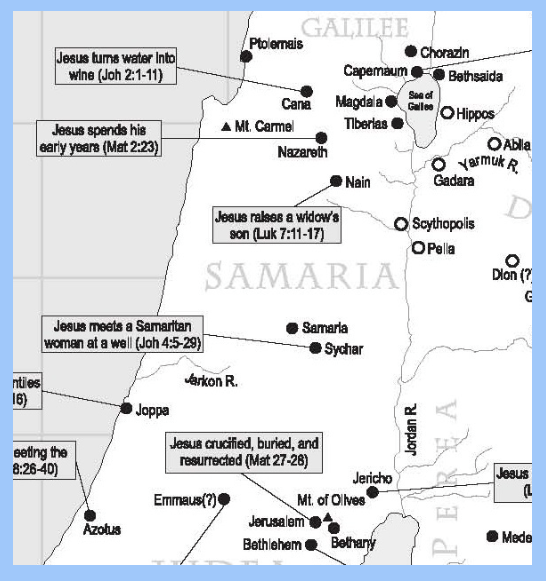
When I began, I thought this would be an easy and fun lesson, but quickly I found trouble. On the map above the distance from Bethany to Cana is about 80 miles. John 2:1 allows just two days for travel by foot, which is not possible. After some digging around, I discovered that the location of the ancient city of Bethany is not known. Bethany as shown on the map above cannot be correct because it is too far from Cana to walk to in two days. To solve the distance problem, some think ancient Bethany is located near the Sea of Galilee, but there is no agreement as to where. Some say it is north of the Sea of Galilee and others say to the south. Wherever ancient Bethany was located it had to be within a two day walk of Cana where Jesus went for the wedding. Since Jesus was going from Bethany to the area of Galilee it seems logical that Bethany would be south of the Sea of Galilee.
“After [the wedding, Jesus] went down to Capernaum with his mother and brothers and his disciples, and they stayed there a few days” (John 2:12 NET). Try to imagine being one of the brothers of Jesus and you just witnessed him making wine out of water. How would you feel and what kind of conversation would you have? After the wedding we learn that “his disciples believed in him” (John 2:11), but what did they believe? What are Mary’s thoughts now that she realizes that this is the start of his journey toward the cross?
Capernaum is an interesting tourist location today. The following link shows what it is like there now.
“Now the Jewish feast of Passover was near, so Jesus went up to Jerusalem” (John 2:13 NET). The distance from Capernaum to Jerusalem is about 106 miles and would have taken six days, covering about 18 miles per day. Going up or down is in terms of elevation.
This lesson sure was different. I pray you gained something from it.
Prayer
Father, this was a different kind of lesson. I realized that when I simply read the Bible (reading for the message) it appears to be no more than a collection of stories, but when I stop and study it (reading for meaning) then it is like sitting down to a wonderful meal. I find flavor and nourishment when I do. Father, over time that nourishment produces a life more like Jesus. Without this regular nourishment how can a person not be spiritually anemic and face all kinds of spiritual problems during their life? Lord, thank you for keeping me close to your word.
2.7 John 2:14-17, Cleansing the Temple
Our lesson today will cover the text from John 2:14 – 17 (ESV): “14 In the temple he found those who were selling oxen and sheep and pigeons, and the moneychangers sitting there. 15 And making a whip of cords, he drove them all out of the temple, with the sheep and oxen. And he poured out the coins of the moneychangers and overturned their tables. 16 And he told those who sold the pigeons, “Take these things away; do not make my Father’s house a house of trade.” 17 His disciples remembered that it was written, “Zeal for your house will consume me.””
Jesus went from Capernaum (the center of Jesus’ Galilean ministry) to Jerusalem (probably with his mother and brothers and disciples). “He found in the temple courts those who were selling oxen and sheep and doves, and the money changers sitting at tables” (2:14 NET). Inside the temple court, a place meant for prayer and other acts of worship, there were pens of oxen and sheep, and cages of doves and merchants sitting around them waiting to make a transaction, and others who were prepared to exchange a pilgrim’s money into the right currency so that they could make a purchase. By selling these animals the merchants were rendering a service to those who had traveled from long distances as it was much easier to bring money and purchase the needed animals for sacrifice upon their arrival. But by doing this business in the temple courts it disrupted the worship of non-Jewish God-fearing people and thus obstructed the very purpose for which the temple courts existed.
When Jesus saw what was taking place it upset him, “So he made a whip of cords and drove them all out of the temple courts, with the sheep and the oxen. He scattered the coins of the money changers and overturned their tables” (2:15 NET). The whips would be seen as an emblem of his authority and used to encourage the merchants and their animals to leave. There is no evidence that Jesus used any violence against the merchants engaged in this unhallowed traffic. Scattering the coins of the money changers and overturned their tables was a way of enforcing his position. As Jesus did this, he gave clear instructions to the merchants by saying, “Take these things away from here! Do not make my Father’s house a marketplace” (2:16 NET)! In this statement Jesus is identifying himself as the Son of God by referring to the temple as his Father’s house. The disciples watched Jesus and remembered that it was written years ago, “Zeal for your house will consume me” (2:17 ESV). This is a reference back to Psalm 69:9 and suggest a growing opposition against Jesus.
Before leaving this section, a problem should be noted. Why is this temple cleansing episode placed here at the beginning of Jesus’ ministry, while the other gospel writers have it near the end of his ministry? Is there one or two temple cleansings? The debate goes on and as it does, I am willing to accept this to be the first cleansing with a second one occurring later.
Prayer
Father, as I study about this temple abuse, I see similar problems today in our churches. We have programs and projects and social events with a focus on entrainment or fun times and we forget to worship and praise as we should the One who gives meaning and purpose to life. We have our Bibles, but we don’t spend the time we should with them to learn about you and how we should live with one another, and we wonder why we have such a limited effect on our culture. Lord, do what it takes to draw us back to you.
2.8 John 2:18-22, Which Temple
Our lesson today will cover the text from John 2:18 – 22 (ESV): “18 So the Jews said to him, “What sign do you show us for doing these things?” 19 Jesus answered them, “Destroy this temple, and in three days I will raise it up.” 20 The Jews then said, “It has taken forty-six years to build this temple, and will you raise it up in three days?” 21 But he was speaking about the temple of his body. 22 When therefore he was raised from the dead, his disciples remembered that he had said this, and they believed the Scripture and the word that Jesus had spoken.”
The Jewish leaders watched and listened to Jesus as he cleared the temple courts and then they responded with, “What sign can you show us, since you are doing these things” (John 2:18 NET)? These Jewish leaders wanted Jesus to defend his actions with some mark of divine authentication. It is not clear if they were requesting a miracle, but when challenged like this Jesus does not respond with a sign. Instead, Jesus replied, “Destroy this temple, and in three days I will raise it up” (John 2:19 ESV). The Jewish leaders had no idea what he was referring to and said to him, “This temple has been under construction for forty-six years, and are you going to raise it up in three days” (John 2:20 NET)? The only temple they understood was the building before them, “But Jesus was speaking about the temple of his body” (John 2:21 NET). If we look ahead to Revelation 21:22 we read, “And I saw no temple in the city, for its temple is the Lord God the Almighty and the Lamb” (ESV). As believers, our bodies are considered a temple of the Holy Spirit that dwells within us (1 Corinthians 6:19).
“So after he was raised from the dead, his disciples remembered that he had said this, and they believed the scripture and the saying that Jesus had spoken” (John 2:22 NET). Put yourself in the place of one of the disciples, especially one of his brothers. How would you feel and what would you think when Jesus referred to the temple as his Father’s house and then when he said that he would rebuild the temple in three days? Would you begin to think there was something wrong with him? How is it possible that God who created the universe is standing before you as your brother? Try to get your mind around that and you will then better identify with the people of Jesus time.
Prayer
Father, another simple passage but with profound implications. I think of the temple and the sacrifices offered there for sin. I then think of Jesus becoming the temple in its place and he being the perfect sacrifice for sin. I think of each of us believers being a temple of the Holy Spirit. Father, the coming of Jesus Christ to earth, to live and then to die and to be raised from the dead was unique and a pivot point in history. Thank you for making me a part of this.
2.9 John 2:23-25 Wrong Understanding
Our lesson today will cover the text from John 2:23 – 25 (ESV): “23 Now when he was in Jerusalem at the Passover Feast, many believed in his name when they saw the signs that he was doing. 24 But Jesus on his part did not entrust himself to them, because he knew all people 25 and needed no one to bear witness about man, for he himself knew what was in man.”
“Now when [Jesus] was in Jerusalem at the Passover Feast, many believed in his name when they saw the signs that he was doing.” People were drawn to Jesus, not because of who he was, but because of what he was doing. It is the same today. People are drawn to a good performance or something spectacular. Through the signs he was doing, people began to see him as a possible deliverer and began to associate him with the Messiah, but their concept of Messiah was not the same as that of Jesus. Today the concept of who Jesus is in the minds of people is very different from who he really is. Only Jesus who is accepted as God in flesh is the true savior and Messiah.
There is growing tension between Jesus and the Jewish leaders and there is a growing desire by the people to have Jesus take charge and set them free from the Roman oppression. Jesus has to act cautiously and prudently to be sure neither group gets out of hand or join forces against him. Jesus has much work to do before it is time for his death. As a result, “Jesus would not entrust himself to them, because he knew all people” (John 2:24 NET). Jesus needed to maintain a balanced relationship with those around him to allow him time to do the work given to him by his Father.
“[Jesus] did not need anyone to testify about man, for he knew what was in man” (John 2:25 NET). No one had to explain to Jesus what man was like. “He knew what was in man” because “All things were created by him” (John 1:3 NET) and because he was God (John 1:1). Their belief in him was not true belief. What they believed he could accomplish would satisfy their desires, but it was definitely not according to God’s plans. The tension between what they wanted Jesus to do and what God’s plan was for him would eventually cause them to join the Jewish leaders and turn against Jesus for claiming to be someone they believed he was not.
Prayer
Lord Jesus, what an awesome thing it is to think that you could create the universe and then enter into it through a woman to demonstrate to a sinful people what God is like and then show through your death and resurrection how much God loves us. Lord, as I watch you carefully spend time with people I see the importance and caution that should guide me as a witness. Father, I pray for my brothers and sisters in locations where they don’t know if they will live another day because of their faith in Jesus.
Questions with Answers
Questions with answers for understanding
1. What are the two major events recorded in John 2?
Answer:
John 2 records two important events: Jesus turning water into wine at the wedding in Cana (John 2:1–12) and Jesus cleansing the temple in Jerusalem (John 2:13–22). The first reveals Jesus’ divine power and brings joy and abundance to a wedding celebration. The second reveals His authority over worship and His concern for the holiness of His Father’s house. Together, these events begin to reveal who Jesus is and the authority He possesses.
2. Why is the miracle at Cana significant?
Answer:
Turning water into wine was the first of the signs through which Jesus publicly revealed His glory. John explains that through this sign, Jesus “manifested his glory,” and His disciples believed in Him (John 2:11). The miracle was therefore more than an act of kindness toward a wedding family. It was a revelation of Jesus’ identity. His ability to transform water into wine demonstrated a creative power that pointed beyond the miracle itself to the divine nature of the One performing it.
3. What can we learn from Mary’s response to Jesus at the wedding?
Answer:
When the wine ran out, Mary brought the need to Jesus. Although Jesus reminded her that His actions would be governed by the Father’s timing rather than human expectations, Mary nevertheless told the servants, “Do whatever he tells you” (John 2:5). Her words express confidence in Jesus and provide an important principle of discipleship. Faith does not require knowing beforehand exactly what Jesus will do; it trusts Him enough to obey what He commands.
4. What is significant about the six stone water jars Jesus used?
Answer:
The jars were used for Jewish purification practices (John 2:6). Jesus instructed the servants to fill them with water, which He then transformed into wine. John’s inclusion of their ceremonial purpose may point beyond the miracle itself. The old purification system could symbolize external cleansing, while Jesus was bringing something greater. Throughout John’s Gospel, Jesus repeatedly fulfills and surpasses institutions and symbols associated with the old covenant. The miracle therefore anticipates the greater cleansing, grace, and new life that would come through Christ.
5. What does the quality and abundance of the wine reveal about Jesus?
Answer:
Jesus did not merely provide enough wine to solve an embarrassing shortage. He provided an extraordinary quantity of excellent wine. The master of the feast remarked that the best wine had been kept until that point (John 2:10). This abundance illustrates the gracious generosity associated with Jesus’ ministry. What Christ provides is not an inferior replacement. His coming introduces the fullness of God’s grace and points toward the abundant spiritual life available through Him.
6. Why did Jesus drive the merchants and money changers from the temple?
Answer:
Jesus found people selling animals and exchanging money within the temple complex. Although animals and proper currency were necessary for sacrifices and offerings, commercial activity had intruded into a place devoted to worship. Jesus declared, “Do not make my Father’s house a house of trade” (John 2:16). His actions demonstrated His zeal for the honor of God and the proper purpose of worship. The temple belonged to His Father and was not to be reduced to a marketplace.
7. What does Jesus’ cleansing of the temple reveal about His authority?
Answer:
Jesus acted as One who possessed authority over the temple itself. The Jewish leaders recognized the significance of His actions and asked what sign He could provide to justify them (John 2:18). Jesus did not appeal to another human authority. Instead, He pointed to His coming death and resurrection. His authority rested in who He was—the Son of God. The cleansing of the temple therefore confronts the reader with the question that runs throughout John’s Gospel: Who is Jesus?
8. What did Jesus mean when He said, “Destroy this temple, and in three days I will raise it up”?
Answer:
The Jewish leaders assumed Jesus was speaking about the physical temple in Jerusalem, which had been under construction for forty-six years. John explains, however, that “he was speaking about the temple of his body” (John 2:21). Jesus was predicting His death and resurrection. His body would be destroyed through crucifixion, but He would rise on the third day. The statement also indicates that access to God would ultimately center not on a building but on Jesus Himself.
9. Why did the disciples understand Jesus’ statement about the temple only after His resurrection?
Answer:
At the time Jesus spoke, the disciples did not fully understand what He meant. After His resurrection, however, they remembered His words and recognized their fulfillment (John 2:22). This demonstrates an important pattern in the Gospel of John: events and teachings that initially seem mysterious become clearer in light of Jesus’ death and resurrection. The resurrection became a lens through which the disciples understood both Scripture and Jesus’ earlier words.
10. Why did Jesus not entrust Himself to everyone who believed because of His signs?
Answer:
Many people in Jerusalem believed in Jesus when they saw the signs He performed, but Jesus knew that their response did not necessarily represent genuine, saving faith. John says that Jesus “knew all people” and “knew what was in man” (John 2:24–25). Jesus could distinguish between fascination with miracles and authentic trust in Him. This prepares for the conversation with Nicodemus in John 3, where Jesus explains the necessity of being born again.
11. What contrast does John 2 establish between outward religion and genuine faith?
Answer:
The chapter repeatedly moves beneath outward appearances. Ceremonial water jars represented purification, but Jesus offered something greater. The magnificent Jerusalem temple represented worship, yet its courts had become corrupted by commerce. Crowds professed belief because of miraculous signs, but Jesus knew what was actually in their hearts. John therefore emphasizes that genuine relationship with God cannot rest merely upon ceremonies, religious institutions, or excitement over miracles. True faith must ultimately be centered upon Christ Himself.
12. What central truth about Jesus does John 2 reveal?
Answer:
John 2 reveals Jesus as the divine Son who brings transformation, possesses authority over worship, knows the human heart, and points forward to His death and resurrection. At Cana, He reveals His glory through transformation. At Jerusalem, He demonstrates His authority over His Father’s house. In speaking of the temple of His body, He points toward the cross and resurrection. And in His response to those who profess belief, He demonstrates supernatural knowledge of the human heart. John 2 therefore advances the Gospel’s central purpose: leading readers to recognize who Jesus truly is and to place genuine faith in Him.
Chapter 3 – You Must Be Born Again
Chapter Introduction
Introduction to Chapter 3
John 3 presents one of the clearest and most profound explanations of salvation in the Gospel of John. The chapter begins with Nicodemus, a Pharisee and respected Jewish leader, coming to Jesus at night to learn more about Him. Jesus moves beyond Nicodemus’s understanding of religion and outward obedience to reveal humanity’s deepest spiritual need: a person must be “born again” or “born from above” by the Spirit of God to enter the kingdom of God. Jesus then explains that salvation comes through faith in the Son of Man, whom God sent into the world because of His great love for humanity. This truth reaches its memorable expression in John 3:16, emphasizing God’s love, Christ’s mission, and the promise of eternal life to everyone who believes in Him. The chapter concludes with John the Baptist faithfully directing attention away from himself and toward Jesus, declaring that Christ must increase while he must decrease. Together, these passages reveal that eternal life cannot be earned through religious status or human effort but is received through faith in Jesus Christ, the Son of God, who came from heaven to bring salvation to the world.
Bible Lessons
3.1 John 3:1-4, Born from Above
Our lesson today will cover the text from John 3:1 – 4 (ESV): “1 Now there was a man of the Pharisees named Nicodemus, a ruler of the Jews. 2 This man came to Jesus by night and said to him, “Rabbi, we know that you are a teacher come from God, for no one can do these signs that you do unless God is with him.” 3 Jesus answered him, “Truly, truly, I say to you, unless one is born again he cannot see the kingdom of God.” 4 Nicodemus said to him, “How can a man be born when he is old? Can he enter a second time into his mother’s womb and be born?”
Chapter 3 opens with “a certain man, a Pharisee named Nicodemus, who was a member of the Jewish ruling council” coming “to Jesus at night” (John 3:1 – 2a ESV). At the time of Jesus, the Pharisees were a member of one of the most important and influential religious and political parties of Judaism and had a growing dislike for him. It appears that Nicodemus wanted to find out more about Jesus and arranged to visit him. There is speculation as to why he came at night. Maybe he was afraid of public association with Jesus, or maybe he wanted a lengthy discussion without interruptions. John does not see the reason for coming when he did to be important enough to give us an explanation for the timing of the interview.
Nicodemus “came to Jesus at night and said to him, ‘Rabbi, we know that you are a teacher who has come from God. For no one could perform the miraculous signs that you do unless God is with him.’” (John 3:2 NET). For Nicodemus to say to Jesus that he was a teacher from God, because of the miraculous signs he was performing, suggest that he thought Jesus may indeed be the Messiah and desired further information. I can see the same thing happening in countries today where there is persecution. A person who wants to learn more about Jesus might seek out a Christian alone at night where they can talk without someone hearing or seeing them. By approaching Jesus this way, Nicodemus was demonstrating prudence by being so private.
In his reply, Jesus makes no reference to being called a teacher from God, but what he does say takes Nicodemus by surprise. Jesus replied, “I tell you the solemn truth, unless a person is born from above, he cannot see the kingdom of God” (John 3:3 NET). Jesus wants to draw the focus away from the things he was teaching and to the idea of a second birth. Here translations differ and cause some confusion. Some say, “born again” and others say “born from above. When born again is used, some, like Nicodemus, wonder how it is possible to be born again physically. Nicodemus said to him, “How can a man be born when he is old? He cannot enter his mother’s womb and be born a second time, can he” (John 3:4 NET)? Nicodemus is right, you can’t, but it also indicates that he had no concept of such a thing as a spiritual birth, which is what Jesus says is required.
We have come to a most important concept in their conversation. Our understanding of this and then experiencing it through faith determines our eternal destiny. We will continue this in our next lesson.
Prayer
Father, thank you for choosing me and causing me to be born again. Thank you that salvation is by grace alone through faith alone in Christ alone. Thank you that by grace I have been saved through faith and that it is not of my own doing. Thank you that it is your gift to me and not a result of works that I could boast of. Thank you that I have been created in Christ Jesus for doing good works, which were prepared before I was ever born. Lord, guide and strengthen me to do them to your honor and glory.
3.2 John 3:5-8, Born of Water and Spirit
Our lesson today will cover the text from John 3:5 – 8 (ESV): “5 Jesus answered, “Truly, truly, I say to you, unless one is born of water and the Spirit, he cannot enter the kingdom of God. 6 That which is born of the flesh is flesh, and that which is born of the Spirit is spirit. 7 Do not marvel that I said to you, ‘You must be born again.’ 8 The wind[c]blows where it wishes, and you hear its sound, but you do not know where it comes from or where it goes. So, it is with everyone who is born of the Spirit.”
We ended the last lesson with Nicodemus saying to Jesus, “How can a man be born when he is old? He cannot enter his mother’s womb and be born a second time, can he” (John 3:4 NET)? Of course, he and we know that is not possible, but it was his way of telling Jesus that he didn’t understand. Jesus then answers, “I tell you the solemn truth, unless a person is born of water and spirit, he cannot enter the kingdom of God” (John 3:5 NET). Being born of water is our physical birth that we all experience, but now we are being told that the second birth is a spiritual birth which is required if we are to enter the kingdom of God. It is this spiritual birth that produces the “new creature in Christ” that Paul speaks of in 2 Corinthians 5:17. It is a time when the old things that our lives have been made up of begin to pass away and are replaced by new things.
Jesus continues by saying, “What is born of the flesh is flesh, and what is born of the Spirit is spirit. Do not be amazed that I said to you, ‘You must all be born from above’” (John 3:6 – 7 NET). We are not sure what Nicodemus was expecting to learn from Jesus, but in just a few words a totally new concept was opened up to him and it is one of eternal consequences. It is one that applies to each one of us. The concept of a spiritual birth is so different from a faithful obedience to the Law that by now Nicodemus probably feels overwhelmed and may have expressed some doubt about this new concept because Jesus continues by saying, “The wind blows where it wishes, and you hear its sound, but you do not know where it comes from or where it goes. So, it is with everyone who is born of the Spirit” (John 3:8 ESV).
It seems that the wind blows where it wishes, and we see its effects on the things it moves around. Jesus is implying here that one who is born of the Spirit will demonstrate that by a kind of behavior. Under the law one painfully tries to be obedient to every point, which is impossible. Jesus is now introducing the idea that when one is born from above there is a new source within us that greatly helps us live the way we should. We are to learn to replace the work we do with allowing Jesus to work through us. This is just the beginning of new concepts Jesus will introduce to us in our future studies.
Prayer
Father, the concept of being born from above is not very widely accepted today because it requires one to humbly confess that we are broken, sinful people in need of a savior that can transform us. Lord, this concept of being born spiritually has opened up such an amazing life adventure for me. I find that the more I study the more treasures I find, and the more meaningful and exciting life becomes. Without your presence in my life there would be death instead of life within and darkness instead of light. Thank you for the kindness of your grace.
3.3 John 3:9-12, How Can These Things Be?
Our lesson today will cover the text from John 3:9 – 12 (ESV): “9 Nicodemus said to him, “How can these things be?” 10 Jesus answered him, “Are you the teacher of Israel and yet you do not understand these things? 11 Truly, truly, I say to you, we speak of what we know, and bear witness to what we have seen, but you[a] do not receive our testimony.12 If I have told you earthly things and you do not believe, how can you believe if I tell you heavenly things?”
Jesus made it very clear to Nicodemus the importance of being born from above when he said, “I tell you the solemn truth, unless a person is born from above, he cannot see the kingdom of God” (John 3:3 NET). Jesus also made it clear that we are to experience two births when he said, “I tell you the solemn truth, unless a person is born of water and spirit, he cannot enter the kingdom of God. What is born of the flesh is flesh, and what is born of the Spirit is spirit” (John 3:5 – 6 NET). But Nicodemus still does not understand what Jesus is saying and replies by saying, “How can these things be” (John 3:9 NET)?
Jesus has made his point about the importance of being born from above and now because of the lack of understanding on the part of Nicodemus, Jesus now shows his displeasure with the prevailing Jewish misunderstanding of his teaching about the necessity of a new, spiritual birth from above by saying, “Are you the teacher of Israel and yet you do not understand these things” (John 3:10 ESV)? Is that true of us? Do we say things or even teach spiritual truths but don’t really understand their meaning? How much of the Bible have you read and know the stories but don’t really understand their significance to where it affects how you live?
Jesus continues by saying, “I tell you the solemn truth, we speak about what we know and testify about what we have seen, but you people do not accept our testimony” (John 3:11 NET). Jesus is making it very clear that he is in a position of knowing because of what he has seen and heard, and he is sharing that with Nicodemus and others, but they do not understand. After the disciples have lived with Jesus and have seen and heard we find John, in 1 John 1:2, saying, “We have seen and testify and announce to you the eternal life that was with the Father and was revealed to us.” There were many that didn’t understand or accept what they were saying either. I find the same thing. As I experience the reality of Jesus Christ in my life and the power of the Word of God and share that with others, I find many that don’t understand or accept what I am saying either.
Jesus continues by saying, “If I have told you earthly things and you do not believe, how can you believe if I tell you heavenly things” (John 3:12 ESV). Here Jesus is suggesting two levels of understanding. Jesus is doing and saying things in their midst that they were not able to understand or accept. If that is the case, then how is it possible talk about heavenly things that are not seen? (To be continued in the next lesson.)
Prayer
Father, as I consider this lack of understanding and acceptance on the part of the people who were witnessing what Jesus was doing and saying and think about people who read the Bible and don’t understand or accept what it is saying, I see the importance of having Jesus in our lives to turn on the light of understanding. Father, thank you for giving to us the Holy Spirit who gives to us who believe the ability to understand.
3.4 John 3:13-15, The Son of Man from Heaven
Our lesson today will begin several lessons covering the text from John 3:13 – 15 (ESV): “13 No one has ascended into heaven except he who descended from heaven, the Son of Man. 14 And as Moses lifted up the serpent in the wilderness, so must the Son of Man be lifted up, 15 that whoever believes in him may have eternal life.”
Nicodemus stands before Jesus and says, “How can these things be?” He simply does not understand the concept of being born from above and Jesus knows that further conversation will not help. I find this to be a common stumbling point when sharing my faith. I try to carefully lead a person along the pathway of life, introducing the basics of the Christian faith. As the conversation continues, we come to a fork in the road where it is time to introduce the concept of being born from above. This is a very critical point and is a time, like with Nicodemus and Jesus that I will know if I can continue to develop the conversation or if it is time to wait. Jesus knew it was time to wait because the Spirit had not yet prepared the heart of Nicodemus to accept further understanding. Before we can believe the heart must be prepared.
In verse 12, Jesus had just said to Nicodemus, “If I have told you earthly things and you do not believe, how can you believe if I tell you heavenly things?” Jesus then continues by saying, “No one has ascended into heaven except he who descended from heaven, the Son of Man” (John 3:13 ESV). Jesus is telling Nicodemus that he has the authority to tell him heavenly things because he has descended from heaven where he has existed from the beginning with his Father. Jesus came down from the Father and he is going to tell us what he came to do. Jesus is going to tell us how we can be born from above.
Because of sin everyone is born spiritually dead, headed toward eternal destruction to experience the wrath of God forever. Before you can be born again the wrath of God must be removed so that the power of the Spirit can be released to cause you to be born again. In John 3:36 we read, “The one who believes in the Son has eternal life. The one who rejects the Son will not see life, but God’s wrath remains on him” (NET). The Son of Man, Jesus Christ, came to remove the wrath of God from those who believe.
Prayer
Father, there is not a one of us that deserves eternal life and without your intervention there is no one who will understand and there is no one who will seek God for we have all turned away (Romans 3:11 – 12). Lord, thank you for coming to remove the wrath of God from those who will believe. Thank you for the spiritual gestation period that leads up to the moment of spiritual birth. Thank you for all that you have done in my life since that time. Lord, without you I would still be dead in my sin, headed toward eternal destruction to experience the wrath of God forever. Thank you for lifting me up with you.
3.5 John 3:13-15, Jesus and the Snake
Today we will continue with the text from John 3:13 – 15 (ESV): “13 No one has ascended into heaven except he who descended from heaven, the Son of Man. 14 And as Moses lifted up the serpent in the wilderness, so must the Son of Man be lifted up, 15 that whoever believes in him may have eternal life.”
We saw in our last lesson that Jesus came from the Father, he descended from heaven, to explain how he was going to provide a way for us to be born from above. We will continue with what Jesus next said to Nicodemus; “Just as Moses lifted up the serpent in the wilderness, so must the Son of Man be lifted up” (John 3:14 NET). In this statement Jesus is referring back to Numbers 21:4 – 9 and is comparing himself to the serpent. Because of the people’s sin, God sent fiery serpents or poisonous snakes among the people, and they bit them so many of them died. To overcome this “Moses made a bronze snake and put it on a pole, so that if a snake had bitten someone, when he looked at the bronze snake he lived” (Numbers 21:9 NET).
From this passage there are several things to notice that will apply to Jesus and his provision. From verse 8 we learn that the bronze snake on the pole is for those who are bitten. It does not prevent anyone from being bitten. The poison is in the person bitten and without God’s intervention the person will die. From verse 6 we learn that the poisonous snakes are from God because of their sin. This poison is God’s wrath because of their sin. The poisonous snake contains the curse from God. Those who are bitten must look at the bronze snake and when they do they will be healed and will live.
Why is this illustration important? In his sermon on these verses John Piper makes five observations we need to spend some time on in future lessons. These observations are
- Jesus Is the Son of Man
- Jesus Is the Source of Rescue
- Jesus Is Portrayed as a Curse
- Jesus Gives Eternal Life
- Jesus Crucified Is the One We See
Prayer
Father, I find it so amazing to look at a simple illustration in the Old Testament and see its connection to Jesus in the New Testament; to see the connection between the bronze snake on the pole and Jesus on the cross; to see how your wrath because of sin is overcome in both cases. Father, to see these connections I see the importance of careful Bible study. For sure we are to heed the command: “Do your best to present yourself to God as one approved, a worker who has no need to be ashamed, rightly handling the word of truth.
3.6 John 3:13-15, From Curse to Rescue
Today we will continue with the text from John 3:13 – 15 (ESV): “13 No one has ascended into heaven except he who descended from heaven, the Son of Man. 14 And as Moses lifted up the serpent in the wilderness, so must the Son of Man be lifted up, 15 that whoever believes in him may have eternal life.”
We will focus on the verse, “Just as Moses lifted up the serpent in the wilderness, so must the Son of Man be lifted up” (verse 14) and see how this relates to Jesus. John Piper pointed out five observations about this verse that are worthwhile looking at. (See previous lesson.) In John 9 we find the story of Jesus healing a man who was born blind. Since this event occurred on the Sabbath, the people brought the man to the Pharisees. Questions were asked and conversation continued finally ending in the man being cast out of the synagogue. Hearing this, Jesus finds the man and said to him, “Do you believe in the Son of Man” (John 9:35)? The man replied, “And who is he, sir, that I may believe in him” (John 9:36)? Jesus said to him, “You have seen him, and it is he who is speaking to you” (John 9:37). The Son of Man that is to be lifted up on the cross as Moses lifted up the serpent in the wilderness is Jesus. Jesus is speaking of his coming crucifixion.
As the people looked at the bronze snake on the pole they were healed or rescued from the poison of their sin and the impending wrath of God. God is the one who saves by means of the snake. Like the snake, Jesus is lifted up and nailed to the cross. As people look to Jesus, God is the one who saves by means of Jesus. Jesus is the source of healing or rescue. But there remains one question. Moses lifted up the snake, but who lifted up Jesus? The answer is found in John 8:28 where Jesus said, “When you lift up the Son of Man, then you will know that I am he.” But who does you refer to? According to John 8:13 it is the Pharisees.
How difficult it must have been for Nicodemus to even begin to comprehend the claim of Jesus being the Messiah and then associating him with the snake on the pole. By taking the place of the snake, Jesus is portraying himself as evil and a curse. Jesus on the cross is a picture of God’s curse on us as sinful people. In 2 Corinthians 5:2, Paul says, “For our sake he made him to be sin who knew no sin, so that in him we might become the righteousness of God.” Jesus takes upon himself our sin and our curse and in so doing in transfers his righteousness to us.
We will cover the last two points and John 3:15 in the next lesson.
Prayer
Father, the plan of salvation is so unique and is so detailed in the Scriptures. It is so simple that a child can understand and find salvation, but yet is so easily rejected as foolishness by those who do not believe. Thank you for the sacrifice that was made to provide a way for a person guilty of sin to find freedom.
3.7 John 3:13-15, A Compelling Picture
Today we will continue with the text from John 3:13 – 15 (ESV): “13 No one has ascended into heaven except he who descended from heaven, the Son of Man. 14 And as Moses lifted up the serpent in the wilderness, so must the Son of Man be lifted up, 15 that whoever believes in him may have eternal life.”
We will finish our discussion of the verse, “Just as Moses lifted up the serpent in the wilderness, so must the Son of Man be lifted up” (verse 14). We were considering the five observations listed by John Piper (See Lesson # 37) and covered the first three in the last lesson. Today we will cover the last two and also verse 15.
Jesus did no wrong. He was able to live fully by the law and out of envy sinful men lifted him up on the cross. These men devised evil and nailed him to the cross as a curse to die a shameful, horrible death. God used this as a time for good, a time for Jesus to finish the work he was sent to do. Through his death provision was made “so that everyone who believes in him may have eternal life” (John 3:15 NET).
The uniqueness of Christianity is the cross and the death of God’s Son on it to provide the way of salvation. This is indeed a compelling picture of Jesus Christ crucified for sinners. This is the picture we need to keep before those like Nicodemus who say, “How can these things be?” Belief in the cross and Jesus crucified is the only way of salvation. When we come with believing faith we will then understand being born from above.
In the beginning was the word “And the Word became flesh and dwelt among us, and we have seen his glory, glory as of the only Son from the Father, full of grace and truth” (John 1:14 ESV). As Jesus is lifted up on the cross, we behold his glory and, in that look, we receive grace that only he can give.
Prayer
Father, thank you for this amazing illustration of the snake on the pole in Numbers and how it points to Jesus on the cross. Thank you for the requirements that were met so that you could offer me the free gift of eternal life.
3.8 John 3:16-18, Introduction to John 3:16 – 18
Today we will begin to cover the text from John 3:16 – 18 (ESV): “16 For God so loved the world, that he gave his only Son, that whoever believes in him should not perish but have eternal life. 17 For God did not send his Son into the world to condemn the world, but in order that the world might be saved through him. 18 Whoever believes in him is not condemned, but whoever does not believe is condemned already, because he has not believed in the name of the only Son of God.”
Here we encounter one of the most famous verses in the Bible; “For God so loved the world, that he gave his only Son, that whoever believes in him should not perish but have eternal life” (John 3:16 ESV). This is a verse I have thought about for years. I have considered what it says and how it is being used. On the surface it appears so simple; God loves, God gave, we believe, we receive. It is commonly used as an invitation by saying, “God loves you so much that he gave you his Son and if you believe that then you will receive eternal life. If you believe that then raise your hand or stand up or come forward (or any combination of that) and you will be saved.” There are many that do that and are counted for salvation but they are not born again. They are simply a salvation statistic used to measure the success of a program.
Along with Alistair Begg, another favorite Bible teachers is John Piper who in his 70-sermon series on the Gospel of John devotes two sermons on these three verses. I have listened to these two sermons so many times I would find it difficult to write about these verses and not be somewhat guilty of plagiarizing. As a result, I am going to try something I have been thinking of doing for over a year. I would like to develop a study, directly using the resources of these two sermons. I plan to divide the two sermons into time segments appropriate for each lesson. For this example, for this introduction you will need this link to go to the sermon and then listen from the beginning to time 13:35.
A careful inspection of John 3:16 reveals eight key words. They are God, loved, world, gave, Son, whoever, believes, and life. A lesson will be devoted to each word, except to the word love, which will take more than one lesson and will be covered after the other seven.
Prayer
Father, to so many, John 3:16 seems so simple, but careful study reveals just the opposite. Father, I find a tension between John 3:8 and 3:16. John 3:8 implies that only the ones the Spirit touches are born again, but John 3:16 seems to imply that whoever believes can be born again. Father, I pray that the Spirit will teach and reveal the truth about these two verses and how they relate and thus release this tension. Lord, because of the importance of this series of studies I pray that readers will take a few minutes to consider what is said.
3.9 John 3:16, God
In our last lesson on John 3:16 – 18, eight key words were introduced. They are God, loved, world, gave, Son, whoever, believes, and life. In this lesson we will focus on God who so loved the world, that he gave his only Son. Before we go any further, please take three minutes and listen from 13:35 to 16:35.
In our context, this God who loves and gives is the God of the Old Testament. John Piper describes him as “the all-powerful Creator and Sustainer of the universe. He is personal and not a mere force, meaning he thinks and wills and feels. He loves, and he hates. And as personal, he is moral—that is, he deals with us in terms of right and wrong and good and bad. And as moral, he is unwaveringly righteous. He only does what is right. And the infinite worth of what he is defines what is right. To do right is to think and feel and act in a way that accords with (is in harmony with) God’s infinite worth.”
As we approach John 3:16 and the God who loves and gives, how should we respond. I think Paul makes this very clear in Romans 1:21 by saying, “For although they knew God, they did not honor him as God or give thanks to him, but they became futile in their thinking, and their foolish hearts were darkened.” As we come to John 3:16 out of desperate need, we are to honor God as the God of infinite worth that he is and we are to thank him for the sacrifice he is making for us, for if we don’t then we will remain futile in our thinking and our foolish hearts will remain darkened.
Prayer
Oh, my Father, you are all powerful and of infinite worth. Your capacity to love and to provide for is beyond comprehension and to think that you want to restore me as your child to enjoy forever. How can I, as one who was dead in my sin and headed for eternal destruction, ever thank you enough? There is one debt I can never hope to repay and that is the debt of love.
3.10 John 3:16, Gave
Today our lesson will cover the next word in our collection of eight words, the word gave. We are looking at the section made up of John 3:16 – 18, which contain the famous verse “For God so loved the world, that he gave his only Son, that whoever believes in him should not perish but have eternal life” (John 3:16 ESV). God gave his only Son because he loved the world so much. Before we go any further you should listen to the instruction John Piper gives at sound bite 19:25 to 23:13.
What does our text reveal to us about this word give? First, we know what God gave was from heaven. Second, looking ahead to verse 17 we see that the word gave is replaced with the word send: “For God did not send his Son into the world to condemn the world, but in order that the world might be saved through him.” Using the word send makes this much more personal because it involves a command and obedience. God the Father is commanding his Son to go to the world and take on flesh and do something for them that they desperately need. The Son needs to consider the command and what it means and decide whether to go.
Looking ahead to John 10:17 – 18 we read, “For this reason the Father loves me, because I lay down my life that I may take it up again. No one takes it from me, but I lay it down of my own accord. I have authority to lay it down, and I have authority to take it up again. This charge I have received from my Father” (ESV). Jesus, the eternal Son of God is being asked to take on a body of flesh and lay it down after taking on our sin and drinking the cup of God’s wrath for our sin in our place. This is what God gave means in John 3:16.
To help get your mind around this think of you as a father who has a son and you say to him, “There is something I want you to do for me: I have some enemies that deserve to perish, and I want you to go and die in their place, so that they can have eternal life.” How radical is that? That is what God asked Jesus to do and we are those enemies he came to die for. This is what our God is like.
Prayer
Father, how much you must love me to send your beloved, most holy Son to become sin in my place and drink from your cup of wrath that was meant for me. Lord, how could you do that for me? How can you possibly love me that much? I confess that my life does not reflect the surrender needed to respect what you accomplished for me. I ask for your forgiveness and your continued work in my heart.
3.11 John 3:16, Son
Today our lesson will cover the next word in our collection of eight words, the word Son. We are looking at the section made up of John 3:16 – 18, which contain the famous verse “For God so loved the world, that he gave his only Son, that whoever believes in him should not perish but have eternal life” (John 3:16 ESV). What does it mean for God to have a Son? John Piper points out a problem Muslims and others have with this. As you listen to audio bite 23:14 to 28:25 you will learn about this.
A basic understanding of the Son of God can be obtained from John 1:1, which reads, “In the beginning was the Word, and the Word was with God, and the Word was God” (ESV). This verse tells us three important things about the Word. First, “The Word was God.” Second, “The Word was with God” and therefore distinct from God. And third, “In the beginning was the Word” so he was always in existence and never had a beginning.
To obtain the connection between the Word and the Son and Jesus we need to look ahead to verse 14; “And the Word became flesh and dwelt among us, and we have seen his glory, glory as of the only Son from the Father” (ESV). So, the Word that was in the beginning that was with God and that was God became flesh and dwelt among the disciples and was known as Jesus. In verse 14, the Word that became flesh is described as the only Son from the Father. Jesus is therefore the Son of God that has always existed, without beginning. “He is the radiance of the glory of God and the exact imprint of his nature, and he upholds the universe by the word of his power. After making purification for sins, he sat down at the right hand of the Majesty on high” (Hebrews 1:3 ESV). How awesome is this Jesus who is the exact imprint of the nature of God and by the word of his power upholds the universe. This Jesus, the Son of God was sent to die on the cross to make purification for sins and then rose again to sit down at the right hand of the Majesty on high. We need to come before him and humble ourselves and show him the respect he deserves for the price he paid for our salvation. Everything we have or will ever have of worth is from him. When will we begin to live like we believe that?
Prayer
Father, my heart has been so captured by this lesson to see that Jesus, the Son of God, the Holy Spirit, and you are one God, one divine nature. You are one essence and three persons in an eternal, perfect, joyful relationship and you have chosen from the mass of humanity those you are giving as a gift to Jesus, your Son, to give the gift of eternal life to. This body of believers are many members but one body in which the Spirit of God dwells. Through the work of Jesus on the cross you have brought us into a oneness with the eternal God. Father, I can’t begin to comprehend this and all I can say is Thank you.
3.12 John 3:16, Believes
Today our lesson will cover the next word in our collection of eight words, the word believes. We are looking at the section made up of John 3:16 – 18, which contain the famous verse “For God so loved the world, that he gave his only Son, that whoever believes in him should not perish but have eternal life” (John 3:16 ESV). What do we need to understand about believes? Before we consider that please listen to the audio bite 28:26 to 37:55.
Whoever believes implies a separation of people into two groups; those who believe and those who do not. Those who believe in Jesus will not be condemned and will have eternal life. Those who don’t believe are already condemned and will perish.
To believe is to embrace something as true, but how do you determine if it is true? You consider its source. In our case it is Jesus who later claims to be the way and the truth and the life (John 14:6). In our last lesson we determined that Jesus was the eternal word. To trust the truth in this case is to trust him to be whom he says he is and to do what he says.
In lesson #43 we noticed that “God gave” was equivalent to “God sent.” From John 1:11 – 12, we find that receive is equivalent to believe: “He came to his own, and his own people did not receive him. But to all who did receive him, who believed in his name, he gave the right to become children of God” (ESV). To believe in Jesus means we receive him and embrace him and what he says.
If believe means we receive, then what are we receiving? There are many verses we could look at to answer this but let us look at just one. In John 6:35, Jesus says, “I am the bread of life. The one who comes to me will never go hungry, and the one who believes in me will never be thirsty” (NET). Food and drink are necessary for physical life and from this verse we see that Jesus is necessary for spiritual life. To receive him is to come to the source of life to receive what is needed for life.
Prayer
Father, what treasure there is in the Word. It is indeed the source of life. As I come and feast upon him my soul is satisfied, and I find such joy and peace. Lord, draw me more deeply into yourself that I would be prepared to enjoy eternity to its fullest.
3.13 John 3:16, Perish
Today our lesson will cover the next word in our collection of eight words which is the word perish. We are looking at the section made up of John 3:16 – 18, which contain the famous verse “For God so loved the world, that he gave his only Son, that whoever believes in him should not perish but have eternal life” (John 3:16 ESV). What does it mean to perish? Before we consider that please listen to the audio bite 37:56 – 40:55.
In John 3:16 we understand that those who believe have eternal life and those who don’t believe, perish. The lack of eternal life in a person leaves that person in a state of perishing. John 3:18 provides a link between perish and condemned: “The one who believes in him is not condemned. The one who does not believe has been condemned already, because he has not believed in the name of the one and only Son of God” (ESV). We begin physical life already condemned and unless God intervenes in our life we will perish.
John 3:36 links another word with perish: “The one who believes in the Son has eternal life. The one who rejects the Son will not see life, but God’s wrath remains on him” (NET). To not believe is to reject the Son and the one who rejects the Son will not see life, but God’s wrath remains on him. In addition to being already condemned at physical birth, we are born with God’s wrath on us. Therefore, to perish means one is condemned guilty of sin and is under the wrath of God. Without belief in the Son, who was given to provide for our need, that person will perish under the righteous eternal wrath of God.
Prayer
Father, thank you for sending your Son to provide me with salvation. Lord, thank you for coming and drinking from the cup of wrath and then dying in my place for my sin. Lord, thank you for taking upon you my sin and clothing me with your righteousness. Thank you for the gift of eternal life.
3.14 John 3:16, Life
Today our lesson will cover the next word in our collection of eight words, the word life. We are looking at the section made up of John 3:16 – 18, which contain the famous verse “For God so loved the world, that he gave his only Son, that whoever believes in him should not perish but have eternal life” (John 3:16 ESV). What does it mean to have eternal life? Before we consider that please listen to the audio bite 40:56 – 43:15.
The last part of John 3:16 is “whoever believes in him should not perish but have eternal life.” Some translations say, “will not perish” in place of “should not perish.” The “will not perish” assumes belief that produces evidence of your belief. Consider James 2:19: “You believe that God is one; well and good. Even the demons believe that—and tremble with fear” (NET). You may say you believe but still perish.
Those who truly believe will not perish but have eternal life. “It is the Spirit who gives life; the flesh is no help at all” (John 6:63a ESV). When God the Father causes spiritual birth (1 Peter 1:3 ESV) the Spirit gives life “And this is the testimony, that God gave us eternal life, and this life is in his Son” (1 John 5:11 ESV). The Father causes, the Spirit gives and the life given by the Spirit at birth is in the Son. Eternal life then implies an eternal connection with the Son. Spiritual birth permanently unites us with Jesus the source of life.
Assurance of eternal life is found in John 11:25 – 26 where Jesus said to Martha, “I am the resurrection and the life. Whoever believes in me, though he die, yet shall he live, and everyone who lives and believes in me shall never die” (ESV). What a living hope we have as believers.
Prayer
Father, you gave your Son to die so that I could live. Lord, Jesus, thank you for dying under the wrath of God in my place as the Lamb of God. Thank you for bearing my sin and my punishment. Thank you for providing forgiveness and removing the fear of death and replacing it with a living hope. Thank you for such love for me.
3.15 John 3:16, Love
We have been looking at eight key words that make up John 3:16. So far, we have covered seven of the eight. I decided to set aside the word love until last and devote more time to it. We will begin that study with this lesson.
“For God so loved the world, that he gave his only Son, that whoever believes in him should not perish but have eternal life” (John 3:16 ESV). Many call this a freewill offer of the gospel. This verse has been used over the centuries to bring a multitude of people to salvation in Jesus Christ, but through misuse I believe it has resulted in many being deceived into thinking they have eternal life. If the heart has been prepared and is ready this verse may be all that is needed to encourage a person to embrace Jesus Christ for salvation. But if the heart is not ready then the verse is used as leverage to persuade the mind to choose to ask Jesus into one’s heart. A person may pray and be sent on their way thinking they are now a Christian when they are not and, in the days, ahead when they see no change in their lives they wonder about the value of the Christian faith.
We know that God loves the people of the world because he sent his Son to die, opening the door of eternal life to anyone who believes on him. But is there a more precious experience of God’s love than this? When a man chooses a woman for his wife, is his love for her more intimate than his love for others? Consider the cultural context and think about the bride being formed for God’s Son. Would not the Father choose those who make up the bride and present her to his Son? “All that the Father gives me will come to me, and whoever comes to me I will never cast out” (John 6:37 ESV). Is there a different love for those chosen compared to God’s love for the world?
Does God make choices and if he does are those choices fair? In our next lesson we will look at some of those choices.
Prayer
Father, I see John 3:16 as a most wonderful offer of love for which I am thankful, but when I consider you choosing me, who was spiritually dead and a rebellious sinner and being willing to transform my life and adopt me into your family, I experience a much greater love than the general love you have for the world. Your choice of me confirms your overwhelming love for me and brings me to my knees in humble thanks.
3.16 John 3:16, Love – Choosing Israel
This is our second lesson related to the word love. I am still thinking about the last lesson and want to try to focus more clearly. As I ponder on this, I see God’s love for us, and I see our love for God. There is the general love God has for everyone, both lost and saved, in the world. But I see a special group of people called the elect that I believe God loves more deeply. As believers we are to love all people, even our enemies, but I believe we have a greater love for the one we have chosen to be our spouse. Now consider our love for God. Consider two possibilities of coming to salvation; you choose through John 3:16 or God chooses you to be one of his. In which case do you think you would feel the greatest love for God and the most secure?
Life is made up of choices. We choose people for various reasons or assignments and others choose us. Does God choose people for certain assignments? The scriptures are clear that he does. As an example, consider God’s choosing of Israel. Consider what John Piper said in the sermon titled “God So Loved the World, Part 2.” The text of what was said is included below.
“Deuteronomy 10:14–15: “Behold, to the Lord your God belong heaven and the heaven of heavens, the earth with all that is in it. Yet the Lord set his heart in love on your fathers and chose their offspring after them, you above all peoples, as you are this day.”
The point here is that God did not just offer to be Israel’s covenant God; he chose Israel. He took them from all the people. He did noy negotiate. He freely and sovereignly and unconditionally chose Israel.
“The Lord your God has chosen you to be a people for his treasured possession, out of all the peoples who are on the face of the earth. It was not because you were more in number than any other people that the Lord set his love on you and chose you, for you were the fewest of all peoples, but it is because the Lord loves you.” (Deuteronomy 7:6–8)
“This does not mean that they all have eternal life. But it does mean that God put them in a special covenant relation to himself. They did not choose him. He chose them. And he calls this love. It is a love that goes beyond an offer.”
With this choice of Israel in mind consider what Peter says in 1 Peter 1:1 – 3 about choice: “To those who reside as aliens . . . who are chosen according to the foreknowledge of God the Father, by the sanctifying work of the Spirit . . . Blessed be the God and Father of our Lord Jesus Christ, who according to His great mercy has caused us to be born again to a living hope through the resurrection of Jesus Christ from the dead” (NASB). Next time we will consider how this love is greater than the general love of John 3:16.
Prayer
Father, today in most sermons and Bible studies we just skim the surface of scripture. We don’t take time and seek out the treasures buried beneath the surface, and we walk away lacking the nourishment we so desperately need. Father, I pray for the Spirit’s guidance as I dig into this material. Lord, teach me what I need to know.
3.17 John 3:16, Love – New Birth
In our last lesson we considered God’s greater love in his choice of Israel as a people he would reveal Himself to. In this lesson we will consider the movement of the Spirit, like the wind as it blows from place to place, as he moves among people choosing one here and another there as he pleases. We as spiritually dead people have no control over where the Spirit goes or who he touches. With his regenerating power he touches those of his choosing.
This choosing is an expression of his great love for us. Consider Ephesians 2:4 – 5: “But God, being rich in mercy, because of His great love with which He loved us, even when we were dead in our transgressions, made us alive together with Christ (by grace you have been saved)” (NASB). In 1 Peter 1:3, this “great love” is expressed as “great mercy”. “Blessed be the God and Father of our Lord Jesus Christ, who according to His great mercy has caused us to be born again to a living hope through the resurrection of Jesus Christ from the dead” (NASB).
In John 3:16, God’s love provides salvation to those who believe, but his great love is what conquers our deadness and gives new life. It also brings us to faith and unites us to Christ and does it all in one sovereign instant. It is God’s quickening love that makes us alive. That is why we are able to believe. This causes me to ask the question, “Do we believe and become sheep or does God make us sheep so we can believe?” Consider John 10:16, “I have other sheep, which are not of this fold; I must bring them also, and they will hear My voice; and they will become one flock with one shepherd” (NASB). I am convinced from my study of Scripture that God chooses those who are to be his sheep. They are scattered throughout the world. It is our job as sheep who believe to preach the Gospel in our search of those “lost” sheep. As the Gospel is proclaimed the sheep will hear the Shepherds voice and will become part of the one flock with our one shepherd. Jesus said to the Pharisees, “I told you, and you do not believe. The works that I do in my Father’s name bear witness about me, but you do not believe because you are not among my sheep” (John 10:25 – 25 ESV). “You do not believe because you are not among my sheep” makes it very clear that you have to be a sheep in order to believe and those who are chosen as sheep are the ones that are greatly loved by our Father. We will consider this further in the next lesson.
Prayer
Father, like a lonely, hopeless child tucked away in some orphanage you saw me and felt a great love for me and chose me to be your child. You gave me to your Son, who died in my place, and he gave me eternal life. I have been forgiven and cleansed of my sin and clothed in the garment of salvation, the righteousness of Christ. How can I thank you but to give my life completely to you?
3.18 John 3:16, Love – Greater Love
In his sovereignty, God can choose those he wants for his sheep, but if these chosen sheep are to come to faith there must first be the death of Jesus Christ to satisfy the justice required of the law. The high priest “prophesied that Jesus was going to die for the nation, and not for the nation only, but in order that He might also gather together into one the children of God who are scattered abroad” (John 11:51 – 52 NASB).
“My sheep listen to my voice (that is how you know they are sheep), and I know them, and they follow me. I give them eternal life, and they will never perish; no one will snatch them from my hand” (John 10:27 – 28 NET). Each one chosen by the Father is provided with a homing instinct that directs them to the Savior. “Everyone whom the Father gives me will come to me, and the one who comes to me I will never send away” (John 6:37 NET). “No one can come to me unless the Father who sent me draws him, and I will raise him up at the last day” (John 6:44 NET). These who come have been granted permission to come. “No one can come to me unless it is granted him by the Father” (John 6:65 ESV).
Each one of us is born with a sin nature and as a result “There is none righteous, not even one; There is none who understands, there is none who seeks for God; All have turned aside, together they have become useless; There is none who does good, there is not even one” (Romans 3:10 – 12 NASB). In John 3:16, “Whoever believes in him will not perish but have eternal life,” but how does one who has turned aside ever come to belief? On their own it is impossible, but with God there is a greater love than John 3:16. It is a love that chooses the unrighteous one who is not seeking God and has turned aside and takes and changes that person from the inside out. I think of hardened terrorist who enjoys killing Christians who later become Christians and are themselves killed. This is clearly God’s doing out of his great love for them. God had a great love and an assignment for Paul and took a hold of him on the way to Damascus. My Damascus Road experience came as I watched a Christian film at church one night as a teen. I knew what had to be done that night and it was done. In one instant was new birth, eternal life and belief. That night began an amazing adventure which eventually took me into full time ministry and extended time teaching Bible in China. Such a great love he has for me.
Prayer
Father, such love I don’t deserve and in spite of that love I continue to sin. How thankful I am to know that you will continue to forgive me and that I am eternally secure in your love. Thank you for the promise that you will conform me into the image of your Son.
3.19 John 3:17-21, Jesus Not a Judge
After twelve lessons related to John 3:16, it is time to move on to John 3:17 – 21: 17 “For God did not send the Son into the world to judge the world, but that the world might be saved through Him. 18 He who believes in Him is not judged; he who does not believe has been judged already, because he has not believed in the name of the only begotten Son of God. 19 This is the judgment, that the Light has come into the world, and men loved the darkness rather than the Light, for their deeds were evil. 20 For everyone who does evil hates the Light, and does not come to the Light for fear that his deeds will be exposed. 21 But he who practices the truth comes to the Light, so that his deeds may be manifested as having been wrought in God” (NASB).
From John 3:16 we know that God loves everyone very much. In fact, he loved us so much that he sent his only Son to purchase our salvation through his death. “God did not send the Son into the world to judge the world, but that the world might be saved through Him.” Jesus comes because of our guilt as an expression of grace from the heart of God. Jesus does not come to judge because “he who does not believe has been judged already, because he has not believed in the name of the only begotten Son of God.” If we accept Jesus we are not judged and we receive eternal life and thus magnify the grace of God. But if we refuse his offer of salvation we remained under judgment and we perish eternally and magnify the justice of God.
We will begin our next lesson by comparing John 3:16 with John 3:18. It is an interesting comparison.
Prayer
Father, thank you that I no longer stand guilty before you because of my sin. Lord Jesus, thank you for taking my place and setting me free of guilt. Thank you, Father, for sending the Holy Spirit to dwell in me as assurance of my salvation.
3.20 John 3:16-18, A Link or Bridge
Our lesson today will focus on John 3:16 – 18 and then we will be ready to move on to verses 19 – 21. Read John 3:16 – 18 again: 16 “For God so loved the world, that He gave His only begotten Son, that whoever believes in Him shall not perish, but have eternal life. 17 For God did not send the Son into the world to judge the world, but that the world might be saved through Him. 18 He who believes in Him is not judged; he who does not believe has been judged already, because he has not believed in the name of the only begotten Son of God” (NASB). First, look at the difference between verse 16 and 18, as shown in the diagram below.
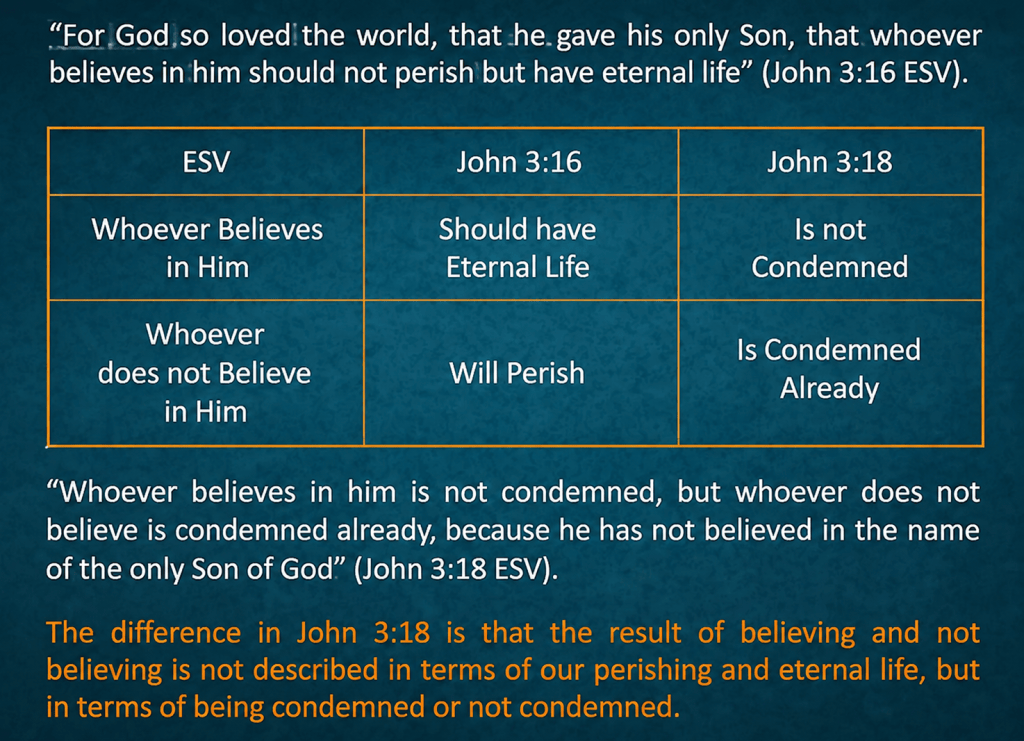
The ESV translation uses the word condemned and the NASB uses judged. The sinner is judged by the law and is declared guilty and condemned to die. Verse 17 forms a bridge between two conditions. In John 3:16 and the second half of John 3:17, Jesus, the Son of God, was sent that the world might be saved through him. The first half of verse 17 links to verse 18 and the idea of judgment and being condemned. John 3:36 helps: “Whoever believes in the Son has eternal life; whoever does not obey the Son shall not see life, but the wrath of God remains on him” (ESV). Each of us is born into this world with God’s wrath on us. We are already judged and condemned to die. On this basis, Jesus does not come to judge, but to provide a way of belief and salvation.
Everyone is born guilty and condemned to death. Jesus was sent to provide a way to make guilty people non-guilty, condemned people not condemned and to make dead people eternally alive. In the providence of God some will accept God’s provision, and the rest will remain in their condemned state. Understanding this I think we are now ready to move on to verses 19 – 21.
Prayer
Father, how marvelous are the Scriptures. It is like a rich mine waiting for one to dig and find the buried treasures. These treasures are like pieces of a magnificent puzzle and as we add pieces the picture becomes more exciting and the desire to keep digging grows. Father, my heart aches for those who just skim the surface and find only the edge pieces. I find that the pleasures and things of the world are a poor substitute for the treasures waiting to be discovered. Thank you for those hidden treasures.
3.21 John 3:19-21, Already Judged
John 3:17 tells us that “For God did not send the Son into the world to judge the world, but that the world might be saved through Him,” but there is something about the name of Jesus that causes division among people. There are some who embrace Jesus and escape judgment and others who oppose Jesus and go away into judgment. Even though Jesus did not come to judge, judgment is happening, and people are gathering into groups of belief and unbelief.
With this in mind let us move on to John 3:19 – 21: 19 “This is the judgment, that the Light has come into the world, and men loved the darkness rather than the Light, for their deeds were evil. 20 For everyone who does evil hates the Light and does not come to the Light for fear that his deeds will be exposed. 21 But he who practices the truth comes to the Light, so that his deeds may be manifested as having been wrought in God” (NASB).
What is this judgment that has come into the world? That judgment is related to “the Light that has come into the world. Jesus is the Word and the Word is God. “God is light, and in him there is no darkness at all” (1 John 1:5 NET). But Jesus is more than light. He is “the way, and the truth, and the life” (John 14:6). Jesus comes into the world as truth and light which exposes the hearts of sinful people. Being exposed to this light is like walking out of a dark room into the bright sunlight. The pain is so great that you immediately seek less light. Those who are in their sin and do evil hate the light and do not come to the Light for fear that their deeds will be exposed. This fear of the light and desire to hide in darkness goes all the way back to the sin of Adam and Eve. They covered themselves with fig leaves and hid from God after they ate the forbidden fruit in disobedience. Even believers feel the urge to hide after they sin because shame is painful.
Light always exposes that which is hidden in darkness and when it shines on the evil hidden in the darkness of our sinful hearts it causes pain, resulting in the person withdrawing further into darkness and unless God intervenes that person is not willing to come out of hiding and into the light. If God were to choose to touch a person, like he did Paul on the road to Damascus, then that light will lead that person to repentance and faith. The person who continues to hide in darkness and continues to sin stands condemned and judged, but those who come forth through the grace of God are set free and embrace the Light. We will consider this further in the next lesson.
Prayer
Father, I confess that even as a believer when I do wrong there is a desire to somehow cover the transgression up, but because of conviction by the Holy Spirit I find the only way to obtain peace is through confession. I can’t imagine what it would be like to desire to withdraw deeper and deeper into the darkness of despair without any hope of peace. Father, I find that unresolved sin causes me to be at war with you, with myself and with others. Thank you for the peace and the living hope you have given me in Christ Jesus.
3.22 John 3:16-21, Set Free
In this lesson we will finish up the section described by John 3:16 – 21. Specifically, we will look at verse 21: “But he who practices the truth comes to the Light, so that his deeds may be manifested as having been wrought in God” (NASB). To become better at something requires practice; to continue to do something over and over to gain greater proficiency at the task. The importance of practice is clear for the one who wants to excel at sports or playing a musical instrument. This idea is expressed in 2 Timothy 2:15: “Be diligent to present yourself approved to God as a workman who does not need to be ashamed, accurately handling the word of truth” (NASB). Through practice we gain proficiency in living out the truth.
The one who practices the truth knows how to accurately handle the word of truth in life situations. As one practices the truth that person is drawn closer to the Light and there it can be clearly seen that his works have been carried out in God. Those who are proud and seek some form of profit and power turn from the light and unless God intervenes, will continue on into the darkness of eternal punishment. But those who desire humility and meekness will practice the truth and will come into the light and will enjoy the benefits of eternal life in the presence of the living God.
Remember Cain and Abel back in Genesis 4:1 – 7 and the offering that each made. Cain brought the best of the fruit of the ground. It was to impress God with the best of his work. Abel brought the best of the firstborn of his flock and by faith trusted that God would accept him. God was not pleased with Cain’s offering and rejected it but was pleased with Abel’s offering and accepted it. As a result, Cain became angry and allowed sin to grow in his life to where he took the life of Abel. As we practice the truth we come to the Light where it becomes plainly evident that our works have been carried out in God, but if we practice sin, we will hate the Light and try to hide in darkness. Jesus did not come to judge the world, but as the truth and light, his presence like a wedge divides people into two groups: those who love the light and those who love darkness.
Prayer
Father, thank you choosing me and causing me to be born again that I would obey Jesus Christ. Thank you for the presence of the Holy Spirit in my life who continues to encourage me in obedience. Thank you for the promise that you will conform me into the image of your Son. Thank you for the living hope that fills my heart and the desire to dwell in the light of eternal life. How awesome and wonderful you are my Father. Thank you, Lord Jesus, for your love and sacrifice that made this possible.
3.23 John 3:22-26, On to the Land of Juda
We are ready to finally move ahead to the next section that we will define to include John 3:22 – 30. Chapter 3 begins with Jesus in Jerusalem having a conversation with a Pharisee, named Nicodemus, a ruler of the Jews. Jesus told him that he had to be born again if he was to enter heaven, but Nicodemus could not comprehend what Jesus meant. Since God had not prepared his heart spiritually to understand, Jesus changed the conversation to why he was sent into the world. Jesus came not to judge the world but that the world might be saved through him. “After this Jesus and his disciples went into the Judean countryside, and he remained there with them and was baptizing” (John 3:22 ESV). Looking ahead to John 4:1 – 2 we learn that Jesus himself was not baptizing, but his disciples were, and they were baptizing more people than John was.
Let us sharpen the picture. We are in the Judean territory, at the Jordan River at Aenon near Salim, because the water was plentiful there and people were coming there to be baptized. On one side of the river John was baptizing and on the other side the disciples of Jesus were baptizing. As expected, people began to notice that John was falling behind Jesus in the number of baptisms. We are no different today. Our pride wants us to be bigger and better than the church down the street or across town. John’s disciples seem to be a little upset because they say to John, “Rabbi, the one who was with you on the other side of the Jordan River, about whom you testified—see, he is baptizing, and everyone is flocking to him!” This is exactly what was supposed to happen and brings us back to consider once again the uniqueness of Jesus. We will pick this up in the next lesson when we look at John 3:27 – 30.
Before we leave this lesson, I should point out that I didn’t cover verse 25 about ceremonial washing because no one really understands what this was all about. Anything I might say would be just speculation and I believe there is more important things to cover in the time we have, so we will move on.
Prayer
Father, some of these lessons are hard to draw a personal application because of their informative nature. But as I think about this lesson, I have to consider my own feelings. How do I feel about someone else receiving attention and not me? Lord, you know that pride is something we humans always struggle with. Father, continue to conform me into the image of Jesus so that I would continue to see greater evidence of humility and meekness in my life.
3.24 John 3:27-30, This Is God’s Plan
In the previous lesson we went from Jerusalem to the Judean countryside and from conversation with Nicodemus about being born again to who was baptizing more people. This brings us to John 3:27 – 30 and a further discussion of why it is a good thing that John is fading in popularity and that Jesus is now drawing the attention of a growing multitude of people. Of all that Jesus has done that John could write about, why does he come back to John the Baptist? Let us look at the verses and see. Our text is: “27 John answered, “A person cannot receive even one thing unless it is given him from heaven. 28 You yourselves bear me witness, that I said, ‘I am not the Christ, but I have been sent before him.’ 29 The one who has the bride is the bridegroom. The friend of the bridegroom, who stands and hears him, rejoices greatly at the bridegroom’s voice. Therefore, this joy of mine is now complete. 30 He must increase, but I must decrease.”” (John 3:27 – 30 ESV).
In verse 27, John answers the person who was concerned that Jesus was baptizing more than John was with the response, “A person cannot receive even one thing unless it is given him from heaven” (ESV). How does this answer relate to the people going to Jesus to be baptized? On the surface it appears that Jesus has more to offer than John. For example, changing water into wine, but there is more in the answer John gives than that. The implication is that the Father gives those of his choosing to Jesus and those he gives will come to Jesus and he will give to them eternal life. You and I “cannot receive even one thing unless it is given [to us] from heaven.” We will see this later when we study John 6:37: “All that the Father gives Me will come to Me, and the one who comes to Me I will certainly not cast out” (NASB). These people are turning away from John and going to Jesus as an illustration that God is doing this and giving them to Jesus, his Son. Coming to Jesus and into the light is only possible with the power of God. John is trying to help us understand that spiritually, people lost in their sin are unable to come to Jesus and into the light without the Father’s intervention.
John continues in verse 28 by saying, “You yourselves can testify that I said, ‘I am not the Christ,’ but rather, ‘I have been sent before him’” (NET). Again John makes it clear that he was simply a forerunner to Jesus. He is not the Christ but simply one that was sent to prepare the way. It was God’s plan for John to come and gather a people around him and then give them up to Jesus. This is our calling also. We are to reach out to people with God’s love and establish a connection with them to gain a hearing and as we do it is our responsibility to share the whole gospel, not just that part they might be comfortable with. We must make it clear to them that Jesus is the center of the gospel even if this might cause some to turn away or even to result in our persecution. This is not about our popularity or our safety and comfort, but about bringing people to Jesus Christ.
This brings us to verse 29 and to the heart of the section, which is about the bridegroom and the joy that results in being related to him. “The one who has the bride is the bridegroom.” Jesus is the bridegroom and we as believers make up the bride. John refers to himself as “the friend of the bridegroom, who stands and hears him” and “rejoices greatly because of the bridegroom’s voice.” As a result of what he hears John says his joy has been made full. We will look at this in our next lesson.
Prayer
Father, as I worked on this lesson, I am reminded of the importance of making connections with people to start conversations about their need for a savior. As they become interested through our growing friendship it is my responsibility to help them establish a relationship with Jesus that will exceed their relationship with me. I pray that the Holy Spirit will help me gather people that I can pass on to Jesus.
3.25 John 3:29-30, Humility Is Key
In our last lesson John 3:29 was introduced, showing us a new image. “29 The one who has the bride is the bridegroom. The friend of the bridegroom, who stands and hears him, rejoices greatly at the bridegroom’s voice. Therefore, this joy of mine is now complete. 30 He must increase, but I must decrease.” (John 3:29 – 30 ESV). Jesus is the bridegroom, and the bride is the multitude of people the Father has chosen and given as a gift to his Son Jesus who gives to each one the gift of eternal life at the precise moment the Father causes spiritual birth, and we believe. John the Baptist is of course the friend of the bridegroom who stands and hears the voice of the bridegroom and rejoices greatly and exclaims that his joy is now complete. Why does this voice cause such a response from John?
In John 1:23 he said, “I am the voice of one crying out in the wilderness.” It was a voice that gathered people together around him, but now there is another voice the people hear, and it seems to be a greater and a stronger voice. This voice is spoken of in John 10:3 – 4: “To him the gatekeeper opens. The sheep hear his voice, and he calls his own sheep by name and leads them out. When he has brought out all his own, he goes before them, and the sheep follow him, for they know his voice” (ESV). The sheep who follow him is the bride and they follow because the bridegroom has a voice, and they know it. The plan has come into focus for John and what he sees completes his joy. Jesus calls and those the Father has prepared will hear his voice and they will come. I think John can only imagine what a wonderful thing it is to be part of the bride.
John cried out and gathered people to himself, but he could not provide them with salvation. John then instructs them to listen for the voice of Jesus, the bridegroom, and turn and go and follow him. John draws to himself but always points them to Jesus who is so much greater. The point John is making is so important for us to see and embrace: “He must become more important while I become less important” (John 3:30 NET). We must never forget this principle of our service of humility to direct people to our loving savior.
Prayer
Father, I have often thought what it might be like when the bride is complete, and we are all assembled in heaven and be embraced by our Lord. We as perfect members of the body, children of the Father, all bonded together in unity by the indwelling Holy Spirit, and one with Christ. It seems that we are drawn into the very being of God in the Trinity. Being in and part of the very presence and existence of holiness, righteousness, and glory, is beyond my mind to grasp. Father, forgive me for not living as though I fully believed this.
3.26 John 3:31, Jesus Is Above All
With this lesson we begin the last section of chapter 3, which includes John 3:31 – 36 (ESV): “31 He who comes from above is above all. He who is of the earth belongs to the earth and speaks in an earthly way. He who comes from heaven is above all. 32 He bears witness to what he has seen and heard, yet no one receives his testimony. 33 Whoever receives his testimony sets his seal to this, that God is true. 34 For he whom God has sent utters the words of God, for he gives the Spirit without measure. 35 The Father loves the Son and has given all things into his hand. 36 Whoever believes in the Son has eternal life; whoever does not obey the Son shall not see life, but the wrath of God remains on him.”
In this lesson we will sharpen our focus on the uniqueness of Jesus. We clearly see this in verse 31: “The one who comes from above is superior to all. The one who is from the earth belongs to the earth and speaks about earthly things. The one who comes from heaven is superior to all” (NET). In the context of chapter 3, the one who comes from above and who comes from heaven is Jesus. This verse makes it very clear that Jesus is not from the earth as all others are. This makes Jesus unique as he is the only one from heaven above.
The one who is from earth includes everyone else. Those from the earth belong to the earth and speak about earthly things because they don’t know any better. We have learned in previous lessons that each one of us is born of the flesh. It is a natural birth and so we are from the earth. We are born spiritually dead without supernatural life and unless we are born of the Spirit we will enter eternal judgment at physical death.
Paul defines two categories of people in 1 Corinthians 15:47 – 49: 47 “The first man is from the earth, earthy; the second man is from heaven. 48 As is the earthy, so also are those who are earthy; and as is the heavenly, so also are those who are heavenly. 49 Just as we have borne the image of the earthy, we will also bear the image of the heavenly” (NASB). The first man is Adam, and the second man is Jesus. Each one of us begins life on earth bearing the image of Adam and enslaved to sin. All who are born spiritually bear the image of Jesus and inherit his righteous condition. Jesus who comes from heaven comes as the head of the new human race called the family of God.
Look again at John3:31: “The one who comes from above is superior to all.” How is this so? “In the beginning was the Word, and the Word was with God, and the Word was God. . . And the Word became flesh and dwelt among us, and we have seen his glory, glory as of the only Son from the Father, full of grace and truth” (John 1:1, 14 ESV). Jesus is superior because he is the Son of God. Jesus came to provide salvation for those who come to him in belief. Out of the mass of humanity that belongs to the earth, God the Father is selecting out those who he gives as a bride to Jesus. This family of God is indwelt by the Holy Spirit and becomes one in union with Jesus Christ. The more I study this and understand this the greater is my desire to go to heaven and really experience this union with Christ. If you really understand what we are and have in Jesus Christ it will change how you live and what you long to experience in heaven. Most western Christians today don’t have a longing for heaven that affects their life now because they really don’t understand who or what they are in Jesus. Unfortunately, western Christianity is becoming more of a religion than it is a vital relationship with the person of Jesus Christ. We are becoming more and more like the group described in Matthew 7: 21 – 23 (ESV): “21 “Not everyone who says to me, ‘Lord, Lord,’ will enter the kingdom of heaven, but the one who does the will of my Father who is in heaven.22 On that day many will say to me, ‘Lord, Lord, did we not prophesy in your name, and cast out demons in your name, and do many mighty works in your name?’ 23 And then will I declare to them, ‘I never knew you; depart from me, you workers of lawlessness.’”.
In our next lesson we will move on to John 3:32 – 34.
Prayer
Father, it is so clear that without Jesus Christ there is no hope. Humans would continue to produce offspring, suffer through physical life, and die to enter an eternity under the wrath of God because of their sin. Jesus and only Jesus is superior and able to save those who come to him. Father, how can I ever thank you for my salvation?
3.37 John 3:32-34, The Testimony of Jesus
Jesus who comes from heaven above has a message for us who are of the earth: 32 “He testifies about what he has seen and heard, but no one accepts his testimony. 33 The one who has accepted his testimony has confirmed clearly that God is truthful. 34 For the one whom God has sent speaks the words of God . . .” (John 3:32 – 34 NET). Since Jesus is the Son of God what he has to say is the word of God. Those who heard Jesus were hearing God speak to them. Today we have the Bible and learn from God as we read, and the Holy Spirit opens it to us. But verse 32 tells us that no one accepts his testimony. From previous lessons we learned that anyone who has not been born spiritually is spiritually dead and does not understand spiritual things. These are the ones who do not accept his testimony.
John speaks of those who accept his testimony in verse 33. They are the ones who are born again and are spiritually alive. Those who accept his testimony believe what they hear and have the conviction that God is indeed truthful. These believers are convinced that God will fulfil all that he has promised and are willing to give their lives to follow him. We see these people in many closed nations giving their lives for their faith. I saw this in the house church movement in China when I taught there and had a close encounter with authorities. Most of my students were not so lucky.
It is clear that Jesus divides the population of the world into two parts; those who accept his testimony, come to him in faith, and obtain eternal live; and those who do not accept his testimony and remain of the earth and continue spiritually dead.
At the end of verse 34 is the difficult statement “for he gives the Spirit without measure.” (ESV) or “but boundless is the gift God makes of His Spirit!” (NET). If for no other reason than my own benefit, I want to spend some time considering what it means and will devote the next lesson to it.
Prayer
Lord, what joy I have as I study your word to prepare these lessons. Each lesson is like being seated before a great meal. My heart aches for those who don’t take time to study or for those who don’t even take time to read. How they will groan in that day when they realize they lived life with the wrong priorities. Father, I pray for them and thank you for all you have done for me.
3.28 John 3:34-35, The Spirit Without Measure
Our lesson today will come from John 3:34 – 35 (ESV): “34 For he whom God has sent utters the words of God, for he gives the Spirit without measure. 35 The Father loves the Son and has given all things into his hand. It is easy to understand that the Father loves the Son.” But what does “For he whom God has sent utters the words of God, for he gives the Spirit without measure” mean? It is clear that God sent Jesus, and he utters the words of God, but what does “for he gives the Spirit without measure” at the end mean? John Piper wondered the same thing and explained what he thinks in the lesson titled “The Father Has Given All Things into Jesus’s Hands.” I am going to jot down some thoughts and let you fill in the details by listening to his lesson.
Who does the Father give the Spirit without measure? Since we are finite it can’t be us so it must be referring to Jesus. But why would he give the Spirit without measure to Jesus? “The Father loves the Son” follows “he gives the Spirit without measure” so maybe there is a connection between giving the Spirit and loves the Son. Consider the following connection. “God is love” (1 John 4:8, 16) and the fruit of the Spirit is love” (Galatians 5:22). This provides a connection between Spirit and love. It is possible that to give the Spirit without measure would be the same as loving without measure. “The Spirit of God is love and this love for the Son is so full and carries so much of the fullness of the Father that this love is himself God” (John Piper). This Spirit is the eternal self-loving of the Father that he gives. Jesus is the one who brings the testimony so we could say that the Son is the eternal self-knowing of the Father. “The Son is the fullness of the Father as his perfect image and the Spirit is the fullness of the Father loving this image, the Son” (John Piper). Consider another thought. Jesus is from above and is superior to all because he is the Son of God. The Father giving the Spirit without measure to Jesus indicates that he is full of God. Therefore, Jesus is God.
Thinking about the Trinity in terms of difference and their relationship is sure a mind stretch. For me, another mind stretch is considering what we will be like and our relationship with the trinity. I think there will be an intimacy beyond what we can think of. We are children of the Father. We are in Christ and he is in us and we are one with Jesus Christ in marriage. The Spirit lives within each of us. All of this and more ties us pretty tight into this trinity structure. The fullness of life, light and love is beyond our comprehension and so foreign to our thinking. If our minds were saturated with this, it would be a simple decision to die if asked to deny Jesus. I am also sure we would live very different lives than we currently do. Comfort and safety would take a back seat to living for Jesus and proclaiming him to the world.
Prayer
Father, lessons like this are good because they cause hard thinking which stretch the mind, and they also sharpen one’s focus on Jesus who sacrifice so much to accomplish so much for us. Thank you for such a profound love that you have for us.
3.29 John 3:31-35, The Fork in the Road Is Jesus
With this lesson we will finish this section identified by John 3:31 – 36. In particular we will focus on the following: 35 “The Father loves the Son and has given all things into his hand. 36 Whoever believes in the Son has eternal life; whoever does not obey the Son shall not see life, but the wrath of God remains on him” (John 3:35 – 36 ESV). Giving all things into his hand makes him ruler of all things. Paul comments on this: “He is before all things, and in Him all things hold together” (Colossians 1:17 NASB). The author of Hebrews comments on this: “He is the radiance of the glory of God and the exact imprint of his nature, and he upholds the universe by the word of his power” (Hebrews 1:3 ESV). How can we not embrace the fact that Jesus is from God and is God and speaks and rules as God? Those from the earth who are not born again do not accept his testimony and do not embrace who he is. One can reject him, but in so doing we eliminate any possibility of access to the grace and truth we so desperately need.
Verse 36 is an interesting way to summarize and end this section: “Whoever believes in the Son has eternal life; whoever does not obey the Son shall not see life, but the wrath of God remains on him.” It is Jesus, the Son of God that divides humanity into two groups: those who believe and have eternal life and those who do not obey and remain under the wrath of God. That belief is possible for those who are born again. They are the ones that are able to receive his testimony. In 1 John 5:10 John says: “The one who believes in the Son of God has the testimony in himself; the one who does not believe God has made Him a liar, because he has not believed in the testimony that God has given concerning His Son” (NASB). He who calls God a liar by not receiving his testimony is the one who remains under the wrath of God. Jesus is the way, the truth and the life. There is no other. How do you choose? Jesus or some other way that leads to eternal death.
Prayer
Father, Jesus clearly stands out as the one who is qualified to provide our salvation. Thank you for revealing this to me and making it possible for me to accept his testimony. Transfer from the domain of darkness to the kingdom of the beloved Son has been an adventure of discipline and love. How I look forward to the adventure continuing on into heaven. Thank you for your mercy and grace that made this salvation possible.
Questions with Answers
Questions with answers for understanding
1. Why did Nicodemus come to Jesus at night?
Answer:
Nicodemus was a Pharisee and “a ruler of the Jews” (John 3:1), making him a respected religious leader. He acknowledged that Jesus must have come from God because no one could perform such signs unless God were with him. His nighttime visit may indicate caution or a desire for a private conversation away from the crowds. More importantly, the encounter shows that even a knowledgeable, respected, religious man needed something he could not obtain through position, learning, or religious observance: new spiritual life from God.
2. What did Jesus mean when He said a person must be “born again”?
Answer:
Jesus told Nicodemus, “Unless one is born again he cannot see the kingdom of God” (John 3:3). The expression can also carry the idea of being “born from above.” Jesus was describing a spiritual transformation accomplished by God. Physical birth gives physical life, but entrance into God’s kingdom requires spiritual life. Christianity, therefore, is not merely improving one’s behavior or becoming more religious. Salvation involves God giving a person new life.
3. What does it mean to be “born of water and the Spirit”?
Answer:
Jesus says, “Unless one is born of water and the Spirit, he cannot enter the kingdom of God” (John 3:5). In light of Old Testament promises such as Ezekiel 36:25–27, water points naturally to cleansing from sin, while the Spirit points to the new life God gives. Jesus is describing the inward renewal promised by God—a cleansing and transformation brought about by the Holy Spirit. Salvation requires more than external religious observance; God must cleanse and renew the heart.
4. Why did Jesus compare the work of the Spirit to the wind?
Answer:
Jesus explained that the wind blows where it wishes; people hear its sound but cannot fully determine where it comes from or where it goes. In the same way, the Holy Spirit works sovereignly and invisibly. We cannot see the Spirit Himself, but we can see the results of His work in transformed lives. The illustration reminds Nicodemus that spiritual rebirth is ultimately God’s work rather than something human beings can manufacture or control.
5. Why was Jesus surprised that Nicodemus did not understand these things?
Answer:
Jesus asked, “Are you the teacher of Israel and yet you do not understand these things?” (John 3:10). As a teacher of Scripture, Nicodemus should have recognized the Old Testament promises that God would cleanse His people, give them new hearts, and put His Spirit within them. His difficulty illustrates an important truth: extensive biblical and religious knowledge does not automatically produce spiritual understanding. Scripture must ultimately lead a person to recognize his need for God’s transforming grace.
6. What does the bronze serpent illustrate about Jesus?
Answer:
Jesus refers to Numbers 21, where Israelites who had been bitten by poisonous serpents were saved when they looked at the bronze serpent God instructed Moses to lift up. Jesus says, “So must the Son of Man be lifted up” (John 3:14). The bronze serpent pointed forward to Christ. Humanity is dying because of sin, but God provides salvation through His Son. Just as the Israelites looked to God’s provision and lived, sinners who believe in Christ receive eternal life. Jesus being “lifted up” ultimately points to His crucifixion.
7. What does John 3:16 teach about God’s love and salvation?
Answer:
John 3:16 summarizes the heart of the gospel: God’s love moved Him to give His only Son so that those who believe in Him will not perish but have eternal life. Salvation begins with God’s love and is accomplished through God’s Son. Eternal life is not earned by good works, religious status, or human merit; it is received through faith in Jesus Christ. The verse also emphasizes the seriousness of humanity’s condition: without Christ, people perish; through Christ, they receive eternal life.
8. Why did God send His Son into the world?
Answer:
John 3:17 explains that God did not send His Son into the world primarily to condemn the world, “but in order that the world might be saved through him.” Jesus came on a mission of salvation. Humanity was already under judgment because of sin and unbelief. Christ came to provide the way of rescue. His first coming therefore reveals God’s mercy and His desire to save sinners through faith in His Son.
9. Why are people condemned if they reject Christ?
Answer:
John 3:18 states that whoever believes in Christ is not condemned, but whoever does not believe “is condemned already.” The fundamental problem is not that Christ came and created condemnation; humanity already stands guilty before God because of sin. Christ provides the means of salvation. Rejecting Him leaves a person in the condition of judgment from which Jesus came to save him.
10. Why does Jesus describe Himself as the light?
Answer:
Jesus explains that light has come into the world, but people loved darkness rather than light because their works were evil (John 3:19–21). Light exposes what darkness conceals. Christ reveals both God’s holiness and humanity’s sinfulness. Those who cling to sin resist the light because they do not want their deeds exposed. Those who come to the light acknowledge the truth and demonstrate that God’s transforming work is taking place in their lives.
11. Why were John’s disciples concerned that people were going to Jesus instead of John?
Answer:
John’s disciples noticed that Jesus was attracting increasing attention and apparently viewed Him as competition. John the Baptist did not. He understood that his ministry had always been to prepare the way for Christ. He reminded his disciples, “I am not the Christ, but I have been sent before him” (John 3:28). John knew that successful ministry was not measured by how many people followed him but by whether people were being directed toward Jesus.
12. What is the significance of John’s comparison of Jesus to the bridegroom?
Answer:
John described himself as the friend of the bridegroom who rejoices when he hears the bridegroom’s voice. Jesus is the central figure; John is merely His servant. Rather than being jealous of Jesus’ growing ministry, John rejoiced in it. His joy was complete because the One for whom he had prepared the way had arrived. The illustration provides a model of humble Christian service: Christ receives the attention and glory, while His servants rejoice simply to serve Him.
13. What does John mean when he says, “He must increase, but I must decrease”?
Answer:
John 3:30 expresses John the Baptist’s understanding of his entire ministry. His purpose was never to build a permanent following around himself. His calling was to point people to Christ. As Jesus’ ministry increased, John’s naturally diminished. Rather than resisting this change, John welcomed it. The statement also expresses an important principle of discipleship: as believers mature, Christ should become increasingly central while pride, self-promotion, and concern for personal recognition diminish.
14. How does John 3 demonstrate the superiority of Jesus?
Answer:
Jesus is described as the One who comes “from above” and is therefore “above all” (John 3:31). John the Baptist was an earthly messenger sent by God, but Jesus came from heaven and speaks what He has seen and heard. The Father loves the Son and “has given all things into his hand” (John 3:35). Jesus is therefore not merely another prophet or religious teacher. He is the heavenly Son who uniquely reveals the Father and possesses divine authority.
15. What two possible destinies are presented at the end of John 3?
Answer:
John 3:36 presents a sharp contrast: “Whoever believes in the Son has eternal life; whoever does not obey the Son shall not see life, but the wrath of God remains on him.” There is no neutral response to Jesus. Faith in the Son brings eternal life, while rejecting Him leaves a person under God’s judgment. This conclusion reinforces the central message of the chapter: eternal life is found only through faith in Jesus Christ.
Central Understanding of John 3
John 3 explains that salvation requires a new birth accomplished by the Holy Spirit and received through faith in Jesus Christ. Religious knowledge, morality, position, and human achievement cannot give eternal life. God loved the world and gave His Son so that sinners might be saved through Him. Jesus is the light who exposes humanity’s need, the Son who was lifted up for salvation, and the One in whom eternal life is found. John the Baptist then provides the proper response to Christ: “He must increase, but I must decrease” (John 3:30).
Chapter 4 – Living Water for a Thirsty Soul
Chapter Introduction
Introduction to Chapter 4
John 4 records one of the most revealing encounters in the ministry of Jesus as He meets a Samaritan woman at Jacob’s well and reveals Himself as the source of living water and the promised Messiah. Breaking through deep cultural, religious, and social barriers, Jesus demonstrates that God’s salvation is offered not only to the Jews but to all who worship Him in spirit and truth. The conversation with the woman reveals Jesus’ knowledge of the human heart, His compassion for the broken, and His mission to seek and save those who are spiritually thirsty. Following this encounter, Jesus heals the official’s son, showing that His authority extends beyond physical boundaries and that faith in His word brings life. John 4 emphasizes that true satisfaction is found only in Christ, who gives eternal life, transforms lives, and calls His followers to share the good news with others.
Bible Lessons
4.1 John 4:1-6, Why Did Jesus Leave Judea
After 62 lessons we have finally come to the fourth chapter of John and a transition section defined by John 4:1 – 6 (ESV): “1 Now when Jesus learned that the Pharisees had heard that Jesus was making and baptizing more disciples than John 2 (although Jesus himself did not baptize, but only his disciples), 3 he left Judea and departed again for Galilee. 4 And he had to pass through Samaria. 5 So he came to a town of Samaria called Sychar, near the field that Jacob had given to his son Joseph. 6 Jacob’s well was there; so, Jesus, wearied as he was from his journey, was sitting beside the well. It was about the sixth hour.”
The section opens with the statement of why Jesus decided to leave Judea and travel to Galilee: “Now when Jesus learned that the Pharisees had heard that Jesus was making and baptizing more disciples than John” (John 4:1 ESV). Why would that information in the hands of the Pharisees cause Jesus to leave the area? In the sermon titled “You Will Never Be Thirsty Again”, John Piper gives four possibilities that I would like to make note of here.
The first possibility has to do with timing. In John 2:4 when the mother of Jesus informed him about the lack of enough wine, Jesus replied, “My hour has not yet come.” In John 7:30 after Jesus cried out that he knew the Father, and had come from him, and that he had sent him, “they were seeking to arrest him, but no one laid a hand on him, because his hour had not yet come.” Did Jesus sense such a threat here and decided to avoid the possibility of arrest by the Pharisees by leaving the area?
The second possibility could relate to the growing popularity of Jesus being used by the Pharisees to discredit John. Leaving the area may have been a way to lessen the tension between the Pharisees and John over the call to repent and be baptized.
The third possibility relates to the desire or plans by the Pharisees to discredit both movements. By leaving the area, Jesus would draw their focus on what he was sent to accomplish by his Father.
The fourth possibility has to do with divine appointments. I have experienced this in my life. The call to minister in China, the people I crossed paths with that God wanted me to help in some way, or the need to pray for something that empresses my mind. Did Jesus feel a divine impulse to go to Galilee by way of Samaria because of a diving appointment there? Because of how God has used me in these divine appointments I am convinced that it was necessary for Jesus to go to Samaria to touch a woman there and develop further his mission on earth.
There are probably many possibilities why Jesus decided to move on to Galilee. There are many things God nudges us to do that are according to his purpose. Was there a purpose in this travel? We will see.
Prayer
Father, thank you for the Holy Spirit that is at work producing these diving appointments. Forgive me for the slowness of responding to these opportunities you provide. Thank you for the blessings I have experience when I was obedient to the urge to respond. What a wonderful thing I am finding it is to walk with the Lord in his work.
4.2 John 4:5-8, Jesus Did the Unthinkable
In our last lesson we concluded that Jesus left Judea and departed for Galilee for some purpose. Hopefully that purpose will become clear in this lesson. When traveling from Judea to Galilee, most Jews would choose a longer route that would take them around Samaria because of their dislike of the Samaritans and their desire to avoid them. The Samaritans were Jews that had earlier in history married people of another race who had settled in the area of Samaria. This intermarriage created a people group that was considered ceremonially unclean and racially impure by the true Jew and were to be avoided. To understand this, consider the fact that back in the early history of our country, whites and blacks would not drink from the same drinking fountain or use the same restrooms.
“So, [Jesus] came to a town of Samaria called Sychar, near the field that Jacob had given to his son Joseph. Jacob’s well was there; so, Jesus, wearied as he was from his journey, was sitting beside the well. It was about the sixth hour” (John 4:5 – 6 ESV). We find Jesus, wearied from traveling, sits down on the stone ring around the well opening to rest. It was about noon, the sixth hour. “A woman from Samaria came to draw water. Jesus said to her, “Give me a drink.” (For his disciples had gone away into the city to buy food.)” (John 4:7 – 8 ESV). As you look carefully at these two verses what observations can you make? He felt led to go to Samaria with his disciples because that is where he is now. He sent all of the disciples away to buy food leaving him alone at the well. He sat on the edge of the well to be easily noticed. And fourth he asked a woman who came to the well to draw water, who in the eyes of a Jew was to be avoided, for a drink.
Here we find Jesus doing the unthinkable of pursuing a relationship with a woman who is considered of little to no value and is to be avoided. A powerful example of this is the documentary “Veil of Tears” (See official movie trailer). All people are created by God in his image and even though fallen they all have value in his eyes. It is our responsibility to approach each person as a possible choice God has made for salvation. “For God did not send the Son into the world to judge the world, but that the world might be saved through Him” (John 3:17 NASB). We must not forget that and as Jesus opens conversation with this woman his desire is for her to respond spiritually. The question is, Will she?
Prayer
Lord, your conversation with an undesirable about spiritual things sets an example for me to share your love with those I am uncomfortable with. Father, I find this similar to loving my enemy and offering forgiveness for my mistreatment. How do I love and forgive those who may persecute me, even if they might take the life of a family member? Father, I know from my study of persecution that my brothers and sisters of eastern countries understand this much better than I do. I pray your blessing on them.
4.3 John 4:9-12, Living Water
Let us go back to the account of the woman of Samaria. Jesus was sitting on the ring that formed the opening to the well waiting for his expected divine encounter. Right on schedule, she walks up alone to draw water. Jesus turns to her and asks her for a drink. “The Samaritan woman said to him, “How is it that you, a Jew, ask for a drink from me, a woman of Samaria?” (For Jews have no dealings with Samaritans.)” (John 4:9 ESV). It was not normal for a Jew to be found alone out in the open like Jesus was in Samaria at the well and was shocking to the woman when Jesus asked for a drink from her bucket. I see a picture of a glass wall separating Jesus and the woman. They both know each other is there, but when Jesus speaks his words crash through the glass shattering it and with utter surprise, she asks why Jesus would even speak to her. Jesus avoids the question with the statement: “If you knew the gift of God, and who it is that is saying to you, ‘Give me a drink,’ you would have asked him, and he would have given you living water” (John 4:10 ESV).
A discussion about the tension between the Jews and the Samaritans was not important to Jesus at this time. He was more concerned that the woman understand that she was standing before the Son of God who was offering her the gift of living water. How she responds to the statement Jesus made will reflect her spiritual condition. Will her response reflect spiritual insight, or will she respond with a natural response? When Jesus told Nicodemus he had to be born again, his response reflected a natural response by wondering how he could enter again into his mother’s womb and be born again. How did the woman respond?
“Sir,” the woman said to him, “you have no bucket and the well is deep; where then do you get this living water? Surely, you’re not greater than our ancestor Jacob, are you? For he gave us this well and drank from it himself, along with his sons and his livestock” (John 4:11 – 12 ESV). This woman is just like Nicodemus. He couldn’t understand how to get back into the womb and she wonders where his bucket is that will provide the living water. Both are blind to spiritual things and are unable to see the glory of the only Son of God (John 1:14).
In our next lesson we will comment further on these two verses and cover verses 13 – 14.
Prayer
Lord, thank you for the living water you provide for those who believe. You are the source of so much that we need to cause life to be abundant and meaningful. Lord, what you have to offer is not like what the world has to offer, which doesn’t last or truly satisfy, but what you supply is free and requires no maintenance on our part. Thank you for your gift of grace, life, love, peace, joy, and most important the gift of yourself.
4.4 John 4:11-14, The Gift of Living Water
In this lesson we will finish up our discussion on John 4:11 – 14 (ESV): “11 The woman said to him, “Sir, you have nothing to draw water with, and the well is deep. Where do you get that living water? 12 Are you greater than our father Jacob? He gave us the well and drank from it himself, as did his sons and his livestock.” 13 Jesus said to her, “Everyone who drinks of this water will be thirsty again, 14 but whoever drinks of the water that I will give him will never be thirsty again. The water that I will give him will become in him a spring of water welling up to eternal life.”
After Jesus said to the woman, “If you knew the gift of God, and who it is that is saying to you, ‘Give me a drink,’ you would have asked him, and he would have given you living water”, she responds with, “You have no bucket and the well is deep; where then do you get this living water? Surely, you’re not greater than our ancestor Jacob, are you? For he gave us this well and drank from it himself, along with his sons and his livestock.” Jesus makes a claim to his superiority, and she challenges him with the question, “Surely you’re not greater than our ancestor Jacob, are you?”
The question before us is, “Do you think Jesus is greater than Jacob and if so, why?” Consider what Jesus said in response to her question: ““Everyone who drinks of this water will thirst again; but whoever drinks of the water that I will give him shall never thirst; but the water that I will give him will become in him a well of water springing up to eternal life” (John 4:13 – 14 NASB). Jesus is greater than Jacob and the water he can supply is greater than the water from the well that Jacob dug. This water that Jesus gives becomes a well in that it never runs out and it satisfies one’s thirst forever.
I will close this lesson and this section with a quote from the sermon by John Piper, titled “You Will Never Be Thirsty Again.” He lists five things Jesus says about the water that he gives and offers us today:
- It’s the gift of God (verse 10: “If you knew the gift of God”).
- It’s living water (verse 10: “He would have given you living water”).
- If you drink it, you never thirst again—that is, it’s always there to satisfy you when your longing soul is thirsty (verse 14: “Whoever drinks of the water that I will give him will never be thirsty again”).
- This water becomes a spring—a well of water (verse 14: “The water that I will give him will become in him a spring of water”). That’s why you never get thirsty again—not because one drink is enough, but because one true drink produces a well for an eternity of drinks.
- This water gives eternal life (verse 14: “. . . a spring of water welling up to eternal life.”).
Have you received this gift of living water from Jesus that springs up to eternal life?
Prayer
Lord, thank you for the gift of living water you have given me. It is the promise of refreshment for an eternity with you. I think of those who will suffer for an eternity apart from you in hell where this refreshing, life giving water will not be available to quench the horrible thirst that will be experienced there. Lord, you have so much to offer. How can anyone not surrender to you to enjoy all you have to offer? Thank you for you gifts to me.
4.5 John 4:15-19, Uncovering Needs
The next section in our study covers John 4:15 – 26. In response to Jesus telling the woman who he was and that he could provide her with living water, the woman clearly communicated that she still did not understand the spiritual nature of the living water by saying, “Sir, give me this water, so that I will not be thirsty or have to come here to draw water” (John 4:15 ESV). Like Nicodemus, she was still unable to understand spiritual things and therefore unable to understand what Jesus was saying. Jesus then realized that further conversation about living water would not be productive, so he changed the focus of the conversation to her marriage by requesting her to “Go call your husband and come back here” (John 4:16 NET) to which she responds that she has no husband. Jesus then demonstrates his ability to know the lives of people, even their thoughts reply with, “You are right in saying, ‘I have no husband’; for you have had five husbands, and the one you now have is not your husband. What you have said is true” (John 4:17 – 18 ESV). This response surprises her and she responds with: “Sir, I perceive that you are a prophet” (John 4:19 ESV).
We need to look more deeply at what we just covered to see if we can’t learn more about this woman. I believe this deeper insight is important because in this culture we often share the gospel without any real interest in the life of the person. Jesus never tried to convince the woman to believe something or to make some kind of decision. He knew there was a deeper issue in her life that he needed to uncover and then make a spiritual connection to. As we look at these verses do, we see a possible clue that might open a door into her life?
In verse 15 and 16 is the word “here”. It seems that the woman doesn’t like to come “here” to the well to draw water and when she comes it is at noon when no one else will be there. Why does she not come in the morning along with the other woman when it is cooler? In verse 16, Jesus makes reference to “here” by requesting that she go and get her husband, which she does not have, and bring him “here” with her. What is the connection? Might it be, for some reason, a painful experience for her to come to the well and is there a connection to the men in her life and this pain? Should not her husband come with her to draw water and protect her from this fear or is her fear related to her many husbands?
Jesus perceives that in her pain to come to the well and the fact that she has had five husbands and is now living with a man, is a sin problem that he can focus on with her that could show her an important need that Jesus can help her with spiritually. Jesus is searching for a way to get into her inner life to open the door to her need of salvation.
We are beginning to see the importance of establishing a caring relationship with the person we want to lead to salvation. Salvation is not simply making a decision. It is a manner of the heart. In our next lesson we will consider this further.
Prayer
Father, thank you for teaching me, while I was in China that salvation is not winning a debate with a person that convinces them to pray a prayer, but is finding a need in a person’s life and showing how Jesus wants to meet that need. Thank you for teaching me that you determine the time of salvation, not me. Thank you for showing me that salvation is needs based not winning an argument.
4.6 John 4:15-19, Is the Heart Ready?
In this lesson we want to consider why it is important to learn about a persons need or relationship to a sin problem that can be used as a connection to a spiritual solution. Evangelism is not getting people to come forward or raise their hand or say a prayer, but it is to lead a person who is spiritually dead to Jesus who has the gift of living water that springs up into eternal life. To be effective, evangelism is to connect a person to Jesus through the work of the Holy Spirit in an area of their need. Salvation is an issue of the heart not the mind. In this section Jesus wants to bring this woman’s need out of the darkness she is hiding it in and expose this need to the light so she can be helped.
Think back to John 3:20: “For everyone who does evil deeds hates the light and does not come to the light, so that their deeds will not be exposed” (NET). This is where the woman was when she was confronted by Jesus. This woman is spiritually dead and blind to spiritual things and because of her sin of years of improper relationships her heart was hard. She felt safe alone where she could better hide her sin and thus her need. Loving relationships must be built with such people to provide safe areas where needs can be exposed, and the gospel applied.
The area of sin for this woman was in her relationship with men. She either chose men who would mistreat her, or they found something about her that caused them to leave her or maybe both. Her unstable sinful life with men set her apart from the other woman as a vile undesirable woman to not be with. Being ridiculed by other women and abused in marriage this woman harbored some very deep hurts in her life. From this Jesus sees a woman with a very deep emptiness and sinfulness that hurts so much she has sealed it up darkness. Jesus knows that her heart is locked up in this darkness and he knows he must probe that darkness to find the source of the hurt. Jesus did not want to deal with the problem at that time. He simply wanted to expose to her the thirst that she didn’t know she had and share with her that the living water he had if drunk by faith would satisfy her thirst and would spring up into eternal life with joy and satisfaction.
What I am trying to emphasize in this lesson is that leading a person to salvation is usually not accomplished by an altar call or a discussion with a person. It is essential to determine if God has prepared the person spiritually to understand spiritual things. Jesus used the example of being born again with Nicodemus and he used the example of living water with this woman. In both cases he determined they had not been spiritually prepared. I generally use spiritual birth as a test. If the person fails my test like Nicodemus did then I know I need to lay more foundation and allow God more time to prepare the person, if he is going to. There are many he doesn’t prepare. My grandfather and my dad were examples. They were never able to understand spiritual things even though they spent years going to church.
Prayer
Father, I know that anyone who comes to Jesus Christ for salvation will not be denied, but I have also learned that unless you prepare the heart they will not come. This was made so clear to me through Paul’s conversion. Father, thank you for showing me through your word that salvation and the time of spiritual birth is determined by you and not by cleaver words on my part.
4.7 John 4:16-21, Jesus as Prophet
In the conversation with the woman at the well, Jesus penetrates to her heart when he asks her in verse 16 to go and get her husband. To her response that she has no husband, Jesus responds with precise information about her relationship with men by saying, “you have had five husbands, and the one you now have is not your husband. What you have said is true” (John 4:18 ESV). The woman, desperate to turn Jesus away from that which is causing her so much pain, responds with “Sir, I perceive that you are a prophet. Our fathers worshiped on this mountain, but you say that in Jerusalem is the place where people ought to worship” (John 4:19 – 20 ESV).
The woman felt trapped and, in an attempt, to get the spotlight off from her sin, which she has been careful to hide away in darkness, she responds with an entirely different topic. In response to what Jesus said, she calls him a prophet, but then quickly brings up the topic of worship. Most of us would respond by ignoring this new topic and go back to the conversation about her husbands and her adultery because that is where her need is that Jesus can help her with. But he does not do that. Notice that again her response is connected to external things; where they worshiped (on this mountain) and where the Jews worshiped (in Jerusalem), but once more Jesus is going to try to bring her back to spiritual things by saying, “Woman, believe me, the hour is coming when neither on this mountain nor in Jerusalem will you worship the Father” (John 4:21 ESV). The place of worship is not going to be important but how we worship.
Before we go any further with this new topic, we need to draw out from all we have said so far, some main points. In versus 1 – 15 we learned that Jesus is the living water that the woman so desperately needs but totally misunderstands. Then in verses 16 – 19 we learned that Jesus is the prophet that can penetrate and lay open our soul and see what is inside and still love us. On this point consider Hebrews 4:12: “For the word of God is living and active, sharper than any two-edged sword, piercing to the division of soul and of spirit, of joints and of marrow, and discerning the thoughts and intentions of the heart” (ESV). The common interpretation is that this verse refers to the Bible, but “word” in “the word of God” comes from the same Greek word that refers to Jesus in John 1:1, 2, 14 and 1 John 1:1. If “word” in this Hebrews verse referred to Jesus then it would harmonize with what Jesus did with the woman. Jesus is living and active and he can pierce deep into our soul and discern our thoughts and intentions. We see Jesus fulfilling Hebrews 4:12 with this woman at the well and he does the same with us and still loves us beyond our comprehension. We now come in our study to where we will see Jesus as the one who will help us understand what true worship is.
Prayer
Lord, you are the source of so many things we need. You are eternal life that overcomes death, light that removes darkness, truth that overcomes deception, the way to the Father that delivers us from the path of destruction, food that nourishes our soul, living water that quenches our thirst, a prophet that knows our inner thoughts and intents but still loves us, to name a few. How can we not love and obey you? All other options lead to eternal destruction. Lord, thank you.
4.8 John 4:20-22, We are to Worship the Father
The section we are working on is John 4:15 – 26. In this lesson we will be looking at verses 20 – 22.
Trying to move the conversation away from the sin problem in her life she responds with, “Our fathers worshiped on this mountain, and you people say that the place where people must worship is in Jerusalem” (John 4:20 NET). At this time Jesus doesn’t try to turn the conversation back to her sin, but he does take control of where this conversation will go. Jesus said to her, “Woman, believe me, the hour is coming when neither on this mountain nor in Jerusalem will you worship the Father” (John 4:21 ESV). Her response was in a physical location, but Jesus comes back and tells her that neither on the mountain or in Jerusalem will be the place of true worship. Jesus is not going to argue with her over which location is best but is hinting at something better. He adds who you will worship which moves the conversation away from location.
Why did Jesus introduce the worship of the Father? In his sermon titled, “Not in This or That Mount, but in Spirit and Truth”, John Piper gives three reasons. Since you have the link to the details, I will only summarize his reasons. First, “God is ‘the Father’ of Samaritans”. From John 4:12: “Are you greater than our father Jacob” (ESV) and John 4:20: “Our fathers worshiped on this mountain”, Jesus knew that father was important to her. Jesus wants to lift her focus from earthly fathers to the Father who is to be worshiped.
Secondly, “God is ‘the Father’ of Children Who receive Him”. Being a father requires God to have children. “But to all who did receive him, who believed in his name, he gave the right to become children of God” (John 1:12 ESV). Jesus wants her to understand that it is not the place of worship that is important, but whether you are a child of God, thus making him your Father. She needs to understand that she must be born again through belief in his Son.
Third, “God is ‘the Father’ of the Son, Jesus Christ”. Jesus wants her to understand that the Father has one unique Son, and he is standing before her. The Father is to be worshiped, but true worship will not happen apart from Jesus Christ. It is not where you worship, but who. We will look at this in our next lesson.
Prayer
Father, how often our worship is focused on God without understanding the role of Father and Son in true worship. Father, I have notices that as we distance our self from Jesus our worship seems to become less personal and more in terms of God without the important connection to salvation in Jesus Christ. Father it seems that as a result Christianity is becoming more like a religion and less of a personal relationship. Father, I pray concerning this apparent drift away from the person of Jesus Christ.
4.9 John 4:22, True Worship
As we work through these verses, we come to John 4:22: “You worship what you do not know; we worship what we know, for salvation is from the Jews” (ESV), which I find rather difficult to clearly explain. The verse has three parts. First, “You worship what you do not know.” It is not where the Samaritans worship that is the problem, but they don’t know whom they worship. I don’t think the Jews did either because in John 8:19 the Pharisees began asking Jesus who or where his father was. Jesus answered, “You do not know either me or my Father. If you knew me, you would know my Father too” (NET). Jesus is suggesting that their understanding of who God is, is wrong and therefore their worship is not true but false worship.
Second, “we worship what we know.” I already suggested that the Jews were also guilty of false worship, but they are closer to the truth than the Samaritans. To understand this, we need the third part of the verse, “for salvation is from the Jews.” The Jews understood that there was coming a savior into the world. They were identifying him as the Messiah, the Son of David, and the servant of the Lord. The Jews knew the coming Messiah was an important element in true worship, but they were not able to accept that Jesus was the one.
There are many religions in the world, but only one is true and it is the one that embraces Jesus as the Savior who came to die for sinners and then to rise again to become the Mediator between God and man. The uniqueness of Jesus that we have been learning about makes the Christian religion unique among all religions and unless a person comes to Jesus in belief and is born again, that person is unable to worship in truth. To see the uniqueness of Jesus in relationship to the Father and thus to true worship, look up John 8:19, 5:23 and 5:42 – 43. Anyone who does not know who Jesus really is cannot truly know or honor or love God and is thus unable to truly worship Him. It is impossible to worship what you reject and thus if you deny who Jesus is then your understanding of who God is, is incorrect and thus the one you worship is not the true God. I believe that many in the western church are dangerously close, if not already there, to worshiping a false god.
We are going to have to leave verse 23 for next time to allow more room to express some thoughts.
Prayer
Father, this lesson reveals a very important concept about true worship and is rather difficult to grasp. I pray that what is covered in the next lesson will bring greater clarity to the concept expressed here. As I see the shift in music from a focus on God to the worshipper and less emphasis on Jesus in our teaching, I am concerned that we may be headed down the path to false worship. Father, protect me by keeping me close to Jesus.
4.10 John 4:23-26, The Requirements of Worship
In the last lesson we learned that location of worship was not important, but who the people were who were worshiping and their connection to the true God was. Only believers, through the person of Jesus Christ, can approach God in true worship. Then in John 4:23 Jesus points how one is to worship: “But the hour is coming, and is now here, when the true worshipers will worship the Father in spirit and truth, for the Father is seeking such people to worship him” (ESV). Up until now the temple in Jerusalem has been the place of worship, but now with the coming of Jesus worship is to focus on him.
Jesus has come to provide the way of salvation and only through him is the way to the Father and as a result through Jesus is the only way to true worship and that worship is to be in spirit and truth: “God is spirit, and those who worship him must worship in spirit and truth” (John 4:24 ESV). To clarify the focus even more, we have learned through our study that Jesus is God who is seeking the worship of God, but who is able and willing to worship Jesus? Those who believe in him and are born again. The one who is truly saved is the one and only one who can truly worship. It is impossible then to separate being saved and God being worshiped. In similar fashion the believer does not truly love apart from obedience. We will cover that in a later lesson.
To worship in spirit implies the presence of spiritual life and thus being born again. Anyone can worship anything they want, but it is false worship. Only the one who is spiritually alive can understand and approach the living God and only the worship of the living God is true worship. To worship in truth implies spiritual life that understands the requirements of true worship. Jesus is the way, the truth, and the life. Jesus is our pass to the Father, but He and the Father are God and before them we bow in true worship. In Romans 3:11, Paul supports this by saying, “there is no one who understands, there is no one who seeks God” (NET). Only the one who is spiritually alive is able to experience true worship.
To this the woman replies with, “I know that Messiah is coming (he who is called Christ). When he comes, he will tell us all things” (John 4:25 ESV). She acknowledges his understanding of things to which Jesus replies, “I who speak to you am he” (John 4:26 ESV). This Messiah who she says is coming, Jesus identifies as himself.
Prayer
Father, until this lesson I have never really thought about true worship, its requirements, and its uniqueness. I can also see that true worship is invisible to the spiritually dead. Spiritual life provides the light that brings true worship into focus and the more holy my life is the stronger is the light and the clearer is my worship. Father, I am overwhelmed by what is available to me from my relationship with Jesus Christ. How thankful I am for these studies in John to learn more about you and your Son and the life you want me to experience.
4.11 John 4:27-42, An Interesting Sandwich
At times it is difficult to break down a section of verses to use for a short Bible lesson like these. As I read John 4:27 – 42, I noticed an unusual presentation of material arranged in three paragraphs. As I read those paragraphs, I couldn’t help but think of a sandwich because of their content. The first paragraph, defined by John 4:27 – 30, describes the woman going to the town to tell of her encounter with Jesus at the well. She describes him as a very unusual person that she thinks might be the Messiah, the Christ. Based on this information from her they decided to go see Jesus and hear for themselves.
In the next paragraph, defined by John 4:31 – 38, you would expect John to continue by explaining what happened when the city people arrived, but he didn’t. He waited until the third paragraph to describe that event. Like sandwich filling between paragraph 1 and paragraph 3 is this paragraph that describes the conversation Jesus had with the disciples when they returned before the city people arrived. Jesus talks about food to eat that they don’t know about. He connects this food with doing his will. Jesus also talks about sowing seeds from which a harvest will be obtained. Why is this paragraph placed between the woman going to tell the city people what she experienced and them coming to see for themselves? Are the topics of this paragraph needed to understand more deeply what is happening spiritually with the woman and the city people?
The third paragraph, defined by John 4:39 – 42, describes what happens when the city people arrive and hear what Jesus has to say to them. What they heard prompted them to ask Jesus to stay longer and share more with them. As he does there is a surprising spiritual awakening in the city, which makes a connection back to the seed sowing and the harvest of paragraph 2.
In future lessons we will look closely at these three paragraphs to understand them and see how they are connected to each other.
Prayer
Father, as I drove from Dallas to western New York this past weekend, I had the opportunity to think deeply about the difference between what the world has to offer and what God has to offer. The difference is like comparing life and death and all that the Bible associates with each. Father, I find that time spent developing these lessons allows me the opportunity to see the benefit of belonging to Jesus Christ. I am so burdened for what Christians are missing in life by leaving the Bible and pursuing the empty claims of the world.
4.12 John 4:27-30, A Woman with a Mission
In the last lesson we reviewed the three paragraphs that make up the section defined by John 4:27 – 42. Further review of those paragraphs suggests that the words given to the disciples by Jesus in paragraph 2 provides us with a deeper understanding of what is happening with the woman and the people of the city of Sychar. We will focus first on the woman and the people from the city then we will use paragraph 2 to enhance our understanding.
Just as the disciples returned with food they went to get, the woman left her waterpot and went back to the city and said to the people, “Come, see a man who told me all that I ever did. Can this be the Christ?” (John 4:29 ESV). This woman who was so despised and rejected as human trash, comes to the forefront with boldness and raises their curiosity to the point where they had to go and see this Jesus that she was raving about.
During the time the woman went to the city and returned with the city people, Jesus was left alone with his disciples who marveled (ESV), or were shocked (NET), or amazed (NASB) that he had been speaking with a woman, but for some reason they didn’t ask him about what he was seeking from her or why he was talking with her. This is a point we shouldn’t overlook.
For thousands of years’ women have been mistreated and considered inferior to men. The attitude is they exist to serve man, to provide, in most cultures, male children and provide pleasure. In most cases they are consider disposable items if they don’t meet the expectations of “their owner”. A source from which an understanding of this can be obtained is the movie “Veil of Tears” (click to see a gripping film trailer). The movie shows the plight of women in India.
As we continue our study of John we will see again and again where Jesus comes alongside the despised, rejected and abused and restores their value and dignity. Wherever Christianity goes there is great benefit for women. This you will see if you were to watch the film referenced above. Jesus has the power to restore woman to their rightful position in society. This is a lesson the disciples will need to learn.
Prayer
Lord, thank you that abused women can find refuge, love and value through a relationship with you. How exciting it is to read and hear reports of what abused women can endure and even accomplish through your love and encouragement. It is difficult to comprehend what heaven will be like when all suffering from sin is removed, and we are completely conformed into your image.
4.13 John 4:39-42, The City People Respond
In this lesson we will skip over paragraph 2 and focus on the contents of paragraph 3, defined by John 4:39 – 42 (ESV): “39 Many Samaritans from that town believed in him because of the woman’s testimony, “He told me all that I ever did.” 40 So when the Samaritans came to him, they asked him to stay with them, and he stayed there two days. 41 And many more believed because of his word.42 They said to the woman, “It is no longer because of what you said that we believe, for we have heard for ourselves, and we know that this is indeed the Savior of the world.””
This woman, who is downcast and rejected, comes to the well at noon to avoid others, is drawn into conversation by Jesus. What she hears causes her to believe that Jesus may be the Messiah. In her excited state she rises to the occasion and goes to the city to tell about this Jesus she met at the well. Her words and the change in her demeanor caused many of the city people to believe in Jesus and as a result they came to him and asked him to stay with them so they could hear and learn more. Jesus stayed there for two days and as a result many more believed in his word.
Notice the progression of faith. Jesus speaks to the woman, and she goes to the city and declares that she may have found the Messiah. As a result, many from the city believed and with others they came to Jesus. As they listened to Jesus, many more believed that he was indeed the Messiah, the Savior of the world. Jesus takes a trip to Samaria, a place the Jews avoided, and meets a woman the Jews would avoid at all costs and stimulates her faith to the point that she goes back to the city and witnesses to those who despise her and as a result they come to Jesus. We need to be careful and not show partiality when it comes to who we share our faith with.
When the woman went back to the city there was some doubt in her heart about Jesus being the Messiah, but her faith was strong enough to encourage the city people to go and check out Jesus. They did and their faith became stronger than the faith of the woman and they believed he was the Messiah, the Savior of the world. This raises a question about what Jesus may have told them that caused their faith to grow as it did. In our next lesson we will consider that.
Prayer
Father, this lesson points out how important it is to share our faith with those you put before us. I have learned as I wrestle with this that these people may not be attractive to me and may even desire to take my life. I think of the many who have been led to salvation through the act of forgiveness or even in their love for the one who was taking their life. Father, I understand that being an effective witness may require me to step away from comfort and security that has silenced Christians in the western culture. Empower me to be more effective as your witness.
4.14 John 4:31-38, The Food Jesus Has
Thinking about these three paragraphs of John 4:27 – 42 as a sandwich, we have covered paragraph 1 and 3 and are now ready to look at the filing, which is paragraph 2: “31 Meanwhile the disciples were urging him, saying, “Rabbi, eat.” 32 But he said to them, “I have food to eat that you do not know about.” 33 So the disciples said to one another, “Has anyone brought him something to eat?” 34 Jesus said to them, “My food is to do the will of him who sent me and to accomplish his work. 35 Do you not say, ‘There are yet four months, then comes the harvest’? Look, I tell you, lift up your eyes, and see that the fields are white for harvest. 36 Already the one who reaps is receiving wages and gathering fruit for eternal life, so that sower and reaper may rejoice together. 37 For here the saying holds true, ‘One sows, and another reaps.’ 38 I sent you to reap that for which you did not labor. Others have labored, and you have entered into their labor.”” (John 4:3 – 38 ESV).
We pick up the story at the point where the disciples had returned from getting something to eat and were surprised to find Jesus talking to this forbidden, in their minds, Samaritan woman. They said nothing about the conversation Jesus had with the woman, but instead urged him to eat. Jesus answers them by saying, “I have food to eat that you know nothing about” (John 4:32 NET). This response really puzzles them, and they say to one another, “Has anyone brought him something to eat?” (John 4:33 ESV). Jesus responds with words that mean nothing to them. “[He] said to them “My food is to do the will of him who sent me and to accomplish his work”” (John 4:34 ESV).
There appears to be two kinds of food in view here. There is the food that the disciples went to get that is needed to provide physical strength and life, but there seems to be food that provides spiritual benefit. Jesus related that food to doing God’s will. Jesus was human and he needed physical food to nourish his body, but Jesus was also God and by doing his Father’s will he was strengthened. Jesus as God gets his source of power from within himself. We do not have this source of power before being born again. After our spiritual birth, Jesus dwells within us and is our source of spiritual food. We show our love for Jesus by obeying him (1 John 2:5) and as we do, we abide more deeply in him and draw upon his source of strength to bear much fruit (John 15:5). Jesus defined his flesh to be food and his blood to be drink (John 6:54 – 56). His flesh and blood are linked to the word (John 1:14) and as we partake of the Word, we are in a sense eating his flesh and drinking his blood and we are taking in spiritual nourishment and life that allows us to bear much fruit to his glory.
The will of the Father is for Jesus to give eternal life because he is the source of eternal life and when he gives life that becomes a source of strength for him. Jesus is strengthened by giving what he is the source of. We are fed and strengthened by being a conduit through which he gives what he has to give to those who need it. The woman at the well needed eternal life and so did the people who came from the city. Giving eternal life to those who believed was the food he was talking about to the disciples.
Prayer
Father, such deep spiritual insight comes from thinking deeply about a passage like this one. I am also reminded of the link between coming and believing and eating and drinking. I long to learn more about this when we get to chapter 6. Thank you for giving me understanding for this lesson.
4.15 John 4:35-38, One Event: Sowing and Reaping
In the physical world in which we live there is a time lapse between sowing our fields and reaping the harvest. According to Amos, “the time is coming,” says the Lord, “when the plowman will catch up to the reaper and the one who stomps the grapes will overtake the planter” (Amos 9:13 NET). That time has come because Jesus said, “Do you not say, ‘There are yet four months, and then comes the harvest’? Behold, I say to you, lift up your eyes and look on the fields, that they are white for harvest. Already he who reaps is receiving wages and is gathering fruit for life eternal; so that he who sows and he who reaps may rejoice together. For in this case the saying is true, ‘One sows, and another reaps.’ I sent you to reap that for which you have not labored; others have labored, and you have entered into their labor” (John 4:35 – 38 NASB).
In the physical world there is a distinct time for sowing and reaping, but in the spiritual realm these events can occur at the same time. One can be sowing seeds as another reaps and the time between sowing and reaping may vary for different people. Because of Jesus, sowing and reaping has blended into a single event. As I sow, I can rejoice because at the same time you are reaping from what someone else has sown. Together we labor at sowing and reaping; rejoicing over what God is doing.
Jesus adds more to the topic of the last lesson and this one when he said, “All authority in heaven and on earth has been given to me. Go therefore and make disciples of all nations, baptizing them in the name of the Father and of the Son and of the Holy Spirit, teaching them to observe all that I have commanded you. And behold, I am with you always, to the end of the age” (Matthew 28:18 – 20 ESV). Here is a command for us to obey and when we do, we are sowing and reaping and by obeying we are being nourished. We are also “receiving wages and [are] gathering fruit for life eternal” (John 4:36). Consider the rejoicing and nourishment you are missing out on by not being obedient to the Great Commission. Think also of lost wages and missing fruit you won’t have to enjoy for eternity.
What a powerful example Jesus gives to us by his conversation with the woman at the well who then goes to the city and shares her experience with them and they who hear her come to hear more from Jesus. How active are you in this sowing reaping event? If you are not, you should consider your loss based upon what we have learned here.
Prayer
Father, I pray for more divine appointments with people so as to be more effective in the sowing reaping event. The joy and nourishment I have experienced creates a thirst and a hunger for more. Father, I pray that I would be more like Jesus was in this example with the woman at the well in sharing my faith. I pray that my life would be to your honor and glory.
4.16 John 4:43-45, On the Move Again
The focus of this lesson will be the short transition paragraph of John 4:43 – 45. After a very successful two-day faith building mission in Samaria, Jesus decides to go to Galilee. The people of Samaria were considered to be outcast by the Jews, but Jesus without performing any signs or wonders was able, with simply the spoken word, convince the people to accept him as their Messiah; “Many more believed because of His word; and they were saying to the woman, “It is no longer because of what you said that we believe, for we have heard for ourselves and know that this One is indeed the Savior of the world.”” (John 4:41 – 42 NASB). This response among the Samaritans was so much stronger than anything Jesus had experienced among his own Jewish people.
“After the two days he departed for Galilee. (For Jesus himself had testified that a prophet has no honor in his own hometown.) So, when he came to Galilee, the Galileans welcomed him, having seen all that he had done in Jerusalem at the feast. For they too had gone to the feast” (John 4:43 – 45 ESV). Reading verses 43 through 45, one might stumble over verse 44. After a successful two days with the Samaritans, Jesus goes to Galilee where he is welcomed, but between 43 and 45 we learn Jesus is not honored there. How can his hometown people welcome him and at the same time dishonor him?
It appears that Jesus is intentionally going to a people who welcome him because of his ability to perform signs and wonders, but they dishonor him because they do not understand him and as a result, they do not honor him for who he is; the Messiah, the Savior of the world. What Jesus is doing here is exactly the opposite of what most western Christians would do. Based upon our worship of the idols of comfort and safety, we would not go to witness to a people who misunderstand us and reject us because it could result in our being imprisoned, tortured and even death. Little do we understand that God is building the church, the kingdom of God on the blood of saints. Jesus goes back to these Jewish people to continue to explain who he is and why he came, and they will torture and kill him, but on his blood our salvation is secured. Consider where in the world the church is growing. It is where people intentionally stay and face persecution. They are on the front lines and they are making advancements for the kingdom of God. An example of this follows:

We will pick up at this point in our next lesson and see what happens next.
Prayer
Father, thank you for what you taught me when I taught in the underground school in Asia, for what I learned at the VOM conference on persecution last summer, and what I am learning from my study of persecution in other countries. Thank you for how this has brought many verses alive for me. In a way I miss being persecuted because I don’t have firsthand experience with the promises of some of these verses on suffering.
4.17 John 4:46-54, The Question of Belie
With this lesson we will cover the last section of chapter 4 defined by John 4:46 – 54. “So, he came again to Cana in Galilee, where he had made the water wine. And at Capernaum there was an official whose son was ill. When this man heard that Jesus had come from Judea to Galilee, he went to him and asked him to come down and heal his son, for he was at the point of death” (John 4:46 -47 ESV). What follows next is not what one would expect. You would expect Jesus to go with the official and heal his son, but he did not. Instead, Jesus lashes out to the people there saying, “Unless you see signs and wonders you will not believe” (John 4:48 ESV). This indictment enforces and makes reference to a comment Jesus previously made in which he “testified that a prophet has no honor in his own country.”
What about the official; is he not asking for a miracle; does he really believe or not? Stop and think for a while about what is happening here. It appears that unbelievers come to God with a need, like a health need, and tell him to fix it; while believers are more concerned about how the health problem will be used by God to help them grow into greater Christlikeness. There is always a tension between physical comfort and spiritual growth that comes from suffering. That is why the kingdom of the beloved Son is growing so rapidly in other countries. It is a question of who are we looking out for. Is our goal to honor Jesus or live for ourselves?
Since the official was in the crowd he was also rebuked by Jesus, but he speaks out and said, “Sir, come down before my child dies” (John 4:49 ESV). Will the official respond to the spoken word or is he in need of a “sign or wonder” for him to believe? Jesus was going to find out by saying to him, “Go; your son will live.” The official demonstrates belief in the words Jesus spoke and “went on his way” (John 4:50 ESV). He didn’t even insist that Jesus go with him; he simply left knowing in his heart that the words Jesus spoke were sovereign.
“As he was going down, his servants met him and told him that his son was recovering. So, he asked them the hour when he began to get better, and they said to him, “Yesterday at the seventh hour the fever left him.” The father knew that was the hour when Jesus had said to him, “Your son will live.” And he himself believed, and all his household” (John 4:51 – 53 ESV). When the official heard that his son was recovering his faith became sight and hearing what Jesus had said and the results, all his household also believed.
John closes this section by saying, “This was now the second sign that Jesus did when he had come from Judea to Galilee” (John 4:54 ESV). The first sign was turning water into wine at the wedding.
Prayer
Father, as I study for these lessons, I realize how little understanding the western Christian has of Jesus. The more I study the more nourishment I receive and such great treasures I find. I am beginning to better understand why people in other countries are willing to risk imprisonment and even their lives to have a copy of the Bible. I pray that it means enough to me to be so willing.
Questions with Answers
Questions with answers for understanding
1. Why did Jesus leave Judea and travel through Samaria?
Answer:
Jesus left Judea and traveled through Samaria because He was intentionally carrying out the Father’s mission. Although many Jews avoided Samaria because of deep cultural and religious hostility between Jews and Samaritans, Jesus “had to pass through Samaria” (John 4:4). This was not simply a geographical necessity; it was a divine appointment. Jesus knew there was a Samaritan woman who needed to hear the truth about God’s salvation. His journey demonstrates that God’s love reaches beyond human boundaries of ethnicity, social status, and past failures.
2. What was unusual about Jesus speaking with the Samaritan woman at the well?
Answer:
Several cultural barriers made this encounter unusual. First, Jews and Samaritans generally avoided one another because of historical conflict and religious disagreement. Second, Jewish teachers typically did not publicly engage in extended conversations with women they did not know. Third, the woman came to draw water at noon, likely indicating she was avoiding the other women because of shame connected to her past. Jesus ignored these barriers because He valued her as a person created by God and sought to offer her forgiveness, hope, and new life.
3. What did Jesus mean when He offered the woman “living water”?
Answer:
The “living water” Jesus offered was not physical water but spiritual life that comes from God. The woman initially thought Jesus was speaking about a better source of ordinary water, but Jesus explained that whoever drinks the water He gives will never thirst again. This living water represents the eternal life, satisfaction, and presence of God given through faith in Christ. Jesus was revealing that only He can satisfy the deepest spiritual needs of humanity.
4. Why did Jesus reveal knowledge of the woman’s personal life?
Answer:
Jesus revealed that He knew the woman had been married five times and was currently living with a man because He wanted her to recognize that He was more than an ordinary traveler. His knowledge demonstrated His divine authority and exposed her need for spiritual healing. Jesus did not reveal her past to condemn her but to lead her toward repentance and restoration. His approach shows that God knows every person completely yet still offers grace and redemption.
5. How did the woman’s understanding of Jesus change throughout their conversation?
Answer:
The woman’s understanding of Jesus developed step by step. At first, she saw Him as simply “a Jew” (John 4:9). Then she recognized Him as a prophet because of His knowledge of her life (John 4:19). Later, she considered the possibility that He was the Christ, the Messiah (John 4:25). After Jesus revealed Himself as the Messiah, she became a witness who told others about Him. Her journey shows how genuine encounters with Jesus transform understanding and lead people to faith.
6. What did Jesus teach about true worship?
Answer:
Jesus taught that true worship is not primarily about a specific location, tradition, or religious system. He explained that “true worshipers will worship the Father in spirit and truth” (John 4:23). Worship must come from a heart transformed by God and must be centered on the truth revealed through Jesus Christ. God desires worship that is sincere, spiritual, and based on knowing Him personally rather than merely following external religious practices.
7. Why was Jesus’ statement, “I who speak to you am he,” significant?
Answer:
Jesus’ statement was significant because He directly revealed Himself as the promised Messiah. The Samaritan woman had mentioned that the Messiah would come and explain all things, and Jesus declared that He was that Savior. This is one of the clearest early revelations of Jesus’ identity in John’s Gospel. Jesus was not merely a teacher or prophet; He was the Christ sent by God to bring salvation.
8. Why did the Samaritan woman leave her water jar and go into the city?
Answer:
The woman left her water jar because her encounter with Jesus had become more important than her original task. She was so transformed by what she had heard that she hurried to tell others about Him. The abandoned water jar symbolizes her new priorities: she had discovered a source of life greater than physical water. Her immediate response demonstrates that those who encounter Christ naturally desire to share what He has done.
9. What was the result of the woman’s testimony to the people of Samaria?
Answer:
Many Samaritans came to believe in Jesus because of the woman’s testimony. They later heard Jesus themselves and declared, “we know that this is indeed the Savior of the world” (John 4:42). Her testimony, although simple, was powerful because it pointed people to Christ. This teaches that every believer can be used by God to introduce others to Jesus.
10. What did Jesus mean when He said, “My food is to do the will of him who sent me and to accomplish his work”?
Answer:
Jesus meant that fulfilling the Father’s purpose was His greatest source of strength and satisfaction. Just as physical food sustains the body, accomplishing God’s will sustained Jesus spiritually. His mission was not based on personal comfort or human approval but on obedience to the Father. This statement reveals Jesus’ complete commitment to God’s plan of salvation.
11. What lesson did Jesus teach through the harvest illustration?
Answer:
Jesus taught that the time for sharing God’s message was always present because people were ready to receive the truth. The fields being “white for harvest” referred to the Samaritans who were coming toward Jesus after hearing the woman’s testimony. Jesus emphasized the urgency and importance of participating in God’s work of bringing people to faith. Believers are called to see opportunities for spiritual harvest around them.
12. Why is the healing of the official’s son included in John 4?
Answer:
The healing of the official’s son demonstrates Jesus’ authority and the importance of faith in His word. The official believed Jesus’ promise before seeing the miracle happen. When he returned home and discovered that his son had been healed at the exact time Jesus spoke, his entire household believed. This account shows that Jesus’ power is not limited by distance and that faith in His promises leads to transformation.
13. What are the major spiritual lessons from John 4?
Answer:
John 4 teaches several important truths:
- Jesus seeks those who are spiritually thirsty and offers them eternal life.
- No person is beyond the reach of God’s grace, regardless of background or past failures.
- True worship comes from the heart and is centered on truth.
- A transformed life naturally becomes a witness for Christ.
- Faith in Jesus’ word brings salvation and spiritual renewal.
The chapter reveals Jesus as the Savior who crosses every barrier to bring people into a relationship with God.
14. How does John 4 reveal the mission of Jesus?
Answer:
John 4 reveals that Jesus came to seek and save people from every nation and background. He reached a rejected Samaritan woman, welcomed those considered outsiders, and revealed Himself as the Savior of the world. His mission was not limited to one ethnic group or social class but extended to all who would believe in Him. The chapter displays the heart of God’s redemptive plan: offering living water and eternal life through Jesus Christ.
Chapter 5 – The Son Gives Life
Chapter Introduction
Introduction to Chapter 5
John 5 records one of the clearest revelations of Jesus’ identity, authority, and relationship with the Father. The chapter begins with Jesus healing a man who had been an invalid for thirty-eight years at the pool of Bethesda, demonstrating His compassion and His power over human suffering. This miracle also becomes the setting for growing opposition from the Jewish leaders because Jesus healed on the Sabbath and claimed a unique relationship with God. In response, Jesus explains that He works in perfect unity with the Father and possesses authority to give life, execute judgment, and receive honor. He declares that those who hear His word and believe in the Father who sent Him have eternal life. John 5 presents Jesus not merely as a miracle worker but as the divine Son of God, whose authority comes from the Father and whose mission is to bring life, judgment, and salvation to all who believe. The chapter calls readers to recognize Christ’s identity, trust His words, and receive the eternal life He offers.
Bible Lessons
5.1 John 5:1-9, Healing the Man at the Pool
With this lesson we begin chapter 5. We will look at the section defined by John 5:1 – 9. After the time spent with the Samaritans, Jesus went up to Jerusalem to attend the feast of the Jews (John 5:1). “Now there is in Jerusalem by the Sheep Gate a pool called Bethzatha in Aramaic, which has five covered walkways” (John 5:2 NET). Here at this pool is the next divine appointment for Jesus. As I prepare these lessons and see Jesus going from place to place to encounter people, I can’t help but think of how this works in my life. I felt strongly led to go to China and over an eight-year period I had the opportunity of teaching Bible in churches and a seminary and had conversations with many Chinese students about the Christian faith. I also think of his leading to go to Tajikistan, India and Mongolia to learn about different cultures. I think of the VOM conference that the Lord used to touch my life and various online courses. I believe that Jesus is setting an example for us to be in tune with God to be where he wants us to be, doing the work he has assigned to us to do. For many this may be our next-door neighbor, or a person God brings across our path.
Lying in those walkways was a great number of sick, blind, lame, and paralyzed people (John 5:3) “[waiting for the moving of the waters; 4 for an angel of the Lord went down at certain seasons into the pool and stirred up the water; whoever then first, after the stirring up of the water, stepped in was made well from whatever disease with which he was afflicted.]” (John 5:3b – 4 NASB). The text in brackets is not found in the original manuscripts and seems to have been added at a later time to give clearer meaning to what follows. Some translations, like NASB, put the text in brackets and others, like ESV include it as a footnote.
“Now a man was there who had been disabled for thirty-eight years. When Jesus saw him lying there and when he realized that the man had been disabled a long time already, he said to him, “Do you want to become well?”” (John 5:5 – 6 NET). How do you think you would answer if you were the person Jesus was speaking to? Would you respond with, “Yes Lord; please make me well” or would you complain as the man did saying, “Sir, I have no one to put me into the pool when the water is stirred up. While I am trying to get into the water, someone else goes down there before me” (John 5:7 NET). How would you feel if you were offering someone what they wanted for 38 years and they responded with a complaint instead of accepting the offer with gratitude? “In everything give thanks” (1 Thessalonians 5:18 NJKV), which leaves no room for complaint.
In spite of this ungrateful response, “Jesus said to him, “Stand up! Pick up your mat and walk.”” (John 5:8 NET). This man was healed, not because he asked to be healed, but because Jesus choose to go to this man and heal him. I am convinced that in the same manner, God chooses who he is going to save and to those he chooses will respond as did this man; “Immediately the man was healed, and he picked up his mat and started walking. (Now that day was a Sabbath.)” (John 5:9 NET). When the Father causes us to be born again, we start walking in our new life and that day becomes the beginning of our Sabbath as we learn in Hebrews chapter 4.
Because Jesus healed this man on the Sabbath a problem is created and will be considered in the next lesson.
Prayer
Father, thank you for choosing me for salvation and causing me to be born again. Father, I pray that I will be more effective in making the most of the divine appointments you set up for me.
5.2 John 5:10-14, God Makes Choices
We ended the last lesson at John 5:9 with the disabled man of 38 years being healed by Jesus and told to pick up his mat and start walking. The problem was it was the Sabbath and to be seen carrying his mat would surlily cause a conflict with the Jews because that was not an acceptable thing, in their view, to do on such a day. Surely Jesus knew this would create conflict, but “Conflict in the ministry of Jesus is the furnace where the steel of his identity is forged. In the fires of conflict, his glory is made to shine” (John Pieper). Let us continue on with John 5:10 – 17 and see how this conflict develops and what we learn about Jesus from it.
“So the Jewish leaders said to the man who had been healed, “It is the Sabbath, and you are not permitted to carry your mat.”” (John 5:10 NET). The conflict begins! The man who for 38 years lay by the pool, trying to be the first to enter its waters when it was stirred to receive healing, was healed by Jesus and is now in trouble with the Jews because he is in violation of one of the Jewish many rules; he was carrying his mat on the Sabbath. The man answers them by saying, “The man who healed me, that man said to me, ‘Take up your bed, and walk.’” (John 5:11 ESV). In an attempt to get himself out of trouble, he blames his behavior on the one who healed him. Wanting to know who to go after for giving such a command, the Jews asked the man, “Who is the man who said to you, ‘Take up your bed and walk’?” (John 5:12 ESV). This question creates a problem for the man because he didn’t know the name of the one who healed him.
At this point we need to use our imagination to fill in the details of what happened in the interval between not being able to give the Jews the name of the one who healed him to where Jesus found him in the temple. All we know is that “the man who had been healed did not know who it was, for Jesus had withdrawn, as there was a crowd in the place. Afterward Jesus found him in the temple and said to him, “See, you are well! Sin no more, that nothing worse may happen to you.”” (John 5:13 – 14 ESV). There are two issues we need to look at in these two verses; first, “Why did Jesus quickly disappear into the crowd after healing the man without further conversation with him about spiritual matters?” and second “Why did he later find the man and speak to him about his sin?” We will finish this lesson by suggesting an answer to the first question and then leave the spiritual aspect of the second question for the next lesson?
Jesus had just performed a miracle in the midst of a crowd of people. He told the man he had just healed what to do and then disappeared before anyone else realized what had happened to prevent the turmoil that would surlily result from many others wanting to be healed. Jesus had a specific mission in mind, and it did not include a general healing of people but was to focus on the sin aspect of this one man. Jesus chose this man to speak to his soul just as God chooses us out of the crowd of humanity to provide us with salvation. Salvation is by grace. It is a gift given by God just as this man was chosen by Jesus to be healed. The man did not seek to be healed by Jesus but was simply a recipient of his grace.
Prayer
Father, I was simply a child confined in the orphanage of sin, but with such love you visited the orphanage, and you chose me, and you caused me to be born again. You passed over many others, but for some reason you extended mercy to me and by your grace you saved me. I had nothing to offer you because I was dead in my sin, but you made me alive in Christ for which I do not cease to give thank.
5.3 John 5:13-17, A Call to Holiness
In our last lesson we were looking at the two issues found in John 5:13 – 14; first, “Why did Jesus quickly disappear into the crowd after healing the man without further conversation with him about spiritual matters?” and second “Why did he later find the man and speak to him about his sin?” We addressed the first issue and in this lesson, we will look at the second.
As we look further into these two verses, we realize that the main purpose was not to heal the man, but to use his healing as an opportunity to have conversation with him about spiritual matters. Jesus begins that conversation by saying to the man, “See, you are well! Sin no more, that nothing worse may happen to you” (John 5:14 ESV). Jesus chooses a person who had a need that he was unable, on his own, to overcome. Jesus saw the need and chose to give a free gift of health, but there is something worse than being disabled for 38 years and that is enduring the wrath of God in Hell for an eternity for a life of sin.
Jesus demonstrated to this man that he has the power to provide health. In his conversation with the man after his healing he suggest that he also has power over sin to provide eternal life. In his conversation, Jesus moves the focus of the man’s need for health to the need to overcome the problem of sin. That is the same job that has been assigned to each one of us as believers. We are to intentionally create conversation with those in need of salvation to help them see their sin problem and how Jesus is the way to overcome it. Jesus later says, “I am the way, and the truth, and the life. No one comes to the Father except through me” (John 14:6 ESV).
As I look back over this incident at the pool, I notice there are a great number there that need healing, but Jesus chose only one. We are not told why he chose that one and not someone else or why he chose only him. Also, this healing did not remove future suffering for the man. When we receive the gift of eternal life this does not remove our battle with sin or the suffering we will experience before death. Full healing for the believer will occur at the second coming of Jesus. As with this man, Jesus provides a foretaste of the complete healing he will provide at his second coming. This statement to this man to “Sin no more” is a call to holiness. We receive that same call when we are born again.
Jesus chooses to work on the Sabbath by performing miracles to draw attention to the fact that his Father also works on the Sabbath; “And this was why the Jews were persecuting Jesus, because he was doing these things on the Sabbath. But Jesus answered them, “My Father is working until now, and I am working” (John 5:16 – 17 ESV). This raises a question; “Why is the Father working?” Did not God rest after creation? So, what is he working on? We will look at this in our next lesson.
Prayer
Father, I am told to be holy as you are holy. This same command is given to the man that Jesus healed by saying, “Go and sin no more.” Lord, thank you for keeping me close to you by keeping me close to your word. Thank you for these studies because the word covered for these lessons are so spiritually nourishing.
5.4 John 5:18, Jesus Is Equal with God
In this lesson we will look at only John 5:18: “This was why the Jews were seeking all the more to kill him, because not only was he breaking the Sabbath, but he was even calling God his own Father, making himself equal with God” (ESV). Two reasons are given in this verse why the Jews were seeking to kill Jesus; first, according to the Jews Jesus was working when performing miracles and thus he was breaking the Sabbath; second, calling God his Father the Jews believed Jesus was making himself equal with God, which was blasphemy and punishable by death.
In John 5:17, Jesus made it very clear that both he and his Father were working together, as we will see in our next lesson, but doing what? At the end of the work of creation, “God rested from all his work that he had done in creation” (Genesis 2:3 ESV). At this point everything was perfect “And God saw everything that he had made, and behold, it was very good” (Genesis 1:31 ESV). Then “The Lord God took the man and put him in the Garden of Eden to work it and keep it. And the Lord God commanded the man, saying, “You may surely eat of every tree of the garden, but of the tree of the knowledge of good and evil you shall not eat, for in the day that you eat of it you shall surely die”” (Genesis 2:15 – 17 ESV). We know what happened. Eve took some of the forbidden fruit and took a bite and she gave some to Adam and he also ate and then their eyes were opened to what had happened (Genesis 3:1 – 7). Because of sin, creation was corrupted and at that point the Father and Son began the work of restoration and continue to this day. That work of restoration is the work referred to in John 5:17.
The Jews saw Jesus as simply a man with unusual abilities, but they were not willing to accept the fact that he was the Messiah, the Son of God, and the Christ. In John 10:30, Jesus said, “I and the Father are one” (ESV). The Jews picked up stones to stone him and Jesus asked why. The Jews answered, “It is not for a good work that we are going to stone you but for blasphemy, because you, being a man, make yourself God” (John 10:33 ESV). The Jews could not accept this, and most people today can’t either. As a believer we know that Jesus is God (John 1:1, 14). In fact, we are children of God and call him “Father”. Maybe that is a reason why the world hates us and persecutes us because we refer to God as our Father.
Prayer
Father, it brings me such joy to know you as my Father. Thank you for adopting me into your family by causing me to be born again. Lord, thank you for your sacrifice that made this possible. Thank you for the living hope I have of being fully restored to the image of God.
5.5 John 5:19-21, Total Submission
We saw in the last lesson that the Jews were seeking to kill Jesus because he was breaking the Sabbath and because he was referring to God as his Father, making himself equal with God. Jesus doesn’t let up but responds with, “Truly, truly, I say to you, the Son can do nothing of his own accord, but only what he sees the Father doing. For whatever the Father does, that the Son does likewise. For the Father loves the Son and shows him all that he himself is doing. And greater works than these will he show him, so that you may marvel. For as the Father raises the dead and gives them life, so also the Son gives life to whom he will” (John 5:19 – 21 ESV).
I have read these verses many times in the past, but never stopped to really think of what was being said. Repeating “truly” implies what follows is very important. Looking at the three translations I usually work from we find that the Son “can do nothing of his own accord” (ESV); “can do nothing of his own initiative” (NET); “can do nothing of Himself” (NASB). Jesus doesn’t decide to act independent of his Father. When I was growing up on my dad’s dairy farm, I didn’t do anything on my own without first receiving directions from my dad. I had to act in accordance with the will of my dad. By the nature of the union between Jesus and his Father, he did nothing he was not commanded to do and that which he did he sees the Father doing. The connection between them is so strong that whatever the Father does, the Son does and whenever the Father acts, Jesus acts. This working together; this union between them is based on the Father’s love for his Son. It is a love that shares all and includes Jesus in everything. It is that love which glues them together to act as one. In saying this Jesus was clearly saying he was one with the Father and thus he was God.
Jesus has turned water into wine, healed the official’s son and now this man. God performed miracles in the Old Testament and so Jesus is not doing anything on his own. Jesus continues by saying that even greater works will be done. As his Father, God in the Old Testament raised the dead and thus don’t be surprised that the Son can and will give life to whom he will.
Consider your union with Jesus. How independent are you in what you do or is there a union of obedience to his commands based on love? This union is to be as close as two oxen yoked together pulling a load.
Prayer
Father, what a lesson this is in singleness of purpose. To see this union of purpose in love between you and your Son is an example to me of how I am to relate to you as your child. I confess that I have much to learn before I realize that perfect submission I will experience in heaven. Forgive my self-centeredness and encourage me to greater submission as revealed in this lesson.
5.6 John 5:22-24, Scripture Tension
In this lesson we will cover John 5:22 – 24 and deal with the tension found between verses 19 and 22. In verse 19, “The Son can do nothing of his own accord, but only what he sees the Father doing” (ESV); in verse 22, “The Father judges no one, but has given all judgment to the Son” (ESV). It seems that in verse 22 Jesus does something that he does not see his Father doing. In John 3:17 we learned that God did not send his Son into the world to condemn the world, but to save it. We need to consider what is not being said here. Based on verse 19 it can’t mean that Jesus doesn’t see the Father judging and goes ahead and judges anyway. We know from John 3:36 that God does judge because his wrath remains on the one who does not obey the Son.
Again, a perfect union is seen here, but this time the standard is on the Son because of his unique involvement on the basis of judgment. This judgment is relative to the work Jesus accomplished on the cross. How a person is judged is based on that person’s relationship with Jesus. Lack of belief allows God’s wrath to remain on the person; belief removes it. All enter life under the wrath of God, but based on their relationship to Jesus can be removed from. Both Father and Son are involved in Judgment, but the critical point is the relationship with Jesus. This is pointed out in verse 23: “Whoever does not honor the Son does not honor the Father who sent him” (ESV). Judgment remains on the person who fails to honor the Son. Judgment is determined on whether a person honors Jesus for who he really is. In that sense all judgment is given to the Son. As we study this it becomes clear that the Father and the Son are in perfect step with each other.
Verse 24 concludes this thought very well: “Truly, truly, I say to you, whoever hears my word and believes him who sent me has eternal life. He does not come into judgment but has passed from death to life” (ESV). Anyone who truly hears the gospel and comes to Jesus in belief will experience something awesome. That person will not come into judgment because the wrath that the person entered life with is removed through the work Jesus did on the cross. As a result, that person passes from spiritual death on to eternal life.
Jesus heals the man beside the pool to get his attention so that a conversation could be had about his holiness; “Go and sin no more.” In the process of doing this Jesus makes it clear that he is not working alone, but in total union with his Father thus making himself equal with the Father. The two are inseparable in work and are inseparable in honor. Failure to honor the Son results in failure to honor the Father. This makes Jesus unique. He is the key that unlocks our passage to heaven. There is no other!
Prayer
Father, as I ponder over these last two lessons, I am struck by the relationship between you and your Son. You have such love for your Son and he is in total submission to you. By this I am reminded of the Lord’s sacrificial love for me and the need for me to honor and submit to him. I am further reminded that as a husband I am to sacrificially love my wife and she is to respect and submit to me. In these three cases I see it is love that creates the bond of unity. Father, forgive me for falling so far short of the example expressed by Jesus.
5.7 John 5:25, The Voice of the Son of God
With this lesson we begin our study of John 5:25 – 29, which looks at two resurrections. Click on the link and read carefully our text and see what points stand out for you. As I read the ESV translation, I notice there are four sentences expressing four thoughts which we will cover in four lessons. In this lesson we will focus on the three parts of verse 25: “Truly, truly, I say to you, an hour is coming, and is now here, when the dead will hear the voice of the Son of God, and those who hear will live” (ESV). We see that there is a special hour when something is going to happen; in that hour there will be a voice with an important message; those who hear the message will live.
In the beginning it was Jesus who spoke the universe into existence “and he upholds (or sustains) the universe by the word of his power” (Hebrews 1:3 ESV). It is appointed for all to die and then to face judgment (Hebrews 9:27). The dead, who are a part of his universe, hear the voice of the Son of God, are these who are appointed to die. Everyone, without exception, will hear the voice of the Son of God. When the Day of Judgment comes it will be clear that the Son of God did speak, but what was said was ignored. Those who heard and responded will not come into judgment.
Those who hear the voice and respond in faith, coming to Jesus, will live. “If you confess with your mouth that Jesus is Lord and believe in your heart that God raised him from the dead, you will be saved” (Romans 10:9 ESV). “He who believes in the Son has eternal life; but he who does not obey the Son will not see life, but the wrath of God abides on him” (John 3:36 NASB). “Whoever has the Son has life; whoever does not have the Son of God does not have life” (1 John 5:12 ESV). Jesus, the Son of God, speaks to everyone and each will choose. Most will choose by ignoring and will remain in their sin, but those who respond in faith will live.
When is this hour that is coming and is now here? As a teen I heard the voice of the Son of God, and I felt compelled to come to Jesus by faith and receive the gift of eternal life. I am confident, and have the assurance of the indwelling Holy Spirit, that I will again hear his voice as he raises me from the dead. A close childhood friend of mine has yet to respond to the first voice and if there is no response, he will one day hear the voice in his call to judgment. For each person there is an hour, a window of destiny. During that hour it is only Jesus who has the authority to speak and be heard. It is he who stands above his creation; who provided the means of salvation; who has the authority to call people to salvation.
Prayer
Father, preparing this lesson has brought to mind a conversation my friend and I had in church one day before either of us was saved. We were talking about our behavior, and I expressed a concern about mine. He expressed no such sensitivity. Father, my sensitivity continued to grow to the point of salvation and his did not. It seemed that in me fertile soil had been prepared to receive the word of life and in him there was no such soil. Father, I am convinced that those you choose for salvation you prepare the heart to hear the voice of Jesus calling. Father, thank you for extending mercy to me and Lord, in mercy your gift of eternal life.
5.8 John 5:26, Jesus Has Life in Himself
In this lesson we will continue our study of John 5:25 – 29, by looking at verse 26: “For as the Father has life in himself, so he has granted the Son also to have life in himself” (ESV). In Psalm 36 verses 5 – 10 are some thoughts on the steadfast love of God. Within those verses is the phrase “For with you is the fountain of life” (v9 ESV). So, God the Father has life within himself. He is the source, the fountain of life and by his voice he can communicate life to all things. But because the majesty of God is so far removed from us, so much above us, it would resemble an unknown and hidden source. To overcome this dilemma, the Father granted the Son to also have life in himself and make it available to us through Jesus Christ. As God the Father and God the Son the fountain of life dwells with them, but in their eternal relationship the Father is seen as eternally first. It is through the Son that authority is granted to make life available to us. For us, Jesus is our source of life. He is the fountain we must come to; the open fountain placed before us from which we can freely draw. Calvin said it very well; “God did not choose to have life hidden, and, as it were, buried within himself, and therefore he poured it into his Son that it might flow to us.” It is for this purpose that the Son was manifested in the flesh as the person of Jesus.
“In the beginning was the Word, and the Word was with God, and the Word was God” . . . and “In Him was life; and the life was the light of men” . . . “And the Word became flesh and dwelt among us.” (John 1:1, 4 and 14 NASB). In the beginning, in the Word, was life and that life became available to us through the Word becoming flesh. Jesus is the life; he is our only source of life.
“As the living Father sent me, and I live because of the Father, so whoever feeds on me, he also will live because of me” (John 6:57 ESV). God the Father sent the Son; he gave Jesus to us and whoever feeds on him or consumes him will live. We must consume food to live physically and in like manner we must consume Jesus because he is the source of our spiritual life. The eternal union we have with Jesus, the source of our life, is essential. Without it there is no life.
Prayer
Lord, as you reveal the deep truths of your word to me from which find such great benefit, I am burdened by the lack of desire on the part of so many believers to spend time learning from the Scriptures and applying what they learn to their daily life. Father, it seems that the western church has become a subculture of the western culture and as a result has become a “good” version of the culture. Father, as a result we don’t stand out as different than the world; we no longer challenge the world with the need to be holy and righteous as you are. Please, by your Spirit, raise up a biblical remnant to challenge the church today.
5.9 John 5:27, Who Is Worthy to Execute Judgment
In this lesson we will continue our study of John 5:25 – 29, by looking at verse 27: “And he has given him authority to execute judgment, because he is the Son of Man” (ESV). Because of the Father’s love for the world, he sent the Son of God. His Son entered this world by taking on flesh and is called the Son of Man. The incarnation of the Son of God did not involve the subtraction of deity, but the addition of humanity. The Son of God reflects deity while the Son of Man reflects humanity. These two natures, divine and human, are conjoined into the person of Jesus.
Consider what Paul said to the people assembled on Mars Hill in Acts 17:30 – 31: “Therefore, although God has overlooked such times of ignorance, he now commands all people everywhere to repent, because he has set a day on which he is going to judge the world in righteousness, by a man whom he designated, having provided proof to everyone by raising him from the dead” (NET). This man who is going to judge the world in righteousness is the one who God raised from the dead; he is Jesus the Son of Man; a human nature.
Several more verses that add clarity to this need of a Son of Man is found in Revelation 5. “A mighty angel cries out with a loud voice, “Who is worthy to open the scroll and break its seals?” This question is asked at the end of human history when God unleashes on the world his final judgments. The answer given is, “Behold, the Lion of the tribe of Judah, the Root of David, has conquered, so that he can open the scroll and its seven seals.” However, John does not see a Lion but instead a Lamb who was found worthy: “Worthy are you to take the scroll and to open its seals, for you were slain, and by your blood you ransomed people for God” (Revelation 5:2, 5 – 6, 9 ESV).
Of the one who would judge the world, God required him to be a slain lamb, a crucified man. In order to judge the Son of God must become the suffering Son of Man; the Lamb of God. The death and resurrection of the Son of Man must occur first before the Son of God as the Lion of Judah can open the seals. The wage of sin is death. A perfect man must die for our sin and when he does, he is qualified to execute judgment.
Prayer
Father, how thankful I am that provision was made for my sin to be covered so that I could be forgiven and given eternal life. Thank you for the sacrifice that was made for me and for the free gift of eternal life.
5.10 John 5:28-29, Done Good or Done Evil
In this lesson we will finish our study of John 5:25 – 29, by looking at verses 28 – 29: “Do not marvel at this, for an hour is coming when all who are in the tombs will hear his voice and come out, those who have done good to the resurrection of life, and those who have done evil to the resurrection of judgment” (ESV). There are two groups in view here; those who have done good and those who have done evil. But how does one determine what doing good means? John 15 will help clarify this.
Jesus said, “I am the true vine, and my Father is the vinedresser. Every branch in me that does not bear fruit he takes away, and every branch that does bear fruit he prunes, that it may bear more fruit” (John 15:1 – 2 ESV). Those who do good are the branches who bear fruit and those who do evil are the ones that do not bear fruit. But in order for a branch to bear fruit it must draw life from the vine; “Abide in me, and I in you. As the branch cannot bear fruit by itself, unless it abides in the vine, neither can you, unless you abide in me” (John 15:4 ESV). Those who do good are the ones who have come to Jesus in faith and continue to grow spiritually. As we abide in him, we continue to become more and more like him, bearing more and more fruit. Jesus continues: “I am the vine; you are the branches. Whoever abides in me and I in him, he it is that bears much fruit, for apart from me you can do nothing” (John 15:5 ESV). As we abide in Jesus, we are able to bear much fruit, but apart from him we can produce nothing that is considered good. These who abide in Jesus are the ones who do good and are raised to the resurrection of life.
What about those who do not abide in Jesus? “If anyone does not abide in me, he is thrown away like a branch and withers; and the branches are gathered, thrown into the fire, and burned” (John 15:6 ESV). Apart from Jesus Christ it is not possible to bear fruit or to do good. The output from the lives of those apart from Jesus is worth nothing in the eyes of God. These people do only evil because what they do is not for God but for their own benefit in some way. They are the branches that are taken away and burned; they are the ones who are raised to the resurrection of judgment. By bearing fruit our Father is glorified, and we prove to be disciples of Jesus (John 15:8).
John says, “An hour is coming when all who are in the tombs will hear his voice and come out.” John does not limit resurrection just to those who were buried in tombs, but in light of other scriptures includes all who have died. Other thoughts expressed by commentators on this are outside the scope of this lesson.
Prayer
Father, again this lesson makes it very clear that our relationship with Jesus determines our eternal destiny. He divides humanity into two groups by providing us with the life we need to bear fruit. Thank you for that life.
5.11 John 5:30-32, There Are Other Witnesses
It is time to look ahead and see what topics remain in chapter 5. John 5:30 – 47 is arranged differently in various translations. Looking at the NASB translation we find verse 30 by itself, verse 31 and 32 together and the remaining verses divided up into four paragraphs. The four paragraphs relate to four different witnesses to Jesus. There is the witness of John the Baptist, the witness of works, the witness of the Father, and the witness of Scripture. We may devote a lesson to each witness. In this lesson we will look briefly at John 5:30 – 32.
Jesus said, “I can do nothing on my own. As I hear, I judge, and my judgment is just, because I seek not my own will but the will of him who sent me” (John 5:30 ESV). Jesus is saying that he doesn’t do anything on his own but is working in perfect harmony with the Father. While on earth, Jesus does not do or say anything that is not according to the perfect will of the Father; he acts by the Father’s direction in all things. When Jesus judges the behavior of the people he is interacting with, his judgments are just because they are not according to his own will, but according to the perfect will of the Father, who sent him.
Jesus continues by saying, “If I alone testify about Myself, my testimony is not true. There is another who testifies of Me, and I know that the testimony which He gives about Me is true” (John 5:31 – 32 NASB). Even though what Jesus is saying about himself coming from the Father is true, his listeners had the right to expect his statements to be confirmed by other evidence. The law that the people are under did not allow a person to testify in his own case but required the witnesses of at least two others. Jesus is aware of this and says there is another who gives testimony of him. The gospel writer, John, will next list four such witnesses, which we will begin to look at in our next lesson.
Prayer
Father, it is with such joy that I prepare these lessons. Even if nobody reads them the discipline of preparing them and posting them and the blessing of learning more about you and your Son are without measure in value to me. When I compare how I could otherwise spend my time, I find those options pail in significance. I also find what the world has to offer is nothing but a shadow when compared to what you offer to those who believe. Thank you from the depths of my heart for your provision and work in my life.
5.12 John 5:33-35, The Witness of John the Baptist
In this lesson we will look at the first of four witnesses given in John 5:33 – 47. These four witnesses are the witness of John the Baptist, the witness of works, the witness of the Father, and the witness of Scripture. For the witness of John the Baptist we will look at John 5:33 – 35: “You have sent to John, and he has testified to the truth. But the testimony which I receive is not from man, but I say these things so that you may be saved. He was the lamp that was burning and was shining, and you were willing to rejoice for a while in his light” (NASB).
Those to whom Jesus spoke have heard the testimony of John the Baptist concerning him. John spoke the truth about Jesus and that should have been enough. John gave a satisfactory answer and had his listeners believed him and embraced Jesus as the Messiah they would have been saved. On this testimony Jesus should have been able to rest his case, proving that he was the Messiah. Jesus states clearly that his testimony is not from man but was from God and that he is from God and is the Messiah. What Jesus was saying, John had already given testimony of and that should have been sufficient to convince those in doubt of who Jesus was.
Before John was confined in prison, he was a lamp, a fountain of light that was shining before these people and in that light, they were willing to rejoice for a while. This was not the true light but was a lamp giving sufficient light to illuminate their minds and guide them to the source of true light which was found in Jesus. Once the people realized that Jesus was the Messiah and was the true source of light, the popularity of John decreased and their rejoicing with John ceased.
The point being made is that John was a valid and sufficient witness to Jesus being the Messiah and true light. His testimony stands as evidence that what Jesus was saying about himself was indeed true.
Prayer
Father, it is not much different today. People hear or read the claims of Jesus Christ being the Messiah and they must decide if it is true or not. Those who understand and believe are those who are saved and enjoy the many benefits of their relationship with Jesus. Those who are not sure or completely reject the claims are left under your wrath. Father, thank you for giving me understanding and causing me to be born again.
5.13 John 5:36, The Witness of Works
In this lesson we will look at the second of four witnesses given in John 5:33 – 47. These four witnesses are the witness of John the Baptist, the witness of works, the witness of the Father, and the witness of Scripture. For the witness of works we will look at John 5:36: “But the testimony which I have is greater than the testimony of John; for the works which the Father has given Me to accomplish—the very works that I do—testify about Me, that the Father has sent Me” (NASB). By this statement, Jesus is claiming that his testimony is greater than that of John because of the works he was doing that substantiated his claim. These works we have covered in previous lessons and include the miracles of creating wine from water, healing the sick and raising the dead.
This verse contains something else we should think about. The Father had work that needed to be done and he chose his Son to go to earth and in a body of flesh and accomplish that work. The work that Jesus is doing points to the work he will do on the cross. Upon each work he does he provides more evidence of who he is and what is to be finally accomplished.
Consider the following verses and see how they relate to what God expects of us. We have been “chosen according to the foreknowledge of God the Father, by the sanctifying work of the Spirit, to obey Jesus Christ” (1 Peter 1:1 – 2 NASB). We have been chosen to obey, but to obey what? “For by grace you have been saved through faith; and that not of yourselves, it is the gift of God; not as a result of works, so that no one may boast. For we are His workmanship, created in Christ Jesus for good works, which God prepared beforehand so that we would walk in them” (Ephesians 2:8 – 10 NASB). As with Jesus, God has chosen us to do work for him that he has prepared us for. The work Jesus established the Church and the work we have been assigned to do is to expand the church. As Jesus worked, he gave evidence of who he was and as we work give evidence of who we are in Christ. How strong of evidence are we each giving by our work?
Prayer
Father, I am afraid that if the effectiveness of the western church to influence our culture is any indication of how well we are doing as your workers, then I don’t think we are doing a very good job. Father, forgive me and encourage me to be a better worker, to better handle the word of God.
5.14 John 5:37-38, The Witness of the Father
In this lesson we will look at the third of four witnesses given in John 5:33 – 47. These four witnesses are the witness of John the Baptist, the witness of works, the witness of the Father, and the witness of Scripture. For the witness of the Father we will look at John 5:37 – 38: “And the Father who sent me has himself borne witness about me. His voice you have never heard, his form you have never seen, and you do not have his word abiding in you, for you do not believe the one whom he has sent” (ESV). This is a harsh statement to the Jews; one which will increase their level of anger toward Jesus.
At the baptism of Jesus, a voice from heaven said, “This is my beloved Son, with whom I am well pleased” (Matthew 3:17 ESV). I believe the Father has also spoken during the Old Testament times when he left peculiar markings along the way of a coming Messiah; one who would provide salvation. God spoke through the prophets is such a way that the Jews could have formed an idea of a coming Christ, but when he was manifested in the flesh before them as Jesus, they despised him and therefore rejected him. The Jews boasted of their knowledge of the Law, but Jesus also called them on this because from the law they didn’t understand what Jesus was testifying of.
John said that they did not hear his voice, but yet they did hear his voice at the baptism of Jesus. The meaning is not just in hearing a sound of a voice, but what is implied is that they did not obey or listen to what God had been telling them. God had given the Jews sufficient evidence of his coming Son, but they disregarded it. 2 Corinthians 3:14 makes this clear: “But their minds were hardened. For to this day, when they read the old covenant, that same veil remains unlifted, because only through Christ is it taken away” (ESV).
Jesus tells them that they do not have the Word of God abiding in them and proof of this is that they didn’t believe the one whom the Father had sent. Jesus is the source of life and without him one remains dead in their sin. That is the message Jesus was declaring to the Jews. Are we any different today? God is speaking in many ways to us, but most tune him out and listen to the clamor of the world.
Prayer
Father, you love us so much you created a universe for us to live in and when we sinned you continued to love us and sent your Son to purchase our salvation. Throughout history you continued to reveal yourself and prepare us to receive your Son. Thank you for your promise that those who come to your Son in belief will experience an eternal love relationship with you. Help me to be more faithful and obedient as your child.
5.15 John 5:39-47, The Witness of Scripture
In this lesson we will look at the last of four witnesses given in John 5:33 – 47. These four witnesses are the witness of John the Baptist, the witness of works, the witness of the Father, and the witness of Scripture. For the witness of Scripture, we will look at John 5:39 – 47: “39 You search the Scriptures because you think that in them you have eternal life; it is these that testify about Me; 40 and you are unwilling to come to Me so that you may have life. 41 I do not receive glory from men; 42 but I know you, that you do not have the love of God in yourselves. 43 I have come in My Father’s name, and you do not receive Me; if another comes in his own name, you will receive him. 44 How can you believe, when you receive glory from one another, and you do not seek the glory that is from the one and only God? 45 Do not think that I will accuse you before the Father; the one who accuses you is Moses, in whom you have set your hope. 46 For if you believed Moses, you would believe Me, for he wrote about Me. 47 But if you do not believe his writings, how will you believe My words?” (NASB).
Jesus understands that the Jews were diligently or anxiously searching the Scriptures. This is something that all people should do, but there is a caution. The Jews thought that by studying the Scriptures they would obtain eternal life, but instead they should have found the way to the source of eternal life. Those Scriptures the Jews studied so diligently testified about a coming Messiah that would suffer and die to purchase them from sin. The Scriptures spoke of a coming Son of God, but when Jesus arrived, he was not what they expected and so they rejected him as a fraud. Since they were unwilling to come to him and accept him, they were unable to obtain eternal life. Those Scriptures they so diligently studied predicted his coming and the manner of his life and death, but they could not accept that kind of a Messiah.
Verses 41 through 44 deal with the problem of pride; a problem that each sinful person has to deal with in their daily life. Jesus makes it clear that pride is not a problem for him because what he is telling them is not for the purpose of obtaining glory from others, but to make clear to them the way of salvation. Jesus then associates humility with one’s love for God. Because of their pride, the Jews do not have the love of God within them. Jesus told them that he has come in his Father’s name, but because of their pride they are unable to accept him. To accept Jesus and what he taught one had to submit to him and let go of their value of pride. The Jews were willing to listen to others who came in their own name because there was no demand to submit to them. In their state of pride, these Jews are willing to listen to one another and receive glory from one another, but they are not willing to seek glory that is from God. As a result, they are unable to believe the truth of who Jesus is and what he came to accomplish.
Jesus made it clear that they didn’t believe what Moses said about the coming Messiah. There is so much said in the Old Testament about a coming suffering Messiah, now standing before them as Jesus, but they were unable or unwilling to believe. Since the Jews would not believe the Scriptures, they could not believe Jesus. In their pride they looked for a powerful world leader that would deliver them from the bondage of Rome, not the bondage of their sin. What affect does your pride have on your relationship with God and with Jesus Christ?
Prayer
Father, as you know pride has been an area of struggle in my life and has made life more difficult for me. Continue to work in my heart that I would become more and more humble and meek like Jesus. Thank you for the promise that you will conform me into the image of your Son.
Questions with Answers
Questions with answers for understanding
1. What is the setting and background of the events recorded in John 5?
Answer:
John 5 takes place in Jerusalem during one of the Jewish feasts. Jesus goes to the pool of Bethesda, located near the Sheep Gate, where many sick, blind, lame, and paralyzed people gathered hoping for healing. This setting reveals both human suffering and the desperate need for God’s restoring power. The chapter moves from Jesus’ physical healing of a man who had been disabled for thirty-eight years to a deeper discussion about spiritual life, Jesus’ authority, and His relationship with the Father.
The healing at Bethesda becomes a turning point because Jesus performs the miracle on the Sabbath. Rather than rejoicing that a man had been restored, the Jewish leaders focus on the fact that Jesus told the man to pick up his bed and walk. Their response reveals that they were more concerned with their interpretation of religious rules than with recognizing the work of God taking place before them.
2. Why did Jesus ask the disabled man, “Do you want to be healed?” (John 5:6)?
Answer:
Jesus’ question was not because He lacked knowledge of the man’s desire or condition. Jesus knew the man had suffered for thirty-eight years. The question was designed to bring the man’s attention to his need and prepare him to respond in faith.
The man’s answer shows his hopelessness. He explained that he had no one to help him into the pool when the waters were stirred. His focus was on his inability and his circumstances. Jesus, however, did not offer a complicated solution. He simply commanded him, “Get up, take up your bed, and walk.”
This demonstrates that Jesus is not limited by human resources, traditions, or circumstances. He has authority to bring healing and restoration where people see only impossibility.
3. What does the healing of the man at Bethesda reveal about Jesus?
Answer:
The healing reveals Jesus’ compassion, authority, and divine power. Jesus saw a man who had been suffering for decades and personally intervened in his life. The miracle was immediate and complete—the man took up his bed and walked.
The event also reveals that Jesus is the source of true restoration. The man could not heal himself, and others could not provide the help he needed. In the same way, humanity cannot overcome sin through its own efforts. Jesus alone has the power to restore people spiritually and bring them into new life.
4. Why did the Jewish leaders oppose Jesus after the healing?
Answer:
The Jewish leaders opposed Jesus because He healed the man on the Sabbath and instructed him to carry his bed. They viewed this action as a violation of their Sabbath traditions.
Their response reveals a spiritual problem: they valued religious regulations above God’s mercy. They were so focused on preserving their interpretation of the law that they failed to recognize the presence and work of the Messiah among them.
Jesus’ actions demonstrated the true purpose of God’s commands. The Sabbath was not intended to prevent acts of compassion and restoration. Instead, it pointed people toward God’s goodness and provision.
5. What did Jesus mean when He said, “My Father is working until now, and I am working” (John 5:17)?
Answer:
Jesus was declaring His unique relationship with God the Father. He explained that God’s work of sustaining, redeeming, and caring for creation continues, and Jesus was participating in that divine work.
The Jewish leaders understood Jesus’ statement as a claim of equality with God. Rather than denying their understanding, Jesus continued to explain His unity with the Father. This passage is one of the clearest statements in John’s Gospel regarding Jesus’ divine identity.
Jesus was not claiming independence from the Father; He was claiming perfect unity with Him. The Son acts in complete harmony with the Father because He shares the same divine nature.
6. What authority has the Father given to the Son according to John 5?
Answer:
The Father has given the Son authority over life, judgment, and honor. Jesus explains that:
- The Son gives life to whom He wills (John 5:21).
- The Father has entrusted all judgment to the Son (John 5:22).
- Everyone should honor the Son just as they honor the Father (John 5:23).
These statements reveal that Jesus is not merely a teacher or prophet. He possesses divine authority. To reject the Son is to reject the Father because the Father has revealed Himself through Jesus.
7. What promise does Jesus give to those who hear His word and believe the Father?
Answer:
Jesus promises that those who hear His word and believe have eternal life and “do not come into judgment, but have passed from death to life” (John 5:24).
This is one of the great promises of salvation in Scripture. Eternal life is not something believers merely receive in the future; it begins the moment they place their faith in Christ. Through Jesus, believers move from spiritual death into spiritual life.
The promise also provides assurance. Salvation is based on hearing and believing Christ, not on human achievement. Jesus becomes the source of forgiveness, security, and eternal hope.
8. What does Jesus teach about spiritual resurrection in John 5:25?
Answer:
Jesus teaches that a time is coming when “the dead will hear the voice of the Son of God, and those who hear will live.” This refers first to spiritual resurrection—the ability of spiritually dead people to receive new life through Christ.
Human beings are separated from God because of sin, but Jesus has the authority to bring spiritual renewal. When people respond to His voice in faith, they receive new life.
This verse also points forward to the future resurrection when all who are in the grave will hear His voice and rise.
9. What does Jesus teach about the future resurrection and judgment?
Answer:
Jesus teaches that a day is coming when all who are in the tombs will hear His voice and be raised. Those who have done good will rise to the resurrection of life, and those who have done evil will rise to the resurrection of judgment.
This passage emphasizes that Jesus is the appointed Judge of humanity. Every person will ultimately stand before Him. The difference between life and judgment is not merely outward behavior but a person’s relationship with Christ.
Those who belong to Jesus receive eternal life, while those who reject Him remain under judgment.
10. Why did Jesus say, “I can do nothing on my own” (John 5:30)?
Answer:
Jesus was describing His perfect unity and submission to the Father. He was not saying He lacked power or ability. Instead, He was explaining that His actions are always completely aligned with the Father’s will.
Jesus’ mission was not independent from God’s plan. Everything He did—His teachings, miracles, death, and resurrection—was carried out according to the Father’s purpose.
This provides an example for believers. The Christian life is not about pursuing personal desires apart from God but about seeking to live in obedience to Him.
11. Who are the witnesses that testify about Jesus in John 5?
Answer:
Jesus identifies several witnesses who testify about Him:
- John the Baptist — He testified that Jesus was the One sent from God.
- Jesus’ works — His miracles demonstrated God’s power and confirmed His identity.
- The Father — The Father Himself testified about the Son.
- The Scriptures — The Old Testament Scriptures pointed toward Christ.
Jesus provides abundant evidence for His identity. The problem was not a lack of evidence but the unwillingness of the religious leaders to believe.
12. Why did Jesus say the Scriptures testify about Him?
Answer:
Jesus said the Scriptures testify about Him because the entire Old Testament points toward the coming Messiah. The Scriptures reveal God’s plan of redemption, and that plan is fulfilled in Jesus.
The Jewish leaders searched the Scriptures because they believed they contained eternal life, but they failed to recognize that the Scriptures were pointing them to Christ. Knowledge of the Bible alone is not enough; the purpose of Scripture is to lead people into a relationship with Jesus.
13. What prevented the religious leaders from believing in Jesus?
Answer:
Jesus identified several spiritual obstacles:
- They sought glory from one another rather than from God.
- They did not have the love of God within them.
- They trusted their own understanding instead of accepting God’s testimony.
- They refused to come to Jesus for life.
Their greatest problem was not intellectual—it was spiritual. Pride prevented them from recognizing the Messiah standing before them.
14. What warning does Jesus give through the example of Moses?
Answer:
Jesus explains that Moses, whom the Jewish leaders trusted, actually wrote about Him. If they truly believed Moses, they would believe Jesus because Moses pointed forward to Christ.
This warning shows that religious knowledge without faith can become a barrier to knowing God. A person can know Scripture, traditions, and religious history yet still reject the Savior those things reveal.
15. What are the major lessons believers should take from John 5?
Answer:
1. Jesus has authority over physical and spiritual life.
The healing at Bethesda demonstrates His power to restore, while His teaching reveals His authority to give eternal life.
2. Jesus is equal with God the Father.
His words and actions reveal His divine identity and authority.
3. Faith in Jesus brings eternal life.
Those who hear and believe His word pass from death to life.
4. Religious activity without faith can blind people to God’s work.
The leaders knew Scripture but rejected the One Scripture revealed.
5. Jesus deserves the same honor as the Father.
To know God fully, people must come to the Son whom the Father has sent.
Key Understanding of John 5
John 5 reveals that Jesus is not merely a healer or teacher—He is the Son of God who has authority to give life, judge humanity, and reveal the Father. The chapter challenges every person to respond to Jesus: either receive His life-giving authority through faith or reject Him and remain separated from God. The central truth of John 5 is that eternal life is found only by hearing the voice of the Son of God and believing in Him.
Chapter 6 – The Bread of Life
Chapter Introduction
Introduction to Chapter 6
John 6 presents one of the most significant chapters in the Gospel of John, revealing Jesus as the divine Son who alone can satisfy humanity’s deepest spiritual need and give eternal life. The chapter begins with the feeding of the five thousand, where Jesus miraculously provides abundant food for a great crowd, demonstrating both His compassion and His divine power. He then walks on the Sea of Galilee, further revealing His authority over creation. When the crowds seek Him because they have eaten the miraculous bread, Jesus redirects their attention from temporary physical provision to the eternal nourishment that only He can provide, declaring, “I am the bread of life” (John 6:35). His teaching becomes increasingly challenging as He explains that salvation depends upon believing in Him and receiving the life He gives. Many who had followed Him are offended by His words and turn away, exposing the difference between those attracted to Jesus for His miracles and those who truly trust Him. The chapter concludes with Peter’s confession, “Lord, to whom shall we go? You have the words of eternal life” (John 6:68), emphasizing the central truth of the chapter: Jesus alone is the source of eternal life, and genuine discipleship remains faithful to Him even when His teaching is difficult.
Bible Lessons
6.1 John 6:1-4, From Jerusalem to a Mountain Desert
With this lesson we begin the sixth chapter of John. The first section, defined by John 6:1 – 15, is about the feeding of the five thousand. Reading through the section reveals several smaller sections defined by verses 1 – 4, 5 – 10, 11 – 13, and 14 – 15, which will be covered in four lessons, respectively.
After the events described in chapter 5, which took place in Jerusalem, “Jesus went away to the other side of the Sea of Galilee, which is the Sea of Tiberias. And a large crowd was following him, because they saw the signs that he was doing on the sick. Jesus went up on the mountain, and there he sat down with his disciples. Now the Passover, the feast of the Jews, was at hand” (John 6:1 – 4 ESV). Going from Jerusalem to the shore of the Sea of Galilee involved time and activities not described by John. Jesus and his disciples crossed over leaving the large crowd to find a way to follow.
As Jesus performed miracles the crowds grew because they saw that he had power to supply their wants. Why do we follow Jesus? Do we follow him to learn from him and to behold his glory or do we follow him because we have needs and desires we want met? Are we obedient servants desiring to serve with him in building his kingdom or do we want his help to build our own kingdom? Do we want to work to produce fruit and bring glory to him or are we looking for his help to bring more glory to self? We need to pay close attention to those making up the crowd. We need to learn what motivates them to follow Jesus and then see what happens when their desires are not met. We also need to evaluate our hearts.
Once across the Sea of Galilee, Jesus and the disciples went up on the mountain to find a place away from the crowd and rest until the time of the feast of the Passover. Jesus wanted time alone with his disciples, but yet he was willing to be led by God from this place of solitude to the open area where the crowd was growing. Jesus was on earth for a purpose just as we are. In 1 Peter 1:1 – 3 we learn that we were chosen and caused to be born again for the purpose of obeying Jesus. In Ephesians 2:8 – 18 we learn that our salvation was a gift and resulted in a new creation, created for good works, which God prepared before we were ever born. In the flesh we may want to execute our agenda, but God clearly has an agenda for us. While we are on earth there will always be tension between these two agendas just as there was with Jesus.
Prayer
Father, this tension is real for me, but my prayer has been for the Holy Spirit to keep me properly focused. There was tension when the call came to minister over an eight-year period in China. The blessing of walking on the edge of persecution and be used to touch so many lives, the lives of some that I am still involved with today was special. Thank you for the work you assigned to me to do, the resources to do it, and the motivation to keep going. Life has been a real adventure with you. Thank you.
6.2 John 6:5-10, Seat the Crowd
In this lesson we will focus on verses 5 – 10 found in the section defined by John 6:1 – 15: “Lifting up his eyes, then, and seeing that a large crowd was coming toward him, Jesus said to Philip, “Where are we to buy bread, so that these people may eat?” He said this to test him, for he himself knew what he would do. Philip answered him, “Two hundred denarii worth of bread would not be enough for each of them to get a little.” One of his disciples, Andrew, Simon Peter’s brother, said to him, “There is a boy here who has five barley loaves and two fish, but what are they for so many?” Jesus said, “Have the people sit down.” Now there was much grass in the place. So, the men sat down, about five thousand in number” (John 6:5 – 10 ESV).
The private time Jesus wanted with his disciples isn’t going to happen because Jesus looks up and sees a large crowd coming toward him. Imagine being there with the disciples and seeing the crowd coming you realize that private time with Jesus is going to be replaced with the demands of those in the crowd. I can imagine Philip being the spokesman for the disciples asking Jesus to send them away, but instead Jesus creates a more intense environment by asking him where they might find food to feed all these people. Stop here and think for a minute. Why does Jesus want to feed all these people? Is it simply to meet their hunger or is there a purpose in performing another miracle? Creating bread to feed these people would be another demonstration of his power and would intensify the desire of the crowd for him to deliver them from the bondage of Rome. As Jesus meets their physical needs with bread, he has the challenge to bring their understanding that he is the bread from heaven that they need. Keep this challenge in mind as we continue.
Philip realized that the two hundred denarii they had would not be enough to provide even a little bread for everyone. Andrew then indicates another resource. He says, “There is a boy here who has five barley loaves and two fish, but what are they for so many?” He sure had that right; they could see no way out of this situation; what were they going to do?
Jesus steps up and tells Phillip to have the people sit down. This is like having the people come into a great banquet hall and take a seat at a table. Imagine a convention hall large enough with tables and chairs to seat about 5000 men plus their wives and several children each. If each family averaged six members in size that would be 30,000 people. Imagine how much food would be needed and how many to serve the food. Now that you have that western view in mind, remove the building, the tables and chairs and the servers leaving the mass of people setting on the grass wondering what is going to happen next. What do you think the disciples are thinking at this point? What impossible thing is Jesus going to ask of them next? Have you ever felt like God put you into a situation that you could see no way out? Think about our brothers and sisters under persecution facing the loss of everything for owning a Bible or simply being a Christian. Life has some real challenges and now before these disciples are maybe 30,000 or so people, they need to get seated and bring to order. Please try to get your mind around that scene on the side of the mountain as you wait for the next lesson.
Prayer
Father, I realize how often you allow me to get into a situation where I don’t know what to do next. I can remember how that used to create terrible stress in my life as I tried to overcome the difficulty. I eventually began to realize that you were trying to get me to rely more and more on you and as I did I began to experience joy in place of stress. It is difficult for the flesh to stop and pray and wait for your direction and your provision. Truly there is spiritual growth and maturity with the passing of time and the presence of a struggle. Thank you for your patience as you work with me to teach me the lessons of life.
6.3 John 6:11-13, Feeding the Five Thousand
In this lesson we will focus on verses 5 – 10 found in the section defined by John 6:1 – 15: “Lifting up his eyes, then, and seeing that a large crowd was coming toward him, Jesus said to Philip, “Where are we to buy bread, so that these people may eat?” He said this to test him, for he himself knew what he would do. Philip answered him, “Two hundred denarii worth of bread would not be enough for each of them to get a little.” One of his disciples, Andrew, Simon Peter’s brother, said to him, “There is a boy here who has five barley loaves and two fish, but what are they for so many?” Jesus said, “Have the people sit down.” Now there was much grass in the place. So, the men sat down, about five thousand in number” (John 6:5 – 10 ESV).
The private time Jesus wanted with his disciples isn’t going to happen because Jesus looks up and sees a large crowd coming toward him. Imagine being there with the disciples and seeing the crowd coming you realize that private time with Jesus is going to be replaced with the demands of those in the crowd. I can imagine Philip being the spokesman for the disciples asking Jesus to send them away, but instead Jesus creates a more intense environment by asking him where they might find food to feed all these people. Stop here and think for a minute. Why does Jesus want to feed all these people? Is it simply to meet their hunger or is there a purpose in performing another miracle? Creating bread to feed these people would be another demonstration of his power and would intensify the desire of the crowd for him to deliver them from the bondage of Rome. As Jesus meets their physical needs with bread, he has the challenge to bring their understanding that he is the bread from heaven that they need. Keep this challenge in mind as we continue.
Philip realized that the two hundred denarii they had would not be enough to provide even a little bread for everyone. Andrew then indicates another resource. He says, “There is a boy here who has five barley loaves and two fish, but what are they for so many?” He sure had that right; they could see no way out of this situation; what were they going to do?
Jesus steps up and tells Phillip to have the people sit down. This is like having the people come into a great banquet hall and take a seat at a table. Imagine a convention hall large enough with tables and chairs to seat about 5000 men plus their wives and several children each. If each family averaged six members in size that would be 30,000 people. Imagine how much food would be needed and how many to serve the food. Now that you have that western view in mind, remove the building, the tables and chairs and the servers leaving the mass of people setting on the grass wondering what is going to happen next. What do you think the disciples are thinking at this point? What impossible thing is Jesus going to ask of them next? Have you ever felt like God put you into a situation that you could see no way out? Think about our brothers and sisters under persecution facing the loss of everything for owning a Bible or simply being a Christian. Life has some real challenges and now before these disciples are maybe 30,000 or so people, they need to get seated and bring to order. Please try to get your mind around that scene on the side of the mountain as you wait for the next lesson.
Prayer
Father, I realize how often you allow me to get into a situation where I don’t know what to do next. I can remember how that used to create terrible stress in my life as I tried to overcome the difficulty. I eventually began to realize that you were trying to get me to rely more and more on you and as I did I began to experience joy in place of stress. It is difficult for the flesh to stop and pray and wait for your direction and your provision. Truly there is spiritual growth and maturity with the passing of time and the presence of a struggle. Thank you for your patience as you work with me to teach me the lessons of life.
6.4 John 6:14-15, This Certainly Is the Prophet
In this lesson we will focus on verses 5 – 10 found in the section defined by John 6:1 – 15: “Lifting up his eyes, then, and seeing that a large crowd was coming toward him, Jesus said to Philip, “Where are we to buy bread, so that these people may eat?” He said this to test him, for he himself knew what he would do. Philip answered him, “Two hundred denarii worth of bread would not be enough for each of them to get a little.” One of his disciples, Andrew, Simon Peter’s brother, said to him, “There is a boy here who has five barley loaves and two fish, but what are they for so many?” Jesus said, “Have the people sit down.” Now there was much grass in the place. So, the men sat down, about five thousand in number” (John 6:5 – 10 ESV).
The private time Jesus wanted with his disciples isn’t going to happen because Jesus looks up and sees a large crowd coming toward him. Imagine being there with the disciples and seeing the crowd coming you realize that private time with Jesus is going to be replaced with the demands of those in the crowd. I can imagine Philip being the spokesman for the disciples asking Jesus to send them away, but instead Jesus creates a more intense environment by asking him where they might find food to feed all these people. Stop here and think for a minute. Why does Jesus want to feed all these people? Is it simply to meet their hunger or is there a purpose in performing another miracle? Creating bread to feed these people would be another demonstration of his power and would intensify the desire of the crowd for him to deliver them from the bondage of Rome. As Jesus meets their physical needs with bread, he has the challenge to bring their understanding that he is the bread from heaven that they need. Keep this challenge in mind as we continue.
Philip realized that the two hundred denarii they had would not be enough to provide even a little bread for everyone. Andrew then indicates another resource. He says, “There is a boy here who has five barley loaves and two fish, but what are they for so many?” He sure had that right; they could see no way out of this situation; what were they going to do?
Jesus steps up and tells Phillip to have the people sit down. This is like having the people come into a great banquet hall and take a seat at a table. Imagine a convention hall large enough with tables and chairs to seat about 5000 men plus their wives and several children each. If each family averaged six members in size that would be 30,000 people. Imagine how much food would be needed and how many to serve the food. Now that you have that western view in mind, remove the building, the tables and chairs and the servers leaving the mass of people setting on the grass wondering what is going to happen next. What do you think the disciples are thinking at this point? What impossible thing is Jesus going to ask of them next? Have you ever felt like God put you into a situation that you could see no way out? Think about our brothers and sisters under persecution facing the loss of everything for owning a Bible or simply being a Christian. Life has some real challenges and now before these disciples are maybe 30,000 or so people, they need to get seated and bring to order. Please try to get your mind around that scene on the side of the mountain as you wait for the next lesson.
Prayer
Father, I realize how often you allow me to get into a situation where I don’t know what to do next. I can remember how that used to create terrible stress in my life as I tried to overcome the difficulty. I eventually began to realize that you were trying to get me to rely more and more on you and as I did I began to experience joy in place of stress. It is difficult for the flesh to stop and pray and wait for your direction and your provision. Truly there is spiritual growth and maturity with the passing of time and the presence of a struggle. Thank you for your patience as you work with me to teach me the lessons of life.
6.5 John 6:16-21, Jesus Walks on Water
With this lesson we begin the next section of chapter 6, in which Jesus walks on the water. This section is defined by John 6:16 – 21; “When evening came, his disciples went down to the sea, got into a boat, and started across the sea to Capernaum. It was now dark, and Jesus had not yet come to them. The sea became rough because a strong wind was blowing. When they had rowed about three or four miles, they saw Jesus walking on the sea and coming near the boat, and they were frightened. But he said to them, “It is I; do not be afraid.” Then they were glad to take him into the boat, and immediately the boat was at the land to which they were going” (ESV). There is much more here than first meets the eye. Since chapter 6 is primarily about bread, why did John insert this episode of Jesus walking on the water? How does it fit in with the context of the chapter on bread?
We are not told why the disciples went down to the sea when evening came and got into the boat without Jesus and started across the sea to Capernaum. The mystery deepens when we read that it was now dark, and Jesus still had not come to him. How were they expecting Jesus to come to them? In the boat, in the darkness without Jesus, the sea becomes rough because of a strong wind and the disciples find themselves in a dangerous situation. I think the connection to bread is right here. In the feeding of the 5,000, Jesus provided physical bread for the people; Jesus was able to meet a physical need that if not met for a long enough time would lead to physical death. Here in the boat the disciples were in danger of losing their lives to the wind and waves. I believe Jesus wanted them to be there so that by his power he could calm the storm and begin to prepare them to understand that he not only has the power to produce bread but that he is the bread from heaven. The next challenge for Jesus is to convince the disciples and the people that he is the bread from heaven that provides spiritual eternal life.
After the disciples had rowed about three or four miles in worsening storm conditions, they became very frightened when they saw Jesus walking on the water coming toward the boat. Jesus knew they were afraid and called out to them saying, “It is I; do not be afraid.” In this account John only tells us that “they were glad to take him into the boat, and immediately the boat was at the land to which they were going.” We don’t see the disciples going to Jesus, but instead we see Jesus coming to the disciples in their time of need and identifying himself. The disciples were glad to see him, and they desired to have him come into the boat with them.
After the feeding of the 5,000 Jesus had the disciples pick up the leftovers, which amounted to twelve baskets full: one basket full for each disciple. By this Jesus indicates that after ministering to the needs of the people, he would provide the resources to feed them, but he wanted to further show them that he is their bread. Jesus arranges for the disciples to be in a boat on a dark stormy night and amidst the storm he comes to them and when they take him into the boat with them, they in a short time will arrive at the desired haven. Jesus is showing them that he does not just give bread, but that he is the bread of life. He does not just make the wind stop and the waves die down, but he gets into the boat with them and takes them to their destination. Think about this when you found yourself in the storm of life and Jesus came to you and you invited him into your life as the bread of life. In time he will take you to heaven as your destination. Jesus has shown that he can provide physical bread to sustain physical life, but he is the living bread from heaven that is needed to sustain spiritual life.
Prayer
Father, how exciting it is to experience how John unfolds who Jesus is. Each lesson takes me further in my understanding and my excitement of being with him for an eternal adventure. As I learn about and experiences the resources Jesus provides me, my concern grows when I realize the horror of eternal separation from the kindness of your grace for those who do not believe.
6.6 John 6:22-26, Logistics
Before we move ahead to the next section defined by John 6:22 – 26, we need to go back to the previous day when Jesus fed the 5,000. Realizing that the people were about to come and take Jesus by force to make him king, Jesus went with the disciples to the shore of the sea and sent then off in a boat to Capernaum (Mark 6:46). Jesus then withdrew to the mountain to be by himself. “On the next day the crowd that remained on the other side of the sea saw that there had been only one boat there, and that Jesus had not entered the boat with his disciples, but that his disciples had gone away alone” (John 6:22 ESV). The crowd had no idea what happened during the night as the disciples tried to cross the sea during the storm. Since there was only one boat at the shore and the disciples took it, the crowd supposed that Jesus was still there with them.
After the disciples left, “Other boats from Tiberias came near the place where they had eaten the bread after the Lord had given thanks” (John 6:23 ESV). The people searched for Jesus, but “when the crowd saw that Jesus was not there, nor his disciples, they themselves got into the boats and went to Capernaum, seeking Jesus” (John 6:24 ESV). They assumed that Jesus must have used one of those boats and gone to the other side, so they went to find him. “When they found him on the other side of the sea, they said to him, “Rabbi, when did you come here”? (John 6:25).” They seemed to be interested in when he crossed the sea, but Jesus does not answer their question. He responds with “Truly, truly, I say to you, you are seeking me, not because you saw signs, but because you ate your fill of the loaves” (John 6:26 ESV).
In the past the crowds were seeking him because of the signs Jesus was doing, but now the bar has been raised. Jesus is now providing food to meet a basic need for life. With the power Jesus has and now the ability to feed an army, what a king he would make! They do not yet have a clue about what Jesus is trying to do. They are focused on the physical and they know that Jesus can meet their physical needs. Being spiritually dead they are unable to even imagine anything outside their living experience. Without faith only the physical realm is possible in their understanding.
Because of signs the people who followed Jesus saw they believed he was the Messiah, but they followed him not for who he was, but what he could provide for them. This is being grossly selfish to replace the deserved worship of the Messiah with seeking him to enhance their physical existence on earth. Let’s be honest; do we come to Jesus to lift him up in worship or do we seek him supposing he will add to our earthly happiness or provide escape from suffering? Is our focus on the bread and fishes or is it to honor God and seek the good of his kingdom? Our answer may determine if we are Christian or not.
Prayer
Father, I struggle with how to live in this western culture as an alien or as a stranger. How do I live to glorify you to where I am seen as being different because my life demonstrates something of true value that attracts those with spiritual needs to the Lord Jesus? Believers facing the loss of everything, who stand against their persecutors with love and forgiveness truly demonstrate this value. How should I stand so others see a value in me that draws them to Jesus?
6.7 John 6:27, Food to Work for
The crowd that follows Jesus around are drawn to him because of his gifts that he has demonstrated through the signs he has been performing. These gifts all relate to the physical and are all temporary. While helpful, these gifts are not sufficient to meet the real needs of the people. They need to see that Jesus is the treasure they need to seek and at this time that treasure is the living bread from heaven that provides eternal life. As the people ate the loaves and the fishes their hunger was satisfied for a while. Jesus wants the people to see that he is the bread that will satisfy them with life for an eternity. With this in mind we will move ahead in our study and work on just one verse; John 6:27: “Do not work for the food which perishes, but for the food which endures to eternal life, which the Son of Man will give to you, for on Him the Father, God, has set His seal” (NASB). This verse is packed with so much information; we will consider it phrase by phrase.
“Do not work for the food which perishes.” Taken out of the context it is in you think it is telling us to not work for our physical food. If we don’t work for the food that perishes, we would soon die, so that is not the meaning. We must work to provide for the food we need for living, but we are not to be anxious about obtaining that food; we are not to make obtaining this food the focus of our desire. We need to understand that this food that provides for our physical need, supplies strength for a short time and another meal is needed. It is a process that must be continued if a person is to live.
“. . . but for the food which endures to eternal life.” The food that perishes provides for our body, but the food which endures provides for our soul by nourishing and strengthening it. This food endures to eternal life. Once eaten it provides life that never diminishes and as we continue to eat more our soul is further nourished. This is a need that must be met for anyone desiring eternal life.
“. . . which the Son of Man will give to you.” The only source of this food which endures to eternal life is Jesus the Son of Man. Anyone who comes and surrenders to him will receive this food. As we continue through chapter 6 we will learn much more about Jesus being this food.
“. . . for on Him the Father, God, has set His seal.” This seal from the Father is his authorization that his Son, as the Son of Man, can give eternal life to whom he will. We will see in future lessons that the Father will select and give to his Son those who he will give eternal life.
Jesus said they were to work for the food which endures to eternal life. The people responded with a question of how they were to do that work. We will cover that in our next lesson.
Prayer
Lord, how thankful I am for the food that provides eternal nourishment; food that is so abundantly available and so nourishing, but I so often don’t stop to take time to enjoy a good meal with you. Forgive me for my neglect and encourage me to take better care of my soul and my relationship with you.
6.8 John 6:28-32, Trying to Comprehend
We are currently working through the section defined by John 6:25 – 36. So far, we have covered verses 25 – 27. In the last lesson Jesus told the people not to work for food that perishes, but for food that endures to eternal life. The people in the crowd responded by saying to Jesus, “What must we do, to be doing the works of God?” (John 6:28 ESV). What are those works? How does one work for bread that gives eternal life? Jesus answered them, “This is the work of God that you believe in him whom he has sent.” (John 6:29 ESV). To work for bread that gives eternal life one simple had to believe in Jesus whom the Father had sent to them.
What if you were in the crowd standing before Jesus Christ, the Bread of Life, before you had been born again; what do you think your thoughts would be; how do you think you would have responded? Jesus is telling them that he is the treasure they should seek, the Bread of Life, which they needed. They cannot work to obtain that treasure; they must come to him in belief, and he will give himself to them. The “work of God” they must do is to believe and see by faith the feast that is before them and come and freely eat and live forever. No amount of work on their part, or yours, will ever accomplish that. It is simply an act of faith.
It is clear that the people in the crowd did not understand; they did not have faith to see what Jesus was laying out before them because they respond with, “Then what sign do you do, that we may see and believe you? What work do you perform?” (John 6:30 ESV). These people already saw a great sign when Jesus fed them on the other side of the sea, but it is now a day later, and they are hungry again. They want to know if he is going to feed them again. I say this because of their next statement.
“Our fathers ate the manna in the wilderness; as it is written, ‘He gave them bread from heaven to eat.’” (John 6:31 ESV). Every day for forty years God provided manna in the wilderness. If Jesus claims to be the Messiah, then how will he meet their continued hunger? They wanted Jesus to keep feeding them as Moses did. But Jesus responds with, “Truly, truly, I say to you, it was not Moses who gave you the bread from heaven, but my Father gives you the true bread from heaven” (John 6:32 ESV). Jesus is now creating a powerful connection. The bread (manna) received in the wilderness was from God. That bread met their physical needs, but Jesus tells them that his Father gives them the true bread from heaven; the bread that endures to eternal life. We will continue this in our next lesson to see that this bread is Jesus.
Prayer
Father, as I study this, I see a people who have seen several signs performed by Jesus. As a result, they see Jesus with power to meet their physical needs in various ways and as a result they refer to him as Messiah. But I see a people who cannot see the spiritual connection. They cannot grasp who Jesus really is and what he can truly provide. Father, thank you for giving to me the ability to believe, see and accept the gift of eternal life.
6.9 John 6:33-36, Unable to Believe
In the last lesson Jesus told the people that his Father gives them true bread from heaven. Jesus continued by saying, “For the bread of God is he who comes down from heaven and gives life to the world” (John 6:33 ESV). The bread of God is a person just like in John1:1 and 14, the Word is a person, and he was sent by the Father and comes down from heaven. Jesus stands before them to give life to them and to all in the world who would come to him in faith, but those standing before him did not understand. They were like the woman at the well who responded to the offer of living water with, “Sir, give me this water, so that I will not be thirsty or have to come here to draw water” (John 4:15 ESV). These responded with, “Sir, give us this bread always.” They expected Jesus to be like Moses and daily provide them with bread.
Jesus then makes it very clear to them by saying, “I am the bread of life; whoever comes to me shall not hunger, and whoever believes in me shall never thirst” (John 6:35 ESV). This hunger and thirst is not physical but represents the needs of our soul. It is that which the soul longs for and occurs on a regular basis. Jesus said that by coming to him their soul would not hunger and by believing in him their soul would not thirst. As we spend time with him daily the needs of our soul are met; we are nourished. Whatever longing our soul has it has been met in Jesus as he is the all satisfying provider. But like Nicodemus and the woman at the well, these people are blind to the spiritual dimension of what Jesus is presenting because they are spiritually dead.
Jesus continues by saying, “But I said to you that you have seen me and yet do not believe” (John 6:36 ESV). These people who have been following Jesus have seen the signs he has performed and heard the words he has spoken, but they still can’t see or understand. Jesus has come to this point of presenting who he is, where he is from, and why he is here, but the people don’t get it. One might be thinking that through Jesus the saving purpose of God has failed because no one seems to truly understand and believe.
These people standing before Jesus are unsaved and as he speaks words of life no one is able, on their own to choose him as their source of eternal life. If you have made a decision, how did you come to the point of being able to understand and believe? What made you different than these people that gave you the ability to truly believe? We will begin to look at this in our next section covering John 6:37 – 40.
Prayer
Father, it appears we have come to a place in our study where unsaved, spiritually dead people are unable to understand spiritual things and believe. It appears that a spiritually dead person is unable to come to Jesus by faith on their own. Father, as I look ahead to the next lesson, I am thankful there is a solution to this apparent dilemma. Thank you that I have experienced the needed gift of grace in my life.
6.10 John 6:37-40, Assurance of Salvation
As we watch the reaction of the crowd that follows Jesus around it becomes apparent that spiritually dead people are unable to see or understand spiritual things. For many this raises a serious question. What is the chance that no one will have the faith to believe that Jesus accomplished anything by his death on the cross? What if no one responds to the sacrifice God is making? God would have then failed to establish an eternal body of believers to have fellowship with. How can God ensure the salvation of people? He could ensure their salvation by choosing those he wants to give eternal life to. Is it within God’s sovereignty and right to do so? Is that fair to those he doesn’t choose?
Consider what Jesus says next: “All that the Father gives me will come to me, and whoever comes to me I will never cast out” (John 6:37 ESV). Jesus tells the crowd that his Father gives his chosen ones to him. This process of the Father choosing and Jesus receiving is also mentioned in verses 39, 44, 65, which we will be coming to. Those chosen by the Father and given to Jesus will come to him. They will come because God brings them. Bringing them ensures that nothing will happen to the one chosen along the way. Those who are chosen and brought to Jesus will be eternally kept. Jesus does not pick over those given and cast some out. The choosing, giving and bringing is the sovereign work of the Father, and the keeping is the sovereign work of the Son. What assurance this gives to know that the Father loves us so much that he chooses us and brings us as a gift to his Son. Then because of the love and desire of the Son for us, he accepts the gift and promises that he will never set us aside or stop loving us.
Jesus continues by saying, “For I have come down from heaven, not to do my own will but the will of him who sent me. And this is the will of him who sent me, that I should lose nothing of all that he has given me but raise it up on the last day” (John 6:38 – 39 ESV). Jesus came to do the Father’s will and that will is that Jesus would not lose any the Father gives him and beyond this assurance is the promise that he will raise up our bodies on the last day.
Jesus adds more by saying, “For this is the will of my Father, that everyone who looks on the Son and believes in him should have eternal life, and I will raise him up on the last day” (John 6:40 ESV). Those the Father brings to Jesus have been prepared to desire to look on the Son and believe in him and as a result will have eternal life as a gift from the Son and be raised up on the last day.
Consider 1 Peter 1:1 – 3 where we learn that according to the foreknowledge of God the Father, we were chosen and according to the Father’s great mercy, he caused us to be born again to a living hope (NASB). This is how we come to salvation. Someone is sure to raise the question about very small children and maybe a miscarriage or an abortion. That is for another time because it is not part of our text for this lesson, but keep in mind; “All that the Father gives me will come to me, and whoever comes to me I will never cast out.” How might those you are questioning be brought to Jesus by the Father?
Prayer
Father, what a lesson this was for me to prepare. What joy and excitement it gives me to carefully look at the word, meditate on, it like eating a great meal, and listen to the Holy Spirit give insight as I ingest what I am eating. The Word is Jesus the bread of life we are to come to and partake of and when we faithfully do, we are fully satisfied. Thank you that I do experience this as I prepare these lessons.
6.11 John 6:41-44, A Verse that Divides Us
Jesus is making some very strong statements about himself; claiming to be the bread of life that came down from heaven from the Father; claiming to have the responsibility of the eternal security of every believer given to him as a gift from the Father; claiming to have the power to raise up everyone the Father gives to him. Considering the fact that Jesus was born of Mary and grew up among them, how do you think the Jews might react to these claims of Jesus?
“So, the Jews grumbled about him, because he said, “I am the bread that came down from heaven.”” (John 6:41 ESV). The people following and listening to Jesus and watching his signs were getting excited, but now we are beginning to see some negative reaction, especially among the Jewish leaders. They are beginning to grumble because things don’t seem to connect the way should in their minds. They said, “Is not this Jesus, the son of Joseph, whose father and mother we know? How does he now say, ‘I have come down from heaven’?” (John 6:42 ESV). Again, we encounter the inability to comprehend the spiritual. Those who grumble are unable to accept or understand the virgin birth that allows Jesus, the Son of God, to become man and live among them as their Messiah. This concept is foreign to them and totally unacceptable. Again and again we witness spiritual concepts to not be understood by the spiritually dead.
Jesus responds to their grumbling by saying to them, “Do not grumble among yourselves. No one can come to me unless the Father who sent me draws him. And I will raise him up on the last day” (John 6:43 – 44 ESV). Jesus tells the Jews to stop grumbling and then tells them something that has divided the church to this day and has been hotly argued for the last 200 years without any resolution. I wrestled with this verse for many years before I realized how the two sides actually come together to establish a concept that is extremely important to understand. We will look at this in future lessons. How can this verse mean two different things?
Some say verse 44 means that no one can come to salvation without God drawing them, but they say that God draws everyone, but not everyone comes. This implies that God makes the coming possible, but that something else causes the process of coming to be complete by those who so choose. That something else is the ability of the one coming to understand their sinful condition and see their need met by coming to Jesus and accepting him into their live. It is assumed that God starts everyone and then each has the free choice to finish the process of coming. The mystery to me is where do these people obtain this ability or power to finish coming without God bringing them?
Others say that verse 44 means that no one can come to salvation without God drawing them, but they say the ones God draws he brings all the way, without exception. This means that the Father draws only the ones he gives to his Son as a gift. This also means that the decisive cause of coming to Jesus lies with God not with man.
This lesson is already too long, so we will delay any further comment until our next lesson. In preparation for future lessons, you might want to watch the video by John Piper on this subject. It may cause you to do some hard thinking.
Prayer
Father, we have come to a verse that divides us with passionate believers on both sides. I pray that as I study this verse in its context that the Holy Spirit will guide my understanding and open the hearts of my readers to what Jesus meant to convey with his statement. I pray that we can set aside preconceived ideas and focus on what lies before us.
6.12 John 6:37, The Father’s Choice
As Jesus reveals more to the crowd before him it does not result in greater clarity for his listeners but instead produces greater resistance. Without understanding and accepting the virgin birth, what Jesus is saying about himself simply is not possible and in the minds of the people it does not make any sense and is the cause of their grumbling. As Jesus continues to share, we will find this resistance to increase to alarming levels. But let us not get ahead of our text and spend some time with verse 44: “No one can come to me unless the Father who sent me draws him. And I will raise him up on the last day” (ESV).
As we move forward, we must keep in mind, and we will see again and again, that this drawing of God is not in conflict with our choosing to come or with our wanting to come, but without this drawing being decisive on the part of God no one would come. What Jesus says in verse 44 is essentially said in five other passages: John 6:37, John 6:63 – 65, John 8:47, John 10:26 – 27, and John 12:37 – 40. We will look at these passages to help give clarity to what Jesus is saying.
“All that the Father gives me will come to me, and whoever comes to me I will never cast out” (John 6:37 ESV). The Father gives people to his Son as a gift and everyone given will comes; none drop by the wayside when coming. Each one that comes is accepted by the Son. Jesus accepts us as a gift from the Father and then he gives to us eternal life as a gift. In the process of coming God is preparing our heart to be spiritually ready for being born again. Who are these people the Father gives? They are the ones in verse 44 that the Father draws; the ones chosen “according to the foreknowledge of God the Father, by the sanctifying work of the Spirit” (1 Peter 1:3 NASB). This drawing is the deciding cause that compels us to come to Jesus Christ; it is what opens our eyes to see and our minds to comprehend spiritual things.
What about those who do not believe? What does Jesus say about them? In our next lesson we will look at John 6:63 – 65, our second of five passages, and see what Jesus says.
Prayer
“For God so loved the world, that he gave his only Son, that whoever believes in him should not perish but have eternal life” (John 3:16 ESV). Father, this extremely familiar verse tells what you do, and it tells what the one who believes has, but it does not say anything about how one comes to believe. We have now learned how one comes to believe; it is the result of the Father drawing and giving to Jesus. Father, thank you for showing me that I am no better than some of my friends who are still unsaved. My salvation is totally from grace as there was nothing that I was able to do to help in my coming. Thank you for your love and grace. Thank you for bringing me to Jesus Christ.
6.13 John 6:63-65, The Father Grants Authority
In this lesson we will look at the second of five passages that relate to John 6:44: “It is the Spirit who gives life; the flesh profits nothing; the words that I have spoken to you are spirit and are life. But there are some of you who do not believe.” For Jesus knew from the beginning who they were who did not believe, and who it was that would betray Him. And He was saying, “For this reason I have said to you, that no one can come to Me unless it has been granted him from the Father.”” (John 6:63 – 65 NASB).
What about those who do not believe; who do not come to Jesus like for example Judas? Jesus makes it clear that there will be some who will not believe. Jesus knows who they are and explains that they have not been granted permission by the Father to come because he did not draw them. These were left in their sin under God’s curse to live out their rebellion against God.
In the Parable of the Sheep and the Goats all humanity is divided into two groups. The sheep are the ones who have been born again and will spend an eternity with God. The goats are the ones who were not born again and will spend an eternity in hell apart from God. The bible also speaks of lost sheep. In the context of chapter 6 it would seem that these are people who have been chosen and drawn by the Father to be given to Jesus. These people are to be found by believers sharing the gospel with all who will listen. It is the process of evangelism that we are commanded to do. The only ones that will hear and understand and believe are the ones granted him from the Father. The rest, like Judas, remained in their lost condition.
This process becomes clear to me as I study the movement of God around the world and see where church growth is taking place. God the Father controls this growth by his drawing and granting authority to people in different parts of the world at different times in history. Those he draws and grants his authority to he brings to Jesus, at times through extremely difficult situations, but he does bring them. The devil may try, but anyone chosen will be drawn through anything he may try and as this process unfolds the person grows in his love and desire to come to Jesus to that time set by the Father for being born again. As one remains faithful to the text the pieces come together and a wonderful picture from God begins to unfold.
Our third text is John 8:47; an interesting verse and is one that will broaden our understanding and will be covered in the next lesson.
Prayer
Father, as I study the material of John 6 I see a marvelous sovereign plan unfolding that explains the growth of the perfect body of Christ. It is not something that happens by chance or by our choosing to believe but is growing according to a perfect plan conceived in the beginning of time. Your sovereign will is perfect and by grace out of love people are coming to Jesus. Thank you for drawing me and developing a desire in me to come to Jesus.
6.14 John 8:47, Whoever Is of God
In this lesson we will look at the third of five passages that relate to John 6:44: “Whoever is of God hears the words of God. The reason why you do not hear them is that you are not of God” (John 8:47 ESV).
Before we consider this verse let us go back and bring to mind several key points. In John 6:37 Jesus said, “All that the Father gives me will come to me, and whoever comes to me I will never cast out.” (ESV). The Father gives people to Jesus as a gift and everyone to be given will come. There are none lost along the way, and everyone given will be eternally kept. In John 6:44 Jesus said, “No one can come to me unless the Father who sent me draws him. And I will raise him up on the last day.” (ESV). Everyone given as a gift to Jesus is first drawn by the Father. If the Father gives all that come to Jesus and none are lost along the way, then the Father draws only those who he gives. If the Father drew everyone and if the ones given are the ones who come, then you have a condition that the Father drew some that he didn’t give. Why would the Father draw some and then decide not to give them? In John 6:65 Jesus continues and said, “This is why I told you that no one can come to me unless it is granted him by the Father.” (ESV). The Father chooses those he draws, grants them permission to come, and brings them as a gift to Jesus Christ. A child in an orphanage is unable to choose the family to live with. We as spiritually dead sinners are unable to choose to be a child of God. The Father chooses us to be born again. This is his sovereign will.
Our verse for this lesson reinforces this sovereign choice. “Whoever is of God hears the words of God” implies that you are of God before you can understand and believe the word. Those who are of God are known in the Scriptures as “loss sheep”. These loss sheep are the ones drawn by the Father and given authority to come and will be brought and given as a gift to Jesus. As the Father brings these to his Son he employs us in the process of evangelism. Being of God are those chosen to be drawn and in that process of drawing the ability to understand and believe is developed. These are the ones granted to come. Study the conversion of Paul and many conversions in the Middle East today as an application of this.
Prayer
Father, as I consider the time before my salvation, I can see the effects of your drawing on my life and the process of bringing me to my point of salvation when I knew without any doubt that the time of the new birth had come. That particular night I knew that I had been given as a gift to Jesus and that he gave me the gift of eternal life. No one convinced me to make a decision. Like Paul on the road to Damascus I knew I had to say yes. Thank you that in your sovereign will I am now a child of yours; loved and secured.
6.15 John 10:26-27, My Sheep Hear My Voice
In this lesson we will look at the fourth of five passages that relate to John 6:44: “But you do not believe because you are not of My sheep. My sheep hear My voice, and I know them, and they follow Me” (John 10:26 – 27 NASB). In Matthew 25 people are divided into two groups: goats and sheep. Goats represent the unsaved while sheep represent the saved. In real life a goat has 60 chromosomes and a sheep has 54. Physically a goat never becomes a sheep. The implication is that from the beginning a person is either a sheep or a goat and before salvation a sheep is known as a lost sheep. Sheep are the ones the Father draws; the ones he has chosen to give to his Son. The reason those in the crowd do not believe, Jesus says, is because they are not sheep. You can preach to a goat for as long as you want, but they will never become a sheep. A believer’s job is to go out into all the world and search for loss sheep.
What determines whether we believe in Jesus, whether we hear his voice and follow him? Jesus says it depends on a decisive act of God that makes us part of his flock. As we reviewed in the last lesson, this is the same as saying: “All that the Father gives me will come to me” (John 6:37), “No one can come to me unless the Father who sent me draws him” (John 6:44), and “No one can come to me unless it is granted him by the Father” (John 6:65). It is very important to note that we come to Jesus voluntarily and freely because we want to come, but behind that desire is the decisive work of the Father. Without that work no one would come because “There is none who understands, there is none who seeks for God; All have turned aside, together they have become useless; There is none who does good, there is not even one” (Romans 3:11 – 12 NASB). Justice demands that all spend an eternity apart from God in Hell, but through the sacrifice of Christ the grace of God is given as a gift to some. This is his sovereign will! Do you have the freedom and the right to give gifts to those of your choosing? Is that fair?
Prayer
Father, thank you for causing me to be a sheep; a member of the flock that belongs to Jesus Christ. Understanding this decisive act on your part results in me feeling greatly loved and secure, but also imparts to me a sense of responsibility. Thank you for your work in my heart and the sustaining power of the Holy Spirit.
6.16 John 12:37-40, Some Cannot Believe
xIn this lesson we will look at the fifth and last passage that relate to John 6:44: “Though he had done so many signs before them, they still did not believe in him, so that the word spoken by the prophet Isaiah might be fulfilled:
“Lord, who has believed what he heard from us, and to whom has the arm of the Lord been revealed?”
Therefore, they could not believe. For again Isaiah said,
“He has blinded their eyes and hardened their heart, lest they see with their eyes, and understand with their heart, and turn, and I would heal them.” (John 12:37 – 40 ESV).
One cannot say that God draws everyone because for some “He has blinded their eyes and hardened their heart, lest they see with their eyes, and understand with their heart, and turn, and I would heal them.” These people “could not believe” because God did not draw them; he has given up on them and the result is a hardening of their hearts. This describes most of Israel today and is described by Paul as a mystery: “For I do not want you, brethren, to be uninformed of this mystery—so that you will not be wise in your own estimation—that a partial hardening has happened to Israel until the fullness of the Gentiles has come in” (Romans 11:25 NASB).
As I study this it is clear to me that those who come to Jesus are the ones drawn by the Father, which none deserve. It is a gift of the grace of God. Those who do not come to Jesus were not drawn by the Father but left in their rebellion against God, which we all deserve. Do not be concerned about which group you are in. Each of us has the responsibility to come to Jesus. Have you responded yet?
Prayer
Father, thank you for what I have learned from preparing these lessons. This verse-by-verse study has forced me to consider all that is presented in logical context. This is how I can obtain a most accurate understanding. I would never consider picking up a good book and reading a paragraph here and one there through the book. If I did, I would not have a very clear picture of what the author was saying in writing the book. This is my objection to most preaching today. It leaves out important parts of the story and allows for false conclusions. Father, thank you for the Spirit’s guidance in my study.x
6.17 John 6:45-47, We Are Taught by God
In the last six lessons we have considered the statement made by Jesus in John 6:44: “No one can come to me unless the Father who sent me draws him” (ESV). The position that was taken in those lessons was that the drawing does not include everyone, but only those who actually come to Jesus. There are verses that many present that they claim indicates that all are drawn and then we decide if we want to actually come. We will come to those verses later in our study of John and will leave our discussion of them until we encounter those verses. It is important that we get back to our verse-by-verse study and pick up where we left off.
After saying “No one can come to me unless the Father who sent me draws him,” Jesus continues by saying, “It is written in the Prophets, ‘And they will all be taught by God.’ Everyone who has heard and learned from the Father comes to me— not that anyone has seen the Father except he who is from God; he has seen the Father. Truly, truly, I say to you, whoever believes has eternal life” (John 6:45 – 47 ESV). This statement will help us understand how the Father draws us.
Those who the Father draws in verse 44, Jesus says, “will all be taught by God.” Each one who is drawn will receive spiritual instruction that will prepare him for spiritual birth. Jesus then says, “Everyone who has heard and learned from the Father comes to me.” These who are drawn are given the ability to hear and learn from God. This understanding continues as the Father brings them to Jesus. Every single one who is drawn and receives this teaching comes to Jesus. No one is lost along the way; they all come and experience the new birth. God’s teaching is so effective that all come into a saving relationship with Jesus.
There is a new covenant that God spoken of by Jeremiah (Jeremiah 31:33 – 34), which will include all believers. Under this covenant God will place his law within our hearts through his teaching. It is this teaching that takes place in those being drawn. Since all that are being taught come to Jesus one must conclude that not everyone is not drawn and taught by God. It is this teaching that overcomes our rebellion, opens our understanding to the truth and gives us the ability to believe. Without God working in our heart, we are unable to come to Jesus and each heart that God works in will come without exception. Take some time and recall the background that led to your salvation.
Prayer
Father, during my time in China I saw the damage done by western Christians who came with intentions of making converts with convincing arguments. One of my seeking students was hurt so badly by this approach that it took years before she was willing to listen again. Several other of my students told me they prayed the requested prayer just to stop the pressure of the conversation. Father, it became so clear to me that we don’t convince anyone to become a believer. It is not by our schedule but yours. Father, forgive us for our arrogance in our method of advancing the gospel.
6.18 John 6:48-51, I Am the Bread of Life
In this lesson we will cover John 6:48 – 51 and see what Jesus says that causes the Jews to dispute among themselves. Jesus continues by saying, “I am the bread of life. Your fathers ate the manna in the wilderness, and they died” (John 6:48 – 49 ESV). We just finished a very difficult verse and now Jesus is leading up to another one. He is now drawing a contrast between him being the bread of life and the manna in the wilderness. Jesus claims there is an important difference. Those who ate the manna were physically nourished for a while, but they eventually died. Jesus claims he is the bread of life that will provide eternal life.
Jesus says, “This is the bread that comes down from heaven, so that one may eat of it and not die” (John 6:50 ESV). Imagine that you are in the crowd, and you hear Jesus say he is the bread of life and if eaten would provide eternal life. Do you think you would understand? I don’t think there are many Christians today that can explain this verse. These people are unsaved, and they stand there wondering what he is talking about. How are they to eat this bread?
What Jesus says next doesn’t help at all and in fact makes the matter even less understandable. He says, “I am the living bread that came down from heaven. If anyone eats of this bread, he will live forever. And the bread that I will give for the life of the world is my flesh” (John 6:51 ESV). Here Jesus identifies his flesh as the bread that is to be given. How will his flesh be given for the life of the world?
His flesh is to become a sacrifice; his flesh and blood will be given as a substitute in our place. The Son of man must be lifted up on a cross (John 3:14) as the perfect sacrifice to die in our place for our sin. The question is, “How do we appropriate this to our lives?” How do we eat of this bread, his flesh, to obtain the life he has to give? Can you imagine the confusion that must exist there in the crowd?
The next section, defined by John 6:52 – 58, will add much more to this discussion. We will start that section in our next lesson.
Prayer
Lord, you claim to be the bread that came down from heaven and if we eat of it we will not die but will live forever. You also said that this bread was your flesh that we were to eat. This is indeed deep and difficult to understand. I pray for understanding as I write and for those who read that we will know the true meaning of this.
6.19 John 6:52-54, His Flesh and Blood
With this lesson we will begin the next section defined by John 6:52 – 58. Jesus said he was the living bread that came down from heaven and if anyone eats this bread, he will live forever. He then relates the bread with his flesh. This causes the Jews to dispute among themselves, saying, “How can this man give us his flesh to eat?” (John 6:52 ESV). This disputing is a sign of disbelief and contempt and as a result it prevents them from honestly inquiring about how they are to eat as Jesus commands. Our sinful natures find it easier to try to discredit what we don’t understand than to seek to understand the possible truth of what is being presented. When Jesus says something, it is a word from God, and we need to accept it as true and then determine to understand it.
Their rejection causes Jesus to issue a rather harsh statement. He says to them, “Truly, truly, I say to you, unless you eat the flesh of the Son of Man and drink his blood, you have no life in you” (John 6:53 ESV). Consider the emotion that must be building up in these Jews as Jesus condemns them to the eternal wrath of God for refusing to seek life from his flesh. Without understanding what Jesus is saying and responding by faith there is no hope of salvation. I can feel the resentment building and their rejection of what Jesus was presenting as truth. In some way the flesh of Jesus contained life that they needed; a life that was to be found no place else.
Jesus continues by saying, “Whoever feeds on my flesh and drinks my blood has eternal life, and I will raise him up on the last day” (John 6:54 ESV). This statement sure doesn’t add any clarity for those thinking about it in terms of a natural response. It is not possible to eat his flesh or drink his blood they think. It makes no sense to them; in the same way it made no sense to Nicodemus to be born again or to the woman at the well that Jesus was the living water that she needed. These concepts are indeed difficult to understand or believe. Just as the body is sustained by eating and drinking, the soul is sustained by feeding on his flesh and blood. We begin to see that our understanding will be found in the spiritual realm and that we will need more information from Jesus on this. There are many things concerning our salvation that are hidden until after our resurrection. Even with more information from Jesus, we still will not have a full understanding of this until we stand before him.
We will seek to add to our understanding in our next lesson.
Prayer
Father, this lesson presents a difficult concept. How easy it is for teachers and pastors to skip over some of the concepts of this chapter, but in so doing we are not stretched spiritually, and we miss a vital piece of information about our Lord and savior. When our Bible studies and sermons are topical and not verse by verse the tendency is to focus on the easy and as a result, we have become a people short of understanding, lacking in faith and of little influence in our culture. Father, forgive us and encourage us to be more intentional to the need of spiritual growth.
6.20 John 6:55-56, True Food and True Drink
Who could possibly understand what Jesus was saying about eating his flesh and drinking his blood in order to have eternal life? It was only natural for the Jews to think about his physical flesh and blood, but Jesus presses on saying, “For my flesh is true food, and my blood is true drink. Whoever feeds on my flesh and drinks my blood abides in me, and I in him” (John 6:55 – 56 ESV). This is an even greater mystery because if we eat his flesh and drink his blood, he abides in us and us in him. What is being said is really difficult but important, so it needs to be understood.
Without food the body will waist away and without heavenly bread the soul will be famished and will perish with hunger. Jesus Christ is saying that he is the source of life and this nourishment our soul needs is found in his flesh. The life in his flesh he gave through his death and resurrection. That life given on the cross becomes our life through faith. We must embrace his death on the cross and die to self with him and then in Christ his life becomes ours. This is eating his flesh.
Jesus continues by saying that his blood is true drink. Since blood is part of his flesh why might he mention it? Since food and drink are necessary for life, I believe Jesus is being complete here by mentioning both flesh and blood. Both are mentioned in the Lord’s Supper: “For as often as you eat this bread and drink the cup, you proclaim the Lord’s death until he comes” (1 Corinthians 11:26 ESV). This verse supports the connection of eating his flesh and drinking his blood with his death on the cross and our belief in how he shares his life with us. This eating we are asked to do, in a way, as Calvin says, implies that “faith alone is the mouth and the stomach of the soul” and as we come to Jesus Christ by faith, he then abides is us and we in him.
Prayer
Father, as I study my way through John, I realize how little we know about the Jesus of the Bible and his provision for present and eternal needs. I believe this deficiency is reflected in a Barna survey which indicates that 40% of born-again Christians said they believe Christians and Muslims worship the same God. Father, my heart aches over how lukewarm the western church is becoming in their desire to learn and apply the word to their lives and in their love for the Lord.
6.21 John 6:57-58, The Flow of Life
With this lesson we will finish the section defined by John 6:52 – 58. We will pick up where Jesus is saying, “As the living Father sent me, and I live because of the Father, so whoever feeds on me, he also will live because of me” (John 6:57 ESV). Jesus has been explaining to us the way we must become partakers of life. The focus has been on him as the source of life; the bread that came down from heaven. We need to expand this focus by going back to the Father. The living Father sent his only Son who took on flesh through the virgin birth. As his only Son, Jesus lives in the flesh of man because of the Father. In his flesh, Jesus speaks of his Father as the source of life, but as the eternal Word Jesus is himself life. The focus here is not the divine nature of Jesus, but in his manifestation to the world, clothed with our flesh.
When Jesus says, “I live because of the Father” he is speaking from his human nature. In the flesh Jesus continues to look back to the Father when he points out divine characteristics within himself. As Jesus looks back to his Father he says that he lives because of him, we must look back to Jesus and say that we live because of him. As Calvin says in his commentary on John, “In the first rank is the living Father, who is the source, but remote and hidden. Next follows the Son, who is exhibited to us as an open fountain, and by whom life flows to us. The third is, the life which we draw from him. We now perceive what is stated to amount to this, that God the Father, in whom life dwells, is at a great distance from us, and that Christ, placed between us, is the second cause of life, in order that what would otherwise be concealed in God may proceed from him to us.” (Christian Classics Ethereal Library, Commentary on John – Volume 1).
Jesus continues by drawing attention the value of this living bread that came down from heaven: “This is the bread that came down from heaven, not like the bread the fathers ate, and died. Whoever feeds on this bread will live forever” (John 6:58 ESV). To summarize this section Jesus again drawn a comparison between the manna the fathers ate and died and the living bread from heaven, which is his flesh, which if eaten would provide eternal life. Jesus plainly states that he is providing a more excellent food than manna because his food, his flesh, comes with life from heaven. This food from heaven is from God and is pure without any earthly corruption. The manna that Moses provided met the physical need of satisfying physical hunger but left the soul without nourishment. The bread that Jesus is providing satisfies the hunger of the soul. It nourishes us in this life spiritually as we work out our salvation, waiting for our resurrection.
Prayer
Father, just as I must be intentional about proper diet and eating habits, I must also be intentional about my spiritual diet and eating habits. Thank you for your guidance and encouragement over the past 65 years to keep me focused on the Word of God. Thank you for the spiritual health this nourishment from the living bread that came down from heaven has provided. Thank you for the wisdom and understanding this has provided me with over the years.
6.22 John 6:59-62, Do You Take Offense at This?
With this lesson we will begin the next section defined by John 6:59 – 65, but first let us go back to the beginning of this chapter where Jesus fed the five thousand. During the night he crosses the sea to Capernaum with the crowd following the next day. When they arrived, they asked him how he got there, but Jesus did not answer and instead he says to them, “I am the bread of life; whoever comes to me shall not hunger, and whoever believes in me shall never thirst” (John 6:35 ESV). Jesus continues to challenge them by saying, “I am the living bread that came down from heaven. If anyone eats of this bread, he will live forever. And the bread that I will give for the life of the world is my flesh” (John 6:51 ESV). Jesus presses on and says, “Truly, truly, I say to you, unless you eat the flesh of the Son of Man and drink his blood, you have no life in you” (John 6:53 ESV). “Jesus said these things while he was teaching in the synagogue in Capernaum” (John 6:59 NET). I found this to be a very interesting and meaningful adventure working through this material. I pray that you did also.
The statements Jesus was making about himself being the true living bread that came down from heaven and whoever feeds on this bread will live forever caused his disciples to say, “This is a hard saying; who can listen to it?” (John 6:60 ESV). It was hard saying because they were trying to interpret was Jesus was saying literally, which was impossible. It literally could not be done, was not done and has not ever been done. Jesus often used the physical as a way to teach spiritual truths. To eat the flesh of Jesus is done by trusting or believing in him, especially in his death for our sins. This connection is made in John 6:35 when Jesus said, “I am the bread of life. The one who comes to me will never go hungry, and the one who believes in me will never be thirsty” (NET). “To drink his blood” means to trust in his atoning death. “Indeed, under the law almost everything is purified with blood, and without the shedding of blood there is no forgiveness of sins” (Hebrews 9:22 ESV).
Throughout the Bible we encounter many “hard statements” we might grumble about or take offense at, but instead we should stop and seek to understand the best we can what they mean. Jesus knew his disciples were grumbling over what he was saying, and he said to them, “Do you take offense at this?” (John 6:61 ESV). Part of the problem is that Jesus stood before his disciples as a man not so different than other men, which prevented them from submitting to his Divine power. Jesus says, “Then what if you were to see the Son of Man ascending to where he was before?” (John 6:62 ESV). What if Jesus were to pull back the veil of flesh and reveal his heavenly glory. Jesus “who was descended from David according to the flesh and was declared to be the Son of God in power according to the Spirit of holiness by his resurrection from the dead, Jesus Christ our Lord” (Romans 1:3 – 4 ESV). Seeing Jesus as he really is, fully man and fully God, allows one to think differently about what Jesus has been saying.
Prayer
Father, as I prayerfully work my way through this material, I often think of how different the western church would be today and as a result how different our country would be if we truly believed the Scriptures and took time to learn them and apply what we learn to our lives. If we did, we would reflect our heavenly citizenship and live lives quite different from the way we currently live. Father, forgive us for going astray and as a wayward child encourage us back to you.
6.23 John 6:63-65, The Flesh Is No Help
The disciples have been listening to some very difficult spiritual truths without the benefit of the Holy Spirit who was given at Pentecost. Jesus says, “It is the Spirit who gives life; the flesh is no help at all. The words that I have spoken to you are spirit and life” (John 6:63 ESV). Every person is born spiritually dead and when it comes to obtaining spiritual life “the flesh is no help at all.” “It is the Spirit who gives life” and it is he who gives understanding. The words that Jesus speaks are spirit and life in that they work in the unseen spiritual realm and awaken spiritual life within us. It is this spiritual life that is needed for our understanding of spiritual things.
From divine omniscience, Jesus demonstrates that he knows who believes and who doesn’t by saying, ““There are some of you who do not believe.” (For Jesus knew from the beginning who those were who did not believe, and who it was who would betray him.)” (John 6:64 ESV). I am intrigued by the statement “Jesus knew from the beginning who those were who did not believe.” Just as God had an intelligent design for the universe, I believe Scripture supports that God has an intelligent design for the body of Christ. The Father has chosen every member that will make up the body (Ephesians 1:4) and has an exact design for each member that will be a part of the body. Each one the father draws to himself and gives as a gift to Jesus who then gives eternal life and raises him or her from the dead. As God, Jesus knows who these believers are and those who stand before him here in chapter 6 he knows this about them. He knew when he chose Judas that he would betray him. Judas was part of the divine plan. Jesus knew Judas was not on the list of people (the Lamb’s Book of Life) the Father would draw and thus would not believe so he was chosen. It was not granted by the Father that Judas would be able to come to Jesus in belief. Jesus points this out by saying, “This is why I told you that no one can come to me unless it is granted him by the Father” (John 6:65 ESV). “For the gate is narrow and the way is hard that leads to life, and those who find it are few” (Matthew 7:13 – 14 ESV). The few that find the way are the ones the Father draws and grants authority to. This is the Fathers sovereign choice. He is free to show mercy on those he so chooses and those chosen he gives to Jesus, who gives as an act of grace eternal life.
Prayer
Father, as I finish this section, I simply want to say thank you for the truth you have revealed to me over the years; for the life you have given to me through Jesus Christ; for the Spirit that lives within me that gives me understanding; for the living hope I have for the future. Thank you.
6.24 John 6:66-71, Who Is Your Lord?
With this lesson we will cover the last section of chapter 6 defined by John 6:66 – 71. Jesus has been saying some very difficult things that pertain to eternal life; things like I am the living bread from heaven, and you must eat my flesh and drink my blood if you are to have eternal life. He then follows that by saying “no one can come to me unless it is granted him by the Father” (John 6:65 ESV). After saying these things “many of his disciples turned back and no longer walked with him” (John 6:66 ESV). When the truth is clearly spoken it divides people. Those who are drawn by the Father will seek to understand and will benefit from what they hear, but those not drawn and thus not granted authority to come to Jesus will grumble and speak against the speaker and what is said and walk away. Unfortunately, when people walk away from the spoken truth the speaker is tempted to water down the truth to make it less painful to hear in order to maintain or to grow congregation size. This I believe, is one of the reasons why the western church is so much like the world; it is not willing to teach and practice the whole truth.
Jesus then said to the twelve, “Do you want to go away as well?” (John 6:67 ESV). Seeing so many turning away from following Jesus might have greatly shaken the faith of the twelve disciples and so Jesus asked them if they wanted to go away as well. Jesus wants to encourage them to stay with him and not be influenced by what others are doing. Even if it comes to where we are left standing alone with Jesus, we are to stand because there is no one else who can meet our needs like he can. Peter answers, “Lord, to whom shall we go? You have the words of eternal life, and we have believed, and have come to know, that you are the Holy One of God” (John 6:68 – 69 ESV). Peter given two reasons for staying: first, Jesus has the words of eternal life, and second, they believe he is the Holy One of God. With Jesus there is life, but apart from him there is only death.
“Jesus answered them, “Did I not choose you, the Twelve? And yet one of you is a devil.” He spoke of Judas the son of Simon Iscariot, for he, one of the Twelve, was going to betray him” (John 6:70 – 71 ESV). Jesus knew the eleven the Father was drawing to give to him and so he chose them. Jesus also knew that Judas would not believe and so he was selected knowing that in the end he would betray him. Jesus wanted the twelve to know that even one of them would eventually leave as many others already had left walking with him. Imagine having walked with Jesus for three years and experienced the very presence of God and his benefits and then in the end betray him into the hands of those who will kill him. Truly this one is to be identified as a devil. Those not drawn by the Father and left in their sin will in some degree turn against and show their hate and anger toward God.
Prayer
Father, I am overwhelmed by your love for me that would choose a sinful person like me from the orphanage of the world and adopt me as your child and give me as a gift to Jesus Christ. All the benefits I have been given convict me of how little in proportion I give back in my love and service to you. Forgive me and encourage me to be more pleasing to you.
6.25 John 6, A Personal Note
Before we begin John chapter 7, I would like to enter a personal note of two things that have stood out as I worked on writing these Bible studies. First, after finishing each entry I feel like I have just gotten up from a special meal. I feel nourished spiritually and I have noticed that these lessons are changing my life. If no one ever reads what I write, I will not stop writing because of the benefit to my life. This benefit is causing me to evaluate how I use my time and determine if what I am doing is of benefit to my life, to others and for eternity. If it is not, then should I be doing it?
Second, a vision has formed in my mind of the earth being a great orphanage filled with children of the devil, condemned to an eternity of suffering under the wrath of God, but the Father had plans from the beginning to select a group of these lost souls. Like those of us who go to an orphanage to select a child, the Father selects and adopts them as children into his family. These children make up the bride for Jesus Christ. Knowing that the Father chose me fills my heart with such great love for him and a desire to be obedient to his will. It was not a choice I made but was his draw on my life that brought me to salvation in Jesus Christ. It was the Father who chose me at the beginning of time and caused me to be born again.
Prayer
Father, I pray that these lessons are a benefit, not only to me, but to those are drawn to read them. I pray that in some small way lives are being eternally changed through them.
Questions with Answers
Questions with answers for an understanding
1. What major events take place in John 6?
Answer:
John 6 contains several important events and teachings that reveal the identity and mission of Jesus. Jesus feeds more than five thousand people with five barley loaves and two fish, demonstrating His divine power and compassionate provision. He then walks on the Sea of Galilee, revealing His authority over creation. The following day, the crowd seeks Him, but Jesus challenges their motives because they are primarily interested in receiving more physical food. This leads to His great discourse in which He declares, “I am the bread of life” (John 6:35). The chapter concludes with many disciples abandoning Jesus because they find His teaching difficult, while Peter confesses that Jesus alone has the words of eternal life.
2. What does the feeding of the five thousand reveal about Jesus?
Answer:
The miracle demonstrates that Jesus is able to provide abundantly when human resources are inadequate. Five loaves and two fish were insignificant compared with the needs of such a large crowd, yet Jesus multiplied them until everyone had eaten and was satisfied. Twelve baskets of fragments remained, emphasizing the abundance of His provision. More importantly, the miracle serves as a sign pointing beyond physical food to Jesus Himself. The One who can provide bread for the body is also the One who provides eternal life for the soul.
3. Why did Jesus ask Philip where they could buy bread for the crowd?
Answer:
Jesus was testing Philip, because John explains that Jesus already knew what He was going to do (John 6:6). Philip looked at the situation from the standpoint of human resources and concluded that even two hundred denarii would not purchase enough bread. Jesus was teaching His disciples that circumstances that appear impossible from a human perspective are not beyond His power. The test invited Philip and the other disciples to move beyond calculating what they possessed and to trust the One who stood among them.
4. Why is the crowd’s response to the feeding miracle significant?
Answer:
After witnessing the miracle, the people concluded that Jesus was “the Prophet who is to come into the world” (John 6:14), probably connecting Him with the prophet promised in Deuteronomy 18:15. However, their understanding of His mission was incomplete. They intended to take Jesus by force and make Him king. They wanted a Messiah who would satisfy their physical and perhaps political desires. Jesus withdrew because His kingdom and mission would not be defined by popular expectations. He had come ultimately to give His life for the salvation of sinners.
5. What does Jesus walking on the water teach about His identity?
Answer:
Jesus’ walking on the Sea of Galilee demonstrates His sovereign authority over the natural world. The disciples were struggling against the wind when Jesus approached them by walking on the water. He told them, “It is I; do not be afraid” (John 6:20). The miracle reveals that Jesus is more than a teacher or miracle worker. Creation itself is subject to Him. His presence also transforms the disciples’ fear into assurance, demonstrating that those who belong to Christ can trust Him even when circumstances appear threatening and beyond their control.
6. Why did Jesus rebuke the crowd when they came looking for Him?
Answer:
Jesus recognized that many were seeking Him for the wrong reason. He told them that they were looking for Him “not because you saw signs, but because you ate your fill of the loaves” (John 6:26). They appreciated what Jesus could give them but failed to understand what the miracle revealed about who He was. Jesus therefore redirected their attention from temporary physical satisfaction toward eternal spiritual life. Their greatest need was not another meal but the salvation that only He could provide.
7. What did Jesus mean by telling the people not to work for food that perishes?
Answer:
Jesus was contrasting temporary earthly necessities with eternal spiritual realities. Physical food sustains life for a short time, but eventually hunger returns and physical life ends. Jesus urged the people to seek “the food that endures to eternal life” (John 6:27), which the Son of Man gives. He was not condemning ordinary work or physical food. Rather, He was teaching that temporal concerns must never replace humanity’s greater need for eternal life through Him.
8. What is the “work of God” that Jesus says people must do?
Answer:
When the people asked what they must do to perform the works of God, Jesus answered, “This is the work of God, that you believe in him whom he has sent” (John 6:29). They were thinking in terms of religious works they could perform, but Jesus directed them toward faith in Himself. Eternal life is not earned through a sufficient number of good deeds. It is received by believing in the Son whom the Father has sent. Genuine faith will produce obedience, but obedience flows from faith rather than serving as the means by which salvation is earned.
9. How is Jesus greater than the manna Israel received in the wilderness?
Answer:
The crowd associated Jesus’ multiplication of bread with the manna God provided Israel through Moses. Jesus corrected their understanding by explaining that Moses was not the ultimate giver; His Father had given the bread from heaven. Furthermore, the manna sustained physical life temporarily, and those who ate it eventually died. Jesus is the true bread from heaven who gives eternal life. Manna therefore points beyond itself toward God’s greater provision in Christ.
10. What does Jesus mean when He says, “I am the bread of life”?
Answer:
Jesus declares that He Himself is God’s essential provision for humanity’s deepest spiritual need. Just as bread sustains physical life, Christ gives and sustains spiritual and eternal life. Jesus says, “whoever comes to me shall not hunger, and whoever believes in me shall never thirst” (John 6:35). The imagery emphasizes that salvation is found not merely in accepting Jesus’ teachings or receiving His blessings, but in personally trusting Him. He is not simply the giver of the bread of life; He is the bread of life.
11. What does John 6 teach about the Father’s role in bringing people to Jesus?
Answer:
Jesus emphasizes God’s sovereign initiative in salvation. He declares, “All that the Father gives me will come to me” (John 6:37), and later says, “No one can come to me unless the Father who sent me draws him” (John 6:44). Salvation begins with God’s gracious action rather than human achievement. At the same time, Jesus repeatedly calls people to come to Him and believe. John 6 therefore places divine sovereignty and the human responsibility to believe alongside one another.
12. What assurance does Jesus give those who come to Him?
Answer:
Jesus gives one of Scripture’s strongest assurances when He says, “whoever comes to me I will never cast out” (John 6:37). Those who genuinely come to Christ in faith will not be rejected. Jesus further explains that He came to accomplish the Father’s will, which includes losing none of those given to Him but raising them up on the last day. Christian assurance therefore rests ultimately upon the faithfulness and saving power of Christ rather than upon human strength.
13. Why did the Jews grumble when Jesus said He had come down from heaven?
Answer:
They believed they knew Jesus’ earthly origins. They knew Joseph and Mary and therefore questioned how He could claim to have come down from heaven. Their familiarity with Jesus’ human background prevented them from recognizing His divine origin. This reflects an important theme throughout John’s Gospel: people often judge Jesus according to outward appearances while failing to recognize His true identity as the Son sent by the Father.
14. What did Jesus mean by saying that people must eat His flesh and drink His blood?
Answer:
Jesus uses striking figurative language to describe the necessity of personally receiving Him and His sacrificial death by faith. Earlier in the discourse, Jesus repeatedly describes coming to Him and believing in Him as the means of receiving eternal life. His reference to His flesh being given “for the life of the world” (John 6:51) points toward His sacrificial death. To eat His flesh and drink His blood therefore emphasizes complete dependence upon Christ and His atoning sacrifice. His death cannot merely be observed or intellectually acknowledged; Christ must personally be received by faith.
15. Why did many disciples find Jesus’ teaching difficult?
Answer:
Jesus refused to reshape His message to fit the expectations of His listeners. His teaching demanded that they abandon confidence in their own understanding and depend completely upon Him for eternal life. Some were attracted to His miracles and benefits but were unwilling to accept His claims about Himself and the necessity of faith in Him. Their reaction demonstrates the difference between being interested in Jesus and genuinely following Him.
16. Why did many of Jesus’ disciples turn back and stop following Him?
Answer:
John 6:66 records a sobering turning point: “After this many of his disciples turned back and no longer walked with him.” These were disciples in the broad sense of people who had followed and listened to Jesus, but His teaching exposed the condition of their hearts. When following Jesus became difficult and His words challenged their expectations, they abandoned Him. Their departure demonstrates that outward association with Christ is not necessarily the same as genuine saving faith.
17. Why did Jesus ask the Twelve, “Do you want to go away as well?”
Answer:
Jesus gave the Twelve an opportunity to confront the same decision faced by the larger crowd. He did not lower the demands of His teaching in order to keep followers. True discipleship requires accepting Jesus for who He truly is rather than following Him merely for what He provides. The question forces every disciple to consider whether his or her commitment rests upon convenience and benefits or upon genuine faith in Christ.
18. What is significant about Peter’s response to Jesus?
Answer:
Peter answers, “Lord, to whom shall we go? You have the words of eternal life” (John 6:68). Peter does not claim that every teaching is easy to understand. Instead, he recognizes that there is nowhere else to turn because eternal life is found in Jesus alone. He continues, “we have believed, and have come to know, that you are the Holy One of God” (John 6:69). Peter’s confession provides a model of genuine discipleship: when Christ’s teaching is difficult, faith remains because it trusts the identity and character of the One who speaks.
19. Why does John 6 conclude by mentioning Judas Iscariot?
Answer:
The mention of Judas provides a warning that outward closeness to Jesus does not guarantee genuine faith. Judas was one of the Twelve, heard Jesus’ teaching, witnessed His miracles, and participated in the ministry of the disciples, yet Jesus knew that Judas would betray Him. His presence among the Twelve reinforces one of the chapter’s major themes: genuine discipleship is determined not merely by outward association with Jesus but by true faith in Him.
20. What is the central message of John 6?
Answer:
The central message is that Jesus Christ is the true Bread of Life sent by the Father, and eternal life is found only through believing in Him. The chapter deliberately moves from physical hunger to spiritual hunger, from miraculous bread to the Bread of Life, and from crowds seeking Jesus’ gifts to disciples deciding whether they truly believe in Jesus Himself. John 6 challenges the reader to move beyond admiration of Christ’s works to personal faith in Christ. The ultimate question is not simply, What can Jesus give me? but rather, Do I believe that Jesus Himself is God’s provision for my eternal life?
Chapter 7 – Rivers of Living Water
Chapter Introduction
Introduction to Chapter 7
John 7 presents a growing conflict over the identity and authority of Jesus as He travels to Jerusalem during the Feast of Booths. Even His own brothers do not yet believe in Him, while the religious leaders are actively seeking an opportunity to kill Him. Jesus initially remains in Galilee but later goes privately to the feast, where He begins teaching openly in the temple and amazes the crowds with His understanding and authority. Throughout the chapter, the people are sharply divided: some consider Him a good man, others accuse Him of deceiving the people, some recognize Him as the Christ, and still others reject Him because of their assumptions about His origins. Jesus repeatedly points beyond human judgment to the Father who sent Him and calls those who are spiritually thirsty to come to Him and drink, promising the life-giving work of the Holy Spirit to those who believe. The chapter closes without a resolution, but the division surrounding Jesus has intensified, revealing that His words and works demand a response and that no one can remain neutral concerning who He truly is.
Bible Lessons
7.1 John 7:1, Where Are You Walking?
With this lesson we will begin the first section of chapter 7 defined by John 7:1 – 9. Before we begin this chapter, we need to go back to chapter 6 and pick up some info that will help in our understanding here. In John 6:41 the Jews grumbled about him because he said, “I am the bread that came down from heaven.” Their perspective of him was physical as the son of Joseph not the Son of God. Some translations replace the word “grumbled” with “who were hostile to Jesus began complaining.” Thus, we can say that the crowds were becoming less friendly toward Jesus. When Jesus talks about eating the bread that came down from heaven, which he equates with his flesh, the hostility grew and the grumbling or complaining was replaced with arguing (John 6:52). Jesus continues with more difficult statements by connecting eternal life with eating this bread from haven and when he does the Jews said, “This is a hard saying: who can listen to it?” (John 6:60) and as a result “many of his disciples turned back and no longer walked with him.” (John 6:66). Because of this growing tension and hostility, it was becoming less safe to be in Judea and so, “After these things Jesus was walking in Galilee, for He was unwilling to walk in Judea because the Jews were seeking to kill Him” (John 7:1 NASB).
If Jesus has the power to turn water into wine (John 2:1 – 11), heal the sick (John 4:46 – 54; 5:2 – 4), feed the five thousand (John 6:1 – 14), and has the ability to walk on water (John 6:16 – 21) then why would he be afraid to walk among those who were seeking to kill him? There is no question that Jesus could protect himself, but we must remember the commission Jesus had received from the Father and confine himself within the limits which belong to him as a man. Paul brings this into focus in Philippians 2:6 – 8. Jesus, “who, although He existed in the form of God, did not regard equality with God a thing to be grasped, but emptied Himself, taking the form of a bondservant, and being made in the likeness of men. Being found in appearance as a man, He humbled Himself by becoming obedient to the point of death, even death on a cross” (NASB). Jesus, the Son of God, took upon himself the form of a servant by humbling himself in obedience until his work was done and his Father exalted him. As Jesus lived as a man, he was liable to danger and therefore walked with care and as he did, he did he stayed focused on the commission his Father sent him on. As with Jesus that commission for us may also, at the proper time, require our life to be given. Think about our brothers and sisters in central Asia who are giving their lives as a witness by simply being a Christian or having a Bible. As with Jesus we may have things the Father has assigned to us to do. We must therefore live an intentional life of obedience until our time of departure, whether it be a natural death or one at the hands of a persecutor. At this time in the life of Jesus, Galilee was the place where he was to be.
Prayer
Father, I think of all the places you directed me to go in different parts of the world to complete assignments you gave to me. On these assignments I learned more about you, became more like Jesus, and hopefully was used to impact lives with the Gospel. As the world continues to draw me into compromise I pray for the power and guidance of the Spirit to keep me on course.
7.2 John 7:2-5, Who Do You Believe Jesus Is?
We continue in the section defined by John 7:1 – 9 with a piece of information about the Feast of Booths mentioned in verse 2 but will make no comment about it other that it simply describes an event taking place. A link to its definition is included. We will continue on at verse 3.
“So his brothers said to him, “Leave here and go to Judea that your disciples also may see the works you are doing. For no one works in secret if he seeks to be known openly. If you do these things, show yourself to the world.”” (John 7:3 – 4 ESV). There is a sense of ridicule here for staying in Galilee when Jesus could follow the crowds to Jerusalem for celebration and increase his popularity through, maybe, more miracles. His brothers wanted him to further prove himself and become a celebrity before the people. If Jesus was who he claimed to be his brothers could not understand why he wanted to conceal himself there in Galilee.
Rome was oppressing the Jews making life difficult and Jesus was spending time with relatively few people. If he could perform miracles before larger crowds in Jerusalem, then his brothers believed he could accomplish more for people. Jesus knew what the people needed and that was to be accomplished by the works of God not the works of man. It is not what man can accomplish that is important, but what God can accomplish in the spiritual realm for eternity. His brothers see Jesus as simply a gifted man and they want him to leverage that gift for their benefit. They don’t yet really believe and don’t understand that he is really the Son of God who was sent to free them, not from the bondage of Rome, but from the bondage of sin.
“For not even his brothers believed in him” (John 7:5 ESV). The humanity of Jesus was so real, and his deity so hidden that people who lived with him for nearly 30 years did not know who he really was. Think about it; these brothers lived and ate and slept with him all those years and they didn’t know they were living with the Son of God. It was out of this unbelief that they wanted him to go out and prove himself by becoming the Messiah he claimed to be, a Messiah they did not understand at this.
Prayer
Father, continue to clarify my focus on spiritual things and protect me from being drawn off course by the powers of darkness. I pray that my life would more clearly reflect my heavenly citizenship and not that of the world. Help me seek glory for the Lord and not for me by how I live out each day.
7.3 John 7:6-9, Not Yet Time
We continue in the section defined by John 7:1 – 9 at verse 6: “Jesus said to them, “My time has not yet come, but your time is always here.”” (ESV). His brothers believed if Jesus was the Messiah now would be the time to go to Jerusalem and go public. With it being festival time in Jerusalem there would be large crowds and in the minds of his brothers the time to rally the people around him, but this is worldly thinking. Jesus came, not as a worldly Messiah to deliver the Jews from bondage under Rome, but to die on the cross as their perfect sacrifice and redeemer to deliver them from the bondage of sin. This is the work of the true Messiah, and his time was not now but later.
“The world cannot hate you, but it hates me because I testify about it that its works are evil” (John 7:7 ESV). Jesus seems to change the topic from what is the correct time to the issue of hate. His brothers are thinking about the popularity of Jesus, but Jesus is thinking about additional time for teaching and for the people’s hate to build against him. There will be coming events with Jesus that will cause the Jews to hate him to the point of hanging him on the cross. Because of sin the world is evil, and Jesus stands against evil, but for those who believe he will die in their place for their sin. Anyone who lives a righteous life will be persecuted, but if you walk with the world, you will not be hated.
Jesus continues by saying, “You go up to the feast. I am not going up to this feast, for my time has not yet fully come.” After saying this, he remained in Galilee (John 7:8 – 9 ESV). When we look ahead to verse 10, we find that he did go, but not publicly. I do not see a mistake here by Jesus saying that he was not going up and then goes. The Greek presence tense in verse 8 can have the sense, “I am not now going” up in the way the brothers expected.
For the purpose of this lesson Jesus did stay in Galilee and his brothers went on ahead. In a much future lesson Jesus learned that his friend Lazarus was very sick. He was asked to come right away, but he waited, and Lazarus died. Jesus waited so he could raise Lazarus from the dead and teach about the resurrection. Here in our lesson Jesus waits and arrives during the middle of the feast and goes to the temple and teaches and says things that cause the Jews to hate him even more. This is according to plan.
Prayer
Father, it appears to me that western Christians are so much like the world that we are not hated and thus not persecuted. It also appears to me that the world is beginning to apply pressure to remove what remains of our faith. I believe we will soon come to the place where we will be asked to deny the Lord in order to receive certain benefits and services from the world. Father, prepare me for that time of persecution when I will be forced to take a stand with the Lord.
7.4 John 7:10-13, Expectation and Tension
With this lesson we will cover the next section defined by John 7:10 – 13. “But after his brothers had gone up to the feast, then he also went up, not publicly but in private” (John 7:10 ESV). We commented in the last lesson that it wasn’t the intent of Jesus to not go up to the feast at all. It appears that he wanted to wait a little while and then go up quietly. He had his own plans and schedule. Those plans were to go unnoticed by others if possible. He “went up, not publicly but in private.”
“The Jews were looking for him at the feast, and saying, “Where is he?” And there was much muttering about him among the people. While some said, “He is a good man,” others said, “No, he is leading the people astray.” Yet for fear of the Jews no one spoke openly of him” (John 7:11 – 13 ESV). There appears to be an interesting dynamic developing. The Jewish leaders were expecting Jesus to come to the feast and maybe do something big, but by waiting and coming privately, Jesus kept them in suspense. The people acted differently than the Jewish leaders. They seemed to fear them because they were not speaking out, but were instead muttering among themselves, not quite sure who Jesus really was. Some saw him as a good man while others felt he was leading them astray.
This muttering or murmuring; this diversity of opinion over Jesus is no different today. Since the historical appearance of Jesus people have discussed and debated over who Jesus really is. One thing is certain, no matter how large or small the crowd, God will always have some present who will think right. The Father has chosen, and the Spirit has worked in the hearts of those who will believe. These will understand while others will eventually walk away unconvinced over who Jesus really is. Who do you think Jesus really is and how does that belief make you different, radically different, than the world?
The Jews burned with such hatred toward Jesus that they did not permit the people to openly discuss who they felt Jesus was. This hatred toward Jesus exists today and expresses itself through persecution of those who identify through faith with Jesus. Today in many places in the world people are dying because of their conversion to Christianity. Later, in John 15, Jesus makes it very clear that the world will hate us because it first hated him. This hate is clear in central Asia, but here in the West we as believers have become so much like the world that we have been pretty much left alone. I think that might change for an emerging group of believers who are willing to walk with Jesus as we should.
Prayer
Father, forgive me for being so much like the brothers of Jesus and living in the ways of the world and not according to your will. It is so natural to try to do things in my own strength and in my own way. The process of dying too self and living for Jesus has been a slow, hard, painful process, but one of great reward. Thank you for your patience and loving discipline and work in my life.
7.5 John 7:14-17, The Teaching of Jesus
With this lesson we will begin the next section of chapter 7 defined by John 7:14 – 24. In the last lesson we left the Jewish leaders wondering where Jesus was, the people muttering among themselves over who they thought Jesus was, and Jesus located someplace at the feast. “About the middle of the feast Jesus went up into the temple and began teaching” (John 7:14 ESV). Jesus held back until just the right time and then he entered the temple and as the great High Priest he was he began teaching those assembled there.
As Jesus taught those present, “The Jews therefore marveled, saying, “How is it that this man has learning, when he has never studied?”” (John 7:15 ESV). As Jesus spoke with such learning the Jews were held in wonder and astonishment because he had not studied as they had. Speaking with such authority and understanding Jesus distinguished himself by his knowledge of the Scriptures and how he applied them. This great knowledge and understanding exceeded that of the Jews resulting in them despising, hating, and rejecting Jesus and as a result they were despising the grace of God.
“So, Jesus answered them, “My teaching is not mine, but his who sent me.”” (John 7:16 ESV). The very fact that Jesus taught with such authority as an untrained teacher made it very clear that his source of understanding was not from the school of men but from a much different source. His teaching was from a much higher level, higher than what the Jews were teaching. In fact, Jesus claimed that what he taught was not his but was from his Father who sent him. Jesus made it very clear that his teaching was not from men but was from God. By referring to God as the author he is impressing on those listening that they should understand what he is saying and obey it.
“If it is anyone’s will, to do God’s will, he will know whether the teaching is from God or whether I am speaking on my own authority” (John 7:17 ESV). If a person has determined to do God’s will and submit to him in reverence, Jesus is saying that person will know whether the teaching is from God or from men. Obedience to God provides us with understanding and thus protection against the teachings of men. The Jews could not accept who Jesus claimed to be. They could not get beyond Jesus being Mary’s illegitimate child so they could not possibly accept his claim that his teaching was from his Father in heaven. They believed his teaching was on his own authority and his claim blasphemous and so their hate for him grew.
We will continue this discussion with verse 18 in our next lesson.
Prayer
Father, how important it is to live in obedience to your will. This was made so clear to the nation of Israel for if they obeyed, they were promised protection and prosperity, but if they disobeyed, they would be destroyed. Father, I see this happening to the US. As we disobey, we turn and listen to the instruction of men and fall deeper and deeper into sin and its wages of death. I fear we have lost our discernment and thus your protection.
7.6 John 7:18-20, Whose Authority
We continue the previous lesson by picking up at verse 18: “The one who speaks on his own authority seeks his own glory; but the one who seeks the glory of him who sent him is true, and in him there is no falsehood” (John 7:18 ESV). Jesus was not speaking on his own authority, but on that of his Father. What Jesus taught was given to him from his Father. When we teach do, we teach on our own authority or on the authority of the Word of God and our position in Christ?
When we listen to someone speak or teach, we need to evaluate what the speaker does with the glory that is generated. Does the person seek it for themselves or for God? He who speaks on his own authority seeks his own glory, but if the message is obtained from God as the source and the speaker seeks glory for Him then there is much less chance of falsehood in the message because the speaker is not seeking his own gain.
“Has not Moses given you the law? Yet none of you keeps the law. Why do you seek to kill me?” (John 7:19 ESV). Back in chapter 5, Jesus healed a paralytic on the Sabbath at the pool called Bethesda. This angered the Jewish leaders because by healing on the Sabbath they claimed Jesus was breaking the law. They claimed they were upset because of their zeal for the Law. Jesus claimed it was not their zeal for the law, but their evil hearts from which their hate for him came. They who claimed to be so righteous and a defender of the Law, Jesus claims they violate the Law as often as they please and therefore they care nothing about the Law but instead are trying to protect their own piety by pointing out the sins of others.
The crowd joins in, in defense of their leaders, saying, “You have a demon! Who is seeking to kill you?” (John 7:20 ESV). It seems that the crowd was not fully aware of the intentions or accusations of their leaders and felt a demon was misleading Jesus. They didn’t realize the intensity of hatred toward Jesus and by saying he had a demon and thus were ascribing to him a form of madness for his feeling. Jesus response to this is too long to this lesson and will be covered in the next.
Prayer
Father, I wonder how often the evil in my own heart has caused me to take a stand in defense of the Scriptures only to be defending my own position. This lesson points out to me how important heart attitude is when approaching the Word of God. Forgive me for my past times of abuse and guide me into a proper understanding of my heart.
7.7 John 7:21-24, Acceptance of Truth
With this lesson we will continue where we left off in the last lesson at verse 21 with Jesus responding to the crowd telling him he had a demon or that he was mad by assuming the Jews wanted to kill him. “Jesus answered them, “I did one work, and you all marvel at it.”” (John 7:21 ESV). Jesus is probably referring back to the paralytic he healed on the Sabbath at the pool called Bethesda. They marveled at his healing, but since he did it on the Sabbath, he is being accused of breaking the Law. If the people would stop and think about what they do on the Sabbath, they would realize that they are also guilty. Jesus gives them an example.
“Moses gave you circumcision (not that it is from Moses, but from the fathers), and you circumcise a man on the Sabbath. If on the Sabbath a man receives circumcision, so that the law of Moses may not be broken, are you angry with me because on the Sabbath I made a man’s whole body well?” (John 7:22 – 23 ESV). We have two events being performed on the Sabbath; circumcision required by God to be done on the eighth day, even if it falls on the Sabbath, and the healing which Jesus did. Circumcision affects only one part of the body, but the healing Jesus did, makes a man’s whole body well. Jesus was claiming that his healing was of greater value that their circumcision. The problem seems to be that Jesus healing on the Sabbath is something new and lies outside of what the Jews have deemed as acceptable.
Jesus continues by saying, “Do not judge by appearances, but judge with right judgment” (John 7:24 ESV). Jesus ends his defense and then condemns them for their sin of judgment. In their minds, circumcision was ok on the Sabbath because they saw it as a work of God that they were to perform, but because of prejudice they were not willing to accept the work of Christ as a worthy activity. Because of the Jews dislike of Jesus, they were unwilling to embrace any truth Jesus presents to them. We must be careful we don’t dislike doctrine and reject it because of our dislike of the person teaching it. It is clear that their dislike of Jesus blocks their acceptance of anything new being proclaimed by him. Their blindness and rejection of the truth will grow as their hatred of Jesus grows.
Prayer
Father, as I wrote this lesson, I thought about how I sometimes react to people who present a doctrinal view different from what I hold. I questioned whether I want to maintain my position or am I willing to listen to their view with the possibility of modifying my view. If I continue to reject their view, do I also reject the person who is presenting the new view. Father, as I think about this, I believe I am in need of a little heart change, just as the Jews were at the time of Jesus.
7.8 John 7:25-29, Who Is Jesus?
With this lesson we will begin the next section defined by John 7:25 – 31. “Some of the people of Jerusalem therefore said, “Is not this the man whom they seek to kill?”” (John 7:25 ESV). It seems that the Jews, the rulers, had been sharing their desire to eliminate Jesus with some of the people of Jerusalem because they now question if Jesus is not the man whom the Jews seek to kill? “And here he is, speaking openly, and they say nothing to him! Can it be that the authorities really know that this is the Christ?” (John 7:26 ESV). It is clear that these people are somewhat confused because here Jesus is speaking openly and the authorities, probably the Sanhedrin, are doing nothing about it. They wonder if the authorities have determined that Jesus is really the Christ. The people wonder about this because the Prophets have testified that the origin of Christ will be unknown. They said, “But we know where this man comes from, and when the Christ appears, no one will know where he comes from” (John 7:27 ESV). Jesus really has an obstacle to overcome at this point.
Before we go any further, we must stop and think about what is really happening here. The religious leaders have determined in their minds, expectations for the coming Christ, the Messiah, and in their view, Jesus is not a good match and so they come up with arguments that explain why Jesus is not who he says he is. When Jesus confronts them and disproves their argument they contrive another argument against him. Sinful man will always come up with something that allows them to reject some new truth that is placed before them that doesn’t meet with their approval. It is no different today. We can decide what we want to believe, and we will always have some argument that prevents us from accepting what God may be trying to teach us.
“So Jesus proclaimed, as he taught in the temple, “You know me, and you know where I come from. But I have not come of my own accord. He who sent me is true, and him you do not know”” (John 7:28 ESV). In Micah 5:2 we are told that from Bethlehem a king would emerge that will rule over Israel, one whose origins are in the distant past. The Jews know where the man Jesus is from, but they can’t accept that he is anything more than that; they are not willing to accept that the one from Bethlehem, namely Jesus, existed in the distant past with God as the Son of God. Jesus points this out by explaining that he has not come on his own accord, but that he was sent by his Father. Jesus informs them that they do not know the one who sent him.
Jesus continues, “I know him, for I come from him, and he sent me” (John 7:29 ESV). Jesus continues to hold firm to who he is, where he is from, and who sent him. Jesus says that he knows the Father because he comes from him in obedience to his request. It is this eternal part of Jesus they can’t accept. They are unable to see that Bethlehem, where Jesus was born, was the door through which God entered; through which we may enter into the presence of the eternal God; God and man together in perfect union.
Prayer
Lord, you are such a great mystery to so many. It seems that unless God gives one understanding that person will not see or accept the deity of Jesus. Most people cannot get beyond the human level. Father, thank you for choosing me, drawing me to yourself, preparing me spiritually to desire Jesus, and giving me to him as a gift. Lord, thank you for unconditionally accepting me and giving me eternal life.
7.9 John 7:28-31, Can This Be the Christ?
The residents of Jerusalem were listening to and watching Jesus and questioning his identity. The Jewish authorities were convinced in their minds that Jesus could not be the Christ, the foretold Messiah, but there were others who believed he was; at least they saw him as their deliver from the bonds of Rome. Jesus concurs with them that they know where he is from as a man, but they simply can’t grasp that the Son of God dwells inside that body. Jesus refers to this by saying, “I have not come of Myself, but He who sent Me is true, whom you do not know. I know Him, because I am from Him, and He sent Me” (John 7:28 – 29 NASB).
This was more that the Jewish authorities could accept “So they were seeking to arrest him, but no one laid a hand on him, because his hour had not yet come” (John 7:30 ESV). The authorities had the will and were seeking an opportunity to arrest Jesus; they had the strength, but something seem to hinder them from carrying out their intent as no one laid a hand on him. God had a plan that he was executing and thus a schedule for Jesus to follow and until that time determined by God arrives, Jesus was protected against all their violence and furious attacks.
God’s plan included Jesus going to the cross as our sacrifice for sin; when, according to schedule, when the time is right, we should not be surprised or alarmed when they finally drag him off to his death. Just as the death of Jesus had an exact time determined by God, we should understand that as we live from day to day we are under God’s authority and protection. As Calvin said, “It is difficult to believe that, while we are subject to so many accidents, exposed to so many open and concealed attacks both from men and beasts, and liable to so many diseases, we are safe from all risk until God is pleased to call us away.” For each of us as believers, God determined our time of birth, assigned us work to do with guidance and strength to do it in his time frame, and set a time of death. Between those two end points we are immortal and will complete the work assigned. I see this in my own life. There were three distinct times in my past when I should have died as a result of accident, but I was protected. There was work assigned to me to do in the distant land of China that I could never have even dreamed of when I was younger. The protection and guidance of God’s hand is so clear in my life that at times it nearly overwhelms me and surely humbles me.
“Yet many of the people believed in him. They said, “When the Christ appears, will he do more signs than this man has done?”” (John 7:31 ESV). The people knew that God was going to raise up a prophet like Moses from among them, “And I (God) will put my words in his mouth, and he shall speak to them all that I command him.” (Deuteronomy 18:18 ESV). Jesus like Moses had performed many miraculous signs and as a result it would be only natural for the people to wonder if Jesus was the Messiah.
Prayer
Father, thank you for your guidance and protection over my life. Thank you for your loving care as you molded my life to look and act more and more like that of Jesus. I long to see how you plan to use me and mold me in the days ahead. Truly, life under your hand is an adventure that has no other match. The world has nothing to offer that comes anywhere close to what life with you has to offer.
7.10 John 7:32-34, Sent to Arrest Jesus
This lesson will be the first of two on the section defined by John 7:32 – 36. “The Pharisees heard the crowd muttering these things about him, and the chief priests and Pharisees sent officers to arrest him” (John 7:32 ESV). The Pharisees were deeply troubled over the common person thinking about Jesus and sharing their thoughts with one another. They felt threatened by the influence Jesus was having over the people. They were afraid that this influence would weaken their control over the people and wanted to stop any further erosion of their authority. This is no different today in many countries. As people learn about Jesus and move toward a relationship with him, authorities feel threatened and apply pressure, often through persecution, to control the influence of their witness. The difference between then and now was the actual presence of Jesus. Then the chief priests and the Pharisees focused on removing the influence of Jesus by arresting him. Today the focus is on Christians who are influencing others through their witness. In either case the object is to eliminate the influence of Christianity on the current culture by silencing in some way the one who is witnessing.
“Jesus then said, “I will be with you a little longer, and then I am going to him who sent me.”” (John 7:33 ESV). It is not clear who Jesus is speaking to; was it the assembly of people or to those who came to arrest him or to both. I think we can be safe to say he is speaking to his enemies, informing them that they have no influence over his death until the time appointed by the Father. It is not only Jesus they are rejecting but the grace God is extending to them. Jesus was sent to them by the Father from heaven’s glory and was calling them to embrace him for their spiritual needs, but they would not receive him. In a little while he would leave, removing the offer of the grace of God from them.
Jesus makes it clear that he is in control of when he leaves and where he is going. His death will not be the end of his influence. At the appointed time he will die, but he, as we will see later, has the power to rise from the dead and through those who believe, continue to have an effective witness. No matter what his enemies try to do they will not be able to overcome what he was sent to accomplish. Once he returns to his Father, he will begin to live his life through those who believe and as hard as his opposition tries, they will not be able to stamp out his witness.
Jesus continues by saying, “You will seek me and you will not find me. Where I am you cannot come” (John 7:34 ESV). If they are able to put Jesus to death, why would they want to then seek him. After dying on the cross they placed him in a sealed tomb, but on the third day the tomb was found to be empty. No matter how hard they look they will not find him because he went to be with his Father, a place where they cannot go. The death of Jesus or the death of believers is never wasted. The death and resurrection of Jesus provided salvation and on the death of believers the church is being built. What the Father has determined, no enemy can defeat. We must never forget that.
Prayer
Father, thank you that you are in control and will complete the process of transforming those you have chosen, before the foundation of the world, into the image of your Son. Thank you for the living hope you have given each one of us who believe. Thank you for your love for us and the kindness of your grace you extend to us.
7.11 John 7:35-36, Where Will Jesus Go?
With this lesson we will finish the section defined by John 7:32 – 36. Jesus had just said to his enemies that he was going to leave in a little while to return to his Father. He further tells them that after he leaves, they would search for him but would not find him. Jesus knew they did not understand what he meant by his statement that he was going to return to his Father because he told them that after he left, they would search for him to see what happened to him or where he went.
“The Jews [then] said to one another, “Where does this man intend to go that we will not find him? Does he intend to go to the Dispersion among the Greeks and teach the Greeks?” (John 7:35 ESV). By this statement, the Jews show their complete lack of understanding of what Jesus has been teaching them. These who do not understand who are deaf to hear God’s instruction are further moved by their wickedness to threaten harm to anyone they do not understand.
Ignoring what Jesus said about going to his Father, the Jews wonder if “he [intended] to go to the Dispersion among the Greeks and teach the Greeks?” “The Dispersion was a common Jewish expression to refer to all the Jewish people scattered throughout the Roman Empire, and even beyond the bounds of the empire, but not living in Palestine itself.” (ESV Bible footnotes for verse 35). They wondered if this is what he meant. Peter refers to the dispersion as those scattered “in Pontus, Galatia, Cappadocia, the province of Asia, and Bithynia” (1 Peter 1:1 NET). The implication is, will Jesus cross the sea to go to Jews who dwell in a world unknown to them?
The Jews are so confused and utter “What does he mean by saying, ‘You will seek me, and you will not find me,’ and ‘Where I am you cannot come’?” (John 7:36 ESV). There is nothing more to say here than to realize these Jews are spiritually dead and are unable to understand any reference made to spiritual things. They simply could not grasp the idea of a spiritual kingdom beyond this worldly kingdom they were currently a part of.
Prayer
Father, thank you that I know that Jesus is with you and I know that one day I will be with you also because of what Jesus accomplished by coming and dying for my sin and then rising from the dead. Father, I pray that the Holy Spirit will guide and empower me to invest the time I have left wisely.
7.12 John 7:37-39, Rivers of Living Water
In this lesson we will cover John 7:37 – 39. We learn from other sources that Jesus was not arrested at this time and in this lesson, we find him before the people on the last day of the feast, “. . . the great day, Jesus stood up and cried out, “If anyone thirsts, let him come to me and drink.”” (John 7:37 ESV). John 7:14 makes reference to the middle of the feast while here we are at the last day of the feast, called the great day of the Feast of Tabernacles. Jesus stands up and cries out, “If anyone thirsts, let him come to me and drink.” Probably Jesus is referring to Psalm 55:1, where in the first part of the verse we read, “Come, everyone who thirsts, come to the waters . . . “. In chapter 4, Jesus refers to the water as “living water” (v 10) and whoever drinks of that water will never thirst again (v13). But to drink, to remove one’s thirst, that person must first come to Jesus in belief.
Jesus continues to describe the meaning of drinking to remove thirst by saying, “Whoever believes in me, as the Scripture has said, ‘Out of his heart will flow rivers of living water.’” (John 7:38 ESV). Jesus is the source of living water that he gives to those who come to him in belief, but as a believer that living water can flow through us to touch the lives of others. To understand how this works we need to continue on the verse 39.
“Now this he said about the Spirit, whom those who believed in him were to receive, for as yet the Spirit had not been given, because Jesus was not yet glorified” (John 7:39 ESV). This living water, that believers were to receive, refers to the Holy Spirit. To understand this, consider the sap that flows within a living tree. That sap is the life of the tree; without it the tree would no longer have life. This living water in us is like the sap in the tree, but there is a great difference. The sap is physical and provides life for a physical tree. Without water our body would die, but unlike the tree we are also spiritual. Without the Spirit flowing within us we would not have spiritual life. Our bodies require water to remove thirst and provide life. Jesus then builds a bridge between the physical and the spiritual using the term “living water”. In the spiritual realm Jesus calls this living water the Spirit. Without the Spirit living in us we do not have spiritual life.
Jesus then informs us the Spirit has not yet been given, because he has not yet been glorified. This living water, this Spirit will come to fill us with life after Jesus goes to the Father. This giving of the Spirit occurs at Pentecost. From that time forward, the Spirit dwells within each believer and remains there for an eternity. This does not mean the Holy Spirit has not been at work in the world prior to Jesus’ resurrection. The Holy Spirit was present in the world as early as Genesis 1:2, where we find “the Spirit of God hovering over the face of the waters.” Probably what Jesus means here is the full and powerful presence would not occur until the church age, which we now live in.
Prayer
Father, what an exciting time to be alive, to be able to enjoy the indwelling presence of the Spirit, providing us with eternal life. What joy it is to have the living hope of our resurrection when Jesus returns and life with you as your child forever.
7.13 John 7:40-44, Division Among the People
In this lesson we will cover John 7:40 – 44. After Jesus spoke about living water, “some of the people said, “This really is the Prophet.” Others said, “This is the Christ.” But some said, “Is the Christ to come from Galilee?”” (John 7:40 – 41 ESV). It was foretold in Deuteronomy 18:15 – 18 that God would raise up a prophet like Moses. When John the Baptist arrived on the scene people wondered if he was the prophet or the Christ. John said that he was neither. Out text shows some confusion amongst the people as some thought the prophet and the Christ were two different people. Some felt Jesus could not be the Christ because he was from Galilee. They apparently forgot he was actually born in Bethlehem.
Those who believed Jesus was not from Bethlehem presented the argument, “Has not the Scripture said that the Christ comes from the offspring of David, and comes from Bethlehem, the village where David was?” (John 7:42 ESV). In Micah 5:2 we read, “But as for you, Bethlehem Ephrathah, too little to be among the clans of Judah, from you One will go forth for Me to be ruler in Israel. His goings forth are from long ago, from the days of eternity” (NASB). This verse tells us that Jesus would come from Bethlehem, from among the clans of Judah, would one day be a ruler in Israel, and that he existed from the days of eternity before being born in Bethlehem. Surely this should have been known by the Jews, but people have a way of being blind to what they don’t want to accept. Jesus grew up in Galilee and so the Jews claimed that was where he was from, which meant he couldn’t be the Christ.
“So there was a division among the people over him” (John 7:43 ESV). A passage from James helps us understand what is happening: “But if you have bitter jealousy and selfish ambition in your hearts, do not boast and be false to the truth. This is not the wisdom that comes down from above, but is earthly, unspiritual, demonic. For where jealousy and selfish ambition exist, there will be disorder and every vile practice” (James 3:14 – 16 ESV). Bitter jealousy and selfish ambition in our hearts can cause us to be false to or reject the truth which results in different human views, causing division. Sinful hearts rebel against God and that which is truth. As we saw in previous lessons, the truth can be presented, but what is done with that truth depends on the heart of the one hearing it. Has there been occasion when you rejected or were not willing to accept and obey what the Scriptures revealed to you? Are you not studying the Scriptures so you will not have to experience the guilt of disobeying what you just learned?
This division among the people overflowed in hate for Jesus and “Some of them wanted to arrest him, but no one laid hands on him” (John 7:44 ESV). Very often when people reject someone their rejection is accompanied by cruelty and the eagerness to cause the person harm. With Jesus, this rejection and cruelty will continue to grow until the time set by the Father for Jesus to go to the cross.
Prayer
Father, I confess that I have experienced this in my own life. I have not liked the message being given by someone and rejected it and thus the person. I now realized that this rejection usually was accompanied by ill feelings toward that person. When my pride sets the standard, I find sin waiting at the door. Father, forgive me and continue to conform me into the image of your Son.
7.14 John 7:45-48, Lack of Belief
With this lesson we come to the last section of chapter 7, defined by John 7:45 – 52. In our last lesson we ended with some wanting Jesus arrested, but no one laid hands on him. In the first verse of this section, we learn more about who those were who wanted to arrest Jesus and then in the next verse we learn why.
“The officers then came to the chief priests and Pharisees, who said to them, “Why did you not bring him?”” (John 7:45 ESV). The officers were temple priest that were deployed by the chief priest and Pharisees, representing the Sanhedrin, to arrest Jesus. They apparently listened to what Jesus had to say and were so moved by it that they returned without arresting him. The officers were asked why they did not obey their command and arrest Jesus. “The officers answered, “No one ever spoke like this man!”” (John 7:46 ESV). What a profound statement! There has been no other man in history who was also fully God who was able to speak with the infinite knowledge and authority of God. We have seen the effects of the power of his words in the miracles he has performed in our earlier lessons. This power tends to terrify the wicked toward their destruction, but for the believer that power provides us with eternal life and a relationship with God that we cannot yet fully comprehend.
The Pharisees were not pleased that Jesus was not arrested and brought to them. “The Pharisees answered them, “Have you also been deceived?” (John 7:47 ESV). The Pharisees were not interested in what Jesus said that so impressed the officers. Their minds were made up and they considered Jesus to be a fraud, and they turned to their officers and insulted them because of the impression Jesus made on them. The officers were willing to listen to Jesus and were touched by what he said and were condemned for doing so. This is a very common response by authorities in areas of the world where persecution against believers is found. Today their hatred for Jesus is taken out on those who represent Jesus called Christians. Jesus warned us by saying, “Then they will hand you over to be persecuted and will kill you. You will be hated by all the nations because of my name” (Matthew 24:9 NET). We see this happening all around us and maybe soon we will experience it also.
The Pharisees continue their insult by saying, “Have any of the authorities or the Pharisees believed in him?” (John 7:48 ESV). The argument of the Pharisees is any person of distinction has rejected Jesus and his message. The implication is that common and thus ignorant people don’t know any better and are thus being led astray. These Pharisees are unwilling to submit to God and rely upon his word as their guide. Instead, they have made up their own sinful minds, turning from the truth and following the path of unbelief to their destruction. We must be very careful we don’t make important decisions that pertain to our eternity apart from God and his revealed truth. The Pharisees are doing just that in rejecting the truth that God is delivering to them through Jesus the Son of God.
Prayer
Father, how thankful I am that you have given me the Holy Spirit to discern your truth. Like the officers in our lesson, I am touched by what I learn from the Word and the more I learn the more I desire to be like Jesus. My heart is grieved by our tendency to be satisfied by what the world has to offer and not staying focused on the task you set before us. Forgive us and continue to work in our hearts.
7.15 John 7:49-52, The Defense of Nicodemus
With this lesson we will finish chapter 7. We ended the last lesson with the Pharisees venting their angry displeasure with the officers not returning with Jesus. The Pharisees told them they were deceived by being moved by what Jesus said and further condemned them by telling them that none of those in authority believed in Jesus. Next the Pharisees condemned the crowd. They said, “But this crowd that does not know the law is accursed” (John 7:49 ESV). In the minds of the Pharisees, the crowd refers to common people, or as we would say, the rabble. They were looked down upon as being unformed and not qualified to make spiritual decisions, especially concerning their salvation; this is because they had not been schooled in the law. It is interesting to note that Christianity is available for everyone and that even a child can know enough to choose a relationship with Jesus Christ and thus obtain salvation. In the eyes of the Pharisees, these people are accursed or cursed to eternal destruction.
The Pharisees had just claimed that none of the authorities believe in Jesus, but we know from a previous lesson that Nicodemus had gone to see Jesus, “and who was one of them, said to them” (John 7:50 ESV) comes forth with a challenge. “Does our law judge a man without first giving him a hearing and learning what he does?” (John 7:51 ESV). Nicodemus, who earlier was so timid and fearful that he went to visit Jesus in the dark, now steps forth with boldness and fearlessly defends the truth that he is beginning to accept from Jesus. He claims that they are not being fair by not carefully listening to Jesus and having dialog with him to discern the truth. What Jesus is saying is radically different to what they currently believe and makes them uncomfortable. Instead of working through their discomfort caused by this new hearing, they reject it and the one who is bringing it, seeking to get back as quickly as possible to their acceptable normal. Nicodemus suggest they give Jesus a fair hearing.
As expected, the Pharisees turn against Nicodemus. “They replied, “Are you from Galilee too? Search and see that no prophet arises from Galilee” (John 7:52 ESV). They lash out with contempt and ridicule, a weapon so often used by the proud and haughty against Christianity. By insisting Jesus is from Galilee and not from Bethlehem, they think they can build a stronger case against Jesus. Scripture is clear that the prophet, the Messiah, is from Bethlehem and not Galilee. Being convinced of the wrong town leads the Pharisees to reject Jesus and the truth God is sending to them through him, his Son.
This ends chapter 7 with each departing to his own house. The earliest manuscripts do not include John 7:53 – 8:11. We will, however, pick up our study with the next lesson starting at John 8:1.
Prayer
Father, this lesson stresses to me the importance of listening to what is being said; to give the speaker a fair hearing and then carefully determine if the message is from God. Father, it seems like many church people are like the Pharisees and want to hear what makes them comfortable. They are not willing to listen to that which is challenging and then take the time to validate it and apply the truth to their lives. Unfortunately, this desire for comfort overpowers their desire to become more like Jesus and as a result they continue to look like those in the world. Father, I wonder if judgment through some persecution would help by replacing some of their comfort with suffering and less safety.
Questions with Answers
Questions with answers for an understanding
1. Why did Jesus remain in Galilee rather than openly traveling in Judea?
Answer: Jesus remained in Galilee because the Jewish leaders in Judea were seeking to kill Him (John 7:1). His decision was not motivated by fear but by obedience to the Father’s timing. Jesus consistently acted according to God’s appointed plan rather than human pressure. His death would occur at the divinely appointed time and in the manner God had determined.
2. What was the significance of the Feast of Booths mentioned in John 7:2?
Answer: The Feast of Booths, or Tabernacles, was one of Israel’s major annual festivals. It commemorated God’s provision for Israel during the wilderness journey and celebrated His continuing provision. The feast forms an important background for Jesus’ teaching in this chapter, particularly His invitation for the spiritually thirsty to come to Him and drink (John 7:37–38). Jesus presents Himself as the ultimate fulfillment of what God’s provision for Israel anticipated.
3. Why did Jesus’ brothers encourage Him to go to Judea?
Answer: Jesus’ brothers urged Him to go publicly to Judea so His works could receive greater attention. They reasoned that someone seeking public recognition should demonstrate his works openly. John explains, however, that “not even his brothers believed in him” (John 7:5). Their advice reflected a worldly understanding of prominence rather than an understanding of Jesus’ divine mission.
4. What did Jesus mean when He said, “My time has not yet come”?
Answer: Jesus was emphasizing that His actions were governed by God’s timetable rather than the expectations of others. His brothers could travel according to their own convenience, but Jesus’ ministry was moving toward the appointed hour of His suffering, death, resurrection, and glorification. Throughout John’s Gospel, Jesus demonstrates complete submission to the Father’s purpose and timing.
5. Why did the world hate Jesus?
Answer: Jesus explained that the world hated Him because He testified that its works were evil (John 7:7). His holiness exposed human sin, and His teaching confronted people with their need for repentance. People often resist the light because it reveals what they would rather keep hidden. Jesus therefore did not merely offer comforting words; He confronted humanity with the truth about sin and the necessity of coming to God.
6. Why did Jesus eventually go to the feast privately?
Answer: Jesus did go to the feast, but not according to His brothers’ expectations or timetable. He traveled “not publicly but in private” (John 7:10). This demonstrates that Jesus was not rejecting the feast itself; He was refusing to allow others to determine how or when He would carry out His mission. His movements remained under the direction of the Father.
7. Why were the people divided in their opinions about Jesus?
Answer: Some believed Jesus was a good man, while others accused Him of misleading the people (John 7:12). As the chapter progresses, the disagreement becomes even stronger. Some regarded Him as the Prophet, others believed He was the Christ, while still others rejected Him. John uses these conflicting responses to show that Jesus forces people to confront the question of His identity.
8. Why were the Jewish leaders amazed at Jesus’ teaching?
Answer: They were amazed because Jesus possessed remarkable knowledge despite not having received the formal rabbinic education they expected (John 7:15). Jesus explained that His teaching did not originate with Himself but with the Father who sent Him. His authority therefore came from God rather than from human institutions or recognized religious teachers.
9. How can a person recognize whether Jesus’ teaching comes from God?
Answer: Jesus said that anyone willing to do God’s will would know whether His teaching came from God (John 7:17). This shows that spiritual understanding involves more than intellectual knowledge. A heart genuinely committed to obeying God becomes receptive to divine truth. Resistance to Jesus can therefore arise not merely from lack of evidence but from unwillingness to submit to God.
10. How did Jesus distinguish Himself from teachers seeking their own glory?
Answer: Jesus explained that a person speaking on his own authority seeks his own glory, but the one seeking the glory of the One who sent Him is true (John 7:18). Jesus consistently sought the Father’s glory rather than personal recognition. His ministry demonstrated perfect faithfulness to God and revealed that His teaching could be trusted.
11. Why did Jesus bring up the healing He had performed on the Sabbath?
Answer: The religious leaders had criticized Jesus for healing a man on the Sabbath, as recorded in John 5. Jesus exposed their inconsistency by pointing out that circumcision could be performed on the Sabbath so that the Law of Moses would not be broken. If circumcision was permitted, they should not condemn Him for making an entire person well on the Sabbath.
12. What did Jesus mean by saying, “Do not judge by appearances, but judge with right judgment”?
Answer: Jesus warned against making judgments based merely on outward appearances, assumptions, traditions, or incomplete information (John 7:24). The leaders saw His Sabbath healing as a violation, while failing to recognize the mercy and divine authority displayed through it. Right judgment evaluates matters according to God’s truth rather than human prejudice.
13. Why were some people confused about Jesus being the Christ?
Answer: Some people believed they knew where Jesus came from and assumed that the Messiah’s origin would be mysterious (John 7:27). Others later argued that the Christ could not come from Galilee because Scripture associated the Messiah with Bethlehem and David’s family (John 7:41–42). Their conclusions were based on incomplete knowledge: Jesus had indeed been born in Bethlehem and was descended from David.
14. What did Jesus reveal about His true origin?
Answer: Jesus declared that although the people thought they knew Him and His earthly origin, He had ultimately come from the Father (John 7:28–29). His deepest identity could not be understood merely by knowing His earthly hometown or family. Jesus was the One sent by God, and He uniquely knew the Father because He came from Him.
15. Why were the authorities unable to arrest Jesus?
Answer: Although they sought to arrest Him, “no one laid a hand on him, because his hour had not yet come” (John 7:30). This emphasizes God’s sovereign control over the events surrounding Jesus. Human opposition was real, but it could not overturn God’s plan. Jesus would eventually be arrested and crucified, but only when the appointed hour arrived.
16. Why did many people begin believing in Jesus?
Answer: Many considered the signs Jesus had performed and asked whether the Christ, when He came, could possibly perform more signs than Jesus had done (John 7:31). His miracles provided evidence supporting His claims and identity. Their response contrasts sharply with that of the religious leaders, who witnessed or heard about the same evidence but became increasingly determined to oppose Him.
17. What did Jesus mean when He said He would go where they could not find Him?
Answer: Jesus was speaking about His approaching death, resurrection, and return to the Father. His opponents misunderstood Him and wondered whether He intended to travel among the Jews dispersed among the Greeks. Jesus was pointing beyond earthly geography to His return to the heavenly Father.
18. What is the significance of Jesus’ invitation, “If anyone thirsts, let him come to me and drink”?
Answer: On the climactic day of the feast, Jesus publicly presented Himself as the answer to humanity’s deepest spiritual need (John 7:37). Physical thirst becomes a picture of humanity’s need for spiritual life. Jesus invites anyone who recognizes that need to come personally to Him. Spiritual satisfaction and eternal life are found not merely in religious observance but in Christ Himself.
19. What did Jesus mean by “rivers of living water”?
Answer: John explains that Jesus was speaking about the Holy Spirit, whom believers would receive (John 7:38–39). Those who believe in Christ do not merely receive enough spiritual life for themselves; the Spirit produces an overflowing life through them. The full outpouring of the Spirit would follow Jesus’ death, resurrection, and glorification.
20. Why did the officers sent to arrest Jesus return without Him?
Answer: The temple officers were so impressed by Jesus’ words that they returned without arresting Him, saying, “No one ever spoke like this man!” (John 7:46). Even those sent by Jesus’ enemies recognized the extraordinary authority of His teaching. His words carried a power and authority unlike those of ordinary religious teachers.
21. How did the Pharisees respond to the officers and those who believed in Jesus?
Answer: The Pharisees responded with pride and contempt. They argued that the rulers and Pharisees did not believe in Jesus and disparaged the crowd that followed Him (John 7:47–49). Their response demonstrates the danger of spiritual pride: rather than seriously considering the evidence concerning Jesus, they treated their own religious status as proof that He must be wrong.
22. What role did Nicodemus play in the discussion about Jesus?
Answer: Nicodemus, who had previously visited Jesus at night in John 3, challenged his fellow leaders by asking whether their law permitted them to judge a man without first hearing him and learning what he had done (John 7:50–51). Nicodemus did not yet make a full public confession of faith, but he demonstrated growing willingness to defend fairness toward Jesus.
23. What major contrast does John 7 reveal between Jesus and the religious leaders?
Answer: Jesus acts according to the Father’s will, speaks the Father’s truth, seeks the Father’s glory, and offers spiritual life. Many religious leaders, by contrast, judge according to appearances, protect their status, and resist evidence that challenges their assumptions. The chapter warns that religious knowledge by itself does not guarantee spiritual understanding.
24. What is the central message of John 7?
Answer: John 7 centers on the growing controversy over who Jesus truly is. The crowds, His brothers, the officers, and the religious leaders respond differently to Him, but Jesus consistently identifies Himself as the One sent from the Father. He possesses divine authority, offers living water to the spiritually thirsty, and promises the Holy Spirit to those who believe. The chapter ultimately confronts every reader with the same question faced by the people at the feast: Who is Jesus, and how will I respond to Him?
Chapter 8 – The Light of the World
Chapter Introduction
Introduction to Chapter 8
John 8 presents a powerful confrontation between Jesus and the religious leaders in Jerusalem, revealing the growing division between those who believe in Him and those who reject His claims. The chapter opens with Jesus extending mercy to a woman caught in adultery while challenging her accusers to examine their own sin. He then declares, “I am the light of the world” (John 8:12), identifying Himself as the One who brings spiritual light and life to those who follow Him. As the discussion intensifies, Jesus explains that true freedom comes through knowing and abiding in His truth, while slavery to sin keeps people in spiritual bondage. The religious leaders appeal to their descent from Abraham, but Jesus teaches that genuine relationship with God is demonstrated by faith and obedience rather than ancestry alone. The conflict reaches its climax when Jesus declares, “Before Abraham was, I am” (John 8:58), unmistakably affirming His eternal existence and divine identity. John 8 therefore emphasizes Jesus as the light of the world, the source of truth and freedom, the revealer of the human heart, and the eternal Son of God who calls people to believe in Him and walk in His light.
Bible Lessons
6.1 John 6:1-4, From Jerusalem to a Mountain Desert
This lesson begins chapter 8, with the first section defined by John 8:1 – 11. This section is not found in John’s original Gospel, for it is absent from all of the oldest manuscripts. The episode about the adulterous woman probably happened during the ministry of Jesus but was not included by John when he wrote his gospel. There is nothing wrong with this story, but it should not be considered as part of Scripture. We will cover it because we can learn from it.
“They went each to his own house, but Jesus went to the Mount of Olives” (John 7:53 – 8:1) ESV). This is clearly a point of transition from the rejection of Jesus by the Pharisees and their condemnation of the officers, the people and Nicodemus to John introducing a new event. The people went to where they were staying; Jesus left Jerusalem and went to the Mount of Olives, where he probably spent the night. “Early in the morning he came again to the temple. All the people came to him, and he sat down and taught them” (John 8:2 ESV). It is now early in the morning and Jesus goes back to the temple and the people gather around him, expecting Jesus to continue teaching, which he does, but before he can hardly get started, he is interrupted by the scribes and the Pharisees.
“The scribes and the Pharisees brought a woman who had been caught in adultery and placing her in the midst they said to him, “Teacher, this woman has been caught in the act of adultery.”” (John 8:3 – 4 ESV). Since adultery involves two people, I wonder why the man was not brought also. My suspicion is that this was a setup. Possibly a man was chosen to seduce the woman to have relations with her and when that occurred, they were interpreted and only the woman was taken to be used in an attempt to trap Jesus. They set that trap by saying, “Now in the Law Moses commanded us to stone such women. So, what do you say? This they said to test him, that they might have some charge to bring against him. Jesus bent down and wrote with his finger on the ground” (John 8:5 – 6 ESV). How might this be a trap? If Jesus sides with the law and says she should die, then they could accuse him of claiming power that belongs to the Romans. They could also accuse him of judgment without a fair hearing or a proper trial. If Jesus decides otherwise, he would then be charged with denying the authority of the law. No matter what Jesus decides he will be in trouble. Jesus is fully aware of what is happening and responds in an unexpected way. He bends down and writes something on the ground with his finger.
The scribes and the Pharisees were not sure Jesus clearly heard them; “And as they continued to ask him, he stood up and said to them, “Let him who is without sin among you be the first to throw a stone at her.”” (John 8:7 ESV). On behalf of Jesus, you want to cry out, “YES” because he stopped them in their tracks. They did not expect this and surly they must be standing there in silence, assessing what was said. We are going to let them think for a while and return to see what happens at the beginning of our next lesson.
Prayer
Father, what an amazing example of wisdom Jesus displays as he responds to an intentional trap. It illustrates how important it is for me as a believer to walk in wisdom from above and be able to discern how to respond to difficult situations. Father, thank you for continually drawing me into your Word to know the truth and to acquire this wisdom.
8.2 John 8:8-11, The Adulterous Woman – Continued
We ended the last lesson with the Pharisees standing in silence, not knowing what to say as Jesus completely disarmed them when he said, “Let him who is without sin among you be the first to throw a stone at her.” As the Pharisees stood there pondering what to say or do, Jesus “once more . . . bent down and wrote on the ground” (John 8:8 ESV). The Pharisees knew the law: “On the evidence of two witnesses or of three witnesses the one who is to die shall be put to death; a person shall not be put to death on the evidence of one witness. The hand of the witnesses shall be first against him to put him to death, and afterward the hand of all the people. So, you shall purge the evil from your midst” (Deuteronomy 17:6 – 7 ESV). By this the witness would feel the responsibility in giving evidence, as he was also to be the executioner. Jesus knew that under these conditions, no one would dare step forth and claim the position of witness and executioner. “Now when they heard this, they began to drift away one at a time, starting with the older ones, until Jesus was left alone with the woman standing before him” (John 8:9 NET). Again, Jesus takes command and shows his authority. As the accusers drift away Jesus was left alone with the woman standing before him.
“Jesus stood up and said to her, “Woman, where are they? Has no one condemned you?”” (John 8:10 ESV). It says in verse 9 that Jesus was left alone with the woman. “Alone” cannot mean there were no people left there except Jesus and the woman because this was taking place a public setting. This is clarified when Jesus asks the woman where all her accusers had gone. Is there no one left to condemn you? The Pharisees had accused the woman, but they were not willing to proceed to the point of taking responsibility for her death and they left. To the question asked by Jesus, the woman replies, “No one, Lord.” And Jesus said, “Neither do I condemn you; go, and from now on sin no more.”” (John 8:11 ESV).
I don’t believe Jesus is not condemning her for her adultery. Since those who brought the charge of adultery against the woman have left, Jesus does not condemn her to die based on their charges. Jesus knows she has sinned; she was detected and accused; her sin was great, but with the accusers gone, Jesus tells her to go and sin no more.
Prayer
Father, how refreshing it is to see that in some difficult situations there may be a way to proceed that would produce positive results that the world would not think of; ways that are from above that disarm evil intentions and bring a measure of order. Here, Jesus displays wisdom that is from above and demonstrates to us the importance of seeking and applying this wisdom. Lord, thank you for being our source of all we have need of.
8.3 John 8:12, I Am the Light of the World
In the next section, defined by John 8:12 – 20, Jesus declares that he is the light of the world and the source of life, but the Pharisees accused him of false testimony. Jesus then defends himself and claims that they don’t really know God.
“Again, In our last lesson we briefly looked at John 8:12, the second I AM that Jesus claimed for himself: “I am the light of the world. Whoever follows me will not walk in darkness but will have the light of life.” Our last lesson was primarily links to work that was previously done. Before moving on to the next verse, let us consider another thought. John tells us in John 1:4 (NASB): “In Him was life, and the life was the Light of men.” Jesus is the source of life, and that life produces light. That light is what removes the darkness we experience. Those who are unsaved and apart from Jesus, walk in darkness and do not know where they are going. The closer a believer is to Jesus, the less darkness there is; if there seems to be a cloud of darkness over you then you need to check your walk with Jesus because Jesus is light, and darkness is displaced by his presence. As you allow Jesus to be squeezed out of your life then darkness invades, so stay close to Jesus.
As you can imagine, a claim like “I AM the light of the world” would cause the Pharisees to react: “So the Pharisees objected, “You testify about yourself; your testimony is not true!”” (John 8:13 NET). The Pharisees objected because the law requires at least two witnesses. Without another witness the Pharisees insist that what Jesus says about himself cannot be trusted, so to be safe they reject it as not being true.
“Jesus answered, “Even if I do bear witness about myself, my testimony is true, for I know where I came from and where I am going, but you do not know where I come from or where I am going.”” (John 8:14 ESV). Even though Jesus is testifying about himself, he insists his testimony is true. The Pharisees are correct and supported by the law not to accept the testimony from man about himself. However, Jesus raises himself above the rank of men by knowing things that men do not know. Being the Son of God, he knows where he came from and when his assignment is completed, he knows where he is going. This is something the Pharisees do not know.
By saying he knows where he came from, he is implying that his origin is not from this world but from God and thus he should not be subject to the laws of men. From their law the Pharisees should know that it points to the coming of such a person as Jesus. But the Son of God coming into the world as he did; born of a virgin; clothed in the flesh of a man, the Pharisees could not accept who Jesus was.
Since the Pharisees could not accept where Jesus was from or know where he was going, they could not accept his testimony as being true. We must keep this in mind; we need to be sure that we know and accept that Jesus is the Son of God, the Messiah, who came from heaven and that he came to die for our sin and then rise from the dead and return to his Father. We need to embrace this and embrace Jesus and as we do, we will walk in the light as the darkness of unbelief is overcome. We must stay focused on Jesus, no matter the trials we encounter, and stay close to him so as to walk in the light of understanding. Do not fail to see the importance of staying near Jesus to keep the darkness of doubt and feeling of defeat from overcoming us. Our victory is found in staying close to Jesus where we can walk in the light of his glory.
Prayer
Father, thank you for bringing me to the Lord Jesus Christ where the darkness of sin was overcome by the light of his glory. Thank you for showing me through this lesson the importance of belief and staying close to Jesus to keep darkness from creeping into my soul. Jesus spoke to them, saying, “I am the light of the world. Whoever follows me will not walk in darkness but will have the light of life.”” (John 8:12 ESV). In the book of John, Jesus uses the phrase “I AM” in seven declarations about himself. Each I AM is linked to a metaphor which describes an aspect of his saving relationship toward the world.
What does it mean that Jesus is the light of the world? “For God so loved the world, that he gave his only Son, that whoever believes in him should not perish but have eternal life” (John 3:16 ESV). Jesus was sent into the world, and he said, “I am the light of the world”. Because of sin the world lies in spiritual darkness and needs the light Jesus has to offer. In contrast to spiritual darkness Jesus is the light that brings true knowledge, moral purity, and the light that shows the presence of God. That light comes from the life he and only he has to offer. This is one powerful claim; the life Jesus gives to those who come to him produces light that removes their blindness. Surely such a claim will not go unchallenged by the Pharisees.
Two Scriptures that illustrates the importance of this light are Ephesians 5:8 – 14 and 1 John 1:5 – 7. Evil and death is associated with darkness, but good fruit is found in the light. If we are to have fellowship with God, we must walk in the light because he is light and in him there is no darkness at all. Jesus provides us with access to this light.
Prayer
Father, thank you that in Jesus Christ my spiritual darkness has been removed by the light that comes from the life he gives. Lord, thank you nourishing me, as the Bread of Life, for removing the darkness from my soul, as the Light of the World. Father, how awesome is the Lord and how loved I feel being with him.
8.4 John 8:13-14, Jesus Ranks Above Men
In our last lesson we briefly looked at John 8:12, the second I AM that Jesus claimed for himself: “I am the light of the world. Whoever follows me will not walk in darkness but will have the light of life.” Our last lesson was primarily links to work that was previously done. Before moving on to the next verse, let us consider another thought. John tells us in John 1:4 (NASB): “In Him was life, and the life was the Light of men.” Jesus is the source of life, and that life produces light. That light is what removes the darkness we experience. Those who are unsaved and apart from Jesus, walk in darkness and do not know where they are going. The closer a believer is to Jesus, the less darkness there is; if there seems to be a cloud of darkness over you then you need to check your walk with Jesus because Jesus is light, and darkness is displaced by his presence. As you allow Jesus to be squeezed out of your life then darkness invades, so stay close to Jesus.
As you can imagine, a claim like “I AM the light of the world” would cause the Pharisees to react: “So the Pharisees objected, “You testify about yourself; your testimony is not true!”” (John 8:13 NET). The Pharisees objected because the law requires at least two witnesses. Without another witness the Pharisees insist that what Jesus says about himself cannot be trusted, so to be safe they reject it as not being true.
“Jesus answered, “Even if I do bear witness about myself, my testimony is true, for I know where I came from and where I am going, but you do not know where I come from or where I am going.”” (John 8:14 ESV). Even though Jesus is testifying about himself, he insists his testimony is true. The Pharisees are correct and supported by the law not to accept the testimony from man about himself. However, Jesus raises himself above the rank of men by knowing things that men do not know. Being the Son of God, he knows where he came from and when his assignment is completed, he knows where he is going. This is something the Pharisees do not know.
By saying he knows where he came from, he is implying that his origin is not from this world but from God and thus he should not be subject to the laws of men. From their law the Pharisees should know that it points to the coming of such a person as Jesus. But the Son of God coming into the world as he did; born of a virgin; clothed in the flesh of a man, the Pharisees could not accept who Jesus was.
Since the Pharisees could not accept where Jesus was from or know where he was going, they could not accept his testimony as being true. We must keep this in mind; we need to be sure that we know and accept that Jesus is the Son of God, the Messiah, who came from heaven and that he came to die for our sin and then rise from the dead and return to his Father. We need to embrace this and embrace Jesus and as we do, we will walk in the light as the darkness of unbelief is overcome. We must stay focused on Jesus, no matter the trials we encounter, and stay close to him so as to walk in the light of understanding. Do not fail to see the importance of staying near Jesus to keep the darkness of doubt and feeling of defeat from overcoming us. Our victory is found in staying close to Jesus where we can walk in the light of his glory.
Prayer
Father, thank you for bringing me to the Lord Jesus Christ where the darkness of sin was overcome by the light of his glory. Thank you for showing me through this lesson the importance of belief and staying close to Jesus to keep darkness from creeping into my soul.
8.5 John 8:15-18, My Testimony Is True
This lesson continues our study of the section defined by John 8:12 – 20. Jesus continues his defense to the Pharisees by saying, “You judge according to the flesh; I judge no one” (John 8:15 ESV). To “judge according to the flesh” means according to natural understanding and human standards of the world. The sinful nature of the flesh can produce wicked judgments sometimes according to the appearance of the person. Consider how you sometimes judge others, especially before you became a believer. Remember what Jesus said, “Do not judge so that you will not be judged. For by the standard, you judge you will be judged, and the measure you use will be the measure you receive” (Matthew 7:1 – 2 NET). If we are in a situation where we must judge, then the standard we use to judge by is to be from the Word not the world. Jesus then said that he judges no one. What he is saying is that during his earthly ministry he did not come to judge the world, but to be its savior. Jesus will judge the world at his second coming, but not at this time.
Jesus then continues: “Yet even if I do judge, my judgment is true, for it is not I alone who judge, but I and the Father who sent me” (John 8:16 ESV). Maybe he doesn’t completely surrender his rights and does pass some judgment, but if he does, he maintains that his judgment is true and that he is not alone in his judgment. Since his deity is veiled under his flesh, he doesn’t openly declare that he is the Son of God, but instead defers to referring to his Father as the second witness required by the law for a testimony to be considered.
Jesus then refers back to the law: “In your Law it is written that the testimony of two people is true” (John 8:17 ESV). Jesus agrees that the law requires two witnesses. He is not willing, at this time, to explain that he is both man and God, but instead he asserts that his testimony is from the Father, the second witness. Jesus then concludes his testimony by saying, “I am the one who bears witness about myself, and the Father who sent me bears witness about me” (John 8:18 ESV). Jesus bears witness about himself but remember at the baptism when a voice from heaven said, “This is my beloved Son, with whom I am well pleased” (Matthew 3:17 ESV). Here the connection is made between Jesus and his Father. We bear witness that what I say is true.
We will wait and finish this section in the next lesson.
Prayer
Father, as I ponder over this lesson and think about how to pray, I am impressed by Jesus, who is the Son of God veiled in flesh, who defers attention from himself and directs it to his Father to whom he is in submission to. My flesh desires recognition and as a result it is a constant battle for me to live in subjection to Christ and to die to the desires of my flesh. Father, continue to break me so that I would be suitable for your service.
8.6 John 8:19-20, Where Is Your Father?
With this lesson we will finish our study of the section defined by John 8:12 – 20. When Jesus makes reference to his Father who sent him, the Pharisees could remain silent no longer. “They said to him therefore, “Where is your Father?” Jesus answered, “You know neither me nor my Father. If you knew me, you would know my Father also”” (John 8:19 ESV). By now the Pharisees should know that Jesus is referring to God when he mentions the name Father, but in contempt they seem to be looking around for his father wondering where he is.
Jesus does not give a direct reply to their question, but instead reproaches them for their ignorance. They ask for the whereabouts of his Father and yet they are unable to recognize the Son of God standing before them. Because of their pride and their wicked ingratitude, they are blind to the one standing before them. Jesus stands before them as the light of the world, but as they reject him for who he is, they continue to walk in darkness and have not sight or understanding. Knowing this Jesus tells them, “You know neither me nor my Father.” Jesus then makes it very clear that they really don’t know God: If you knew me, you would know my Father also.” To know the Father, we must know the Son, the Lord Jesus Christ. This is a real problem today. Anyone who says they know God and rejects Jesus as God’s Son is deceived and does not know God and are without eternal life. If Christians were to stand strong on this Biblical truth, we would experience much more persecution in this country.
John then closes this section by describing where Jesus was speaking to the people: “These words he spoke in the treasury, as he taught in the temple; but no one arrested him, because his hour had not yet come” (John 8:20 ESV). Depending upon which commentary one looks at, one finds little or much said on the treasury. It seems to be part of the temple where the sacred offerings were laid up. It is a place where people often come and as a result Jesus may have had a good crowd to speak to. Jesus is speaking these things about him in this sacred place and no one puts forth their hand to arrest him. God is indeed in control and since the hour had not yet come those who hated Jesus were restrained from arresting him.
Prayer
Father, as I thought about my prayer for this lesson I was reminded about two fathers: “You are of your father the devil, and your will is to do your father’s desires.” (John 8:44 ESV) and as Jesus said, “If you knew me, you would know my Father also” (John 8:19 ESV) and would do his will. Father, thank you for adopting me from the family whose father is the devil and making me a member of your family, the family of God.
8.7 John 8:21-22, I Am Going Away; You Can’t Come!
In the next section, defined by John 8:21 – 30, we will consider where Jesus came from and where he is going. So, he said to them again, “I am going away, and you will seek me, and you will die in your sin. Where I am going, you cannot come.”” (John 8:21 ESV). Surely Jesus knows that he will not make any further progress with these obstinate men, so he says to them that he is going away to a place where they cannot come, even if they wanted to. The reason they cannot go where he is going is because they do not accept him for who he is and as a result they will die in their sin and go to their destruction.
There seems to be an acceptable time for salvation. In 2 Corinthians 6:2 (ESV), we read, “For he says, “I heard you at the acceptable time, and in the day of salvation I helped you.” Look, now is the acceptable time; look, now is the day of salvation!” It is very possible, if a person continues to ignore the wooing of the Holy Spirit, that one may lose their chance for salvation. Jesus withdrawing from these Pharisees and condemning them to death, I believe, is a warning to us to not delay in making a decision for Christ. “Now is the acceptable time, look, now is the day of salvation; tomorrow may prove to be too late.
As time passes by and a person anguish in their sinful state, that person may seek for God, but because of their pride and defiance, they will be unable to find him. Remember, “God opposes the proud, but gives grace to the humble” (James 4:6 ESV). Unless one is humble, broken, before God, God will resist that one. The Scripture is clear that we are to be broken for a purpose. Here that purpose is salvation.
The Pharisees clearly did not understand what Jesus said and so they said, “Will he kill himself, since he says, ‘Where I am going, you cannot come’?” (John 8 22 ESV). The Pharisees have come to the point of making fun of what Jesus is saying. They are ridiculing him; they speak words without understanding; they have no feeling but anger and hate. They speak to their own destruction as Jesus said to them. They can’t go where he is going because they are lost in their sin.
We will stop here because verses 23 – 25 belong together and will take another lesson to cover.
Prayer
Father, the day of salvation was sure clear to me some 65 years ago when I felt compelled to accept Jesus Christ into my life. I don’t know how I could have possibly put it off one more day. I knew that was the acceptable time and God did his work in me, and I was born again. Father, clearly you came to me and drew me to yourself and gave me to Jesus for eternal life. How can I thank you enough?
8.8 John 8:23-25, You Will Die in Your Sins Unless
With this lesson we will cover John 8:23 – 25. Jesus continues his conversation with the Pharisees: “He said to them, “You are from below; I am from above. You are of this world; I am not of this world.”” (John 8:23 ESV). Jesus shows patience with the Pharisees and explains to them why they do not receive his testimony. He implies that they dislike the kingdom of God because they are from below or belonging to the natural world. As a result, their thinking or their wisdom is earthly, unspiritual, demonic and is accompanied with jealousy and selfish ambition, from which comes disorder and every vile practice (James 3:15 – 16). The natural human mind is unable to understand the Gospel because that requires heavenly wisdom. Jesus is not of this world; he is from above, from his Father and they are unable to understand that with their natural minds.
Jesus continues: “I told you that you would die in your sins, for unless you believe that I am he you will die in your sins” (John 8:24 ESV). In John 8:21, Jesus told them they would die in their “sin” while here he uses the word “sins”. In verse 21 Jesus used sin to include all their sins and so the meaning is the same. Each one of us is born into this world with a mortal disease with an addiction to continue to sin. Like any addict who is enslaved to their particular substance, their path leads to death unless somehow, they can change directions by breaking their enslavement. Jesus then explains how that is possible; unless they believe that “I am he” [they] will die in [their] sin. Jesus and only Jesus is the solution to their dilemma. The “I am he” that Jesus uses to describe himself means Messiah or Son of God, the Christ. This idea of God veiled in a body of flesh is a concept that most people are unable to accept or believe in. The Pharisees are an example of this.
The Pharisees “. . . said to him, “Who are you?” Jesus said to them, “Just what I have been telling you from the beginning”” (John 8:25 ESV). It is clear that the Pharisees and Jesus are at an impasse because they ask again who he was. Jesus responds by repeating what he has already told them. There is more in the phrase “from the beginning”, that Jesus uses, than meets the eye. The general consensus is that it implies that he did not arise suddenly but existed in eternity past and was promised to appear publicly in the future.
Prayer
Father, it is easy to read these three verses and not see the application to us the reader. Unless we believe that Jesus is the Messiah, the Son of God, veiled in a human body and surrender to him as our Lord and Savior, we will die in our sin. Father, without you touching one’s heart, that one would act no differently than the Pharisees. Father, thank you for giving me understanding and the desire to come to Jesus in belief.
8.9 John 8:26-30, To Know that I Am He
With this lesson we will cover John 8:26 – 30 and finish this section. The Pharisees continue to ask Jesus who he is and he continues to tell them, but they don’t understand what he is saying or if they do, they will not accept it and believe in him. Jesus continues to say to them: “I have much to say about you and much to judge, but he who sent me is true, and I declare to the word what I have heard from him” (John 8:26 ESV). Jesus, speaking to these Pharisees is like speaking to the deaf; they are unable to hear so as to comprehend what he is saying. Jesus knows these Pharisees very well and could say much about them and there is much he could accuse them of concerning their relationship to the doctrine being presented to them. That which Jesus Christ teaches will always stand against the wickedness and contempt of men. Jesus listens to his Father and what he hears is true and so what he declares to the world is true and so we need to listen to and heed what he says.
As we just said above, “They did not understand that he had been speaking to them about the Father” (John 8: 27 ESV). They are altogether blind and walk in darkness and unless they come to Jesus in belief that darkness will not be removed, and they will continue along the pathway to eternal destruction. This is happening to people all around us today who reject the Gospel. Such blindness and deafness we see here among these religious teachers should warn us to walk in fear before God because without Jesus Christ, eternal judgment stands before us.
Jesus continues his declaration to them and says, “. . . When you have lifted up the Son of Man, then you will know that I am he, and that I do nothing on my own authority, but speak just as the Father taught me” (John 8:28 ESV). There is a time coming when they will know who he is. They will first judge him for blasphemy, based on false witness, scourge him, and nail him to a cross between two thieves. At his death “. . . the curtain of the temple was torn in two, from top to bottom. And the earth shook, and the rocks were split. The tombs also were opened. And many bodies of the saints who had fallen asleep were raised, and coming out of the tombs after his resurrection they went into the holy city and appeared to many. When the centurion and those who were with him, keeping watch over Jesus, saw the earthquake and what took place, they were filled with awe and said, “Truly this was the Son of God!”” (Matthew 27:51 – 54 ESV). The Pharisees will also know that he did nothing on his own authority and spoke the truth given to him by his Father, but most will still not believe.
Jesus declares that he is not alone, “[Because] he who sent me is with me. He has not left me alone, for I always do the things that are pleasing to him” (John 8 29 ESV). As believers this is to be our position before God. We must understand and believe that he who chose us is always with us and will never leave us. In return we are to always do the things that are pleasing to him.
“As [Jesus] was saying these things, many believed in him” (John 8:30 ESV). Even though the Pharisees did not believe, John tells us that there were others who believed. The meaning of believe at this point is probably not believing faith that occurred after Pentecost, but a sort of preparation for that faith. These people who John says believed were able to accept the doctrine Jesus was presenting in preparation for belief after the death and resurrection of Jesus.
Prayer
Father, what a powerful example Jesus is for us; how he stands before those of unbelief and presents the Gospel without argument. His presentation is clear and brief that he is the Son of God who has you as his Father in heaven. Jesus is clear concerning the kind of relationship with you we are to have; one of belief and obedience. Thank you for your love and mercy in choosing me and the security of knowing that you will never leave me or forsake me.
8.10 John 8:31-36, The Truth Will Set You Free
In the next section, defined by John 8:31 – 38, we will learn that the truth will set us free. We begin this section with Jesus speaking to those who accept what Jesus has said so far. “Then Jesus said to those Judeans who had believed him, “If you continue to follow my teaching, you are really my disciples and you will know the truth, and the truth will set you free (John 8:31 – 32 NET). We will soon see that some of these will turn from him and then much later many more will also stop believing, but to those who John says currently believe, Jesus gives a promise and an implied warning. If those who currently accept what Jesus has been saying and continue to follow it, then they are truly his disciples and those the truth will set free. Many, even today, say they believe, but through the passing of time and the presence of trials that challenge their faith, they turn away. A true disciple will not fall away but will grow spiritually through those trials and will continue on to the very end of life; some even facing death. Those who continue on in his teaching will truly know and understand the truth and will be set free by it.
As Jesus continues to teach, resistance continues to grow and the number of those who believe continue to decrease. “We are descendants of Abraham,” they replied, “and have never been anyone’s slaves! How can you say, ‘You will become free’?” (John 8:33 NET). Again, is the problem of Jesus speaking spiritual truth and they heard with a natural understanding. In their minds they are thinking of being a slave to some human master, but Jesus is speaking of a different kind of enslavement. As descendants of Abraham, they claim not to be anyone’s slave, but they are not thinking of the claim sin has on their lives and how it enslaves them.
“Jesus answered them, “I tell you the solemn truth, everyone who practices sin is a slave of sin” (John 8:34 NET). Jesus clarifies his statement about enslavement by explaining that the one who practices sin is a slave of sin; sin is actually their master who they are obeying, so they are not free. As a slave they are unable, on their own, to escape from their sinful pattern of conduct. We will see in John 8:36, that they will need help from Jesus.
Prayer
Father, how easy it is to be drawn away from your word by the world. There is so much I think I would enjoy doing, but when enticed I so often find my expectations not met. Over the 60 years that I have studied in your word I have learned much truth, been nourished spiritually, and have a growing, living hope in the life I will spend with you forever. This learned truth has indeed set me free from many things that have been a bondage in my life. Thank you for loving me and setting me free.
8.11 John 8:35-38, The Son Provides True Freedom
With this lesson we will finish the section defined by John 8:31 – 38. We ended the last lesson with Jesus saying, “everyone who practices sin is a slave to sin.” Then he draws a comparison between a slave and a son: “The slave does not remain in the house forever; the son remains forever” (John 8:35 ESV). At first this seemed confusing, but when you consider the legal rights of both the slave and the son you see the difference. The slave is not the heir and at any time can be expelled from the house of his master for whatever reason the master decides. But with the son it is different. He is the heir and is privileged with the right to remain in the family; he cannot be expelled or sold as can the slave. As a slave to sin, the Jews may at any time be rejected from being the people of God. So, what is the solution?
Jesus then refers to the son, used in his comparison, and says, “So if the Son sets you free, you will be free indeed” (John 8:36 ESV). Jesus presents himself as the Son of God who is heir of all things, who is forever with God the Father, and who has the right and the power to set one free from bondage and the dominion of sin. This freedom the Son has to offer is not a freedom from earthly masters, but from the bondage of sin which has the power to drag one into eternal destruction.
Jesus then agrees with them that they are offspring of Abraham, that they seek to kill him and then gives a reason why: “I know that you are offspring of Abraham; yet you seek to kill me because my word finds no place in you” (John 8:37 ESV). Even though the Jews are offspring of Abraham they are found lacking God’s Spirit, and in its place, they have a hate for God’s Son and seek an opportunity to kill him. This hate for him prevents them from having a place available for the words Jesus is delivering to them.
Jesus continues by saying, “I speak of what I have seen with my Father, and you do what you have heard from your father” (John 8:38 ESV). Again, Jesus identifies God as his Father and claims that what he is saying he has seen while with his Father. Jesus claims that what he does he has seen or learned from his Father and He accuses them of doing what they have heard or learned from their father the devil. This implication that their father is the devil will not go unchallenged and will produce even greater hate and contempt for Jesus.
Prayer
Father, this lesson caused me to think back across my life and see where areas of sin had prevented your word from taking root as it should have in me. That sin produced areas of infertile ground where growth was stunted. This ground had to be broken up through confession and seeking forgiveness and nourished through meditating on relevant scriptures. This process, I found, required the passing of time in the presence of trials. There was simply no shortcut.
8.12 John 8:39-42, Your Father the Devil
With this lesson we begin the section defined by John 8:39 – 47, in which Jesus makes it very clear to the Jews that their father is the devil. “They answered him, “Abraham is our father.” Jesus said to them, “If you were Abraham’s children, you would be doing the works Abraham did, but now you seek to kill me, a man who has told you the truth that I heard from God. This is not what Abraham did” (John 8:39 – 40 ESV). The Jews insisted that Abraham was their father. They would not acknowledge any other possibility and in their minds to do so they would be guilty of slander. Abraham was an honorable man who gave them status, whereas the devil could not even be considered a possibility; pride would not allow that. Jesus responds by pointing out that their works did not correspond to the works of Abraham, which was belief in God. If they truly believed God with the spirit Abraham had, they would understand that Jesus came from God and is speaking the very words of God, but they see him as an impostor to be killed for blasphemy. Jesus makes it clear that this is not how Abraham would respond.
“You are doing the works your father did.” They said to him, “We were not born of sexual immorality. We have one Father—even God” (John 8:41 ESV). Again, Jesus is referring back to his claim that their father is the devil and their desire to kill him is proof that they are doing the works of this father. The Jews come back to discredit Jesus by stating that he was not virgin born but was born of sexual immorality. The Jews then identify with God as their father. If God adopted the family of Abraham, then as his offspring they conclude that they must be God’s children. As offspring of the seed of Abraham they assumed that their holiness was secure from birth, but it is not. Because of original sin, every person, Jew included, is born spiritually dead and part of the devil’s family. The Jews, standing before Jesus, simply did not understand that Jesus was the only way to God. Their connection to Abraham, or their relationship to the law, or their animal sacrifices in themselves would not satisfy the justice of God. Only Jesus as the perfect sacrifice and belief in his work on the cross was sufficient.
“Jesus said to them, “If God were your Father, you would love me, for I came from God and I am here. I came not of my own accord, but he sent me.”” (John 8: 42 ESV). If God was their father, then Jesus claims that they should know and love his Son, who was standing before them. Whoever is a child of God, Jesus claims, will acknowledge the Son of God, but since you hate me you have no reason to claim that you are God’s children. When Jesus Christ is rejected, there is no fear of God or piety, and one is carried off by their sin. Jesus was sent from heaven by his Father and stands before them as their means of salvation. Without him they will continue along the road of deception into the everlasting wrath of God into the depth of a burning hell.
Prayer
Father, I think of the powerful effect the world has had on me and in many ways still has. After 79 years of life, there is still tension between my desire to love and worship the Lord and the draw I feel from the world. My time in China and other parts of the world amplified my struggle by demonstrating the freedom and peace that came with simple living, which seems so hard to secure. Father, draw me deeper into your will for me and that I would abide more deeply in the Lord.
8.13 John 8:43-44, Your Works Reflect the Devil
We continue on in the section, defined by John 8:39 – 47, at verse 43: “Why do you not understand what I say? It is because you cannot bear to hear my word” (ESV). I can almost see Jesus standing before them and with the authority of the Son of God, saying to them, “Why do you not understand what I say? Well, let me tell you why. It is because you are not able to accept what I say as truth that is given to me from my Father.” Jesus follows this with a repeat punch: “You are of your father the devil, and your will is to do your father’s desires. He was a murderer from the beginning, and does not stand in the truth, because there is no truth in him. When he lies, he speaks out of his own character, for he is a liar and the father of lies” (John 8:44 ESV). Again, for the third time, Jesus tells them that the devil is their father and since the creation of man he has felt compelled to do him harm. Since the devil knew that the Son of God was to come as the Messiah and clothe himself with human flesh, he has done his best to prevent that from happening. With such an intense desire to kill Jesus these Jews are clearly demonstrating that they are doing the work of devil and thus he is their father. The devil was a murderer from the beginning and even today he “prowls around like a roaring lion, seeking someone to devour” (1 Peter 5:8 ESV).
The devil was not evil by nature, for there was a time when he walked in the truth, but pride was found in his heart and his worship turned from God to himself. The devil is now head over the domain of darkness of which every human is a member apart from Jesus Christ. This evil kingdom is engaged in battle with the kingdom of light, the kingdom of God’s beloved Son. Having turned from the truth he is now knows as the father of lies. The devil hates the truth and therefore cannot endure it and when he speaks, he speaks he speaks out of his own nature and all that he speaks are lies. We see this lying in the garden of Eden. God placed man in the garden and said, “from the tree of the knowledge of good and evil you shall not eat, for in the day that you eat from it you will surely die” (Genesis 2:17 NASB). But the devil shows us as a serpent and says to the woman, “You will not surely die” (Genesis 3:4 ESV). These Jews speak the same way, accusing Jesus of being an impostor and speaking lies to them. The devil is the father of lies and his children follow his example and speak lies also.
This section contains three more verses, which we will cover in the next lesson.
Prayer
Father, when I was born again, I became a new creature in Christ, living in a body of sinful flesh. As a new creature I desire to live a holy and righteous life, allowing Jesus to live his life through me, but my flesh still has ties back to my old father and still struggles to express itself through works learned from him. The battle between self-wanting to live and Christ living in me is constant and, I am sure, will continue until death. Father, please continue to conform me into the image of your Son.
8.14 John 8:45-47, What Divides Us?
With this lesson we will finish up the section defined by John 8:39 – 47. We finished the last lesson with Jesus describing the devil as a murderer and the father of lies who does not stand in the truth. Jesus claims that the Jews do not have God as their father, as they claim, but the devil. Thus, when Jesus tells them the truth, they are unable to believe him (John 8:45). By opposing what Jesus is telling them, with their hateful and intolerable view of the truth, the Jews plainly show they are children of the devil and not children of God.
Jesus then asks them two questions: “Which one of you convicts me of sin? If I tell the truth, why do you not believe me?” (John 8:46 ESV). Out of perfect confidence that the Jews would be unable to, Jesus asks them to show evidence of his sin; to justify why they should level such slander toward him and the truth he presents. At this time Jesus is not claiming he is sinless as the Son of God, but in the context of this passage they would be unable to present anything that would show that he was not a faithful servant of God. Then, as a faithful servant of God, he asks the Jews why they do not believe him. Jesus is not here defending his behavior as a person, but the truth given him by his Father that he was to deliver to sinful men.
Jesus then summarizes what he has been saying about the Jews: “Whoever is of God hears the words of God. The reason why you do not hear them is that you are not of God” (John 8:47 ESV). Since they cannot bring forth any evidence to convict Jesus that what he is saying is not from God, he concludes that they have nothing in common with God because they do not believe what they hear and follow its instruction. Here Jesus provides an important standard in which to measure one’s mind. That standard is the doctrine of Christ; he who rejects it excludes himself from righteousness and life and shows evidence of a reprobate mind; he who embraces it shows evidence of the seal of election. We must be careful to note where we stand and what we do with the doctrine of Christ because it determines who our father really is.
Prayer
Father, when Jesus walked among us he told us that he was the only way that we could come to you; that he and he alone was able to provide us with eternal life. As with the Jews, today Jesus and his doctrine is rejected by most as unimportant and in fact useless; to be repressed even at the cost of the believers’ life. Father, thank you that obedient belief in the doctrine of Christ is indeed evidence of our seal of election.
8.15 John 8:48-50, Knowing the Source of Ones’ Value
With this lesson we begin the last section of chapter 8, defined by John 8:48 – 59. Conversation between Jesus and the Jews continues from the last section. Jesus made it clear to them that their works clearly show that they are not of God. Again, the Jews respond by slandering Jesus: “The Jews answered him, “Are we not right in saying that you are a Samaritan and have a demon?”” (John 8:48 ESV). Calling Jesus, a Samaritan is a very strong charge because the Jews consider the Samaritans to be apostates and those who corrupt the Law. In trying to think of a more serious crime to charge Jesus with they imply that he is controlled by a demon. As the Jews express their hate for Jesus through their slanderous words and accusing God’s Son of being an evil spirit, I can’t help but wince at the pain they will experience when their time comes to stand in judgment before God and they realize what they had done.
“Jesus answered [them], “I do not have a demon, but I honor my Father, and you dishonor me”” (John 8:49 ESV). Jesus simply ignores their first charge of being a Samaritan and clears himself of the second charge of having a demon by pointing out who he honors. The doctrine Jesus taught tended to exalt God; he continues to imply that he is holy and true and that men should love and obey him. The way Jesus lived his life before them clearly shows that he does not have an evil spirit and is not influenced by one. Therefore, he honors his Father with his life and since they do not recognize this or accept this, they dishonor him.
Jesus continues: “Yet I do not seek my own glory; there is One who seeks it, and he is the judge” (John 8:50 ESV). At no time is our previous study have we ever seen Jesus attempt to exalt or to seek his own glory. Jesus has always been willing to lie under their hateful, evil, slanderous reproach because it in no way depreciates his value of who he is. If our relationship to Jesus was like his relationship to his Father, what people said about us would also have little effect on us. We so often see this in our brothers and sisters who are heavily oppressed by persecution. Jesus knows that his Father stands behind him and will one day glorify him. Jesus rests in this because he knows God will take care of his reputation and those who do evil against him will one day stand in judgment.
Prayer
Father, as I think about this lesson I am reminded of “I have been crucified with Christ. It is no longer I who live, but Christ who lives in me” (Galatians 2:20a ESV). Being crucified with Christ is the process of my pride being broken. True brokenness allows Christ to live in me and it is this experienced reality that allows me to live in the face of evil with love and forgiveness. Father, I am beginning to understand this as evidence that you are conforming me into the image of Christ. Thank you for connecting this thought with Jesus in this lesson.
8.16 John 8:51-53, He Will Never See Death
With this lesson we will continue with the conversation Jesus was having with the Pharisees. Jesus said to them, “Truly, truly, I say to you, if anyone keeps my word, he will never see death” (John 8:51 ESV). The Jews have accused Jesus of being birthed from fornication and now having a demon. Jesus simply tells them they are wrong and then adds more about what he can offer one who believes in him. Jesus establishes himself as a standard or a marker for division of all mankind. Those who hear and obey what he is teaching will experience spiritual birth and will never experience eternal death.
Jesus told Nicodemus that he must be born again if he is to see the kingdom of God (John3:3). He told the woman of Samaria that he was the source of living water that she needed (John 4:14). In John 5:25, Jesus said, “An hour is coming, and is now here, when the dead will hear the voice of the Son of God, and those who hear will live” (ESV). In John 6:35, Jesus claims to be the bread of life. In John 8:12, Jesus spoke to the people, saying, “I am the Light of the world; he who follows Me will not walk in the darkness, but will have the Light of life” (NASB). In John 8:31, 32, 34, Jesus claims power over sin by stating that he can set one free from their sin if they abide in his word. It is, therefore, no surprise when Jesus states, here in verse 51, that anyone who keeps his word will never see spiritual death.
As expected, the unbelieving Jews responded harshly, saying to him, “Now we know that you have a demon! Abraham died, as did the prophets, yet you say, ‘If anyone keeps my word, he will never taste death’” (John 8:52 ESV). Without understanding the concept of being born again, what Jesus is saying is contrary to their experience. Physically, they know that everyone dies and so what Jesus is saying makes no sense to them, just like it made no sense to Nicodemus in John 3:4. They then supported their stand by pointing out that great spiritual figures of the past, like Abraham and the prophets died, so then, how can one continue to live by simply keeping your word?
The Jews continue by asking two questions: “Are you greater than our father Abraham, who died? And the prophets died! Who do you make yourself out to be?” (John 8:53 ESV). In their minds, Jesus would have to be greater than Abraham and the prophets, who died, in order to do what he claims and they are convinced beyond any doubt that it is not so. It is no different today. As I share Jesus with people I meet, I find their response very similar to the Jews. I am convinced, from my study of the Scriptures, that for a person to understand what Jesus is saying, their name would have to have been recorded, before the foundation of the world, in the Lambs Book of Life (Revelation 13:8 ESV). Those are the ones the Father is going to adopt as his children and to them he gives spiritual understanding leading up to their spiritual birth. Without being adopted a person will continue to act like these Jews and continue on to eternal destruction, which justice would demand of all of us if it had not been for his mercy, grace and sovereignty.
Prayer
Father, in this lesson Jesus gives a condition that should be seen as evidence that one has eternal life. I can claim to have eternal life, but if I am not living out the Word of God is it not like what James says, “Faith without works is dead.” I pray that my behavior shows evidence of eternal life and that it in fact draws others to investigate the claims of Jesus.
8.17 John 8:54-55, The Condemnation of Silence
In our last lesson we looked at the statement Jesus made about the relationship between keeping his word and never tasting death and then the Jews response implying that to be impossible. In this lesson we will look at the response Jesus makes. “Jesus answered, “If I glorify myself, my glory is nothing. It is my Father who glorifies me, of whom you say, ‘He is our God.’”” (John 8:54 ESV). Here stands Jesus, the Son of God, and he wants no glory for himself because when one seeks his own glory, that glory is nothing. The glory that counts is that which comes from another. Again, we see Jesus submitting to his Father allowing him to glorify Jesus at the appropriate time. How important it is for us to see Jesus as our example and allow God to conform us into that image.
Again, Jesus points out that they do not know God whom they so presumptuously boast about as being their father and they the children of God. Anyone who boast of the name of God apart from the word of God are mere liars. Rooted in the Word, our spirit bears witness who our Father is and like with Jesus that is all that is needed. Jesus is not distracted by anything the Jews throw at him because he is at peace with his Father and that should be the same with us. If we are firmly established with God, through Jesus Christ, then we have no need to get upset over any persecution we might face. I believed this is sealed in the statement: “I have been crucified with Christ. It is no longer I who live, but Christ who lives in me. And the life I now live in the flesh I live by faith in the Son of God, who loved me and gave himself for me” (Galatians 2:20 ESV). If we have been born again, then we have been crucified with Christ and then by faith he lives out his life through us. If this is true, then we can also respond as Jesus did to the Jews when we face persecution.
Jesus continues: “But you have not known him. I know him. If I were to say that I do not know him, I would be a liar like you, but I do know him and I keep his word” (John 8:55 ESV). Jesus must speak out because silence would be a denial of the truth. Through Jesus, God reveals himself to us and it is through us that we are to reveal Jesus to others. To remain silent, which is a growing tendency in the western church, we are denying the truth that we are God’s children. When a person worships the idols of comfort and safety, as so many western Christians do, it follows that one would remain silent. It is very possible that this silence is evidence that we are not his children after all.
Prayer
Father, this lesson speaks to two major problems facing believers, especially in the west: seeking glory for self and remaining silent when we should be a witness. Father, I know you have been busy over the years reducing my pride to a state of brokenness. It has been a painful process, but the outcome is truly a blessing. Father, you know the hurt I experienced long ago in witnessing and the struggle to again have an effective witness. Thanks for the healing and guidance to a more productive witness.
8.18 John 8:56-59, Before Abraham was, I AM
We continue with the conversation between Jesus and the Jews with Jesus saying, “Your father Abraham rejoiced that he would see my day. He saw it and was glad” (John 8:56 ESV). Jesus had identified their father spiritually as the devil and now he identifies Abraham as their father in the family tree. Abraham is not only their father, but he is the father of the whole Church (See the genealogy of Jesus Christ in Matthew 1:1 – 17). Spiritually, Abraham looked ahead and saw the coming of Jesus and what that meant for the people of faith. In some way God allowed Abraham to see the coming of Jesus and all that he would provide in establishing his kingdom. Abraham was able to see it and he was glad.
As expected, the Jews respond by saying to him, “You are not yet fifty years old, and have you seen Abraham?” (John 8:57 ESV). The implication is that Jesus is not old enough to have seen Abraham, who died many centuries before. Notice that Jesus never said that he saw Abraham, but that Abraham saw his day. That is quite different.
To that Jesus responds with a most powerful claim which we will see brings the Jews to the point of attempted murder. “Jesus said to them, “Truly, truly, I say to you, before Abraham was, I am”” (John 8:58 ESV). The Jews pointed out that Jesus was not old enough to see Abraham. Jesus then claimed that he was alive before Abraham, over 2000 years ago. Claiming to exist over 2000 years ago raises himself above man to the existence of God. In this, Jesus claims to be eternal and in fact is identifying himself as the I AM who spoke to Moses at the burning bush. The Jewish opponents understood this claim clearly and picked up stones, to stone him to death for blasphemy.
“So, they picked up stones to throw at him, but Jesus hid himself and went out of the temple” (John 8:59 ESV). According to Leviticus 24:16, stoning was the prescribed punishment for blasphemy. However, the Jews were wrong in attempting the execution themselves. This means of punishment was to be the result of righteous judgment, not mob violence. The Jews were not successful because it was not yet time for the death of Jesus, which was to occur on the cross. Jesus somehow eludes them as chapter 8 ends.
Prayer
Father, if anyone reads the scriptures with an open mind to learn what it has to say, I find it hard to understand how anyone cannot see Jesus for who he is, but I also know from our study of John that without your draw on a person, that person will be unable to understand. Father, thank you for giving me an understanding of who Jesus is and a desire to want to come to him for salvation.
Questions with Answers
Questions with answers for an understanding
1. What does the account of the woman caught in adultery teach about Jesus’ response to sin?
Answer:
The account in John 8:1–11 demonstrates both the mercy and holiness of Jesus. The scribes and Pharisees brought the woman before Jesus intending to trap Him between the demands of the Law and His reputation for mercy. Jesus exposed the hypocrisy of her accusers by declaring, “Let him who is without sin among you be the first to throw a stone at her” (John 8:7). One by one, they departed. Jesus did not excuse the woman’s sin, but neither did He condemn her. Instead, He told her, “go, and from now on sin no more” (John 8:11). His response shows that grace does not redefine sin as acceptable; rather, grace forgives the sinner and calls that person to a transformed life.
2. What did Jesus mean when He said, “I am the light of the world”?
Answer:
In John 8:12, Jesus declared, “I am the light of the world. Whoever follows me will not walk in darkness, but will have the light of life.” Light represents truth, holiness, revelation, and life, while darkness represents sin, spiritual ignorance, and separation from God. Jesus was claiming that He is the divine source of spiritual illumination and life. Those who follow Him no longer have to wander in the darkness of sin and unbelief. His statement also reveals that salvation is found not merely by learning His teachings but by personally following Him.
3. Why did the Pharisees challenge Jesus’ testimony about Himself?
Answer:
The Pharisees argued that because Jesus testified about Himself, His testimony could not be considered valid (John 8:13). Jesus responded that He knew where He came from and where He was going, while they did not understand His divine origin or mission. Furthermore, Jesus explained that the Father who sent Him also testified concerning Him. Therefore, His testimony was not isolated; the Father Himself confirmed the identity and authority of the Son. The Pharisees’ inability to recognize this testimony demonstrated their spiritual blindness.
4. What did Jesus mean when He said, “Unless you believe that I am he you will die in your sins”?
Answer:
Jesus was emphasizing the absolute necessity of faith in Him for salvation (John 8:24). Humanity’s fundamental problem is sin, which separates people from God and brings judgment. Jesus came as the divinely appointed Savior who alone can deliver people from that condemnation. To reject Him is to remain under the guilt and consequences of sin. Salvation therefore depends upon recognizing and trusting Jesus for who He truly is. His words leave no room for the idea that people can overcome their sinful condition apart from Him.
5. What did Jesus mean when He said that the truth would set His followers free?
Answer:
Jesus told those who believed Him that genuine discipleship involves abiding in His word: “If you abide in my word, you are truly my disciples” (John 8:31). Continuing in His teaching leads to knowing the truth, and “the truth will set you free” (John 8:32). The freedom Jesus described is primarily freedom from the bondage of sin. His listeners thought in terms of political or social freedom, but Jesus addressed a deeper slavery—the spiritual enslavement produced by sin. Through Christ and His truth, believers are liberated from sin’s mastery and brought into a new relationship with God.
6. Why did Jesus describe those who practice sin as slaves to sin?
Answer:
Jesus explained, “everyone who practices sin is a slave to sin” (John 8:34). Sin is not merely a collection of isolated wrong actions; it is a power that holds fallen humanity in bondage. A person may believe he is spiritually independent while actually being controlled by sinful desires and rebellion against God. Human effort alone cannot break this bondage. Jesus contrasted the temporary position of a slave with the permanent position of a son and declared, “if the Son sets you free, you will be free indeed” (John 8:36). True spiritual freedom therefore comes through Christ.
7. Why was physical descent from Abraham insufficient to establish a right relationship with God?
Answer:
Jesus acknowledged that His opponents were physical descendants of Abraham, but He challenged their claim to be Abraham’s true spiritual children. Abraham trusted God and responded faithfully to Him. In contrast, these religious leaders sought to kill Jesus, the One who spoke God’s truth to them. Jesus therefore said, “If you were Abraham’s children, you would be doing the works Abraham did” (John 8:39). Spiritual relationship with God cannot be inherited merely through ancestry, religious tradition, or cultural identity. Genuine faith is demonstrated by receiving God’s truth and responding obediently to Him.
8. Why did Jesus tell His opponents that their father was the devil?
Answer:
Jesus was describing their spiritual character rather than their physical ancestry. They claimed God as their Father, but their rejection of Jesus demonstrated otherwise. Jesus explained that if God were truly their Father, they would love Him because He had come from God (John 8:42). Instead, they rejected the truth and sought to kill Him. Jesus identified these characteristics with the devil, whom He described as “a murderer from the beginning” and “the father of lies” (John 8:44). Their actions reflected Satan’s opposition to truth and life rather than God’s character.
9. Why could Jesus ask, “Which one of you convicts me of sin?”
Answer:
Jesus challenged His opponents to identify any genuine sin in His life (John 8:46). None could do so. This statement points toward the sinlessness of Christ. Unlike every other human being, Jesus perfectly obeyed the Father and lived without sin. His opponents could accuse Him, misunderstand Him, and ultimately condemn Him, but they could not truthfully demonstrate moral wrongdoing in Him. His sinlessness is also essential to His saving work because He could offer Himself as the spotless sacrifice for the sins of others.
10. What did Jesus mean when He said that whoever keeps His word will never see death?
Answer:
Jesus was not promising that His followers would escape physical death. Rather, He was speaking about eternal life and deliverance from ultimate spiritual death. Those who trust Him may physically die, but death does not have the final word over them. Their relationship with God continues into eternal life. His opponents misunderstood the statement because they were thinking only in physical terms, pointing out that Abraham and the prophets had died. Jesus was revealing that He possesses authority over a far greater enemy—the eternal consequences of sin and death.
11. Why is Jesus’ statement, “Before Abraham was, I am,” so significant?
Answer:
John 8:58 contains one of the strongest declarations of Jesus’ divine identity in the Gospel of John. Jesus did not merely say that He existed before Abraham; He declared, “before Abraham was, I am.” His language echoes God’s revelation of Himself in Exodus 3:14, where God identifies Himself as “I AM.” Jesus was claiming an existence that preceded Abraham and identifying Himself in terms associated with God’s eternal identity. His opponents clearly understood the seriousness of the claim, because they immediately picked up stones to throw at Him.
12. What does John 8 reveal about the identity of Jesus?
Answer:
Throughout the chapter, Jesus presents Himself as far more than a teacher or prophet. He is the Light of the World (John 8:12), the One sent by the Father (John 8:16–18), the One in whom people must believe to escape dying in their sins (John 8:24), the Son who gives genuine freedom (John 8:36), the sinless One (John 8:46), the giver of eternal life (John 8:51), and the eternal “I am” who existed before Abraham (John 8:58). Together, these statements reveal Jesus as the divine Son whose identity demands a response of faith.
13. What contrast does John 8 establish between true discipleship and mere religious profession?
Answer:
John 8 shows that religious claims alone do not demonstrate genuine faith. Some people claimed Abraham as their father and God as their Father, yet they rejected Jesus and resisted His word. Jesus instead defined true discipleship by continuing in His teaching: “If you abide in my word, you are truly my disciples” (John 8:31). Genuine discipleship therefore involves more than intellectual agreement or religious heritage. It is characterized by continuing faith, submission to Christ’s truth, and a life increasingly shaped by His Word.
14. What is the central spiritual choice presented in John 8?
Answer:
John 8 presents a decisive contrast between light and darkness, truth and falsehood, freedom and slavery, belief and unbelief, and life and death. Jesus stands at the center of each contrast. Those who follow Him receive the light of life; those who abide in His Word know the truth; those whom the Son sets free are truly free; and those who keep His Word receive eternal life. Conversely, rejecting Christ leaves a person in spiritual darkness and bondage to sin. The chapter therefore confronts every reader with the fundamental question: Who is Jesus, and will I believe Him, follow Him, and abide in His Word?
Chapter 9 – The Healing of the Man Born Blind
Chapter Introduction
Introduction to Chapter 9
John 9 presents one of the Gospel’s most vivid demonstrations of Jesus as “the light of the world.” The chapter centers on a man who had been blind from birth, whose healing becomes the setting for a growing conflict over the identity and authority of Jesus. When the disciples initially view the man’s blindness through the question of sin and blame, Jesus redirects their attention toward the works of God that are about to be revealed. After Jesus restores the man’s sight, the miracle leads not simply to celebration but to investigation, interrogation, and division as the Pharisees struggle to explain a healing performed on the Sabbath. Throughout repeated questioning, the formerly blind man grows increasingly bold in his understanding and testimony concerning Jesus, while the religious leaders become increasingly resistant despite the evidence before them. The chapter therefore develops a powerful contrast between physical blindness and spiritual blindness: the man who could not see comes to recognize Jesus as the Son of Man and worship Him, while those who claim spiritual insight refuse to believe. John 9 ultimately teaches that encountering Christ demands a response—faith receives His light and leads to spiritual sight, while pride and unbelief can leave a person blind even when the truth stands plainly before them.
Bible Lessons
9.1 John 9:1-4 Jesus Heals a Man Born Blind
With this lesson we begin the first section of chapter 9. That section is defined by John 9:1 – 7, which introduces us to the focus of the chapter; a man born blind whom Jesus heals. “Now as Jesus was passing by, he saw a man who had been blind from birth” (John 9:1 NET). Remember, at the end of chapter 8, the Jews were so angry and filled with hate they picked up stones to stone Jesus to death, but Jesus managed to escape from them. Along this escape route, Jesus sees a man who was born without any sight. Jesus could have easily passed by, but he sees an opportunity to further teach through performing another miracle. Stopping to perform this healing will also allow time for the Jews to catch up to him, making for an exciting time to come in a future lesson.
“His disciples asked him, “Rabbi, who committed the sin that caused him to be born blind, this man or his parents?”” (John 9:2 NET). This question reveals a universal opinion held among the Jews that a misfortune of this nature was the result of someone’s sin. Since he was born blind, the disciples could not determine who committed the sin, the man or his parents. They assumed it had to be one or the other. If it was the man’s fault, that would imply he sinned before he was born. I believe Jesus chose this situation to clear up this untrue opinion that a misfortune like this is the result of sin.
Jesus answered the disciples, “It was not that this man sinned, or his parents, but that the works of God might be displayed in him” (John 9:3 ESV). Jesus is making it clear that in this situation it was neither the sin of the man or his parents that caused the blindness. Jesus then indicates that God caused it. Long before this man was born God determined this man’s blindness and also determined this meeting of Jesus with the man. God in this sovereignty can choose to inflict people or place them in certain situations in the world to later use them to further his work in some way. How often we see misfortune as bad luck that causes difficulty in life, and we don’t realize that God may have allowed it or even caused it for a purpose. Maybe we need to see these trials of life as an opportunity; even an honor to work with God on something close to his heart.
Jesus continues his answer, “We must work the works of him who sent me while it is day; night is coming, when no one can work” (John 9:4 ESV). The Father sent Jesus to do some work. In this case that work involves healing, on the Sabbath, a man born blind. It is not the healing that is to be the focus here, but what Jesus is going to teach through that healing. We often lose sight of that today. When a trial comes our prayer request often are to get us through it; to remove the trial. We fail to grasp how God may want to use the situation to benefit us in some way or to prepare us for further ministry he has for us.
“While it is day” refers to the time Jesus is here on the earth. He is the light of the world and so while he is here that time is called day. “Night is coming” is the time of the crucifixion and death of Jesus when darkness seems to have the victory, but before that time Jesus knows there is work to be done; work which he could not do after he leaves.
Prayer
Father, how exciting it is to open a new chapter and experience further teaching by Jesus; teaching that removes past misunderstandings and teaching that instructs us in a clearer understanding of God, his ways, and his purpose for our lives. Father, open my understanding to the things you want to teach me from this chapter.
9.2 John 9:5-7, The Method Used to Heal
With this lesson we continue with the section defined by John 9:1 – 7 and the answer Jesus was giving to the disciples about the cause of the man’s blindness. Jesus continues by saying, “As long as I am in the world, I am the light of the world” (John 9:5 ESV). A summary of the seven I AM statements is found in Lesson #137. Here on earth, we experience day and night, which is determined by the rotation of the earth in respect to the sun. The light from the sun is constant, but the rotation of the earth determines the amount of light any one spot receives. In the spiritual realm this is true with respect to Jesus. Since Jesus is our spiritual light, our relationship with him determines the amount of light our soul experiences. As Jesus withdraws from our soul, spiritual darkness settles in. While Jesus is in the world, he is our spiritual light. When we are born again this light comes to dwell in our soul forever, but while we are on earth the intensity of that light is determined by our relationship with Jesus.
To demonstrate that he has the power to give light in the spiritual realm, Jesus is going to demonstrate his power by giving sight to a man born blind. Jesus now begins his demonstration: “Having said these things, he spit on the ground and made mud with the saliva. Then he anointed the man’s eyes with the mud” (John 9:6 ESV). It is not clear why Jesus made mud using his spit to anoint the blind man’s eyes. One thought relates to the use of spit as medicine. The Jews regarded spit as a medicine for diseased eyes, but it was not to be used on the Sabbath and Jesus was healing on the Sabbath. A second thought goes back to the Genesis account when God formed man from the dust of the ground (Genesis 2:7). The soil used to make mud connects Jesus with creation. Jesus as creator is going to provide light for this blind man and he is going to do it on the Sabbath, showing that he is over the Sabbath.
Jesus then gives instruction to the blind man: “and said to him, “Go, wash in the pool of Siloam” (which means Sent). So, he went and washed and came back seeing” (John 9:7 ESV). The man could have just stood there, and he would have remained blind. He had to act out his faith in Jesus and obey the command to go wash in the pool of Siloam in order to obtain his sight. The water had no importance other than to wash off the mud, but as the mud was washed off the man gained his sight for the first time. He returns to Jesus now seeing. There is an important lesson here for us. How often we read promises in the Scriptures, but we don’t act on them and as a result we don’t experience the power of the Word and our lives and as believers we do not bring glory to God.
Prayer
Father, this lesson reminds me of how independent I have been and how slow I have been in listening to your instructions and obeying them. As a result, I have forfeited so many opportunities to experience your power at work in and through my life. Lord, forgive me and encourage me to draw closer to you and listen more carefully in my walk through life.
9.3 John 9:8-12, Confusion Over Who and How
With this lesson we will cover the third section of chapter 9, which is defined by John 9:13 – 17. The people bring the man, who claimed to be healed, to the Pharisees and they also ask how he was healed. The man again explains, but since the miracle occurred on the Sabbath some of the Pharisees concluded this could not be the work of God. Let us go back to our text and look at the details.
“They brought to the Pharisees the man who had formerly been blind” (John 9:13 ESV). The man was physically blind, but the people and the Pharisees are showing they are also blind, spiritually blind to the truth that is being revealed before them. Even with the evidence of a miracle standing before them, instead of praising God, they are going to do their best to discredit Jesus by claiming he is a sinner because he did this wonderful deed on the Sabbath. “Now it was a Sabbath day when Jesus made the mud and opened his eyes” (John 9:14 ESV).
“So the Pharisees again asked him how he had received his sight. And he said to them, “He put mud on my eyes, and I washed, and I see.”” (John 9:15 ESV). What could be clearer? How could one not accept the evidence before them, but instead go to so much effort to somehow discredit it. Things sure have not changed because you see the same thing happening today. “Some of the Pharisees said, “This man is not from God, for he does not keep the Sabbath.” But others said, “How can a man who is a sinner do such signs?” And there was a division among them” (John 9:16 ESV). Because Jesus is not keeping the Sabbath, but doing work according to the Law, the Jews conclude that Jesus cannot be from God as he claims. These Jews conclude that Jesus is a law breaker, and anyone sent from God would not do that. Other Pharisees conclude that since he is breaking the law he must be a sinner and if he is, how can he possibly do such signs? Jesus is trying to get the Jews to consider thinking outside of what they are comfortable with and see that God through Jesus is adding to the body of truth. In the boundaries of their accepted truth, Jesus has to be rejected as a law breaker and therefore a sinner. The fact that Jesus is performing miracles they have to somehow find another source other than God.
Not able to figure out what to think or do about Jesus, they turn to the man again to involve him. “So, they said again to the blind man, “What do you say about him, since he has opened your eyes?” He said, “He is a prophet.”” (John 9:17 ESV). It is hard to understand why the Jews of much learning would think the man’s opinion would be important in helping them figure this out, they nevertheless ask his opinion. The man sees Jesus as more than just a normal man and elevates him to the level of a prophet. As we continue on with our study, we will see the man continue to upgrade who he thinks Jesus is.
Prayer
Father, it is clear in this lesson to see those not truly walking with God in faith, reject that which they don’t hold as truth. They will do all they can to either discredit what is presented or the one presenting it. Again, this lesson is evidence, at least to me, that unless God prepares the heart one will not truly accept new revelation from God. Father, thank you for preparing my heart to accept the person of Jesus Christ, the living Word of Truth.
9.4 John 9:13-17, Jesus Must Be a Sinner
With this lesson we will cover the third section of chapter 9, which is defined by John 9:13 – 17. The people bring the man, who claimed to be healed, to the Pharisees and they also ask how he was healed. The man again explains, but since the miracle occurred on the Sabbath some of the Pharisees concluded this could not be the work of God. Let us go back to our text and look at the details.
“They brought to the Pharisees the man who had formerly been blind” (John 9:13 ESV). The man was physically blind, but the people and the Pharisees are showing they are also blind, spiritually blind to the truth that is being revealed before them. Even with the evidence of a miracle standing before them, instead of praising God, they are going to do their best to discredit Jesus by claiming he is a sinner because he did this wonderful deed on the Sabbath. “Now it was a Sabbath day when Jesus made the mud and opened his eyes” (John 9:14 ESV).
“So the Pharisees again asked him how he had received his sight. And he said to them, “He put mud on my eyes, and I washed, and I see.”” (John 9:15 ESV). What could be clearer? How could one not accept the evidence before them, but instead go to so much effort to somehow discredit it. Things sure have not changed because you see the same thing happening today. “Some of the Pharisees said, “This man is not from God, for he does not keep the Sabbath.” But others said, “How can a man who is a sinner do such signs?” And there was a division among them” (John 9:16 ESV). Because Jesus is not keeping the Sabbath, but doing work according to the Law, the Jews conclude that Jesus cannot be from God as he claims. These Jews conclude that Jesus is a law breaker, and anyone sent from God would not do that. Other Pharisees conclude that since he is breaking the law he must be a sinner and if he is, how can he possibly do such signs? Jesus is trying to get the Jews to consider thinking outside of what they are comfortable with and see that God through Jesus is adding to the body of truth. In the boundaries of their accepted truth, Jesus has to be rejected as a law breaker and therefore a sinner. The fact that Jesus is performing miracles they have to somehow find another source other than God.
Not able to figure out what to think or do about Jesus, they turn to the man again to involve him. “So, they said again to the blind man, “What do you say about him, since he has opened your eyes?” He said, “He is a prophet.”” (John 9:17 ESV). It is hard to understand why the Jews of much learning would think the man’s opinion would be important in helping them figure this out, they nevertheless ask his opinion. The man sees Jesus as more than just a normal man and elevates him to the level of a prophet. As we continue on with our study, we will see the man continue to upgrade who he thinks Jesus is.
Prayer
Father, it is clear in this lesson to see those not truly walking with God in faith, reject that which they don’t hold as truth. They will do all they can to either discredit what is presented or the one presenting it. Again, this lesson is evidence, at least to me, that unless God prepares the heart one will not truly accept new revelation from God. Father, thank you for preparing my heart to accept the person of Jesus Christ, the living Word of Truth.
9.5 John 9:18-23, The Need to Stand Firm
With this lesson we will cover the fourth section of chapter 9, which is defined by John 9:18 – 23. In the last lesson we saw blindness and hatred exhibited, blindness to a miracle and hatred toward Jesus. “Now the Jewish religious leaders refused to believe that he had really been blind and had gained his sight until at last they summoned the parents of the man who had become able to see” (John 9:18 NET). A surface reading simply tells us that the Jews wanted parent verification that this man was born blind and had now gained his sight, but a deeper reading reveals that in the face of a miracle the Jews choose to not believe that a miracle had occurred and secondly, hatred toward Jesus causes blindness to what he does as being from God. If the heart is not right, then it is an easy step to reject what is clearly before them.
“They asked the parents, “Is this your son, whom you say was born blind? Then how does he now see?”” (John 9:19 NET). They ask the parents two questions: first, “Is this your son, whom you say was born blind?” and second, “Then how does he now see?”. How do the parents respond?
“So, his parents replied, “We know that this is our son and that he was born blind. But we do not know how he is now able to see, nor do we know who caused him to see. Ask him, he is a mature adult. He will speak for himself.” (John 9:20 – 21 NET). They were willing to answer only the first question. They verify that he is indeed their son who was born blind and who now sees, but what they don’t say is important. For the parents to pass by such a miracle without giving glory to God causes one to pause and wonder why they didn’t. Their silence shows their ingratitude for such a marvelous gift; a silence birthed from fear of the Jews restrains them and results in an opportunity for an important witness of what God has done to be missed. However, their witness is not entirely missing because they give their son an opportunity to speak, but in so doing they try to avoid possible persecution from the Jews and are not much better than one who simply denies Christ.
John now tells us what we expected: “(His parents said these things because they feared the Jews, for the Jews had already agreed that if anyone should confess Jesus to be Christ, he was to be put out of the synagogue.)” (John 9:22 ESV). Fear of retribution causes these parents to deny Jesus Christ by their silence. Consider the reports coming out of the middle east where terrorists go from house to house looking for Christians. It is an interesting study to see how people respond and the consequences. The western view tends to be to deny Jesus to stay alive so you can continue to serve him. We don’t seem to understand that denial is a disgrace to God, loss of your most powerful witness and that God is building his church on the blood of his children. Because of our embrace of comfort and safety we have little or no understanding of what it really means to be a Biblical Christian. We are a western, cultural Christianity with the salvation of many in question (See Matthew 7:21 – 23 for a fearful assessment.)
Because of this fear of retribution, “. . . his parents said, “He is of age; ask him.”” (John 9:23 ESV). The focus is back to the man who gained his sight with the Jews asking him again to describe the restoration process. We will look at how this unfolds in the next lesson.
Prayer
Father, as I search the New Testament, I see no true church that does not experience persecution. We must therefore ask why the Western Church has not. Is it because we have become a cultural church and are so much like the world that we do not chafe them over their sin? Are we a Laodicea type church that makes the Lord sick? Does our adherence to safety and comfort hinder us from walking in holiness and righteousness and taking a stand with Jesus and pay the cost? Father, I fear the day when ISIS knocks on the doors of our homes and churches because I fear they may find only a remnant willing to stand with the Lord at the possible cost of losing everything, even their lives.
9.6 John 9:24-27, Seeking a Contradiction
With this lesson we will start the fifth section of chapter 9, which is defined by John 9:24 – 34. In the last lesson the Jews called on the parents of the man who claimed to have been born blind, whom Jesus gave sight to for the first time, and asked if this was their son and if he was indeed born blind. The answer given by the parents satisfied the Jews that this was indeed the man. We enter this lesson with the Jews, for the second time, asking the man how he gained his sight.
“So for the second time they called the man who had been blind and said to him, “Give glory to God. We know that this man is a sinner.” (John 9:24 ESV). The character of two people is referenced in this verse. First, the phrase, “Give glory to God” is a form of oath in telling the truth. The Jews are implying that the man is not being truthful with them in some way and that he should confess his falsehood to God and ask to be forgiven. To encourage him to do that they claim Jesus to be a sinner. This is based on the fact that Jesus healed on the Sabbath and thus broke the Law and that he is not the Son of God as he claims but is in fact an impostor.
The man then answers, “Whether he is a sinner I do not know. One thing I do know, that though I was blind, now I see.” (John 9:25 ESV). At this point the man does not know Jesus well enough to know that he is without sin. He honestly answers that he does not know. The one thing he does know, which is the point of the inquiry, is that he was blind and now he sees. His answer does establish focus again. “They said to him, “What did he do to you? How did he open your eyes?”” (John 9:26 ESV). I don’t believe they are looking for new information as much as they hope to draw him into a contradiction with his previous testimony. The Jews are bearing down on this man, hoping to get him to say something that would discredit this miracle, but God isn’t going to let that happen and gives the poor man grace and strength to make a bold confession and exasperate the Jews.
“He answered them, “I have told you already, and you would not listen. Why do you want to hear it again? Do you also want to become his disciples?”” (John 9:27 ESV). With grace and strength from God, the man steps up and delivers a strong punch. He asks the Jews why they would want to hear again. It is clear that they are not listening because their minds are blind to any worthy thing Jesus does. The statement the man made that will really set the Jews off is, “Do you also want to become his disciples?” As you can well appreciate, this statement will incur their wrath against him because in no way do the Jews want any relationship with Jesus. Their response will be covered in the next lesson.
Prayer
Father, as I read testimonies of prisoners of persecution, I see the same process being used by the persecutors that the Jews were using. Pressure is used under some form of physical or emotional pain to get the persecuted person to confess to something that is not true or to deny their belief in something. Father, I pray that you will provide me with the grace and strength if I one day I am faced with similar circumstance.
9.7 John 9:28-34, Evidence of Divine Mission
With this lesson we will finish the fifth section of chapter 9, which is defined by John 9:24 – 34. After a strong statement made by the man to the Jews, they now revile him: “And they reviled him, saying, “You are his disciple, but we are disciples of Moses. We know that God has spoken to Moses, but as for this man, we do not know where he comes from.”” (John 9:28 – 29 ESV). Since the man gives Jesus credit for his healing, the Jews then accuse him of being his disciple. In the minds of the Jews, you can’t be his disciple and also a disciple of Moses because they believe Jesus has broken the law. They believe they have kept the law and thus are disciples of Moses. The problem with the Jews is, even though they believe God commanded Moses to deliver the law, they think their interruption of that law to be infallible and hence Jesus broke the law by healing on the Sabbath. They continue to show contempt for Jesus by referring to him as “this man”. Concerning where he is from, they should know he was born in Bethlehem, but later came from Galilee. Later in John this will become an issue with the Jews. I think in their minds they have no knowledge of his calling so as to say he was from God. They cannot accept that he was from God as he says.
“The man answered brilliantly: “Why, this is an amazing thing! You do not know where he comes from, and yet he opened my eyes”” (John 9:30 ESV). The man stands before the Jews in amazement that they cannot accept the fact that Jesus performed a one-of-a-kind miracle and that he must have some special connection with God. He thinks, “How can these Jews not know that he is from God after performing such an amazing miracle?”
The man continues: “We know that God does not listen to sinners, but if anyone is a worshiper of God and does his will, God listens to him” (John 9:31 ESV). The man may have had in mind verses like the following: “The eyes of the Lord are toward the righteous and his ears toward their cry” (Psalm 34:15 ESV) and “If I had cherished iniquity in my heart, the Lord would not have listened” (Psalm 66:18 ESV). The man’s conclusion is that God listened to Jesus and performed a great miracle and therefore he must be who he claims he is, the Son of God.
The man continues: “Never since the world began has it been heard that anyone opened the eyes of a man born blind” (John 9:32 ESV). If this be the case, then Jesus must be from God. Today sight can be restored, in many cases, by surgery. Even today it is extremely rare for a person born blind to be given sight.
The man concludes his statement to the Jews by saying: “If this man were not from God, he could do nothing” (John 9:33 ESV). In the man’s opinion, anyone who could perform such a miracle must be from God because if he was not this miracle would be an impossibility. Jesus performed many miracles, thus showing proof of his Divine mission. Not willing to see the logic of the man’s argument, they discredit him with their answer: ““You were born in utter sin, and would you teach us?” And they cast him out” (John 9 34 ESV). Their conclusion that he was born in sin comes from the established fact that he was born blind. In that culture, misfortune was believed the result of the person’s sin or in this case that of his parents. We see this belief clearly held by Jobs friends.
Prayer
Father, as I study the life of Jesus, I am amazed at how unique he was among men; the cultural norms he stood against, the traditions he challenged, the miracles he performed, the love he demonstrated, the humble attitude of heart that was always present, the authority of his teaching, his sinless life, and his willingness to die in our place are some things that come to mind. It must then follow, as Jesus said, “I am the way, and the truth, and the life. No one comes to the Father except through me.” Thank you for making it possible for me to believe and embrace this truth.
9.8 John 9:35-41, The Man’s Spiritual Growth
With this lesson we will cover the sixth and last section of chapter 9, defined by John 9:35 – 41. The last lesson ends with the Jews casting the man out of the Synagogue because of his belief about Jesus. This lesson begins with Jesus hearing that the man had been cast out of the Synagogue, so he goes to finds him to offer encouragement: “Jesus heard that they had put him out, and finding him, He said, “Do you believe in the Son of Man?”” (John 9:35 NASB). The man born blind is a good example of our salvation. We are born spiritually blind and unless God gives us spiritual sight, we will remain blind and will reject Jesus and the Gospel just like the Jews are. The blind man receives his sight and begins to travel along the road of spiritual growth. At first the man believed that Jesus had the power to heal and thought that he might be a prophet. His level of belief was according to the amount of light he had. In the discussion with the Jews, the man believes that to do what Jesus did, he must be from God. Then when Jesus finds him, he seeks to determine if he might believe that he is the Son of Man, the Messiah.
“He answered, “And who is he, sir, that I may believe in him?”” (John 9:36 ESV). You can see the spiritual growth that is taking place. Remember how Jesus healed the man. He put mud on his eyes and sent him away to wash to gain his sight, but he has yet to see Jesus, so he doesn’t know that this is Jesus speaking to him. That is why he says to Jesus, “And who is he, sir, that I may believe in him?” Jesus then identifies himself. “Jesus said to him, “You have seen him, and it is he who is speaking to you.” (John 9:37 ESV).
All of a sudden it all comes together for the man and “He said, “Lord, I believe,” and he worshiped him” (John 9:38 ESV). Here is the point of salvation; the point of belief; the time of spiritual birth. As an example, Jesus began with a physical example of restoring the man’s sight and now the man has spiritual sight. Whether we are born with physical sight or not, we are all born spiritually blind and need the gift of spiritual sight. We see that Jesus has the power to provide both.
Prayer
Father, there is so much evidence before us that the Son of God came as Jesus to reveal to us who he was and make necessary provisions for our rescue. With everything in place, after the death and resurrection of Jesus, justice was met, and God could now show mercy and extend grace to those who he grants authority to for salvation. Father, how clear this becomes as one studies carefully the Gospel of John. Oh, God (Father, Son and Spirit) how thankful for all you have done and made possible for me.
Questions with Answers
Questions with answers for an understanding
1. What situation does Jesus encounter at the beginning of John 9?
Answer:
Jesus and His disciples encounter a man who had been blind from birth. The disciples immediately ask whether the man’s blindness resulted from his own sin or the sin of his parents. Their question reflects a common assumption that physical suffering could always be traced directly to a particular personal sin. Jesus redirects their attention away from assigning blame and toward what God is about to accomplish through the man’s condition. The chapter therefore begins by challenging simplistic explanations of suffering and directing attention to the sovereign work of God.
2. What does Jesus mean when He says that the man’s blindness was so “the works of God might be displayed in him”?
Answer:
Jesus does not present the man merely as the victim of divine punishment. Instead, He explains that the man’s condition will become an occasion for God’s power and glory to be revealed. Through the healing, Jesus demonstrates both divine compassion and divine authority. The miracle becomes more than the restoration of physical sight; it provides evidence concerning the identity of Jesus. What appears to be an irreversible human limitation becomes the setting in which the work of God is unmistakably displayed.
3. Why does Jesus describe Himself as “the light of the world”?
Answer:
Jesus declares, “As long as I am in the world, I am the light of the world” (John 9:5, ESV). Light is a major theme throughout John’s Gospel. Jesus brings spiritual illumination, revealing God and exposing the true spiritual condition of humanity. The healing of a blind man becomes a visible illustration of this spiritual reality. Jesus can give physical sight to blind eyes, but more importantly, He can give spiritual sight to those who recognize their need and believe in Him.
4. How does Jesus heal the man who had been blind from birth?
Answer:
Jesus spits on the ground, makes mud with the saliva, places it on the man’s eyes, and instructs him to wash in the pool of Siloam. The man obeys Jesus, washes, and returns seeing. Significantly, the man does not fully understand who Jesus is when he obeys. His willingness to follow Jesus’ instruction precedes his fuller understanding. The miracle is also extraordinary because the man had never possessed sight; Jesus does not merely restore something lost but gives him an ability he had never experienced.
5. Why does the healing create controversy among the Pharisees?
Answer:
The healing took place on the Sabbath. Some Pharisees focus not on the extraordinary miracle but on their belief that Jesus violated Sabbath regulations by making mud and performing the healing. They conclude, “This man is not from God, for he does not keep the Sabbath” (John 9:16, ESV). Others recognize the difficulty of explaining how a sinner could perform such signs. Their disagreement reveals the central problem of the chapter: overwhelming evidence stands before them, yet some are unwilling to reconsider their conclusions about Jesus.
6. How does the formerly blind man’s understanding of Jesus develop throughout the chapter?
Answer:
His understanding develops progressively. At first he simply identifies Jesus as “The man called Jesus” (John 9:11). Later, when questioned by the Pharisees, he says, “He is a prophet” (John 9:17). As the interrogation continues, he becomes increasingly convinced that Jesus must be from God. Finally, after Jesus reveals Himself as the Son of Man, the healed man declares, “Lord, I believe,” and worships Him (John 9:38). His journey moves from receiving physical sight to possessing spiritual sight and faith.
7. Why are the man’s parents reluctant to answer the religious leaders directly?
Answer:
The parents confirm that the man is their son and that he was born blind, but they refuse to explain how he received his sight. John tells us that they feared the Jewish authorities because anyone confessing Jesus as the Christ could be put out of the synagogue. Their response illustrates the social cost associated with openly identifying with Jesus. Although they know something remarkable has happened to their son, fear prevents them from speaking boldly about its implications.
8. What is significant about the healed man’s statement, “One thing I do know, that though I was blind, now I see”?
Answer:
This statement in John 9:25 expresses the undeniable reality of what Jesus has done for him. The man cannot answer every theological accusation made by the Pharisees, but he can testify to his personal experience: “Though I was blind, now I see” (ESV). His testimony demonstrates that faith does not require having an answer to every question before acknowledging the work of Christ. The religious leaders possess greater formal knowledge, but the healed man possesses compelling evidence that Jesus has transformed his life.
9. How does the formerly blind man challenge the reasoning of the Pharisees?
Answer:
The man points out the contradiction in their position. They claim not to know where Jesus comes from, yet Jesus has accomplished something extraordinary that had never been heard of—opening the eyes of a man born blind. He reasons that God does not listen approvingly to those who reject Him but hears those who worship Him and do His will. Therefore, he concludes, “If this man were not from God, he could do nothing” (John 9:33, ESV). Ironically, the formerly blind beggar sees the theological significance of the miracle more clearly than the religious experts.
10. What happens to the healed man because he refuses to deny what Jesus has done?
Answer:
The religious leaders reject his testimony and cast him out. His growing conviction about Jesus costs him acceptance within his religious community. Yet this rejection leads to an even greater encounter. When Jesus hears that the man has been cast out, He finds him. The man loses the approval of the religious establishment but gains a deeper relationship with Christ. John thus demonstrates that faithful identification with Jesus may bring earthly rejection while producing something infinitely more valuable—fellowship with the Son of God.
11. Why does Jesus seek out the man after he has been cast out?
Answer:
Jesus does not abandon the man after healing him physically. He deliberately finds him and asks whether he believes in the Son of Man. This shows the personal compassion of Christ and reveals that physical healing was not the ultimate purpose of their encounter. Jesus desires the man to know Him personally and believe in Him. The man’s greatest blessing is therefore not receiving eyesight but coming to faith in Christ.
12. What is the significance of the man worshiping Jesus?
Answer:
After Jesus reveals His identity, the man responds, “Lord, I believe,” and he worshiped him (John 9:38, ESV). His response represents the climax of his spiritual journey. He began the chapter physically and spiritually blind, but he ends it seeing Jesus for who He truly is and responding in faith and worship. Within John’s Gospel, this response also contributes to the revelation of Jesus’ divine identity. The proper response to truly seeing Christ is belief, submission, and worship.
13. What does Jesus mean when He says that He came so “those who do not see may see, and those who see may become blind”?
Answer:
Jesus is speaking primarily about spiritual sight and blindness. Those who recognize their spiritual need and turn to Christ receive understanding and salvation. Those who confidently believe that they already possess spiritual insight while rejecting Christ demonstrate that they are actually blind. The healed man represents the first group: he recognizes Jesus progressively and eventually believes. The Pharisees represent the second: despite witnessing clear evidence, they become increasingly resistant to the truth.
14. Why does Jesus tell the Pharisees, “If you were blind, you would have no guilt”?
Answer:
Jesus exposes their spiritual pride. Their problem is not simply ignorance; it is their confident claim that they already see and understand spiritual truth. Jesus tells them, “But now that you say, ‘We see,’ your guilt remains” (John 9:41, ESV). A person who recognizes spiritual blindness can seek the light Christ provides. The Pharisees, however, believe they have no need of correction. Their self-assurance prevents them from recognizing the One standing before them.
15. What contrast does John 9 establish between the blind man and the Pharisees?
Answer:
The chapter presents a deliberate reversal. The man begins physically blind but gradually comes to see both physically and spiritually. The Pharisees begin with physical sight and considerable religious knowledge, yet their rejection of Jesus exposes their spiritual blindness. As the healed man grows increasingly certain about Jesus, the Pharisees become increasingly hostile. The chapter therefore teaches that genuine spiritual sight is not determined by education, position, or religious authority but by recognizing and believing in Jesus Christ.
16. What does John 9 teach about suffering and the purposes of God?
Answer:
John 9 warns against assuming that every hardship is the direct consequence of a particular sin. Jesus refuses to reduce the man’s lifelong blindness to a simple formula of personal blame. Instead, He reveals that God can work through circumstances that appear tragic or hopeless. This does not mean that suffering itself is good, but it does demonstrate that suffering does not place a person beyond God’s purposes. God can use even profound human weakness as an occasion to reveal His grace, power, and glory.
17. What does John 9 teach about responding to the evidence concerning Jesus?
Answer:
The chapter demonstrates that evidence alone does not guarantee faith. The Pharisees investigate the miracle repeatedly, question the man, question his parents, and confirm that he had indeed been blind. Yet many still refuse to accept the implications. Their resistance reveals that unbelief can involve the will and the heart as well as the intellect. By contrast, the healed man responds honestly to the evidence before him, and his understanding of Jesus continues to grow until it results in faith and worship.
18. What is the central message of John 9?
Answer:
John 9 teaches that Jesus Christ is the Light of the World who gives true sight to those who believe in Him. The chapter begins with a man who cannot physically see and ends with that man spiritually seeing Christ clearly. At the same time, religious leaders who claim to see are revealed to be spiritually blind. The miracle therefore serves as both a compassionate act of healing and a spiritual sign. Jesus opens physical eyes, but His greater work is opening hearts and minds so that people may recognize Him, believe in Him, and worship Him.
Central Truth: The greatest blindness is not the inability to see with the eyes but the refusal to recognize Jesus Christ. The greatest sight is to see Him for who He truly is, believe in Him, and respond in worship.
Chapter 10 – The Good Shepherd
Chapter Introduction
Introduction to Chapter 10
John 10 continues Jesus’ confrontation with the religious leaders following the healing of the man born blind in John 9 and presents one of the Gospel’s most powerful descriptions of Jesus’ relationship with His people. Using the familiar imagery of shepherds, sheep, a sheepfold, and a gate, Jesus contrasts Himself with false spiritual leaders who exploit and mislead the flock. He declares Himself to be both “the door of the sheep” and “the good shepherd,” emphasizing that He alone provides salvation, security, abundant life, and loving care for those who belong to Him. Unlike a hired hand who abandons the sheep when danger comes, Jesus willingly lays down His life for His sheep and takes it up again, pointing directly to His coming death and resurrection. He also speaks of other sheep who will be brought into one flock under one Shepherd, anticipating the inclusion of Gentile believers. Later, during the Feast of Dedication in Jerusalem, Jesus responds to demands that He plainly identify Himself as the Christ by pointing to His works and explaining that His sheep hear His voice, follow Him, and receive eternal life. His declaration, “I and the Father are one” (John 10:30, ESV), brings the conflict to a climax as His opponents again attempt to stone Him for blasphemy. John 10 therefore reveals Jesus as the divine Shepherd who knows His people personally, sacrifices Himself for them, gives them eternal life, and keeps them securely in His hand.
Bible Lessons
10.1 John 10:1-3, The Sheep Know Their Shepherd
With this lesson we will begin the first section of chapter 10, defined by John 10:1 – 6. There is no reason to not assume that chapter 10 is a continuation of what was being said in chapter 9. Jesus, then continues with another story: “Truly, truly, I say to you, he who does not enter the sheepfold by the door but climbs in by another way, that man is a thief and a robber” (John 10:1 ESV). From this description the sheepfold would seem to be some enclosed area, maybe by a stone wall, with an opening called a door, in which the sheep are kept during the night. This sheepfold maybe near the houses of several families who share its use, or an enclosure made of stones in the field where the sheep are grazing. The opening or doorway probably does not have a door, but in any case, is usually guarder by a person called a gatekeeper. This gatekeeper may be a hired person, or it may be the shepherd himself. The verse also describes an enemy that climbs into the sheepfold to take out one or more sheep. That person is called a thief and a robber; a thief may indicate one who comes silently and secretly and takes away while robber may indicate one who uses violence producing bloodshed (Luke 10:30, 36). “But he who enters by the door is the shepherd of the sheep” (John 10:2 ESV). It was through this doorway guarded by the gatekeeper, that the shepherd of the sheep was able to enter with his sheep or to take them out.
After the healing of the blind man in chapter 9, he comes to recognize and believe that Jesus is the Son of Man—the promised Messiah. As the narrative moves into chapter 10, Jesus begins explaining that He Himself is the true shepherd and that the sheep rightfully belong to Him. He unfolds the real relationship between the shepherd and the sheep, exposing that the Jewish leaders are not true shepherds and that those who follow them may not be genuine sheep. In this section, Jesus is laying the foundation for a parable from which He will draw several essential truths.
“To him the gatekeeper opens. The sheep hear his voice, and he calls his own sheep by name and leads them out” (John 10:3 ESV). The gatekeeper would, of course, know the shepherd and would let him into the sheepfold. This sheepfold may contain sheep from several shepherds and if they do the sheep belonging to each shepherd would recognize his voice and would follow his lead to exit the sheepfold. The remaining sheep who do not recognize his voice will not follow because they know he is not their shepherd. When the shepherd walks through the opening into the sheepfold, he calls his own sheep my name and they hear him and follow him as he leads them out.
When Jesus calls his sheep, do you hear him as he calls your name? Do you expectantly and obediently following him to where he wants you to go? Is the Lord your shepherd? If so you shall lack nothing you need. As you follow him, he stops at times and makes us lie down in green pastures, not in dry overgrazed pastures. When we thirst, he leads us to still waters where we can safely drink our need. As one continues to read Psalm 23, you see the many more benefits of belonging to Jesus, the one true Shepherd.
Prayer
Father, I close this lesson with the beautiful and well-known Psalm of David: “The Lord is my shepherd; I shall not want. He makes me lie down in green pastures. He leads me beside still waters. He restores my soul. He leads me in paths of righteousness for his name’s sake. Even though I walk through the valley of the shadow of death, I will fear no evil, for you are with me; your rod and your staff, they comfort me. You prepare a table before me in the presence of my enemies; you anoint my head with oil; my cup overflows. Surely goodness and mercy shall follow me all the days of my life, and I shall dwell in the house of the Lord forever” (Psalm 23 ESV). Thank you that I know this Shepherd personally and as one of his sheep he knows by name.
10.2 John 10:2-6, The Shepherd of the Sheep
With this lesson we will finish the first section of chapter 10, defined by John 10:1 – 6. I just noticed that we didn’t cover verse 40 and 41 of chapter 9. Let’s use them as an entry into this section of chapter 10, which is a kind of parable or word picture; the picture contains a sheepfold, sheep, a door, a shepherd, a gatekeeper, and a stranger. Anyone who enters the sheepfold not using the door, but climbs in some other way, is a thief and a robber. At the end of chapter 9, Jesus said to the Jews, in answer to their question about being blind, “If you were blind, you would have no guilt; but now that you say, ‘We see,’ your guilt remains” (John 9:41 ESV). Jesus now develops a story in which to show that the Jews are blind and guilty. These Jews are the thieves and robbers that climb into the sheepfold and are also the strangers of verse 5. Let’s look at the story again and see what Jesus is presenting to the Jews and us. “But he who enters by the door is the shepherd of the sheep. To him the gatekeeper opens. The sheep hear his voice, and he calls his own sheep by name and leads them out. When he has brought out all his own, he goes before them, and the sheep follow him, for they know his voice” (John 10:2 – 4). Jesus is gathering a flock, people from the sheepfold of Israel. Notice that he calls the sheep by name, and they hear him and follow him as he goes before them. Jesus was calling people then and he calls people today. The question is, do we hear the voice of an insane man or the voice of God.
Jesus is telling the Pharisees this story, to give them another chance to show that they were not blind. Jesus continues: “A stranger they will not follow, but they will flee from him, for they do not know the voice of strangers” (John 10:5 ESV). The Jews were not hearing Jesus with understanding and the more that Jesus explained to them the more they took offence to him. Jesus is trying to explain to them and to us that he is the door and also the shepherd. This divides the people of the world into two groups; those who want to understand how this is possible and those who do not care to understand and say it is foolish.
In verse 6, John summarizes what the outcome was: “This figure of speech Jesus used with them, but they did not understand what he was saying to them” (John 10:6 ESV). The conclusion is as Jesus said at the end of chapter 9; they are blind, and their guilt remains. The same is true today. Those who are his sheep will hear his voice and follow him and learn from him while others reject what he says and remain on the road to eternal destruction.
Prayer
Father, thank you for giving me the ability to hear and the desire to understand. The more I study to write these lessons the more I learn about Jesus and the stronger is my desire to follow him in obedience and then one day to stand before him and see him face to face in all of his glory. Thank you for the inheritance that is imperishable, undefiled, and unfading that is kept in heaven for me, guarded by the power of God. How can I not look heavenward and rejoice and bow low to worship?
10.3 John 10:7-10, I Am the Door
With this lesson we will cover the second section of chapter 10, defined by John 10:7 – 10, where Jesus refers to himself as the door: “So Jesus again said to them, “Truly, truly, I say to you, I am the door of the sheep. All who came before me are thieves and robbers, but the sheep did not listen to them. I am the door. If anyone enters by me, he will be saved and will go in and out and find pasture. The thief comes only to steal and kill and destroy. I came that they may have life and have it abundantly.”” (John 10:7 – 10 ESV).
Jesus is the door through which lost sheep, who have been given authority by the Father, gain entrance to the sheepfold. Those lost sheep had their names recorded in the Lamb’s book of life before the foundation of the world and were chosen by the Father and presented as gifts to his Son who will give to each eternal life as the Father causes them to be born again. These who enter through the door of Jesus as the only way to God, are promised two things: they will be saved, and they will go in and out and find pasture. Jesus will repeat this in John 14:6: “Jesus said [. . .], “I am the way, and the truth, and the life. No one comes to the Father except through me”” (John 14:6 ESV). Jesus is the only way to the Father, but that way passes through Jesus as the door. You must accept that Jesus is the only way and then you have to accept Jesus as the Son of God clothed in flesh and pass through him as the door. I do not believe anyone can possibly pass through these two filters without the selection of the Father, the work of the Spirit, and the acceptance of the Son. God makes it possible for a person to want to believe and accept and embrace the terms of eternal life.
What will the sheep that pass through the door be saved from? They will be saved from the thief who comes only to steal and kill and destroy. But just being safe is not enough; the human heart wants and needs more. We do want protection from that which can destroy us; we want more than just life; we want abundant life with its love, peace and joy. The sheepfold is seen as a place of safety and protection, but to experience the fullness of life, the abundant life, we are given the promise of being able to freely go out to green pastures and still waters and safely return. This does not mean we will not suffer in this life; Jesus tells us we will, but in the next life, how this plays out is beyond our imagination. In the midst of horrible suffering here, it sure gives us a living hope as we look ahead. Yes, we live in the now where life can be difficult, but we live with our focus to the future and its promises.
Prayer
Father, I pray that these lessons are a blessing to those who consistently return for the next one. I pray that the word that goes forth with each lesson will not return empty but will accomplish what God desires and achieves the purpose for which it was sent. I pray that I am an obedient servant between God and my readers. I pray that one day we can rejoice together over how God used these lessons to grow each one of us. Until then I pray for strength and insight to continue writing and the continued interest of a growing number of readers.
10.4 John 10:11-12, The Good Shepherd
With this lesson we will begin the third section of chapter 10, defined by John 10:11 – 18, where Jesus refers to himself as the good shepherd: “I am the good shepherd. The good shepherd lays down his life for the sheep” (John 10:11 ESV). Here we encounter another one of the “I AM” statements made by Jesus. Use this link to see a summary of the seven “I AM” statements. Jesus refers to himself as the good shepherd, which is in contrast to what we will see when we look at the behavior of a hired hand. Jesus is good because he cares for his sheep, even in the face of great danger. When the wolves come, he does not leave the sheep to be destroyed, but fights them, even to the laying down of his life for them.
Four times in this section, Jesus says he lays down his life for the sheep. Verse 11: “I am the good shepherd. The good shepherd lays down his life for the sheep.”; Verse 15b: “I lay down my life for the sheep.”; Verse 17: “For this reason the Father loves me, because I lay down my life that I may take it up again.”; Verse 18: “No one takes it from me, but I lay it down of my own accord.” The last three we will consider when we get to those verses. But here in verse 11, Jesus is considered good in contrast to the hired hand of verse 12: “He who is a hired hand and not a shepherd, who does not own the sheep, sees the wolf coming and leaves the sheep and flees, and the wolf snatches them and scatters them” (John 10:12 ESV). If we are the sheep, then who or what are the wolves?
Three times in John wolves are mentioned that Jesus lays down his life to save us from. First, in John 1:29: “Behold, the Lamb of God, who takes away the sin of the world!” Sin is a wolf that is destroying the world and cuts us off from a relationship to God. Jesus came as the Lamb of God to offer up himself as the perfect sacrifice to draw the wolf of sin off of the world and onto himself and die in place of the sheep. Isaiah spoke of this in Isaiah 53:6 – 12, where “All of us had wandered off like sheep; each of us had strayed off on his own path, but the Lord caused the sin of all of us to attack him” (Isaiah 53:6 NET) like wolves. “He was treated harshly and afflicted, but he did not even open his mouth. Like a lamb led to the slaughtering block, like a sheep silent before her shearers, he did not even open his mouth” (Isaiah 53:7 NET). Jesus, as the Shepherd in John 10:11, is the Lamb of God here in Isaiah and in John 1:29.
The second wolf is death and follows after sin: “For the wages of sin is death, but the free gift of God is eternal life in Christ Jesus our Lord” (Romans 6:23 ESV). The wages of sin is death and death destroys. It does not matter who you are; your position; your wealth; your age or your sex, you will experience its devastation in your life. Death does not end what we have planned in this life and end our conscience existence. It destroys what we have planned in this life and leads us into God’s judgment. Jesus died on the cross for our sin and by rising again he defeated death. If we are in Christ, we have eternal life and are free of judgment and protected from this second wolf.
The third wolf is judgment. “And just as it is appointed for man to die once, and after that comes judgment” (Hebrews 9:27 ESV). Justice requires that one die for his sin, but Jesus came and lived a perfect life and earned the right to take and drink the cup of God’s wrath, which was meant for us, by his death on the cross. By being judged for our sin, justice is satisfied, and God is able to grant us mercy by pardoning our sin and extend grace to us in the form of eternal life. The death of Jesus satisfies justice and protects us from this third wolf.
Indeed, Jesus is the good shepherd to give his life for the sheep for through his death he defeated the wolves that would have overcome us, the wolves of sin, death and judgment.
Prayer
Lord, thank you for your obedience to the Father, to willing come to earth as Jesus and out of your love for us, die that we might have eternal life. Lord, your sacrifice, by the shedding of your blood you established the means of our salvation and became the head of the church. Father, through our sacrifice and the shedding of our blood, when necessary, the church is being extended. Father, set me free from the need to embrace safety and comfort and prepare me to be willing to sacrifice everything for my faith if called upon to do so.
10.5 John 10:12-15, The Unreliable Hired Man
With this lesson we will begin the fourth section of chapter 10, defined by John 10:11 – 18. We begin this section by considering the inferiority of the hired hand who was to watch over and care for the sheep. “He who is a hired hand and not a shepherd, who does not own the sheep, sees the wolf coming and leaves the sheep and flees, and the wolf snatches them and scatters them. He flees because he is a hired hand and cares nothing for the sheep” (John 10:12 – 13 ESV). Jesus is telling this story, a parable, to point out the failure of the Jews as shepherds to the people of Israel and point out that God sent him as the true Shepherd.
Those who names were recorder in the Book of Life before the foundation of the world are the people the Father chooses for salvation. They are the ones Jesus died on the cross for and with the shedding of his blood he purchases them. These chosen ones the Father draws to himself, prepares them to understand and to desire to come and accept Jesus Christ for who he is. These people the Father causes to be born again and given as gifts to Jesus Christ.
Since the hired man does not own the sheep, he thus considers his life and its protection to be more important than the safety of the sheep. When the hired hand sees danger coming, he is not willing to risk harm to himself, he leaves the sheep to the destruction of the wolves and flees to safety. As a believer, are we like the hired man? Do we embrace safety and comfort so that when our faith in Jesus Christ is threatened, we tend to remain silent or even deny Jesus to protect ourselves? We need to evaluate our willingness to face persecution and its cost, and we also need to consider the effect on our relationship to God if we do not remain faithful.
After pointing out the unreliability of the hired man, Jesus then continues by saying, “I am the good shepherd. I know my own and my own know me, just as the Father knows me and I know the Father; and I lay down my life for the sheep” (John 10:14 – 15 ESV). Jesus is the good shepherd because he was willing to lay down his life for the sheep. Jesus owns the sheep because, as the perfect sacrifice he shed his blood, dying on the cross as payment. These he owns, he knows by name, and they know him. Jesus then gives an example of how well we should know each other; as well as the Father knows him, and he knows the father. Jesus then, for the second time, says he will lay down his life for the sheep.
The relationship between us and God may be greater than you think. On January 29th I posted some thoughts about 1 Corinthians 6:17 on Facebook. That verse reads: “But he who is joined to the Lord becomes one spirit with him.” Jesus has always existed as the Son of God, who came to earth in the form of a man, fully God and fully man. At our spiritual birth our new creature in Christ had its beginning, our starting point for eternal life. At that point the eternal Spirit came to dwell in us and we in him. At that instant we became God-men, one with God and he with us. This same eternal Spirit dwells in you and I, if you are a believer, making us part of one body. Can you comprehend the meaning of oneness with God and having the capacity to know every believer intimately because of this oneness of relationship? We who make up this body of believers are the sheep that belong to Jesus, the good Shepherd. As you get your mind around what God has done for you through Jesus Christ, we can’t but bow before him in worship and out of love serve him in obedience.
Prayer
Father, the more I study for these lessons, the more I learn about who I am in Christ and what he has provided for me now and for the future. The more I know and understand the more overwhelmed I become and the more I look forward to passing from this earthly body to the heavenly realm. What a truly awesome day that will be. But if we don’t study and learn so as to understand, how can we look forward to that time with anticipation? Father, maybe that is why people pray so hard to be healed when near death; to live a bit longer here on earth. When that time comes for me, I pray that my family and friends will pray for a quick passage and for the grieving of those left behind.
10.6 John 10:16, I Have Other Sheep
With this lesson we continue with the fourth section of chapter 10, defined by John 10:11 – 18. We will pick up our study at verse 16: “And I have other sheep that are not of this fold. I must bring them also, and they will listen to my voice. So, there will be one flock, one shepherd” (John 10:16 ESV). There are four important parts to this verse; 1) “I have other sheep”, 2) “I must bring them also”, 3) “They will listen to my voice”, and 4) “So there will be one flock, one shepherd”.
Before we look at these four statements, consider how one becomes a sheep. The sheep are those who have given their lives to Jesus Christ as instruments for righteousness (Romans 6:13) and their bodies as a living sacrifice to God (Romans 12:1). These will not perish but will have eternal life (John 3:16). Have you given your life to Jesus Christ as an instrument for righteousness and your body as a living sacrifice? If not now is the time to do so.
Jesus says, “I have other sheep.” Who are these other sheep? Before we answer that we need to review this chapter. In verse 1, we are introduced to the sheepfold containing sheep. Jesus is the shepherd of these sheep (verse 2) and enters by the door. He calls to these sheep by name, and they come to him, and he leads them out (verse 3). Jesus goes before those he brought out of the sheepfold, and they follow him because they know his voice (verse 4). Before Jesus calls them, these people are already defined as sheep. I believe they were defined as sheep when their names were recorded in the book of life way back in the beginning. In the context of chapter 10, these sheep are the people Jesus is calling to himself during the time he was in Israel as her Messiah. He is in the process of creating a new people, a new flock. Notice, that these he calls and adds to the flock are already known as sheep that already belong to him, because when he calls them, they hear his voice and come to him.
How can people be sheep before Jesus calls them, before they are born again? The answer is found in John 17:6: “I have manifested your name to the people whom you gave me out of the world. Yours they were, and you gave them to me, and they have kept your word” (ESV). These people, these sheep, belong to the Father and he gives them to Jesus at their salvation, when being born again. These were the loss sheep that are to be brought into the fold. They are sheep because their names are in the book of life. Ephesians 1:4 helps us understand this: “For he chose us in Christ before the foundation of the world that we may be holy and unblemished in his sight in love” (NET). From before the foundation of the world the Father had title to these sheep. They were his to do with as he pleased; these he given to the great Shepherd to give eternal life to and to keep secure forever. Today, throughout the world are these lost sheep waiting to be called and brought into the fold.
Prayer
Father, so many people struggle with this concept of sheep existing before being born again. You are sovereign and you can choose who you want to adopt, but we your sheep have been given the command to search for the lost sheep. Father, for me these two doctrines are not one or the other, as so many argue, but both. I believe you choose, and we are to find those chosen. Thank you for the power and the beauty of these two doctrines working together.
10.7 John 10:16, I Must Bring Them Also
With this lesson we continue with the fourth section of chapter 10, defined by John 10:11 – 18. We will continue our study of verse 16, looking at the second of four parts. The first part was “I have other sheep” and the second part is “I must bring them in”. We saw in the last lesson that these other sheep are those chosen by the Father that are yet to be found and be born again. The “must” of this statement is critical; it is of divine necessity because their names are in the book of life, the Father has chosen them, and Jesus has laid down his life for them. Therefore, not one of them can be overlooked. Everyone has to be found! So, how does Jesus bring them into the flock?
We find the answer in verse 3: “To him the gatekeeper opens. The sheep hear his voice, and he calls his own sheep by name and leads them out” (John 10:3 ESV). How does that work today? The Father sent Jesus to be a witness and “Just as the Father has sent me, I also send you” (John 20:21 NET). So how is his voice heard as we are sent out? Jesus said, “I am not praying only on their behalf, but also on behalf of those who believe in me through their testimony” (John 17:20 NET). Jesus calls through prayer and we witness to those he is calling. Can you see the importance of our prayer to know who he is calling so we can be at the right place at the right time for an effective witness?
The third part of verse 16 is, “They will listen to my voice.” If Jesus calls and the sheep hear him, then is there a need for our witness? Yes, as we have seen above, there sure is! But there is more. Jesus commands us to “Go into all the world and proclaim the gospel to the whole creation” (Mark 16:15 ESV); to “Go therefore and make disciples of all nations, baptizing them in the name of the Father and of the Son and of the Holy Spirit, teaching them to observe all that I have commanded you” (Matthew 28:19 – 20a ESV). It is a partnership in which we share the gospel, and he calls. It is true that today many Muslims are reporting having dreams and visions in which Jesus calls them, but there is still follow up to the experience with someone sharing the gospel. Once Jesus calls and has “brought out all his own, he goes before them, and the sheep follow him, for they know his voice” (John 10:4 ESV). How do you know you have been called out? You hear his voice, and you follow him. If you are not following the Lord Jesus in loving obedience, then you need to question your salvation.
The fourth part of verse 16 is, “So there will be one flock, one shepherd.” Notice the two words “will be”? Some say there are two flocks; Jews and Gentiles and they are to become one. The results of our studies indicate two different flocks; those in the sheepfold and those already called out. As people are born physically, those with names in the book of life will be in the sheepfold, waiting to be found and called out. These are lost sheep waiting to experience being born again. One day when the last person whose name is in the book of life is born again, then there will be just one flock, and this flock is forever. We know this because of verses we will study later: “My sheep hear my voice, and I know them, and they follow me. I give them eternal life, and they will never perish, and no one will snatch them out of my hand. My Father, who has given them to me, is greater than all, and no one is able to snatch them out of the Father’s hand. I and the Father are one” (John 10:27 – 30 ESV).
Prayer
Father, what a beautiful plan is laid out here. Every person is born in sin and deserves eternal punishment, but you prepared a way through the sacrifice of Jesus Christ to satisfy the demands of justice, allowing you to exercise your sovereignty and show mercy to a chosen group. These you adopted as children into your family, giving the gift of salvation as an act of grace. Father, my salvation is all about you and not about me. The only part I played was to simply accept your offer, which no “lost sheep” is able to resist. I will never forget the night I heard your call. Nothing could have prevented me from accepting Jesus Christ into my life that night. Absolutely nothing!
10.8 John 10:17-18, Why the Father Loves the Son
With this lesson we will finish the fourth section of chapter 10, defined by John 10:11 – 18. We will pick up our study at verse 17: “For this reason the Father loves me, because I lay down my life that I may take it up again” (John 10:17 ESV). Why does the Father love Jesus? “For this reason,” looks back to Jesus as the shepherd in verse 16 who is calling the sheep out of the sheepfold to himself, but in order to have these sheep he must die for them. This brings great delight to the Father because in this way Jesus is reconciling us to the Father. He loves us so much and his desire for a relationship with us is so great that he is willing to sacrifice his only Son to obtain it. Our salvation is dearer to him than his Son’s life. To think that the Father would ask his Son to drink the cup of his wrath in our place shows that in his mind he values us as equal to that of his Son. That is the price he is willing to pay to obtain us. It is for that act of obedience that the Father loves Jesus.
This act of obedience, on the part of Jesus, eternally changes him. It starts with the necessity of the Son taking on our flesh and becoming Jesus the God-man and taking that flesh to the cross as the perfect sacrifice. Through our faith in him and what he is doing we are joined to him in his death; we die together physically, but it doesn’t end there. Jesus has the power to lay down his life when his work is done and then he has the power to take it up again. His resurrection doesn’t raise just him, but those of us who by faith died with him. “For if we have become united with him in the likeness of his death, we will certainly also be united in the likeness of his resurrection” (Romans 6:5 NET). This union with the resurrected Jesus is the great mystery of the ages, “which is Christ in you” (Colossians 1:27). Forever, he and we are intermingled together as one. As he is one with the Father and the Spirit dwells in us, thus we are one together with God. If we really understood this and embraced it, it would radically change our lives. We would indeed by seen as aliens and strangers and would be willing to forsake our idols of safety and comfort and sacrifice our lives, if called upon, and stand as a witness for our Lord.
Jesus continues his discourse: “No one takes it from me, but I lay it down of my own accord. I have authority to lay it down, and I have authority to take it up again. This charge I have received from my Father” (John 10:18 ESV). Jesus is totally in control, even while dying on the cross. He knows when his work is done; when all the sin for those chosen by the Father have been covered; have been paid for by his shed blood; he then cries out “It is finished.” (John 19:28); “Into your hands I commit my spirit.” (Luke 23:46). Then on the third day he frees himself and us, who are joined with him through faith, from death. We rise with him, to forever be one with him. It is no longer us and him, but we. I am sure it will take an eternity to fully fathom the meaning of this “we” and what it will be like.
Prayer
Father, as I begin to understand how much God has done for me, through the preparation of these 169 lessons, I find myself standing more and more against the world and standing with more determination with the Lord as a witness. Activities that I engaged in with the world a short while ago, I can no longer tolerate. The constant desire of my heart is to be conformed into the image of Jesus Christ and serve him in loving obedience. As I continue to study and pray, God continues to change me. Father, thank you for the change.
10.9 John 10:19-21, Division and Resistance
With this lesson we will finish the fourth section of chapter 10, defined by John 10:19 – 21. Jesus comes to the end of his discourse and as expected, “There was again a division among the Jews because of these words” (John 10:19 ESV). These Jews professed that they worship the God of Abraham and obey the Law of Moses, but now when Jesus comes in fulfillment of the law, they begin to struggle with what Jesus is saying. Over the years the Jews have constructed walls around their belief system and have decided what to look for in the coming Messiah. In their minds he was to deliver them from the Romans. Think about the demands of the law concerning sacrifices and how to worship. To replace these sacrifices with the sacrifice of Jesus as the Lamb of God and to accept him as the Messiah, not of a current physical kingdom, but of an eternal kingdom is too radical for them. Jesus is trying to tear down their walls and enlarge their spiritual borders, but those walls provided them security and comfort. With what Jesus is saying about who he is and what they should believe, they are feeling very insecure and troubled. Some understood and believed, but most didn’t, resulting is division, accusations, anger and hate.
“Many of them said, “He has a demon, and is insane; why listen to him?”” (John 10:20 ESV). Standing before them is the Son of God, their Messiah and they say he has a demon and is insane. If only they knew that one day, they would have to stand before him in all of his glory and face God’s judgment against them. I can’t even begin to imagine the pain they will experience when this time comes. How thankful I am that Jesus took all of my pain and suffering that I would have experienced and gave me eternal life in place of eternal judgment. They said, “Why listen to him?”; because he has the words that will set them free of their sin. When a person doesn’t understand and begins to feel uncomfortable or threatened, the natural response is to condemn the one causing their problem and remove that one from their presence.
“Others said, “These are not the words of one who is oppressed by a demon. Can a demon open the eyes of the blind?”” (John 10:21 ESV). There are those who see the miracles Jesus performs and see the hand of God at word, not the powers of the demonic. They also see the connection between the signs and his words and realize that Jesus is indeed their deliverer and for now they are followers of Jesus. Jesus will say and do things in the future that will cause many of these to also turn away.
Prayer
Father, I pray that when I encounter challenges to my faith, I will not react negatively against the challenge but will step back and quiet my soul and seek understanding of the truth. Lord, I pray that you will continue to open the word to me in greater understanding and strengthen my ability to write, that my readers would be touched by the word through the work of the Spirit, resulting in changed lives to your honor and glory.
10.10 John 10:22-25, Do Not Keep Us in Suspense
With this lesson we will open the next major section of Chapter 10, in which Jesus asserts his deity by claiming that he and the Father are one. We will break it up into lesson sized pieces, with the first piece covering John 10:22 – 25a. “At that time the Feast of Dedication took place at Jerusalem. It was winter, and Jesus was walking in the temple, in the colonnade of Solomon” (John 10:22 – 23 ESV). We now move to a different time and location. It was the time of the Feast of Dedication. I am tempted to simply define what this feast was and move on, but I think we need to stop here for a thought. This is not the first feast John has referenced to give a better understanding of Jesus. For example, Passover gives background to the Exodus themes running through the Bread of Life discourse in the sixth chapter. John used the Feast of Booths as background for the discourse and drama in chapter 7 – 9. The use of this feast is not quite as clear, but if we look ahead to what follows it seems to create a fitting setting for that discussion and allows John to continue to emphasize Jesus’ fulfilment of the feasts, and in particular of the temple.
The Feast of Dedication, which was once called the Feast of the Maccabees, is today called Hanukkah or the Festival of Lights. This feast refers back to the re-dedication of the Jewish temple after it had been defiled with pagan sacrifices and rituals. The Festival of Lights is reference back to the one jar of undefiled olive oil found in the temple, which was used to light the menorah in the temple. This oil lasted for eight days, allowing time to make more olive oil to keep the light burning. As the light of the world, Jesus walks into the temple and will soon declare that he and the Father are one and that he is the replacement of that temple, which will soon be destroyed.
Since it was winter, Jesus did not teach outside, but inside, in the area referred to as the colonnade of Solomon. “So, the Jews gathered around him and said to him, “How long will you keep us in suspense? If you are the Christ, tell us plainly.”” (John 10:24 ESV). Did they gather around Jesus to have him clearly explain if he is the Christ or not or are they hoping he will say something that will cause the gathering to become a mob with the desire to kill him. I don’t think this gathering is entirely friendly. After all they have seen Jesus do and say, their request seems to indicate a level of hostility. They want a direct answer, not one couched in a parable, that can be used to either condemn him or believe in him.
“Jesus answered them, “I told you, and you do not believe”” (John 10:25a ESV). Jesus points his finger back to the people and says to them, “I told you, and you do not believe.” This is sure to increase their anger, but what Jesus then says, we will see later, brings them to the boiling point. A final comment before leaving; What can be very plain to one person can be a complete mystery to another. Think about what you as a believer see as being clear, but to an unbeliever it makes no sense. The natural man is unable to understand spiritual things, but to the one who is spiritually alive it becomes clear. As we witness and teach, we must not forget this because like with Jesus before these people, what we say may be accepted as truth or it may result in persecution against you, as it did with Jesus.
Prayer
Lord Jesus, I find that the closer I walk with you and the deeper I abide in you, the easier it is to understand your word. Thank you for the indwelling Spirit that gives this understanding. Thank you considering me worthy to entrust me with this growing understanding. I pray that you will give me clarity as I write, so that my readers would be blessed with a greater understanding of your word and desire to walk more closely with you.
10.11 John 10:25-30, Are You One of His Sheep?
We continue with the response Jesus was making to the request made by the gathering about the clarity of what Jesus had been saying about himself. They wanted him to clearly tell them whether he was the Christ or not. We will look at John 10:25 – 30. “Jesus answered them, “I told you, and you do not believe. The works that I do in my Father’s name bear witness about me, but you do not believe because you are not among my sheep”” (John 10:25 – 26 ESV). Jesus has already told them he is the Christ the promised Messiah, but they do not believe. Is there a reason they do not believe; is there a reason why your friend or neighbor does not believe? I believe there is. Those who are children of God, “who were born, not of blood nor of the will of the flesh nor of the will of man, but of God” (John 1:13 ESV). It is not our will that we believe, but the will of God. “No one can come to me unless the Father who sent me draws him. And I will raise him up on the last day” (John 6:44 ESV). No one born physically has the desire or the ability to love and believe what God says concerning salvation. God the Father in his sovereignty, determines who his children will be. We are adopted and he makes the choice as to who will be born again.
Jesus tells them they do not believe because they are not among his sheep. Those whom the Father chooses are lost sheep that we are sent out into the world to find. As we share or preach the word, they will hear and be drawn to Jesus and at the right time the Father will cause them to be born again, and Jesus will give them eternal life. These lost sheep, by hearing the word, grow in their understanding, like a baby grows in the womb of its mother. When the time is right, these lost sheep are called out of the sheepfold by Jesus, and they follow him in belief and are born again.
Jesus continues by saying, “My sheep hear my voice, and I know them, and they follow me. I give them eternal life, and they will never perish, and no one will snatch them out of my hand” (John 10:27 – 28 ESV). It is clear from the response of these people that they do not hear with understanding or believe what Jesus is saying and therefore are not his sheep. Notice three important conditions: 1) his sheep hear his voice, 2) Jesus knows them by name, and 3) his sheep follow him. But those who are his sheep he gives eternal life, which has no end. Once you have been given eternal life you will never perish, because if you could then you weren’t given eternal life. There is therefore no possibility of you losing your salvation. There is also no power in the universe that can snatch a sheep out of his hand. He gave his life for us and as a result we are eternally secure with him. Jesus adds more: “My Father, who has given them to me, is greater than all, and no one is able to snatch them out of the Father’s hand. I and the Father are one” (John 10:29 – 30 ESV). We are the Father’s children and therefore protected by the power of almighty God. Jesus then draws unity with the Father. Here we see two persons and one God. As you can expect, this will result in a violent reaction on the part of those who are not his sheep.
Prayer
Father, as I study for these lessons, I realize my need for help to live like a member of the family of God. My talk, my thoughts, my behavior and my appearance should reflect who I belong to. I should stand out like a foreigner who is living among us. I should seek to be holy and righteous and reflect your love to those around me. God, I pray for your help to live as I should.
10.12 John 10:31-33, Evidence that Jesus Is God
In John 10:24 the Jews asked Jesus to tell them plainly if he was the Christ. In John 10:30, Jesus made it very plain who he was when he said, “I and the Father are one.” In this lesson we will look at John 10:31 – 33 and the reaction by the Jews to who Jesus said he was.
“The Jews picked up stones again to stone him. Jesus answered them, “I have shown you many good works from the Father; for which of them are you going to stone me?” The Jews answered him, “It is not for a good work that we are going to stone you but for blasphemy, because you, being a man, make yourself God.”” (John 10:31 – 33 ESV).
In verse 30, when Jesus claimed to be one with the Father, it was clear to the Jews that he was claiming to be God. They heard blasphemy because in verse 30 they said, “It is not for a good work that we are going to stone you but for blasphemy, because you, being a man, make yourself God.” When Jesus claimed to be one with the Father, was he really implying that he was God? To be sure that is what Jesus meant, we will list six passages in John that support this.
- John 1:1, 14a: “In the beginning was the Word, and the Word was with God, and the Word was God. . . And the Word became flesh and dwelt among us.” This is very clear that Jesus is God.
- John 5:19: “So Jesus said to them, “Truly, truly, I say to you, the Son can do nothing of his own accord, but only what he sees the Father doing. For whatever the Father does, that the Son does likewise.” It is impossible for any human to say that he does only what he sees the Father doing.
- John 8:58: “Jesus said to them, “Truly, truly, I say to you, before Abraham was, I am”. Jesus has to be more than human to say he existed before Abraham did.
- John 10:18: “No one takes it from me, but I lay it down of my own accord. I have authority to lay it down, and I have authority to take it up again. This charge I have received from my Father.” It is impossible for a human to be able to raise himself from the dead.
- John 12:41: “Isaiah said these things because he saw his glory and spoke of him.” John considers the glory of God that Isaiah saw to be the glory of Jesus.
- John 20:28: “Thomas answered him, “My Lord and my God!”” Jesus accepted the assessment of Thomas as to who he was and also his worship.
From the above verses, we know for sure that Jesus was claiming to be equal with God and for that the Jews were about to kill him. Since Jesus was to die on a cross, not by stoning, he had to again escape from them or somehow defuse the situation. We will see how he does that in our next lesson.
10.13 John 10:34-42, Understand Who I Am by My Works
We come to a text that I find very difficult to clearly explain. “Jesus answered them, “Is it not written in your Law, ‘I said, you are gods’? If he called them gods to whom the word of God came—and Scripture cannot be broken— do you say of him whom the Father consecrated and sent into the world, ‘You are blaspheming,’ because I said, ‘I am the Son of God’?” (John 10:34 – 36 ESV). The reference to “gods” is from Psalm 82:6, but that doesn’t help me, and I don’t find real insight from commentaries at the level I want to write here. There was something about what was said that the Jews seem to understand that caused them to back off a bit. What Jesus said doesn’t lead to any conclusion that resolved the matter but was a maneuver on his part to keep the stones from flying and gives him time to say more on the matter.
“If I am not doing the works of my Father, then do not believe me; but if I do them, even though you do not believe me, believe the works, that you may know and understand that the Father is in me, and I am in the Father.” Again, they sought to arrest him, but he escaped from their hands” (John 10:37 – 39 ESV). Jesus wants them to seriously consider his works and if they do not sincerely believe he is doing the works of his Father, then they shouldn’t believe what he says. But, Jesus says, if I do the works of my Father and you don’t believe me, at least believe the works so that “you may know and understand that the Father is in me, and I am in the Father.” That was more than they could take, so “they sought to arrest him, but he escaped from their hands” because it was not yet time for him to die as he had more work to accomplish. This is true for you and I as believers. If there is still work God wants to use us for, then our lives are protected from death until we are released. Jesus escapes from their hands and the Jerusalem story ends with anger, unbelief and murderous plans.
We next find Jesus across the Jordan where the atmosphere is much improved. “He went away again across the Jordan to the place where John had been baptizing at first, and there he remained. And many came to him. And they said, “John did no sign, but everything that John said about this man was true.” And many believed in him there” (John 10:40 – 42 ESV). Jesus goes to the place where John the Baptist had prepared the soil for his initial arrival and remained there for a while. John did no miracles, but simply said things about Jesus, which the people realized, after being with him, were true. Here faith had the opportunity to flourish, and many believed in him there as we come to the end of chapter 10.
Prayer
Father, as I watch Jesus do the work of ministry among the people, I can’t help but think about my brothers and sisters in other countries where they face persecution. In spite of the dangers, they continue to witness with some who hear believing and others growing in hostility, just as it was with Jesus. Some are able to continue to do the work of ministry for some time and others are imprisoned or killed in a short time, but as with Jesus I believe they are able to continue until their work in finished. Why then does the western Christian seem to be an abnormality? Is it because our idols of safety and comfort have bound us?
Questions with Answers
Questions with answers for an understanding
1. What central picture does Jesus use in John 10 to describe His relationship with His people?
Answer:
Jesus presents Himself as the Good Shepherd and His followers as His sheep. This imagery emphasizes His personal knowledge, loving leadership, protection, and sacrificial care for those who belong to Him. The sheep recognize the shepherd’s voice and follow him because they know him. In the same way, believers respond to Christ because they have come to know and trust Him. The shepherd imagery also contrasts Jesus with false spiritual leaders who seek their own interests rather than the welfare of God’s people.
2. What does Jesus mean when He says that the shepherd enters the sheepfold by the door?
Answer:
Jesus contrasts the legitimate shepherd with thieves and robbers who attempt to enter by another way. The true shepherd approaches the sheep openly and rightfully, while false shepherds seek access for selfish purposes. The imagery exposes religious leaders who claim spiritual authority but do not truly care for God’s people. Jesus possesses legitimate authority because He has been sent by the Father and fulfills God’s promises concerning the coming Shepherd of His people.
3. What does it mean that Jesus’ sheep know His voice?
Answer:
Knowing the Shepherd’s voice describes the spiritual relationship between Christ and those who belong to Him. Jesus calls His sheep, and they recognize and follow Him. This does not primarily refer to hearing an audible voice; rather, believers recognize Christ through His revealed truth and respond to Him in faith and obedience. Their relationship with Him is personal: Jesus knows His sheep individually, and they learn to trust His leadership.
4. Why does Jesus call Himself “the door of the sheep”?
Answer:
When Jesus declares, “I am the door” (John 10:7, 9), He identifies Himself as the only true entrance into salvation and fellowship with God. A person enters God’s flock through Christ. Jesus promises that the one who enters through Him “will be saved and will go in and out and find pasture.” The image communicates security, provision, and life. Salvation is not ultimately found through religious institutions, human merit, or spiritual leaders, but through Jesus Christ.
5. What contrast does Jesus make between Himself and the thief?
Answer:
Jesus states that the thief comes “only to steal and kill and destroy,” while He came so that His sheep “may have life and have it abundantly” (John 10:10). The thief represents those who exploit or harm God’s people. Jesus does precisely the opposite. He gives rather than takes, protects rather than destroys, and brings spiritual life rather than death. The abundant life Jesus provides is fundamentally the fullness of eternal life experienced in relationship with Him.
6. What does Jesus mean when He says, “I am the good shepherd”?
Answer:
Jesus identifies Himself as the promised Shepherd who perfectly cares for God’s people. His goodness is demonstrated most clearly by His willingness to sacrifice Himself: “The good shepherd lays down his life for the sheep” (John 10:11). Unlike hired workers who abandon the flock when danger comes, Jesus remains faithful even when protecting His sheep requires His death. The statement therefore anticipates the cross, where Jesus voluntarily gives His life for those He came to save.
7. How is the Good Shepherd different from a hired hand?
Answer:
A hired hand cares for the sheep only as long as doing so does not threaten his own interests. When the wolf comes, he abandons them because the sheep do not truly belong to him. Jesus does not abandon His people. They belong to Him, and He willingly places Himself between them and danger. The comparison reveals the depth of Christ’s commitment: His care is based not merely upon responsibility but upon love, ownership, and a personal relationship with His sheep.
8. What does Jesus mean when He says that He knows His sheep and His sheep know Him?
Answer:
Jesus describes an intimate relationship between Himself and believers. Remarkably, He compares it to the relationship between Himself and the Father: “I know my own and my own know me, just as the Father knows me and I know the Father” (John 10:14–15). Christianity is therefore more than knowing facts about Jesus. Salvation brings people into a genuine relationship with Christ in which He knows them personally and they increasingly know, trust, love, and follow Him.
9. Who are the “other sheep” Jesus mentions in John 10:16?
Answer:
The “other sheep” most naturally refers to people outside the Jewish community who would believe in Christ—particularly the Gentiles. Jesus’ mission would extend beyond Israel. Through the gospel, Jews and Gentiles who believe in Christ would become “one flock” under “one shepherd.” This anticipates the worldwide expansion of the gospel and demonstrates that God’s saving purpose in Christ reaches people from every nation and background.
10. What does John 10 teach about Jesus’ death?
Answer:
Jesus emphasizes that His death will be voluntary. He declares, “No one takes it from me, but I lay it down of my own accord” (John 10:18). Although human beings would arrest and crucify Him, His death was not ultimately an unexpected defeat. Jesus willingly gave Himself according to the Father’s saving purpose. He also declares that He has authority to lay down His life and authority to take it up again, pointing directly toward both His crucifixion and resurrection.
11. Why did Jesus’ teaching produce division among the people?
Answer:
Jesus’ words forced His listeners to confront His identity. Some accused Him of having a demon and being insane, while others recognized that His teaching and miracles could not easily be dismissed. They specifically remembered that He had opened the eyes of a blind man, referring back to the miracle of John 9. John repeatedly shows that encountering Jesus demands a response. The same revelation that produces faith in some exposes unbelief in others.
12. Why did the Jewish leaders ask Jesus to tell them plainly whether He was the Christ?
Answer:
During the Feast of Dedication, the leaders confronted Jesus and demanded a direct answer about His messianic identity. Jesus responded that He had already told them, and that His works performed in His Father’s name testified about Him. Their fundamental problem was therefore not insufficient evidence. They had heard His teaching and witnessed His works, but they remained unwilling to believe. Their unbelief revealed that they were not responding to Him as His sheep respond to their Shepherd.
13. What characteristics does Jesus give of His sheep in John 10:27?
Answer:
Jesus says, “My sheep hear my voice, and I know them, and they follow me.” Three important truths appear here. Christ’s sheep hear Him, meaning they receive His truth; Christ knows them, demonstrating a personal relationship; and they follow Him, showing that genuine faith produces discipleship and obedience. Following Christ does not earn salvation, but it is a defining characteristic of those who truly belong to Him.
14. What assurance does Jesus give His followers in John 10:28–29?
Answer:
Jesus gives one of Scripture’s strongest statements concerning the security of believers. He gives His sheep eternal life and declares that “they will never perish.” Furthermore, no one can snatch them from His hand or from the Father’s hand. The believer’s security ultimately rests upon the power and faithfulness of Christ and the Father. The Shepherd who saves His sheep is also fully able to preserve them.
15. What does Jesus mean by the statement, “I and the Father are one”?
Answer:
Jesus’ statement in John 10:30 expresses a profound unity between Himself and the Father. In the immediate context, the Father and Son are united in their divine power to preserve Christ’s sheep. Yet Jesus’ opponents understood the claim as much more than simple agreement, because they immediately prepared to stone Him for blasphemy, saying, “you, being a man, make yourself God” (John 10:33). The passage therefore contributes significantly to John’s presentation of Jesus as sharing in the divine identity.
16. Why did the Jewish leaders attempt to stone Jesus?
Answer:
They believed Jesus had committed blasphemy by claiming a relationship with God that placed Him on the divine level. Jesus challenged them to consider His works, which had been performed by the Father’s authority. His miracles were signs pointing to His identity. Rather than simply accepting or rejecting His claims without evidence, they were called to examine whether His works demonstrated that “the Father is in me and I am in the Father” (John 10:38).
17. What role do Jesus’ works play in revealing His identity?
Answer:
Jesus repeatedly points to His works as evidence supporting His claims. His miracles were not merely acts of compassion or demonstrations of supernatural power; they were signs revealing who He is. Jesus tells His opponents that even if they struggle to accept His words, they should consider His works so that they might recognize His unique relationship with the Father. The signs therefore serve as divine testimony that Jesus truly came from God.
18. Why is John the Baptist mentioned again at the end of John 10?
Answer:
Jesus withdraws to the region where John the Baptist had previously ministered. The people there remember John’s testimony about Jesus and recognize that everything John had said concerning Him was true. Although John himself performed no signs, his testimony faithfully pointed people toward Christ. The passage concludes with the significant statement, “And many believed in him there” (John 10:42). This provides a striking contrast with the unbelief and hostility Jesus encountered in Jerusalem.
19. What does John 10 teach about the relationship between salvation and following Jesus?
Answer:
John 10 presents salvation and discipleship as inseparably connected. Jesus gives eternal life freely to His sheep, but those sheep are characterized by hearing His voice and following Him. Their obedience does not purchase eternal life; rather, their willingness to follow demonstrates that they belong to the Shepherd. Genuine faith places a person in a continuing relationship with Christ in which the believer increasingly trusts His Word and follows His leadership.
20. What is the central message of John 10?
Answer:
John 10 reveals Jesus Christ as the Good Shepherd who knows, saves, leads, protects, and gives His life for His sheep. He is the door through whom salvation is received, the Shepherd who willingly lays down His life and takes it up again, and the Son who shares an extraordinary unity with the Father. Those who belong to Him hear His voice, follow Him, receive eternal life, and rest securely in His hand. The chapter therefore combines Christ’s identity, His sacrificial death, His divine authority, and the believer’s assurance into one powerful picture: the sheep are eternally secure because they belong to the Good Shepherd.
Chapter 11 – The Resurrection and the Life
Chapter Introduction
Introduction to Chapter 11
John 11 presents one of the most powerful demonstrations of Jesus’ divine authority and one of the clearest revelations of His identity in the Gospel of John. The chapter centers on the sickness, death, and resurrection of Lazarus, a close friend of Jesus and the brother of Mary and Martha. Although Jesus loves this family deeply, He intentionally delays traveling to Bethany after hearing that Lazarus is ill, explaining that the situation will ultimately serve the glory of God and reveal the glory of the Son. When Jesus arrives, Lazarus has been in the tomb four days, and both Martha and Mary express their grief while affirming their confidence in Him. In His conversation with Martha, Jesus makes the profound declaration, “I am the resurrection and the life” (John 11:25), revealing that eternal life is found not merely in a future event but in Him personally. At Lazarus’s tomb, Jesus openly shares in human sorrow—“Jesus wept” (John 11:35)—before commanding Lazarus to come forth from the dead. This extraordinary sign leads many to believe in Jesus, but it also intensifies the opposition of the religious leaders, who begin making definite plans to put Him to death. John 11 therefore serves as a major turning point in the Gospel: the One who gives life to Lazarus moves steadily toward Jerusalem, where He will surrender His own life and ultimately conquer death through His resurrection.
Bible Lessons
11.1 John 11:1-2, Lazarus Is Sick
With this lesson we begin our study of the first major section of chapter 11, defined by John 11:1 – 16. In this section Jesus is notified that Lazarus was sick, but Jesus does not respond and waits until he dies before going to him. His death will provide Jesus with the opportunity to present some very important material. Let us begin our study and see what God has for us to learn from this section.
“Now a certain man was ill, Lazarus of Bethany, the village of Mary and her sister Martha” (John 11:1 ESV). The setting of our narrative is the village of Bethany, located about two miles from Jerusalem (verse 18). The three main characters of our narrative are named: Lazarus, Mary and Martha; a brother and two sisters. Bethany was identified as the village of Mary and Martha, suggesting that they were well known by people in the area. It seems from Luke 10:36 that these women were accustomed to entertaining Jesus with their hospitality. Since Lazarus was identified simply as living in Bethany, we can conclude that he was not as well-known as his sisters.
“It was Mary who anointed the Lord with ointment and wiped his feet with her hair, whose brother Lazarus was ill” (John 11:2 ESV). This Mary is not the sinful woman who anointed the Lord’s feet at the table in the Pharisee’s house in Jerusalem (Luke 7:37). She was a different Mary. This anointing that John identifies with Mary, at this time, has not occurred yet (John 12:3), but is important enough to this event to mention here. John mentions this anointing to show a very special relationship between Mary and Jesus.
I probably should not raise this point, but I think it demonstrates the importance of careful Bible study. There is another anointing we all know about that is recorder in both Mathew and Mark. “Now when Jesus was in Bethany, at the home of Simon the leper, a woman came to Him with an alabaster vial of very costly perfume, and she poured it on His head as He reclined at the table” (Matthew 26:6 – 7 NASB). Who was this woman? It is commonly thought to be the same Mary that anointed his feet in John 12: “Six days before the Passover, Jesus therefore came to Bethany, where Lazarus was, whom Jesus had raised from the dead. So, they gave a dinner for him there. Martha served, and Lazarus was one of those reclining with him at table. Mary therefore took a pound of expensive ointment made from pure nard and anointed the feet of Jesus and wiped his feet with her hair” (John 12:1 – 3 ESV). Some say Mary also anointed his head and is thus the woman in the Matthew 26 account. Careful inspection reveals the dinner in the house of Simon the leper occurred two days before Passover. The dinner put on by Mary and Martha appeared to be at their home and it occurred six days before Passover. If we assume two separate dinners, which satisfies the Scriptures, it is possible to assume the woman in Mathew 26 was Mary. That conclusion is based on the foot and head anointing being acts of love expressed by Mary toward Jesus and that the anointing of the head of Jesus and what he says ties very well into the account being developed in John 11. I therefore tend to lean toward the woman in Matthew being Mary. This is not directly supported by Scripture and shows why it is important to distinguish between truth and tradition. Until this study I had assumed that the Scripture named Mary as the woman who anointed the head of Jesus, but I was mistaken.
Prayer
Father, this lesson enforces my resolve to not teach from denominational Bible studies. These studies are a level removed from the Scriptures allowing interpretation to be heard as truth. These studies cover the material quickly and usually include just the easy parts and do not allow time to uncover what the Bible really teaches. I believe this is a good reason why believers today are so ill-informed on what the Bible actually teaches. Father, we desperately need to take time for proper Biblical training to lay a foundation for holy living and an effective witness. Father, we desperately need your discipline and guidance in this matter.
11.2 John 11:3-6, Lazarus Dies
“Now a certain man was ill, Lazarus of Bethany, the village of Mary and her sister Martha. It was Mary who anointed the Lord with ointment and wiped his feet with her hair, whose brother Lazarus was ill” (John 11:1 – 2 ESV). We spend most of the last lesson trying to determine if this Mary also anointed the head of Jesus. Scripture doesn’t name that person, but tradition identifies this Mary with that woman. After considering a number of things we also assumed the probably that it was this, Mary. Let us continue in our study.
“So, the sisters sent to him, saying, “Lord, he whom you love is ill” (John 11:3 ESV). Lazarus was apparently sick enough to cause concern, so the sisters sent someone to inform Jesus that Lazarus was sick. John makes it very clear by the wording of this request that Jesus had a special place in his heart for this family. “But when Jesus heard it, he said, “This illness does not lead to death. It is for the glory of God, so that the Son of God may be glorified through it”” (John 11:4 ESV). Looking ahead, we know that Lazarus does die, but if we look ahead even further, we know that he lives again physically. Death is not the real issue, but the glory of God is. Jesus healed illness and raised others to increase the faith of those witnessing the events, demonstrating his ability to do the works of God. In restoring physical life to Lazarus, Jesus will use this as an illustration in teaching those there, that he has the power to also restore spiritual life. In chapter 9, Jesus used a man born blind and demonstrated the works of God by restoring his sight. What Jesus has in mind here is to demonstrate that he has the power to give spiritual life to a person born spiritually dead.
“Now Jesus loved Martha and her sister and Lazarus” (John 11:5 ESV). Again, John emphasizes the love Jesus has for this family because he knows that Jesus is going to do something that on the surface doesn’t show much love on his part for this family. “So, when he heard that Lazarus was ill, he stayed two days longer in the place where he was” (John 11:6 ESV). Jesus knew that if he stayed those two extra days, it would mean certain death for Lazarus. Jesus chose to wait to be sure Lazarus would be dead when he filled the request to come to be with Lazarus and his sisters. At the end of waiting these two days, Jesus tells his disciples his plans to go visit. We will look at their response in our next lesson.
Prayer
Father, how often you do things that at first glance seem not to make sense or demonstrate your love for me, but time has a way to revealing that your ways and thoughts are not necessarily my ways and thoughts. You are all knowing and you see things and have plans I don’t know about. Scripture is clear and you demonstrate to me so often that you deeply love me and want the best for me. Father, help me fully trust all of my life into your loving hands. Conform me into the image of your beloved Son.
11. 3John 11:7-13, I Go to Awaken Him
After being told that Lazarus was sick, Jesus waits for two days to allow him to die. “Then after this he said to the disciples, “Let us go to Judea again.”” (John 11:7 ESV). After waiting for two days, I think the disciples were kind of surprised that he was going now, especially since it was not safe for Jesus to go to Judea now. “The disciples said to him, “Rabbi, the Jews were just now seeking to stone you, and are you going there again?”” (John 11:8 ESV). Think about how you would feel if you were a disciple and knew that Jesus was going to return to an area of danger. Is your concern for Jesus or for yourself? If they were to stone Jesus, what might they do to you? What thoughts might you have about why Jesus was going back? Was it to grieve with the family, to encourage them, or maybe raise Lazarus from the dead? How does Jesus answer them?
“Jesus answered, “Are there not twelve hours in the day? If anyone walks in the day, he does not stumble, because he sees the light of this world. But if anyone walks in the night, he stumbles, because the light is not in him.”” (John 11:9-10 ESV). Jesus begins his answer with a physical example of working during the twelve hours of daylight. At night when it is dark you would not be able to see and would stumble around. But the wording Jesus uses implies something deeper; it suggests a spiritual dimension. Since Jesus is the light of the world (John 8:12), then to walk in the day means to walk in the light that Jesus provides; to walk in fellowship with him, believing in and obeying his words. In contrast, to walk in the night means you not walking with Jesus in his light; you are not in fellowship with him, and you do not believe in or obey his words. To walk in darkness apart from him means there is no light or spiritual life within. But there is still another level to the response Jesus gives to his disciples. As long as Jesus is on earth, it is day for him, and he has work to do. At this time the work Jesus has to do in located in Judea. As Jesus continues to work, he gets closer and closer to the final work he has been assigned to do on the cross.
“After saying these things, he said to them, “Our friend Lazarus has fallen asleep, but I go to awaken him.”” (John 11:11 ESV). Again, a dual meaning is conveyed in this response. The disciples hear physical sleep and wonder why Jesus is going for the purpose of wakening Lazarus from needed restful sleep, but Jesus knows Lazarus is dead and he is going for the purpose of raising a dead stinking body to life. As you can imagine, the disciples and Jesus are on two entirely different pages at this point. This is clear from the next two verses: “The disciples said to him, “Lord, if he has fallen asleep, he will recover.” Now Jesus had spoken of his death, but they thought that he meant taking rest in sleep.”” (John 11:12-13 ESV).
We will finish this conversation in the next lesson.
Prayer
Father, the multilevel found in these verses point out a rather unique aspect of the Bible. We have looked at many verses in which there is a physical aspect, that often doesn’t make any sense to an unbeliever, but when studies by one spiritual alive it takes on meaning. To an unbeliever, the Bible is not much more than a history book containing stories and poems, but to the believer it is indeed a living book. Father, as I study for these lessons, the life I encounter nourishes my soul and draws me closer to your heart.
11.4 John 11:11-16, We Go So that You May Believe
We ended the last lesson with the disciples thinking that Lazarus was alive and having a restful sleep, but “Then Jesus told them plainly, “Lazarus has died, and for your sake I am glad that I was not there, so that you may believe. But let us go to him.”” (John 11:14-15 ESV). There are some who question the death of Lazarus, but Jesus makes it very clear, “Lazarus has died” and his death was, I am sure, not an easy thing. Do you anticipate your death to be an easy thing, something you think will be a pleasant experience? Lazarus was sick and any sickness that snuffs our life is not something you would call pleasant. If Jesus loved this family so deeply, then why did he allow Lazarus to suffer unto death like this. How is this love to set Lazarus up to suffer and die and cause grief among family and friends?
Jesus also made it clear in his statement to his disciples, that he is glad that he was not there while Lazarus was sick, because if he was, he would be expected to heal him. Jesus did not want to heal him but wanted him dead because he wanted to demonstrate his power in physically raising Lazarus from the dead and use that as an illustration of his ability to raise all believers and provide them with perfect bodies in heaven. Jesus had planned this event to help his disciples, and others, believe. Now that we know that the death of Lazarus was planned for a purpose, we are ready to go visit the family of the deceased and learn from Jesus. But I am not so sure about the disciples: “So Thomas, called the Twin, said to his fellow disciples, “Let us also go, that we may die with him.”” (John 11:16 ESV). The disciples had no clue what Jesus was going to do. Their main concern was their safety. Think about their lack of faith. They were with Jesus in the boat in the midst of a mighty storm and witnessed his power in subduing the storm, so why couldn’t they believe he could protect them from an angry mob?
This brings us to the end of the first major section of chapter 11, defined by John 11:1 – 16. We will finish this lesson by starting the next major section of chapter 11, defined by John 11:17 – 27. In this section we find another I AM statement Jesus claims for himself. In John 11:25, Jesus said to Martha, “I am the resurrection and the life,” which is the fifth in a series of seven. Follow this link for further information on the “I AM” statements of Jesus.
Prayer
Lord, the thing that stood out in this lesson is how at times you allow us to go through suffering for various reasons. You may want to reveal something about what we are like, about how we are growing or maybe not growing; you may want to reveal to us something about yourself that we need to know; maybe you want to teach us something or grow our faith; maybe it is something else like what Job went through, but whatever it is, it will be for our benefit as we will see in coming lessons when you raise Lazarus from the dead.
11.5 John 11:17-24, Maratha Meets Jesus on the Road
“Now when Jesus came, he found that Lazarus had already been in the tomb four days” (John 11:17 ESV). Since there is no mention that Lazarus was embalmed, as is sometimes the custom, and since Martha tells Jesus at the tomb that the body would stink by now, it is assumed that he wasn’t and that he was buried shortly after his death.
“Bethany was near Jerusalem, about two miles off, and many of the Jews had come to Martha and Mary to console them concerning their brother” (John 11:18 – 19 ESV). Since Bethany was so close to Jerusalem, many of the Jews went to Bethany to console Martha and Mary concerning the death of their brother. Word had also gotten back to Bethany that Jesus was on his way, “So when Martha heard that Jesus was coming, she went and met him, but Mary remained seated in the house” (John 11:20 ESV). We know from Luke 10:40, that Martha was entrusted with the management of the affairs of the family and as a result she felt responsible to go and meet Jesus, probably without notifying Mary. The fact that Mary remained seated in the house, the posture for grieving at that time, indicates she was totally absorbed in the grieving process.
Martha finally intercepts Jesus and immediately says to him, “Lord, if you had been here, my brother would not have died. But even now I know that whatever you ask from God, God will give you.”” (John 11:21 – 22 ESV). How do you suppose Martha said “Lord”? Was she upset; did her voice reflect that she was unhappy with Jesus for his lack of concern for Lazarus? Remember this and compare it with what Mary does and says when she meets Jesus. Martha, in a way, blames Jesus for the death of Lazarus when she said, “If you had been here, my brother would not have died.” Surely, Martha had seen Jesus heal others and because of his love for them she easily concluded that had Jesus been there he would have healed him, restoring him back to good health, but Jesus wasn’t there, and Lazarus died.
The rest of Maratha’s statement is rather interesting. It sounds as though she thinks he might, even at this late time, raise him up and restore his health. However, we will soon see that this thought is not supported by much faith on her part. Jesus picks up on this thought and said to her, “Your brother will rise again” (John 11:23 ESV). To Maratha, that statement did not suggest that Jesus would raise Lazarus now, but later, because she said to him, “I know that he will rise again in the resurrection on the last day” (John 11:24 ESV). Jesus then makes it clear that he is about to do something that will reveal more about who he is and what he is capable of doing. We will look at that in the next lesson.
Prayer
Father, as I think about Maratha’s responds to Jesus I sense that she hopes Jesus might, even at this late date, raise Lazarus and return him to good physical health, but in response to Jesus telling her that Lazarus would rise again, she lacks the faith to claim what she was hoping for and succumbs to him being raised at the resurrection on the last day. Father, this lack of faith, displayed by Martha, is quite like our western faith, which is quite lukewarm when compared to those who, in other cultures, are able to live out their faith. After teaching in China, I am painfully aware of this in my own life and seek your help in overcoming this weakness.
11.6 John 11:25-30, The Conversation Between Martha and Jesus
Up to this point, Jesus has raised people, who have died physically, back to physical life without any connection to their spiritual life. The time has now come when Jesus must include the spiritual dimension. He introduces this concept when he said to Martha, “I am the resurrection and the life. Whoever believes in me, though he die, yet shall he live, and everyone who lives and believes in me shall never die. Do you believe this?” (John 11:25-26 ESV). Notice the wording Jesus uses. He does not say he will bring about the resurrection or that he will be the cause of the resurrection, but he says something much stronger; he says, “I am the resurrection and the life.” Jesus is connecting the resurrection from the dead to an eternal fellowship with God and it occurs only through a relationship with him. This relationship with Jesus is established as of necessity by his statement, “Whoever believes in me.” This resurrection will not occur apart from Jesus Christ. The one who will experience the resurrection is the one who has eternal life before he or she dies, who lives on after physical death. The resurrection will then provide a new, perfect body to complete our salvation. If you are only born physically, you will experience two deaths: spiritual and physical. If you are born both physically and spiritually you will experience only one death: physical death. You must be born twice in order to be a new creature in Christ to which a resurrection body can become a part of and that second birth occurs only in relationship with Jesus Christ. Jesus asks Martha if she believes this to which she says, “Yes, Lord; I believe that you are the Christ, the Son of God, who is coming into the world.” (John 11:27 ESV). She says she believes, but she limits her belief to Jesus being the Son of God the one who is coming into the world and does not include the aspect of he being the resurrection. We will see shortly that she still has more to learn.
We will finish this lesson by beginning the next section, which is defined by John 11:28-37.
After having this conversation with Jesus on the road into Bethany, Maratha “went and called her sister Mary, saying in private, “The Teacher is here and is calling for you.”” (John 11:28 ESV). From this verse it is easy to conclude that Martha is concerned about the safety of Jesus, because she went, not she and Jesus, to Mary and in private she told her about Jesus calling for her. It appears that Martha is trying to get Jesus and Mary together without a large crowd. Referring to Jesus as “The Teacher” was a natural way for any disciple of Jesus to refer to him at that time.
“And when [Mary] heard it, she rose quickly and went to him. Now Jesus had not yet come into the village but was still in the place where Martha had met him” (John 11:29-30 ESV). Martha disrupts Mary’s grieving to inform her about Jesus, which prompts her to quickly go to meet him. As we suspected earlier, Jesus waited to meet Mary outside of the village, where he had talked with Martha.
We will see next time that Mary wasn’t alone when she went to meet with Jesus.
Prayer
Father, as I prepare this lesson, I am touched by Martha’s struggle in trying to grasp the concept of Jesus being the resurrection, not just the one who will bring it about or cause it to happen. In thinking about this I realize that since he is the resurrection and the life, I have to be in him and he in me if I am to experience the resurrection. The resurrection is a process that occurs in him, not external to him. Apart from Jesus there is no resurrection, simply eternal death apart from God.
11.7 John 11:31-33, Mary Goes to Meet Jesus
In our last lesson, Martha had just informed Mary that Jesus was calling for her and quickly rose to go to him. “When the Jews who were with her in the house, consoling her, saw Mary rise quickly and go out, they followed her, supposing that she was going to the tomb to weep there” (John 11:31 ESV). I believe it was Martha’s intent to have Mary be alone with Jesus, but that wasn’t going to happen as the Jews who were in the house consoling her, saw Mary rise quickly and go out so they followed her. They assumed she was going to the tomb to weep, but they soon found out differently. This may have been what Jesus was planning on because he wants the Jews to witness another miracle, designed to further their understanding of who he really is and why his Father sent him to earth.
“Now when Mary came to where Jesus was and saw him, she fell at his feet, saying to him, “Lord, if you had been here, my brother would not have died.”” (John 11:32 ESV). Notice the difference in the approach of these two sisters when meeting Jesus. Martha faces Jesus and says, “Lord, if you had been here, my brother would not have died.”, but Mary fell at his feet and said, “Lord, if you had been here, my brother would not have died.” They both said the same thing, but their body language was quite different. I think Martha was showing more pride and that Jesus didn’t care enough to be there to meet their need. Mary shows some disappointment, but her posture reflects love and a measure of forgiveness.
“When Jesus saw her weeping, and the Jews who had come with her also weeping, he was deeply moved in his spirit and greatly troubled” (John 11:33 ESV). Another difference between these two sisters is how they are affected by the death of their brother. Maratha doesn’t show much emotion and is very businesslike during this family tragedy. Mary, on the other hand, is deeply moved by the death of Lazarus; was the one morning and is the one now weeping at the feet of Jesus. The emotion of Mary was felt by the Jews, and they weep along with her. This weeping caused Jesus to be deeply moved in his spirit and deeply troubled him. Maratha seems to stand out as being different from those gathered there. She is clearly the one in charge and seems to feel responsible to take care of things during this time of trial for the family. With Mary and the Jews, Jesus feels the emotion of the situation and that greatly troubles him.
Jesus may have been deeply trouble for several reasons. Jesus is also human and in his spirit, he is troubled because by allowing the death of his friend he has brought such grief and caused such suffering for his friends. Jesus may also feel some anger at the evil of death and have thoughts about his suffering, which is needed to allow the power of God to flow through him in overcoming death. Jesus knows his plans for Lazarus and how he will use the miracle of raising him to demonstrate that he is the resurrection. Jesus knows that this will bring him one big step closer to his death on the cross.
Let us stop here and finish up this section in our next lesson when we will try to answer the question, “Why did Jesus weep?”
Prayer
Father, I am touched by the difference in the approach of these two sisters toward Jesus. Maratha seems upset that Jesus failed to meet her expectations concerning Lazarus. Mary was disappointed, but in humility and love she was at his feet weeping. Martha seems to desire control and results, but Mary is willing to surrender and see what is next. Of these two, Mary is my encourager. I desire her humble, teachable spirit.
11.8 John 11:34-39, At the Tomb
When Jesus saw Mary weeping at his feet and the Jews also weeping, he was greatly troubled and he said, “Where have you laid him?” They said to him, “Lord, come and see.” (John 11:34 ESV). The pieces are coming together, emotions are sober, and Jesus has a gathering of people around him. He asks where they laid Lazarus, and they told him to follow them, and they would show him. As they near the tomb where Lazarus lay, the emotions of Jesus bubbled over and “Jesus wept” (John 11:34 ESV). This is the shortest verse in the Bible, but it demonstrates the humanity of Jesus.
As Jesus wept, “the Jews said, “See how he loved him!” But some of them said, “Could not he who opened the eyes of the blind man also have kept this man from dying?”” (John 11:35 – 36 ESV). Again, the Jews are divided into two groups. The first group speaks with candor and modesty and point out the love Jesus had for Lazarus, but the second group maliciously slander him for not healing Lazarus to keep him from dying. If Jesus had the power to give sight to a man born blind, then surely, they reason, he could have prevented this death. They had expectations of what Jesus should have done and since he failed to meet these expectations, they now turn against him with complaint. Have you ever expected God to do something for you and when he didn’t your expectation turned into a complaint? We need to be careful not to subject God to the desires of our flesh and limit him from doing greater things for us in his time.
“Then Jesus, deeply moved again, came to the tomb. It was a cave, and a stone lay against it” (John 11:38 ESV). Jesus knows what he is going to do with Lazarus and as a result Lazarus will again have to experience physical death. Jesus also knows the hatred that will increase against him when he links the raising of Lazarus to him being the resurrection and he knows the extreme suffering he must endure when he takes upon himself our sin and drinks completely the cup of God’s wrath and then dies in our place to defeat the power of death.
“Jesus said, “Take away the stone.” Martha, the sister of the dead man, said to him, “Lord, by this time there will be an odor, for he has been dead four days.”” (John 11:39 ESV). Jesus moves into action and gives orders to take away the stone that sealed the tomb where Lazarus lay and when he does, Martha cries out in shock and disbelief. Her thoughts go to the decomposing body of her brother and wants things left as they are to take their natural course. There is no thought, based on her earlier conversation with Jesus about the resurrection, that Jesus could take his decomposing body and raise it again to good health. Her course of action is to leave things as they are, but in so doing she limits Jesus in the work he was sent to do. She fails to grasp the fact that standing before her is the eternal Son of God who spoke the universe into existence. Beyond this, Jesus must demonstrate and convince those present that he is the resurrection and that he has the power to raise from the grave all who die in him. Jesus needed this decomposing body of Lazarus as a means of demonstrating to all of us that one day our decomposed bodies will be raised as a perfect eternal body to house our eternal soul. What a glorious day that will be and being in Jesus we will experience that resurrection.
Prayer
Father, as I write about what Jesus is about to do with the decomposing body of Lazarus and realize that he will raise each one of our decomposed bodies to perfect eternal bodies to house our eternal souls, I get really excited. What Jesus is about to do is such a clear example that he is the resurrection and what he will do for us in the end. Praise the Lord! Thank you, Jesus!
11.9 John 11:38-43, The Preparation and the Call
In our last lesson we started the next section, defined by John 11:38 – 43. The section begins with Jesus giving instructions to remove the stone that blocked the entryway to the tomb followed by Martha’s concern that maybe that was not such a good idea because surely by this time the body would begin to smell or as some translations say, “stink.” We will pick up the conversation at this point.
“Jesus said to her, “Did I not tell you that if you believed you would see the glory of God?”” (John 11:40 ESV). Jesus reminds Martha of their earlier conversation in which they talked about he being the resurrection, but Martha did not form a sufficient hope to expect some kind of miracle at this point. It seems that Jesus and Martha had more conversation than John recorded and from that conversation Jesus made it clear that if Martha believed what Jesus said, then she should now be expecting to see the glory of God. Are we not often like Martha when we read certain promises in the Bible? There is so much in our natural life, especially here in the west, that tends to interfere with our faith being able to live out the promise.
“So, they took away the stone. And Jesus lifted up his eyes and said, “Father, I thank you that you have heard me. I knew that you always hear me, but I said this on account of the people standing around, that they may believe that you sent me.”” (John 11:41 – 42 ESV). Not knowing what to expect, the people are obedient and took away the stone. As Jesus lifts up his eyes toward heaven there must have been dead silence to hear and see what he was going to do. Jesus begins by addressing God as his Father and thanks him for being readily available to hear him. But Jesus said, “you have heard me” implying that Jesus has already been in prayer about what is soon to take place. Jesus and his Father are clearly on the same page and are about to do something very revolutionary. This preliminary conversation with his Father is for the benefit of the people standing around, that they would have a stronger understanding that Jesus is the Son of God and that he was sent by his Father to accomplish the necessary work to secure our salvation. The demonstration that is about to take place is to advance the understanding of what that work involves.
Having establish communication with his Father, in the hearing of the people, Jesus then “cried out with a loud voice, “Lazarus, come out.”” (John 11:43 ESV). We will stop here and start the next lesson at this point.
Prayer
Father, the point that stood out for me in this lesson was the question, “Did I not tell you that if you believed you would see the glory of God?” Lord, in our western culture in which we have so much it seems we seldom have no other options but to call out to you for help and then watch your hand provide. As I read the testimonies of those under persecution, I realize their walk with you is very different than my walk with you is. Persecution provides so many opportunities to believe and see your glory that we don’t have here.
11.10 John 11:44-46, Power of the Spoken Word
We ended the last lesson at John 11:43: “When he had said these things, he cried out with a loud voice, “Lazarus, come out.”” (ESV). In the beginning God said, “Let there be light” (Genesis 1:3). The universe came into existence by God speaking it into existence. “He (Jesus) was in the beginning with God. All things were made through him, and without him was not anything made that was made” (John 1:2 – 3 ESV). It appears that Jesus was the one who spoke and out of nothing came everything. “He was in the world, and the world was made through him” (John 1:10a ESV). God created everything, but the Father and the Spirit worked through Jesus who spoke the words; he who is known as the Word of God (John 1:1). Getting closer to our text, “Jesus said to him, “Go; your son will live.” The man believed the word that Jesus spoke to him and went on his way” (John 4:50 ESV). Jesus who spoke the universe into existence can surely speak a person back to life. Here, Jesus cries out with a loud voice, “Lazarus, come out.” Should we not expect Lazarus to come out?
“The man who had died came out, his hands and feet bound with linen strips, and his face wrapped with a cloth. Jesus said to them, “Unbind him, and let him go.”” (John 11:44 ESV). John is rather short on words here, saying only that the man who had died came out. Nothing was recorded about Lazarus’s reaction or any of the aftermath of his raising. Nothing was said about how Lazarus came out with his hands and feet bound with linen strips and his face wrapped with a cloth, but in reality, these are but details we can live without. The important thing is that Jesus spoke and that which was decomposing is now alive and well. Jesus, as the resurrection, will speak and the decomposed bodies of those in Christ will rise to inherit perfect bodies to house our perfect souls and conclude our salvation. Jesus then gives one last instruction to unbind Lazarus and let him go.
You can imagine the divided response that occurred as a result of this miracle? Let us start the next section of this chapter, defined by John 11:45 – 53, and see what the reactions are. “Many of the Jews therefore, who had come with Mary and had seen what he did, believed in him, but some of them went to the Pharisees and told them what Jesus had done” (John 11:45 – 46 ESV). As we have seen in the past, when Jesus performs a miracle, we have those who believe in him, and we have those who do not and oppose him. This division exists even to this day and is so clear in many countries in the world where persecution continues to grow in intensity.
Prayer
Father, I pray for my readers that you would bless them through the word that is contained in each lesson. I pray that it would not return empty, but that it would accomplish that purpose for which it was sent. I pray that along with me, these lessons would draw us closer in our walk with the Lord; that we would learn more about who the real Jesus is and his love and provision for us.
11.11 John 11:47-50, The Decision to Kill Jesus
At the end of our last lesson, we were told that some of the Jews “went to the Pharisees and told them what Jesus had done.” “So, the chief priests and the Pharisees gathered the council and said, “What are we to do? For this man performs many signs. If we let him go on like this, everyone will believe in him, and the Romans will come and take away both our place and our nation.”” (John 11:47 – 48 ESV). The religious leaders come together and prove that they are controlled by the powers of darkness by what they say. They confess that Jesus performs many signs that demonstrate his divine power, but they do not accept the fact that God is in their midst and desires to reveal great and marvelous things to them. They do not consider what God wants to accomplish in and through them, but instead they think of the potential loss of power and prestige as people believe in and follow Jesus in this new expression of religion. Clearly, they are not true shepherds because they are not interested in leading people to God, but to keep them under their control. They are afraid that if people leave Judaism and establish this Christian form of worship and witness under Jesus Christ, that the Romans will come and remove their temple and control in their nation. These Jewish leaders are willing to oppose God and what he wants to accomplish in the hearts and lives of people to maintain their own position of glory. Clearly, they have given up God’s call for them to represent him to the people they were asked to shepherd. They clearly are not willing to humble themselves to serve the people, as Jesus is, but to seek glory that is rightfully God’s.
As they make fools out of themselves, “. . . one of them, Caiaphas, who was high priest that year, said to them, “You know nothing at all. Nor do you understand that it is better for you that one man should die for the people, not that the whole nation should perish.”” (John 11:49 – 50 ESV). What Jesus is doing is unconventional; it is radical. It is a behavior that is outside of their belief and their comfort zone. Their religion is neatly packages in a box with secure walls and provides them with a measure of safety. It is Jesus who has the potential of unsetting the Romans and thus their wrath against them. Since Jesus is the problem, Caiaphas presents a brilliant plan; eliminate that which has the potential of upsetting the Romans; kill Jesus. With this plan, only one person needs to die, the trouble makes, bringing the situation back to normal, thus protecting them and the people from possible destruction. This is indeed a brilliant plan as it eliminates the one they all hate so much.
Prayer
Father, I see a similar thinking with the radical Islam believers, who are convinced that Allah is the one true God, who believe Muhammad is the true prophet and teacher of Islam, and who feel threatened by Christians. Just as the Jews decided to eliminate Jesus and his threat to them, these terrorists have decided to eliminate Christians. Father, the persecution that Jesus experienced and that Christians experience today I see as a normal expression of the sinful nature of humans. The normal expression of sin is to hate God and without your intervention in our lives, I am convinced that no one has the ability on his own to come to Christ. Father, thank you for your provision, in Jesus Christ, for our salvation.
11.12 John 11:51-53, The Prophetic Words of Caiaphas
In out last lesson, Caiaphas presented a plan that would sacrifice one man and thus protect them and the whole nation from danger at the hands of the Romans. “He did not say this of his own accord, but being high priest that year he prophesied that Jesus would die for the nation, and not for the nation only, but also to gather into one the children of God who are scattered abroad” (John 11:51 – 52 ESV). When Caiaphas spoke, he spoke as with two tongues. With one tongue he spoke of a cruel design, which he had formulated in his mind, of putting Christ to death, but the words spoken were influenced by God, as a second tongue, to utter a prediction. God chose Caiaphas, who was high priest at the time, to say that Jesus would die for the people.
I am sure Caiaphas saw that death as a means of providing safety for the Jewish people and their nation by removing a growing problem seen by the Romans, not what God intended to purchase with that death. Little did he understand that sacrificing Jesus on the cross would purchase the salvation of many, gathering into one body, the church, the children of God. God’s plan was to send his Son into the world as Jesus, who would reveal who he was through the spoken word backed up with miracles. He knew that sinful people would turn against one who lived a sinless life and would thus provide the means of delivering Jesus to his death on the cross to complete the work necessary for our salvation. As we have followed Jesus in our lessons, we see God’s hand insuring that his plan would be carried out exactly. In the beginning when God the Father decided who he would choose for salvation, he also determined what we would be at the end of our life. We have the freedom to determine how we will walk with God through life, but the course we take will be under his guidance and control. As Jesus was sent into the world to accomplish work for God, he likewise sends us into the world to accomplish work. The end points of Jesus and us has been determined and assured by God. The clearer I see this through these studies, the more desirous I am to do his work.
“So from that day on they made plans to put him to death” (John 11:53 ESV). The evil workers of darkness would be employed by God to provide the means to get Jesus to the cross, but as we will see later, they did not have the authority to actually kill him. Jesus would, at the point his work was finished, voluntary give up his life at the time appointed by God.
Prayer
Father, in preparing this lesson I realize how little is said today about the sovereignty of God. In the western church it seems as though we are focused on ourselves, not on what work God had planned for us to do. We seem to think that life is for our pleasure and comfort, not in possible hard work and suffering to advance the kingdom of your beloved Son. With these studies I learn more and more about your plan for Jesus and as I look back in my life, I see how your plan was for me to teach Bible in China over an eight-year period. Never in my wildest dreams could I have ever imagined doing that, but it was part of your sovereign will for me. Thank you for the experience and the joy of spending that time with you and people in a foreign culture.
11.13 John 11:54-57, Be on the Lookout
With this lesson we will cover the last section of chapter 11, defined by John 11:54 – 57. Now that the Jewish leaders have decided to make plans to put Jesus to death; “Thus Jesus no longer went around publicly among the Judeans but went away from there to the region near the wilderness, to a town called Ephraim, and stayed there with his disciples” (John 11:54 NET). Now that the Jews had already determined to put Jesus to death, they only needed to determine how and when they would do it. As a result, Jesus kept a lower public profile by leaving the area and going to a region near the wilderness, to a town called Ephraim. It is not clear where Ephraim was located at that time. The important point is that Jesus went there with his disciples to get away from the public, particularly the Jews.
“Now the Passover of the Jews was at hand, and many went up from the country to Jerusalem before the Passover to purify themselves” (John 11:55 ESV). This is the third and final Passover mentioned by John; the first was at John 2:13 and the second was at John 6:4. It seems that many people voluntarily went up to Jerusalem to purify themselves to prepare themselves for the Passover celebration. They went up to Jerusalem, not simply to Jerusalem because Jerusalem was higher in elevation than the countryside around it.
As people arrived; “They were looking for Jesus and saying to one another as they stood in the temple, “What do you think? That he will not come to the feast at all?”” (John 11:56 ESV). Because of the miracles Jesus has performed and the things he has said, he had become a famous person among the people and as a result they are always on the lookout for him. This time is no exception as John says the people were looking for Jesus there in Jerusalem and since they didn’t find him, they were wondering whether he would come or not since the Jews had determined to kill him.
“Now the chief priests and the Pharisees had given orders that if anyone knew where he was, he should let them know, so that they might arrest him” (John 11:57 ESV). The chief priest and the Pharisees had formulated a plan to arrest Jesus when he arrives. They had given orders for people to be on the outlook and if anyone sees him they are to notify them. What they plan to charge him with is not yet clear.
Prayer
Father, we have kind of come to a break in the drama, to an intermission, waiting for the stage to be reset and the curtain to be drawn back and the drama to press on in intensity as we draw closer and closer to the cross. Jesus had come to die, not to live so that through his death and resurrection we could have eternal life. You called us out of darkness into your marvelous light to receive mercy; to go forth as your chosen people to proclaim your excellences to those around us. Lord, show me mercy as I endeavor to do this with a surrendered life.
Questions with Answers
Questions with answers for an understanding
1. Why did Mary and Martha send word to Jesus that Lazarus was ill?
Answer: Mary and Martha knew that Jesus loved Lazarus and believed He had the power to help him. Their message, “Lord, he whom you love is ill” (John 11:3), expresses both their concern and their confidence in Jesus. They did not tell Jesus what He must do; they simply brought their need to Him. Their example demonstrates that believers can bring their deepest concerns to Christ while trusting His wisdom and love.
2. Why did Jesus delay going to Lazarus after hearing that he was sick?
Answer: Jesus deliberately remained where He was for two more days. His delay was not caused by indifference or lack of love. John specifically emphasizes that Jesus loved Martha, Mary, and Lazarus (John 11:5–6). Jesus knew that Lazarus’s death would provide an opportunity for a greater revelation of God’s glory. What appeared to the sisters to be a painful delay was actually part of God’s larger purpose. The passage teaches that God’s timing may be difficult to understand while still being perfectly consistent with His love.
3. What did Jesus mean when He said Lazarus’s illness was “for the glory of God”?
Answer: Jesus was explaining the ultimate purpose that would be accomplished through Lazarus’s illness and death. By raising Lazarus from the dead, Jesus would reveal God’s power and demonstrate His own identity as the Son of God. The miracle would also strengthen the faith of His disciples and others who witnessed it. Lazarus’s suffering therefore became the setting in which the glory and authority of Christ were dramatically displayed.
4. Why were the disciples concerned when Jesus decided to return to Judea?
Answer: The disciples remembered that the Jewish authorities had recently attempted to stone Jesus (John 10:31, 39). Returning to Judea therefore appeared extremely dangerous. Jesus responded by explaining that He was walking according to the Father’s appointed purpose. His enemies could not ultimately determine the timing of His death. Jesus would continue His mission until the work appointed by the Father was completed.
5. What did Jesus mean when He said, “Our friend Lazarus has fallen asleep”?
Answer: Jesus used sleep as a metaphor for Lazarus’s death. The disciples initially misunderstood Him and assumed that natural sleep meant Lazarus was recovering. Jesus then told them plainly, “Lazarus has died” (John 11:14). The metaphor is significant because sleep suggests that death is not the final condition for those who belong to Christ. Jesus was about to demonstrate His authority to awaken Lazarus from death just as easily as someone might awaken a sleeping person.
6. Why did Jesus say He was glad that He had not been there when Lazarus died?
Answer: Jesus was not glad about Lazarus’s suffering or the grief experienced by the family. He was glad because what was about to happen would strengthen the disciples’ faith: “so that you may believe” (John 11:15). Had Jesus healed Lazarus before he died, they would have witnessed another healing miracle. By raising a man who had been dead four days, Jesus would reveal His authority over death itself.
7. What does Thomas’s response reveal about him and the disciples?
Answer: Thomas said, “Let us also go, that we may die with him” (John 11:16). His statement contains pessimism, but it also demonstrates loyalty and courage. Thomas apparently believed that returning to Judea might result in Jesus’s death and perhaps their own deaths as well. Yet he was willing to accompany Jesus. His response shows that genuine devotion can exist alongside incomplete understanding and fear.
8. Why is the fact that Lazarus had been in the tomb four days important?
Answer: The four-day period makes the reality of Lazarus’s death unmistakable. There could be no reasonable suggestion that he had merely fainted or been mistakenly declared dead. When Martha later warned that there would be an odor from the tomb, she confirmed the physical reality of his death (John 11:39). The miracle therefore demonstrated unmistakably that Jesus possessed authority over death.
9. What does Martha’s conversation with Jesus reveal about her faith?
Answer: Martha expressed both disappointment and faith when she said, “Lord, if you had been here, my brother would not have died” (John 11:21). She believed Jesus could have prevented Lazarus’s death, yet she did not fully understand what Jesus was about to do. She also affirmed her belief in the future resurrection. Jesus used her existing faith to lead her toward a deeper understanding—not merely of resurrection as a future event, but of Himself as the source of resurrection and life.
10. What did Jesus mean when He declared, “I am the resurrection and the life”?
Answer: This statement is one of the great “I am” declarations in John’s Gospel. Jesus did not merely claim that He could perform a resurrection; He declared that resurrection and life are found in Him personally. He said, “Whoever believes in me, though he die, yet shall he live” (John 11:25). Physical death cannot destroy the eternal life Christ gives. Jesus therefore directs Martha’s attention away from simply believing in a future event and toward trusting in Him.
11. Why did Jesus ask Martha, “Do you believe this?”
Answer: Jesus brought the theological truth of resurrection into the realm of personal faith. Knowing that resurrection will occur is not the same as trusting the One who gives resurrection life. Martha responded with a remarkable confession: “I believe that you are the Christ, the Son of God, who is coming into the world” (John 11:27). Her confession closely reflects the stated purpose of John’s Gospel—that readers might believe Jesus is the Christ, the Son of God, and have life in His name (John 20:31).
12. What do Mary’s actions reveal about her relationship with Jesus?
Answer: When Mary heard that Jesus had arrived, she quickly went to Him and fell at His feet. Like Martha, she said, “Lord, if you had been here, my brother would not have died” (John 11:32). Her grief was profound, yet she brought that grief directly to Jesus. Mary demonstrates that faith does not eliminate sorrow. Believers may honestly express grief, disappointment, and unanswered questions while remaining at the feet of Christ.
13. Why did Jesus weep even though He knew He was about to raise Lazarus?
Answer: “Jesus wept” (John 11:35) reveals the genuine compassion and humanity of Christ. Jesus knew that Lazarus would soon walk out of the tomb, yet He entered into the sorrow of those around Him. His tears show that death is truly grievous and that God is not indifferent to human suffering. At the same time, Jesus’s emotional response occurs immediately before He demonstrates His divine authority over death. The scene beautifully reveals both His compassion and His power.
14. Why did Jesus command that the stone be removed from Lazarus’s tomb?
Answer: Removing the stone required those present to act in response to Jesus’s command. Martha hesitated because Lazarus had been dead four days and decomposition had begun. Jesus reminded her, “Did I not tell you that if you believed you would see the glory of God?” (John 11:40). The removal of the stone prepared the witnesses to see unmistakably what Jesus was about to accomplish.
15. Why did Jesus pray publicly before raising Lazarus?
Answer: Jesus’s prayer was primarily for the benefit of the people standing nearby. He thanked the Father and said, “I said this on account of the people standing around, that they may believe that you sent me” (John 11:42). The miracle was therefore more than an act of compassion toward one family. It was a sign revealing Jesus’s relationship with the Father and providing evidence that He had been sent by God.
16. What is significant about Jesus crying, “Lazarus, come out”?
Answer: Jesus raised Lazarus simply by speaking. There was no elaborate ceremony or struggle. His command demonstrates the authority and life-giving power of His word. The dead man responded to the voice of Christ and came from the tomb. This event anticipates Jesus’s earlier teaching that a time is coming when “all who are in the tombs will hear his voice and come out” (John 5:28–29). Lazarus’s resurrection was a powerful preview of Christ’s ultimate authority over death.
17. Was Lazarus’s resurrection the same as the final resurrection promised to believers?
Answer: No. Lazarus was restored to his ordinary physical life and would eventually die again. The final resurrection will involve being raised to an immortal, glorified existence. Lazarus’s restoration therefore served as a sign pointing beyond itself. It demonstrated that the One standing before the tomb possessed the power necessary to fulfill His promise of eternal resurrection life.
18. How did people respond to the raising of Lazarus?
Answer: The miracle produced sharply different responses. Many of those who witnessed what Jesus had done believed in Him. Others reported the event to the Pharisees. The same undeniable sign that produced faith in some contributed to increasing opposition among others. John repeatedly shows that Jesus’s signs reveal His identity but also expose the spiritual condition of those who witness them.
19. Why were the chief priests and Pharisees so concerned about Jesus after this miracle?
Answer: They recognized that Jesus was performing extraordinary signs and feared that increasing numbers of people would believe in Him. Their primary concern became political and institutional: they feared Roman intervention and the loss of their “place” and nation (John 11:48). Rather than allowing the evidence to lead them to faith, they viewed Jesus as a threat. Their response demonstrates how unbelief can resist even powerful evidence when personal interests and established authority are at stake.
20. What is significant about Caiaphas’s statement that one man should die for the people?
Answer: Caiaphas intended his statement politically. He argued that killing Jesus would be preferable to risking destruction of the entire nation. Yet John explains that Caiaphas unknowingly spoke prophetically: Jesus would indeed die for the nation, “and not for the nation only, but also to gather into one the children of God who are scattered abroad” (John 11:52). Caiaphas meant that Jesus should die to preserve the existing political order; God intended Jesus’s death to accomplish redemption.
21. How does the raising of Lazarus point forward to Jesus’s own death and resurrection?
Answer: The miracle demonstrates Jesus’s authority over death, but it also accelerates the events leading to His crucifixion. Ironically, giving life to Lazarus becomes one of the immediate reasons the religious leaders determine to put Jesus to death. Yet Jesus’s own resurrection will be greater than Lazarus’s restoration. Lazarus emerged still wrapped in grave clothes and would die again; Jesus would rise victorious over death, never to die again.
22. What does John 11 teach about God’s apparent delays?
Answer: John 11 teaches that divine delay should not automatically be interpreted as divine indifference. Mary and Martha knew Jesus loved them, yet He did not arrive according to the timetable they expected. From their perspective, Jesus appeared too late. From God’s perspective, events were moving toward a greater revelation of Christ’s glory. Believers may not immediately understand God’s timing, but they can trust that His love, wisdom, and purposes remain unchanged.
23. What does John 11 teach believers about grief and death?
Answer: The chapter does not minimize the reality of grief. Martha grieved, Mary wept, the mourners wept, and Jesus Himself wept. Christianity does not require believers to pretend that death is painless. Yet grief is placed within the larger reality of Christ’s victory. Because Jesus is “the resurrection and the life,” death is real but it is not ultimate. Christian hope rests not merely in the expectation of a better future but in the person and promise of Jesus Christ.
24. What is the central message of John 11?
Answer: The central message is that Jesus Christ is the resurrection and the life, possessing sovereign authority over death and giving eternal life to everyone who believes in Him. The raising of Lazarus reveals His divine glory, strengthens the faith of His followers, and points forward to His own death and resurrection. The chapter moves the reader toward the same personal question Jesus asked Martha: “Do you believe this?”
Chapter 12 – The Hour Has Come
Chapter Introduction
Introduction to Chapter 12
John 12 marks a decisive transition in the Gospel of John as Jesus enters the final days before His crucifixion. The chapter begins with Mary anointing Jesus at Bethany, an act of devotion that Jesus connects with His approaching burial, while Judas Iscariot’s objection reveals the growing contrast between genuine faith and unbelief. Jesus then enters Jerusalem to the acclaim of the crowds, fulfilling Old Testament prophecy as Israel’s King, yet the people still struggle to understand the true nature of His mission. The arrival of Greeks who desire to see Jesus signals that His saving work will extend beyond Israel to the nations, and Jesus declares that “the hour has come for the Son of Man to be glorified” (John 12:23). He explains that His death, like a grain of wheat falling into the earth, will produce abundant spiritual fruit and calls His followers to serve Him with wholehearted devotion. Although Jesus has performed many signs, widespread unbelief remains, fulfilling the words of Isaiah. John 12 therefore brings Jesus’ public ministry toward its conclusion and prepares the reader for His final teaching, suffering, death, and resurrection, emphasizing that the cross is not a defeat but the appointed means through which Christ will be glorified, Satan will be judged, and people will be drawn to Him.
Bible Lessons
12.1 John 12:1-2, Mary Anoints Jesus
With this lesson we will begin the first section of chapter 12, defined by John 12:1 – 8. We open this chapter with the anointing of Jesus by Mary of Bethany, which casts a long shadow over the imminent arrest of Jesus, his trial, condemnation, crucifixion and burial. Let us return to our text and watch the drama unfold.
“Six days before the Passover, Jesus therefore came to Bethany, where Lazarus was, whom Jesus had raised from the dead” (John 12:1 ESV). We are just six days before the Passover, the time when Jesus will die. In John 11:57, the chief priests and the Pharisees had given orders for his arrest and Jesus and his disciples left the area for some down time. Now Jesus is back in the general region in which he was condemned to die. Since Jesus has moved from his hiding place of safety to a place of increased danger, we know that time is near for the event his Father sent him to attend, his crucifixion.
Upon his return to Bethany, he went to see Mary, Martha and Lazarus, whom Jesus rad raised from the dead; “So they gave a dinner for him there. Martha served, and Lazarus was one of those reclining with him at table” (John 12:2 ESV). This dinner appears to be a time to thank Jesus for raising Lazarus from the dead, but through the guidance of the Spirit it will turn to focus on the amazing power of Jesus, who raised Lazarus from the dead, who is reclining at the table with them. As expected, we find Martha in her usual place of organizing the meal and making sure everyone is well served. We find Mary preparing to express her heart in a lavish way by anointing Jesus and we find Lazarus quietly watching the one who gave him life to see what will happen next.
“Mary therefore took a pound of expensive ointment made from pure nard and anointed the feet of Jesus and wiped his feet with her hair. The house was filled with the fragrance of the perfume” (John 12:3 ESV). When you encounter the word “therefore” you must stop and ask, “What is it there for?” In this case the therefore points back to the purpose of the dinner, which was to thank Jesus for raising Lazarus from the dead. On this side of therefore we see Mary expressing her thanks by pouring on the feet of Jesus a rather large amount of expensive ointment and then wiping his feet with her hair.
In their own way, each sister expressed their thanks to Jesus. Martha by organizing the meal and making sure everyone is well served and Mary in her loving fashion, anointing the feet of Jesus. Here is a good reminder for us to look back and remember what we are thankful for and in our own unique way thank God for what he has done for us.
Not everyone at the dinner was pleased over what Mary did: “But Judas Iscariot, one of his disciples (he who was about to betray him), said, . . .” What he said and why we will look at in our next lesson.
Prayer
Father, this lesson reminds me of the importance to thank those who have been a blessing in my life. I need to consider all that God has done for me and out of love for him I need to graciously thank him. Father, as I continue to think about what Mary did, I notice that her thanks pointed to the death of Jesus and also cost her a great deal. Her thanks reflected a sincere and mature heart and set an example for us.
12.2 John 12:4-6, Mary’s Heart of Devotion
I thought I was finished with verse 3 at the end of the last lesson, but when I opened my Bible, I looked at the note in the margin and noticed that reference was made to another anointing in both Matthew 26:7 and Mark 14:3. The margin notes claims that the unnamed woman in both the Matthew and the Mark account was Mary and that she anointed both the head and the feet of Jesus. I decided to check the references and see and when I did, I saw a problem; both the time of the anointing and the location was different. It appears that Mary anointed the feet of Jesus six days before Passover at their home and in the Matthew and Mark account, the event occurred two days before Passover and in the house of Simon the leper. From what Bible scholars say, I agree that the woman was Mary, but I don’t think I can accept the general consensus that it was the same event. I don’t think Martha would be serving dinner at Simon’s home and I have a problem with the day difference. I think there were two events; to show respect at both homes and I think the same container of ointment was used for both.
I wanted to include these thoughts at the beginning of this lesson to point out the importance of careful Bible study. This lack of careful study seems to be normal in BFG Bible studies and, I believe, has produced a generation of Christians that do not know how to study the Bible and as a result know only the popular, pleasant events at the surface level covered in their study guide. As a result, we are not living as Biblical Christians, but as western cultural Christians and, I believe, this is going to result is Christians suffering greatly at the Judgment seat of Christ or disaster in the face of persecution. Enough on this, we need to return to our text.
With a complete lack of respect for what Mary has done, Judas speaks up and in so doing reveals the kind of person he was. “But Judas Iscariot, one of his disciples (he who was about to betray him), said, “Why was this ointment not sold for three hundred denarii and given to the poor?”” (John 12:4 – 5 ESV). Judas was one of the disciples, but not the same nature. Hidden under the disguise of having been chosen by Jesus to be trained by him, we find Judas with a very selfish heart. He has no intent to serve or to honor Jesus but will look for opportunities to serve his own wants and desires. Here is one of those opportunities. With the great value of the ointment, estimated by some to be about $25,000 in today’s value, Judas felt Mary should have given the ointment to Jesus to be sold and the value given to the poor. I am sure he didn’t care about the poor, but since he took care of the money this would give him a chance to benefit financially. It seems that Mary had been saving up for this and indicates the depth of her devotion to Jesus. This was truly a sacrifice and an exceptional expression of love and honor.
John clarifies what we just said about Judas: “He said this, not because he cared about the poor, but because he was a thief, and having charge of the moneybag he used to help himself to what was put into it” (John 12:6 ESV). Having lost this opportunity to have access to such wealth, Judas will be looking for another opportunity. John hints at this in verse 4 by saying that he will betray Jesus and that would involve money, as we will soon see.
Prayer
Father, what a powerful example Mary was in her devotion to Jesus. The focus of her heart’s devotion was so pure that she felt compelled to sacrifice in extravagance. There was no thought to hold back for herself. On the other hand, Judas had no intentions to honor Jesus, but only to gather value to himself. Father, how clear this lesson is for us to evaluate our heart and see if it is fully devoted to Jesus or are we holding back some honor for ourselves.
12.3 John 12:7-8, Jesus Rebukes Judas
Before moving ahead to the next verse, let us stop and think about the difference between Mary and Judas. Mary’s response to the worth of Jesus was with a heart full of wonder, thankfulness and joy overflowing in lavish demonstrations of affection. Judas felt none of that, but valued money more than he valued Jesus; Mary loved Jesus; Judas loved money.
After Judas dishonored Mary for her costly, precious act of devotion toward Jesus, “Jesus [then] said, “Leave her alone, so that she may keep it for the day of my burial. For the poor you always have with you, but you do not always have me.”” (John 12:7 – 8 ESV). Jesus quickly speaks up in defense of Mary and instructs Judas to leave her alone. The words of Judas were hurtful words toward Mary, and they were words that revealed the sinful heart of one not devoted to Jesus. I think Judas is beginning to realize that Jesus is not who he thought he was; a Messiah to establish an earthly kingdom to free the Jews from the control of Rome. As treasurer, Judas had a growing interest in such a kingdom because it would fuel his greed. This excessive devotion to Jesus by Mary was seen by Judas as a waste and misdirection of resources. Mary sees this as a time of worship; Judas sees it as a business opportunity gone wrong. As the Jews plot to kill Jesus, Judas sees his dream of a position of wealth in this earthly kingdom fading and as a result his heart is growing cold and hard against Jesus.
The next phrase, “so that she may keep it for the day of my burial,” is difficult to explain because of disagreement among commentaries. John did not make it clear what Jesus meant by this statement, and as a result commentators have different views. To use the whole amount to anoint the feet of Jesus and then wipe them with her hair would seem to be way too ointment for feet and hair. To anoint his feet now and then his head several days later at Simon’s house would still seem to be too much. So maybe she used it to anoint his feet here at their home, then used some to anoint his head at Simon’s house and then used the remaining amount for his burial. Only in the Gospel of Mark is it reported that she broke the flask. It is this one detail that causes commentators to ignore the day difference and location difference and opt for one event. Since Mark is the only one that reports this detail and since it causes so much trouble, I have to set it aside for now and say that I don’t know what Mark actually saw.
Jesus makes reference to the poor that Judas mentioned; “the poor you will always have with you,” points back to Deuteronomy 15:11: “For there will never cease to be poor in the land. Therefore, I command you, ‘You shall open wide your hand to your brother, to the needy and to the poor, in your land.’” (ESV). Jesus is not discouraging helping the poor, but the focus now is to be on Jesus, who doesn’t have much time left before the cross. Mary seems to know the time is short and she is at work helping to prepare the stage for coming events. Time is short and Jesus still has much to do before the cross.
Prayer
Father, I see Mary in a state of worship and Judas as a disruption. We were created to worship God, and the powers of darkness are constantly at work to distract us. I find the more committed we are to a life of obedience, the greater the pressure from the enemy. I notice that as my brothers and sisters, in other countries, are obedient in sharing the Gospel, they face danger, possible loss of all earthly possessions, and possibly even the loss of life. This tension I see between the activities of Mary and of Judas is a reality for the one who faithfully walks with the Lord. Father, have mercy on believers here in the west as we try to live in safety and comfort in the face of this tension. Help us stay focused, as Jesus demonstrates in his rebuke to Judas, and be willing to pay the price of obedience.
12.4 John 12:9-11, The Plot to Kill Lazarus
We come to a short section, defined by John 12:9 – 11, where we learn about plans the Jews have to kill Lazarus. “When the large crowd of the Jews learned that Jesus was there, they came, not only on account of him but also to see Lazarus, whom he had raised from the dead” (John 12:9 ESV). Two reasons are given to explain the large crowd of Jews. First, they learned that Jesus was there and as a result of his ability to raise Lazarus from being dead for several days, he was now even more famous. Second, they came to see Lazarus, who Jesus had raised. They probably wondered if he was any different now than before dying and they probably wondered if he would have anything to say about the experience of being dead and now alive again. But I think there is a third reason why the crowd has gathered; would Jesus do or say something spectacular. I believe that most in the crowd came out of respect, not to seize him or to cause trouble. Jesus claims to be the Christ, the Messiah and where he is people will gather. Jesus also claims to be a king and where a king is there is a court.
If we were to sit back and think of reasons why you might be encouraged to come, you might come up with reasons like, being curious, or maybe you have some question to ask them since they are both there, or maybe it will be a time to strengthen your faith. Maybe you are hoping to learn something about the other side of death. There can be many reasons why you might take the time to go.
“So the chief priests made plans to put Lazarus to death as well, because on account of him many of the Jews were going away and believing in Jesus” (John 12:10 – 11 ESV). Seeing Jesus and Lazarus together caused many of the Jews to leave believing in Jesus. This did not sit well with Jewish leaders, so they made plans to put Lazarus to death to remove the evidence of a miracle. It is hard to believe that in the face of such undeniable facts these religious leaders are unwilling to allow their beliefs to change. They would rather destroy the evidence than change their minds. This is not rational behavior, but that is what sin is capable of producing. Let this be a warning for us to keep short accounts. Always keep before you Galatians 2:20: “I have been crucified with Christ; and it is no longer I who live, but Christ lives in me; and the life which I now live in the flesh I live by faith in the Son of God, who loved me and gave Himself up for me” (NASB). Simply put, I must get out of the way to allow Jesus Christ to live in and through me. That must be the goal of every believer.
Enough said about this short section. Next time we will begin the next section, which covers the triumphal entry of Jesus into Jerusalem.
Prayer
Father, I pray for my readers, that they will take enough time to understand what Jesus is trying to teach; that they would be willing to set aside tradition or incorrect beliefs, when necessary, and out love for God be willing to obey the word that is before them. Father, I pray for any needs my readers might have, that you would provide for those needs is such a way that they would grow spiritually and that their walk with the Lord would be closer. I pray for your blessing upon them for their love and obedience before you. I pray that what I write in these lessons is worth the time to read and will be a benefit to them and help prepare them for eternity.
12.5 John 12:12-15, The Triumphal Entry
With this lesson we will begin the next section, defined by John 12:12 – 19, which relates to Jesus’s triumphal entry into Jerusalem. This event is spoken of in Zechariah 9:9: “Rejoice greatly, O daughter of Zion! Shout aloud, O daughter of Jerusalem! Behold, your king is coming to you; righteous and having salvation is he, humble and mounted on a donkey, on a colt, the foal of a donkey” (ESC). The description of this king is not what you would expect of a king that would bring national deliverance. This king is described as being righteous and having salvation. Being described as humble and mounted on a donkey is the not the image of a great king that was about to deliver this nation from the bondage of Roman. It is easy to pick from a verse what you want it to say and ignore the rest and come up with something that is not true.
“The next day the large crowd that had come to the feast heard that Jesus was coming to Jerusalem” (John 12:12 ESV). This “next day” is probably Sunday of Passion Week, which we call Palm Sunday. The feast the large crowd came to was Passover and the large crowd was primarily made up of country people that came from remote parts to worship at the feast. It seems that the farther the people were from the temple in Jerusalem the closer they were to Jesus.
Word had gotten around that Jesus was coming, “So they took branches of palm trees and went out to meet him, crying out, “Hosanna! Blessed is he who comes in the name of the Lord, even the King of Israel!”” (John 12:13 ESV). I am sure excitement, and expectations were high as the people got palm branches and went out to meet Jesus, crying out the words from Psalm 118:26a: “Blessed is he who comes in the name of the Lord!”, hoping that Jesus was the promised Messiah. Unfortunately, there was a great misunderstanding on the part of the people, as there has been all along, thinking that Jesus was coming to use his amazing powers in a political and military sense to resist Roman rule and lead the nation of Israel to independence. In a few days they would figure this out and then they would turn against him and call for his crucifixion.
Prior to coming into Jerusalem, “. . . Jesus found a young donkey and sat on it, just as it is written, “Fear not, daughter of Zion; behold, your king is coming, sitting on a donkey’s colt!”” (John 12:14 – 15 ESV). Luke gives us the following details about obtaining that donkey or colt as Luke says. “When he drew near to Bethphage and Bethany, at the mount that is called Olivet, he sent two of the disciples, saying, “Go into the village in front of you, where on entering you will find a colt tied, on which no one has ever yet sat. Untie it and bring it here. If anyone asks you, ‘Why are you untying it?’ you shall say this: ‘The Lord has need of it.’” (Luke 19:29 – 31 ESV). Here we see Jesus portrayed as the humble shepherd-king of Zechariah 9:9, given above, who comes to the Holy City to take his rightful place. An early messianic prophecy speaks of this in Genesis 49:10 – 11: “The scepter will not depart from Judah, nor the ruler’s staff from between his feet, until he comes to whom it belongs; the nations will obey him. Binding his foal to the vine, and his colt to the choicest vine, he will wash his garments in wine, his robes in the blood of grapes” (ESV).
What do you suppose Jesus’s disciples are thinking about all of this? We will find out in our next lesson.
Prayer
Father, it so strengthens my faith to see prophecies written so long before the events happen and then to see the event unfold just as foretold. For nearly 200 lessons, we have watched Jesus teach with authority and perform with extraordinary power as he steadily moved closer and closer to his death on the cross. Everything he says and does is in perfect sync with you and results in people who believe in him and those who hate him. Father, how much we can learn about how to live by following Jesus.
12.6 John 12:16, How Shall We Live?
As I sit here in front of my computer screen looking at the prayer, I wrote at the end of the last lesson I think of all we have witnessed Jesus say and do and with such authority and extraordinary power. We have watched the God/man live among people with many emotions felt about him; from those who loved him and worshiped him to those who hated him and are making plans to kill him. It is clear that Father sent his Son as Jesus, not to live for himself, but to live to die a sacrificial death for you and me. I am thinking about you and me and about what he accomplished for us on the cross. “For by grace you have been saved through faith. And this is not your own doing; it is the gift of God, not a result of works, so that no one may boast. For we are his workmanship, created in Christ Jesus for good works, which God prepared beforehand, that we should walk in them” (Ephesians 2:8 – 10 ESV). My salvation is not my doing; it is totally a gift God gives to those he in his sovereignty chooses. But the thing that grips me as I sit here and think, is that Father had work for Jesus to do and sent him to earth to accomplish it on our behalf. Likewise, Father has work prepared beforehand for you and me and prepared us as new creatures in Christ to do that work. We are flesh, but we have God living in us. Should our lives not stand out as being different than the unsaved; should the lives we live not reflect that we children of God with a heavenly citizenship and should the lives we live not divide the people we live among into two groups like those who knew Jesus? Are we as committed as Jesus to live to die, if necessary, to complete the work we have been assigned to do? Have you really thought about what that work might be and how effective you are in doing it? With these heavy thoughts before us, let us return to our text and continue with our lesson.
The disciples obtain the requested donkey and Jesus rides into Jerusalem, surrounded by a large celebrating crowd over the arrival of their long-awaited Messiah and deliverer. The disciples watch this and maybe recall Jesus saying that he must go to Jerusalem and die. What must they be thinking? “His disciples did not understand these things at first, but when Jesus was glorified, then they remembered that these things had been written about him and had been done to him” (John 12:16 ESV). Jesus spoke of this many times about his pending death and resurrection, but they just could not understand because they had nothing in their experience to relate to and they were not yet spiritually prepared to understand. This was true for the people that Jesus was among, and it is true for people today. Without being spiritually alive one is not able to understand spiritual things. After the death and resurrection of Jesus, when he met with them, they began to understand much more clearly and then at Pentecost when the Holy Spirit came to indwell them, understanding was enforced with power and now God had a people that would multiply and carry out his plan to form the body of Christ.
There is a mild break point in our text, so we will stop here and continue in our next lesson.
Prayer
Father, as I reflect on this lesson, a passage from 1 Peter comes to mind: “[Beloved], I urge you as foreigners and exiles to keep away from fleshly desires that do battle against the soul, and maintain good conduct among the non-Christians, so that though they now malign you as wrongdoers, they may see your good deeds and glorify God when he appears” (1 Peter 2:11 – 12 NET). Father, it is clear that we are to be a people set apart by our lifestyle and by the work we do we will incite some to malign us, to persecute us, but others may see our good deeds and be drawn to Jesus Christ to salvation. Father, through your grace have mercy on us and encourage us to live as set apart from the world, doing your assigned work.
12.7 John 12:17-19, The Popularity of Jesus
Our text brings the focus back from the disciples’ lack of understanding to the people who had been with Jesus when he called Lazarus out of the tomb and raised him from the dead. “The crowd that had been with him when he called Lazarus out of the tomb and raised him from the dead continued to bear witness” (John 12:17 ESV). Conversation about that remarkable event continue to spread among the people. How could it not? If you had been there and saw what had happened and heard Jesus claim that he was the resurrection, with the implication that as a believer he would raise you from the dead to eternal life in heaven, would you not talk about what had happened and what Jesus meant by what he said?
“The reason why the crowd went to meet him was that they heard he had done this sign” (John 12:18 ESV). As the conversation about Jesus raising Lazarus from the dead and about Jesus being the resurrection and the life spread, a growing number of people wanted to know more and hearing that Jesus was coming they went to meet him. At this point, Jesus is still pretty much a celebrity because people feel important around him or they feel he will benefit them in their desired ways. When they realize that Jesus is not who they now think he is, they will turn against him and being incited by the Jewish leaders they will cry out for his crucifixion.
“So the Pharisees said to one another, “You see that you are gaining nothing. Look, the world has gone after him.”” (John 12:19 ESV). This statement is obviously an overstatement, spoken out of frustration over the growing popularity of Jesus. However, when the time is right their resentment, and frustration will erupt and lead a disillusioned crowd to cry out for the crucifixion of Jesus. But opposition against Jesus Christ will not prevail and will accomplish nothing, because God is in control and will accomplish his own purposes in spite of them. There may be times when the opposition may seem to gain ground, for example, the crucifixion, but soon to follow is the resurrection as God accomplishes his purpose. God is sovereign and nothing will thwart his plans.
This is a short lesson and since the next verse starts another section, we will end here.
Prayer
Father, writing a prayer at the end of these lessons is often a challenge. It forces me to look for something from the lesson I can apply to my life and for my readers. As I think about this lesson, my heart is impressed that people are viewing Jesus through the wrong lens, the religious leaders see Jesus as a bad infection to be eliminated, the disciples don’t understand what is going on, and Jesus continues to live outside the walls of established tradition. It appears that we have some similar problems today.
12.8 John 12:20-23, Seekers
With this lesson we open a new section, defined by John 12:20 – 26. In previous lessons we saw Jesus teach with authority and with miraculous power demonstrate that he was the Son of God, the Messiah and in so doing the religious Jewish leadership turned against him, rejecting his claims to be their coming Messiah. In this section, for the first time, Gentiles approach Jesus seeking to know how to obtain eternal life. In a way, the appearance of these Gentiles singles to Jesus that his ministry to the Jews is about to come to an end, but before Jesus can reach out to the Gentiles, he must first die on the cross to provide a way for their salvation. In John 10:16, Jesus said, “I have other sheep, which are not of this fold; I must bring them also, and they will hear My voice; and they will become one flock with one shepherd” (NASB). These other sheep are the Gentiles from other nations. Because of the death of Jesus on the cross and then his resurrection from the dead we find, from Revelation 7:9 – 11, a great multitude “from every nation, from all tribes and peoples and languages, standing before the throne and before the Lamb, clothed in white robes, with palm branches in their hands, and crying out with a loud voice, “Salvation belongs to our God who sits on the throne, and to the Lamb!”” All believers, whether Jew or Gentile, will be part of one group with one Shepherd, Jesus Christ, leading them.
“Now among those who went up to worship at the feast were some Greeks” (John 12:20 ESV). These Greeks are not necessarily from Greece but refers to Gentiles. These people would be non-Jews, who are God-fearers, who have come to Jerusalem to worship at the Jewish festival. While they are there, they would like to have a word with Jesus, “So these came to Philip, who was from Bethsaida in Galilee, and asked him, “Sir, we wish to see Jesus.”” (John 12:21 ESV). Some say it is possible that these Greeks lived in or near Bethsaida and knew Philip, who was from there. I don’t think so, because if they lived there, they would have learned from Jesus as others did. John didn’t make it clear why they went to Philip, so I am not going to speculate. “Philip went and told Andrew; Andrew and Philip went and told Jesus.” (John 12:22 ESV). Why did Philip take Andrew with him when he went to tell Jesus about the request of the Greeks to speak with him? Possibly it was because “. . . if two of you agree on earth about anything they ask, it will be done for them by my Father in heaven” (Matthew 18:19 ESV). We will see shortly that Jesus was teaching, and people were around him, so maybe Philip felt that he had a better chance of getting the attention of Jesus with Andrew along. They did and Jesus took time to listen to their request, “And Jesus answered them, “The hour has come for the Son of Man to be glorified”” (John 12:23 ESV).
“The hour” that John speaks of is the time of Jesus’ crucifixion, at which time his saving work is accomplished in his atoning death. Jesus stating that the hour has come is a clear indication that from now on we will see his teaching and events preparing for the cross. In order for Jesus to be glorified and on which the destiny of the world would turn, he would have to endure the cross and rise from the dead. From his death on the cross he would rise to his glory and bring with him his sheep; those provided by the Father, which Jesus calls into the fold to rise with him into glory when he returns. In his response to the Greeks, Jesus makes reference to “the Son of Man”, not to “the Son of God”. The highest Man, the supreme Man, who is to rule the world is about to ascent to his eternal throne and clothe himself with all authority of judgment and mercy in heaven and earth. One of the main themes of the Gospel is the glorification of the Son of man. Its justification is to be found in the fact that the Son of man is the Word made flesh (John 1:14), and the Lamb who was slain (Revelation 13:8), and like the Serpent is being lifted up (John 3:14, Numbers 21:9), and as the true Shepherd is laying down his life that he might take it up again (John 10:17 – 18).
Prayer
Father, indeed, the hour has come for Jesus to fulfill his mission to provide the means of salvation. Father, as I prepared this lesson I thought about where this plan of salvation started at Genesis 3:15: “I will put enmity between you and the woman, and between your offspring and her offspring; he shall bruise your head, and you shall bruise his heel” (ESV). This is where this thread of salvation begins, in the Scripture, that we can follow through the Bible that leads to where we are here in this lesson; a thread with prophesies made hundreds of years before being fulfilled; a thread so delicately woven through history that it couldn’t happen by chance, but by your sovereign hand. Father, a plan so wonderfully planned and now being fulfilled before us in our studies. How can we not humble ourselves before you in thanksgiving, praise and worship?
12.9 John 12:24-26, Death, Life, Service, Fruit
Jesus continues his response to the Greeks: “Truly, truly, I say to you, unless a grain of wheat falls into the earth and dies, it remains alone; but if it dies, it bears much fruit” (John 12:24 ESV). Again, Jesus turns to nature to help him explain why he must die. He asks us to consider a grain of wheat. If it remains protected in a granary someplace, it will continue as a grain of wheat, but if it is taken and sown into the soil it begins to deteriorate as though it was dying, but as this is happening a hidden force from within brings forth new life which roots into the soil and sends up a shoot through the soil to light and air above. The plant continues to grow and eventually reproduces the seed sacrificed with many more seeds. Stored in the protection of the granary, the seed accomplished nothing, but sown into the soil to die it is able to reproduce itself many times. Jesus, as the Son of God, could have remained in the safety of heaven, but he was sent to earth to die and in so doing, life emerged from him to become the life of men. The life we sinful people needed was locked up in the Son of God and through the death of Jesus it was made available to us. Jesus is the Life, the source of Life for us and through his death on the cross that life is made available for us only if we believe and come to Jesus, denying ourselves, to be crucified with him. Only when we are crucified with him through faith will we be dead to the world to rise in the newness of life. As crucified ones, as we are poured out as a sacrificial offering which allow Jesus to live out his life in us producing much fruit. As believers in countries of persecution offer their bodies as a living sacrifice (Romans 12:1), they bear much fruit and Christianity experiences tremendous growth.
“Whoever loves his life loses it, and whoever hates his life in this world will keep it for eternal life” (John 12:25 ESV). To make his point, Jesus speaks here in absolute terms to emphasize a point. He who “loves his life” means to delight your life in this world more than you delight in God, and “whoever hates his life in this world” means to think so little of your life and so much of God, that you are willing to sacrifice it all for God. Here in the west, examples of this are few and far between, but in nations where persecution is the norm, people are willing to sacrifice their life just to be a Christian, to own a Bible, and to stand with Jesus and defend their faith in him. These who love God so much more than their own lives, who are willing to sacrifice their body as a demonstration of their love, are the ones who in the end demonstrate that they have eternal life.
“If anyone serves me, he must follow me; and where I am, there will my servant be also. If anyone serves me, the Father will honor him” (John 12:26 ESV). Verses 24 through 26 are not for the faint of heart or one who is looking for a life of comfort. Verse 24 speaks of dying in order to bear fruit, verse 25 indicates that our love for the Lord is to be so great that in comparison we hate our life in this world, and here in verse 26 we find that service means sacrifice and suffering. The one who is truly born again will desire to serve Jesus and in order to serve him we must follow him to be where he is. The language of these verses suggest that we must follow him to the cross because there we are to be crucified with him, which is required if he is going to live his life in and through us. A Biblical Christian is one who is willing to sacrifice everything, including his life to follow Jesus. A clear picture of what this is like is obtained by learning from our persecuted brothers and sisters.
I have been engaged in such a study for the past two years and as a result I am finding a fresh understanding of many passages in the Bible. Believers in the west must understand the culture in which the Bible was written and interrupt the text through that culture. Those who are being tortured and suffer in prison describe the honor of suffering, the blessing they experience, the fellowship of suffering, and the closeness of the Lord. They describe the love they feel and the ability to forgive. Unless we experience this ourselves or get close enough to these who are suffering, we are unable to adequately understand verses on suffering. I am so thankful for the experience I obtained in China teaching in an underground school, being followed by police, getting through checkpoints to meet up with believers in unfinished high-rise buildings or in remote apartments. I learned to sleep on plywood and eat food I didn’t realize you could eat. I miss the relationship I had with students whose parents were in prison for sharing their faith. Are we willing to be where the Lord wants us serving him? If we are and are serving him, the Father will honor us.
Prayer
Father, I don’t believe many in America understand the implications of the verses covered in this lesson. If we truly understood and lived out these verses, I believe our lives would be radically different. In fact, people might refer to us as aliens and strangers as described by Peter and as a result, we would probably experience persecution as they were when Peter wrote 1 Peter. Lord, our love for you has grown cold and with passion we seek the things of the world, not the things from above. Maybe it is time for us to carefully read Matthew 7:21 – 23 and be sure we are not part of that group the Lord doesn’t know. Father, have mercy on us.
12.10 John 12:27-28 My Soul is Deeply Troubled
With this lesson we will start the next section, defined by John 12:27 – 36, in which Jesus teaches about his coming death on the cross. “Now is my soul troubled. And what shall I say? ‘Father, save me from this hour’? But for this purpose, I have come to this hour” (John 12:27 ESV). What a verse! Have you ever experienced a time when you faced something that totally overwhelmed you and set your adrenaline surging through your body? Jesus is drawing closer and closer to an event that is beyond our understanding because we have never been without sin and about to experience the sting of death and the cup of God’s wrath, which will separate Jesus from his Father. Try to imagine what it would be like for Jesus, the holy righteous Son of God, to absorb our sin with the death that comes with it and the curse of God as punishment.
When Jesus saw Mary and the Jews weeping, in John 11:33, he became deeply moved in his spirit and greatly troubled as he thinks about the evils and curse of death that took the life of his friend Lazarus. This God Man is beginning to more fully realize that his state of holiness is about to become indescribably horrid; something he has never experienced in all of eternity. “Now” that Jesus is closer to the cross, he again is reminded about what lies ahead and as a result his soul is troubled or stirred up and unsettled. He is so deeply troubled that he doesn’t know what to say to his Father. Think about having the knife to your throat with the command to deny the Lord or else you get sliced. What shall you say? Do you deny Jesus to save your body, or do you stand firm and give your body as a living sacrifice to God as many of our brother and sisters who are living under persecution?
The Son of Man feels the full weight of what lies ahead (the horrific suffering from scourging, the agony of the cross, and the separation from his Father) and he says, “What shall I say?” He thinks of the coming agony and would like so much to avoid it, but he realizes it was for this purpose that he has come to this hour, and he cries out, “Father, glorify your name” (John 12:28a ESV). A heavy dark cloud seems to be hanging over him, but for a moment there appears to be a slight break in the gloomy darkness of agony and instead of crying out for a legion of angles to deliver him from the impending tremendous trial, he utters a prayer from the depths of his heart and cries out, “Father, glorify your name.” How do you think his Father will respond? We will find out in the next lesson.
Prayer
Father, there are times when I feel overwhelmed by a trial that seems to close in on me with its deepening darkness of despair. I know this trial is for my benefit, to know my spiritual growth, but I feel alone and wonder where you are. Like my exams in college when my teacher watches, I know you are watching, and I know that the trial will not overwhelm me and will be for my benefit. Father, I pray that each trial will develop greater endurance and reveal areas of needed growth. Lord, through my suffering I need to stay focused on the cross where you suffered for me and know that not only am I crucified with you, but I will rise with you.
12.11 John 12:28-30, The Voice from Heaven
We closed our last lesson with Jesus saying, “Father, glorify your name.” If you were standing there when Jesus spoke those words, how would you feel, what would be your reaction when a voice spoke from heaven saying, “I have glorified it, and I will glorify it again” (John 12:28). When the people were camped before Mount Sinai and God prepared to speak, “. . . [and] all the people saw the thunder and the flashes of lightning and the sound of the trumpet and the mountain smoking, the people were afraid and trembled, and they stood far off and said to Moses, “You speak to us, and we will listen; but do not let God speak to us, lest we die.” Moses said to the people, “Do not fear, for God has come to test you, that the fear of him may be before you, that you may not sin.” The people stood far off, while Moses drew near to the thick darkness where God was” (Exodus 20:18 – 21 ESV). If we have truly encountered God and know and understand him, should we not experience some fear before the living God of the universe? How can a sinner stand before a holy God and not have some semblance of feat? We seem to have lost this respect for him today!
This is one of three recorded times when the voice from heaven spoke during the earthly ministry of Jesus. The first was at his baptism: “And when Jesus was baptized, immediately he went up from the water, and behold, the heavens were opened to him, and he saw the Spirit of God descending like a dove and coming to rest on him; and behold, a voice from heaven said, “This is my beloved Son, with whom I am well pleased.”” (Matthew 3:16 – 17 ESV). The second was at his transfiguration: “[Jesus] was still speaking when, behold, a bright cloud overshadowed them, and a voice from the cloud said, “This is my beloved Son, with whom I am well pleased; listen to him.”” (Matthew 17:5 ESV).
“The crowd that stood there and heard the voice said that it had thundered. Others said, “An angel has spoken to him.”” (John 12:29 ESV). People who write commentaries can’t agree whether the speech was distinct or not. I believe the words were clearly spoken based on the words being understood in the first two instances listed above and on what Jesus will say about this in the next verse. I believe the voice was so loud and majestic that the people described the sensation like that of thunder, maybe like the voice of an angle as some in the crowd said. “Jesus answered, “This voice has come for your sake, not mine.”” (John 12:30 ESV). This comment, I believe, establishes that the words were understandable and were for their sake; to convince them that he was the Messiah, and engage them to believe in him, or to leave them without excuse.
This lesson is a bit shorter, but this is a good break point in the text.
Prayer
Father, three times you have spoken from heaven to validate that Jesus is your Son, the Messiah and these three times the people had the opportunity to hear the Father speak. Several times Jesus made claims as to who he was and backed up his claims with a miracle. Father, today in areas of severe persecution you are giving visions and dreams to people to validate who Jesus is. All around us is evidence to validate the claims of Jesus Christ, but people continue to disbelieve what they hear or see. Father, have mercy on us for our disobedience and continue to encourage us to walk with the Lord as we should.
12.12 John 12:31-33, The Uniqueness and Power of the Cross
The voice from heaven just validated who Jesus is and now Jesus is going to try to help the people understand that before their Messiah rules as the King, he must suffer and die for the people. We will see in future lessons that this concept is going to severely alienate the people from Jesus, even to the point that they will cry out for his crucifixion. Following the voice from heaven, Jesus continues by saying, “Now is the judgment of this world; now will the ruler of this world be cast out” (John 12:31 ESV). Paul spoke of the ruler of this world: “And even if our gospel is veiled, it is veiled to those who are perishing, in whose case the god of this world has blinded the minds of the unbelieving so that they might not see the light of the gospel of the glory of Christ, who is the image of God” (2 Corinthians 4:3 – 4 ESV). Through his death on the cross and his resurrection, Jesus assures that the world will be judged for its evil and its stand against God, especially their stand against Jesus and his followers. The victory that Jesus gains over death, guarantees that the reign of Satan as the ruler of this world will end at the end of the age.
Jesus continues to say, “And I, when I am lifted up from the earth, will draw all people to myself” (John 12:32 ESV). There is some debate on how to interpret the phrase “lifted up from the earth.” Does it refer to the Lord’s resurrection and ascension or does it refer to his being lifted up and hung on the cross to die? The next verse speaks of his death and in the conversation with Nicodemus, the same language is used: “And as Moses lifted up the serpent in the wilderness, so must the Son of Man be lifted up, that whoever believes in him may have eternal life” (John 3:14 – 15 ESV). In John 6:44 we first encountered the concept “will draw” when Jesus said, “No one can come to me unless the Father who sent me draws him. And I will raise him up on the last day” (John 3:44 ESV). Jesus is declaring that his death on the cross would draw all of those whom the Father has chosen. Through his death and resurrection, Jesus draws as the Father gives, those chosen in ages past. By the Father’s work of grace, those chosen are prepared to come to Christ and when they hear the message about the work Jesus finished on the cross, they find it more compelling than anything the world has to offer and they surrender their will to the Lordship of Jesus Christ. This work on the cross, this matchless love of God, is a pronouncement of judgment against the world and its prince.
Why did Jesus say he would be lifted up? “He said this to show by what kind of death he was going to die” (John 12:33 ESV). Jesus was making it very clear to the people listening, who had just heard the Father speak from heaven, that he would be lifted up and nailed to a cross and die and through that death would release judgment against the world and gain victory over its ruler, the devil. He also made it clear that his death on the cross and his resurrection would divide the population of the world into two groups; those chosen by the Father and those not chosen. Those chosen would see it as the power of salvation and those not would see it at utter foolishness. In which group do you currently find yourself?
Prayer
Father, how compelling this passage is concerning your validation of who Jesus is, how he would die and what would be gained by that death. The promise Jesus made on the cross that he would draw all of those you chose is being realized throughout the world every day. Father, thank you for your plan of salvation and its implementation that provides us with the gift of salvation. Thank you for such a rich and powerful text. Thank you for salvation so rich and free through the death and resurrection of Jesus. Lord, thank you for your overwhelming love for us that you would be willing to sacrifice yourself in our place on the cross.
12.13 John 12:34-36, Darkness to Light
Jesus has been teaching throughout the Gospel of John that he was the Son of God, the Son of Man, the Christ their coming Messiah, but the people believe that the Christ would not die but live forever. Let us go back to the text and see what the crowd had to say: “So the crowd answered him, “We have heard from the Law that the Christ remains forever. How can you say that the Son of Man must be lifted up? Who is this Son of Man?”” (John 12:34 ESV). The people have been listening to Jesus but based on information they have received from public teaching; they believe the Law states that Christ will remain forever. The people realize that Jesus has been holding himself up as the Christ and that he must die a violent death, which ran counter to all their ideas of the Messianic prophecies; prophecies like: “I saw in the night visions, and behold, with the clouds of heaven there came one like a son of man, and he came to the Ancient of Days and was presented before him. And to him was given dominion and glory and a kingdom, that all peoples, nations, and languages should serve him; his dominion is an everlasting dominion, which shall not pass away, and his kingdom one that shall not be destroyed.” (Daniel 7:13 – 14 ESV). They could not see that Jesus who was the Christ must die first.
“So, Jesus said to them, “The light is among you for a little while longer. Walk while you have the light, lest darkness overtake you. The one who walks in the darkness does not know where he is going.” (John 12:35 ESV). Jesus did not respond to their question but instead refers back to John 8:12, where he claims to be the light of life and as that light, he will not be with them much longer and when he leaves, they will be left in darkness. The idea of being with them “for a little while longer” has been stated before: “I will be with you a little longer, and then I am going to him who sent me.” (John 7:33); “Little children, yet a little while I am with you.” (John 13:33); “Yet a little while and the world will see me no more, but you will see me. Because I live, you also will live.” (John 14:19); “A little while, and you will see me no longer; and again, a little while, and you will see me.” (John 16:16). Jesus is encouraging them to use this “little while” to understand their need as sinners and to see Jesus as their savior to allow them to be with their Messiah. Jesus says to them that they need to come to this understanding while they have the light among them, because if darkness overtakes you, you will not know where you are going. In that darkness are unseen perils and pitfalls to stumble over. They will have no perception of imminent danger and will be driven on by a measureless force to their eternal destruction. Their only hope is to be in the light that only Jesus can offer.
Jesus holds out an offer to them: “While you have the light, believe in the light, that you may become sons of light.” (John 12:36 ESV). While the light is among you, believe in the light; believe in Jesus who is that light that gives life. By coming to the light and believing in the light you will be born again and will become sons of light. Paul speaks of this in 1 Thessalonians 5:5: “For you all are sons of the light and sons of the day. We are not of the night nor of the darkness” (NET). We as believers carry this light throughout the world, providing people the opportunity to come to it, but many will refuse and continue to walk in darkness into eternal destruction. Now is the time of salvation. We must not wait.
Prayer
Father, the more time I spend preparing these lessons the more aware I am of the darkness of the world in which we live and of the darkness that prevails in the hearts of unbelievers. Father, even many believers tend to stay in the shadows because of the pleasure of sin and the enjoyment the world offers. Father, I find that these things are nothing compared to the love, joy and peace you offer. Father, thank you for your training and discipline used to guide my life.
12.14 John 12:36-38, They Still Did Not Believe
With this lesson we will start the next section of chapter 12, defined by John 12:36 – 43, which considers the unbelief of the people. Tension has been growing between the Jewish authorities and Jesus and so he decides to go undercover for a while. “When Jesus had said these things, he departed and hid himself from them” (John 12:36 ESV). Here is where the public ministry of Jesus comes to an end. People who have been following him will not see him again until he appears as a criminal in the hands of the officers of the Sanhedrin, on his way to the Praetorium. In the verses to follow, John presents his own reflections on why his own people would not receive him.
“Though he had done so many signs before them, they still did not believe in him” (John 12:37 ESV). How the people responded then is not much different today; there is evidence of who Jesus is, but people let it pass by. At the time of Jesus, the people heard him speak and saw him perform miracles. Today we see and hear reports of God doing great things among Christians as well as unbelievers and we see how surrender to Jesus results in changed lives. The purpose of miracles is to establish faith in Jesus Christ and provide abundant proof of the deity of Jesus and his Messiahship, but people in their hardness of heart are not moved and continue to walk in spiritual darkness.
“So that the word spoken by the prophet Isaiah might be fulfilled: “Lord, who has believed what he heard from us, and to whom has the arm of the Lord been revealed?”” (John 12:38 ESV). The quote in verse 38 is from Isaiah 53:1, which is a chapter devoted to prophecy of the Messiah. Isaiah suggests that there would only be a few that would believe the report made in the ministry of the Gospel, concerning the Messiah. Even though the testimony of Jesus was true and was confirmed by miracles, and mighty deeds, the people simply would not believe and accept his powerful and special grace to them.
“and to whom has the arm of the Lord been revealed?” can have several meanings: It may refer to the Gospel, which is the power of God unto salvation; It may refer to the Lord Jesus Christ himself, who is the power of God, by whom he made the heavens and the earth, and upholds them, and by whom he has redeemed and saved his people; or It may refer to the Holy Spirit by whom these miracles were done. No matter which meaning is correct, the people were not willing to submit to the evidence and believe.
Maybe there is a reason for this unbelief that we will discover in our next lesson.
Prayer
Father, as I think about the unbelief of the people covered in this lesson, my thinking is prompted with thoughts from 2 Corinthians 4:3 – 4: “And even if our gospel is veiled, it is veiled to those who are perishing. In their case the god of this world has blinded the minds of the unbelievers, to keep them from seeing the light of the gospel of the glory of Christ, who is the image of God” (ESV). The gospel that Jesus is proclaiming is seen as foolishness by those who are perishing; those who were not chosen by you before the foundation of the world. Those unchosen ones are left in darkness, under the power of the god of this world, to blind their minds, and to keep them from seeing the light of the gospel. By your sovereign will you select those you will adopt as your children, and they will hear and believe. Your selection is not random and will not leave out anyone truly desiring salvation; it is perfect according to your sovereign will. Thank you for salvation; so rich and free.
12.15 John 12:39-40, They Could Not Believe
In this lesson we will look at a reason why the people did not believe. Again, John quotes from the prophecy of Isaiah; “Therefore they could not believe. For again Isaiah said, “He has blinded their eyes and hardened their heart, lest they see with their eyes, and understand with their heart, and turn, and I would heal them.”” (John 12:39 – 40 ESV). Since they “could not believe,” one might ask, “Why could they not believe?” The answer is not straight forward and is viewed differently by people who hold to different views about how people come to salvation. Let us begin by involving God in the reason. We might say that God had determined to leave the people in their blindness and hardness of their hearts, and to deny them his grace. Without his grace their hardness will not lessen, enabling them to believe. We must remember that salvation is a gift freely given by God. The question is what prompts this gift? Is it based on God’s sovereignty or on our faith? If you say our faith, then what prompts your faith? As I think about this, I see little difference between creation and evolution, and between God’s sovereignty and free will. For me, Scriptures is clear; God spoke the universe into existence from nothing, not evolution and God adds to the body of Christ through his sovereignty, not our free will.
God chose the Jewish people to be his people, whom he planned to use as a means of revealing himself and his plan of salvation to the world, but from the beginning they were a rebellious self-centered people who were unwilling to humbly serve the Lord. Instead, they wanted to serve themselves. There were times when God wanted to do away with them, but he didn’t and he still hasn’t, but when they were unwilling to accept Jesus as their Messiah, God set them aside for the time and turned to the Gentiles to help him. This ushered in the church age of grace, which I believe comes to an end during the tribulation period because of the great multitude that obtain salvation during the tribulation. I believe they are part of the body of Christ, part of the church. I believe, that during the tribulation period, God’s attention turns from the church back to the Jewish people. We must leave this discussion and return to our study.
It seems that since the Jews did not obey God’s plan for them, requiring him to turn to the Gentiles to help carry it out, “He has then blinded their eyes and hardened their heart, so that they would not see with their eyes and understand with their heart, and turn to me, and I would heal them.” (NET). The day will come when God will touch the hearts of the Jewish people and then they will realize that Jesus was indeed their Messiah, but for now only a few are chosen to understand and receive the gift of eternal life. We must be careful not to look down on the Jews for their disobedience because the American church has through disobedience turned from a Biblical church to a cultural church, allowing our wonderful country to slip into the hands of the powers of darkness. We are very quickly turning from the kingdom of light to the domain of darkness where all forms of evil lurk. At this point our suffering is not from persecution (it would be better if it was), but from the effects of not walking with the Lord as we should. When we live the way we want to live, the results are usually, in the end, not so pleasant as the lives of so many Christians show.
Prayer
Father, the thought that comes to mind as I come to the end of this lesson is from Galatians 2:20: “I have been crucified with Christ. It is no longer I who live, but Christ who lives in me. And the life I now live in the flesh I live by faith in the Son of God, who loved me and gave himself for me” (ESV). If this was the way we lived, the western church would look so different today as would be the direction of our country. Father, have mercy on us as you judge our failure.
12.16 John 12:41-43, Are We Secret Believers?
Even though Jesus taught with authority and backed up what he taught with many signs, most of those who heard him would not believe. As a result of disobedience on the part of the Jewish people from the time they were chosen, God turns from them and enlists the Gentiles, leaving for the time being, the Jews outside of his grace of salvation. In a way he blinded their eyes and hardened their heart because of their disobedience. Isaiah prophesied this condition of unbelief long before Jesus came to earth.
Let us return to our text and see what John has for us today. “Isaiah said these things because he saw his glory and spoke of him” (John 12:41 ESV). “In the year of King Uzziah’s death I saw the Lord sitting on a throne, lofty and exalted, with the train of His robe filling the temple” (Isaiah 6:1 NASB). King Uzziah reigned for 52 years as one of the great kings, who walked with God until the end when he sinned by assuming the role of a priest and made an offering. This sin tarnished his reign, leaving the people wondering who another good king could be to lead them. At this point God brings Isaiah on the scene to point to the Lord, God’s Son, “sitting on a throne, lofty and exalted, with the train of His robe filling the temple” as their perfect king. Jesus came to earth claiming to be that king, but he did not fulfill the expectations of the king the people had in mind and thus was rejected by most as a fraud. However, Isaiah saw the glory of Christ, the indescribable majesty of the “Word of God,” that would become flesh and dwell among us. There are few verses of the New Testament that convey as clearly as this reference does to the pre-existence of Jesus Christ and his place in the eternal Godhead.
“Nevertheless, many even of the authorities believed in him, but for fear of the Pharisees they did not confess it, so that they would not be put out of the synagogue” (John 12:42 ESV). In the last two lessons the focus was on unbelief, but here there might be a ray of hope with the use of the word “Nevertheless,” which implies that there were some who believed, even among the authorities. If we think back to earlier lessons in chapter 3, Nicodemus comes to mind as one who eventually stood in defense of Jesus. However, the meaning of “believed” must be considered. Consider the demons that Jesus cast out of people: “Demons also came out of many, crying out, “You are the Son of God!” But he rebuked them, and would not allow them to speak, because they knew that he was the Christ” (Luke 4:41 NET). They believed because they knew who Jesus was and they confessed that, but they would still spend an eternity in hell. These demons believed and confessed but were still eternally lost. In Romans, we read in 10:9 – 10: “If you confess with your mouth that Jesus is Lord and believe in your heart that God raised him from the dead, you will be saved. For with the heart, one believes and is justified, and with the mouth one confesses and is saved” (ESV). Something seems to be missing because this isn’t true when applying to the demons Jesus is casting out of people. We might find the missing condition in Luke 6:46: “Why do you call me ‘Lord, Lord,’ and not do what I tell you?” (ESV). Obedience is that missing condition. True belief results in obedience, which results in a lifestyle that you can’t hide for very long. I read reports from persecuting countries, where people come to salvation, but out of fear keep their conversion secret, but as they grow spiritually people see a change in their lives and eventually determine there has been a conversion. Like the Pharisees, some of these people who live under persecution are in bondage under fear for a time, but if truly saved their conversion will become known. The Pharisees did not want to be put out of the synagogue, and these people here mentioned did not want to be isolated from their loved ones and face possible death for their relationship with Jesus.
The Pharisees remained silent about their belief, “for they loved the glory that comes from man more than the glory that comes from God” (John 12:43 ESV). This expression gives a distinct difference between the Pharisees and the people living under persecution. The Jews desiring glory from men more than from God remained silent while the people living under persecution desired to maintain family relationships and feared the consequences of rejection. In both cases, true belief will be validated by their obedience to the Lord and resulting lifestyle.
Prayer
Father, this was a longer than usual lesson, but the text required it be done as one lesson. I believe this lesson is vitally important for us today because of many in the American church that believe they are Christian but seem to fall in the category of those who call Jesus Lord but do not obey his commands. Father, I fear this number may be larger than we realize. Lord, encourage us to evaluate our lifestyle against the Bible to determine whether there is sufficient evidence to support our confession.
12.17 John 12:44-46, Characteristics of the Believer
With this lesson we begin the last section of chapter 12, defined by John 12:44 – 50. The words of this section are Jesus’ final public words and pertain to his coming to save the world. “And Jesus cried out and said, “Whoever believes in me, believes not in me but in him who sent me. And whoever sees me sees him who sent me. I have come into the world as light, so that whoever believes in me may not remain in darkness” (John 12:44 – 46 ESV). The last public words seem to have ended at John 12:36, which then would make this section a summary inserted by John of things spoken before. These three verses characterize the belief of the believer.
“Whoever believes in me, believes not in me but in him who sent me” is a way of saying belief in the Father requires belief in the Son. Jesus said to him, “I am the way, and the truth, and the life. No one comes to the Father except through me” (John 14:6 ESV) implies belief in Jesus as the only way to have access to the Father. We must believe the Father when three times he spoke from heaven testifying that Jesus was his Son, sent by him. The Father and his Son come together. You can’t have one without the other and when you believe in both of them and are born again, you receive the third person of the eternal Godhead, the Spirit who comes to eternally dwell within you.
“And whoever sees me sees him who sent me.” “If you had known me, you would have known my Father also. From now on you do know him and have seen him.” Philip said to him, “Lord, show us the Father, and it is enough for us.” Jesus said to him, “Have I been with you so long, and you still do not know me, Philip? Whoever has seen me has seen the Father. How can you say, ‘Show us the Father’?”” (John 14:7 – 9 ESV). “[Jesus] is the image of the invisible God, the firstborn of all creation” (Colossians 1:15 ESV). “And [Jesus] is the radiance of His glory and the exact representation of His nature and upholds all things by the word of His power” (Hebrews 1:3 NASB). It is clear from these verses that Jesus stands before us as a means for us to know the Father. We must study the life and person of Jesus if we are to know God. There is simply no other way as he is the only way to know and to go to the Father.
“I have come into the world as light, so that whoever believes in me may not remain in darkness.” We have heard this before: “Again Jesus spoke to them, saying, “I am the light of the world. Whoever follows me will not walk in darkness but will have the light of life.”” (John 8:12 ESV). Jesus is light and that light provides eternal life. That light removes the darkness of spiritual death and by that light we can see and understand.
To believe in God requires that we believe in Jesus. To see Jesus allows us to know and see God. Coming to Jesus in faith opens up our heart to the light of his saving grace and transfers us from the domain of darkness into the eternal kingdom of the beloved Son. These are some things that characterize the one who believes in Jesus and is obedient to his Lordship.
Prayer
Father, Jesus is clearly the only way to God. Is it any wonder the devil works so hard to keep people from knowing Jesus and has established such an effective army to persecute those who do find him or maybe find ways to distract believers with things of the world? Father, help us to be intentional in our walk with Jesus, to be willing to pay any cost to follow him to the end. Father, have mercy on us when we don’t.
12.18 John 12:47-48, Christ Relationship to the Believer
In the last lesson we looked at the characteristics of one who believes in Jesus. In this lesson the emphasis is on Christs relation to the believer. “If anyone hears my words and does not keep them, I do not judge him; for I did not come to judge the world but to save the world” (John 12:47 ESV). Jesus came into the world as light, so that whoever believes in him may not remain in darkness (v46). The emphasis in verse 47 is on his words, which the whole future of mankind will be affected. What we do with those words is very important because, “Everyone who hears these words of Mine and does not act on them, will be like a foolish man who built his house on the sand. The rain fell, and the floods came, and the winds blew and slammed against that house; and it fell—and great was its fall.” (Matthew 7:26 – 27 NASB). Woe to the one who hears but does not act because an awful charge of responsibility is now assessed to that person.
Jesus said that he will not judge the person for hearing and not acting, because that is not what he came for. While on earth, Jesus will not pronounce a sentence against disobedience because he came to be our savior. The person is already condemned because he believes not. “For God did not send his Son into the world to condemn the world, but in order that the world might be saved through him. Whoever believes in him is not condemned, but whoever does not believe is condemned already, because he has not believed in the name of the only Son of God” (John 3:17 – 19 ESV). There will be a time in the future when Jesus will judge. We find an indication of this in John 5:22: “The Father judges no one but has given all judgment to the Son” (ESV).
“The one who rejects me and does not receive my words has a judge; the word that I have spoken will judge him on the last day” (John 12:48 ESV). “In the beginning was the Word, and the Word was with God, and the Word was God. And the Word became flesh and dwelt among us, and we have seen his glory, glory as of the only Son from the Father, full of grace and truth” (John 1:1, 14 ESV). The Word, the Son of God, in flesh as Jesus said, “I am the way, and the truth, and the life. No one comes to the Father except through me” (John 14:6 ESV). These are the words that must be received, believed and acted upon and if they are not then they in turn will judge that person on the last day.
What is Christs’ relationship to you? Is he your savior and as a result God abides in you and you in God? If so, then you should have come to know and to believe the love God has for you. “God is love, and whoever abides in love abides in God, and God abides in him. By this is love perfected with us, so that we may have confidence for the day of judgment” (1 John 4:16b – 17a ESV). Our future is determined by what we do with the words of Jesus.
Prayer
Father, thank you for providing the way of salvation through your Son, Jesus Christ. Thank you that he is not only the way and eternal life, but he is also the source and foundation of truth. As the Word, what Jesus said is truth, no manner what else anyone thinks or believes. Thank you that by grace I have been saved through faith. My salvation is not based on anything I did; it is simply the gift of God. Father, thank you for that gift.
12.19 John 12:49-50, There Is Life in His Words
With this lesson we come to the end of chapter 12 and the final two verses: “For I have not spoken on my own authority, but the Father who sent me has himself given me a commandment—what to say and what to speak. And I know that his commandment is eternal life. What I say, therefore, I say as the Father has told me” (John 12:49 – 50 ESV). Again, Jesus makes it clear that he is not speaking from his authority, but from the authority of his Father. This would indicate that supreme authority in the Trinity belongs to the Father, with delegated authority to the Son, even though they are equal in deity. In a similar fashion the authors and the prophets of the Bible received input from God and then through their humanity and culture spoke and wrote. With three persons of equal deity making up the Trinity, there has to be one with supreme authority, which is the Father, with the rest being in subjection. That which the Father gives to the Son comes with the authority and importance of a commandment. It is something we must take time to hear, understand and obey, because what is said or written will form judgment against us later.
The importance of these words can be seen in the following: “Whoever believes in the Son has eternal life; whoever does not obey the Son shall not see life, but the wrath of God remains on him” (John 3:36 ESV); “These things I have written to you who believe in the name of the Son of God, so that you may know that you have eternal life” (1 John 5:12 – 13 NASB). To reject the words of Jesus is to reject and insult the Father. His words spoken through Jesus are no less important that the words spoken on Sinai. The oneness of the Trinity in this is amazing. The Logos came to earth in the form of flesh in the person of Jesus. The Father speaks with supreme authority the words of life through the Logos and only through the work of the Spirit are people able to understand.
Through twelve chapters we have witnessed the public ministry of Jesus. The Logos found adequate utterance through the human life and lips of Jesus and as a result the Father has be amply revealed so that the one who hears and does not keep what was spoken has turned away from life to remain spiritually dead and on eternal judgment. Back in John 8:28, Jesus said, “When you have lifted up the Son of Man, then you will know that I am he, and that I do nothing on my own authority, but speak just as the Father taught me” (ESV). There is still time to believe what was said, but once death comes to a person, that person will then see and understand, but it will be too late then because salvation is based on faith, not on sight. The demons validate that conclusion. They saw and knew who Jesus was, but like the unbeliever after death, faith is then no longer a factor.
Prayer
Father, it has been a wonderful journey with Jesus through these twelve chapters. For me they have been life changing as I am not the same person that I was when we started one year ago. I pray that this is also true of those who faithfully followed the study. It is with great anticipation that I look ahead to a greater depth of teaching as Jesus spends time with the disciples before his coming trial. I pray that the next year of study will be empowered by the Spirit as we sit at the feet of Jesus and learn.
Questions with Answers
Questions with answers for an understanding
1. Why did Mary anoint Jesus with expensive perfume?
Answer: Mary’s act of anointing Jesus was an expression of extraordinary love, devotion, and honor. She used costly perfume and wiped Jesus’ feet with her hair, demonstrating humility and wholehearted worship. Jesus interpreted her action in light of His approaching death, saying that she had kept it for the day of His burial. Although Mary may not have understood everything that was about to happen, her devotion prepared Jesus symbolically for His burial and stood in sharp contrast to Judas’s selfish concern about the perfume’s value.
2. What does Judas Iscariot’s objection to Mary’s act reveal about him?
Answer: Judas complained that the perfume could have been sold and the money given to the poor, but John explains that his concern was not genuine. Judas was a thief who stole from the common moneybag. His words sounded compassionate, but his motives were corrupt. The passage warns that outwardly religious or charitable language does not necessarily reveal the true condition of the heart. Jesus sees not only what people say but also why they say it.
3. Why were the chief priests planning to kill Lazarus as well as Jesus?
Answer: Lazarus had become living evidence of Jesus’ miraculous power. Many people were believing in Jesus because they knew that Lazarus had been raised from the dead. Rather than responding to this evidence with faith, the chief priests sought to eliminate Lazarus. Their reaction demonstrates how deeply unbelief can resist the truth. Instead of allowing the evidence to change their beliefs, they attempted to remove the evidence itself.
4. What is the significance of Jesus’ triumphal entry into Jerusalem?
Answer: Jesus entered Jerusalem publicly as Israel’s promised King. The crowd welcomed Him with palm branches and cried, “Hosanna! Blessed is he who comes in the name of the Lord, even the King of Israel!” Jesus rode on a young donkey, fulfilling the prophecy of Zechariah 9:9. Yet He did not enter as a military conqueror riding a warhorse. He came humbly, revealing the character of His kingdom and pointing toward the salvation He would accomplish through His death.
5. Why did the disciples not immediately understand the significance of the triumphal entry?
Answer: John explains that the disciples understood these events more fully after Jesus was glorified. At the time, they witnessed the events without comprehending how they fulfilled Scripture. After Jesus’ death, resurrection, and glorification, they could look back and recognize God’s sovereign plan. This demonstrates that spiritual understanding often becomes clearer as God’s purposes unfold and Scripture illuminates what He has done.
6. Why is the request of the Greeks to see Jesus important?
Answer: The Greeks who said, “Sir, we wish to see Jesus,” signaled that interest in Jesus was extending beyond Israel. Their request anticipates the worldwide reach of the gospel. Jesus responded by declaring that the hour had come for the Son of Man to be glorified. His coming death and resurrection would open the way for people from every nation to come to Him. Their arrival therefore points toward the universal scope of Christ’s saving mission.
7. What did Jesus mean by the grain of wheat that must die?
Answer: Jesus used the picture of a grain of wheat to explain the necessity and fruitfulness of His death. A seed that remains alone produces nothing, but when it falls into the earth and dies, it produces abundant fruit. Likewise, through Jesus’ death would come salvation for many. The principle also applies to discipleship: those who follow Christ must surrender self-centered living and place loyalty to Him above preserving their own comfort, ambitions, and desires.
8. What does Jesus teach about serving and following Him?
Answer: Jesus declared, “If anyone serves me, he must follow me; and where I am, there will my servant be also.” Genuine service to Christ involves following Christ. A disciple cannot separate service from obedience. Following Jesus may involve sacrifice, rejection, or suffering, but Jesus promises that the Father will honor the one who serves Him. Christian service is therefore not merely performing religious activities; it is living in faithful allegiance to Jesus.
9. Why was Jesus’ soul troubled as He approached His death?
Answer: Jesus fully understood the suffering that awaited Him. The cross would involve physical agony, rejection, humiliation, and bearing the judgment associated with human sin. Yet Jesus did not ask the Father to rescue Him from the purpose for which He had come. Instead He prayed, “Father, glorify your name.” His response demonstrates both the reality of His suffering and His complete obedience to the Father’s saving purpose.
10. What did Jesus mean when He said that He would draw all people to Himself?
Answer: Jesus said, “And I, when I am lifted up from the earth, will draw all people to myself.” John explains that Jesus said this to indicate the kind of death He would die. Being “lifted up” refers directly to His crucifixion while also pointing toward His exaltation. “All people” emphasizes that the saving significance of the cross extends beyond one ethnic or national group. Through Christ crucified, people from throughout the world are drawn to Him in faith.
11. Why did many people continue in unbelief despite Jesus’ miracles?
Answer: John presents unbelief as more than a lack of evidence. Jesus had performed many signs before the people, yet many still refused to believe. John connects their response with Isaiah’s prophecies concerning spiritual blindness and hardened hearts. Persistent rejection of God’s revelation can produce increasing spiritual hardness. The passage therefore emphasizes both human responsibility for unbelief and the fulfillment of God’s revealed purposes.
12. Why did some authorities believe in Jesus but refuse to confess Him openly?
Answer: Some of the authorities believed in Jesus, but fear of the Pharisees prevented them from openly acknowledging Him because they feared being expelled from the synagogue. John identifies the deeper problem: “they loved the glory that comes from man more than the glory that comes from God.” Their example demonstrates the danger of allowing social approval, reputation, or fear of rejection to control one’s response to Christ.
13. What does Jesus teach about His relationship with the Father?
Answer: Jesus declares that believing in Him is inseparably connected with believing in the Father who sent Him. Likewise, seeing Jesus is seeing the One who sent Him. Jesus does not act independently from the Father but perfectly reveals Him. His words, works, mission, and character make the Father known. Therefore, a person cannot rightly claim to accept God while rejecting the Son whom God has sent.
14. What does Jesus mean when He says that He came as light into the world?
Answer: Jesus came to deliver people from spiritual darkness. Darkness represents ignorance of God, unbelief, sin, and separation from Him. Jesus reveals the truth about God and provides the way to eternal life. Those who believe in Him no longer need to remain in darkness. The image of light emphasizes both revelation and salvation: Jesus makes God known and leads those who trust Him into life.
15. Why did Jesus say that He came to save the world rather than judge it?
Answer: Jesus’ first coming was fundamentally a saving mission. He came to provide salvation through His sacrificial death and resurrection. Nevertheless, rejecting Him has serious consequences. Jesus explains that the word He has spoken will judge the unbeliever on the last day. Salvation is presently offered through Christ, but those who continually reject His truth ultimately face judgment.
16. What does John 12 reveal about the approaching cross?
Answer: John 12 presents the cross not as an unexpected tragedy but as the appointed purpose toward which Jesus’ ministry has been moving. His burial is anticipated through Mary’s anointing; His kingship is proclaimed during the triumphal entry; His death is pictured by the grain of wheat; and His crucifixion is described as His being “lifted up.” The chapter shows that Jesus knowingly and willingly moves toward the cross in obedience to the Father.
17. What central choice does John 12 place before the reader?
Answer: John 12 repeatedly contrasts faith and unbelief, light and darkness, devotion and self-interest, the glory of God and the praise of people. Mary honors Jesus, while Judas criticizes Him. Lazarus becomes evidence that leads others to believe, while the religious leaders seek to kill him. Some leaders privately believe but fear public confession. Jesus ultimately calls people to believe in the light while the light is available. The central question is therefore personal: Will a person believe in Jesus, follow Him, and value God’s approval above the approval of the world?
Chapter 13 – The Servant King
Chapter Introduction
Introduction to Chapter 13
John 13 marks a decisive transition in the Gospel of John as Jesus turns from His public ministry to His final hours of intimate instruction with His disciples. Knowing that the time had come for Him to return to the Father, Jesus demonstrated the depth of His love by humbling Himself to wash His disciples’ feet, providing a powerful example of servant leadership and calling His followers to serve one another with the same humility. During the Passover meal, Jesus also revealed that one of His disciples would betray Him, leading Judas to depart into the night and setting the events of the crucifixion in motion. Yet in the shadow of betrayal and approaching suffering, Jesus spoke of His coming glorification and gave His disciples a new commandment: to love one another as He had loved them. The chapter concludes with Peter confidently declaring his willingness to lay down his life for Jesus, only to hear Jesus predict that Peter would deny Him three times. John 13 therefore prepares the way for Jesus’ farewell teaching by emphasizing His sacrificial love, humble service, divine knowledge, and the distinctive love that should characterize all who belong to Him.
Bible Lessons
13.1 John 13:1, Coming Departure
With this lesson we begin our study of chapter 13. The first major section, defined by John 13:1 – 20, can be divided into three smaller sections: verses 1 – 4, getting ready to wash the disciple’s feet; 5 – 11, washing the disciple’s feet; verses 12 – 21, instructions from Jesus. Remember, Jesus has ended his public ministry and will devote his remaining time, before his trial, with his disciples.
“Now before the Feast of the Passover, when Jesus knew that his hour had come to depart out of this world to the Father, having loved his own who were in the world, he loved them to the end” (John 13:1 ESV). The Feast of the Passover was instituted as a memorial of the deliverance of the children of Israel out of Egypt, where they existed as slaves. Like the Jewish slaves, as believers, we are sojourners and exiles in a foreign land (1 Peter 2:11 ESV), viewed as bondslaves of God (1 Peter 2:16 NASB) looking forward to our deliverance. God used Moses to deliver the people from Egypt and he would use Jesus to deliver believers from this dark sinful world in which we now serve. This feast would be the last for Jesus, provides the setting for his death on the cross, followed by his resurrection from the grave, which provides for our deliverance.
“Jesus knew that his hour had come to depart out of this world to the Father.” He states this in John 12:23: “And Jesus answered them, “The hour has come for the Son of Man to be glorified” (ESV). This is the hour for which he has long waited for; the event he has been trying to explain to and prepare the people for. Opposition against his has finally become a crisis with the breach with the authorities at the breaking point and with the disciples trembling in doubt in their sandals. The hour had come for Jesus to die on the cross, but that death was not final; it was the beginning point of his departure out of this world to the Father. “I came from the Father and have come into the world, and now I am leaving the world and going to the Father” (John 16:28 ESV). Death was not the end point for Jesus, but a departure to a closer and more intimate relations and communion with his Father than was possible, even for him, in this sinful world. This work he finished on the cross and his departure to the Father, provides him the right to deliver us, who are believers, also to the Father.
“having loved his own who were in the world” were the ones chosen and given to him by the Father. You might want to search back to our study of John 6:37: “All that the Father gives me will come to me, and whoever comes to me I will never cast out” and John 6:44: “No one can come to me unless the Father who sent me draws him. And I will raise him up on the last day” (ESV). These who were his would continue on in the world until their time of departure and while they were here most would experience tribulation; “If the world hates you, know that it has hated me before it hated you. If you were of the world, the world would love you as its own; but because you are not of the world, but I chose you out of the world, therefore the world hates you. Remember the word that I said to you: ‘A servant is not greater than his master.’ If they persecuted me, they will also persecute you. If they kept my word, they will also keep yours” (John 15:18 – 20 ESV).
John ends the sentence with: “he loved them to the end.” His love for them was constant in this life and because of our departure we would be together for an eternity, so that love will continue on without end.
Prayer
Father, what a wonderful verse this was; to be reassured of his love and our departure when our time comes to an end here in the world. How exciting it is to study a plan, developed in the beginning, and now completed on the cross that provides our deliverance and access to your loving presence for an eternity; a deliverance we don’t deserve, but out of love and mercy, through grace was provided as a free gift; a free gift to us, but it cost you everything. Father, forgive us and show us mercy for taking this sacrifice so lightly and not in return express our love and gratitude in obedient service.
13.2 John 13:2, Judas Decides to Betray Jesus
Chapter 13 begins with, “Now before the Feast of the Passover,” which creates a time problem that commentators can’t agree on. There seem to be two possibilities: The meal mentioned in verse 2 occurred at Simon’s house at Bethany, two days before the Passover, or the meal was the Passover meal. I will not go into the arguments for either interruption but will make some comments along the way.
“During supper, when the devil had already put it into the heart of Judas Iscariot, Simon’s son, to betray him,” (John 13:2 ESV). As treasurer of the disciples, Judas had big plans to be treasurer in the coming kingdom, but when Jesus began to talk about dying and not establishing an earthly kingdom, I believe Judas began to resent Jesus. I believe the breaking point came for Judas when Mary poured the expensive ointment on Jesus during the meal at Simon’s house. Judas saw that that act kindness and worship as a waist and a lost opportunity for financial gain, had the ointment been sold and the money given to Jesus to give to the poor. I believe Judas decided at that time that he would betray Jesus and following that meal at Simon’s house, Judas went to the chief priests and made arrangements to betray Jesus (Matthew 26:14 – 16).
Before we can go any farther, we need some clarification in our text. Consider just the following: “During supper . . . Jesus, knowing that the Father had given all things into his hands, and that he had come from God and was going back to God, rose from supper” (John 13:2 – 4a). The piece I left out is: “when the devil had already put it into the heart of Judas Iscariot, Simon’s son, to betray him.” At the time of writing this lesson, I believe the devil put into the heart of Judas to betray Jesus at the time of the anointing of Jesus at Simon’s house. A very big question I am now facing for the first time pertains to who the father of Judas was. Was Simon the leper, where the meal is being served two days before Passover, the father of Judas? Commentators are divided over this. At this LINK the argument is presented that he was. Personally, I do not have an opinion on this yet.
Now that we have mentioned the time when Judas decided to betray Jesus and the question of who his father might be, I want to say no more about this and try to move on. I am going to end this lesson at this point, with these issues left open. With the next lesson we will move on with verse 3.
Prayer
Father, when we do a verse-by-verse study like this, we are bound to encounter some difficult verses that are not easy to interpret. This is one of them. We do the best we can and then move on. Maybe someday we will find something that will help us understand these difficult verses. Father, I think it is best that we move on to that which is easier to understand. There is a saying that I have often heard Alistair Begg use: “The main things are the plain things, and the plain things are the main things.” This lesson was not about a plain thing.
13.3 John 13:3-6, My Foot Washing in China
As we start this lesson, my thoughts go back to our previous two lessons. What occurred before the Feast of the Passover that we know about from our text? The fact that Jesus knew that his hour had come to depart out of this world to go to the Father. It also appears that before the supper mentioned in verse 2, Judas had already decided to betray Jesus. That, I believe occurred two days earlier at the dinner at Simon’s house. I don’t believe the foot washing mentioned in verses 3 – 11 occurred at Simon’s house, because if it did it would have been mentioned before. Foot washing also occurs as you enter the house, not after eating. The special event at Simon’s house was Mary anointing Jesus. The special event at this supper is the foot washing event. At this point my thinking is leaning toward this supper not being the meal at Simon’s house.
“Jesus, knowing that the Father had given all things into his hands, and that he had come from God and was going back to God, rose from supper. He laid aside his outer garments, and taking a towel, tied it around his waist” (John 13:3 – 4 ESV). Here Jesus is stating that he has power and authority over all other persons and things, to make them subservient to his purposes. His Father had sent him to earth to provide a means of salvation and when that was accomplished, he would return to his Father, where he would sit at the Father’s right hand, to have a name above every name, and to have angels, authorities, and powers subject to him. This Jesus, who is above all, rose from supper to humble himself by washing the feet of his disciples.
“Then he poured water into a basin and began to wash the disciples’ feet and to wipe them with the towel that was wrapped around him” (John 13:5 ESV). Washing a person’s feet when coming into someone’s home was a job of a servant. We understand this from 1 Samuel 25:41, when David sent for Abigail to come and be his wife “she rose and bowed with her face to the ground and said, “Behold, your handmaid is a servant to wash the feet of the servants of my lord”” (ESV). Here we see the Son of God, the coming Messiah, humbling himself to the role of a servant, leaving us an example. Some think Jesus may have started with the feet of Judas to begin to develop remorse in him with this example of kindness and love. Jesus knew Judas was his enemy, but he still reached out to him like he was one of his followers. Others think Jesus may have started with Peter, but these are only hunches.
“He came to Simon Peter, who said to him, “Lord, do you wash my feet?”” (John 13:6 ESV). Peter had often seen the great humility of Jesus, but never to this extent. As one who was proud this was very difficult for him to accept and he resists by saying, “Lord, do you wash my feet?” I understand this because I found myself in such a position twice while I taught in an underground school in China. One night when I was getting ready for bed, a knock came to my door. The wife of the school’s leader and a female student wanted to enter. I allowed them in, and they came in with a basin of water and a towel. I knew what they wanted to do and as a proud American I admit I was uncomfortable at first. Each of the two washed a foot and dried it and as they did, they shared with me how much my teaching and my love for them meant to them. By the end of their service, God had done a special work in my heart. It was an event packed with so much meaning that it is something, under those circumstances, I will never forget. The following night the leader of the school and a male student came in and repeated the process. Two weeks later, after I had just returned to my home in the US, I learned that the authorities found the school and took everyone, who didn’t manage to escape, into custody. I am so thankful I was not there at the time; my heart still aches for them.
Prayer
Father, what an important lesson we have for us here. We must remember that we are your workmanship, created in Christ Jesus for good works (Ephesians 2:10). The Scriptures are clear that we, as servants, are to serve in obedience out of love for you. Father, forgive us and have mercy on us because of our attraction to the world, it’s things and pleasures and our desire to enjoy them, instead of finding joy in you and in serving you in humility. Father, as we have turned from serving you, our love has grown cold, the church has lost its value, in the mind of unbelievers, and its impact on our culture and as a result spiritual darkness is growing across our country. Father, we do not deserve to experience the kindness of your grace, but your discipline of judgment for our disobedience. Please, have mercy on us.
13.4 John 13:7-9, The Importance of Humility
Speaking from experience, I found it to be humbling to have someone wash my feet and I believe Peter felt the same way and offered some resistance. In my case, in that underground school, I knew that washing my feet was their way of humbling themselves before me and in so doing they were honoring me for my willingness to become like one of them and humbly teach them from the Word. While I was there a special bond formed between us and when I learned they were taken into custody and the school closed, my heart really ached for them.
When Peter resisted, “Jesus answered him, “What I am doing you do not understand now, but afterward you will understand.”” (John 13:7 ESV). Jesus knew Peter was terribly uncomfortable with this. He knew Peter was thinking, “How could one claims to be the Son of God, the coming Messiah, and possibly stoop to the level of a slave and wash my dirty feet?” Jesus perceiving this, confirmed that Peter did not understand this act of humility and assured him that at a future time he would. Jesus knew the disciples needed to learn the importance of humility and the best way to teach that was by example. We can teach someone how to live, but the best way is to back up that teaching by actually living it out as an example. That was the method Jesus often used.
But Peter was not yielding: “Peter said to him, “You shall never wash my feet.” Jesus answered him, “If I do not wash you, you have no share with me.”” (John 13:8 ESV). In resisting Jesus, Peter was respecting his authority by showing his deepest reverence for him, but it was an improper response at this time. Like in other examples, Jesus often had a spiritual lesson to teach, which was the case here; something that related to the salvation of Peter. He needed to learn the importance of submitting to Jesus; the importance of humility because that was necessary when coming to Jesus for salvation. Jesus was using this act of foot washing to symbolize the washing away of our sins, which would be provided through his death on the cross. This washing away of our sin through his death was a necessary requirement for our forgiveness.
It appears that Peter understood the Lord’s meaning and saw that this was illustrative of a spiritual cleansing and desired to be completely washed: “Simon Peter said to him, “Lord, not my feet only but also my hands and my head!”” (John 13:9 ESV). Peter began to realize that something important was taking place, but I think he is focused on the wrong thing. There are two things in view here: humility and washing. Peter had to first lay aside his pride to allow Jesus to wash his feet, but now Peter is focused on the washing as most important. His thinking is, if washing my feet connects me to Jesus then washing all of me might provide additional benefit. I am not sure Peter has made the connection between washing the feet and the need of the soul being washed from sin. Peter will one day realize that we come to Jesus in humility and then through his blood by his death on the cross, we are cleansed from our sin. “If we confess our sins, he is faithful and just to forgive us our sins and to cleanse us from all unrighteousness” (1 John 1:9 ESV). Now Jesus is washing the disciple’s feet, but later he will cleanse their souls from all unrighteousness. As before, Jesus uses a physical example to help understand a spiritual application.
Prayer
Father, my experience has proven to me the importance of keeping the soul cleansed from sin. I think of how often I wash my hands to enhance healthy living, so, likewise I need to confess often my sin to maintain healthy spiritual living. Father, I try to be sensitive to the Holy Spirit, to know when I have sinned so I can confess my sin and seek your help in minimizing future occurrences. Thank you that I am no longer a slave to sin and by living out Galatians 2:20: “I have been crucified with Christ. It is no longer I who live, but Christ who lives in me. And the life I now live in the flesh I live by faith in the Son of God, who loved me and gave himself for me.” I am enjoying a growing relationship with you and Jesus Christ.
13.5 John 13:10-13, Have You Taken a Bath?
When Jesus came to Peter to wash his feet, Peter refused, but after Jesus informed him that if he didn’t then he would have no share with him. Peter thought about that and went to the other extreme and insisted that Jesus should wash all of him. This is where we pick up the story for this lesson. “Jesus said to him, “The one who has bathed does not need to wash, except for his feet, but is completely clean. And you are clean, but not every one of you.”” (John 13:10 ESV). This is another verse that commentators are divided on. They do not agree on the meaning of “bathed.” Does it refer to a physical bath or to spiritual cleansing? If bathed means a physical bath then walking from the bath to supper would require only the feet to be washed, but this idea fails when Jesus refers to Judas as not being clean. I don’t think it means he didn’t take a bath along with the other disciples, so I have to reject this. If I consider belief, then I can think about the disciples being washed from their sins and thus being clean. This would leave Judas in an unclean condition because of his rejection of Jesus. The foot washing could then illustrate our daily sins that we must be cleansed from. In the case of Judas, who had not come to Jesus in belief, foot washing was not enough. There are church goers today who confess their sins, but yet they are not clean because they have not been born again. “[Jesus] knew who was to betray him; that was why he said, “Not all of you are clean.”” (John 13:11 ESV). There is no question that Jesus knew the true character of Judas and that he would betray him. Judas, in taking his stand against Jesus was still in a sinful, lost and unclean condition.
To finish out this lesson, we will start the next section, defined by John 13:12 – 20, which has its focus on the application of foot washing to our lives. “When he had washed their feet and put on his outer garments and resumed his place, he said to them, “Do you understand what I have done to you?”” (John 13:12 ESV). The humble, foot washing ceremony was now over and putting on his outer garments, Jesus no longer filled the role of a slave, but the role of authority as their Teacher and Lord. Jesus returns to his place at the table and asked a simple question, “Do you understand what I have done to you?” They knew Jesus had washed their feet, but as yet, they didn’t know the spiritual implications of it. That is what he wants to help them understand.
Jesus continues by saying, “You call me Teacher and Lord, and you are right, for so I am” (John 13:13 ESV). Teacher and Lord were names of reverence which disciples of the Hebrew teachers were accustomed to offer their masters. Such an address was a way of showing respect. When I taught in China I was often referred to as teacher. Now in a position of authority, Jesus accepts those labels as an indication of his position by saying, “for so I am.” Jesus is these things, but he is more than that. He is Emmanuel, which translated means, “God with us.” (Matthew 1:23).
Prayer
Father, this act of foot washing and my experience with it in China, makes it clear the importance of humility in relationship with Jesus. Pride is about self and can’t tolerate competition with anyone else; humility sets self aside, making room for others. The connection between having bathed and thus being clean and the washing of regeneration I see as important and when made the foot washing illustrates our daily sin that we continually need cleansing for. Father, thank you that I was cleansed by the blood of Christ and provided with its provision of forgiveness. As I confess my sin, after being born again, you are faithful and just to forgive me and cleanse me from all unrighteousness.
13.6 John 13:14-16, The Example to Follow
We now get to the foot washing application. “If I then, your Lord and Teacher, have washed your feet, you also ought to wash one another’s feet. For I have given you an example, that you also should do just as I have done to you” (John 13:14 – 15 ESV). Jesus washed the disciple’s feet as an illustration of humility and in that culture the willingness to do good to strangers and travelers. He was also setting up a teaching example for the disciples. It was not to establish a custom to be performed by Christians later. In rare circumstances it can, however, be effective today as in my experience in the underground school in China. I believed the Lord planned this to teach his disciples about humble love and the need of purity. We are to be willing to humble ourselves to perform all sorts of services when the opportunity exists or necessity calls.
“Truly, truly, I say to you, a servant is not greater than his master, nor is a messenger greater than the one who sent him” (John 13:16 ESV). Truly, truly, is a way of saying what follows is important and needs our attention. Two examples are given for our consideration. In our western culture we would understand that the one who serves is not greater than the one being served, but if you look to areas outside the western culture, you might see a different application. We may see this as a difference in rank, but it may relate more to experience. Consider 1 Peter 2:20 – 21: “For what credit is it if, when you sin and are beaten for it, you endure? But if when you do good and suffer for it you endure, this is a gracious thing in the sight of God. For to this you have been called, because Christ also suffered for you, leaving you an example, so that you might follow in his steps” (ESV). Jesus never sinned, but yet he was willing to suffer and die on the cross for us, leaving us an example. As his servants we cannot be greater than he by not suffering. As his servants (as his sheep) we will follow him and if this means suffering and maybe dying, even if falsely accused, then that is the path we must travel. Our love for him requires our obedience to follow in his steps. This is so clearly seen in those who face persecution and can face their persecutors with love and forgiveness. This is the example Jesus left for us.
The second example is closely related and is about the one who is sent with a message. Again, I question whether we are talking about rank or about what we do? Jesus was sent by his Father with a message and a work to do to purchase our salvation. That message cost him his life. Jesus, as our example, gave us a message to deliver and those who faithfully do very often face persecution. Jesus continued to share the message from the Father until his life was taken and if we follow in his steps we must share the message until our physical life ends. To not be obedient conveys an attitude of pride, putting us above our sender and in a position to be put down in shame. I personally know Christians who have the message of the gospel and are compelled to share it even if it means their life. I know a young lady who was being tortured who continued to share God’s love and forgiveness until she was beaten unconscious. When she gained consciousness, she found her persecutor on his knees before her asking Jesus into his life. Her obedience of love and faithfulness broke his heart, causing him to now be persecuted along with her.
Prayer
Father, how is it possible for one to love and forgive the one who is torturing you? It appears the key is found in 1 Peter 2:23: “When he was reviled, he did not revile in return; when he suffered, he did not threaten but continued entrusting himself to him who judges justly” (ESV). Father, testimonies I read reveal that when suffering occurs, if retribution is left in your hands those being persecuted are then set free to love and forgive their persecutors providing a most powerful witness that draws many to Jesus Christ in salvation. Father, we desperately need to understand this if we are to stand in the face of persecution when it comes and humbly submit as to washing their feet.
13.7 John 13:16-17, How Large Is Your Spiritual Gap?
Intense suffering for Jesus is getting much closer and as a result one needs to think about how to interpret these verses in a context of suffering. In John 13:16, where the servant is not greater than his master and the messenger is not greater than the one who did the sending. Jesus is about to suffer for us, leaving us an example, so that we might follow in his steps. Remember, the Father sent Jesus with a message. In the setting of v16, Jesus is not greater that the Father who sent him with a message, which led to his death. Jesus as our Lord gave us the Gospel to share. We are not greater than the Lord and if we follow his example we may suffer and die also. This is happening with growing intensity in a growing number of countries. If we are not willing to share the gospel and face possible persecution with love and forgiveness, then we are taking the position of being greater than our Lord. That position of pride will result is shame when God brings us down to the humble state. I say all of this because I have a growing concern over the ignorance of the western church in regard to persecution, resulting in a lack of Biblical understanding of how to face persecution and why.
In view of what I just wrote, the next verse is quite appropriate: “If you know these things, blessed are you if you do them” (John 13:17 ESV). I have often in the past referred to the space between what we know and what we actually live out as a “gap.” I know people in the east countries who live out what they hear as soon as they hear it. Here in the west, we grow in knowledge but live out only a small portion it. Our verse implies, the smaller the gap the greater the blessing. Consider the following verses. “Not everyone who says to me, ‘Lord, Lord,’ will enter the kingdom of heaven, but the one who does the will of my Father who is in heaven” (Matthew 7:21 ESV). It is possible to have knowledge and not apply it and end up in hell for an eternity of suffering. “Why do you call me ‘Lord, Lord,’ and not do what I tell you?” (Luke 6:46 ESV). That is a good question. How many things has the Lord told you to do, but yet you don’t do them? “And that servant who knew his master’s will but did not get ready or act according to his will, will receive a severe beating” (Luke 12:47 ESV). What do you suppose our punishment will be? How might we be suffering today because of disobedience? “But the one who looks into the perfect law, the law of liberty, and perseveres, being no hearer who forgets but a doer who acts, he will be blessed in his doing (James 1:25 ESV). Blessed is the one who hears and out of love for his savior and following in his steps, in obedience goes out and does what he hears.
We are at a good break point and will try to cover verses 18 through 20 in the next lesson.
Prayer
Father, I pray for those who are reading these studies. I pray that the Spirit will give understanding and greatly bless those who apply what they are learning. I pray that together we will become more like our Lord and be willing to step outside our comfort zone and take some risks when obedience requires it. Father, thank you for the gift of salvation, but I am afraid we have forgotten the next verse: “For we are his workmanship, created in Christ Jesus for good works, which God prepared beforehand, that we should walk in them” (Ephesians 2:10 ESV). Father, you caused us to be born again for the purpose of working as your servants. Forgive us and have mercy on us for our disobedience; for our living for self and not for you.
13.8 John 13:18-20, The Chosen Ones
Jesus was using the foot washing as a means of separating the disciples into two groups; those who accept him as Master and Lord and the one who doesn’t, who is going to betray him. For those who believe, the spiritual implications will take on greater meaning as time and events advance. For Judas, the one who does not believe, it surely must drive him into a greater dislike for Jesus.
Jesus continues speaking: “I am not speaking of all of you; I know whom I have chosen. But the Scripture will be fulfilled, ‘He who ate my bread has lifted his heel against me.’” (John 13:18 ESV). In John 6:70, Jesus comments on the twelve he chose: “Did I not choose you, the Twelve? And yet one of you is a devil” (ESV). Here in John 13:18, Jesus makes it clear to the disciples that one of them who is eating with them has deceived them as being one of them but isn’t. Jesus knew who he was choosing, and I believe he intentionally chose Judas for the purpose of betraying him. I believe Judas was born with a specific assignment, which we see unfolding before us. Remember, as born-again believers, “we are his workmanship, created in Christ Jesus for good works, which God prepared beforehand, that we should walk in them” (Ephesians 2:10 ESV). I believe God will see to it that we will do the assigned work, but how well we do it is up to us and will determine our reward and blessing we will receive from him. “For we must all appear before the judgment seat of Christ, so that each one may be recompensed for his deeds in the body, according to what he has done, whether good or bad” (2 Corinthians 5:10 NASB). I believe there will be many from the western church that will stand before this judgment seat in great shame because they lived for self and not for the Lord; they left little time to do the assigned work properly and with the right attitude.
Jesus continues by saying, “I am telling you this now, before it takes place, that when it does take place, you may believe that I am he” (John 12:19 ESV). Jesus had a knowledge of the heart and the power of foretelling future events and must therefore be seen by his disciples as sent by God. Also his frequent predictions of his death, so circumstantial in themselves, continued to confirm to his disciples that not only was he the Messiah, but that he was also omniscient. If these things Jesus was telling his disciples came to pass, then they would have greater evidence and assurance of who he was.
John then concludes this section with Jesus saying, “Truly, truly, I say to you, whoever receives the one I send receives me, and whoever receives me receives the one who sent me” (John 13:20 ESV). It is not real clear why Jesus included this statement here. In general, it means that anyone Jesus sends out as a witness for him, including us, will experience a few who will receive our message, but most will not. Those who do receive the message in essence, receive Jesus and if they do, they will also receive the Father. In the context of this chapter, those who do not receive the message we have to deliver may turn against us in persecution. This is a growing reality today.
Prayer
Father, Judas was accepted by the other disciples as one of them. I don’t think they had any idea what he was going to do. Today in many persecuted churches there are those we would call a “Judas” who act like a true believer but are there gathering information about true believers to be used by others in an attempt to destroy them. Father, how different life would be for us if we knew the enemy was infiltrating our circle of worshipers for the purpose of learning who the true believers were. This sure gives meaning to 1 Peter 5:8: “Be sober-minded; be watchful. Your adversary the devil prowls around like a roaring lion, seeking someone to devour” (ESV). Father, encourage us to learn about persecution and how to face it when it comes.
13.9 John 13:21-26, Judas Singled Out
With this lesson we begin the next section, defined by John 13:21 – 30, which is about the one who would betray Jesus. Jesus has alluded to the disciples that one of them is not clean. Jesus will now give us some details about this: “After saying these things, Jesus was troubled in his spirit, and testified, “Truly, truly, I say to you, one of you will betray me.”” (John 13:21 ESV). “After saying these things” refers back to the previous section and about what Jesus said about the one who was eating bread with them and has lifted up his heel against him by going to make a deal with the Pharisees to betray him. Thinking about his betrayer, Jesus once again “was troubled in his spirit.” We first encountered this troubled spirit in John 12:27 at the time of the death of Lazarus. The sorrow of Jesus was very deep now, so deep that it penetrated from body to soul, and then into the inmost spirit. The Lord was deeply distressed, not merely with the approaching agony aggravated by treachery and desertion, but by the rejection by Judas and his pending doom. To help the disciples come to grips with what was about to happen to him, he says to them with great seriousness, “One of you will betray me.” We will see later that there is more than one betrayer in the group. Consider the three denials of Peter at the trial.
“The disciples looked at one another, uncertain of whom he spoke” (John 12:22 ESV). As the disciples looked at one another, they were perplexed as to who it might be. Judas had done such a good job deceiving them about his feelings toward Jesus that they didn’t suspect him. With a heart-rending inquiry, the disciples wanted to know who it was. “One of them, the disciple whom Jesus loved, was reclining next to him. Simon Peter motioned to this disciple and said, “Ask him which one he means.”” (John 13:23 – 24 NIV). No words were spoken, just a gesture to have the disciple closest to Jesus ask him to find out who. “So that disciple, leaning back against Jesus, said to him, “Lord, who is it?”” (John 13:25 ESV). They still did not suspect Judas and thus they wondered if it might be one of them. There are some who think that Judas was on one side of Jesus and John on the other side. If the disciple was John, who Peter got the attention of, he leans back against Jesus and asks the question, “Lord who is it?”
“Jesus answered, “It is he to whom I will give this morsel of bread when I have dipped it.” So, when he had dipped the morsel, he gave it to Judas, the son of Simon Iscariot” (John 13:26 ESV). Surely, everyone’s attention was waiting for the answer. Jesus takes a morsel of bread in his hand and dipped it and he tells them that the one he gives it to is the one. Imagine how Judas must feel having been singled out by Jesus. We will consider that in out next lesson. Even though Judas was singled out as the one, the disciples still did not understand the extent or the meaning of his betrayal.
Prayer
Father, Jesus knew all along what Judas was going to do and that he was an enemy among them. This shows me that our sin is not hidden from you and that you know from the beginning how we are going to live out our lives. We also have an example of how Jesus treated an enemy among them, with love and without partiality. My heart aches for Judas; he walked with the Son of God who could give him eternal life, but he turns away to soon receive his just punishment; the eternal wrath of God. Father, Judas sure had opportunity to learn and walk in the truth, but selfishness and pride takes its stand, and he will continue his fall into the pit of hell. Father, how we need to humble ourselves before the Lord Jesus to prevent your hand from coming down upon us.
13.10 John 13:26-30, Satan Enters Judas
We left off last time with the verse: “Jesus answered, ‘It is he to whom I will give this morsel of bread when I have dipped it.’ So, when he had dipped the morsel, he gave it to Judas, the son of Simon Iscariot” (John 13:26 ESV). You were left to imagine how Judas must have felt being singled out by Jesus as the betrayer, but it is going to get much worse because, “Then after he had taken the morsel, Satan entered into him. Jesus said to him, “What you are going to do, do quickly.”” (John 13:27 ESV). Back in verse 2, the devil put into the heart of Judas the aspiration to betray Jesus, but here when Judas takes the morsel, Satan entered into him. Judas has spent three years living with Jesus and was learning about the kingdom of the beloved Son. Judas could have chosen Jesus and entered that kingdom, but instead he remains in the kingdom of darkness and now as Satan enters Judas the deal to betray Jesus has been sealed. I can’t begin to put into words how Judas must now feel. Jesus makes the separation final when he says to Judas, “What you are going to do, do quickly.” Up to this point there was still an opportunity for Judas to embrace Jesus, but now he had sinned against knowledge and love, and even Jesus gives him up. What it must be like when the powers of hell and darkness take possession of a person, strengthening that one to do evil.
“Now no one at the table knew why he said this to him. Some thought that, because Judas had the moneybag, Jesus was telling him, “Buy what we need for the feast,” or that he should give something to the poor” (John 13:28 – 29 ESV). As I think about this it appears that when John asked Jesus who the betrayer was, Jesus must have whispered his response allowing only John to understand what was happening. As a result, the rest were relying on their imagination to come up with an answer. To think that Judas was being sent to buy what was need for the feast gives proof that this meal was not the Passover meal.
“So, after receiving the morsel of bread, he immediately went out. And it was night” (John 13:30 ESV). In the context of what we are covering, it is very difficult where to fit in the Lords Supper. Commentators, like me, are unable to determine the timing of these things. The important thing is to learn from what John is writing; not try to figure how everything fits together. The important thing to know is that Jesus is troubled in his spirit because of the suffering that lies ahead. This is brought into sharp focus when Jesus gives the morsel to Judas and Jesus tells him to go do what he going to do and do it quickly. I believe Jesus wants this period of intense suffering to be as short as possible.
Prayer
Father, physically Jesus and the disciples are together having a meal. Jesus announces there is a betrayer in their midst and then points out Judas, but in such a subtle way that the disciples didn’t make the connection over why Judas left. Father, underneath this activity there was spiritual warfare going on between Satan and the kingdom of darkness and Jesus and his kingdom of light. One can feel the tension mounting as these two, with their kingdoms, prepare to engage a terrific battle concerning our salvation. How thankful I am that Jesus was victorious and that I am part of his kingdom.
13.11 John 13:31-33, The Love of Jesus for His Disciples
With this lesson we will start the next short section, defined by John 13:31 – 35, which introduces a new commandment that we are to consider. Our last lesson ended with Jesus going out into the night: “When he had gone out, Jesus said, “Now is the Son of Man glorified, and God is glorified in him”” (John 13:31 ESV). Judas has left on his devilish mission, leaving Jesus with the true disciples and thus greater freedom to have conversation with them about his suffering and death. There is so much yet to explain to his disciples about their future conduct and behavior.
Let us stop and think for a moment. Peter motioned to John, who was leaning next to Jesus, to ask him who the betrayer was. John must have been stunned when he learned it was Judas and then things began to come together in his mind. Remember when Mary took the expensive ointment and anointed the feet of Jesus and Judas got upset over this as a waste. He thought the ointment should be sold for 300 denarii and the money given to Jesus to give to the poor. As the one in charge of the moneybag, John now realized that Judas was a thief all along, helping himself to the money (John 12:3 – 6). As Judas leaves the meal, being sent out by Jesus, John is trying to process this new information that there has been a devil living in their midst and now he is probably out doing some evil work. Knowing that Judas is a betrayer, John now hears Jesus say, “Now is the Son of Man glorified.” “Now” set the beginning of the journey Jesus will make to the cross. As the Son of Man, his death in our place for our sin is his accomplished work and speaks of his present glory. The brightness of what Jesus is about to accomplish, troubles his spirit, but it over-powers all thought of the darkness along the path to the cross. The work the Son was doing was the Father’s work also, because the glory of the Son of Man in the redemption of the world was the glory of God, who gave His only-begotten Son, that by Him the world might be saved. We see this in the next verse: “If God is glorified in him, God will also glorify him in himself, and glorify him at once” (John 13:32 ESV).
What is probably one of the most emotionally charged moments of John’s life, he next hears Jesus say, “Little children, yet a little while I am with you. You will seek me, and just as I said to the Jews, so now I also say to you, ‘Where I am going you cannot come’”” (John 13:33 ESV). “Little children” or beloved children is an expression which implies great tenderness and affection, like you would find with a mother toward her beloved children. With Judas no longer with the group, Jesus is free to use this expression of tenderness.
Jesus made it clear that the end of his life was at hand by saying, “Yet a little while I am with you.” Judas is gone to carry out his treason plans, leaving Jesus a short while to express his tenderness for them and that he was going to leave them in this cold and unfeeling world. Imagine that you were dying and had your loved ones around you. How would you feel if they were your children? What would you say to encourage them; to prepare them for your absence? This is what Jesus was doing with his disciples. Jesus knew they would miss him and express this by saying, “You will seek me”; an expression of longing for his presence. Jesus was going to the cross to die and for now the disciples cannot come because they must stay behind and complete the work left for them to do. In 13:36, Jesus assures them that the time without him would be temporary and short.
Prayer
Father, as I think about how to close this lesson with prayer, a verse in 1 Peter comes to mind: “Finally, all of you be of one mind, having compassion for one another; love as brothers, be tenderhearted, be courteous” (1 Peter 3:8 NKJV). Father, Jesus expressed how he loved his disciples and in 1 Peter, Peter instructs those to follow him with words of unity, compassion or sympathy, love, tenderhearted and courteous. If we were to live these out, seeing Jesus as our example, how different Christianity would be today. Father, as I look at these terms I realize they cannot exist in a proud and arrogant heart. Jesus referred to his disciples as little children. Father, I am afraid we have fallen short of having unity of mind, and showing sympathy, brotherly love, a tender heart with a humble mind toward our brothers and sisters in Christ. Father, forgive us and help us live out Galatians 2:20.
13.12 John 13:34-35, A New Commandment
With this lesson we will finish this section. In our last lesson, Jesus referred to the disciples as “little children.” This expression must have meant very much to John because of his frequent use of it when he wrote the letter of 1 John. Another interesting link to 1 John is found in our next verse: “A new commandment I give to you, that you love one another: just as I have loved you, you also are to love one another” (John 13:34 ESV). In 1 John we find: “Beloved, I am writing you no new commandment, but an old commandment that you had from the beginning. The old commandment is the word that you have heard. At the same time, it is a new commandment that I am writing to you, which is true in him and in you, because the darkness is passing away and the true light is already shining” (1 John 2:7 – 8 ESV). John is pointing out that the “new commandment” is really not new, but an old commandment with something added to it. We need to determine what that addition is.
The old commandment being referred to is found in Leviticus 19:18: “You shall not take vengeance, nor bear any grudge against the children of your people, but you shall love your neighbor as yourself: I am the Lord” (NKJV). Look at both carefully. In Leviticus we find, “Love your neighbor as yourself.” and here is John it is, “Love one another: just as I have loved you.” See the difference in how we are to love. In Leviticus we are to love as we love ourselves, but in John we are to love as Jesus loved us. Jesus not only loved his neighbor as himself, but he loved him more than himself, for he laid down his life for the neighbor and for everyone else. This new commandment contains the added idea of a sacrifice for the benefit of the one being loved; a sacrifice to the extent of laying down our life if needed. Never before has this kind of love been prescribed; a love so pure and disinterested in self when compared to the one being loved. Jesus has indeed set a very high standard. Not only are we to lay down our lives for each other, but we are to also love our enemies (Matthew 5:44).
Love is important because, “By this all people will know that you are my disciples, if you have love for one another” (John 13:35 ESV). Peter tells us to “. . . have unity of mind, sympathy, brotherly love, a tender heart, and a humble mind” (1 Peter 3:8 ESV) toward one another. The fruit of the Spirit is love and the characteristics of that love is “joy, peace, patience, kindness, goodness, faithfulness, gentleness, [and] self-control” (Galatians 5:22 – 23 ESV). We could also look at 1 Corinthians 13:4 – 7) for additional aspects of love, but Jesus adds the premium part and that is to be willing to sacrifice for the benefit of the one being loved, even if it requires your life. This intensity of love; this willingness to sacrifice for another is the mark that is to set apart those who are disciples of Jesus from the rest of the population. I find it difficult to give examples of this love being displayed today. We do have endless examples of this sacrificial love for the Lord Jesus by those under persecution giving their lives before they will deny him. Their stand in the face of persecution; their love of the persecutor and their forgiveness of the suffering they are receiving from them; their willingness to lay down their lives before they will deny their faith is an indication that these are disciples of Jesus.
Prayer
Father, for many today, love is all about feeling and not about sacrifice. In so many cases, if the feeling is gone then it seems to be time for a spouse trade in. If we were willing to love as Jesus loves us and sacrifice for the benefit of others, we would have lasting marriages, stable families and a stronger country. When we make life about us and not about our Lord and others, that is when strife begins to take hold of our relationships. Father, forgive us for our selfishness and have mercy on us as you work in our hearts. Lord, help us get our focus off from us and our desires and onto you and your will.
13.13 John 13:36-38, Jesus Foretells Peter’s Denial
With this lesson we will cover the last section of chapter 13, defined by John 13:36 – 38, in which Jesus foretells Peter’s denial. Just as Jesus told the Jews, he tells the disciples that they cannot come with him. Peter wants to know more about where Jesus is going and “. . . said to him, “Lord, where are you going?” Jesus answered him, “Where I am going you cannot follow me now, but you will follow afterward.”” (John 13:36 ESV). It is easy to read this verse and pass on to the next without thinking about the impact on John and Peter. As I sat before my computer screen looking at this simple verse the thought struck me about the different focus between John and Peter and about what was covered in the last lesson. Jesus spoke about leaving them in a little while and that they would not be able to come with him. He also spoke about a new commandment that they were to love one another just as he loved them. John was so impressed by his statement on love that he writes about it in 1 John, but Peter was impressed by the statement of not being able to go with Jesus and as we will shortly see, is willing to suffer and die to go with him. This idea of suffering with Jesus comes out in the two letters Peter wrote. The only response Jesus gives to Peter’s question is that he cannot follow now but will be able to follow “afterward.” I don’t think Peter was helped by that answer and in fact was probably now more confused because of what “afterward” meant; after what?
“Peter, [not being satisfied], said to him, “Lord, why can I not follow you now? I will lay down my life for you.”” (John 13:37 ESV). Peter had experienced the glory of the Transfiguration and the majesty of Christ’s power, and the depth of his uttermost love, and he probably thought he was ready to die in his stand with Jesus, but he was missing at least one important thing, the love that had taken a grip on John. Paul speaks about this in 1 Corinthians 13:1 – 3: “If I speak in the tongues of men and of angels, but have not love, I am a noisy gong or a clanging cymbal. And if I have prophetic powers, and understand all mysteries and all knowledge, and if I have all faith, so as to remove mountains, but have not love, I am nothing. If I give away all I have, and if I deliver up my body to be burned, but have not love, I gain nothing” (ESV). Without this love Peter was not ready to die. Jesus knew that he was not ready and that when the time came to live out his commitment, he would fail.
“Jesus answered him, “Will you lay down your life for My sake? Most assuredly, I say to you, the rooster shall not crow till you have denied Me three times” (John 13:38 NKJV). There is a difficulty here with timing that we have encountered before in how John writes. John seems more intent to follow a line of thinking than he is in laying events out in a time order. When did this dialog actually take place and how many times did the roster actually crow is uncertain. Mark speaks of the roster crowing twice. Having grown up on a farm, I have no problem with this. During the early morning hours, Peter denied the Lord three times and by that time it was light enough for the roster to crow and he crowed twice in a short time frame. John refers to this as the roster crowing once.
In hindsight of this chapter, be careful when trying to fit events into a strict time frame, because you can’t. Instead, think about the thoughts John is presenting and learn from them.
Prayer
Father, this has been an interesting chapter to write about. There were several things that stood out for me: The importance of humility as demonstrated in the washing of the disciple’s feet; How Jesus used the idea of washing the disciple’s feet to introduce the idea of needing to be clean on the inside also; How Jesus related to the enemy within the group by protecting him by not revealing to others what his evil deeds were, allowing him the chance to believe; The attitude of Jesus as he approaches a horrible time of suffering. There is so much we need to learn from these topics that were introduced in this chapter. Lord, teach us and show us mercy as we learn.
Questions with Answers
Questions with answers for an understanding
1. What is the significance of Jesus washing His disciples’ feet?
Answer:
Jesus washing the disciples’ feet demonstrates the humility and servant-hearted nature of Christ. Foot washing was normally performed by a household servant, yet Jesus—the Lord and Teacher—willingly assumed this lowly task. His actions reveal that greatness in God’s kingdom is expressed through humble service rather than position or authority. Jesus then instructed His disciples to follow His example. Christian leadership and discipleship are therefore characterized by a willingness to serve others, even when the task is unnoticed or considered beneath one’s status.
2. Why did Peter initially refuse to allow Jesus to wash his feet?
Answer:
Peter was shocked that Jesus would perform the work of a servant. He recognized Jesus as his Lord and could not understand why someone of such authority would humble Himself before His disciples. Peter’s refusal also reveals that he did not yet understand the deeper spiritual meaning of Jesus’ action. When Jesus told him, “If I do not wash you, you have no share with me” (John 13:8, ESV), Peter immediately wanted his hands and head washed as well. Jesus explained that one who has bathed does not need another complete washing. The exchange points beyond physical cleansing to the spiritual cleansing and fellowship with Christ that only Jesus can provide.
3. What did Jesus mean when He said that the disciples were clean, “but not every one of you”?
Answer:
Jesus was referring to Judas Iscariot, who would soon betray Him. Although Judas outwardly belonged to the group of disciples and participated in their ministry, his heart was not truly devoted to Christ. Jesus knew exactly who would betray Him. This distinction demonstrates that outward association with Jesus does not necessarily indicate inward faith. Genuine discipleship involves a heart that has been transformed and cleansed through faith in Christ.
4. What lesson did Jesus expect the disciples to learn from His example?
Answer:
Jesus wanted them to understand that His followers should willingly serve one another. He said, “If I then, your Lord and Teacher, have washed your feet, you also ought to wash one another’s feet” (John 13:14, ESV). The emphasis extends beyond the literal act of washing feet to a lifestyle of humble service. If Jesus willingly served His disciples, no follower of Christ should consider himself too important to serve another person. Jesus overturned worldly ideas of greatness by demonstrating that true greatness is found in humble, loving service.
5. Why did Jesus reveal beforehand that one of His disciples would betray Him?
Answer:
Jesus revealed the coming betrayal so that the disciples would understand afterward that the betrayal had not taken Him by surprise. He remained fully aware of what was happening and continued moving deliberately toward the cross. Jesus told them, “I am telling you this now, before it takes place, that when it does take place you may believe that I am he” (John 13:19, ESV). His foreknowledge would strengthen their faith after the events unfolded. Even betrayal and suffering did not remove Jesus from the sovereign purpose of God.
6. What does Judas’s betrayal teach about the seriousness of rejecting Christ?
Answer:
Judas had extraordinary spiritual privileges. He traveled with Jesus, heard His teaching, witnessed His miracles, and lived in close fellowship with the other disciples. Yet proximity to Jesus did not produce genuine faith in his heart. His betrayal demonstrates that spiritual opportunity must be accompanied by personal faith and obedience. Judas serves as a sobering warning that someone can possess extensive knowledge about Christ while never truly surrendering to Him.
7. What is significant about Jesus giving Judas the morsel of bread?
Answer:
Giving Judas the morsel identified him as the betrayer in response to the beloved disciple’s question, but the gesture also carried an element of personal attention and hospitality. Even knowing what Judas intended to do, Jesus treated him without cruelty or vindictiveness. Judas nevertheless chose to proceed with his betrayal. John records the ominous statement, “And it was night” (John 13:30, ESV). While literally describing the time of day, the statement also powerfully corresponds with the spiritual darkness into which Judas was entering.
8. Why did Jesus speak about being glorified immediately after Judas departed?
Answer:
Judas’s departure set the events leading to Jesus’ arrest and crucifixion into motion. From a human perspective, the cross appeared to be humiliation and defeat. From God’s perspective, however, it would reveal the glory of Christ through His sacrificial love, obedience, victory over sin, and accomplishment of redemption. Jesus therefore declared, “Now is the Son of Man glorified, and God is glorified in him” (John 13:31, ESV). The cross would reveal both the holiness and love of God in an unparalleled way.
9. What was the “new commandment” Jesus gave His disciples?
Answer:
Jesus commanded, “Just as I have loved you, you also are to love one another” (John 13:34, ESV). The command to love was already present in the Old Testament, but Jesus established Himself as the supreme pattern and measure of that love. His disciples were not merely to love others according to human standards; they were to love as Christ had loved them—humbly, sacrificially, faithfully, and selflessly. The cross would soon provide the ultimate demonstration of this kind of love.
10. How does love identify people as disciples of Jesus?
Answer:
Jesus said, “By this all people will know that you are my disciples, if you have love for one another” (John 13:35, ESV). Christian love provides visible evidence of an invisible relationship with Christ. Doctrine, knowledge, and religious activity are important, but the transforming presence of Christ should also be evident in the way believers treat one another. Forgiveness, patience, compassion, humility, generosity, and sacrificial service make the character of Christ visible to the world.
11. Why did Peter insist that he was willing to lay down his life for Jesus?
Answer:
Peter sincerely loved Jesus and believed that his devotion was strong enough to withstand any trial. However, Peter overestimated his own spiritual strength. He did not yet understand how fear would affect him when Jesus was arrested. His confident declaration illustrates the danger of relying upon human determination rather than depending upon God. Peter’s intentions were sincere, but sincerity alone was insufficient when his faith was severely tested.
12. Why did Jesus predict Peter’s denial?
Answer:
Jesus knew Peter completely—including both his devotion and his weakness. He told Peter that before the rooster crowed, Peter would deny Him three times. The prediction demonstrates Christ’s perfect knowledge while preparing Peter to understand his failure afterward. Peter’s denial would be serious, but it would not be the end of his discipleship. Jesus would later restore him and entrust him with responsibility for caring for His people. Peter’s story demonstrates that failure does not have to be final when it is followed by repentance and restoration.
13. What contrast does John 13 present between Judas and Peter?
Answer:
Both Judas and Peter failed Jesus, but their failures were fundamentally different. Judas deliberately betrayed Jesus and moved farther into rejection. Peter denied Jesus out of fear and weakness, but his underlying faith remained, and he later repented. Judas illustrates persistent unbelief and rejection; Peter illustrates the weakness of a genuine disciple who needs grace and restoration. The contrast reminds believers that the decisive issue is not whether a person ever fails, but how that person responds to Christ after failure.
14. What does John 13 teach about the relationship between humility and Christian leadership?
Answer:
Jesus demonstrates that godly authority and humble service are not opposites. He knew exactly who He was—Teacher, Lord, and the One who had come from God—yet that confidence enabled Him to kneel before His disciples and serve them. Christian leadership therefore should never be built upon self-importance or superiority. The greater the responsibility entrusted to a believer, the greater the opportunity to use that responsibility for the good of others.
15. What central truth should believers take from John 13?
Answer:
John 13 teaches that those who belong to Jesus are called to reflect His character through humility, service, sacrificial love, and faithful dependence upon Him. Jesus knowingly moved toward betrayal, suffering, and the cross while continuing to serve and love His disciples. He washed their feet, warned them of what was coming, commanded them to love one another, and exposed the weakness of human self-confidence. The chapter therefore prepares believers to understand that following Christ means receiving His cleansing and then allowing His love to shape the way they serve and relate to others.
Chapter 14 – The Way, the Truth, and the Life
Chapter Introduction
Introduction to Chapter 14
John 14 continues Jesus’ final teaching to His disciples on the night before His crucifixion. With the disciples troubled by His announcement that He is going away, Jesus comforts them by calling them to trust in God and in Him, assuring them that He is preparing a place for them in His Father’s house and will return to bring them to Himself. He declares that He alone is “the way, and the truth, and the life,” revealing that knowing Him is knowing the Father. Jesus also promises that those who love Him will demonstrate their love through obedience and that the Father will send the Holy Spirit—the Helper—to teach, remind, guide, and remain with His followers. As Jesus prepares His disciples for life without His visible presence, He gives them a peace unlike anything the world can provide. John 14 therefore presents a powerful message of assurance: although Jesus would soon depart, His followers would not be abandoned; they would have the promise of His return, the presence of the Holy Spirit, the peace of Christ, and an enduring relationship with the Father through the Son
Bible Lessons
14.1 John 14:1, Let Not Your Hearts Be Troubled
With this lesson we will start chapter 14. The ESV translation that I usually work from divides the chapter into two major sections: I Am the Way, and the Truth, and the Life (John 14:1 – 14) and Jesus Promises the Holy Spirit (John 14:15 – 31). The first section is further divided up into three paragraphs, but I think we will start at verse 1 and work our way to the end of the section, not worrying about subsections.
“Let not your hearts be troubled. Believe in God; believe also in me” (John 14:1 ESV). Chapter divisions can cloud the context of a verse. When you read “Let not your hearts be troubled,” did you think of your own heart, or did you immediately go back to the end of chapter 13 and the trouble the disciples were then experiencing? Maybe you even memorized John 14:1 as applied to your heart, which is what we should do, but we must stay focused on the story John is unfolding. We must first understand the context of the verses before we make personal application of them. This “out of context” is done often in sermons, Bible studies and especially in devotionals where one or two verses are selected and then a thought is developed that relates to the verse(s), but not truly in the context setting. There are times I slip back into old habits and do the same thing when I teach on single verses in My Faith Notes blog.
Jesus was not speaking to you when he said, “let not your hearts be troubled,” but to his disciples. He knew they were troubled by their facial expressions and by their comments. Much had just happened with the realization that Judas was a betrayer, that Peter was going to deny him, that Jesus was going to leave them, and they must continue on without him, and that Jesus is going to suffer and die, and they feared for themselves. They now understood that the physical kingdom on earth wasn’t going to happen, and they sure didn’t understand the spiritual kingdom yet. It seemed that all was lost and ending in horrible failure, but to this Jesus, probably with some sternness, said, “Let not your hearts be troubled. Believe in God; believe also in me.” Now with the disciples, we are ready to apply his statement to us also. When everything seems to be falling apart and anxiety is escalating, we need to be still and wait on God and believe in him for the way to proceed. As we continue with our studies, we will see that God is in control, as he has been in the past, and is working from his master plan. The plan is not clear to the disciples and at first the plan is not clear to us when we enter that valley of darkness. It is like looking at the back side of a cross-stitch where the threads of various colors run here and there and look rather disorganized and unattractive, but if you could see the other side, you would see something of beauty. During times of trouble, we see the back side of life while God is at work creating the beauty of Christlikeness on the front side.
Notice that it is not just God the disciples were to believe in; He said, “believe also in me.” Jesus is the source of what we need. We have seen this in past studies when we looked at the statements Jesus made about himself: “I am the bread of life,” “I am the light of the world,” “I am the door,” I am the good shepherd,” “I am the resurrection and the life,” and in this chapter he will say “I am the way, the truth and the life,” and then in chapter 15 he will say “I am the vine.” All that, which we need, comes to us from God, but has its source in Jesus Christ. Through our relationship with Jesus, we have our connection to our Father and then from our source in Jesus our needs are supplied through the Spirit that indwells us. When, like the disciples, we are troubled, believe in God; believe also in Jesus as he is the key; the source of what we need.
Prayer
Father, I pray for my readers for your provision for them. If any are currently in that place of trouble, like the disciples were, I pray that you would quiet their hearts and assure them that you are in control. I pray that they will turn their focus from their troubles to you and as you work things out for them they will experience your love, your grace, and your hand of provision through Jesus Christ. Father, have mercy on them and guide them with your wisdom I pray in Jesus Name.
14.2 John 14:2-3, A Place Prepared for Us
What a meaningful verse we covered in the last lesson: “Let not your hearts be troubled. Believe in God; believe also in me” (John 14:1 ESV). When we find ourselves in those times of “trouble” let’s then think about what Jesus next told his disciples: “In my Father’s house are many rooms. If it were not so, would I have told you that I go to prepare a place for you?” (John 14:2 ESV). Many translations replace “many rooms” with “many mansions,” which does not fit well with the eastern context from which this is written. As believers, we make up the bride of Christ and when a son prepares to bring his bride home, he first prepares a place for him at his father’s house. A room is added to the original house for her. As each son brings back his bride, there is a room added for her. In this context, Jesus says, “In my Father’s house are many rooms,” but for each one of us who are born again, he will add a room. During the past 2000 years Jesus Christ has been busy adding rooms to his Father’s house for his bride. I don’t believe we can begin to imagine what the Father’s house is like or what our room will be like. How important this concept is, especially for believers who have little covering to protect them from their current harsh living conditions. In any kind of trial, let us not forget the “inheritance that is imperishable, undefiled, and unfading, kept in heaven for you, who by God’s power are being guarded through faith for a salvation ready to be revealed in the last time. In this you rejoice, though now for a little while, if necessary, you have been grieved by various trials” (1 Peter 2:4 – 6 ESV).
“If it were not so, would I have told you that I go to prepare a place for you?” The truth of our personal room in the Father’s house is established on who Jesus is; the Son of God. Jesus will, in verse 6, enforce the truth of this statement by referring to himself as “the truth.” Jesus is trying to soften the blow of his announcement of his leaving the disciples behind by giving them a reason for his going away; he is going to his Father’s house to prepare a wonderful place for them. Here is where all believers will be gathered together with Jesus. Now our focus is on this future personal dwelling place, but nothing has yet been said about how we will spend our time in heaven. Here we are introduced to our place of residence, but we have yet to learn much about the fullness of life there. We can’t stop here but must press on to the next verse.
“And if I go and prepare a place for you, I will come again and will take you to myself, that where I am you may be also” (John 14:3 ESV). Jesus is going to prepare a place and now he makes the promise that he will come again to take us there because that is where he will be. Let us not be discouraged by our suffering, even if it should lead to death because as we think about what lies ahead, we need to be of good courage because it is better to be away from our body and be at home with the Lord (2 Corinthians 5:8). How important it is for us to study the Scriptures and know what lies on the outer side of death and to draw closer to Jesus Christ to know what living with him for an eternity will be like. How easy it is to get sidetracked in our preparation, by life in this world, and not be prepared for life in eternity and to be encouraged by what lies beyond our difficult time here. What hope and encouragement these two verses give us when we face difficult times, and our hearts become troubled.
Prayer
Father, I reminded to pray for my brothers and sisters who face serious persecution and are not sure how soon before death might come; I also think of others who face persecution from family members or others who make life nearly unbearable; I think of those going through difficult health issues, difficult relational issues, or many other various trials that stir up life; I see the importance of what Jesus said in these two verses that we need to focus on instead of on how bad our circumstances are now. I pray for these, and I pray that my readers will also pray for them and for each other. Lord, thank you for going to prepare a place for us and your promise to return to get us.
14.3 John 14:4-7, Lord, We Don’t Know the Way
Now that we know that Jesus is preparing a place for us, we come back to the disciple’s question of where he was going. At this point in the conversation, Jesus said, “And you know the way to where I am going.”” (John 14:4 ESV). After what Jesus had taught them about the Father sending him to prepare the way for them through his suffering on the cross and his laying down his life as a ransom for many and then taking it up again, they should have some idea how he was going to get to where he was going. He was going back to his Father by way of the cross and his resurrection. When Jesus raised Lazarus, he demonstrated that he was the resurrection and the life. When those who are born again physically die, Jesus will raise them up to be with him. Jesus has spent three years with them and by now they should know more than their questions reveal. Jesus saying, “You know the way” implies that they by now should know the way, but they don’t. Their ignorance is further revealed by what Thomas says next.
“Thomas said to him, “Lord, we do not know where you are going. How can we know the way?”” (John 14:5 ESV). This question from Thomas will draw from Jesus that he was going to the Father and that his death was their way as well as his way there. Thomas seems to be a rather anxious, intellectual who is striving after truth and reality. He seems to have a fear of issues which he could not grasp, and I believe out of great love for Jesus, he asks his question. I understand their dilemma. Each Sunday morning, I sit under a gifted Bible teacher who is currently teaching verse by verse through 1 Peter. He will often at the end of a short passage stop and ask for a few words to summarize the main point. I struggle at times trying to find the summary he wants, but his training is so helpful for my study and writing these lessons. How I feel at times is similar to how the disciples must have felt. Jesus expects them to know the way by summarizing three years of teaching. They don’t and he knows it and in the next two verse he will give them a summary in his answer to Thomas.
“Jesus said to him, “I am the way, and the truth, and the life. No one comes to the Father except through me. If you had known me, you would have known my Father also. From now on you do know him and have seen him.”” (John 14:6 – 7 ESV). This should have helped, but we will see in the next lesson that it doesn’t. It simply raised more questions, revealing their lack of understanding of what Jesus was sent to accomplish. We must stop here and spend a lesson or more on verses 6 through 7.
Prayer
Father, we must be careful how we judge the disciples. What Jesus was teaching, was radically different than anything they knew up to that point and to further complicate their understanding, they did not yet have the Holy Spirit dwelling within them. Their understanding grew when they met Jesus after his resurrection and then it grew tremendously after Pentecost. Just as the disciples were struggling to understand then, there are times, as you well know if you are a regular reader, that I struggle in trying to understand some portion of Scripture. Father, thank you for the Spirit that helps give us understanding.
14.4 John 14:6, The Way, the Truth and the Life
At the end of the last lesson we left Thomas saying, “Lord, we do not know where you are going. How can we know the way?” In this lesson we will look at the answer Jesus gave: “Jesus said to him, “I am the way, and the truth, and the life. No one comes to the Father except through me”” (John 14:6 ESV). (A table of information on the seven I AM statements of Jesus can be found here.) Looking at what Jesus said, it probably isn’t going to help the disciples much and if we look ahead to verse 8 we see that it didn’t. For this lesson we need to stop and think about what his answer means to us. What do you think is the meaning of “I am the way?” Jesus is the way to what or to who? Remember the context of our study; Remember in verse 2 Jesus said he was going to prepare a place for them in his Father’s house. Jesus is the way for them and for us to the Father’s house and that special room designed and constructed just for each of us, but there is so much more. Remember, Jesus said he was from the Father and that by way of the cross he is returning to the Father. If you were to go to visit your dad’s house, would you not want to visit with your dad? That house that Jesus is the way to is our Father’s house and surely visiting with him is much, much more important that simply visiting our room.
Jesus is the way to our Father’s house where along with Jesus we will see our Father and also our special room, but that raises an important question that needs to be answered. How does Jesus provide the way for us? Jesus was sent by his Father on assignment, just as you and I as believers were chosen by the Father and sent here on assignment (Ephesians 2:10). The assignment for Jesus was to reveal the Father to us, explain that Jesus was the Son of God, the Messiah, and then allow himself to be hung on a cross to die in payment for our sin. If we come to Jesus, believing who he claimed to be and accept his death on the cross in our place as payment for our sin, and that he can and will raise us from the dead, then we will have clearance to enter the Father’s house. This is what the disciples must eventually get their minds and hearts around; so must any unsaved person if they expect Jesus to be their way to the Father.
Probably the most important figure in the Old Testament was Moses because through him the law was given. That law was God’s instructions on proper behavior toward one another and toward God. It also described a method of sacrifice to cover one’s sins, but it was only a shadow of what was to come. When the time was right, God the Father sent his Son, the Word, to become flesh and dwell among us. He was described as being full of grace and truth and so through Jesus, grace and truth came to us. (John 1:14, 17). Since Jesus was God in flesh and since he never sinned, he became the perfect sacrifice and dying on the cross he provided justice by satisfying the law, which allowed God to forgive our sin and show us mercy and extend to us grace in the form of eternal life. Because of his death and resurrection, Jesus is the only source of God’s grace and the only way to the Father. But Jesus is also truth in that he teaches the knowledge of God and directs us in the way to the Father. As the Word he also assures us that all promises God makes will be kept and all instruction will be true and coming to Jesus, to the Word, to the truth we find freedom, because if “the Son sets you free, you will be free indeed” (John 8:36 ESV).
We need to stop here and finish this verse in our next lesson.
Prayer
Father, I pray that my readers have come to understand that Jesus is the way to the Father and the source of true instruction on that way. Father, such horrendous cost in the death of Jesus to provide our way to you for those who through faith surrender themselves in obedience to Jesus. Thank you for providing the way to you through Jesus as a gift.
14.5 John 14:6-7, Jesus Is the Only Way
We need to finish up John 14:6: “Jesus said to him, “I am the way, and the truth, and the life. No one comes to the Father except through me”” (ESV). We know Jesus is the way to our Father’s house and to our Father and that Jesus, as the Word, is the absolute truth; the source from which all truth comes. As the creator of the universe and all that it contains, think about the body of truth there is in areas like science, mathematics, philosophy, theology, etc. The source of all advancements we make; all discoveries made through research; finds it source in Jesus the creator.
Jesus said he was also “the Life”, which is a repeat of John 11:25 when he claimed to be the resurrection and the life. “In Him was life, and the life was the light of men” (John 1:4 NASB); he has life in himself; he is the source of eternal life (John 3:16). It is his life that gives life and light to our spirit. Without it we are spiritually dead and separated from God. Without eternal life we will spend an eternity, separated from God and under his wrath; a condition no one wants to experience.
Jesus then said, “No one comes to the Father except through me.” There are particular places located through the world where one cannot enter without special clearance. We need special clearance to come to the Father and that clearance is obtained through Jesus Christ. The Father is holy and to enter his presence we would also have to be holy; a status that we can obtain only through coming to Jesus in obedient faith. No other perfect man has died in our place for our sin and risen from the dead. It is through that finished work, provided by Jesus that we have access to the Father. There is no other way in spite of what other religions believe. “Salvation is found in no one else, for there is no other name under heaven given to mankind by which we must be saved” (Acts 4:12 NIV).
Jesus then concludes his answer to Thomas by saying, “If you had known me, you would have known my Father also. From now on you do know him and have seen him” (John 14:7 ESV). Without the Spirit indwelling them I don’t think the disciples will understand this statement. We will see in the next lesson, but first some closing comments on the verse. The disciples still did not fully understand that Jesus was to die and be raised from the dead. They still saw him as a temporal earthly Messiah and did not understand the spiritual, eternal extent of what he was to accomplish. If they had understood what Jesus was sent to accomplish then they would have also understood the Father. This will all begin to take focus after the disciples meet Jesus after his resurrection, but until then there will be confusion. A good summary of this is found in Hebrews 1:3: “The Son is the radiance of God’s glory and the exact representation of his being, sustaining all things by his powerful word. After he had provided purification for sins, he sat down at the right hand of the Majesty in heaven” (NIV).
Prayer
Father, it appears that eternal life can be obtained in one of two ways: A gift of God through grace or by enough good works. Our lesson makes it very clear that Jesus is the only source of life to replace our spiritual death we were born with. All life has its source in Jesus the creator of all things. No amount of work on our part will ever produce life. Most think living a good enough life on earth will be rewarded by a gift of eternal life, but if it could, how would it not be a miserable extension of life like it is on earth. Father, unless a person is born again it is impossible to understand and embrace by faith the way through faith. The disciples and their lack of understanding make that clear. Thank you for providing the way through Jesus.
14.6 John 14:8-11, Jesus and the Father Are One
Jesus finished his answer to the question Thomas asked about knowing the way and as we start this lesson, Philip speaks up: “Lord, show us the Father, and it is enough for us” (John 14:8 ESV). The request Philip made is similar to the one made by Moses after God told him that he had found favor in his sight and that he knew him by name. These words of affirmation encouraged Moses to say, “Please show me your glory” (Exodus 33:18 ESV). It would have been inexcusable if Peter, James or John had made the request Philip made because they had seen the transfiguration on the mount (Matthew 17:1 – 8). What Philip was asking for was some outward and visible manifestation of God. God had manifested himself in various ways to the prophets and saints of old, and Philip desired that if such a manifestation could be made to them, they would be satisfied. It was right for Philip to desire evidence that Jesus was the Messiah, but such evidence had been given in the miracles and teachings of Jesus, and that should have satisfied them.
Jesus then responds with: “Have I been with you so long, and you still do not know me, Philip? Whoever has seen me has seen the Father. How can you say, ‘Show us the Father’? (John 14:9 ESV). Two verses to support this are: “The Son is the radiance of God’s glory and the exact representation of his being, sustaining all things by his powerful word. After he had provided purification for sins, he sat down at the right hand of the Majesty in heaven.” (Hebrews 1:3 NIV) and “The Son is the image of the invisible God, the firstborn over all creation” (Colossians 1:15 NIV). Jesus is the Son of God; he is God clothed in flesh and as we learn about Jesus we learn about God. As we learn about the character of Jesus we learn about the character of God.
Jesus continues: “Do you not believe that I am in the Father and the Father is in me? The words that I say to you I do not speak on my own authority, but the Father, who dwells in me does his works” (John 14:10 ESV). There is one God, but three persons: Father, Son and Holy Spirit. In the Godhead, each has a specific role, but work together in perfect harmony. Consider creation; the Father developed the design; the Son spoke it into existence by the power of the Holy Spirit. Consider our salvation; the Father had a plan; the Son came to carry out the plan by dying and the Spirit works in our hearts. Jesus was sent on assignment and does what the Father assigned to him to do. Just as the Father is in Jesus and Jesus is in the Father, so should that be with Jesus and us. As we get out of the way by being crucified with Christ, we release ourselves for Jesus to live in and through us (Galatians 2:20). Like Jesus doing what the Father instructs him to do, we should be doing what Jesus instructs us to do in the power of the Holy Spirit as we let him live his life through us. It is a mystery to the disciples that Jesus and the Father are one, as is the mystery of Christ in us the hope of glory (Colossians 1:27).
Jesus continues: “Believe me that I am in the Father and the Father is in me, or else believe on account of the works themselves” (John 14:11 ESV). If they are not convinced by his words, then they should be convinced by the miracles themselves. Either way there is enough evidence for them to see this oneness between him and the Father; Jesus speaks as the Father speaks to him and he works as the Father works through him. There is perfect unity; perfect oneness; they are one God.
Prayer
Father, the gospel of John is truly amazing. As Jesus speaks and performs miracles, those of unbelief try to make sense out of it by applying it to the physical world and as they do they end up thinking Jesus is some kind of fake, but those of belief understand he is speaking about a spiritual application, and they try to then understand new things. Father, since we are born physically alive but spiritually dead it is only natural for us to try to understand spiritual things from a physical perspective and end up not understanding. Lord, help us as believers to understand the spiritual applications of your word.
14.7 John 14:12, Doing the Works Jesus Did
Jesus continues to talk to his disciples and now says, “Truly, truly, I say to you, whoever believes in me will also do the works that I do; and greater works than these will he do, because I am going to the Father” (John 14:12 ESV). “Whoever believes” includes all believers, not just certain ones. This phrase is followed by a promise. This is a phrase we have seen before and each time it is followed by a promise. For example, John 6:35: “. . . whoever believes in me shall never thirst.”; John 7:38: “Whoever believes in me, . . . ‘Out of his heart will flow rivers of living water.’”; John 11:25: “. . . Whoever believes in me, though he die, yet shall he live”; John 12:46: “. . . whoever believes in me may not remain in darkness.” These five promises are for these who believe; this is normal Christianity.
If we are not careful, we can get ourselves into trouble here trying to figure out what the works Jesus did that we will do. If we scroll through our previous lessons and make a list of what Jesus did, we would get a list that would include the following: He turned water into wine (John 2:1 – 11); He read the mind of the woman of Samaria (John 4:18); He healed the official’s son (John 4:46 – 54); He healed the man crippled for 38 years (John 5:1 – 9); He fed 5000 people with five loaves and two fish (John 5:1 – 14); He walked on water (John 6:19); He healed a man born blind (John 9:1 – 7); He raised Lazarus from the dead after four days in the grave (John 11:43 – 44). Does this mean we should be able to do these also and if we can’t, does that mean we don’t believe? As we think about these miracles, it becomes clear that doing these things is not what is meant by doing the works Jesus did. So, what did he mean?
These works that Jesus did were for the purpose of helping people believe in him (John 14:11). Therefore, the works we do should be for the purpose of helping people believe. Look at Galatians 2:20 and see if it doesn’t help: “I have been crucified with Christ. It is no longer I who live, but Christ who lives in me. And the life I now live in the flesh I live by faith in the Son of God, who loved me and gave himself for me” (ESV). When we get ourselves out of the way and allow Jesus to live in and through us, he is able to do his works through us. In this way we do the works he does because he works through us and those works are for the purpose of helping people believe. The works we do are to point people to Jesus, to bear witness of Jesus to others. These works that we are to do are the ones assigned to us as described in Ephesians 2:10: “For we are his workmanship, created in Christ Jesus for good works, which God prepared beforehand, that we should walk in them” (ESV). These are the works that are like his works.
We are at the end of the space I have allotted for a lesson, and we have the most difficult part of the verse yet to cover: “and greater works than these will he do.” We will start at this point next time. Can you think of how we can do greater works that Jesus?
Prayer
Father, each time I sit down to work on a lesson I feel like I am being nourished spiritually and as I am I sense a stronger attachment to my home in heaven. There is a greater realization that I am here on assignment and one day my work will be done, and I will be home with you. Through these studies I am also realizing that in one way or another, every aspect of our assigned work relates to kingdom work. We are to be content if we have food and covering, but how much food and how elaborate of a covering is needed before it affects our kingdom work. Father, I am afraid that we have allowed working for ourselves to leave little, if any, time for doing your assigned work. Forgive us and have mercy on us.
14.8 John 14:12, Greater Works You Will Do
In our last lesson we started the verse, “Truly, truly, I say to you, whoever believes in me will also do the works that I do; and greater works than these will he do, because I am going to the Father” (John 14:12 ESV), but we didn’t finish. We still need to gain an understanding of what these “greater works” are that we are going to be able to do. Clearly the works do not refer to miracles because how can you do more than walk on water or raise the dead?
If we read to the end of the verse, we find that these greater works are somehow related to the fact that Jesus is going to his Father by way of the cross, where he will lay down his life for his sheep (John 10:15). But death could not hold him; he rises from the dead and ascends to his Father and, as he promised, sends the Holy Spirit to reside in us so we can do the works we are called to do. Take a look at John 20:21 – 23: “. . . “As the Father has sent me, even so I am sending you.” And when he had said this, he breathed on them and said to them, “Receive the Holy Spirit. If you forgive the sins of any, they are forgiven them; if you withhold forgiveness from any, it is withheld”” (ESV). The Father sent Jesus to purchase our salvation and provide the means of forgiveness, but as the Father sent Jesus, Jesus is sending us to do the work we were called to do and to do that work we are empowered by the Holy Spirit. That work seems to be related to the last command given by Jesus: “Go therefore and make disciples of all nations, baptizing them in the name of the Father and of the Son and of the Holy Spirit, teaching them to observe all that I have commanded you. And behold, I am with you always, to the end of the age” (Matthew 28:19 – 20 ESV).
The cross was a historical marker. In the days before the cross, forgiveness of sin was in anticipation of the death and resurrection of Jesus, while after the cross forgiveness of sin was based on his finished work. For the first time ever, after the cross we were able to go and preach forgiveness of sin based on his finished work. Then came Pentecost and we received the Holy Spirit, which empowered us to teach about forgiveness in the finished work of Jesus and lead people to the cross and to their forgiveness and new birth. As believers, empowered by the Holy Spirit and in union with Christ, we will be instruments in leading people to their salvation. Many in the world today are suffering from persecution and even giving their lives in doing this assigned work. This work of sharing the gospel, based on what Jesus accomplished for us through the cross, is, I believe, the greater work.
In lesson jn226, we looked at the first part of verse 12: “whoever believes in me will also do the works that I do.” In this lesson we looked at the last part of the verse: “greater works than these will he do, because I am going to the Father.” There is one more piece we need to consider, to complete this and that is found in verse 13 and will be covered in the next lesson.
Prayer
Father, looking back over this lesson and the one before it I find the works discussed in both are essentially the same. What makes the works greater in this lesson is the emphasis placed on the fact that they could only be done after the finished work Jesus completed on the cross. Before the cross, one could only point unbelievers to the cross and believe God’s promise that the purchase of our salvation would happen. After the cross we become priest who then can point unbelievers to the cross and the finished work and to their forgiveness. Father, thank you for calling us as priests, as instruments, in leading unbelievers to their salvation. Indeed, this is a greater work.
14.9 John 14:13-14, Ask for Anything in My Name
In the last lesson we discussed the works that we can do that are considered greater than those done by Jesus, but to try to do those works in our own strength will produce only limited results at best. We need help and Jesus now instructs his disciples where to find that help. “And whatever you ask in My name, that I will do, that the Father may be glorified in the Son. If you ask anything in My name, I will do it” (John 14:13 – 14 NKJV). From a quick reading of the verse, there seems to be a promise without a practical condition; Ask anything in his name and he will do it. I can think of many things I could ask in his name that he would not answer. We must find what the limiting factor is when asking in his name.
Let us look at some verses like this one that have conditions. “If you abide in me, and my words abide in you, ask whatever you wish, and it will be done for you” (John 15:7 ESV). Here the condition is that we must abide in him and his words abide in us. “Now this is the confidence that we have in Him, that if we ask anything according to His will, He hears us. And if we know that He hears us, whatever we ask, we know that we have the petitions that we have asked of Him” (1 John 5:14 – 15 NKJV). Here the condition is that we must ask anything according to his will. “Therefore, I say to you, whatever things you ask when you pray, believe that you receive them, and you will have them” (Mark 11:24 NKJV). Here the condition is belief; Do you really believe you will receive what you ask for? Any doubt and the answer is no.
If we ask anything in his name, does that mean the conditions stated above do not apply? I believe they do because there is unity in the word of God. When applying something from one place in Scripture, it must be supported by other Scripture and also harmonize with the whole. Therefore, all the above conditions must be included when asking for something in his name. I believe there is also a further limitation in that the request must relate to kingdom work being done. We are not to pray for things for ourselves when our focus is reaching people with the gospel to the glory of God. We can ask for anything in his name as long as it will enhance the work we were called to do in advancing the kingdom of Christ to the glory of God.
Prayer
Father, in view of this lesson, we need to evaluate what we pray for and determine whether our focus is ourselves or kingdom work. When we experience physical pain do, we pray for our comfort, or do we use our pain as a prompt to pray for our brothers and sisters who are suffering deep pain because of persecution? Do we pray for nicer things for ourselves or for those who have lost their jobs, their homes and so much more just because they are Christians? As people die by the thousands for not denying their faith, are we praying for boldness to live a life that sets us apart from those of the world? Father, you know what we ask for and I wonder to what extent our prayers please you.
14.10 John 14:15-16 The Love and Obedience Partnership
With this lesson we begin the next and last major section of chapter 14, defined by John 14:15 – 31. We begin this section with Jesus drawing a relationship between our love for him and our obedience to his commandments: “If you love me, you will keep my commandments” (John 14:15 ESV). It is easy to say, “I love Jesus.” But what evidence is there that your statement is really true? If our love for him leads us to do his will, to love each other, to deny ourselves and take up our cross and follow him through good and difficult times, then we have evidence of our love for him. This is like a child who truly loves his parents will, without hesitation or complaining, do all that is required. As a child of God, no matter what opposition faces us, we will demonstrate our love by our faithful obedience.
Just how important is this love for God? How does it compare in value to faith? Consider the following: “If I have the gift of prophecy and can fathom all mysteries and all knowledge, and if I have a faith that can move mountains, but do not have love, I am nothing” (1 Corinthians 13:2 NIV). This is a very powerful statement and even relates to our salvation. “For by grace you have been saved through faith. And this is not your own doing; it is the gift of God, not a result of works, so that no one may boast” (Ephesians 2:8 – 9 ESV). Paul tells us we are saved by grace through faith, but Paul also said that without love I am nothing. It appears that a saving faith is to be undergirded by love that will obey his commandments after salvation. “God is love” (1 John 4:8, 16) and as his children his love dwells in us and must manifest its characteristics through us and one of those is obedience to him.
Following this instruction to obey his commandments, Jesus informs us that we will be given a Helper: “And I will ask the Father, and he will give you another Helper, to be with you forever” (John 14:16 ESV). After making atonement for our sin, Jesus becomes our Mediator with God, and through his mediation and intercession will flow the blessings of his grace to us. One of those blessings is the Helper, the Holy Spirit, who will come and dwell in us forever and be God’s active agent to empower us in righteous living. This active agent, the Holy Spirit, is the source from which flows that which empowers us to love and obey, but we must stay focused on Jesus Christ and deny our friendship with the world. From testimonies I hear and read, those who suffer deeply under persecution, attest to the blessings of this Helper in their lives. How desperately we as western believers need to live in a way to experience the Spirits presence, help and power in our daily lives, because this Helper will empower us in righteous living forever. We desperately need practice in this today to better understand his role in our lives for ages to come.
Prayer
Father, obeying his commandments as evidence of our love for Jesus, requires that we know his commandments. If we do not know his commandments, then how will we show any evidence that we love him? Father, in preparing this lesson, I fear that we may have a greater love for the things of the world than we do for the Lord. At least it seems much easier for believers to spend time and energy in their friendship with the world than they do with the Lord Jesus and his word. Observing a believer’s life for a while provides evidence of what or who is loved, and I am not so sure that Jesus is anywhere near the top of the list. Father, have mercy on us and encourage us to get our priorities right so that we produce the right evidence.
14.11 John 14:18-20, Not Left as Orphans
We have considered the connection between love and obedience and have learned that Jesus was going to ask the Father to send us a Helper. We know that happened because later books of the New Testament testify that he did, and we personally know he did because he bears witness of his presence in our lives. Jesus continues by saying, “I will not leave you as orphans; I will come to you” (John 14:18 ESV). Some translations replace orphans with the words comfortless, desolate, all alone and bereaved. Orphans is a good translation because the disciples of a particular teacher among the Hebrews called him father; his scholars were called his children and, on his death, they were considered as orphans. In John 13:33, Jesus referred to his disciples as little children and now that he is about to be removed from them by death, he assures them that they shall not be left fatherless, or without a teacher. He assures them that he will come to them again; that he would rise from the dead and appear to them. Then after his ascension they will receive the Holy Spirit, which will comfort them and be their advocate, teacher, and guide forever.
After being assured that they will not be left as orphans, Jesus continues to encourage the disciples by saying, “Yet a little while and the world will see me no more, but you will see me. Because I live, you also will live” (John 14:19 ESV). Once Jesus is taken down from the cross and placed in the tomb the world will no longer see him, but for the disciples and other believers, that would not be the case. Jesus will rise from the dead and his resurrection will be proof and a pledge that the disciples and also for us that we will rise likewise. Jesus will live a life of intercession for us at the right hand of God and while here on earth we will live a life of grace and peace and then a life of glory hereafter.
When the disciples see Jesus after his death they will realize an important fact: “In that day you will know that I am in my Father, and you in me, and I in you” (John 14:20 ESV). After his resurrection, the disciples will be more fully convinced of this important truth, that Jesus and the Father are One, for he will live in them by his Spirit, and they shall live in him by faith, love and obedience. One of these meeting times is as follows: “On the evening of that day, the first day of the week, the doors being locked where the disciples were for fear of the Jews, Jesus came and stood among them and said to them, “Peace be with you.”” (John 20:19 ESV). This was very convincing!
Prayer
Father, when I feel alone or unloved or troubled, I turn to you and by faith I see myself as a little boy sitting on your lap, being help close and told how much you love me. Father, what a beautiful experience that is; one the world knows nothing about and maybe even those who are flirting with the world don’t understand. Father, thank you for the Holy Spirit who lives within me and assures me that I am your child and that I am secure in Jesus Christ.
14.12 John 14:21-24, How Much Do You Love Jesus?
We have been assured that Jesus will not leave us as orphans as so many children are in the world. It is such a tragic picture to see many children fending for themselves, having lost their parents to the aftermath of evil that surrounds them. We now pick where we left off with Jesus saying: “Whoever has my commandments and keeps them, he it is who loves me. And he who loves me will be loved by my Father, and I will love him and manifest myself to him” (John 14:21 ESV). Again, Jesus stresses the importance between obedience and love. Every one of you who has a Bible, especially the New Testament, has his commandments and if you do it is your responsibility to know them and to keep them. If you don’t, then you show little or no love for Jesus. If by this evidence we show that we love Jesus, then we will experience the Father’s love for us and Jesus will love us and will make himself known to us in clear and understandable ways.
“Judas (not Iscariot) said to him, “Lord, how is it that you will manifest yourself to us, and not to the world?”” (John 14:22 ESV). The “Judas” John names here is identified, in Matthew 10:3, as Lebbeus or Thaddaeus. This disciple wanted to know how Jesus was going to reveal himself to them and not to those in the world. We are not told what he was thinking, but it is apparent he had not thought of the possibility of Jesus appearing inside a closed room with them after his death. Jesus is going to ignore the question and allow time to answer the question when he shows himself.
“Jesus answered him, “If anyone loves me, he will keep my word, and my Father will love him, and we will come to him and make our home with him”” (John 14:23 ESV). It is clear that Jesus does not want to get sidetracked but wants to continue to stress the importance of the relationship between obedience and love. Earlier, keeping the commandments was evidence of love for Jesus. Here, evidence of our love for him is seen in our obedience to his word. Notice that Jesus expands what he is saying to include anyone, not just his disciples. As before our obedience is tied to the Fathers love for us. Jesus now adds intimacy by indicating that Jesus and his Father will make their home with us. It is in our heart they will come to rest and live. How this should challenge us to experience this today and not continue to keep friends with the world.
Jesus continues: “Whoever does not love me does not keep my words. And the word that you hear is not mine but the Father’s who sent me” (John 14:24 ESV). I believe this statement opens the possibility that one may be obedient as a form of good works (Matthew 7:21-23), but without love the effort is without eternal benefit (1 Corinthians 13:1-3). God is love and if our obedience is not connected to love then we are not obeying for God’s benefit but for ours. Jesus repeats what he said in John 12:49: “For I have not spoken on my own authority, but the Father who sent me has himself given me a commandment—what to say and what to speak” (ESV). What Jesus has been saying is not from him as a man, but is from his Father who sent him.
Prayer
Father, as I think about this lesson, several verses come to mind. “. . . Jesus said to those . . . who believed Him, “If you abide in My word, you are My disciples indeed. And you shall know the truth, and the truth shall make you free.”” (John 8:30 – 32 NKJV). Father, it is so easy to spend time with things of the world, like Facebook or watching sports, as two examples, but nearly impossible to spend equal time with as much attention to seeking to know the truth found in the Bible. Maybe deception is to blame. “So, the great dragon was cast out, that serpent of old, called the Devil and Satan, who deceives the whole world; he was cast to the earth, and his angels were cast out with him” (Revelation 12:9 NKJV). “. . . there is no truth in [the devil]. When he lies, he speaks out of his own character, for he is a liar and the father of lies” (John 8:44 ESV). It seems that Satan will do his best to deceive us into thinking the truth is not important and will look for every opportunity to tell us that it isn’t. Embracing these lies leads us into the bondage of sin, but embracing the truth will set us free. Father, we as western believers desperately need your help in this matter.
14.13 John 14:25-26, The Importance of the Holy Spirit
As Jesus continues to prepare his disciples for his departure, he says: “These things I have spoken to you while I am still with you” (John 14:25 ESV). For over a year we have studied the things Jesus said and did and to us we understand because we have the New Testament to learn from and we have the Holy Spirit to lead us into all truth. The disciples were before all of this and to the natural mind they were not able to understand these spiritual applications. Jesus wanted them to hear what he was saying and even if they didn’t understand, they will one day. This understanding will come when they meet Jesus after being raised from the dead and especially when they receive the Holy Spirit at Pentecost. This is the hope Jesus again tells them about.
Jesus continues: “But the Helper, the Holy Spirit, whom the Father will send in my name, he will teach you all things and bring to your remembrance all that I have said to you” (John 14:26 ESV). The disciples are struggling to understand, and Jesus is trying to encourage them by telling them that the Helper, the Holy Spirit, whom the Father will send in his name, will one day give them understanding. The Holy Spirit will teach them all they need to know when they need to know it. One of the joys of Bible study, especially in preparing these lessons, is being taught by the Holy Spirit. Not only does he teach me new things about verses, but he brings to mind things I learned in the past. I notice this even more as I age and have more trouble remembering things of normal life but find that my recall of spiritual things continues to grow.
How might “bring to your remembrance” apply to the disciples? First, I think it applies to remembering the things Jesus told them. There was much information that needed to be remembered in order to write the gospels and for the edification of believers and the church. Second, the Holy Spirit would teach them the meaning of those things which Jesus had spoken of that they didn’t understand when he was with them, even though he repeatedly told them. Remember, God chose the Jews to be a light to the Gentiles, but they kept God to themselves. The Gentiles were to also have hope in the name of Jesus Christ. The Holy Spirit used Peter to help establish an understanding of this in Acts 10:44 – 48.
I decided to ask Google the question, “What is the importance of the Holy Spirit in our lives?” to see what I would get for an answer. I browsed through the information retrieved and chose to look at this link, which provided a list of 50 things the Holy Spirit does.
Prayer
Father, as I think about a closing prayer for this lesson, I am reminded of how we misuse the tools you give us for ministry. We need to be reminded over and over again that you chose us and assigned kingdom work for us to do and gave us tools to use. Three of these tools are prayer, the Word, and the Holy Spirit. We usually use prayer, asking you to meet our needs and to establish greater comfort for us and others. From the Word we are nourished and find directions in how to do our work, but we tend to leave it on the shelf or table. We often seek the Holy Spirit for our enjoyment, not for the purpose of guidance, strength and understanding in doing our assigned work. Are we not like the person who was given the one talent who did not invest it? Father, have mercy on us.
14.14 John 14:27-28, What Is Biblical Peace?
Try to put yourself in the disciples’ place. What Jesus is telling them and doing is so radically different than what they have experienced or been taught by their Jewish teachers. Jesus tells them about things that will happen and about things they will not understand until later. They don’t know what to think or how it will finally impact them. This is not unlike many nonbelievers today. Without the indwelling Holy Spirit, they are unable to understand many spiritual concepts found in the Bible. We must be careful not to be too harsh with the disciples, because they have much to learn and experience yet.
Jesus continues to say to them: “Peace I leave with you; my peace I give to you. Not as the world gives do I give to you. Let not your hearts be troubled, neither let them be afraid” (John 14:27 ESV). “Peace, I leave with you” is a Jewish form of salutation and benediction. Jesus desires that they experience peace now and after he leaves. The expression “peace” used by Jesus had a much richer connotation that the English word does since it conveyed not merely the absence of conflict and turmoil but also the notion of positive blessing, especially in terms of a right relationship with God. For example: “The Lord bless you and keep you; the Lord make his face to shine upon you and be gracious to you; the Lord lift up his countenance upon you and give you peace” (Numbers 6:24 – 26 ESV). Also, “The Lord will give strength to His people; The Lord will bless His people with peace” (Psalm 29:11 NKJV). This peace will manifest itself most clearly in the midst of persecution and tribulation from the world. Remember what Jesus said, “If the world hates you, you know that it hated Me before it hated you. If you were of the world, the world would love its own. Yet because you are not of the world, but I chose you out of the world, therefore the world hates you” (John 15:18 – 19 NKJV). Later in our study, Jesus will say, “I have said these things to you, that in me you may have peace. In the world you will have tribulation. But take heart; I have overcome the world” (John 16:33 ESV). This peace Jesus speaks of is testified of by people currently experiencing persecution in various parts of the world.
The Jews offer empty wishes, and the people of the world offer empty compliments, but to the followers of Jesus he gives peace, procures it, preserves it, and establishes it. He is the author, prince, promoter, and keeper of peace. The disciples, and we, are to focus on this and not let our hearts shrink back through fear of any approaching evil. Jesus wants his disciples to understand that this approaching evil will only fall on him, and this evil he is to endure will result in comfort and salvation for them and for us, and in the redemption of a lost world.
Jesus continues to tell them: “You heard me say to you, ‘I am going away, and I will come to you.’ If you loved me, you would have rejoiced, because I am going to the Father, for the Father is greater than I” (John 14:28 ESV). Jesus is going away from them through his death, and he will come to them by his resurrection. I don’t think there is any question that the disciples loved Jesus, but Jesus was implying that they didn’t have a proper view of him as their Messiah, were still influenced by various Jewish prejudices, and lacked confidence in what he was telling them. If they really understood his mission, they would rejoice because of the benefits they would receive in the person of the Holy Spirit.
What is the meaning of “the Father is greater than I?” Over and over again Jesus has told the disciples that he was sent by his Father. The one who sends is considered greater than the one sent. In this sense, the Father is greater than Jesus, but in terms of the Godhead the Son is equal to the Father.
Prayer
Father as I think of this peace that Jesus gives, I am reminded that Paul tells us to “let the peace of Christ rule in [our] hearts, to which indeed [we] were called in one body. And be thankful” (Colossians 3:15 ESV). It is so easy to let other things take over our hearts and as a result we wonder why we experience so much tribulation in our lives. Father, we need to get our priorities straight and let the peace of God rule our hearts because that peace surpasses all understanding, and it will guard our hearts and our minds (Philippians 4:7).
14.15 John 14:29-31, The Ruler of the World Is Coming
With this lesson we will finish chapter 14. Jesus continues to share with the disciples: “And now I have told you before it takes place, so that when it does take place you may believe” (John 14:29 ESV). At John 13:19, Jesus said: “I am telling you this now, before it takes place, that when it does take place, you may believe that I am he” (ESV). This is not the first time he has told the disciples he would die. He wanted to be sure that when his time came, they would not be taken by surprise. By explaining to them what was to happen, and then when it does happen just as he said, they might then believe that he was truly the Son of God, the promised Messiah, and that he was then in glory, sitting at the right hand of God.
Time is short, as Jesus says: “I will no longer talk much with you, for the ruler of this world is coming. He has no claim on me” (John 14:30 ESV). The remaining time left before the cross will not allow much more to be said. The “ruler of this world” is Satan the devil and is coming to do his work. His plans to kill Jesus seem to be coming together and soon he believes he will have victory over God. His plans are God’s plans because God is allowing him to carry them out. Little does he know what will be accomplished on the cross and that his assumed victory will be turned into his defeat. This reminds me of Haman in Ester 5:13 – 14, who had a gallows fifty cubits high made on which he would have Mordecai hanged, but events did not unfold as he had planned and in Ester 7:9 – 10, we find Haman was hanged in place of Mordecai. Satan’s plans to defeat God will be overcome and Satan defeater. As Jesus suffers on the cross, drawing closer and closer to his death, Satan was feeling pretty good, but then things began to happen and death could not hold onto Jesus and he rose victorious, sealing Satan’s defeat. The ruler of this world came to do his work, but in the end, he had no claim on Jesus.
Jesus makes it clear that he is here on earth on assignment. He says: “but I do as the Father has commanded me, so that the world may know that I love the Father. Rise, let us go from here” (John 14:31 ESV). The obedience of Jesus to carry out the wishes of his Father is evidence of his love for him. Adam Clark, in his commentary, 1832, summarized this verse so well when he wrote: “The reader should carefully note the conduct of our Lord. He goes to die as a Sacrifice, out of love to mankind, in obedience to the Divine will, and with unshaken courage. All our actions should be formed on this plan. They should have the love of God and man for their principle and motive; his glory for their end; and his will for their rule. He who lives and acts thus shall live forever. Amen.” (public domain). It is not easy to walk as Jesus walked because it requires, we carry a cross, the meaning of which is clearly described by Galatians 2:20: “I have been crucified with Christ. It is no longer I who live, but Christ who lives in me. And the life I now live in the flesh I live by faith in the Son of God, who loved me and gave himself for me” (ESV). This is another uniqueness of Christianity. We must die if we are to truly live. Those who truly live will appear as aliens and strangers (1 Peter 2:11 – 12 NASB) compared to those who don’t. Where on the living scale are you in your walk with the Lord?
Prayer
Father, as we come to the end of chapter 14, I want to pray for those who take time to read and think about these lessons. I am amazed over how many countries of the world readers are found. They represent a variety of cultures and personal experiences. Many with freedom to express their faith in Jesus Christ and some who are found facing persecution. In whatever circumstance they find life, I pray for their endurance to remain faithful in serving the Lord; I pray for needs to be met that are hindering their walk with the Lord; I pray that resentment and the need of justice will be surrendered to God allowing love and forgiveness to rule their hearts; I pray that their souls are being nourished by the Word and that their lives are a living testimony of the wonderful salvation we have in Jesus Christ.
Questions with Answers
Questions with answers for an understanding
1. Why does Jesus tell His disciples not to let their hearts be troubled?
Answer: Jesus knows that His disciples are deeply disturbed by what He has just told them. He has spoken of His departure, His betrayal, and Peter’s coming denial. Yet Jesus calls them to respond with faith rather than fear: “Believe in God; believe also in me” (John 14:1, ESV). Their security does not depend upon understanding everything that is about to happen but upon trusting the One who does. Jesus directs their troubled hearts toward confidence in both the Father and Himself.
2. What does Jesus mean when He says there are many rooms in His Father’s house?
Answer: In John 14:2–3, Jesus assures His disciples that His departure is not abandonment. He is going to prepare a place for them and promises to return and receive them to Himself. The emphasis is not primarily on the physical characteristics of heaven but on the certainty that believers have a permanent place in the presence of God. The greatest promise is contained in Jesus’ words, “that where I am you may be also” (John 14:3, ESV). Eternal life ultimately means being forever with Christ.
3. Why is John 14:6 so important for understanding who Jesus is?
Answer: Jesus declares, “I am the way, and the truth, and the life” (John 14:6, ESV). He does not merely claim to show the way to God, teach truth about God, or offer life from God. He identifies Himself as the way, truth, and life. He then makes the exclusive statement that no one comes to the Father except through Him. Salvation and reconciliation with God are therefore centered entirely in the person and work of Jesus Christ.
4. What does Jesus mean when He says that whoever has seen Him has seen the Father?
Answer: Jesus is explaining His unique relationship with God the Father. Philip asks Jesus to show them the Father, but Jesus responds that seeing Him is seeing the Father (John 14:8–9). Jesus is not saying that He and the Father are the same Person; rather, He reveals the Father perfectly because of their divine unity. His words, character, works, compassion, holiness, and authority reveal what the Father is like. To know Christ is to know the God whom Christ reveals.
5. What does Jesus mean when He says, “I am in the Father and the Father is in me”?
Answer: John 14:10–11 emphasizes the profound unity between the Father and the Son. Jesus does not act independently of the Father. His words and works reveal the Father working through Him. Throughout John’s Gospel, Jesus presents Himself as distinct from the Father while also sharing an extraordinary divine unity with Him. The disciples are called to believe this truth because of Jesus’ testimony and because His miraculous works testify to His identity.
6. What are the “greater works” believers will do because Jesus goes to the Father?
Answer: In John 14:12, Jesus promises that those who believe in Him will continue His work and will do “greater works” because He is going to the Father. This does not necessarily mean that individual believers will perform miracles more spectacular than those of Jesus. Rather, following Christ’s death, resurrection, ascension, and the coming of the Holy Spirit, the gospel would spread far beyond the geographical limits of Jesus’ earthly ministry. Through His followers, the message of salvation would reach nations and bring multitudes to faith in Christ.
7. Does Jesus promise to give believers anything they ask for in prayer?
Answer: Jesus says that He will do whatever His disciples ask “in my name” so that the Father may be glorified in the Son (John 14:13–14). Praying in Jesus’ name means more than simply adding His name to the end of a prayer. It means praying according to His character, purposes, authority, and will. The goal of such prayer is ultimately the glory of God rather than merely the fulfillment of personal desires.
8. What relationship does Jesus establish between loving Him and obeying Him?
Answer: Jesus states, “If you love me, you will keep my commandments” (John 14:15, ESV). Christian obedience is therefore intended to flow from love rather than merely from obligation. Obedience does not earn Christ’s love or salvation; instead, it becomes evidence of a genuine relationship with Him. This principle appears repeatedly in the chapter: those who love Christ value His words and desire to live according to them.
9. Who is the “Helper” Jesus promises to send?
Answer: The Helper is the Holy Spirit, whom Jesus also calls “the Spirit of truth” (John 14:16–17, ESV). Jesus promises that the Father will give the Spirit to His followers and that He will remain with them forever. Unlike the world, which does not know Him, believers will know the Spirit because He dwells with them and will be in them. Jesus’ physical departure therefore does not leave His disciples spiritually abandoned.
10. What does Jesus mean when He says, “I will not leave you as orphans”?
Answer: Jesus assures His disciples that His departure will not leave them helpless or alone (John 14:18). His resurrection will demonstrate that He lives, and His followers will share in the life He possesses. Furthermore, His presence will continue among them through the Holy Spirit. The disciples may lose the physical presence of Jesus as they had known it, but they will gain an abiding divine presence that will sustain them throughout their lives.
11. How does Jesus reveal Himself to those who love Him?
Answer: Jesus explains that those who have His commandments and keep them demonstrate their love for Him. Such believers are loved by the Father, and Jesus promises to love them and manifest Himself to them (John 14:21). This describes an increasingly intimate relationship with Christ characterized by faith, love, obedience, and spiritual fellowship. Jesus is not promising a public physical manifestation to the world but a genuine knowledge of His presence experienced by His disciples.
12. What does it mean for the Father and Son to make their home with a believer?
Answer: In John 14:23, Jesus describes the extraordinary fellowship God establishes with those who love Him and keep His word. God does not merely remain distant from His people; He dwells with them. Together with Jesus’ teaching concerning the indwelling Holy Spirit, this reveals the deeply personal nature of the believer’s relationship with God. Christianity is not simply adherence to teachings about God but life lived in fellowship with Him.
13. What role does the Holy Spirit have in teaching believers?
Answer: Jesus promises that the Holy Spirit will teach the disciples and bring to their remembrance everything Jesus had told them (John 14:26). This promise was especially significant for the apostles, who would become authoritative witnesses to Christ and His teaching. More broadly, the Holy Spirit continues to illuminate God’s truth for believers, helping them understand and apply the teaching Christ has given.
14. How is the peace Jesus gives different from the peace the world gives?
Answer: Jesus says, “Peace I leave with you; my peace I give to you” (John 14:27, ESV). The world often understands peace as favorable circumstances, the absence of conflict, or freedom from difficulty. Christ’s peace is deeper because it rests upon reconciliation with God and confidence in His sovereign care. The disciples are about to experience grief, persecution, uncertainty, and loss, yet Jesus tells them not to be troubled or afraid. His peace can remain even when circumstances are anything but peaceful.
15. Why should the disciples rejoice that Jesus is going to the Father?
Answer: Although the disciples naturally grieve at the thought of Jesus leaving them, His departure is part of God’s redemptive plan. Jesus will pass through the cross and resurrection and return to the Father in glory. His departure will also result in the coming ministry of the Holy Spirit. What appears to the disciples to be devastating loss will actually become the means through which God accomplishes salvation and equips Christ’s followers for their mission.
16. Why does Jesus tell the disciples beforehand what is going to happen?
Answer: Jesus says, “I have told you before it takes place, so that when it does take place you may believe” (John 14:29, ESV). The coming events will initially appear chaotic and frightening, but they are not outside God’s control. By predicting them beforehand, Jesus prepares His disciples to understand afterward that His arrest, death, resurrection, and departure were part of God’s sovereign purpose. Fulfilled prediction will strengthen their faith in Him.
17. Who is the “ruler of this world,” and what does Jesus mean when He says he has no claim on Him?
Answer: The “ruler of this world” refers to Satan (John 14:30). Satan is actively involved in the events leading toward Jesus’ crucifixion, but he possesses no rightful authority over Christ. Jesus is sinless and therefore gives Satan no legitimate claim against Him. Most importantly, Jesus does not go to the cross because Satan defeats Him. Jesus willingly submits to the Father’s redemptive plan.
18. What does Jesus’ obedience to the Father demonstrate?
Answer: Jesus explains that what is about to happen will demonstrate to the world that He loves the Father and does exactly as the Father has commanded Him (John 14:31). The cross therefore reveals not only Christ’s love for sinners but also His perfect obedience and love toward the Father. Jesus willingly moves toward suffering because He is committed to accomplishing the Father’s saving purpose.
19. What does John 14 teach about the Trinity?
Answer: John 14 presents the Father, Son, and Holy Spirit as distinct yet intimately united. Jesus speaks to and about the Father, declares His unity with the Father, and promises that the Father will send the Holy Spirit. The Spirit will continue Christ’s ministry among His followers by dwelling within them, teaching them, and reminding them of Christ’s words. The chapter therefore provides an important foundation for the Christian understanding of one God revealed as Father, Son, and Holy Spirit.
20. What is the central encouragement of John 14 for believers today?
Answer: John 14 teaches believers that they can trust Christ even when circumstances are uncertain and the future is unclear. Jesus prepares a place for His people, provides the only way to the Father, hears prayer offered in His name, gives the Holy Spirit as an abiding Helper, and provides a peace the world cannot give. The chapter begins with “Let not your hearts be troubled” and repeatedly explains why that command is possible. The believer’s confidence rests not in knowing everything that lies ahead but in knowing Christ, trusting His promises, and living in His presence.
Chapter 15 – The True Vine
Chapter Introduction
Introduction to Chapter 15
John 15 continues Jesus’ final teaching to His disciples on the night before His crucifixion. Using the powerful picture of the vine and the branches, Jesus explains that He is the true vine, the Father is the vinedresser, and His followers are the branches whose spiritual life and fruitfulness depend entirely upon remaining in Him. The chapter emphasizes abiding in Christ, bearing spiritual fruit, obedience, love, and prayer, showing that genuine discipleship flows from an ongoing relationship with Jesus. Christ commands His disciples to love one another as He has loved them, demonstrating the greatest expression of love through laying down one’s life for others. At the same time, Jesus prepares them for the hostility they will encounter from a world that rejected Him, reminding them that opposition is a consequence of belonging to Christ. He concludes by promising the coming Helper, the Holy Spirit, who will testify about Him and empower the disciples to bear faithful witness. John 15 therefore presents the Christian life as one of continual dependence upon Christ; abiding in Him, loving as He loves, bearing fruit for God, and faithfully witnessing in a world that may oppose Him.
Bible Lessons
15.1 John 15:1, Jesus the True Vine
With this lesson we will begin chapter 15, which is divided into two major parts by the ESV Bible: I Am the True Vine (verses 1-17), and the Hatred of the World (verses 18-27). “I am the true vine, and my Father is the vinedresser” (John 15:1 ESV). A short verse that contains so much to think about. I find it interesting to see how much space is taken up by commentators trying to decide when Jesus shared this material with his disciples and what might have prompted him to say this. We will stay focused on the verse and consider the meaning of “I am the true vine” and “my Father is the vinedresser.”
“I am the true vine” is the last of the seven “I AM” statements made in this gospel by Jesus. For a summary of these follow the link to summary. The area around Palestine abounded with vineyards and often used in reference to Jewish people. In Isaiah 5:1 – 7, God compares the illustration of a vineyard that was not bearing fruit to the inhabitants of Jerusalem and Judah, who were not bearing fruit with their lives. God looked for justice but instead he found bloodshed. A growing picture of America today. In Jeremiah 2:21 we read of God’s disappointment in his people: “I had planted you like a choice vine of sound and reliable stock. How then did you turn against me into a corrupt, wild vine?” (NIV). Jesus may have had this verse in mind when he referred to himself at the true vine. In this sense, Jesus is real and genuine and truly gives what is emblematically represented by a vine. A vine is a source of life for the branches attached to it. If a branch is cut off it dies. In like manner, Jesus as the vine, is the source of life for us as believers. It is Jesus as our leader and teacher that imparts to us grace and strength to bear the fruit of holiness.
In our next lesson we will consider the role of a vinedresser in producing greater fruit.
Prayer
Father, thank you for the illustration of Jesus being the vine who provides us, the branches, with all we need for life. Father, I am afraid we live depending on physical substance and give little attention to the nourishment our soul needs. Father, challenge us through future studies in this chapter to see the importance of becoming a healthier branch, attached to Jesus the true vine.
15.2 John 15:1, Father Is the Vinedresser
We are currently working on John 15:1: “I am the true vine, and my Father is the vinedresser” (ESV). Jesus is the true vine who provides the attached branches with all that is needed for producing fruit. I have been around vineyards and have had my own grape vines, and have quickly learned that left to themselves, production begins to decrease as the branches tend to grow for themselves instead of focusing on bearing fruit. These branches that enjoy producing an abundance of leaves, leave little energy to produce fruit. To correct this problem a vinedresser is hired to maintain the vineyard with proper cultivation, fertilizing and trimming. Not only does overgrowth draw energy away from fruit bearing, but the extra growth blocks the sunlight and air movement for a healthy environment. It is truly amazing how the removal of extra growth at the proper time stimulates production. This idea carries over into other areas of agriculture. It is important to know how many seeds to sow to maximize yield; too few seeds result in not enough plants and too many seeds produce an overcrowding problem; both results in lower yields.
How does this apply to us as a believer? As we start this chapter, we must remember why God left us here on earth after becoming believers. At least two reasons stand out: First, we need to grow spiritually from children to young men, to fathers (1 John 2:12 – 14) and second, before the beginning of time, God prepared work for us to do while we were growing spiritually. Jesus is the source of all we need to grow spiritually and to do the assigned work, and our Father will provide the guidance, training, and even discipline to ensure that we are conformed into the image of his Son (Romans 8:29) as we serve him. This process will take on much more meaning as we work our way through this chapter.
Prayer
Father, I find that if I am to have healthy trees around my home, I need to trim them on a regular basis; I need to remove lower branches that hang down and remove extra growth from within the tree. As I do the trees take on a nicer shape and are much healthier as they grow, and they have more endurance to weather severe storms. As the vinedresser, you do the same thing with my life; trimming some here and some more there; things that I do that use up time and energy and detract from doing kingdom work assigned to me. Father, thank you for taking me from being lost and without hope and are transforming me into the image of Jesus. Thank you for the joy you have given me as I do my assigned kingdom work.
15.3 John 15:2, He Takes Away?
The vinedresser checks the branches attached to the vine and “Every branch in [Jesus] that does not bear fruit he takes away, and every branch that does bear fruit he prunes, that it may bear more fruit” (John 15:2 ESV). As believers, we are like branches connected to the vine, to draw nourishment that is needed to produce fruit. The Holy Spirit that was given to each of us is like the sap that flows from the vine to the branches. Any branch in Jesus must be a believer, which raises a question about the meaning of “he takes away.” A quick check of Strong’s Concordance shows that “he lifts up” to be a better choice. Some translations replace “he takes away” with “he cuts off.” This presents a problem because if a branch is in Jesus Christ, it implies one who is saved and then to cut off the branch, or even to take it away, implies the loss of salvation, which is not possible because once you are a child of God you are always a child of God. “All that the Father gives me will come to me, and whoever comes to me I will never cast out” (John 6:37 ESV). Jesus will never cast us out and we do not have the ability to cease being a child of God.
If we rewrite the first part of the verse to read, “Every branch in [Jesus] that does not bear fruit he lifts up” and look at a possible meaning. In a vineyard, grape vines are trimmed to grow along horizontal wires stretched along a row of posts. If a branch growing along the bottom wire becomes dislodged and falls to the ground it will not bear fruit, but if it is cared for by lifting it back up to its supporting wire and attached it will once again become productive. This idea carries over to believers. If believers fall down into sin, should we just ignore them or try to lift them up again to godly living? Because of my agricultural background and because of Christians who make bad choices and need to be restored, I am going to embrace the choice of words “he lifts up.”
“and every branch that does bear fruit he prunes, that it may bear more fruit.” If left unattended, branches will add extra growth and look nice and green and full, but this is an unhealthy condition as this extra foliage draws away nourishment needed for fruit bearing. This extra foliage needs to be trimmed away to produce more fruit. The same applies to believers. We can become distracted by so many things in the world that we leave little energy or time to do good works, called fruit bearing. Our Father will keep his eye on us and will trim where needed. Some of this trimming may be painful and come in the form of trouble or trials in our lives, but his goal for us is to do the good works he has assigned to us to do. This may not sound very enjoyable if your focus is on your selfish desires, but remember our Father chose us and assigned to us work to do and he expects obedience out of our love for him. He does not expect us to live a life of self-gratification as friends with the world. If this is your focus, then you should check to see if you are really a branch in Jesus Christ and not part of the group mentioned in Matthew 7:21 – 23.
Prayer
Father, from this lesson we see that it is essential that believers bear fruit. As believers we are left here on earth, on assignment to do our Father’s will. It appears, by our lifestyle, that we have a greater interest in seeking what the world has to offer than we are in spending our life to the glory of God. As we work through future lessons, help us see the importance of fruit bearing.
15.4 John 15:3, How Does the Word Cleanse?
As we move on to John 15:3, it seems to be out of place since verse 2 and 4 are both about branches. In verse 2 the branches are being lifted up or pruned to encourage greater fruit bearing and verse 4, we will see later, is about the branch abiding in Jesus in order to bear fruit. In that context we need to think about what John was trying to teach us about the word and its relationship to being cleansed.
To bear fruit, verse 2 tells us that extra foliage is to be pruned away to encourage nourishment being used to bear fruit. In verse 4, fruit bearing is related to abiding in Jesus who is the Word in flesh. In John 13:10, Jesus spoke of the disciples being clean, except for Judas. In some way, as the disciples listened to the teaching of Jesus, all except Judas, who betrayed him, were cleansed. In Proverbs 16:6: “In mercy and truth Atonement is provided for iniquity; And by the fear of the Lord, one departs from evil” (NKJV). Verses like this teach us about our provision for salvation and as we learn about God and what he has done for us and what he expects for us, then out of fear of punishment for disobedience we feel pressure to turn from evil. Psalm 119:9, 11: “How can a young man cleanse his way? By taking heed according to Your word. Your word I have hidden in my heart, that I might not sin against You” (NKJV). As we know the Word, it has a cleansing influence on us because with it in our heart we will tend to live it out. 2 Timothy 3:16 – 17: “All Scripture is breathed out by God and profitable for teaching, for reproof, for correction, and for training in righteousness, that the man of God may be complete, equipped for every good work” (ESV). These verses contain more evidence of the cleansing of the Word. And finally in 2 Timothy 2:15: “Do your best to present yourself to God as one approved, a worker who does not need to be ashamed and who correctly handles the word of truth” (NIV). As we spend time with the Word it has an influence over our lives of cleansing.
Like the Father pruning the branches, the word of God, whether taught by Jesus to the disciples or through our study of the Word, through its power it has a cleansing effect on us who believe and abide as a branch in Jesus.
Prayer
Father, I thank you for the cleansing effect the word of God has had on my life; how it guards me in times of temptation; how it stimulates me to live more and more like Jesus each day. It provides me with a standard or a filter through which input from the world is received. Having the Word standing between me and the world has prevented me from experiencing much trouble and heart ache. “Your word I have hidden in my heart, that I might not sin against You” I find to be a key to righteous living.
15.5 John 15:4, Abide in Me
Our Father is the vinedresser who cares for the vineyard, especially the branches where fruit is produced. He lifts up those that have fallen down and prunes those that are putting out extra growth instead of fruit. The vineyard is to be kept free of other plant life, like weeds, that would interfere with good fruit bearing. In this sense, the word of God can act as a cleansing agent to aid in fruit production. We are being encouraged to produce fruit, but what is really needed to bear fruit?
“Abide in me, and I in you. As the branch cannot bear fruit by itself, unless it abides in the vine, neither can you, unless you abide in me” (John 15:4 ESV). Jesus is making it clear that he wants us to abide in him; to intentionally come to him and retain an active relationship with him. He also wants us to allow him into our lives; to live his life through us. This is a picture of intimacy; a vital union in which we come to him by faith, and we accept him into our life.
John then using the vine and branch relationship, points out the importance of the vine in providing nourishment for the branches for the purpose of producing fruit. The branch cannot produce fruit by itself and neither can we. We must be connected to Jesus Christ if we are to bear fruit, but what is this fruit that we are to bear? The answer seems to depend on who you ask as people emphasize different fruits. I would like to point out two that I believe should be considered.
First, if we look at Galatians 5:16 – 24 we find the works of the flesh and the fruit of the Spirit listed. As one reads through this passage, it becomes clear that we are to crucify the flesh with its passions and desires (verse 24) and allow the fruit of the Spirit to show forth. Over the years I have come to embrace the idea that there is only one fruit and that is love and the others are characteristics of love. I came to this conclusion during my time in China when students continued to comment about these characteristics of love they saw in me. I continued to tell them what they saw was evidence of God living in me; a God who is love and what they saw were characteristics of his love. Therefore, one way to bear fruit is to show evidence of God in our lives through a display of his love characteristics, thus drawing loss sheep to Jesus. Some see good works as fruit. Whether it be good works or characteristics of God’s love, the end result is to bring loss sheep to Jesus for salvation.
Second, and major evidence of fruit is found in creation. “And God said, “Let the earth sprout vegetation, plants yielding seed, and fruit trees bearing fruit in which is their seed, each according to its kind, on the earth.” And it was so. The earth brought forth vegetation, plants yielding seed according to their own kinds, and trees bearing fruit in which is their seed, each according to its kind. And God saw that it was good” (Genesis 1:11 – 12 ESV). The primary purpose of God’s creation is for life to bear fruit after its kind. Hear plants are to bear fruit. Next God created fish and birds and animals, and he told them to go and bear fruit after their kind (Genesis 1:20 – 25). After these he created man and he told them to go forth and be fruitful and multiply and fill the earth (Genesis 1:26 – 31). But remember, Jesus told Nicodemus that he must be born again; he must have spiritual life (John 3:3:3). In John 15:8, Jesus said that his Father would be glorified if we bear fruit, but then in John 15:16, Jesus makes it clear what this fruit is that we are to bear. He said, “You did not choose me, but I chose you and appointed you that you should go and bear fruit and that your fruit should abide, so that whatever you ask the Father in my name, he may give it to you” (ESV). From Genesis 1, the purpose of creation is to bear fruit; fruit that remains are born again believers that form the body of Christ and populate the kingdom of God. Bearing fruit must contribute to the process of populating the family of God.
Prayer
Father, it appears from my study that after Adam sinned, you allowed the fallen human race to continue to populate the earth with fallen people, determined to live for themselves. From this great multitude of humans, living under the curse of death, you have chosen a group, according to your sovereignty, that will come to salvation. It is these lost sheep that we are to find and disciple. This, I believe is our assigned work and includes all of us applying the gifts given to us. This process of finding and bringing to maturity these lost sheep appears to be the process of bearing fruit. Father, I find this to be an exciting adventure of searching for those you have chosen and as my brothers and sisters, helping them adjust to family living with you as our Father.
15.6 John 15:5, No Jesus, No Fruit!
In the last lesson we saw that a branch by itself cannot bear fruit and neither can we. The branch must be attached to the vine, and we must abide in Jesus. Jesus continues by saying, “I am the vine; you are the branches. Whoever abides in me and I in him, he it is that bears much fruit, for apart from me you can do nothing” (John 15:5 ESV). For emphasis, Jesus repeats that he is the vine, the source, and we are the branches, the place where fruit is produced. The vine and the branches go together and in similar fashion, Jesus and we go together. Just as the branches draw life from the vine to produce fruit, so we draw life from Jesus to produce fruit. Without this union, in both cases, there will be no fruit. As we abide in Jesus and he in us we have a fruit bearing combination. Jesus is our source of life and nourishment and he in us provides us with the mind of Christ and a Christlikeness and in obedience we press on, even if suffering results, to produce fruit.
What does Jesus mean, “apart from me you can do nothing?” Clearly, it does not mean we can do nothing at all, for unbelievers can carry on the normal activities of life without abiding in or being a part of Jesus Christ. What it does mean is that we can do nothing of eternal value. In 2 Corinthians 3, Paul speaks of each of us being a letter from Christ, written with the Spirit of the living God on our hearts. That letter is a reflection of Christ in us, is only possible as we abide in Jesus. It is those letters which recommend Jesus to others and is an active ingredient in bearing fruit. The formation of these letters on our hearts provides us with confidence in our work to the glory of God. Paul makes it clear that we cannot claim anything as coming from us because of our sufficiency is from God. These letters are read by unbelievers as they observe us living out life, especially through hard or difficult times. What they read may produce fruit. Without this union with Jesus, these letters are impossible and without them any work accomplished is to our glory and not to God and does not count for anything. The work that counts is the work Jesus does as he lives his life through us.
Prayer
Father, as I wrote the last sentence of this lesson, I was deeply impressed with thoughts from Galatians 2:20: “I have been crucified with Christ. It is no longer I who live, but Christ who lives in me. And the life I now live in the flesh I live by faith in the Son of God, who loved me and gave himself for me” (ESV). To bear fruit I no longer live for myself, but for Jesus Christ. I allow him to live through me and together we bear fruit to your glory. Father, without Jesus, there is no hope of being productive.
15.7 John 15:6, The Horror of Not Abiding
Jesus continues to speak about the importance of abiding in him: “If anyone does not abide in me, he is thrown away like a branch and withers; and the branches are gathered, thrown into the fire, and burned” (John 15:6 ESV). Once you are born again you abide in Jesus. Therefore, if one does not abide in Jesus then that person is not a believer. Branches are people and these branches can either be attached to Jesus the true vine or they can be from somewhere else. They were not once abiding in Jesus and now they are not. That would imply the loss of salvation and that is not supported by Scripture. I know of some who think otherwise, but they are not interrupting the Scriptures correctly.
If branches are found not attached to the true vine they are of little value and are to be gathered up and thrown into the fire and burned. This brings to mind the fate of the unbeliever: “But as for the cowardly, the faithless, the detestable, as for murderers, the sexually immoral, sorcerers, idolaters, and all liars, their portion will be in the lake that burns with fire and sulfur, which is the second death” (Revelation 21:8 ESV). Anyone who has not been born again will experience the second death and will burn forever.
Think about what we have covered so far that would apply to the unbeliever. The unbeliever is cut off from Jesus, having no connection to the light and life he provides. The unbeliever is withered, having no spiritual life within. Unbelievers are gathered up through God’s judgment to experience his wrath forever because of their sin. Unbelievers are separated from God’s people and from God himself and left to themselves and the devil forever. The unbeliever will experience burning in hell for an eternity. How important it is that we abide in Jesus and seek the mind of Christ and in obedience, fight the good fight of bringing in the harvest of plentiful fruit to the glory of God.
Prayer
Father, after seeing the outcome of the one who does not abide in Jesus, it is hard to understand why so many stand in opposition to him. It is also hard to understand why so many Christians continue to live for themselves and not for the eternal work of the kingdom of God. Father, your word is so rich and walking with Jesus is truly an adventure of a lifetime, but living by faith seems so unattractive to so many. Father, have mercy on them because they don’t know what they are missing now and in many respects for all eternity.
15.8 John 15:7, Are You Making Proper Requests?
All of our lessons from chapter 15 have to do with bearing fruit. John began with an example from agriculture to help us better understand the process of bearing fruit. From this example, in which the branch must abide in the vine in order to bear fruit, John extends the concept to us as believers abiding in Jesus in order to bear fruit. Anyone who does not abide in Jesus will not bear fruit and that person is unsaved and headed to the fire of hell.
We now come to a verse that has been misunderstood and misused; “If you abide in me, and my words abide in you, ask whatever you wish, and it will be done for you” (John 15:7 ESV). This verse begins with two conditions, which must be met if the expected results are to be obtained. First, the person making the request must abide in Jesus Christ and therefore must be a believer. Second, that believer must meet the conditions of 2 Timothy 2:15: “Be diligent to present yourself approved to God, a worker who does not need to be ashamed, rightly dividing the word of truth” (NKJV). As we abide in Jesus, we draw life and light from him and as we abide in the word, we grow spiritually and become more and more like him in how we live and how we think.
Besides these two conditions there is another one of equal importance that most Bible students don’t think about. Always, and I mean always, stop and understand the context in which you find the verse. The western believer lives so far from the context of the Bible that little thought is given to context and as a result many verses end up being abused. The verse we are studying is clearly in the context of bearing fruit. The command is to bear fruit and as much as you can. Therefore, as a believer who is abiding in the word, you will be applying this verse in the context of bearing fruit. You can ask for anything you wish that you need to help you bear more fruit. Remember, God the Father chose you and caused you to be born again unto obedience to him in doing your assigned work, which relates in some form to fruit bearing. The general focus of the western believer is so far off that we live like those in the world, and we use verses like this one to enhance our own comfort or position in the world. If we were to adjust our focus to meet the context of the Bible and actually apply the word from the context from which it was written your life would probably be quite different and you would probably be suffering in the face of persecution.
Prayer
Father, it is verses like this one that point out the importance of context. If we abide in Jesus and through faithful Bible study, his words abide in us and we are at work in some aspect of fruit bearing, then we can ask for whatever we want that will help us in this process and he will answer us. Father, when I watch spiritual darkness deepening in America, I fear that one day we will wake up to horrible suffering because we haven’t been living out the theme of this lesson. We need to walk with the Lord in some aspect of bearing fruit, not with the world and its things.
15.9 John 15:8-9, What Evidence Do You Have?
In our last lesson we saw the importance of context. When a verse tells us that we can ask for anything we wish, we need to stop and see if we can find any conditions. We find three conditions that we need to consider. First, the person asking had to be a believer and second, that believer was to be a student of the word. There is one more condition and here is where believers get into trouble because they do not consider the context of the verse. The context is about bearing fruit. This verse is inserted here for those who might need help to bear more fruit. Therefore, you can ask for anything that will help you bear more fruit and if you are a student of the word and have the mind of Christ, you will know what to ask for and it will be done for you. As we look ahead to the verse of this current lesson, we will see the importance of this prayer.
“By this my Father is glorified, that you bear much fruit and so prove to be my disciples” (John 15:8 ESV). The will of our Father is that we bear much fruit and in so doing he is glorified or honored. The prayer of verse 7 is for the purpose of bearing more fruit and thus glorifying our Father. As we pray, we are to be zealous and devoted to the work of the Lord and in so doing we will prove to be his disciples. As I write these studies, I like to stay in touch with what others before me have written. In an old Pulpit commentary, I found something interesting. “On earth the vine reveals itself in the branches, and thus conceals itself behind them. “This explains why the diffusion of spiritual life makes such slow progress in the world – the Vine effects nothing but by means of the branches, and these so often paralyze instead of promoting the action of the Vine” (Godet).”
In each of the verses 4, 5, 6, and 7, Jesus tells us we must abide in him if we are to bear fruit. Here in verse 8, the “abide in me” is changed to “abide in my love.” “As the Father has loved me, so have I loved you. Abide in my love” (John 15:9 ESV). Even before the foundation of the world, Jesus, as the Son of God, has been the object of his Father’s love and out of this love, Jesus responded with obedience unto death to purchase our salvation. As Jesus was the object of the Father’s love, we are seen as the objects of Jesus’s love and that love for us is as intense as the Father’s love for Jesus is. We are to abide in, or remain in, the love in which Jesus loves us. God is love and to abide in that love is to abide in Jesus as the Son of God and as we abide in that love, we will reflect the characteristics of that love, which I see as “joy, peace, patience, kindness, goodness, faithfulness, gentleness, [and] self-control” (Galatians 5:22 – 23). Displaying these characteristics is an aspect of fruit bearing, affecting the lives of others for Christ.
Prayer
Father, I pray that my readers and I will abide more deeply in you and your word, that we will be more earnest in our prayers to bear more fruit and thus as you answer those prayers, you would be glorified. I pray that as we bear fruit, we will prove to the world that we are your disciples.
15.10 John 15:10-11, Conditions for Full Joy
In the last lesson we were challenged to bear more fruit to bring glory to our Father and thus prove that we are disciples of Jesus Christ. We were also instructed to abide in or to remain in that love in which Jesus loves us. In this lesson we will learn how to abide in his love and to experience his joy.
Jesus then said, “If you keep my commandments, you will abide in my love, just as I have kept my Father’s commandments and abide in his love. These things I have spoken to you, that my joy may be in you, and that your joy may be full” (John 15:10 – 11 ESV). God expects that we, as his people, will serve him with joyfulness and gladness of heart. Consider the following: “Because you did not serve the Lord your God with joyfulness and gladness of heart, because of the abundance of all things, therefore you shall serve your enemies whom the Lord will send against you, in hunger and thirst, in nakedness, and lacking everything. And he will put a yoke of iron on your neck until he has destroyed you” (Deuteronomy 28:47 – 48 ESV). Obedience is not something we do out of drudgery, but out of joy and if we don’t then we can expect judgment. This deeply concerns me when I see how much we in the west embrace comfort, safety and security as opposed to serving the Lord with sacrifice, love and joy. As I watch spiritual darkness manifesting itself in unrest and evil, I sense, as a result of our disobedience, I fear God’s judgment is developing against us. Evidence of our abiding in his love is found in our obedience with joy and that seems to be on the decrease today. I can say that I love Jesus, but without joyful obedience, I have no proof that I speak the truth.
Verse 11 is preparing for a transition to a wider deeper development of the union between himself and his disciples. We began this chapter with the metaphor of the vine and its branches, to introduce the concept of abiding in Jesus in order to produce fruit. When we were born again, we became a new creation, through his workmanship, created in Christ Jesus for good works (Ephesians 2:10). Those good works that we should walk in, is this process of bearing fruit. Bearing that fruit is accomplished through prayer (verse 7) and obedience. These things that John has spoken of in verses 1 – 11 and we have studied in the previous nine lessons, clarifies God’s call for our lives and when lived out, fills our lives with his joy.
John speaks to us in this chapter of the importance of bearing fruit, out of obedience, as we abide in him. In 1 John 1:1-4, John talks about this joy being found complete in us as we have fellowship with each other and with the Father and with his Son Jesus Christ. “That which was from the beginning, which we have heard, which we have seen with our eyes, which we looked upon and have touched with our hands, concerning the word of life— the life was made manifest, and we have seen it, and testify to it and proclaim to you the eternal life, which was with the Father and was made manifest to us— that which we have seen and heard we proclaim also to you, so that you too may have fellowship with us; and indeed our fellowship is with the Father and with his Son Jesus Christ. And we are writing these things so that our joy may be complete” (ESV). Having joy fill our lives is clearly related to who we love and have fellowship with and with who we obey.
Prayer
Father, thank you for assigning meaningful work for us to do in the form of bearing fruit and thank you for the benefit of joy we experience in so doing. We have also seen how important environment is to the production of fruit, the importance of love and fellowship. These lessons have shown the relationship between abiding, love, obedience and joyfulness. Without obedience the others will be incomplete.
15.11 John 15:12-13, Sacrificial Love
In John 15:1 – 11, we saw the importance of obeying the command to bear fruit. We now transition to another commandment: “This is my commandment, that you love one another as I have loved you” (John 15:12 ESV). In verse 9 we were commanded to abide in his love just as Jesus abides in his Father’s love. Jesus now repeats the commandment to love one another as he has loved us (see John 13:34). We are to first love God and then as proof that we do, we are to love one another. God so loved the world that he gave his only Son and out of obedience he came as Jesus to die to purchase our salvation. Out of love for us, Jesus was willing to sacrifice his life that we might have eternal life. In view of the command to bear fruit, it would seem that to love others as Jesus loved us, even while we were yet sinners, we should be willing to sacrifice ourselves, if necessary, to reach out with the gospel to those who are still dead in their sin. Our love for one another is to be a sacrificial love, which will provide a benefit for the one being loved. It is not a love based on what we will get out of it, but what the one being loved gains. We see this in the next verse.
“Greater love has no one than this, that someone lay down his life for his friends” (John 15:13 ESV). No one can carry love farther than this: for, when he gives his life, he gives all he has to give. I read about this so often when I read about the behavior of Christians who stand before those who torture them. Since they have deferred justice to God for the evil against them, they are then free to love and forgive those who are causing them to suffer or to even die. Those who do this are loving even their enemies the way Jesus loved when he died for our salvation.
Consider the following as an example of the love Jesus had for us: “For if when we were enemies we were reconciled to God through the death of His Son, much more, having been reconciled, we shall be saved by His life” (Romans 5:10 NKJV). How much are we willing to suffer for the benefit of others?
Prayer
Father, today our love is probably stronger for self than it is for others. An example of this is the emphasis on selfies, even among Christians. In the last days’ people will be lovers of self (2 Timothy 3:1 – 2) and so we take pictures of ourselves in various settings for all to see. Some are even willing to risk their lives to get an exceptional picture. Father, we need to crucify ourselves with Christ and reach out with love for others for their benefit as Jesus did.
15.12 John 15:14-15, Are We His Friend?
In the last lesson we covered the command to love one another as Jesus loved us. His love was a sacrificial love for our benefit of gaining salvation and for joy for Jesus for gaining a people for himself to enjoy forever in love and fellowship. In this lesson we will consider how to become God’s friend.
“You are my friends if you do what I command you” (John 15:14 ESV). When Jesus says, “You are my friends,” he is implying a stunning level of comfortable personal interaction with a holy God. “In the beginning was the Word, and the Word was with God, and the Word was God. He was in the beginning with God. All things were made through Him, and without Him nothing was made that was made. When we look back in the Old Testament, we find that only Abraham (2 Chronicles 20:7; Isaiah 41:8) and by implication Moses (Exodus 33:11) are called “friends of God.” Jesus extends this privilege of being his friends, if we obey his commandments. I wonder how many friends God has in the western church today based upon this criterion.
“No longer do I call you servants, for a servant does not know what his master is doing; but I have called you friends, for all things that I heard from My Father I have made known to you” (John 15:15 NKJV). Again and again, Jesus spoke of those who were his servants: “If anyone serves me, he must follow me; and where I am, there will my servant be also. If anyone serves me, the Father will honor him” (John 12:26 ESV); “You call me Teacher and Lord, and you are right, for so I am. . . . Truly, truly, I say to you, a servant is not greater than his master, nor is a messenger greater than the one who sent him” (John 13:13, 16 ESV). Now if out of love for him, we obey him he will no longer call us servants, but friends. Servants are instruments, doing by command, not from intimate knowledge, but friends because of our intimate relationship are kept informed. Being born again makes us a member of God’s family, not one who is on the outside serving the family. If that relationship breaks down because of our disobedience, then our knowledge of what God is doing suffers and we become more like a servant who must simply obey his master. If one lacks knowledge of God’s will and feels distant from him, then maybe we need to check our obedience.
Prayer
Lord, it is an awesome thing to be considered your friend, but there is also a danger in this through loss of respect. Lord, it alarms me when I see how casual believers are in relationship to you. With friendship we are not to lose sight that you are the holy, sovereign God of the universe. Friendship implies intimacy and knowledge in relationship and is not to bring you down to our level. Lord, have mercy on us and help us not forget that you are a holy and righteous God, who by speaking words brought the universe into existence in which we live. As a friend, we need to respect that. Father, forgive us.
15.13 John 15:16, God Made the Choice
In the last lesson we considered what a unique privilege it is to be considered a friend of God. Only Abraham and Moses were called friends throughout the Old Testament and now Jesus is extending that privilege to those who live in obedience to him. We also learned that being considered a friend provides us with insight into what our Father is doing and how that affects us. In this lesson John brings us back to the context of fruit bearing and the importance of investing our lives in fruit bearing.
“You did not choose me, but I chose you and appointed you that you should go and bear fruit and that your fruit should abide, so that whatever you ask the Father in my name, he may give it to you” (John 15:16 ESV). There is so much one can have conversation about in this verse. Let us begin with, “You did not choose me, but I chose you.” Think about what Paul said in Romans 3:10 – 12: “None is righteous, no, not one; no one understands; no one seeks for God. All have turned aside; together they have become worthless; no one does good, not even one” (ESV). We are born as spiritually dead people and according to what Paul said, a spiritually dead person does not understand spiritual things and does not seek God. If we are to reach out to God, God must first reach out to us and choose us and begin spiritual life within us. As I study the Scriptures, I am convinced that the choice on the part of God is spiritual conception, similar to physical conception. There will follow a period of gestation when spiritual growth prepares one for spiritual birth. When you are ready for being born again you know it and as you accept the gift of salvation you know that you are a changed person.
Because of God’s love for us he chose us, but we need to ask what were we chosen for? Let us begin by looking at Ephesians 2:8 – 10: “For by grace you have been saved through faith. And this is not your own doing; it is the gift of God, not a result of works, so that no one may boast. For we are his workmanship, created in Christ Jesus for good works, which God prepared beforehand, that we should walk in them” (ESV). Again, we see that our salvation was God choice, and we are his workmanship, created in Christ Jesus to work for him. John describes that work as bearing fruit, a fruit that will abide and last forever.
We will finish this verse and do the next verse in our next lesson.
Prayer
Father, thank you for choosing me and adopting me into your family as a child. Thank you for your love for me and the sacrifice you were willing to make for my salvation.
15.14 John 15:16-17 Love, Sacrifice and Prayer
In our last lesson we began John 15:16: “You did not choose me, but I chose you and appointed you that you should go and bear fruit and that your fruit should abide, so that whatever you ask the Father in my name, he may give it to you” (John 15:16 ESV). We didn’t make it to the end of the verse, but we learned that God chose us and appointed us to bear fruit for him. Our assignment is to search for lost sheep, those he has chosen, and encourage them into the sheepfold of our savior, Jesus Christ. That work is understood as bearing fruit.
God the Father chose us for salvation, but then he appoints us to perform a task. Our life as a believer is not to do our will and have a good time in the world, but it is to be invested in going and bearing fruit. We have been given a work order, not a vacation pass, and the work we are called to do may require some discomfort, in fact it could even cost us our life as it does in countries where there is persecution. There is much preaching and teaching about our salvation, but very little is said about what God expects from the believer. It is easy to teach about Ephesians 2:8 -9, about the gift of salvation, but little is said about the fact that we were saved to work, as described in verse 10.
Bearing fruit is not something we should do in our own strength. It is to be a partnership with God. In verse 7 as well as here, we are told to ask the Father in the name of Jesus, for whatever we need to help us in fruit bearing. Our purpose on earth as Christians is to be involved, according to how we have been gifted, in some aspect of salvation of the lost and in helping that fruit grow to maturity. Again, and again the command has been given to bear fruit. That involves all of us doing our part in bring fruit to maturity for a good harvest.
This brings us to the last verse in this section: “These things I command you, so that you will love one another” (John 15:17 ESV). Jesus is commanding us to bear fruit and if that is to be accomplished it will require an environment of love. Our Father loved us and sacrificed his Son for our salvation. Jesus loved us and was willing to bear the shame of the cross and die for our salvation. Do we love the unsaved enough to sacrifice to help reach them for salvation? In this chapter Jesus has commanded us to love one another, to abide in him and his love, to pray for help in bearing fruit, and then actually getting to work in some aspect of fruit bearing. Three words that stand out are: love, sacrifice, and prayer. Without these you will not experience much if any fruit.
Prayer
Father, a characteristic of being lukewarm is to have little concern for the lost. A lukewarm Christian tends to enjoy the things and pleasures of the world and its comforts, but not the inconvenience or discomfort and possible risk involved in searching for lost sheep and helping them find their way home. Unfortunately, we tend to see salvation as a pass to heaven, not as an assignment to a kingdom work force. A measure of how seriously we take our assignment lies in how often we come in prayer for help in bearing more fruit. Father, have mercy on us for our lack of desire or interest in doing the work you asked us to do. Father, encourage us to get to work while there is still time.
15.15 John 15:18-19, Why Are We Not Hated
With this lesson we begin the second major section of chapter 15. As we read through this next section, we see that the normal Christian experience will involve suffering. Jesus makes it very clear that by identifying ourselves with him, we will be hated by the world as he was. Believers living in countries where there is persecution know about this firsthand. We in the west have become cultural Christians by taking on world values and as a result we are tolerated and not hated. Let us begin our study.
“If the world hates you, know that it has hated me before it hated you” (John 15:18 ESV). If we are not hurting those in the world, then why do they hate us? Our Christian lives are examples of God’s grace at work and since the world is humanity set apart from grace, they see us as different. They see a higher and unworldly standard we set up and that makes them uncomfortable and stimulates their hate for us. Their hatred for us will be proportional to our faith, holiness and love for one another, which is no comforting factor for us. Their persecution can be a measure of our level of holy and righteous living; by how strongly we live like Jesus lived.
This hatred we experience is not about us, it is about the one we remind the world of, the person of Jesus Christ. In the beginning, Lucifer was a most beautiful and powerful angle in heaven. In God’s conversation with Job, in Job 38:4 – 7, we learn that the angels were created before the earth was. Sometime between then and the account in Genesis 3:1 – 14 he fell into sin and became known as Satan, the devil or the serpent. In this Genesis account we find him as a serpent tempting Eve to eat the forbidden fruit. This hatred for God has its origin in Lucifer and continues through a sinful human race. Anyone whom God chooses to represent him becomes a target of Satan’s hate for God. This hatred rose to new heights when Jesus appeared on earth. The battle between Satan and Jesus had its ups and down during the earthly life of Jesus and then when Jesus rose from the dead, Satan realized the battle was not over. As Christians, we are to reflect the life of Jesus and when we do we become objects of his hatred.
“If you were of the world, the world would love you as its own; but because you are not of the world, but I chose you out of the world, therefore the world hates you” (John 15:19 ESV). When we live like the world, as so many western believers do, and do not reflect Jesus in our lives, we don’t then irritate those of the world and thus are not hated, but when we live like we are part of God’s family with our citizenship in heaven, then we are seen as different with a standard of holiness and righteousness that really chafes those of the world and stimulates their hatred toward us. In reality that hatred is not toward us, but toward the one we represent. We are a reminder of him that they hate and by removing us they hope to remove the reminder, thus persecution is strongest against believers who are willing to stand for their faith, even in the face of death. We were chosen out of the world, but left in the world to represent him and do his work and as we do, we can expect to suffer from their hatred of him.
Prayer
Father, because we do not live under a major false religion, Christianity is not seen as a threat to be defeated as it is in many other countries and so persecution has not been a problem for us and as a result, we have not had to suffered for our faith. As western values became more materialistic, Christians increasingly embraced those values. Had we stood our ground and defended our faith, persecution would have risen against us. With our position of being politically correct and not willing to offend, we have allowed Christianity to lose its ability to maintain Christian values in our culture. Father, we stand guilty of not properly representing Jesus Christ and as a result we are not chafing unbelievers with a holy and righteous standard and therefore we are not hated by them. Surely, one day this sin of ours will require accountability that we will find to be rather painful.
15.16 John 15:19, Do You Belong to the IN or the OF Group?
The last lesson got too long before I had finished. As a result, I would like to spend some more time on verse 19: “If you were of the world, the world would love you as its own; but because you are not of the world, but I chose you out of the world, therefore the world hates you” (John 15:19 ESV). There is a difference between being IN the world and being OF the world. Being of the world means that your lifestyle is like those who claim the world as their residence. Being in the world means that your residence is found outside the world, and you are here as on assignment.
In 1 Peter 2:11, Peter refers to us as “sojourners and exiles” (ESV), as “foreigners and exiles” (NIV), or “aliens and strangers” (NASB). Like a foreigner visiting America, we would recognize them by their looks, by their speech, maybe by how they eat and what they eat, and maybe by a somewhat different behavior. In a similar manner, we as Christians should stand out as different and should reflect characteristics of our heavenly family. As people observe us, we should remind them of Jesus by how we live and relate to people. They should also notice that we invest our time and energy differently than they do.
If we are of the world as Christians, it means we have accepted some world values and are beginning to look and act like those of the world, resulting in a greater involvement with sin. We would tend to gravitate toward being slaves of sin and not slaves of righteousness. As new creatures in Christ, we should understand our assignment and in loving obedience we should be doing our best to help build the kingdom of God. Living like God is our Father and representing Jesus in how we live, we will remind those of the world or Jesus and very possibly be hated by them. Here in America, we have put a premium on not offending others and as a result we pick and choose verses to preach and teach from to keep people comfortable and in the process, we have watered down the gospel and removed its power in changing the lives of people. As a result, the western church has become so much of a cultural church, that if we were to preach and teach the whole gospel and not leave out those verses that make us uncomfortable, we would probably be hated by many within the church not to mention those of the world.
Prayer
Father, I don’t think it is right to select 2 Timothy 3:12: “Indeed, all who desire to live a godly life in Christ Jesus will be persecuted” (ESV) and say that persecution is a measure of a godly life. If one lives in a peaceful Christian area of the world, persecution will probably be very minimal. If one lives in a part of the world dominated by another religion who see Christianity as a threat, then persecution will be a common experience for the one living a godly life. Father, have mercy on us and encourage us to live godly lives and be willing to suffer if called upon to do so.
15.17 John 15:20-21, The Norm Is Persecution
We learned from the last two lessons that if we are living godly lives there is a good chance we will be hated by the world. In this lesson a similarity will be drawn between us and Jesus. “Remember the word that I said to you: ‘A servant is not greater than his master.’ If they persecuted me, they will also persecute you. If they kept my word, they will also keep yours” (John 15:20 ESV). Jesus was reminding the disciples to think back to when he had washed their feet and in the course of the conversation then he said, “Truly, truly, I say to you, a servant is not greater than his master, nor is a messenger greater than the one who sent him” (John 13:16 ESV). The implication we mentioned at the time was that we need to follow the examples set by Jesus. If we were greater than Jesus, then we wouldn’t be obligated to be obedient to him, but he to us. In this context it follows that if they persecuted Jesus then we can expect they will persecute us since we represent him.
When Jesus spoke there were those who believed and embraced what he said and there were those who rejected it as either false or of no value. I find the same is true when I share the word with others; some will believe, and others will reject it. The closer we walk with Jesus and the more like him we become, greater will be the likelihood that we will be hated and what we say will be rejected.
Many who are persecuted today are told to deny Jesus and stop following him and maybe follow another religion and if they do, they will no longer be persecuted. Jesus told his disciples, “But all these things they will do to you on account of my name, because they do not know him who sent me” (John 15:21 ESV). It is not us they don’t like, but the one we associate with and obediently follow. Identifying yourself with and being a witness of Jesus, quickly draws a line in the sand, making many very uncomfortable. There are even those who identify themselves with the Christian faith who become uncomfortable when Jesus is placed front and center of them. Jesus clearly divides the population into two parts; those who embrace him and those denounce him. You might say there is a third group who don’t know about Jesus or don’t care, but in the end they are with the group that is not with Jesus. The bottom line is if they do not know Jesus or accept him, then they really don’t know God the Father. If they did, they would believe Jesus.
Prayer
Father, as I think about how to pray at the end of this lesson, I am reminded of my readers who live here in the US and those located in many different foreign countries. There are many readers with so many different needs. Here in the US, we need to be willing to set aside our addiction to safety, security and comfort and initiate conversation with people we often ignore. There are readers in foreign lands who face persecution and need our prayers for encouragement and steadfastness in their faith as they endure suffering. There are others who are simply going through hard times who need encouragement and a loving helping hand from someone. There are others who are searching who want to know more about Christianity and how Jesus can meet their needs. Father, I pray for my readers that they would experience your love, your presence, your mercy, the kindness of your grace, and the hand of your blessing as they walk in hope with the Lord Jesus.
15.18 John 15:22-23, Knowledge Increases Guilt
In our last lesson we were warned that our association with Jesus may result is some difficult times for us. It is often said that the safest place to be is in the center of God’s will. In view of this warning, we might want to rethink this, as God’s will may place us in a very difficult situation to do some work for him. Jesus was in the center of God’s will when he died on the cross for our sin and for some, being in the center of God’s will, may also result in their death as they defend their faith in the face of intense persecution. Western Christians may think that being safe, secure and comfortable is God’s plan for them, but it may not be. Such living, I believe, has allowed our culture to infiltrate the church thus causing us to be ineffective in maintaining a standard of holiness and righteousness in our nation.
In this lesson we will look at the next two verses: “If I had not come and spoken to them, they would not have been guilty of sin, but now they have no excuse for their sin. Whoever hates me hates my Father also” (John 15:22 – 23 ESV). Jesus the Son of God came in the flesh as Jesus and declared God’s will and made known his requirements. By his arguments and his miracles, he demonstrated that he was the Messiah they were waiting for, but it was by this evidence that those who reject him stand guilty.
“If I had not come and spoken to them, they would not have been guilty of sin” does not mean they would have been cleared of all sin, because that is not true. This sin which Jesus speaks of here is their rejection of this evidence that he is the Son of God, the Messiah. Had Jesus not spoken of this to them, they would not have known and thus not have been guilty. There is a relationship between our guilt and the amount of knowledge we have about something. Consider the following: “And that servant who knew his master’s will but did not get ready or act according to his will, will receive a severe beating. But the one who did not know, and did what deserved a beating, will receive a light beating. Everyone to whom much was given, of him much will be required, and from him to whom they entrusted much, they will demand the more” (Luke 12:47 – 48 ESV). We have been entrusted with so much, but we lack the desire or willingness to do the work God has assigned to us. This may result in horrible shame for us when we stand before the judgment seat of Christ at the end of our life on earth. Like those who heard Jesus and had no excuse for their disobedience, neither will we.
To show them that this was no slight crime, Jesus reminds them that a rejection of himself is also a rejection of God. Such is the union between them, that no one can hate the one without also hating the other. You cannot come to the Father without coming by way of the Son (John 14:6).
Prayer
Father, in view of this lesson one might think it would be best not to have knowledge of the Scriptures if increased knowledge increases our guilt, but by ignoring the Scriptures we may fall short of doing the work God assigned to us and thus face judgment on that account. We have been given the command to “Be diligent to present yourself approved to God, a worker who does not need to be ashamed, rightly dividing the word of truth” (2 Timothy 2:15). Father, we need to know the word of truth and live it out if we want to stand approved before you. Doing this will set us apart from those of the world and will probably result in some discomfort that we must be willing to live with.
15.19 John 15:24-25, Hated Without Cause
In the last lesson we saw a connection between knowledge and guilt; if we know what we are supposed to do or believe and we don’t, then we are considered guilty. However, we can choose to not be informed, but then if we do wrong, we will still be guilty, but to a lesser degree. What we need to do is to be informed and in love obey, doing the will of God.
In this lesson we will look at the next two verses: “If I had not done among them the works that no one else did, they would not be guilty of sin, but now they have seen and hated both me and my Father. But the word that is written in their Law must be fulfilled: ‘They hated me without a cause.’” (John 15:24 – 25 ESV). How were the works that Jesus did greater or different than those done by others? Think of the great number of miracles he did and how many were affected; miracles that no one had ever done before, like healing a man born blind. The nature of his miracles involved a greater exertion of power than others. He healed all forms of disease and raised Lazarus after being dead for four days. His miracles were also different than those performed by the prophets. Another thing that stands out is that he performed these miracles by his own power, not by calling on the power of God as the ancient prophets had done. Another uniqueness is the number of miracles he performed in just three and a half years. That number probably exceeded all those done by Moses and Elijah and all the prophets put together.
With this display of his power, those who were a witness and also heard him have no excuse not to believe him and when they don’t, but reject him as a false prophet, they stand guilty of sin. They not only disbelieve and reject him, but they hate him for claiming to be the Messiah, one that doesn’t match their understanding of what the Messiah will be like. They are so set in their ways that the words of Jesus, backed up by an unprecedented display of power can’t move them closer to the truth.
We are not to be surprised that they hated Jesus without a cause. David spoke of this: “More in number than the hairs of my head are those who hate me without cause; mighty are those who would destroy me, those who attack me with lies. What I did not steal must I now restore?” (Psalm 69:4 ESV). Persecution today is carried out against Christians without cause. They have done nothing wrong that deserves punishment; they simply believe in and obey Jesus. Sin is simply rejecting God and doing your own thing and anyone who stands before them with a different standard will be hated and subjected to persecution.
Prayer
Father, I pray for my readers who face persecution in foreign countries because of their stand with Jesus. They are my brothers and sisters, and I need to encourage them with my prayers, that they would be able to endure the evil they experience. I also pray for my readers here in the US, that they would take time to learn from those who endure persecution because one day we may also face the same thing.
15.20 John 15:26-27, An Effective Witness
In the last lesson we were left with the sobering fact that as Christians we are hated by others without a cause. We, like Jesus, have done nothing wrong, but standing as a witness of the importance of living a righteous and holy life we make others feel uncomfortable and draw their hatred toward us.
With this lesson we will cover the next two verses and thus finish chapter 15. Those two verses are: “But when the Helper comes, whom I will send to you from the Father, the Spirit of truth, who proceeds from the Father, he will bear witness about me. And you also will bear witness, because you have been with me from the beginning” (John 15:26 – 27 ESV). Here, Jesus is again making a promise that when he leaves, he will send from the Father a Helper (also referred to as the comforter, Spirit of truth and Holy Spirit), who will replace him as a witness of the things of God. We also know from other Scriptures that he will dwell within the hearts of those born again. There is encouragement in this and for the disciples and for us because both they and we have been assigned kingdom work to do. This Helper will empower us to do that work if we are willing to obey the command and do it.
This Helper will continue to bear witness about Jesus and as we learn more and more about him, we are to be witnesses of that to others. Like Jesus being a witness to the disciples, we are to be a witness to those around us. This concept of being a witness, I believe has been skewed in the west today to focus mainly on sharing the gospel with others. An effective witness involves much more than just telling someone about Jesus. On the mission field I lived with a family whose language I did not know, and they did not know mine, but as they watched me live out my life, they decided to go to church with me, where they heard the message in their language. My living with them prepared them to want what I had.
I believe the most powerful witness come out of persecution where Christians are being tortured and as they endure this over a period of time, they have learned to trust God with justice and as a result they can stand before those inflicting harm with an expression of love and forgiveness. This is so unnatural that even some hardened persecutors have been broken by it. This unnatural witness is only possible through the power of the Helper that Jesus has sent from the Father to dwell within us. Being willing to pay whatever cost is required to stand firm in our faith is a powerful witness. Witness with power is an effective witness, but that power is only available to those who have been trained by a close walk with Jesus through times of suffering. James, Peter and Paul make that very clear in their writings.
Prayer
Father, here in the west a witness is mainly spoken words to persuade someone to accept Jesus into their life. The goal is to persuade a positive response. When serving in China, I watched believers from the west use this approach and produce more damage than good. Father, I see believers stand in the face of persecution with love and forgiveness and as a result others want what they have, knowing they will also suffer. We tend to witness with words while they witness with action and power. With this in mind, I am not surprised that church growth is in areas of persecution.
Questions with Answers
Questions with answers for an understanding
1. What does Jesus mean when He says, “I am the true vine”?
Answer:
Jesus uses the picture of a vine to describe the essential relationship between Himself and His followers. He is the “true vine,” the genuine source of spiritual life, while the Father is the vinedresser who cares for the vine. Just as branches cannot live or produce fruit apart from the vine, believers cannot produce genuine spiritual fruit apart from Christ. This statement emphasizes that spiritual life does not come merely through religious activity, heritage, or human effort; it comes through a living relationship with Jesus.
2. What is the significance of the Father being the vinedresser?
Answer:
As the vinedresser, God the Father actively cares for His people so that their lives become increasingly fruitful. Jesus explains that the Father removes fruitless branches and prunes fruitful branches so that they may bear more fruit. Pruning illustrates God’s work of shaping, correcting, disciplining, and refining believers. Some experiences may be difficult, but God uses them to remove what hinders spiritual growth and to develop greater Christlike character and usefulness.
3. What does Jesus mean by “Abide in me, and I in you”?
Answer:
To abide in Christ means to remain in continual fellowship with Him, depending upon Him as the source of spiritual life and strength. Jesus says, “As the branch cannot bear fruit by itself, unless it abides in the vine, neither can you, unless you abide in me” (John 15:4, ESV). Abiding involves trusting Christ, receiving His Word, obeying His commands, praying in dependence upon Him, and maintaining fellowship with Him. Christianity is not simply believing certain truths about Jesus; it is living each day in dependence upon Him.
4. What kind of fruit should a believer’s life produce?
Answer:
The fruit Jesus describes includes the visible results of a life transformed through fellowship with Him. This includes obedience, love, godly character, answered prayer, faithful witness, and actions that glorify God. Fruit is not produced by forcing spiritual growth through human effort alone. It develops naturally as believers remain connected to Christ. The more deeply a person abides in Christ, the more the character and purposes of Christ should become evident in that person’s life.
5. Why does Jesus say, “apart from me you can do nothing”?
Answer:
Jesus is emphasizing complete spiritual dependence upon Him. People can accomplish many earthly things through natural ability, education, discipline, and determination, but nothing of lasting spiritual value can be produced independently of Christ. The branch possesses no life-giving power within itself; its ability to bear fruit comes entirely from the vine. Likewise, believers must recognize that spiritual strength, holiness, effective ministry, and lasting fruitfulness come through Christ working in and through them.
6. What does John 15 teach about prayer?
Answer:
Jesus connects effective prayer with abiding in Him and allowing His words to abide within the believer. He says, “If you abide in me, and my words abide in you, ask whatever you wish, and it will be done for you” (John 15:7, ESV). This does not mean that God promises to satisfy every personal desire. Rather, abiding in Christ increasingly shapes a believer’s desires according to God’s will. As Christ’s Word transforms the heart, prayer becomes increasingly aligned with His purposes.
7. How does bearing fruit glorify God?
Answer:
Jesus says that the Father is glorified when His disciples bear much fruit and demonstrate that they truly belong to Christ. A fruitful Christian life directs attention beyond the believer to the God who produces the transformation. Love, holiness, obedience, generosity, perseverance, and faithful witness reveal God’s work within His people. Therefore, spiritual fruit is not ultimately intended to bring recognition to the believer but glory to God.
8. How are love and obedience connected in John 15?
Answer:
Jesus presents obedience as a natural expression of genuine love for Him. He remained in His Father’s love and obeyed His Father’s commandments, and He calls His disciples to follow the same pattern. Christian obedience is therefore not merely compliance with religious rules. It flows from a loving relationship with Christ. The believer does not obey in order to earn Christ’s love but obeys because he or she has received and remains in that love.
9. Why does Jesus speak about joy while preparing His disciples for suffering?
Answer:
Jesus wants His disciples to understand that genuine joy does not depend entirely upon favorable circumstances. He tells them, “These things I have spoken to you, that my joy may be in you, and that your joy may be full” (John 15:11, ESV). Their circumstances were about to become extremely difficult, yet their relationship with Christ could provide a deeper and more enduring joy. Christian joy comes from knowing Christ, remaining in His love, trusting His promises, and living according to His purposes.
10. What is the central command Jesus gives His disciples?
Answer:
Jesus commands, “This is my commandment, that you love one another as I have loved you” (John 15:12, ESV). The standard of Christian love is therefore Jesus Himself. His love is sacrificial, faithful, self-giving, and willing to place the good of others above personal interests. Christian community should visibly demonstrate this kind of love. The disciples’ relationships with one another were to become evidence that the transforming love of Christ was operating within them.
11. What is the greatest expression of love according to Jesus?
Answer:
Jesus declares that there is no greater love than laying down one’s life for one’s friends. Although the disciples may not yet have fully understood His meaning, Jesus was preparing them for His approaching crucifixion. He would demonstrate the supreme example of sacrificial love by willingly giving His life for others. His sacrifice becomes both the foundation of salvation and the model for Christian love. Followers of Christ are called to love sacrificially rather than merely when love is convenient.
12. Why does Jesus call His disciples “friends”?
Answer:
Jesus contrasts friendship with the position of a servant who does not know what his master is doing. Jesus had revealed to His disciples what He had heard from the Father, allowing them to understand God’s purposes and participate in His mission. Calling them friends expresses the closeness of the relationship Christ establishes with His followers. Nevertheless, this friendship does not eliminate His authority as Lord; rather, it demonstrates the remarkable privilege believers receive through knowing Him.
13. What does Jesus mean when He says, “You did not choose me, but I chose you”?
Answer:
Jesus reminds the disciples that their calling and mission originated with Him. They were not merely individuals who independently decided to join a religious teacher. Jesus deliberately called them, trained them, and appointed them to bear lasting fruit. Their ministry therefore rested upon Christ’s initiative rather than their own worthiness. This truth encourages believers to recognize both the privilege and responsibility of being called to participate in God’s purposes.
14. Why does Jesus warn His disciples that the world will hate them?
Answer:
Jesus prepares His disciples for opposition because their identification with Him would place them in conflict with a world that rejects Him. He explains that if the world hated Him, His followers should not be surprised when they experience similar hostility. Faithfulness to Christ exposes values and behaviors that oppose God. Therefore, persecution is not necessarily evidence that believers have failed; at times, it may result precisely because they have remained faithful to Christ.
15. What does Jesus mean when He says His disciples are “not of the world”?
Answer:
Jesus teaches that His followers now possess a new identity and allegiance. Although they continue living within the world, they no longer belong to its rebellious system of values and priorities. Christ has chosen them “out of the world.” This does not mean believers should withdraw from society. Instead, they are to live within the world as people whose values, conduct, loyalties, and purposes are shaped by Christ rather than by a culture that rejects God.
16. Why does the world’s rejection of Jesus carry such serious responsibility?
Answer:
Jesus explains that His words and works provided extraordinary revelation of God. Those who witnessed His works had received clear evidence concerning His identity, yet many deliberately rejected Him. Their opposition was therefore not simply based upon ignorance. By rejecting Jesus despite the revelation they had received, they demonstrated their rejection of the Father who sent Him. Greater revelation brings greater responsibility for how a person responds to that revelation.
17. Who is the “Helper” Jesus promises to send?
Answer:
The Helper is the Holy Spirit, whom Jesus calls “the Spirit of truth, who proceeds from the Father” (John 15:26, ESV). The Holy Spirit would testify about Christ and strengthen the disciples in their witness. After Jesus’ physical departure, His followers would not be abandoned. The Spirit would continue God’s work through them, enabling them to understand and proclaim the truth about Jesus.
18. What responsibility do the disciples have in bearing witness to Jesus?
Answer:
Jesus tells the disciples that they also must bear witness because they had been with Him from the beginning of His ministry. They had personally heard His teaching, witnessed His miracles, observed His character, and would soon witness His death and resurrection. Empowered by the Holy Spirit, they would testify concerning what they had seen and heard. Their eyewitness testimony would become foundational to the proclamation of the gospel and the growth of the early church.
19. What major contrast runs throughout John 15?
Answer:
John 15 presents a striking contrast between the believer’s relationship with Christ and the world’s relationship with Christ. Those who abide in Jesus experience life, fruitfulness, love, joy, friendship, and fellowship with God. Those who reject Him remain separated from the source of spiritual life and may oppose those who follow Him. The chapter therefore calls believers to remain firmly connected to Christ regardless of the response of the surrounding world.
20. What is the central message of John 15?
Answer:
The central message is that a fruitful Christian life flows from continual dependence upon Jesus Christ. Believers are branches; Christ is the vine. Remaining in Him produces spiritual fruit, obedience, love, joy, effective prayer, and faithful witness. At the same time, disciples should expect opposition from a world that rejected Christ. They are not left to face that opposition alone, because the Holy Spirit bears witness to Christ through them. John 15 therefore calls every believer to abide in Christ, love others as Christ loves, bear lasting fruit, and faithfully testify about Jesus.
Chapter 16 – The Spirit Will Guide You
Chapter Introduction
Introduction to Chapter 16
John 16 continues Jesus’ final teaching to His disciples on the night before His crucifixion, often called the Upper Room Discourse (John 13–17). Knowing that His departure would soon bring sorrow, confusion, and persecution, Jesus prepares His followers for what lies ahead by explaining the work of the Holy Spirit, the reality of opposition from the world, and the certainty of His ultimate victory. He tells them that His leaving is necessary so that the Helper, the Holy Spirit, can come and guide them into truth, convict the world concerning sin, righteousness, and judgment, and empower the disciples to faithfully proclaim the gospel. Jesus also acknowledges their grief at His death but promises that their sorrow will be transformed into joy through His resurrection and continued presence with them. John 16 reveals that Christian faith is not dependent on physical sight of Jesus but on the abiding work of the Spirit, who enables believers to understand God’s truth, experience His peace, and overcome the trials of the world because Christ has already conquered it. The chapter concludes with Jesus’ comforting assurance: “In the world you will have tribulation. But take heart; I have overcome the world” (John 16:33, ESV).
Bible Lessons
16.1 John 16:1-2, Persecution Is Normal
With this lesson we begin chapter 16. As we look through this chapter, using the ESV translation, we find a short section of four verses at the beginning, which carry on the content of chapter 15. Following that are three major sections: “The Work of the Holy Spirit” (verses 4b – 15), “Your Sorrow Will Turn into Joy” (verses 16 – 24, and “I Have Overcome the World” (verses 25 – 33). Each chapter we work through is an adventure that benefits our lives. Remember, we are to “Be diligent to present yourself approved to God, a worker who does not need to be ashamed, rightly dividing the word of truth” (2 Timothy 2:15 NKJV). So, shall we begin our study of chapter 16 with diligence?
“I have said all these things to you to keep you from falling away” (John 16:1 ESV). This verse begins the conclusion of the last section of chapter 15 and probably should have been left there because it points back to the things Jesus shared with his disciples; things about being hated by the world. We were chosen out of the world by our Father and therefore the world hates us because they first hated Jesus. Jesus spoke with authority, explaining who he was and backed it up with many miracles, but they hated him for it and since we represent Jesus, they hate us. Their hate was expressed with reviling and threats, and we can expect no less. Jesus is making it clear that we can expect suffering as a normal part of the Christian experience.
Jesus is sharing these things with his disciples and thus with us, so that when we experience persecution, we will not try to escape suffering by falling away from the faith. Older translations used “be offended” in place of “falling away”. If something offends you, you may be inclined to withdraw from it, thus fall away from.
In addition to what has been said in chapter 15, Jesus adds the following: “They will put you out of the synagogues. Indeed, the hour is coming when whoever kills you will think he is offering service to God” (John 16:2 ESV). If they were to identify with belief in Jesus, then they would be put out of the synagogue and not be allowed to worship there. In a similar fashion, today if a person converts from Islam to Christianity, that person often is disowned by the family. In either case, being Christian is seen as one who brings dishonor to the unit they use to identify with.
It didn’t take long for the hour to arrive when some believed they were offering a service to God to kill those who identified with Jesus Christ. Saul was a prime example before Jesus interrupted his journey to Damascus. He honestly thought he was serving God by persecuting Christians, but when he met Jesus, he realized how wrong he was. Today, this is a common belief in countries of persecution under Islam dominance. To kill a Christian, some believe they will gain entrance into heaven and receive a reward for doing a good deed. Satan is waging war with God and has enlisted many to search out Christians and eliminate those who continue to search for converts through their witness.
Prayer
Father, even the killing of Jesus, the Jews believed they were offering a service to God and as Christians rose up to continue the witness of Jesus, we became the objects of their persecution. Increased efforts are being put forth today to quench the activities of Christians. I believe this present-day persecution will continue to increase and during the seals of Revelation it will become worldwide and will not cease until the last lost sheep is found, completing our work, allowing us to be raptured out before the bowls of God’s wrath are poured out upon the earth. Father, there is clearly a spiritual war raging in countries of persecution and we in the west need to be engaged with them through informed prayer and practical means of encouragement.
16.2 John 16:3-4, They Do Not Understand
In the last lesson, Jesus reminds the disciples again about persecution they will experience. He is concerned about them “falling away” after he leaves, and they begin to transfer their hate for him over to them. He wants them to be prepared to be mistreated by those who think they are doing God a service by even killing them. This warning is for us also, because there is a growing belief that Christians stand against what they think is best for the world. They believe we are a hindrance to social advancements and thus our influence needs to be reduced. The question is, “Why do they think they are doing God’s will and persecute us who identify with Jesus?”
“And they will do these things because they have not known the Father, nor me” (John 16:3 ESV). These things include putting them out of the synagogues and even taking their lives; they were doing this because they did not know the Father or Jesus. These Jews boast of their knowledge of God, but they demonstrate by their words and their actions that they do not know God as the Father and sender of Jesus Christ and he as the true Messiah. Since they did not know the Father or Jesus Christ, it is no wonder that they would mistreat the disciples of Jesus. Their zeal was not according to knowledge, it was a blind and misguided one based on their own misconceptions. We see this zeal exhibited today by radical Islamic terrorist who believe they know the truth and are willing to do all that is in their power to eliminate those who disagree with them. Neither they or the Jews are out of the reach of mercy, because they are acting ignorantly in unbelief. This is why it is so important for us to turn justice over to God, freeing us to love and forgive those who mistreat us. This unnatural witness of love and forgiveness has softened the stone hard hearts of terrorist, drawing them to salvation in Jesus Christ.
Jesus continues by saying: “But I have said these things to you, that when their hour comes you may remember that I told them to you” (John 16:4a ESV). Jesus knows what his disciples will experience, and he warns them of what to expect and when the hour comes when wicked men rise against them, they will not be surprised and fall away from following him. This persecution is common in many countries and may soon be experienced to some degree here in the west. We need to heed this warning that we may soon face persecution and be prepared by understanding how to stand our ground with Jesus. We have much to learn from our brothers and sisters who suffer under persecution. We must wake up and be prepared, even if some of us older ones don’t live long enough to see it. At 80 years of age, I may not live long enough to experience such persecution, but I have a responsibility, as long as I have my health, to learn from the Scriptures and from those who are suffering and pass on what I learn to my readers so they will understand and take steps to be prepared.
Prayer
Father, such joy and excitement fills my heart as I study the word and prepare these lessons. It is also with great joy and anticipation as I post these lessons and watch the growing number of readers from a growing number of countries. Father, this is not about counts, but about more people being fed from the word. My constant prayer for my readers is that their lives would benefit from the word and that it would not return void but would accomplish in their hearts and lives what you intend. Father, bless my readers, protect them, encourage and strengthen them when needed, and fill their hearts with your love. As my brothers and sisters in Jesus Christ, I love them and pray for them.
16.3 John 16:4-5, We Need to Wake Up
In the last lesson we learned that those who persecute us do so because they do not know the Father nor Jesus Christ, because if they did, they would have a whole different view of life. Jesus now brings to an end his discussion about coming persecution with the following comment: “I did not say these things to you from the beginning, because I was with you” (John 16:4b ESV). When bringing up children there are things we don’t share with them until they are ready or its time to do so. The same was true with the disciples. At first, they needed to learn about who Jesus was and his purpose for coming and then as he got closer to the cross, it was time to begin to share the suffering he was to endure and once that began to take hold, it was time to inform them that they would also suffer. This kind of teaching should be taught to Christians in America so that we would know how to pray for and help our brothers and sisters who are suffering from persecution in various parts of the world. We need to learn from them and how various Scripture verses apply under persecution and how to live them out. I believe the pre-tribulation rapture position tends to discourage this need to prepare for persecution here in the west. If those who proclaim this position are wrong, it will be with great shame that they will have to stand before their congregations and ask for forgiveness for not preparing them for the suffering that our brothers and sisters are already experiencing. Look at the seals and compare what you read with what is happening in parts of the world already. The only difference is that the seals declare the persecution to be worldwide, which would include the western Christian. Jesus foretold his suffering and the suffering for those who follow him. That may soon include us here in the west.
Time is drawing close to Jesus leaving the disciples. He says: “But now I am going to him who sent me, and none of you asks me, ‘Where are you going?’ (John 16:5 ESV). These words seem to belong with John 16:4 and gives the reason why he shared those things with them; the reason is, he is going to leave them and return to his Father who sent him. With Jesus gone, the disciples would be responsible for the work Jesus started and would thus become the targets of persecution.
In John 13:36 (ESV) “Simon Peter said to him, “Lord, where are you going?” Jesus answered him, “Where I am going you cannot follow me now, but you will follow afterward.”” At that time Peter had no idea that Jesus meant he was going to leave this world and return to his Father in heaven. He thought Jesus meant he was going to a different country. In John 14:2 (ESV) Jesus said, “In my Father’s house are many rooms. If it were not so, would I have told you that I go to prepare a place for you?”, but they didn’t seem to understand that either. I am sure they will not understand this until after the ascension.
Prayer
Father, it is clear, from the growing intensity of spiritual warfare, that the end is drawing near. Frontlines are intensifying in many countries, with many being wounded and many causalities among those who stand firm in the face of persecution in defense of their faith in Jesus. To be effective, frontlines require strong supply lines and that is where the resources of the west should be used, but on the most part we have ignored the frontline need and spent the resources on ourselves. We go about life ignoring those who are dying for their faith, leaving behind loved ones who need our help. We don’t know what they are experiencing so we don’t know how to pray or help. Father, in fact, I don’t think very many care. When persecution comes to us there won’t be anyone around to help us. Father, we really need to wake up before it is too late.
16.4 John 16:6-7, Does Sorrow Fill Your Heart
In our last lesson, Jesus made it very clear that he was leaving them and going back to his Father who sent him. It was also pointed out that the disciples probably were still not clear what he really meant by the statement “going to him who sent me”. Jesus then tells them: “But because I have said these things to you, sorrow has filled your heart” (John 16:6 ESV). The Lord knew this was a difficult time for the disciples as there was so much yet to understand, fear and worry over all this talk about persecution and death has them worried, and the definite departure of Jesus leaving them alone with all the responsibility. In light of this I believe Jesus spoke to them out of tenderness and compassion, rather than in censure. Jesus knew how difficult it was for them to grasp the full meaning and significance of the events that were to unfold before them. It is no different for us today. Time and time again we face situations we don’t understand; times of great loss, or a great setback, or being forced to live in a way that is dangerous and very difficult. There are times when we find our hearts filled with great sorrow and we are not sure the outcome or what we should do.
Jesus says: “Nevertheless, I tell you the truth: it is to your advantage that I go away, for if I do not go away, the Helper will not come to you. But if I go, I will send him to you” (John 16:7 ESV). In spite of how they feel and how hopeless it all seems, Jesus ensures them that he is telling them the truth, that it is to their advantage that he leave them and return to the Father. How is this to their advantage? Looking at verses like Matthew 20:19, Matthew 26:2, Mark 9:31, Mark 10:33, Luke 9:44, and Luke 18:32, we see that it is absolutely necessary that Jesus die for our salvation and rise again in victory over death. Here, Jesus speaks of the Helper, or Holy Spirit, that will not come to them unless he returns back to the Father.
A great mystery has been hidden through ages past that is about to be revealed, for “To them God chose to make known how great among the Gentiles are the riches of the glory of this mystery, which is Christ in you, the hope of glory” (Colossians 1:27 ESV). Jesus stood among them as one person, but when he leaves, the Holy Spirit will come to replace him by entering the lives of all believers. With Jesus God was with them, but when the Holy Spirit comes, God will dwell within each believer, “which is Christ in you, the hope of glory.” This will be a life changing event that they will not understand until Pentecost occurs, but when it does, they will go forth with great power to do the Lord’s work. There is much they have yet to experience before they will understand, just as there is much for us to experience before we can understand why some things happen to us or what God is doing in our lives.
Prayer
Father, it was at the end of 2014 that a friend in China called me and asked me about my faith. That call resulted in a series of lessons on the Christian faith, which are found at the beginning of this blog. After doing those it was decided to do a verse-by-verse study of John, which we are still working on. During this period of study, I find that I have gained a fresh understanding of my relationship with the Trinity. I am learning the importance of prayer, asking Jesus for his mind on the verses being covered, for the Spirit to communicate this to me and for him to draw readers to the lessons to read and then to learn, all to the glory of our Father. This partnership, tied together with prayer, is becoming so much more a reality in other areas of my life and helps me better understand those going through persecution. Father, thank you for how life changing this blog writing has been for me. I pray it is benefiting many readers also.
16.5 John 16:8, The Convicting Work of the Helper
With this lesson, we come to John 16:8, which begins an English sentence that continues through verse 11. In this lesson we are to learn more about the Helper that is to be sent by the Father when Jesus returns to heaven. “And when he comes, he will convict the world concerning sin and righteousness and judgment:” (John 16:8 ESV). This work of conviction by the Helper is seen in Acts 2:37 ESV: “Now when they heard this they were cut to the heart, and said to Peter and the rest of the apostles, “Brothers, what shall we do?”” The Helper or Holy Spirit cannot be received by the world; only by believers (John 14:17) but is present in the world doing the work of convicting sinners of their need for a savior. As a believer, we are led by the Spirit in sharing the gospel, which the Spirit uses to bring conviction. He does not convict the whole world, but just those of his choosing. The more I study the Scriptures, the more convinced I am that the Father chooses those the Holy Spirit will convict of their need for salvation, and they will respond as in Acts 2:37, above.
I find it interesting that the three things the Spirit will convict the world of are sin, righteousness, and judgment, and that these three words can be related to three persons. It was through Adam that sin entered the world, resulting in the need of salvation. It was through the death of Jesus on the cross that our salvation was secured and our righteousness provided, and through the resurrection of Jesus the penalty of ultimate judgment will fall upon Satan. It was those of the world, like the Pharisees that said, “Give glory to God. We know that this [Jesus] is a sinner.” (John 9:24). These Pharisees “trusted in themselves that they were righteous and treated others with contempt” (Luke 18:9). Their judgment against Jesus eventually hung him on the cross; they “killed the Author of life, whom God raised from the dead” (Acts 3:15). The Spirit was to “convict the world concerning sin and righteousness and judgment”, which is lived out by the Pharisees as they were guilty of sin, thought they were the righteous ones, and judged the Author of life, sentencing him to death. As we consider the human race, from Adam to the Great White Throne, we see a race of sinners in need of redemption, who seek righteousness through good works, and end up being judged and left under the curse of God that was given to Adam in the garden.
How about you? Has your sin been covered by the blood of Jesus? Are you clothed in his righteousness? By faith has he taken your place and died in judgment for your sin? Has the Helper convicted you concerning sin, righteousness, and judgment, and how have you responded?
Prayer
Father, thank you for choosing me and sending the Holy Spirit to convict me of my sin and need to accept Jesus Christ as my Savior. Father, since my own righteousness was like filthy rags, I thank you that I am now clothed with the righteousness of Jesus Christ. Thank you that I no longer stand under judgment, condemned for my sin, but have been raised us up with him and seated with him in the heavenly places. Father, we need to sharpen our focus on this and walk in a manner worthy of our calling in Christ Jesus.
16.6 John 16:9-11, Sin, Righteousness and Judgment
In our last lesson we learned that when the Helper, the Holy Spirit, comes he will convict the world concerning sin, righteousness, and judgment. In this lesson we will look at some details of these three words. Let us begin with the word sin: “concerning sin, because they do not believe in me” (John 16:9 ESV). Paul describes our condition in pretty definite terms in Ephesians 2:1 – 3 (ESV): “And you were dead in the trespasses and sins in which you once walked, following the course of this world, following the prince of the power of the air, the spirit that is now at work in the sons of disobedience— among whom we all once lived in the passions of our flesh, carrying out the desires of the body and the mind, and were by nature children of wrath, like the rest of mankind.” Without being born spiritually and having the Holy Spirit dwelling within, we have nothing in us but that which leads us to continue to sin. Jesus said, “I am the way, and the truth, and the life. No one comes to the Father except through me” (John 14:6 ESV). As long as we do not believe in Jesus and surrender our will to him, we will continue to be children of wrath, will continue in our sin, and will continue to be separated from him and his many eternal benefits.
Then, “concerning righteousness, because I go to the Father, and you will see me no longer” (John 16:10 ESV). The world must be convinced of their sin, because without they will see no need to be convinced of their need of righteousness. Without being convicted of their sin they will lack the humility needed to surrender to Jesus Christ. This righteousness does not result from our efforts but is from Jesus Christ as a gift of grace. Paul expresses this in 2 Corinthians 5:21 (NIV): “God made him who had no sin to be sin for us, so that in him we might become the righteousness of God.” This is established because of the ascension of Jesus to heaven and his position at the right hand of the Father.
Then, “concerning judgment, because the ruler of this world is judged” (John 16:11 ESV). “We know that we are from God, and the whole world lies in the power of the evil one” (1 John 5:19 ESV). Through the death and resurrection of Jesus, the evil one was defeated, but left in power until God was through using him. When that time comes the evil one will be removed from power and Jesus Christ will restore all things to their original perfect state, free from the effects of sin.
Prayer
Father, we have a world system emerging where sin is perceived as righteousness and righteousness as sin. Terrorists believe they are righteousness and doing God’s will and they see the righteousness of Christians as sin. In order to turn this around, the Holy Spirit must convict them of sin as we witness to them, even in the face of death.
16.7 John 16:12-13, When the Spirit of Truth Comes
In the last lesson we looked more deeply into the three words: sin, righteousness, and judgment. The things Jesus has been telling his disciples were not really understood and were causing a certain amount of anxiety. What Jesus says next is not going to help: “I still have many things to say to you, but you cannot bear them now” (John 16:12 ESV). What those things are that Jesus would like to tell them is unknown and it is therefore foolish for anyone to try to guess what they are because there is no way to prove their guess is right. Whatever they were, Jesus felt his disciples were not ready to hear them. This reminds me of some extraordinary event that may have occurred that affected or relates to a small child that cannot be told until the child has matured enough to understand and be able to accept it emotionally.
For the disciples there are four events yet to come that will propel them into a powerful ministry. Those events will be the crucifixion, resurrection, ascension, and Pentecost. The first three will provide some understanding, but it will be Pentecost, when the Holy Spirit comes to dwell within them that they will then become a new creation in Christ with understanding and power. As an example, compare Peter before and after Pentecost and you see two different people; before Peter denied he knew Jesus three times in a row, but after Pentecost, he was willing to stand up before a great multitude of people and risk his life to preach about Jesus, leading thousands to salvation.
In the next three verses, Jesus tells the disciples what to expect when the Helper comes: “When the Spirit of truth comes, he will guide you into all the truth, for he will not speak on his own authority, but whatever he hears he will speak, and he will declare to you the things that are to come” (John 16:13 ESV). Unlike the devil, who is the father of lies, the Holy Spirit can bear witness of only that which is truth and as a result he is referred to as the Spirit of truth. Jesus is trying to encourage them by ensuring them that the Holy Spirit, the Spirit of truth, will in some way guide them, or lead them like you would lead a small child by the hand, into understanding of what now eludes them.
We will finish this lesson with some comments on the meaning of “all the truth” and finish the verse in the next lesson. “All the truth” is like “all things” you encounter in various verse. It is critically important to understand the range of “all” as it relates to the context in which it is found. The context at this point relates to Jesus preparing his disciples to establish the Christian church, which had its beginning at Pentecost. “All the truth” would then refer to what the disciples need to understand to teach and lead people in the process of establishing the church. This body of truth is revealed by the Holy Spirit, as needed, through those teaching and writing the New Testament. Looking at the first and second chapters of Acts, we find the disciples learned more in just a few days about the true nature of the Christian plan than they would have done in months or even years under the teaching of Jesus himself. This was the fulfilment of the promise Jesus was making to his disciples at this time.
Prayer
Father, I find this promise being fulfilled in my life. As I sit to write these lessons, I am learning about an important partnership. In prayer I seek the Lord’s mind and heart on what is to be said and ask that I will be guided by the Holy Spirit in writing down what he wants said. I find this to be a learning process, but as I grow in this partnership, I believe my lessons improve and my readers benefit all to the glory of the Father. As I die to self and allow Jesus to live through me, I find this partnership of Jesus, the Spirit, and me to be a beautiful thing to the honor and glory of our Father.
16.8 John 16:13, The Holy Spirit Declares the Future
In our last lesson we started John 16:13 and covered the first part of the verse: “When the Spirit of truth comes, he will guide you into all the truth”. It was pointed out the importance of context in understanding phrases like “all the truth”. Verse 13 continues with: “for he will not speak on his own authority, but whatever he hears he will speak, and he will declare to you the things that are to come.” The Holy Spirit does not speak as if prompted by himself, but he shall declare what is communicated to him. This has practical meaning to me; for example, when I write these lessons, I pray that I will know the Lord’s mind and heart concerning the verses I am writing about. Jesus communicates this to the Holy Spirit who communicates it to me. Because of my sinful nature, the reception is not always really good, so I tend to miss part of the message. I long for that day when in heaven the reception will be 100%. In the context of this verse the Holy Spirit will inform us of things to come. This could relate to changes that were to take place in the Jewish nation. It could also be that the disciples were inspired to predict future events which would take place in the church and the world.
Some examples are as follows: “And one of them named Agabus stood up and foretold by the Spirit that there would be a great famine over all the world (this took place in the days of Claudius)” (Acts 11:28 ESV); “And coming to us, he took Paul’s belt and bound his own feet and hands and said, “Thus says the Holy Spirit, ‘This is how the Jews at Jerusalem will bind the man who owns this belt and deliver him into the hands of the Gentiles.’”” (Acts 21:11 ESV); “Now the Spirit expressly says that in later times some will depart from the faith by devoting themselves to deceitful spirits and teachings of demons, through the insincerity of liars whose consciences are seared, who forbid marriage and require abstinence from foods that God created to be received with thanksgiving by those who believe and know the truth” (1 Timothy 4:1 – 3 ESV). The whole book of Revelation was delivered to John by the Holy Spirit.
We will end this lesson here and cover verses 14 and 15 in the next lesson.
Prayer
Father, thank you for the presence of the Holy Spirit in my life; for making known to me that I am saved; convicting me of sin; guiding, directing and giving me understanding; encouraging, strengthening and comforting me when needed. He is the presence of God in my life and for that I thank you.
16.9 John 16:14-15, The Spirit Declares to Us
In our last lesson we started John 16:13 and covered the first part of the verse: “When the Spirit of truth comes, he will guide you into all the truth”. It was pointed out the importance of context in understanding phrases like “all the truth”. Verse 13 continues with: “for he will not speak on his own authority, but whatever he hears he will speak, and he will declare to you the things that are to come.” The Holy Spirit does not speak as if prompted by himself, but he shall declare what is communicated to him. This has practical meaning to me; for example, when I write these lessons, I pray that I will know the Lord’s mind and heart concerning the verses I am writing about. Jesus communicates this to the Holy Spirit who communicates it to me. Because of my sinful nature, the reception is not always really good, so I tend to miss part of the message. I long for that day when in heaven the reception will be 100%. In the context of this verse the Holy Spirit will inform us of things to come. This could relate to changes that were to take place in the Jewish nation. It could also be that the disciples were inspired to predict future events which would take place in the church and the world.
Some examples are as follows: “And one of them named Agabus stood up and foretold by the Spirit that there would be a great famine over all the world (this took place in the days of Claudius)” (Acts 11:28 ESV); “And coming to us, he took Paul’s belt and bound his own feet and hands and said, “Thus says the Holy Spirit, ‘This is how the Jews at Jerusalem will bind the man who owns this belt and deliver him into the hands of the Gentiles.’”” (Acts 21:11 ESV); “Now the Spirit expressly says that in later times some will depart from the faith by devoting themselves to deceitful spirits and teachings of demons, through the insincerity of liars whose consciences are seared, who forbid marriage and require abstinence from foods that God created to be received with thanksgiving by those who believe and know the truth” (1 Timothy 4:1 – 3 ESV). The whole book of Revelation was delivered to John by the Holy Spirit.
We will end this lesson here and cover verses 14 and 15 in the next lesson.
Prayer
Father, thank you for the presence of the Holy Spirit in my life; for making known to me that I am saved; convicting me of sin; guiding, directing and giving me understanding; encouraging, strengthening and comforting me when needed. He is the presence of God in my life and for that I thank you.
16.10 John 16:16-20, What Does a Little While Mean?
With this lesson we will start the next major section of chapter 16, titled in the ESV translation, “Your Sorrow Will Turn into Joy”. The section begins with Jesus saying, “A little while, and you will see me no longer; and again, a little while, and you will see me” (John 16:16 ESV). In “a little while” Jesus would die on the cross and be placed in the tomb where he would be concealed from their view. Then after three days he would rise from the dead and appear to them. Who else saw Jesus after he rose from the dead?
When people saw Jesus and in what order is not clear from the gospels, but we know that Mary who went to the tomb to anoint the body of Jesus did; the two disciples on their way to Emmaus saw him; when the disciples were gathered together and Jesus appeared among them (Luke 24:36 – 49); a group of more than 500 saw him (1 Corinthians 15:6) are some examples. This link is to a document listing twelve appearances Jesus made to different groups ranging in size from one person to more than 500.
This statement from Jesus was not understood by his disciples as we see from the next verse: “So some of his disciples said to one another, “What is this that he says to us, ‘A little while, and you will not see me, and again a little while, and you will see me’; and, ‘because I am going to the Father’?” So, they were saying, “What does he mean by ‘a little while’? We do not know what he is talking about.”” (John 16:17 – 18 ESV). Not much more needs to be said about these verses other than the disciples really did not understand and would not understand until later when various events would occur.
“Jesus knew that they wanted to ask him, so he said to them, “Is this what you are asking yourselves, what I meant by saying, ‘A little while and you will not see me, and again a little while and you will see me’?” (John 16:19 ESV). Jesus doesn’t try to clear up the confusion but turns their focus to how they are going to feel when this occurs. Jesus said to them: “Truly, truly, I say to you, you will weep and lament, but the world will rejoice. You will be sorrowful, but your sorrow will turn into joy” (John 16:20 ESV). When Jesus leaves them through his death on the cross, the disciples “will weep and lament” over their loss of one they loved and lived with for the last three years, but the world will rejoice that he is finally gone, so they think.
Prayer
Father, when I try to imagine being a disciple to understand what they were experiencing, I think of how I felt when I was a college student, and the professor just presented some complex new material. Like the disciples, I look to a fellow student and ask what they thought he meant. Maybe that feeling was similar to what the disciples were experiencing.
16.11 John 16:21-23, Sorrow Now, Joy Later
We ended the last lesson with Jesus telling his disciples that they would weep and lament over his leaving, but their sorrow would soon turn into joy. Jesus then gives an example of sorrow turning into joy: “When a woman is giving birth, she has sorrow because her hour has come, but when she has delivered the baby, she no longer remembers the anguish, for joy that a human being has been born into the world” (John 16:21 ESV). The fact that joy very often comes out of sorrow is seen in Romans 8:28 (NKJV): And we know that all things work together for good to those who love God, to those who are the called according to His purpose.” Even when believers experience death in the face of persecution, they will experience joy in heaven. When I listen to or read testimonies of those who experience suffering under persecution, there is usually an expression of joy experienced at some time during their suffering. Love, joy and peace are from God and remain with us through suffering because God remains with us. There will be, however, periods of darkness as we adjust to the conditions of suffering and get our focus back onto God.
Jesus continues: “So also you have sorrow now, but I will see you again, and your hearts will rejoice, and no one will take your joy from you” (John 16:22 ESV). To witness the death of Jesus on the cross and then to be laid in the tomb, the disciples would naturally experience sorrow over their loss. This period of darkness, when joy seems to escape them, is only temporary, because soon Jesus is raised from the dead and joins them for a short time, providing assurance that he lives and goes to the Father, to be joined by the disciples at their death. This joy that is set before us is something we as believers have that the world knows nothing about. Their joy ends in eternal destruction, but ours is eternal.
Jesus continues: “In that day you will ask nothing of me. Truly, truly, I say to you, whatever you ask of the Father in my name, he will give it to you” (John 16:23 ESV). “That day” reaches ahead to the time when they would experience a great light of understanding from the Holy Spirit. The days the disciples were with Jesus, were like learning the ABC’s and then words and then short sentences, but when the Holy Spirit comes at Pentecost their understanding will soar and so will their joy. At that time the mysteries of God will begin to unfold before them and will take shape in the formation of the New Testament. “In that day” Jesus has ascended into heaven and the Holy Spirit has come to dwell within believers. In place of Jesus, he now provides the understanding they need.
We will end this lesson at this point and begin the next lesson by covering the remaining part of the verse: “Truly, truly, I say to you, whatever you ask of the Father in my name, he will give it to you.”
Prayer
Father, with sin came death in so many different forms and with death came sorrow because of loss, a loss which is heightened during persecution. Paul said: “Indeed, I count everything as loss because of the surpassing worth of knowing Christ Jesus my Lord. For his sake I have suffered the loss of all things and count them as rubbish, in order that I may gain Christ” (Philippians 3:8 ESV). Once Paul experienced Jesus, the loss of all things came within reach. Under the suffering of persecution, it is with great sorrow that we are asked to give up everything to hold onto Jesus Christ, but through that sorrow of loss, the joy we have in Jesus magnifies itself in us. Father, thank you for that joy that no one can take away.
16.12 John 16:23-24, In the Name of Jesus
We ended the last lesson at the end of the first sentence of John 16:23 (ESV): “In that day you will ask nothing of me. Truly, truly, I say to you, whatever you ask of the Father in my name, he will give it to you.” Since writing the last lesson I have done some more thinking about the statement: “In that day you will ask nothing of me.” When Jesus was with the disciples, they could ask him for what they wanted, but when he leaves them, they will no longer be able to do that.
Saying “truly, truly” is like us underlining or using bold print or italicizing to emphasize something. Thus, what Jesus is going to say next is important and relates to asking nothing of him. He tells them they are to ask the Father to supply their need, but they are to ask him in his name. When we end our prayers we make to our Father, we usually end them by saying, “In Jesus name.” This is where that comes from.
When Jesus ascends to his Father and is replaced on earth by the Holy Spirit, Jesus then begins his role as Mediator. As long as Christ was here on earth, he did not yet exercise the office of Advocate, that through him the prayers of believers might be acceptable to God. After Jesus left and the Holy Spirit came, they were to pray to the Father, as we are today, to meet their needs, but in the name of Jesus.
Jesus continues: “Until now you have asked nothing in my name. Ask, and you will receive, that your joy may be full” (John 16:24 ESV). “Until now you have asked nothing in my name” is repeated, again stressing its importance. The disciples were trained during Old Testament times and were required to access God through the priest. They could not go directly to God. When Jesus died on the cross, access to God changed as the veil in the temple was torn from top to bottom, revealing the holy of holies. Jesus rose from the dead as the great high priest and ascended into the heavenly sanctuary to intercede for his people. Each believer is now a temple of the Holy Spirit and are priest under Jesus the great high priest. As a priest, each believer has direct access to the Father in the name of our high priest, Jesus. This is a major adjustment for the disciples to make. We know it is an important one to make because of the emphasis. Even in light of this emphasis, the catholic church today still believes direct access in not possible, with confessions being made to earthly priest.
The focus shifts from earthly priest and animal sacrifices to Jesus becoming the high priest and he the sacrifice. This is a major shift, and Jesus tells his disciples to begin to ask the Father directly, but in his name and if they do that the Father will provide, and their joy will be made full. When someone asks you why you end your prayers with “In Jesus name,” you now know why and its source; Jesus commands we do this when we pray to our Father.
Prayer
Father, it is in Jesus name that I come to you in prayer. What joy it is to know that I have direct access to you as my Father because of the death and resurrection of your Son Jesus. Father, I completely overlooked the change of prayer from the Old Testament to the New; from indirect access to direct access and as a result I had to completely rewrite this lesson. What joy it gave me when this picture became clear to me. This is another good example why Bible study is important. It has taken me 65 years to understand what Jesus meant as covered in these verses. Should the disciples not have trouble understanding also. Father, thank you for this understanding.
16.13 John 16:25-27, Figures of Speech
With this lesson we begin the last major section of chapter 16 and in the ESV translation it is titled “I Have Overcome the World”. We will pick up our study at John 16:25 (ESV): “I have said these things to you in figures of speech. The hour is coming when I will no longer speak to you in figures of speech but will tell you plainly about the Father.” Let us begin with what “these things” might refer to. Think back to the point where Jesus talked about his Father’s house and that Jesus was going there to add more rooms for the disciples and also for us when we believe. This is the Jewish tradition; when the son goes to bring his bride home, he first must provide space at the father’s house for them. This is what Jesus is going to do. Jesus also talked about the way to the Father and thus to their rooms, but the disciples didn’t understand yet that Jesus was the way and that he had to die on the cross for our sins first to purchase our salvation. This was further illustrated by the vine and branch illustration, from which we learn that we are to abide in Jesus just as the branch abides in the vine in order to bear fruit. He also explained to them that they could not come with him at this time and that his departure would produce sorrow within them but would soon be replaced with joy. Jesus illustrated this with an example of a mother giving birth to a child. All of these examples seem easy to understand, but the spiritual implications seem to be hidden from them, just as it is hidden today from those who do not believe. Saying “these things” with these kinds of examples are the “figures of speech” expressed in our verse.
Jesus continues by saying: “The hour is coming when I will no longer speak to you in figures of speech but will tell you plainly about the Father.” That hour may point to two different times: the first occurring after his resurrection when he meets with them and the second at the time of Pentecost when the Holy Spirit comes to give understanding to them. What the disciples are going through is the same process an unbeliever goes through in becoming a believer. At first nothing makes any sense, but gradually as the Spirit works in them, they gain understanding and then one day, at their spiritual birth, the Holy Spirit comes to indwell them, and they come to life spiritually and they see. This is not unlike a child being born from the darkness of the mother’s womb into the light of the world. Spiritually, we go from spiritual darkness into light as God comes to dwell within us.
Jesus continues to tell his disciples: “In that day you will ask in my name, and I do not say to you that I will ask the Father on your behalf; for the Father himself loves you, because you have loved me and have believed that I came from God” (John 16:26 – 27 ESV). We will need to reserve an entire lesson for these two verses and possibly verse 28, so we will end here and continue next time.
Prayer
Father, I believe this lesson gives us some understanding as to why the disciples were so slow to understand and why today many unbelievers require years to come to salvation. Just as an unbeliever will not understand spiritual things today, neither did the disciples as unbelievers understand then. It is clear that belief and thus understanding requires spiritual life. Father, thank you for causing us to be born again so that we can know you, love you, serve you and worship you forever.
16.14 John 16:26-28, I Came but I Am Leaving
At the end of our last lesson, we introduced the verses we would cover today. They are: “In that day you will ask in my name, and I do not say to you that I will ask the Father on your behalf; for the Father himself loves you, because you have loved me and have believed that I came from God” (John 16:26 – 27 ESV). In John 16:23, Jesus instructed his disciples, and thus us, to pray to the Father in his name. This is repeated here in the statement: “you will ask in my name”. We don’t necessarily pray to Jesus, but we pray to our Father in the name of Jesus, and he will provide. The prayer outline Jesus gave to his disciples, starts out with, “Our Father”.
To decide who we pray to, consider the family of God. First there is God the Father and his only Son, who we know as Jesus. Being born again, we become children of God the Father; we are sons and daughters, and in this sense, Jesus is our big Brother. When you have a need in the family the point of authority is the Father, but there are times when a big brother might be appropriate. For example, I have learned to ask Jesus for his thoughts and his heart on the verses I write about and that he would communicate it to me by way of the Holy Spirit who dwells within me. I also ask that the Holy Spirit draw people to read what has been posted and to provide understanding. In this way we work together to bring honor and glory to our Father. However, in most cases I pray to my Father in the name of Jesus. To me these two verses are about family. There are times when Jesus does pray on our behalf. There are times when we sin and then Jesus becomes our Advocate and intercedes on our behalf.
Jesus continues and says: “I came from the Father and have come into the world, and now I am leaving the world and going to the Father” (John 16:28 ESV). God the Father loved the world with such love that he sent his only Son. “In the beginning was the Word, and the Word was with God, and the Word was God. He was in the beginning with God. . . And the Word became flesh and dwelt among us, and we have seen his glory, glory as of the only Son from the Father, full of grace and truth” (John 1:1, 2, 14 ESV). There is no question who Jesus is, but why did he come? He came that he might be to us wisdom, righteousness, sanctification, and redemption (1 Corinthians 1:30).
Once his work of purchasing salvation through his death is accomplished, Jesus will be raised from the dead and will ascend into heaven to allow the Holy Spirit to be sent in his place to reside within each believer. His ability to return to heaven through his ascension is the assurance that his power on earth will be replaced by that of the Holy Spirit.
Prayer
Father, what a beautiful thing it was that Jesus, your only Son, came into the world to purchase our salvation. Thank you that our faith is made valid by his resurrection and ascension into heaven to sit at your right hand to rule over the kingdom of God. Father, thank you for making us part of that kingdom. Father, have mercy on us because of our lack of love and obedience and forgive us for our friendship with the world.
16.15 John 16:29-31, Now You Are Speaking Plainly
Jesus came into the world to purchase our salvation and once that is accomplished, he will return to his Father. He came to build a bridge from the world to heaven; that bridge is the person of Jesus as there is no other way to the Father. The disciples are apparently beginning to understand this because they respond in a positive manner: “His disciples said, “Ah, now you are speaking plainly and not using figurative speech!”” (John 16:29 ESV). The disciples have experienced enough with Jesus to understand that he is from God by what he is capable of doing. They are also beginning to understand that the Holy Spirit will come to be with them once he is received by his Father. What that will be like and what he will do is still beyond their understanding and will be until Pentecost or after. There seems to be joy for the moment, but between now and Pentecost there will be times of deep darkness and discouragement.
The disciples continue: “Now we know that you know all things and do not need anyone to question you; this is why we believe that you came from God” (John 16:30 ESV). We have encountered examples where Jesus knew the thoughts and responded to their questions without them asking. An example of this is in 16:1, where Jesus said, “A little while, and you will see me no longer; and again, a little while, and you will see me.” Then in 16:19, “Jesus knew that they wanted to ask him, so he said to them, “Is this what you are asking yourselves, what I meant by saying, ‘A little while and you will not see me, and again a little while and you will see me’?” Jesus knows the thoughts of all men, even the secrets of their hearts. Jesus could come up to a person and start a conversation based on what the person was thinking. There was no need for the person to express first what the conversation should be about; Jesus knew.
“Jesus answered them, “Do you now believe?”” (John 16:31 ESV). His question was a challenge to them to consider if they really do believe. He wants them to do a full examination of their hearts to determine if their faith is unshakable; faith that would endure every trial they would face. He warned them that they were about to go through situations that would test them; tests where they would need confidence in God to endure. When we feel strong in the faith, we should examine ourselves. It may be that we are deceived; and it may be that God may even then be preparing trials for us that will shake our faith to its foundation.
In our next lesson we will look at a coming trial so severe that it will scatter the disciples away from Jesus.
Prayer
Father, the struggle the disciples are going through in gaining understanding is not unlike the struggle an unbeliever goes through in coming to salvation or even the struggle a believer goes through when encountering a new truth in the Bible they had not thought about in the past. Father, at times learning is not easy. There have been times when preparing these lessons that I have encountered verses that needed an extra amount of effort to properly understand, but endurance has yielded the blessing of understanding. I am so thankful you challenged me to commit to preparing these studies. They have been a real source of joy in my life.
16.16 John 16:32-33, Peace or Tribulation
The disciples are making progress in understanding what Jesus has been teaching them, but there is trouble coming! “Behold, the hour is coming, indeed it has come, when you will be scattered, each to his own home, and will leave me alone. Yet I am not alone, for the Father is with me” (John 16:32 ESV). A time of great testing is only a day away when Jesus will be seized, condemned and crucified as a malefactor. When this happens the faith of the disciples will be so shaken that they will run away from him to their own homes. When they see Jesus die, they probably supposed that his work was defeated. It is probable that the two disciples going to Emmaus were on their way to their homes. We will cover this when we get to John 21:1 – 14.
The disciples will heave Jesus alone, but Jesus tells them he will not be alone because his Father will be with him. His Father was his friend and in the prospect of his sufferings he could still look to him for support. Even in his dying moments when he suffered so much when our sin was placed upon him and his Father had to turn away from him, he still addresses him as his God when he cries out “My God, my God, why have you forsaken me?” (Matthew 27:46). When his time of death finally came, he was still able to call out with a loud voice, saying, “Father, into your hands I commit my spirit!” (Luke 23:46 ESV). Through all of these sufferings he had the assurance that God was his friend and that he was doing his will. If our identity is clearly in Jesus Christ, then it matters little who else forsakes us. If God is with us during the time of pain and even death and if we have the consciousness of his presence and his favor, then we may fear no evil for his rod and his staff, they will comfort us. Without the assurance of his presence, suffering and death would be full of horrors. This posture is clearly seen as we witness our brothers and sisters going through the torture of persecution. The Christian can die saying, I am not alone, because the Father is with me. The sinner dies without a friend that can alleviate his sufferings.
We chose chapter 16 with Jesus telling his disciples: “I have said these things to you, that in me you may have peace. In the world you will have tribulation. But take heart; I have overcome the world.” (John 16:33 ESV). Jesus is giving them this warning as another proof that he knows all things, and in the end, they may look to him alone for peace and happiness. In Jesus Christ we have peace and joy, but in the world, you will experience tribulation in some form, depending where in the world you live. When Jesus is nailed to the cross and dies the disciples are told not to give up in despair because Jesus has the power to overcome. When he rises from the dead, the powers of darkness have been put on notice of their coming judgment, but we have the victory, and our salvation is secure.
Prayer
Father, when our time of tribulation comes, what will we do? Will we deny our faith to save our self, or will we stand with endurance and steadfastness with the Lord? Father, help us make the correct choice now and be prepared if our time comes. Help us count the cost now and prepare us to give everything if called on to do so. Jesus gave his life for our salvation; the least we can do is be willing to give ours in return.
Questions with Answers
Questions with answers for an understanding
John 16:1–4 — Jesus Warns His Disciples of Coming Persecution
1. Why did Jesus tell His disciples about future persecution before it happened?
Answer:
Jesus wanted His disciples to be spiritually prepared so that when suffering came, they would not fall away from their faith. He knew that opposition, rejection, and even persecution would test their commitment. By warning them beforehand, Jesus showed His love and concern, helping them understand that suffering for His name was not evidence that God had abandoned them but part of their calling as His followers.
Jesus said, “I have said these things to you to keep you from falling away” (John 16:1, ESV). His warning was not intended to create fear but to strengthen their faith.
2. What kind of persecution did Jesus say His followers would face?
Answer:
Jesus explained that His followers would be expelled from religious communities and that some would even be killed by those who believed they were serving God. The greatest tragedy was that these persecutors would act without truly knowing the Father or the Son.
This reveals an important spiritual truth: religious activity alone does not guarantee a relationship with God. People can be sincerely committed yet sincerely wrong when they reject the truth of Christ.
John 16:5–15 — The Work of the Holy Spirit
3. Why were the disciples troubled when Jesus said He was going away?
Answer:
The disciples were deeply attached to Jesus and could not understand how His departure could possibly benefit them. They had followed Him, learned from Him, and depended on His presence. Their sorrow came from focusing on what they would lose rather than what God would provide.
Jesus explained that His departure was necessary because it would bring the coming of the Holy Spirit, who would continue Christ’s work among them.
4. Why did Jesus say it was better for Him to go away?
Answer:
Jesus said, “it is to your advantage that I go away” (John 16:7, ESV) because His departure would make possible the coming of the Holy Spirit. While Jesus had been physically present with His disciples in one location, the Spirit would dwell within every believer.
Through the Holy Spirit, Christ’s presence would continue to guide, teach, strengthen, and empower His followers throughout the world.
5. What three things would the Holy Spirit do concerning the world?
Answer:
Jesus said the Holy Spirit would convict the world concerning:
- Sin — because people do not believe in Jesus.
- Righteousness — because Jesus would return to the Father, proving His righteousness and completing His mission.
- Judgment — because the ruler of this world, Satan, has been judged.
The Holy Spirit exposes humanity’s need for salvation and reveals that Jesus is the only true source of righteousness and victory over sin.
6. Why is unbelief in Jesus considered the greatest sin?
Answer:
Jesus identified unbelief as the central issue because rejecting Him means rejecting God’s provision for salvation. All other sins flow from humanity’s separation from God, but the refusal to trust Christ leaves people without forgiveness and reconciliation with the Father.
The Holy Spirit’s work is to open hearts to recognize the truth about Jesus and respond in faith.
7. What does Jesus mean when He says the Spirit will guide believers into all truth?
Answer:
Jesus means that the Holy Spirit would continue revealing God’s truth to His followers. The Spirit would help the apostles understand Christ’s teachings, remember His words, and proclaim the message of salvation.
This promise was especially important for the writing of the New Testament, as the apostles were guided by the Spirit to faithfully communicate God’s revelation.
8. How does the Holy Spirit glorify Jesus?
Answer:
The Holy Spirit glorifies Jesus by revealing His character, teaching His words, and pointing people toward His saving work. The Spirit does not draw attention to Himself but magnifies Christ.
A true work of the Spirit will always lead people to a greater understanding, love, and worship of Jesus.
John 16:16–24 — Sorrow Turned into Joy
9. Why were the disciples confused when Jesus said, “a little while, and you will see me no longer; and again a little while, and you will see me”?
Answer:
The disciples did not understand that Jesus was speaking about His death, resurrection, and return. They were thinking only in physical terms and could not yet grasp God’s plan.
Jesus was preparing them for the temporary sorrow of His crucifixion and the great joy they would experience when they saw Him alive again after His resurrection.
10. How did Jesus compare the disciples’ sorrow to a woman giving birth?
Answer:
Jesus used childbirth as an illustration of temporary suffering followed by great joy. A mother experiences pain during labor, but that pain is forgotten when she sees her child.
In the same way, the disciples would experience deep sorrow at Jesus’ death, but their sorrow would be transformed into overwhelming joy when they witnessed His resurrection.
11. What does Jesus mean by saying, “your joy no one will take from you”?
Answer:
Jesus describes a joy that is rooted in the victory of Christ rather than in temporary circumstances. Because Jesus conquered sin and death, believers possess a lasting hope that cannot be taken away by suffering, persecution, or earthly difficulties.
Christian joy is not the absence of hardship but confidence in God’s eternal promises.
John 16:25–33 — Peace Through Christ’s Victory
12. Why did Jesus say He had spoken in figures of speech but would later speak plainly?
Answer:
Jesus was preparing His disciples for a fuller understanding after His resurrection and after the coming of the Holy Spirit. Before the cross, many truths about His mission were difficult for them to understand.
After His resurrection, the disciples would see clearly that Jesus was the promised Messiah who came to save the world.
13. What did Jesus teach about the Father’s love for the disciples?
Answer:
Jesus explained that the Father Himself loved them because they loved Jesus and believed that He came from God. This reveals that faith in Christ brings believers into a personal relationship with the Father.
Through Jesus, believers are not merely servants of God but are welcomed as His beloved children.
14. Why did Jesus say the disciples would scatter and leave Him alone?
Answer:
Jesus knew that fear would cause His disciples to abandon Him during His arrest and crucifixion. Their weakness demonstrated their dependence on God’s strength rather than their own courage.
Even though they failed temporarily, Jesus assured them that He would not be abandoned because the Father was with Him.
15. What is the significance of Jesus’ statement, “I have overcome the world”?
Answer:
Jesus’ declaration points to His victory over sin, Satan, suffering, and death. Although the disciples would face trouble, they could have peace because Christ had already secured the ultimate victory.
This statement is the foundation of Christian hope: believers do not overcome because life is easy, but because Jesus has already triumphed.
16. How can believers have peace even while experiencing trouble in the world?
Answer:
Believers have peace because their confidence rests in Christ’s victory rather than their circumstances. Jesus never promised His followers freedom from difficulties; instead, He promised His presence and ultimate victory.
John 16:33 reminds Christians that hardship is temporary, but Christ’s triumph is eternal.
Summary Understanding of John 16
John 16 prepares Jesus’ disciples for life after His departure. Jesus teaches that persecution will come, but the Holy Spirit will empower and guide them. Their sorrow over His death will become joy through His resurrection, and their uncertainty will become confidence through God’s presence. The chapter concludes with one of Scripture’s greatest encouragements: believers can have peace because Jesus has overcome the world.
Chapter 17 – The High Priestly Prayer
Chapter Introduction
Introduction to Chapter 17
John 17 records the prayer of Jesus on the night before His crucifixion and is often called the High Priestly Prayer. After teaching His disciples in the Upper Room (John 13–16), Jesus turns from speaking to His followers to speaking directly to the Father. This prayer reveals the heart of Christ as He prepares to complete His earthly mission, asking the Father to glorify Him through His death, resurrection, and return to heavenly glory. Jesus first prays for Himself, expressing His desire that the Father be glorified through the finished work of redemption. He then prays for His disciples, asking that they be protected, sanctified by the truth, and empowered to continue His mission in the world. Finally, Jesus prays for all future believers, emphasizing the unity of His people so that the world may recognize the love and truth of God. John 17 provides a profound glimpse into the relationship between the Father and the Son, the purpose of salvation, and Christ’s continuing concern for those who belong to Him. It reveals that Jesus’ final moments before the cross were not focused on His suffering alone, but on the glory of God and the spiritual life, protection, and unity of all who would believe in Him.
Bible Lessons
17.1 John 17:1, The Hour Has Come
With this lesson we begin chapter 17, which is one major section in the ESV translation and is titled, “The High Priestly Prayer”. Jesus has been preparing his disciples, or at least trying to, for the traumatic experience they were about to have when Jesus is taken from them. Jesus now turns his focus from his disciples to his Father in heaven. Looking at verse 1, we read: “When Jesus had spoken these words, he lifted up his eyes to heaven, and said, “Father, the hour has come; glorify your Son that the Son may glorify you” (John 17:1 ESV). “When Jesus had spoken these words,” refers back to the previous chapters where Jesus gave words of comfort, advice, direction, and instruction to his disciples, preparing them for his time of suffering and death. We can assume that Jesus and the disciples are on their way towards Gethsemane since they have not yet crossed the Kidron Valley (John 18:1).
Jesus assumes a position of prayer (Luke 18:13) of lifting up his eyes to heaven. Some suggest that he is outdoors, after being in the upper room, and looks up to the starry sky and prays. Some suggest other things it might mean. The only thing we know for sure is that he feels the need to spend time with his Father in prayer. There are many times I also feel this way. Again and again, I must stop what I am doing and pray. It is part of my assignment from God, to listen and know when to pray and for what. In the same way thoughts come from God’s word, and I must stop and take notes, or I will forget, and I will lose something very special. Jesus says: “Father, the hour has come.” His Father had sent his only Son into the world in fulfillment of many Old Testament prophecies. It was the hour when the true Passover would be sacrificed, when he would bruise the head of Satan and accomplish the purchase of our salvation.
Jesus then says: “glorify your Son that the Son may glorify you.” By saying this, Jesus is claiming deity because Isaiah 42:8 and 48:11 affirm that God will not give his glory to another. For a touch of this glory, we can go to Mark 9:2 – 8 and read the transfiguration account in which Jesus was transfigured, and his clothes became radiant, intensely white. We then turn to Galatians 3:13, we find it written, “Cursed is everyone who is hanged on tree (the cross).” The holy one of God being cursed in our place is the epitome of shame. Jesus is asking that once he bears such intense shame as a cursed man, that he be raised back up to his former position of glory. Through the work Jesus will accomplish on the cross in obtaining victory over sin and death, the Father will be glorified.
Prayer
Father, as I think about this verse, I can’t help but think about those who are giving their lives for being a witness, or having a Bible, or simply being a Christian. They are being persecuted as the scum of the earth; pollution to be eliminated, but yet they stand firm in their faith because they know who they are in Jesus Christ and the worth they are to you. They suffer or die as trash to be destroyed and as they pray for their persecutors, they look forward to the glory they will receive in heaven. What an example Jesus is for us.
17.2 John 17:1-2, Authority Over All
Jesus knows that his hour has come. In John 2:4, Jesus told his mother: “My hour has not yet come.” By these two statements Jesus knew why he was sent to earth, and he knew he was to become sin in our place and die in our place. He knew that the next few hours where going to be severe and we find him praying to his Father. There are so many brothers and sisters in countries of persecution that also face severe suffering and even death that are following the Lord and are willing to also pay a very high price to remain faithful to their assignment. We in the west need to learn about suffering because some day we may experience real pain without the availability of pain killers. I think of mothers who give birth without pain killers. They probably understand best what torture could be like.
Coming back to our text, Jesus begins his prayer by saying: “Father, the hour has come; glorify your Son that the Son may glorify you, since you have given him authority over all flesh, to give eternal life to all whom you have given him” (John 17:1b – 2 ESV). We covered: “Father, the hour has come; glorify your Son that the Son may glorify you” in the previous lesson. The phrase: “since you have given him” is interesting because of the use of the third person in the use of “him”. Jesus is God/man and here as in verse 3, we see Jesus positioned between the two as he prayers. His prayer is so earnest and he feels so connected with his Father that he feels his God nature and referring to ‘him” he sees his human nature and in verse 3 refers to “him” as Jesus Christ.
The Father has given him authority over all flesh. In Romans 14:11 (ESV): “As I live, says the Lord, every knee shall bow to me, and every tongue shall confess to God.” In Philippians 2:9 – 11 (ESV) this is clearly seen: “Therefore God has highly exalted him and bestowed on him the name that is above every name, so that at the name of Jesus every knee should bow, in heaven and on earth and under the earth, and every tongue confess that Jesus Christ is Lord, to the glory of God the Father.” There will be a time when every living soul will respond to Jesus Christ. We see this in John 5:28 – 29 (ESV): “Do not marvel at this, for an hour is coming when all who are in the tombs will hear his voice and come out, those who have done good to the resurrection of life, and those who have done evil to the resurrection of judgment.”
We now come to an expression that needs more space than we have left in this lesson. Therefore, we will devote the next lesson to the statement: “to give eternal life to all whom you have given him.”
Prayer
Father, it is so difficult, maybe impossible, for many to accept the fact that the Son of God actually dwelt in a body of human flesh and that through him the universe was created and that he has authority over everything. How clear this became when he spoke to the wind and to the sea and they obeyed him and became calm. In this lesson he speaks to his Father from a body of human flesh that is about to be sacrificed to purchase our salvation. Without the work of the Holy Spirit, belief in this is impossible. Father, thank you for placing me under the authority of Jesus Christ as a believer.
17.3 John 17:3, This Is Eternal Life
Imagine the following conversation between the Father and his Son.
Father: As part of creation humans will be created in our image and given free will to decide whether to love and obey us. They will decide they want to live apart from us and will experience death. I am asking you to become a human like them and die to purchase their salvation.
Son: How do I know that any will choose to love and obey me if I make this sacrifice for them. (We know from Romans 3:11 – 12 that no one seeks God, they are worthless, and not even one does good. Jesus has good reason to question the plan of salvation.)
Father: I will make a list of names of those I will choose, and I will cause them to be born again and those I will give to you, and you will give to them eternal life and will keep them and love them as your own forever. (These are called lost sheep until they are born again. As believers, we have been assigned the task of sharing the gospel with everyone in searching for these loss sheep. The Father chooses and we must find. Be assured, the Father will not allow any to be missed in the search and also be assured that anyone who seeks salvation will not be denied.)
Son: You will give these to me as my bride to love and cherish and they will love and desire me!
Father: Yes.
Son: Father, with joy I will go to earth and take on the flesh of a human, suffer great shame, and die for them under your curse for their sin.
With this conversation in our minds, we will consider the phrase: “to give eternal life to all whom you have given him.” Since Jesus is the way, the truth, and the life and since all authority has been given to him, he is able to give eternal life to all the Father gives to him. At the moment the Father causes them to be born again (1 Peter 1:3) and gives them to Jesus, Jesus gives to them eternal life, and the Holy Spirit comes to dwell within them. This is an event that involves the trinity. It is a moment in my life that I will never, ever, forget.
Jesus continues praying: “And this is eternal life, that they know you, the only true God, and Jesus Christ whom you have sent” (John 17:3 ESV). It is interesting that “him” in verse 2 is praying to the Father and referring to himself as Jesus Christ. In this way he can point out the importance of knowing the Father and Jesus Christ. In this way he can reference the name Jesus Christ, not me. The connection in knowing both for salvation is obtained from John 14:6 (ESV): “I am the way, and the truth, and the life. No one comes to the Father except through me.” Any other way that man can think up as a way to God will end in death (Proverbs 14:12; 16:25). To obtain eternal life you must come to Jesus because no one else has it to give and to receive it we must be given as a gift to Jesus.
Prayer
Father, I am eternally thankful that you chose me from among those lost and on their way to eternal destruction and caused me to be born again and gave me as a gift to Jesus who gave me eternal life and promised to love and care for me forever. I am so thankful that the Son of God, Jesus Christ, was willing to suffer such shame and die to purchase my salvation. Have mercy on me and forgive me for my lack of love, thankfulness, obedience, and worship.
17.4 John 17:4-5, Father, Glorify Me
In the last lesson Jesus, again made it clear that to know the Father, one must know Jesus Christ, the Son of God, as Jesus is the only way to the Father. In this lesson we continue with Jesus praying: “I glorified you on earth, having accomplished the work that you gave me to do” (John 17:4 ESV). As Jesus prays, he is looking ahead to the other side of his death when the work assigned to him to do will be complete. As we followed Jesus through our study, we saw him making God known to the world by his teaching and by his miracles. As he did this, he drew closer and closer to the cross where he would die as the perfect sacrifice for our sin and would rise from the grave to obtain victory over death. This act of purchasing our salvation provided payment for our debt to satisfy the law to establish justice allowing God to show mercy and extend grace to us.
With the assignment then complete, Jesus will be ready to go home to his Father. Jesus now prays: “And now, Father, glorify me in your own presence with the glory that I had with you before the world existed” (John 17:5 ESV). When Jesus came to earth and took on human flesh, he laid aside his glory. However, there was a time when some of his glory shown forth: “And after six days Jesus took with him Peter and James, and John his brother, and led them up a high mountain by themselves. And he was transfigured before them, and his face shone like the sun, and his clothes became white as light” (Matthew 7:1 – 2 ESV). What Jesus is asking the Father is for the return of his full glory, the glory we will see when we stand before him in our glorified bodies in heaven. We see this in John 17:24 (ESV): “Father, I desire that they also, whom you have given me, may be with me where I am, to see my glory that you have given me because you loved me before the foundation of the world.
“Before the foundation of the world” refers to eternity past when the Word was with God and the Word was God and the Word became flesh and dwelt among us (John 1:1, 14). Nothing could be clearer than these verses that Jesus existed in glory with his Father during eternity past. That glory he had and is asking for is a magnificent display of his greatness and power, that every knee will bow to him (Philippians 2:10). Jesus is not asking for anything that does not strictly belong to him, but since he rose in bodily form, it appears that he is asking for that glory to be displayed from that body. I don’t think we have any idea of the glory that will be displayed from our glorified bodies when we are in heaven.
John 17:1 – 5, is a remarkable passage, which teaches us that Christ is not a God who has been newly contrived, or who has existed only for a time; for if his glory was eternal then he also has always existed.
Prayer
Father, as we read again these five verses we have been studying, we can’t help but be impressed that Jesus is unique. No other human has ever existed or ever will, that can make the claims that Jesus did and then perform works of power to back up his claim. These verses clearly show that he is the Son of God and that we must hear and obey him. We must embrace an understanding of this in belief or we will spend an eternity agonizing in hell over our failure to respond when we had the opportunity.
17.5 John 17:6, Were You Given as a Gift to Jesus?
With this lesson we begin the next subsection of this chapter with a verse that many might not have thought carefully about: “I have manifested your name to the people whom you gave me out of the world. Yours they were, and you gave them to me, and they have kept your word” (John 17:6 ESV). Jesus identifies a group of people that were the possession of the Father; those people were his. These people came out of the world and were given as a gift to Jesus. To these people Jesus has manifested the Fathers name, and they have kept his word. With this summary in mind, we need to look at some details.
Looking at John 17:4, Jesus is praying as though he has already died on the cross and completed the work assigned to him to do: “I glorified you on earth, having accomplished the work that you gave me to do.” This is important because as Jesus glorified the Father through work that was yet to be accomplished, he likewise will manifest the Fathers name to those yet to be born again. The manifestation that Jesus did while on earth, he continues to do through the work of the Holy Spirit. As we study the Scriptures or are engaged is some way with true Bible teaching and preaching, we are learning more about the Father. Jesus is the truth and by him through the Spirit the Father is manifested.
To these people Jesus manifested the Father and continues to do so, but these people did something in response; they kept the Fathers word; the word of God. There is one God, so there is one Word, but that word is from the Father in the person of Jesus. By Jesus saying they kept the Fathers word, Jesus is pointing to the Father as the head of authority. For us, the people, we should be keeping the word of God if we truly are his people.
The real question before us is who are these people that are in the possession of the Father and given as a gift to Jesus? Do these people choose salvation or does the Father choose them and cause then to be born again? I grow weary over the debate on this that divides us as believers. From many years of Bible study, I am convinced that the Father makes the choice, but no one is excluded that desires salvation. Without God’s intervention in our lives, no one would choose salvation, because Romans 3:10 – 11 tells us that: “None is righteous, no, not one; no one understands; no one seeks for God. All have turned aside; together they have become worthless; no one does good, not even one.” Like selecting a child from an orphanage, the Father chooses from the human population, those who will make up this group of people and records them in the book of life. These are his children and are known as lost sheep, until born again, who we have the responsibility of finding through sharing the gospel.
Every person physically conceived is born is spiritually dead, under the bondage of sin. Justice demands that each one suffer eternally in hell, but God in his sovereignty can choose those he will adopt as his children. We may call that unfair but ask any orphan who was chosen by a loving family and see how thankful they are. I don’t know of any orphan who ever chose the family who would adopt them, and I know of no children who chose who would be their parents. I am eternally thankful that my Father chose me because he loved me and gave me as a gift to Jesus to keep and love forever.
Prayer
Lord, it is a mystery concerning who is offered the gift of salvation. Today, under severe persecution, many are started along the journey of salvation through a dream or vision about Jesus. Paul was an example where you reached down and converted a murderer and used him to write a large portion of the New Testament. I think of all the people you chose to walk with you in the Old Testament. People in their pride want to think they chose salvation, thus earning the gift. Your word is clear that no one left spiritually dead is interested in salvation. Father, thank you for your gift of me to Jesus and the gift of eternal life to me from Jesus.
17.6 John 17:7-8, How Well Do You Represent Jesus?
In our last lesson we looked at a special group of people that the Father has chosen, before the foundation of the world, to be his children. These the Father gives to Jesus to be given eternal life. About these people, Jesus said, “they have kept your word.” He continues by saying, “Now they know that everything that you have given me is from you. For I have given them the words that you gave me, and they have received them and have come to know in truth that I came from you; and they have believed that you sent me” (John 17:7 – 8 ESV). These two verses have the disciples in view, but there is application for us today. During the three years the disciples spent with Jesus they had learned what Jesus was teaching was actually from the Father and not made up by him. Those words were received by the disciples and by those who were following Jesus, and they came to know the truth that Jesus was from the Father.
The Son of God, Messiah, was sent to earth by his Father and took on a body of flesh through a virgin birth and became known as Jesus. He taught that he was from the Father and was the way, the truth, and the life, the only way to the Father. Jesus made it clear that knowing him was how one would know the Father. Jesus came as a witness for the Father and to die on the cross to purchase our salvation and rise from the dead to insure our resurrection.
What the disciples and others learned from Jesus as a basis for belief, we also had to learn and then when our spiritual gestation period was complete we were born spiritually and experienced our Pentecost when the Spirit came to indwell us. Jesus was the Son of God in flesh and after our spiritual birth we are flesh inhabited by the Spirit. One day our salvation will be complete, and our sinful body of flesh will be replaced with a perfect eternal body. What a marvelous time that will be.
Jesus was sent by the Father to be a witness and purchase our salvation. We as Christians, indwelt by the Spirit are to take the place of Jesus as a witness and through our sacrifice work at expanding the kingdom of God. As we walk with Jesus through the Gospel of John, we see a person completely dedicated in doing the work assigned to him by the Father. As representatives of Jesus, we have been assigned work to do, but our sinful flesh encumbers us and hinders our progress.
Prayer
Father, there are so many ways my sinful flesh encumbers me in doing kingdom work. I find that I have to constantly be nourished by the word and exercise faith through Galatians 2:20 (ESV): “I have been crucified with Christ. It is no longer I who live, but Christ who lives in me. And the life I now live in the flesh I live by faith in the Son of God, who loved me and gave himself for me.” I must not let my focus drift from: “For to me to live is Christ, and to die is gain” (Philippians 1:21 ESV). If I am to bear much fruit I must abide deeply in Jesus, for apart from him I can do nothing. Father, I long for more of Jesus to live in and through me
17.7 John 17:9, Praying for Them
In our last two lessons, Jesus was praying for a special group of people that were chosen out of the world by the Father and given as a gift to Jesus. In this lesson, Jesus continues to pray for these believers: “I am praying for them. I am not praying for the world but for those whom you have given me, for they are yours” (John 17:9 ESV). This verse clearly describes two groups of people: those chosen by the Father and adopted as his children from the world and those he passed over and left for eternal judgment because of their sin.
Jesus suffered and died to purchase salvation for this group of people, and he did it for the joy that would be his as he spends an eternity with them. From eternity past Jesus knew the names of those who would make up this group. These he loves and will protect and provide everlasting care. It is these he prays for because they are family. Such love on the part of God that he would sacrifice his Son to purchase this select group of people. Such a demonstration of his love, mercy and grace.
The other group he does not pray for because they are not part of the family of God and never will be. They are children of the devil and live under the eternal wrath of God. This is a very harsh view, that we don’t hear preached about today, but it is reality.
“I am praying for them.” Jesus sets an example for us to also pray for those who make up this group. We don’t know what Jesus prayed for this group. All we know is that he knows them as a shepherd knows his sheep and the sheep know who their shepherd is. We also know that he died to secure their salvation and his right and authority over this group. Will he continue to pray for them after he ascends to heaven? Will we pray when we reach heaven? I believe the answer to both questions is no, because faith is then replaced with sight. Now Jesus is working with us gathering the loss sheep together into one flock; the Church; the body of Christ. In heaven we can talk directly to God as we see in Revelation 6:10 (ESV): “They called out in a loud voice, “How long, Sovereign Lord, holy and true, until you judge the inhabitants of the earth and avenge our blood?”
“for they are yours.” First this group was chosen out of the world by the Father and adopted as his children. They are his and will always be his children, but children grow up and the Father given them to Jesus as he would give a bride to his Son. Jesus uniquely meets all that is needed to be the rightful groom for this bride. How wonderful all of this is!
Prayer
Father, what joy it brings me to study your word and as I do the living hope I have, continues to grow to where the things of this world have less and less interest for me. I long to grow in my relationship with Jesus in writing these studies and to pray for the work of the Holy Spirit in touching lives of people in various cultures around the world as they read these. At one time I never imagined I would teach Bible in China, and I never imagined I would one day write Bible studies to be read in a multitude of countries. Father, I pray that you will find me faithful in Christ to bless me, to bear much fruit, through this outreach.
17.8 John 17:10, What Is this Joint Ownership?
It is by now clear that the human population is divided into two groups: a small select group chosen by the Father and the rest that are left spiritually dead in their sin to spend an eternity under the wrath of God. While on earth Jesus had been praying for this chosen group that the Father gives as a gift to Jesus. The next verse, we are to cover, is an emphasis that this group has joint ownership. John 17:10 (ESV) reads: “All mine are yours, and yours are mine, and I am glorified in them.” They first belong to the Father because he chose them out of the world and legally adopted them as his children. These children make up God’s family. We who make up this group, have been born again as spiritual children and should mature into young men [and women] and then into mature fathers [and mothers] (1 John 2:12 – 14). While on earth we have the responsibility to move along this path of maturity (Philippians 2:12 – 13) doing the work assigned to us to do (Ephesians 2:10). This group is given to Jesus and thus becomes his as a father chooses a bride to give to his son. This group, the bride, thus belongs to Jesus and he has authority over her.
In this group, this bride, this body of Christ, Jesus is glorified; how? He is glorified by our believing in him; by our walking worthy of him in our lives and our conversations; by our suffering patiently and cheerfully when called upon to do so; by attributing to him our eternal spiritual nature; and by our worship of, our praise to and our love for him for all eternity. I am overwhelmed by this picture of family, our relationships and our joint activities. Our Father is raising us, his adopted children, through his loving discipline. Jesus purchased our salvation and gives the gift of eternal life to us as the Father gives us as a gift to Jesus. As our growth takes place, we are working with the Lord Jesus is building his kingdom. If I am proven faithful in the small things now, then in heaven activities will continue with the Father and his Son in an ever-increasing manner. This joint effort of writing these Bible studies with Jesus and the Spirit to the glory of the Father, I believe, is just the beginning of a wonderful eternity of activity. I long to learn more now as an apprentice to be ready for skillful work when we meet face to face (2 Timothy 2:15).
This is enough for this study as the next verse is long and has many parts to it. It is a good verse to start a new lesson on.
Prayer
Father, I am still here on earth and as part of this chosen group, I must pray for others. Father, I pray for those lost sheep yet to be found. I know that many of them will be exposed to persecution, some even facing death shortly after conversion. Father, I pray for those facing persecution that they will be encouraged, that they will be strengthened and have endurance to continue on in their suffering, that they would stand steadfast and not forsake the Lord or their faith, that your love will fill their hearts providing them the ability to forgive, and that you would place your hand of blessing and grace upon them. Father, I pray for those not facing persecution that they would resist the call of comfort, convenience, safety, and security and be willing to take some risk in their walk with the Lord. Father, protect each one of us from the powers of darkness and from deception and please have mercy on us because of our sin.
17.9 John 17:11, Do You Feel Secure? Why Not?
As we move ahead to the next verse, we find Jesus praying as if he had already risen from the dead. Jesus continues, saying: “And I am no longer in the world, but they are in the world, and I am coming to you. Holy Father, keep them in your name, which you have given me, that they may be one, even as we are one” (John 17:11 ESV). At this time the work on the cross is finished and Jesus has risen from the dead but has not yet ascended into heaven. This is the time when he appears to the disciples and to others before his ascension. He is concerned over leaving them and prays for their need of assistance and support in his absence. They will be left among wicked men and will be subject to trials and persecutions and will be in need of the same protection he could give them if he were with them. Jesus is asking his Father to keep them; to preserve, defend, and sustain them in trials and to protect them from apostasy.
There is some question among commentators about the meaning of “Holy Father, keep them in your name, which you have given me.” Think of this in the context of family. We have our holy Father and his Son Jesus and us adopted children. Jesus is asking the Father to keep each one safe, that no one will be loss along the way as we are family. In a family the name of the father is given to his offspring, like possibly the name Christian.
Not only does Jesus want each one to be kept and not be lost along life’s journey, but he asks that there be unity as perfect as there is between Jesus and his Father. Later in verse 26, Jesus asks that the love with which the Father loves him be given to each believer because without this kind of love for one another, unity will be impossible. This divine love of the Father is the substance which sustains the unity of the body of believers. Today that love is nearly lacking and as a result unity is hard to come by among Christians. God’s love is willing to sacrifice for the benefit of others and that produces unity.
While Jesus was with the disciples, he claims to have done his part. We will look at that in our next lesson.
Prayer
Father, what a beautiful picture of love and protection is emerging. Out of love you chose us, and you take each of us through the spiritual gestation period to our spiritual birth, then you work in our lives, conforming us into the image of Jesus Christ while waiting for all to be ready for the great marriage celebration. The central focus of Scripture seems to be the process of selecting and preparing the bride for Jesus Christ and in his work of preparation for receiving her. As in any large family, the older siblings have the responsibility of helping raise the younger ones. Father, because of such disunity in the church today and historically, it is very difficult to comprehend what family unity in heaven will be like. Father, we need to get our minds around your love and focus on the work of spiritual maturity of ourselves and as we grow to help out in the growth of less mature children. Father, forgive us for trying to navigate life in the ditch along the pathway we should be on.
17.10 John 17:12-13, Security and Joy Is Ours
The prayer of Jesus is now focused on the disciples: “While I was with them, I kept them in your name, which you have given me. I have guarded them, and not one of them has been lost except the son of destruction, that the Scripture might be fulfilled” (John 17:12 ESV). During the time Jesus was on earth with the disciples he taught them many things and kept them in the truth he was teaching. He watched over them and protected them from being drawn away by the evil one, except for Judas.
Before the foundation of the world, the Father selected those who he would give to Jesus to receive eternal life. Included in this group were the disciples, except for Judas. He was chosen, not for eternal life, but to carry out the assignment of betraying Jesus. Everyone the Father chooses for salvation would be given to Jesus as a gift and everyone given will be accepted and will be kept forever. Some are chosen for everlasting life, and others are appointed to eternal wrath; some are saved, and some are lost; some as sons of God and others as sons of perdition. The betrayal of Jesus by Judas took place in fulfilment of Scripture; Psalm 41:9 (ESV) speaks of this: “Even my close friend in whom I trusted, who ate my bread, has lifted his heel against me.” Judas is called the son of destruction or in some translations, the son of perdition. Referring to Judas in this manner points ahead to the man of sin. “Let no one deceive you by any means; for that Day will not come unless the falling away comes first, and the man of sin is revealed, the son of perdition” (2 Thessalonians 2:3 ESV).
Jesus continues with his prayer: “But now I am coming to you, and these things I speak in the world, that they may have my joy fulfilled in themselves” (John 17:13 ESV). The phrase “I am coming to you” is repeated from John 17:11, where one could sense his concern of the coming cross and his suffering, but here the focus shifts to the joy of his homecoming and being with his Father.
Jesus has been speaking of the nature of eternal life, and his power to give it to those the Father gives to him; He has been sharing about the work of redemption that will be finished by him with his death on the cross and the glory due to him as a result; He has spoken about the chosen ones, especially the disciples, and his sharing the gospel with them and keeping them by the powerful influence of his grace; He has spoken about his concern for the preservation of the disciples after he leaves them. These things he has prayed about before he leaves the world.
Jesus looks forward to the joy he will experience when he returns to his Father, but he also refers to the joy that will be experienced by the disciples and by all of us. There are two phases to this joy; first here on earth and then in heaven. John speaks of this joy (1 John 1:4) being complete through our understanding of the things he is writing about in the book of 1 John. To have this understanding we must abide in Jesus as the branch abides in the vine (John 15:1 – 11) and then his joy will be in us and will be full (John 15:11). But the verse that really excites me about this joy is found in 1 Peter 1:8 – 9 (ESV): “Though you have not seen him, you love him. Though you do not now see him, you believe in him and rejoice with joy that is inexpressible and filled with glory, obtaining the outcome of your faith, the salvation of your souls.” The theme of 1 Peter is hope in the midst of suffering. Through their suffering they look to the cross and see the suffering of Jesus and then his resurrection, providing the promise of their resurrection to the living hope of obtaining their imperishable, undefiled and unfading inheritance reserved for them in heaven. For anyone walking with the Lord, this living hope should provide inexpressible joy.
Prayer
Father, there were two important topics touched on in this lesson: security and joy. We have the promise that everyone of us chosen by the Father will be received and eternally protected by Jesus and by our relationship with him, even during times of intense suffering, we can experience inexpressible joy. We have so much to enjoy and be thankful for from the kindness of your grace, but yet we so easily get so messed up with our friendship with the world. Father, forgive us and by your Spirit direct us back to a right relationship with Jesus.
17.11 John 17:14, Why Are We Not Persecuted?
Jesus continues his prayer and brings up something that might make a western Christian uncomfortable. Jesus prays: “I have given them your word, and the world has hated them because they are not of the world, just as I am not of the world” (John 17:14 ESV). As I read this verse, I happened to look ahead to verse 20 where we read: “I do not ask for these only, but also for those who will believe in me through their word” and realized that I may have violated the context some in previous lessons by including us at that time. Jesus was specifically praying for the disciples, most of the time, but then in verse 20 he draws us into his prayer. Knowing this I want to include both the disciples and us in the application of verse 14.
While with the disciples, Jesus gave them the word he heard from his Father. We receive this word from the Scriptures by the Holy Spirit. It is this word we are to know and live by and if we do it should affect our lives; it should set us apart from the world with a different lifestyle. Jesus relates living out the word with being hated by the world. Paul tells Timothy: “Indeed, all who desire to live a godly life in Christ Jesus will be persecuted” (2 Timothy 3:12 ESV). He doesn’t say may be persecuted but will be. This begs the question, “Why are we not persecuted here in the US?” I might suggest two reasons: environment and compromise.
Another verse we should look at is found at Matthew 5:10 (ESV): Blessed are those who are persecuted for righteousness’ sake, for theirs is the kingdom of heaven.” Those being persecuted for righteousness’ sake are promised a blessing. It says nothing about righteous living producing persecution. How might persecution be affected by environment? Living as a Christian in Iran compared to living here in the west will yield different results due to difference in environment. Here Christianity is the major religion not a minor one as in Iran. Clearly this would affect the level of persecution.
What about compromise? How faithful are we in living according to the Scriptures? Have we not defiled ourselves with our relationship with the world? How close does our lifestyle match that of Jesus or our Father in heaven? How closely do we represent the image of a child of God according to the Scriptures? I am not so sure we are as righteous as we might think. Being politically correct is just one way we protect ourselves. Another way we avoid persecution (I am sure you are tired of me saying this again) is by embracing the idols of comfort, convenience, safety, and security. If we were not encumbered by these, the Christian community would look much different than it does now.
Prayer
Father, as I worked on this lesson I thought about my brothers and sisters living under persecution who can lose their lives by just owning a Bible. Father, I wonder how many of us would keep a Bible and what would be our relationship to it if it might cost us our lives. I believe if we someday wake up to that reality, it will probably have an adverse effect on our walk with the Lord and how we view the Scriptures. Father, I wonder if we are drawing closer to war with Russia that might make this suffering a reality.
17.12 John 17:15, Why Are We Left in the world?
In the last lesson Jesus told his Father that he had given the disciples his word and as a result the world hated them because they were not of the world. Jesus continues his prayer by saying: “I do not ask that you take them out of the world, but that you keep them from the evil one” (John 17:15 ESV). As a result of teaching in an underground seminary in China and personally spending time with students there, some of whom had parents in prison because of their Christian activities, and by going to VOM conferences on persecution, and by studying considerable material on persecution, I have come to an understanding on this verse that is different than many western Christians will readily accept.
Even though the world hates true practicing Christians living out the word, Jesus does not ask his Father to remove them out of the world and thus away from danger. It would be nice that as soon as we are born again that we would be transported to heaven; at least we initially think it would be nice because we would sure miss many trials and much suffering. But if we stop and get the focus off our desire for comfort and focus on why Jesus came to earth, we would soon realize the importance of us staying in the world. We will consider what I consider two major reasons; spiritual maturity and assigned work.
When we are born again, we are spiritual babies with an important need to mature. This spiritual growth is mentioned in Hebrews 5:12 – 13 (ESV): “For though by this time you ought to be teachers, you need someone to teach you again the basic principles of the oracles of God. You need milk, not solid food, for everyone who lives on milk is unskilled in the word of righteousness, since he is a child.” and in 1 Corinthians 3:2 (ESV): “I fed you with milk, not solid food, for you were not ready for it. And even now you are not yet ready.” We begin our spiritual life as children and the Father needs time to train us, to prepare us for life with him and his Son in heaven. This training, growing period, is referred to as working out our salvation with fear and trembling (Philippians 2:12). But in addition to maturing spiritually, we are to complete the work assigned to us: “For we are his workmanship, created in Christ Jesus for good works, which God prepared beforehand, that we should walk in them” (Ephesians 2:10 ESV).
The Son of God came into the world and took on a body of human flesh, who we know as Jesus, to live a perfect life and then die on the cross as our perfect sacrifice in payment for our salvation. But that is not all he did. While living on earth he chose his disciples and taught them about himself and his Father and the gospel of salvation and their responsibility to share it with others and on into the future until every person the Father had chosen for salvation was found and helped on their way to being born again. There are many Christians living under persecution who are giving their lives to accomplish this work. Here in the west, we stand opposed to what Jesus is praying in principle and stress the importance of removing Christians from danger. Do not forget that we are engaged in a spiritual battle and in any war, there will be casualties. You cannot continue to retreat from areas of danger and expect to advance into the domain of darkness in search of loss sheep. Is it any wonder the church is growing where Christians remain engaged and not growing in areas where our safety is more important? That is why I was willing to be smuggled, under darkness, into the school in China to teach.
We still need to cover the phrase “keep them from the evil one”, but there is too much to say about it to include here. We will finish this verse in the next lesson.
Prayer
Father, I pray for my brothers and sisters who are willing to suffer for their faith as Jesus suffered. I pray for their encouragement during their suffering; for endurance to be able to stand against evil; and for steadfastness to be able to withstand the temptation to turn from the Lord and deny their faith. In areas of persecution, Christianity sets people apart from the world and are seen as a threat. Unfortunately, here in the west Christianity does not set us apart from the world and we are not seen as a threat and thus we are not persecuted. Here we must decide to live different than the world and that seems to be more difficult to do than stand against persecution. Father, it appears that the devil may have gained the upper hand here in the west.
17.13 John 17:15, Kept from the Evil One
We need to finish up the verse we started in the last lesson, which was: “I do not ask that you take them out of the world, but that you keep them from the evil one” (John 17:15 ESV). Jesus did not ask his Father to take Christians out of the world, but to leave us here because there was the need for us to grow spiritually and we are needed to search the domain of darkness, looking for loss sheep and when found we need to encourage them along the path of growth to the point of being born again. After that comes the work of discipleship to prepare them to keep the work Jesus started going until the last loss sheep is found and the work of Christians on earth will be done.
This work we are left to do, that was assigned to us before the foundation of the world, will meet with continuous opposition from the powers of darkness. The head of these powers of darkness is the evil one, which Jesus prays that we be kept or protected from. To help us understand what our attitude should be and what we are to be kept from we will look at 1 Peter 5:8 (ESV): “Be sober-minded; be watchful. Your adversary the devil prowls around like a roaring lion, seeking someone to devour.” This verse identifies two parties: Those under attack who are to be sober-minded and watchful and our enemy who is intent on hindering or even removing us from advancing the kingdom of God.
Searching the Scriptures for verses containing sober-minded we can gain some insight on the meaning of being sober-minded. We find words or expressions like sound-mind, aware, minds prepared for action, alert, self-controlled, dignified, and focused. Being at war is to be taken seriously, requires proper preparation and continual training. Any engagement with an opponent requires an understanding of that opponent and his ways of engagement. James tells us in James 4:7 that we are to submit ourselves to God, resist the devil and he will flee from you because greater is he who dwells in us than he who is in the world.
In 1 Peter 5:8, consider the three descriptors of our enemy: adversary, devil, and roaring lion. What do these descriptors tell us about the evil one that Jesus is praying that we be kept from? An adversary is an opponent in a court of justice; he contends against you as a plaintiff; an accuser. The devil means slanderer, tempter, one who maligns or demeans one’s character. A roaring lion presents a challenge because prowling and roaring don’t go together. You can’t sneak up on your enemy if you are announcing that you are coming; your roar would scare them away.
We know the evil one sets snares to trap us. Consider the possibility of a group of believers who hears the roar of the enemy under persecution and do not stand and resist him, but scatter and as they do, they get ensnared by his various traps. Consider Jesus and his disciples at the garden of Gethsemane, located at the edge of the Kidron Valley, when Judas comes with the soldiers and identifies Jesus with a kiss. Here the roar of the lion might be when they bound Jesus. At that point the disciples left him and fled except Peter and another disciple, thought to be John. “Since that disciple was known to the high priest, he entered with Jesus into the courtyard of the high priest, but Peter stood outside at the door. So the other disciple, who was known to the high priest, went out and spoke to the servant girl who kept watch at the door, and brought Peter in” (John 18:15 – 16 ESV). The lion had set his trap and use the servants to ask Peter questions about his relationship to Jesus. Peter, unlike the other disciple, denied he knew Jesus three times and the roster crowed. The lion had his prey. Have we not heard the roar of the enemy and fled only to be snared by his traps? We need to learn to stand, even if it costs us our life, as it did Jesus, because God has the final word and the victory is his.
Prayer
Father, this lesson is rather long, but it contains an important concept. We must not fear what the evil one can do or say because Jesus has prayed that we be kept from the evil one. He may destroy our flesh, but he has no claim on us spiritually. I pray that the Holy Spirit will empower us to stand in the face of evil and not deny Jesus because we have the final victory in Jesus. How we stand determines the power of our witness for Jesus to others. Father, help us not forget that.
17.14 John 17:16, Are We “In” or “Of”?
We finally finished John 17:15 in which we discussed why Jesus prayed that we be kept in the world after being born again and while in the world we be kept from the evil one. We will next look at what our relationship with the world is to be like. Jesus continues his prayer with: “They are not of the world, just as I am not of the world” (John 17:16 ESV). This is a repeat of the last half of verse 14, which in looking back I see that I failed to cover it so we should do that in this lesson. Let us look at some related verses that might help us.
In James 4:4 we learn that “anyone who chooses to be a friend of the world becomes an enemy of God.” Who we chose as friends is important to God. That does not mean we do not associate with people of the world; we do but we set guidelines as to who we associate with and our purpose for those associations.
In 1 John 2:15 (NLT) we are told: “Do not love this world nor the things it offers you, for when you love the world, you do not have the love of the Father in you.” You can evaluate your love by comparing your attraction to the things the world offers with your desire for the things God offers. Which do you prefer to spend time with; things seen or things unseen?
In Romans 12:2 (NLT) we are told to consider our thinking: “Don’t copy the behavior and customs of this world, but let God transform you into a new person by changing the way you think. Then you will learn to know God’s will for you, which is good and pleasing and perfect.” It is important to consider what we are feeding our minds with. Is it the behavior and customs of the world or is it what Paul tells us to think about in Philippians 4:8 (NLT)? “And now, dear brothers and sisters, one final thing. Fix your thoughts on what is true, and honorable, and right, and pure, and lovely, and admirable. Think about things that are excellent and worthy of praise.” What is the measure of the quality of your thinking?
Think of being “In” the world as your point of location. During the time I spent ministering in China, that was my location, but not my identity. I was a US citizen living in China according to their laws and customs as long as they did not interfere with my heavenly citizenship. I was there to influence people for Jesus, not to be influenced by their unchristian customs and beliefs. I was there as an ambassador to look out for God’s interest not my own.
Think of being “Of” the world as your source of information. Is that information from the world affecting the way I think and believe? When I was in China I learned many things about their culture, but I did not let it affect my thinking, behavior and beliefs in a negative way. I used that information to help me understand them and learn how to best relate to them with God’s message to them.
Being “in” the world specifies your location and being “of” the world implies that you are receiving information from it and making it part of your life in ways that hinder your assignment as a representative of God there on assignment. We are to be more concerned about the information we receive from the world than we are of being located there.
Prayer
Father, sometimes you ask us to locate in dangerous places. I had to carefully consider your call for me when you sent me into the underground school system in China. The information I received I could use to help mold my thinking on how to impact people in that country for Jesus Christ. Father, I am a much different person today than I would have been had I not been placed there and learn what I did. Because of continued relationships, I know I had an effect on people there for Christ. What a blessing to be “in” China, but while there to not be “of” China.
17.15 John 17:17-19, Sanctified in Truth, Sent into the World
Those who are believers and are born spiritually are part of the family of God and should exhibit traits of that heavenly family. One of those traits is revealed as Jesus continues to pray: “Sanctify them in the truth; your word is truth” (John 17:17 ESV). To sanctify is to be set apart, to make holy, for the use intended by God. Jesus came to earth to establish his kingdom, provide a way for people to become a part of that kingdom, to teach those people the qualifications for membership and their expected involvement in expanding the kingdom. These people who were chosen by the Father and given to Jesus, become a new creation through the new birth and now Jesus prays that they be sanctified; to be set apart to do the work assigned to them before the foundation of the world. This kingdom that Jesus is establishing is to be established in truth to reflect Jesus who is truth. Jesus is praying that we would be set apart as workers of truth. Our part in this is that we are to “Do [our] best to present [ourselves] to God as one approved, a worker who has no need to be ashamed, rightly handling the word of truth” (2 Timothy 2:15 ESV). It is this word of truth that sets us apart in doing kingdom work.
Jesus continues to pray: “As you sent me into the world, so I have sent them into the world” (John 17:18 ESV). “For God so loved the world that he gave his only begotten Son” (John 3:16a). The Father gave by sending his Son to die on the cross in the person of Jesus to purchase our salvation. Just as Jesus was sent into the world to accomplish a mission, Jesus sends his disciples and thus us into the world on assignment to expand his kingdom. This is why Jesus prayed that we would not be taken out of the world; there is work for us to do first before we are taken out through death. If that work should mean our death under severe persecution that is ok because we must all die and it is best, we die doing our assignment than to die neglecting to do our assignment through denial or disobedience.
Jesus continues to pray: “And for their sake I consecrate myself, that they also may be sanctified in truth” (John 17:19 ESV). As sinful people dead in sin, we desperately needed a way of salvation. It was to this end that Jesus consecrated himself or dedicated himself to accomplish. All through this study of John, we find Jesus focused on the cross and working toward it. His death on the cross purchases our salvation and his resurrection gained victory over death. We are now justified through Jesus, allowing God to show us mercy and extend grace to us. This puts us in a position in Christ, who is truth, to be sanctified, to be set apart in holiness as a people he desires us to be and to do the work he desires us to do.
Prayer
Father, I pray that writing these Bible studies to be read by people in various parts of the world is according to you will for my life. I receive such nourishment from studying your word and such joy to see the growing number of readers from a growing number of countries. From the countries my stats show, I know there are people found in a variety of circumstances who need prayer for encouragement, endurance and steadfastness. I pray that through their suffering they will be encouraged, maybe by what they read. I pray that through their trials they would have the endurance needed to press on to the end and for some that may mean giving their life. I pray for those called upon by the powers of darkness to denounce Jesus that they would remain steadfast and not waver in their faith as an effective witness, especially to us here in the west. Those of you in countries of intense persecution, your ability to stand with the Lord in your faith is a powerful witness to us who may not understand persecution. My prayers are for you with thanksgiving for your faithfulness.
17.16 John 17:20-21, The Prayer for Unity
Jesus continues with his prayer and expands his view from mainly his disciples to all believers. Jesus prays: “I do not ask for these only, but also for those who will believe in me through their word, that they may all be one, just as you, Father, are in me, and I in you that they also may be in us, so that the world may believe that you have sent me” (John 17:20 – 21 ESV). It is expected that the disciples would share their faith with others who will believe and who will then share their faith with others and eventually it is you and me who share with others. This sharing may take on various forms: verbal, written material and lifestyle. Think about the disciples who wrote much of the New Testament. Since then, many materials have been written, including these Bible studies. How we live before others, especially when going through difficult times, is an effective witness as it sets us apart from how others behave. A good verbal witness requires a right heart attitude. Consider those who stand before one who is torturing them and is able to love them and forgive them. Not forsaking the Lord and fighting back with the sword of the Spirit, which is the Word of God, has won many harden hearts. An argument is not a witness; we don’t argue anyone into being born again. That happens under the timing of the sovereign will of the Father (1 Peter 1:3 ESV).
Those who will believe will come from all parts of the world, all language groups and cultures and over many years of time, but we make up one body in Christ. That oneness is to be like the unity of the Father and the Son, but because of disobedience that unity, among believers, is missing today as it has in the past and will into the future. The command we are not obeying is, we are to love one another as Jesus loved us (John 15:12). Jesus sacrificed himself for us. He looked out for our interest and died that we might have eternal life. In Philippians 2:4, Paul tells us to “look out not only to his own interest, but also to the interest of others.” When we see the needs of others and are willing to sacrifice to meet those needs through love, we would have greater unity. Where love abounds there is unity, but where there is sin, love is replaced with anger and resentment and the body breaks down into pieces with conflict between the pieces. The image in my mind is of a stone going through a stone crusher and coming our as crushed stone. The stone is the body, the stone crusher is our sin, and the pieces are believers in disunity. It is hard to imagine what it will be like in heaven when we love the one we can’t stand for various reasons now here on earth. Clearly, something is going to happen when we shed this body of sin, and our works pass through the fire at the judgment seat of Christ. To have perfect harmony will require the removal of all sin.
When we are born again the Holy Spirit indwells us and installs God’s love in us. The characteristics of that love are: “joy, peace, patience, kindness, goodness, faithfulness, gentleness, [and] self-control” (Galatians 5:22 – 23 ESV). If our walk was totally in the Spirit, then there would be perfect unity, as we will experience in heaven, but since we live in bodies of sinful flesh, our walk will not be pure but will contain sin which results in disunity.
Out lesson is too long already, and we have more to go so we will finish verse 21 in the next lesson.
Prayer
Father, it is clear from the Scriptures that this problem of disunity goes back to the beginning of the church. One of several examples was the conflict between Paul and Barnabas over Mark. The disagreement was so sharp that Paul and Barnabas went their own separate ways with Barnabas taking Mark and Paul selecting Silas. It is no different today. As Jesus prayed for unity, we also need to pray for unity. Father, we need to be more faithful to Philippians 1:21 (ESV): For to me to live is Christ, and to die is gain.” Galatians 2:20 needs to be foremost in our walk with the Lord: “I have been crucified with Christ. It is no longer I who live, but Christ who lives in me. And the life I now live in the flesh I live by faith in the Son of God, who loved me and gave himself for me” (ESV). To have unity, Jesus needs to be in control in the driver’s seat and we need to be observant passengers ready to serve.
17.17 John 17:20-21, The Diagram of Oneness
We didn’t finish what we started in the last lesson, so we must finish up work on those verses: “I do not ask for these only, but also for those who will believe in me through their word, that they may all be one, just as you, Father, are in me, and I in you, that they also may be in us, so that the world may believe that you have sent me” (John 17:20 – 21 ESV). We still need to look at “that they also may be in us, so that the world may believe that you have sent me.”
The context of these two verses is being an effective witness from a unified body. Those who come to salvation through that witness become part of the body that is in Christ and in the Father and they in us by the Holy Spirit. This beautiful unity of Father, Son and Spirit, with Jesus being the Son in flesh and we are the body included into the trinity by the Spirit being in us. The Son of God is seen in Jesus and the Holy Spirit is seen in us as a body of believers. This is a picture that has taken me years to understand and only now am I gradually coming to see my place in this unity along with other believers. Writing these Bible studies and praying for my readers has helped me understand how Jesus, the Spirit and I work together to prepare these lessons, draw readers to them, and work in the lives of those who read to the glory of our Father. The body of believers left in the world is the visible part of the entity of God and represents God to the world. The more we reflect the nature of God, the greater is the likelihood that those in the world will believe that Jesus was sent by his Father and find salvation.
Working on this lesson has resulted in the formation a diagram in my mind that relates to this unity. I tried to develop that diagram and describe it on a separate page. Here is a link to the diagram and its description.
Prayer
Father, the concept of the trinity is difficult to comprehend and now Jesus complicates it by speaking of a further oneness. What does it truly mean that we as a body of born again are in Jesus and you? Jesus as a person is in the Father and now, he prays for us to be in Jesus and in you in the same way. If we could truly comprehend this oneness that we are part of even today, it would radically change how we live our lives. As I have grown to comprehend this some, I find the world losing its grip on me as my desire to know more about living with and working with God increases.
17.18 John 17:22, The Hope of Glory
Now that we have stretched our minds with the concept of being in God and thus part of God, we now need to stretch them further and consider this next verse: “The glory that you have given me I have given to them, that they may be one even as we are one” (John 17:22 ESV). Before we do anything else we need to try to figure what this glory is. How does one define glory? How does one describe beauty? How does one describe a basketball? Which is easier to describe, a basketball or beauty? Do you see the problem? Isaiah 6:3 might help: “And one cried to another and said: “Holy, holy, holy is the Lord of hosts; The whole earth is full of His glory!”” (NKJV). Is the glory of God somehow a manifestation of his holiness? Maybe if we understand holiness we can get a handle on glory.
The holiness of God puts him in a class by himself. That holiness is what God is that nobody else is. His perfections, greatness and worth are matched by no one else. God is not determined by anything outside of himself; he defines himself; his infinite value. There also seems to be a connection given between holiness and glory in Leviticus 10:3: “I will display my holiness through those who come near me. I will display my glory before all the people” (NLT). As we draw near to him and can apprehend and reckon with his holiness, we can then is some sense perceive to see his glory. Maybe we can say that the glory of God is the infinite beauty of his holiness in terms of his perfection, greatness and worth. Maybe it is that unapproachable light of his holiness that veils the Father.
Moses asked God to show him his glory and God responded with: “I will make all my goodness pass before you and will proclaim before you my name” (Exodus 33:19 ESV). Here there seems to be a relationship between glory and goodness. A few verses later we read: “while my glory passes by I will put you in a cleft of the rock, and I will cover you with my hand until I have passed by. Then I will take away my hand, and you shall see my back, but my face shall not be seen” (Exodus 33:22 – 23 ESV). This seems to suggest an unapproachable light shining from his face. I think this because of the transfiguration of Jesus when “he was transfigured before them, and his face shone like the sun, and his clothes became white as light” (Matthew 17:2 ESV). To connect us to this glory we need to look at 1 John 3:2 (ESV): “Beloved, we are God’s children now, and what we will be, has not yet appeared; but we know that when he appears we shall be like him, because we shall see him as he is.” We shall be like him by becoming partakers of his divine nature (2 Peter 1:4). When Moses went up Mount Sinai to talk with God, he returned and “did not know that the skin of his face shone because he had been talking with God” (Exodus 34:29 ESV). In heaven we will be given a new sinless body that will allow the glory of God who dwells inside of us to radiate out from us. The unapproachable light of God’s glory will permeate every part of the body of believers. We cannot begin to comprehend what this will be light! Paul refers to this as a great mystery: “how great among the Gentiles are the riches of the glory of this mystery, which is Christ in you, the hope of glory” (Colossians 1:27 ESV). What a mystery; what a hope; what glory we will experience in all of its characteristics.
Prayer
Father, I only touched on the mystery unfolding in this lesson. When I think of Christ in us, and he with the glory he is asking you to restore to him and our new bodies to radiate that glory, I can’t begin to comprehend our potential beauty. Father, as we absorb ourselves in this world, we lose sight of this coming glory as we become willing to live like spiritually homeless people. Preparing this lesson sure pointed this out to me and hopefully to my readers.
17.19 John 17:23, Perfectly One
Now that we have stretched our minds with the concept of being in God and thus part of God, we now need to stretch them further and consider this next verse: “The glory that you have given me I have given to them, that they may be one even as we are one” (John 17:22 ESV). Before we do anything else we need to try to figure what this glory is. How does one define glory? How does one describe beauty? How does one describe a basketball? Which is easier to describe, a basketball or beauty? Do you see the problem? Isaiah 6:3 might help: “And one cried to another and said: “Holy, holy, holy is the Lord of hosts; The whole earth is full of His glory!”” (NKJV). Is the glory of God somehow a manifestation of his holiness? Maybe if we understand holiness we can get a handle on glory.
The holiness of God puts him in a class by himself. That holiness is what God is that nobody else is. His perfections, greatness and worth are matched by no one else. God is not determined by anything outside of himself; he defines himself; his infinite value. There also seems to be a connection given between holiness and glory in Leviticus 10:3: “I will display my holiness through those who come near me. I will display my glory before all the people” (NLT). As we draw near to him and can apprehend and reckon with his holiness, we can then is some sense perceive to see his glory. Maybe we can say that the glory of God is the infinite beauty of his holiness in terms of his perfection, greatness and worth. Maybe it is that unapproachable light of his holiness that veils the Father.
Moses asked God to show him his glory and God responded with: “I will make all my goodness pass before you and will proclaim before you my name” (Exodus 33:19 ESV). Here there seems to be a relationship between glory and goodness. A few verses later we read: “while my glory passes by I will put you in a cleft of the rock, and I will cover you with my hand until I have passed by. Then I will take away my hand, and you shall see my back, but my face shall not be seen” (Exodus 33:22 – 23 ESV). This seems to suggest an unapproachable light shining from his face. I think this because of the transfiguration of Jesus when “he was transfigured before them, and his face shone like the sun, and his clothes became white as light” (Matthew 17:2 ESV). To connect us to this glory we need to look at 1 John 3:2 (ESV): “Beloved, we are God’s children now, and what we will be, has not yet appeared; but we know that when he appears we shall be like him, because we shall see him as he is.” We shall be like him by becoming partakers of his divine nature (2 Peter 1:4). When Moses went up Mount Sinai to talk with God, he returned and “did not know that the skin of his face shone because he had been talking with God” (Exodus 34:29 ESV). In heaven we will be given a new sinless body that will allow the glory of God who dwells inside of us to radiate out from us. The unapproachable light of God’s glory will permeate every part of the body of believers. We cannot begin to comprehend what this will be light! Paul refers to this as a great mystery: “how great among the Gentiles are the riches of the glory of this mystery, which is Christ in you, the hope of glory” (Colossians 1:27 ESV). What a mystery; what a hope; what glory we will experience in all of its characteristics.
Prayer
Father, I only touched on the mystery unfolding in this lesson. When I think of Christ in us, and he with the glory he is asking you to restore to him and our new bodies to radiate that glory, I can’t begin to comprehend our potential beauty. Father, as we absorb ourselves in this world, we lose sight of this coming glory as we become willing to live like spiritually homeless people. Preparing this lesson sure pointed this out to me and hopefully to my readers.
17.20 John 17:24, To Know and to Love God
Jesus continues to pray, saying: “Father, I desire that they also, whom you have given me, may be with me where I am, to see my glory that you have given me because you loved me before the foundation of the world” (John 17:24 ESV). Justice demands that every person physically born must die an eternal death in hell, but mercy can be extended to those God wills because Jesus was able and willing to die for these sheep (John 10:11). These Jesus died for, the Father gives to him as a gift and Jesus then gives each eternal life.
Jesus is looking forward to when all the sheep will be with him in heaven, but now he is praying for those yet to come to salvation. Jesus desires so much that they be able to behold his glory and enjoy it in bodies that are also filled with his glory. The Father loved his Son from eternity past and desired to express this love by selecting a bride for him from out of the world, preparing that bride and giving her to Jesus. What a scene of beauty and love we see here and to think it includes you and I as believers.
Jesus continues to pray for those who the Father has given to him: “O righteous Father, even though the world does not know you, I know you, and these know that you have sent me” (John 17:25 ESV). Jesus admits that the world does not know the Father because it does not know or accept Jesus for who he is. Again, Jesus confesses that he knows the Father because he has been with him for an eternity past and he confesses that we know that Jesus was sent by the Father to purchase our salvation.
Jesus then concludes his prayer with: “I made known to them your name, and I will continue to make it known, that the love with which you have loved me may be in them, and I in them” (John 17:26 ESV). While on earth, Jesus declared the Father to his disciples and to others and he makes the promise that while in heaven he will continue through the Spirit to proclaim the Fathers name that we would know the One True God. Again, he asks for the Father’s love to be in them. God is love and as God in the Spirit dwells in us, that love in is us. Jesus then concludes with that great concept of “Christ in us the hope of glory!” How desperately we in the western church need to experience that hope to draw us away from friendship with the world.
Prayer
Father, as we come to the end of another great chapter, I want to pray again for my readers and myself. The growing number of readers humbles me and emphasize the opportunity and responsibility I have with the Lord and the Spirit to provide lessons to think about and to learn from. I pray for the mind of the Lord and the help of the Spirit for me in writing these lessons and then for the Spirit to draw more readers to come and be touched by the word of God. I pray for the needs and trials being experienced by my readers. I pray for God to encourage, provide endurance and steadfastness in their walk. Father, bless them and fill their hearts with your love and kindness of your grace.
Questions with Answers
Questions with answers for an understanding
1. What is the significance of John 17 in the ministry of Jesus?
Answer:
John 17 records the prayer Jesus prayed shortly before His arrest and crucifixion. It is often called the High Priestly Prayer because Jesus intercedes for Himself, His disciples, and all future believers. This prayer reveals the heart of Jesus as He prepares to complete the work the Father sent Him to accomplish. It shows His deep love for His followers, His desire for their unity and holiness, and His longing that they would share in the glory and fellowship of God.
2. Why does Jesus begin His prayer by asking the Father to glorify Him?
Answer:
Jesus begins by saying, “Father, the hour has come; glorify your Son that the Son may glorify you” (John 17:1, ESV). The “hour” refers to His approaching death, resurrection, and exaltation. Jesus was not seeking personal recognition apart from God’s purpose; rather, He desired that through His sacrificial work the Father’s character, love, and plan of salvation would be revealed.
The cross, which appeared to be a moment of defeat, would become the greatest display of God’s glory. Through Jesus’ obedience, the Father would be glorified, and humanity would have the opportunity to receive eternal life.
3. According to Jesus, what is eternal life?
Answer:
Jesus defines eternal life as knowing God and knowing Jesus Christ:
“And this is eternal life, that they know you, the only true God, and Jesus Christ whom you have sent.”
— John 17:3 (ESV)
Eternal life is more than endless existence; it is a restored relationship with God. Through Christ, believers are brought into a personal relationship with the Father and the Son. Knowing God means experiencing His love, trusting His character, and living in fellowship with Him.
4. What work did Jesus say He had completed on earth?
Answer:
Jesus said:
“I glorified you on earth, having accomplished the work that you gave me to do.”
— John 17:4 (ESV)
Jesus completed the mission entrusted to Him by the Father. This included revealing God’s character, teaching truth, calling disciples, performing signs, and ultimately offering Himself as the perfect sacrifice for sin. His obedience demonstrates that the purpose of His earthly life was not self-promotion but faithful completion of the Father’s will.
5. What does Jesus reveal about His relationship with the Father before the world existed?
Answer:
Jesus prayed:
“And now, Father, glorify me in your own presence with the glory that I had with you before the world existed.”
— John 17:5 (ESV)
This statement reveals the eternal existence and divine nature of Christ. Jesus did not begin His existence at His birth in Bethlehem; He existed with the Father before creation. John 17 affirms that Jesus shared in the glory of God from eternity and willingly entered the world to accomplish redemption.
6. How does Jesus describe His disciples?
Answer:
Jesus describes His disciples as those whom the Father gave Him from the world. They belong to God and have received His word:
“They have kept your word.”
— John 17:6 (ESV)
Although the disciples were imperfect and would soon scatter during Jesus’ arrest, Jesus recognized their genuine faith. He understood both their weaknesses and their future role in proclaiming the gospel.
7. Why does Jesus pray that the Father would protect His disciples?
Answer:
Jesus knows His disciples will remain in a hostile world after His departure. He prays:
“Holy Father, keep them in your name, which you have given me, that they may be one, even as we are one.”
— John 17:11 (ESV)
Jesus is not asking the Father to remove believers from the world but to protect them spiritually. They would face opposition, temptation, and persecution, but God’s power would preserve them as they continued His mission.
8. What does Jesus mean when He says His followers are “not of the world”?
Answer:
Jesus says:
“They are not of the world, just as I am not of the world.”
— John 17:16 (ESV)
This does not mean believers should physically separate themselves from society. Instead, it means their identity, values, and purpose come from God rather than from the sinful patterns of the world. Christians live in the world as witnesses for Christ but are called to belong first to God.
9. Why does Jesus ask the Father to sanctify His disciples?
Answer:
Jesus prays:
“Sanctify them in the truth; your word is truth.”
— John 17:17 (ESV)
To be sanctified means to be set apart for God’s purposes and made holy. Jesus identifies God’s Word as the means of sanctification. As believers know and obey Scripture, they are transformed to reflect God’s character and become prepared for His work.
10. What mission does Jesus give to His disciples?
Answer:
Jesus sends His disciples into the world just as the Father sent Him:
“As you sent me into the world, so I have sent them into the world.”
— John 17:18 (ESV)
The disciples were not called merely to receive salvation but to share the message of salvation with others. Their mission was to proclaim the truth about Jesus and continue His work of bringing people to God.
11. Who else does Jesus pray for beyond His immediate disciples?
Answer:
Jesus prays for all future believers:
“I do not ask for these only, but also for those who will believe in me through their word.”
— John 17:20 (ESV)
This verse includes every believer who would come to faith through the testimony of the apostles. Jesus was praying for the worldwide church that would exist throughout history.
12. Why does Jesus emphasize unity among believers?
Answer:
Jesus prays:
“That they may all be one, just as you, Father, are in me, and I in you.”
— John 17:21 (ESV)
Unity among believers reflects the relationship between the Father and the Son. This unity is not merely organizational agreement but a spiritual unity rooted in shared faith, love, and commitment to Christ. Jesus desired that the church’s unity would demonstrate God’s presence to the world.
13. How does the unity of believers serve as a witness to the world?
Answer:
Jesus says:
“So that the world may believe that you have sent me.”
— John 17:21 (ESV)
The love and unity of Christ’s followers provide evidence of the reality of Jesus’ mission. When believers live in harmony and reflect Christ’s love, they display the transforming power of the gospel.
14. What glory has Jesus given to believers?
Answer:
Jesus says:
“The glory that you have given me I have given to them.”
— John 17:22 (ESV)
This glory refers to the privilege of belonging to God, sharing in Christ’s mission, and ultimately participating in eternal life with Him. Believers do not receive divine glory in the same way Christ does, but they receive the honor of being united with Him and reflecting His character.
15. What does Jesus desire for believers regarding their future?
Answer:
Jesus prays:
“Father, I desire that they also, whom you have given me, may be with me where I am.”
— John 17:24 (ESV)
Jesus desires that His followers experience eternal fellowship with Him. This reveals His love and His promise that believers will one day share in His presence and behold His glory.
16. How does John 17 reveal the love of Jesus for His followers?
Answer:
John 17 reveals that Jesus’ love extends beyond His earthly ministry. Even as He faced suffering, His concern was for His disciples and all who would believe through them. He prayed for their protection, holiness, unity, mission, and eternal relationship with Him.
This chapter shows that Jesus’ sacrifice was not simply an act of obedience but an expression of divine love.
17. What are the major themes found in John 17?
Answer:
1. The Glory of God
Jesus’ ultimate purpose was to glorify the Father through His obedient sacrifice.
2. Eternal Life Through Christ
True life comes through knowing the Father and the Son.
3. The Protection and Preservation of Believers
God keeps His people faithful in a world opposed to Him.
4. Sanctification Through Truth
God’s Word transforms believers and prepares them for service.
5. Unity of the Church
Believers are called to reflect the unity of the Father and Son.
6. The Mission of Believers
Followers of Jesus are sent into the world to testify about Him.
18. What central truth should believers remember from John 17?
Answer:
John 17 teaches that Jesus Christ is not only the Savior who died for His people but also the High Priest who continually cares for them. Before facing the cross, Jesus prayed for His followers’ faithfulness, holiness, unity, and eternal joy. His prayer assures believers that they are known, loved, protected, and invited into fellowship with God through Christ.
Chapter 18 – The Arrest and Trials of Jesus
Chapter Introduction
Introduction to Chapter 18
John 18 marks a decisive transition in the Gospel of John as Jesus moves from His private teaching and prayer with His disciples to His arrest, trials, and approaching crucifixion. After crossing the Kidron Valley, Jesus enters a garden where Judas arrives with soldiers and officials to betray Him. Yet Jesus is not portrayed as a helpless victim; He knowingly steps forward, identifies Himself, and willingly submits to the events that will fulfill His mission. The chapter contrasts Jesus’ courage and faithfulness with Peter’s fear and repeated denial, while also revealing the hostility of the religious leaders and the uncertainty of the Roman governor, Pontius Pilate. During His questioning, Jesus testifies that His kingdom is “not of this world” and declares that He came into the world “to bear witness to the truth” (John 18:36–37). Pilate’s haunting response, “What is truth?” highlights one of the chapter’s central ironies: the One who embodies divine truth stands before him, yet Pilate fails to recognize Him. John 18 therefore presents Jesus as the sovereign King who remains completely faithful to the Father even as He is betrayed, rejected, denied, and unjustly condemned, preparing the way for the crucifixion through which He will accomplish redemption.
Bible Lessons
18.1 John 18:1-2, On to the Garden
With this lesson we begin chapter 18, which in the ESV translation is divided up into seven sections. The first section, about the betrayal and arrest of Jesus, includes the first eleven verses. Beginning at the first verse, we read: “When Jesus had spoken these words, he went out with his disciples across the brook Kidron, where there was a garden, which he and his disciples entered” (John 18:1 ESV). The words which Jesus spoke refer to his prayer in the preceding chapter. At the end of his prayer, he and his disciples went out and crossed the brook Kidron, which was a small stream that flowed to the east of Jerusalem, through a very narrow valley, dividing the city from the Mount of Olives. The Garden of Gethsemani is located on the lower slopes of the Mount of Olives and is a place that Jesus knew about and probably went there to get away from the crowds and pray at various times. At this critical time in the ministry of Jesus, he and his disciples enter this garden.
It is interesting to note that it was in a garden that Adam’s disobedience was committed resulting in death permeating the human race and here in the garden of Gethsemani, the obedience of Jesus, the second Adam, to die for sin begins. The sentence of death, on account of sin, was passed in a garden and in a garden the execution for that sin began.
The next verse indicates that Jesus and his disciples often came here. There is reason to think that the garden belonged to some wealthy man in Jerusalem that Jesus was friends with who gave him access. “Now Judas, who betrayed him, also knew the place, for Jesus often met there with his disciples’ (John 18:2 ESV). Because of the Passover celebrations in Jerusalem and with many attending from outlying locations, lodging in Jerusalem was probably scarce so Jesus chose to take his disciples and stay the night in the garden. When visiting Jerusalem, Jesus probably stayed here with his disciples and so Judas expected to find him there.
Prayer
Father, as I think about Jesus and his coming trial, scourging and crucifixion and think of his response to that evil against him, I often wonder how I would respond to persecution against me, and I think of how I am preparing myself for that possibility. Father, prepare me so if that time comes, I will be encouraged by having made a previous decision to endure and stand fast through your strength and not turn away and experience the shame of denial. Lord Jesus, you are my example. Prepare me to live it out if called upon to do so.
18.2 John 18:3-4, The Beginning of the Execution
The stage has been set and now comes the action: “So Judas, having procured a band of soldiers and some officers from the chief priests and the Pharisees, went there with lanterns and torches and weapons” (John 18:3 ESV). Judas, the betrayer, enters the garden with a band of soldiers. How large this band was, is uncertain so I will not speculate. The soldiers were probably those Roman soldiers given by the governor for the defense of the temple and the officers were those belonging to the Sanhedrin.
These came with lanterns and torches and weapons. At this time in the month of Nisan there should be a bright full moon, so why the lanterns and torches. They were probably for the possibility of searching for Jesus if he was hiding in the garden, but surely, he would not be hiding because he knew this was his time and he knew what was going to happen and what should happen. The weapons were probably swords and clubs (Mark 14:48); the swords probably those of the Roman soldiers and the clubs belonged to the chief priest’s officers.
As Judas and the band of soldiers and officers arrived, “Jesus, knowing all that would happen to him, came forward and said to them, “Whom do you seek?” (John 18:4 ESV). Jesus, being the Son of God, was the omniscient, so he would have access to all information. The One who can speak the universe into existence would know what was going to happen to him because he and his Father worked out the plan of salvation long before creating humans. They knew sin would enter into their creation through them, but that would not stop them because out of that rebellion would be create something even better. Jesus, as the sacrificial Lamb, knew of the suffering that lay ahead and he knew what was to happen next.
As Judas and the band of soldiers and officers arrived, Jesus did not try to hide from them, but instead stepped forward to intercept them and engaged them with the question, “Whom do you seek?” Jesus knew who they were after, and he knew this was the time to give himself to them and not escape from them as he had in the past. Jesus is still in control and will be, even up to the point when on the cross he says it is finished and takes his last breath.
Prayer
Father, what an adventure and what a thrill it has been to develop nearly 300 Bible studies in following Jesus on his way to the cross. I don’t feel that I just followed him, but in so many ways I walked with him. Father, I feel the same way as I study those under persecution. At times when I suffer, I feel a unity with them, and I join them in prayer for encouragement, endurance and steadfastness. As Jesus was crucified on the cross, by faith I am crucified with Christ that he might live in and through me. Father, thank you for this great plan of salvation that is unfolding before our eyes and in our lives as we work out our salvation.
18.3 John 18:5, I AM [he]
In the last lesson we ended with Jesus asking the question: “Whom do you seek?” “They answered him, “Jesus of Nazareth.” Jesus said to them, “I am he.” Judas, who betrayed him, was standing with them” (John 18:5 ESV). John does not mention the kiss of Judas to identify him and so we don’t know if it occurred before or after this response. Jesus makes it clear that he is the one they are after by saying, “I am he.” Most translations weaken his answer by adding “he” to “I am” for English clarity, but in the Greek, Jesus said: “I AM”, identifying himself as part of the Godhead. We will see the impact of Jesus saying “I AM” in the next verse.
Judas, who betrayed him, was standing with those he brought to capture Jesus. What a contrast we see here with Judas. A short while ago he was at supper with Jesus and the rest of the disciples and now, he is with those intent to destroy Jesus. This reminds me of Psalm 1 (ESV): “Blessed is the man who walks not in the counsel of the wicked, nor stands in the way of sinners, nor sits in the seat of scoffers; but his delight is in the law of the Lord, and on his law, he meditates day and night. He is like a tree planted by streams of water that yields its fruit in its season, and its leaf does not wither. In all that he does, he prospers. The wicked are not so but are like chaff that the wind drives away. Therefore, the wicked will not stand in the judgment, nor sinners in the congregation of the righteous; for the Lord knows the way of the righteous, but the way of the wicked will perish.” Judas clearly left the place of blessing and went and walked in the counsel of the wicked, stood among sinners, and sat with scoffers and as we follow his life, we will find that he like chaff will be driven away into destruction. Those who stay with Jesus and delight themselves in the Word will be like a tree planted by streams of water and will yield its fruit, even in times of drought.
One must stop and think hard about Judas. How did he get from being a disciple to walking with those seeking to destroy Jesus? Is it possible for you, if you experience some major tragedy or disappointment, to get really upset with God and turn away from him? If you were to experience severe persecution and were about to lose everything, maybe even your life, how would that affect your walk with the Lord? Be sure of your salvation and decide how you will respond if that time comes and how to prepare for it. Study those under persecution and learn from them. Find verses that relate to persecution and learn the proper interpretation of them, not the western view. As you experience any form of suffering now, learn from it as your first priority, even at the expense of comfort. If persecution comes you will lose your idols of comfort, convenience, safety and security. How will you live without them? Will you continue to walk with the Lord or maybe tend to follow Judas?
Prayer
Father, we each need to clearly determine who we are standing with. It is Jesus or some form of Judas and are there conditions that help us determine that? Father, I believe that this is a serious question to be asked here in the west where we are not standing in the face of active persecution against our faith. If our faith was tested, what score would we receive? At what cost would we say enough and turn away like Judas? I believe we need to determine if we are willing to die for our faith as Jesus died to make faith possible.
18.4 John 18:6-8, Jesus Is in Control
In the last lesson Jesus responded with “I AM [he]”. We learned that “he” was added in translation for the sake of English. When Jesus responded with “I AM” it went forth with power. “When Jesus said to them, “I am he,” they drew back and fell to the ground” (John 18:6 ESV). When the translation is written “I am he” it loses the impact of saying “I AM” and how you might interpret the action of them drawing back and falling down. I believe this is one more example of Jesus demonstrating who he was and giving proof of his power. We are not told what there was about the stance of Jesus when he addressed them, but there was something they experienced that caused them to pause and draw back as though afraid. Was it his boldness, lack of fear of them, power of his spoken response, or something else that momentarily overpowered them? In Job 4:9 (ESV) we read: “By the breath of God they perish, and by the blast of his anger they are consumed.” Did they experience some of this in their soul when Jesus spoke?
Because of their falling back, Jesus speaks again: “So he asked them again, “Whom do you seek?” And they said, “Jesus of Nazareth.”” (John 18:7 ESV). Jesus did not hurt them with his words and now Jesus seems to invite them to get up and proceed with their mission. He repeats the question to them of who they were after. Repeating this question demonstrates that Jesus had no intentions of trying to escape or to resist. He was delivering himself into their hands because it was now time to do that. Up until now when anyone came to arrest him, he would manage to escape them, but now he turns himself over to them. Having recovered, Judas and those with him, with hardened hearts intent on wickedness, set aside Jesus’ display of power and do not respond with “We seek the Messiah!”, but instead they again say, “Jesus of Nazareth.” to which “Jesus answered, “I told you that I am he. So, if you seek me, let these men go.” (John 18:8 ESV). Following the authority of Jesus saying, “I AM”, I believe when Jesus spoke “let these men go” he was expressing authority, not an entreaty. Jesus was turning himself over to them, but he made it clear that in exchange his disciples were to be free to leave unharmed.
There is no question about whether Jesus could avoid them taking him in, but that was not the plan. Jesus was sent by the Father to lay down his life for the sheep so that he could show them mercy and extend grace to them. Under the power of Jesus, the soldiers and others were restrained from harming the disciples. They needed to leave the garden and wait for further direction to be received from Jesus after his resurrection.
Prayer
Father, I find it interesting and encouraging how Jesus was in control when Judas came with those who wanted to arrest him. Jesus knew when they would arrive, received them with power that caused them to fall to the ground, and gave directions to let the disciples go without harm. Jesus then gives himself to them. There may be times when we may need to submit into the hands of the enemy and suffer as Jesus did. There may be other times when we will be protected and sent on to finish our work for him. Father, I am so thankful that you have a plan for me, that if followed, will produce the results you want from me. Thank you that the Holy Spirit is in control.
18.5 John 18:9-11, Not One Is Lost
We finished the last lesson with Jesus saying to his captors: “If you seek me, let these men go.” “This was to fulfill the word that he had spoken: “Of those whom you gave me I have lost not one.”” (John 18:9 ESV). With this statement, Jesus is reaching back to John 17:12, where we read: “While I was with them, I kept them in your name, which you have given me. I have guarded them, and not one of them has been lost except the son of destruction, that the Scripture might be fulfilled” (ESV). In the sovereignty of God, Judas was not chosen for salvation but was chosen to deliver Jesus over to be crucified as the sacrificial lamb for our sin. God did not show mercy to Judas but allowed him to experience justice for his sin. The other disciples were chosen by the Father, shown mercy, and given as a gift to Jesus just as he chooses us and gives us as a gift to Jesus. “All that the Father gives me will come to me, and whoever comes to me I will never cast out” (John 6:37 ESV). For all of eternity I will never forget that out of the Father’s love for me, he chose me and extended mercy to me, removing me from under the hand of justice. He adopted me as his child, disciplined and trained me up and gave me to his Son, the Lord Jesus, as a gift who then gave me eternal life and promised to keep me secure for all eternity. I am so thankful that my salvation required absolutely no work on my part: “For by grace you have been saved through faith. And this is not your own doing; it is the gift of God, not a result of works, so that no one may boast. For we are his workmanship, created in Christ Jesus for good works, which God prepared beforehand, that we should walk in them” (Ephesians 2:8-10 ESV).
Up to this point neither Jesus or his disciples showed any resistance and harmed no one, but “Then Simon Peter, having a sword, drew it and struck the high priest’s servant, and cut off his right ear. (The servant’s name was Malchus.)” (John 18:10 ESV). A situation that was under control and peaceful and now Peter takes out his sword (probably a Roman short sword) and probably trying to make his promise to Jesus good and maybe to force Jesus to use his power against the enemy, lashes out to the servant and manages to cut off his right ear. This outburst from Peter required another miracle to prevent his arrest and possible execution.
Jesus steps forward and takes control, but probably not in the way Peter was thinking. We will consider this in the next lesson. “So, Jesus said to Peter, “Put your sword into its sheath; shall I not drink the cup that the Father has given me?”” (John 18:11 ESV). Luke adds more by saying, “No more of this!” And he touched his ear and healed him” (Luke 22:51 ESV). This restored peace to the situation and allowed God’s plan to continue on to the cross.
In the next lesson we will come back to verses 10 and 11 and add some detail which we do not have room for in this lesson. We need to consider the difference between Jesus and Peter in facing our enemy and we need to consider the cup that the Father gave Jesus to drink.
Prayer
Father, the more I study Scripture the more I am awed by your plan of salvation. To see how justice is satisfied for those chosen to receive mercy and given as a gift to Jesus to be given eternal life and security through grace without any work on my part, but to simply accept the gift of salvation simply overwhelms me and fills my heart with love and praise.
18.6 John 18:10, Who Is the Enemy?
It was mentioned in the last lesson that we would revisit John 18:10 – 11 in this lesson: “Then Simon Peter, having a sword, drew it and struck the high priest’s servant and cut off his right ear. (The servant’s name was Malchus.) So, Jesus said to Peter, “Put your sword into its sheath; shall I not drink the cup that the Father has given me?”” (ESV). First, we need to consider the difference between Jesus and Peter in relationship to our enemy and second, we need to consider the cup given to Jesus by his Father to drink.
Jesus presented himself as the righteous one from the Father, who came to purchase our salvation. His claims infuriated the Jewish leaders and, in their anger, and hate, they planned to kill him. Jesus knew why he was on earth and the events that would lead him to the cross. He also knew the timing and had the power and focus to arrive at the cross at a specific time, having accomplished the appropriate work along the way. This was accomplished without physical force or any violence, simply with spoken words and acts of power. When the time came, he surrendered into their hands and died, finishing the work he was sent to do.
Then there was Peter who saw a different enemy and had a different approach. The enemy that Peter saw was the Roman government, which Peter felt could be overcome by the power and leadership of Jesus. If Jesus can change water to wine, can heal people, feed people with the spoken word, control the wind and the sea, raise the dead, and cause those coming to arrest him to fall down before him by saying “I AM”, then possibly Peter might have thought this could be the beginning of that uprising that he thought the Messiah would lead and so he strikes out with his sword believing that Jesus would then take the lead, but instead Jesus commands Peter to put away his sword, heals the damage done and again announces why he was sent to earth by his Father. Jesus knew what his mission was, but Peter had his own mission, and it did not match that of Jesus.
This leads to the conclusion of the first point we were going to cover. Think about Christians in the world today and the forms of the enemy that they face. Anyone who truly identifies and walks with Jesus, intent on living a righteous and holy life will stir up hate in the lives of the unsaved. Over and over again Jesus made this very clear. We must not be deceived as Peter was and think that our enemy is some form of evil in this world. It is more than that; it is the power behind the evil, the power of darkness, the devil. In time Rome fell and was replaced by other world powers or kingdoms.
I think of my brothers and sisters living under persecution. They are not taking up weapons of the world in which to fight their enemy, but instead they are continuing to witness and as a result they suffered and many even died. Jesus died and purchased our salvation, rising victorious over death. These under persecution are suffering and even dying and as a result the church is seeing tremendous growth. What is the victory we are looking for and what are our instruments of warfare? If it is some kind of kingdom here on earth, then we line up behind Peter, but if it is the Kingdom of the beloved Son, then our instruments of warfare are quite different and we will approach our enemy with love and forgiveness as Jesus did, not with some form of violence, leaving justice in the hands of God.
We will get to the second point in the next lesson.
Prayer
Father, this lesson was from my heart, and I believe contains some things we need to think about today. I believe we need to identify our enemy and the effect it is having on us. I believe we need to stand against that enemy while we still have the freedom to do so, but when the enemy seems to gain the upper hand, strengthen us with your grace and fill us with your love so that we can stand with endurance and steadfastness of faith and continue to be a witness by loving our persecutors and forgiving them because they do not know what they are doing. Father, use our suffering and even the loss of our lives as a means of advancing the Kingdom of your beloved Son.
18.7 John 18:11, Drink the Cup
In the last lesson two points were listed that we needed to cover from John 18:10 – 11, but we managed to cover only the first, leaving the second point for this lesson. That second point relates to the second part of verse 11 in which Jesus said, “shall I not drink the cup that the Father has given me?” To gain a better understanding of what this cup is, we will look at two Old Testament verses. We will begin with Jeremiah 25:15 (ESV): “Thus the Lord, the God of Israel, said to me: “Take from my hand this cup of the wine of wrath, and make all the nations to whom I send you drink it.”” Looking at the context of this verse we find nations, including Israel, who have done evil and not obeyed God. As a result, God is very angry with them and makes a promise to them that they will become a desolation and a waste. This anger against them is seen as the wrath of God and is symbolized by a cup, which they will be forced to drink.
Another verse is in Isaiah 51:17 (ESV): “Wake yourself, wake yourself, stand up, O Jerusalem, you who have drunk from the hand of the Lord the cup of his wrath, who have drunk to the dregs the bowl, the cup of staggering.” Jerusalem continued to reject God’s warnings of destruction and did not repent and return to him in obedience but continued in their sin. As a result, judgment overtook them, and they were destroyed. This judgment is here described as the cup of his wrath.
Because of our disobedience, our sin, we also stand condemned, guilty before God with our sentence being death. This judgment against us, like the judgment described in Jeremiah and Isaiah, will be experienced as the wrath of God; a cup the unsaved will drink from for an eternity in hell. To provide our salvation, Jesus who lived a sinless life sacrificed himself on the cross, drinking our cup of wrath.
If Jesus did not drink this cup, then like those described in Revelation 14, we would have to drink it ourselves. “If anyone worships the beast and its image and receives a mark on his forehead or on his hand, he also will drink the wine of God’s wrath, poured full strength into the cup of his anger, and he will be tormented with fire and sulfur in the presence of the holy angels and in the presence of the Lamb. And the smoke of their torment goes up forever and ever, and they have no rest, day or night, these worshipers of the beast and its image, and whoever receives the mark of its name.” (Revelation 14:9 – 11 ESV). This is one cup you want to avoid having to drink from. Jesus provided the way to avoid it. Don’t miss your opportunity to avoid this cup of God’s wrath! There in the Garden Peter didn’t yet understand this drinking from the cup in his place.
Prayer
Father, how thankful I am that Jesus drank the cup of God’s wrath in our place so that you could extend to us the cup of God’s fellowship. As with those who live under persecution, that cup of fellowship might include suffering, but not the wrath of God. That fellowship of suffering is not worth comparing with the glory that is to be revealed to us (Romans 8:18) and for those who are called according to his purpose, who love God, all things work together for good (Romans 8:28). Father, thank you for that living hope of what lies, on the other side of this life of suffering, in heaven with you.
18.8 John 18:12-14, The Arrest
“So the band of soldiers and their captain and the officers of the Jews arrested Jesus and bound him” (John 18:12 ESV). From previous studies, we found Jesus willing to surrender to them, so why the need to bind him? Maybe they bound him for security reasons, thinking that he might try to escape again as he did in the past when they came to arrest him. Maybe they bound him in an act of contempt as they led him away to be treated as a vile criminal. As Jesus was bound the process was set in motion for his people to be set free from the bondage of sin, to be delivered from captivity by Satan, and to be freed from the bondage of the law. Binding Jesus reminds us of Abraham binding his son Isaac to be offered as a sacrifice and the binding of the sacrifice to the horns of the altar.
“First they led him to Annas, for he was the father-in-law of Caiaphas, who was high priest that year” (John 18:13 ESV). It is not clear why John added this bit of information. Trying to give a reason is only speculation, so I will simply say that the home of Annas, the father-in-law of Caiaphas was probably a convenient stopping point and place to hold Jesus until Caiaphas assembled the council. In Luke 3:2 we learn that Annas and Caiaphas may have shared the position of high priest.
“It was Caiaphas who had advised the Jews that it would be expedient that one man should die for the people” (John 18:14 ESV). This piece of information is enough to disqualify Caiaphas as the person to sit in judgment of Jesus. His advice to the Jews that Jesus should die for the people, indicates that he had already prejudged and condemned him. If Jesus was to be condemned to die it would have to be done apart from the rules of justice because Jesus was without sin; he was not guilty of any charge that might be made against him. This is not unlike what is happening to many Christians who live under persecution today. Christians are being imprisoned, tortured and even killed on false charges. Like Jesus, these Christians are seen as troublemakers who oppose their false beliefs, and their influence needs to be reduced, sometimes even eliminated.
Prayer
Father, as I think about this injustice, I think of some of my readers who live in countries of persecution. I try to learn as much as I can about what their lives are like; the fears of false charges be levied against them; the suffering they might have to endure; the concern if they will be strong enough to stand and not deny like Peter did. Father, I pray for these, some who risk so much if caught reading these Bible studies. I pray for their encouragement when the going is hard; for endurance when they are not sure how much more they can take; for steadfastness to be able to stand with honor and not deny their faith or their Lord. Father, I encourage my western readers to learn from these brothers and sisters, because someday it may be our turn to take a stand; maybe that time for some is now.
18.9 John 18:15-16, The Door of Temptation
Jesus was arrested and taken into custody, but “Simon Peter followed Jesus, and so did another disciple. Since that disciple was known to the high priest, he entered with Jesus into the courtyard of the high priest,” (John 18:15 ESV). I am pretty sure that Peter fled with the rest, but he was curious enough to see what was going to happen to follow “him at a distance, as far as the courtyard of the high priest, and going inside he sat with the guards to see the end” (Matthew 26:58 ESV). Following him at a distance shows some fear, but the fact he followed shows a commitment to Jesus, a property of his sheep. However, when tested, Jesus told Peter he would deny him. Peter is about to experience this test.
The other disciple, who followed Jesus, is thought to be John, because he frequently speaks of himself without mentioning his name. Some think John knew the high priest from taking fish to his home and selling them to him. Since he was not known, he was not questioned as Peter was and entered with Jesus into the courtyard of the high priest. The courtyard was an impressive structure with apartments, stalls for guards, and the usual trappings of a palace. It is likely that both Caiaphas and Annas lived there. As a result, the sending of Jesus from Annas, bound to Caiaphas involved nothing more than leading him across the courtyard.
As a result of not being known, “. . . Peter stood outside at the door. So, the other disciple, who was known to the high priest, went out and spoke to the servant girl who kept watch at the door, and brought Peter in” (John 18:16 ESV). Peter stood outside the door, possibly in fear of going in, to see if he could see or hear anything from inside and maybe for an opportunity to enter. Peter’s curiosity had brought him to this door to wait. Knowing what Jesus had foretold about Peter and his denial, it would have been better if Peter had left because here, he stands at the door of temptation. Peter waited too long because the other disciple, who was known to the high priest, went out and spoke to the servant who kept watch at the door and told her that it was ok to let Peter inside to where Jesus was.
In the next lesson we will find Peter in a very difficult situation.
Prayer
Father, this is the quiet before the storm. Jesus is about to be questioned as is Peter. We will see that Jesus stands his ground, focused on the cross, where he will finish the work assigned to him by his Father. Peter does not have a clear focus yet and does not have the strength to remain steadfast to the Lord. Father, as I study the persecution of my brothers and sisters in other countries, I see those who stand with the Lord and those who deny. Those who stand encourage me and honor the Lord. Those who break and deny need to confess their failure, ask for forgiveness and the strength to press on. I pray for them because, like Peter, God still has a need for them. They need to press on with resolve and a stronger relationship with the Lord. Lord, comfort and encourage them like you did Peter.
18.10 John 18:17-18, The First Denial
Peter was brought into the courtyard where he could see and hear better what was going on, but he apparently remained near the door because the servant girl who kept watch at the door, turns to Peter and asks him if he wasn’t one of the disciples of Jesus. Peter has now come to a fork in the road; does he identify with Jesus and risk possible harm to himself, or does he deny Jesus and try to protect himself?
“The servant girl at the door said to Peter, “You also are not one of this man’s disciples, are you?” He said, “I am not.”” (John 18:17 ESV). We now have the answer to the above question. Why did Peter deny being one of the disciples? What did he fear since the servant girl did not bring any charge against him, but appear to express only words of recognizing Peter as being with John who was known to her as a disciple? Apparently, Peter did not think of that, but instead recalled that he had been with Jesus and had attempted to kill one of the high priest’s servants. Maybe he feared this identification for this reason, but in any case, he firmly says, “I am not.”
It seems that the servant girl doesn’t press Peter any further and he moves away from her, maybe to avoid and further questioning. “Now the servants and officers had made a charcoal fire, because it was cold, and they were standing and warming themselves. Peter also was with them, standing and warming himself” (John 18:18 ESV). The charcoal fire that the servants and officers of the chief priests had made was located in the courtyard outside the house where Jesus was taken for questioning.
This being about the time of the Passover, the weather can be frosty at night and so a charcoal fire was started to provide some warmth for those waiting. Peter joined those beside the fire, probably for some warmth and to mix in with people so as to not stand out by being alone, but the company he joins turns out to be bad company for him.
John drops this part of the story, for now, and brings us up to date with what is happening to Jesus. We will leave that for the next lesson.
Prayer
Father, there are some important lessons we can learn to this point. Peter had boasted that he would die before he would deny Jesus, but the Scriptures say: “Pride goes before destruction, and a haughty spirit before a fall” (Proverbs 16:18 ESV). The boast had set Peter up to fail as a disciple of Jesus. If Peter had told the truth he would have remained faithful, but to protect himself he lies and instead of being set free he is brought further into the bondage of sin that began with the boast. Father, this is a temptation we all face from time to time and from them we need to learn, as Peter will, how to remain faithful and not be drawn into a trap that will ensnare us. Father, have mercy on us and help us walk with the Lord as we should.
18.11 John 18:19-21, Looking for a False Charge
Peter has denied Jesus once so far and is now with others near the fire. At this point there is a change of scene and John takes us inside the house of Annas to see what is happening to Jesus. “The high priest then questioned Jesus about his disciples and his teaching” (John 18:19 ESV). The high priest who was asking the questions was probably Annas because in verse 24 we read about Annas sending Jesus to Caiaphas. At this point the questioning is very general and focused on his disciples and his teaching. They probably wanted to know how big a following he had and what was being taught to them. Maybe they wanted to know about his authority to gather disciples, teaching them a new doctrine, and forming a different sect, but that is simply speculation. Since they haven’t charged him yet, they are probably hoping he would say something that would help them levy a charge against him.
To this inquiry, “Jesus answered him, “I have spoken openly to the world. I have always taught in synagogues and in the temple, where all Jews come together. I have said nothing in secret”” (John 18:20 ESV). Jesus doesn’t answer their questions distinctly but makes it clear that he did not do or say anything in secret but openly to the world, in synagogues and in the temple where all Jews come together. There is nothing hidden that they shouldn’t already know about. During my time of Bible teaching in China, I had become good friends with a police officer and some of his police friends. Their advice to me was to do nothing in secret that would surprise them. At times I was followed and kept track of, but when I had time and the opportunity, I helped their children speak better English. It was clear to them that I met no harm, and they did not bother my teaching, but I was careful because I knew that things could change overnight and that I could face charges.
Jesus continues his answer: “Why do you ask me? Ask those who have heard me what I said to them; they know what I said” (John 18:21 ESV). Jesus knows they have no legitimate case against him and in a way, he reproves the high priest of trying to extort a confession from him. If he had done anything wrong or taught any false doctrine, all he had to do was to ask those who listened to Jesus to find out what he said. These words of Jesus were probably said with some sternness because it causes one of the officers to react with some physical and verbal violence, as we will see in our next lesson.
Prayer
Father, what is happening to Jesus reminds me of my brothers and sisters who live in countries of persecution where those who feel threatened by the presence of Christians and their lifestyle, bring violence against them to reduce their threat by some form of repression, even death. During my time teaching in the illegal schools in China, I had opportunities to talk with some of these people and learned from them. Father, I know we in the western church need to learn more about this because one day we are going to wake up and find we have lost our safety and security and with it will go our comfort. Father, as the sin of our nation has grown so great that its wages of death will take its toll on us through increased evil and spiritual darkness. Father, please have mercy on us.
18.12 John 18:22-24, What Have I Done Wrong?
We ended the last lesson with Jesus saying: “Why do you ask me? Ask those who have heard me what I said to them; they know what I said.” For nearly three years Jesus has suffered from the abuse of the Jews and now just hours away from the cross they are trying to trap him into saying something they can use as a charge against him, but there is nothing to find because he is without sin. Jesus knows the magnitude of suffering that waits him and is probably tired of this petty questioning and as a result his response to them might have had a touch of sharpness in his voice because, “When he had said these things, one of the officers standing by struck Jesus with his hand, saying, “Is that how you answer the high priest?”” (John 18:22 ESV). This response on the part of the officer is another indication that this is not going to be a fair trial. No one has the right to touch a prisoner before being condemned and without an order to do so. If what Jesus said had been an offence against Annas the high priest and if Annas had given orders to strike him, then a blow to the face was the customary punishment (Acts 23:2). A decision had been made to send Jesus to the cross and the only way that was going to happen was on made up charges. This is a very common technique in countries of persecution of Christians who are arrested on false charges and on the basis of these charges they are forced to bear severe treatment, even death in many cases.
After being struck, “Jesus answered him, “If what I said is wrong, bear witness about the wrong; but if what I said is right, why do you strike me?”” (John 18:23 ESV). Jesus is implying that they need to produce the evidence which the law requires, but they can’t because there is no such evidence.
Unable to precede any further, “Annas then sent him bound to Caiaphas the high priest” (John 18:24 ESV). There is a difference of opinion about what really happened here. I am going to accept what John wrote. It appears to me that Jesus was at the house of Annas during the above questioning and mistreatment. Now Jesus is being moved across the courtyard from the house of Annas to the house of Caiaphas, also serving as the high priest. Moving Jesus across the courtyard sets the stage for Peter’s second and third denials, which we will cover in the next lesson.
Prayer
Father, as I mentioned in the lesson, I am reminded of my brothers and sisters living in countries of persecution who are being treated as Jesus was. They also are being arrested and mistreated simply because they identify with Jesus as Christians. Jesus suffered and died to purchase our salvation and now these children of yours are suffering and dying in the process of being your witness. Father, I pray for these that they would be encouraged to know that their sacrifice honors you, Jesus, and their families. I pray for their endurance that they will be able to press on to the end. I pray for their steadfastness that they would not deny Jesus and turn from their faith, for they have a great reward waiting them in heaven. Father, have mercy on them.
18.13 John 18:25-27, The Second and Third Denial
Try to imagine what is happening in the courtyard at this time when the focus moves from Jesus back to Peter. “Now Simon Peter was standing and warming himself. So, they said to him, “You also are not one of his disciples, are you?” He denied it and said, “I am not.”” (John 18:25 ESV). Peter was asked this question as he was standing and warming himself by the fire and while Jesus was being taken across the courtyard from Annas to Caiaphas. Peter responds without clearly thinking and denies that he is a disciple of Jesus, who is there to hear him.
Peter still has not realized that his denials were foretold by Jesus, so one more question will be needed. “One of the servants of the high priest, a relative of the man whose ear Peter had cut off, asked, “Did I not see you in the garden with him?”” (John 18:26 ESV). Pressure really builds when Peter realizes this person was an eyewitness of him cutting off the ear of the high priest’s servant. “Peter again denied it, and at once a rooster crowed” (John 18:27 ESV). This is the third denial recorded by John and as soon as the roster crowed, he realized what he had done in the presence of Jesus. Peter stands condemned and he knows it.
In looking at the other gospels for more information I realized there is some confusion about how many denials there were and how many times the roster crowed. I decided to Google this and found some very interesting material. I will include two links to this material in case you are interested.
How Many Times Did Peter Deny Jesus?
There is room in this lesson for me to ask a question that might apply to our lives. “What was the reason behind Peter’s denial of Jesus?” I think there are two main reasons: weakness and fear. If someone were to ask you if you were a Christian and if an answer of “Yes” meant suffering for you, would weakness and/or fear cause you to also deny Jesus?
Peter’s weakness had caused him to be “devoured” as he denies Jesus, but in 1 Peter 5:8 (ESV) we find that he has learned his lesson because he exhorts us: “Be sober-minded; be watchful. Your adversary the devil prowls around like a roaring lion, seeking someone to devour.”
Peter’s fear caused his focus to shift from pressing on with Jesus to thinking about harm to himself. We need to overcome this fear with a deeper love for Jesus because we may soon lose our safety and security that we enjoy now.
Prayer
Father, as I write this lesson, I am reminded that I am “not be ashamed of the testimony about our Lord, nor of me his prisoner, but share in suffering for the gospel by the power of God” (2 Timothy 1:8 ESV). I am also reminded “that I may know Him and the power of His resurrection, and the fellowship of His sufferings, being conformed to His death” (Philippians 3:10 NKJV). We may speak of the poser of his resurrection, but very little is said about the fellowship of suffering, being conformed to his death. Father, we need to prepare our hearts to stand in the face of opposition and be willing to sacrifice ourselves for the sake of the gospel.
18.14 John 18:28-29, Jesus Brought Before Pilate
In the last lesson, Jesus was led across the courtyard to the house of Caiaphas as Peter was twice denied that he was a disciple of Jesus. After an unspecified period of time, “. . . they led Jesus from the house of Caiaphas to the governor’s headquarters. It was early morning. They themselves did not enter the governor’s headquarters, so that they would not be defiled, but could eat the Passover” (John 18:28 EST). The governor’s headquarters is the house where Pilate lodged. It was also the place where he held his court and tried cases. John doesn’t tell us what happened inside; the accusations brought against Jesus; the false witnesses; the insults which Jesus received in the house of the high priest; the assembling of the grand council, or the Sanhedrin.
John does tell us that the Jews did not enter the governor’s headquarters because they considered the touch of a Gentile to be a defilement, and on this occasion, at least, seemed to regard it as a pollution to enter the house of a Gentile. They are so concerned over this form of pollution, but yet were wholly unconcerned at the enormous crime they were committing by of putting Jesus to death without any evidence of wrongdoing and soiling their hands with the blood of their Messiah. How is it possible for a person to have such a double standard? Here they were in the process of committing one of the greatest of all crimes and yet were concerned about becoming ceremonial unclean, which would prevent them from eating the Passover meal. This is the blindness of sin and their accompanying religion where anything can be justified for your own advantage.
Since the Jews would not go in, “. . . Pilate went outside to them and said, “What accusation do you bring against this man?”” (John 18:29 ESV). John 19:13 gives more insight on the meaning of “outside to them”: “So when Pilate heard these words, he brought Jesus out and sat down on the judgment seat at a place called The Stone Pavement, and in Aramaic Gabbatha” (ESV). This is the place where the Jewish Sanhedrim used to sit because they would not come into Pilate’s court of judicature. Pilate, in a show of humility, would go out to them in compliance to their ceremonial customs.
Pilate went out to them to hear what accusation they brought against Jesus; what offence he had committed. He wanted to know what evidence they had to support their accusation. As a judge, he wanted to judge fairly according to Roman law. He wanted a fair trial, but that will be impossible when bringing to trial a sinless man with false charges and plans to incite mob unrest to distract Pilot from making correct decisions.
Prayer
Father, I think about Jesus who is brought to trial on false charges, and I immediately think of my brothers and sisters in countries of persecution who are likewise brought to trial on false charges for the purpose of removing the ones charged from further Christian influence. As I watch the reaction of Jesus, I notice a similar behavior among those being persecuted on false charges. In both cases they release justice to God, allowing them to love and forgive their persecutors, providing a powerful witness to them. This may be the only way they will hear the gospel and be given an opportunity to believe. Father, if I should find myself in this spot someday, I pray that you will have prepared me to remain faithful to my faith and to Jesus.
18.15 John 18:30-32, Guilty Without Evidence
Jesus was brought to Pilot and Pilot comes out to hear what accusation they had brought against Jesus. “They answered him, “If this man were not doing evil, we would not have delivered him over to you.”” (John 18:30 ESV). By their statement the Jews are implying that they have tried Jesus and had determined that he was guilty. They were hoping that Pilot would accept their veridic and give sentence that Jesus should be executed. This was the usual practice, but in this case, Pilot knew about Jesus and his miracles and had a belief that Jesus was innocent and wanted the Jews to punish him according to his wrongdoing.
“Pilate said to them, “Take him yourselves and judge him by your own law.” The Jews said to him, “It is not lawful for us to put anyone to death.”” (John 18:31 ESV). At this point Pilot didn’t see anything worthy of the death sentence, so he felt the Jews were able to punish according to the wrongdoing on the part of Jesus. The Jews knew that Roman law would not allow them to execute Jesus, so they point that out to Pilot. The Jews wanted Jesus dead and only Pilot could legally make that happen.
“This was to fulfill the word that Jesus had spoken to show by what kind of death he was going to die” (John 18:32 ESV). Those words were recorded in Matthew: “And as Jesus was going up to Jerusalem, he took the twelve disciples aside, and on the way, he said to them, “See, we are going up to Jerusalem. And the Son of Man will be delivered over to the chief priests and scribes, and they will condemn him to death and deliver him over to the Gentiles to be mocked and flogged and crucified, and he will be raised on the third day.”” (Matthew 20:17 – 19 ESV).
Prayer
Father, you sent your Son, born of a virgin, to purchase our salvation by sacrificing his life on the cross. The Jews intend this for evil, but you intend his death for our good. For those who reject Jesus, this seals their eternity under the wrath of God, but those who love and embrace Jesus it provides eternal life. “And we know that all things work together for good to those who love God, to those who are the called according to His purpose” (Romans 3:28 NKJV). Father, I believe you have called certain Christians to sacrifice their lives as a testimony to those who are torturing them. This may be the only way they will experience your love and forgiveness and hear the gospel. What they plan for evil may be your plan to reach them with eternal life at the cost of a believer’s life. Jesus gave his life for us, and we should be prepared to give our life for someone else, even the one who is about to take our life.
18.16 John 18:33-35, Are You the King of the Jews?
The Jews were not backing down and wanted a death sentence from Pilate against Jesus. “So, Pilate entered his headquarters again and called Jesus and said to him, “Are you the King of the Jews?”” (John 18:33 ESV). At this point this is a private investigation because the Jews would not enter the headquarters of Pilate because of causing ceremonial pollution for them. Pilate called Jesus to him and asks if he considered himself to be the King of the Jews. Pilate knew the charges the Jews had against Jesus because he granted permission for the Roman cohort to go and arrest him. The Jews made up the claim that Jesus wanted to be a secular king over Israel, a charge the Jews knew to be false, but this is the best they could do, hoping that Pilate would believe their false charge and sentence him. However, Pilate wanted to ask Jesus plainly about it to see how he would respond.
“Jesus answered, “Do you say this of your own accord, or did others say it to you about me?”” (John 18:34 ESV). The issue is regarding the meaning of “king” and over which kingdom. From our study, the Jewish people wanted Jesus as king of an earthly kingdom like David was, but Jesus has been trying to get them to see that he was talking about a future kingdom of born-again believers. If Jesus was looking forward to establishing an earthly kingdom, then Pilate would have reason to sentence him.
“Pilate answered, “Am I a Jew? Your own nation and the chief priests have delivered you over to me. What have you done?”” (John 18:35 ESV). Asking the question, “Am I a Jew?” implies that Pilate is not and as a result he is not likely to be influenced by Jewish prejudices. Since charges against Jesus have come from his own nation, from his own countrymen and from the highest authority among his people, they are worthy of deepest attention. The question, “What have you done?” is an attempt to get Jesus to evaluate why he has been charges. Pilate wants to know what Jesus thinks he might have done to so upset the Jews.
The response Jesus gives will be looked at in out next lesson.
Prayer
Father, I carefully watch the statistics of readers by country, looking for any anomalies that might warrant special prayer. Several months ago, strong readership in a country of persecution abruptly stopped. I learned it was related to a new law passed against Christians there. Recently those counts returned very strong for several weeks and then abruptly disappeared again. It is my prayer that those who were reading in that country were not identified and taken into custody. I understand this as I came close to being picked up when I served in Asia. I feel a oneness with my readers and pray for their
18.17 John 18:36-38, I Came to Bear Witness to the Truth
We ended the previous lesson with Pilate asking Jesus the question, “What have you done?” “Jesus answered, “My kingdom is not of this world. If my kingdom were of this world, my servants would have been fighting, that I might not be delivered over to the Jews. But my kingdom is not from the world.”” (John 18:36 ESV). Jesus does not deny that he has a kingdom, but that kingdom is not of this world as is the Roman kingdom in which Pilot is a part of. His kingdom is not political, but as we will see in verse 37, his kingdom is a moral kingdom and relates to truth. That kingdom does extent into this world, but not in a way that makes him guilty before Pilot.
Jesus made it clear that if he were a king of an earthly kingdom, then his followers would have been fighting to protect him from being delivered over to the Jews. When Jesus “[perceived] . . . that they were about to come and take him by force to make him king, [he] withdrew again to the mountain by himself” (John 6:15 ESV). Later “. . . they took branches of palm trees and went out to meet him, crying out, “Hosanna! Blessed is he who comes in the name of the Lord, even the King of Israel!”” (John 12:13 ESV). Peter tried to start a conflict by using his sword, cutting off the right ear of the high priest’s servant. Whenever the people tried to force his hand, Jesus always maintained control and stayed focused on the cross.
“Then Pilate said to him, “So you are a king?” Jesus answered, “You say that I am a king. For this purpose, I was born and for this purpose I have come into the world—to bear witness to the truth. Everyone who is of the truth listens to my voice.”” (John 18:37 ESV). Since Jesus made it clear that he had a kingdom, Pilot then responds with, “So you are a king?” Jesus responds with an indirect yes. Jesus was born to be a king, but also to bear witness of the truth. That truth we are to also bear witness of and as we do people come to belief in Jesus and his kingdom grows. Jesus was born to be king, and we are assigned the task of sharing the truth to provide him with a kingdom. Those who populate his kingdom are those of the truth who hear his voice and respond. Those of the truth are the ones the Father has chosen, whose names are recorded in the book of life.
“Pilate said to him, “What is truth?”” (John 18:38 ESV). I am sure that was said in jest because he did not wait for an answer as we will see in the next lesson.
Prayer
Father, it was clear to Jesus that he knew why he came into our world. He was born to be a king and to bear witness of the truth. Father, we fall so far short in sharing the truth with others. We think more of ourselves and what we want to do and are not focused on the task of building a kingdom for our king. Jesus gave us the assignment in Matthew 28:19 – 20, known as the great commission. Paul also made it clear when he wrote: “For we are his workmanship, created in Christ Jesus for good works, which God prepared beforehand, that we should walk in them (ESV). Father, I do not believe this is a very important priority in the western church. We are not very willing to sacrifice very much for this or risk possible harm to us if we stepped outside our boundary of safety and security. Father, have mercy on us, I pray.
18.18 John 18:38-40, Jesus Is Left in Limbo
We will pick up where we left off in the last lesson. “Pilate said to him, “What is truth?” After he had said this, he went back outside to the Jews and told them, “I find no guilt in him”” (John 18:38 ESV). The more I think about Pilate’s response of “What is truth?” the less sure I am that it was said in jest. I say this because back in verse 31, “Pilate said to them, “Take him yourselves and judge him by your own law.”” because at that time the Jews were unable to furnish a formal accusation. It is very possible that Pilot was simply frustrated with the Jews for trying to get him to sentence Jesus to death for no substantial reason. Pilot has neither the time or the will to go along with the Jews and goes from the palace back outside to tell the Jews that he finds no guilt in him.
Pilate’s statement of innocence’s to the Jews should have brought this episode to an end, but Pilate gives the Jews an option when he says: “But you have a custom that I should release one man for you at the Passover. So do you want me to release to you the King of the Jews?”” (John 18:39 ESV). This option allows God’s plan to continue to move Jesus closer to the cross. In mockery Pilot refers to Jesus as their king and wants to know if he should be released to them to satisfy the Passover custom of releasing one prisoner. There is no doubt how the Jews will respond. If Jesus were released, then they had accomplished nothing toward ending the life of Jesus.
“They cried out again, “Not this man, but Barabbas!” Now Barabbas was a robber” (John 18:40 ESV). The Jews did not want Jesus to be released to them. They wanted to keep him in the hands of Pilot to deal with. In the next lesson, which begins chapter 19, we will learn what Pilot did with Jesus.
Prayer
Father, this is a short lesson, but the chapter abruptly ends. It is clear that a purpose of sending Jesus to earth was to have him die on the cross as a means of purchasing our salvation. I find it interesting how you are allowing the sin of the Jews and Pilot to carry out your will to have Jesus condemned to death on the cross without any evidence. In countries of persecution, you are allowing evil men to cause great suffering, even death, of believers to further the kingdom of your beloved Son. It is amazing how you can take that which is evil and out of it create something beautiful.
Questions with Answers
Questions with answers for an understanding
1. What major events take place in John 18?
Answer:
John 18 records the beginning of the final events leading to the crucifixion of Jesus. Jesus is arrested in the garden after Judas arrives with soldiers and officers. Peter attempts to defend Jesus with a sword, but Jesus stops him and willingly submits to arrest. Jesus is then taken first to Annas and later to Caiaphas, the high priest. During these proceedings, Peter denies Jesus three times, exactly as Jesus had predicted. Finally, Jesus is brought before Pontius Pilate, where He explains that His kingdom is not of this world and declares that He came to bear witness to the truth. The chapter ends with the crowd choosing Barabbas rather than Jesus.
2. How does Jesus demonstrate that He is in control during His arrest? — John 18:1–9
Answer:
Jesus does not attempt to hide or escape when the soldiers arrive. Instead, He steps forward and asks whom they are seeking. When they answer, “Jesus of Nazareth,” He responds, “I am he” (John 18:5, ESV). The arresting party draws back and falls to the ground, demonstrating that Jesus is not being taken because His enemies possess greater power. He then identifies Himself again and asks that His disciples be allowed to leave. Even while facing arrest, Jesus remains sovereign and protects those entrusted to Him. His arrest is therefore presented not as an unexpected defeat but as part of the mission He willingly accepts.
3. Why is Jesus’ response to Peter important? — John 18:10–11
Answer:
Peter draws his sword and strikes Malchus, the servant of the high priest, cutting off his right ear. Jesus immediately commands Peter, “Put your sword into its sheath; shall I not drink the cup that the Father has given me?” (John 18:11, ESV). The “cup” represents the suffering and judgment Jesus must endure in accomplishing the Father’s redemptive purpose. Jesus understands that the cross cannot be avoided if God’s plan of salvation is to be fulfilled. Peter attempts to prevent through human force what Jesus has willingly accepted through obedience. Jesus’ response shows that His victory will come through sacrificial obedience rather than armed resistance.
4. Why was Jesus taken first to Annas? — John 18:12–14
Answer:
Although Caiaphas was the official high priest that year, Annas remained an extremely influential religious figure. He had previously served as high priest, and several members of his family subsequently held the office. Jesus is therefore taken to Annas for preliminary questioning before being sent to Caiaphas. John also reminds the reader that Caiaphas had previously said that it was expedient for one man to die for the people. Caiaphas intended this politically, but his words unknowingly pointed toward the greater truth that Jesus would give His life for others.
5. Why are Peter’s denials significant? — John 18:15–18, 25–27
Answer:
Peter had previously declared his willingness to lay down his life for Jesus, but when confronted with the possibility of being identified as one of Jesus’ disciples, he denies knowing Him three times. His failure demonstrates the weakness of human confidence when it depends upon personal strength rather than God’s sustaining grace. The contrast with Jesus is striking: while Jesus openly acknowledges who He is before His enemies, Peter repeatedly denies who he is as a disciple. The rooster’s crow confirms Jesus’ earlier prediction and exposes Peter’s inability to fulfill his promise through his own strength.
6. What does Jesus’ response to Annas reveal about His ministry? — John 18:19–24
Answer:
When questioned about His disciples and teaching, Jesus explains that He has spoken openly to the world. He taught publicly in synagogues and in the temple rather than secretly promoting a hidden doctrine. Jesus therefore tells the high priest to question those who heard Him. His answer emphasizes the openness and integrity of His ministry. When an officer strikes Him, Jesus does not retaliate but challenges the injustice: if He has spoken wrongly, the officer should identify the wrong; if He has spoken rightly, there is no justification for striking Him.
7. Why did the Jewish leaders take Jesus to Pilate? — John 18:28–32
Answer:
The religious authorities wanted Jesus put to death, but Roman authority governed the execution of capital punishment. They therefore brought Jesus to Pontius Pilate, the Roman governor. John explains that this development also fulfilled Jesus’ earlier statements concerning the manner of His death. The Jewish leaders’ actions thus become part of the fulfillment of what Jesus had already revealed. Ironically, they are concerned about ceremonial purity so that they may eat the Passover while simultaneously seeking the death of the innocent Son of God.
8. What does Jesus mean when He says, “My kingdom is not of this world”? — John 18:36
Answer:
Jesus is not saying that His kingdom has nothing to do with this world. Rather, He explains that His kingdom does not originate from the political systems, military powers, or human authorities of this world. If His kingdom operated according to worldly methods, His servants would fight to prevent His arrest. Christ’s kingdom comes from God and advances through divine truth, redemption, and transformed lives rather than political or military force. Jesus truly is King, but the nature and source of His kingship are fundamentally different from the kingdoms Pilate understands.
9. What does Jesus reveal about His purpose in coming into the world? — John 18:37
Answer:
Jesus tells Pilate, “For this purpose I was born and for this purpose I have come into the world—to bear witness to the truth” (John 18:37, ESV). His statement reveals that His birth and earthly ministry were purposeful parts of God’s redemptive plan. Jesus does not merely teach truthful ideas; throughout John’s Gospel He reveals the truth about God, humanity, sin, salvation, eternal life, and Himself. Those who belong to the truth listen to His voice. The question before Pilate therefore reaches beyond Jesus’ legal guilt or innocence: it concerns whether a person will hear and respond to the truth revealed by Christ.
10. What is significant about Pilate’s question, “What is truth?” — John 18:38
Answer:
Pilate’s question is deeply ironic because he asks about truth while standing before Jesus, who has already declared, “I am the way, and the truth, and the life” (John 14:6, ESV). Pilate appears interested enough to ask the question but not interested enough to pursue its answer. Immediately afterward, he returns to the Jewish leaders and declares that he finds no guilt in Jesus. John thus presents a powerful contrast between encountering truth and submitting to truth. A person can stand remarkably close to Christ and still fail to recognize who He truly is.
11. Why is Pilate’s declaration that he finds no guilt in Jesus important? — John 18:38
Answer:
Pilate states, “I find no guilt in him” (John 18:38, ESV). This declaration emphasizes Jesus’ innocence. He is not approaching the cross because He deserves punishment for His own wrongdoing. The innocent Christ will suffer in the place of guilty sinners. Pilate recognizes that there is no legitimate Roman charge deserving death, yet political pressure will eventually overcome his willingness to act according to that conclusion. Jesus’ innocence therefore becomes an important part of John’s presentation of His sacrificial death.
12. What is the significance of the people choosing Barabbas instead of Jesus? — John 18:39–40
Answer:
Pilate offers to release Jesus according to the customary Passover practice, but the crowd demands Barabbas instead. John specifically identifies Barabbas as a robber. The choice creates a striking picture: the guilty man is released while the innocent Jesus remains condemned. Although the crowd does not understand the theological significance of its choice, the event anticipates the substitutionary nature of Christ’s death. The guilty goes free while the innocent One takes the path toward judgment.
13. What contrasts does John emphasize throughout John 18?
Answer:
John develops several important contrasts. Jesus courageously identifies Himself while Peter denies his identity as a disciple. Jesus speaks openly while His opponents conduct proceedings filled with injustice. Jesus possesses true authority even while appearing powerless before earthly authorities. Pilate recognizes Jesus’ innocence but fails to act consistently with that knowledge. Barabbas is guilty but released, while Jesus is innocent but condemned. Together, these contrasts demonstrate that appearances can be deceptive: the prisoner is actually the King, the accused is innocent, and what appears to be Christ’s defeat is moving God’s plan of redemption toward its fulfillment.
14. What does John 18 teach about the sovereignty of God?
Answer:
The chapter repeatedly shows that the events surrounding Jesus’ death are not spiraling beyond God’s control. Jesus knows who is coming to arrest Him, willingly identifies Himself, protects His disciples, accepts the “cup” given by the Father, predicts Peter’s denial, and moves toward the kind of death He had already foretold. Human beings remain responsible for their choices, but their actions cannot overturn God’s redemptive purpose. The chapter therefore presents the cross not merely as something done to Jesus but as the mission Jesus willingly undertakes in obedience to His Father.
15. What is the central message of John 18?
Answer:
John 18 presents Jesus as the sovereign, innocent King who willingly moves toward the cross in obedience to the Father. Although He is arrested, questioned, struck, denied, and rejected, He never loses control of His mission. Peter’s failure reveals human weakness, Pilate’s questioning reveals the world’s uncertainty about truth, and the release of Barabbas dramatically pictures the innocent taking the place of the guilty. The chapter prepares the reader for the crucifixion by making clear that Jesus goes to the cross willingly, truthfully, innocently, and according to the Father’s saving purpose.
Chapter 19 – The Crucifixion of the King
Chapter Introduction
Introduction to Chapter 19
John 19 presents the culmination of Jesus’ suffering and crucifixion, revealing both the depth of human rejection and the fulfillment of God’s redemptive plan. After being scourged and mocked by Roman soldiers, Jesus is presented by Pilate to the crowd, yet the religious leaders continue to demand His crucifixion. Though Pilate repeatedly recognizes that Jesus has committed no crime deserving death, he ultimately yields to political pressure and delivers Him to be crucified. At Golgotha, Jesus is nailed to the cross as “Jesus of Nazareth, the King of the Jews,” fulfilling Scripture even in the details surrounding His death. From the cross, Jesus provides for His mother, declares “It is finished,” and willingly gives up His spirit, signifying the completion of the work He came to accomplish. His side is pierced, confirming His death and providing eyewitness testimony to the events. The chapter concludes with Joseph of Arimathea and Nicodemus respectfully preparing Jesus’ body and placing it in a new tomb. John 19 therefore portrays the cross not merely as a tragic execution, but as the decisive moment in which Jesus, the true King and Lamb of God, completes His sacrificial mission and prepares the way for the resurrection that follows.
Bible Lessons
19.1 John 19:1-2, A Crown of Thorns
We have come to a new chapter, but the narrative of chapter 18 continues with the trial of Jesus and the ultimate success of the Jewish leaders in overcoming the stubborn will of Pilate to release Jesus. Looking ahead through chapter 19 we find we will be covering the topics of: Jesus delivered to be crucified, the crucifixion, and his burial.
Thus, continuing from chapter 18: “Then Pilate took Jesus and flogged him” (John 19:1 ESV). Pilate would not have personally flogged Jesus but delivered him over to others who do that. Notice that Pilate had him flogged not scourged. Looking at Matthew 27:26, one sees a possible second beating: “Then he released for them Barabbas, and having scourged Jesus, delivered him to be crucified” (ESV). The flogging comes before the sentencing and before Barabbas is released, then after releasing Barabbas, Pilate has Jesus scourged and delivered to be crucified. It was customary to scourge the person who was to be crucified and at this point Jesus hasn’t been sentenced to be crucified. I believe the flogging was a lesser punishment than scourging and that Pilate was hopeful that by releasing Barabbas and punishing Jesus with a flogging, he could satisfy the Jews.
Note that flogged in John 19:1 comes from emastigosen and scourged in Matthew 27:26 comes from phragellosas; two different Greek words. A flogging is the infliction of punishment by dealing blows or whipping while scourging is a beating with a scourge. Flogging is designed to bruise not break the skin while scourging is designed to shred the skin, so it hangs down in pieces. I confess there is confusion here because Matthew says, “having scourged Jesus” which seems to imply the same time as the flogging in John. The commentaries are divided on this so I must leave this unresolved and stay focused on what John is saying and move on to verse 2.
“And the soldiers twisted together a crown of thorns and put it on his head and arrayed him in a purple robe” (John 19:2 ESV). The crown of thorns and the purple robe are two examples of mockery of the claim of Jesus being a king. It appears from Luke 23:11 that Jesus was sent from Herod to Pilate wearing a gorgeous purple royal robe. This robe would have been taken off before Jesus was scourged. After being scourged, a crown of thorns was placed on his head and the robe put back on him. The crown of thorns may point back to the disobedience of Adam and as a result he would experience thorns and thistles among the good plants. This crown is a reminder of the curse on us because of our sin; a curse that, as our king, Jesus was about to take on himself in our place. The crown of thorns and the robe may be a way of satisfying the rage of the Jews by implying that the accusations which were brought against Jesus were true.
Prayer
Father, like Jesus was condemned to death without any evidence of guilt, so too our brothers and sisters who are brought to trial and condemned without real evidence. The suffering and death of Jesus purchased our salvation and from the suffering and even death of those under persecution, the church expands. Jesus promised we would be hated as he was and for many this is played out with great suffering even death. Father, we who are living in comfort and safety need to learn about them and pray for them.
19.2 John 19:3-5, Hail, King of the Jews!
In the previous lesson we left Jesus with the soldiers, who had just forced a crown of thorns onto his head and put his robe back on. Then: “They came up to him, saying, “Hail, King of the Jews!” and struck him with their hands” (John 19:3 ESV). Matthew gives more detail: “And they stripped him and put a scarlet robe on him, and twisting together a crown of thorns, they put it on his head and put a reed in his right hand. And kneeling before him, they mocked him, saying, “Hail, King of the Jews!”” (Matthew 27:28 – 29 ESV). In sportive mockery these soldiers abused Jesus not realizing that he was the King over all and the Messiah and in their judgment, they will have to bow before him when they see him for who he really is. What a time of horror that will be for them.
After the abusing of Jesus by the soldiers, “Pilate went out again and said to them, “See, I am bringing him out to you that you may know that I find no guilt in him.”” (John 19:4 ESV). I believe Pilate was impressed with the patience and meekness of Jesus through his questioning and physical abuse and was convinced that Jesus was innocent, and he went out to the Jews to report that he found no guilt in him. Pilate was anxious to release him and be free of this pressure to sentence an innocent man.
“So, Jesus came out, wearing the crown of thorns and the purple robe. Pilate said to them, “Behold the man!”” (John 19:5 ESV). To this point, John has not said that Jesus had been scourged, but only flogged. Other gospel writers seem to think that by this time Jesus had been scourged. My answer to why the differences is that we have four different witnesses writing what they seem to remember after the passing of a number of years. Should God have guided them more carefully? These kinds of differences are seen today in our trials when different witnesses report on the same situation and so I am not overly concerned by this. Pilate said to them, “Behold the man!” Look at his suffering – is this not enough? Pilate wanted to release him, but the Jews had other plans: “When the chief priests and the officers saw him, they cried out, “Crucify him, crucify him!” Pilate said to them, “Take him yourselves and crucify him, for I find no guilt in him.”” (John 19:6 ESV).
We will end the lesson at this point and start the next lesson with verse 6.
Prayer
Father, this is an interesting situation. We know from our past study that your plan was to send Jesus into the world and allow sinful men nail him to the cross to die for our sins. Here we see the tension between the innocence of Jesus and power of darkness to hang him on the cross. We see you allowing evil to do your will because if good had won and if Jesus was released, then your will would not have been carried out. Sometimes maybe you allow evil to impact our lives to accomplish your purpose. We should think about those in countries of persecution who are suffering and dying for their obedience to the Lord’s command to be witnesses. Lost sheep are being found through a powerful witness fueled by the fire of persecution. Father, I fear that we don’t understand this concept. Why should we sacrifice our comfort and instead suffer and maybe die to be obedient to your call on our lives? It appears that maybe the world has gotten into our lives.
19.3 John 19:6-8, Innocent, but a New Charge
We ended the previous lesson with the verse: “When the chief priests and the officers saw him, they cried out, “Crucify him, crucify him!” Pilate said to them, “Take him yourselves and crucify him, for I find no guilt in him.”” (John 19:6 ESV). If Jesus had just come from being scourged, he would show marks of cruel punishment. As Jesus stands quietly and with meekness before the chief priests and the officers, they are infuriated and with hatred for who is their King and Messiah, and cry out, “Crucify him, crucify him!” These Jews are determined on evil and cannot be reasoned with. Every argument used to defeat their plans seem to encourage them to press on with even greater determination to overcome him.
In total frustration, Pilate sternly says to them, “Take him yourselves and crucify him, for I find no guilt in him.” At this point Pilate is satisfied of the innocence of Jesus and will not pronounce the death sentence. If you want Jesus dead, then you take him yourselves and you crucify him. You take the responsibility and assume the consequences because I don’t want to and do not believe that I should and remember, Pilate would have said, you will need my consent and without it you will stand guilty before the law and will face justice for your actions.
The Jews, hearing this, bring a greater charge: “The Jews answered him, “We have a law, and according to that law he ought to die because he has made himself the Son of God.”” (John 19:7 ESV). On the original charge of being a king, the Jews were now convinced that Pilate would not grant the death penalty, so they bring a different charge and pressure him again. The Jews had already arraigned Jesus on the charge of calling himself the Son of God and condemned him for blasphemy (See Matthew 26:63-65).
“When Pilate heard this statement, he was even more afraid” (John 19:8 ESV). Because of the teaching of Jesus and its support by his miracles, Pilate probably had some idea that Jesus was someone rather unusual, but now to have Jesus accused of being the Son of God, he probably wondered who Jesus really was. The conscience of Pilate was probably beginning to bother him, causing him to fear the vengeance he might suffer if he put to death an innocent man who might have some special relationship to a god. It is clear that Pilate is convinced that Jesus is innocent and even for a pagan this additional pressure from the Jews about who Jesus is, is causing serious agitation within him.
In the next lesson the drama will continue as Pilate again confronts Jesus to try to determine who he is.
Prayer
Father, how amazing this is, that Jesus had to be condemned by sinful men to die on a cross in a public setting as a sinner. He was without sin but being condemned as a sinner he took upon himself our sin and died in our place thus setting us free to be clothed with his righteousness to be able to stand before a righteous and holy God. How amazing that out of such evil you were to bring our salvation. In a similar way in countries of persecution, you are bringing out of such evil the growth of the kingdom of God.
19.4 John 19:9-11, The Frustration of Pilate
Since the Jews were not making any progress with Pilate with their charge of being a king, they make a new charge; that being the Son of God. This causes great concern for Pilate, so “He entered his headquarters again and said to Jesus, “Where are you from?” But Jesus gave him no answer” (John 19:9 ESV). Pilate brought Jesus out to the people and announced to them that he found no guilt in him and now in the face of the charge of being the Son of God, Pilate takes him back into his headquarters again to ask Jesus privately where he was from. He wasn’t concern of his earthly beginning but more of his origin and nature. There are many suggestions of why Jesus remained silent at this point; each being a speculation. When Pilate asked Jesus, in John 18:37, if he were a king, “. . . Jesus responded, “You say I am a king. Actually, I was born and came into the world to testify to the truth. All who love the truth recognize that what I say is true.” His answer implies that he was born as a baby in human flesh, but that he was from outside the world and that he came into the world to testify to the truth. Pilate treated that answer with impatience and so I believed Jesus thinks the same answer would not be received now and chooses to remain silent. Pilate was not ready to hear the truth from the voice of the Son of God, so that voice did not speak.
In frustration “. . . Pilate said to him, “You will not speak to me? Do you not know that I have authority to release you and authority to crucify you?”” (John 19:10 ESV). Here is a man of pride who feels fear not knowing who he is really dealing with and he tries to increase the level of fear in Jesus by declaring that the life of Jesus resides in his hands. Pilate believes he has the power to condemn Jesus to death and he wants Jesus to fear him, but Jesus is in control and “[he] answered him, “You would have no authority over me at all unless it had been given you from above. Therefore, he who delivered me over to you has the greater sin.”” (John 19:11 ESV). Pilate is a proud Roman official who believes he has great power, but Jesus tells Pilate that any authority he has over him is granted from above. Any power that Pilate has over Jesus will be in accordance to God’s plan for why he sent Jesus into the world; to die for our sin. As we watch Pilate we sense that his conscience is bothering him, which indicates that he is involved in sin, but his sin is not as great as those who delivered Jesus up. That would include Judas who delivered Jesus to the Jews and the Sanhedrin, especially Caiaphas, the high priest, who as God’s representative, declared that he should die.
Prayer
Father, through our study of John we have clearly seen two layers of understanding: the natural and the spiritual. Many statements that Jesus made were viewed from the natural and not understood. For example, how can one be born again. Physically it is impossible, but at the spiritual level it is necessary and possible. Here on earth, there is struggle between good and evil, but overlaying it like frosting on a cake is God’s will and sovereignty that allows and limits what happens to allow his plan to succeed. Father, we see that tension in this lesson as Pilate tries to free Jesus, but the Jews continue to press for his death. We will soon see Pilate break under this pressure and send Jesus off to be crucified, thus allowing your will to continue to be fulfilled. I find this to be true with my own life. I thank you for the transformation you are bringing about in my life.
19.5 John 19:12-16 Jesus Delivered to be Crucified
As the last lesson ended, so did the conversation between Pilate and Jesus. “From then on Pilate sought to release him, but the Jews cried out, “If you release this man, you are not Caesar’s friend. Everyone who makes himself a king opposes Caesar.”” (John 19:12 ESV). Pilate continued to grow in his conviction that Jesus was innocence and became more unwilling to condemn him to death as the Jews wanted, but one way or another they would get what they wanted because it was the will of God that Jesus die on the cross for our sin. The Jews now turn on Pilate and point out that he is not acting like a friend of Caesar.
At the time the reigning emperor was Tiberius, but since the reign of Julius Caesar all emperors were called Caesar. During the latter part of his reign, Tiberius was the most cruel, jealous and wicked king to sit on the Roman throne. If the Jews passed the information on that Jesus had called himself a king and that Pilate had done nothing about it, this would put Pilate in a very bad light with Tiberius, which is something he could not allow to happen. “So, when Pilate heard these words, he brought Jesus out and sat down on the judgment seat at a place called The Stone Pavement, and in Aramaic Gabbatha” (John 19:13 ESV). With Pilate now personally at risk he is ready to pronounce the final sentence and brings Jesus out to a place called The Stone Pavement and sits down on the judgment seat. The judgment seat is believed to be a raised area used for official judgments, but its exact location is uncertain.
“Now it was the day of Preparation of the Passover. It was about the sixth hour. He said to the Jews, “Behold your King!”” (John 19:14 ESV). Since there is disagreement on the time mentioned here, I will say nothing in addition to what John has written. The important point is that Pilate has surrendered to the demand of the Jews as he says to them, “Behold your King!” “[The Jews] cried out, “Away with him, away with him, crucify him!” Pilate said to them, “Shall I crucify your King?” The chief priests answered, “We have no king but Caesar.”” (John 19:15 ESV). Pilate seems to taunt them with the statement, “Behold your King!” and with their hatred of Jesus they shout back with passion to have him crucified. Once more Pilate questions them by saying to them, “Shall I crucify your King?” With the reply from the Jews that they have no king but Caesar, Pilate yields to their demands and delivers Jesus to be crucified: “So he delivered him over to them to be crucified” (John 19:16 ESV). The crucifixion will be carried out by the Roman soldiers, acting under the direction of the chief priests.
Prayer
Father, here is an example where justice did not prevail; where evil won out and the power of darkness, working through the Jewish leadership, claim the victory. Little do they know that their victory, which will ensure that Jesus goes to the cross, is actually what you were planning on. In a similar way in countries of persecution where justice does not prevail, Christians are being falsely charged and condemned, some to death. Like in the case with Jesus, you are using this perversion of justice to advance the gospel. It is clear that you allow trials in our lives and use them to produce in us Christ-like character. I don’t believe the western church embraces this belief very strongly because it upsets our desire for comfort.
19.6 John 19:17-19, Jesus Placed Between Two Criminals
We ended the last lesson with Pilate delivering Jesus over to the soldiers to be crucified. “So, they took Jesus, and he went out, bearing his own cross, to the place called The Place of a Skull, which in Aramaic is called Golgotha” (John 19:17 ESV). The soldiers took Jesus from Pilate, but John doesn’t give much detail about what happened. John simply tells us that they placed the cross on Jesus and he went to the place called The Place of a Skull. We are not told that along the way Jesus collapses, and Simon of Cyrene was taken from those who lined the way to the cross and forced him to carry the cross (Matthew 27:32). John says, “he went out”. This going out was in keeping with the Jewish requirement that executions take place outside the camp or city (Leviticus 24:14, Numbers 15:35-36, Hebrews 13:12). So, the place of the skull was near the city, but outside the walls. The exact location is becoming clearer as information is being discovered.
Wherever the location was, “There they crucified him, and with him two others, one on either side, and Jesus between them” (John 19:18 ESV). Jesus was not crucified alone, but with two other convicted criminals. Jesus was numbered and reckoned among transgressors, but he was not a transgressor of the law of God as charged by men and treated as such. He was nailed to the cross, but he was without sin and as a result he was qualified and willing to take our place by taking on himself our sin and dying because of its curse. His death provided justice for us, allowing God to have mercy on us and by grace provide the gift of salvation.
Having been nailed to the cross Pilate added an inscription: “Pilate also wrote an inscription and put it on the cross. It read, “Jesus of Nazareth, the King of the Jews.”” (John 19:19 ESV). It may have been customary to affix a sign on the cross describing the offence, however, the sign placed on the cross of Jesus did not imply any offence or disgrace. The title Pilate chose, “Jesus of Nazareth, the King of the Jews”, does not imply guilt, but seemed to be an attempt to avenge himself indirectly on the Jews because they had just extorted an unjust sentence of death from him for an innocent man. The title Pilate wrote was not based on his belief, but on the charge the Jews brought against him; it was God who guided Pilate to write what he did to announce who Jesus really was. To emphasize the importance of that title, the Spirit caused the title to be written in three languages as we will see in the next lesson.
Prayer
Father, how meaningful the journey has been to this point, to see your hand guide events and people, to see the tension between the sinless Son of God and sinful men, and to see your plan for our salvation stay on course. Before humans were created, you had a perfect plan for our salvation. Likewise, before we were ever born you had a plan for each of our lives, which you will carry our just as you did the plan for our salvation. All of the people you chose, each with a plan as to how they would develop to form a perfect body of Christ. We are many members, but we make up one body indwelt with the Spirit. Father, we really need to take time and try to wrap our mind around this.
19.7 John 19:20-22, What I Have Written I Have Written
We ended the previous lesson with Pilate writing an inscription on a sign and attaching it to the cross declaring that Jesus was the King of the Jews. “Many of the Jews read this inscription, for the place where Jesus was crucified was near the city, and it was written in Aramaic, in Latin, and in Greek” (John 19:20 ESV). The place where Jesus was crucified was called Golgotha, or the Place of the Skull, and was located a short distance outside of the city. I decided to Google the location of Golgotha and found the following: “The notion that Golgotha, “The Place of the Skull” (Matthew 27:33), was named because of the appearance of the hill is a modern idea. From early Christian times, virtually all commentators held that Golgotha was so named simply because it was a place of execution, where the skulls and bones of criminals lay scattered.” (Link to quote.) It was a place where many would come and go to see what was happening. Pilate had the inscription written in three languages so all could read it to show that he claimed to be King over all. These three languages were the principal languages at the time and probably understood by Pilate, so he chose to use them.
As you might expect, the chief priests of the Jews didn’t like this and said to Pilate, “Do not write, ‘The King of the Jews,’ but rather, ‘This man said, I am King of the Jews.’” (John 19:21 ESV). Why did this upset the Jews? The inscription “King of the Jews” was being painted in blood on the conscience of everyone who read it and communicated two important facts: that Jesus of Nazareth was in truth the King of the Jews and that the Romans had crucified him. In the minds of many people, this cast a very poor light on the priests who sought to get Pilate to change the inscription.
The priests began to understand the impact the inscription was having on the conscience of people. They also realized that their window of influence on Pilate had closed and no longer would he go along with their desires. Things were rapidly changing as history was hardening around the events of the day that Jesus, who had taught and performed so many miracles and had lived a life of such humility and meekness, had been crucified.
Pilate stood unwavering against the request and “. . . answered, “What I have written I have written.”” (John 19:22 ESV). Most assumed that what was done, was done and it was over, but before the day ended, the sun would hide behind dark storm clouds, the veil of the temple would be torn from tip to bottom, an earthquake would occur in the city, and a great apprehension would fall upon the people of the city of the great King (Matthew 5:35).
In our next lesson we will look at what the soldiers did after they had crucified Jesus.
Prayer
Father, as I write each lesson, I remain amazed at how sinful men continue to allow the powers of darkness to use them as pawns in his war against God and how by allowing them to continue in their sin, they are actually carrying out your plan of salvation. Even as Jesus, who lived such an exemplary life, dies on the cross, the inscription written by Pilate, a pagan, proclaimed to everyone the truth that Jesus is the King of the Jews. Little does anyone know that in this horrendous display of cruelty, you are at work preparing the next event, which will shake the very foundations of the powers of darkness. How amazing that out of something so evil can come something so beyond our comprehension.
19.8 John 19:23-25, Divided the Garments
What Pilate wrote for an inscription is going to stand and so we move on to the next scene, which involves the soldiers. “When the soldiers had crucified Jesus, they took his garments and divided them into four parts, one part for each soldier: also, his tunic. But the tunic was seamless, woven in one piece from top to bottom” (John 19:23 ESV). At first glance you might say the event about the seamless tunic came after Jesus was dead, but we learn differently from Matthew 27:35 – 36 ESV: “And when they had crucified him, they divided his garments among them by casting lots. Then they sat down and kept watch over him there. And over his head they put the charge against him, which read, “This is Jesus, the King of the Jews.” From these verses it appears they had finished nailing Jesus to the cross and had placed the sign over him and then they sat down to watch him die. It was during that watch that they decided what to do with his garments.
The soldiers had done their work of securing Jesus to the cross and now waited for him to die and as they did, they decided to divide his garments into four parts, presumably one part for each of four soldiers. Among his garments there was a nice tunic that required much work to make because it was seamless, woven in one piece from top to bottom. There was an opening for the head and the sleeves were woven into it as one seamless piece. It was an expensive garment, probably the kind worn by a high priest. As a result, the soldiers did not want to destroy it so they agreed to cast lots for it.
“They said therefore among themselves, “Let us not tear it, but cast lots for it, whose it shall be,” that the Scripture might be fulfilled which says: “They divided My garments among them, and for My clothing they cast lots.” Therefore, the soldiers did these things” (John 19:24 NKJV). The Scripture that is being referred to is Psalm 22:18. This is what the soldiers did to pass some time.
The focus now shifts from the soldiers to others: “Now there stood by the cross of Jesus His mother, and His mother’s sister, Mary the wife of Clopas, and Mary Magdalene” (John 19:25 NKJV). When Joseph and Mary brought Jesus to the temple as a small child, Simeon took him into his arms and spoke about him causing his parents to marvel. Then Simeon said to Mary, “Behold, this child is appointed for the fall and rising of many in Israel, and for a sign that is opposed (and a sword will pierce through your own soul also), so that thoughts from many hearts may be revealed” (Luke 2:34 ESV). As Mary stood there before the cross, she surely would recall what Simeon had said as now in agony a sword pierces her own soul as she watches her son die. Being his mother, surely those around her verbally abused her because of the claims Jesus made, but now hangs on the cross. How desperately she needed a savior, but she would have to wait a few more days until he overcomes death and returns as the promised savior.
It is unlikely that his mother’s sister was her natural sister because one would not give the same name to two of their children. It is more likely that the sister was the sister of her husband Joseph. The last Mary of the three, Mary Magdalene, is mentioned by all four gospel writers as a witness of the crucifixion and the empty tomb. In Matthew and John, we learn that she also encounters the resurrected Jesus. I find it interesting that only in Luke is there an earlier reference to Mary Magdalene. In Luke 8:1 – 2 (ESV) we read: “Soon afterward [Jesus] went on through cities and villages, proclaiming and bringing the good news of the kingdom of God. And the twelve were with him, and also some women who had been healed of evil spirits and infirmities: Mary, called Magdalene, from whom seven demons had gone out.” Having traveled with Jesus and now seen here at the cross, shows her devotion to Jesus.
More will be said about these three-woman named Mary in the next lesson.
Prayer
Father, how close the soldiers were to Jesus as they cast lots for his garments, but yet how far away they were. Here before them was truly the King of the Jews, soon to be our savior, but all they could see was another man dying. There were others as spectators making fun of him for the fraud, they thought he was. Missing were the disciples of Jesus, except John who will be identified later. Even Peter, who had boasted of standing with Jesus to the end was not there but showing their devotion to Jesus were the three-woman named Mary. Father, we will soon see Mary Magdalene displaying such great devotion and love when she goes to visit the tomb.
19.9 John 19:26-27, Behold Your Son!
We ended the previous lesson with the comments that we would say more about the three-woman named Mary. These three women were of great encouragement to Jesus as he hung dying on the cross above them. They were faithful to the very end. This dedication to Jesus reminds me of my time of service in China. There were several women that helped me, making ministry so much more effective. They helped me understand the culture, the language and how to be a more effective teacher in an unfamiliar culture. In many ways they made my life so much easier. I long for the day when I can again spend some time with them is heaven. I know that Jesus had a tender spot for these women who sat with him at the cross.
Attention is now directed to Jesus as he looks at his mother: “When Jesus saw his mother and the disciple whom he loved standing nearby, he said to his mother, “Woman, behold, your son!” Then he said to the disciple, “Behold, your mother!” And from that hour the disciple took her to his own home” (John 19:26 – 27 ESV). In the midst of his suffering, Jesus takes time to care for his mother. Besides the three women being there, we learn that the disciple whom he loved was also there; that would identify the disciple as being John. Jesus said to his mother, “Woman, behold, your son!” In my western culture this would show disrespect, but in that culture, it would be like saying “Sir!” or “Madam!”, titles of respect. There is a consensus that Joseph is no longer living and now that Jesus will not be there to care for her, he entrusts her into the care of John, referring to him as her son. For reasons we are not told, Jesus decided it is best to entrust the care of Mary with John than his own half brothers and sisters.
Jesus had a unique relationship with Mary in that he was virgin born. Jesus had a unique relationship with John in that he was the only disciple that Scripture pointed out as being loved by Jesus. I find it interesting that Jesus brings these two together and that of the disciples, John was the only one to die a natural death.
As Jesus talked to Mary and John, I was reminded of the effect this would have on the pain Jesus felt. I have experienced several situations where I experienced severe physical pain and I learned that when I turned my focus away from the cause of the pain and focus either on prayer or conversation with someone, the pain level was much lower. People who have gone through torture have said the same thing. This is something one should understand who is about to experience physical pain from someone.
Prayer
Father, I see such control on the part of Jesus; such love and care for his mother. I know he has that same love and care for us, but how much of it do we enjoy. Those who suffer intensely under persecution today, speak of this love and care. They speak of this in ways we don’t understand here in in the west. Father, thank you that you have given us to Jesus for safe keeping, to enjoy his love and care forever.
19.10 John 19:29-30, It Is Finished
Now that Jesus has entrusted the care of Mary into the hands of John, he now considers his own need. “After this, Jesus, knowing that all was now finished, said (to fulfill the Scripture), “I thirst.”” (John 19:28 ESV). Jesus came into the world to live a sinless life and without guilt be nailed to a cross and take upon him our sin and die in our place. In just a short time, Jesus will surrender to death, completing the work he was sent to accomplish. Jesus knows the exact time he will do this and so now he speaks at though his work was finished. Now that the end was so close, Jesus says, “I thirst.” Psalm 22:15 speaks of this thirst: “My strength is dried up like a potsherd, and My tongue clings to My jaws; You have brought Me to the dust of death.” In response to this request, “They gave me poison for food, and for my thirst they gave me sour wine to drink” (Psalm 69:21 ESV). Surely, he was thirsty, but I think he also had a great thirst and desire for the salvation of his people.
A soldiers responded to his thirst. John 19:29 (ESV) informs us that “A jar full of sour wine stood there, so they put a sponge full of the sour wine on a hyssop branch and held it to his mouth.” The sour wine that was offered to Jesus was probably there for the soldiers use and is different from that which was offered to him on the way to the cross. That drink was wine mixed with myrrh to reduce his pain, which Jesus refused to take. At the cross the sponge full of the sour wine was lifted up to Jesus using a hyssop branch, which was mentioned in 1 Kings 4:33 as a simple shrub that could grow out from a crack in a wall. In Exodus 12:22 we find a bunch of hyssop was dipped in blood and then used to place the blood on the lintel and the two doorpost of a home at the original Passover.
“When Jesus had received the sour wine, he said, “It is finished,” and he bowed his head and gave up his spirit” (John 19:30 ESV). Since this wine was not mixed with Myrrh, Jesus accepted it and then made his final statement, declaring that he had finished the work that his Father had sent him to do. The wage of sin is death, and Jesus took upon him our sin and he died in our place. Justice has been served and we can now be forgiven and receive eternal life and be clothed in his righteousness, allowing us to come into God’s presence.
Jesus was in complete control of his death. He received the sour wine, made his statement, bowed his head in surrender to death, and gave up his spirit. Many thought this was the end of him, just as the world thought it was the end of the two witnesses in Revelation 11, but in three and a half days the breath of life from God entered them and they stood up on their feet. Jesus would be placed in a tomb and after three days he would be raised from the dead and have a most profound effect on humanity.
Prayer
Father, it is very clear that the death of Jesus was not just a normal death. The obvious control that he had on when he would die, the darkness that covered the city, the earthquake, and the tearing of the curtain, bear witness that Jesus was indeed the Son of God. Father, you had a plan for our salvation and now the death portion of that plan is complete; Jesus died for our sin. We will soon see the life portion be completed when Jesus rises in victory over death to provide us with the availability of eternal life. What a journey it has been to see this plan unfold, but there is more to come.
19.11 John 19:31-34, The Day of Crucifixion
In the previous lesson we ended with Jesus receiving the sour wine and said, “It is finished,” and then he bowed his head and gave up his spirit. “Since it was the day of Preparation, and so that the bodies would not remain on the cross on the Sabbath (for that Sabbath was a high day), the Jews asked Pilate that their legs might be broken and that they might be taken away” (John 19:31 ESV). According to John 19:14, the day of Preparation of the Passover began about the sixth hour the day before the Sabbath. Some translations say about the ninth hour or at three PM. Since there is confusion on this time I didn’t comment on this when we covered John 19:14, but I will comment now.
There is no question that Jesus was crucified on the day of Preparation, the day before the Sabbath, but there is some evidence that this was not an ordinary Sabbath, but as John says, a high day. Indications are that one such day of preparation began on Thursday. If that is true then Jesus would have been crucified on Thursday, not on Friday. In that case Matthew 12:40 makes more sense: “For just as Jonah was three days and three nights in the belly of the great fish, so will the Son of Man be three days and three nights in the heart of the earth.” I say this only to show that not all agree that Jesus was crucified on Friday. For more reading on this you might go to this link and this link as a starting point.
Because of instructions given in Deuteronomy 21:22 – 23, the Jews wanted Pilate to have their legs broken so they would suffocate and die and could be taken down from the cross and buried before the Sabbath, or high day, started.
Pilate agreed to the request and “. . . the soldiers came and broke the legs of the first, and of the other who had been crucified with him” (John 19:32 ESV). At this time the two that were crucified with Jesus were still alive and as a result their legs were broken to hasten their death. “But when they came to Jesus and saw that he was already dead, they did not break his legs” (John 19:33 ESV). It appears that the soldiers may have intentionally left Jesus until last to allow him a longer time to suffer, but when they came to him and found that he was already dead they refrained from breaking his legs as it would not incur any further suffering. If they had broken his legs, then Psalm 34:20 (ESV) would not have been fulfilled: “He keeps all his bones; not one of them is broken.”
The next four verses go together, but we will start here. “But one of the soldiers pierced his side with a spear, and at once there came out blood and water” (John 19:34 ESV). Someone might ask which side was pierced as there are paintings showing either side. There are discussions about this, but since we are not told we do not know and leave it as not being important. Piercing the side of Jesus released both blood and water. This has led to other discussions about the meaning of blood and water. Some say the blood is an emblem of the Eucharist and the water as emblem of baptism. Others say they represent the old and new covenants. Protestants see them as emblems of justification, which is through the blood of the Lamb, and sanctification, which is through the washing of regeneration. The only point John is making is that blood and water came from the side of Jesus and that the soldiers verify that he is dead.
Prayer
Father, I find it interesting to consider the possibility that Jesus was crucified on Thursday and not on Friday as tradition supports. I like to approach such ideas with an open mind but embrace that which is important and true. The day of death is not critical to our salvation, but the fact that he died for our sin and rose from the dead is. From my research, I can easily embrace Thursday, but I am going to wait and ask Jesus when I am with him in heaven.
19.12 John 19:35-37, Blood and Water
We encountered a certain amount of speculation in the previous lesson about which day Jesus was crucified on, which side was pierced, and the meaning of the blood and water. Our conclusion is to be careful to determine what is important and true, embrace that and leave the rest as simply observations that were recorded. John continues with what he witnessed: “He who saw it has borne witness—his testimony is true, and he knows that he is telling the truth—that you also may believe” (John 19:35 ESV).
John must have been fairly close to the cross if he was able to identify both blood and water coming from the side of Jesus. John wants his readers to be sure they understand that the wound inflicted by the spear was serious enough to ensure death because our salvation is dependent on it. Jesus must die as payment for our sin.
In the next two verses, John draws our attention to two Scriptures that were fulfilled: “For these things took place that the Scripture might be fulfilled: “Not one of his bones will be broken.” And again, another Scripture says, “They will look on him whom they have pierced.”” (John 19:36 – 37 ESV). At the time of the first Passover, when blood from the lamb was placed on the doorpost and the lintel, instruction was given not to break any of the bones of the lamb: “It shall be eaten in one house; you shall not take any of the flesh outside the house, and you shall not break any of its bones” (Exodus 12:46 ESV). This was stated again in Numbers: “They shall leave none of it until the morning, nor break any of its bones; according to all the statute for the Passover they shall keep it” (Numbers 9:12 ESV). These verses apply to Jesus because he is considered the Passover lamb who is being offered for our sin. A more direct reference to Jesus is: “He (Jesus) keeps all his bones; not one of them is broken” (Psalm 34:20 ESV).
A scripture that relates to: “They will look on him whom they have pierced.” is: “And I will pour out on the house of David and the inhabitants of Jerusalem a spirit of grace and pleas for mercy, so that, when they look on me, on him whom they have pierced, they shall mourn for him, as one mourns for an only child, and weep bitterly over him, as one weeps over a firstborn” (Zechariah 12:10 ESV). The day will come when the Jewish people realize that the one they pierced is indeed their Messiah and they will embrace him in belief.
With this lesson we come to the end of the witness of John concerning the death of Jesus. With our next lesson we will look at what John has to say about the burial of Jesus.
Prayer
Father, there should be no question in anyone’s mind that Jesus is dead as he hangs there on the cross with blood and water running out of his side. If Jesus were to stay dead, then there would be no hope for any of us. We would all remain under God’s wrath. Father, thank you that we will see in a few lessons that Jesus overcame death and rose to victory and provides us with a living hope.
19.13 John 19:38-43 Laid to Rest for a Time
Our previous lesson ended with the assurance, by John, of the death of Jesus. “After these things Joseph of Arimathea, who was a disciple of Jesus, but secretly for fear of the Jews, asked Pilate that he might take away the body of Jesus, and Pilate gave him permission. So, he came and took away his body” (John 19:38 ESV). After it was determined that Jesus was dead, Arimathea who was a wealthy member of the Jewish ruling council, came to Pilate and asked permission to take away the body of Jesus. Permission was granted “And Joseph took the body and wrapped it in a clean linen shroud and laid it in his own new tomb, which he had cut in the rock. And he rolled a great stone to the entrance of the tomb and went away” (Matthew 27:59 – 60 NLT). This fulfills the prophecy found at Isaiah 53:9 (ESV): “He had done no wrong and had never deceived anyone. But he was buried like a criminal; he was put in a rich man’s grave.”
Joseph takes the body and now “Nicodemus also, who earlier had come to Jesus by night, came bringing a mixture of myrrh and aloes, about seventy-five pounds in weight” (John 19:39 ESV). We met Nicodemus in Lesson #33 when he came to speak privately with Jesus and during the conversation Jesus told him he had to be born again, causing confusion for Nicodemus. Now Nicodemus comes to Jesus again, this time to show his respect, bringing with him that which is necessary for embalming. Seventy-five pounds is a rather large quantity for embalming just one person, but it is believed that large quantities were used for important people.
It appears that they met at the cross because “. . . they took the body of Jesus and bound it in linen cloths with the spices, as is the burial custom of the Jews” (John 19:40 ESV). They covered the body with the mixture of myrrh and aloes and as they did, they wrapped his body with a clean linen cloth. Joseph and Nicodemus were good friends of Jesus and if there was life left in him, they would have detected it during this process. Even if there was life, it would have been impossible for that life to have continued for the time Jesus laid in the tomb wrapped the way he was.
“Now in the place where he was crucified there was a garden, and in the garden a new tomb in which no one had yet been laid” (John 19:41 ESV). It is interesting to note that the fall of Adam occurred in a garden and Jesus, the second Adam, was laid to rest in a tomb in a garden. The wage of sin is death and that was committed in a garden by Adam and Jesus who paid that wage on the cross was brought to a garden and placed in a tomb.
Joseph and Nicodemus were running out of time, “So because of the Jewish day of Preparation, since the tomb was close at hand, they laid Jesus there” (John 19:41 ESV). They probably intended to place Jesus into a more magnificent tomb, but because of time constraints and since Joseph had a tomb there, they chose to use it.
Because of space constraints, we will end our lesson here and begin our next lesson at the beginning of chapter 20.
Prayer
Father, so many people of the world simply see Jesus as a historical person of influence like many other historical people. They fail to see him as the perfect sacrifice that was offered for their sin and refuse to believe that he rose from the dead to provide eternal life for those who embrace him in belief. Father, if the story ended here with Jesus in the tomb, then there is no hope and we all remain under the wrath of a holy God, but it doesn’t! Father, thank you for the resurrection, which we will study about in our next lesson.
Questions with Answers
Questions with answers for an understanding
1. Why did Pilate have Jesus flogged even though he found no guilt in Him?
Answer: Pilate appears to have hoped that severe punishment would satisfy the crowd and allow him to release Jesus. Jesus was flogged, and the soldiers mocked Him by placing a crown of thorns on His head and dressing Him in a purple robe. Pilate repeatedly declared that he found no guilt in Jesus, yet he lacked the courage to act according to that judgment. His actions demonstrate how political pressure and fear of people can lead someone to compromise what he knows to be right.
2. What was the significance of the crown of thorns and purple robe?
Answer: The soldiers intended these objects as mockery. The crown imitated a royal crown, while purple was associated with royalty. They sarcastically greeted Jesus as the “King of the Jews.” Yet John’s account contains profound irony: the One they mocked as a false king truly was the King. Their ridicule unintentionally pointed to Jesus’ genuine identity and authority.
3. Why did the Jewish leaders insist that Jesus should die?
Answer: The leaders told Pilate, “We have a law, and according to that law he ought to die because he has made himself the Son of God” (John 19:7, ESV). Their central accusation was therefore theological. Jesus’ claims concerning His relationship with the Father were regarded by them as blasphemous. They rejected His identity and demanded the death of the very Son whom God had sent.
4. Why was Pilate even more afraid when he heard that Jesus claimed to be the Son of God?
Answer: Pilate had already recognized that there was something unusual about Jesus. When he heard that Jesus claimed divine sonship, his fear increased. He took Jesus back inside and asked, “Where are you from?” Pilate was confronting a reality that exceeded an ordinary political dispute. John’s Gospel has already answered Pilate’s question for the reader: Jesus came from the Father and ultimately from heaven.
5. What did Jesus mean when He told Pilate that his authority had been “given you from above”?
Answer: Jesus made clear that Pilate’s authority was neither absolute nor independent of God. Whatever governmental power Pilate possessed existed under God’s sovereign rule. Although Pilate and the Jewish leaders were morally responsible for their decisions, God’s redemptive purpose was unfolding through these events. Jesus was not merely a helpless victim of human authority; He was willingly proceeding toward the cross according to the Father’s plan.
6. Why did Pilate finally surrender Jesus to be crucified?
Answer: Pilate yielded when the Jewish leaders turned the issue into a political threat, declaring that anyone who made himself a king opposed Caesar. Pilate feared the consequences of appearing disloyal to Rome. Although convinced of Jesus’ innocence, he chose political security over justice. His decision illustrates the danger of allowing fear, reputation, and self-interest to overrule truth.
7. What is significant about Pilate saying, “Behold your King!”?
Answer: Pilate intended the statement partly as a taunt toward the Jewish leaders, but John again presents a deeper irony. Jesus truly was Israel’s King, though He stood before them rejected and condemned. Their response—“Away with him, away with him, crucify him!”—revealed the tragic depth of their rejection of the Messiah.
8. Why is the statement “We have no king but Caesar” so significant?
Answer: This declaration represents one of the darkest moments in the chapter. Israel’s religious leaders publicly expressed allegiance to the Roman emperor while rejecting Jesus, their true Messiah and King. Their words demonstrated how far their opposition to Jesus had taken them. In seeking His death, they were willing to make a declaration that contradicted Israel’s fundamental confession that God was their ultimate King.
9. Why does John mention that Jesus carried His own cross?
Answer: John emphasizes Jesus’ willing movement toward His death: “So he delivered him over to them to be crucified. So they took Jesus, and he went out, bearing his own cross” (John 19:16–17, ESV). Jesus was not dragged unknowingly toward His fate. Throughout John’s Gospel, He had repeatedly spoken of the approaching “hour.” He now deliberately moved toward the fulfillment of the mission for which He had come.
10. Why was the inscription placed above Jesus important?
Answer: Pilate wrote, “Jesus of Nazareth, the King of the Jews.” It was written in Aramaic, Latin, and Greek so that many people could read it. The chief priests objected, but Pilate refused to change it. Once again, words intended politically and perhaps mockingly proclaimed a greater truth. Jesus was indeed King, and His kingship would ultimately extend far beyond Israel.
11. Why does John describe the soldiers dividing Jesus’ garments?
Answer: John connects this event directly with Scripture, particularly Psalm 22:18. The soldiers divided Jesus’ clothing but cast lots for His seamless tunic rather than tearing it. Their ordinary actions unknowingly fulfilled what Scripture had foretold. John repeatedly emphasizes that the crucifixion was not an unexpected defeat but occurred according to God’s revealed purposes.
12. What is significant about Jesus entrusting His mother to the beloved disciple?
Answer: Even while suffering on the cross, Jesus showed compassion and concern for His mother. He told her, “Woman, behold, your son!” and told the disciple, “Behold, your mother!” From that hour, the disciple took her into his own home. The scene reveals Jesus’ personal love and responsibility even amid unimaginable suffering. The Savior accomplishing redemption for the world still cared for the needs of an individual standing before Him.
13. Why did Jesus say, “I thirst”?
Answer: Jesus’ statement demonstrates the reality of His physical suffering and humanity. Crucifixion produced intense dehydration and agony. John also states that Jesus spoke these words “to fulfill the Scripture.” Jesus was fully conscious that His death was accomplishing what Scripture had foretold. His suffering was real, yet it was also part of God’s redemptive plan.
14. What did Jesus mean when He said, “It is finished”?
Answer: “It is finished” is one of the most important declarations in John’s Gospel. Jesus was announcing that the work the Father had given Him to accomplish had reached its intended completion. His earthly ministry, obedience, suffering, and sacrificial death had reached their appointed goal. The statement is not a cry of defeat but of accomplishment. The price of redemption had been paid, and the saving work for which Jesus came had been completed.
15. What does John mean when he says Jesus “gave up his spirit”?
Answer: John’s wording emphasizes the voluntary nature of Jesus’ death. Earlier Jesus had declared, “I lay down my life that I may take it up again. No one takes it from me, but I lay it down of my own accord” (John 10:17–18, ESV). At the cross, Jesus willingly surrendered His life. Human beings crucified Him and remained responsible for their actions, but His death ultimately occurred according to His willing obedience to the Father.
16. Why were Jesus’ legs not broken?
Answer: Because the Sabbath was approaching, the Jewish leaders wanted the bodies removed quickly. Soldiers broke the legs of the two men crucified alongside Jesus to hasten their deaths. When they came to Jesus, however, they discovered that He was already dead and therefore did not break His legs. John sees this as fulfillment of Scripture: “Not one of his bones will be broken.” The detail also recalls the Passover lamb, whose bones were not to be broken, reinforcing John’s presentation of Jesus as the true sacrificial Lamb.
17. Why did a soldier pierce Jesus’ side?
Answer: The soldier pierced Jesus’ side to confirm that He was dead, and John reports that “at once there came out blood and water.” This provides eyewitness testimony to the reality of Jesus’ physical death. John emphasizes the importance of his testimony so that his readers may believe. Jesus did not merely appear to die; His death was real and historical.
18. Why does John emphasize that he personally witnessed these events?
Answer: John states that “he who saw it has borne witness” and that his testimony is true. His purpose is explicitly evangelistic: “that you also may believe.” Christianity rests upon claims concerning events that occurred in history—Jesus truly lived, suffered, died, and, as John 20 will proclaim, rose again. John presents himself as a witness so that readers may place their faith in Christ.
19. Who were Joseph of Arimathea and Nicodemus, and why are their actions important?
Answer: Joseph had been a secret disciple because he feared the Jewish authorities, while Nicodemus had previously approached Jesus at night. After Jesus’ death, both men publicly identified themselves with Him. Joseph requested Jesus’ body from Pilate, and Nicodemus brought a large quantity of myrrh and aloes for burial. Their actions show a significant development: men who had previously approached discipleship cautiously now openly honored Jesus when doing so could have carried considerable personal risk.
20. Why is the burial of Jesus important to John’s account?
Answer: Jesus’ burial confirms the reality of His death and prepares the reader for the resurrection narrative of John 20. His body was wrapped with spices according to Jewish burial customs and placed in a new tomb in a nearby garden. The One who declared, “It is finished,” was truly dead and buried. The tomb therefore becomes essential to what follows: the resurrection is not merely the continuation of Jesus’ influence but God’s victory over actual physical death.
21. What does John 19 teach about God’s sovereignty and human responsibility?
Answer: Both truths operate throughout the chapter. Pilate, the religious leaders, the crowd, and the soldiers made genuine choices for which they were responsible. Yet their actions simultaneously fulfilled Scripture and advanced God’s predetermined redemptive purpose. Human sin did not defeat God’s plan; God sovereignly accomplished salvation even through the sinful decisions of human beings.
22. What is the central message of John 19?
Answer: John 19 presents Jesus as the rejected yet victorious King who willingly gives His life to accomplish God’s plan of redemption. Though mocked, condemned, crucified, and buried, Jesus remains sovereign throughout the narrative. Scripture is fulfilled repeatedly, His identity as King is ironically proclaimed by His enemies, and His mission reaches its climax with the words “It is finished.” What appears outwardly to be Christ’s defeat is actually the completion of the saving work for which the Son of God came into the world.
Chapter 20 – The Resurrection of Jesus
Chapter Introduction
Introduction to Chapter 20
John 20 records the glorious turning point of the Gospel as the sorrow of Jesus’ crucifixion gives way to the joy and victory of His resurrection. Early on the first day of the week, Mary Magdalene discovers the empty tomb, leading Peter and the beloved disciple to investigate and begin to understand that Jesus has risen from the dead. Jesus then appears personally to Mary, transforming her grief into joyful testimony, and later appears to His gathered disciples, bringing them peace, commissioning them for ministry, and affirming the work of the Holy Spirit. Thomas, absent from the first gathering, initially refuses to believe but later encounters the risen Christ and responds with the profound confession, “My Lord and my God!” (John 20:28, ESV). The chapter concludes with John explaining the purpose of his Gospel: the signs of Jesus have been recorded so that readers may believe that Jesus is the Christ, the Son of God, and that by believing they may have life in His name. John 20 therefore moves from the empty tomb to personal encounters with the risen Lord and finally to the call to faith, proclaiming that Jesus has conquered death and offers eternal life to all who believe in Him.
Bible Lessons
20.1 John 20:1, The Tomb was Open
With this lesson we begin chapter 20 of the Gospel of John. We ended chapter 19 with Jesus being placed in a tomb, but there is hope because of an event that took place at the tomb. Let us find out what that event was. “Now on the first day of the week Mary Magdalene came to the tomb early, while it was still dark, and saw that the stone had been taken away from the tomb” (John 20:1 ESV). The first day of the week is what we call Sunday; Mary Magdalene came to the tomb early, while it was still dark, which means we can’t count Sunday as a day that Jesus was in the tomb. Tradition has been established that Jesus died Friday afternoon. If that is true then Friday and Saturday are the only two days that Jesus was in the tomb, but Jesus himself said that he would be buried for three days. That means he would have died on Thursday, because he had risen before daylight on Sunday.
John speaks of only Mary Magdalene coming to the tomb, but Mark gives more details: “When the Sabbath was past, Mary Magdalene, Mary the mother of James, and Salome bought spices, so that they might go and anoint him” (Mark 16:1 ESV). These three women brought spices with the intension of embalming Jesus again and in a more complete manner than Joseph and Nicodemus had done because of their shortness of time. But when they arrive at the tomb they found that someone had apparently rolled the stone back. It is important that we stop here and consider what took place.
According to Matthew 27:62 – 66, The chief priests and Pharisees requested that the tomb be sealed, and a guard posted to ensure that no one would come and remove the body, claiming that he had risen. Pilate granted permission, so they went and made the tomb secure by sealing the stone and setting a guard. It would have taken several men with tools to break the seal and roll the stone away from the entrance. To do that at night with a guard standing watch would have been impossible.
Matthew continues by saying: “Now after the Sabbath, toward the dawn of the first day of the week, Mary Magdalene and the other Mary went to see the tomb. And behold, there was a great earthquake, for an angel of the Lord descended from heaven and came and rolled back the stone and sat on it. His appearance was like lightning, and his clothing white as snow. And for fear of him the guards trembled and became like dead men” (Matthew 28:1 – 4 ESV). That is how the tomb was opened.
Matthew continues by saying: “But the angel said to the women, “Do not be afraid, for I know that you seek Jesus who was crucified. He is not here, for he has risen, as he said. Come, see the place where he lay” (Matthew 28:5 – 6 ESV). This explains how Jesus left the tomb.
In the next lesson we will learn what the women did.
Prayer
Father, I think I have said enough about the possibility of the crucifixion of Jesus being on Thursday instead of Friday as tradition holds. Like the Pharisees, who held to tradition and rejected truth from Jesus, we at times are enslaved to our tradition and are not willing to look into it further. I don’t think it is really important on what day Jesus died, but it is absolutely important that he rose from the dead and on that the Scriptures are very clear. Father, thank you that the women experienced the tomb being opened by an angel, and the angel declaring that Jesus had risen.
20.2 John 20:2, Jesus Is Gone
Mary Magdalene came to the tomb, along with Mary the mother of James, and Salome, while it was still dark, and saw that the stone had been removed from the entrance. “So, she ran and went to Simon Peter and the other disciple, the one whom Jesus loved, and said to them, “They have taken the Lord out of the tomb, and we do not know where they have laid him.”” (John 20:2 ESV). In the previous lesson we made reference to Matthew 28:1 – 6 to learn that an angel came and rolled back the stone, sat on it and told the women that Jesus was not there, but had risen. They were instructed to look inside and see that he was gone. In Luke 24:3 – 4 they went inside and did not find the body. They found this perplexing and then two men stood by them in dazzling apparel. Luke continues: “And as they were frightened and bowed their faces to the ground, the men said to them, “Why do you seek the living among the dead? He is not here but has risen. Remember how he told you, while he was still in Galilee, that the Son of Man must be delivered into the hands of sinful men and be crucified and on the third day rise.” And they remembered his words, . . .” (Luke 24:5 – 8 ESV).
John leaves much detail out and simply states that Mary Magdalene ran and went to Simon Peter and John and explained to them that “They have taken the Lord out of the tomb, and we do not know where they have laid him.” When you compare the witness of Mark, given above, with what John says, you have an example of how two witnesses seem to remember things differently after the passing of several years. However, we must remember that neither Peter or John was at the tomb and what they are writing is from what they heard from Mary and probably the other two women who were there. Each share what they remember and stress what they feel is important in the story they are telling.
John indicates that Mary told only Peter and John, but Matthew states that she told the disciples. It appears that since only Peter and John went to the tomb to check on what Mary was saying, that may have been why he only mentions the two being told. The rest of the disciples either did not care or didn’t believe and were willing to, maybe, sleep a little longer and wait for a report from Peter and John. Another interesting point is about who is meant by “they” in reference to removing Jesus from the tomb. Was Mary referring the two men in dazzling apparel or maybe someone else?
This lesson is a bit short, but this is a good break point because the next several verses are about Peter and John going to the tomb to investigate the claims of Mary.
Prayer
Father, the fact that Jesus is not in the tomb is a big problem for many because it validates the claim Jesus made about rising from the dead. If Jesus actually died on the cross and then rose from the dead, then his claim that he is the only way to obtain eternal life is also validated. Father, I believe another validation of this is the fact that the Bible has been translated into more than 2000 languages, that it can be studied for a lifetime and still not be completely understood and that there has been since the time of Jesus, persecution against those who claim to be his followers. Without the death and resurrection of Jesus there is no hope beyond the grave. Father, thank you that we have a living hope today.
20.3 John 20:3-10, Jesus Is Alive!
We ended the last lesson with a report from Mary that Jesus had been taken from the tomb. “So, Peter went out with the other disciple, and they were going toward the tomb. Both of them were running together, but the other disciple outran Peter and reached the tomb first” (John 20:3 – 4 ESV). Upon hearing the report from Mary, Peter and John decided to go to the tomb to see for themselves. They were in a hurry to get there and so they ran. It is interesting that John reveals that he is like us in saying that he outran Peter.
They arrived at the tomb to check things out, “And stooping to look in, he saw the linen cloths lying there, but he did not go in” (John 20:5 ESV). Since we know that John got there first, we know that it was he who looked in. John may have gotten there first because some think he was younger than Peter. Was it possible that Peter held back a little because of apprehension over the possibility of meeting Jesus there, remembering that he had denied him earlier.
John stopped at the entrance and looked in, but “Then Simon Peter came, following him, and went into the tomb. He saw the linen cloths lying there, and the face cloth, which had been on Jesus’ head, not lying with the linen cloths but folded up in a place by itself” (John 20:6 – 7 ESV). Visualize what Peter saw and what it means. The linen cloths that Jesus was wrapped in for burial were lying there where Jesus was laid. This would strongly suggest that Jesus rose through the linen cloths just as he will later appear in a room with the disciples behind closed doors. Indeed, Jesus did rise from the dead as told by the angel in Matthew 28:6.
“Then the other disciple, who had reached the tomb first, also went in, and he saw and believed” (John 20:8 ESV). John then follows Peter into the tomb and he saw the evidence before him and he believed what Jesus said about rising from the dead and also believed what the woman reported. Up to this point the disciples did not understand what Jesus meant about rising from the dead: “for as yet they did not understand the Scripture, that he must rise from the dead” (John 20:9 ESV). Things that were written in the Old Testament and things that Jesus said simply did not have meaning to them, but now John is beginning to understand.
Having heard the report of the women and seeing, for themselves, the empty tomb, “. . . the disciples went back to their homes” (John 20:10 ESV). It is uncertain what is meant by “their homes” here so we will not speculate along with others.
Prayer
Father, the struggle the disciples are going through in trying to understand, to believe what Jesus has been saying about rising from the dead is not unlike the struggle many go through in accepting salvation in Jesus Christ. The marvelous thing is that Jesus did die on the cross for our sin and he did rise to obtain victory over death and insured our salvation; a salvation that is a free gift to us, but a gift that required the sacrifice of the true Lamb of God. Father, thank you.
20.4 John 20:11-14, Mary Is Overcome with Grief
We ended the previous lesson with the disciples going back to their homes, “But Mary stood weeping outside the tomb, and as she wept, she stooped to look into the tomb” (John 20:11 ESV). Mary apparently followed Peter and John back to the tomb, but when they left and went back to their homes, Mary stayed at the tomb and wept, but why? According to Matthew, Mary and two other women saw an angle remove the stone and said that Jesus had risen. John reports Mary saying that someone had taken the body from the tomb. Remember, neither Matthew or John were eyewitnesses and what they are reporting is secondhand information. So, what really happened at the tomb?
“Mary stood weeping outside the tomb, and as she wept, she stooped to look into the tomb,” “And she saw two angels in white, sitting where the body of Jesus had lain, one at the head and one at the feet” (John 20:12 ESV). It appears that Matthew reported the appearance of the angles too early. Mary was at the tomb twice and if both had reported Mary seeing the angles on the second visit then the reports would have been less confusing. We will go with the version John gives and place the visit with the angels at the second visit to the tomb.
As she wept, Mary stooped to look into the tomb for the second time but is met with a surprise; she sees two angels in white sitting where the body of Jesus had lain. “They said to her, “Woman, why are you weeping?” She said to them, “They have taken away my Lord, and I do not know where they have laid him.”” (John 20:13 ESV). John didn’t record the angels telling Mary that Jesus had risen as Matthew did. He covers this in a different way in the next verse.
Before looking at that verse, consider the two angels and where they were sitting. Jesus died in payment for our salvation so that God could have mercy on us and extend grace to us. In Exodus 25 the mercy seat is mentioned in relation to two angels: “And you shall make two cherubim of gold; of hammered work shall you make them, on the two ends of the mercy seat. Make one cherub on the one end, and one cherub on the other end. Of one piece with the mercy seat shall you make the cherubim on its two ends” (Exodus 25:18 – 19 ESV). I find it interesting that John reports two angels sitting at the two ends of where Jesus lay, like the two cherubim of gold at the ends of the mercy seat.
Back to Mary: “Having said this, she turned around and saw Jesus standing, but she did not know that it was Jesus” (John 20:14 ESV). John didn’t tell us that the angels told the women that Jesus had risen. Instead, he presents Jesus alive to talk to Mary, but she was so absorbed in grief that she didn’t realize at first that it was Jesus, because she probably had no expectation of seeing him there. As of yet, she probably had no concept of what the resurrection was like and so was unprepared to recognize the person standing there as Jesus.
Prayer
Father, we have come to a special place in our study of John where a great mystery is about to be understood. Up to this point no one has yet understood the meaning of rising from the dead. When Mary turns, absorbed in grief with eyes blurred by tears, she sees a man standing near her, but does not realize it is Jesus. Father, in the next lesson is the excitement of her realizing that she is talking with Jesus, and he is alive.
20.5 John 20:15-17, From Grief to Ecstatic Joy
At the end of the previous lesson, we left Mary facing Jesus through eyes blurred with tears of grief, not realizing yet that it was Jesus. Then “Jesus said to her, “Woman, why are you weeping? Whom are you seeking?” Supposing him to be the gardener, she said to him, “Sir, if you have carried him away, tell me where you have laid him, and I will take him away.”” (John 20:15 ESV). In John 2:4, Jesus referred to his mother as “woman” and here he is referring to Mary as “woman”. As we said earlier, this was not out of disrespect but was like us saying “madam”. Woman was used then as madam is used by us today to address or refer to a woman in a polite or respectful way.
Notice that Jesus asks Mary the same question the angels asked, but added “Whom are you seeking?” Not only was Mary weeping over the death of Jesus, but she was concern that someone took the body from the tomb and is not properly caring for it. Mary assumed the person she was talking to was the gardener and for some reason he took the body and put it someplace else, and she wanted to know where so she and close by friends could take it and prepare it for a proper burial.
At this point “Jesus said to her, “Mary.” She turned and said to him in Aramaic, “Rabboni!” (which means Teacher).” (John 20:16 ESV). Jesus breaks through to her by speaking her name in a way she was very familiar with, and she explodes with expression and responds with “teacher!” What a change of emotion; from grief, born out of the death of Jesus and his missing body to ecstatic joy of him standing before her in a body full of life. This will surely cause her some deep reflection as to how this happened and some great conversation starters with others.
“Jesus said to her, “Do not cling to me, for I have not yet ascended to the Father; but go to my brothers and say to them, ‘I am ascending to my Father and your Father, to my God and your God.’”” (John 20:17 ESV). This is another one of those difficult verses and is open to discussion as to why Jesus asked Mary to not cling to him when later Jesus will tell Thomas to touch him so as to believe that it was him. Maybe it was because Jesus wanted her to go quickly to the disciples “and say to them, ‘I am ascending to my Father and your Father, to my God and your God.’”
It is significant that Mary was instructed to go to his brothers, the disciples, because just a short while ago Peter denied him after boasting that he never would, even in the face of death, and all had fled during the crucifixion. Jesus now refers to them for the first time, not as his disciples, but as his brothers, as fellow heirs of God and fellow heirs with Christ (Romans 8:17) and now qualified to share in the inheritance of the saints in light (Colossians 1:12).
We still need to comment on the phrase “I am ascending to my Father and your Father, to my God and your God.” We will start the next lesson with those comments.
Prayer
Father, in this lesson we witnessed Mary coming from a position of no hope to that of ecstatic joy when she sees Jesus alive. For her it was a life changing experience, just as it is when anyone comes to salvation out of a desperate situation. Her love has deepened as living hope floods her soul, just as happens to so many coming to salvation in Jesus Christ from another religion. Father, I pray for a growing number to find salvation in Jesus, who are currently without hope, enslaved in the bondage of religion. Thank you for salvation, so rich and free to us as a gift, but which cost you the sacrifice of your only Son.
20.6 John 20:17-19, I Have Seen the Lord! Have You?
We need to finish up John 20:17: “Jesus said to her, “Do not cling to me, for I have not yet ascended to the Father; but go to my brothers and say to them, ‘I am ascending to my Father and your Father, to my God and your God.’”” Jesus gave Mary the instruction to tell the disciples, now referred to as his brothers, where he was going.
At the darkest time in the life of Jesus, he calls out from the cross, “My God, my God, why have you forsaken me?” (Matthew 27:46). This was the only time Jesus did not refer to God as his Father, but now on the other side of the resurrection, Jesus again refers to God as his Father, but he doesn’t say our Father and our God because he needs to distinguish what God is to him and to us. The Father is his God only in the connection of Jesus with us and our God only in out connection with him. The Father and the Son are one in essence, but Jesus steps in between us and God in his relationship with us.
In obedience, “Mary Magdalene went and announced to the disciples, “I have seen the Lord”—and that he had said these things to her” (John 20:18 ESV). I am sure Mary would like to have stayed there and have conversation with Jesus (I know I would have), but with a willing and excited heart, she needed to share the good news. When we come to know Jesus for who he is, do we get excited like Mary and want to go and tell others or is Jesus just another friend to us?
Mary goes, knowing that Jesus has risen from the dead, not because the angels said so, but because she actually had conversation with him. She has firsthand experience and a firm belief that has given her confidence, assurance, pleasure and great joy. Mary was deeply emotionally connected to Jesus and stayed with him through the crucifixion and for her faithfulness, she was rewarded by being the first to see him alive and gets the opportunity to report to the disciples that what Jesus said about rising from the dead is true and they are considered as brothers of Jesus.
Mary is filled with excitement, but what about the disciples? “On the evening of that day, the first day of the week, the doors being locked where the disciples were for fear of the Jews, Jesus came and stood among them and said to them, “Peace be with you.” (John 20:19 ESV). This event occurred on the same day that Mary met Jesus alive at the tomb (John 20:1). The resurrection of Jesus from the dead establishes Sunday, the day following the Sabbath, as the most important day of the week and thus the first day of the week from that point on. This is seen in Acts 20:7 (NLT): “On the first day of the week, we gathered with the local believers to share in the Lord’s Supper. Paul was preaching to them, and since he was leaving the next day, he kept talking until midnight.” Sunday is the day we are to come together for worship, in celebration of our Lord’s resurrection and to learn from the word.
John seems to make it clear that the doors were closed and also locked to prevent entry of others. Because of what the Jews did to Jesus, they probably feared that they may be next on their list. Jesus comes and appears in the room with them. If Moses and Elijah were able to appear on the Mount of Transfiguration with Jesus, Peter, James and John, and if Philip, after baptizing the eunuch, was carried away by the Spirit, then why would anyone question how Jesus got into the room with the disciples hiding behind locked doors. I can imagine when Jesus appeared and said, “Peace be with you.” the disciples were probably speechless not knowing what to say.
Prayer
Father, we found Mary at the empty tomb, wanting to honor Jesus with a proper burial, but the disciples were hiding behind locked doors in fear for their lives. What a contrast in faithfulness between the two. Mary was out having conversation with angels and with Jesus and the disciples were living in fear because of their relationship with Jesus. How true that is today. Some are willing to give their lives to remain faithful to Jesus and others sit behind closed doors in soft chairs, afraid to share the message Mary was told to share with the disciples. Father, have mercy on us!
20.7 John 20:20-21, It Is You! You are Alive!
We finished the previous lesson with the appearance of Jesus to his disciples who were hiding behind closed and locked doors. “Jesus came and stood among them and said to them, “Peace be with you.” John doesn’t explain what he means by “Jesus came” and stood among them and as a result there is a difference of opinion about how Jesus got into the room. It is very simple. He just appeared and he said to them: “Peace be with you.” “When he had said this, he showed them his hands and his side. Then the disciples were glad when they saw the Lord” (John 20:20 ESV).
In a kind, tender and affectionate manner, Jesus instructs them to be at peace and come and look at his hands and side to see the marks of crucifixion. Except for the nail marks and the spear wound, Jesus stands before them with a restored physical body, but not yet clothed with glory. He wants his disciples to be sure they understand this is the same body that hung and died on the cross and is now alive. Having those marks is important as they are evidence that this resurrected Jesus is the one who was crucified on the cross for their sin. This evidence will be very important when the Jews will one day see and realize that the One they hung on the cross for blasphemy and crucified was indeed their Messiah. The disciples saw the marks and were glad to know that the person they had lived with for three years and explained to them that he would die for their sin and would rise again. He now gives them proof that he has overcome death and that anyone who is born spiritually will also rise from the grave.
“Jesus said to them again, “Peace be with you. As the Father has sent me, even so I am sending you.”” (John 20:21 ESV). Jesus knows there are difficult times ahead for the disciples and so he again said to them, “Peace be with you.” But just as Jesus, God’s Son, was sent on assignment with a message and a job to do, so he sends his disciples on assignment and thus us also. Paul makes this very clear: “For by grace you have been saved through faith. And this is not your own doing; it is the gift of God, not a result of works, so that no one may boast. For we are his workmanship, created in Christ Jesus for good works, which God prepared beforehand, that we should walk in them” (Ephesians 2:8 – 10 ESV). Jesus will strengthen this command later, but for now he tells them there is work to do, which can’t be done filled with fear sitting behind closed and locked doors. What closed and locked door are we sitting behind or are we out on our assignment?
Jesus was sent by the Father to explain in word and by miracles that he was the way and the truth and the life, and that he was going to the cross as God’s perfect sacrifice to purchase our salvation. As believers, we are to go and explain to others this message.
Prayer
Father, what an amazing moment that must have been for the disciples to have Jesus appear in the room with them. I wonder what they had to say. What assurance that must have given them; what hope. Jesus appeared to them once before as a ghost, walking on water during a great storm, but now their assurance of eternal life stands before them as their resurrected savior. Father, what joy and excitement to have spent two years of study and walked with Jesus and now meet him in the room with the disciples. Father, I must go and write more Bible studies to send out into the world, where I can’t go now, to share the message of salvation and help train up disciples.
20.8 John 20:24-25, The Arrogant Unbelief of Thomas
When Jesus appeared among the disciples and he showed them his hands and his side and breathed on them and said to them, “Receive the Holy Spirit”, one of the disciples was missing. “Now Thomas, one of the twelve, called the Twin, was not with them when Jesus came” (John 20:24 ESV). Why was Thomas not with the disciples? Possibly he figured that since Jesus was dead there was nothing else left to happen. Jesus said he would rise from the dead, but apparently Thomas wasn’t willing to believe, even after all he experienced living with Jesus for three years.
By separating himself from the rest of the disciples, he missed the opportunity to experience Jesus alive and receive the blessing of the Holy Spirit. When we are together as believers, Jesus Christ is in the midst of us just as he appeared in the midst of the disciples in that locked room. What was the effect on Thomas by not being there? How were the other ten disciples now different?
Later, the other disciples found Thomas and told him, “. . . “We have seen the Lord.” But he said to them, “Unless I see in his hands the mark of the nails and place my finger into the mark of the nails, and place my hand into his side, I will never believe.”” (John 20:25 ESV). Ten brothers witnessed to Thomas that they had seen Jesus, but he refused to believe them. He was determined that he would not believe any evidence presented to him. He would believe only if his conditions were met and no other way. Consider how much Thomas had lost by not being with the other disciples and now not believing and consider how evil and darkness is creeping into his life. We must remember what was said in Hebrews about this: “Let us think of ways to motivate one another to acts of love and good works. And let us not neglect our meeting together, as some people do, but encourage one another, especially now that the day of his return is drawing near” (Hebrews 10:24 – 25 ESV). As we see in the case of Thomas, it is important that we spend time in fellowship with other believers. We can learn from each other and be held accountable.
Thomas is in a very dangerous place. With his unbelief and his attitude, no amount of witness will ever penetrate his heart if God does not intervene. In the beginning, God chose twelve disciples: eleven lost sheep and one goat, that being Judas. Ten of the twelve have seen Jesus and have received the Holy Spirit, but Thomas is still a lost sheep. Thomas is yet to be found, but we can be certain he will be, just as anyone chosen by the Father will come to salvation. We will see this in the next lesson.
Prayer
Father, this unbelief held by Thomas was also seen in Paul before his encounter with Jesus on the way to Damascus. Many in the middle east are encountering Jesus in dreams and visions and hardened evil men, who torture believers for their faith, are encountering Jesus through the supernatural witness of those they are torturing. Father, without your touch, not a one of us would ever respond on our own. Father, thank you for that touch.
20.9 John 20:26-29, Doubting Thomas Believes
We left Thomas saying to the other disciples, “Unless I see in his hands the mark of the nails and place my finger into the mark of the nails, and place my hand into his side, I will never believe.” But then, “Eight days later, his disciples were inside again, and Thomas was with them. Although the doors were locked, Jesus came and stood among them and said, “Peace be with you.”” (John 20:26 ESV).
Eight days later is the way Jews spoke of a week: like counting from Sunday to Sunday, starting with Sunday as one. Jesus appeared to Mary and then to the ten disciples on Sunday and then one week later, on Sunday, Jesus appeared to the eleven as Thomas was with them this time. Why was Thomas among them? Maybe the ten who believed felt it was important to meet on Sunday and maybe they believed Jesus might appear again, so maybe they persuaded Thomas to join then that day.
As before, the disciples were in a room behind locked doors for fear of the Jews as well as privacy for their time of conversation and possible devotion. Jesus promised that “. . . where two or three are gathered in my name, there am I among them” (Matthew 18:20 ESV). The disciples were together, and Jesus appeared in their midst physically because he had not yet ascended to his Father. When we come together, Jesus is in our midst in the Spirit.
Gathered together in that room were ten believers and one of unbelief with set conditions to be met before he would believe. Jesus was willing to appear with Thomas there and meet his conditions. We might be surprised how many people have barriers set up that God has to overcome to reach his loss sheep. As before, Jesus simple appeared and said, “Peace be with you.”
It is now time for Jesus to deal with doubting Thomas. “Then he said to Thomas, “Put your finger here, and see my hands; and put out your hand, and place it in my side. Do not disbelieve but believe.” (John 20:27 ESV). This appearance of Jesus was primarily for the sake of Thomas. Jesus knew the conditions of belief Thomas had set up and he now addresses them. He instructs Thomas to do exactly what Thomas had required and as a result the impact would be immediate and powerful. “Thomas answered him, “My Lord and my God!” (John 20:28 ESV). Without examining his hands and side, Thomas stood there, ashamed of his unbelief, he now responds in belief, referring to Jesus as his Lord and his God. Thomas did not doubt now that Jesus had risen from the dead, just as he said he would.
“Jesus said to him, “Have you believed because you have seen me? Blessed are those who have not seen and yet have believed.”” (John 20:29 ESV). Thomas believed because he physically saw Jesus. Paul encountered Jesus on the road to Damascus and many in the middle east are encountering Jesus in dreams and visions, but most will come to belief upon hearing the gospel. Jesus says, “Blessed are those who have not seen and yet have believed.”
Prayer
Father, if there are readers of this Bible study, like Thomas, who have conditions that need to be met before they would believe, I pray that they would ask the Lord to show them what they need to see or hear to believe. Father, for those who believe, I pray that these studies are found to be helpful in learning more about Jesus and growing spiritually. Thank you for teaching me as I study and write and that I can share these studies with people found in many different places and many different conditions around the world. Father, I pray for any needs they have at this time.
20.10 John 20:29-31, Being Poured Out to Receive More
We kind of rushed through John 20:29 in the previous lesson and so we will go back for a few more comments. The verse was: “Jesus said to him, “Have you believed because you have seen me? Blessed are those who have not seen and yet have believed.”” In the matter of faith and unbelief, how might people be divided? There are those who have been with Jesus, heard him speak and seen his miracles, but will not believe, like those who came to arrest Jesus in the garden. As Jesus declares who he is they fall down before his words, but even at this demonstration of his power, his uniqueness, they still take him away to be crucified. Of the disciples, Judas was in this group. As an example from the Old Testament, consider Pharaoh. He witnessed the power of God through various miracles but would not let Israel go until the country was ruined and the first born of every Egyptian was dead. Even after he then let them go he went after them and his army was destroyed.
There are those, like Thomas, that will not believe unless they see. Along with Thomas the other ten disciples were in this group for a while. They lived with Jesus, listened to him and watched him, but they could not believe until they saw him after his resurrection. In a way this is true for many people today. For years the Jesus file has provided a way for people to view the life of Jesus; to hear him speak, to see him perform miracles, to see him suffer and die for them, and then to rise from the dead. There are many in various parts of the world who are having dreams and visions in which they see Jesus and then soon hear a testimony from someone about him and then believe.
There are those who, like most of us, have not seen and yet have believed. It is this kind of faith that pleases God. It is this kind of faith that allows God to do the impossible in and through us. It is with this kind of faith that one can read or hear the word of God, believe it and apply it to their lives and enjoy its benefits.
Whether we see in some visible way or we simply believe the word of God, each believer is blessed by God. How we come to belief is not important. The important thing is that once we do believe and are born spiritually, how then do we live out that new life in Christ? Is it clear to those around us that by our speech and our behavior we are children of God?
“Now Jesus did many other signs in the presence of the disciples, which are not written in this book; but these are written so that you may believe that Jesus is the Christ, the Son of God, and that by believing you may have life in his name” (John 20:30 – 31 ESV). Along with what John has written, we have the writings of Matthew, Mark and Luke. These writings make up the Gospels and provide sufficient evidence as to who Jesus was, why the Son of God came to earth, and what Jesus Christ accomplished while here. From this evidence, those who believe that Jesus is the Christ, the Son of God, receive the blessing of eternal life in his name.
Prayer
Father, we have come to the end of another exciting chapter in the life of Jesus. We could end here and have all that is needed for salvation, but there is some unfinished business with Peter that need some attention and that we will learn about in the next chapter. Father, I know there are lost sheep scattered all over the world, held by the power of darkness, who need to be found by sharing the gospel that we have studied for the past two years. I pray for those who suffer and even die as a result of living out their faith in search for these lost sheep. I pray that we will obey the command to go and make disciples. We must be poured out and keep being poured out so that God can keep filling us up with his blessings. That is the Christian life; to be continually poured out that God can continually fill us with newness of life. What a marvelous life that is!
Questions with Answers
Questions with answers for an understanding
1. What does Mary Magdalene discover when she comes to Jesus’ tomb?
Answer: Mary Magdalene comes to the tomb early on the first day of the week while it is still dark and discovers that the stone has been removed from the entrance. Assuming that Jesus’ body has been taken away, she runs to Simon Peter and the disciple whom Jesus loved. Her discovery begins the unfolding revelation that Jesus has risen from the dead (John 20:1–2).
2. How do Peter and the other disciple respond to Mary’s report?
Answer: Peter and the other disciple immediately run to the tomb. The other disciple arrives first and sees the linen cloths lying inside, but Peter enters the tomb and examines them more closely. The face cloth is folded separately from the other linen cloths. These details suggest that Jesus’ body was not hastily removed by grave robbers but that something extraordinary had occurred (John 20:3–7).
3. What is significant about the other disciple seeing and believing?
Answer: After Peter enters the tomb, the other disciple also goes inside. John states, “he saw and believed.” The empty tomb and burial cloths lead him toward faith in the resurrection, although the disciples still do not fully understand the Scriptures concerning Jesus’ resurrection. Their understanding will continue to deepen as the risen Christ appears to them (John 20:8–10).
4. Why is Mary Magdalene weeping outside the tomb?
Answer: Mary believes that Jesus is dead and that someone has removed His body. Her tears reflect both grief over His death and distress over the apparent disappearance of His remains. She does not yet understand that the empty tomb is not evidence of further tragedy but evidence of Christ’s victory over death (John 20:11–13).
5. What happens when Mary looks into the tomb?
Answer: Mary sees two angels dressed in white sitting where Jesus’ body had been, one at the head and one at the feet. They ask why she is weeping. Even this supernatural sight does not immediately overcome her grief because she remains focused on finding Jesus’ body. Her response shows how difficult it was for the disciples initially to comprehend the reality of the resurrection (John 20:11–13).
6. Why does Mary initially fail to recognize Jesus?
Answer: When Mary turns around and sees Jesus, she assumes He is the gardener. Her grief and her expectation that Jesus is dead likely prevent her from recognizing Him. Everything changes when Jesus calls her by name: “Mary.” She recognizes Him and responds, “Rabboni!” The personal call of Jesus transforms her sorrow into recognition and joy (John 20:14–16).
7. What does Jesus mean when He tells Mary, “Do not cling to me”?
Answer: Jesus is teaching Mary that His resurrection introduces a new stage in His relationship with His followers. She cannot simply return to the relationship they had before His death. Jesus will ascend to the Father, and His disciples must understand His resurrection within the larger work of His exaltation and the coming ministry of the Holy Spirit. Mary is instead given a mission: she is to go and tell the disciples what Jesus has revealed (John 20:17).
8. What message does Mary Magdalene bring to the disciples?
Answer: Mary announces, “I have seen the Lord.” She also tells them what Jesus said to her. Mary therefore becomes the first person in John’s Gospel specifically commissioned to announce the risen Christ to the disciples. Her testimony moves the resurrection from the discovery of an empty tomb to the proclamation of a living Savior (John 20:18).
9. Why are the disciples gathered behind locked doors?
Answer: The disciples are afraid of the Jewish authorities who had opposed Jesus and participated in bringing about His crucifixion. They may reasonably fear that Jesus’ followers could be targeted next. Their locked doors reveal their fear and uncertainty, but those barriers cannot prevent the risen Jesus from coming into their midst (John 20:19).
10. What is significant about Jesus’ greeting, “Peace be with you”?
Answer: Jesus’ words are more than a common greeting. Through His death and resurrection, Jesus has accomplished reconciliation and peace between God and those who believe in Him. The disciples who had recently abandoned Him are not greeted with condemnation but with peace. His words reassure them and prepare them for the mission He is about to give them (John 20:19–21).
11. Why does Jesus show the disciples His hands and His side?
Answer: Jesus shows them the wounds from His crucifixion to demonstrate that the risen Lord standing before them is the same Jesus who was crucified. The resurrection does not mean that Jesus was replaced by another being or merely survived spiritually. The crucified Jesus has truly risen bodily from the dead. Seeing Him transforms the disciples’ fear into joy (John 20:20).
12. What mission does Jesus give His disciples?
Answer: Jesus tells them, “As the Father has sent me, even so I am sending you.” Just as the Father sent Jesus into the world to reveal God and accomplish His saving work, Jesus now sends His followers into the world as witnesses to Him. Christian discipleship therefore includes mission: those who have received the message of Christ are commissioned to proclaim it to others (John 20:21).
13. What is the significance of Jesus breathing on the disciples and saying, “Receive the Holy Spirit”?
Answer: Jesus connects the disciples’ mission with the power and presence of the Holy Spirit. They cannot fulfill Christ’s commission merely through human ability. His breathing upon them also recalls God breathing life into humanity in Genesis 2:7, suggesting the new life associated with Christ’s resurrection. This moment anticipates the fuller empowering work of the Spirit in the church (John 20:22).
14. What does Jesus teach about forgiving and withholding forgiveness?
Answer: Jesus gives His apostles authority to proclaim the consequences of the gospel faithfully. Those who receive Christ through faith are assured of forgiveness, while those who reject Him remain in their sins. The disciples do not possess independent authority to forgive sins according to personal preference; rather, they proclaim the forgiveness God grants through Christ and the consequences of rejecting Him (John 20:23).
15. Why does Thomas refuse to believe the other disciples?
Answer: Thomas was absent when Jesus first appeared to the disciples. When they tell him, “We have seen the Lord,” he demands physical evidence. He wants to see the nail marks and place his hand into Jesus’ side before believing. Thomas illustrates the struggle between demanding visible proof and trusting reliable testimony concerning Christ (John 20:24–25).
16. How does Jesus respond to Thomas’ doubts?
Answer: Eight days later, Jesus appears again while Thomas is present. Rather than rejecting Thomas, Jesus graciously addresses the exact doubts Thomas had expressed. He invites Thomas to examine His wounds and commands him, “Do not disbelieve, but believe.” Jesus meets Thomas in his uncertainty but calls him beyond doubt into genuine faith (John 20:26–27).
17. What is the significance of Thomas’ confession, “My Lord and my God”?
Answer: Thomas makes one of the clearest declarations of Jesus’ divine identity in the Gospel of John. He does not merely acknowledge that Jesus has risen; he personally confesses Jesus as his Lord and his God. This confession brings John’s Gospel back to its opening declaration that “the Word was God” (John 1:1). The Jesus introduced as God in the opening chapter is personally confessed as God near the Gospel’s conclusion (John 20:28).
18. What does Jesus mean when He says, “Blessed are those who have not seen and yet have believed”?
Answer: Jesus looks beyond the original eyewitnesses to future generations of believers. Most Christians will never physically see the risen Jesus before believing in Him. Instead, they will believe through the trustworthy testimony of the apostles preserved in Scripture. Jesus declares such faith blessed, emphasizing that genuine faith does not require personally seeing the risen Christ (John 20:29).
19. Why did John record the signs of Jesus in his Gospel?
Answer: John explains that Jesus performed many other signs that were not recorded in his Gospel. He deliberately selected particular events so that readers would understand who Jesus is. The Gospel is therefore not intended to be an exhaustive biography but a carefully constructed testimony designed to lead people to faith (John 20:30–31).
20. What is the central purpose of the Gospel of John?
Answer: John states his purpose explicitly: his Gospel was written so that readers “may believe that Jesus is the Christ, the Son of God,” and that by believing they “may have life in his name.” Everything John has recorded—from Jesus’ signs and teachings to His crucifixion and resurrection—points toward this conclusion. The proper response to the evidence about Jesus is faith, and the result of genuine faith in Him is eternal life (John 20:31).
21. What major truth does John 20 teach about the resurrection?
Answer: John 20 presents the resurrection as a real, historical, bodily event that confirms Jesus’ identity and transforms His followers. The empty tomb, burial cloths, eyewitness encounters, wounds of Jesus, testimony of Mary, experience of the disciples, and confession of Thomas all point to the same truth: the crucified Jesus is alive. The resurrection turns sorrow into joy, fear into peace, doubt into faith, and frightened disciples into commissioned witnesses.
22. How should a reader respond to John 20?
Answer: John does not present the resurrection merely as an event to be studied but as a truth requiring a personal response. The chapter repeatedly moves people toward faith: the beloved disciple believes, Mary recognizes the Lord, the disciples rejoice, and Thomas confesses Jesus as “My Lord and my God.” John then turns directly toward his readers and invites them to make the same response—believing that Jesus is the Christ, the Son of God, and receiving life in His name.
Chapter 21 – Breakfast on the Shore and Peter’s Restoration
Chapter Introduction
Introduction to Chapter 21
John 21 serves as a fitting epilogue to the Gospel of John, showing the risen Jesus continuing to guide, provide for, restore, and commission His disciples. After returning to Galilee, Peter and several other disciples go fishing on the Sea of Tiberias, but their efforts produce nothing until Jesus appears on the shore and directs them to a miraculous catch of fish. During a breakfast prepared by Jesus, the focus turns especially to Peter, who had denied Him three times before the crucifixion. Three times Jesus asks Peter if he loves Him and then entrusts him with the responsibility to care for His people, demonstrating both gracious restoration and renewed calling. Jesus also prepares Peter for the cost of discipleship, ultimately commanding him, “Follow me.” The chapter concludes by correcting speculation concerning the beloved disciple and affirming the reliability of his testimony. John 21 therefore presents a powerful picture of Christ’s grace toward those who have failed, His provision for those who depend upon Him, and His call for every disciple to faithfully follow and serve Him without comparing his or her calling with that of others.
Bible Lessons
21.1 John 21:1-3, Jesus with the Seven
When we finished the previous lesson, one might have thought we were at the end of the Gospel of John because the last two verses stated the purpose of the book; that the reader may believe that Jesus is the Christ, the Son of God, and that by believing we may have life in his name. But we have one more chapter to go and some unfinished business to attend to. Peter denied Jesus even after promising he would die first, and Jesus wants to help Peter recover that denial and by doing so he gives an example for those who face death today for their faith and deny Jesus and need help recovering from their shame.
“After this Jesus revealed himself again to the disciples by the Sea of Tiberias, and he revealed himself in this way” (John 21:1 ESV). After Jesus had appeared several times to the woman, and to the disciples, and at the tomb, he told them to go into Galilee and he would meet them there. This promise is fulfilled here and what he does will be explained in the following verses. Galilee was a place where they could meet away from people in a safe and quiet setting where Jesus could give them his last instructions.
“Simon Peter, Thomas (called the Twin), Nathanael of Cana in Galilee, the sons of Zebedee, and two others of his disciples were together” (John 21:2 ESV). These were together in one place waiting for another appearance of Jesus. Those present were Simon Peter, who had denied the Lord, but stayed with the disciples. There was Thomas, who for a while did not believe; he had to see before he would believe, and Jesus honored that request. There was Nathanael of Cana in Galilee and the sons of Zebedee, who were James and John the writer of this gospel. There were two others, who were thought to be Andrew and Philip. That makes seven with the other four missing. Those four would be James the brother of Jesus, Judas called Lebbaeus and surnamed Thaddaeus, Simon the Canaanite, or zealot, and Matthew the publican.
“Simon Peter said to them, “I am going fishing.” They said to him, “We will go with you.” They went out and got into the boat, but that night they caught nothing” (John 21:3 ESV). Before the death of Jesus, when the disciples were traveling with him, they were supported by the kindness of the people, but now there was need for them to support themselves. Simon Peter, a former fisherman, announced that he was going fishing and was joined by the others. They spent all night out on the water but caught nothing. Luke records that happening once before: “And when he had finished speaking, he said to Simon, “Put out into the deep and let down your nets for a catch.” And Simon answered, “Master, we toiled all night and took nothing! But at your word I will let down the nets.” And when they had done this, they enclosed a large number of fish, and their nets were breaking” (Luke 5:4 – 6 ESV). In the Luke account there was a large crowd to which Jesus was teaching. Here, the disciples and Jesus are alone, but Jesus is going to do something to remind them of something that happened before at the start of his ministry.
Prayer
Father, chapter 21 seems so out of place, kind of like a P.S. at the end of a letter. It looks like John finished up at the end of chapter 20 and then realized later that he had left out a few important details and so he adds them here after his closing, which became chapter 21. Father, there have been times when I thought I was finished with a lesson, only to come back to it and either modify it or add to it. That is how life is: “The heart of man plans his way, but the Lord establishes his steps” (Proverbs 16:9 ESV). Here lies the problem; our will verses God’s will. Father, help us bring the two together.
21.2 John 21:4-8, The Large Catch of Fish
We ended the previous lesson with the seven disciples returning to shore after fishing all night but catching nothing. The same thing happened in Luke 5:4 – 6 at the beginning of the ministry of Jesus. “Just as day was breaking, Jesus stood on the shore; yet the disciples did not know that it was Jesus” (John 21:4 ESV). There is nothing mysterious here as some people think. John reported that day was just breaking and as a result there was not enough light to clearly make out who was on shore. In the minds of the disciples, it could have been almost anyone.
“Jesus said to them, “Children, do you have any fish?” They answered him, “No.”” (John 21:5 ESV). Calling out “Children”, Jesus is expressing friendship and affection to those in the boat. Jesus was probably not asking them for food but helping them realize that they were not successful in going back to their old way of life. Now that he has their attention, “He said to them, “Cast the net on the right side of the boat, and you will find some.” So, they cast it, and now they were not able to haul it in, because of the quantity of fish” (John 21:6 ESV). No reason is given why Jesus instructed them to cast the net on the right side of the boat. In the Luke account they argued with Jesus telling them it was a waste of effort, but here they responded and were quickly rewarded with a large catch of fish.
That large catch of fish must have really caused them to think back several years when they had the big catch and needed help bringing them in because: “That disciple whom Jesus loved therefore said to Peter, “It is the Lord!” When Simon Peter heard that it was the Lord, he put on his outer garment, for he was stripped for work, and threw himself into the sea” (John 21:7 ESV). John was the first to recognize Jesus, maybe because of his close friendship with him. When this announcement from John was made, things quickly came together for Peter, and he took action by putting on his outer garment and getting into the sea.
Being stripped for work meant that he had removed his coat and maybe his shirt. These he put back on and went overboard. They were close to shore, which allowed Peter to walk in because he would not try to swim ashore from farther out wearing a coat. Casting himself into the sea may have been a way of expressing that Peter was excited and, in a hurry, to get too short to see Jesus.
“The other disciples came in the boat, dragging the net full of fish, for they were not far from the land, but about a hundred yards off” (John 21:8 ESV). Finally, they were all back on shore with a great supply of fish that they could sell and make some money to live on for a while. Being on shore together with Jesus sets the stage for the next lesson.
Prayer
Father, the disciples must have been very tired and discouraged from working all night and catching nothing. How special it was of Jesus to show up at this time of need, provide the necessary food for breakfast, which he enjoyed with them. How often Jesus shows up during our time of need and discouragement to help us. Father, I can’t begin to imagine what it will be like to spend an eternity with you, free from sin and enjoying everything we need. What joy that given me in just thinking about it.
21.3 John 21:9-11, Obeying Jesus to Produce Results
he disciples are now on the beach with a full catch of fish. “When they got out on land, they saw a charcoal fire in place, with fish laid out on it, and bread” (John 21:9 ESV). There is disagreement over whether the fire, fish and bread were a miracle. I believe they were. We know that Jesus fed the five thousand by multiplying five loaves and two fish. Surely, he would have no problem producing fish and bread for the disciples and a fire to cook the fish over.
“Jesus said to them, “Bring some of the fish that you have just caught.” Jesus started breakfast with little and asks the disciples to bring some from their catch. As these fish were cooking the disciples could start eating with the little Jesus had prepared and have a time of conversation. By starting with little and then taking from the large catch was a parallel of the feeding of the five thousand. At that event they started with little and ate from the abundance.
Since doing these studies and publishing this blog, I am humbled by the growing number of countries with readers. It reminds me that as I humble myself, broken before Jesus, he can take my brokenness and multiply my writing to feed a multitude with the word of God. I am learning that out of brokenness comes much. Jesus was broken and out of it came our salvation. It is an amazing thing that the more we are poured out the more we can receive and the more we are broken the more we can be multiplied. The goal is to be as completely poured out and as completely broken as possible. That way God can reveal much more and use us to accomplish much.
In response to the request of Jesus, “. . . Simon Peter went aboard and hauled the net ashore, full of large fish, 153 of them. And although there were so many, the net was not torn” (John 21:11 ESV). Maybe the 153 fish indicates a full catch and Jesus ensured the nets would not tear. The point being made is that we can toil for long periods of time, working in our own strength, and accomplish little or nothing of value, but if we would yoke ourselves with Jesus, we would be so much more successful and would come to better understand our working relationship with him. Here in the west, we take pride is what we can accomplish, but if we would simple humble ourselves and partner with Jesus, life would be so much more productive and enjoyable. I speak from personal experience as I enjoy my time with Jesus as we write these studies and then watch the Holy Spirit take them and multiply the number of readers from a growing number of countries.
Prayer
Father, as I ponder over this lesson, I sense the application, at least for me, is that we can work in our own strength in our own way and accomplish little, like the disciples who fished all night and caught nothing, or we can join hands with you and bear fruit. If we are willing to be broken before him and agree to submit to his urgings, we find a different picture emerges. Not only is there success, but we have the enjoyment of being with Jesus. Father, I don’t think many in the western culture think very highly of being yoked with Jesus in our everyday assignments. We are too proud for that. If we are not careful, you may allow suffering to enter the picture to break our pride down into useful humility.
21.4 John 21:12-14, Come and have Breakfast
At the end of the previous lesson, we left the disciples on shore with their great catch of fish. “Jesus said to them, “Come and have breakfast.” Now none of the disciples dared ask him, “Who are you?” They knew it was the Lord” (John 21:12 ESV). A warm invitation from Jesus to the disciples to come and bring some fish to add to what is already cooking and let us have a time of fellowship. Maybe the light was poor yet, but the disciples knew it was Jesus and thus had no reason to ask.
“Jesus came and took the bread and gave it to them, and so with the fish” (John 21:13 ESV). This verse does not indicate that Jesus ate with them. His purpose was to appear again to them and show evidence by his miracles who he was and to enforce that truth. He wanted to be sure that they knew he was the same friend who had died on the cross.
“This was now the third time that Jesus was revealed to the disciples after he was raised from the dead” (John 21:14 ESV). John reports that this is the third time that Jesus had revealed himself to the disciples, but what about to others? Depending on what sources you look at, it is possible to come up with twelve appearances. Let us finish this lesson with a partial list of scriptures that supports these twelve appearances.
- Jesus Appears to Mary Magdalene (John 20:11 – 18)
- Jesus Appears to Mary Magdalene and the other Mary (Matthew 28:1 – 10)
- Jesus Appears to Peter in Jerusalem (Luke 24:33 – 34)
- Jesus Appears to Two Disciples on the Road (Mark 16:12 – 13)
- Jesus Appears to Ten Disciples Behind Closed Doors (John 20:19 – 25)
- Jesus Appears to Eleven Disciples with Thomas (John 20:26 – 29)
- Jesus Appears to Seven Disciples by the Sea of Tiberias (John 21:1 – 14)
- Jesus Appears to Eleven Disciples on the Mountain (Matthew 28:16 – 20)
- Jesus Appears to a Crowd of 500 (1 Corinthians 15:6)
- Jesus Appears to his brother James (1 Corinthians 15:7)
- Those Who Watched Jesus Ascend to Heaven (Acts 1:3 – 8)
- Jesus Appears to Paul on the Road to Damascus (Acts 9:1 – 8) I don’t think this should be counted because it occurred after the ascension. People today in various places are seeing Jesus in dreams and visions and being prepared to come to Jesus in salvation.
Prayer
Father, what a picture of life these verses are. We can work in our own strength and accomplish little, but with Jesus we can bear fruit. It is easy when going through a dry period in life, like the disciples were in, to revert to old ways of thinking and doing things, but we need to remember that it is during the dry times that we are being prepared for a period of growth to follow. Jesus provided the fish for breakfast and then they sat around and ate and had fellowship. We need to do more of that with Jesus and others today.
21.5 John 21:15-17, How Much Do You Love Me?
At the end of the previous lesson, we left Jesus and the disciples enjoying a breakfast of fish and bread. They should be finished by now: “When they had finished breakfast, Jesus said to Simon Peter, “Simon, son of John, do you love me more than these?” He said to him, “Yes, Lord; you know that I love you.” He said to him, “Feed my lambs.”” (John 21:15 ESV). It is now time for Jesus to help Peter through a difficult time, just as he helps us through difficult times when we need help. Out of pride, Peter had boasted that even in the face of death he would not deny Jesus, but in the courtyard, outside where Jesus was being tried, he denied him three times. Peter was devastated when he realized, as the roster crowed the second time, that he had denied Jesus just as predicted, and now Jesus wants to restore him because there is some important work for Peter to do after Jesus ascends into heaven.
Peter had professed a closer and a more affectionate relationship with Jesus than the other disciples, and yet no one, other than Judas, had treated Jesus so severely. Jesus is now going to confront Peter and determine what his love for him really is and so he asks Peter if he loved him more than the other disciples did. That is a question that Peter could not answer because he could only account for his own love for Jesus. Thus, Peter responds with, “Yes, Lord; you know that I love you.” Jesus responds with, “Feed my lambs.”
The meaning of the Greek word from which feed comes, portrays the duty of a Christian teacher to promote in every way the spiritual welfare of the members of the church. Jesus asks Peter the same question again: “He said to him a second time, “Simon, son of John, do you love me?” He said to him, “Yes, Lord; you know that I love you.” He said to him, “Tend my sheep.”” (John 21:16 ESV). The answer Peter gives is the same as the first time, but Jesus gives a different command. He tells Peter to tend his sheep. The meaning of the Greek word from which tend comes, denotes rather the care, guidance, and protection which a shepherd extends to his flock. Jesus then asks Peter the third time, “. . . “Simon, son of John, do you love me?” Peter was grieved because he said to him the third time, “Do you love me?” and he said to him, “Lord, you know everything; you know that I love you.” Jesus said to him, “Feed my sheep.”” (John 21:17 ESV). In his response to Peter, Jesus returns to the first command to feed his sheep.
In the next lesson we will return to these verses and consider the expressions containing love and also look at the meaning of lambs and sheep.
Prayer
Father, this lesson raises some important questions we each need to consider. Jesus asked Peter how much he loved him. If he were to ask you, how would you answer? Each time Jesus asked that question he followed Peters answer with a command to do something as a validation of his answer. If our level of obedience determines our love for Jesus, then what can we say about how much we love Jesus? Love is not a feeling; it is a sacrifice that benefits the one being loved. Jesus loved us so much he was willing to die for our salvation. How much are we willing to sacrifice for the benefit of the kingdom of God? Father, encourage our hearts and direct our focus on that which is important and eternal.
21.6 John 21:15-17, Are We Feeding and Tending?
At the end of the previous lesson, it was mentioned that we would come back to the following verses to consider expressions containing love and also look at the meaning of lambs and sheep that Jesus told Peter to care for. “When they had finished breakfast, Jesus said to Simon Peter, “Simon, son of John, do you love me more than these?” He said to him, “Yes, Lord; you know that I love you.” He said to him, “Feed my lambs.” He said to him a second time, “Simon, son of John, do you love me?” He said to him, “Yes, Lord; you know that I love you.” He said to him, “Tend my sheep.” He said to him the third time, “Simon, son of John, do you love me?” Peter was grieved because he said to him the third time, “Do you love me?” and he said to him, “Lord, you know everything; you know that I love you.” Jesus said to him, “Feed my sheep” (John 21:15 – 17 ESV).
When Jesus asked Peter the first time if he loved him, he used the word “agapao” and Peter responded with the word “philo”. The definition for “agapao” given by the Strong’s Concordance is: “agapáō – properly, to prefer, to love; for the believer, preferring to “live through Christ” (1 John 4:9,10), i.e. embracing God’s will (choosing His choices) and obeying them through His power. 25 (agapáō) preeminently refers to what God prefers as He “is love” (1 John 4:8,16).” “Phileo”, given by Peter in response, is defined in the Strong’s Concordance as: “philéō (from 5384 /phílos, “affectionate friendship”) – properly, to show warm affection in intimate friendship, characterized by tender, heartfelt consideration and kinship.” Jesus is asking Peter if he is willing to live through him, obeying his will through his power. Thinking about his betrayal, Peter responds with love limited to intimate friendship.
Jesus repeats his question, and Peter responds with the same answer. After Peters’ first response, Jesus said to go and feed his lambs, but this time he tells Peter to go and tend his sheep. The third time Jesus asks the question he uses the word “phileis” for love, which has the same definition as “phileo”. Peter responds the same and Jesus tells him to feed his sheep. The three love questions asked yield three commands: “Feed my lambs”, “Tend my sheep”, and “Feed my sheep”.
What is the difference between lambs and sheep in the commands Jesus gives Peter? Lambs and sheep are the same animal but different in age; a lamb is a young sheep, usually under the age of 12 months. Insight on these two words, lamb and sheep, can be obtained from Isaiah 53:7 (NLT): “He was oppressed and treated harshly, yet he never said a word. He was led like a lamb to the slaughter. And as a sheep is silent before the shearers, he did not open his mouth.” A lamb is slaughtered for its tender meat, but the larger older sheep provides wool for making clothing.
The commands that were given to Peter are also given to us. We need to stop and evaluate how well we are doing at feeding and tending.
Prayer
Father, I believe the commands given by Jesus to feed and tend assume that we are spiritually mature enough to know how to properly feed and tend. Having grown up on a farm around animals I know how important this is. Father, it seems that we should “Be diligent to present yourself approved to God as a workman who does not need to be ashamed, accurately handling the word of truth” (2 Timothy 2:15 NASB) and as we grow as his workman, we have a greater responsibility to feed and tend. Father, how much better life would be if we were obedient to these commands.
21.7 John 21:18-19, Are You Willing to Die for Your Faith?
In the previous lesson the question of how much Peter loved Jesus was looked at with the application to us and our love for Jesus. That love was then related to obedience when Jesus gave Peter, and thus us, three commands: “Feed my lambs.”, Tend my sheep.” and Feed my sheep.” Before Peter denied Jesus, he boasted that he would die before he would do that, but we know that didn’t happen. We will learn in this lesson that Peter will have another chance to make that boast good.
Jesus continues his conversation with Peter and says: “Truly, truly, I say to you, when you were young, you used to dress yourself and walk wherever you wanted, but when you are old, you will stretch out your hands, and another will dress you and carry you where you do not want to go.” (John 21:18 ESV). Jesus now compares the younger years of Peter to his older. When he was young, he had freedom to go and to do what he pleased, but when he is older that will not be true. As an example, Peter chose to go fishing, with the other six disciples joining him, and when at the request of Jesus, they put down their nets and made a great catch. Peter girds himself, gets out of the boat and pulls the catch up to the shore.
Later in life, Peter will not have this freedom. In his obedience to feed and tend the flock and in going to make disciples, he will face persecution and will eventually have to stretch forth his arms and be bound to a cross and be forced to carry it to a place where you do not want to go. Earlier in life Peter had the freedom to choose whether he would deny or not deny Jesus and he chose to deny. When older and indwelt by the Holy Spirit, he would be compelled, out of his love for Jesus, to face death before he would deny Jesus again. My observation of my brothers and sisters who live under persecution for their faith, face the same choice and some like Peter, when he was younger, and not mature enough in their faith, deny the Lord, while many others are willing to suffer and even die for their faith. Most believers in the west, who do not face persecution, do not understand the importance of preparing for this possible choice to happen to them later in life. My time serving in China and from what I have learned from VOM, I have come to understand the importance of being ready to stand for my faith.
“(This he said to show by what kind of death he was to glorify God.) And after saying this he said to him, “Follow me.”” (John 21:19 ESV). From this statement, and the verse before it, we know that Peter would suffer a violent death and that his death would bring glory to God. It is believed that Peter was crucified upside down about 34 years later. This should be an encouragement to those who deny Jesus, like Peter did, that they can be forgiven and enter back into service and possible have other chances to stand in their faith with the Lord.
Prayer
Father, in many counties, many face suffering and even death for their walk with Jesus. We in the west do not as yet face such persecution. We do not face the possibility of actual crucifixion, but we do have the opportunity to take up our cross daily. How well we live out Galatians 2:20, may well indicate how well we might do when facing real persecution. Father, we have much to learn about our walk with the Lord and how much we are willing to suffer for our faith.
21.8 John 21:20-23, Lord, What About Him?
After helping Peter through his guilt over his denial and telling him how his life would end, “Peter turned and saw the disciple whom Jesus loved following them, the one who also had leaned back against him during the supper and had said, “Lord, who is it that is going to betray you?”” (John 21:20 ESV). Jesus told Peter to follow him. It appears that John also gets up and follows Jesus, but behind Peter. Peter turns around and sees John following them. Since Peter knew how he was going to die he wanted to know how John’s life would end: “When Peter saw him, he said to Jesus, “Lord, what about this man?” (John 21:21 ESV).
That was none of his business and “Jesus said to him, “If it is my will that he remain until I come, what is that to you? You follow me!”” (John 21:22 ESV). Jesus wanted Peter to keep his focus on following him and serving him, not in knowing what might happen to someone else. This is also a warning to us as it is easy to get distracted by other things and allow our focus to drift away from doing kingdom work as we follow the Lord’s lead.
Another concern is over the statement “If it is my will that he remain until I come, what is that to you?” This was not a statement about John not dying, but simply used to emphasize to Peter to mind his own business and stay focused. This is a warning to us to be careful not to lift a verse out of its context and draw some conclusion that was not intended. This is how false doctrine gets passed around, as we see in the next verse: “So the saying spread abroad among the brothers that this disciple was not to die; yet Jesus did not say to him that he was not to die, but, “If it is my will that he remain until I come, what is that to you?” (John 21:23 ESV).
It seems natural to compare ourselves with others so as to make some kind of assessment of our importance. For example, one day a dispute arose among the disciples as to which of them was to be regarded as the greatest. Jesus said to them, “The kings of the Gentiles exercise lordship over them, and those in authority over them are called benefactors. But not so with you. Rather, let the greatest among you become as the youngest, and the leader as one who serves” (Luke 22:25 – 26 ESV). It is natural to feed our pride by accomplishing all we can and gathering the best things we can around us. As a result, I have envied those who are more gifted than me who can accomplish more than I can, but during the last two years of writing Bible studies, I have come to realize, with Paul, that my accomplishments and abilities are of little importance. That which I accomplish in the world will all pass away, but that done for the kingdom as assigned to me (Ephesians 2:10) will last forever. I find that my abilities are not all that important either and have come to understand that they set limits to what I can do or not do. That is God’s way of keeping me focused on his will for my life. If he wanted me to do more or something different then he would have gifted me differently. I have also learned that what is much more important is learning to form a partnership with Jesus and the Holy Spirit. As I am crucified with Christ it allows Jesus to life his life in me more fully and as I am broken before him, he can use my brokenness to touch the lives of many around the world. As I seek the mind of Christ and study the word, I am nourished by it and guided by the Holy Spirit in writing these lessons. The Holy Spirit then draws people to read them to the glory of our Father. Writing these studies in partnership with Jesus and the Holy Spirit and maintaining my website so people can access them is where I believe God wants me during this later season of my life.
We have just two verses left, but I want to leave them for the last lesson because they provide an opportunity to write about out next study and new website, which is anchormyfaith.com.
Prayer
Father, I hope in future studies to spend some time looking at the kingdom work we are called to do. Peter looked back and asked Jesus about John. Jesus made it very clear that he didn’t need to know, but that he was to stay focused on his assignment and follow Jesus. Father, I am afraid that we are much too busy with the things of the world and not focused in following you and doing the assigned kingdom work. These last two years in John has shown me the importance of doing my share of kingdom work. I believe writing these Bible studies is part of that work I was called to do.
21.9 John 21:24-25, The End of a Great Study
On February 22, 2015, we started this study and now over two years later we are looking at lesson #342, the last lesson. We have two verses to cover to close this study: “This is the disciple who is bearing witness about these things, and who has written these things, and we know that his testimony is true” (John 21:24 ESV). It is understood that “the disciple who is bearing witness about these things” is John. He is the disciple who Jesus loved (John 21:7) and is a firsthand witness of the ministry of Jesus. The things he saw Jesus do and say, he has written them down for us to learn from. He and others who were with him declare that these things are true.
In addition to the things John wrote about “. . . there are also many other things that Jesus did. Were every one of them to be written, I suppose that the world itself could not contain the books that would be written” (John 21:25 ESV). As the Son of God, Jesus has always existed and has done many things. The sum total of all things done by an infinite being would, if written down, fill a very large space.
We have come to the end of our study, but just a few more words about what is next. I have not taken this task of deciding lightly. I knew it would have to be another verse-by-verse study of a book of the Bible, but which book? There are so many good choices. As I looked at various possibilities I kept thinking about a gospel harmonization. A search of the Internet for source material produced several ideas, but the one that stood out for what I wanted to accomplish was the work done by Jerry Peyton and copyrighted in 2015 by Jerry Peyton and Biblical Studies Press L.L.C. Follow this link to review “The NET Bible Synthetic Harmony of the Gospels – Study Edition”. I am carefully reading through his materials and to be sure I understand his results I am developing a parallel version of his work using the ESV translation. This work is for my own personal use in establishing the background I feel I need. The order of verses selected for our Bible studies comes from his work found at the link above. You may follow his work to see where the order of verses is coming from. I will say more about this at the beginning of our study, titled, “Gospel Harmonization Bible Studies.”
Prayer
Father, this has been an exciting adventure to look at each verse in the Gospel of John and write something about it; nearly 210 thousand words it total. I have learned much from this study and seen my life change as a result. Father, I look forward with great anticipation to our next study. I pray for the health and strength to endure the many years it will take us to complete that study.
Questions with Answers
Questions with answers for an understanding
1. What is the setting of John 21?
Answer:
John 21 takes place after Jesus’ resurrection, when several disciples are together by the Sea of Tiberias, another name for the Sea of Galilee. Peter announces that he is going fishing, and six other disciples join him. They fish throughout the night but catch nothing. The chapter shows the risen Christ meeting His disciples in the ordinary circumstances of life, providing for them, restoring Peter, and reaffirming their calling to follow and serve Him.
2. Why is it significant that the disciples caught nothing during the night?
Answer:
Their unsuccessful night of fishing prepares the way for Jesus to demonstrate His authority and provision. These were experienced fishermen, yet their skill produced nothing. When Jesus directs them where to cast the net, they immediately receive an abundant catch. The event reminds the disciples that fruitful service ultimately depends upon Christ rather than merely upon human ability, experience, or effort.
3. What happened when Jesus told the disciples to cast their net on the right side of the boat?
Answer:
The disciples obeyed Jesus even though they did not initially recognize Him. When they cast the net as He instructed, they caught so many fish that they could not haul it into the boat. The miraculous catch demonstrated Jesus’ supernatural knowledge and power and caused the beloved disciple to recognize Him.
4. How did John recognize that the man on the shore was Jesus?
Answer:
When the miraculous catch occurred, the disciple whom Jesus loved said to Peter, “It is the Lord!” (John 21:7). The event likely reminded the disciples of earlier experiences in which Jesus had demonstrated His authority over creation and had provided a miraculous catch of fish. John recognized that what had just happened could only be explained by the presence and power of Jesus.
5. How did Peter respond when he learned that Jesus was standing on the shore?
Answer:
Peter immediately put on his outer garment and threw himself into the sea so that he could reach Jesus. His impulsive response reflects Peter’s characteristic enthusiasm, but it also reveals his strong desire to be near Christ. Although Peter had denied Jesus three times, he did not flee from Him. Instead, he hurried toward Him, preparing the way for the personal restoration that would soon follow.
6. What does Jesus’ preparation of breakfast reveal about Him?
Answer:
When the disciples reached shore, Jesus had already prepared a charcoal fire with fish and bread. The risen Lord, victorious over death, graciously served His disciples a simple breakfast. This scene demonstrates both His power and His tenderness. Jesus is not distant from His followers; He knows their needs and cares for them personally. His invitation, “Come and have breakfast” (John 21:12), illustrates the fellowship and gracious provision Christ offers His people.
7. Why is the number of fish—153—mentioned?
Answer:
John specifically records that the net contained 153 large fish and yet was not torn. Many symbolic interpretations have been suggested, but the text itself does not explain a symbolic meaning for the number. Most naturally, the precise number emphasizes the eyewitness character of the account and the extraordinary size of the catch. The important theological point is that obedience to Christ resulted in remarkable provision.
8. Why did Jesus ask Peter three times, “Do you love me?”
Answer:
Peter had denied Jesus three times on the night of Jesus’ arrest. In John 21, Jesus gives Peter three opportunities to affirm his love. The repetition is painful to Peter, but it is also restorative. Jesus does not ignore Peter’s failure; He addresses it and then recommissions him. Peter’s past failure would not be the final word over his life. Christ’s grace restored him to faithful service.
9. What did Jesus mean by “Feed my lambs,” “Tend my sheep,” and “Feed my sheep”?
Answer:
Jesus was entrusting Peter with responsibility for caring for His people. The sheep belong to Christ—Jesus repeatedly calls them “my” sheep—but Peter is commissioned to shepherd them. His responsibility would include teaching, protecting, guiding, and spiritually nourishing believers. Genuine love for Christ is therefore demonstrated through faithful service to those who belong to Him.
10. What relationship does John 21 establish between loving Jesus and serving Him?
Answer:
Jesus connects Peter’s declaration of love directly with the command to care for His sheep. Christian service is not intended merely to arise from obligation, ambition, or position. It flows from love for Christ. Peter is first asked whether he loves Jesus and then commanded to serve. The passage teaches that devotion to Christ should be the foundation and motivation for ministry.
11. What did Jesus reveal about Peter’s future?
Answer:
Jesus told Peter that when he was older, others would stretch out his hands and take him where he did not want to go. John explains that Jesus said this “to show by what kind of death he was to glorify God” (John 21:19). Peter, who had once denied Jesus out of fear, would eventually remain faithful even when following Christ required giving his life.
12. Why did Jesus tell Peter, “Follow me”?
Answer:
The command returns Peter to the heart of discipleship. Jesus had originally called Peter to follow Him, and after Peter’s failure and restoration, the command is given again. Peter’s future would involve ministry, suffering, and ultimately death, but his fundamental responsibility remained simple: follow Christ faithfully. Restoration was therefore not merely forgiveness of Peter’s past; it was a renewed calling for his future.
13. Why did Peter ask Jesus about the future of the disciple whom Jesus loved?
Answer:
After Jesus revealed something about Peter’s future, Peter saw the beloved disciple and asked, “Lord, what about this man?” (John 21:21). Peter shifted his attention from his own calling to another disciple’s future. His question reflects a common human tendency to compare our circumstances, responsibilities, or future with those of others.
14. How did Jesus respond to Peter’s concern about John?
Answer:
Jesus essentially told Peter that John’s future was not Peter’s concern. He said, “If it is my will that he remain until I come, what is that to you? You follow me!” (John 21:22). Jesus was not promising that John would remain alive until His return. Rather, He emphasized that Peter should concentrate on his own calling. Each disciple is responsible to follow Christ faithfully without becoming distracted by comparisons with others.
15. What misunderstanding developed concerning John?
Answer:
Some believers began saying that the beloved disciple would not die. John carefully corrects this misunderstanding. Jesus had not said that John would never die; He had spoken hypothetically: “If it is my will that he remain until I come, what is that to you?” John’s clarification demonstrates the importance of accurately understanding and communicating Jesus’ words rather than building conclusions upon assumptions.
16. What does John 21 teach about failure and restoration?
Answer:
Peter’s experience demonstrates that serious failure does not necessarily end a believer’s usefulness to God. Peter had publicly denied knowing Jesus, yet the risen Christ deliberately sought him, confronted the issue of his love, restored him, and entrusted him with significant responsibility. Christ’s grace does not pretend failure never happened; it addresses failure, brings restoration, and calls the repentant disciple forward into renewed obedience.
17. What does John 21 teach about discipleship?
Answer:
The chapter presents discipleship as dependence upon Christ, obedience to His word, love for Him, service to His people, willingness to suffer, and steadfast personal faithfulness. Peter is not promised an easy future. Instead, Jesus calls him to follow regardless of what following might cost. The repeated command “Follow me” summarizes the continuing responsibility of every disciple.
18. Why does John emphasize that his testimony is trustworthy?
Answer:
Near the conclusion, John identifies the beloved disciple as the one who testifies about these events and writes them down, declaring, “we know that his testimony is true” (John 21:24). This reinforces the Gospel’s foundation in eyewitness testimony. John is not presenting religious speculation but testimony concerning Jesus’ words, works, death, and resurrection.
19. What does the final verse mean when it says the world could not contain the books that could be written about Jesus?
Answer:
John 21:25 uses deliberate hyperbole to emphasize the extraordinary fullness of Jesus’ life and ministry. John has recorded selected signs, teachings, conversations, and events rather than everything Jesus did. As John 20:30–31 explains, those events were carefully chosen so readers might believe that Jesus is the Christ, the Son of God, and through believing have life in His name.
20. What is the central message of John 21?
Answer:
John 21 reveals the risen Jesus as the Lord who provides for His disciples, restores those who have failed, commissions them for service, and calls them to faithful discipleship. Peter’s story moves from failure to restoration and from restoration to renewed mission. The chapter leaves every disciple with Christ’s personal and enduring command: “You follow me!” (John 21:22).

