
Photo: Tremain Tanner
Author: Stephen Weller
John the Baptist Prepares the Way [AD 28, Fall] – Jordan River, Judea
Scripture Reference: Luke 3:1-18; Matthew 3:1-12; Mark 1:1-8
Context:
Luke 3:1–18, Matthew 3:1–12, and Mark 1:1–8 together introduce the public ministry of John the Baptist, set within a precise historical framework under Roman and Jewish leadership, emphasizing that God’s redemptive work unfolds in real time and space. John appears in the wilderness as the fulfillment of Isaiah’s prophecy, a “voice crying in the wilderness,” calling Israel to repentance in preparation for the coming Messiah. His message confronts both the general population and religious leaders, exposing reliance on heritage (being children of Abraham) rather than genuine spiritual transformation. Through the baptism of repentance, John symbolizes cleansing and readiness for God’s kingdom, while warning of imminent judgment for unfruitfulness. At the same time, he points beyond himself to one greater, Jesus Christ, who will baptize with the Holy Spirit and fire, separating the repentant from the unrepentant. This combined passage establishes a crucial transition from prophetic expectation to fulfillment, preparing hearts for the arrival of the Savior and the inauguration of His ministry.
Event Narrative:
The narrative for this section was obtained from three similar texts, using the highlighted material shown below. The selection was determined by Jerry Peyton and copyrighted in 2015 by Jerry Peyton and Biblical Studies Press L.L.C.
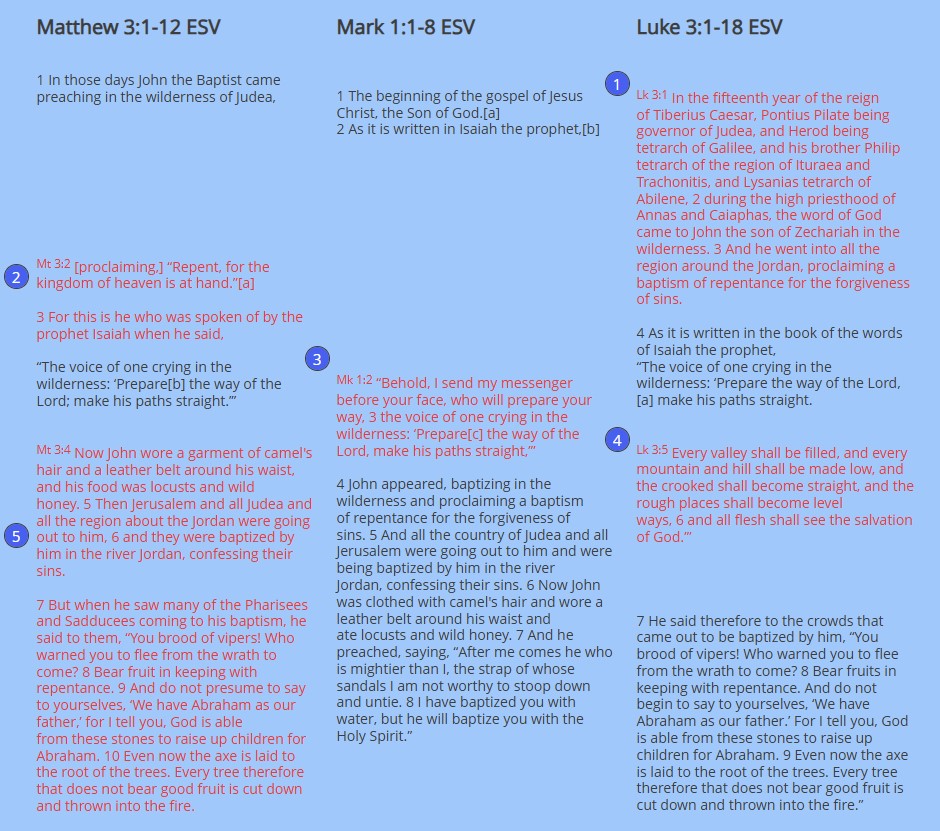
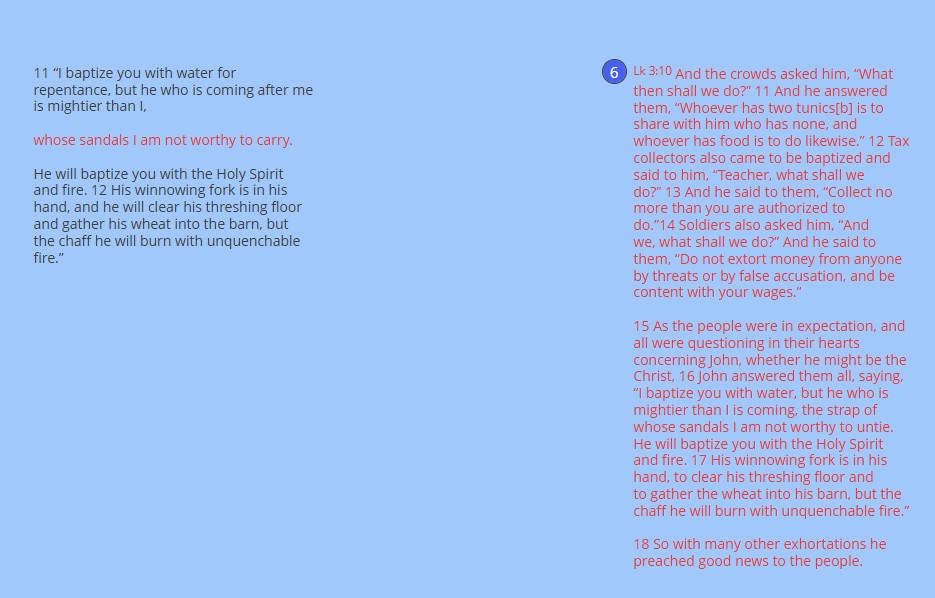
From the above worksheet photos, following the numbers and the text in red, the following narrative is produced. This process is discussed in lesson H072.
Lk 3:1 In the fifteenth year of the reign of Tiberius Caesar, Pontius Pilate being governor of Judea, and Herod being tetrarch of Galilee, and his brother Philip tetrarch of the region of Ituraea and Trachonitis, and Lysanias tetrarch of Abilene, 2 during the high priesthood of Annas and Caiaphas, the word of God came to John the son of Zechariah in the wilderness. 3 And he went into all the region around the Jordan, proclaiming a baptism of repentance for the forgiveness of sins, Mt 3:2 proclaiming, “Repent, for the kingdom of heaven is at hand.”
3 For this is he who was spoken of by the prophet Isaiah when he said, Mk 1:2 “Behold, I send my messenger before your face, who will prepare your way, 3 the voice of one crying in the wilderness: ‘Prepare the way of the Lord, make his paths straight, Lk 3:5 Every valley shall be filled, and every mountain and hill shall be made low, and the crooked shall become straight, and the rough places shall become level ways, 6 and all flesh shall see the salvation of God.’”
Mt 3:4 Now John wore a garment of camel’s hair and a leather belt around his waist, and his food was locusts and wild honey. 5 Then Jerusalem and all Judea and all the region about the Jordan were going out to him, 6 and they were baptized by him in the river Jordan, confessing their sins.
7 But when he saw many of the Pharisees and Sadducees coming to his baptism, he said to them, “You brood of vipers! Who warned you to flee from the wrath to come? 8 Bear fruit in keeping with repentance. 9 And do not presume to say to yourselves, ‘We have Abraham as our father,’ for I tell you, God is able from these stones to raise up children for Abraham. 10 Even now the axe is laid to the root of the trees. Every tree therefore that does not bear good fruit is cut down and thrown into the fire.”
Lk 3:10 And the crowds asked him, “What then shall we do?” 11 And he answered them, “Whoever has two tunics is to share with him who has none, and whoever has food is to do likewise.” 12 Tax collectors also came to be baptized and said to him, “Teacher, what shall we do?” 13 And he said to them, “Collect no more than you are authorized to do.” 14 Soldiers also asked him, “And we, what shall we do?” And he said to them, “Do not extort money from anyone by threats or by false accusation and be content with your wages.”
15 As the people were in expectation, and all were questioning in their hearts concerning John, whether he might be the Christ, 16 John answered them all, saying, “I baptize you with water, but he who is mightier than I is coming, the strap of whose sandals I am not worthy to untie (Mt 3:11 to carry). He will baptize you with the Holy Spirit and fire. 17 His winnowing fork is in his hand, to clear his threshing floor and to gather the wheat into his barn, but the chaff he will burn with unquenchable fire.”
18 So with many other exhortations he preached good news to the people.
Bible Lessons for this event:
H072 Narrative Formation
H073 John Hears the Call to Start (Luke 3:1-3; Matthew 3:2)
H074 The Voice in the Wilderness (Matthew 3:3; Mark 1:2-3; Luke 3:5-6)
H075 John and His Words of Conviction (Matthew 3:4-6)
H076 Fruit Validates Our Repentance (Matthew 3:7-10)
H077 What Shall We Do They Asked (Luke 3:10-14)
H078 John, Who Are You? (Luke 3:15-18)
Event Summary:
This event describes the ministry of John the Baptist, who prepares the way for Jesus’ coming through preaching and baptism. These passages emphasize repentance, the fulfillment of prophecy, and John’s role as the forerunner of the Messiah.
Key points of this event are:
(1) John’s ministry focuses on repentance as a necessary preparation for receiving Jesus and entering God’s kingdom. True repentance involves a change of heart and actions that align with God’s will.
(2) John’s presence and message fulfill Old Testament prophecy, marking him as the forerunner who prepares the people for the Messiah’s arrival.
(3) John’s warning of judgment and promise of the Holy Spirit highlight both the urgency of repentance and the promise of transformation through Jesus.
(4) John consistently points beyond himself to Jesus, emphasizing that his role is to prepare the way, while Jesus’ ministry will bring true spiritual renewal.
In summary, this event collectively present John the Baptist as the prophetic forerunner of Jesus, calling people to repentance and warning of impending judgment, while pointing to the superior and transformative work of the coming Messiah.
Understanding and Application:
Here are Questions of Understanding with Extended Answers for the combined account of Luke 3:1–18; Matthew 3:1–12; Mark 1:1–8, focusing on the ministry of John the Baptist.
Discussion Questions with Extended Answers
1. Who was John the Baptist, and what was his role in God’s plan?
Answer:
John the Baptist was the forerunner of Jesus Christ, sent by God to prepare the people for the coming Messiah. His ministry fulfilled Old Testament prophecy, particularly Isaiah’s declaration of “a voice crying in the wilderness” preparing the way of the Lord. John’s role was not to be the Savior, but to point others to Him. He called people to repentance, awakening them spiritually so they would recognize and receive Jesus. His life and message demonstrate that God prepares hearts before revealing His full redemptive work.
2. What is the significance of the historical details given in Luke 3:1–2?
Answer:
Luke carefully lists rulers and leaders (such as Tiberius Caesar, Pontius Pilate, and Herod) to anchor the account in real history. This shows that the gospel is not myth or legend, but rooted in actual events and people. At the same time, while political and religious leaders held visible authority, God’s word came to John in the wilderness; highlighting that God often works outside established systems. This contrast emphasizes that true spiritual authority comes from God, not human position.
3. What does “repentance” mean in John’s message?
Answer:
Repentance means a genuine turning of the heart and life away from sin and toward God. It is not merely feeling sorry, but involves a change in direction, priorities, and behavior. John called for a repentance that produced visible fruit—evidence of transformed living. This prepares individuals to receive forgiveness and restoration through Christ. Repentance is foundational to the gospel because it acknowledges sin and opens the heart to God’s grace.
4. Why did John emphasize “bearing fruit in keeping with repentance”?
Answer:
John challenged superficial religion. Many believed their identity as descendants of Abraham guaranteed God’s favor, but John declared that true relationship with God is demonstrated by transformed lives. “Fruit” refers to actions, attitudes, and behaviors that reflect a changed heart, such as honesty, generosity, and justice. Without such fruit, repentance is empty. This teaching warns against relying on heritage, tradition, or outward religion instead of genuine spiritual change.
5. How did John address different groups (crowds, tax collectors, soldiers)?
Answer:
John gave practical, specific instructions tailored to each group:
- The crowds were told to share with those in need.
- Tax collectors were told to act honestly and not take more than required.
- Soldiers were instructed to avoid extortion and be content with their wages.
This shows that repentance affects everyday life and personal conduct. God’s call is not abstract; it transforms how people live in their occupations and relationships. Each person is responsible to live out righteousness where they are.
6. Why did John deny being the Christ?
Answer:
Many people wondered if John himself might be the Messiah because of his powerful message. However, John clearly stated that he was not the Christ. His humility is central; he recognized his role as a servant preparing the way for someone far greater. This teaches that true ministry points away from self and toward Jesus. John’s example warns against seeking personal recognition instead of glorifying Christ.
7. What is the difference between John’s baptism and the baptism Jesus brings?
Answer:
John baptized with water as a symbol of repentance, a public declaration of a changed heart. However, he proclaimed that Jesus would baptize “with the Holy Spirit and fire.” This points to a deeper, inward transformation brought by Christ. Jesus’ baptism involves spiritual renewal, empowerment by the Holy Spirit, and purification. It signifies not just outward cleansing, but inner regeneration and new life in God.
8. What does the imagery of the “winnowing fork” and “unquenchable fire” mean?
Answer:
John uses agricultural imagery to describe judgment. A winnowing fork separates wheat from chaff; keeping what is valuable and discarding what is worthless. The wheat represents those who truly belong to God, while the chaff represents those who reject Him. The “unquenchable fire” symbolizes final judgment. This reveals that the coming of Jesus brings both salvation and judgment. It is a call to respond now, while there is opportunity for repentance.
9. What does John’s lifestyle and setting (the wilderness) teach us?
Answer:
John lived in the wilderness, wearing simple clothing and eating basic food. This reflects a life set apart from worldly comforts and distractions. The wilderness symbolizes spiritual preparation; a place where people encounter God away from noise and corruption. John’s life emphasizes that God often works through simplicity and separation, calling people back to a pure and focused relationship with Him.
10. What is the central message of John the Baptist’s ministry?
Answer:
The central message is: Prepare for the coming of the Lord through repentance and transformed living. John proclaimed that God’s kingdom was near and that people must be ready. His ministry bridges the Old Testament expectation and the New Testament fulfillment in Jesus. He calls every generation to examine their hearts, turn from sin, and be ready to receive Christ.
11. How does this passage prepare the way for Jesus’ ministry?
Answer:
John’s work creates spiritual readiness among the people. By calling out sin and pointing to the need for repentance, he clears away misconceptions and pride. This prepares individuals to recognize their need for a Savior. Without this preparation, many would not understand Jesus’ message. John’s ministry shows that conviction of sin precedes the experience of grace.
12. What application does this passage have for believers today?
Answer:
This passage calls believers to ongoing repentance and authentic faith. It challenges us to examine whether our lives bear fruit consistent with our profession of faith. It reminds us not to rely on external identity (church attendance, tradition, background) but on a real relationship with God. Additionally, like John, believers are called to point others to Christ, living humbly and faithfully in their role within God’s plan.
 Anchor My Faith
Leave a comment