
Photo: Tyan Lee
Author: Stephen Weller
Temptation of Jesus – Wilderness
Scripture Reference: Matthew 4:1-11; Mark 1:12-13; Luke 4:1-15
Context:
The temptation of Jesus in Matthew Gospel 4:1–11, Mark Gospel 1:12–13, and Luke Gospel 4:1–15 occurs immediately after His baptism, where He was publicly affirmed as the Son of God and anointed by the Spirit. Led by the Spirit into the wilderness, Jesus enters a period of forty days of fasting, echoing Israel’s forty years in the wilderness and demonstrating His role as the true and faithful Son. In this time of physical weakness, He is confronted by Satan, who tempts Him to misuse His divine power, test God’s protection, and pursue earthly authority apart from the Father’s will. Unlike Israel, and unlike Adam, Jesus resists every temptation by relying on Scripture and remaining fully obedient to God. This event not only reveals His sinless nature and moral authority but also prepares Him for His public ministry in Galilee, where He begins proclaiming the kingdom of God in the power of the Spirit.
Event Narrative:
The narrative for this section was obtained from three similar texts, using the highlighted material shown below. The selection was determined by Jerry Peyton and copyrighted in 2015 by Jerry Peyton and Biblical Studies Press L.L.C.
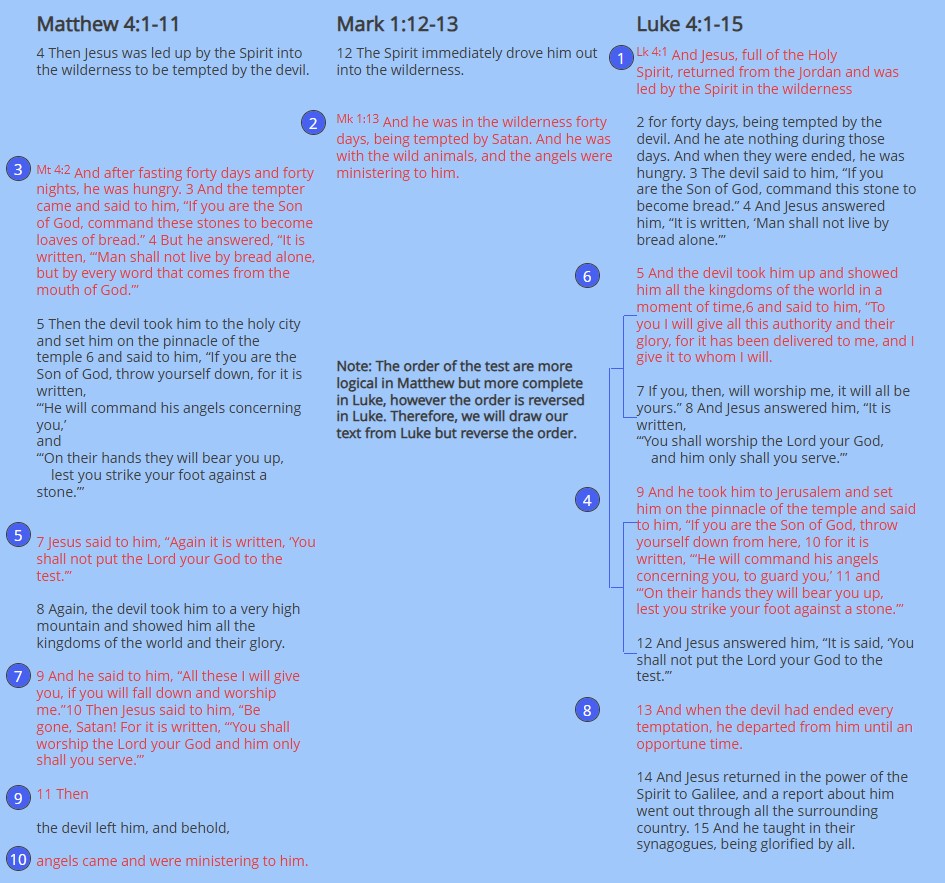
From the above worksheet photo, following the numbers and the text in red, the following narrative is produced.
Lk 4:1 And Jesus, full of the Holy Spirit, returned from the Jordan and was led by the Spirit in the wilderness. Mk 1:13 And he was in the wilderness forty days, being tempted by Satan. And he was with the wild animals, and the angels were ministering to him. Mt 4:2 And after fasting forty days and forty nights, he was hungry. 3 And the tempter came and said to him, “If you are the Son of God, command these stones to become loaves of bread.” 4 But [Jesus] answered, “It is written, “‘Man shall not live by bread alone, but by every word that comes from the mouth of God.’”
Lk 4:9 And [the devil] took him to Jerusalem and set him on the pinnacle of the temple and said to him, “If you are the Son of God, throw yourself down from here, 10 for it is written, “‘He will command his angels concerning you, to guard you,’ 11 and “‘On their hands they will bear you up, lest you strike your foot against a stone.’” Mt 4:7 Jesus said to him, “Again it is written, ‘You shall not put the Lord your God to the test.’”
Lk 4:5 And the devil took him up and showed him all the kingdoms of the world in a moment of time, 6 and said to him, “To you I will give all this authority and their glory, for it has been delivered to me, and I give it to whom I will. Mt 4:9 And he said to him, “All these I will give you, if you will fall down and worship me.” 10 Then Jesus said to him, “Be gone, Satan! For it is written, “‘You shall worship the Lord your God and him only shall you serve.’”
Lk 4:13 And when the devil had ended every temptation, he departed from him until an opportune time. Mt 4:11 Then angels came and were ministering to him.
Bible Lessons for this event:
H082 Led into the Wilderness (Luke 4:1)
H083 Temptation 1: Turn Stones into Bread (Mark 1:13; Matthew 4:2-4)
H084 Temptation 2: Throw Yourself Down (Matthew 4:7; Luke 4:9-11)
H085 Temptation 3: Grant You Authority (Matthew 4:9-11; Luke 4:5-6; Luke 4:13)
Event Summary:
This event recounts the temptation of Jesus in the wilderness, where he is led by the Spirit to face testing by the devil. This event occurs after his baptism and before the start of his public ministry. The key themes include obedience to God, resisting temptation, reliance on Scripture, and Jesus’ triumph over evil.
Key points of this event are:
(1) Jesus is led by the Spirit into the wilderness, where he fasts for 40 days and is tested by the devil. The wilderness symbolizes a place of trial, solitude, and preparation. This moment demonstrates that testing is a necessary part of spiritual growth and preparation for ministry. Even Jesus, the Son of God, faced trials to fulfill his mission.
(2) Jesus is tempted by the devil in three different and specific ways: First by turning stones into bread (physical need), as the devil appeals to Jesus’ hunger after fasting. Jesus responds with Deuteronomy 8:3, affirming that true life comes from God’s word, not just physical sustenance; The second by throwing himself from the temple (testing God), as the devil misuses Scripture to tempt Jesus to prove his identity. Jesus counters with Deuteronomy 6:16, rejecting the idea of putting God to the test; The third by worshiping the devil for worldly power (idolatry), the devil offers Jesus all the kingdoms of the world in exchange for worship. Jesus firmly replies with Deuteronomy 6:13, affirming that only God is worthy of worship. The response of Jesus to these three temptations demonstrates his reliance on Scripture and his unwavering obedience to God. His victory over these temptations highlights his role as the sinless Son of God, able to resist where humanity often fails.
(3) Jesus uses Scripture as his primary defense against each temptation. This underscores the power and authority of God’s word as a tool to resist sin and combat spiritual attacks. We as believers are encouraged to know and rely on Scripture to navigate challenges and resist temptation in their own lives.
(4) Jesus’ victory over temptation contrasts with the failure of Adam, who succumbed to the devil’s lies in Eden, and with Israel, who often failed during their time of testing in the wilderness. Jesus succeeds where Adam and Israel failed, signifying his role as the new Adam who will redeem humanity and the true representative of Israel who fulfills God’s purposes.
(5) This period of testing strengthens Jesus for his mission. His victory over temptation establishes his authority over evil and sets the tone for his ministry of proclaiming God’s kingdom. Testing and trials can prepare believers for greater service and reveal their dependence on God’s strength.
(6) In Mark’s brief account, Jesus is depicted living among wild animals and attended by angels, highlighting both his vulnerability and his divine protection. Jesus identifies fully with humanity’s struggles yet remains victorious through God’s power.
In this event the temptations of Jesus reveal his perfect obedience to God, his victory over sin and evil, and his reliance on Scripture as a defense against temptation. It affirms his identity as the Son of God and prepares him for his mission to proclaim the kingdom of God. This event also serves as a model for believers, showing that through reliance on God’s word and trust in his power, they can overcome trials and live faithfully in obedience to him.
Understanding and Application:
Here are questions of understanding with extended answers for the temptation of Jesus as recorded in Matthew 4:1-11; Mark 1:12-13; Luke 4:1-15:
1. What was the purpose of Jesus being led into the wilderness to be tempted?
Answer:
Jesus was led into the wilderness by the Spirit to face temptation as part of His preparation for public ministry. This was not accidental but divinely appointed. The temptation demonstrated His sinless nature and His obedience to the Father. It also parallels Israel’s testing in the wilderness; where Israel failed, Jesus succeeded. Additionally, it establishes Him as the perfect and righteous Son of God who is qualified to be our Savior (Hebrews 4:15).
2. What role did the Holy Spirit play in this event?
Answer:
The Holy Spirit actively led (Matthew, Luke) or drove (Mark) Jesus into the wilderness. This shows that the temptation was under God’s sovereign plan, not outside His control. The Spirit’s role highlights that spiritual testing can be part of God’s purpose for strengthening and proving faith. Jesus entered the trial in full dependence on the Spirit, modeling how believers must rely on God in times of testing.
3. Why did Satan begin by saying, “If You are the Son of God…”?
Answer:
Satan was not questioning whether Jesus was the Son of God; rather, he was challenging Him to misuse His divine authority. The phrase is better understood as “Since You are the Son of God…” Satan was tempting Jesus to act independently of the Father’s will, appealing to His identity in a distorted way. This tactic mirrors how temptation often distorts truth to lead people into disobedience.
4. What was the significance of the first temptation (turning stones into bread)?
Answer:
This temptation appealed to physical need and self-gratification. After fasting forty days, Jesus was hungry. Satan tempted Him to satisfy His hunger apart from God’s provision. Jesus responded by quoting Deuteronomy 8:3, emphasizing that life depends on God’s word, not merely physical sustenance. This shows that obedience to God is more important than immediate physical needs.
5. How did Jesus respond to each temptation, and what does this teach us?
Answer:
Jesus responded to every temptation by quoting Scripture, specifically from Deuteronomy. He did not argue or rely on His own reasoning but stood firmly on God’s Word. This teaches that Scripture is the primary weapon against temptation. It also shows the importance of knowing and trusting God’s Word in moments of testing. Jesus demonstrated perfect submission and reliance on divine truth.
6. What was the second temptation about (throwing Himself from the temple)?
Answer:
Satan tempted Jesus to test God by forcing Him to act; misusing Scripture (Psalm 91) to justify reckless behavior. This temptation centered on pride and presumption, urging Jesus to seek a dramatic display of divine protection. Jesus replied with Deuteronomy 6:16, “You shall not test the Lord your God,” affirming that faith does not demand proof but trusts God’s will without manipulation.
7. What was the third temptation (worshiping Satan for the kingdoms of the world)?
Answer:
This temptation offered Jesus a shortcut to power and glory without the suffering of the cross. Satan promised the kingdoms of the world in exchange for worship. It was a direct appeal to compromise allegiance to God. Jesus rejected it decisively, quoting Deuteronomy 6:13, declaring that only God is worthy of worship. This shows that true worship and obedience cannot be compromised for worldly gain.
8. How does Jesus’ temptation compare to Israel’s experience in the wilderness?
Answer:
Jesus’ temptations closely parallel Israel’s failures in the wilderness. Israel grumbled over food, tested God, and turned to idolatry. In contrast, Jesus remained obedient in each corresponding situation. Where Israel failed as God’s son (Exodus 4:22), Jesus succeeded as the true Son of God. This establishes Him as the faithful representative of His people and the fulfillment of Israel’s calling.
9. What does Mark’s brief account add to our understanding?
Answer:
Mark emphasizes the immediacy and intensity of the event, noting that Jesus was “driven” into the wilderness and was among wild animals, with angels ministering to Him. This highlights both the harshness of the environment and God’s provision and care. It underscores the spiritual conflict and divine support present during the temptation.
10. What does Luke add by including Jesus’ return “in the power of the Spirit”?
Answer:
Luke notes that after the temptation, Jesus returned in the power of the Spirit to begin His ministry. This indicates that the period of testing was not only a trial but also a preparation that strengthened and confirmed His mission. Victory over temptation preceded effective ministry, showing that spiritual readiness often comes through testing.
11. What does this passage teach about the nature of temptation?
Answer:
Temptation often targets legitimate needs (hunger), identity (Son of God), and desires (power and glory), but twists them toward sinful ends. It may also involve misusing Scripture or appealing to shortcuts that bypass God’s will. This passage reveals that temptation is both spiritual and strategic, requiring discernment and reliance on God’s truth.
12. How is Jesus an example for believers in overcoming temptation?
Answer:
Jesus models dependence on God, use of Scripture, and unwavering obedience. He did not rely on His divine power independently but submitted fully to the Father. Believers are encouraged to follow His example by resisting temptation through God’s Word, prayer, and trust in the Spirit. His victory also provides assurance that He understands our struggles and helps us overcome (Hebrews 2:18).
13. Why is this event important in understanding Jesus’ mission?
Answer:
The temptation reveals the nature of Jesus’ mission—He would accomplish God’s will through obedience, not shortcuts or worldly power. It confirms His role as the sinless Son of God and the second Adam who succeeds where humanity failed. This victory at the outset of His ministry sets the tone for His path to the cross and ultimate redemption.
 Anchor My Faith
Leave a comment