
Photo: Alex Alishevskikh Photography
Author: Stephen Weller
2,015 words, 11 minutes read time
Fasting and New Wineskins
Scripture Reference: Matthew 9:14-17; Mark 2:18-22; Luke 5:33-39
Context:
The parallel accounts in Matthew 9:14–17, Mark 2:18–22, and Luke 5:33–39 occur in the midst of growing tension between Jesus and the religious leaders, following His call of Matthew (Levi) and His fellowship with tax collectors and sinners. After Jesus emphasizes mercy over ritual observance, a question arises, likely from the disciples of John the Baptist and echoed by the Pharisees, regarding why His disciples do not fast as others do. Fasting was a regular expression of piety in Jewish tradition, often associated with repentance, mourning, or longing for God’s intervention. Jesus responds by revealing the deeper reality of His presence: He likens Himself to a bridegroom, indicating that His arrival inaugurates a time of joy, not mourning. This imagery points to a significant shift in redemptive history; the long-awaited Messiah has come, and His presence changes the appropriate spiritual response. However, Jesus also hints that a time will come when fasting will be appropriate again, foreshadowing His departure.
To further explain, Jesus uses two parables: the unshrunk cloth on an old garment and new wine in old wineskins. These illustrations emphasize that the new life and covenant He brings cannot simply be patched onto the old religious system. The old forms, represented by traditional practices and interpretations, cannot contain the fullness of what Jesus is introducing. The “new wine” symbolizes the dynamic, transforming nature of the kingdom of God, which requires new structures and hearts prepared to receive it. Luke uniquely adds the observation that those accustomed to the old often resist the new, preferring what is familiar. Altogether, these passages highlight a pivotal transition from old covenant expectations to the new covenant reality in Christ, showing that Jesus did not come merely to reform existing traditions but to fulfill and transform them, calling for a renewed understanding of righteousness, worship, and relationship with God.
Event Narrative:
The narrative for this section was obtained from three similar texts, using the highlighted material shown below. The selection was determined by Jerry Peyton and copyrighted in 2015 by Jerry Peyton and Biblical Studies Press L.L.C.
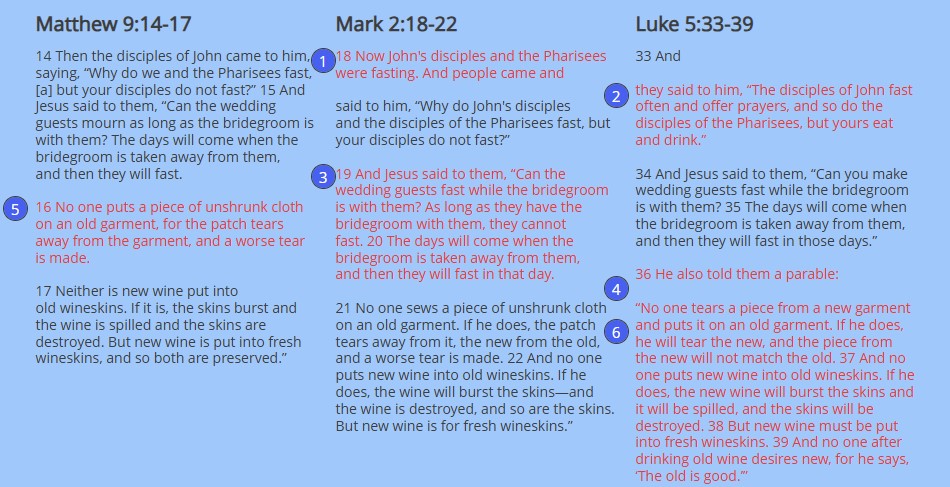
From the above worksheet photo, following the numbers and the text in red, the following narrative is produced.
Mk 2:18 Now John’s disciples and the Pharisees were fasting. And people came and Lk 5:33 they said to [Jesus], “The disciples of John fast often and offer prayers, and so do the disciples of the Pharisees, but yours eat and drink [and do not fast].” Mk 2:19 And Jesus said to them, “Can the wedding guests fast while the bridegroom is with them? As long as they have the bridegroom with them, they cannot fast. 20 The days will come when the bridegroom is taken away from them, and then they will fast in that day.
Lk 5:36 He also told them a parable: Mt 9:16 “No one puts a piece of unshrunk cloth on an old garment, for the patch tears away from the garment, and a worse tear is made.” Lk 5:36 “No one tears a piece from a new garment and puts it on an old garment. If he does, he will tear the new, and the piece from the new will not match the old. 37 And no one puts new wine into old wineskins. If he does, the new wine will burst the skins and it will be spilled, and the skins will be destroyed. 38 But new wine must be put into fresh wineskins. 39 And no one after drinking old wine desires new, for he says, ‘The old is good.’”
Bible Lessons for this event:
H178 The Question of Fasting (Mark 2:18-20; Luke 5:33)
H179 New Wineskins/New Covenant (Matthew 9:16; Luke 5:36-39)
Event Summary:
This event describes questions about fasting and Jesus’ response, which uses metaphors of new cloth and new wine to emphasize the nature of His mission and the arrival of something new in God’s kingdom.
Key points of this event are:
(1) The disciples of John the Baptist and the Pharisees ask Jesus why his disciples do not fast, unlike their own disciples. In Jewish tradition, fasting was associated with mourning, repentance, and anticipation of God’s deliverance. The question reflects confusion about why Jesus’ followers do not follow this religious practice.
(2) Jesus responds by comparing himself to a bridegroom at a wedding feast. He explains that as long as the bridegroom is present, the guests should not fast, implying that his presence is a time of joy, not mourning. Jesus hints at a future time when the bridegroom will be taken away, alluding to his eventual crucifixion, when fasting and mourning will be appropriate.
(3) Jesus uses two metaphors to illustrate the incompatibility of the new with the old: If unshrunk cloth is used to patch an old garment, it will tear away, making the hole worse. New wine, which ferments and expands, will burst old wineskins, which are not flexible, ruining both the wine and the wineskins. These parables emphasize that Jesus’ message and ministry represent something entirely new—the arrival of God’s kingdom in a fresh and transformative way, which cannot be contained by the old structures of religious tradition.
(4) Jesus’ teaching indicates that the kingdom of God he brings is marked by joy, celebration, and transformation, rather than by the rituals of the old covenant. The new way of Jesus requires a new mindset—a readiness to embrace radical change and renewal, rather than trying to fit it into existing religious traditions.
The central message of this event is that Jesus’ arrival inaugurates a new era of God’s kingdom, characterized by joy, grace, and transformation. His mission is not an addition to existing religious practices but a complete renewal that transcends old traditions. The new covenant of grace cannot be constrained by the old forms of the law; it requires a fresh, flexible approach that aligns with the life and joy of Jesus’ presence. This event challenges the mindset of clinging to old religious forms when God is doing something entirely new through Christ.
Understanding and Application:
Below are questions of understanding with extended answers for the combined passages Matthew 9:14–17; Mark 2:18–22; Luke 5:33–39, which all record the same teaching of Jesus about fasting, the bridegroom, and the new vs. old.
1. Why did the disciples of John and the Pharisees question Jesus about fasting?
Answer:
The question arose because fasting was a visible and respected religious practice in Jewish life. The Pharisees fasted regularly (often twice a week), and John the Baptist’s disciples also practiced fasting as an expression of repentance and devotion. When they observed that Jesus’ disciples were not fasting, it appeared inconsistent with accepted spiritual discipline.
Their question reveals more than curiosity; it exposes a comparison mindset. They were measuring righteousness by external practices and expecting Jesus’ followers to conform to established traditions. However, their understanding of fasting was rooted in ritual, while Jesus was introducing a deeper reality: spiritual practices must align with God’s present work, not merely past traditions.
2. What does Jesus mean by referring to Himself as the “bridegroom”?
Answer:
By calling Himself the bridegroom, Jesus is identifying His presence as a time of joy, celebration, and fulfillment. In the Old Testament, God is often depicted as the bridegroom of His people (Isaiah 62:5; Hosea 2:19–20). Jesus is therefore making a profound claim; He is the divine bridegroom, the One to whom God’s people belong.
A wedding is not a time for mourning but for rejoicing. As long as the bridegroom is present, fasting (which is associated with mourning, repentance, or longing) would be inappropriate. Jesus is teaching that His arrival inaugurates a new era; the long-awaited Messiah is here, and that changes everything.
3. What does Jesus mean when He says, “the days will come when the bridegroom is taken away”?
Answer:
Jesus is pointing forward to His death. The phrase “taken away” suggests a sudden and forceful removal, foreshadowing the crucifixion. When He is no longer physically present, His disciples will indeed fast, not as a ritual obligation, but as an expression of longing, dependence, and devotion.
This statement also reveals a shift: fasting is not abolished, but redefined. It becomes relational rather than ritualistic, rooted in a desire for communion with Christ rather than adherence to tradition.
4. What is the meaning of the parable of the unshrunk cloth on an old garment?
Answer:
Jesus explains that no one patches an old garment with unshrunk (new) cloth. When the new cloth shrinks, it pulls away and makes the tear worse. This illustrates that His teaching and ministry cannot simply be added onto the existing religious system.
The “old garment” represents the established traditions of Judaism as practiced by the Pharisees, particularly their rigid, external approach to the law. The “new cloth” represents the new life and truth Jesus brings. Attempting to combine the two without transformation results in greater damage, not improvement.
Jesus is not merely reforming old religion; He is introducing something fundamentally new.
5. What does the parable of new wine in old wineskins teach?
Answer:
New wine is still fermenting and expanding. Old wineskins have already been stretched and hardened; they cannot accommodate expansion. If new wine is placed into old wineskins, the pressure causes them to burst, ruining both the wine and the skins.
The “new wine” represents the dynamic, living reality of the kingdom of God through Christ—grace, transformation, and the indwelling Spirit. The “old wineskins” represent rigid religious structures and mindsets that cannot adapt to this new reality.
Jesus is teaching that His message requires new forms, new hearts, and new understanding. The kingdom of God cannot be contained within inflexible traditions.
6. What additional insight does Luke provide with the statement about old wine being preferred?
Answer:
Luke alone includes the statement: “No one after drinking old wine desires new, for he says, ‘The old is good.’” This highlights the human tendency to resist change. People often prefer what is familiar, even if it is inferior, because it feels comfortable and safe.
This explains why many religious leaders rejected Jesus. They were accustomed to the old system and unwilling to embrace something new that challenged their authority and understanding. It is a warning about spiritual complacency—clinging to tradition can prevent us from receiving God’s new work.
7. How do these teachings redefine the purpose of fasting?
Answer:
Fasting is no longer presented as a routine obligation tied to religious identity. Instead, it becomes an expression of relationship with Christ. While Jesus is present, the appropriate response is joy. When He is absent, fasting becomes a meaningful way to seek Him.
Thus, fasting shifts from external compliance to internal devotion. It is not about earning righteousness, but about expressing longing for God.
8. What is the central message Jesus is communicating through these illustrations?
Answer:
Jesus is declaring that His coming introduces a new covenant reality that cannot be contained within old religious forms. He is not merely another teacher within Judaism—He is the fulfillment of God’s redemptive plan.
The central message is this:
The kingdom of God is new, transformative, and incompatible with rigid, external religion. It requires a new heart, new understanding, and a willingness to leave behind what is outdated.
This teaching calls listeners to examine whether they are clinging to tradition or embracing the living work of God through Christ.
9. How should believers apply this teaching today?
Answer:
Believers must guard against reducing faith to routine, tradition, or external performance. While spiritual disciplines like fasting, prayer, and study are valuable, they must flow from a living relationship with Christ.
This passage challenges us to remain spiritually flexible and open to God’s ongoing work. It calls us to examine whether we are trying to “fit Jesus” into our existing patterns or allowing Him to transform us completely.
Ultimately, it invites us to live in the joy of the bridegroom, to long for His presence, and to embrace the new life He brings.
 Anchor My Faith
Leave a comment