
Photo: William Theis (St Davids Cathedral, Pembrokeshire.)
Author: Stephen Weller
1,825 words, 10 minutes read time
Lord of the Sabbath
Scripture Reference: Matthew 12:1-8; Mark 2:23-28; Luke 6:1-5
Context:
The account of the disciples plucking grain on the Sabbath in Matthew 12:1–8, Mark 2:23–28, and Luke 6:1–5 occurs during a growing season of tension between Jesus and the Pharisees, as His authority and interpretation of the Law increasingly challenge their rigid traditions. The Law of Moses did permit travelers to pluck grain by hand to satisfy hunger (Deuteronomy 23:25), but the Pharisees had developed detailed Sabbath regulations that classified such actions as unlawful “work.” As Jesus and His disciples walked through the grainfields on the Sabbath, the disciples’ simple act of eating exposed a deeper conflict—not about the Law itself, but about its proper understanding and application. Jesus responds by pointing to the example of David eating the consecrated bread (1 Samuel 21:1–6), demonstrating that human need can take precedence over ceremonial restrictions. He also reminds them that the priests “profane” the Sabbath in their temple duties and yet remain guiltless, highlighting that service to God transcends strict Sabbath limitations. Matthew uniquely emphasizes Jesus’ declaration that He is “greater than the temple,” while all three accounts culminate in the profound truth that “the Son of Man is Lord of the Sabbath.” Mark alone includes the key principle, “The Sabbath was made for man, not man for the Sabbath,” clarifying God’s original intent: the Sabbath was designed as a gift for rest, mercy, and life—not as a burdensome legal system. This moment reveals the Pharisees’ misplaced priorities, valuing ritual precision over compassion, and sets the stage for further confrontations that will ultimately lead to open opposition against Jesus.
Event Narrative:
The narrative for this section was obtained from three similar texts, using the highlighted material shown below. The selection was determined by Jerry Peyton and copyrighted in 2015 by Jerry Peyton and Biblical Studies Press L.L.C.
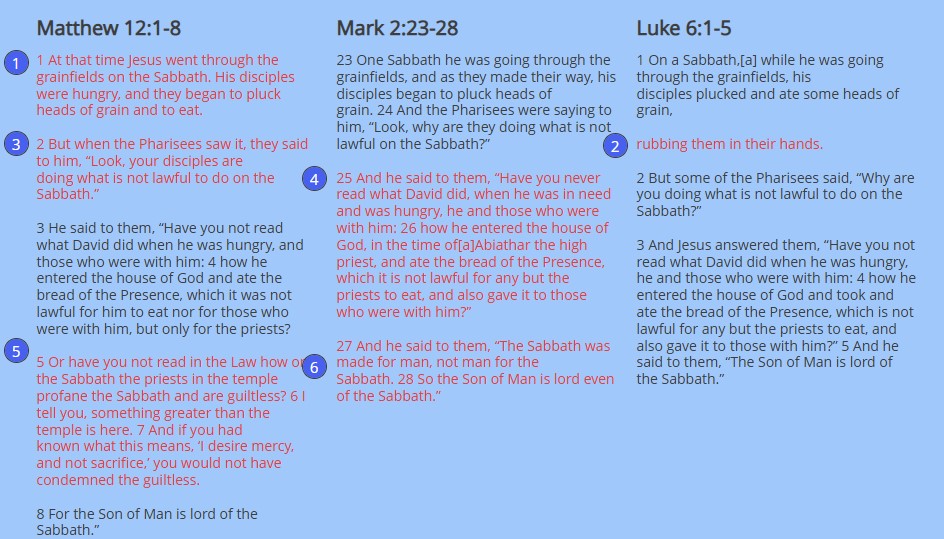
From the above worksheet photo, following the numbers and the text in red, the following narrative is produced.
Mt 12:1 At that time Jesus went through the grain fields on the Sabbath. His disciples were hungry, and they began to pluck heads of grain Lk 6:1 rubbing them in their hands Mt 12:1 and to eat. But when the Pharisees saw it, they said to him, “Look, your disciples are doing what is not lawful to do on the Sabbath.”
Mk 2:25 And he said to them, “Have you never read what David did, when he was in need and was hungry, he and those who were with him: 26 how he entered the house of God, in the time of Abiathar the high priest, and ate the bread of the Presence, which it is not lawful for any but the priests to eat, and also gave it to those who were with him?”
Mt 12:5 Or have you not read in the Law how on the Sabbath the priests in the temple profane the Sabbath and are guiltless? 6 I tell you, something greater than the temple is here. 7 And if you had known what this means, ‘I desire mercy, and not sacrifice,’ you would not have condemned the guiltless.
Mk 2:27 And he said to them, “The Sabbath was made for man, not man for the Sabbath. 28 So the Son of Man is lord even of the Sabbath.”
Bible Lessons for this event:
H180 Intentionally skipped
H181 Plucking Heads of Grain (Matthew 12:1-2; Luke 6:1)
Event Summary:
This event describes an encounter where Jesus defends his disciples for picking and eating grain on the Sabbath, challenging the Pharisees’ rigid interpretation of Sabbath law and emphasizing themes of mercy, purpose, and Jesus’ authority over the Sabbath.
Key points of this event are:
(1) The Pharisees criticize Jesus’ disciples for picking heads of grain on the Sabbath, an act they consider to be “work,” which is prohibited by their interpretation of Sabbath law. Their reaction reflects a legalistic approach to the Sabbath, focusing more on rule-keeping than on the intent or spirit of the law.
(2) Jesus responds by citing examples from Scripture where human need takes precedence over ritual observance: He refers to David eating the consecrated bread meant only for priests, showing that human need can override ceremonial laws, and he also points to the priests working in the temple on the Sabbath as an example of work being permitted for a higher purpose.
(3) Jesus quotes Hosea 6:6: “I desire mercy, not sacrifice,” emphasizing that God values compassion and mercy over ritual compliance. This statement underscores that human need, and kindness should take precedence over strict adherence to ceremonial rules.
(4) Jesus concludes by declaring, “The Son of Man is Lord of the Sabbath.” He asserts his authority to interpret and fulfill the Sabbath, indicating that he has the divine authority to define its purpose. By claiming lordship over the Sabbath, Jesus redefines it as a day meant for rest, mercy, and renewal, not for legalistic restrictions.
The central message of this event is that the Sabbath was created for human benefit, not as a burdensome obligation. Jesus teaches that God values mercy, compassion, and meeting human needs above rigid adherence to rules. His declaration as “Lord of the Sabbath” emphasizes that he has the authority to interpret and fulfill the Sabbath’s purpose, redefining it in line with God’s intention of rest and compassion. This event challenges a legalistic approach to faith, emphasizing a heart of mercy and love as central to God’s kingdom.
Understanding and Application:
Here are questions of understanding with extended answers for the parallel passages Matthew 12:1–8; Mark 2:23–28; Luke 6:1–5 (Jesus and the Sabbath):
1. What were Jesus’ disciples doing on the Sabbath, and why did the Pharisees object?
Answer:
The disciples were walking through grainfields on the Sabbath and began to pluck heads of grain, rub them in their hands, and eat. According to the Law, this action itself was not stealing (Deuteronomy 23:25 allowed it), but the Pharisees interpreted the rubbing and harvesting as forms of “work,” which they believed violated Sabbath regulations. Their objection reflects how religious leaders had added layers of human tradition to God’s law, turning the Sabbath from a gift of rest into a burden of strict rule-keeping. This moment reveals a deeper conflict—not about grain, but about authority and the correct understanding of God’s law.
2. How does Jesus respond to the Pharisees’ accusation?
Answer:
Jesus responds by pointing them back to Scripture, specifically the account of David eating the consecrated bread (1 Samuel 21:1–6), which was technically reserved for priests. David’s need justified his actions, and God did not condemn him. Jesus also refers (in Matthew’s account) to priests working in the temple on the Sabbath without guilt. By doing this, Jesus demonstrates that the Pharisees misunderstood the heart of the law—God prioritizes mercy, necessity, and human need over rigid ceremonial rules. His response exposes their selective and inconsistent application of Scripture.
3. What principle does Jesus teach about the purpose of the Sabbath?
Answer:
In Mark’s account, Jesus states, “The Sabbath was made for man, not man for the Sabbath.” This is a foundational principle: the Sabbath was designed by God as a blessing—a time for rest, renewal, and worship—not as a restrictive system that oppresses people. The Pharisees had reversed this purpose, making people serve the Sabbath through burdensome rules. Jesus restores the original intent by teaching that God’s commands are meant to promote life, not hinder it. The Sabbath reflects God’s care for humanity, not a test of legal perfection.
4. What does Jesus mean when He says, “I desire mercy, not sacrifice”? (Matthew 12:7)
Answer:
Jesus quotes Hosea 6:6 to emphasize that God values compassion and mercy over ritual observance. The Pharisees were meticulous about sacrifices and rules but lacked compassion for people in need—even something as simple as hunger. Jesus is not dismissing the law but revealing its deeper intention: obedience must flow from a heart aligned with God’s character. True righteousness is not merely external compliance but inward transformation that produces mercy, grace, and understanding toward others.
5. What is the significance of Jesus declaring Himself “Lord of the Sabbath”?
Answer:
When Jesus says, “The Son of Man is Lord even of the Sabbath,” He is making a profound claim to divine authority. The Sabbath was instituted by God at creation, so to claim lordship over it is to claim equality with God. Jesus is declaring that He has the authority to interpret the law, define its true meaning, and even fulfill it. This statement shifts the discussion from legal debate to identity: the issue is not merely what is lawful, but who Jesus is. If He is Lord, then His interpretation is final.
6. How do these passages reveal the difference between legalism and true obedience?
Answer:
Legalism focuses on external rule-keeping, often adding human traditions and measuring righteousness by strict adherence. True obedience, however, seeks to understand and apply God’s heart behind the law. The Pharisees exemplified legalism—they condemned harmless actions and ignored genuine need. Jesus demonstrates true obedience by upholding God’s intent: mercy, compassion, and life. These passages show that legalism can lead to spiritual blindness, while true obedience leads to freedom and alignment with God’s will.
7. What does this account teach about responding to human need?
Answer:
Jesus teaches that meeting human need is never out of step with God’s will, even on the Sabbath. Hunger justified the disciples’ actions, just as necessity justified David’s. God’s law is not indifferent to human suffering; rather, it is designed to address it. This challenges believers to prioritize compassion over rigid systems and to act in ways that reflect God’s mercy. It also warns against using religious rules as an excuse to ignore the needs of others.
8. Why is this event important in the growing conflict between Jesus and the Pharisees?
Answer:
This event marks a significant escalation in the tension between Jesus and the religious leaders. It challenges their authority, exposes their misunderstanding of Scripture, and confronts their legalistic system. By asserting His authority over the Sabbath, Jesus directly opposes their interpretive control of the law. This contributes to the growing opposition that will ultimately lead to His rejection and crucifixion. The conflict is not merely about doctrine—it is about authority, identity, and the nature of God’s kingdom.
9. How should believers apply the teaching of this passage today?
Answer:
Believers should recognize that God’s commands are rooted in His character—gracious, compassionate, and life-giving. This passage calls for a balance between honoring God’s Word and understanding its purpose. It challenges us to avoid rigid legalism and instead pursue a heart that reflects God’s mercy. Practically, this means prioritizing people over rules, extending grace, and seeking to understand Scripture in light of Christ’s teaching. It also calls believers to rest in Christ, who fulfills the true meaning of the Sabbath.
 Anchor My Faith
Leave a comment