
Rockport, Indiana
Ohio River Scenic Byway
Photo taken on October 11, 2022
The rocky bluffs take a sharp curve along the Ohio River coastline in Rockport, Indiana.
Photo: Larry Braun Photography (Rockport Bluffs, Rockport, Indiana)
Author: Stephen Weller
2,179 words, 12 minutes read time
Healing a Withered Hand on the Sabbath
Scripture Reference: Matthew 12:9-15; Mark 3:1-7; Luke 6:6-11
Context:
The events recorded in Matthew 12:9–15, Mark 3:1–7, and Luke 6:6–11 occur within a growing conflict between Jesus and the Pharisees over the true meaning and purpose of the Sabbath. After demonstrating in the preceding passages that the Sabbath was made for man’s good and not as a burdensome legal restriction, Jesus enters a synagogue where a man with a withered hand is present. The religious leaders, already hardened in opposition, watch Him closely—not with compassion for the suffering man, but with the intent to accuse Him. Knowing their thoughts, Jesus confronts their distorted interpretation of the law by asking whether it is lawful to do good or to do harm on the Sabbath, to save life or to destroy it. Their silence exposes the hardness of their hearts and the emptiness of their legalism. In contrast, Jesus, moved with both righteous anger and grief, heals the man, restoring his hand completely. This miracle not only demonstrates His authority over the Sabbath but also reveals the heart of God—that mercy, restoration, and life are central to His law. Rather than leading the Pharisees to repentance, the act intensifies their hostility, and they begin to plot against Him, even aligning with political opponents like the Herodians. As a result, Jesus withdraws, and large crowds follow Him, highlighting the widening divide between those who reject Him in hardened unbelief and those drawn to Him in need and faith. This passage powerfully illustrates the contrast between external religion and genuine righteousness, emphasizing that the Sabbath—and all of God’s commands—find their fulfillment in acts of mercy and the life-giving authority of Christ.
Event Narrative:
The narrative for this section was obtained from three similar texts, using the highlighted material shown below. The selection was determined by Jerry Peyton and copyrighted in 2015 by Jerry Peyton and Biblical Studies Press L.L.C.
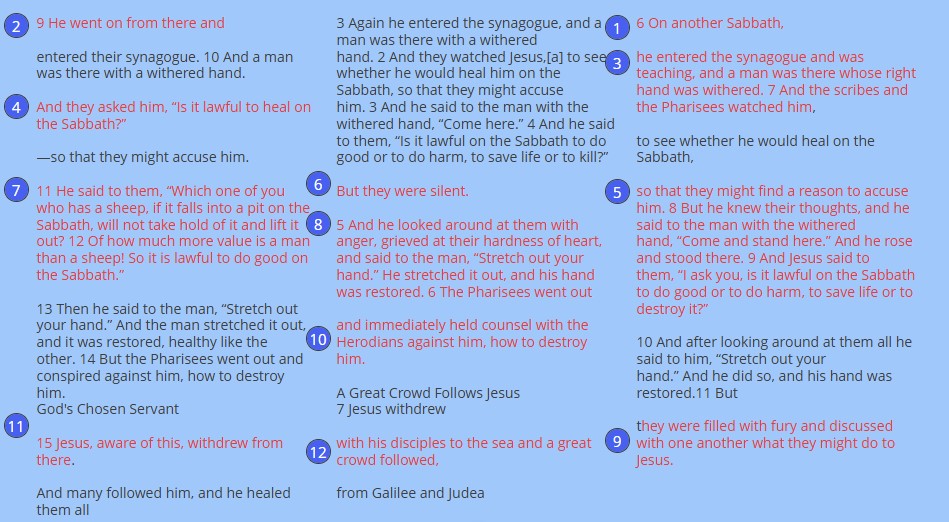
From the above worksheet photo, following the numbers and the text in red, the following narrative is produced.
Lk 6:6 On another Sabbath, Mt 12:9 [Jesus] went on from there and Lk 6:6 he entered the synagogue and was teaching, and a man was there whose right hand was withered. 7 And the scribes and the Pharisees watched him, Mt 12:10 and they asked him, “Is it lawful to heal on the Sabbath?” Lk 6:7 so that they might find a reason to accuse him.
Lk 6:8 But [Jesus] knew their thoughts, and he said to the man with the withered hand, “Come and stand here.” And he rose and stood there.
Lk 6:9 [Then] Jesus said to them, “I ask you, is it lawful on the Sabbath to do good or to do harm, to save life or to destroy it?” Mk 3:4 But they were silent.
Mt 12:11 [Jesus] said to them, “Which one of you who has a sheep, if it falls into a pit on the Sabbath, will not take hold of it and lift it out? 12 Of how much more value is a man than a sheep! So, it is lawful to do good on the Sabbath.”
Mk 3:5 [Jesus] looked around at them with anger, grieved at their hardness of heart, and said to the man, “Stretch out your hand.” He stretched it out, and his hand was restored. 6 The Pharisees went out, Lk 6:11 filled with fury and discussed with one another what they might do to Jesus, Mk 3:6 and they held counsel with the Herodians against him, as to how to destroy him.
Mt 12:15 Jesus, aware of this, withdrew from there Mk 3:7 with his disciples to the sea, and a great crowd follow him.
Bible Lessons for this event:
H183 The Withered Hand (Matthew 12:9-10; Mark 3:4; Luke 6:6-9)
H184 Stretch Out the Hand (Matthew 12:11-12, 15; Mark 3:5-7; Luke 6:11)
Event Summary:
This event describes Jesus healing a man with a withered hand on the Sabbath in a synagogue, addressing themes of compassion, mercy over legalism, and Jesus’ authority. The encounter reveals the hard-heartedness of the religious leaders and underscores Jesus’ commitment to doing good, regardless of opposition.
Key points of this event are:
(1) Jesus encounters a man with a withered hand in the synagogue. The Pharisees and religious leaders closely watch him, hoping to accuse him of breaking the Sabbath if he heals. The leaders’ intention reveals a legalistic and accusatory mindset, more focused on finding fault than on compassion for the man in need.
(2) Jesus directly challenges their thinking by asking whether it is lawful to do good or harm on the Sabbath, to save life or to destroy it. He emphasizes that the purpose of the Sabbath is to bring life and restoration, not to impose unnecessary burdens. Jesus’ question underscores the priority of compassion and mercy over strict Sabbath observance, confronting the Pharisees’ misunderstanding of God’s law.
(3) Jesus proceeds to heal the man, commanding him to stretch out his hand, which is immediately restored. This act demonstrates that God’s work is not limited by human-imposed restrictions and that healing, and restoration are at the heart of God’s will. The healing affirms Jesus’ authority over the Sabbath and reveals that his mission is to bring wholeness and mercy to those in need.
(4) Rather than being moved by the miracle, the Pharisees respond with hostility, immediately plotting against Jesus. Their reaction reveals a deep hard-heartedness and resistance to Jesus’ message of compassion. Jesus is grieved by their hardened hearts, highlighting the tragic reality of legalism that blinds people to God’s love and mercy.
(5) Jesus withdraws from the hostile environment, but large crowds continue to follow him, showing that his message of compassion resonates with the people. Jesus continues his ministry, healing and teaching, despite opposition.
The central message of this event is that compassion and mercy take precedence over rigid legalism, especially on the Sabbath, a day intended for rest and life-giving acts. Jesus demonstrates that the true spirit of God’s law is to uplift, heal, and restore, confronting the Pharisees’ hardened approach to religion. By healing on the Sabbath, Jesus asserts his authority to fulfill God’s will and invites followers to prioritize love and mercy over legalistic rule-keeping. This event underscores the importance of a tender, responsive heart that values people over strict adherence to ritual.
Understanding and Application:
Here are questions of understanding with extended answers for the combined account of Matthew 12:9–15; Mark 3:1–7; Luke 6:6–11, focusing on the healing of the man with the withered hand on the Sabbath.
1. What was the setting of this event, and why is it significant?
Answer:
The event takes place in a synagogue on the Sabbath, a setting associated with worship, teaching, and the reading of Scripture. This is significant because it highlights that Jesus’ action occurs in a sacred space and on a sacred day. The synagogue represents the heart of Jewish religious life, and the Sabbath was central to covenant identity. By healing in this context, Jesus is not acting outside the system but directly within it, demonstrating the true purpose of both the Sabbath and the law. His actions challenge the prevailing interpretations of religious leaders and reveal that God’s intent for the Sabbath is restoration, not restriction.
2. Why were the Pharisees watching Jesus closely?
Answer:
The Pharisees were observing Jesus with the intent to accuse Him. They were not seeking truth but looking for grounds to charge Him with violating the Sabbath law. This reveals a hardened posture—they prioritized legal interpretation over compassion. Their vigilance shows that Jesus had already become a perceived threat to their authority and traditions. Instead of rejoicing at the possibility of healing, they focused on whether Jesus would break their rules, exposing a deeper spiritual blindness.
3. What question did Jesus ask, and what was its purpose?
Answer:
Jesus asked, “Is it lawful to do good on the Sabbath, or to do evil? To save life, or to kill?” (Mark and Luke). This question exposes the moral inconsistency of the Pharisees. By framing the issue this way, Jesus reveals that failing to do good when one has the opportunity is equivalent to doing harm. His question shifts the focus from legal technicalities to moral responsibility. It also forces the religious leaders to confront the true intent of God’s law, which is rooted in mercy and life, not rigid rule-keeping.
4. How did the Pharisees respond to Jesus’ question, and what does this reveal?
Answer:
They remained silent. Their silence is revealing—it shows they could not refute Jesus’ reasoning, yet they were unwilling to accept it. This silence reflects stubbornness and a refusal to submit to truth. It also demonstrates that their concern was not righteousness but control. Their inability to answer exposes the weakness of their position and the hardness of their hearts.
5. What emotions did Jesus display, and why are they important?
Answer:
Mark records that Jesus looked at them with anger and was grieved at their hardness of heart. These emotions are important because they show that Jesus is not indifferent to sin or hypocrisy. His anger is righteous—it is directed at the misuse of God’s law and the lack of compassion for human suffering. His grief reveals His deep sorrow over their spiritual condition. Together, these emotions reflect the heart of God: just, holy, and compassionate.
6. Why did Jesus call the man forward before healing him?
Answer:
Jesus brought the man into the center, making the situation visible to all. This was intentional. It ensured that the healing would be unmistakable and publicly witnessed. It also highlighted the contrast between the man’s need and the leaders’ indifference. By placing the man at the center, Jesus emphasized that people—not rules—are the focus of God’s concern. It also forced the Pharisees to confront the reality of suffering directly.
7. What does Jesus’ command, “Stretch out your hand,” demonstrate about faith and obedience?
Answer:
The command required the man to act in faith. His hand was withered, meaning he could not naturally do what Jesus asked. Yet in obedience, he attempted to stretch it out—and as he did, it was restored. This demonstrates that faith often involves acting on Jesus’ word even when it seems impossible. The miracle occurred in the act of obedience, showing that divine power meets human trust.
8. What was the reaction of the Pharisees after the healing?
Answer:
Instead of rejoicing, the Pharisees were filled with rage and began plotting with the Herodians to destroy Jesus. This reaction is striking—it shows that witnessing a clear act of divine power did not soften their hearts but hardened them further. Their response reveals the danger of entrenched unbelief: when the heart is resistant, even undeniable truth can be rejected. Their alliance with the Herodians, a political group, also shows how far they were willing to go to oppose Jesus.
9. What does this passage teach about the true purpose of the Sabbath?
Answer:
The passage teaches that the Sabbath was designed for good, not restriction. It is a day meant for restoration, mercy, and life. Jesus demonstrates that doing good and relieving suffering is always appropriate, even on the Sabbath. This aligns with God’s original intent—that the Sabbath would be a blessing to humanity. The religious leaders had turned it into a burden, but Jesus restores its true meaning.
10. Why did Jesus withdraw after this event, and what does this show?
Answer:
Jesus withdrew because the opposition against Him was intensifying. His withdrawal was not out of fear but wisdom—His mission operated according to God’s timing, not human schemes. At the same time, many followed Him, and He continued to heal them. This shows that opposition does not hinder God’s work; instead, it often accompanies it. Jesus remained focused on His mission despite growing hostility.
11. What contrast is seen between Jesus and the religious leaders?
Answer:
Jesus is characterized by compassion, authority, and a desire to bring life and restoration. The religious leaders, by contrast, are marked by legalism, hardness of heart, and a willingness to harm in order to protect their system. Jesus seeks to heal; they seek to destroy. This contrast highlights two fundamentally different approaches to God—one rooted in mercy and truth, the other in control and tradition.
12. How does this passage challenge believers today?
Answer:
This passage challenges believers to examine whether they prioritize rules over people. It calls for a heart aligned with God’s compassion, willing to do good at all times. It also warns against spiritual hardness—being so committed to tradition or personal views that one resists God’s work. Finally, it encourages active faith—responding to Jesus’ commands with trust, even when the outcome seems impossible.
 Anchor My Faith
Leave a comment