
Photo: Trent Goeckner (Simpson Park, St. Louis, MO, USA)
Author: Stephen Weller
1,913 words, 10 minutes read time
Crowds by the Sea of Galilee
Scripture Reference: Matthew 4:25; 12:15b-21; Mark 3:7b-12; Luke 6:17-19
Context:
The passages in Matthew 4:25; 12:15b–21; Mark 3:7b–12; and Luke 6:17–19 together present a unified picture of the growing public ministry of Jesus Christ at a pivotal moment in the Gospel narrative. These verses describe the remarkable expansion of His influence as large crowds from diverse regions—including Galilee, Judea, Jerusalem, Idumea, and beyond the Jordan—are drawn to Him because of His teaching and miraculous healings. This surge of popularity occurs alongside rising opposition from the Pharisees, making it both a moment of widespread acceptance and increasing tension. Jesus responds to the crowds with compassion, healing diseases, casting out unclean spirits, and demonstrating His authority over both physical and spiritual realms. Yet, He also repeatedly withdraws and instructs those healed—and even the demons—not to make Him known, emphasizing His deliberate control over the timing and nature of His revelation. Matthew uniquely connects these events to the fulfillment of Isaiah’s prophecy (Isaiah 42:1–4), portraying Jesus as the Servant of the Lord who ministers gently, avoids self-promotion, and brings justice to the nations without strife or loud proclamation. Together, these parallel accounts highlight the dual themes of Jesus’ growing fame and His intentional humility, revealing a Savior who powerfully meets human need while faithfully carrying out God’s redemptive plan according to divine timing.
Event Narrative:
The narrative for this section was obtained from three similar texts, using the highlighted material shown below. The selection was determined by Jerry Peyton and copyrighted in 2015 by Jerry Peyton and Biblical Studies Press L.L.C.
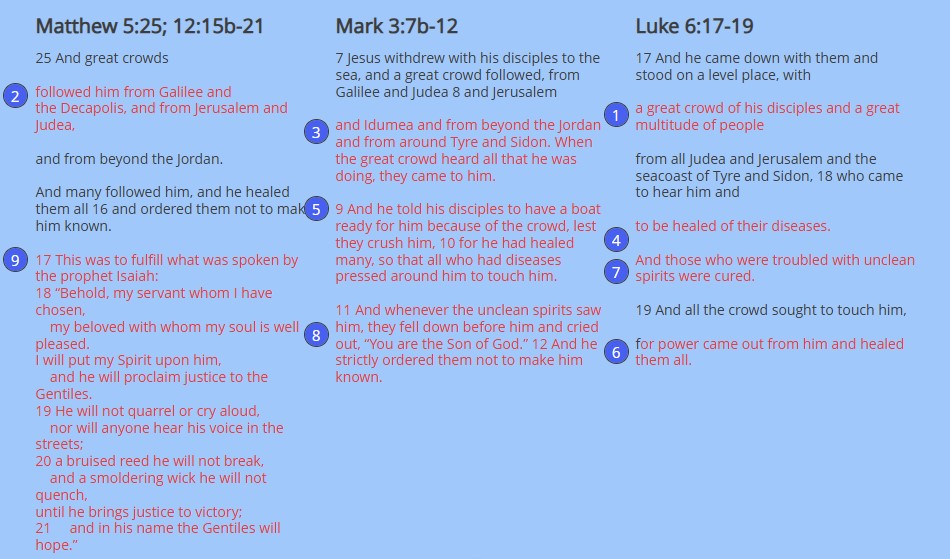
From the above worksheet photo, following the numbers and the text in red, the following narrative is produced.
Lk 6:17 A great crowd of his disciples and a great multitude of people Mt 4:25 followed him from Galilee and the Decapolis, and from Jerusalem and Judea, Mk 3:8 and Idumea and from beyond the Jordan and from around Tyre and Sidon. When the great crowd heard all that he was doing, they came to him Lk 6:18 to be healed of their diseases.
Mk 3:9 [Jesus] told his disciples to have a boat ready for him because of the crowd, lest they crush him, 10 for he had healed many, so that all who had diseases pressed around him to touch him, Lk 6:19 for power came out from him and healed them all. Lk 6:18 And those who were troubled with unclean spirits were cured. Mk 3:11 And whenever the unclean spirits saw him, they fell down before him and cried out, “You are the Son of God.” 12 And he strictly ordered them not to make him known.
Bible Lessons for this event:
H185 Crowds by the Sea of Galilee (Matthew 4:25; Mark 3:8-12; Luke 6:17-19)
H186 My Chosen Servant (Matthew 12:17-21)
H187 Proclaims Justice to the Gentiles (Matthew 12:18-21)
Event Summary:
This event describes Jesus’ widespread ministry of healing and teaching to large crowds from various regions who gather to hear him and be healed, underscoring themes of compassion, fulfillment of prophecy, and the inclusive reach of Jesus’ ministry.
Key points of this event are:
(1) Large crowds from various regions, including Galilee, Judea, Jerusalem, Idumea, Tyre, Sidon, and beyond the Jordan, gather to hear Jesus and be healed by him. This widespread interest demonstrates Jesus’ appeal across social, ethnic, and geographical boundaries, revealing the inclusive and far-reaching nature of his ministry.
(2) Many people come specifically for healing from diseases and deliverance from unclean spirits. Jesus’ ministry meets both physical and spiritual needs, showing that the kingdom of God brings wholeness to all areas of human life. Jesus’ compassion is evident as he attends to the needs of each person, illustrating that God’s love is expressed through tangible acts of healing and restoration.
(3) When unclean spirits recognize Jesus as the Son of God, he commands them to remain silent. This demonstrates Jesus’ authority over the spiritual realm and his control over the revelation of his identity, choosing to reveal himself according to God’s timing. By silencing the demons, Jesus ensures that his message and actions, rather than supernatural declarations, will reveal who he is.
(4) Matthew cites Isaiah’s prophecy, which describes God’s chosen servant who will bring justice to the nations with gentleness and compassion, avoiding violence and lifting up the broken. This prophecy highlights that Jesus’ ministry fulfills God’s promise of a merciful and humble Messiah, emphasizing his role in bringing hope and healing rather than judgment.
(5) In Luke’s account, people seek to touch Jesus, knowing that power goes out from him and heals them. This detail underscores that Jesus’ presence is life-giving, and his power to heal is accessible to those who reach out in faith.
The central message of this event is that Jesus’ ministry fulfills the prophecy of a compassionate, merciful Messiah, reaching people of all backgrounds and bringing healing and wholeness to those in need. Jesus’ authority over both physical and spiritual afflictions reveals the kingdom of God as a source of restoration, peace, and hope. his ministry emphasizes inclusivity, compassion, and divine power, embodying God’s love and justice for all people and inviting all who are in need to experience his transformative presence.
Understanding and Application:
Here are Questions of Understanding with Extended Answers for the combined passages: Matthew 4:25; Matthew 12:15b–21; Mark 3:7b–12; Luke 6:17–19. These passages together present a unified picture of Jesus’ growing ministry, His authority, and the nature of His mission.
1. What do these passages reveal about the scope and reach of Jesus’ ministry?
Answer:
These passages show that Jesus’ ministry extended far beyond a local or regional influence. Large crowds followed Him from Galilee, the Decapolis, Jerusalem, Judea, and beyond the Jordan (Matthew 4:25). Mark and Luke further emphasize that people came from distant regions, including coastal areas like Tyre and Sidon. This widespread response demonstrates that Jesus’ works and teachings were not confined to one group but attracted diverse populations—Jews and Gentiles alike.
The broad reach highlights two important truths: first, the universal need for healing and truth, and second, the growing recognition of Jesus’ authority. People were drawn not only by curiosity but by genuine need—physical, spiritual, and emotional. This anticipates the global scope of the gospel, where Christ’s mission ultimately extends to all nations.
2. Why were such large crowds drawn to Jesus, and what does this indicate about His ministry?
Answer:
The crowds were drawn primarily because of Jesus’ healing power and authoritative teaching. People brought the sick, those afflicted with diseases, and those troubled by unclean spirits, and they were healed (Luke 6:17–19; Mark 3:10). The fact that “power came out from Him and healed them all” underscores both His divine authority and His compassion.
This indicates that Jesus’ ministry was holistic—addressing both physical suffering and spiritual need. His miracles were not merely displays of power but signs pointing to His identity as the Messiah. They validated His message and revealed the kingdom of God breaking into human history. The crowds came seeking relief, but they were encountering the presence of God Himself.
3. What is the significance of Jesus withdrawing from conflict while continuing to heal (Matthew 12:15b–21)?
Answer:
Jesus’ withdrawal in Matthew 12:15 shows His intentional approach to ministry. Rather than engaging in escalating conflict with the Pharisees, He chose to continue His work quietly. This reflects both wisdom and obedience to God’s timing. His mission was not to provoke political or religious upheaval prematurely but to fulfill the Father’s plan.
Matthew connects this behavior to the prophecy of Isaiah, describing the Messiah as gentle, humble, and non-contentious. Jesus did not seek attention or force recognition; instead, He ministered with quiet strength. This reveals the nature of His kingdom—it advances not through coercion or spectacle, but through truth, compassion, and faithful obedience.
4. How does the prophecy from Isaiah (quoted in Matthew 12:18–21) help us understand Jesus’ identity and mission?
Answer:
The quoted prophecy identifies Jesus as God’s chosen Servant, empowered by the Spirit, who brings justice to the nations. It emphasizes His gentleness—“He will not quarrel or cry aloud”—and His compassion—“a bruised reed He will not break.”
This passage reveals that Jesus’ mission is both restorative and redemptive. He comes not to crush the weak but to heal and restore them. The reference to bringing justice to the Gentiles expands His mission beyond Israel, pointing to a global salvation plan. Ultimately, the prophecy highlights that Jesus fulfills the Old Testament expectation of a Messiah who combines power with mercy and authority with humility.
5. What role do unclean spirits play in these passages, and what do their reactions reveal?
Answer:
Unclean spirits repeatedly recognize Jesus’ true identity, declaring Him to be the Son of God (Mark 3:11). Their reactions—falling down before Him and crying out—demonstrate His absolute authority over the spiritual realm.
However, Jesus commands them not to make Him known. This reveals that while the demons speak truth, their testimony is not the means by which Jesus chooses to reveal Himself. His identity is to be understood through His teaching, works, and ultimately His death and resurrection—not through the declarations of evil spirits.
This also underscores the spiritual dimension of Jesus’ ministry. He is not only healing physical ailments but also confronting and overcoming the forces of darkness, demonstrating that the kingdom of God has authority over all powers.
6. What does Luke’s description of “power coming out from Him” teach us about Jesus?
Answer:
Luke 6:19 describes power proceeding from Jesus to heal all who touched Him. This vivid description emphasizes that Jesus is the source of divine power, not merely a mediator or prophet. Healing is not external to Him—it flows from His very being.
This teaches that Jesus possesses inherent divine authority. The power is not limited or selective; it is abundant and effective for all who come to Him in faith. It also highlights accessibility—people could approach Him directly and receive healing, illustrating the openness of His ministry.
7. How do these passages together portray the balance between Jesus’ popularity and His purpose?
Answer:
While Jesus’ popularity grew rapidly, He did not allow the crowds to define His mission. He healed many and showed compassion, but He also withdrew at times, avoided unnecessary conflict, and silenced premature declarations about His identity.
This balance shows that Jesus was not driven by public approval or demand. His purpose was rooted in obedience to the Father’s will. The crowds often sought immediate benefits—healing and relief—but Jesus’ ultimate mission was deeper: to bring salvation through His sacrificial work.
Thus, these passages reveal a tension between what people wanted from Jesus and what He came to accomplish. He met immediate needs while steadily moving toward the cross, where His mission would be fully realized.
8. What overall picture of Jesus emerges from these combined accounts?
Answer:
Taken together, these passages present Jesus as a compassionate healer, authoritative teacher, and sovereign Son of God. He draws multitudes, heals completely, commands spiritual forces, fulfills prophecy, and carries out His mission with humility and purpose.
He is powerful yet gentle, widely recognized yet intentionally reserved, deeply compassionate yet unwavering in His divine calling. This combination reveals the fullness of His character: the Servant-King who brings healing, truth, and ultimately salvation to all who come to Him.
 Anchor My Faith
Leave a comment