
Photo: Terri Waters Photography & Design (Land’s End, winter in Cornwall)
Author: Stephen Weller
2,273 words, 12 minutes read time
The Beatitudes
Scripture Reference: Matthew 5:1-12; Luke 6:17-26
Context:
The teachings recorded in Matthew 5:1–12 and Luke 6:17–26 occur at a pivotal moment early in Jesus’ public ministry, shortly after He has begun proclaiming the kingdom of God and gathering disciples. In Matthew’s account, often called the Sermon on the Mount, Jesus ascends a hillside, sits down as a teacher, and addresses His disciples while the crowds listen, presenting a structured and deeply theological introduction to kingdom living. Luke’s parallel, sometimes called the Sermon on the Plain, places Jesus on a level area surrounded by a large, diverse crowd from across Judea and beyond, emphasizing the broad reach of His message. Both settings highlight that Jesus is not merely offering moral advice but announcing a radical reversal of values in the kingdom of God. The “blessings” (Beatitudes) identify those whom God regards as favored—not the powerful, wealthy, or self-sufficient, but the poor, humble, mourning, persecuted, and those who hunger for righteousness. Luke uniquely pairs these blessings with corresponding “woes,” underscoring the danger of worldly satisfaction and complacency. Together, these passages establish the ethical and spiritual foundation of Jesus’ teaching: the kingdom belongs to those who depend fully on God, and true blessedness is rooted not in present circumstances but in God’s coming reign. This introduction sets the tone for all that follows, revealing that discipleship involves a transformed heart, a reoriented value system, and a willingness to endure present hardship in light of eternal reward.
Event Narrative:
The narrative for this section was obtained from two similar texts, using the highlighted material shown below. The selection was determined by Jerry Peyton and copyrighted in 2015 by Jerry Peyton and Biblical Studies Press L.L.C.
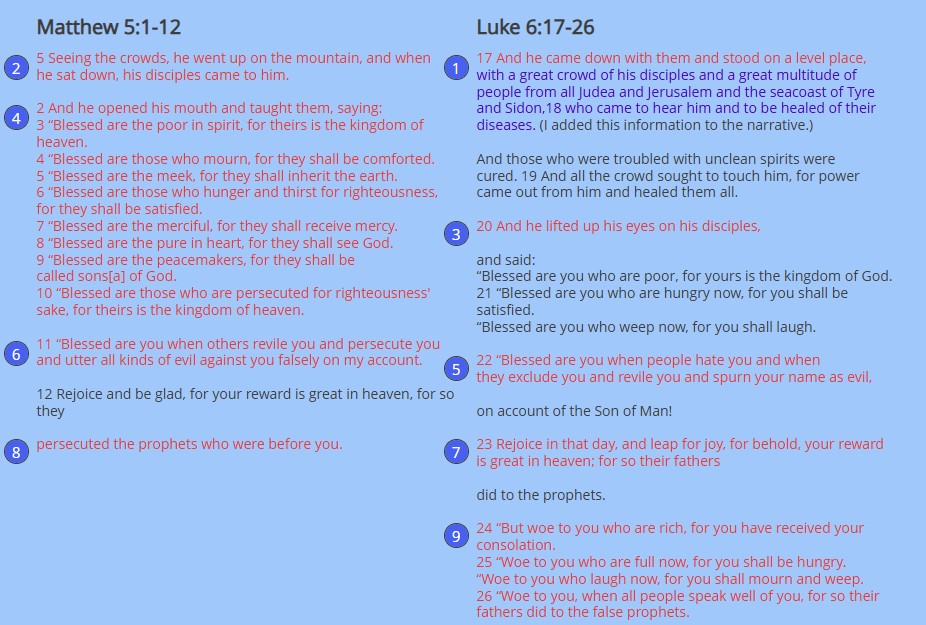
From the above worksheet photo, following the numbers and the text in red, the following narrative is produced.
Lk 6:17 And [Jesus] came down with them and stood on a level place, with a great crowd of his disciples and a great multitude of people from all Judea and Jerusalem and the seacoast of Tyre and Sidon, 18 who came to hear him and to be healed of their diseases [and] Mt 5:1 seeing the crowds, he went up on the mountain, and when he sat down, his disciples came to him. Lk 6:20 And he lifted up his eyes on his disciples, Mt 5:2 he opened his mouth and taught them, saying:
3 “Blessed are the poor in spirit, for theirs is the kingdom of heaven.
4 “Blessed are those who mourn, for they shall be comforted.
5 “Blessed are the meek, for they shall inherit the earth.
6 “Blessed are those who hunger and thirst for righteousness, for they shall be satisfied.
7 “Blessed are the merciful, for they shall receive mercy.
8 “Blessed are the pure in heart, for they shall see God.
9 “Blessed are the peacemakers, for they shall be called sons of God.
10 “Blessed are those who are persecuted for righteousness’ sake, for theirs is the kingdom of heaven.
Lk 6:22 “Blessed are you when people hate you and when they exclude you and revile you and spurn your name as evil, Mt 5:11 and persecute you and utter all kinds of evil against you falsely on my account. Lk 6:23 Rejoice in that day, and leap for joy, for behold, your reward is great in heaven; for so their fathers Mt 5:12 persecuted the prophets who were before you.
Lk 6:24 “But woe to you who are rich, for you have received your consolation.
25 “Woe to you who are full now, for you shall be hungry.
“Woe to you who laugh now, for you shall mourn and weep.
26 “Woe to you, when all people speak well of you, for so their fathers did to the false prophets.
Bible Lessons for this event:
H190 Intentionally skipped
H191 Gathering for the Beatitudes (Matthew 5:1-2; Luke 6:17-18, 20)
H192 The Poor in Spirit (Matthew 5:3)
H193 Those Who Mourn (Matthew 5:4)
H194 Those Who Are Meek (Matthew 5:5)
H195 Those Who Hunger and Thirst (Matthew 5:6)
H196 The Merciful (Matthew 5:7)
H197 The Pure in Heart (Matthew 5:8)
H198 Peacemakers (Matthew 5:9)
H199 Those Who Are Persecuted (Matthew 5:10)
H200 The Command to Rejoice Under Persecution (Matthew 5:10-12; Lk 6:22-23)
H201 The Blessings of Persecution (Matthew 5:10)
H202 Four Woes (Luke 6:24-26)
Event Summary:
This event is often referred to as the Beatitudes (Matthew) and Sermon on the Plain (Luke), which describes Jesus’ teaching on the values and blessings of God’s kingdom. They highlight themes of spiritual humility, compassion, reversal of worldly values, and a promise of hope and reward for the marginalized and faithful.
Key points of this event are:
(1) Jesus declares blessings for the poor in spirit, those who mourn, the meek, the merciful, the pure in heart, the peacemakers, and those persecuted for righteousness (Matthew). These characteristics reflect a spirit of humility, compassion, and purity that aligns with God’s values. In Luke’s account, Jesus specifically blesses the poor, the hungry, those who weep, and those persecuted for his sake. These blessings indicate that God sees and cares for the suffering and marginalized, promising a future reversal of their circumstances.
(2) Jesus’ blessings contrast with typical worldly values of power, wealth, comfort, and recognition. He proclaims that those who are weak, humble, and faithful to God are truly blessed, as they will inherit God’s kingdom, be comforted, and experience lasting joy and fulfillment. In Luke, Jesus follows the blessings with “woes” directed at the rich, well-fed, those who laugh now, and those admired by others. These “woes” serve as warnings that relying on worldly wealth, comfort, and social approval is fleeting and empty in light of God’s eternal kingdom.
(3) Jesus assures that those who experience hardship and suffering for his sake will be rewarded in the kingdom of heaven. This promise of reward is not necessarily in this life but in the life to come, offering hope and encouragement to remain faithful amid persecution or difficulty. The Beatitudes affirm that God’s blessing rests on those who live in humble dependence on him, even when they face adversity, because they are living in alignment with God’s kingdom values.
(4) These teachings invite followers of Jesus to embrace a countercultural life that values humility, mercy, and justice over material success, comfort, and social status. Jesus calls his followers to be distinct in their character and priorities, encouraging a life of compassion, peacemaking, and enduring faith even in difficult times.
The message of this event is that God’s kingdom blesses and values those who are humble, compassionate, and faithful, regardless of their earthly circumstances. Jesus emphasizes a reversal of worldly values, promising that those who endure suffering for righteousness will receive eternal joy and fulfillment in God’s kingdom. The teachings encourage followers to seek God’s approval over human approval and to live with a spirit of humility, mercy, and justice, trusting in the hope and rewards that God promises to those who live according to his will.
Understanding and Application:
Questions of Understanding with Extended Answers
1. What is the setting and audience of Jesus’ teaching in these passages?
Answer:
In Matthew, Jesus ascends a mountain and teaches His disciples, presenting a structured and authoritative discourse often called the Sermon on the Mount. The mountain setting emphasizes Jesus as the new and greater Moses, delivering divine instruction. In Luke, Jesus stands on a level place among a large crowd of disciples and people from many regions, emphasizing accessibility and the broad reach of His message. While both accounts include the disciples as primary listeners, the presence of the crowd shows that these teachings are foundational for all who would hear and respond to the kingdom message.
2. What does the term “blessed” mean in these teachings?
Answer:
The word “blessed” refers to a state of divine favor and spiritual well-being, not merely outward happiness or circumstance. It describes those who are approved by God and aligned with His kingdom values. This blessing is often paradoxical, as it is pronounced upon those who appear disadvantaged in worldly terms (poor, mourning, persecuted). The emphasis is on God’s evaluation rather than human perception—those who are “blessed” are those who belong to God and are recipients of His present grace and future reward.
3. Who are the “poor in spirit” (Matthew) and the “poor” (Luke), and how do these relate?
Answer:
Matthew’s “poor in spirit” highlights an inward attitude of humility and dependence on God. It refers to those who recognize their spiritual bankruptcy and need for God’s grace. Luke’s “poor” emphasizes the literal and social dimension—those who are materially lacking and often marginalized. Together, these descriptions reveal a unified truth: those who are empty of self-reliance and often stripped of worldly security are in a position to receive the kingdom. Poverty becomes both a physical condition and a spiritual posture pointing to reliance on God.
4. What is the significance of mourning in these passages?
Answer:
Mourning refers not only to grief over life’s hardships but especially sorrow over sin and brokenness in the world. Those who mourn recognize the effects of sin—both personal and societal—and grieve accordingly. Jesus promises that such individuals will be comforted, pointing to both present consolation through God’s presence and ultimate restoration in the coming kingdom. Mourning reflects a heart aligned with God’s perspective on sin and suffering.
5. What does it mean to be “meek,” and why are the meek promised the earth?
Answer:
Meekness is not weakness but controlled strength—humility expressed through submission to God’s will. The meek do not assert themselves through power or force but trust God to act on their behalf. The promise that they will inherit the earth reflects a reversal of worldly expectations: those who do not grasp for power will ultimately receive lasting inheritance in God’s kingdom. This echoes Old Testament promises and highlights that true possession comes through trust, not domination.
6. What does it mean to hunger and thirst for righteousness?
Answer:
To hunger and thirst for righteousness is to have a deep, ongoing desire for God’s will, justice, and moral purity. It reflects an intense longing for personal holiness and for the world to be made right according to God’s standards. This desire is not passive but active, shaping one’s life and pursuits. Jesus promises that such longing will be satisfied, pointing to both spiritual fulfillment now and complete righteousness in the future kingdom.
7. How do mercy, purity of heart, and peacemaking reflect kingdom character?
Answer:
These qualities describe the ethical and relational outworking of belonging to God’s kingdom. The merciful extend compassion because they have received mercy from God. The pure in heart are sincere and undivided in their devotion to God, free from hypocrisy. Peacemakers actively pursue reconciliation, reflecting God’s reconciling work in Christ. Together, these traits demonstrate that kingdom citizens mirror God’s character in their relationships and inner life.
8. Why are those who are persecuted considered blessed?
Answer:
Persecution arises because the values of God’s kingdom conflict with the world’s systems. Those who live according to righteousness often face opposition, rejection, or suffering. Jesus declares them blessed because their suffering identifies them with the prophets and with Himself. Their reward is great in heaven, showing that present hardship is temporary and meaningful within God’s eternal plan. Persecution becomes evidence of genuine allegiance to God’s kingdom.
9. What is the significance of the “woes” in Luke’s account?
Answer:
Luke includes corresponding woes that serve as warnings to those who are rich, satisfied, laughing, and well-spoken of. These woes are not condemnations of wealth or happiness in themselves but warnings against self-sufficiency, complacency, and reliance on worldly approval. They highlight the danger of finding fulfillment apart from God. The contrast between blessings and woes underscores a great reversal: those who appear secure now may face loss, while those who suffer now may receive eternal gain.
10. How do these teachings reveal a reversal of worldly values?
Answer:
Both passages emphasize that God’s kingdom operates according to principles opposite to worldly expectations. The world values power, wealth, comfort, and recognition, while Jesus blesses humility, dependence, suffering, and faithfulness. This reversal demonstrates that true life is not found in present circumstances but in relationship with God and participation in His kingdom. The teachings call for a reorientation of values, urging believers to live with an eternal perspective.
11. How do these passages point to the nature of the kingdom of God?
Answer:
The kingdom of God is both a present reality and a future fulfillment. The repeated phrase “theirs is the kingdom of heaven” (Matthew) and “yours is the kingdom of God” (Luke) shows that believers already belong to God’s reign. At the same time, many promises are future-oriented (comfort, inheritance, satisfaction), indicating that the fullness of the kingdom is yet to come. This “already and not yet” nature shapes how believers live—experiencing God’s blessings now while anticipating their complete realization.
12. What is the central message Jesus is communicating through these blessings and woes?
Answer:
Jesus is defining the identity and values of those who belong to His kingdom. He calls His followers to a life marked by humility, dependence on God, righteousness, mercy, and faithfulness even in suffering. At the same time, He warns against trusting in worldly success and comfort. The central message is that true blessing is found in relationship with God and alignment with His purposes, not in external circumstances. These teachings invite a transformed perspective and a life shaped by eternal priorities.
 Anchor My Faith
Leave a comment