
Photo: Sergey Trush.
Author: Stephen Weller
1,377 words, 7 minutes read time
John the Baptist Imprisoned, Jesus Leaves for Galilee
Scripture Reference: Matthew 4:12; Mark 1:14a; Luke 3:19-20; John 4:1-4
Context:
The transition described in Matthew 4:12, Mark 1:14a, Luke 3:19–20, and John 4:1–4 marks a pivotal moment in the early ministry of Jesus, set against the backdrop of rising political tension and prophetic fulfillment. John the Baptist, who had faithfully prepared the way by calling Israel to repentance, boldly rebuked Herod Antipas for his unlawful marriage and other evils. This confrontation led to John’s imprisonment, effectively silencing the prophetic voice that had been announcing the coming of the Messiah. With John removed from public ministry, a significant shift occurs: Jesus begins to step forward more prominently. Matthew highlights that upon hearing of John’s arrest, Jesus withdraws into Galilee, not out of fear but in accordance with divine timing and prophecy, positioning Himself in a region where His light would shine among the nations. Mark succinctly ties the beginning of Jesus’ public proclamation to the moment after John’s imprisonment, emphasizing continuity in the message, repentance and the nearness of God’s kingdom. Luke provides the moral and political details behind John’s arrest, underscoring the cost of prophetic truth. Meanwhile, John’s Gospel reveals another dimension: as Jesus’ ministry begins to attract greater attention, even surpassing John’s in baptizing disciples, He deliberately departs Judea and travels through Samaria, demonstrating both strategic withdrawal from premature conflict and intentional outreach beyond traditional Jewish boundaries. Together, these passages reveal a divinely orchestrated transition from preparation to fulfillment: the forerunner decreases, and the Messiah increases, as God’s redemptive plan advances into a new and more public phase through Jesus’ ministry.
Event Narrative:
The narrative for this section was obtained from three similar texts, using the highlighted material shown below. The selection was determined by Jerry Peyton and copyrighted in 2015 by Jerry Peyton and Biblical Studies Press L.L.C.
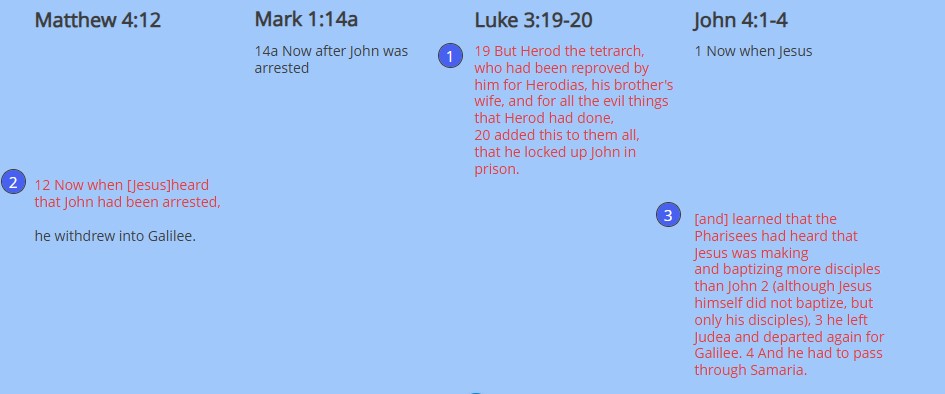
From the above worksheet photo, following the numbers and the text in red, the following narrative is produced.
Lk 3:19 But Herod the tetrarch, who had been reproved by him for Herodias, his brother’s wife, and for all the evil things that Herod had done, 20 added this to them all, that he locked up John in prison. Mt 4:12 Now when [Jesus] heard that John had been arrested, Jn 4:1 [and] learned that the Pharisees had heard that Jesus was making and baptizing more disciples than John 2 (although Jesus himself did not baptize, but only his disciples), 3 he left Judea and departed again for Galilee. 4 And he had to pass through Samaria.
Bible Lessons for this event:
H136 Herod Puts John in Prison (Luke 3:19-20; Matthew 4:12; John 4:1-4)
Event Summary:
This event provides a brief account of John the Baptist’s imprisonment and Jesus’ response, marking a turning point in the transition from John’s ministry to Jesus’ public ministry in Galilee.
Key points of this event are:
(1) John’s imprisonment marks the end of his public ministry and the beginning of Jesus’ ministry, fulfilling John’s words that Jesus must increase while he decreases (John 3:30).
(2) Jesus’ decision to return to Galilee in response to both John’s imprisonment and rising Pharisaic attention demonstrates his strategic approach to ministry, choosing the right time and place to expand his work.
(3) John’s imprisonment for confronting Herod’s immorality highlights the cost of prophetic truth-telling, foreshadowing the opposition Jesus will also face as he challenges both political and religious authorities.
This event highlights the transition from John the Baptist’s preparatory ministry to the beginning of Jesus’ mission. They emphasize the cost of proclaiming truth, the importance of faithfulness to God’s calling, and the sovereignty of God’s timing in advancing his redemptive plan. Believers are encouraged to trust God’s timing, remain steadfast in proclaiming his truth, and act with wisdom and discernment in fulfilling their roles in his kingdom.
Understanding and Application:
Questions of understanding with extended answers for the combined passages: Matthew 4:12; Mark 1:14a; Luke 3:19–20; John 4:1–4.
1. What event marked the transition from John the Baptist’s ministry to Jesus’ public ministry?
Answer:
The imprisonment of John the Baptist marked the turning point between his preparatory ministry and the beginning of Jesus Christ’s public ministry. In Matthew 4:12 and Mark 1:14a, we see that Jesus begins His ministry after hearing that John had been arrested. Luke 3:19–20 provides the reason; John had rebuked Herod Antipas for his unlawful marriage and other evils.
This transition is significant because John’s role was to prepare the way for the Messiah (Isaiah 40:3). Once his mission reached its climax, Jesus steps forward as the fulfillment. The imprisonment does not hinder God’s plan; rather, it signals the shift from preparation to fulfillment.
2. Why was John the Baptist imprisoned, and what does this reveal about his character?
Answer:
John was imprisoned because he boldly confronted Herod Antipas about his immoral relationship with Herodias (Luke 3:19). This confrontation was not merely political, it was deeply moral and prophetic. John stood for God’s righteousness regardless of personal cost.
This reveals that John was a faithful prophet who feared God more than man. His willingness to speak truth to power reflects the prophetic tradition seen throughout the Old Testament. His imprisonment, and eventual death, demonstrates that obedience to God often comes with suffering, yet it remains the path of faithfulness.
3. How does Jesus respond to the news of John’s imprisonment?
Answer:
According to Matthew 4:12, Jesus withdraws into Galilee after hearing of John’s arrest. This was not an act of fear, but of divine timing and strategy. Jesus avoids premature confrontation with authorities while positioning Himself to begin His ministry in fulfillment of prophecy (Isaiah 9:1–2).
John 4:1–4 further shows Jesus leaving Judea and traveling to Galilee, passing through Samaria. This movement reflects intentional purpose; He is not reacting randomly but advancing according to God’s plan. Even in transition, Jesus is fully in control of His mission.
4. What role does Herod Antipas play in these events?
Answer:
Herod Antipas serves as the political authority who imprisons John the Baptist. His actions represent worldly power opposing God’s truth. Though he holds authority, he is morally compromised and resistant to correction.
Luke 3:20 adds that Herod “added this to them all, that he locked up John in prison,” highlighting that this act was part of a broader pattern of evil. Herod’s role illustrates a recurring biblical theme: earthly rulers often resist God’s messengers, yet their opposition cannot stop God’s purposes.
5. Why is the movement from Judea to Galilee (and through Samaria) significant in John 4:1–4?
Answer:
Jesus’ journey from Judea to Galilee, passing through Samaria, is both geographically natural and theologically profound. While many Jews avoided Samaria due to longstanding hostility, John 4:4 says Jesus “had to pass through Samaria,” indicating divine necessity.
This movement foreshadows the expansion of the gospel beyond traditional Jewish boundaries. It shows that Jesus’ mission is not limited by cultural divisions. The transition from Judea to Galilee also marks the broader launch of His ministry to diverse groups, preparing the way for the inclusion of all people in God’s redemptive plan.
6. How do these passages demonstrate God’s sovereignty in unfolding events?
Answer:
These passages reveal that even adverse events, like John’s imprisonment, serve God’s greater plan. What appears to be a setback is actually a divinely appointed transition point.
God sovereignly uses:
- John’s imprisonment to conclude the preparatory phase
- Jesus’ relocation to initiate His ministry
- Political opposition to advance prophetic fulfillment
Nothing occurs outside of God’s control. The timing, movement, and unfolding of events all align perfectly with His redemptive purposes. This reassures believers that God is at work even in difficult or uncertain circumstances.
7. What theological connection exists between John the Baptist and Jesus in these passages?
Answer:
John and Jesus are closely linked in purpose but distinct in role. John is the forerunner, the voice preparing the way, while Jesus is the fulfillment, the Messiah Himself.
Theologically:
- John represents the culmination of the Old Testament prophetic tradition
- Jesus inaugurates the New Covenant and the kingdom of God
John’s imprisonment symbolizes the closing of one era, while Jesus’ emergence marks the beginning of another. Together, they demonstrate the continuity of God’s plan from promise to fulfillment.
 Anchor My Faith
Leave a comment