
Photo: Hannes Koening (The spirit of Madeira)
Author: Stephen Weller
1,479 words, 8 minutes read time
Back in Galilee
Scripture Reference: Mark 1:14b; Luke 4:14-15; John 4:43-45
Context:
The statements in Mark 1:14b, Luke 4:14–15, and John 4:43–45 all describe the same pivotal transition in the ministry of Jesus Christ; His return to Galilee following early events in Judea and the wilderness. After His baptism by John the Baptist and His temptation in the wilderness, Jesus begins to move into public ministry with increasing visibility. Mark emphasizes that this occurs after John’s arrest, signaling a shift from John’s preparatory ministry to Jesus’ proclamation of the gospel of God. Luke adds that Jesus returns “in the power of the Spirit,” highlighting divine empowerment and the growing spread of His reputation as He teaches in synagogues and is praised by many. John provides additional background, explaining that Jesus’ return to Galilee follows His earlier ministry in Judea (including the encounter with the Samaritan woman) and noting the mixed nature of Galilean reception; while He is welcomed, it is partly because they had seen His works in Jerusalem rather than fully understanding His identity. Together, these passages form a harmonized picture: Jesus intentionally withdraws from Judea after initial ministry and rising tensions, returns to Galilee as the central base of His work, and begins proclaiming the kingdom with authority, empowered by the Spirit, and increasingly recognized by the people; marking the true launch of His public ministry.
Event Narrative:
The narrative for this section was obtained from three similar texts, using the highlighted material shown below. The selection was determined by Jerry Peyton and copyrighted in 2015 by Jerry Peyton and Biblical Studies Press L.L.C.
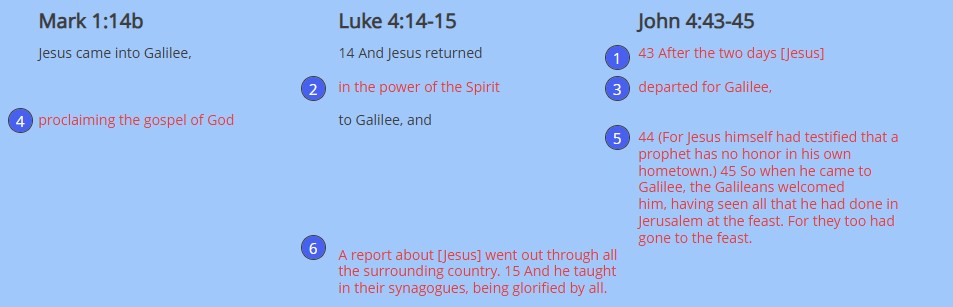
From the above worksheet photo, following the numbers and the text in red, the following narrative is produced.
Jn 4:43 After the two days [Jesus] Lk 4:14 in the power of the Spirit Jn 4:43 departed for Galilee, Mk 1:14b proclaiming the gospel of God Jn 4:44 (For Jesus himself had testified that a prophet has no honor in his own hometown.) 45 So when he came to Galilee, the Galileans welcomed him, having seen all that he had done in Jerusalem at the feast. For they too had gone to the feast.
Lk 4:14 A report about [Jesus] went out through all the surrounding country. 15 And he taught in their synagogues, being glorified by all.
Bible Lessons for this event:
H151 Intentionally skipped
H152 Return to Galilee (Mark 1:14b; Luke 4:14-15; John 4:43-45)
Event Summary:
This event describes the beginning of Jesus’ public ministry in Galilee after John the Baptist’s imprisonment. These passages highlight Jesus’ initial preaching, growing reputation, and reception in Galilee.
Key points of this event are:
(1) This event describes the early stages of Jesus’ public ministry as he begins teaching, performing miracles, and proclaiming the good news of the kingdom of God. They emphasize themes of Jesus’ authority, the power of the Spirit, the spread of his message, and the mixed responses to his ministry.
(2) Luke emphasizes that Jesus’ ministry is conducted in the power of the Spirit, underscoring the divine authority behind his words and works.
(3) While Jesus is initially welcomed, John hints at the superficial nature of this welcome, as many are drawn by his miracles rather than a deep understanding of his message. His comment about a prophet not being honored in his own country foreshadows the resistance and rejection he will face later.
(4) In these early stages, Jesus’ ministry centers on proclaiming the good news and teaching in synagogues, setting the foundation for the kingdom of God.
This event highlights the beginning of Jesus’ public ministry, emphasizing his Spirit-empowered proclamation of the kingdom of God and the varied responses he receives. They challenge readers to go beyond superficial admiration of Jesus’ works and embrace genuine faith in his mission and identity. These passages also underscore the universal nature of Jesus’ ministry, calling all people to repentance, faith, and participation in God’s kingdom.
Understanding and Application:
Questions of understanding with extended answers for Mark 1:14b; Luke 4:14–15; John 4:43–45, focusing on the beginning of Jesus’ Galilean ministry:
1. What is the central message Jesus proclaims as He begins His ministry in Galilee?
Answer:
In Mark 1:14b, Jesus comes into Galilee “proclaiming the gospel of God.” This message is clarified in the following verse (Mark 1:15) as the announcement that the kingdom of God is at hand and that people must repent and believe. The term “gospel” means “good news,” and it centers on God’s redemptive plan now being fulfilled through Christ. Jesus is not merely teaching moral improvement; He is declaring that God’s long-awaited reign is breaking into history. His message calls for a response; repentance (a turning from sin) and faith (trust in Him). This establishes the foundation of His entire ministry.
2. What role does the power of the Spirit play in Jesus’ ministry according to Luke?
Answer:
In Luke 4:14, Jesus returns to Galilee “in the power of the Spirit.” This highlights that His ministry is not carried out in mere human strength but is empowered by the Holy Spirit. This connects directly to His baptism (Luke 3:22) and temptation (Luke 4:1), where the Spirit was already active in guiding and strengthening Him. The Spirit’s power authenticates His mission, enables His teaching, and later empowers His miracles. It also serves as a model: just as Jesus ministers in the Spirit’s power, so His followers are to depend on the Spirit for effective service.
3. How did people initially respond to Jesus’ teaching in Galilee?
Answer:
Luke 4:14–15 tells us that a report about Jesus spread throughout the region and that He was “praised by all.” This indicates a positive and enthusiastic reception at the beginning of His ministry. People were drawn to His authority, clarity, and wisdom as He taught in synagogues. However, this early praise is somewhat superficial and does not necessarily reflect deep faith. As the Gospel accounts continue, this admiration often turns to opposition when Jesus challenges expectations and exposes hearts. Thus, this passage shows the contrast between initial excitement and the deeper commitment that true discipleship requires.
4. Why is it significant that Jesus taught in the synagogues?
Answer:
Teaching in synagogues, as noted in Luke 4:15, placed Jesus within the established structure of Jewish worship and instruction. Synagogues were centers for reading Scripture and teaching, making them ideal places to reach people who were already familiar with God’s Word. By teaching there, Jesus demonstrates continuity with the Old Testament while also revealing its fulfillment in Himself. It shows that His message is not a rejection of Scripture but its culmination. Additionally, this setting allows His message to spread quickly, as those who heard Him would carry reports to other regions.
5. What explains the different reception Jesus receives in Galilee according to John?
Answer:
In John 4:43–45, we are told that although a prophet has no honor in his hometown, the Galileans welcomed Jesus because they had seen what He did in Jerusalem during the feast. This reveals a mixed motive behind their reception. On one hand, they welcome Him; on the other, their interest is largely based on His signs rather than a true understanding of His identity. Their belief is influenced by what they witnessed rather than by genuine spiritual insight. This highlights a recurring theme in John’s Gospel: many are drawn to Jesus because of miracles, but not all come to saving faith.
6. How do these passages together provide a unified picture of the start of Jesus’ ministry?
Answer:
Together, Mark 1:14b, Luke 4:14–15, and John 4:43–45 present a comprehensive view of Jesus’ early Galilean ministry. Mark emphasizes the message, proclaiming the gospel of God. Luke emphasizes the means, the power of the Spirit and authoritative teaching. John emphasizes the response, people welcoming Him, though often for incomplete reasons. When combined, these passages show that Jesus’ ministry begins with divine authority, Spirit empowerment, widespread attention, and varied human responses. This sets the stage for everything that follows: the expansion of His ministry, the deepening of His teaching, and the growing division among those who hear Him.
7. What does this passage teach about the difference between true faith and superficial interest?
Answer:
The reception described in these passages, especially in John 4:45, demonstrates that not all who welcome Jesus truly believe in Him. Many were attracted to His miracles and reputation rather than to His call to repentance and faith. True faith involves recognizing Jesus as the Son of God and submitting to His authority, not merely being impressed by His works. This distinction is crucial, as it challenges readers to examine their own response: Are they following Christ for who He is, or merely for what He can do? The early popularity of Jesus reminds us that outward approval is not the same as inward transformation.
 Anchor My Faith
Leave a comment