
Photo: Atif Hussain Photography (Brienz, Switzerland)
Author: Stephen Weller
2,116 words, 11 minutes read time
Jesus Rejected at Nazareth
Scripture Reference: Matthew 13:53-58; Mark 6:1-6; Luke 4:16-30
Context:
The events recorded in Matthew 13:53–58, Mark 6:1–6, and Luke 4:16–30 describe Jesus returning to His hometown of Nazareth after establishing a growing reputation through teaching and miracles throughout Galilee. In Gospel of Matthew and Gospel of Mark, the focus is on the people’s astonishment turning quickly into skepticism; they recognize Jesus as the carpenter’s son, familiar with His family, and therefore struggle to reconcile His ordinary upbringing with His extraordinary wisdom and power. Their unbelief becomes a barrier, leading Jesus to declare that a prophet is not honored in his own hometown and resulting in limited miracles due to their lack of faith. In contrast, Gospel of Luke provides a fuller account of an earlier visit to Nazareth, where Jesus reads from Isaiah in the synagogue and proclaims the fulfillment of Scripture in Himself. Initially admired, the crowd becomes hostile when Jesus exposes their unbelief and reminds them that God’s grace historically extended beyond Israel to Gentiles, as seen in Elijah and Elisha’s ministries. This provokes intense anger, culminating in an attempt to throw Him off a cliff; an early foreshadowing of the broader rejection He would face. Together, these passages highlight the tragic irony that those who knew Jesus best according to the flesh failed to recognize Him spiritually, illustrating how familiarity can breed contempt and how unbelief limits the reception of God’s work, even in the presence of divine truth and power.
Event Narrative:
The narrative for this section was obtained from three similar texts, using the highlighted material shown below. The selection was determined by Jerry Peyton and copyrighted in 2015 by Jerry Peyton and Biblical Studies Press L.L.C.
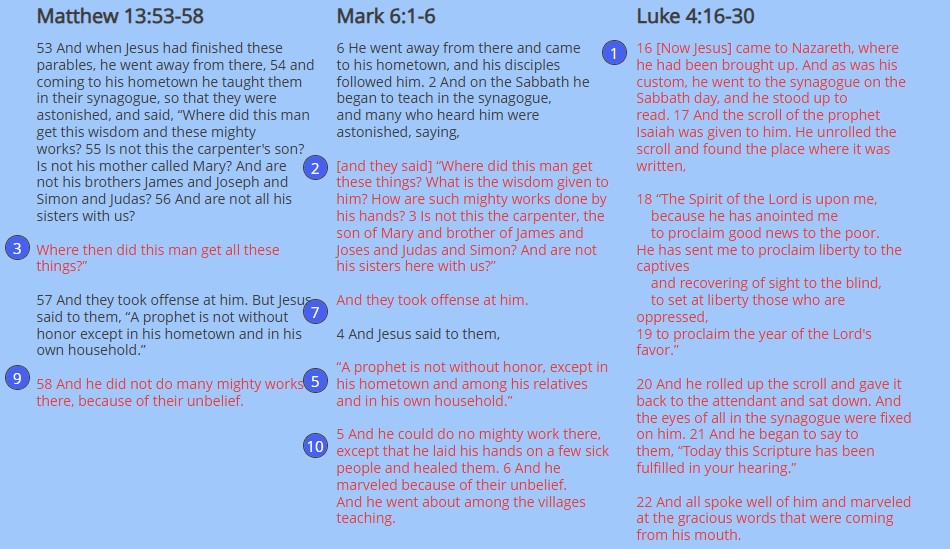

From the above worksheet photo, following the numbers and the text in red, the following narrative is produced.
LK 4:16 [Now Jesus] came to Nazareth, where he had been brought up. And as was his custom, he went to the synagogue on the Sabbath day, and he stood up to read. 17 And the scroll of the prophet Isaiah was given to him. He unrolled the scroll and found the place where it was written; 18 “The Spirit of the Lord is upon me, because he has anointed me to proclaim good news to the poor. He has sent me to proclaim liberty to the captives and recovering of sight to the blind, to set at liberty those who are oppressed, 19 to proclaim the year of the Lord’s favor.” 20 And he rolled up the scroll and gave it back to the attendant and sat down. And the eyes of all in the synagogue were fixed on him. 21 And he began to say to them, “Today this Scripture has been fulfilled in your hearing.”
22 All spoke well of him and marveled at the gracious words that were coming from his mouth. Mk 6:2 [They said] “Where did this man get these things? What is the wisdom given to him? How are such mighty works done by his hands? 3 Is not this the carpenter, the son of Mary and brother of James and Joses and Judas and Simon? And are his sisters not here with us? Mt 13:56 Where then did this man get all these things?”
Lk 4:23 [Jesus] said to them, “Doubtless you will quote to me this proverb, ‘“Physician, heal yourself.” What we have heard you did at Capernaum, do here in your hometown as well.’” 24 And he said, “Truly, I say to you, Mk 6:4 a prophet is not without honor, except in his hometown and among his relatives and in his own household.”
Lk 4:25 [Jesus continued,] “But in truth, I tell you, there were many widows in Israel in the days of Elijah, when the heavens were shut up three years and six months, and a great famine came over all the land, 26 and Elijah was sent to none of them but only to Zarephath, in the land of Sidon, to a woman who was a widow.27 And there were many lepers in Israel in the time of the prophet Elisha, and none of them was cleansed, but only Naaman the Syrian.”
28 When they heard these things, all in the synagogue were filled with wrath Mt 6:3 and they took offense at him. Lk 4:29 And they rose up and drove him out of the town and brought him to the brow of the hill on which their town was built, so that they could throw him down the cliff. 30 But passing through their midst, he went away.
Mt 13:58 And he did not do many mighty works there, because of their unbelief. Mk 6:5 And he could do no mighty work there, except that he laid his hands on a few sick people and healed them. 6 And he marveled because of their unbelief. [Then] he went about among the villages teaching.
Bible Lessons for this event:
H153 The Official Beginning of Ministry (Luke 4:16-19)
H154 Prophecy About Jesus (Luke 4:18-19)
H155 Jesus Claims to be the One (Luke 4:20-22)
H156 A Lack of Honor (Mark 6:2-4, Matthew 13:56; Luke 4:23-24)
H157 Two Examples of Gentiles (Luke 4:25-27)
H158 People’s Wrath Towards Jesus (Luke 4:28-30, Matthew 6:3)
H159 The Hindrance of Unbelief (Matthew 13:58; Mark 6:5-6)
Event Summary:
This event describes Jesus’ visit to His hometown of Nazareth, where He faces skepticism and rejection. This event emphasizes the difficulty of accepting a familiar figure as a prophet, the people’s unbelief, and Jesus’ response to their rejection.
Key points of this event are:
(1) This event underscores the difficulty of recognizing God’s work in familiar people. The people of Nazareth struggle to accept Jesus’ divine mission because of his ordinary origins among them.
(2) Jesus boldly claims to fulfill Isaiah’s Messianic prophecy, but this claim only provokes more resistance from those who know his background.
(3) Jesus’ reference to Elijah and Elisha’s ministry to Gentiles foreshadows the expansion of the Gospel to all nations, not just to Israel, indicating that God’s salvation will reach those who are open to it, regardless of ethnicity.
(4) The Nazarenes’ lack of faith limits the impact of Jesus’ work, illustrating the connection between faith and the reception of God’s blessings.
This event highlights the challenge of faith, the rejection of truth by those unwilling to believe, and the inclusivity of God’s mission. Jesus’ rejection in Nazareth reflects humanity’s struggle to accept God’s work through the familiar and the unexpected. The accounts call believers to recognize and respond to Jesus with faith and humility, embrace the universal nature of God’s mission, and remain steadfast in proclaiming truth, even in the face of rejection.
Understanding and Application:
Here are Questions of Understanding with Extended Answers for the combined passages Matthew 13:53–58; Mark 6:1–6; Luke 4:16–30, focusing on Jesus’ rejection at Nazareth:
1. What was the setting and significance of Jesus returning to Nazareth?
Answer:
Nazareth was Jesus’ hometown—the place where He had grown up and lived most of His earthly life prior to beginning His public ministry. Returning there carried deep personal and spiritual significance. It was not merely a visit, but a moment of revelation: the people who knew Him best would now be confronted with who He truly was. This setting highlights a powerful tension; familiarity with Jesus’ humanity blinded them to His divinity. Instead of responding with faith, they evaluated Him based on their prior knowledge of His family and occupation. This demonstrates that proximity to truth does not guarantee acceptance of truth; in fact, it can sometimes hinder it.
2. How did Jesus initially present Himself in the synagogue according to Luke 4:16–21?
Answer:
In the synagogue, Jesus read from Isaiah (Isaiah 61:1–2), proclaiming that the Spirit of the Lord was upon Him to bring good news, liberty, healing, and restoration. He then declared, “Today this Scripture has been fulfilled in your hearing.” This was a clear and direct claim to be the Messiah, the anointed one sent by God. Initially, the people responded with amazement at His gracious words. However, their amazement did not mature into faith. Instead, they questioned how someone they knew as Joseph’s son could make such a claim. This moment reveals that hearing truth is not enough; it must be received with belief and humility.
3. Why did the people of Nazareth take offense at Jesus?
Answer:
The people were offended because Jesus did not fit their expectations of the Messiah. They knew His family, His mother Mary and His brothers, and had watched Him grow up. In their minds, He was simply a carpenter, not a divine figure. Their familiarity bred contempt rather than faith. Additionally, Jesus’ message challenged their pride and assumptions, particularly when He implied that God’s blessings often extend beyond those who presume themselves to be favored. Their offense was rooted in unbelief, pride, and a refusal to accept that God could work through someone so ordinary in their eyes.
4. What examples did Jesus give from the Old Testament, and why did they provoke anger?
Answer:
Jesus referenced two events:
• Elijah being sent to a widow in Zarephath (a Gentile region) during a famine
• Elisha cleansing Naaman the Syrian, also a Gentile
These examples showed that God’s grace had historically been extended to outsiders when Israel was in unbelief. This deeply offended His audience because it implied that they, like their ancestors, were rejecting God, and that others might receive what they were refusing. The implication that Gentiles could receive God’s favor over them struck at their national pride and religious self-confidence, provoking intense anger.
5. What does Jesus mean when He says, “A prophet is not without honor except in his hometown”?
Answer:
Jesus is expressing a recurring biblical pattern: those who are closest to a prophet often fail to recognize his authority. Familiarity can dull spiritual perception. In Nazareth, people saw Jesus through the lens of their past experiences rather than through the truth of His present revelation. This statement reveals that honor is often withheld where it should be most evident. It also highlights the tragedy of missed opportunity; those who should have received Him first instead rejected Him.
6. How did unbelief affect Jesus’ ministry in Nazareth?
Answer:
According to Matthew and Mark, Jesus did not perform many miracles there, except for healing a few individuals. This was not due to a lack of power but a lack of faith among the people. Miracles in Jesus’ ministry were often connected to faith as a response to God’s work. Their unbelief created an environment resistant to His works. Mark even notes that Jesus “marveled because of their unbelief,” emphasizing how extraordinary and grievous their rejection was. This teaches that unbelief limits the experience of God’s power—not because God is unable, but because people are unwilling to receive.
7. How did the crowd’s reaction escalate in Luke 4:28–30?
Answer:
The crowd moved from curiosity to outrage. After hearing Jesus’ message and understanding its implications, they were filled with wrath. They drove Him out of the town and attempted to throw Him off a cliff. This escalation reveals how deeply offensive truth can be when it confronts pride and unbelief. However, Jesus passed through their midst and went away, demonstrating His authority and the fact that His mission would not be stopped prematurely. His life was governed by divine timing, not human hostility.
8. What broader theological theme is revealed in Jesus’ rejection at Nazareth?
Answer:
A central theme is the rejection of God’s chosen messenger by His own people; a pattern seen throughout Scripture. This anticipates the broader rejection of Jesus by Israel and points forward to the inclusion of the Gentiles in God’s redemptive plan. It also highlights the nature of faith: true reception of Christ requires spiritual discernment, not merely external familiarity or cultural association. The passage underscores both human responsibility (to believe) and divine sovereignty (God’s plan advancing despite rejection).
9. How should believers respond to this passage today?
Answer:
Believers should examine their own hearts for areas of familiarity without faith. It is possible to be close to Scripture, church, and Christian truth yet remain unmoved in genuine belief. This passage calls for a renewed recognition of who Jesus is, not merely as a historical figure or teacher, but as the Messiah and Son of God. It also encourages believers to remain steadfast when facing rejection, remembering that even Jesus was rejected by those closest to Him. Finally, it invites a posture of humility, ensuring that we do not miss God’s work because it comes in ways we do not expect.
 Anchor My Faith
Leave a comment