
Photo: Miranda Perry Photography (The Smokey Mountain National Park)
Author: Stephen Weller
1,551 words, 8 minutes read time
Jesus Moves from Nazareth to Capernaum
Scripture Reference: Matthew 4:13-17; Mark 1:15
Context:
Following His temptation in the wilderness, Jesus begins His public ministry at a decisive moment in Israel’s history. After hearing that John the Baptist has been arrested, signaling both increasing opposition and a transition in God’s redemptive plan, Jesus withdraws from Judea to Galilee, a region often looked down upon spiritually, yet strategically positioned among both Jews and Gentiles. Leaving Nazareth, He settles in Capernaum by the Sea of Galilee, fulfilling the prophecy of Isaiah that a great light would dawn in “Galilee of the Gentiles,” a place associated with spiritual darkness and mixed populations. This relocation is not incidental but purposeful, demonstrating that the message of the kingdom is intended not only for the religious center of Jerusalem but for all people, including those considered outsiders. From this point forward, Jesus begins proclaiming the central message of His ministry: “Repent, for the kingdom of heaven is at hand,” and “The time is fulfilled, and the kingdom of God is at hand; repent and believe in the gospel.” These parallel declarations emphasize that a divinely appointed moment in history has arrived—the long-awaited reign of God is breaking into the present through the person and work of Christ. His call to repentance is not merely moral reform but a radical turning of heart and mind in response to God’s nearness, while the call to believe invites trust in the good news that God’s redemptive purposes are now being fulfilled. This marks the beginning of Jesus’ authoritative ministry, where He not only announces the kingdom but will soon demonstrate its power through teaching, healing, and calling disciples.
Event Narrative:
The narrative for this section was obtained from two similar texts, using the highlighted material shown below. The selection was determined by Jerry Peyton and copyrighted in 2015 by Jerry Peyton and Biblical Studies Press L.L.C.
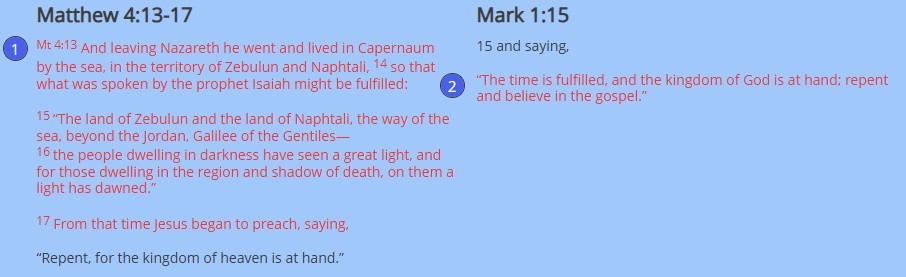
From the above worksheet photo, following the numbers and the text in red, the following narrative is produced.
Mt 4:13 And leaving Nazareth he went and lived in Capernaum by the sea, in the territory of Zebulun and Naphtali, 14 so that what was spoken by the prophet Isaiah might be fulfilled. 15 “The land of Zebulun and the land of Naphtali, the way of the sea, beyond the Jordan, Galilee of the Gentiles—16 the people dwelling in darkness have seen a great light, and for those dwelling in the region and shadow of death, on them a light has dawned.” 17 From that time Jesus began to preach, saying, Mk 1:15 “The time is fulfilled, and the kingdom of God is at hand; repent and believe in the gospel.”
Bible Lessons for this event:
H160 Jesus Begins His Ministry (Matthew 4:13-17; Mark 1:15)
Event Summary:
This event marks the beginning of Jesus’ public ministry, focusing on His proclamation of the kingdom of heaven and His call to repentance. They emphasize themes of fulfillment of prophecy, the arrival of God’s kingdom, and the need for repentance and belief.
Key points of this event are:
(1) Jesus’ move to Capernaum fulfills the prophecy from Isaiah, signaling that he is the promised light that brings spiritual transformation, even to regions perceived as spiritually dark.
(2) Jesus proclaims that “the kingdom of heaven” (Matthew) or “the kingdom of God” (Mark) has come near. This message emphasizes that God’s rule, presence, and authority are now breaking into the world through Jesus’ ministry.
(3) The central call is to repent, a change of mind and heart, and to believe the good news. Repentance is both turning away from sin and turning toward the new reality of God’s reign.
This event emphasize that Jesus is the fulfillment of prophecy and the provider of God’s kingdom. His message calls for a response of repentance and belief, inviting people to turn from sin and embrace the hope and salvation he offers. These passages challenge readers to recognize Jesus as the light in the midst of spiritual darkness and to align their lives with his message of redemption and transformation.
Understanding and Application:
Questions of understanding with extended answers for Matthew 4:13–17 and Mark 1:15, focusing on context, meaning, and theological significance.
1. Why did Jesus leave Nazareth and settle in Capernaum?
Answer:
Jesus’ move from Nazareth to Capernaum was both practical and prophetic. Practically, Capernaum was a central location along major trade routes by the Sea of Galilee, making it an ideal base for ministry. Prophetically, this fulfilled Isaiah’s prophecy (Isaiah 9:1–2), which spoke of a great light shining in the regions of Zebulun and Naphtali—areas associated with Galilee. By relocating there, Jesus demonstrated that His ministry was not random but divinely directed. It also emphasized that God’s redemptive work often begins in unexpected or overlooked places, highlighting His grace toward those considered spiritually distant or marginalized.
2. What is the significance of the phrase “the people dwelling in darkness have seen a great light”?
Answer:
This phrase describes the spiritual condition of humanity apart from God, living in ignorance, sin, and separation from divine truth. “Darkness” represents not only moral corruption but also a lack of understanding of God’s ways. The “great light” is Jesus Himself, who brings revelation, truth, and salvation. His arrival marks the breaking of spiritual darkness and the beginning of restoration. This imagery underscores that salvation originates from God’s initiative; people in darkness do not generate light themselves but receive it through Christ. It also highlights the transformative power of Jesus’ presence, bringing hope where there was none.
3. What does Jesus mean by “Repent, for the kingdom of heaven is at hand”?
Answer:
The call to “repent” means more than feeling sorry for sin; it involves a complete change of mind, heart, and direction. It is a turning away from sin and a turning toward God in faith and obedience. The phrase “the kingdom of heaven is at hand” means that God’s reign has drawn near through the person and work of Jesus. This is not merely a future reality but a present one—God’s authority is now being revealed and established. Jesus’ message calls for an immediate response because the arrival of the kingdom demands a reorientation of one’s entire life under God’s rule.
4. How does Mark 1:15 expand our understanding of Jesus’ message?
Answer:
Mark 1:15 provides a fuller summary of Jesus’ proclamation: “The time is fulfilled, and the kingdom of God is at hand; repent and believe in the gospel.” This adds two important elements. First, “the time is fulfilled” indicates that God’s redemptive plan has reached a निर्णायक moment; what was promised in the Old Testament is now being realized. Second, it pairs repentance with belief, showing that turning from sin must be accompanied by trusting in the good news (the gospel). This highlights that salvation is not achieved through human effort but received through faith in Christ.
5. What is meant by “the kingdom of God” or “kingdom of heaven”?
Answer:
The kingdom refers to God’s sovereign rule and reign. It is not primarily a physical location but the dynamic reality of God’s authority being exercised. In Jesus, the kingdom is both present and future; present in His ministry, miracles, and teaching, and future in its complete fulfillment when He returns. The kingdom transforms individuals internally (through salvation and new birth) and will ultimately transform all creation. Understanding the kingdom helps us see that Jesus’ mission was not only to save individuals but to restore God’s rightful rule over all things.
6. Why is repentance and belief presented as an urgent response?
Answer:
The urgency comes from the declaration that “the time is fulfilled” and “the kingdom is at hand.” This signals that a decisive moment in history has arrived. God’s redemptive plan is unfolding, and delay in responding means missing the opportunity to enter into His kingdom. Repentance and belief are not optional or secondary; they are essential responses to the presence of Christ. This urgency reflects the seriousness of sin, the nearness of God’s judgment, and the availability of grace through Jesus.
7. How do these passages connect to the broader theme of God’s redemptive plan?
Answer:
These passages mark the beginning of Jesus’ public ministry and the fulfillment of long-awaited promises. From Genesis onward, Scripture anticipates a coming deliverer and the establishment of God’s kingdom. Jesus’ proclamation shows that this plan is now being realized. His message of repentance and belief aligns with God’s consistent call throughout Scripture for His people to turn to Him. These verses serve as a pivotal moment where promise becomes fulfillment, and anticipation becomes reality in Christ.
8. What is the practical application of these verses for believers today?
Answer:
These verses call believers to continual repentance and faith. Repentance is not a one-time act but an ongoing posture of turning away from sin and aligning with God’s will. Belief involves trusting in the gospel daily and living under Christ’s authority. Additionally, believers are called to reflect the “light” of Christ in a dark world, participating in the spread of His kingdom. These passages remind us that God’s kingdom is present now, and our lives should demonstrate submission to His rule and commitment to His mission.
 Anchor My Faith
Leave a comment