
Photo: Alfa Bravo
Author: Stephen Weller
1,912 words, 10 minutes read time
Casting Out an Unclean Spirit – Capernaum, Galilee
Scripture Reference: Mark 1:21-28; Luke 4:31-37
Context:
The accounts in Mark 1:21–28 and Luke 4:31–37 take place early in Jesus’ Galilean ministry, shortly after His baptism, temptation, and initial calling of disciples. Both writers place this event in the synagogue at Capernaum, a prominent town along the Sea of Galilee that became a central hub for Jesus’ ministry. The synagogue setting is significant, as it was the primary place of teaching, Scripture reading, and community gathering for the Jewish people, especially on the Sabbath. Into this established religious environment, Jesus enters not as a trained scribe but as one who teaches “with authority,” immediately distinguishing Himself from the traditional teachers who relied on citing earlier rabbis. The astonishment of the people highlights a growing tension: while they recognize something uniquely powerful in His teaching, they do not yet fully understand His identity.
This tension escalates dramatically when a man possessed by an unclean spirit interrupts the gathering, crying out in recognition of Jesus as “the Holy One of God.” This moment reveals a deeper spiritual reality; while the people are still questioning who Jesus is, the demonic realm clearly recognizes His authority and divine identity. Jesus’ response is immediate and commanding; without ritual, incantation, or struggle, He rebukes the spirit and delivers the man, demonstrating absolute authority over evil. This act serves as one of the first public displays of His power in Galilee, confirming that His authority is not only in word but also in action. The people’s amazement spreads rapidly throughout the region, marking the beginning of Jesus’ reputation as one who possesses both authoritative teaching and sovereign power over spiritual forces. This passage, therefore, establishes a foundational theme in the Gospels: the kingdom of God has arrived in the person of Jesus, confronting and overpowering the forces of darkness while revealing His identity progressively to those who witness His works.
Event Narrative:
The narrative for this section was obtained from two similar texts, using the highlighted material shown below. The selection was determined by Jerry Peyton and copyrighted in 2015 by Jerry Peyton and Biblical Studies Press L.L.C.
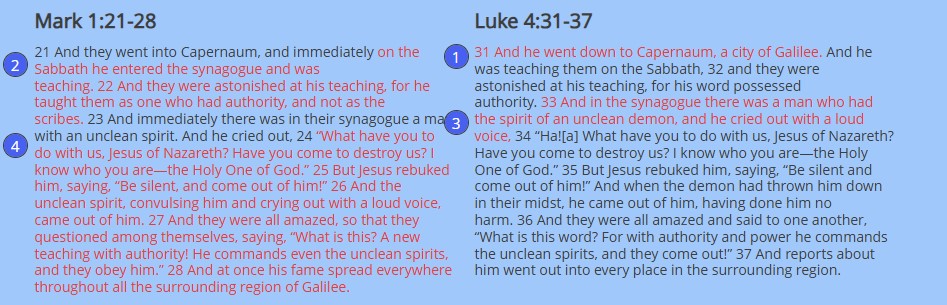
From the above worksheet photo, following the numbers and the text in red, the following narrative is produced.
Lk 4:31 [Then Jesus and his disciples] went down to Capernaum, a city of Galilee. Mk 1:21 On the Sabbath he entered the synagogue and [began to teach]. 22 [The people] were astonished at his teaching, for he taught them as one who had authority, and not as the Scribes.
Lk 4:33 [Now] in the synagogue there was a man who had the spirit of an unclean demon, and he cried out with a loud voice, Mk 1:24 “What have you to do with us, Jesus of Nazareth? Have you come to destroy us? I know who you are—the Holy One of God.” Mk 1:25 But Jesus rebuked him, saying, “Be silent, and come out of him!” 26 And the unclean spirit, convulsing him and crying out with a loud voice, came out of him.
Mk 1:27 And they were all amazed, so that they questioned among themselves, saying, “What is this? A new teaching with authority! He commands even the unclean spirits, and they obey him.” 28 And at once his fame spread everywhere throughout all the surrounding region of Galilee.
Bible Lessons for this event:
H166 Authority Over Unclean Spirits (Mark 1:21-28; Luke 4:31, 33)
Event Summary:
This event describes Jesus’ teaching and exorcism in the synagogue in Capernaum, highlighting his authority and power over evil. The key themes emphasize Jesus’ divine authority in both his teaching and his actions.
Key points of this event are:
(1) In this event, Jesus teaches in the synagogue on the Sabbath, and the people are astonished by His teaching, noting that He speaks with an authority unlike the scribes. This authority signifies that Jesus is not merely a teacher of religious tradition but the authoritative voice of God, revealing God’s truth directly and with power.
(2) During His teaching, a man possessed by an unclean spirit cries out, recognizing Jesus as the “Holy One of God.” This shows that even the spiritual realm acknowledges Jesus’ true identity. Jesus rebukes the unclean spirit, commanding it to come out of the man, and the spirit immediately obeys. This act demonstrates Jesus’ power over demonic forces, affirming his authority over evil.
(3) The people are amazed, not only by Jesus’ teaching but also by his authority to command unclean spirits, which leads to widespread news of him throughout the region. The combined authority of Jesus’ words and deeds confirms his divine mission, showing that the kingdom of God has come with power, bringing freedom and deliverance.
This event emphasizes Jesus’ divine authority in his teaching and his power over evil. His words and actions reveal that he is more than a teacher; he is the Son of God with authority over all creation. The passages challenge readers to recognize Jesus’ unique authority and to trust in his power to bring truth, liberation, and restoration to their lives. They also affirm that his victory over evil is central to the arrival of God’s kingdom.
Understanding and Application:
Here are questions of understanding with extended answers for the parallel accounts of Gospel of Mark 1:21–28 and Gospel of Luke 4:31–37, which both describe Jesus casting out a demon in the synagogue at Capernaum.
Questions of Understanding with Extended Answers
1. Where does this event take place, and why is that significant?
Answer:
This event takes place in the synagogue in Capernaum on the Sabbath. The synagogue was the central place of worship, teaching, and community life for the Jews. That Jesus performs this act there is highly significant, it shows that His authority is not limited to private settings but is openly demonstrated in the heart of religious life. It also confronts the spiritual condition of Israel directly. The presence of a demon-possessed man in the synagogue reveals that outward religious structure does not guarantee inward spiritual purity. Jesus’ authority is therefore shown to surpass the existing religious system, exposing its inability to deal with the deeper problem of sin and spiritual bondage.
2. What distinguishes Jesus’ teaching from that of the scribes?
Answer:
The people were astonished because Jesus taught “as one who had authority, and not as the scribes.” The scribes typically relied on quoting traditions, rabbis, and interpretations of the law. Their authority was derivative. In contrast, Jesus speaks directly and decisively; His authority is inherent. He does not appeal to other teachers because He Himself is the source of truth. His words carry divine weight, penetrating hearts and confronting reality with clarity and power. This distinction highlights that Jesus is not merely another teacher but the authoritative revelation of God Himself.
3. How does the demon respond to Jesus, and what does this reveal?
Answer:
The demon cries out, “I know who You are; the Holy One of God!” This response reveals several important truths. First, the spiritual realm recognizes Jesus’ identity even when many humans do not. Second, the demon’s recognition is not submission but fear and resistance. It acknowledges Jesus’ authority and anticipates judgment (“Have You come to destroy us?”). This demonstrates that Jesus’ authority extends beyond the physical world into the unseen spiritual realm. It also shows that mere knowledge of Jesus is not the same as faith; demons know who He is yet remain opposed to Him.
4. Why does Jesus command the demon to be silent?
Answer:
Jesus rebukes the demon and commands it to be silent, refusing its testimony. This is significant because Jesus does not accept truth proclaimed by unclean sources. He controls the revelation of His identity and mission, ensuring it unfolds according to God’s timing and purpose. Additionally, He avoids confusion; He does not want His identity associated with demonic voices or misunderstood through premature or distorted declarations. His authority is not dependent on validation from evil spirits; rather, He demonstrates who He is through His works and words.
5. What does Jesus’ command over the demon demonstrate about His authority?
Answer:
Jesus commands the demon with a simple, direct order: “Be quiet and come out of him!” The demon obeys immediately. There is no struggle, ritual, or appeal to a higher power; Jesus speaks, and it happens. This demonstrates absolute authority over the spiritual realm. Unlike others who might attempt exorcism through elaborate means, Jesus exercises effortless control. His authority is intrinsic and sovereign. This confirms that the kingdom of God has arrived in power, confronting and overcoming the forces of darkness.
6. How do the people react, and what does their reaction reveal?
Answer:
The people are amazed and begin discussing what they have witnessed, saying, “What is this? A new teaching with authority!” Their reaction reveals both astonishment and curiosity. They recognize that something unprecedented is taking place; teaching and power combined in one person. However, their response is primarily observational rather than fully understanding or believing. This reflects a common theme in the Gospels: people are amazed by Jesus but do not always grasp the full significance of who He is. Their amazement spreads His fame, but deeper faith is still developing.
7. What connection is shown between Jesus’ teaching and His authority over demons?
Answer:
The passage closely links Jesus’ teaching with His authority over demons. His words are not merely informative—they are powerful and effective. The same authority that astonishes listeners in His teaching is demonstrated in His command over the demon. This shows that His word carries divine power. Teaching and action are unified; what He declares, He enacts. This reinforces that Jesus is not only a teacher of truth but the embodiment of truth and power.
8. How do these accounts together strengthen our understanding of the event?
Answer:
The accounts in Mark and Luke complement each other and provide a fuller picture. Mark emphasizes the immediacy and authority of Jesus’ actions, while Luke highlights the power and impact of His word. Together, they reinforce key themes: Jesus’ authority, the recognition of His identity by the spiritual realm, and the amazement of the people. The consistency between the accounts strengthens their reliability and underscores the significance of the event as a defining moment early in Jesus’ ministry.
9. What is the broader theological significance of this miracle?
Answer:
This miracle reveals that Jesus has authority over evil and that the kingdom of God is breaking into the world. It is a visible demonstration that the power of darkness is being confronted and overcome. The event points forward to the ultimate victory of Christ over sin, death, and Satan. It also affirms that Jesus is the Holy One of God; the One who brings deliverance and restoration. This is not just an isolated act of compassion but a sign of a greater redemptive work unfolding through His ministry.
 Anchor My Faith
Leave a comment