
Photo: Alex Forst
Author: Stephen Weller
1,700 words, 9 minutes read time
Healing at Simon Peter’s House – Capernaum, Galilee
Scripture Reference: Matthew 4:18-22; Mark 1:16-20; Luke 5:1b-11
Context:
The calling of the first disciples, Peter, Andrew, James, and John, takes place early in Jesus’ Galilean ministry and marks a decisive transition from preparation to active mission. After His temptation in the wilderness and initial proclamation of the kingdom of God, Jesus begins to gather those who will become the foundation of His earthly ministry and later the leaders of the early church. The setting along the Sea of Galilee is significant: these men are ordinary fishermen engaged in their daily labor, representing the common people to whom the gospel first comes. In Matthew 4:18–22 and Mark 1:16–20, the call is presented with striking immediacy; Jesus simply commands, “Follow Me,” and they respond without hesitation, leaving nets, boats, and even family behind. This highlights both the authority of Jesus’ call and the radical nature of true discipleship. Luke 5:1b–11 expands the account by including the miraculous catch of fish, which reveals Jesus’ divine power and deepens the disciples’ awareness of their own unworthiness, especially in Peter’s confession, “Depart from me, for I am a sinful man, O Lord.” This miracle not only authenticates Jesus’ authority but also transforms their vocation, shifting them from catching fish to becoming “fishers of men,” a metaphor for gathering people into the kingdom of God. Together, these parallel accounts emphasize key themes: the sovereign initiative of Christ in calling His followers, the immediate and costly response required of true discipleship, and the transformation of ordinary lives into instruments for God’s redemptive purpose.
Event Narrative:
The narrative for this section was obtained from three similar texts, using the highlighted material shown below. The selection was determined by Jerry Peyton and copyrighted in 2015 by Jerry Peyton and Biblical Studies Press L.L.C.
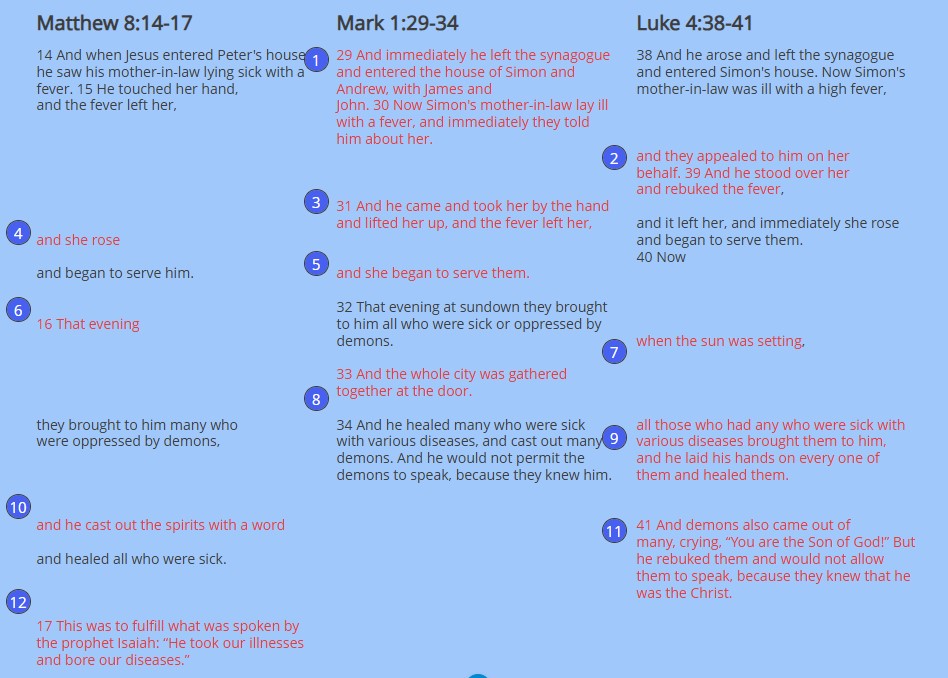
From the above worksheet photo, following the numbers and the text in red, the following narrative is produced.
Mk 1:29 [As soon as] he left the synagogue [he went] and entered the house of Simon and Andrew, with James and John. 30 Now Simon’s mother-in-law lay ill with a fever, and immediately they told him about her, Lk 4:38 and they appealed to him on her behalf, 39 and he [came and] stood over her and rebuked the fever, Mk 1:31 and he took her by the hand and lifted her up and the fever left her. Mt 8:15 Immediately she [got up] Mk 1:31 and she began to serve them.
Mt 8:16 That evening, Lk 4:40 when the sun was setting, Mk 1:33 the whole city was gathered together at the door. Lk 4:40 All those who had any who were sick with various diseases brought them to him, and he laid his hands on every one of them and he healed them. Mt 8:16 and he cast out the spirits with a word. Lk 4:41 Demons also came out of many, crying, “You are the Son of God!” But he rebuked them and would not allow them to speak, because they knew that he was the Christ.
Mt 8:17 This was to fulfill what was spoken by the prophet Isaiah: “He took our illnesses and bore our diseases.”
Bible Lessons for this event:
H167 Go, Your Son Will Live (Matthew 8:15; Mark 1:29-31; Luke 4:38-39)
H168 Go, Your Son Will Live (Matthew 8:16-17; Mark 1:33; Luke 4:40-41)
Event Summary:
This event emphasizes Jesus’ compassionate healing power, His authority over sickness and demons, and the fulfillment of Messianic prophecy.
Key points of this event are:
(1) Jesus heals Peter’s mother-in-law and many others who are sick, demonstrating his compassion and willingness to address both individual needs and the larger suffering of the community. His personal touch and response to those in need highlight the tender, personal nature of his ministry, revealing his heart to bring restoration and wholeness.
(2) Jesus not only heals physical ailments but also casts out demons, showing his complete authority over the spiritual realm as well as over physical suffering. His command for the demons to remain silent underscores his control over the timing of his revelation as the Messiah.
(3) This event links Jesus’ healings to Isaiah’s prophecy, “He took up our infirmities and bore our diseases.” This emphasizes that Jesus is the promised servant who carries humanity’s burdens and fulfills God’s redemptive plan.
This event emphasizes Jesus’ compassion and authority in healing sickness and driving out demons. His miracles reveal the arrival of God’s kingdom, fulfilling prophecy and pointing to his ultimate mission of spiritual restoration. These passages challenge readers to trust in Jesus’ power, respond to his healing with service and gratitude, and recognize his role as the Savior who brings wholeness to all aspects of life.
Understanding and Application:
Questions of understanding with extended answers for the calling of the first disciples in Gospel of Matthew 4:18–22; Gospel of Mark 1:16–20; and Gospel of Luke 5:1b–11.
1. Who are the men Jesus calls in these passages, and what are they doing when He finds them?
Answer:
Jesus calls Simon Peter, Andrew, James, and John, all of whom are fishermen by trade. In Matthew and Mark, they are actively engaged in their work; casting nets into the sea or mending them. Luke provides additional detail, showing them washing their nets after an unproductive night of fishing. This setting emphasizes their ordinary, working-class background. They are not religious elites but laborers, highlighting that Jesus calls common people into His service. Their occupation also becomes a powerful metaphor for their future role—just as they gather fish, they will gather people into the kingdom of God.
2. What command and promise does Jesus give when He calls them?
Answer:
Jesus gives both a command and a promise: “Follow me, and I will make you fishers of men.” The command, “Follow me,” is a call to personal discipleship; leaving behind their former priorities to walk with and learn from Him. The promise, “I will make you fishers of men,” indicates transformation. Jesus does not merely recruit them; He reshapes their identity and purpose. Their existing skills, discipline, and perseverance as fishermen will be redirected toward spiritual work, bringing others into relationship with God. This shows that discipleship is both relational (following Christ) and missional (participating in His work).
3. How do the disciples respond to Jesus’ call, and what does this reveal about true discipleship?
Answer:
Their response is immediate and decisive. Matthew and Mark emphasize that they “immediately left their nets” and followed Him. James and John even leave their father, Zebedee, in the boat. Luke adds that after witnessing the miraculous catch, “they left everything and followed Him.” This reveals that true discipleship involves urgency, surrender, and trust. They do not delay, negotiate, or seek guarantees. Their willingness to leave livelihood, security, and family business demonstrates that following Jesus requires a reordering of priorities, where allegiance to Him surpasses all else.
4. What additional event does Luke include that deepens our understanding of Peter’s response?
Answer:
Luke includes the miraculous catch of fish, which occurs after Jesus instructs Peter to let down his nets despite a fruitless night. The overwhelming catch astonishes Peter and his companions. In response, Peter falls at Jesus’ knees and says, “Depart from me, for I am a sinful man, O Lord.” This moment reveals a deeper spiritual awakening; Peter recognizes both Jesus’ divine authority and his own unworthiness. The miracle serves as a turning point, transforming a simple call into a profound encounter with holiness. It shows that discipleship begins with recognizing who Jesus truly is and responding with humility and repentance.
5. Why does Jesus tell Peter, “Do not be afraid,” and what does this teach about His calling?
Answer:
Jesus reassures Peter with “Do not be afraid” because Peter is overwhelmed by both the miracle and his sense of sinfulness. This statement reveals that Jesus’ call is not based on human worthiness but on divine grace. Rather than rejecting Peter for his sinfulness, Jesus invites him into a greater purpose. This teaches that God calls imperfect people and equips them for His work. Fear is replaced with mission; “from now on you will be catching men.” The call of Christ transforms fear into purpose and inadequacy into usefulness.
6. How do these three Gospel accounts complement one another in presenting this event?
Answer:
Matthew and Mark present a concise and immediate call narrative, focusing on Jesus’ authority and the disciples’ instant obedience. Luke provides a more detailed account, including the setting, the miracle, and Peter’s personal response. Together, they offer a fuller picture:
- Matthew and Mark emphasize the authority of Jesus’ call and the cost of discipleship.
- Luke highlights the power of Jesus, the recognition of sin, and the transformative encounter that leads to commitment.
This harmony shows that the call to discipleship is both authoritative (Jesus commands) and transformational (Jesus reveals Himself and changes lives).
7. What does the phrase “fishers of men” teach about the mission of Jesus’ followers?
Answer:
The phrase “fishers of men” conveys the mission of gathering people into God’s kingdom. Just as fishermen cast nets intentionally and persistently, disciples are called to actively engage in reaching others with the message of salvation. It implies effort, patience, and dependence on God’s provision; just as a fisherman cannot control the catch, disciples rely on God to bring results. It also suggests rescue, drawing people out of danger (sin and death) into life. This metaphor defines the central mission of every follower of Christ: to participate in God’s redemptive work by leading others to Him.
8. What key theological truths emerge from these passages?
Answer:
Several important truths stand out:
- Divine Initiative: Jesus takes the first step in calling His disciples.
- Grace Over Merit: The disciples are chosen not for status but for God’s purpose.
- Transformation: Jesus changes both identity and mission.
- Authority of Christ: His call demands immediate response.
- Cost of Discipleship: Following Jesus requires leaving behind former securities.
- Mission-Centered Life: Discipleship is directed toward reaching others.
Together, these truths show that following Christ is a life-changing call rooted in grace, marked by surrender, and directed toward God’s mission in the world.
 Anchor My Faith
Leave a comment