
Photo: Nenad Spasojevic (An old railroad track completely wrapped in snow in rural Illinois)
Author: Stephen Weller
2,188 words, 12 minutes read time
Private Prayer & Public Healing
Scripture Reference: Matthew 4:23-24; Mark 1:35-39; Luke 4:42-44
Context:
The passages in Matthew 4:23–24, Mark 1:35–39, and Luke 4:42–44 together present a unified picture of the early Galilean ministry of Jesus, emphasizing both His growing popularity and His unwavering sense of divine mission. Following the calling of His first disciples and initial demonstrations of authority, particularly through teaching and healing, Jesus begins to travel throughout Galilee, proclaiming the gospel of the kingdom in synagogues and demonstrating its power through miraculous healings. Matthew highlights the breadth of His ministry, noting that His fame spread beyond Galilee into surrounding regions, drawing large crowds who brought the sick, demon-possessed, and afflicted to Him. Mark provides a more personal glimpse into Jesus’ rhythm of ministry, showing that despite increasing demands, He withdrew early in the morning to pray, underscoring His dependence on the Father. When the disciples find Him and report that everyone is searching for Him, Jesus responds by pressing forward to other towns, revealing that His mission is not to remain where He is most popular but to preach the kingdom message more broadly. Luke reinforces this purpose, noting that although the crowds tried to keep Him from leaving, He declared that He “must” preach the good news of the kingdom of God to other towns also, for that is why He was sent. Together, these accounts reveal a critical tension in Jesus’ ministry: the compassion that draws Him to meet immediate human needs and the divine necessity that compels Him to continue proclaiming the kingdom throughout a wider region.
Event Narrative:
The narrative for this section was obtained from three similar texts, using the highlighted material shown below. The selection was determined by Jerry Peyton and copyrighted in 2015 by Jerry Peyton and Biblical Studies Press L.L.C.
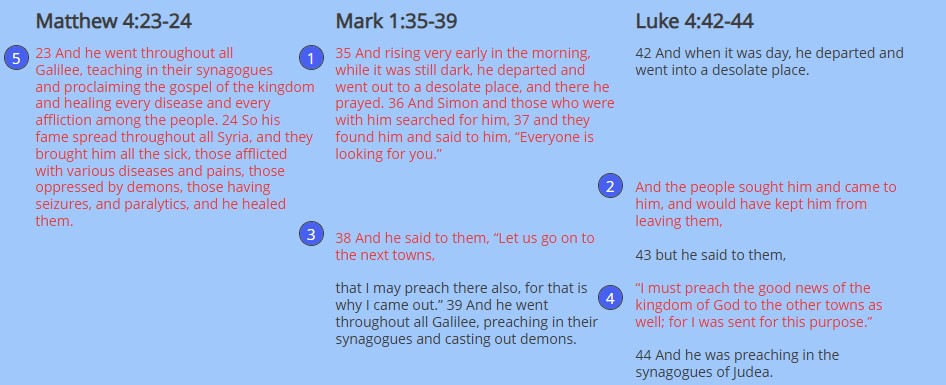
From the above worksheet photo, following the numbers and the text in red, the following narrative is produced.
Mk 1:35 Rising very early in the morning, while it was still dark, [Jesus] departed and went out to a desolate place, and there he prayed. 36 Simon and those who were with him searched for him, 37 and they found him and said to him, “Everyone is looking for you.”
Lk 4:42 The people sought him and came to him and would have kept him from leaving them. Mk 1:38 He said to them, “Let us go on to the next towns. Lk 4:43 I must preach the good news of the kingdom of God to the other towns as well; for I was sent for this purpose.”
Mt 4:23 And he went throughout all Galilee, teaching in their synagogues and proclaiming the gospel of the kingdom and healing every disease and every affliction among the people. 24 So his fame spread throughout all Syria, and they brought him all the sick, those afflicted with various diseases and pains, those oppressed by demons, those having seizures, and paralytics, and he healed them.
Bible Lessons for this event:
H169 Intentionally skipped
H170 Go, Your Son Will Live (Mark 1:35-37)
H171 Your (Matthew 4:23-24; Mark 4:38; Luke 4:42-43)
Event Summary:
This event depicts Jesus’ ministry of preaching, healing, and prayer, highlighting the priorities of his mission and His commitment to proclaiming God’s kingdom.
Key points of this event are:
(1) In this event, Jesus travels through Galilee, teaching in synagogues and proclaiming the good news of the kingdom. His message is central to His mission: the kingdom of God is near, calling people to repentance and new life. Jesus prioritizes preaching as the foundation of His ministry, emphasizing spiritual transformation through the word of God.
(2) Jesus heals various diseases and casts out demons, demonstrating his authority over physical and spiritual realms. His ministry of healing shows the holistic nature of God’s kingdom, addressing both spiritual and physical needs, bringing restoration and wholeness to individuals and communities.
(3) This event finds Jesus going to a solitary place to pray early in the morning. This highlights Jesus’ dependence on the Father and His need for spiritual renewal amid a busy ministry. This time of prayer emphasizes the importance of communion with God, even for Jesus, and serves as a model of spiritual priority for His disciples.
(4) When the crowds try to keep Jesus from leaving, he insists on moving to other towns to continue His mission, saying, “I must preach the good news of the kingdom of God to other towns also, because that is why I was sent.” This demonstrates his unwavering commitment to spreading the message beyond one location, ensuring that others also hear the gospel of the kingdom.
The key message of this event is that Jesus’ ministry is defined by proclaiming the good news of God’s kingdom, combined with healing and deliverance that affirm the kingdom’s presence and power. His focus on prayer, spiritual renewal, and expanding his mission underscores the importance of both personal communion with God and the relentless commitment to God’s redemptive work. It illustrates that the kingdom is both a spiritual reality and a transformative power that reaches the whole person—spiritually, physically, and communally.
Understanding and Application:
Questions of understanding with extended answers for the combined passages Matthew 4:23–24; Mark 1:35–39; Luke 4:42–44, focusing on Jesus’ early Galilean ministry, His priorities, and His mission.
Discussion Questions with Extended Answers
1. What activities defined Jesus’ ministry in these passages?
Answer:
These passages consistently present three central activities that defined Jesus’ ministry: teaching, preaching, and healing. In Matthew 4:23–24, Jesus is described as teaching in synagogues, proclaiming the gospel of the kingdom, and healing every disease and affliction among the people. This same pattern is confirmed in Mark and Luke.
Teaching refers to explaining the truth of God’s Word, often in synagogue settings where Scripture was read and interpreted. Preaching emphasizes proclamation, declaring that the kingdom of God had arrived through His presence. Healing demonstrated the authority and compassion of Jesus, validating His message and revealing the power of God’s kingdom breaking into a fallen world.
Together, these activities show that Jesus’ ministry addressed both spiritual and physical needs, revealing that the kingdom of God brings restoration in every dimension of life.
2. Why did Jesus prioritize prayer, as seen in Mark 1:35?
Answer:
Mark 1:35 highlights that Jesus rose “very early in the morning” and went to a desolate place to pray. This reveals that prayer was not secondary but foundational to His ministry.
Despite being the Son of God, Jesus modeled dependence on the Father. Prayer was His means of communion, guidance, and strength. It prepared Him for the demands of ministry and aligned His actions with the Father’s will.
This moment is especially significant because it follows a day of intense ministry (healing many people). Instead of continuing immediately with public activity, Jesus withdrew to pray. This shows that spiritual renewal must precede effective ministry, and that intimacy with God is more important than public success.
3. Why did Jesus refuse to stay where He was popular and instead move on to other towns?
Answer:
In both Mark 1:38 and Luke 4:43, Jesus makes it clear that He must go to other towns to preach, saying that this is why He was sent. Although the crowds were seeking Him and wanted Him to stay, He did not allow popularity to dictate His mission.
This reveals that Jesus’ purpose was not to build a localized following or remain where He was most celebrated. Instead, His mission was global in scope, even within Israel; He came to proclaim the kingdom of God to as many as possible.
His decision demonstrates unwavering commitment to divine purpose over human expectation. It also shows that the gospel is meant to be spread, not contained, and that ministry must be guided by God’s calling rather than comfort or demand.
4. What does the widespread response to Jesus’ healing ministry reveal about the people?
Answer:
Matthew 4:24 describes how news about Jesus spread throughout Syria, and people brought to Him all who were sick, afflicted, demon-possessed, epileptic, and paralyzed. This response reveals several things about the people.
First, it shows a deep awareness of their need. People recognized their suffering and were desperate for help. Second, it reflects growing faith, or at least hope, that Jesus had the power to heal. Even those from distant regions came, indicating that His reputation had spread rapidly.
However, it also suggests that many were drawn primarily by physical needs rather than spiritual understanding. While Jesus compassionately healed, His greater mission was to call people to repentance and faith in the kingdom of God. The crowds’ response highlights both human need and the risk of focusing on temporary relief rather than eternal truth.
5. How do these passages reveal the authority of Jesus?
Answer:
Jesus’ authority is evident in multiple ways throughout these passages. He teaches in synagogues with authority, unlike the scribes, indicating that His words carry divine weight. He proclaims the kingdom of God not as a distant hope but as a present reality, showing authority over spiritual truth.
Most visibly, His authority is demonstrated through healing and casting out demons. Diseases of every kind and spiritual oppression are subject to His command, revealing that He has authority over both the physical and spiritual realms.
This authority confirms that Jesus is not merely a teacher or prophet, but the divine Son of God, bringing the reign of God into human history. His works authenticate His message and reveal His identity.
6. What is the significance of Jesus preaching in synagogues?
Answer:
The synagogues were central places of worship, teaching, and community life in Jewish society. By preaching in synagogues, Jesus engaged directly with people who were already familiar with the Scriptures.
This setting allowed Him to connect the Old Testament promises with their fulfillment in Himself. It also shows that His ministry was rooted in God’s revealed Word and was not disconnected from Israel’s spiritual heritage.
At the same time, His teaching often challenged traditional interpretations and exposed misunderstandings. This demonstrates that Jesus came not only to continue religious tradition but to fulfill and clarify God’s truth, calling people to a deeper and more accurate understanding of God’s kingdom.
7. What does Jesus’ compassion in healing teach us about God’s character?
Answer:
Jesus’ willingness to heal all who were brought to Him reflects the compassion and mercy of God. He did not turn people away based on the severity of their condition or their social status. Instead, He responded to human suffering with care and power.
This reveals that God is not distant or indifferent but deeply concerned with human brokenness. The healings serve as visible expressions of God’s love and as signs of the coming restoration of all things.
At the same time, these acts point beyond themselves. They are not merely acts of kindness but signs of the kingdom, indicating that God’s ultimate plan is to remove all suffering through redemption in Christ.
8. What is the central mission Jesus declares in Luke 4:43?
Answer:
In Luke 4:43, Jesus states, “I must preach the good news of the kingdom of God to the other towns as well; for I was sent for this purpose.” This statement clearly defines His mission.
The central focus of Jesus’ work is the proclamation of the good news of God’s kingdom; that God’s rule is being established through Him, bringing salvation, restoration, and reconciliation.
Healing and miracles support this mission, but they are not the ultimate goal. The priority is the message itself, which calls people to respond in faith and repentance.
This declaration emphasizes that Jesus is sent by the Father with a specific purpose, and everything He does aligns with that mission.
9. How do these passages together provide a balanced picture of ministry?
Answer:
These passages present a well-rounded model of ministry that includes spiritual devotion (prayer), proclamation (preaching and teaching), and compassionate action (healing).
Jesus does not neglect any of these aspects. His private prayer life fuels His public ministry. His preaching communicates truth, while His healing demonstrates that truth in action.
This balance shows that true ministry must be rooted in relationship with God, centered on His Word, and expressed through love and service to others. It avoids extremes; neither focusing only on action without truth nor only on teaching without compassion.
10. What application can believers draw from Jesus’ example in these passages?
Answer:
Believers can learn several key principles from Jesus’ example. First, the importance of prioritizing time with God through prayer, even in the midst of busy schedules. Second, the need to remain focused on God’s mission rather than being driven by popularity or immediate demands.
Third, believers are called to share the message of the gospel while also demonstrating God’s love through acts of compassion. Finally, these passages remind us that ministry is not about personal recognition but about faithfully carrying out God’s purpose.
Jesus’ example calls believers to live with intentionality, dependence on God, and a commitment to spreading the message of the kingdom.
 Anchor My Faith
Leave a comment