
Photo: Larry Braun Photography (South Haven, MI)
Author: Stephen Weller
1,711 words, 9 minutes read time
The Real Law: Anger and Murder
Scripture Reference: Matthew 5:21-26; Luke 12:57-59
Context:
Context Overview: Matthew 5:21–26; Luke 12:57–59
In Matthew 5:21–26, Jesus is speaking within the Sermon on the Mount, where He deepens the understanding of the Law by moving from outward actions to inward attitudes. Addressing the commandment against murder, He reveals that the root issue is not merely the act itself but the condition of the heart, anger, contempt, and unresolved conflict. Jesus confronts the prevailing interpretation of the Law taught by the religious leaders and shows that righteousness in God’s kingdom requires reconciliation and purity of heart. He emphasizes urgency in restoring relationships, even placing reconciliation above religious acts such as offering sacrifices at the altar. The imagery of being handed over to a judge and imprisoned underscores the seriousness of unresolved sin and the certainty of accountability.
In parallel, Luke 12:57–59 presents a similar teaching in a different setting, where Jesus is addressing the crowds about spiritual discernment and readiness. Here, the focus is on recognizing the times and acting wisely before judgment comes. Using the analogy of settling with an accuser on the way to court, Jesus calls for immediate action to resolve disputes and, more importantly, to make peace with God before facing divine judgment. Both passages highlight the urgency of reconciliation, whether with others or ultimately with God, and warn that delay leads to inevitable consequences.
Together, these passages teach that God’s concern goes beyond external compliance to the deeper issues of the heart, relationships, and spiritual readiness. They stress that reconciliation is not optional but essential, and that the time to act is now, before one stands before the ultimate Judge.
Event Narrative:
The narrative for this section was obtained from two similar texts, using the highlighted material shown below. The selection was determined by Jerry Peyton and copyrighted in 2015 by Jerry Peyton and Biblical Studies Press L.L.C.
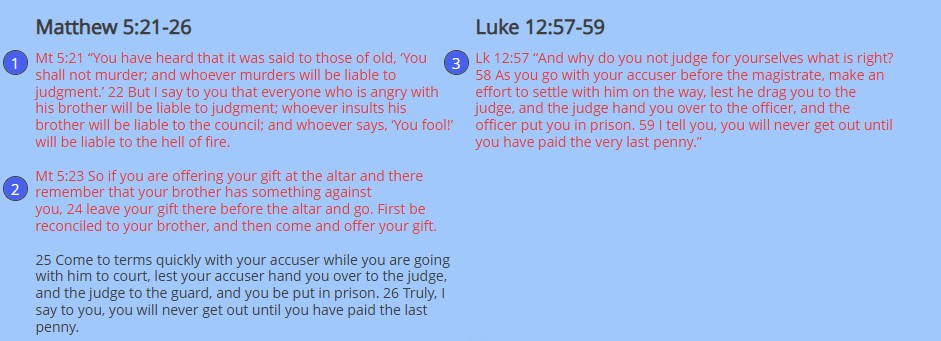
From the above worksheet photo, following the numbers and the text in red, the following narrative is produced.
Mt 5:21 “You have heard that it was said to those of old, ‘You shall not murder; and whoever murders will be liable to judgment.’ 22 But I say to you that everyone who is angry with his brother will be liable to judgment; whoever insults his brother will be liable to the council; and whoever says, ‘You fool!’ will be liable to the hell of fire.
Mt 5:23 “So if you are offering your gift at the altar and there remember that your brother has something against you, 24 leave your gift there before the altar and go. First be reconciled to your brother and then come and offer your gift.
Lk 12:57 “And why do you not judge for yourselves what is right? 58 As you go with your accuser before the magistrate, try to settle with him on the way, lest he drag you to the judge, and the judge hand you over to the officer, and the officer put you in prison. 59 I tell you; you will never get out until you have paid the very last penny.”
Bible Lessons for this event:
H207 Murder (Matthew 5:21-22)
H208 Anger (Matthew 5:22)
H209 Be Reconciled (Matthew 5:23-24)
H210 Come to Terms Quickly (Luke 12:57-59
Event Summary:
This event focuses on Jesus’ teaching about anger, reconciliation, and the urgency of resolving conflicts. They highlight themes of inner transformation, peacemaking, and the consequences of unresolved disputes.
Key points of this event are:
(1) Jesus deepens the commandment “You shall not murder” by addressing anger and contempt in the heart (Matthew 5:21-22). He teaches that harboring anger or insulting others can lead to judgment just as serious as the act of murder itself. This teaching emphasizes that true righteousness involves not just avoiding outward sin but cultivating a heart free from hatred, contempt, and hostility toward others.
(2) Jesus urges His followers to seek reconciliation with others before offering worship to God (Matthew 5:23-24). If someone has an unresolved issue with a “brother or sister,” they should make amends before presenting their gift at the altar. This underscores that God values reconciliation and peace in human relationships. Right relationships with others are essential to a right relationship with God, highlighting the importance of peacemaking as a priority in the kingdom.
(3) Jesus advises settling disputes quickly, both in Matthew and in the parable-like warning in Luke 12:57-59. In Luke, he describes a situation where someone is taken to court, urging them to settle before reaching the judge to avoid severe consequences. This illustrates that delaying reconciliation can lead to escalating consequences. Jesus warns that unresolved conflicts can result in greater judgment, urging his followers to address conflicts proactively and with humility.
(4) The warning to resolve anger and disputes reflects an awareness of the consequences of harboring resentment. Jesus emphasizes that failing to forgive and reconcile not only affects earthly relationships but has spiritual repercussions, impacting one’s standing before God.
The central message of this event is that true righteousness requires a heart free from anger, resentment, and unresolved conflict. Jesus calls his followers to pursue inner transformation, peacemaking, and urgent reconciliation as essential aspects of life in God’s kingdom. His teaching emphasizes that reconciling with others is a priority for maintaining a right relationship with God and avoiding spiritual consequences. By addressing not only outward actions but also inner attitudes, Jesus invites his followers to live with integrity, humility, and a commitment to peace.
Understanding and Application:
Discussion Questions with Extended Answers
1. What deeper issue does Jesus address beyond the command “You shall not murder”?
Answer:
Jesus moves beyond the external act of murder to expose the internal root, anger, contempt, and hatred. While the Law condemned the act, Jesus reveals that God judges the heart. Anger that leads to insult (“Raca”) or condemnation (“fool”) reflects a heart out of alignment with God. This teaching shows that sin begins internally before it manifests externally. Jesus is not lowering the standard but intensifying it, calling for inward righteousness. True obedience is not merely avoiding harmful actions but cultivating a heart free from bitterness and hostility.
2. Why does Jesus connect anger with judgment and severe consequences?
Answer:
Jesus emphasizes that unchecked anger is spiritually dangerous because it destroys relationships and reflects rebellion against God’s character. By linking anger to judgment, the council, and even hell (Gehenna), He highlights the seriousness of relational sin. Anger may seem small compared to murder, but it carries the same root; disregard for the value of another person made in God’s image. Jesus teaches that God’s justice evaluates not only actions but attitudes, making reconciliation essential rather than optional.
3. What is the significance of reconciling with a brother before offering a gift at the altar?
Answer:
Jesus teaches that right relationships take priority over religious rituals. Bringing a gift to the altar represents worship, yet He instructs that reconciliation must come first. This reveals that worship is not merely ceremonial; it is relational. A broken relationship hinders genuine worship because it contradicts God’s nature of love and peace. God desires sincerity of heart, not outward religious acts disconnected from how we treat others. Reconciliation restores both horizontal (human) and vertical (with God) relationships.
4. What does it mean to “agree with your adversary quickly,” and why is urgency emphasized?
Answer:
To “agree” with an adversary means to seek resolution, humility, and peace before a situation escalates. Jesus uses the imagery of legal consequences, being handed over to a judge, then to prison, to illustrate the cost of unresolved conflict. The urgency reflects the limited opportunity to make things right. Delayed reconciliation often leads to hardened hearts, deeper division, and unavoidable consequences. Spiritually, this also points to the urgency of repentance before facing God’s final judgment.
5. How does Luke’s version (Luke 12:57–59) reinforce the message of Matthew 5:21–26?
Answer:
In Luke 12:57–59, Jesus emphasizes personal responsibility in discerning what is right and acting on it. The legal illustration mirrors Matthew’s teaching but highlights the necessity of sound judgment and timely action. Luke’s account stresses that people already possess the ability to recognize truth and should act accordingly before consequences become unavoidable. Together, both passages reinforce the themes of discernment, urgency, and accountability in relationships and spiritual life.
6. What does this teaching reveal about the nature of true righteousness?
Answer:
True righteousness is not merely external compliance with laws but internal transformation of the heart. Jesus contrasts superficial righteousness (avoiding murder) with authentic righteousness (removing anger and pursuing peace). This aligns with His broader teaching that righteousness must exceed that of the scribes and Pharisees (Matthew 5:20). It is a righteousness rooted in love, humility, and reconciliation; reflecting God’s character rather than simply following rules.
7. How can unresolved conflict affect one’s spiritual life today?
Answer:
Unresolved conflict creates barriers in relationships and disrupts fellowship with God. It fosters bitterness, pride, and division, which can hinder prayer, worship, and spiritual growth. Just as Jesus taught that reconciliation should precede worship, unresolved issues today can dull spiritual sensitivity and lead to further sin. Addressing conflict promptly restores peace, promotes healing, and aligns believers with God’s will.
8. What practical steps can be taken to apply this teaching in daily life?
Answer:
Practical application includes examining one’s heart for anger or resentment, seeking forgiveness when wrong, extending grace to others, and addressing conflicts quickly and humbly. It requires initiative; going to the other person, even if they have something against you. It also involves honest self-judgment, recognizing when one is at fault, and taking responsibility. Ultimately, it reflects a commitment to peace and reconciliation as a way of life, not just a one-time action.
9. How does this passage point forward to the need for salvation and grace?
Answer:
Jesus’ teaching reveals the impossibility of achieving perfect righteousness through human effort alone. If even anger is subject to judgment, all fall short of God’s standard. This exposes humanity’s need for grace and forgiveness through Christ. While the passage calls for righteous living, it also drives us to depend on God’s mercy and the transforming work of the heart that only He can accomplish.
 Anchor My Faith
Leave a comment