
Photo: John Kenealy Photography (This image features the Shane cabin from the Movie, Shane, starring Alan Ladd. In the background, you can see the Teton Range.
Author: Stephen Weller
2,399 words, 13 minutes read time
The Real Law: Don’t Retaliate & Love Your Enemies
Scripture Reference: Matthew 5:38-48; 7:12; Luke 6:27-36
Context:
Here is an extended contextual paragraph that brings these passages together within their setting and meaning:
Matthew 5:38–48, Matthew 7:12, and Luke 6:27–36 all occur within the larger teaching framework of Jesus’ Sermon on the Mount (Matthew) and Sermon on the Plain (Luke), where Jesus reveals the deeper righteousness of the kingdom of God in contrast to the external righteousness of the law as commonly interpreted. In Matthew 5:38–48, Jesus addresses the principle of retaliation (“an eye for an eye”) and radically redefines it by calling His followers to relinquish personal vengeance and instead respond to evil with humility, generosity, and love, even toward enemies. This teaching reaches its climax in the command to “love your enemies and pray for those who persecute you,” reflecting the character of God Himself, who shows kindness to both the righteous and the unrighteous. Luke 6:27–36 parallels and reinforces this message, emphasizing active love expressed through doing good, blessing, giving, and expecting nothing in return, all grounded in the call to be “merciful, just as your Father is merciful.” Matthew 7:12, often called the Golden Rule, serves as a summary principle of this kingdom ethic: treating others as one desires to be treated encapsulates the Law and the Prophets. Together, these passages reveal that true righteousness is not merely refraining from harm but actively pursuing sacrificial love that mirrors God’s grace—demonstrating that those who belong to His kingdom are marked by a transformed heart that extends mercy, forgives freely, and loves without partiality.
Event Narrative:
The narrative for this section was obtained from two similar texts, using the highlighted material shown below. The selection was determined by Jerry Peyton and copyrighted in 2015 by Jerry Peyton and Biblical Studies Press L.L.C.
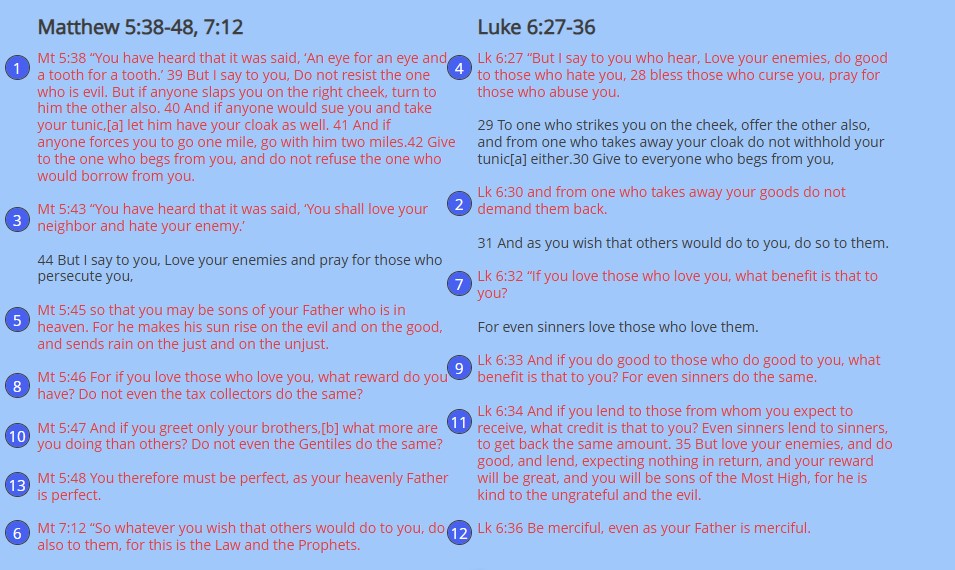
From the above worksheet photo, following the numbers and the text in red, the following narrative is produced.
Mt 5:38 “You have heard that it was said, ‘An eye for an eye and a tooth for a tooth.’ 39 But I say to you, do not resist the one who is evil. But if anyone slaps you on the right cheek, turn to him the other also. 40 And if anyone would sue you and take your tunic, let him have your cloak as well. 41 And if anyone forces you to go one mile, go with him two miles. 42 Give to the one who begs from you, and do not refuse the one who would borrow from you. Lk 6:30 and from one who takes away your goods do not demand them back.
Mt 5:43 “You have heard that it was said, ‘You shall love your neighbor and hate your enemy.’ Lk 6:27 But I say to you who hear, love your enemies, do good to those who hate you, 28 bless those who curse you, pray for those who abuse you, Mt 5:45 so that you may be sons of your Father who is in heaven. For he makes his sun rise on the evil and on the good and sends rain on the just and on the unjust.
Mt 7:12 “So whatever you wish that others would do to you, do also to them, for this is the Law and the Prophets.
Lk 6:32 “If you love those who love you, what benefit is that to you? Mt 5:46 For if you love those who love you, what reward do you have? Do not even the tax collectors do the same? Lk 6:33 And if you do good to those who do good to you, what benefit is that to you? For even sinners do the same. Mt 5:47 And if you greet only your brothers, what more are you doing than others? Do not even the Gentiles do the same?
Lk 6:34 And if you lend to those from whom you expect to receive, what credit is that to you? Even sinners lend to sinners, to get back the same amount. 35 But love your enemies, and do good, and lend, expecting nothing in return, and your reward will be great, and you will be sons of the Most High, for he is kind to the ungrateful and the evil.
Lk 6:36 Be merciful, even as your Father is merciful. Mt 5:48 You therefore must be perfect, as your heavenly Father is perfect.
Bible Lessons for this event:
H217 Don’t Retaliate (Matthew 5:38)
H218 Vengeance Is God’s Responsibility (Matthew 5:38-42; Luke 6:30)
H219 Love your Enemies (Matthew 5:43, 45; Luke 6:27-28)
H220 The Golden Rule (Matthew 5:46-47, 7:12; Luke 6:32-33)
H221 Be Merciful (Matthew 5:48; Luke 6:34-36)
Event Summary:
In this event, Jesus teaches on love, mercy, forgiveness, and the rejection of retaliation, highlighting the values of non-retaliation, radical love, and the Golden Rule. His teachings challenge believers to embrace a higher standard of love and mercy that reflects the character of God.
Key points of this event are:
(1) Jesus contrasts the common principle of “an eye for an eye” with his call to avoid retaliation. Instead of responding to harm with harm, He encourages a spirit of forgiveness and generosity. He advises his followers to turn the other cheek, go the extra mile, and give freely, indicating a heart that is not ruled by vengeance but by grace. This teaching emphasizes self-control and compassion over retribution, calling believers to respond to wrongs in a way that is redemptive rather than retaliatory.
(2) Jesus extends the command to love beyond friends and family, teaching his followers to love their enemies, do good to those who hate them, bless those who curse them, and pray for those who mistreat them. This radical love reflects God’s unconditional love, who is “kind to the ungrateful and wicked” (Luke 6:35) and causes the sun to rise on both the evil and the good (Matthew 5:45). By loving their enemies, believers reflect God’s mercy and compassion, embodying his character and setting themselves apart from worldly standards of love.
(3) Jesus summarizes His teachings on love and mercy with the Golden Rule: “Do to others as you would have them do to you.” This simple yet profound statement captures the heart of Jesus’ ethical teaching, urging believers to treat others with the same respect, kindness, and compassion they desire for themselves. The Golden Rule is a practical way of showing empathy, ensuring that love for others guides one’s actions in all circumstances. (Matthew 7:12; Luke 6:31)
(4) Jesus concludes by calling His followers to “be perfect, therefore, as your heavenly Father is perfect.” This perfection does not mean moral flawlessness but rather complete and mature love that mirrors God’s love. The call to perfection is a call to live with a heart full of compassion, mercy, and love for others, regardless of whether they are friends or foes. (Matthew 5:48)
The message of this event is that God’s kingdom is characterized by radical love, mercy, and non-retaliation. Jesus calls his followers to go beyond conventional standards by loving their enemies, forgiving wrongs, and treating others as they would like to be treated. This higher standard reflects the unconditional love and mercy of God and invites believers to mirror his character. By practicing the Golden Rule and embracing a spirit of generosity, believers live out God’s redemptive love, displaying a distinct and powerful witness in the world.
Understanding and Application:
Understanding Questions with Extended Answers
1. What does Jesus mean by “You have heard… but I say to you” in Matthew 5:38–39?
Answer:
Jesus is contrasting the traditional interpretation of the Law, specifically the principle of “an eye for an eye,” with the deeper righteousness of the kingdom of God. The original law (Exodus 21:24) was meant to ensure justice and limit retaliation, preventing excessive revenge. However, many had reduced it to a justification for personal vengeance.
Jesus elevates the standard by calling His followers not to resist evil with retaliation, but with humility and restraint. “Turning the other cheek” is not passivity, but a deliberate choice to reject vengeance and entrust justice to God. It reflects a transformed heart that values mercy over personal rights and mirrors God’s patience toward sinners.
2. How should we understand the commands to turn the other cheek, give more than what is taken, and go the extra mile (Matthew 5:39–42)?
Answer:
These commands illustrate a radical posture of selflessness. Jesus is not giving rigid legal commands for every situation but presenting examples that reveal the spirit of kingdom living.
- Turning the other cheek shows refusal to retaliate when insulted.
- Giving your cloak also demonstrates willingness to surrender personal rights.
- Going the extra mile reflects a heart that serves beyond obligation.
Together, these examples teach that believers are called to respond to wrongdoing not with resistance rooted in pride, but with generosity, humility, and love. This behavior disrupts the cycle of evil and reflects trust in God’s justice rather than self-defense.
3. What does it mean to “love your enemies” and “pray for those who persecute you” (Matthew 5:44; Luke 6:27–28)?
Answer:
Loving enemies goes far beyond natural human affection. It involves choosing to act for the good of those who oppose, harm, or mistreat us. This includes:
- Speaking well of them instead of cursing
- Doing good rather than seeking revenge
- Praying for their well-being and repentance
This kind of love is not based on emotion but on a decision rooted in God’s character. It reflects the gospel itself—God loved us while we were His enemies (Romans 5:8). By loving enemies, believers demonstrate that they belong to God and are shaped by His grace rather than human instinct.
4. How does loving enemies reflect the character of God (Matthew 5:45; Luke 6:35)?
Answer:
Jesus explains that God “makes His sun rise on the evil and on the good” and “is kind to the ungrateful and the evil.” This reveals God’s common grace; His kindness extended even to those who reject Him.
When believers love their enemies, they reflect this divine character. It shows that their identity is rooted in being “sons of your Father who is in heaven.” This is not about earning sonship, but demonstrating it. Kingdom citizens resemble their King.
Such love is evidence of transformation. It shows that a believer’s life is no longer governed by natural responses but by the supernatural work of God within them.
5. What does Jesus mean when He says, “Be perfect, as your heavenly Father is perfect” (Matthew 5:48)?
Answer:
The word “perfect” here means complete or mature. Jesus is calling His followers to a full expression of God-like love; especially love that extends beyond friends to enemies.
This perfection is not sinless flawlessness but completeness in love. It is a call to reflect God’s character in a holistic way. Just as God’s love is impartial and generous, so should the believer’s love be.
Ultimately, this standard drives us to depend on God’s grace. It reveals that such love is impossible apart from a transformed heart empowered by the Holy Spirit.
6. What is the significance of the Golden Rule in Matthew 7:12?
Answer:
The Golden Rule, “Whatever you wish that others would do to you, do also to them,” summarizes the ethical teaching of the Law and the Prophets. It moves beyond avoiding harm to actively pursuing good.
This principle requires empathy and intentional action. Instead of asking, “What must I avoid doing?” it asks, “What good would I desire if I were in their place?”
In the context of Jesus’ teaching, the Golden Rule aligns perfectly with loving enemies. It calls believers to treat all people, not just friends, with dignity, kindness, and grace. It is a practical expression of kingdom righteousness in everyday relationships.
7. How does Luke 6:32–34 challenge common human standards of love and generosity?
Answer:
Jesus points out that loving those who love you, doing good to those who do good to you, and lending expecting repayment are behaviors common even among sinners. In other words, such actions require no transformation, they are natural and self-serving.
Jesus calls His followers to go beyond this standard. Kingdom love is marked by:
- Loving without expectation of return
- Giving without calculation
- Doing good regardless of response
This challenges believers to examine their motives. True kingdom generosity reflects God’s grace, which is given freely, not earned or repaid.
8. What does it mean to “be merciful, even as your Father is merciful” (Luke 6:36)?
Answer:
Mercy involves compassion expressed in action—especially toward those who do not deserve it. To be merciful like God means:
- Forgiving rather than condemning
- Showing kindness instead of judgment
- Extending grace where punishment might seem justified
This command flows directly from God’s nature. Just as God has shown mercy to us, pardoning our sin and withholding judgment, so we are to reflect that same mercy toward others.
Mercy is not weakness; it is a powerful demonstration of God’s character at work in the believer. It shows that we understand the grace we have received and are willing to extend it to others.
9. How do these passages together define true kingdom righteousness?
Answer:
Taken together, these passages reveal that kingdom righteousness is not merely external obedience but internal transformation expressed through radical love.
It includes:
- Rejecting retaliation
- Practicing sacrificial generosity
- Loving enemies
- Treating others with empathy and grace
- Reflecting God’s mercy and kindness
This righteousness surpasses that of the scribes and Pharisees because it is rooted in the heart. It is not about legal compliance but about becoming like God in character.
10. Why are these teachings so difficult, and how can believers live them out?
Answer:
These teachings are difficult because they run contrary to human nature, which seeks self-protection, justice, and reciprocity. Loving enemies and refusing retaliation require surrendering pride and trusting God fully.
Believers can live this out by:
- Remembering the grace they have received in Christ
- Relying on the Holy Spirit for strength and transformation
- Practicing humility and forgiveness daily
- Keeping an eternal perspective, trusting God’s justice
Ultimately, these commands are not burdens but invitations, to participate in the life and character of God. As believers grow in relationship with Him, these qualities become increasingly evident in their lives.
 Anchor My Faith
Leave a comment