
Photo: MSwanson Photography (View of Niagara Horseshoe Falls from the Skylon Tower – Ontario, Canada)
Author: Stephen Weller
1,965 words, 10 minutes read time
Don’t Judge/Condemn
Scripture Reference: Matthew 7:1-2a, 3-6; Luke 6:37, 41-42
Context:
The teachings in Matthew 7:1–2a, 3–6 and Luke 6:37, 41–42 occur within the broader context of Jesus’ instruction on kingdom righteousness, specifically within the Sermon on the Mount and its parallel in Luke often called the Sermon on the Plain. These passages address the attitude and posture of the disciple toward others, emphasizing humility, mercy, and self-examination rather than harsh or hypocritical judgment. Jesus warns that the standard by which a person judges others will be the same standard applied to them, highlighting a divine principle of reciprocal accountability. The vivid illustration of the “speck” and the “log” exposes the blindness of hypocrisy; how one can be quick to notice minor faults in others while ignoring greater sins within oneself. This teaching does not forbid all discernment, as seen in the instruction about not giving what is holy to dogs or casting pearls before swine, but rather condemns a self-righteous, condemning spirit that lacks mercy and awareness of one’s own need for grace. In Luke’s account, the emphasis expands to include forgiveness and generosity, reinforcing that kingdom living reflects the character of God, gracious, patient, and just. Together, these passages call believers to examine their hearts, pursue integrity, and extend the same mercy they have received, recognizing that true righteousness flows not from outward judgment of others but from inward transformation and alignment with God’s standards.
Event Narrative:
The narrative for this section was obtained from two similar texts, using the highlighted material shown below. The selection was determined by Jerry Peyton and copyrighted in 2015 by Jerry Peyton and Biblical Studies Press L.L.C.
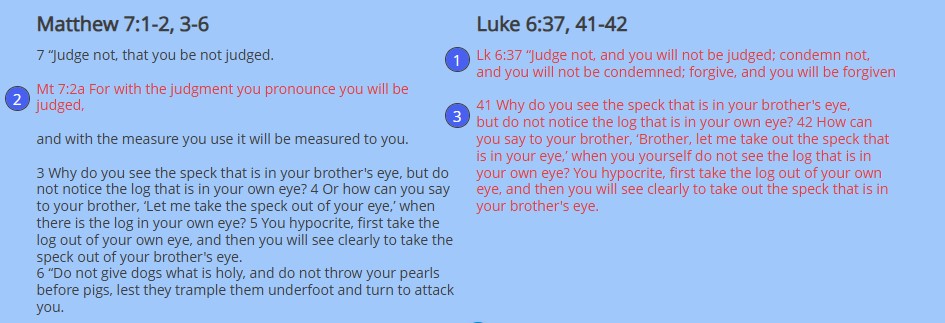
From the above worksheet photo, following the numbers and the text in red, the following narrative is produced.
Lk 6:37 “Judge not, and you will not be judged; condemn not, and you will not be condemned; forgive, and you will be forgiven; Mt 7:2a for with the judgment you pronounce you will be judged.
Lk 6:41 “Why do you see the speck that is in your brother’s eye, but do not notice the log that is in your own eye? 42 How can you say to your brother, ‘Brother, let me take out the speck that is in your eye,’ when you yourself do not see the log that is in your own eye? You hypocrite, first take the log out of your own eye, and then you will see clearly to take out the speck that is in your brother’s eye.
Bible Lessons for this event:
H226 Judging and Condemning Others (Matthew 7:2; Luke 6:37, 41-42)
Event Summary:
In this event, Jesus teaches about judgment, self-reflection, and discernment, emphasizing the importance of compassionate attitudes, humility, and self-awareness. The focus is on approaching others with grace rather than harsh criticism, while also being mindful of our own shortcomings.
Key points of this event are:
(1) Jesus warns against judging others harshly, stating, “Do not judge, or you too will be judged.” He teaches that the same measure of judgment we apply to others will be applied to us. This instruction emphasizes humility and compassion in our attitudes toward others. Jesus encourages His followers to avoid condemning others and instead to extend grace and understanding, knowing that everyone is accountable to God. (Matthew 7:2a; Luke 6:37)
(2) Jesus uses the metaphor of a speck and a plank to illustrate the need for self-awareness. He cautions against noticing minor flaws in others (“speck”) while ignoring one’s own larger faults (“plank”). This teaching highlights the importance of self-reflection and humility. Jesus calls his followers to address their own shortcomings before trying to correct others, underscoring that true change starts with personal accountability. (Luke 6:41-42)
(3) By teaching against judgment and encouraging self-examination, Jesus advocates for a merciful and compassionate approach to others. Recognizing one’s own flaws fosters humility, which helps in avoiding harsh criticism. This message aligns with the principle that we should treat others with the same grace and understanding we wish to receive from God and others.
The central message of this event is that compassion, humility, and self-awareness are essential in how we view and treat others. Jesus teaches that rather than judging harshly, believers should examine their own lives first, approaching others with grace and understanding. By avoiding a critical spirit and exercising discernment, believers reflect God’s mercy and patience, promoting a community of kindness and humility. Jesus encourages his followers to replace judgment with empathy, recognizing that only through a humble and merciful heart can they truly help others and honor God’s intentions.
Understanding and Application:
Understanding Questions with Extended Answers
1. What does Jesus mean when He says, “Judge not, that you be not judged”?
Answer:
Jesus is not forbidding all forms of judgment, but rather condemning a self-righteous, condemning spirit. The context shows that the kind of judgment He warns against is hypocritical and harsh; one that elevates oneself while tearing down others. Scripture elsewhere calls believers to exercise discernment (John 7:24), so the issue is not evaluation but attitude and posture of the heart.
Jesus is addressing the tendency to assume a position of moral superiority, where one acts as judge, jury, and executioner over others. This kind of judgment lacks mercy and fails to recognize one’s own sinfulness. Instead of restoring others gently, it condemns them.
Thus, Jesus is teaching that we must avoid unmerciful condemnation and instead approach others with humility, recognizing our shared need for grace.
2. What is meant by “with the measure you use it will be measured to you”?
Answer:
This statement reflects a principle of reciprocity in God’s moral order. The way a person treats others, especially in judgment, becomes the standard by which they themselves will be evaluated. If one uses a harsh, unforgiving measure, that same standard will be applied to them.
This does not mean we earn salvation by our actions, but it does reveal that our treatment of others reflects the condition of our hearts. A merciful person demonstrates that they understand God’s mercy; a harsh person reveals a lack of such understanding.
Jesus is emphasizing that God values mercy over condemnation, and those who extend grace show alignment with God’s character. This teaching echoes later in Matthew 7:12 (the Golden Rule) and in other passages like James 2:13: “Mercy triumphs over judgment.”
3. What is the meaning of the “speck” and the “log” in Jesus’ illustration?
Answer:
The “speck” represents a small fault in another person, while the “log” represents a much larger fault in oneself. Jesus uses exaggerated imagery to expose the absurdity of hypocrisy, trying to correct minor issues in others while ignoring major issues in one’s own life.
This illustration highlights how easily people minimize their own sins while magnifying the sins of others. It reveals a lack of self-awareness and spiritual blindness. The person with the “log” is not qualified to help another because their own vision is distorted.
The teaching calls for honest self-examination. Before addressing others, one must first confront and deal with personal sin. Only then can one see clearly and help others rightly.
4. Why does Jesus call such a person a hypocrite?
Answer:
A hypocrite is someone who presents a false appearance, pretending to be righteous while harboring sin. In this context, the hypocrisy lies in judging others for faults that one also possesses, often in greater measure.
This behavior is deceptive because it shifts attention away from one’s own sin and places it on others. It creates a false sense of moral superiority and undermines genuine righteousness.
Jesus exposes hypocrisy because it is destructive both spiritually and relationally. It prevents true repentance, damages relationships, and misrepresents God’s character. True righteousness begins with humility and a willingness to be corrected before correcting others.
5. After removing the “log,” what responsibility does a person have toward others?
Answer:
After addressing one’s own sin, Jesus says, “then you will see clearly to take the speck out of your brother’s eye.” This shows that helping others is still appropriate and necessary, but it must be done rightly.
The goal is not condemnation but restoration. Once a person has humbly dealt with their own faults, they are better equipped to help others with compassion, clarity, and gentleness.
This reflects a balanced approach:
- Self-examination first
- Loving correction second
It aligns with teachings like Galatians 6:1, where believers are instructed to restore others “in a spirit of gentleness.”
6. What does Jesus mean by “condemn not, and you will not be condemned; forgive, and you will be forgiven”? (Luke 6:37)
Answer:
Jesus expands the teaching by contrasting condemnation with forgiveness. To “condemn” is to pass final judgment on someone, treating them as beyond grace. Jesus warns against this because it assumes a role that belongs to God alone.
Instead, He calls His followers to be characterized by forgiveness and mercy. Those who forgive others demonstrate that they have received and understand God’s forgiveness.
This principle reinforces that the heart of a believer should reflect God’s character. Just as God is merciful, His people are to be merciful. Forgiveness does not ignore sin but chooses to release others from personal vengeance and extend grace.
7. What is the connection between self-examination and spiritual clarity?
Answer:
Jesus teaches that removing the “log” from one’s own eye leads to clear vision. This means that spiritual clarity begins with personal repentance. When sin clouds one’s life, it distorts perception and judgment.
Self-examination allows a person to see both themselves and others accurately. It fosters humility, which is essential for spiritual insight. Without this process, attempts to guide others are flawed and potentially harmful.
Thus, personal holiness and honest self-assessment are prerequisites for effective spiritual leadership and care for others.
8. What does Jesus mean by “do not give dogs what is holy, and do not throw your pearls before pigs”?
Answer:
This statement introduces the need for discernment. While believers are to avoid harsh judgment, they are not to abandon wisdom. “Dogs” and “pigs” symbolize those who are hostile to or incapable of appreciating sacred truths.
“Holy things” and “pearls” represent valuable spiritual truths, such as the gospel. Jesus warns that offering these truths indiscriminately to those who reject and mock them can lead to disrespect and even harm.
This teaching balances the earlier command:
- Do not judge hypocritically
- But do exercise wise discernment
Believers are called to recognize when someone is receptive and when continued sharing may be fruitless or harmful.
9. How do these passages together present a balanced view of judgment?
Answer:
Taken together, these passages present a threefold balance:
- Avoid hypocritical and harsh judgment
– Do not condemn others self-righteously. - Practice self-examination first
– Deal with your own sin before addressing others. - Exercise discernment wisely
– Recognize when and how to engage others with truth.
This balance prevents two extremes:
- Being overly critical and condemning
- Being undiscerning and naïve
Jesus calls His followers to a higher standard; humble, merciful, and wise engagement with others.
10. What is the overall heart attitude Jesus is teaching in these passages?
Answer:
The central attitude is one of humility, mercy, and spiritual responsibility. Jesus calls His followers to reflect God’s character by being gracious rather than condemning, self-aware rather than hypocritical, and wise rather than careless.
This teaching challenges believers to examine their motives, attitudes, and actions. It redirects focus from judging others to transforming oneself, and from condemning others to helping them in love.
Ultimately, Jesus is shaping a community marked by grace, truth, and discernment, where relationships are governed by God’s mercy and righteousness rather than human pride.
 Anchor My Faith
Leave a comment