
Photo: Darren Coleshill
Author: Stephen Weller
2,059 words, 11 minutes read time
Real Disciples: Endurance
Scripture Reference: Matthew 7:24-29; Luke 6:46-49
Context:
These parallel passages bring to a close two of Jesus’ most significant teaching sections; the Sermon on the Mount in Matthew (chapters 5–7) and the Sermon on the Plain in Luke (6:20–49). Throughout these sermons, Jesus has redefined righteousness, contrasting outward religious appearance with inward obedience to God. He has addressed the character of kingdom citizens (the Beatitudes), the true intent of the Law, genuine love for enemies, sincere devotion, and the necessity of bearing good fruit. Leading up to these verses, Jesus issues a series of warnings about false professions of faith (Matthew 7:21–23) and the danger of merely hearing His words without acting on them. Against this backdrop, the illustration of the wise and foolish builders serves as a decisive conclusion: the “rock” represents a life founded on hearing and doing Jesus’ teachings, while the “sand” represents superficial acknowledgment without obedience. The coming storm symbolizes testing, both present trials and ultimate judgment, revealing the true foundation of one’s life. In Matthew’s account, the response of the crowds emphasizes Jesus’ authority, not as a scribe interpreting the Law, but as one who speaks with divine authority. In Luke’s account, the emphasis falls more directly on the inconsistency of calling Jesus “Lord” without submission. Together, these passages summarize the central message of Jesus’ teaching ministry: true discipleship is demonstrated not by words alone, but by a life built securely on obedience to Him.
Event Narrative:
The narrative for this section was obtained from two similar texts, using the highlighted material shown below. The selection was determined by Jerry Peyton and copyrighted in 2015 by Jerry Peyton and Biblical Studies Press L.L.C.
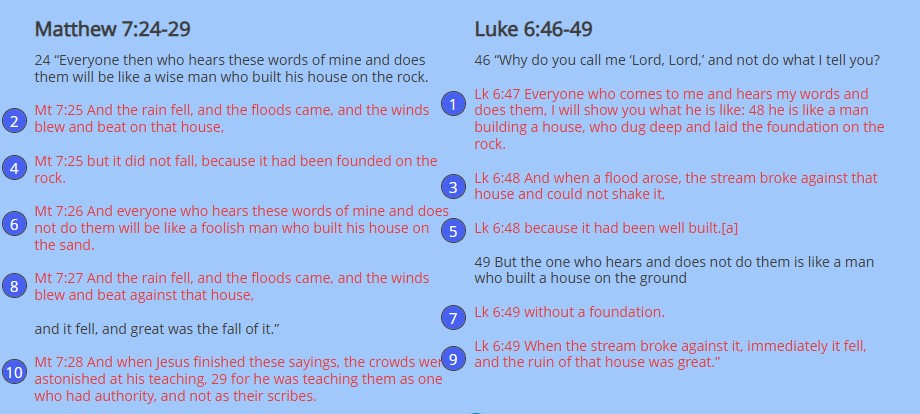
From the above worksheet photo, following the numbers and the text in red, the following narrative is produced.
Lk 6:47 “Everyone who comes to me and hears my words and does them, I will show you what he is like: 48 he is like a man building a house, who dug deep and laid the foundation on the rock. Mt 7:25 And the rain fell, and the floods came, and the winds blew and beat on that house. Lk 6:48 And when a flood arose, the stream broke against that house and could not shake it, Mt 7:25 but it did not fall, because it had been founded on the rock; Lk 6:48 it had been well built.
Mt 7:26 “And everyone who hears these words of mine and does not do them will be like a foolish man who built his house on the sand, Lk 6:49 without a foundation. Mt 7:27 And the rain fell, and the floods came, and the winds blew and beat against that house. Lk 6:49 When the stream broke against it, immediately it fell, and the ruin of that house was great.”
Mt 7:28 And when Jesus finished these sayings, the crowds were astonished at his teaching, 29 for he was teaching them as one who had authority, and not as their scribes.
Bible Lessons for this event:
H231 A Foundation on Rock (Matthew 7:25-29; Luke 6:47-49)
Event Summary:
In this event, Jesus teaches the parable of the wise and foolish builders, emphasizing the importance of putting his teachings into practice. The central themes are obedience, stability, and the strength of a life founded on God’s word.
Key points of this event are:
(1) Jesus describes two kinds of people: those who hear his words and put them into practice and those who hear but do not act on them. He compares those who obey his teachings to a wise builder who builds on a solid foundation. This teaching underscores that true discipleship requires action, not just listening. Genuine faith is shown in living out Jesus’ teachings in everyday life. (Luke 6:47-48)
(2) Jesus uses the metaphor of building on rock versus sand. The wise builder lays a foundation on rock, symbolizing a life grounded in obedience to Jesus’ words, which withstands life’s trials and challenges (symbolized by rain, floods, and winds). In contrast, the foolish builder constructs on sand, representing a superficial or hollow faith that cannot withstand adversity. When challenges come, this life collapses because it lacks a solid foundation. (Matthew 7:25-27; Luke 6:48-49)
(3) The parable highlights that obedience to God’s word provides stability and resilience in the face of life’s difficulties. Those who base their lives on Jesus’ teachings are like a well-built house that remains standing despite storms. Jesus teaches that only a life firmly rooted in obedience to God can endure hardship and lead to lasting peace, security, and spiritual fulfillment.
(4) Matthew notes that the crowds were astonished at Jesus’ teaching because he spoke with authority, unlike their traditional teachers. This final observation emphasizes that Jesus’ words carry divine truth and power, demanding not only attention but also a life response. Jesus’ authority reinforces the importance of building one’s life on his teachings, as his words are trustworthy, life-giving, and enduring. (Matthew 7:28-29)
The message of this event is that a life built on obedience to Jesus’ teachings is strong, stable, and enduring, able to withstand the trials of life. Jesus calls his followers not only to hear his words but to act on them, building their lives on the solid foundation of God’s truth. The parable challenges believers to examine whether their faith is deeply rooted in obedience or merely superficial. By living out Jesus’ teachings, believers establish a faith that remains resilient and steadfast, reflecting the unshakable nature of God’s word and his kingdom.
Understanding and Application:
Understanding Questions with Extended Answers
1. What is the central illustration Jesus uses in these passages?
Answer:
Jesus uses the illustration of two builders’ one wise and one foolish, to describe two types of hearers. Both hear His words, but only one acts on them. The wise man builds his house on a solid foundation (rock), while the foolish man builds without a proper foundation (sand or bare ground). This imagery represents the difference between obedient faith and mere hearing without obedience. The storm that tests both houses symbolizes trials, judgment, and ultimately the testing of one’s life before God.
2. What distinguishes the wise builder from the foolish builder?
Answer:
The key difference is not in what they hear, but in what they do. Both builders hear the words of Jesus, but the wise builder acts upon them, while the foolish builder does not. The wise builder represents a person who not only receives Christ’s teaching but submits to it, allowing it to shape their life. The foolish builder represents someone who may listen, agree, or even admire Jesus’ teaching, yet fails to live it out. This distinction highlights that true discipleship is evidenced by obedience, not mere knowledge or verbal acknowledgment.
3. What does the “rock” represent in Jesus’ teaching?
Answer:
The rock represents a secure foundation grounded in obedience to Christ’s words. It is not merely intellectual belief, but a life built upon trust in Christ expressed through action. In the broader biblical context, the rock also symbolizes God Himself and His unchanging truth. Therefore, building on the rock means anchoring one’s life in the authority of Christ, trusting His teaching as the ultimate standard, and living in accordance with it. This foundation provides stability that cannot be shaken by life’s trials or divine judgment.
4. What do the storm elements (rain, floods, winds) symbolize?
Answer:
The storm elements symbolize tests, trials, and ultimate judgment. These may include difficulties in life such as suffering, temptation, persecution, or hardship, as well as the final judgment before God. Both houses experience the same storm, showing that trials come to all people, regardless of their outward profession. However, the outcome differs dramatically based on the foundation. The storms reveal what is hidden; whether a person’s life is truly grounded in Christ or merely appears to be.
5. Why does the foolish builder’s house fall so dramatically?
Answer:
The fall is described as great because the foundation was fundamentally flawed. The foolish builder may have constructed something that looked similar to the wise builder’s house, but it lacked the essential support needed to endure testing. This represents a life that may appear religious or outwardly moral but is not rooted in genuine obedience to Christ. When trials or judgment come, the weakness of that foundation is exposed, leading to total collapse. The severity of the fall underscores the seriousness of ignoring Christ’s words.
6. In Luke’s account, why is the detail of “digging deep” significant?
Answer:
Luke emphasizes that the wise builder dug deep and laid the foundation on rock. This detail highlights the intentional effort and commitment required to truly follow Christ. Obedience is not superficial; it involves deliberate action, perseverance, and a willingness to go beyond the surface. Digging deep suggests examining one’s heart, removing obstacles, and firmly establishing one’s life on truth. It reflects the cost of discipleship and the diligence required to build a life that will endure.
7. What does Jesus mean by calling Him “Lord” in Luke 6:46?
Answer:
Jesus asks, “Why do you call me ‘Lord, Lord,’ and not do what I tell you?” This question exposes the inconsistency between profession and practice. Calling Jesus “Lord” implies submission, authority, and obedience. However, if a person does not obey His commands, their confession is empty. Jesus is teaching that true recognition of His lordship must be accompanied by a life that reflects His authority. Words alone are insufficient; genuine faith is demonstrated through obedience.
8. How do these passages relate to the broader message of the Sermon on the Mount/Plain?
Answer:
These passages serve as the conclusion and application of Jesus’ teaching. Throughout the Sermon on the Mount/Plain, Jesus has described the character of the kingdom of God; righteousness, humility, love, integrity, and trust in God. The parable of the two builders calls listeners to respond. It moves from instruction to decision: will one merely hear these teachings, or will one live them out? The conclusion reinforces that the teachings are not optional ideals but essential commands that determine one’s spiritual foundation.
9. What warning does this passage give to religious listeners?
Answer:
The passage warns that hearing truth without obedience is dangerous. Religious activity, knowledge of Scripture, or verbal confession does not guarantee a secure foundation. A person may appear faithful outwardly while lacking true submission to Christ. This warning is especially directed at those who are familiar with God’s Word but fail to apply it. It calls for self-examination to ensure that faith is genuine and active, not superficial or merely intellectual.
10. What assurance does this passage give to true followers of Christ?
Answer:
The passage offers strong assurance that those who build their lives on Christ through obedience will stand firm. Despite trials, hardships, and even final judgment, their foundation will not fail. This assurance is not based on personal strength but on the reliability of Christ and His Word. It encourages believers to remain steadfast, knowing that a life rooted in Christ is secure and enduring.
11. What is the significance of the crowd’s reaction in Matthew 7:28–29?
Answer:
The crowd is astonished because Jesus teaches with authority, unlike the scribes. This authority is not derived from tradition or other teachers but from His own identity as the Son of God. His words carry divine weight and demand a response. The reaction highlights that Jesus is not merely offering advice but issuing authoritative truth that requires obedience. It reinforces the seriousness of His teaching and the responsibility of those who hear it.
12. What practical application should a believer take from these passages?
Answer:
A believer should examine whether their life is truly built on obedience to Christ. This involves not only hearing and studying Scripture but actively applying it in daily life, through attitudes, decisions, and actions. It calls for consistency between belief and behavior, a willingness to obey even when it is difficult, and a commitment to build one’s life on the unchanging truth of God’s Word. Ultimately, the passage urges believers to ensure that their foundation is secure, so they can stand firm in every circumstance.
 Anchor My Faith
Leave a comment