
Photo: Mogens Poulsen (Between Rø and Tejn. Bornholm, Denmark.)
Author: Stephen Weller
2,147 words, 11 minutes read time
Healing the Centurion’s Slave – Capernaum, Galilee
Scripture Reference: Matthew 8:1, 5-13; Luke 7:1-10
Context:
The healing of the leper and the centurion’s servant in Gospel of Matthew 8:1 and 5–13 (paralleled in Gospel of Luke 7:1–10) takes place early in Jesus’ Galilean ministry, immediately following the Sermon on the Mount, where He has just taught with unprecedented authority. These miracles serve as powerful demonstrations that His authority is not merely in words but extends over disease, impurity, and even distance. The leper’s approach in Matthew 8:1 highlights both desperation and faith, as leprosy rendered a person ceremonially unclean under the Law of Moses, isolating them from society and worship; yet Jesus not only heals him but touches him, showing divine compassion and authority over uncleanness. In contrast, the centurion, a Roman officer and Gentile outsider, reveals remarkable humility and faith, recognizing Jesus’ authority in terms familiar to his military experience: just as he commands soldiers, Jesus can command healing with a word. This account is especially striking in its cultural context, as Jews typically avoided close association with Gentiles, yet Jesus praises the centurion’s faith as greater than any in Israel and uses the moment to foreshadow the inclusion of Gentiles in the kingdom of heaven. Together, these passages emphasize key themes of authority, faith, and the breaking of social and religious barriers, showing that Jesus’ mission reaches both the marginalized within Israel (the leper) and those outside it (the centurion), affirming that access to God’s kingdom is based on faith rather than status, heritage, or ceremonial condition.
Event Narrative:
The narrative for this section was obtained from two similar texts, using the highlighted material shown below. The selection was determined by Jerry Peyton and copyrighted in 2015 by Jerry Peyton and Biblical Studies Press L.L.C.
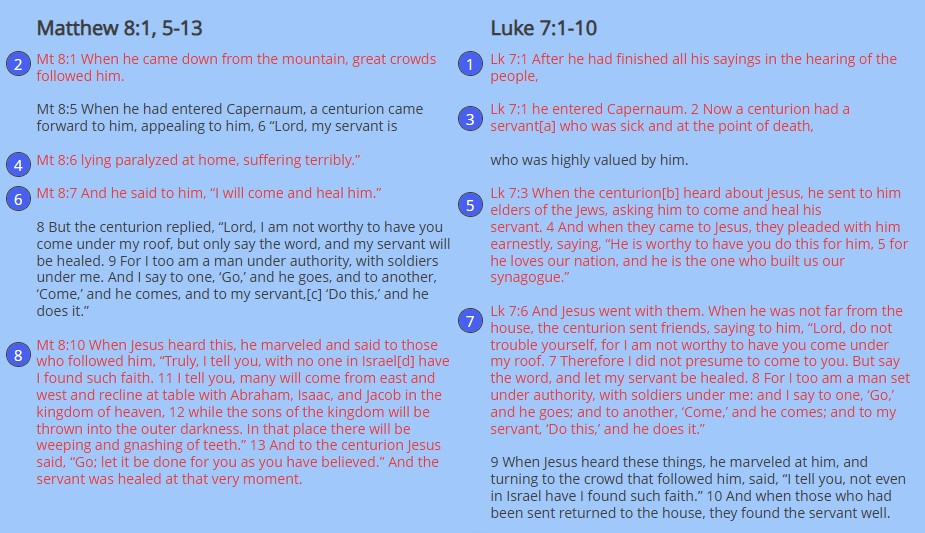
From the above worksheet photo, following the numbers and the text in red, the following narrative is produced.
Lk 7:1 After he had finished all his sayings in the hearing of the people, Mt 8:1 he came down from the mountain, [with] great crowds followed him, Lk 7:1 [and] he entered Capernaum. 2 Now a centurion had a servant who was sick and at the point of death, Mt 8:6 lying paralyzed at home, suffering terribly.” Lk 7:3 When the centurion heard about Jesus, he sent to him elders of the Jews, asking him to come and heal his servant. 4 And when they came to Jesus, they pleaded with him earnestly, saying, “He is worthy to have you do this for him, 5 for he loves our nation, and he is the one who built us our synagogue.”
Mt 8:7 And he said to him, “I will come and heal him.”
Lk 7:6 And Jesus went with them. When he was not far from the house, the centurion sent friends, saying to him, “Lord, do not trouble yourself, for I am not worthy to have you come under my roof. 7 Therefore I did not presume to come to you. But say the word, and let my servant be healed. 8 For I too am a man set under authority, with soldiers under me: and I say to one, ‘Go,’ and he goes; and to another, ‘Come,’ and he comes; and to my servant, ‘Do this,’ and he does it.”
Mt 8:10 When Jesus heard this, he marveled and said to those who followed him, “Truly, I tell you, with no one in Israel have I found such faith. 11 I tell you; many will come from east and west and recline at table with Abraham, Isaac, and Jacob in the kingdom of heaven, 12 while the sons of the kingdom will be thrown into the outer darkness. In that place there will be weeping and gnashing of teeth.”
13 And to the centurion Jesus said, “Go; let it be done for you as you have believed.” And the servant was healed at that very moment.
Bible Lessons for this event:
H232 Intentionally skipped
H233 Travel Time (Matthew 8:1, 6-7; Luke 7:1-6)
H234 The Centurion’s Faith (Matthew 8:10-13; Luke 7:6-8)
Event Summary:
This event recounts the healing of the centurion’s servant, highlighting themes of faith, humility, and the inclusive nature of Jesus’ ministry. This story demonstrates the power of faith in Jesus’ authority and reveals that God’s kingdom is open to all who approach him with sincere belief.
Key points of this event are:
(1) A Roman centurion, a figure of authority and status, approaches Jesus with humility on behalf of his servant, showing deep care for his servant’s well-being. The centurion believes that Jesus’ word alone is enough to heal, without requiring Jesus to come in person. His acknowledgment that he is unworthy for Jesus to enter his home reflects a profound humility, especially remarkable given his position and the fact that he is a Gentile. This encounter emphasizes that genuine faith is marked by humility and a deep respect for Jesus’ authority. (Matthew 8:1, 8:6-7; Luke 7:1-5)
(2) The centurion expresses complete confidence in Jesus’ authority, comparing it to his own experience of giving orders as a leader. He trusts that Jesus has the power to heal simply by speaking a word, showing a profound understanding of Jesus’ divine authority. Jesus is amazed by the centurion’s faith, noting that he has not found such faith even among his own people (the Israelites). This reinforces that faith is not limited by background or ethnicity but is accessible to all who recognize Jesus’ power. (Matthew 8:10-13; Luke 7:6-8)
(3) In Matthew’s account, Jesus uses this occasion to teach about the inclusive nature of God’s kingdom, saying that many will come from the east and west (representing Gentiles) to join the kingdom, while some of Israel’s own people may miss out because of unbelief. This teaching foreshadows the global scope of the gospel and the inclusion of Gentiles in God’s redemptive plan. Jesus highlights that faith, not heritage or nationality, is the key to entering the kingdom. (Matthew 8:11-12)
(4) Jesus heals the centurion’s servant from a distance, underscoring the power of his word and his authority over all creation. The miracle demonstrates that Jesus’ authority transcends physical presence, affirming his divine power to heal and restore. This healing reflects the compassion and responsiveness of Jesus to sincere faith, regardless of the social or ethnic identity of the one seeking his help. (Luke 7:6-8; Matthew 8:10-14)
The message of this event is that faith in Jesus’ authority, marked by humility and sincerity, opens the door to God’s kingdom. The centurion’s faith demonstrates that true belief in Jesus’ power can transcend cultural and religious boundaries, inviting all who approach him with humility to experience his grace. Jesus’ healing of the servant reinforces that God’s kingdom is inclusive and based on faith, not heritage. This story calls believers to recognize and trust in Jesus’ authority, understanding that God’s grace reaches all who come to him in faith, regardless of background or status.
Understanding and Application:
Questions of Understanding with Extended Answers
1. What is the setting and significance of this encounter with the centurion?
Answer:
The event takes place in Capernaum, a prominent town in Jesus’ Galilean ministry. The centurion is a Roman officer, likely commanding around 100 soldiers, making him a Gentile and part of the occupying force. This is significant because Jews typically viewed Romans as oppressors and outsiders to God’s covenant. Yet this centurion stands out as a man who respects Israel’s God, even helping build a synagogue (Luke 7:5). His approach to Jesus highlights a surprising openness of faith among Gentiles, foreshadowing the expansion of God’s kingdom beyond Israel. This encounter demonstrates that faith, not ethnicity or status, is what grants access to God’s grace.
2. How does the centurion demonstrate humility in his interaction with Jesus?
Answer:
The centurion shows remarkable humility in several ways. First, he does not approach Jesus directly at first but sends Jewish elders (Luke 7:3), indicating respect for Jewish customs. Then, when Jesus comes near his house, he sends friends to say, “Lord, do not trouble yourself, for I am not worthy to have you come under my roof” (Luke 7:6). This statement reveals deep self-awareness—he recognizes both his unworthiness and Jesus’ authority. Despite being a man of high rank, he lowers himself before Christ. His humility contrasts sharply with many religious leaders of the time who rejected Jesus. True faith, as shown here, is always accompanied by humility.
3. What does the centurion’s understanding of authority reveal about his faith?
Answer:
The centurion explains that he understands authority because he himself is under authority and commands soldiers (Matthew 8:9). He recognizes that just as his orders are carried out without question, Jesus has authority over illness and can command healing from a distance. This insight reveals an extraordinary level of faith; he believes Jesus does not need to be physically present to heal. He sees Jesus not merely as a healer, but as one who possesses divine authority over creation. His faith is rooted in understanding who Jesus is, not just what He can do.
4. Why does Jesus marvel at the centurion’s faith?
Answer:
Jesus marvels because the centurion’s faith surpasses anything He has seen in Israel (Matthew 8:10). This is striking because Israel had the Scriptures, the promises, and the long history of God’s revelation. Yet many in Israel lacked true faith, while this Gentile demonstrates complete trust in Jesus’ authority. The centurion believes without needing signs or physical presence. Jesus highlights this to show that genuine faith is not tied to heritage or religious privilege but is a matter of the heart’s trust in Him.
5. What is the meaning of Jesus’ statement about many coming from east and west?
Answer:
In Matthew 8:11–12, Jesus says that many will come from east and west and sit with Abraham, Isaac, and Jacob in the kingdom of heaven, while some “sons of the kingdom” will be cast out. This statement reveals a profound truth: God’s kingdom will include Gentiles who have faith, while some Jews who rely only on heritage will be excluded. It emphasizes that entrance into the kingdom is based on faith, not lineage. This was a radical teaching that challenged Jewish expectations and pointed forward to the global mission of the gospel.
6. How do the accounts in Matthew and Luke complement each other?
Answer:
Matthew presents a more direct interaction between Jesus and the centurion, emphasizing the centurion’s faith and Jesus’ authority. Luke provides additional details, such as the centurion’s good relationship with the Jewish community and the use of intermediaries (elders and friends). Together, they give a fuller picture: Matthew focuses on the theological significance, while Luke highlights the character and reputation of the centurion. Both accounts agree on the central point; the centurion’s extraordinary faith and Jesus’ power to heal.
7. What does this miracle teach about Jesus’ authority over distance and circumstance?
Answer:
Jesus heals the servant without ever entering the house or even seeing the servant. This demonstrates that His authority is not limited by space or proximity. His word alone is sufficient to bring healing. This reinforces the truth that Jesus is sovereign over all creation; He does not need physical contact or rituals. For believers, this teaches that Christ’s power is not limited by our circumstances; He is fully able to act wherever and whenever He wills.
8. What role do others (the elders and friends) play in this account?
Answer:
In Luke’s account, the Jewish elders advocate for the centurion, and his friends deliver his message to Jesus. This shows the importance of intercession; others bringing needs before Jesus. It also highlights the centurion’s good character and relationships. However, while others speak on his behalf, the faith ultimately belongs to the centurion himself. This balance shows that while intercession is valuable, each person must personally trust in Christ.
9. What does this passage teach about faith and worthiness?
Answer:
The centurion declares himself unworthy, yet Jesus responds to his faith and grants his request. This teaches that God’s blessings are not earned by worthiness but received through faith. The elders say he is “worthy” (Luke 7:4), but the centurion says he is not; revealing the difference between human evaluation and true spiritual humility. Faith acknowledges unworthiness while trusting fully in Christ’s grace.
10. How can believers apply the centurion’s example today?
Answer:
Believers are called to imitate the centurion’s faith by trusting Jesus completely, even when they cannot see how He will act. His humility reminds us to approach Christ with reverence, not entitlement. His understanding of authority challenges us to recognize Jesus as Lord over every area of life. Finally, his confidence in Jesus’ word encourages believers to rely on Scripture and God’s promises, knowing that Christ is able to act powerfully even from afar.
 Anchor My Faith
Leave a comment