
Photo: Nini pics (Lake Jasna in Slovenia)
Author: Stephen Weller
1,857 words, 10 minutes read time
Healing a Leper
Scripture Reference: Matthew 8:2-4; Mark 1:40-45; Luke 5:12-16
Context:
The healing of the leper recorded in Gospel of Matthew 8:2–4, Gospel of Mark 1:40–45, and Gospel of Luke 5:12–16 takes place early in Jesus’ Galilean ministry, shortly after He has begun publicly teaching and demonstrating His authority through miracles. In first-century Jewish society, leprosy (a term covering various skin diseases) rendered a person ceremonially unclean according to the Law (Leviticus 13–14), isolating them from community life, worship, and even family. Lepers were required to live outside populated areas and announce their uncleanness, making this man’s approach to Jesus both bold and desperate. When the leper kneels and says, “Lord, if You are willing, you can make me clean,” he expresses remarkable faith; not doubting Jesus’ power but appealing to His compassion. Jesus’ response is striking: He not only declares His willingness but also touches the man, an act that would normally transmit uncleanness under the Law, yet instead demonstrates His divine authority as holiness flows outward, cleansing rather than being defiled. Immediately, the leprosy leaves, confirming both His power over disease and His authority over ceremonial law. Jesus then instructs the man to tell no one and to present himself to the priest with the required offering, fulfilling the Mosaic Law and providing an official testimony of healing. This command reflects both Jesus’ desire to avoid premature public frenzy and His respect for the Law’s verification process. However, as Mark records, the man spreads the news widely, resulting in increased crowds and making it difficult for Jesus to enter towns openly, thus shifting His ministry pattern toward more secluded places where He continues to pray and minister. Across all three accounts, the event reveals Jesus as both compassionate and authoritative, willing to restore the outcast, powerful to cleanse completely, and faithful to God’s law, while also foreshadowing the deeper spiritual cleansing He brings from sin.
Event Narrative:
The narrative for this section was obtained from three similar texts, using the highlighted material shown below. The selection was determined by Jerry Peyton and copyrighted in 2015 by Jerry Peyton and Biblical Studies Press L.L.C.
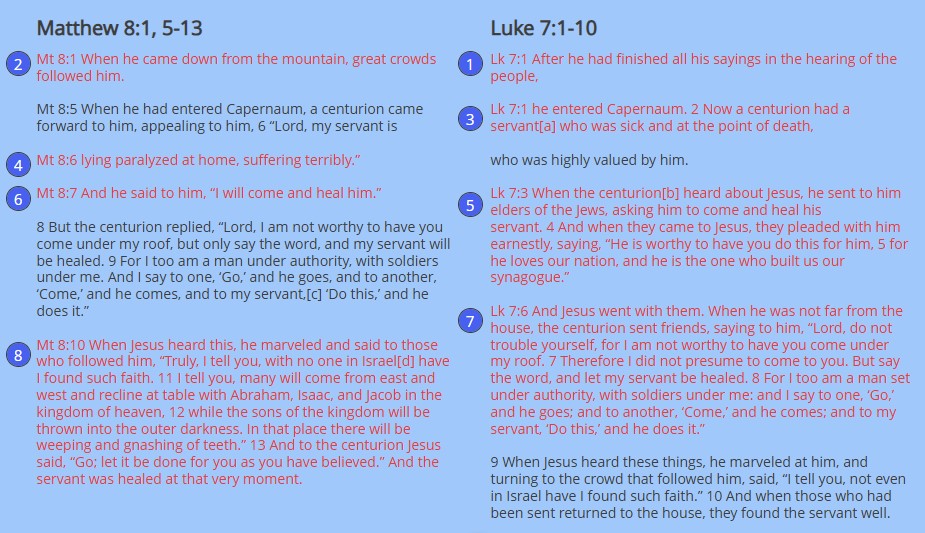
From the above worksheet photo, following the numbers and the text in red, the following narrative is produced.
Lk 5:12 While he was in one of the cities, there came a man full of leprosy. And when he saw Jesus, he fell on his face and begged him, “Lord, if you will, you can make me clean.”
Mk 1:41 Moved with pity, [Jesus] stretched out his hand and touched him and said to him, “I will; be clean.” 42 And immediately the leprosy left him, and he was made clean.
Mk 1:43 And Jesus sternly charged him and sent him away at once, 44 and said to him, “See that you say nothing to anyone, but go, show yourself to the priest and offer for your cleansing what Moses commanded, for a proof to them.”
Mk 1:45 But he went out and began to talk freely about it, and to spread the news, Lk 5:15 and great crowds gathered to hear him and to be healed of their infirmities Mk 1:45 so that Jesus could no longer openly enter a town, but was out in desolate places, and people were coming to him from every quarter. Lk 5:16 But [Jesus] would [frequently] withdraw to desolate places and pray.
Bible Lessons for this event:
H235 A Disobedient Cleansed Leper (Mark 1:41-45; Luke 5:12, 15-16)
Event Summary:
This event recounts the story of Jesus healing a man with leprosy, highlighting themes of compassion, faith, and the power of Jesus’ healing. The encounter demonstrates Jesus’ willingness to reach out to the marginalized and restore both physical health and social connection to those who are isolated.
Key points of this event are:
(1) A man with leprosy approaches Jesus and, kneeling before him, says, “If You are willing, You can make me clean!” This statement reflects both faith in Jesus’ power and humility, as the man submits to Jesus’ will, acknowledging that only Jesus can heal him. His approach emphasizes the importance of coming to Jesus in faith and trusting in his ability to provide healing and restoration, while also showing respect for Jesus’ divine authority. (Luke 15:12)
(2) Jesus is moved with compassion and reaches out to touch the leper, saying, “I am willing. Be clean. His willingness to touch the man, despite the social stigma and ritual impurity associated with leprosy, demonstrates Jesus’ profound empathy and willingness to meet people where they are. By touching the man, Jesus not only heals him physically but also restores his dignity and social belonging, as touch was something lepers were deprived of in their isolation. (Mark 1:41).
(3) After healing the leper, Jesus instructs him to show himself to the priest and make the required offerings according to the Law of Moses. This serves as a testimony of his cleansing and allows him to be officially reintegrated into society. This instruction highlights the importance of obedience and fulfilling religious obligations as a way of honoring God and respecting established customs. (Mark 1:42-45)
(4) The leper spreads the news widely, despite Jesus’ instruction to remain silent. As a result, Jesus becomes so popular that He can no longer enter towns openly and often retreats to desolate places to pray. This detail highlights both the impact of Jesus’ ministry on the public and his commitment to prayer and communion with the Father, demonstrating a balance between serving others and maintaining spiritual strength. (Luke 5:15-16).
The message of this event is that Jesus is willing and able to heal those who come to him in faith, and he reaches out with compassion to those who are marginalized. His healing power is not limited by social or religious boundaries, and he restores dignity, physical health, and social belonging to those who are isolated. The story calls believers to approach Jesus with humility and faith and shows that God’s love extends to the most vulnerable and outcast. Through this miracle, Jesus models a ministry of compassion, inclusivity, and spiritual strength, reminding us that his grace and power are available to all who seek him.
Understanding and Application:
Questions of Understanding with Extended Answers
1. What was the condition of the man who approached Jesus, and why was it significant?
Answer:
The man was a leper, described in Luke as being “full of leprosy,” indicating an advanced and severe case. In biblical times, leprosy was not only a physical disease but also a social and religious condition. According to the Law (Leviticus 13–14), lepers were considered unclean and were required to live outside the community, avoid contact with others, and announce their uncleanness. This meant the man was isolated, rejected, and cut off from worship. His approach to Jesus was therefore bold and desperate, crossing social and religious boundaries. It highlights both his great need and his willingness to risk everything to seek healing.
2. What did the leper’s request reveal about his faith in Jesus?
Answer:
The leper said, “Lord, if You are willing, You can make me clean.” This statement reveals remarkable faith. He did not question Jesus’ power—he was fully convinced that Jesus could heal him. Instead, his uncertainty was about Jesus’ willingness. This shows humility and reverence, not presumption. He recognized Jesus’ authority and submitted to His will. His faith was not demanding but trusting, acknowledging both Christ’s power and His sovereignty.
3. How did Jesus respond to the leper, and why is this response significant?
Answer:
Jesus responded by stretching out His hand and touching the man, saying, “I am willing; be cleansed.” This response is deeply significant. First, Jesus expressed compassion (Mark notes He was “moved with compassion”), showing that His power is accompanied by mercy. Second, His touch is remarkable because touching a leper would normally make someone ceremonially unclean. Instead, Jesus’ holiness overpowered the uncleanness—the leper was cleansed instantly. This demonstrates that Jesus is not defiled by sin or disease; rather, He has authority to remove it. His touch symbolizes both healing and restoration.
4. What happened immediately after Jesus spoke to the man?
Answer:
Immediately, the leprosy left him, and he was cleansed. The healing was instantaneous and complete, not gradual. This emphasizes the divine authority of Jesus—His word alone is sufficient to bring total restoration. The immediacy also confirms that this was not a natural recovery but a miraculous act. The man’s body was fully restored, demonstrating that Jesus has power over even the most severe physical conditions.
5. Why did Jesus instruct the man not to tell anyone and to go to the priest?
Answer:
Jesus commanded the man to tell no one but instead to go to the priest and offer the sacrifices required by Moses as a testimony. This instruction served several purposes. First, it upheld the Law, as Leviticus required a priest to examine and officially declare a healed leper clean. Second, it provided a testimony to the religious leaders that a genuine healing had occurred, something only God could do. Third, Jesus often sought to avoid premature publicity that could hinder His ministry or lead to misunderstandings about His mission. He desired obedience and proper testimony rather than uncontrolled excitement.
6. How did the man respond to Jesus’ instruction, and what were the consequences?
Answer:
Despite Jesus’ clear command, the man went out and freely proclaimed what had happened. While his response may have come from joy and gratitude, it was still disobedience. As a result, Jesus could no longer openly enter towns but stayed in desolate places. The widespread publicity created crowds that made it difficult for Jesus to move freely and continue His ministry as intended. This shows that even well-intentioned disobedience can have unintended consequences that hinder God’s work.
7. What does this account teach about Jesus’ authority and mission?
Answer:
This account reveals that Jesus has absolute authority over disease, uncleanness, and the effects of sin. Leprosy, often seen as a symbol of sin due to its defiling and isolating nature, is completely removed by Jesus’ word and touch. His mission includes not only physical healing but also restoration, bringing the outcast back into community and worship. It points forward to His greater work of cleansing humanity from sin. Jesus is shown as both powerful and compassionate, fully able and willing to restore those who come to Him in faith.
8. What spiritual lessons can believers learn from the leper’s encounter with Jesus?
Answer:
Believers can learn several key lessons. First, like the leper, we must recognize our need and come to Jesus with humility. Second, true faith trusts both Christ’s ability and His will. Third, Jesus is willing to cleanse and restore, no matter how severe the condition. Fourth, obedience to Christ’s commands is essential, even when we are overwhelmed with joy. Finally, the account reminds us that Jesus not only heals but restores us to fellowship with God and others. It encourages believers to approach Him confidently, knowing that He is both compassionate and powerful to save.
 Anchor My Faith
Leave a comment