
Photo: Luis Gil (Iceland, geological paradise.)
Author: Stephen Weller
2,497 words, 13 minutes read time
Jesus and John, the Baptist
Scripture Reference: Matthew 11:2-19; Luke 7:18-35; 16:16
Context:
The passages Matthew 11:2–19 and Luke 7:18–35 occur at a pivotal moment in Jesus’ ministry, when expectations about the Messiah are being challenged and clarified. John the Baptist, now imprisoned by Herod, sends his disciples to ask Jesus, “Are You the Coming One, or do we look for another?” This question reflects both John’s faithful anticipation and the tension between his earlier proclamation of a coming judgment and the present reality of Jesus’ ministry characterized by healing, mercy, and proclamation of good news. Jesus responds not with a direct assertion, but by pointing to His works, fulfilling the prophetic signs of the Messiah found in Isaiah (the blind see, the lame walk, the poor have the gospel preached to them), thereby affirming His identity while also redefining messianic expectations. He then honors John as more than a prophet, the forerunner who fulfills prophecy, yet notes that even the least in the kingdom of heaven is greater, highlighting the surpassing privilege of those who witness the kingdom’s fulfillment. Despite this, Jesus rebukes the generation for their inconsistency: they rejected John for his austerity and reject the Son of Man for His association with sinners, revealing hardened hearts unwilling to respond to God’s truth in any form. Luke 16:16 adds a theological summary to this moment, declaring that “the Law and the Prophets were until John; since that time the kingdom of God has been preached,” marking John as the transitional figure between the old covenant era and the inaugurated kingdom of God. Together, these passages emphasize the shift from expectation to fulfillment, the necessity of recognizing God’s work even when it defies human assumptions, and the accountability of responding rightly to the revelation of Jesus Christ.
Event Narrative:
The narrative for this section was obtained from two similar texts, using the highlighted material shown below. The selection was determined by Jerry Peyton and copyrighted in 2015 by Jerry Peyton and Biblical Studies Press L.L.C.
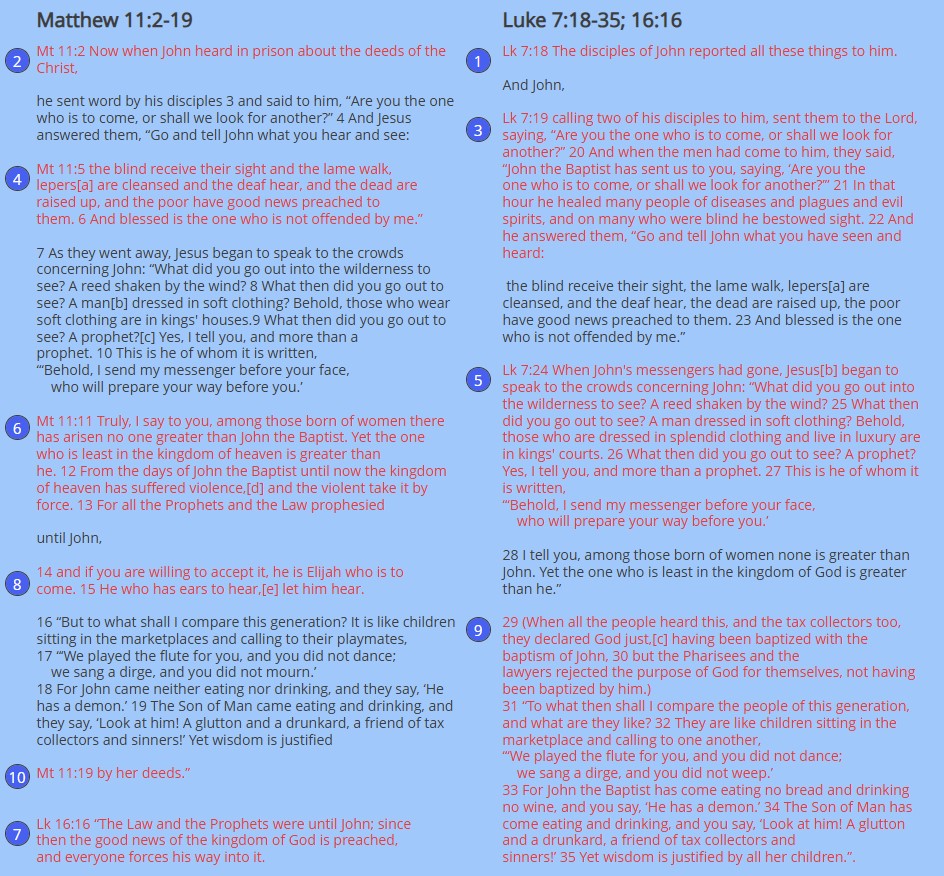
From the above worksheet photo, following the numbers and the text in red, the following narrative is produced.
Lk 7:18 The disciples of John reported all these things to him. Mt 11:2 Now when John heard in prison about the deeds of the Christ, Lk 7:19 [he called] two of his disciples to him, sent them to the Lord, saying, “Are you the one who is to come, or shall we look for another?” 20 And when the men had come to [Jesus], they said, “John the Baptist has sent us to you, saying, ‘Are you the one who is to come, or shall we look for another?’”
Lk 7:21 In that hour he healed many people of diseases and plagues and evil spirits, and on many who were blind he bestowed sight. 22 And he answered them, “Go and tell John what you have seen and heard: Mt 11:5 the blind receive their sight and the lame walk, lepers are cleansed and the deaf hear, and the dead are raised up, and the poor have good news preached to them. 6 And blessed is the one who is not offended by me.”
Lk 7:24 When John’s messengers had gone, Jesus began to speak to the crowds concerning John: “What did you go out into the wilderness to see? A reed shaken by the wind? 25 What then did you go out to see? A man dressed in soft clothing? Behold, those who are dressed in splendid clothing and live in luxury are in kings’ courts. 26 What then did you go out to see? A prophet? Yes, I tell you, and more than a prophet. 27 This is he of whom it is written, ‘Behold, I send my messenger before your face, who will prepare your way before you.’”
Mt 11:11 “Truly, I say to you, among those born of women there has arisen no one greater than John the Baptist. Yet the one who is least in the kingdom of heaven is greater than he.”
Mt 11:12 “From the days of John the Baptist until now the kingdom of heaven has suffered violence, and the violent take it by force. 13 For all the Prophets and the Law prophesied Lk 16:16 and were until John; since then, the good news of the kingdom of God is preached, and everyone forces his way into it. Mt 11:14 And if you are willing to accept it, he is Elijah who is to come. 15 He who has ears to hear, let him hear.”
Lk 7:29 (When all the people heard this, and the tax collectors too, they declared God just, having been baptized with the baptism of John, 30 but the Pharisees and the lawyers rejected the purpose of God for themselves, not having been baptized by him.)
Lk 7:31 [Jesus continued,] “To what then shall I compare the people of this generation, and what are they like? 32 They are like children sitting in the marketplace and calling to one another, ‘We played the flute for you, and you did not dance; we sang a dirge, and you did not weep.’”
Lk 7:33 “For John the Baptist has come eating no bread and drinking no wine, and you say, ‘He has a demon.’ 34 The Son of Man has come eating and drinking, and you say, ‘Look at him! A glutton and a drunkard, a friend of tax collectors and sinners!’ 35 Yet wisdom is justified by all her children, Mt 11:19 by her deeds.”
Bible Lessons for this event:
H237 John’s Questions About Jesus (Matthew 11:2, 5-6; Luke 7:18-21)
H238 Jesus Describes John the Baptist (Matthew 11:11; Luke 7:24-27)
H239 In the Likeness of Elijah (Matthew 11:12-15; Luke 16:16)
H240 What People Are Like (Matthew 11:19; Luke 7:29-34)
Event Summary:
In this event, the focus is on John the Baptist’s inquiry about Jesus’ identity, Jesus’ response, and his teachings about John’s role, the kingdom of God, and people’s varied responses to God’s message. Key themes include recognizing Jesus as the Messiah, the fulfillment of prophecy, the inclusivity of God’s kingdom, and the challenge of human resistance to God’s ways.
Key points of this event are:
(1) John the Baptist, hearing of Jesus’ works from prison, sends disciples to ask if Jesus is “the one who is to come.” John’s question may reflect a desire for confirmation, possibly due to unmet expectations of a Messianic figure who would bring judgment. Jesus replies by pointing to the miraculous signs he is performing: the blind see, the lame walk, lepers are cleansed, the deaf hear, the dead are raised, and the good news is preached to the poor. This response echoes Messianic prophecies (Isaiah 35:5-6; 61:1), affirming that Jesus fulfills the role of the promised Messiah. Jesus blesses those who do not stumble on account of him, encouraging faith in his mission even if it doesn’t align with traditional expectations. (Matthew 11:2, 5-6; Luke 7:18-22)
(2) Jesus affirms John’s identity as the foretold prophet and “messenger” who prepared the way for the Messiah, fulfilling Malachi 3:1. He declares that among those born of women, none is greater than John, yet even the “least in the kingdom” is greater. This highlights John’s unique role as the last prophet of the old covenant, bridging the prophetic tradition to the fulfillment of God’s promises in Jesus. Jesus’ statement about the “least in the kingdom” indicates the surpassing greatness of those who fully experience the kingdom of God, which John only glimpsed. (Matthew 11:11; Luke 7:24-27)
(3) Jesus notes that people are like children who are dissatisfied with both John’s and his own ministries. They criticize John for his ascetic lifestyle and Jesus for his association with sinners, reflecting a resistant and critical spirit toward God’s work, regardless of how it is presented. Jesus’ remark that “wisdom is justified by her children” (or “by all her children” in Luke) means that true wisdom is demonstrated by the outcomes of God’s work through both John and Jesus, regardless of people’s opinions or criticisms. (Matthew 11:16; Luke 7:29-35)
(4) Jesus explains that since the days of John, the kingdom of heaven has been forcefully advancing, with people “forcefully taking hold” of it (Matthew 11:12). This statement implies that entering God’s kingdom requires an intense, committed response. In Luke 16:16, Jesus says that “the Law and the Prophets were proclaimed until John,” and since then, “the good news of the kingdom is preached, and everyone is forcing their way into it.” This suggests that the kingdom is now fully accessible through Jesus, marking a transition from the old covenant to the new, where people are urged to respond with urgency and commitment. (Matthew 11:12-13; Luke 16:16)
The message of this event is that Jesus is the long-awaited Messiah, fulfilling the promises of the prophets, though his mission may challenge traditional expectations. Through his miracles and teachings, he demonstrates the presence of God’s kingdom, which is inclusive and open to all who respond in faith. The passages highlight the importance of recognizing and accepting God’s work, despite human resistance or preconceptions. Jesus invites his followers to embrace the kingdom wholeheartedly, with urgency and conviction, while warning against a critical or dismissive spirit that misses God’s grace and truth in unexpected forms.
Understanding and Application:
Questions of Understanding with Extended Answers
How do these passages together reveal the transition from the Old Covenant to the New Covenant?
Answer:
John the Baptist stands as the final and greatest prophet of the Old Covenant, preparing the way for Jesus. His ministry bridges expectation and fulfillment. Jesus’ works confirm that the kingdom has arrived, yet in a form different from popular expectations. The rejection by many and acceptance by humble sinners illustrate the dividing line of the New Covenant: faith in Christ. These passages show that God’s plan is consistent and fulfilled in Jesus, but requires a response of faith that aligns with God’s revealed truth rather than human expectation.
Why did John the Baptist send disciples to ask Jesus, “Are You the one who is to come?”
Answer:
John’s question (Matthew 11:3; Luke 7:19) arises from his imprisonment and the unexpected nature of Jesus’ ministry. John had proclaimed a Messiah who would bring immediate judgment (Matthew 3:10–12), yet Jesus’ ministry emphasized healing, mercy, and preaching good news. This contrast may have caused uncertainty—not necessarily unbelief, but a need for confirmation. Jesus’ response points John back to Scripture (Isaiah 35:5–6; 61:1), affirming that He is indeed the Messiah, though His mission unfolds in stages: first salvation, later judgment.
How did Jesus answer John’s question, and why is His answer significant?
Answer:
Jesus answered by describing His works: the blind receive sight, the lame walk, lepers are cleansed, the deaf hear, the dead are raised, and the poor have good news preached to them (Matthew 11:4–5; Luke 7:22). This answer is significant because it fulfills Old Testament Messianic prophecies, demonstrating that Jesus’ identity is proven by divine action rather than mere claim. He concludes with, “Blessed is the one who is not offended by me,” emphasizing that faith must accept the Messiah as He truly is, not as people expect Him to be.
What did Jesus teach about John the Baptist’s role and significance?
Answer:
Jesus declared that John is more than a prophet, he is the messenger foretold in Malachi 3:1 who prepares the way for the Lord (Matthew 11:10). He also stated that among those born of women, none is greater than John (Matthew 11:11). John represents the pinnacle of the Old Testament prophetic tradition. Yet Jesus adds that “the one who is least in the kingdom of heaven is greater than he,” highlighting the superiority of the New Covenant era, where believers experience the fulfillment of what John only anticipated.
What does Jesus mean when He says, “the kingdom of heaven has suffered violence”?
Answer:
This phrase (Matthew 11:12) indicates the intense opposition and conflict surrounding the arrival of God’s kingdom. From John’s imprisonment to growing resistance against Jesus, the kingdom advances amid hostility. It can also suggest the urgency and determination required to enter the kingdom—people must respond decisively and wholeheartedly. The kingdom is not passively received; it demands earnest pursuit and commitment.
How is John the Baptist identified with Elijah, and why is this important?
Answer:
Jesus says John is “Elijah who is to come” (Matthew 11:14), fulfilling Malachi 4:5. This does not mean John is literally Elijah reincarnated, but that he comes in the “spirit and power of Elijah” (Luke 1:17). This identification confirms that the long-awaited prophetic forerunner has arrived, signaling that the Messianic age has begun. It reinforces that God’s redemptive plan is unfolding exactly as foretold.
What criticism did Jesus make about “this generation”?
Answer:
Jesus compared the people to children in the marketplace who complain regardless of what is offered (Matthew 11:16–17; Luke 7:31–32). They rejected John for his austerity (“he has a demon”) and rejected Jesus for His association with sinners (“a glutton and a drunkard”). This reveals a hardened, inconsistent unbelief; people were not seeking truth but excuses to reject God’s messengers. Their problem was not lack of evidence, but unwillingness to respond.
What does the phrase “wisdom is justified by her deeds (or children)” mean?
Answer:
This statement (Matthew 11:19; Luke 7:35) means that God’s wisdom is proven right by its results. Though people criticized both John and Jesus, the lives transformed by their ministries demonstrated that God’s plan was true and effective. In other words, the fruit of repentance and faith vindicates God’s approach, even when misunderstood or rejected by many.
What does Luke 7:29–30 reveal about different responses to God’s message?
Answer:
Luke notes that tax collectors and sinners justified God by accepting John’s baptism, while the Pharisees and lawyers rejected God’s purpose for themselves by refusing it. This contrast shows that humility and repentance open the way to God’s truth, while pride and self-righteousness prevent it. The dividing line is not knowledge or status, but the condition of the heart.
What is the meaning of Luke 16:16: “The Law and the Prophets were until John”?
Answer:
This statement marks a turning point in redemptive history. The Law and the Prophets represent the Old Covenant era, which culminates with John the Baptist. With John, the transition begins into the proclamation of the kingdom of God through Jesus. The message shifts from anticipation to fulfillment; what was promised is now being realized in Christ.
What does it mean that “everyone forces his way into” the kingdom of God?
Answer:
This phrase (Luke 16:16) conveys urgency and intensity. The kingdom is being actively proclaimed, and people are pressing into it with eagerness and determination. It reflects a strong, decisive response to the gospel; those who recognize its value pursue it wholeheartedly. It contrasts with the indifference and resistance of others, highlighting that entering the kingdom requires intentional faith and response.
 Anchor My Faith
Leave a comment