
Photo: Joshua Johnston Photography (Mount Hood National Forest.)
Author: Stephen Weller
Baptism of Jesus – Jordan River
Scripture Reference: Matthew 3:13-17; Mark 1:9-11; Luke 3:21-23
Context:
The baptism of Jesus Christ marks the formal beginning of His public ministry and serves as a pivotal moment of divine revelation in the Gospels of Matthew, Mark, and Luke. Coming from Galilee to the Jordan River, Jesus is baptized by John the Baptist, not for repentance, but to “fulfill all righteousness,” identifying Himself with humanity and God’s redemptive plan. This event occurs in the context of John’s call to repentance and preparation for the coming Messiah. As Jesus emerges from the water, the heavens open, the Holy Spirit descends upon Him in bodily form like a dove, and the Father’s voice declares His approval: “You are My beloved Son; in You I am well pleased.” This moment uniquely reveals the presence and unity of the Trinity, Father, Son, and Holy Spirit, and affirms Jesus’ divine identity and mission. It also sets the stage for His subsequent temptation in the wilderness and the unfolding of His ministry, while Luke further connects this event to Jesus’ genealogy, emphasizing His role as both the Son of God and the representative of all humanity.
Event Narrative:
The narrative for this section was obtained from three similar texts, using the highlighted material shown below. The selection was determined by Jerry Peyton and copyrighted in 2015 by Jerry Peyton and Biblical Studies Press L.L.C.
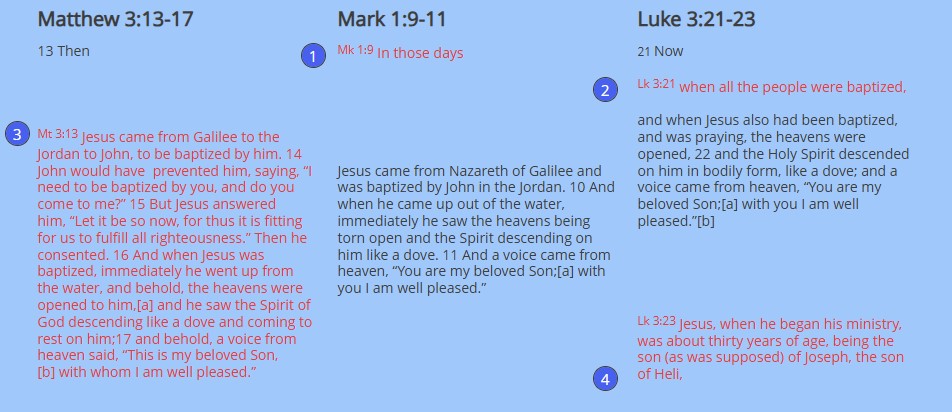
From the above worksheet photo, following the numbers and the text in red, the following narrative is produced.
Mk 1:9 In those days Lk 3:21 when all the people were baptized, Mt 3:13 Jesus came from Galilee to the Jordan to John, to be baptized by him. 14 John would have prevented him, saying, “I need to be baptized by you, and do you come to me?” 15 But Jesus answered him, “Let it be so now, for thus it is fitting for us to fulfill all righteousness.” Then he consented. 16 And when Jesus was baptized, immediately he went up from the water, and behold, the heavens were opened to him, and he saw the Spirit of God descending like a dove and coming to rest on him; 17 and behold, a voice from heaven said, “This is my beloved Son, with whom I am well pleased.”
Lk 3:23 Jesus, when he began his ministry, was about thirty years of age, being the son (as was supposed) of Joseph, the son of Heli.
Bible Lessons for this event:
H079 John Baptized Jesus (Mark 1:9; Luke 3:21; Matthew 3:13-15
H080 A Voice from Heaven (Matthew 3:16-17; Luke 3:21-22)
H081 What the Voice Said (Matthew 3:16-17; Luke 3:23)
Event Summary:
This event describes Jesus’ baptism by John the Baptist. This event marks the beginning of Jesus’ public ministry and is significant for its revelation of Jesus’ identity and divine approval.
Key points of this event are:
(1) God’s declaration affirms Jesus as his Son, marking him as the Messianic King and confirming his unique relationship with the Father.
(2) Jesus’ baptism marks the start of his public ministry, serving as a pivotal moment where he is anointed by the Spirit for his mission.
(3) Jesus’ willingness to be baptized, despite being sinless, demonstrates his humility and obedience to God’s will. It also shows his identification with sinful humanity, symbolizing his role as the one who will take on humanity’s sins.
(4) The baptism scene reveals the Father, Son, and Holy Spirit in unity, emphasizing the Trinitarian nature of God and the divine endorsement of Jesus’ mission.
In summary, this event present Jesus’ baptism as a significant event that affirms His divine identity, marks the beginning of His ministry, and reveals the Trinity, while emphasizing His obedience and identification with humanity.
Understanding and Application:
Here are questions of understanding with extended answers for Matthew 3:13–17; Mark 1:9–11; Luke 3:21–23, focusing on the baptism of Jesus:
1. Why did Jesus come to John to be baptized?
Answer:
Jesus came to John not because He needed repentance, but to fulfill God’s righteous plan. In Matthew’s account, Jesus tells John, “it is fitting for us to fulfill all righteousness.” This indicates that His baptism was an act of obedience to the Father’s will. It identified Him with humanity, even though He was sinless, and marked the beginning of His public ministry. By submitting to baptism, Jesus also affirmed John’s ministry and God’s call upon him. This moment demonstrates that righteousness is not only about avoiding sin but also about actively obeying God’s purposes.
2. Why was John initially reluctant to baptize Jesus?
Answer:
John recognized the superiority and sinlessness of Jesus. He understood that his baptism was for repentance, and therefore Jesus, who had no sin, had no need for it. John even stated that he himself needed to be baptized by Jesus. His hesitation reflects a correct understanding of Jesus’ identity and holiness. However, when Jesus insisted, John submitted, showing that obedience to God’s will must override personal understanding or hesitation.
3. What does it mean that Jesus was baptized “to fulfill all righteousness”?
Answer:
To “fulfill all righteousness” means that Jesus was completing every requirement of God’s plan in perfect obedience. His baptism was part of His role as the obedient Son who would accomplish salvation. It also symbolized His identification with sinners, foreshadowing His ultimate work on the cross. Though He was without sin, He stood in the place of sinners, beginning a ministry that would culminate in bearing their sin. This act reveals that righteousness includes submission, identification, and obedience to God’s redemptive purpose.
4. What happened immediately after Jesus was baptized?
Answer:
As Jesus came up out of the water, several significant events occurred simultaneously. The heavens were opened, the Spirit of God descended like a dove, and a voice from heaven declared God’s approval of Jesus. These events mark a divine affirmation and public revelation of Jesus’ identity. Luke also notes that Jesus was praying, emphasizing His communion with the Father at this critical moment. This scene serves as a clear inauguration of His ministry and a visible manifestation of God’s presence.
5. What is the significance of the heavens being opened?
Answer:
The opening of the heavens signifies divine revelation and access. It indicates that God is making Himself known in a new and powerful way through Jesus. This moment breaks the perceived silence between heaven and earth, showing that God is actively intervening in human history. It also symbolizes that Jesus is the mediator between God and humanity, the one through whom heaven is opened to us.
6. What does the descent of the Holy Spirit like a dove represent?
Answer:
The Holy Spirit descending like a dove signifies divine anointing and empowerment. It marks Jesus as the Messiah, the anointed one, who is empowered by the Spirit for His mission. The imagery of a dove suggests peace, purity, and gentleness. This moment fulfills prophetic expectations that the Messiah would be endowed with the Spirit. It also demonstrates that Jesus’ ministry would be carried out in the power of the Spirit, not merely human strength.
7. What is the meaning of the Father’s voice from heaven?
Answer:
The voice from heaven declares, “This is my beloved Son, with whom I am well pleased.” This statement affirms Jesus’ divine identity as the Son of God and expresses the Father’s approval. It echoes Old Testament themes, combining elements of kingship and servanthood (Psalm 2 and Isaiah 42). The declaration reveals that Jesus is both the royal Son and the suffering Servant. It assures all who witness (and later readers) that Jesus is fully endorsed by God for His mission.
8. How does this event reveal the Trinity?
Answer:
The baptism of Jesus is one of the clearest revelations of the Trinity in Scripture. All three persons of the Godhead are present and active:
- The Son is being baptized.
- The Spirit descends upon Him.
- The Father speaks from heaven.
This moment shows the distinct persons working together in unity. It provides a foundational understanding of God’s triune nature and demonstrates how the Father, Son, and Spirit are involved in the work of redemption.
9. Why is Jesus’ baptism considered the beginning of His public ministry?
Answer:
Before this event, Jesus lived in relative obscurity. After His baptism, He begins His public work—teaching, preaching, and performing miracles. The baptism serves as His formal commissioning, marked by divine approval and empowerment by the Spirit. Luke’s account also transitions directly into His genealogy and then His temptation, further emphasizing that this moment initiates His mission. It is both a spiritual and public turning point.
10. What is the significance of Luke including Jesus’ age (about thirty)?
Answer:
Luke notes that Jesus was about thirty years old when He began His ministry. This detail is significant because it aligns with the age at which priests began their service in the Old Testament. It highlights that Jesus is entering His role as the ultimate High Priest. Additionally, Luke’s genealogy connects Jesus to all humanity, reinforcing that His mission is universal. The mention of His age emphasizes that this moment is the proper and appointed time for His ministry to begin.
11. How do the three Gospel accounts complement one another?
Answer:
Each Gospel provides unique details that together give a fuller picture:
- Matthew emphasizes the dialogue between Jesus and John and the fulfillment of righteousness.
- Mark presents a concise, action-focused account highlighting the immediacy of the event.
- Luke includes the detail that Jesus was praying and adds the note about His age and genealogy.
Together, they provide a comprehensive understanding of both the theological meaning and the historical event.
12. What practical lessons can believers learn from Jesus’ baptism?
Answer:
Believers can learn several important truths:
- Obedience to God is essential, even when it may not seem necessary from a human perspective.
- God honors and affirms those who walk in His will.
- The Christian life is empowered by the Holy Spirit.
- Identity matters: just as Jesus was affirmed as God’s Son, believers are called to live in their identity in Christ.
- Prayer is central, especially at key moments of life and ministry.
This passage encourages believers to walk in humility, obedience, and dependence on God.


Leave a comment