
Photo: Trent Goeckner (Simpson Park, St. Louis, MO, USA)
Author: Stephen Weller
1,928 words, 10 minutes read time
Calling Levi, Eating with Sinners
Scripture Reference: Matthew 9:9-13; Mark 2:13-17; Luke 5:27-32
Context:
The calling of Matthew (also called Levi in Mark and Luke) takes place during a period of growing tension between Jesus and the religious leaders, particularly the Pharisees, who were deeply concerned with ritual purity and strict separation from those considered “sinners.” Tax collectors like Matthew were especially despised in first-century Jewish society because they worked for the Roman authorities and were often associated with corruption and exploitation. When Jesus passes by and simply says, “Follow Me,” Matthew immediately leaves his profession, an act of decisive repentance and surrender that highlights the transforming authority of Jesus’ call. He then hosts a large banquet in his home, inviting fellow tax collectors and others labeled as sinners, creating a setting that visibly demonstrates the inclusive reach of Jesus’ ministry. This gathering becomes a point of controversy, as the Pharisees question why Jesus would associate with such people, revealing their misunderstanding of both righteousness and mercy. Jesus responds with a profound statement of His mission, declaring that He came not to call the righteous, but sinners to repentance, and emphasizing the principle, “I desire mercy, not sacrifice,” echoing Hosea 6:6. In this moment, Jesus redefines holiness—not as separation from sinners, but as redemptive engagement with them—showing that the kingdom of God advances through grace, compassion, and the calling of those who recognize their need for healing.
Event Narrative:
The narrative for this section was obtained from three similar texts, using the highlighted material shown below. The selection was determined by Jerry Peyton and copyrighted in 2015 by Jerry Peyton and Biblical Studies Press L.L.C.
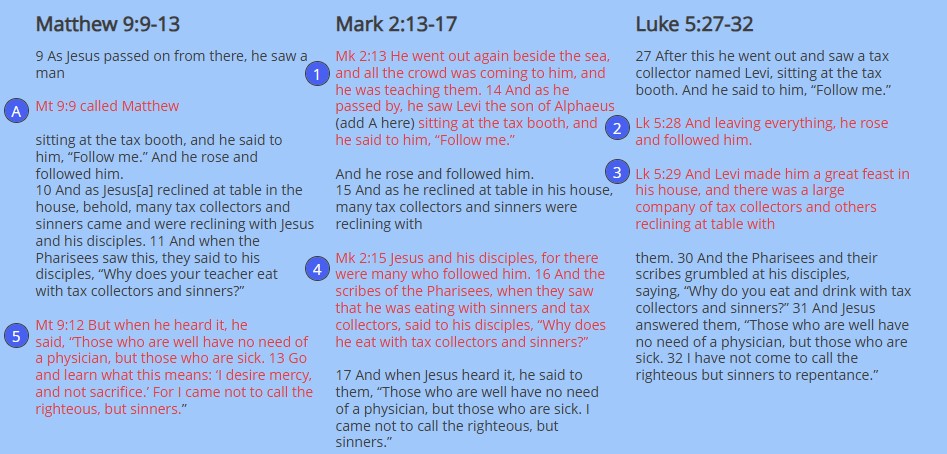
From the above worksheet photo, following the numbers and the text in red, the following narrative is produced.
Mk 2:13 [Jesus] went out again beside the sea, and all the crowd was coming to him, and he was teaching them. 14 And as he passed by, he saw Levi the son of Alphaeus sitting at the tax booth, and he said to him, “Follow me.” Lk 5:28 And leaving everything, he rose and followed him.
Lk 5:29 And Levi made him a great feast in his house, and there was a large company of tax collectors and others reclining at table with Jesus and his disciples, for there were many who followed him. Mk 2:16 And the scribes of the Pharisees, when they saw that he was eating with sinners and tax collectors, said to his disciples, “Why does he eat with tax collectors and sinners?”
Mt 9:12 But when [Jesus] heard it, he said, “Those who are well have no need of a physician, but those who are sick. 13 Go and learn what this means: ‘I desire mercy and not sacrifice.’ For I came not to call the righteous, but sinners.”
Bible Lessons for this event:
H176 Calling Levi (Matthew 9:9; Mark 2:13-14; Luke 5:28)
H177 Dinner with Levi and Sinners (Matthew 9:12-13; Mark 2:16; Luke 5:29)
Event Summary:
This event describes Jesus’ call of Levi (Matthew), a tax collector, and the subsequent meal with tax collectors and sinners, emphasizing themes of mercy, grace, and Jesus’ mission to the spiritually needy.
Key points of this event are:
(1) Jesus sees Levi (also called Matthew), a tax collector, sitting at his booth and simply says, “Follow Me.” Levi immediately leaves his job and follows Jesus, demonstrating the radical nature of Jesus’ call and the necessity of a wholehearted response. Levi’s quick decision to leave everything behind highlights that Jesus’ call to discipleship is open to all, including those considered social outcasts or sinners.
(2) Levi hosts a meal for Jesus in his house, inviting other tax collectors and sinners to dine with them. This act represents table fellowship, a symbol of acceptance and relationship, showing that Jesus is not afraid to associate with those seen as morally or socially unclean. Jesus’ presence at this meal signifies his willingness to engage with sinners where they are, affirming his mission to reach the marginalized and spiritually lost.
(3) The Pharisees criticize Jesus for eating with sinners, considering it inappropriate for a rabbi to associate with such people. Jesus responds with a profound statement of his mission: “It is not the healthy who need a doctor, but the sick. I have not come to call the righteous, but sinners to repentance.” This response highlights that Jesus’ purpose is not to reinforce religious exclusivity but to extend mercy and call sinners to transformation.
(4) In this event Jesus tells the Pharisees to learn what God means by, “I desire mercy, not sacrifice” (Hosea 6:6). This emphasizes that God values compassion and grace over mere ritual observance, affirming that mercy is central to Jesus’ mission.
The message of this event is that Jesus’ mission is to seek and save the spiritually lost by extending mercy and grace to sinners. Jesus challenges societal norms and religious boundaries, demonstrating that the kingdom of God is inclusive and available to all who recognize their need for repentance and healing. This event emphasize that true righteousness is defined not by ritual purity but by a heart for mercy and a commitment to the transformation of the spiritually needy.
Understanding and Application:
Discussion Questions with Extended Answers
1. Who was Levi (Matthew), and why is his calling significant?
Answer:
Levi, also called Matthew, was a tax collector; an occupation despised by the Jewish people. Tax collectors worked for the Roman government and were often associated with corruption, greed, and betrayal of their own people. By calling Levi, Jesus demonstrates that His invitation to follow Him extends even to those considered morally compromised or socially rejected. This calling is significant because it reveals that no one is beyond the reach of God’s grace. It also shows that Jesus does not choose His followers based on human standards of worthiness but on divine purpose and mercy.
2. What does Levi’s immediate response to Jesus reveal about true discipleship?
Answer:
Levi “left everything” and followed Jesus immediately. This response reflects the essence of true discipleship: a decisive break from the past and wholehearted commitment to Christ. There is no hesitation, negotiation, or delay. Levi’s willingness to abandon a lucrative career shows that following Jesus requires surrendering personal security, identity, and priorities. His response also demonstrates faith; he trusted Jesus enough to walk away from everything familiar. True discipleship is marked by obedience, sacrifice, and a reorientation of one’s life around Christ.
3. Why did Levi host a great feast for Jesus, and what does this teach us?
Answer:
Levi hosted a banquet in his home, inviting many fellow tax collectors and others. This act reflects gratitude, joy, and a desire to introduce others to Jesus. Rather than isolating himself from his former associates, Levi used his relationships as an opportunity for evangelism. This teaches that new believers should not withdraw from people in their lives but should seek to bring them to Christ. It also shows that celebration and fellowship are appropriate responses to encountering Jesus; salvation is not only a personal transformation but also a communal invitation.
4. Why did the Pharisees criticize Jesus for eating with tax collectors and sinners?
Answer:
The Pharisees believed that associating with sinners would lead to moral contamination and undermine religious purity. They viewed themselves as righteous and separate from those they considered unclean. Their criticism of Jesus reveals a misunderstanding of both holiness and God’s mission. They prioritized external separation over internal transformation. Their attitude reflects pride and self-righteousness, as they failed to recognize their own need for grace. Jesus’ actions challenge this mindset by demonstrating that God’s holiness is not compromised by engaging with sinners; rather, it is expressed through redeeming them.
5. What does Jesus mean when He says, “Those who are well have no need of a physician, but those who are sick”?
Answer:
Jesus uses a metaphor to explain His mission. Just as a physician seeks out the sick, Jesus came to bring healing to those who recognize their spiritual need. The “sick” represent sinners who are aware of their brokenness, while the “well” represent those who believe they are righteous and therefore see no need for repentance. Importantly, Jesus is not affirming that the Pharisees are truly “well”; rather, He is exposing their self-deception. This statement emphasizes that salvation begins with recognizing one’s need for grace.
6. What is the meaning of Jesus’ statement, “I desire mercy, and not sacrifice”?
Answer:
Jesus quotes Hosea 6:6 to confront the Pharisees’ misplaced priorities. “Sacrifice” represents outward religious rituals, while “mercy” reflects compassion, love, and a heart aligned with God. The Pharisees were diligent in performing religious duties but lacked genuine compassion for others. Jesus teaches that God values a merciful heart over mere external observance. True righteousness is not measured by ritual performance but by a transformed heart that reflects God’s character. Mercy demonstrates an understanding of God’s grace and a willingness to extend that grace to others.
7. What does Jesus mean when He says He came “not to call the righteous, but sinners to repentance”?
Answer:
Jesus clarifies the purpose of His ministry: to call sinners to repentance. This does not mean that some people are truly righteous and do not need Him; rather, it highlights the difference between those who recognize their sin and those who deny it. The “righteous” in this context are those who believe they are already acceptable before God. Jesus’ mission is directed toward those who acknowledge their need for forgiveness and are willing to turn from their sin. Repentance involves both a change of mind and a change of direction, turning away from sin and toward God.
8. How does this passage reveal the contrast between grace and self-righteousness?
Answer:
The passage presents a clear contrast between Jesus and the Pharisees. Jesus embodies grace; He seeks out sinners, welcomes them, and calls them to transformation. The Pharisees represent self-righteousness, separating themselves from others and relying on their own perceived goodness. Grace reaches out and restores; self-righteousness isolates and condemns. This contrast highlights the heart of the gospel: salvation is not earned through human effort but received through God’s mercy. Those who understand grace will extend it to others, while those who rely on self-righteousness will struggle to do so.
9. What role does repentance play in Jesus’ call to follow Him?
Answer:
Repentance is central to Jesus’ call. It is not merely feeling sorry for sin but involves a genuine turning away from it. Levi’s response illustrates repentance in action; he leaves his old life behind and follows Jesus. Repentance prepares the heart to receive grace and initiates a new direction of life. It is both an initial response to Christ and an ongoing posture for believers. Without repentance, there can be no true discipleship, as it is the means by which one aligns with God’s will.
10. How should believers today apply the example of Jesus eating with sinners?
Answer:
Believers are called to engage with the world in the same spirit as Jesus, showing compassion without compromising truth. This means building relationships with those who do not yet know Christ, not to affirm sinful behavior but to offer the hope of transformation. Christians should avoid both isolation (withdrawing from the world) and assimilation (adopting the world’s values). Instead, they are to be present, loving, and intentional in pointing others to Christ. This passage challenges believers to examine their attitudes toward others and to reflect the mercy they themselves have received.


Leave a Reply