
Photo: Maciej Wojciechowski (Santa Maddalena, Val di Funes, Dolomites, Italy)
Author: Stephen Weller
1,995 words, 11 minutes read time
Choosing the Twelve Apostles
Scripture Reference: Matthew 10:2-4; Mark 3:13-19; Luke 6:12-16
Context:
The calling and appointment of the twelve apostles in Matthew 10:2–4; Mark 3:13–19; and Luke 6:12–16 mark a decisive turning point in Jesus’ earthly ministry, as He transitions from primarily teaching and healing the multitudes to intentionally establishing a group of chosen representatives who would carry forward His mission. After a season of growing popularity—evidenced by large crowds gathering from various regions and increasing opposition from religious leaders; Jesus withdraws to a mountain, a place often associated with divine revelation and communion with God. As recorded in Luke’s account, He spends the entire night in prayer, emphasizing the weight and intentionality of this decision. From among His broader group of disciples, He selects twelve men, symbolically corresponding to the twelve tribes of Israel, signifying the formation of a renewed people of God centered on Himself. These men come from diverse backgrounds, fishermen, a tax collector, a zealot, highlighting that the kingdom of God is not built on human status or qualification but on divine calling and transformation. The lists provided in the Gospels not only identify the apostles by name but also subtly reveal their personalities and future roles, including Judas Iscariot, whose eventual betrayal is noted even at this early stage. Mark emphasizes that they were appointed “that they might be with Him” and “that He might send them out,” underscoring both relationship and mission as essential elements of discipleship. This moment establishes the foundation for apostolic authority, the spread of the gospel, and the continuation of Jesus’ work after His departure, demonstrating that God’s redemptive plan involves calling ordinary individuals into extraordinary purposes through close fellowship with Christ.
Event Narrative:
The narrative for this section was obtained from three similar texts, using the highlighted material shown below. The selection was determined by Jerry Peyton and copyrighted in 2015 by Jerry Peyton and Biblical Studies Press L.L.C.
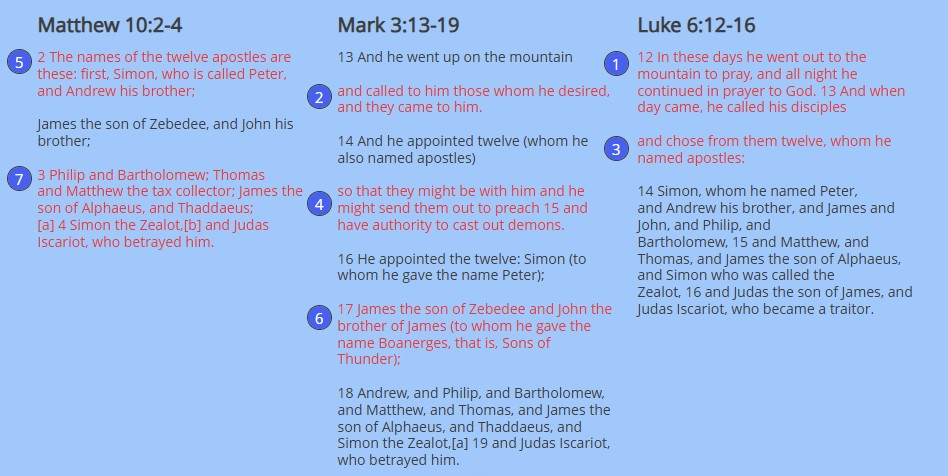
From the above worksheet photo, following the numbers and the text in red, the following narrative is produced.
Lk 6:12 In these days he went out to the mountain to pray, and all night he continued in prayer to God. 13 And when day came, he called his disciples Mk 3:13 and [he] called to him those whom he desired, and they came to him. Lk 6:13 [He] chose from them twelve, whom he named apostles, Mk 3:14 so that they might be with him, and he might send them out to preach 15 and have authority to cast out demons.
Mt 10:2 The names of the twelve apostles are these: first, Simon, who is called Peter, and Andrew his brother; Mk 3:17 James the son of Zebedee and John the brother of James (to whom he gave the name Boanerges, that is, Sons of Thunder); Mt 10:3 Philip and Bartholomew; Thomas and Matthew the tax collector; James the son of Alphaeus, and Thaddaeus; 4 Simon the Zealot, and Judas Iscariot, who betrayed him.
Bible Lessons for this event:
H188 Assignment and Prayer (Mark 3:13; Luke 6:12-13)
H189 Choosing the Twelve (Matthew 10:2-4; Mark 3:14-15, 17; Luke 6:13)
Event Summary:
This event describes Jesus’ selection of the twelve apostles, emphasizing themes of purposeful calling, preparation for ministry, and the importance of prayerful discernment in choosing his closest followers.
Key points of this event are:
(1) Jesus calls twelve specific disciples to be apostles, setting them apart for a unique role in his mission. The twelve are chosen to be with him, learn from him, and eventually be sent out to preach and carry forward his ministry. The number twelve is significant, symbolizing the twelve tribes of Israel and indicating that Jesus is forming a new spiritual community as part of God’s renewed people.
(2) In Luke’s account, Jesus spends the entire night in prayer before choosing the twelve, emphasizing the importance of seeking God’s guidance in significant decisions. This detail highlights that Jesus’ selection of his apostles is not random but is rooted in prayerful deliberation and alignment with God’s will.
(3) Jesus calls the twelve to be with him—to learn his teachings, observe his actions, and understand the heart of his ministry. They are not only followers but are being prepared for leadership and outreach. Jesus also gives them authority to perform miracles, cast out demons, and heal the sick (as indicated in later events), showing that his mission will be extended through them. Their calling signifies a transfer of his authority for the work of the kingdom.
(4) The twelve are a diverse group of men with varied backgrounds, including fishermen (Peter, Andrew, James, and John), a tax collector (Matthew), and a zealot (Simon). This diversity shows that Jesus’ call reaches people from all walks of life. The inclusion of individuals who might have held conflicting ideologies (e.g., Matthew the tax collector and Simon the zealot) illustrates that unity in Christ transcends social and political differences.
(5) These twelve apostles are chosen as the foundational leaders who will spread Jesus’ teachings and establish the early Church after his departure. Their selection underscores the importance of dedicated and prepared leaders who are entrusted to continue Jesus’ work and bring the message of the kingdom to all nations.
The message of this event is that Jesus intentionally calls and prepares a group of dedicated followers who will extend his mission, symbolizing a new beginning for God’s people. The selection process emphasizes the importance of prayerful discernment, unity amidst diversity, and preparation for leadership in God’s kingdom. The apostles’ diverse backgrounds underscore that Jesus’ call is inclusive, reaching across social and cultural boundaries to form a community united by faith and mission. This foundational group is chosen to be messengers of the kingdom, demonstrating that God’s mission involves equipping and empowering his people for service and leadership.
Understanding and Application:
Questions of Understanding with Extended Answers
1. What is the significance of Jesus naming the twelve apostles in these passages?
Answer:
The naming of the twelve apostles marks a pivotal moment in Jesus’ ministry, as He formally appoints specific individuals to represent Him. The number twelve is deeply symbolic, corresponding to the twelve tribes of Israel, indicating that Jesus is establishing a renewed people of God. This act shows intentionality; Jesus is not gathering followers randomly, but is forming a structured group with a divine mission. These men would become the foundation of the early church, carrying forward Jesus’ teaching, authority, and gospel message after His resurrection.
2. What does Luke’s account (Luke 6:12–13) reveal about how Jesus made this decision?
Answer:
Luke uniquely records that Jesus spent the entire night in prayer before choosing the twelve. This highlights the spiritual weight and divine dependence involved in the decision. Jesus, though fully divine, models complete reliance on the Father’s will. The selection of the apostles was not based on human qualifications alone but on God’s sovereign purpose. This teaches that major decisions in ministry, and in life, should be grounded in prayer and alignment with God’s will.
3. Why are the disciples called “apostles” in these passages?
Answer:
The term “apostle” means “one who is sent.” While many followed Jesus as disciples (learners), these twelve were uniquely commissioned to be sent out with authority. According to Mark’s account (Mark 3:14–15), they were appointed to be with Jesus and to be sent out to preach and have authority to cast out demons. This dual role, relationship with Christ and mission for Christ, defines apostleship. Their authority was delegated, not inherent, emphasizing that their power came from Jesus.
4. What can we learn from the diversity of the twelve apostles?
Answer:
The twelve apostles came from varied backgrounds: fishermen (Peter, Andrew, James, John), a tax collector (Matthew), and even a political zealot (Simon the Zealot). This diversity demonstrates that God calls people from all walks of life to serve His purposes. It also shows that unity in Christ transcends social, political, and economic differences. The group itself would have had natural tensions, yet Jesus formed them into a unified mission team, illustrating the transforming power of His leadership.
5. Why is Peter consistently listed first among the apostles?
Answer:
Peter is always named first in the lists, indicating his role as a leader among the apostles. While not superior in worth, he often acted as a spokesman and was part of Jesus’ inner circle. His prominence reflects both his personality and his calling. However, his later failures (such as denying Jesus) remind us that leadership in God’s kingdom is not based on perfection but on grace, restoration, and continued faithfulness.
6. What is the significance of the inclusion of Judas Iscariot in the list?
Answer:
Judas Iscariot’s inclusion is sobering because he would later betray Jesus. His presence among the twelve demonstrates that proximity to Jesus does not guarantee true faith or obedience. It also fulfills God’s sovereign plan, as the betrayal was foretold and necessary for the unfolding of redemption. This serves as a warning about the condition of the heart and the importance of genuine commitment to Christ.
7. How do the three Gospel accounts complement each other in describing the apostles?
Answer:
Each Gospel provides a slightly different emphasis:
- Matthew 10:2–4 focuses on the names and pairs them, possibly reflecting ministry partnerships.
- Mark 3:13–19 emphasizes Jesus appointing them to be with Him and sending them out with authority.
- Luke 6:12–16 highlights the prayerful preparation before their selection.
Together, they provide a fuller picture: the apostles were prayerfully chosen, personally trained, relationally connected to Jesus, and missionally sent.
8. What does Mark 3:14 teach about the priority of being “with Jesus” before being sent?
Answer:
Mark emphasizes that Jesus appointed the twelve “that they might be with Him.” This shows that relationship precedes responsibility. Before the apostles could effectively minister, they needed to learn from Jesus, observe His life, and grow in understanding. This principle remains true today: effective service for God flows out of a deep, personal relationship with Him.
9. What role did authority play in the apostles’ calling?
Answer:
Jesus gave the apostles authority to preach, heal, and cast out demons (Mark 3:15). This authority was not their own but was granted by Christ. It authenticated their message and demonstrated the arrival of God’s kingdom. Their authority also foreshadows the continuing mission of the church, which operates under Christ’s authority to proclaim the gospel.
10. How do these passages contribute to our understanding of God’s sovereign plan?
Answer:
These passages reveal that God’s plan is intentional and unfolds through chosen individuals. The selection of the twelve was not случай or reactive; it was part of a divine strategy to establish the gospel message and the church. Even elements that seem negative, such as Judas’ betrayal, are woven into God’s redemptive plan. This assures believers that God is sovereign over both people and events.
11. What practical lessons can believers draw from the calling of the twelve apostles?
Answer:
Several key lessons emerge:
- God calls ordinary people for extraordinary purposes.
- Prayer is essential in discerning God’s will.
- Relationship with Christ must come before ministry.
- Unity in diversity is possible through Christ.
- Faithfulness matters more than background or status.
These truths encourage believers that God can use anyone who is willing to follow Him.
12. How does the calling of the apostles relate to the mission of the church today?
Answer:
The apostles were the foundation of the church’s mission, and their calling sets a pattern for all believers. While not all are apostles in the same sense, every Christian is called to follow Christ, grow in relationship with Him, and participate in His mission. The church continues the work begun by the apostles; proclaiming the gospel, making disciples, and living under Christ’s authority.


Leave a Reply