
Photo: Luis (The feast of color at Sierra de Albarracin, Spain)
Author: Stephen Weller
1,976 words, 10 minutes read time
Salt and Light
Scripture Reference: Matthew 5:13-16; Mark 4:21-22, 9:50; Luke 8:16-17, 14:34-35
Context:
These passages come from key moments in Jesus’ teaching ministry, especially within the broader context of the Sermon on the Mount (Matthew 5) and parallel teachings recorded in Mark and Luke, where Jesus uses vivid, everyday images, salt and light, to describe the identity and responsibility of His disciples. In Matthew 5:13–16, immediately following the Beatitudes, Jesus shifts from describing the character of kingdom citizens to their function in the world: they are to be “the salt of the earth” and “the light of the world.” Salt in the ancient world was essential for preservation, purification, and flavor, symbolizing the disciples’ role in restraining moral decay and bringing the distinctiveness of God’s truth into a fallen world. Light, represented by a lamp on a stand or a city set on a hill, emphasizes visibility and influence; disciples are not meant to conceal their faith but to live in such a way that their good works point others to glorify God. In Mark 4:21–22 and Luke 8:16–17, these same images are tied to the revelation of truth: what God reveals is not meant to remain hidden but to be made known, underscoring the responsibility to receive and faithfully proclaim the message of the kingdom. Mark 9:50 and Luke 14:34–35 add a warning dimension, salt that loses its saltiness becomes useless, highlighting the danger of compromised discipleship and the loss of spiritual distinctiveness. Altogether, these passages are unified by the theme that those who belong to Christ are both recipients and carriers of divine truth; their lives are to visibly reflect God’s transforming work, preserving righteousness, illuminating truth, and bearing witness in a world that desperately needs both.
Event Narrative:
The narrative for this section was obtained from three similar texts, using the highlighted material shown below. The selection was determined by Jerry Peyton and copyrighted in 2015 by Jerry Peyton and Biblical Studies Press L.L.C.
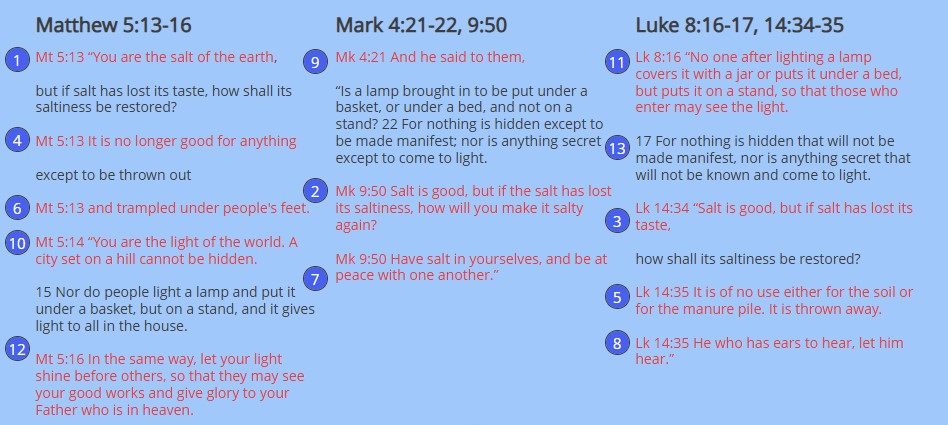
From the above worksheet photo, following the numbers and the text in red, the following narrative is produced.
Mt 5:13 “You are the salt of the earth. Mk 9:50 Salt is good, but if the salt has lost its saltiness, how will you make it salty again? Lk 14:34 Salt is good, but if salt has lost its taste, Mt 5:13 it is no longer good for anything. Lk 14:35 It is of no use either for the soil or for the manure pile. It is thrown away Mt 5:13 and trampled under people’s feet. Mk 9:50 Have salt in yourselves and be at peace with one another. Lk 14:35 He who has ears to hear, let him hear.”
Mk 4:21 And he [also] said to them, Mt 5:14 “You are the light of the world. A city set on a hill cannot be hidden. Lk 8:16 No one after lighting a lamp covers it with a jar or puts it under a bed, but puts it on a stand, so that those who enter may see the light. Mt 5:16 In the same way, let your light shine before others, so that they may see your good works and give glory to your Father who is in heaven.”
Bible Lessons for this event:
H203 Salt of the Earth (Matthew 5:13; Mark 9:50; Luke 14:34-35)
H204 Light of the World (Matthew 5:14, 16; Mark 4:21; Luke 8:16)
Event Summary:
This event emphasizes Jesus’ call for his followers to be “salt and light” in the world, underscoring themes of influence, visibility, integrity, and purpose in living out the values of God’s kingdom. They highlight the responsibility of disciples to reflect God’s truth, preserve goodness, and make a positive impact on the world.
Key points of this event are:
(1) Jesus calls his followers the “salt of the earth” (Matthew, Mark, Luke), indicating their role in preserving, purifying, and enhancing the world. Salt was used in the ancient world to preserve food and add flavor, symbolizing the positive and purifying influence believers should have in society. Jesus warns that if salt loses its flavor, it becomes useless and is thrown out. This emphasizes the importance of remaining true to one’s faith and purpose. Disciples are meant to maintain their distinctive character and values; otherwise, their impact and witness are diminished.
(2) Jesus describes his followers as the “light of the world” (Matthew), a light that should not be hidden but set on a stand to illuminate the surroundings. This metaphor conveys the role of disciples in revealing God’s truth and guiding others through their actions and words. Jesus’ mention of light in Mark and Luke further supports this idea, as he says that a lamp is not meant to be hidden but placed where it can be seen. His followers are to live transparently and visibly, sharing God’s love, truth, and wisdom with others.
(3) The call to be salt and light is a call to authentic, purposeful living that reflects God’s character. Followers of Jesus are encouraged to embody integrity, kindness, and moral courage, impacting the world around them in positive ways. In Mark 9:50 and Luke 14:34-35, Jesus warns that if salt loses its saltiness, it has no value, suggesting that believers must remain steadfast in their faith and character, as a compromised witness loses effectiveness.
(4) In Matthew, Jesus concludes by saying that others should see the “good works” of his followers and glorify God as a result. This highlights that the purpose of being salt, and light is ultimately to draw others to God. Good works and a faithful witness make the kingdom of God tangible to those around, leading others to experience and honor God.
The central message of this event is that Jesus’ followers are called to be a positive, visible, and transformative presence in the world. By being “salt and light,” believers are to preserve goodness, reveal God’s truth, and act as moral guides for others, pointing to the reality of God’s kingdom. These metaphors encourage disciples to live with integrity, compassion, and purpose, allowing their actions to inspire others to seek and glorify God. Jesus challenges his followers to embrace their role as influencers for the kingdom, knowing that their faithful witness can have a lasting impact on the world.
Understanding and Application:
Questions of Understanding with Extended Answers
1. What does Jesus mean when He calls His disciples “the salt of the earth”?
Answer:
When Jesus calls His followers “the salt of the earth” (Matthew 5:13), He is describing their preserving, purifying, and influencing role in the world. In the ancient world, salt was essential for preserving food and preventing decay. Spiritually, believers are meant to slow the moral and spiritual decay of the world by living in righteousness and truth. Salt also adds flavor, symbolizing how a faithful life brings the knowledge of God into a world that is otherwise spiritually dull.
However, Jesus warns that if salt loses its taste, it becomes useless. This points to the danger of compromised faith. A believer who adopts the values of the world instead of reflecting God’s truth loses effectiveness. The call is not merely to exist among people but to actively influence them by a life shaped by God’s holiness.
2. What does it mean to be “the light of the world”?
Answer:
In Matthew 5:14–16, Jesus declares that His followers are “the light of the world.” Light reveals what is hidden, guides those in darkness, and provides clarity. Spiritually, believers reflect the light of Christ by demonstrating truth, righteousness, and the character of God.
Jesus emphasizes that a lamp is not meant to be hidden but placed on a stand so it can give light to all. This teaches that faith is not private or concealed; it is meant to be visible through good works and godly living. The purpose of shining is not self-glory, but that others “may see your good works and give glory to your Father who is in heaven.” Thus, the believer’s life becomes a testimony that points others to God.
3. How do the teachings about light in Mark 4:21–22 and Luke 8:16–17 expand on this idea?
Answer:
In both Mark 4:21–22 and Luke 8:16–17, Jesus reinforces the principle that light is meant to be revealed, not hidden. He uses the imagery of a lamp placed on a stand rather than under a basket or bed. This builds on the teaching in Matthew by stressing accountability and revelation.
Jesus also adds that “nothing is hidden except to be made manifest.” This introduces a deeper spiritual truth: God’s truth will ultimately be revealed, and so will the condition of every heart. The light of God exposes both truth and error. For believers, this is both a comfort and a warning; comfort because truth will prevail, and a warning because hidden sin or unfaithfulness will not remain concealed.
4. What is the connection between salt and peace in Mark 9:50?
Answer:
In Mark 9:50, Jesus says, “Have salt in yourselves, and be at peace with one another.” Here, salt symbolizes inner spiritual integrity, purity, wisdom, and devotion to God. To “have salt” within oneself means to possess a heart shaped by God’s truth and grace.
This inner condition leads to outward harmony. When believers are grounded in God’s character, they are able to live in peace with others. Thus, salt is not only about influence in the world but also about maintaining unity within the community of believers. A lack of “salt” results in conflict, compromise, and spiritual instability.
5. What warning does Jesus give about salt losing its effectiveness in Luke 14:34–35?
Answer:
In Luke 14:34–35, Jesus again speaks of salt losing its taste, but here the emphasis is on discipleship. Salt that has lost its effectiveness is described as “fit neither for the soil nor for the manure pile;” it is completely useless.
This illustrates the seriousness of half-hearted commitment. A disciple who does not fully follow Christ, who compromises or withdraws from faithful obedience, fails to fulfill their purpose. Jesus concludes with the call, “He who has ears to hear, let him hear,” urging careful reflection and genuine response. True discipleship requires perseverance, devotion, and a life that consistently reflects Christ.
6. How do these passages together define the believer’s role in the world?
Answer:
Taken together, these passages present a unified picture of the believer’s calling: to be both salt and light. As salt, believers preserve truth, resist corruption, and promote spiritual health. As light, they reveal God’s truth, expose darkness, and guide others toward Him.
This role is both inward and outward. Inwardly, believers must maintain spiritual integrity (“have salt in yourselves”). Outwardly, they must live visibly and faithfully (“let your light shine”). The teachings also stress accountability—nothing remains hidden, and every life will ultimately reveal its true nature.
The believer’s life, therefore, is not passive. It is an active witness, shaped by God and displayed before others, with the ultimate goal that God would be glorified.
7. What is the ultimate purpose of living as salt and light?
Answer:
The ultimate purpose is the glory of God. In Matthew 5:16, Jesus clearly states that the goal of good works and visible faith is that others “give glory to your Father who is in heaven.” The believer’s life is not about self-promotion but about reflecting God’s character so that others are drawn to Him.
Additionally, these passages point to the unfolding of God’s truth—what is hidden will be revealed. As believers live faithfully, they participate in God’s redemptive work by pointing others to the light of Christ. Their lives become instruments through which God’s truth is made known in a dark world.


Leave a comment