
Photo: Ryan Lamont Photography (Olympia, WA)
Author: Stephen Weller
1,723 words, 9 minutes read time
Fulfilling the Law & Prophets
Scripture Reference: Matthew 5:17-20; Luke 16:17
Context:
Matthew 5:17–20 and Luke 16:17 both arise from The Gospel of Matthew and The Gospel of Luke within the broader setting of Jesus’ teaching ministry, where He clarifies His relationship to the Law and the Prophets. In Matthew’s account, these verses occur early in the Sermon on the Mount, immediately after Jesus describes the character and influence of His disciples (Matthew 5:1–16). Here, Jesus addresses a critical concern among His listeners, many of whom were shaped by the teachings of the scribes and Pharisees, by declaring that He has not come to abolish the Law but to fulfill it. This fulfillment points to both his perfect obedience to God’s commands and His role in bringing the Law’s ultimate purpose to completion, revealing its deeper, heart-centered intent. His statement that not even the smallest letter or stroke will pass away underscores the enduring authority of God’s Word, while His call for a righteousness that surpasses that of the religious leaders confronts superficial, external obedience and points toward inward transformation. In Luke 16:17, spoken in a different context but reinforcing the same truth, Jesus emphasizes the unchanging nature of the Law by stating that it is easier for heaven and earth to pass away than for one stroke of the Law to fail. This comes amid His teaching on faithfulness, stewardship, and the exposure of the Pharisees’ hypocrisy, particularly their tendency to justify themselves before others while disregarding God’s standards. Together, these passages highlight that Jesus does not diminish the Law but upholds its full authority, revealing its true meaning and calling His followers to a deeper righteousness rooted in the heart—one that is ultimately made possible through Him.
Event Narrative:
Event Narrative:
The narrative for this section was obtained from two similar texts, using the highlighted material shown below. The selection was determined by Jerry Peyton and copyrighted in 2015 by Jerry Peyton and Biblical Studies Press L.L.C.
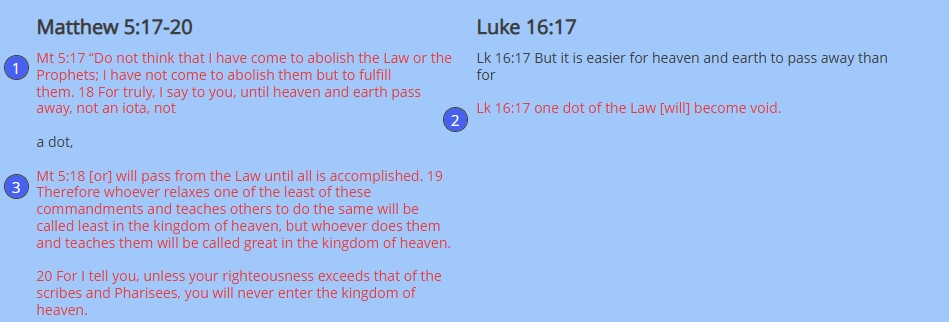
From the above worksheet photo, following the numbers and the text in red, the following narrative is produced.
Mt 5:17 “Do not think that I have come to abolish the Law or the Prophets; I have not come to abolish them but to fulfill them. 18 For truly, I say to you, until heaven and earth pass away, not an iota, not Lk 16:17 one dot of the Law [will] become void Mt 5:18 [or] will pass from the Law until all is accomplished. 19 Therefore, whoever relaxes (or breaks, NET) one of the least of these commandments and teaches others to do the same will be called least in the kingdom of heaven, but whoever does them and teaches them will be called great in the kingdom of heaven. Mt 5:20 For I tell you, unless your righteousness exceeds that of the scribes and Pharisees, you will never enter the kingdom of heaven.
Bible Lessons for this event:
H205 Jesus Came to Fulfill the Law (Matthew 5:17-18; Luke 16:17)
H206 Our Relationship to the Commandments (Matthew 5:19-20)
Event Summary:
This event focuses on Jesus’ relationship to the Law and the Prophets and emphasize his role in fulfilling God’s law rather than abolishing it. They highlight themes of faithfulness to God’s commandments, the enduring validity of the law, and the call to a higher righteousness.
Key points of this event are:
(1) Jesus clarifies that he has not come to abolish the Law or the Prophets but to fulfill them (Matthew 5:17). This means that his life and teachings complete and bring out the full meaning of God’s commandments and promises. He embodies the law’s ultimate purpose, revealing God’s heart and intention behind the commandments. In fulfilling the law, Jesus shows that God’s standards are timeless and point toward holiness, justice, and love.
(2) Jesus emphasizes that not even the smallest letter or stroke of the law will disappear until all is fulfilled (Matthew 5:18). Similarly, Luke 16:17 reinforces that God’s law is unchanging, saying it is easier for heaven and earth to disappear than for a part of the law to pass away. This underscores that God’s principles remain relevant and valid, even as Jesus brings a fuller understanding of them. He affirms the law’s importance and insists on the need to honor its true spirit.
(3) Jesus challenges his followers to pursue a righteousness greater than that of the scribes and Pharisees (Matthew 5:20). This higher righteousness goes beyond mere external compliance with rules and seeks to fulfill the spirit and purpose of God’s commands. True righteousness, according to Jesus, is about heart transformation and genuine commitment to God. It is not enough to simply follow the letter of the law; believers are called to embrace the law’s intent, living out love, mercy, and integrity in all their actions.
(4) Jesus’ teaching invites his followers to live with integrity and to uphold God’s values in their thoughts, words, and actions. This commitment to holistic obedience reflects a deep love for God and others, fulfilling the law’s purpose of building a just and compassionate community.
The message of this event is that Jesus fulfills and upholds God’s law, inviting his followers to a deeper, more genuine righteousness that transcends outward compliance. The law remains an enduring reflection of God’s will, and Jesus calls his disciples to honor it not just in action but in spirit. He challenges believers to pursue a higher standard of righteousness marked by love, sincerity, and obedience, affirming that true faithfulness involves understanding and living out the heart of God’s commands.
Understanding and Application:
Questions of Understanding with Extended Answers
1. What does Jesus mean when He says He did not come to abolish the Law or the Prophets (Matthew 5:17)?
Answer:
Jesus is clarifying that His mission is not to discard the Old Testament Scriptures, but to bring them to their intended completion. The “Law and the Prophets” represents the entire Hebrew Scriptures. To “fulfill” means that Jesus completes what the Law pointed toward—He perfectly obeys it, reveals its true meaning, and accomplishes its ultimate purpose through His life, death, and resurrection. Rather than replacing the Law, He brings it to its fullest expression. The Law anticipated righteousness; Jesus embodies it.
2. In what ways does Jesus fulfill the Law?
Answer:
Jesus fulfills the Law in multiple ways:
- Perfect obedience: He lived without sin, keeping the Law completely (Hebrews 4:15).
- Prophetic fulfillment: He fulfills Old Testament prophecies about the Messiah.
- Typological fulfillment: Sacrifices, priesthood, and ceremonies pointed forward to Him.
- Righteous requirement: He satisfies the Law’s demands on behalf of believers (Romans 8:3–4).
Thus, fulfillment is not merely teaching but accomplishing everything the Law anticipated.
3. What is meant by “not an iota, not a dot, will pass from the Law” (Matthew 5:18)?
Answer:
Jesus emphasizes the absolute authority and permanence of Scripture. The “iota” (smallest Greek letter) and “dot” (tiny stroke in Hebrew writing) represent the smallest details of the Law. This means that every part of God’s Word is significant and will remain valid until God’s purposes are fully accomplished. It highlights the precision, reliability, and enduring nature of Scripture; nothing is accidental or temporary.
4. How does Luke 16:17 reinforce this same truth?
Answer:
In Luke 16:17, Jesus states that it is easier for heaven and earth to pass away than for even the smallest part of the Law to fail. This reinforces the same message as Matthew 5:18: God’s Word is unbreakable and permanent. The created universe itself is more likely to disappear than for God’s Law to lose its authority. This underscores the unchanging nature of divine truth.
5. What warning does Jesus give about relaxing even the least commandment (Matthew 5:19)?
Answer:
Jesus warns that anyone who disregards even the smallest command and teaches others to do the same will be called least in the kingdom of heaven. This shows that all of God’s commands matter; there are no insignificant parts. Teaching others incorrectly about God’s Word carries serious responsibility. Conversely, those who practice and teach God’s commands faithfully are honored in the kingdom.
6. What does Jesus mean by righteousness exceeding that of the scribes and Pharisees (Matthew 5:20)?
Answer:
The scribes and Pharisees were known for strict outward adherence to the Law. However, their righteousness was often external; focused on rules rather than the heart. Jesus teaches that true righteousness must go deeper:
- It is internal, involving the heart and motives.
- It is genuine, not performative.
- It is God-centered, not self-righteous.
This higher righteousness ultimately comes through a transformed heart, which Jesus later reveals is made possible through Him.
7. How do these passages challenge a purely external view of obedience?
Answer:
These passages reveal that obedience is not just about outward conformity but inward transformation. The Pharisees followed the letter of the Law but often missed its spirit. Jesus calls His followers to align their hearts with God’s intent, loving God and others genuinely. True obedience flows from a changed heart, not mere rule-keeping.
8. What is the relationship between the Old Testament Law and believers today?
Answer:
Believers are not under the Law as a system of earning righteousness, but the Law still reveals God’s character and moral will. Through Christ:
- The ceremonial and sacrificial aspects are fulfilled.
- The moral truths remain instructive.
- The Law points believers to Christ and guides holy living.
Thus, the Law is not discarded but understood through the lens of Christ’s fulfillment.
9. Why is it important that Scripture is presented as unchanging and enduring?
Answer:
If God’s Word were changeable, truth would be uncertain. Jesus teaches that Scripture is fixed and reliable, providing a firm foundation for faith and life. This assures believers that God’s promises, commands, and redemptive plan are trustworthy and will not fail.
10. How do these teachings prepare for the rest of the Sermon on the Mount?
Answer:
These verses serve as a foundation for everything that follows in Matthew 5–7. Jesus will go on to deepen the understanding of the Law (e.g., anger as murder of the heart, lust as adultery of the heart). By establishing that He fulfills the Law and reveals its true intent, He prepares His listeners to understand that God desires inward righteousness, not merely outward compliance.


Leave a comment