
Photo: Daniel Hofman
Author: Stephen Weller
2,263 words, 12 minutes read time
Real Disciples: The Fruit of Their Lives
Scripture Reference: Matthew 7:13-23; Luke 6:43-46
Context:
These passages from Matthew and Luke occur within the broader teachings of Jesus often identified as the Sermon on the Mount (Matthew 5–7) and the Sermon on the Plain (Luke 6). In both contexts, Jesus is concluding a sustained section of ethical and spiritual instruction that defines what true righteousness looks like in the kingdom of God. Leading up to these verses, Jesus has addressed issues such as judgment, hypocrisy, prayer, and obedience, progressively moving His listeners from outward religious behavior to inward transformation. As He approaches the conclusion, His tone becomes more urgent and discerning, calling His hearers to make a decisive response.
In Matthew 7:13–23, Jesus presents a series of contrasts that emphasize the necessity of genuine commitment. The imagery of the narrow gate versus the wide gate illustrates that the path to life is restrictive and requires intentional choice, while the path to destruction is broad and easily followed by the majority. This is followed by a warning about false prophets, who may appear outwardly righteous but are inwardly corrupt, recognized not by their claims, but by their “fruit,” meaning the visible evidence of their lives and teachings. Jesus then intensifies the warning by declaring that not everyone who verbally acknowledges Him (“Lord, Lord”) will enter the kingdom, but only those who do the will of the Father. Even impressive religious works, prophecy, exorcism, miracles, are insufficient if they are not accompanied by true obedience and relationship with Him.
Luke 6:43–46 parallels and reinforces these themes with a focus on inner character producing outward behavior. Jesus uses the metaphor of trees and fruit to teach that a person’s nature determines their actions; good hearts yield good deeds, while corrupt hearts produce evil. This reinforces the idea that righteousness is not superficial but rooted in transformation from within. The passage culminates in a penetrating question: “Why do you call me ‘Lord, Lord,’ and do not do what I say?” This exposes the inconsistency between profession and practice and highlights obedience as the true mark of discipleship.
Together, these passages function as a climactic call to authentic faith. Jesus is not merely offering moral instruction but demanding a response that involves discernment, self-examination, and submission to His authority. The emphasis is clear: true discipleship is evidenced not by outward appearance or verbal confession alone, but by a life that consistently reflects the character and will of God.
Event Narrative:
The narrative for this section was obtained from two similar texts, using the highlighted material shown below. The selection was determined by Jerry Peyton and copyrighted in 2015 by Jerry Peyton and Biblical Studies Press L.L.C.
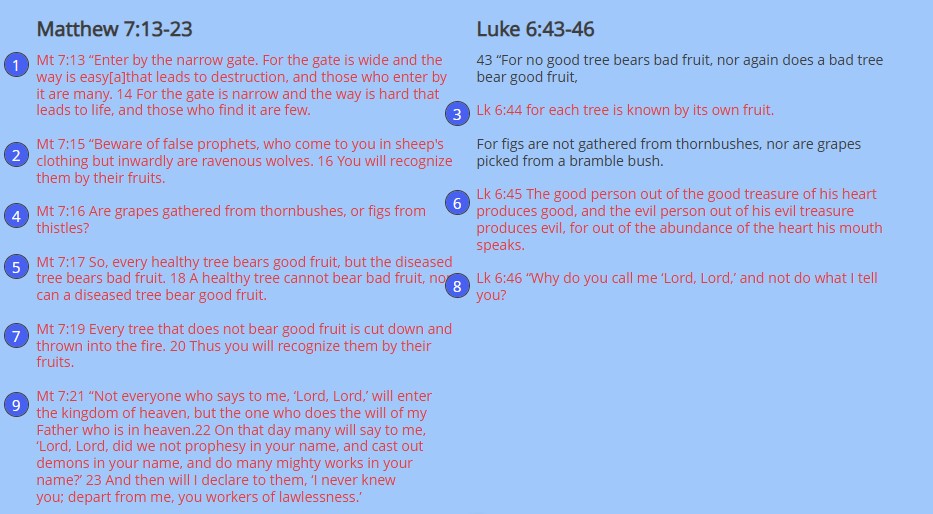
From the above worksheet photo, following the numbers and the text in red, the following narrative is produced.
Mt 7:13 “Enter by the narrow gate. For the gate is wide and the way is easy that leads to destruction, and those who enter by it are many. 14 For the gate is narrow and the way is hard that leads to life, and those who find it are few.
Mt 7:15 “Beware of false prophets, who come to you in sheep’s clothing but inwardly are ravenous wolves. 16 You will recognize them by their fruits, Lk 6:44 for each tree is known by its own fruit. Mt 7:16 Are grapes gathered from thorn bushes, or figs from thistles?
Mt 7:17 So, every healthy tree bears good fruit, but the diseased tree bears bad fruit. 18 A healthy tree cannot bear bad fruit, nor can a diseased tree bear good fruit. Lk 6:45 The good person out of the good treasure of his heart produces good, and the evil person out of his evil treasure produces evil, for out of the abundance of the heart his mouth speaks.
Mt 7:19 Every tree that does not bear good fruit is cut down and thrown into the fire. 20 Thus you will recognize them by their fruits.
Lk 6:46 “Why do you call me ‘Lord, Lord,’ and not do what I tell you? Mt 7:21 “Not everyone who says to me, ‘Lord, Lord,’ will enter the kingdom of heaven, but the one who does the will of my Father who is in heaven. 22 On that day many will say to me, ‘Lord, Lord, did we not prophesy in your name, and cast out demons in your name, and do many mighty works in your name?’
Mt 7:23 And then will I declare to them, ‘I never knew you; depart from me, you workers of lawlessness.’
Bible Lessons for this event:
H227 The Two Gates (Matthew 7:13-14)
H228 False Prophets (Matthew 7:15-16; Luke 6:44)
H229 Good Fruit (Matthew 7:17-20; Luke 6:45)
H230 Do You Belong to Jesus (Matthew 7:21-23; Luke 6:46)
Event Summary:
In this event, Jesus teaches about the narrow path of true discipleship, the importance of bearing good fruit, and the necessity of genuine faith. These teachings emphasize living a life aligned with God’s will and warning against superficial or hypocritical faith.
Key points of this event are:
(1) Jesus describes two paths: the narrow path that leads to life and the wide path that leads to destruction. He urges his followers to choose the narrow path, which represents a life of faithful obedience, self-discipline, and commitment to God’s values. This teaching emphasizes that following Jesus is often challenging and requires dedication and integrity. The narrow path calls for a commitment to God’s kingdom over worldly desires, leading to eternal life. (Matthew 7:13-14)
(2) Jesus uses the metaphor of trees and their fruit to illustrate the difference between true and false followers. A good tree produces good fruit, while a bad tree produces bad fruit, representing how genuine faith results in righteous actions. This teaching warns against false prophets and superficial believers, emphasizing that true discipleship is reflected in one’s actions and character. Jesus calls his followers to examine the “fruit” of their lives, as a true relationship with God will naturally produce compassion, kindness, and integrity. (Matthew 7:15-20; Luke 6:44-45)
(3) Jesus warns that not everyone who calls him “Lord” will enter the kingdom of heaven but only those who do the will of the Father. He highlights that mere words or external displays of religiosity are not enough; a genuine relationship with God is marked by obedience to his will. In Luke, Jesus asks, “Why do you call me, ‘Lord, Lord,’ and do not do what I say?” This question challenges believers to examine whether their faith is authentic and lived out in their daily actions, rather than being based only on outward appearances or empty words. (Matthew 7:21-23; Luke 6:46)
(4) The overarching message is a call to authentic faith that aligns with God’s will. Jesus emphasizes that it’s not enough to profess faith verbally; true discipleship is demonstrated through obedience, integrity, and consistent actions that reflect God’s love and righteousness
The message of this event is that genuine discipleship requires more than words, it requires action, commitment, and a heart aligned with God’s will. Jesus calls his followers to walk the narrow path of obedience and to bear good fruit, as these are signs of a true relationship with God. This teaching warns against superficial faith and encourages believers to live out their faith in tangible ways, producing actions that reflect God’s love and truth. By following the narrow path and living with integrity, believers demonstrate a faith that goes beyond appearances and remains steadfast in the pursuit of God’s kingdom.
Understanding and Application:
Understanding Questions with Extended Answers
1. What does Jesus mean by the “narrow gate” and the “wide gate”?
Answer:
Jesus contrasts two paths representing two ways of life and two eternal destinations. The wide gate and broad road symbolize the easy, popular path, living according to human desires, cultural norms, and self-centered priorities. This path requires little sacrifice or repentance, which is why “many” enter it. However, it ultimately leads to destruction, spiritual separation from God.
The narrow gate and difficult path represent the way of true discipleship. It requires repentance, faith, surrender, and obedience to God’s will. It is “narrow” because it excludes self-righteousness, pride, and reliance on anything other than Christ. It is “difficult” because it involves denying self, enduring opposition, and living in holiness. Yet, it leads to life—eternal fellowship with God.
This teaching emphasizes that salvation is not found in what is easy or popular, but in faithfully following Christ.
2. Why does Jesus warn about false prophets, and how can they be recognized?
Answer:
Jesus warns that false prophets come “in sheep’s clothing,” meaning they appear outwardly harmless, religious, and even trustworthy. However, inwardly they are “ravenous wolves,” seeking to deceive and lead people away from truth.
He gives a clear test: “You will recognize them by their fruits.” This refers to the visible results of their lives and teachings. Good fruit includes sound doctrine, godly character, humility, and righteousness. Bad fruit includes false teaching, moral corruption, pride, and leading others away from obedience to God.
The analogy of trees and fruit teaches that what a person truly is on the inside will eventually be revealed on the outside. Just as a good tree cannot produce bad fruit, a true servant of God will consistently reflect God’s character over time.
This calls believers to discernment; not judging superficially but evaluating teaching and character according to Scripture.
3. What does the illustration of the tree and its fruit teach about a person’s heart?
Answer:
In both passages, Jesus teaches that a person’s words and actions are the natural overflow of their heart. A good tree produces good fruit because its nature is good; a bad tree produces bad fruit because its nature is corrupt.
In Luke 6:45, Jesus explains this directly: “Out of the abundance of the heart his mouth speaks.” This means that behavior is not merely external; it reveals the internal condition of the heart. Righteous actions come from a heart transformed by God, while sinful actions flow from an unrepentant heart.
This teaching shifts the focus from outward appearances to inward reality. True righteousness is not about external conformity but about inner transformation. It also highlights the necessity of spiritual rebirth; only God can change the heart so that good fruit is consistently produced.
4. Why does Jesus say that not everyone who calls Him “Lord” will enter the kingdom of heaven?
Answer:
Jesus makes a sobering distinction between verbal profession and genuine obedience. Simply calling Jesus “Lord” is not enough; true discipleship requires doing “the will of My Father.”
Many people may outwardly identify with Christ, participate in religious activities, or even perform impressive works. However, if their lives are not marked by obedience and submission to God, their profession is empty.
This reveals that salvation is not based on words alone but on a real relationship with Christ that results in obedience. True faith produces action, aligning one’s life with God’s will.
Jesus is exposing the danger of self-deception: it is possible to think one belongs to Him while lacking genuine surrender and transformation.
5. What is the significance of those who prophesy, cast out demons, and perform miracles in Jesus’ name?
Answer:
Jesus describes individuals who appear highly spiritual; they prophesy, cast out demons, and perform miracles in His name. These are extraordinary works that would seem to confirm genuine faith.
Yet, Jesus declares to them, “I never knew you; depart from Me, you workers of lawlessness.” This shows that even powerful religious activity is not proof of a true relationship with Him.
The key issue is not what they did, but whether they were truly known by Christ. Their lives were characterized by “lawlessness,” meaning they did not live in obedience to God despite their outward works.
This teaches that spiritual gifts, ministry success, or visible power are not substitutes for a genuine, obedient relationship with Christ. The foundation of salvation is not what we do for God, but whether we truly belong to Him.
6. How does Luke 6:46 summarize the core message of these passages?
Answer:
Luke 6:46 captures the heart of Jesus’ teaching: “Why do you call Me ‘Lord, Lord,’ and not do what I tell you?”
This question exposes the inconsistency between confession and conduct. Calling Jesus “Lord” implies authority, submission, and obedience. If a person truly recognizes Him as Lord, their life should reflect that reality.
Jesus is emphasizing that true discipleship is not merely intellectual agreement or emotional expression; it is demonstrated through obedience. A life that ignores His commands reveals that He is not truly recognized as Lord, regardless of what is said.
This verse serves as a direct challenge: it calls each person to examine whether their life aligns with their profession of faith.
7. What overall warning and invitation do these passages give to believers?
Answer:
These passages contain both a warning and an invitation.
The warning is against:
- Following the easy, popular path that leads to destruction
- Being deceived by false teachers
- Relying on outward religion instead of inward transformation
- Mistaking activity or profession for genuine faith
The invitation is to:
- Enter the narrow gate by trusting and following Christ
- Cultivate a transformed heart that produces good fruit
- Live in obedience to God’s will
- Pursue a real, personal relationship with Jesus
Ultimately, Jesus is calling people to examine their lives honestly. True discipleship is marked by faith that produces obedience, a heart changed by God, and a life that reflects His truth.


Leave a Reply