
Photo: Adventure With Whimsy (Beautiful Wintertime on Lake Erie)
Previous Lesson
Next Lesson
Author: Stephen Weller
2,219 words, 12 minutes read time
Yeast of the Leaders – NE Coast, Sea of Galilee
Scripture Reference: Matthew 16:5-12; Mark 8:13-21
Context:
After confronting the Pharisees and Sadducees who demanded a sign from heaven, Jesus departed and crossed to the other side of the sea with His disciples. In both Matthew 16:5–12 and Mark 8:13–21, the disciples realized they had forgotten to bring enough bread, and they were concerned because they had only one loaf with them. Jesus used this ordinary situation to teach a much deeper spiritual lesson, warning them to “beware of the leaven of the Pharisees and Sadducees” (Matthew) and also “the leaven of Herod” (Mark). The disciples misunderstood Him, thinking He was speaking about literal bread, revealing that they were still struggling to grasp His spiritual teaching. Jesus rebuked them for their lack of understanding and reminded them of the two miraculous feedings, the five thousand and the four thousand, where He had multiplied a few loaves to feed multitudes, leaving baskets of leftovers. His point was not about physical provision, since He had already demonstrated complete power over material needs, but about spiritual corruption. Just as a small amount of leaven spreads through an entire batch of dough, the false teaching, hypocrisy, unbelief, and worldly influence of the religious leaders and Herod could spread and corrupt faith if left unchecked. The Pharisees represented legalism and hypocrisy, the Sadducees unbelief and denial of truth, and Herod worldly compromise and political corruption. Jesus was calling His disciples to spiritual discernment, urging them not to be shaped by these influences. This moment also exposed the disciples’ spiritual dullness; they had seen miracles with their own eyes, yet still struggled with fear and misunderstanding. Christ patiently corrected them, leading them from earthly thinking to spiritual understanding, and Matthew records that they finally understood He was speaking about doctrine, not bread.
Event Narrative:
The narrative for this section was obtained from two similar texts, using the highlighted material shown below. The selection was determined by Jerry Peyton and copyrighted in 2015 by Jerry Peyton and Biblical Studies Press L.L.C.
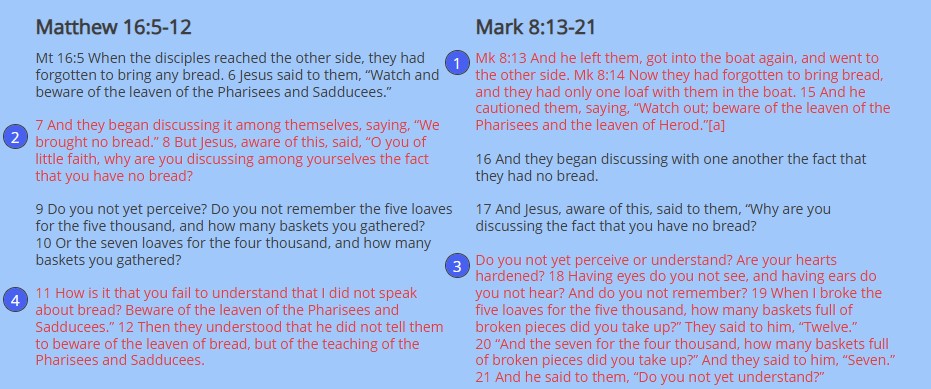
From the above worksheet photo, following the numbers and the text in red, the following narrative is produced.
Mk 8:13 [Then Jesus] left them, got into the boat again, and went to the other side. 14 Now they had forgotten to bring bread, and they had only one loaf with them in the boat. 15 And [Jesus] cautioned them, saying, “Watch out; beware of the leaven of the Pharisees and the leaven of Herod.”
Mt 16:7 [So] they began discussing it among themselves, saying, “We brought no bread.”
Mt 16:8 But Jesus, aware of this, said, “O you of little faith, why are you discussing among yourselves the fact that you have no bread? Mk 8:17 Do you not yet perceive or understand? Are your hearts hardened? 18 Having eyes do you not see, and having ears do you not hear? And do you not remember? 19 When I broke the five loaves for the five thousand, how many baskets full of broken pieces did you take up?”
Mk 8:19 They said to him, “Twelve.”
Mk 8:20 “And the seven for the four thousand, how many baskets full of broken pieces did you take up?”
Mk 8:20 And they said to him, “Seven.”
Mk 8:21 And he said to them, “Do you not yet understand? Mt 16:11 How is it that you fail to understand that I did not speak about bread? Beware of the leaven of the Pharisees and Sadducees.”
Mt 16:12 Then they understood that he did not tell them to beware of the leaven of bread, but of the teaching of the Pharisees and Sadducees.
Bible Lessons for this event:
H327 The Leaven Connection (Matthew 16:7; Mark 8:13-15)
H328 Slow to Understand (Matthew 16:8, 11-12; Mark 8:17-21)
Event Summary:
This event describes Jesus’ warning to his disciples about the “yeast of the Pharisees and Sadducees” (or Pharisees and Herod, in Mark). The disciples misunderstand his teaching, and Jesus uses the opportunity to address their lack of spiritual insight. The themes emphasize spiritual discernment, faith, and the dangers of corrupting influences.
Key points of this event are:
(1) Jesus warns His disciples, “Be on your guard against the yeast of the Pharisees and Sadducees” (Matthew) or “the yeast of the Pharisees and that of Herod” (Mark). Yeast, a small but pervasive substance, symbolizes the corrupting influence of hypocrisy, legalism, and worldly power. (On the above worksheet see circle 1) Believers must be vigilant against influences that distort truth, such as hypocrisy, false teaching, or reliance on human authority over God’s ways. These subtle corruptions can spread and undermine faith.
(2) The disciples mistakenly think Jesus is speaking about bread because they had forgotten to bring enough food. Their focus on physical needs blinds them to the spiritual lesson. (On the above worksheet see circles 2) A preoccupation with material concerns can hinder spiritual understanding. Believers are called to focus on eternal truths rather than immediate, worldly concerns.
(3) Jesus rebukes the disciples for their lack of understanding and reminds them of the miraculous feeding of the five thousand and the four thousand. He asks, “Do you still not understand?” (On the above worksheet see circle 3) Jesus calls His followers to trust in His provision and power. Forgetting God’s past faithfulness can lead to unnecessary worry and hinder spiritual growth.
(4) Jesus clarifies that his warning about yeast refers to the teachings and influence of the Pharisees and Sadducees, not physical bread. (On the above worksheet see circle 4) Spiritual discernment is necessary to grasp deeper truths. Believers must look beyond surface-level interpretations to understand God’s message fully.
(5) The Pharisees and Sadducees represent hypocrisy and legalism, while Herod (in Mark) symbolizes worldly power and self-interest. These influences can mislead and distract from genuine faith in God. Corrupt teachings and worldly priorities can infiltrate and weaken faith. Believers must guard their hearts and minds against such influences and remain rooted in God’s Word.
This event warns against the corrupting influence of false teachings, hypocrisy, and world values, symbolized by yeast. The passages highlight the importance of spiritual discernment and faith in God’s provision, urging believers to trust in his power and avoid being distracted by material concerns. They challenge followers of Christ to remain vigilant, focus on eternal truths, and cultivate a deeper understanding of God’s work in their lives.
Discussion Questions with Extended Answers:
1. Why did Jesus warn His disciples to “beware of the leaven of the Pharisees and Sadducees”?
Answer:
Jesus used the image of leaven (yeast) to describe the subtle but powerful influence of false teaching and spiritual corruption. Just as a small amount of yeast spreads through an entire batch of dough, the hypocrisy, unbelief, and man-made traditions of the Pharisees and Sadducees could quietly spread and affect the hearts of the disciples. The Pharisees represented legalism, external religion, and hypocrisy, while the Sadducees were marked by unbelief, denial of spiritual truths like the resurrection, and worldly compromise. Jesus was warning His followers not to adopt their attitudes, teaching, or hardened hearts. Spiritual error often begins small but can shape an entire life if left unchecked.
2. Why did the disciples think Jesus was talking about literal bread?
Answer:
The disciples misunderstood Jesus because they were focused on physical concerns rather than spiritual truth. They had forgotten to bring bread, so when Jesus mentioned leaven, they immediately assumed He was referring to food. This showed that even after witnessing many miracles, they still struggled to think spiritually. Their minds were still occupied by immediate practical needs rather than deeper kingdom lessons. This misunderstanding revealed how easy it is for believers to miss spiritual truth when distracted by earthly concerns. Jesus often used physical illustrations to teach spiritual realities, but the disciples were still learning how to listen beyond the surface meaning.
3. How did Jesus use the miracles of the loaves to correct their misunderstanding?
Answer:
Jesus reminded them of the feeding of the five thousand and the feeding of the four thousand, asking how many baskets were left over after each miracle. His purpose was to show that lack of bread should not have been their concern because He had already demonstrated complete authority over physical provision. If He could multiply a few loaves to feed multitudes, surely He was not worried about one forgotten meal. His rebuke exposed their little faith and dull understanding. Their anxiety over bread showed they had not fully grasped who He was. Jesus wanted them to trust His power and focus on the spiritual warning He was giving.
4. What does Jesus mean when He says, “Do you still not understand?”
Answer:
Jesus was pointing to their spiritual slowness and failure to connect what they had seen with what they were hearing. They had witnessed miracles, healings, and divine authority, yet they still responded with confusion and fear. Understanding in Scripture is not merely intellectual knowledge but spiritual perception. Jesus expected them to recognize that His words carried deeper meaning and that His miracles revealed His identity as the Son of God. Their lack of understanding was not because the truth was hidden, but because their hearts were still slow to believe. This question was both a correction and an invitation to deeper faith.
5. What is significant about Jesus asking, “Having eyes do you not see, and having ears do you not hear?”
Answer:
This language echoes Old Testament warnings about spiritual blindness and hardness of heart, especially in passages like Isaiah and Jeremiah. Jesus was not speaking about physical sight or hearing, but spiritual perception. The disciples had physical evidence before them, they saw miracles and heard truth, but they were still failing to grasp its meaning. This warning connects them to Israel’s long history of spiritual dullness, where people could be near God’s works yet far from true understanding. Jesus was urging them not to become like the religious leaders who were blind despite their religious knowledge.
6. Why are both the Pharisees and Sadducees mentioned together, even though they were often opposed to each other?
Answer:
Though the Pharisees and Sadducees differed in many beliefs, they were united in their rejection of Jesus. The Pharisees emphasized strict tradition and outward law-keeping, while the Sadducees were more politically connected and denied key spiritual doctrines like resurrection and angels. Despite their differences, both groups represented opposition to the truth of Christ. Jesus warned against both because false religion can appear in different forms, either rigid legalism or worldly unbelief. Both can keep people from genuine faith. Their partnership against Jesus showed that error often unites when truth is confronted.
7. What lesson about faith should the disciples have learned from the feeding miracles?
Answer:
They should have learned that Jesus is fully able to provide for every need and that worry reveals misplaced trust. The feeding miracles were not only acts of compassion but lessons about Christ’s divine sufficiency. If He could provide abundantly for thousands with almost nothing, then the disciples should have trusted Him for their daily bread without fear. Their concern over having no bread showed they were still measuring life by human limitations rather than divine power. Faith grows when believers remember God’s past faithfulness and apply it to present needs. Forgetfulness often leads to fear, while remembrance strengthens trust.
8. How does this passage warn believers today?
Answer:
This passage warns believers to guard both doctrine and the condition of the heart. False teaching rarely arrives openly; it often enters gradually through compromise, pride, hypocrisy, or neglect of truth. Christians must remain watchful against influences that distort the gospel, whether through legalism, unbelief, worldly thinking, or empty religion. It also warns against spiritual forgetfulness. Like the disciples, believers may witness God’s faithfulness yet still live in anxiety and dullness of heart. Jesus calls His people to remember His works, trust His provision, and pursue spiritual discernment. Faith requires both vigilance and remembrance.
9. When did the disciples finally understand Jesus’ warning?
Answer:
According to Matthew 16:12, they finally understood that Jesus was not speaking about bread, but about the teaching of the Pharisees and Sadducees. This moment marked a shift from literal thinking to spiritual understanding. Jesus patiently guided them from confusion to clarity by using questions, reminders, and correction. Their understanding did not come instantly, but through reflection on His words and works. This shows that spiritual maturity often develops gradually. Christ teaches His followers patiently, leading them from shallow understanding into deeper truth as they continue walking with Him.
10. What does this passage teach us about Jesus as a teacher?
Answer:
Jesus teaches with patience, wisdom, and purpose. He does not simply give answers—He asks questions that expose the heart and force reflection. He uses everyday things like bread and leaven to reveal eternal truths. He corrects misunderstanding, but He also leads His disciples toward deeper understanding rather than rejecting them for their slowness. His teaching reveals both His authority and His compassion. He wants His followers not merely to hear words, but to grow in discernment, faith, and spiritual perception. This passage shows that discipleship involves continual learning under the guidance of Christ.


Leave a comment