
Photo: Tomi Jutila
Author: Stephen Weller
1,878 words, 10 minutes read time
Jesus’ True Family – Capernaum, Galilee
Scripture Reference: Matthew 12:46-50; Mark 3:20-21, 31-35; Luke 8:19-21
Context:
The accounts in Matthew 12:46–50, Mark 3:20–21, 31–35, and Luke 8:19–21 occur during a pivotal phase of Jesus Christ’s Galilean ministry, when His growing popularity and authoritative teaching were drawing large crowds while simultaneously increasing misunderstanding and opposition. In Mark’s account, the immediate context highlights intense activity; Jesus is surrounded by such pressing crowds that He and His disciples are unable even to eat, prompting concern from His family, who fear He is “out of His mind,” reflecting a natural but limited human perspective on His mission. At the same time, religious leaders are escalating their accusations, even attributing His power to demonic influence (Mark 3:22), demonstrating a sharp contrast between unbelief and true spiritual discernment. Into this setting, His mother and brothers arrive, seeking to speak with Him, likely motivated by concern or confusion about His actions. When informed of their presence, Jesus responds by redefining the concept of family, not dismissing His earthly relationships but elevating a greater spiritual reality: those who hear the word of God and do it are His true family. Matthew emphasizes doing the will of the Father, Luke highlights hearing and obeying God’s word, and Mark underscores the contrast between misunderstanding insiders and obedient followers. Together, these parallel accounts reveal a key theological moment in which Jesus teaches that spiritual kinship, rooted in obedience and faith, surpasses biological ties, marking a transition from natural identity to kingdom identity and inviting all who respond in faith to be included in the family of God.
Event Narrative:
The narrative for this section was obtained from three similar texts, using the highlighted material shown below. The selection was determined by Jerry Peyton and copyrighted in 2015 by Jerry Peyton and Biblical Studies Press L.L.C.
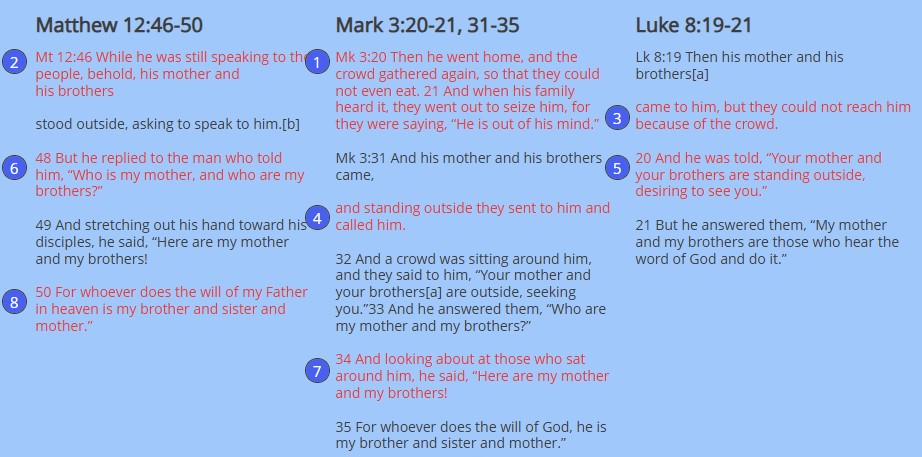
From the above worksheet photo, following the numbers and the text in red, the following narrative is produced.
Mk 3:20 Then [Jesus] went home, and the crowd gathered again, so that they could not even eat. 21 And when his family heard it, they went out to seize him, for they were saying, “He is out of his mind.”
Mt 12:46 While he was still speaking to the people, behold, his mother and his brothers’ Lk 8:19 came to him, but they could not reach him because of the crowd, Mk 3:31 and standing outside they sent to him and called him.
Lk 8:20 And he was told, “Your mother and your brothers are standing outside, desiring to see you.”
Mt 12:48 But he replied to the man who told him, “Who is my mother, and who are my brothers?” Mk 3:34 And looking about at those who sat around him, he said, “Here are my mother and my brothers! Mt 12:50 For whoever does the will of my Father in heaven is my brother and sister and mother.”
Bible Lessons for this event:
H244 Introduction of a New Family (Matthew 12:46, 48, 50; Mark 3:20-21, 31, 34; Luke 8:19-20)
Event Summary:
In this event, Jesus redefines the concept of family by emphasizing that spiritual kinship, marked by obedience to God’s will, is more significant than biological relationships. The key themes include spiritual family, obedience to God, and the inclusiveness of Jesus’ community.
Key points of this event are:
(1) When Jesus is informed that his mother and brothers are looking for him, he responds by saying that those who do the will of God are his true family. (See Luke 8:20) This statement expands the traditional notion of family beyond biological ties to include all who are committed to God’s purposes. Jesus teaches that obedience to God’s will creates a new kind of family among his followers, marked by shared faith and commitment to God rather than ancestry or blood relations.
(2) Jesus highlights that doing God’s will is the defining trait of his spiritual family. (See Matthew 12:50) This means that anyone, regardless of background, can become part of Jesus’ family through a commitment to live according to God’s will. The emphasis on obedience shows that Jesus values faithful action and alignment with God’s purposes as the basis for true closeness with him.
(3) By declaring that his family consists of those who follow God, (See Matthew 12:50) Jesus demonstrates the inclusive nature of the kingdom of God. Anyone who seeks to do God’s will is welcomed into this spiritual family, transcending social, ethnic, and familial boundaries. This teaching reflects the unity and equality of all believers in Christ, where relationships are based on shared faith rather than social or familial hierarchies.
(4) In Mark’s account, Jesus’ family expresses concern that he is “out of his mind” (See Mark 3:20-21) due to the intense demands of his ministry. This detail underscores the dedication and urgency of Jesus’ mission, which sometimes created tension with his biological family. Jesus’ focus on spiritual family highlights that his primary commitment is to God’s kingdom, setting an example for his followers to prioritize their relationship with God above all else.
The message of this event is that true family in God’s kingdom is defined by obedience to his will, rather than by biological relationships. Jesus redefines family, emphasizing that those who commit to following God’s purposes are part of his spiritual family. This teaching reflects the inclusive and unifying nature of God’s kingdom, where relationships are based on shared faith and obedience to God. Jesus invites all who seek to do God’s will into close relationship with him, forming a community united by spiritual kinship, rather than blood ties. This passage challenges believers to prioritize their relationship with God and embrace the global, diverse family of faith.
Understanding and Application:
Questions of Understanding with Extended Answers
- What situation brings Jesus’ biological family to seek Him in these passages?
Answer: In all three accounts, Jesus’ mother and brothers come to find Him while He is surrounded by a large crowd. In Mark’s account especially (Mark 3:20–21), they are concerned because reports about Him have spread, and some are saying He is “out of His mind.” The intensity of His ministry, constant teaching, healing, and the overwhelming crowds, likely prompted both concern and misunderstanding from His family. Their attempt to reach Him physically is hindered by the crowd, symbolizing not just a logistical barrier but also a deeper spiritual distinction between those who merely relate to Jesus physically and those who truly understand His mission. - How does Jesus respond when told that His mother and brothers are seeking Him?
Answer: Instead of immediately going out to meet them, Jesus responds with a profound question: “Who is my mother, and who are my brothers?” (Matthew 12:48). He then gestures toward His disciples and those listening to His teaching and declares them to be His true family. This response is not a rejection of His earthly family but a redefinition of what it means to belong to Him. Jesus shifts the focus from biological ties to spiritual relationships, emphasizing that obedience to God takes precedence over natural family connections. - What does Jesus mean by identifying His followers as His true family?
Answer: Jesus teaches that those who “do the will of my Father” (Matthew), “do the will of God” (Mark), and “hear the word of God and do it” (Luke) are His true family. This reveals that spiritual kinship is based on faith and obedience rather than lineage. In God’s kingdom, belonging is not inherited through birth but granted through a responsive relationship to God’s Word. This elevates the importance of obedience and faith as the defining marks of discipleship, creating a new community bound together by shared devotion to God. - Why is obedience to God’s will central to being part of Jesus’ family?
Answer: Obedience demonstrates genuine faith and alignment with God’s purposes. Jesus consistently teaches that hearing God’s Word must lead to action (Luke 8:21). It is not enough to be near Jesus physically or to be aware of Him intellectually; true relationship is evidenced by submission to God’s will. This principle reinforces the broader biblical teaching that faith is active and transformative, producing a life that reflects God’s character and priorities. - How does Mark’s account add depth to our understanding of this event?
Answer: Mark uniquely includes the detail that Jesus’ family thought He was out of His mind (Mark 3:21), which adds tension to the narrative. This highlights the misunderstanding and even opposition Jesus faced from those closest to Him. Additionally, Mark frames the episode with a “sandwich” structure, placing the family’s concern around the account of the scribes accusing Jesus of being demon-possessed. This literary structure emphasizes the contrast between misunderstanding from His family and hostility from religious leaders, showing that both insiders and outsiders can fail to recognize who Jesus truly is. - What does Luke emphasize in his version of this teaching?
Answer: Luke emphasizes the importance of hearing and doing the Word of God (Luke 8:21), which aligns with his broader theme of responsive obedience. In Luke’s Gospel, there is a strong focus on the Word of God as something that must be received and acted upon. By connecting family membership with obedience to the Word, Luke underscores that discipleship is not passive, it requires a life shaped by God’s truth. - Does Jesus’ statement diminish the importance of earthly family relationships?
Answer: No, Jesus is not dismissing or dishonoring His earthly family. Scripture elsewhere affirms the importance of honoring parents and maintaining family relationships. Instead, Jesus is placing them in proper perspective. Loyalty to God must come first, even above the closest human relationships. His statement teaches that spiritual priorities are supreme and that allegiance to God defines one’s ultimate identity. - What is the significance of Jesus gesturing toward His disciples when making this statement?
Answer: The gesture is symbolic and powerful. By pointing to those around Him who are listening and learning, Jesus visibly identifies them as His family. This act reinforces that discipleship is not abstract, it is lived out in community. It also shows that anyone, regardless of background, can become part of Jesus’ family through faith and obedience. This inclusion would have been especially significant in a culture where family identity was central. - How do these passages challenge traditional views of identity and belonging?
Answer: In the ancient world, identity was largely determined by family, ancestry, and social status. Jesus radically redefines this by teaching that true identity is found in relationship with God. Belonging to God’s family is open to all who respond to Him in faith, regardless of their earthly background. This challenges both ancient and modern assumptions, calling people to find their primary identity not in human relationships or achievements but in their relationship with God. - What practical lesson do these passages offer for believers today?
Answer: These passages call believers to evaluate their relationship with God in terms of obedience and responsiveness to His Word. It is not enough to have familiarity with spiritual things or association with Christian community; true belonging is demonstrated by a life that hears and follows God’s will. They also encourage believers by reminding them that they are part of a spiritual family, united with Christ and with one another through shared faith and obedience.
 Anchor My Faith
Leave a comment