
Photo: Gary Syrba Photography (Here is a photo taken somewhere on this world (I think).)
Author: Stephen Weller
1,998 words, 11 minutes read time
Parable of the Sower
Scripture Reference: Matthew 13:1-9; Mark 4:1-9, 23; Luke 8:4-8
Context:
The parable of the sower, recorded in Matthew 13:1–9, Mark 4:1–9, 23, and Luke 8:4–8, is set at a pivotal moment in Jesus’ ministry when large crowds were gathering, yet genuine understanding among the people was increasingly divided. Teaching by the Sea of Galilee, Jesus used the familiar agricultural setting of a sower scattering seed to illustrate deeper spiritual realities about the reception of God’s word. The varied soils, path, rocky ground, thorns, and good soil, represent the different conditions of human hearts as they respond to the message of the kingdom. This parable marks a significant transition in Jesus’ teaching method, as He begins to speak more frequently in parables, both to reveal truth to those who are receptive and to conceal it from those who are hardened or indifferent. The inclusion of the call, “He who has ears to hear, let him hear,” along with the added exhortation in Mark 4:23, emphasizes personal responsibility and spiritual attentiveness. Within the broader context, this teaching explains why the same message produces radically different outcomes and prepares the disciples to understand both the growth of the kingdom and the resistance it will encounter, highlighting that fruitfulness depends not on the seed—which is constant and life-giving—but on the condition of the heart that receives it.
Event Narrative:
The narrative for this section was obtained from three similar texts, using the highlighted material shown below. The selection was determined by Jerry Peyton and copyrighted in 2015 by Jerry Peyton and Biblical Studies Press L.L.C.
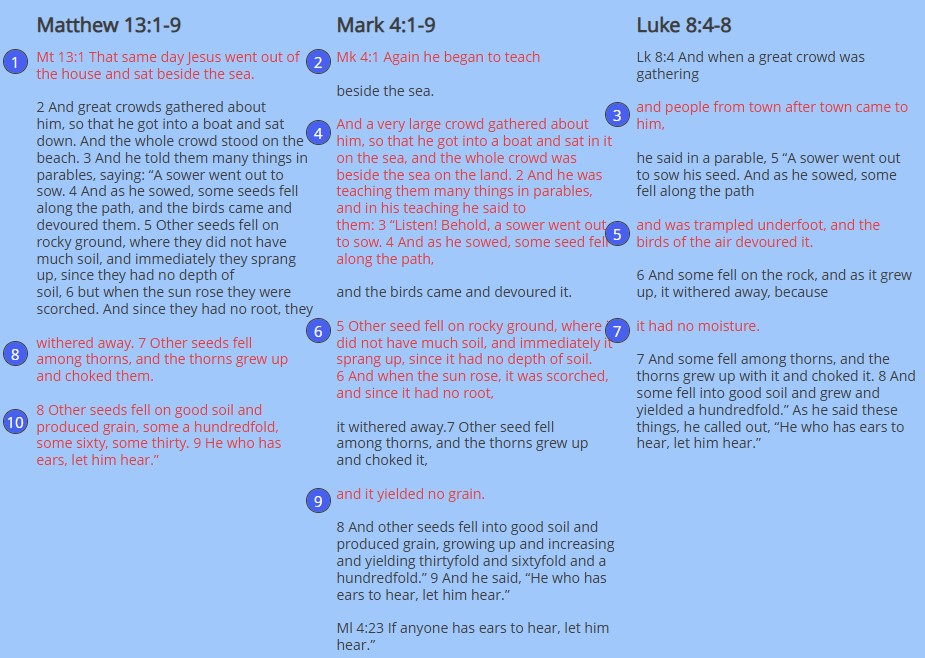
From the above worksheet photo, following the numbers and the text in red, the following narrative is produced.
Mt 13:1 [On that day when Jesus] went out of the house and sat beside the sea, Mk 4:1 he again began to teach Lk 8:4 and people from town after town came to him, Mk 4:1 and a very large crowd gathered about him, so that he got into a boat and sat in it on the sea, and the whole crowd was beside the sea on the land. 2 And he was teaching them many things in parables, and in his teaching, he said to them:
Mk 4:3 “Listen! Behold, a sower went out to sow. 4 And as he sowed, some seed fell along the path, Lk 8:5 and was trampled underfoot, and the birds of the air devoured it. Mk 4:5 Other seed fell on rocky ground, where it did not have much soil, and immediately it sprang up, since it had no depth of soil, 6 [but] when the sun rose, it was scorched, and since it had no root, [and] Lk 8:6 it had no moisture Mt 13:6 it withered away. 7 Other seeds fell among thorns, and the thorns grew up and choked them Mk 4:7 and it yielded no grain. Lk 8:8 Other seeds fell on good soil and produced grain, some a hundredfold, some sixty, some thirty.
Mk 4:9 He who has ears, let him hear.”
Bible Lessons for this event:
H245 Intentionally skipped
H246 The Parable of the Sower (Matthew 13:1,6-7; Mark 4:1-7, 9; Luke 8:4-6, 8
Event Summary:
In this event, Jesus shares the parable of the sower, which illustrates how people respond differently to the message of God’s kingdom based on the condition of their hearts. The parable emphasizes themes of receptivity, spiritual growth, and the importance of a fruitful response to God’s word.
Key points of this event are:
(1) In the parable, a sower scatters seeds on four different types of ground: the path, rocky ground, among thorns, and good soil. Each type of soil represents a different way people receive and respond to God’s word. This variety of responses reflects that receptivity to God’s message varies from person to person, depending on their openness, spiritual readiness, and resilience against distractions.
(2) The seed that falls on the path is quickly eaten by birds, symbolizing people who hear the message but do not understand or accept it. Their hearts are hardened, making it difficult for the message to penetrate. This highlights that spiritual receptivity requires openness. A closed heart does not allow the message to take root, leaving it vulnerable to being snatched away.
(3) The seed that falls on rocky ground sprouts quickly but withers because it lacks deep roots. This represents people who receive the message with enthusiasm but fall away when faced with challenges or persecution. This response shows that true discipleship requires depth and perseverance. Initial enthusiasm must be supported by a deep-rooted commitment to endure life’s hardships.
(4) The seed that falls among thorns is choked by competing plants, symbolizing people who hear the message but are distracted by worldly concerns, wealth, and desires. This illustrates that spiritual growth can be hindered by distractions and material pursuits. A divided heart struggles to bear fruit because it is preoccupied with competing interests.
(5) The seed that falls on good soil produces an abundant harvest, symbolizing people who hear, understand, and embrace the message of the kingdom, allowing it to transform their lives and bear fruit. This type of response shows that true discipleship is marked by receptivity and fruitfulness. A heart fully open to God’s word is one that allows his message to take root, grow, and yield positive spiritual impact.
(6) Jesus concludes the parable by emphasizing the importance of spiritual understanding and discernment. This statement invites listeners to examine their own hearts and attitudes toward God’s word. His call to “hear” suggests a deeper, attentive listening that leads to action, urging listeners to consider how receptive they are to the message of the kingdom.
The message of this event is that the effectiveness of God’s word in a person’s life depends on the condition of their heart and their openness to receiving it. Jesus calls His followers to examine their own receptivity and strive to be like the “good soil” that nurtures the message and produces a fruitful response. This parable challenges believers to avoid hardness, shallow commitment, and worldly distractions, embracing God’s word fully so it can transform their lives and lead to spiritual growth. The teaching encourages a deep, enduring faith that is willing to listen, understand, and act, producing a life that reflects the values and power of God’s kingdom.
Understanding and Application:
Discussion Questions with Extended Answers
What does this parable teach about the responsibility of the sower versus the soil?
Answer: The sower faithfully spreads the seed without discrimination, illustrating that God’s Word is proclaimed broadly to all people. The responsibility of the sower is to sow; the responsibility of the soil is to receive. The varying results are not due to the seed or the sower but to the condition of the soil. This teaches that while God provides the truth, each individual is accountable for how they respond to it. The effectiveness of the Word in a person’s life depends on their openness, humility, and willingness to receive and act upon it.
What is the setting of this teaching, and why is it significant?
Answer: In each account, Jesus teaches a large crowd gathered by the sea. Because of the size of the crowd, He enters a boat and teaches from the water while the people remain on the shore. This setting highlights both the popularity of Jesus’ ministry and the diverse audience listening to Him. The mixed crowd, composed of sincere seekers, curious listeners, and hardened skeptics, mirrors the different types of “soil” described in the parable. The physical distance (Jesus in the boat, the crowd on land) also subtly reflects the spiritual distance that can exist between the speaker of truth and those who hear it.
What are the four types of soil described in the parable?
Answer: The parable presents four types of soil:
• The path (or wayside), where the seed is eaten by birds
• Rocky ground, where the seed springs up quickly but withers
• Among thorns, where the seed is choked out
• Good soil, where the seed produces a fruitful crop
These soils represent different responses to the Word of God. Though the same seed is sown in each case, the outcome varies depending on the condition of the soil, emphasizing that the issue is not the seed (God’s Word) but the heart of the hearer.
What happens to the seed that falls on the path, and what does it represent?
Answer: The seed that falls on the path is immediately eaten by birds. This represents a hardened heart that does not receive or understand the Word. The message is quickly taken away before it can take root. Spiritually, this reflects individuals who hear the truth but are unaffected by it, whether due to indifference, resistance, or spiritual blindness. The Word never penetrates their hearts, leaving no opportunity for growth or transformation.
Why does the seed on rocky ground fail to produce lasting fruit?
Answer: The seed on rocky ground grows quickly because the soil is shallow, but it lacks deep roots. When the sun rises, it withers because it has no moisture or depth to sustain it. This represents those who initially receive the Word with joy but do not develop deep spiritual roots. When trials, persecution, or difficulties arise, their faith quickly fades. Their response is emotional rather than rooted in conviction, revealing a lack of endurance and genuine transformation.
What do the thorns symbolize, and how do they affect the seed?
Answer: The thorns symbolize competing priorities and distractions, such as worries, riches, and the pleasures of life. These choke the growing seed, preventing it from maturing and bearing fruit. This represents individuals who hear the Word but allow worldly concerns to dominate their hearts. Though there may be initial growth, it is ultimately stifled because their devotion is divided. The Word is present but not fruitful, crowded out by other pursuits.
What distinguishes the good soil from the other types?
Answer: The good soil receives the seed, allows it to take root, and produces a crop, yielding thirty, sixty, or even a hundredfold. This soil represents a heart that hears, understands, and responds obediently to the Word. Unlike the other soils, the good soil is receptive, persevering, and fruitful. It demonstrates that true hearing involves more than listening; it requires understanding, commitment, and a life that reflects the truth received.
Why does Jesus use a parable to teach this message?
Answer: Jesus uses parables to reveal truth to those who are spiritually receptive while concealing it from those who are hardened or indifferent. Parables invite deeper reflection and require the listener to engage thoughtfully. Those who desire to understand will seek further explanation, while those who are uninterested will dismiss the message. This method of teaching exposes the condition of the listener’s heart, aligning with the very message of the parable itself.
What is the significance of the repeated phrase, “He who has ears to hear, let him hear”?
Answer: This phrase is a call to intentional and attentive listening. It emphasizes that hearing is not merely a physical act but a spiritual responsibility. Jesus is urging His audience to consider how they are receiving His message. The statement implies that not everyone who hears externally will truly understand internally. It challenges each listener to examine their own heart and response to God’s Word.
How does this parable challenge believers today?
Answer: The parable challenges believers to evaluate the condition of their hearts. It asks whether they are merely hearing the Word or truly receiving it in a way that produces lasting fruit. It warns against superficial faith, divided loyalties, and spiritual complacency. At the same time, it encourages believers to cultivate a heart that is receptive, rooted, and responsive to God’s truth. The ultimate measure of hearing is not knowledge alone but a transformed life that bears fruit.
 Anchor My Faith
Leave a comment