
Photo: Hannes Koenig (The spirit of Madeira)
Author: Stephen Weller
1,986 words, 11 minutes read time
Parable of the Sower Explained
Scripture Reference: Matthew 13:18-23; Mark 4:13-20; Luke 8:11-15
Context:
Matthew 13:18–23, Mark 4:13–20, and Luke 8:11–15 present Jesus’ direct explanation of the Parable of the Sower, given privately to His disciples after the crowds heard the story. In the broader context, Jesus has begun teaching in parables as a form of both revelation and judgment, revealing truth to those who are receptive while concealing it from those whose hearts are hardened (as seen in the preceding verses). When the disciples ask for understanding, Jesus emphasizes that this parable is foundational; understanding it becomes a key to grasping many of His other teachings about the kingdom of God. The “seed” is identified as the Word of God, and the various types of soil represent the differing conditions of the human heart in response to that Word. The hard path symbolizes those who hear but do not understand, allowing Satan to quickly remove the truth before it takes root. The rocky ground reflects those who receive the Word with initial joy but fall away under pressure, persecution, or hardship because their faith lacks depth. The thorny soil describes those whose spiritual growth is choked by worldly cares, the deceitfulness of riches, and competing desires. Finally, the good soil represents those who hear, understand, receive, and persevere in the Word, bearing fruit with patience and endurance. Together, these passages emphasize that the effectiveness of God’s Word is not diminished; rather, the determining factor is the condition and response of the hearer’s heart, calling for self-examination and a steadfast, fruitful faith.
Event Narrative:
The narrative for this section was obtained from three similar texts, using the highlighted material shown below. The selection was determined by Jerry Peyton and copyrighted in 2015 by Jerry Peyton and Biblical Studies Press L.L.C.
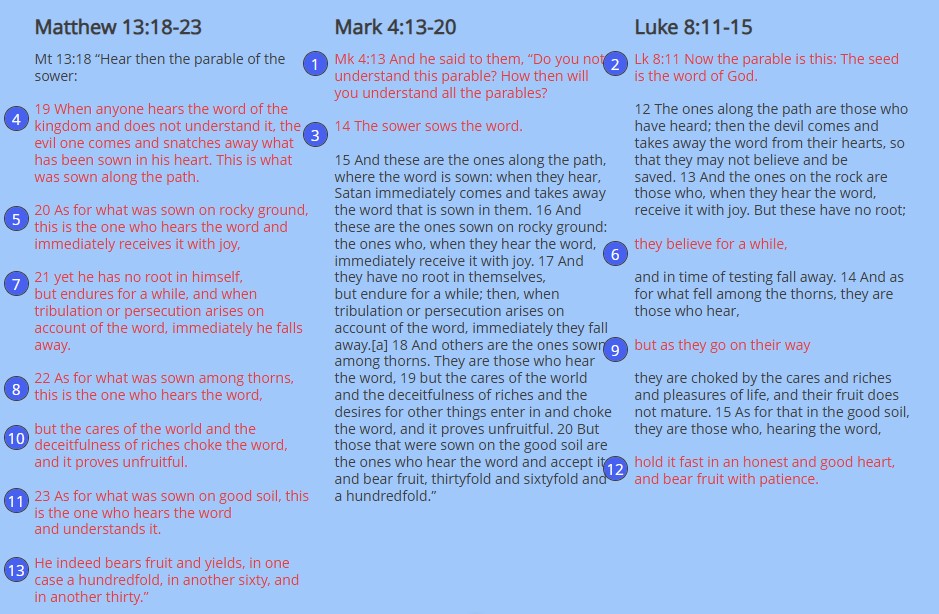
From the above worksheet photo, following the numbers and the text in red, the following narrative is produced.
Mk 4:13 And he said to them, “Do you not understand this parable? How then will you understand [any of] the parables? Lk 8:11 Now the parable is this: The seed is the word of God [and] Mk 4:14 the sower sows the word. Mt 13:19 When anyone hears the word of the kingdom and does not understand it, the evil one comes and snatches away what has been sown in his heart. This is what was sown along the path.
Mt 13:20 As for what was sown on rocky ground, this is the one who hears the word and immediately receives it with joy. Lk 8:13 they believe for a while, Mt 13:21 yet he has no root in himself, but endures for a while, and when tribulation or persecution arises on account of the word, immediately he falls away.
Mt 13:22 As for what was sown among thorns, this is the one who hears the word, Lk 8:14 but as they go on their way Mt 13:22 the cares of the world and the deceitfulness of riches choke the word, and it proves unfruitful.
Mt 13:23 As for what was sown on good soil, this is the one who hears the word and understands it, Lk 8:15 holding it fast in an honest and good heart, and bear fruit with patience. Mt 13:23 He indeed bears fruit and yields, in one case a hundredfold, in another sixty, and in another thirty.”
Bible Lessons for this event:
H249 Why Do You Not Understand? (Matthew 13:19; Mark 4:13-14; Luke 8:11)
H250 Further Explanation Given (Matthew 13:20-23; Luke 8:13-15)
Event Summary:
In this event, Jesus explains the parable of the sower, revealing how different types of hearts respond to the message of God’s kingdom. The seed represents the word of God, and the different types of soil represent the varying levels of receptivity among people. Key themes include receptivity to God’s word, the obstacles to spiritual growth, and the importance of a fruitful response to God’s message.
Key points of this event are:
(1) The seed that falls on the path is quickly eaten by birds, representing people who hear the word but don’t understand it. The word does not penetrate, and Satan (or “the evil one”) quickly removes it from their hearts. This type of response reflects a hardened heart, closed off to the message of the kingdom. It warns that without openness, the word cannot take root or bring about change. (See Mark 4:13-14; Luke 8:11; Matthew 13:19)
(2) The seed that falls on rocky ground sprouts quickly but withers under the sun because it has no deep roots. This represents people who receive the word with joy initially but fall away when they face difficulties or persecution. This response reflects a superficial commitment to God’s word, where initial enthusiasm fades because of a lack of depth. True discipleship requires perseverance and rootedness, especially in the face of challenges. (See Matthew 20-21; Luke 8:13)
(3) The seed that falls among thorns is choked by weeds, representing people who hear the word but are preoccupied with worries, riches, and pleasures. These distractions prevent the word from bearing fruit. This response shows the danger of a divided heart that is consumed by worldly concerns, ultimately hindering spiritual growth. The message warns that the cares and desires of this world can choke out spiritual vitality, leaving one unfruitful. (See Matthew 13:22; Luke 8:14)
(4) The seed that falls on good soil produces a fruitful harvest, representing those who hear, understand, and hold fast to the word with a sincere and good heart. These individuals allow the message to transform them, yielding a life of spiritual growth and impact. This response illustrates genuine discipleship, marked by openness, perseverance, and a commitment to bear fruit. The fruitful heart reflects a deep engagement with God’s word, resulting in a transformed life that positively impacts others. (See Matthew 13:23)
(5) The parable emphasizes that hearing the word is not enough; it must be received deeply and acted upon. True receptivity to God’s message is demonstrated by a life that produces spiritual fruit—such as love, kindness, humility, and perseverance. Jesus’ explanation calls his followers to examine their own hearts, encouraging them to cultivate the “good soil” of a receptive and committed heart.
The message of this event is that God’s word requires a receptive, enduring, and undivided heart to bear fruit. Jesus shows that different responses to the gospel depend on the condition of the heart, with some people hindered by hardness, superficiality, or worldly distractions. Only those who fully embrace the message of the kingdom, holding onto it with commitment and allowing it to transform their lives, will produce a fruitful harvest. This teaching challenges believers to cultivate openness, resilience, and focus in their relationship with God, allowing His word to shape their lives and yield spiritual growth.
Questions of Understanding with Extended Answers
1. What does the “seed” represent in this parable?
Answer:
The seed represents the Word of God, the message of the kingdom. In each account, Jesus clearly identifies the seed as God’s truth being proclaimed to people. The power is in the seed itself; it contains life and the potential to produce fruit. However, the outcome depends not on the seed but on the condition of the soil (the human heart). This emphasizes that God’s Word is inherently effective and life-giving, but its impact varies based on how it is received.
2. What does the “soil” symbolize?
Answer:
The soil represents the hearts and responses of individuals who hear the Word of God. Each type of soil reflects a different spiritual condition. Some hearts are hardened, some are shallow, some are distracted, and some are receptive. The parable teaches that hearing alone is not enough; the condition of the heart determines whether the Word will take root, grow, and bear fruit. Thus, the focus is on self-examination; how one receives and responds to God’s truth.
3. What happens to the seed sown along the path, and what does it teach?
Answer:
The seed along the path is quickly taken away by birds, which Jesus explains as the devil removing the Word from hearts that do not understand or receive it. These individuals hear the message but remain hardened, often due to indifference, unbelief, or spiritual blindness. This teaches that a resistant heart allows no penetration of truth, making it easy for Satan to snatch away the message before it can take root. It highlights the importance of openness and understanding when hearing God’s Word.
4. What characterizes the rocky soil, and why does the plant not last?
Answer:
The rocky soil represents those who receive the Word with immediate joy but have no deep root. They respond emotionally and quickly, but their commitment is shallow. When trials, persecution, or difficulties arise because of the Word, they fall away. This reveals that genuine faith must be rooted deeply in conviction and understanding, not merely emotional enthusiasm. Endurance through hardship is evidence of true spiritual depth.
5. What does the seed among thorns represent?
Answer:
The thorny soil represents those who hear the Word but allow it to be choked by competing concerns. Jesus identifies these as the cares of life, the deceitfulness of riches, and desires for other things. These distractions gradually suffocate spiritual growth, preventing fruit from maturing. This teaches that divided priorities and worldly attachments can render the Word unfruitful, even if it initially takes root. Spiritual growth requires intentional focus and the removal of competing influences.
6. What distinguishes the good soil from the others?
Answer:
The good soil represents those who hear the Word, understand it, accept it, and hold fast to it with a sincere and good heart. Unlike the other soils, these individuals persevere and allow the Word to grow deeply within them. The key distinction is not just hearing but retaining and obeying the Word. This kind of heart produces lasting spiritual fruit, demonstrating genuine transformation and faithfulness.
7. What is meant by “bearing fruit,” and why is it important?
Answer:
Bearing fruit refers to the visible evidence of a transformed life, obedience, righteousness, spiritual growth, and influence on others. Fruit can include character (such as love and faithfulness), actions that reflect God’s will, and the multiplication of the message in others’ lives. It is important because fruit is the proof of genuine faith. In all three accounts, only the good soil produces fruit, showing that true reception of the Word results in a changed life.
8. Why do the Gospel accounts mention different yields (thirty, sixty, one hundredfold)?
Answer:
The varying yields illustrate that while all genuine believers bear fruit, the degree of fruitfulness differs. Factors such as spiritual maturity, faithfulness, and responsiveness to God’s Word influence the extent of growth. The emphasis is not on comparison but on the certainty that true faith produces results. Even the smallest yield is significant, while greater yields reflect abundant spiritual productivity.
9. What role does perseverance play in this parable?
Answer:
Perseverance is a defining mark of the good soil. Luke’s account emphasizes “bearing fruit with patience” (or endurance). This shows that spiritual growth is not instantaneous but requires ongoing faithfulness through trials, distractions, and time. Those who endure demonstrate that the Word has truly taken root. Without perseverance, initial responses, no matter how enthusiastic, prove to be temporary and unfruitful.
10. How does this parable serve as a warning and an encouragement?
Answer:
The parable serves as a warning by revealing that not all who hear the Word respond rightly, and many fall away due to hardness, shallowness, or distraction. It calls for careful self-examination. At the same time, it is an encouragement because it assures that when the Word is received with a faithful heart, it will produce abundant fruit. It affirms the power of God’s Word and the possibility of a fruitful, transformed life for those who truly receive it.
 Anchor My Faith
Leave a comment