
Photo: Alex Vershinin
Author: Stephen Weller
2,090 words, 11 minutes read time
Parables of Seeds and Yeast
Scripture Reference: Matthew 13:31-35; Mark 4:26-34; Luke 13:18-21
Context:
Matthew 13:31–35, Mark 4:26–34, and Luke 13:18–21 present a unified teaching moment in which Jesus explains the nature and growth of the kingdom of heaven through a series of agricultural parables spoken to large crowds. These passages occur during a phase of Jesus’ ministry when opposition from religious leaders is increasing, and His use of parables both reveals truth to receptive hearts and conceals it from those who are hardened (as explained earlier in Matthew 13). In this setting, Jesus uses familiar images from everyday life, seeds, soil, and leaven, to communicate profound spiritual realities. The parable of the mustard seed emphasizes how the kingdom begins in seemingly insignificant ways yet grows into something expansive and influential, while the parable of the leaven illustrates the quiet, internal, and pervasive transformation the kingdom brings. Mark uniquely includes the parable of the growing seed, highlighting the mysterious and sovereign work of God in bringing about growth apart from human control. Together, these teachings reassure Jesus’ listeners, especially His disciples, that despite humble beginnings and slow, often unseen progress, God’s kingdom is advancing according to His divine purpose. Matthew also notes that Jesus’ use of parables fulfills prophecy (Psalm 78:2), reinforcing that His teaching method is part of God’s redemptive plan. These passages collectively emphasize both the certainty and the surprising nature of the kingdom’s expansion: it grows gradually, often unnoticed at first, yet ultimately results in a visible, far-reaching impact that reflects God’s sovereign power and wisdom.
Event Narrative:
The narrative for this section was obtained from three similar texts, using the highlighted material shown below. The selection was determined by Jerry Peyton and copyrighted in 2015 by Jerry Peyton and Biblical Studies Press L.L.C.
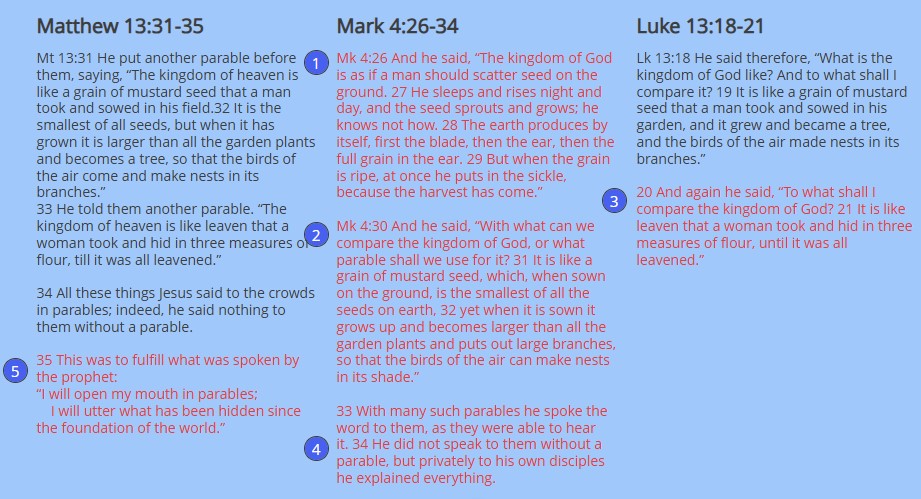
From the above worksheet photo, following the numbers and the text in red, the following narrative is produced.
Mk 4:26 [Jesus] said, “The kingdom of God is as if a man should scatter seed on the ground. 27 He sleeps and rises night and day, and the seed sprouts and grows; he knows not how. 28 The earth produces by itself, first the blade, then the ear, then the full grain in the ear. 29 But when the grain is ripe, at once he puts in the sickle, because the harvest has come.”
Mk 4:30 [Jesus also] said, “With what can we compare the kingdom of God, or what parable shall we use for it? 31 It is like a grain of mustard seed, which, when sown on the ground, is the smallest of all the seeds on earth, 32 yet when it is sown it grows up and becomes larger than all the garden plants and puts out large branches, so that the birds of the air can make nests in its shade.”
Lk 13:20 [Again Jesus] said, “To what shall I compare the kingdom of God? 21 It is like leaven that a woman took and hid in three measures of flour, until it was all leavened.”
Mk 4:33 With many such parables [Jesus] spoke the word to them, as they were able to hear it. 34 He did not speak to them without a parable, but privately to his own disciples he explained everything.
Mt 13:35 This was to fulfill what was spoken by the prophet: “I will open my mouth in parables; I will utter what has been hidden since the foundation of the world.”
Bible Lessons for this event:
H253 Scattered Seeds (Mark 4:26-29)
H254 Mustard Seed (Mark 4:30-32)
H255 Leaven or Yeast (Matthew 13:35; Mark 4:33-34; Luke 13:20-21)
Event Summary:
This event contains parables about the kingdom of God, including the parable of the mustard seed and the parable of the yeast (or leaven). In Mark, an additional parable about the seed growing on its own is included. The central themes focus on the growth, influence, and transformative power of God’s kingdom.
Key points of this event are:
(1) The mustard seed, though one of the smallest seeds, grows into a large tree where birds can perch. This illustrates that the kingdom of God starts small—such as Jesus’ ministry with a few disciples—but grows into something expansive and impactful. The image of birds finding shelter in the tree reflects the inclusivity of God’s kingdom, providing refuge and blessing to all nations and peoples. The kingdom of God may seem insignificant or hidden at first, but it will grow into a powerful, life-giving force that welcomes and benefits all who seek it. (See Mark 4:30-32)
(2) A small amount of yeast, when mixed into a large quantity of flour, leavens the whole batch. This demonstrates the hidden yet transformative power of God’s kingdom, which works from within to change hearts, communities, and the world. The kingdom of God has a subtle but profound effect, spreading quietly yet powerfully, transforming everything it touches. (See Luke 13:20-21)
(3) The parable describes a farmer sowing seeds and witnessing their growth, even though he does not fully understand how it happens. The seed grows “all by itself,” eventually producing a harvest. This parable highlights that the growth of God’s kingdom is ultimately God’s work, not human effort, and it will culminate in a great harvest at the end of time. The kingdom of God grows steadily and inevitably by God’s power, even if its progress is not immediately visible to human eyes. (See Mark 4:26-29)
(4) Jesus uses parables to reveal deep spiritual truths in ways that provoke reflection and faith in those who are receptive. This fulfills prophecy, showing that God’s wisdom is accessible to those with open hearts while remaining hidden from those who are hardened or indifferent. (See Mark 4:33-34; Matthew 13:35)
The message of this event is that the kingdom of God is characterized by small beginnings, transformative power, steady growth, and ultimate greatness. Though it may start humbly or seem hidden, its influence spreads widely, transforming individuals and the world. These parables encourage believers to trust in the inevitable growth and success of God’s kingdom, even when its progress seems slow or unnoticed, and to take comfort in knowing that God is at work behind the scenes. The passages also highlight the inclusiveness and universal impact of God’s kingdom, which offers life, refuge, and transformation to all.
Discussion Questions with Extended Answers:
1. What is the central theme of the parables of the mustard seed and the leaven?
Answer:
The central theme is the Kingdom of God’s surprising growth and expansive influence. In both the mustard seed and the leaven, something very small and seemingly insignificant becomes something large and impactful. The mustard seed grows into a tree large enough for birds to nest in, while the leaven spreads invisibly through the entire batch of dough. These images teach that God’s kingdom may begin quietly and modestly, such as through Jesus’ ministry or a believer’s faith, but it will grow steadily and ultimately fill and transform the world. The emphasis is not on human effort but on the inherent power of God’s work to expand beyond expectations.
2. What unique insight does the parable of the growing seed in Mark 4:26–29 provide about the Kingdom of God?
Answer:
This parable highlights the mysterious and sovereign nature of spiritual growth. The farmer scatters seed and then goes about his daily life, yet the seed grows “he knows not how.” This teaches that the growth of God’s kingdom does not depend on human control or understanding. While believers are responsible to sow the Word, the actual growth is God’s work. The stages, blade, ear, full grain, show that growth is gradual and purposeful, culminating in a harvest. This encourages patience and trust in God’s timing, reminding us that spiritual fruit develops according to divine design, not human urgency.
3. Why does Jesus compare the Kingdom of God to a mustard seed specifically?
Answer:
The mustard seed was known as one of the smallest seeds in the region, making it an ideal illustration of small beginnings leading to great outcomes. Jesus uses this comparison to challenge expectations of a grand, immediate kingdom. Instead of political power or visible dominance, the kingdom begins in humility, through Christ’s teaching, a small group of disciples, and quiet acts of faith. Yet its end result is vast and inclusive, symbolized by the birds nesting in its branches, which may represent the nations finding refuge in God’s kingdom. The comparison emphasizes that God’s work often starts in ways that seem insignificant but carries immense future impact.
4. What does the image of birds nesting in the mustard tree signify?
Answer:
The birds nesting in the branches suggest provision, shelter, and inclusion. This imagery echoes Old Testament passages where great trees symbolize kingdoms that provide refuge for many (such as in Daniel 4:12). In this context, it points to the expansive reach of God’s kingdom, extending beyond Israel to include people from all nations. It emphasizes that the kingdom will grow into a place of rest and blessing for many, fulfilling God’s redemptive plan for the world.
5. What does the parable of the leaven teach about how the Kingdom of God works in the world and in individuals?
Answer:
The leaven teaches that the Kingdom of God works internally, quietly, and pervasively. Unlike the visible growth of the mustard tree, leaven operates unseen, gradually transforming the entire batch of dough. This reflects how God’s kingdom influences hearts, lives, and societies from within. It may not always be immediately visible, but its effect is comprehensive and unavoidable. In an individual, it represents inner transformation through the Word and Spirit. In the world, it points to the gradual permeation of God’s truth and righteousness across cultures and generations.
6. Why did Jesus primarily teach in parables according to Matthew 13:34–35?
Answer:
Jesus taught in parables to both reveal and conceal truth. Matthew explains that this fulfilled prophecy (Psalm 78:2), showing that God’s truths would be spoken in parables, revealing “what has been hidden since the foundation of the world.” Parables make spiritual truths accessible to those who are receptive and seeking, while those who are hardened or indifferent may not grasp their meaning. This method invites listeners to reflect deeply and engage with the message, distinguishing between those who truly desire understanding and those who do not.
7. How do these parables correct misunderstandings about the nature of God’s kingdom?
Answer:
Many in Jesus’ time expected the kingdom to come with immediate power, political dominance, and visible glory. These parables correct that expectation by showing that the kingdom begins small, grows gradually, and works often unseen. Rather than arriving with force, it advances through transformation, faith, and divine power. This redefines greatness, not as outward display, but as inward reality and eventual fullness. It teaches that God’s purposes unfold over time and often in ways that defy human expectations.
8. What role do believers play in the growth of the Kingdom according to these parables?
Answer:
Believers are called to participate faithfully in sowing and trusting, not controlling the outcome. Like the farmer, they scatter the seed of God’s Word through teaching, sharing, and living out their faith. However, the growth itself belongs to God. These parables encourage believers to be diligent and patient, recognizing that their role is obedience, while God ensures the increase. This fosters humility and dependence on God rather than reliance on human effort or strategies.
9. What does the concept of “harvest” in Mark 4:29 represent?
Answer:
The harvest represents the culmination of God’s work, often associated with final judgment and the gathering of believers. It signifies the completion of the kingdom’s growth process when what has been developing unseen becomes fully realized. The immediate action, “he puts in the sickle,” suggests readiness and divine timing. This reminds believers that history is moving toward a purposeful end when God will bring His kingdom to full fruition.
10. How should these parables shape a believer’s perspective on ministry and spiritual growth?
Answer:
These parables encourage a perspective marked by patience, faith, and hope. Ministry may seem small or slow, but God is at work beyond what is visible. Believers are reminded not to despise small beginnings or become discouraged by lack of immediate results. Instead, they should trust in the power of God’s Word to produce growth over time. Spiritually, they are encouraged to allow God’s work to permeate every area of life, trusting that He will bring about full transformation in His time.


Leave a comment