
Photo: Call of the Turtle Road Trips
Author: Stephen Weller
2,110 words, 11 minutes read time
Jesus Calms a Storm – Sea of Galilee
Scripture Reference: Matthew 8:18, 23-27; Mark 4:35-41; Luke 8:22-25
Context:
The accounts of Matthew 8:18, 23–27; Mark 4:35–41; and Luke 8:22–25 occur within a pivotal phase of Jesus’ Galilean ministry, following a series of powerful teachings and miracles that revealed both His authority and the varied responses to it. In Matthew, this event comes after Jesus has demonstrated authority over sickness (healing the leper and the centurion’s servant) and has begun to define the cost of true discipleship, as seen in the surrounding verses where He challenges would-be followers to count the cost before committing to Him. In Mark, the calming of the storm follows a day of teaching in parables (Mark 4), where Jesus explains the mysteries of the kingdom of God, emphasizing faith and understanding. Likewise, Luke places this event after teachings about hearing and doing the word of God (Luke 8:19–21), reinforcing the connection between faith and obedience. As Jesus and His disciples cross the Sea of Galilee, the sudden and violent storm serves as both a literal danger and a spiritual test, exposing the disciples’ fear and lack of faith despite their proximity to Him. The miracle itself—Jesus rebuking the wind and the sea—reveals His divine authority over creation, echoing Old Testament descriptions of God’s power over the waters (e.g., Psalm 107:29). The disciples’ response, marked by awe and questioning (“What sort of man is this?”), highlights a growing but still incomplete understanding of His identity. Thus, this event functions not only as a display of miraculous power but also as a formative moment in the disciples’ journey, confronting them with the reality that faith in Jesus must extend beyond witnessing His works to trusting His authority even in the midst of fear and uncertainty.
Event Narrative:
The narrative for this section was obtained from three similar texts, using the highlighted material shown below. The selection was determined by Jerry Peyton and copyrighted in 2015 by Jerry Peyton and Biblical Studies Press L.L.C.
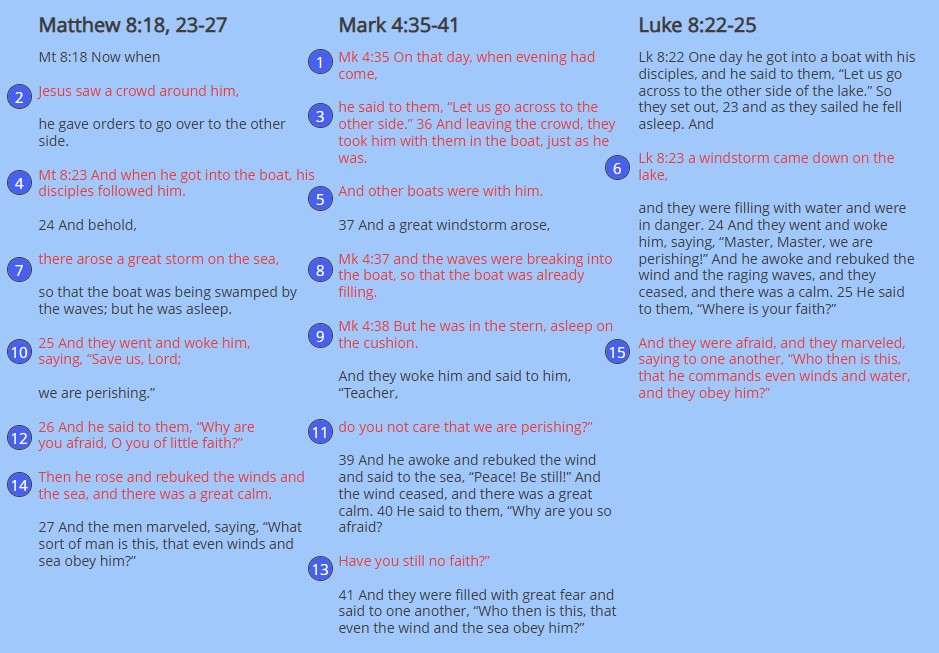
From the above worksheet photo, following the numbers and the text in red, the following narrative is produced.
Mk 4:35 On that day, when evening had come, Mt 8:18 Jesus saw a crowd around him, Mk 4:35 [and] he said to them, “Let us go across to the other side.” 36 And leaving the crowd, they took him with them in the boat, just as he was. Mt 8:23 And when he got into the boat, his disciples followed him. Mk 4:36 And other boats were with him.
Lk 8:23 [Now a violent] windstorm came down on the lake, [and] Mt 8:24 there arose a great storm on the sea, Mk 4:37 and the waves were breaking into the boat, so that the boat was already filling.
Mk 4:38 [Jesus] was in the stern, asleep on the cushion. Mt 8:25 And they went and woke him, saying, “Save us, Lord; Mk 4:38 do you not care that we are perishing?”
Mt 4:26 [But Jesus] said to them, “Why are you afraid, O you of little faith?” Mk 4:40 Have you still no faith?” Mk 4:39 [So Jesus] rose and rebuked the winds and the sea, and there was a great calm.
Lk 8:25 [But the disciples] were afraid, and they marveled, saying to one another, “Who then is this, that he commands even winds and water, and they obey him?”
Bible Lessons for this event:
H259 A Violent Storm (Matthew 8:18, 23-25; Mark 4:35-38; Luke 8:23)
H260 Storm Control by Jesus (Matthew 4:26; Mark 4:39-40; Luke 8:25)
Event Summary:
This event recounts the story of Jesus calming the storm, highlighting themes of faith, Jesus’ divine authority over creation, and the reassurance of his presence in times of fear and uncertainty.
Key points of this event are:
(1) Jesus instructs his disciples to cross to the other side of the lake, showing his intention to lead them on a journey. This is a reminder that following Jesus often involves stepping into unknown or challenging situations. Jesus calls his followers to trust him and obey, even when the path is uncertain or seems risky. (On the above worksheet see circles 1 – 5)
(2) As Jesus and the disciples sail across the lake, a fierce storm arises, causing waves to swamp the boat. The disciples, many of whom are experienced fishermen, are terrified and believe they are about to perish. Storms symbolize the trials and challenges of life. Even those close to Jesus will face situations that test their faith. The disciples’ fear illustrates how easy it is to lose trust in God’s care when overwhelmed by circumstances. (On the above worksheet see circles 6 – 8)
(3) Jesus, asleep during the storm, is awakened by his frightened disciples. He rebukes the wind and waves, and the storm immediately ceases. His power over the elements demonstrates his divine authority, revealing him as Lord over all creation. Jesus has power over every force, whether physical or spiritual. His calming of the storm reminds believers that he is sovereign and able to bring peace, no matter how dire the situation. (On the above worksheet see circles 9 – 11)
(4) After calming the storm, Jesus asks the disciples, “Why are you so afraid? Do you still have no faith?” (Mark) or “Where is your faith?” (Luke). This question challenges them to reflect on their trust in him, even in the face of danger. Faith involves trusting Jesus even in the midst of life’s storms. His presence is a reassurance that, no matter what the circumstances, he is in control and will not abandon His followers. (On the above worksheet see circles 12 – 14)
(5) The disciples marvel at Jesus, asking, “Who is this? Even the wind and the waves obey him!” This moment deepens their understanding of Jesus’ identity as the Son of God and their realization of his divine power. Encounters with Jesus in moments of crisis lead to greater faith and recognition of His true nature. (On the above worksheet see circle 15)
The story of Jesus calming the storm, making up this event, teaches that faith is essential in facing life’s challenges, and that Jesus, as Lord of all creation, is sovereign over every trial. His presence brings peace and reassurance, even in the most overwhelming situations. The disciples’ fear and awe reflect the human journey of growing in faith and understanding of who Jesus is. This passage encourages believers to trust in Jesus’ power and care, knowing that he is always with them, even in life’s most turbulent moments.
Discussion Questions with Extended Answers:
1. What prompted Jesus and His disciples to cross the lake, and what does this reveal about His ministry?
Answer:
In Matthew 8:18 and Mark 4:35, Jesus initiates the crossing after a day of teaching the crowds. This reveals that His ministry was intentional and directed; He was not reacting to circumstances but moving according to divine purpose. In Mark’s account, the phrase “Let us go across to the other side” shows His authority over the mission itself. The crossing leads to the region of the Gerasenes, where further ministry would occur. This demonstrates that Jesus’ work extends beyond Jewish regions and anticipates His mission to all people. It also shows that obedience to His call sometimes leads directly into challenging situations.
2. What was the condition of the storm, and how did it affect the disciples?
Answer:
The storm is described as a “great storm” (Matthew), a “great windstorm” (Mark), and a “windstorm” that filled the boat (Luke). The Sea of Galilee is known for sudden, violent storms due to its geography, but this storm was severe enough to terrify experienced fishermen. The waves were breaking into the boat, threatening to sink it. The disciples, though seasoned, were overwhelmed and feared for their lives. This highlights the intensity of the trial; they were not exaggerating their danger. Spiritually, it represents how even those familiar with life’s “storms” can find themselves in situations beyond their control.
3. What was Jesus doing during the storm, and why is this significant?
Answer:
Jesus was asleep in the stern of the boat (Mark 4:38), resting on a cushion. This detail is significant for several reasons. First, it reveals His true humanity—He was physically exhausted from ministry. Second, it demonstrates His complete trust in the Father; He was not anxious or alarmed by the storm. Third, His sleep contrasts sharply with the disciples’ panic, highlighting the difference between perfect faith and fearful doubt. His calm presence, even while asleep, symbolizes divine peace in the midst of chaos.
4. How did the disciples respond to Jesus during the storm?
Answer:
The disciples cried out in fear, saying, “Lord, save us! We are perishing!” (Matthew 8:25) and “Teacher, do you not care that we are perishing?” (Mark 4:38). Their response reveals both faith and doubt. On one hand, they turned to Jesus, recognizing Him as their only hope. On the other hand, their question implies uncertainty about His care and power. This mixture is common in believers, faith that seeks Christ, yet struggles to fully trust Him in crisis. Their plea becomes a model of honest prayer, even when imperfect.
5. What did Jesus say to the disciples before calming the storm, and what does this teach about faith?
Answer:
Jesus rebuked them, saying, “Why are you afraid, O you of little faith?” (Matthew 8:26). In Luke, He asks, “Where is your faith?” This indicates that their fear was not merely emotional but spiritual; they had not yet grasped who He truly was. Faith is not the absence of danger but confidence in Christ despite danger. Jesus expected them to trust Him because of what they had already seen, His teaching and miracles. This teaches that faith grows through remembering God’s past faithfulness and trusting His present authority.
6. How did Jesus calm the storm, and what does this reveal about His identity?
Answer:
Jesus rebuked the wind and the sea, saying, “Peace! Be still!” (Mark 4:39), and immediately there was a great calm. This act reveals His divine authority over creation. In the Old Testament, only God has power over the seas (see Psalm 107:29). By commanding nature itself, Jesus demonstrates that He is not merely a teacher or prophet, but God in the flesh. The immediacy and completeness of the calm show that His authority is absolute; creation obeys Him instantly.
7. How did the disciples respond after the storm was calmed?
Answer:
The disciples were filled with great fear and amazement, asking, “Who then is this, that even the wind and the sea obey him?” (Mark 4:41). Their fear shifted from the storm to a reverent awe of Jesus. This is a key turning point, they begin to recognize that they are in the presence of divine power. Their question reflects growing understanding but not yet full comprehension. It invites the reader to consider the same question and arrive at the conclusion that Jesus is Lord over all creation.
8. What spiritual lesson does this event teach about trials in the life of a believer?
Answer:
This event teaches that following Jesus does not eliminate storms; sometimes it leads directly into them. However, His presence in the storm guarantees ultimate safety, even when circumstances appear threatening. The disciples were never truly in danger of perishing because Jesus was with them. Trials reveal the condition of our faith and provide opportunities to grow in trust. The story encourages believers to rely on Christ’s power and presence rather than their own understanding.
9. Why is the contrast between “great storm” and “great calm” important?
Answer:
The narrative intentionally contrasts the “great storm” with a “great calm” to emphasize the magnitude of Jesus’ power. The same intensity that defined the storm now defines the peace. This highlights that Jesus does not merely improve difficult situations; He has the authority to completely transform them. Spiritually, it reflects how Christ brings total peace to the chaos of sin, fear, and uncertainty.
10. How does this passage contribute to the overall revelation of Jesus in the Gospels?
Answer:
This miracle reveals Jesus as sovereign over nature, reinforcing His divine identity. It builds upon earlier miracles (healing the sick, casting out demons) by showing His authority extends beyond people to all creation. In the broader context of the Gospels, it answers the question of who Jesus is, not just a miracle worker, but the Son of God with authority over all things. It also prepares the disciples for future understanding, as their recognition of His identity unfolds progressively throughout His ministry.


Leave a comment