
Photo: My Lovely Scotland
Author: Stephen Weller
2,549 words, 13 minutes read time
Healing a Demon-Possessed Man – Decapolis, East Side of Sea of Galilee
Scripture Reference: Matthew 8:28-34; Mark 5:1-20; Luke 8:26-39
Context:
The accounts of Matthew 8:28–34, Mark 5:1–20, and Luke 8:26–39 describe Jesus’ encounter with the demon-possessed man (or men, as Gospel of Matthew records two, while Gospel of Mark and Gospel of Luke focus on one) in the region of the Gerasenes/Gadarenes, a predominantly Gentile area on the eastern side of the Sea of Galilee. This event follows Jesus calming the storm, demonstrating His authority over nature, and now transitions to His authority over the spiritual realm. The man is described as living among the tombs, isolated from society, exhibiting superhuman strength, and tormented continually by a multitude of demons identifying themselves as “Legion,” indicating a vast number. The setting among tombs and unclean spirits, along with the presence of pigs, underscores the uncleanness of the region from a Jewish perspective. When Jesus confronts the demons, they immediately recognize His authority and divine identity, begging not to be tormented and requesting permission to enter a nearby herd of pigs. Jesus permits this, and the demons enter the pigs, which then rush into the sea and drown; visibly demonstrating the destructive nature of demonic forces. The herdsmen flee and report the event, and the townspeople, instead of rejoicing over the man’s restoration, respond with fear and ask Jesus to leave, revealing their greater concern for economic loss and disruption than for spiritual deliverance. In contrast, the healed man is found clothed and in his right mind, desiring to follow Jesus, but is instead commissioned to remain in his region and proclaim what God has done for him—making him one of the first witnesses to the Gentile world. This passage powerfully highlights Jesus’ supreme authority over demons, His compassion for the marginalized, the reality of spiritual warfare, and the varied human responses to His power, fearful rejection or faithful proclamation.
Event Narrative:
The narrative for this section was obtained from three similar texts, using the highlighted material shown below. The selection was determined by Jerry Peyton and copyrighted in 2015 by Jerry Peyton and Biblical Studies Press L.L.C.
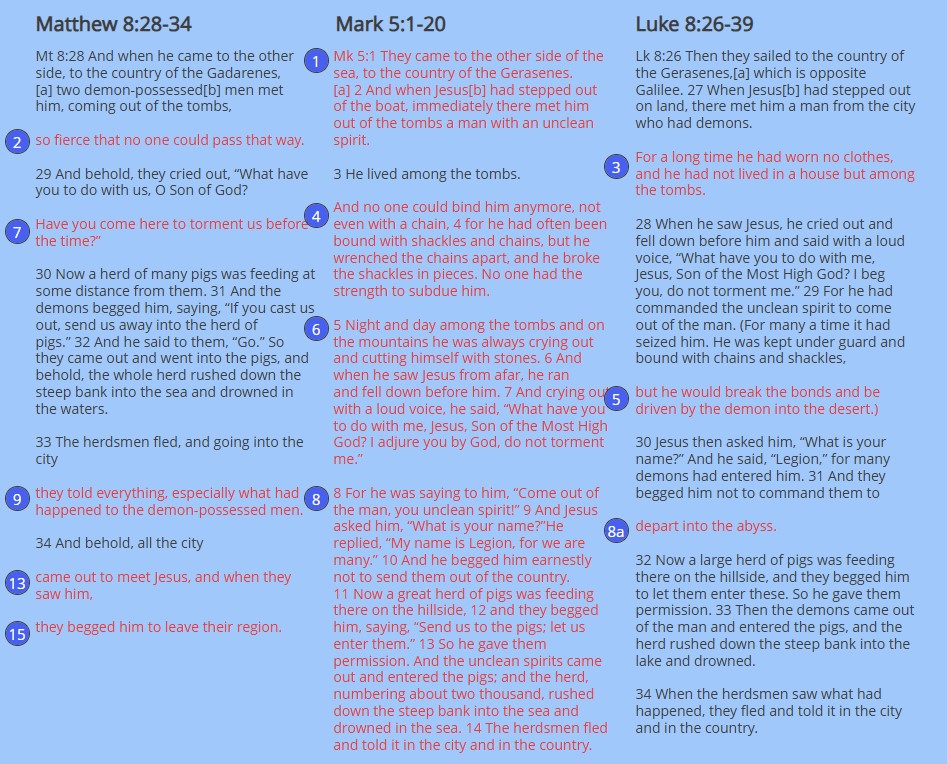
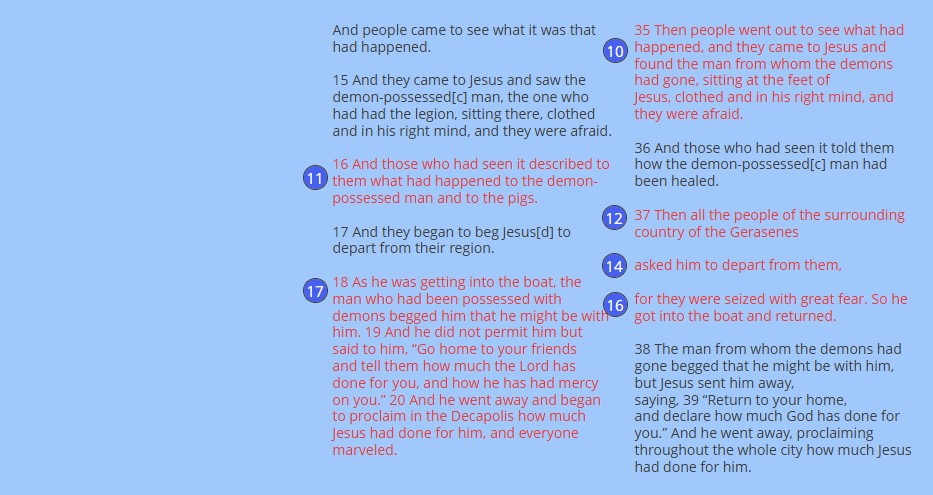
From the above worksheet photo, following the numbers and the text in red, the following narrative is produced.
A Demon Possessed Man
Mk 5:1 They came to the other side of the sea, to the country of the Gerasenes. 2 And when Jesus had stepped out of the boat, immediately there met him out of the tombs a man with an unclean spirit. [He was] Mt 8:28 so fierce that no one could pass that way. Lk 8:27 For a long time he had worn no clothes, and he had not lived in a house but among the tombs.
Mk 5:3 No one could bind him anymore, not even with a chain, 4 for he had often been bound with shackles and chains, but he wrenched the chains apart, and he broke the shackles in pieces. No one had the strength to subdue him. Lk 8:29 He would break the bonds and be driven by the demon into the desert. Mk 5:5 Night and day among the tombs and on the mountains, he was always crying out and cutting himself with stones.
Mk 5:6 And when he saw Jesus from afar, he ran and fell down before him. 7 And crying out with a loud voice, he said, “What have you to do with me, Jesus, Son of the Most High God? I adjure you by God, do not torment me.” Mt 8:29 Have you come here to torment us before the time?” Mk 5:8 For [Jesus] was saying to him, “Come out of the man, you unclean spirit!”
Mk 5:9 And Jesus asked him, “What is your name?”
Mk 5:9 He replied, “My name is Legion, for we are many.” 10 And he begged him earnestly not to send them out of the country Lk 8:31 and into the abyss.
From Man to Pigs
Mk 5:11 Now a great herd of pigs was feeding there on the hillside, 12 and they begged [Jesus], saying, “Send us to the pigs; let us enter them.” Mk 5:13 So he gave them permission. And the unclean spirits came out and entered the pigs; and the herd, numbering about two thousand, rushed down the steep bank into the sea and drowned in the sea.
Mk 5:14 The herdsmen fled and told it in the city and in the country. Mt 8:33 They told everything, especially what had happened to the demon-possessed men. Lk 8:35 Then people went out to see what had happened, and they came to Jesus and found the man from whom the demons had gone, sitting at the feet of Jesus, clothed and in his right mind, and they were afraid. 16 And those who had seen it described to them what had happened to the demon-possessed man and to the pigs. Lk 8:37 Then all the people of the surrounding country of the Gerasenes Mt 8:34 came out to meet Jesus, and when they saw him, [they] Lk 8:37 asked him to depart from them; Mt 8:34 they begged him to leave their region Lk 8:37 for they were seized with great fear. So, he got into the boat and returned.
Mk 5:18 As he was getting into the boat, the man who had been possessed with demons begged him that he might be with him. 19 And he did not permit him but said to him, “Go home to your friends and tell them how much the Lord has done for you, and how he has had mercy on you.” 20 And he went away and began to proclaim in the Decapolis how much Jesus had done for him, and everyone marveled.
Bible Lessons for this event:
H261 A Demon Possessed Man Encountered (Matthew 8:28-29; Mark 5:1-8; Luke 8:27, 29)
H262 No Bible Lesson
H263 From Man to Pigs (Mark 5:9-13; Luke 8:31)
H264 The Reaction of the People (Matthew 8:33-34; Mark 5:14, 16, 18-20; Luke 8:35, 37)
Event Summary:
This event recounts the story of Jesus healing a man (or men in Matthew) possessed by demons in the region of the Gerasenes (or Gadarenes in Matthew). This event highlights themes of Jesus’ authority over evil, the transformative power of his deliverance, and the appropriate response to his work.
Key points of this event are:
(1) Jesus encounters a man (or men) possessed by demons who live among the tombs, cut off from society, and are uncontrollable due to the destructive power of the spirits. When the demons see Jesus, they immediately recognize his divine authority and beg not to be sent into the abyss. Jesus permits the demons to enter a herd of pigs, which then rush into the lake and drown. This demonstrates his absolute authority over the spiritual realm, showing that even the forces of evil must submit to him. Jesus has power over all forces of evil, bringing liberation to those who are oppressed. His authority extends over both the physical and spiritual worlds. (On the above worksheet see circles 1 – 9)
(2) After Jesus casts out the demons, the man is completely transformed—he is found sitting calmly, clothed, and in his right mind. This radical change underscores the restorative power of Jesus, who not only delivers but also restores dignity and peace to the man. Jesus’ deliverance brings not only freedom from oppression but also renewal and healing, offering people a new beginning. (On the above worksheet see circle 10)
(3) The townspeople, upon seeing the man healed and hearing about the drowned pigs, respond with fear and ask Jesus to leave their region. Their reaction reveals a focus on the economic loss (the pigs) rather than the miracle of the man’s transformation. The presence of Jesus can be disruptive, challenging priorities and revealing misplaced values. Some may resist his transformative power when it disrupts their comfort or material concerns. (On the above worksheet see circles 11 – 16)
(4) The healed man begs to follow Jesus, but Jesus instead sends him back to his home to proclaim what God has done for him. The man obeys, spreading the news throughout the region, becoming a witness to Jesus’ power and mercy. Those who experience Jesus’ transformative power are called to share their testimony, becoming messengers of God’s goodness and grace in their own communities. (On the above worksheet see circle 17)
(5) The demons acknowledge Jesus as the Son of God and his authority over them. This serves as a powerful affirmation of his divine nature, even in a Gentile region far from Jewish religious centers. Jesus’ authority and mission are universal, extending beyond cultural and geographic boundaries to bring freedom and restoration to all people. (On the above worksheet see circle 17)
The story of Jesus healing the demon-possessed man, making up this event, demonstrates his absolute authority over evil, his ability to bring healing and restoration, and the call to respond to his work with faith and testimony. It warns against valuing material concerns over spiritual transformation and challenges believers to embrace the disruptive yet redemptive power of Jesus’ presence. Ultimately, this event highlights Jesus as the liberator who brings peace, calling those transformed by him to share his message of hope with the world.
Discussion Questions with Extended Answers:
1. Where does this event take place, and why is that significant?
Answer:
This event occurs in the region of the Gerasenes (or Gadarenes), which is on the eastern side of the Sea of Galilee, a predominantly Gentile area. This is significant because it shows that Jesus’ authority and mission extend beyond Israel to the Gentile world. The presence of pigs (unclean animals under Jewish law) confirms the Gentile setting. This passage anticipates the broader mission of the gospel going to all nations, demonstrating that Christ’s power over evil is universal, not limited by geography or ethnicity.
2. How do the Gospel accounts differ in describing the demon-possessed individuals?
Answer:
Matthew mentions two demon-possessed men, while Mark and Luke focus on one. This is not a contradiction but a difference in emphasis. Matthew records both individuals, while Mark and Luke highlight the more prominent or severe case to provide a detailed narrative. Mark and Luke give a fuller account of the man’s condition and transformation, emphasizing the dramatic nature of Jesus’ deliverance. This selective focus is common in Gospel writing and serves theological and narrative purposes.
3. What was the condition of the demon-possessed man before encountering Jesus?
Answer:
The man was in a state of extreme spiritual and physical torment. He lived among the tombs, indicating isolation, uncleanness, and separation from society. He exhibited supernatural strength, breaking chains and restraints, yet he was uncontrollable and self-destructive, often crying out and cutting himself with stones (Mark and Luke). His condition illustrates the destructive nature of demonic influence, alienation, loss of identity, and bondage. He represents the depth of human helplessness apart from divine intervention.
4. What does the name “Legion” reveal about the nature of the demonic presence?
Answer:
When asked his name, the demon responds, “Legion,” indicating that many demons were present within the man. A Roman legion could consist of thousands of soldiers, suggesting an overwhelming level of demonic oppression. This reveals both the severity of the man’s condition and the organized nature of demonic forces. Yet, despite their number, they are powerless before Jesus. This contrast highlights Christ’s supreme authority over even the most overwhelming spiritual opposition.
5. How do the demons respond to Jesus, and what does this reveal about His authority?
Answer:
The demons immediately recognize Jesus as the Son of God and plead with Him not to torment them before the appointed time. They beg for permission to enter a herd of pigs. This response shows that demonic forces are subject to Jesus’ authority; they cannot act without His permission. Their fear demonstrates that Jesus is the ultimate judge and ruler over the spiritual realm. Even evil spirits acknowledge His divine identity and power.
6. Why did Jesus allow the demons to enter the pigs, and what was the result?
Answer:
Jesus permits the demons to enter a herd of pigs, which then rush down a steep bank into the sea and drown. This event visibly demonstrates the destructive intent of the demons; they bring death and chaos. It also provides tangible proof that the demons have left the man. The loss of the pigs, while economically significant, reveals the greater value of a human life restored. The event underscores that spiritual deliverance is more important than material possessions.
7. How did the people of the region respond to this miracle, and why?
Answer:
Instead of rejoicing, the people respond with fear and ask Jesus to leave their region. Their reaction likely stems from a combination of fear of His power and concern over economic loss (the pigs). They recognize that Jesus’ presence brings disruption and authority beyond their control. This response reveals a tragic preference for stability and material security over spiritual transformation and truth.
8. What transformation is seen in the healed man?
Answer:
The man who was once possessed is now described as sitting, clothed, and in his right mind. This indicates complete restoration, mentally, physically, and socially. He is no longer isolated among the tombs but reintegrated into normal life. His transformation demonstrates the totality of Jesus’ saving power: He not only removes evil but restores dignity, identity, and peace. This is a vivid picture of redemption and new life.
9. Why does Jesus tell the man to stay and testify rather than follow Him?
Answer:
When the healed man asks to follow Jesus, Jesus instead instructs him to return to his home and declare what God has done for him. This is significant because, in a Gentile region, the man becomes a witness to God’s mercy. While Jesus often tells people in Jewish regions to remain silent (to control the timing of His revelation), here He commissions the man as a messenger. His testimony prepares the way for future ministry in that region and demonstrates that personal testimony is a powerful tool for spreading the gospel.
10. What does this account teach about the nature of spiritual warfare and Christ’s power?
Answer:
This account reveals that spiritual warfare is real and intense, but it also affirms that Christ’s authority is absolute. No matter how severe the bondage, Jesus has the power to deliver completely. The story illustrates the destructive intent of evil, the helplessness of humanity without God, and the transforming power of Christ. It encourages believers to trust in Jesus’ authority over all spiritual forces and to recognize that true freedom comes only through Him.
11. How does this passage foreshadow the mission of the Church?
Answer:
The sending of the healed man to proclaim what God has done foreshadows the mission of the Church; to go and testify of Christ’s saving work. His story becomes a model of evangelism: a transformed life bearing witness to God’s mercy. It also points to the inclusion of the Gentiles in God’s redemptive plan. Just as this man was sent to his people, believers are called to share the gospel within their own communities and beyond.


Leave a comment