
Photo: Ryan Lamont (A moody sunset at Heceta Head Light! Florence, Oregon)
Author: Stephen Weller
2,383 words, 13 minutes read time
Healing Jairus’s Daughter and a Bleeding Woman – Capernaum, Galilee
Scripture Reference: Matthew 9:18-26; Mark 5:21-43; Luke 8:40-56
Context:
The accounts in Matthew 9:18–26, Mark 5:21–43, and Luke 8:40–56 occur during a pivotal period in Jesus’ Galilean ministry when His authority over sickness, demons, and even death is being progressively revealed to the crowds and His disciples. Having just crossed back from the region of the Gerasenes, where He demonstrated power over a legion of demons, Jesus is immediately met by a large, expectant crowd. In this setting, a synagogue ruler named Jairus approaches Him in desperation, pleading for the life of his dying daughter, reflecting both the urgency of human need and the growing recognition of Jesus’ divine authority. As Jesus goes with him, the narrative is interrupted by a woman who had suffered from a chronic flow of blood for twelve years, ceremonially unclean and socially isolated according to the Law, yet displaying remarkable faith by believing that merely touching Jesus’ garment would bring healing. This “interwoven miracle” structure highlights contrasting yet complementary expressions of faith: one public and desperate, the other private and trembling. Jesus pauses to draw attention to the woman’s faith, not only healing her physically but restoring her socially and spiritually by calling her “daughter.” Meanwhile, news arrives that Jairus’ daughter has died, intensifying the crisis and setting the stage for an even greater revelation of Jesus’ authority. Jesus responds with a call to faith over fear, proceeds to the house, dismisses the mourners, and raises the girl to life, demonstrating His sovereign power over death itself. Together, these events emphasize that Jesus is not hindered by delay, human limitation, or even death, and they reveal that faith, whether expressed boldly or quietly, is the means by which individuals experience His saving power.
Event Narrative:
The narrative for this section was obtained from three similar texts, using the highlighted material shown below. The selection was determined by Jerry Peyton and copyrighted in 2015 by Jerry Peyton and Biblical Studies Press L.L.C.
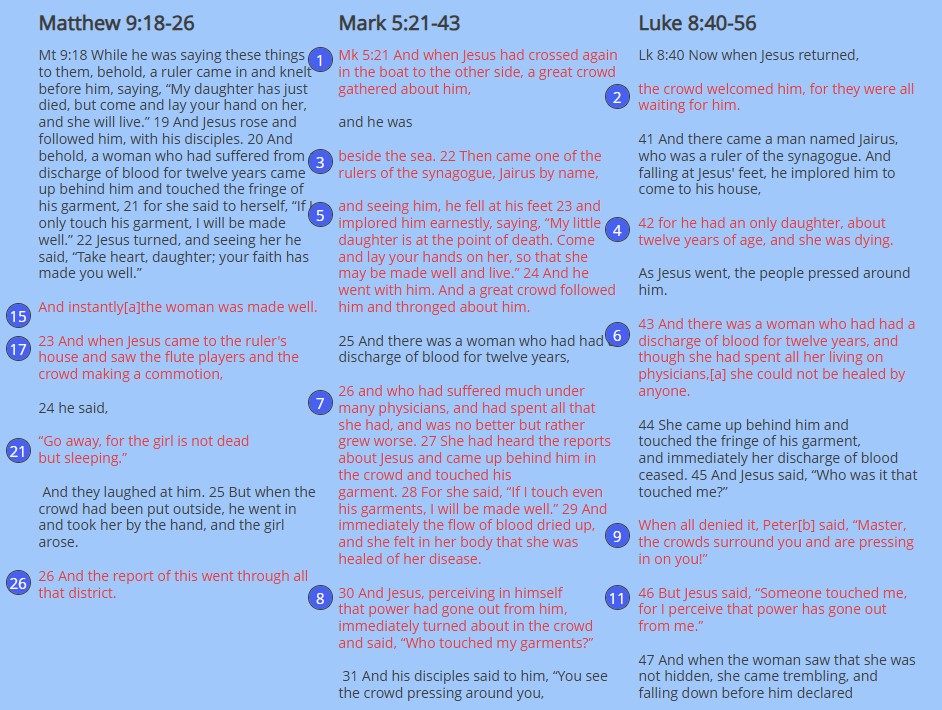

From the above worksheet photos, following the numbers and the text in red, the following narrative is produced.
Mk 5:21 And when Jesus had crossed again in the boat to the other side, a great crowd gathered about him, Lk 8:40 [and] welcomed him, for they were all waiting for him Mk 5:21 beside the sea. 22 Then came one of the rulers of the synagogue, Jairus by name, Lk 8:42 for he had an only daughter, about twelve years of age, and she was dying. Mk 5:22 [When] seeing [Jesus], he fell at his feet 23 and implored him earnestly, saying, “My little daughter is at the point of death. Come and lay your hands on her, so that she may be made well and live.” 24 [Jesus] went with him and a great crowd followed him and thronged about him.
Lk 8:43 [Now] there was a woman who had had a discharge of blood for twelve years, and though she had spent all her living on physicians, she could not be healed by anyone. Mk 5:26 [She] had suffered much under many physicians, and had spent all that she had, and was no better but rather grew worse. 27 She had heard the reports about Jesus and came up behind him in the crowd and touched his garment. 28 For she said, “If I touch even his garments, I will be made well.” 29 And immediately the flow of blood dried up, and she felt in her body that she was healed of her disease.
Mk 5:30 [Now] Jesus, perceiving in himself that power had gone out from him, immediately turned about in the crowd and said, “Who touched my garments?”
Lk 8:45 When all denied it, Peter said, “Master, the crowds surround you and are pressing in on you!” Mk 5:31 and yet you say, ‘Who touched me?’”
Lk 8:46 But Jesus said, “Someone touched me, for I perceive that power has gone out from me.” Mk 5:32 And he looked around to see who had done it.
Mk 5:33 [Now] the woman, knowing what had happened to her, came in fear and trembling and fell down before him and told him the whole truth Lk 8:47 in the presence of all the people why she had touched him, and how she had been immediately healed.
Mk 5:34 [Jesus] said to her, “Daughter, your faith has made you well; go in peace and be healed of your disease.” Mt 9:22 and instantly the woman was made well.
Bible Lessons for this event:
H265 Two Examples of Faith (Mark 5:21-24, 26-29; Luke 8:40, 42-43
H266 Woman’s Plan Worked (Matthew 9:22; Mark 5:30-34; Luke 8:45-47)
H267 Daughter Raised from the Dead (Matthew 9:23-24, 26; Mark 5:38-43; Luke 8:49-53, 55)
Event Summary:
This event recounts the intertwined stories of Jairus’ daughter being raised from the dead and the healing of the woman with the issue of blood. Together, these miracles highlight themes of faith, Jesus’ authority over life and death, and the inclusiveness of his healing power.
Key points of this event are:
(1) Jairus, a synagogue leader, approaches Jesus with desperation and faith, asking him to heal his dying daughter. Despite his high social status, Jairus humbly kneels before Jesus, showing his belief in Jesus’ power. (On the above worksheet see circles 1 – 5) The woman with the issue of blood, suffering for 12 years, believes that merely touching Jesus’ cloak will heal her. Her faith is personal, bold, and persistent. (On the above worksheet see circles 6 – 7) Faith, regardless of one’s social standing or circumstances, is the key to experiencing Jesus’ power and grace. Both Jairus and the woman demonstrate the kind of trust and boldness that Jesus honors.
(2) When Jairus’ daughter is reported dead, Jesus tells him, “Don’t be afraid; just believe.” Jesus goes to Jairus’ home, takes the girl by the hand, and restores her to life, demonstrating his authority even over death. (On the above worksheet see circles 16 – 24) Jesus’ power extends to both physical healing and the ultimate enemy, death itself. His ability to raise the dead confirms his divine nature and his role as the giver of life.
(3) The woman with the issue of blood had been ostracized because her condition made her ceremonially unclean. By healing her and publicly addressing her, Jesus restores her health and dignity, calling her “Daughter” (Mark 5:34), a term of affection and inclusion. Jairus’ daughter is also tenderly addressed by Jesus, showing that his care and power are available to all, from the marginalized to the influential (Mark 5:41). Jesus’ healing ministry is inclusive and compassionate, breaking down societal and religious barriers to bring restoration to all who seek him in faith.
(4) On his way to Jairus’ home, Jesus pauses to address the woman who touched his cloak, delaying his journey (Luke 8:43). While this might have seemed like an unnecessary delay to others, it demonstrates Jesus’ attentiveness to every individual’s need, even in urgent situations. God’s timing may not align with human expectations, but his power and compassion are never late. Jesus’ actions show that he values each person’s faith and trust in him.
(5) When news arrives that Jairus’ daughter has died, the situation appears hopeless. Yet, Jesus reassures Jairus to continue believing (Luke 8:49-50), demonstrating that even in the most dire circumstances, his power brings hope. Jesus calls his followers to trust him completely, even when circumstances seem beyond repair. Faith in him brings hope and life, even in the face of death.
The stories, of this event, of Jairus’ daughter and the woman with the issue of blood emphasize that faith is essential for experiencing Jesus’ transformative power. Jesus demonstrates his authority over sickness, death, and social barriers, showing that his compassion and healing are available to all. These miracles encourage believers to trust in Jesus’ power and timing, even in seemingly hopeless situations, and to approach him with bold, unwavering faith.
Discussion Questions with Extended Answers:
1. Who was Jairus, and what does his request reveal about him?
Answer:
Jairus was a synagogue leader, a man of status and responsibility within the Jewish religious community. His position would normally align him with those cautious or even skeptical of Jesus. Yet, his actions reveal deep humility and desperation; he falls at Jesus’ feet and pleads earnestly for his dying daughter. This demonstrates that faith often emerges most clearly in moments of crisis. Jairus shows that true faith is not concerned with reputation but with reaching Jesus. His request reveals both his belief in Jesus’ authority and his urgent dependence on Him.
2. What is significant about the woman with the bleeding condition?
Answer:
The woman had suffered for twelve years, spending all she had on physicians without improvement. According to Jewish law (Leviticus 15), her condition made her ceremonially unclean, isolating her socially and religiously. Her suffering was therefore physical, emotional, and spiritual. Her approach to Jesus, quietly touching His garment, shows both humility and bold faith. She believed that even indirect contact with Jesus’ power would heal her. Her condition lasting twelve years also parallels the age of Jairus’ daughter, creating a meaningful connection between the two miracles.
3. Why did Jesus stop to address the woman instead of continuing immediately to Jairus’ house?
Answer:
Jesus’ pause demonstrates that He is never rushed or limited by human urgency. While Jairus’ situation was critical, Jesus took time to acknowledge the woman publicly. This was not because He lacked awareness, but to draw out her faith, affirm her healing, and restore her dignity before the crowd. By calling her “Daughter,” He not only healed her body but also welcomed her back into community and relationship. This moment teaches that Jesus values both the visible crisis and the hidden suffering equally.
4. What does the woman’s healing teach about faith?
Answer:
Her healing illustrates that faith is not about physical proximity alone but about trust in Jesus’ power and authority. She believed, “If I only touch His garment, I will be healed.” Jesus confirms this by saying, “Your faith has made you well.” Faith, in this context, is active; it moves her to act despite fear, shame, and obstacles. It also shows that even a seemingly small expression of faith, when directed toward Christ, is sufficient because the power lies in Him, not in the strength of the faith itself.
5. What message was brought to Jairus while Jesus was still speaking, and how did Jesus respond?
Answer:
Messengers arrived to tell Jairus that his daughter had died, suggesting that there was no longer any reason to trouble Jesus. This moment represents the collapse of hope from a human perspective. However, Jesus immediately responds with, “Do not fear; only believe.” This statement shifts the focus from circumstances to faith. Jesus calls Jairus to trust beyond what he can see, teaching that faith must persist even when situations appear final or hopeless.
6. Why did Jesus allow only a few disciples to enter the house?
Answer:
Jesus took Peter, James, and John with Him, along with the child’s parents. This smaller group allowed for a more intimate and focused setting, free from the skepticism and commotion of the crowd. It also prepared these disciples for future leadership by giving them firsthand experience of His power over death. Additionally, it removed the influence of unbelief, as the mourners were already expressing doubt and ridicule.
7. Why did Jesus say, “The child is not dead but sleeping”?
Answer:
Jesus used the term “sleep” to reframe death from His divine perspective. While the child was physically dead, Jesus viewed death as temporary and reversible under His authority. This statement also tested the faith of those present, as the mourners responded with ridicule. It highlights the difference between human understanding, which sees finality, and divine power, which sees possibility.
8. How did Jesus raise Jairus’ daughter?
Answer:
Jesus took the girl by the hand and spoke the words, “Talitha koum,” meaning “Little girl, I say to you, arise.” Immediately, she stood up and began to walk. This simple yet authoritative command demonstrates Jesus’ power over death. There is no struggle or ritual, only His word is needed. It reveals that life responds instantly to His authority.
9. Why did Jesus instruct that the girl be given something to eat?
Answer:
This instruction confirms the completeness and reality of the miracle. The girl was not merely revived in appearance but fully restored to life and health. Eating is a natural act, demonstrating that she had truly returned to normal life. It also reflects Jesus’ compassion and attention to practical needs, showing that His care extends beyond the miraculous moment.
10. What do these two miracles together teach about Jesus’ authority?
Answer:
Together, these miracles reveal Jesus’ authority over both chronic illness and death. The woman’s condition represents long-term suffering that no human effort could cure, while the girl’s death represents the ultimate human limitation. Jesus overcomes both with ease. The pairing of these accounts emphasizes that no situation, whether prolonged or seemingly final, is beyond His power. It also shows that faith, whether expressed quietly or boldly, is met with His compassionate response.
11. How do these events illustrate the relationship between fear and faith?
Answer:
Fear is a natural response in both accounts; the woman fears exposure, and Jairus fears loss. Jesus directly addresses fear by calling for faith: “Do not fear; only believe.” Faith does not deny reality but trusts in Jesus above it. The narratives show that faith often must persist in the presence of fear, and that Jesus meets individuals at that intersection, guiding them toward trust.
12. What is the broader spiritual lesson of this combined narrative?
Answer:
The combined narrative teaches that Jesus responds to both public and private needs, honors persistent faith, and has authority over every form of human suffering, even death itself. It reveals that faith may begin in desperation but is strengthened through encounter with Christ. Ultimately, the passage points to Jesus as the giver of life, foreshadowing His victory over death through His own resurrection and His power to bring spiritual life to all who believe.


Leave a comment