
Photo: Hannes Koenig (Do you think I can trust him)
Author: Stephen Weller
2,001 words, 11 minutes read time
John the Baptist Executed
Scripture Reference: Matthew 14:3-13; Mark 6:17-29
Context:
Matthew 14:3–13 and Mark 6:17–29 provide a sobering narrative that explains the death of John the Baptist within the broader unfolding of Jesus’ ministry. John, the forerunner of Christ, had boldly confronted Herod Antipas for his unlawful marriage to Herodias, his brother’s wife, demonstrating prophetic faithfulness rooted in God’s law rather than fear of political authority. This confrontation led to John’s imprisonment, revealing the tension between God’s truth and worldly power. Herod himself was conflicted; he feared John as a righteous and holy man and was intrigued by his message, yet he was spiritually weak and morally compromised. The turning point comes during Herod’s birthday banquet, a setting marked by indulgence and pride, where Herodias seizes an opportunity through her daughter’s dance to manipulate Herod into ordering John’s execution. Bound by his rash oath and concern for public perception before his guests, Herod chooses reputation over righteousness, illustrating the destructive power of unchecked sin and human approval. John’s beheading in prison marks the end of his prophetic ministry but also foreshadows the rejection and suffering that will culminate in Jesus’ own death. When Jesus hears of John’s death (Matthew 14:13), He withdraws to a solitary place, reflecting both personal grief and the mounting opposition to His mission. This passage highlights themes of courage in proclaiming truth, the cost of discipleship, the moral weakness of compromised leadership, and the inevitable conflict between the kingdom of God and the kingdoms of this world, while also serving as a transition point that intensifies the focus on Jesus’ ministry and mission.
Event Narrative:
The narrative for this section was obtained from two similar texts, using the highlighted material shown below. The selection was determined by Jerry Peyton and copyrighted in 2015 by Jerry Peyton and Biblical Studies Press L.L.C.
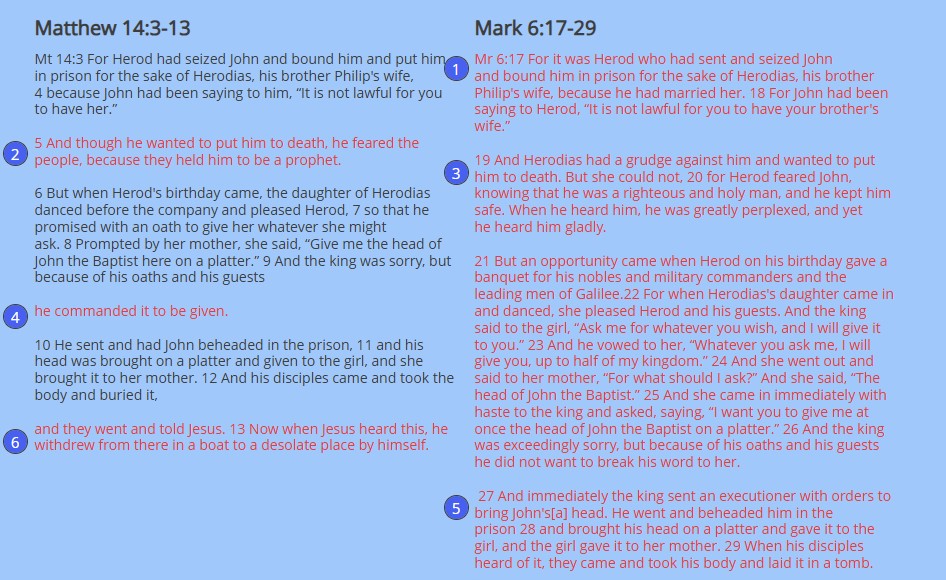
From the above worksheet photo, following the numbers and the text in red, the following narrative is produced.
Mk 6:17 For it was Herod who had sent and seized John and bound him in prison for the sake of Herodias, his brother Philip’s wife, because he had married her. 18 For John had been saying to Herod, “It is not lawful for you to have your brother’s wife.” Mt 14:5 And though he wanted to put him to death, he feared the people, because they held him to be a prophet.
Mk 6:19 And Herodias had a grudge against him and wanted to put him to death. But she could not, 20 for Herod feared John, knowing that he was a righteous and holy man, and he kept him safe. When he heard him, he was greatly perplexed, and yet he heard him gladly.
21 But an opportunity came when Herod on his birthday gave a banquet for his nobles and military commanders and the leading men of Galilee. 22 For when Herodias’s daughter came in and danced, she pleased Herod and his guests. And the king said to the girl, “Ask me for whatever you wish, and I will give it to you.” 23 And he vowed to her, “Whatever you ask me, I will give you, up to half of my kingdom.”
24 And she went out and said to her mother, “For what should I ask?” And she said, “The head of John the Baptist.”
25 And she came in immediately with haste to the king and asked, saying, “I want you to give me at once the head of John the Baptist on a platter.”
26 And the king was exceedingly sorry, but because of his oaths and his guests he did not want to break his word to her Mt 14:9 he commanded it to be given. Mk 6:27 And immediately the king sent an executioner with orders to bring John’s head. He went and beheaded him in the prison 28 and brought his head on a platter and gave it to the girl, and the girl gave it to her mother. 29 When his disciples heard of it, they came and took his body and laid it in a tomb Mt 14:12 and they went and told Jesus. 13 Now when Jesus heard this, he withdrew from there in a boat to a desolate place by himself.
Bible Lessons for this event:
H269 Why Was John the Baptist in Prison (Matthew 14:5; Mark 6:17-20)
H270 The Foolish Execution of John (Matthew 14:9, 12-13; Mark 6:21-29)
Event Summary:
This event recounts the death of John the Baptist, highlighting themes of courage in standing for truth, the cost of discipleship, human weakness, and the continuing conflict between God’s kingdom and worldly power.
Key points of this event are:
(1) John the Baptist is imprisoned by Herod Antipas because he publicly rebuked Herod for unlawfully marrying Herodias, his brother Philip’s wife. Despite the personal risk, John stands firm in proclaiming the truth. (On the above worksheet see circles 1 – 2) Faithfulness to God’s truth often requires courage, even in the face of opposition or personal danger. John serves as a model of integrity and boldness in standing up for righteousness.
(2) Herodias harbors a grudge against John and manipulates the situation to have him executed. During a banquet, Herod makes a rash promise to Herodias’ daughter after her dance, leading to John’s beheading at her request. (On the above worksheet see circle 3) Proclaiming God’s truth can lead to persecution, rejection, or even martyrdom. John’s death illustrates the potential cost of discipleship and unwavering commitment to God’s mission.
(3) Herod is portrayed as conflicted. He respects John and recognizes him as a righteous man, but he lacks the moral courage to protect him. His fear of losing face in front of his guests drives him to fulfill Herodias’ deadly request. (On the above worksheet see circle 4) Weakness of character and the desire for approval from others can lead to moral compromise and devastating consequences. Herod’s actions warn against prioritizing worldly reputation over doing what is right.
(4) The death of John the Baptist parallels Jesus’ own future suffering and execution. Both confront political and religious authorities with the truth, leading to rejection and death. (On the above worksheet see circle 5) John’s martyrdom foreshadows the cost of bringing God’s kingdom into a world resistant to truth and righteousness. It reminds believers that the mission of God often involves suffering but ultimately leads to victory.
(5) After John’s death, his disciples take his body and bury it, then go to inform Jesus. Jesus withdraws to a solitary place, likely to grieve and pray. (On the above worksheet see circles 5 – 6) The response of John’s disciples and Jesus demonstrates the importance of honoring those who have sacrificed for God’s mission and seeking God in times of grief and loss.
In this event the story of John the Baptist’s death underscores the cost of discipleship, the courage required to stand for truth, and the moral dangers of fear and compromise. It highlights the tension between God’s kingdom and worldly powers, showing that faithfulness to God may lead to suffering but remains a vital witness to righteousness. John’s life and death call believers to live boldly for God, trust him in the face of opposition, and remain committed to the truth, no matter the cost.
Discussion Questions with Extended Answers:
1. Why was John the Baptist imprisoned by Herod?
Answer:
John the Baptist was imprisoned because he boldly confronted Herod about his unlawful marriage to Herodias, who had previously been the wife of Herod’s brother Philip. According to the Law (Leviticus 18:16; 20:21), this relationship was sinful. John’s role as a prophet required him to speak truth regardless of consequences. His imprisonment shows the cost of faithfulness; standing for righteousness often brings opposition from those in power who refuse to repent.
2. What do we learn about Herod’s character from these passages?
Answer:
Herod is portrayed as conflicted and weak. He feared John, recognizing him as a righteous and holy man, and even listened to him at times (Mark 6:20). However, Herod lacked moral courage. He was more concerned about public opinion and saving face before his guests than doing what was right. His decision to execute John reveals a man controlled by fear, pride, and pressure rather than truth and conviction.
3. How does Herodias influence the events that lead to John’s death?
Answer:
Herodias harbored deep resentment toward John because he exposed her sin. She sought an opportunity to silence him permanently. When her daughter pleased Herod at his banquet, Herodias seized the moment and instructed her to ask for John’s head. Her actions demonstrate how unchecked bitterness and hatred can lead to destructive outcomes. She represents a hardened opposition to truth and righteousness.
4. What role does Herodias’s daughter play in this account?
Answer:
Herodias’s daughter (traditionally identified as Salome) plays a key role as the instrument through which Herodias carries out her plan. Though she performed the dance that pleased Herod, she acted under her mother’s influence when making the request. This shows how others can be used, sometimes unknowingly, to carry out harmful intentions when guided by ungodly counsel.
5. Why did Herod agree to execute John even though he was distressed?
Answer:
Herod agreed to execute John because of his oath and his desire to maintain honor before his guests. In that culture, breaking an oath, especially in a public setting, would have brought shame. However, Herod’s decision reveals misplaced priorities. He valued reputation over righteousness. His grief shows he knew the act was wrong, yet he lacked the integrity to choose what was right over what was socially expected.
6. What does John the Baptist’s death teach us about the cost of discipleship?
Answer:
John’s death demonstrates that faithfulness to God can come at a great personal cost, even death. As a forerunner of Christ, John remained steadfast in proclaiming truth without compromise. His life and death foreshadow the suffering of Jesus and remind believers that following God does not guarantee earthly safety but does guarantee eternal purpose. True discipleship requires courage, conviction, and willingness to stand firm regardless of consequences.
7. How did John’s disciples respond to his death?
Answer:
John’s disciples showed loyalty and respect by taking his body, burying it, and then going to inform Jesus. Their actions reflect devotion not only to John but also to the truth he proclaimed. It also highlights the connection between John’s ministry and Jesus’ ministry; John’s followers recognized Jesus as the one to whom John had pointed.
8. How did Jesus respond when He heard about John’s death?
Answer:
When Jesus heard the news, He withdrew to a solitary place. This response reveals His humanity; He experienced grief over the loss of John, who was both a relative and a faithful servant of God. It also shows His desire for quiet reflection and communion with the Father in times of sorrow. Yet even in grief, Jesus continued His ministry, demonstrating compassion for the crowds who followed Him.
9. What connection can be seen between John’s death and Jesus’ future suffering?
Answer:
John’s death foreshadows the rejection and execution of Jesus. Both were righteous men who spoke truth and were opposed by corrupt leaders. Both were unjustly condemned due to political pressure and moral weakness. John’s death serves as a precursor, preparing the way not only for Jesus’ ministry but also for the pattern of suffering that would culminate in the cross.
10. What overall spiritual lessons can be drawn from this passage?
Answer:
This passage teaches several important lessons:
- God’s plan continues, even through tragedy, as John’s death transitions to the continued ministry of Jesus.
- Truth must be spoken boldly, even when it is unpopular.
- Sin hardens the heart when it is defended instead of repented of.
- Fear of man leads to poor decisions, while fear of God leads to righteousness.
- Faithfulness to God may involve suffering, but it is never without purpose.


Leave a comment