
Photo: Terry Waters Photography & Design (Tintagel footbridge)
Previous Lesson
Next Lesson
Author: Stephen Weller
3,045 words, 16 minutes read time
Bread of Life – Capernaum, Gennesaret – NW side Sea of Galilee
Scripture Reference: Matthew 14:34-35a; Mark 6:53-54; John 6:22-58
Context:
These passages describe the immediate aftermath of Jesus’ miraculous walking on the sea and the feeding of the five thousand, drawing together a pivotal moment in His Galilean ministry where His identity becomes both more revealed and more contested. After crossing the Sea of Galilee, Jesus and His disciples arrive in the region of Gennesaret, where the people quickly recognize Him (as noted in Matthew and Mark). This recognition reflects the growing reputation of Jesus as a healer and miracle worker, prompting widespread response and urgent movement among the people to bring the sick to Him. The scene highlights both the faith and desperation of the crowds, as well as the compassionate power of Jesus, who continues to heal all who come to Him. At the same time, John’s account shifts the focus from physical need to spiritual understanding. The crowd that had been miraculously fed follows Jesus across the sea, seeking Him not because they fully grasp the sign, but because they desire more bread. Jesus confronts this shallow pursuit and begins to teach about the true “bread from heaven,” revealing Himself as the Bread of Life. This teaching marks a significant turning point, as Jesus calls the crowd away from temporal, physical provision toward eternal, spiritual nourishment found only in Him. Together, these passages contrast superficial faith based on miracles with genuine belief rooted in recognizing Jesus’ divine identity and mission, setting the stage for both deeper discipleship and increasing opposition.
Event Narrative:
The narrative for this section was obtained from three similar texts, using the highlighted material shown below. The selection was determined by Jerry Peyton and copyrighted in 2015 by Jerry Peyton and Biblical Studies Press L.L.C.
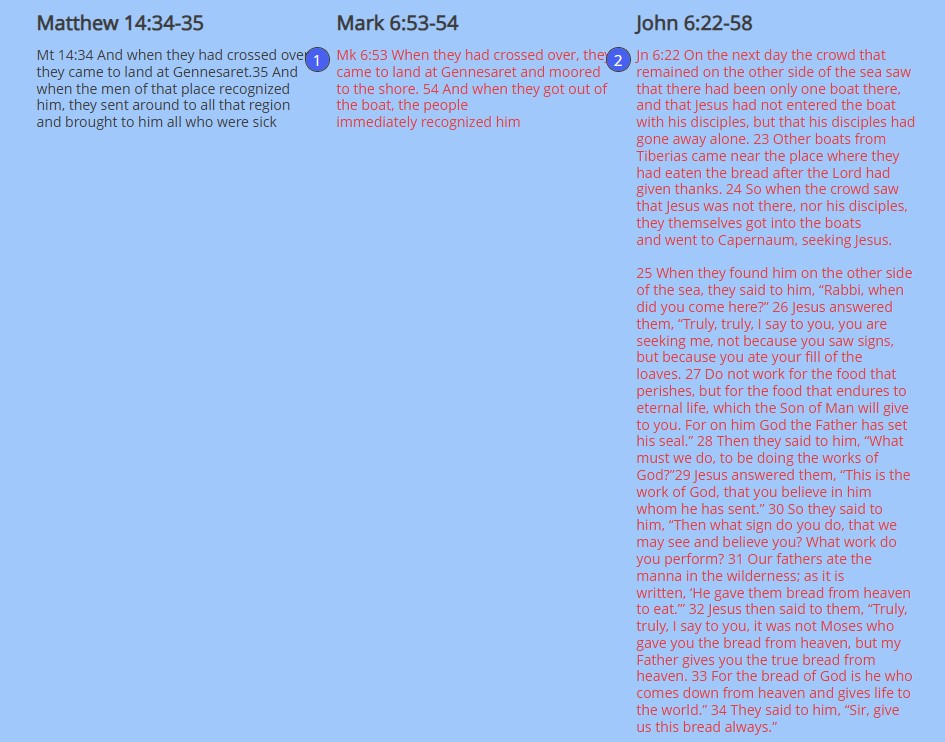


From the above worksheet photo, following the numbers and the text in red, the following narrative is produced.
Bread From Heaven
Mk 6:53 When they had crossed over, they came to land at Gennesaret and moored to the shore. 54 And when they got out of the boat, the people immediately recognized [Jesus].
Jn 6:22 On the next day the crowd that remained on the other side of the sea saw that there had been only one boat there, and that Jesus had not entered the boat with his disciples, but that his disciples had gone away alone. 23 Other boats from Tiberias came near the place where they had eaten the bread after the Lord had given thanks. 24 So when the crowd saw that Jesus was not there, nor his disciples, they themselves got into the boats and went to Capernaum, seeking Jesus.
Jn 6:25 When they found him on the other side of the sea, they said to him, “Rabbi, when did you come here?”
Jn 6:26 Jesus answered them, “Truly, truly, I say to you, you are seeking me, not because you saw signs, but because you ate your fill of the loaves. 27 Do not work for the food that perishes, but for the food that endures to eternal life, which the Son of Man will give to you. For on him God the Father has set his seal.”
Jn 6:28 Then they said to him, “What must we do, to be doing the works of God?”
Jn 6:29 Jesus answered them, “This is the work of God, that you believe in him whom he has sent.”
Jn 6:30 So they said to him, “Then what sign do you do, that we may see and believe you? What work do you perform? 31 Our fathers ate the manna in the wilderness; as it is written, ‘He gave them bread from heaven to eat.’”
Jn 6:32 Jesus then said to them, “Truly, truly, I say to you, it was not Moses who gave you the bread from heaven, but my Father gives you the true bread from heaven. 33 For the bread of God is he who comes down from heaven and gives life to the world.”
Jn 6:34 They said to him, “Sir, give us this bread always.”
Jesus Is the Bread of Life
Jn 6:35 Jesus said to them, “I am the bread of life; whoever comes to me shall not hunger, and whoever believes in me shall never thirst. 36 But I said to you that you have seen me and yet do not believe. 37 All that the Father gives me will come to me, and whoever comes to me I will never cast out. 38 For I have come down from heaven, not to do my own will but the will of him who sent me. 39 And this is the will of him who sent me, that I should lose nothing of all that he has given me but raise it up on the last day. 40 For this is the will of my Father, that everyone who looks on the Son and believes in him should have eternal life, and I will raise him up on the last day.”
Jn 6:41 So the Jews grumbled about him, because he said, “I am the bread that came down from heaven.” 42 They said, “Is not this Jesus, the son of Joseph, whose father and mother we know? How does he now say, ‘I have come down from heaven’?”
Jn 6:43 Jesus answered them, “Do not grumble among yourselves. 44 No one can come to me unless the Father who sent me draws him. And I will raise him up on the last day. 45 It is written in the Prophets, ‘And they will all be taught by God.’ Everyone who has heard and learned from the Father comes to me— 46 not that anyone has seen the Father except he who is from God; he has seen the Father.
Jn 6:47 Truly, truly, I say to you, whoever believes has eternal life. 48 I am the bread of life. 49 Your fathers ate the manna in the wilderness, and they died. 50 This is the bread that comes down from heaven, so that one may eat of it and not die. 51 I am the living bread that came down from heaven. If anyone eats of this bread, he will live forever. And the bread that I will give for the life of the world is my flesh.”
Jn 6:52 The Jews then disputed among themselves, saying, “How can this man give us his flesh to eat?”
Jn 6:53 So Jesus said to them, “Truly, truly, I say to you, unless you eat the flesh of the Son of Man and drink his blood, you have no life in you. 54 Whoever feeds on my flesh and drinks my blood has eternal life, and I will raise him up on the last day. 55 For my flesh is true food, and my blood is true drink. 56 Whoever feeds on my flesh and drinks my blood abides in me, and I in him. 57 As the living Father sent me, and I live because of the Father, so whoever feeds on me, he also will live because of me. 58 This is the bread that came down from heaven, not like the bread the fathers ate, and died. Whoever feeds on this bread will live forever.”
Bible Lessons for this event:
H300 Introduction to the Bread of Life Study (Mark 6:53-54)
H301 Two Kinds of Bread (John 6:22-29)
H302 The Bread of God (John 6:30-33)
H303 I Am the Bread of Life (John 6:33-36)
H304 Those Given Will Come! (John 6:37)
H305 Those Given Will Be Raised Up on the Last Day (John 6:38-40)
H306 Only Those Drawn Will Come (John 6:43-46)
H307 My Flesh is the Bread of Life (John 6:47-52)
H308 Requirements for Eternal Life (John 6:53)
H309 The Only True Way to Eternal Life (John 6:54-58)
Event Summary:
This event captures Jesus’ miraculous works, his popularity among the people, and his profound teaching about being the “Bread of Life.” The narratives focus on themes of physical and spiritual provision, faith, eternal life, and Jesus’ identity as the source of life.
Key points of this event are:
(1) When Jesus arrives at Gennesaret, people immediately recognize him and bring their sick to him. His reputation for healing spreads rapidly, and many come seeking physical restoration. (Mark 6:53-54) Jesus’ compassion is evident in His willingness to heal and care for the physical needs of people. His miracles reveal God’s power and invite people to approach Him in faith.
(2) After the feeding of the five thousand, the crowd follows Jesus, seeking more physical bread. Jesus confronts them, redirecting their focus to spiritual sustenance: “Do not work for food that spoils, but for food that endures to eternal life.” He declares himself the “Bread of Life” and calls them to believe in him for eternal life. (John 6:22-40) Jesus challenges people to seek not just temporary, material provision but the eternal life and satisfaction that only he can provide. Faith in Jesus as the “Bread of Life” is essential for spiritual fulfillment.
(3) Jesus deepens his teaching, explaining that he is the true bread that came down from heaven, surpassing the manna given to the Israelites in the wilderness. He promises that those who eat his flesh and drink his blood will have eternal life and abide in him. His words, though challenging and controversial, symbolize the necessity of fully accepting and internalizing him as the source of life. (John 6:41-58) Jesus is the ultimate source of spiritual nourishment and eternal life. His teaching points to the necessity of a deep, abiding relationship with him, symbolized by partaking in his sacrifice (foreshadowing the Eucharist/Communion).
(4) Jesus repeatedly emphasizes belief as the key to receiving eternal life. “Whoever comes to me will never go hungry, and whoever believes in me will never be thirsty.” (John 6:35-40, 47-51) Faith in Jesus is the foundation for receiving eternal life and spiritual satisfaction. Believers are called to trust him fully as the one sent by God.
(5) Both in the physical healings at Gennesaret and in the crowd’s pursuit of bread, there is a contrast between temporary physical needs and eternal spiritual needs. Jesus meets both but points people toward the eternal. While Jesus meets physical needs, He prioritizes spiritual transformation and eternal life. True satisfaction comes from seeking the things of God rather than the temporary comforts of this world.
This event teaches that Jesus is the compassionate provider of both physical and spiritual needs, but He ultimately calls people to seek Him as the source of eternal life. His identity as the Bread of Life highlights the necessity of faith and a deep, personal relationship with Him for eternal fulfillment. Believers are challenged to look beyond temporary needs and fully trust in Jesus for their spiritual nourishment and salvation.
Discussion Questions with Extended Answers:
1. What happens immediately after Jesus and the disciples arrive in Gennesaret?
Answer:
Upon arriving in Gennesaret, the people immediately recognize Jesus (Matthew 14:35a; Mark 6:54). This recognition is significant because it shows that Jesus’ reputation had spread widely throughout the region. The people respond quickly and urgently, bringing the sick to Him and seeking His healing power. Their reaction demonstrates both faith and need; they believe Jesus can heal, yet their understanding of Him is still largely centered on His miraculous abilities rather than His deeper identity.
2. How do the crowds respond to Jesus’ presence, and what does this reveal about their understanding of Him?
Answer:
The crowds respond with enthusiasm and urgency, running throughout the region to bring the sick to Him (Matthew 14:35; Mark 6:55). This reveals that they see Jesus primarily as a healer and miracle worker. While their actions reflect a measure of faith, it is largely physical and immediate; they seek relief from suffering rather than transformation of the heart. Their understanding is incomplete, as they have not yet grasped that Jesus came not only to heal bodies but to bring eternal life.
3. According to John 6:22–24, why do the crowds continue searching for Jesus the next day?
Answer:
The crowds search for Jesus because they had witnessed the miraculous feeding of the five thousand and were intrigued by Him (John 6:22–24). They notice that Jesus is no longer present and go to great lengths to find Him, even crossing the sea to Capernaum. However, their motivation is later exposed by Jesus; they are seeking Him not because they understood the spiritual significance of the miracle, but because they ate the bread and were satisfied (John 6:26). Their pursuit is driven more by physical benefit than spiritual hunger.
4. What does Jesus mean when He says, “Do not labor for the food that perishes, but for the food that endures to eternal life”?
Answer:
Jesus is contrasting temporary, physical sustenance with eternal, spiritual nourishment (John 6:27). The crowd is focused on bread that satisfies hunger for a moment, but Jesus calls them to seek something far greater; eternal life that only He can provide. This statement redirects their priorities from earthly needs to eternal realities. It emphasizes that while physical needs matter, the soul’s need for salvation and relationship with God is far more important.
5. What “work of God” does Jesus say is required for eternal life?
Answer:
Jesus answers clearly that the “work of God” is to believe in Him whom God has sent (John 6:29). This is a profound shift from human effort to divine grace. The crowd expects a list of works or actions they must perform, but Jesus points them to faith, trusting in Him as the Son of God. Salvation is not earned through works but received through belief in Jesus Christ.
6. Why do the people ask for a sign, and how does this reflect their spiritual condition?
Answer:
Despite having already witnessed miracles, the people ask for another sign (John 6:30). They even reference Moses and the manna in the wilderness, suggesting that they expect Jesus to provide continual physical provision. This reveals spiritual blindness and hardness of heart. They fail to recognize that the miracles they have already seen point to Jesus’ divine identity. Their demand for more signs shows that they are focused on external proof rather than internal faith.
7. How does Jesus redefine the concept of “bread from heaven”?
Answer:
Jesus explains that it was not Moses who gave the true bread from heaven, but God the Father (John 6:32). He then declares that the true bread is the one who comes down from heaven and gives life to the world, referring to Himself (John 6:33). This redefinition shifts the focus from a historical provision (manna) to a present and eternal reality in Christ. Jesus is not merely a provider of bread; He is the bread.
8. What does Jesus mean when He says, “I am the bread of life”?
Answer:
When Jesus declares, “I am the bread of life” (John 6:35), He is identifying Himself as the essential source of spiritual life and sustenance. Just as physical bread sustains the body, Jesus sustains the soul. Those who come to Him will never hunger spiritually, and those who believe in Him will never thirst. This statement emphasizes dependence on Christ for eternal life and ongoing spiritual nourishment.
9. Why do some people grumble at Jesus’ teaching?
Answer:
The people grumble because Jesus claims to have come down from heaven, which challenges their understanding of His earthly origins (John 6:41–42). They know Him as the son of Joseph and struggle to reconcile this with His divine claims. Their reaction reveals unbelief and a reliance on human reasoning rather than spiritual insight. They are unable to accept His identity because they view Him only from a worldly perspective.
10. What role does the Father play in a person coming to Jesus?
Answer:
Jesus teaches that no one can come to Him unless the Father draws them (John 6:44). This highlights God’s նախաձեռն նախաձեռն (initiative) in salvation. It is not merely a human decision but a divine work in the heart. The Father opens the eyes, softens the heart, and leads individuals to faith in Christ. This underscores the grace of God in salvation and the necessity of divine intervention.
11. What does it mean to “eat the flesh” and “drink the blood” of the Son of Man?
Answer:
This metaphorical language (John 6:53–56) refers to fully receiving and trusting in Jesus’ sacrificial death. To “eat” and “drink” is to internalize His work; to believe in Him deeply and personally. It symbolizes dependence on His atonement for life. Just as food becomes part of the body, faith in Christ becomes central to one’s life. It is not a literal act but a spiritual reality of विश्वास (faith) and union with Christ.
12. What promise does Jesus give to those who believe in Him?
Answer:
Jesus promises eternal life and resurrection on the last day to those who believe in Him (John 6:40, 54). This assurance provides both present and future hope. Believers receive spiritual life now and the guarantee of bodily resurrection in the future. It affirms that salvation is secure and grounded in Christ’s authority and faithfulness.
13. How do these passages together contrast physical needs and spiritual truth?
Answer:
The passages show a clear progression: the crowds recognize Jesus physically and seek Him for healing and food (Matthew and Mark), but Jesus calls them to understand a deeper spiritual truth (John). Physical needs draw people to Jesus, but He uses those moments to reveal eternal realities. The contrast highlights the danger of stopping at surface-level faith and the necessity of moving toward true belief in who Jesus is; the source of eternal life.
14. What is the central lesson about Jesus’ identity in these passages?
Answer:
The central lesson is that Jesus is more than a miracle worker; He is the Son of God and the source of eternal life. While the crowds initially respond to His works, Jesus reveals that true life comes only through faith in Him. Recognizing His power is not enough; one must believe in His person and receive Him as the bread of life.


Leave a comment