
Photo: Ned E Drulard (Split Rock Park, Minnesota)
Previous Lesson
Next Lesson
Author: Stephen Weller
2,394 words, 13 minutes read time
God’s Righteousness, Not Human Tradition
Scripture Reference: Matthew 14:35b-15:20; Mark 6:55-7:23; Luke 6:39; John 7:1
Context:
The passages Matthew 14:35b–15:20, Mark 6:55–7:23, Luke 6:39, and John 7:1 together form a unified context highlighting both the growing popularity of Jesus’ ministry and the intensifying opposition from religious leaders. After widespread recognition of Jesus’ healing power, crowds urgently bring the sick to Him, demonstrating faith that even touching the fringe of His garment will bring restoration. This surge of public response contrasts sharply with the scrutiny of the Pharisees and scribes, who confront Jesus over His disciples’ failure to follow the “tradition of the elders,” particularly ceremonial handwashing. Jesus responds by exposing the deeper issue: their elevation of human tradition above God’s Word, revealing a heart-level hypocrisy that nullifies true obedience. He shifts the focus from external ritual purity to internal moral corruption, teaching that defilement comes not from what enters the body but from what proceeds from the heart, evil thoughts, pride, and sinful actions. This teaching marks a significant turning point, clarifying that true righteousness is inward and spiritual rather than merely outward and ceremonial. Jesus Christ further illustrates this principle through a parable about the blind leading the blind (Luke 6:39), warning against spiritually unqualified leaders who lack true understanding. Meanwhile, John’s note that Jesus remains in Galilee because the Jews in Judea seek to kill Him reveals the escalating hostility and danger surrounding His ministry. Together, these passages emphasize the contrast between genuine faith and superficial religion, the authority of Jesus’ teaching over human tradition, and the growing division between those who receive Him and those who reject Him.
Event Narrative:
The narrative for this section was obtained from four similar texts, using the highlighted material shown below. The selection was determined by Jerry Peyton and copyrighted in 2015 by Jerry Peyton and Biblical Studies Press L.L.C.
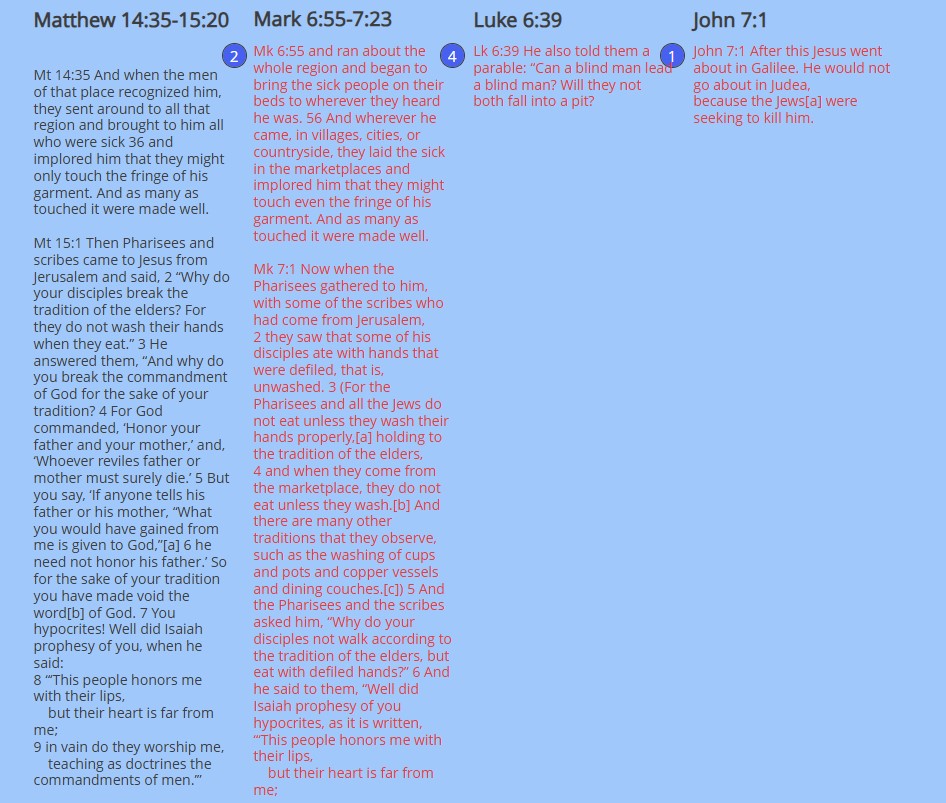
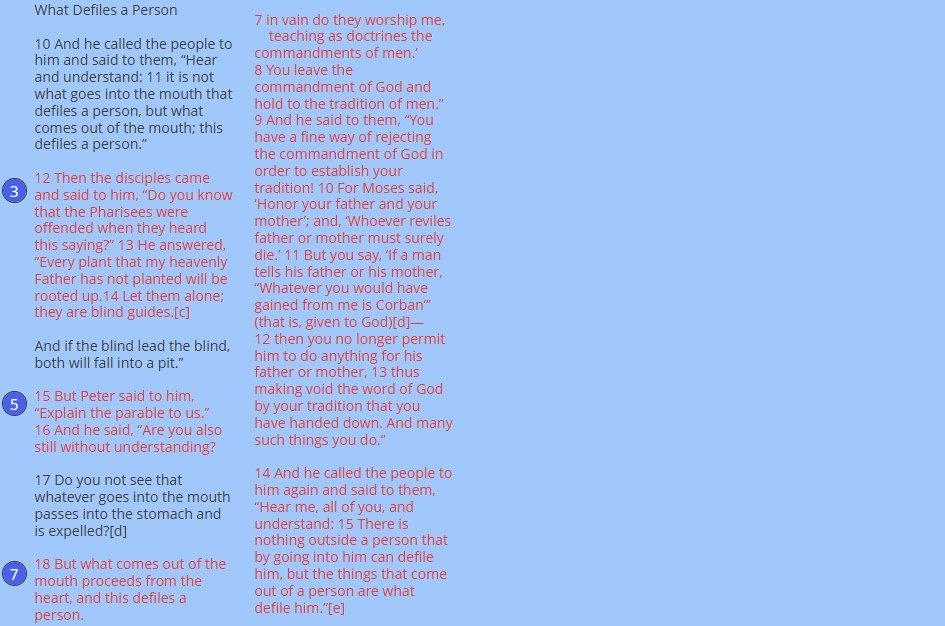
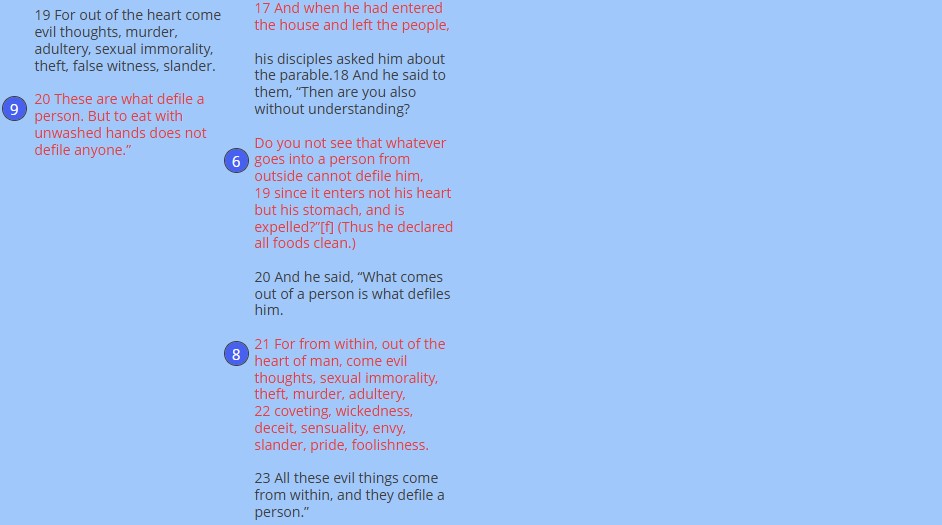
From the above worksheet photos, following the numbers and the text in red, the following narrative is produced.
Holding to the Traditions of Men
Jn 7:1 After this Jesus went about in Galilee. He would not go about in Judea, because the Jews were seeking to kill him. Mk 6:55 [The people] ran about the whole region and began to bring the sick people on their beds to wherever they heard he was. 56 And wherever he came, in villages, cities, or countryside, they laid the sick in the marketplaces and implored him that they might touch even the fringe of his garment. And as many as touched it were made well.
Mk 7:1 Now when the Pharisees gathered to him, with some of the scribes who had come from Jerusalem, 2 they saw that some of his disciples ate with hands that were defiled, that is, unwashed. 3 (For the Pharisees and all the Jews do not eat unless they wash their hands properly, holding to the tradition of the elders, 4 and when they come from the marketplace, they do not eat unless they wash. And there are many other traditions that they observe, such as the washing of cups and pots and copper vessels and dining couches.)
Mk 7:5 And the Pharisees and the scribes asked him, “Why do your disciples not walk according to the tradition of the elders, but eat with defiled hands?”
Mk 7:6 And he said to them, “Well did Isaiah prophesy of you hypocrites, as it is written, “‘This people honor me with their lips, but their heart is far from me; 7 in vain do they worship me, teaching as doctrines the commandments of men.’
Mk 7:8 You leave the commandment of God and hold to the tradition of men.”
Evil Lurks in the Heart
Mk 7:9 And he said to them, “You have a fine way of rejecting the commandment of God in order to establish your tradition! 10 For Moses said, ‘Honor your father and your mother’; and ‘Whoever reviles father or mother must surely die.’ 11 But you say, ‘If a man tells his father or his mother, “Whatever you would have gained from me is Corban”’ (that is, given to God)— 12 then you no longer permit him to do anything for his father or mother, 13 thus making void the word of God by your tradition that you have handed down. And many such things you do.”
Mk 7:14 And he called the people to him again and said to them, “Hear me, all of you, and understand: 15 There is nothing outside a person that by going into him can defile him, but the things that come out of a person are what defile him.”
Mk 17:17 And when he had entered the house and left the people, Mt 15:12 Then the disciples came and said to him, “Do you know that the Pharisees were offended when they heard this saying?”
Mt 15:13 He answered, “Every plant that my heavenly Father has not planted will be rooted up. 14 Let them alone; they are blind guides. Lk 6:39 He also told them a parable: “Can a blind man lead a blind man? Will they not both fall into a pit?
Mt 15:15 But Peter said to him, “Explain the parable to us.”
Mt 15:16 And he said, “Are you also still without understanding? Mk 7:18 Do you not see that whatever goes into a person from outside cannot defile him, 19 since it enters not his heart but his stomach, and is expelled?” (Thus, he declared all foods clean.) Mt 15:18 But what comes out of the mouth proceeds from the heart, and this defiles a person. Mk 7:21 For from within, out of the heart of man, come evil thoughts, sexual immorality, theft, murder, adultery, 22 coveting, wickedness, deceit, sensuality, envy, slander, pride, foolishness. Mt 15:20 These are what defile a person. But to eat with unwashed hands does not defile anyone.”
Bible Lessons for this event:
H314 From Judea to Galilee (Mark 6:55-56; John 7:1)
H315 The Disciples Handwashing Sin (Mark 7:1-9)
H316 The Sin of “Corban” (Mark 7:10-13)
H317 What Defiles a Person? (Mark 7:14-15)
H318 Can the Blind Lead the Blind? (Matthew 15:12-14; Mark 7:17; Luke 6:39)
H319 Are You Still Without Understanding? (Matthew 15:16, 18, 20; Mark 7:18-19, 21-22)
Event Summary:
Event Summary:
This event addresses Jesus’ healing ministry, his confrontation with the Pharisees over traditions, and his teachings on inner purity. Together, they highlight themes of compassion, true righteousness, the contrast between human traditions and God’s commands, and the importance of inward transformation.
Key points of this event are:
(1) Jesus avoids traveling openly in Judea because of the growing hostility and threats to His life from Jewish leaders. (On the above worksheet see circle 1) Jesus operates with wisdom and discernment in the face of opposition. His mission proceeds according to God’s timing, showing his reliance on the Father’s plan despite external pressures.
(2) Crowds bring their sick to Jesus, believing that even touching the edge of his cloak will bring healing. Many are healed as a result of their faith. (See Mark 6:55-56) Jesus’ ministry reflects God’s compassion and power. Faith in Jesus leads to healing, both physical and spiritual, as he meets the needs of those who seek him.
(3) The Pharisees and teachers of the law criticize Jesus’ disciples for eating with unwashed hands, accusing them of breaking the traditions of the elders. Jesus rebukes them for prioritizing human traditions over God’s commands, quoting Isaiah: “These people honor me with their lips, but their hearts are far from me.” (See Mark 7:1-13) True righteousness is not about outward adherence to human traditions but about inward devotion to God. Faithfulness to God’s commands must take precedence over man-made rules.
(4) Jesus uses the metaphor of the blind leading the blind, emphasizing the danger of following spiritually blind leaders who misinterpret or distort God’s truth. (On the above worksheet see circle 4) True understanding of God’s ways requires spiritual insight. Believers must discern and follow leaders who are grounded in God’s Word rather than relying on legalistic or hypocritical authorities.
(5) Jesus declares that what defiles a person is not what enters the body (like food) but what comes from the heart, such as evil thoughts, greed, deceit, and slander. (On the above worksheet see circles 5 – 8) True purity is a matter of the heart, not external rituals. Sin originates from within, and transformation requires inward renewal through God’s grace.
This event teaches that true righteousness and purity come from a transformed heart, not from external rituals or human traditions. Jesus’ ministry demonstrates God’s compassion and power, contrasting with the legalism and hypocrisy of the Pharisees. Believers are called to focus on inward transformation, prioritize God’s commands over human traditions, and discern true spiritual leadership. Additionally, Jesus’ response to opposition reminds us to trust in God’s timing and sovereignty in the face of challenges.
Discussion Questions with Extended Answers:
1. What response did the people have when they recognized Jesus, and what does this reveal about their understanding of Him?
Answer:
In Matthew 14:35b–36 and Mark 6:55–56, the people urgently brought the sick to Jesus, even laying them in marketplaces and begging to touch the fringe of His garment. This reveals that they recognized His power to heal and had a level of faith in His authority over physical illness. However, their understanding appears largely centered on His miraculous abilities rather than His identity as the Messiah who addresses the deeper problem of sin. Their response demonstrates faith, but it is primarily need-driven and not yet fully rooted in spiritual comprehension.
2. What issue do the Pharisees and scribes raise, and why is it significant?
Answer:
In Matthew 15:1–2 and Mark 7:1–5, the Pharisees question why Jesus’ disciples do not follow the “tradition of the elders,” specifically regarding ceremonial handwashing. This issue is significant because it highlights the growing conflict between Jesus and the religious leaders. The Pharisees elevate human traditions to the level of divine command, revealing a shift from God’s Word to man-made regulations. Their concern is not moral impurity but ritual cleanliness, exposing a misunderstanding of true righteousness.
3. How does Jesus respond to the Pharisees’ accusation, and what does He reveal about their practices?
Answer:
Jesus responds by turning the accusation back on them (Matthew 15:3–9; Mark 7:6–13). He exposes how their traditions actually lead them to break God’s commandments, using the example of “Corban” (dedicating resources to God to avoid supporting one’s parents). He quotes Isaiah 29:13, showing that their worship is external and hypocritical: they honor God with their lips, but their hearts are far from Him. Jesus reveals that elevating tradition above Scripture results in nullifying God’s Word and leads to empty worship.
4. According to Jesus, what truly defiles a person?
Answer:
In Matthew 15:10–11 and Mark 7:14–15, Jesus teaches that defilement does not come from what enters the mouth but from what comes out of it. This is a radical redefinition of purity. The issue is not external food or ritual practices but the internal condition of the heart. Sin originates within and is expressed through words and actions. This teaching shifts the focus from ceremonial law to moral and spiritual reality.
5. Why do the disciples struggle to understand Jesus’ teaching about defilement?
Answer:
In Matthew 15:12–16 and Mark 7:17–18, the disciples ask Jesus to explain His teaching, showing that they are still influenced by traditional Jewish views of purity. Their struggle highlights how deeply ingrained these traditions were. Even those closest to Jesus needed time and instruction to grasp the spiritual nature of His message. Their misunderstanding also reflects the broader challenge of moving from external religion to internal transformation.
6. What warning does Jesus give about spiritual leaders who are blind?
Answer:
In Matthew 15:13–14 and echoed conceptually in Luke 6:39, Jesus warns that blind guides lead others into destruction: “If the blind lead the blind, both will fall into a pit.” This is a direct critique of the Pharisees. Spiritually blind leaders, those who lack true understanding of God, mislead others and produce harmful outcomes. This warning emphasizes the importance of discernment in following spiritual authority and the danger of relying on leaders who prioritize tradition over truth.
7. What comes out of the heart, according to Jesus, and why is this important?
Answer:
In Matthew 15:18–20 and Mark 7:20–23, Jesus lists the things that proceed from the heart: evil thoughts, murder, adultery, sexual immorality, theft, false witness, and slander. These are what truly defile a person. This teaching is crucial because it identifies the heart as the source of sin. It underscores the need for inner transformation rather than external compliance. True righteousness cannot be achieved by following rules alone; it requires a changed heart.
8. How does Luke 6:39 contribute to the overall message of these passages?
Answer:
Luke 6:39 reinforces the theme of spiritual blindness with the parable of the blind leading the blind. It connects directly with Jesus’ critique of the Pharisees as blind guides. This verse broadens the application by emphasizing that anyone lacking true spiritual insight cannot rightly guide others. It calls for humility, self-awareness, and dependence on God for true understanding.
9. What does John 7:1 reveal about the growing opposition to Jesus?
Answer:
John 7:1 notes that Jesus remained in Galilee because the Jewish leaders in Judea were seeking to kill Him. This reveals the شدت (intensity) of opposition that had developed. The conflict is no longer just theological disagreement; it has become a matter of life and death. This verse provides context for the confrontations in the other passages, showing that Jesus’ teachings were not only challenging but also threatening to the established religious system.
10. What overall lesson do these passages teach about true faith and righteousness?
Answer:
These passages collectively teach that true faith is not about outward conformity to religious traditions but about inward transformation of the heart. Rituals and traditions, while not inherently wrong, become dangerous when they replace God’s Word or mask spiritual emptiness. Jesus calls for a righteousness that begins within and flows outward in genuine obedience. He also warns against spiritual blindness and emphasizes the need for discernment in following leaders. Ultimately, true purity comes from a heart aligned with God, not from external practices.


Leave a comment