
Photo: Nandor Bezeczki
Previous Lesson
Next Lesson
Author: Stephen Weller
1,916 words, 10 minutes read time
Faith of a Gentile Woman – Tyre & Sidon, Phoenicia, East Coast of the Mediterranean
Scripture Reference: Matthew 15:21-28; Mark 7:24-30
Context:
The account of Jesus and the Canaanite (Syrophoenician) woman in Gospel of Matthew 15:21–28 and Gospel of Mark 7:24–30 occurs during a significant transition in Jesus’ ministry, when He deliberately withdraws from predominantly Jewish regions into the Gentile territory of Tyre and Sidon. This follows intense conflict with the Pharisees over issues of ritual purity, where Jesus teaches that defilement comes from the heart rather than external practices. In this setting, a Gentile woman, identified as a Canaanite in Matthew and a Syrophoenician in Mark, approaches Jesus with bold persistence, pleading for the healing of her demon-oppressed daughter. Her address of Jesus as “Son of David” in Matthew reveals an extraordinary recognition of His messianic identity, especially for a non-Jew. Jesus’ initial silence and His statement about being sent “only to the lost sheep of Israel,” along with the metaphor about children’s bread and dogs, reflect the historical priority of His mission to Israel and test the depth of her faith. Rather than being deterred, the woman humbly accepts her position and expresses confidence that even a “crumb” of Jesus’ power is sufficient. Her response demonstrates remarkable faith, humility, and perseverance, leading Jesus to commend her faith and grant her request. This encounter not only highlights the expanding scope of God’s mercy beyond Israel but also foreshadows the inclusion of the Gentiles in the kingdom of God. It serves as a powerful illustration that faith, not ethnic identity, is the basis for receiving God’s grace, and it anticipates the broader mission that will unfold after Jesus’ resurrection.
Event Narrative:
The narrative for this section was obtained from two similar texts, using the highlighted material shown below. The selection was determined by Jerry Peyton and copyrighted in 2015 by Jerry Peyton and Biblical Studies Press L.L.C.
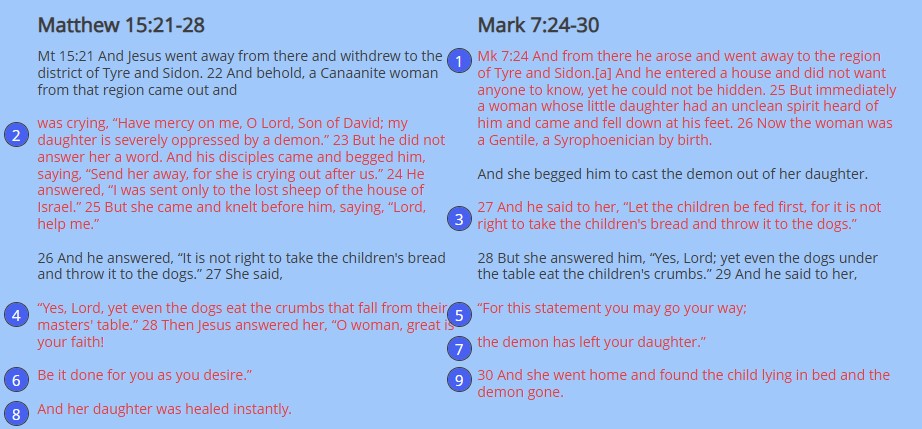
From the above worksheet photo, following the numbers and the text in red, the following narrative is produced.
Mk 7:24 And from there [Jesus] arose and went away to the region of Tyre and Sidon. He entered a house and did not want anyone to know, yet he could not be hidden. 25 But immediately a woman whose little daughter had an unclean spirit heard of him and came and fell down at his feet. 26 Now the woman was a Gentile, a Syrophoenician by birth.
Mt 15:22 [She cried out], “Have mercy on me, O Lord, Son of David; my daughter is severely oppressed by a demon.”
Mt 15:23 But he did not answer her a word. And his disciples came and begged him, saying, “Send her away, for she is crying out after us.”
Mt 15:24 He answered, “I was sent only to the lost sheep of the house of Israel.”
Mt 15:25 But she came and knelt before him, saying, “Lord, help me.”
Mk 7:27 And he said to her, “Let the children be fed first, for it is not right to take the children’s bread and throw it to the dogs.”
Mt 15:27 “Yes, Lord, yet even the dogs eat the crumbs that fall from their masters’ table.”
Mt 15:28 Then Jesus answered her, “O woman, great is your faith! Mk 7:29 For this statement you may go your way. Mt 15:28 Be it done for you as you desire. Mk 7:29 The demon has left your daughter.”
Mt 15:28 And her daughter was healed instantly. Mk 7:30 And she went home and found the child lying in bed and the demon gone.
Bible Lessons for this event:
H321 A Woman and a Little Daughter (Matthew 15:22; Mark 7:24-26)
H322 Can the Blind Lead the Blind? (Matthew 15:12-14; Mark 7:17)
Event Summary:
Event Summary:
This event recounts the story of the Syrophoenician (or Canaanite) woman, who approaches Jesus to heal her demon-possessed daughter. It highlights themes of faith, persistence, humility, and the inclusivity of God’s kingdom.
Key points of this event are:
(1) The woman, a Gentile, seeks out Jesus, addressing him as “Lord, Son of David” (Matthew). Despite being outside the Jewish community, she acknowledges his authority and role as the Messiah. (On the above worksheet see circles 1 – 2) True faith recognizes Jesus’ power and authority, regardless of cultural or religious background. The woman’s faith transcends barriers, showing her deep trust in Jesus.
(2) Initially, Jesus does not respond to her plea, and his disciples urge him to send her away. She continues to persist, even kneeling before him in worship, saying, “Lord, help me!” (On the above worksheet see circles 1 – 2) Faith involves persistence and unwavering trust, even in the face of apparent silence or rejection. The woman’s determination reflects her deep belief in Jesus’ ability to heal.
(3) Jesus tests her faith by saying, “It is not right to take the children’s bread and toss it to the dogs.” The woman humbly responds, “Even the dogs eat the crumbs that fall from their master’s table.” (On the above worksheet see circles 3 – 4) Humility is a vital component of faith. The woman’s response demonstrates her acceptance of her position while boldly trusting in God’s mercy and provision.
(4) Jesus commends the woman’s great faith, saying, “Woman, you have great faith! Your request is granted.” Her daughter is healed, signifying that God’s blessings are not limited to Israel but extend to all who believe. (On the above worksheet see circles 5 – 9) God’s kingdom is inclusive and open to all who come to Jesus in faith, regardless of nationality, ethnicity, or background. Faith, not lineage, is the key to receiving God’s blessings.
(5) Jesus’ initial silence and challenging response are not acts of rejection but opportunities to test and reveal the depth of the woman’s faith. Her response serves as a model for persistence and trust. Faith is often refined and revealed through trials. Jesus’ interaction with the woman shows that perseverance and trust in him lead to blessings.
In this event is the story of the Syrophoenician woman teaches that faith, humility, and persistence are essential in approaching Jesus. Her bold yet humble plea demonstrates the power of unwavering trust in Christ’s mercy and ability to save. The narrative also emphasizes the inclusivity of God’s kingdom, showing that his grace is available to all who believe, regardless of background. This passage encourages believers to approach Jesus with faith, perseverance, and humility, trusting in his compassion and power to transform their lives.
Discussion Questions with Extended Answers:
1. Where does this event take place, and why is the location significant?
Answer:
This event occurs in the region of Tyre and Sidon, Gentile territory outside of Israel. This is significant because Jesus intentionally enters a non-Jewish area, highlighting that His ministry, though initially focused on Israel, is not limited to them. The setting prepares the reader to see a shift; God’s mercy extending beyond ethnic Israel. It anticipates the global scope of the gospel, where Gentiles are included in God’s redemptive plan.
2. Who is the woman, and how do the Gospel writers describe her?
Answer:
Matthew describes her as a Canaanite woman, while Mark calls her a Syrophoenician woman by birth. Both descriptions emphasize that she is a Gentile. Matthew’s use of “Canaanite” is especially striking, as it recalls Israel’s ancient enemies, heightening the contrast and demonstrating the depth of God’s grace. Despite her outsider status, she approaches Jesus with faith, becoming an example of true belief.
3. What is the woman’s request, and what does it reveal about her faith?
Answer:
She pleads with Jesus to heal her daughter, who is severely oppressed by a demon. Her request reveals remarkable faith in several ways:
- She recognizes Jesus as “Lord” and “Son of David,” acknowledging His messianic authority.
- She believes in His power to heal from a distance.
- She persists despite silence and apparent rejection.
Her faith is not casual; it is desperate, informed, and unwavering.
4. How does Jesus initially respond, and why might this seem surprising?
Answer:
Jesus initially does not answer her, and then He states that He was sent “only to the lost sheep of the house of Israel.” This may seem surprising because it appears dismissive. However, this response reflects the order of God’s redemptive plan; Israel first, then the nations. It also serves to draw out and display the woman’s faith publicly, making her persistence and humility evident to the disciples and readers.
5. What role do the disciples play in this interaction?
Answer:
The disciples urge Jesus to send her away because she is crying out after them. Their response reveals a limited understanding of Jesus’ mission and compassion. They see her as a nuisance, while Jesus sees an opportunity to demonstrate faith and extend grace. This contrast highlights the difference between human impatience and divine mercy.
6. What does Jesus mean by the statement about children and dogs?
Answer:
Jesus says it is not right to take the children’s bread and throw it to the dogs. The “children” represent Israel, and the “dogs” represent Gentiles. While this may sound harsh, the term used refers to household dogs, not wild scavengers, softening the tone. The statement emphasizes priority, not exclusion; God’s blessings are first given to Israel but not withheld from others who come in faith.
7. How does the woman respond to Jesus’ statement, and what does this demonstrate?
Answer:
She humbly agrees and replies that even the dogs eat the crumbs that fall from their masters’ table. This response demonstrates:
- Humility: She accepts her position without اعتراض.
- Faith: She believes even a “crumb” of Jesus’ power is sufficient.
- Perseverance: She continues despite obstacles.
Her reply shows deep trust in Jesus’ mercy and abundance.
8. How does Jesus ultimately respond, and what is the outcome?
Answer:
Jesus commends her for her great faith and grants her request, healing her daughter instantly. This outcome demonstrates that faith—not ethnicity or status—is the key to receiving God’s mercy. It also shows that Jesus’ power extends beyond physical presence and national boundaries.
9. Why does Jesus commend her faith as “great”?
Answer:
Jesus rarely describes faith as “great,” making this commendation significant. Her faith is great because it is:
- Persistent despite silence
- Humble despite challenge
- Confident in Jesus’ authority
- Rooted in trust rather than entitlement
She contrasts with many in Israel who witnessed miracles yet lacked belief.
10. What theological truth does this passage teach about salvation?
Answer:
This passage teaches that salvation and God’s mercy are available to all who come in faith, regardless of background. While God’s plan began with Israel, it was always intended to bless the nations. The woman’s experience foreshadows the inclusion of Gentiles in the gospel, affirming that faith is the basis for receiving grace.
11. How does this account challenge common assumptions about who can receive God’s blessing?
Answer:
It challenges the assumption that heritage, status, or proximity to religious tradition guarantees access to God. The woman had none of these advantages, yet she received Jesus’ commendation. This shows that God values genuine faith over external identity, overturning human expectations.
12. What practical lessons can believers draw from this passage?
Answer:
Believers can learn to:
- Approach God with persistence in prayer
- Maintain humility before Him
- Trust in His mercy even when answers seem delayed
- Recognize that no one is beyond the reach of God’s grace
The passage encourages a faith that clings to Christ, even in silence or difficulty.


Leave a comment