
Photo: Terri Waters Photography & Design (Kennall Vale in spring)
Previous Lesson
Next Lesson
Author: Stephen Weller
2,263 words, 12 minutes read time
Healing a Deaf Mute and Many Others – East Coast, Sea of Galilee
Scripture Reference: Matthew 15:29-31; Mark 7:31-37
Context:
After His encounter with the Syrophoenician woman in the region of Tyre and Sidon, Jesus traveled through the Decapolis, a predominantly Gentile region east of the Sea of Galilee. This setting is significant because it shows that Christ’s ministry extended beyond the Jewish people and revealed God’s compassion for all nations. In Matthew 15:29–31, large crowds brought to Him the lame, blind, crippled, mute, and many others, laying them at His feet, and He healed them. The people were amazed as they witnessed the mute speaking, the crippled restored, the lame walking, and the blind seeing, and they responded by glorifying “the God of Israel,” a phrase that highlights the likely Gentile audience recognizing the power of Israel’s God. Mark 7:31–37 focuses specifically on one miracle within this broader ministry: the healing of a deaf man with a speech impediment. Jesus took the man aside privately, touched his ears and tongue, looked up to heaven, sighed deeply, and said, “Ephphatha,” meaning “Be opened.” Immediately, the man’s hearing and speech were restored. This miracle demonstrates not only Christ’s divine authority over physical infirmity but also His personal compassion and intimate care for individuals. His sigh reflects the burden of human brokenness and the effects of sin in the world. Though Jesus instructed the people not to spread the news, they proclaimed it even more, declaring, “He has done all things well,” echoing the language of creation in Genesis and pointing to Jesus as the One who restores what sin has broken. Together, these passages reveal Jesus as the compassionate Messiah whose healing ministry fulfills prophetic expectations, displays the kingdom of God, and foreshadows the greater spiritual restoration He brings to both Jews and Gentiles.
Event Narrative:
The narrative for this section was obtained from two similar texts, using the highlighted material shown below. The selection was determined by Jerry Peyton and copyrighted in 2015 by Jerry Peyton and Biblical Studies Press L.L.C.
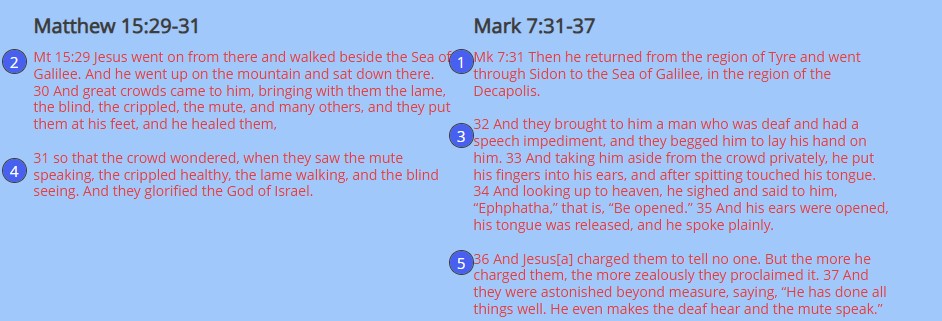
From the above worksheet photo, following the numbers and the text in red, the following narrative is produced.
Mk 7:31 Then [Jesus] returned from the region of Tyre and went through Sidon to the Sea of Galilee, in the region of the Decapolis. Mt 15:29 Jesus went on from there and walked beside the Sea of Galilee. And he went up on the mountain and sat down there. Mt 15:30 And great crowds came to him, bringing with them the lame, the blind, the crippled, the mute, and many others, and they put them at his feet, and he healed them, MK 7:32 And they brought to him a man who was deaf and had a speech impediment, and they begged him to lay his hand on him.
Mk 7:33 And taking him aside from the crowd privately, [Jesus] put his fingers into his ears, and after spitting touched his tongue. 34 And looking up to heaven, he sighed and said to him, “Ephphatha,” that is, “Be opened.” 35 And his ears were opened, his tongue was released, and he spoke plainly.
Mt 15:31 [As a result] the crowd wondered, when they saw the mute speaking, the crippled healthy, the lame walking, and the blind seeing. And they glorified the God of Israel. Mk 7:36 And Jesus charged them to tell no one. But the more he charged them, the more zealously they proclaimed it. 37 And they were astonished beyond measure, saying, “He has done all things well. He even makes the deaf hear and the mute speak.”
Bible Lessons for this event:
H324 Many more are healed (Matthew 15:29-31; Mark 7:31-37)
Event Summary:
This event describes Jesus’ healing ministry, focusing on his miraculous works among the crowds and the healing of a man who was deaf and had a speech impediment. They highlight themes of compassion, divine power, inclusivity, and the recognition of Jesus’ mission.
Key points of this event are:
(1) In Matthew, great crowds bring the sick, lame, blind, mute, and others to Jesus, and he heals them all. In Mark, people bring a deaf and mute man to Jesus, pleading for him to lay his hands on him. (On the above worksheet see circles 1 – 3) Jesus demonstrates deep compassion for human suffering, responding to the physical and spiritual needs of those who come to him. His care extends to everyone, regardless of their condition.
(2) Jesus heals with authority and power. In Mark, he uses physical actions (touching the man’s ears and tongue, and sighing) to heal the man, symbolizing his personal involvement and care. (On the above worksheet see circle 3) Jesus’ miracles reveal His divine power and authority, confirming His identity as the Messiah. He has the ability to heal and restore completely.
(3) In Mark, the events occur in the Decapolis, a Gentile region, and Matthew’s account emphasizes the healing of “great crowds.” This reflects Jesus’ mission extending beyond the Jewish people to all nations. (On the above worksheet see circles 1 – 2) Jesus’ compassion and salvation are inclusive, transcending ethnic and cultural boundaries. His mission brings hope and healing to all who seek Him, regardless of their background.
(4) In Matthew, the crowd is amazed and glorifies the God of Israel after witnessing Jesus’ miracles. In Mark, the people are astonished and exclaim, “He has done everything well. He even makes the deaf hear and the mute speak!” (On the above worksheet see circles 4 – 5) Jesus’ works lead to recognition of God’s glory and provoke awe and worship. His ministry reveals the goodness and perfection of God’s plan for humanity.
(5) Jesus takes the deaf and mute man aside privately, touches him, and looks to heaven, showing his personal care and reliance on the Father. (On the above worksheet see circle 3) Jesus’ healing is deeply personal, reflecting his intimate concern for each individual. His miracles are not just displays of power but acts of love and restoration.
(6) The healing of the deaf and mute man echoes Isaiah’s prophecy about the Messiah: “Then will the eyes of the blind be opened and the ears of the deaf unstopped” (Isaiah 35:5-6). (On the above worksheet see circle 3) Jesus fulfills Old Testament prophecies, confirming that he is the promised Messiah who brings healing and restoration to the world.
This event emphasizes Jesus’ compassion, divine power, and inclusivity, showing his mission to heal and restore both Jews and Gentiles. His miracles lead to the recognition of God’s glory and fulfill messianic prophecies, demonstrating that he is the Savior sent to bring hope and renewal. Believers are encouraged to trust in Jesus’ ability to heal, both physically and spiritually, and to glorify God for his transformative work in their lives.
Discussion Questions with Extended Answers:
1. Where did Jesus go after leaving the region of Tyre and Sidon, and why is this significant?
Answer:
After leaving Tyre and Sidon, Jesus traveled through the region of Decapolis near the Sea of Galilee. Matthew records that He went up on a mountain and sat down there, while Mark gives more detail about His route through Sidon and Decapolis. This is significant because Decapolis was largely a Gentile region, meaning Jesus was ministering among non-Jewish people. His presence there demonstrates that His compassion and power extended beyond Israel alone. This fulfills the broader purpose of God’s redemptive plan—that salvation would reach all nations. The people in this region responded with amazement and glorified the God of Israel, showing that Gentiles were beginning to recognize the authority of Christ.
2. What kinds of people were brought to Jesus in Matthew 15:30, and what does this reveal about His ministry?
Answer:
Matthew says that great crowds brought the lame, blind, mute, crippled, and many others to Jesus, laying them at His feet. This reveals that Jesus’ ministry was deeply compassionate and restorative. He did not only preach truth; He demonstrated the kingdom of God through healing and mercy. These physical conditions represented human brokenness caused by the fall, and Christ’s healing ministry showed His authority over suffering and disease. By healing them, Jesus gave visible evidence that the Messiah had come. His miracles were signs of both divine power and divine compassion, proving that He came to restore what sin had damaged.
3. Why were the crowds astonished in Matthew 15:31, and what was their response?
Answer:
The crowds were astonished because they saw the mute speaking, the crippled made whole, the lame walking, and the blind seeing. These miracles were undeniable demonstrations of divine power. Their amazement was not merely emotional excitement; it led them to glorify the God of Israel. This response is important because true miracles should lead people to worship God rather than simply admire the miracle itself. The healing works pointed beyond themselves to the identity of Jesus as the promised Messiah. Their praise reflected recognition that God Himself was working among them through Christ.
4. Why is the healing of the deaf and mute man in Mark 7:31–37 especially unique?
Answer:
This miracle is unique because Mark records Jesus using very personal and intentional actions. He took the man aside from the crowd, put His fingers into the man’s ears, touched his tongue with saliva, looked up to heaven, sighed deeply, and said, “Ephphatha,” meaning “Be opened.” This intimate process highlights Christ’s personal care for individuals, not just crowds. Jesus was not performing a public spectacle; He was compassionately engaging with a man who likely lived in social isolation because of his disability. The miracle shows that Jesus ministers personally and tenderly to individual needs.
5. Why did Jesus take the deaf man aside privately before healing him?
Answer:
Jesus likely took the man aside privately to spare him unnecessary public attention and to minister to him personally. A deaf man with a speech impediment would have faced communication barriers and likely embarrassment in large crowds. Jesus’ private interaction demonstrates dignity, compassion, and personal care. Rather than treating him as a spectacle, Jesus met him with gentleness and understanding. This reflects the heart of the Savior—He sees people as individuals, not as interruptions or opportunities for display. His compassion is personal, not distant.
6. What is the significance of Jesus saying “Ephphatha” (“Be opened”)?
Answer:
“Ephphatha” was a direct command from Jesus that immediately opened the man’s ears and released his tongue so he could speak plainly. The significance lies in the authority of Christ’s word. Just as God spoke creation into existence, Jesus speaks healing and restoration into brokenness. His word carries divine power. This command also symbolizes spiritual truth: humanity is spiritually deaf and unable to speak rightly about God apart from divine intervention. Christ opens ears to hear truth and loosens hearts to confess faith. Physical healing here points to the greater spiritual healing only Christ can provide.
7. Why did Jesus sigh before healing the man?
Answer:
Jesus’ sigh reveals deep compassion and sorrow over the effects of sin in the world. He was not merely addressing physical deafness and muteness; He was confronting the brokenness of fallen humanity. His sigh reflects grief over suffering, disease, and the curse of sin that damages human life. It shows that Jesus is not emotionally detached from pain; He feels deeply for those who suffer. This moment reminds us that Christ is not only powerful enough to heal, but also compassionate enough to care personally about human suffering.
8. Why did Jesus tell the people not to tell anyone, and why did they proclaim it even more?
Answer:
Jesus often gave such commands because He did not want His ministry reduced to sensational miracle-seeking or political misunderstanding. Many people wanted a miracle-worker, but Jesus came first as the Savior and Redeemer. Public excitement could distract from His true mission and create false expectations of an earthly political Messiah. However, the people could hardly contain their amazement. They proclaimed it even more because what they witnessed was extraordinary. Their excitement showed the overwhelming impact of Christ’s power, though they still did not fully understand the deeper purpose of His mission.
9. What does the statement “He has done all things well” teach us about Jesus?
Answer:
This statement reflects both admiration and theological truth. The people recognized that everything Jesus did was good, complete, and right. It echoes Genesis, where God looked upon creation and declared it good. Jesus, as the Son of God, demonstrates perfect works because He is perfectly righteous and divine. His healing ministry reveals not only ability, but perfection in purpose and execution. He does not act carelessly or partially; He does all things well. This truth extends beyond miracles to salvation itself: Christ’s work of redemption is complete, perfect, and trustworthy.
10. How do these passages point to Jesus as the promised Messiah?
Answer:
These passages fulfill Old Testament messianic expectations, especially passages like Isaiah 35:5–6, which says that when the Messiah comes, the blind will see, the deaf will hear, the lame will leap, and the mute will sing for joy. Jesus’ miracles directly match these promises. He was not merely helping people—He was proving His identity. The healing of the deaf, mute, lame, and blind showed that the kingdom of God had arrived in Him. These signs testified that Jesus was the promised Deliverer sent by God. His miracles were not random acts of kindness; they were messianic evidence pointing to His divine mission and authority.


Leave a comment