
Photo: Luis (The feast of color at Sierra de Albarracin, Spain)
Previous Lesson
Next Lesson
Author: Stephen Weller
2,243 words, 12 minutes read time
Feeding the 4,000+
Scripture Reference: Matthew 15:32-38; Mark 8:1-9
Context:
In Matthew 15:32–38 and Mark 8:1–9, Jesus performs the miracle of feeding the four thousand, revealing both His deep compassion for human need and His divine authority to provide abundantly. This event takes place after Jesus has been ministering for three days to a large crowd in a remote area, likely in the Decapolis region among many Gentiles, where people had gathered to hear Him teach and to witness His healing power. Seeing that the people had remained with Him without sufficient food, Jesus expressed concern that sending them away hungry would cause them to faint on their journey home. His compassion was not only spiritual but also practical, showing that the Savior cares for the whole person. The disciples, however, still struggled with doubt, asking how they could find enough bread in such a wilderness place to feed so many people—even though they had previously witnessed Jesus feed the five thousand. Jesus asked what they had, and they found seven loaves and a few small fish. After giving thanks, He broke the bread and gave it to the disciples to distribute to the crowd. Everyone ate and was satisfied, and afterward seven large baskets of leftovers were gathered, demonstrating both God’s sufficiency and abundance. The number four thousand, along with the setting and context, often points to Jesus extending His mercy beyond Israel and showing that the blessings of the kingdom were reaching the Gentile nations as well. This miracle emphasizes that Jesus is the true Bread of Life, the compassionate Shepherd who provides for His people in the wilderness, just as God provided manna for Israel in the desert. It also teaches the disciples to trust Christ’s power rather than their limited resources, reminding believers that what is impossible for man is fully sufficient in the hands of God.
Event Narrative:
The narrative for this section was obtained from two similar texts, using the highlighted material shown below. The selection was determined by Jerry Peyton and copyrighted in 2015 by Jerry Peyton and Biblical Studies Press L.L.C.
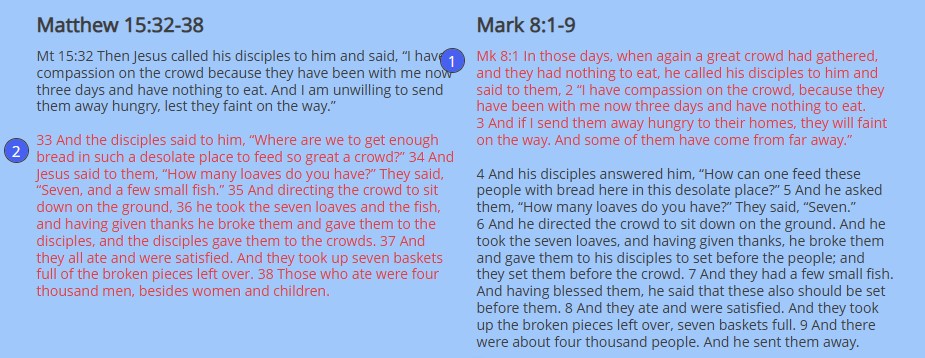
From the above worksheet photo, following the numbers and the text in red, the following narrative is produced.
Mk 8:1 In those days, when again a great crowd had gathered, and they had nothing to eat, [Jesus] called his disciples to him and said to them, 2 “I have compassion on the crowd, because they have been with me now three days and have nothing to eat. 3 And if I send them away hungry to their homes, they will faint on the way. And some of them have come from far away.”
Mt 15:33 The disciples said to him, “Where are we to get enough bread in such a desolate place to feed so great a crowd?”
Mt 15:34 Jesus said to them, “How many loaves do you have?” They said, “Seven, and a few small fish.”
Mt 15:35 Directing the crowd to sit down on the ground, 36 [Jesus] took the seven loaves and the fish, and having given thanks, he broke them and gave them to the disciples, and the disciples gave them to the crowds. 37 And they all ate and were satisfied. And they took up seven baskets full of the broken pieces left over. 38 Those who ate were four thousand men, besides women and children.
Bible Lessons for this event:
H325 Jesus Feeds Another Large Crowd (Matthew 15:33-38; Mark 8:1-3)
Event Summary:
This event recounts the feeding of the four thousand, a miracle where Jesus multiplies a few loaves and fish to feed a large crowd. The narrative emphasizes themes of compassion, divine provision, faith, and the inclusivity of Jesus’ mission.
Key points of this event are:
(1) Jesus expresses concern for the crowd, saying, “I have compassion for these people; they have already been with me three days and have nothing to eat.” He does not want to send them away hungry, knowing they might collapse on the way. (On the above worksheet see circle 1) Jesus deeply cares for both the physical and spiritual needs of people. His compassion drives him to provide for their well-being, reflecting God’s care for all aspects of human life.
(2) The disciples question how they can feed such a large crowd in a remote place. Jesus asks them what they have, and they reply with seven loaves and a few small fish. (On the above worksheet see circle 2) Human resources may seem insufficient, but in Jesus’ hands, they become more than enough. Trusting Jesus with what we have allows him to accomplish great things.
(3) Jesus gives thanks for the loaves and fish before breaking them and distributing them to the crowd. His act of thanksgiving acknowledges God as the source of all provision. (On the above worksheet see circle 2) Gratitude is a key element of faith. Recognizing and thanking God for his provision paves the way for his blessings to be multiplied.
(4) After everyone eats and is satisfied, the disciples collect seven baskets of leftovers, emphasizing the abundance of Jesus’ provision. (On the above worksheet see circle 2) God’s provision is not limited or scarce; it is abundant and overflowing. Jesus’ miracles reflect the generosity of God’s kingdom, where all needs are met.
(5) This miracle occurs in a predominantly Gentile region, reflecting the expansion of Jesus’ ministry beyond the Jewish people. By feeding the Gentile crowd, Jesus demonstrates that God’s kingdom is for all nations. Jesus’ compassion and provision extend to everyone, regardless of ethnicity or background. The Gospel is universal, offering hope and sustenance to all who come to Him.
(6) The disciples’ initial question about feeding the crowd highlights their struggle to fully grasp Jesus’ power, despite witnessing previous miracles like the feeding of the five thousand. Faith involves trusting in Jesus’ ability to meet needs, even when circumstances seem impossible. Believers are called to remember his past faithfulness as they face new challenges.
In this event the feeding of the four thousand demonstrates Jesus’ compassion, divine power, and the abundance of God’s provision. It emphasizes that God cares for both physical and spiritual needs and that his blessings are inclusive and generous. The story challenges believers to trust in Jesus’ ability to provide, to approach him with gratitude, and to recognize the universal scope of his mission to bring hope and sustenance to all people.
Discussion Questions with Extended Answers:
1. Why did Jesus say He had compassion on the crowd before performing this miracle?
Answer:
Jesus expressed compassion because the people had been with Him for three days and had nothing left to eat. He was concerned that if He sent them away hungry, they would faint on the journey home, especially since many had come from far away (Mark 8:3). This reveals the heart of Christ; He not only cared for their spiritual needs through teaching and healing, but also for their physical well-being. His compassion was not abstract sympathy but active concern that moved Him to provide. Jesus demonstrates that God’s care extends to the whole person. This miracle reminds believers that the Lord sees practical needs and responds with mercy. His compassion reflects the shepherd-heart of God toward His people.
2. How is this miracle different from the feeding of the five thousand?
Answer:
Although both miracles involve Jesus multiplying bread and fish, they are distinct events. In this account, the crowd had been with Jesus for three days instead of one, there were four thousand men instead of five thousand, there were seven loaves instead of five, a few small fish instead of two fish, and seven baskets of leftovers instead of twelve. Also, this event likely took place in a more Gentile region, suggesting Jesus’ ministry extending beyond Israel. The disciples later recognized these as separate events (Matthew 16:9–10). This distinction is important because it shows that Jesus repeatedly demonstrated His divine provision and that His compassion was not limited to one group of people.
3. Why were the disciples still questioning how the crowd could be fed after witnessing the earlier miracle?
Answer:
The disciples’ question reveals how quickly human beings can forget God’s past faithfulness when facing a new problem. Even though they had already seen Jesus feed five thousand, they still focused on the impossibility of the present situation rather than the power of Christ. This shows spiritual dullness and the struggle of faith. Mark’s Gospel often highlights the disciples’ slowness to understand. Their response mirrors the common human tendency to trust God yesterday but doubt Him today. Jesus patiently continued to teach them, showing that faith grows through repeated dependence on Him. Their weakness also encourages believers that Christ works with imperfect followers.
4. What is the significance of Jesus asking, “How many loaves do you have?”
Answer:
Jesus asked this question not because He lacked knowledge, but because He wanted the disciples to participate in the miracle and recognize that little in His hands becomes more than enough. They had only seven loaves and a few small fish, which seemed insufficient for such a large crowd. Yet Jesus used what was available rather than waiting for abundance. This teaches an important spiritual principle: God often begins with what we already have. Human limitation is not a barrier to divine power. The disciples were invited to trust Christ with their small resources and watch Him multiply them for His glory.
5. Why did Jesus instruct the people to sit down on the ground?
Answer:
Jesus instructed the crowd to sit down because He was preparing them to receive God’s provision in an orderly and peaceful way. This action demonstrated intention, expectation, and divine order rather than confusion. It also emphasized that the miracle would happen through His authority and timing. Sitting down required trust; they had no visible food source, yet they obeyed His instruction. This reflects how faith often begins with obedience before provision is seen. God’s blessings are often received through trustful submission to His word. The orderly arrangement also reveals that the kingdom of God is marked by peace, not disorder.
6. What is the importance of Jesus giving thanks before breaking the bread?
Answer:
Jesus gave thanks before distributing the food, showing dependence upon the Father and gratitude even before the visible multiplication occurred. Thanksgiving preceded the miracle. This models trust and teaches believers to respond with gratitude before the answer is fully seen. Jesus acknowledged God as the source of provision, even though He Himself possessed divine power. It also connected the miracle to God’s covenant provision in the wilderness, reminding listeners of manna from heaven. Giving thanks sanctified the ordinary bread and pointed to the deeper truth that all provision ultimately comes from God.
7. What do the seven baskets of leftovers teach us?
Answer:
The seven baskets of leftovers demonstrate that Jesus provides not merely enough, but abundance. Everyone ate and was satisfied, and there was still more remaining than what they started with. This reveals the overflowing generosity of God. The number seven often symbolizes completeness, suggesting fullness and divine sufficiency. Nothing in Christ’s provision is lacking. This miracle teaches that God’s grace is not scarce or barely sufficient; it is abundant and overflowing. It also shows wise stewardship, since the leftovers were gathered rather than wasted. Divine abundance does not remove human responsibility.
8. What does this miracle teach about Jesus’ identity?
Answer:
This miracle reveals Jesus as more than a teacher or prophet—He is the divine provider, the Messiah, and the true Shepherd of God’s people. Like God providing manna in the wilderness through Moses, Jesus provides bread in the wilderness, but He does so by His own authority. This points to His divine nature. He is the One who satisfies both physical hunger and spiritual need. Later, Jesus would declare Himself the Bread of Life (John 6:35), showing that this miracle points beyond food to salvation itself. The feeding miracle is both a sign of His compassion and proof of His divine authority.
9. How does this miracle point forward to the gospel?
Answer:
The miracle points forward to the gospel by showing humanity’s helplessness and Christ’s sufficient provision. The crowd could not feed themselves, just as sinners cannot save themselves. Jesus provided what they lacked, just as He provides salvation through His death and resurrection. Everyone who came received enough, illustrating the fullness of grace available in Christ. The breaking of bread also points symbolically toward the Lord’s Supper and the sacrifice of Christ. He is the true bread given for the life of the world. The miracle teaches that satisfaction is found only in Him.
10. What practical lesson should believers learn from this event?
Answer:
Believers should learn to trust Christ in both spiritual and practical needs. The disciples saw scarcity; Jesus saw opportunity for divine provision. Christians are often tempted to focus on what is lacking rather than on who Christ is. This passage teaches faith, gratitude, obedience, and compassion. It also reminds believers to care for others as Jesus did, not only preaching truth but meeting real needs. The Lord still calls His people to bring what little they have, place it in His hands, and trust Him to use it for His glory. Faith grows when we remember that Christ is always sufficient.


Leave a comment