
Ryan Lamont Photography (Peach Tulip Vibes at Wooden Shoe Tulip Festival.)
Author: Stephen Weller
Contributors: ChatGPT & Bible Gateway
Lesson Index
Lesson: sls01
1,521 words, 8 minutes read time
The Parallel Between the Tabernacle and Jesus Christ
In a life group I attend, we covered Hebrews 9 which made reference to the Tabernacle. This prompted me to consider the relationship between it and Jesus Christ, so I decided to investigate and found some interesting information.
The Tabernacle was God’s dwelling among his people in the wilderness. Every piece of its structure and worship pointed forward to Jesus Christ. By studying these parallels, we see how Christ fulfills God’s plan to dwell with his people and provide the way of access to him.
Below is a drawing of the Tabernacle showing its structure.
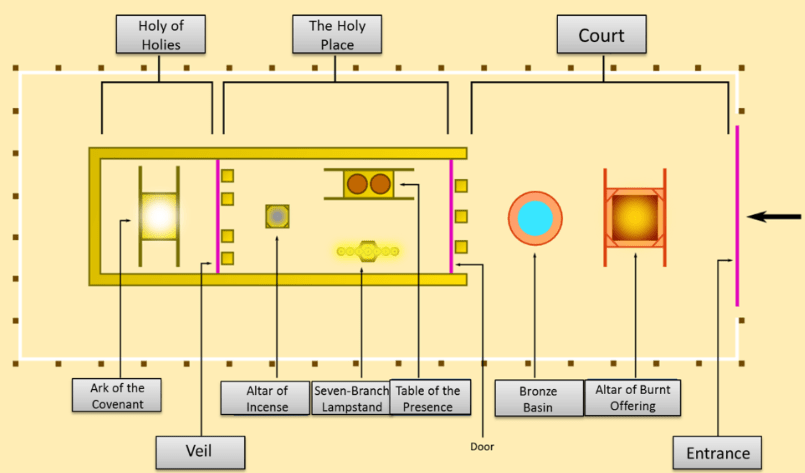
Now, as we look at this diagram, let us take time to see how the Tabernacle and its furnishings point us to Jesus Christ and deepen our relationship with him.
1. God’s Dwelling Among His People
- Tabernacle: God commanded, “Let them make me a sanctuary, that I may dwell in their midst” (Exodus 25:8).
- Jesus: John 1:14 says, “The Word became flesh and dwelt [literally ‘tabernacled’] among us.” Jesus is the true presence of God with us.
- Application: God’s ultimate purpose has always been to dwell with his people, not to remain distant or unreachable. In the Old Testament, his presence was symbolized by the Tabernacle, a physical tent in the midst of Israel’s camp. But that arrangement was temporary and limited. Through Jesus Christ, God has come near in a deeper and permanent way. By his Spirit, Christ now dwells within believers, making our lives his temple (1 Corinthians 6:19). This means we no longer need a sacred tent or building to experience God’s nearness, his presence is with us every day, guiding, comforting, and strengthening us from within.
2. The Way of Access to God
- Tabernacle: Access was limited, structured, and required sacrifices and priestly mediation.
- Jesus: He is the one Mediator between God and man (1 Timothy 2:5). His sacrifice grants us bold access to the Father (Hebrews 10:19–20).
- Application: Access to God is no longer gained through outward ceremonies, religious performances, or the work of priests who serve as go-betweens, as it was in the Old Testament. In Christ, the sacrificial system and priestly mediation have been fulfilled and made complete. He alone is the final sacrifice for sin and the one true Mediator who brings us into God’s presence (1 Timothy 2:5; Hebrews 10:19–22). This reminds us that salvation and fellowship with God cannot be earned through human effort, tradition, or religious ritual, it comes only through faith in Jesus Christ and his finished work on the cross.
3. The Bronze Altar – The Sacrifice for Sin
- Tabernacle: Daily sacrifices of animals were made to atone for sin (Leviticus 1–7).
- Jesus: He offered Himself once for all as the perfect sacrifice (Hebrews 9:26–28).
- Application: Our forgiveness of sins does not depend on continual sacrifices, ceremonies, or religious duties, as it did under the Old Testament system where animal sacrifices had to be repeated daily and yearly. Instead, forgiveness is secured once and for all through Jesus Christ’s death on the cross. His sacrifice was perfect and complete, fully satisfying God’s justice and opening the way for us to be reconciled to him. Because of this, believers rest not in their own efforts or rituals but in Christ’s finished work, trusting that his blood has fully and permanently paid for our sins (Hebrews 10:10–14).
4. The Bronze Basin – Cleansing for Service
- Tabernacle: Priests washed before serving in God’s presence (Exodus 30:17–21).
- Jesus: He cleanses us from sin (1 John 1:7), making us a royal priesthood (1 Peter 2:9).
- Application: Before serving God, we too need continual cleansing through Christ’s forgiveness. The priests in the Old Testament had to wash at the basin before entering the Tabernacle to minister, we also cannot serve God in our own strength or with unconfessed sin. Though Christ’s sacrifice has once-for-all secured our salvation, we still need ongoing cleansing in our daily walk because sin disrupts our fellowship with God. This continual cleansing comes through confession, repentance, and trusting in Christ’s forgiveness (1 John 1:9). Only then are we spiritually prepared to worship, serve, and represent him faithfully.
5. The Golden Lampstand – The Light in the Darkness
- Tabernacle: Provided light in the Holy Place (Exodus 25:31–40).
- Jesus: “I am the Light of the World” (John 8:12). He reveals God and guides His people.
- Application: To “walk in his light” means to live in the truth, holiness, and guidance of Jesus, who is the Light of the World (John 8:12). It is a daily choice to follow him, letting his Word and Spirit direct our steps instead of stumbling in the darkness of sin or self-will. To “reflect his light to others” means that our lives should visibly display his character; our good works, love, and faithfulness serve as a witness that points people back to God (Matthew 5:16). Just as the moon reflects the sun’s light, we do not shine by our own power but by Christ shining through us. In doing so, others are drawn not to us, but to the glory of God.
6. The Table of Showbread – The Bread of Life
- Tabernacle: Twelve loaves symbolized God’s provision and fellowship (Leviticus 24:5–9).
- Jesus: “I am the Bread of Life” (John 6:35). He sustains our souls with true life.
- Application: Just as physical bread sustains and strengthens our bodies, Jesus himself is the true source of spiritual life and strength. To “feed on Christ” means to continually depend on him, drawing life from his presence, promises, and power. Practically, this happens as we receive his Word in faith, meditate on his truth, and rely on the Holy Spirit to apply it to our hearts. It is a picture of ongoing, daily reliance, just as we cannot live long without food, we cannot thrive spiritually without Christ nourishing us.
7. The Altar of Incense – Intercession
- Tabernacle: Incense rose as a symbol of prayer (Exodus 30:1–10).
- Jesus: He continually intercedes for us as our High Priest (Hebrews 7:25).
- Application: Our prayers are heard because Jesus presents them before the Father. Our access to God in prayer is not based on our worthiness or eloquence but on the intercession of Jesus Christ. As our High Priest, Jesus continually stands in God’s presence on our behalf (Hebrews 7:25). When we pray in his name, it is as though Jesus himself carries our prayers into the throne room of heaven, making them acceptable to the Father. Even when our prayers are weak, confused, or incomplete, Christ perfects them and represents us faithfully. This gives us confidence that God always hears us, not because of who we are, but because of who Jesus is and what he has done for us.
8. The Veil – The Barrier Removed
- Tabernacle: The veil separated the Holy Place from the Most Holy Place (Exodus 26:31–33).
- Jesus: At His death, the veil was torn in two (Matthew 27:51), showing open access to God (Hebrews 10:19–20).
- Application: We can now boldly enter God’s presence through Christ, without fear or barrier because the separation between a holy God and sinful humanity has been removed by Jesus’ death and resurrection. In the Old Testament, access to God’s presence in the Most Holy Place was restricted, only the high priest could enter, and only once a year, with the blood of sacrifice. But when Jesus offered himself as the perfect sacrifice, the veil was torn in two (Matthew 27:51), symbolizing that believers now have direct access to God. Through Christ, we can come confidently, not in our own righteousness but clothed in his (Hebrews 4:16; 10:19–22). This access is no longer marked by fear of rejection or judgment, but by assurance of welcome, forgiveness, and fellowship with the Father.
9. The Ark of the Covenant – God’s Throne of Mercy
- Tabernacle: Contained the tablets of the Law, Aaron’s rod, and manna; the mercy seat was where atonement was made (Exodus 25:10–22).
- Jesus: He is the true mercy seat (hilastērion, Romans 3:25), where God’s justice and mercy meet.
- Application: In Christ, we find forgiveness, covenant faithfulness, and God’s very presence. Everything the Tabernacle symbolized is fully realized in Jesus. Through his death and resurrection, Jesus provides forgiveness; our sins are completely covered and cleansed (Ephesians 1:7). He is the embodiment of God’s covenant faithfulness; the fulfillment of all of God’s promises to his people (2 Corinthians 1:20), showing that God never abandons his word. And he is the revelation of God’s very presence, Immanuel, “God with us” (Matthew 1:23), who dwells in believers by the Holy Spirit (John 14:23). In other words, Jesus is the meeting place between God and man: the one who secures pardon, guarantees God’s promises, and brings us into living fellowship with the Father.
Conclusion:
The Tabernacle was a shadow; Jesus is the substance (Hebrews 8:5). Through Him, God dwells with his people permanently, sin is forgiven, and access to God is fully opened. Just as Israel centered its life around the Tabernacle, so we center our lives on Christ, who fulfills it all.


Leave a comment