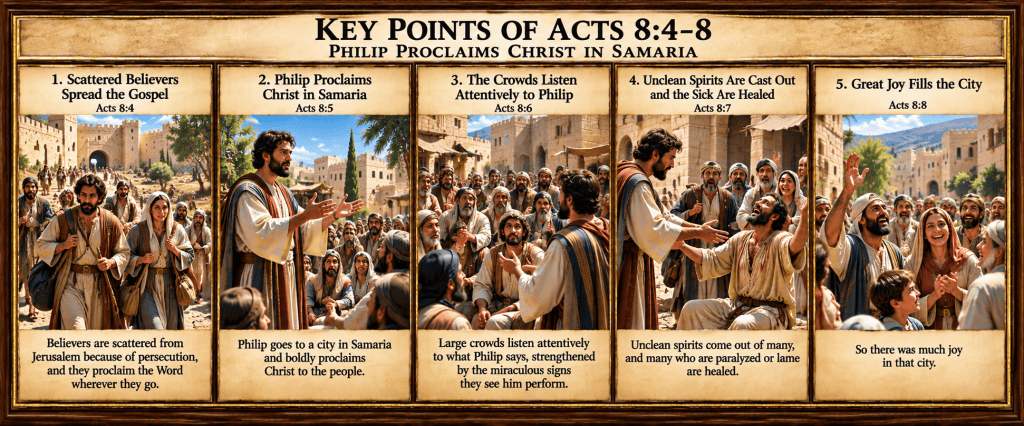
image Acts 8:4–8
New Testament Events Series
Event: nte020 Philip Proclaims Christ in Samaritans (Acts 8:4–8)
Facilitator/Editor: Stephen Weller
Information Collection: ChatGPT
Bible Text: BibleGateway
2,461 words, 13 minutes read time
NT Event Index
Event Context
Context for Acts 8:4–8
Acts 8:4–8 marks a significant turning point in the growth of the early church as the gospel begins spreading beyond Jerusalem into the surrounding regions. Following the martyrdom of Stephen and the severe persecution led by Saul (Acts 7:54–8:3), believers were scattered throughout Judea and Samaria. Rather than silencing their faith, persecution became the means through which God’s message reached new communities, fulfilling Jesus’ command in Acts 1:8 that His followers would be witnesses in Jerusalem, Judea, Samaria, and to the ends of the earth. Among those scattered was Philip, one of the seven men chosen to serve the church in Acts 6:1–6, who traveled to Samaria and boldly proclaimed Christ. This was especially significant because longstanding religious and cultural hostility had divided Jews and Samaritans for generations. Through Philip’s preaching, accompanied by miraculous signs, unclean spirits were cast out, and many who were paralyzed or lame were healed. These demonstrations of God’s power confirmed the message of salvation through Jesus Christ and drew the attention of the people. As the crowds listened and witnessed these works, the city experienced great joy. This passage demonstrates how God can transform persecution into opportunity, use ordinary believers to advance His kingdom, overcome longstanding divisions through the gospel, and bring spiritual freedom, physical healing, and lasting joy to those who receive His message.
Understanding the Event
Event Text
Philip Proclaims Christ in Samaria
4 Now those who were scattered went about preaching the word. 5 Philip went down to the city[a] of Samaria and proclaimed to them the Christ. 6 And the crowds with one accord paid attention to what was being said by Philip, when they heard him and saw the signs that he did. 7 For unclean spirits, crying out with a loud voice, came out of many who had them, and many who were paralyzed or lame were healed. 8 So there was much joy in that city.
Questions with answers
1. What caused the believers to scatter from Jerusalem, and how did God use their circumstances to advance the Gospel? (Acts 8:4)
Answer: Following the death of Stephen, severe persecution arose against the church in Jerusalem. Believers were forced to leave their homes and communities, scattering throughout Judea and Samaria. Although their departure was caused by opposition and suffering, God used these difficult circumstances to accomplish His greater purpose. Rather than abandoning their faith or remaining silent, the scattered believers continued proclaiming the Word wherever they went. What appeared to be a setback for the early church became an opportunity for the Gospel to reach new people and places. This development fulfilled the direction Jesus had given in Acts 1:8, where He declared that His followers would be witnesses in Jerusalem, Judea, Samaria, and to the ends of the earth. The passage demonstrates God’s sovereignty in using even persecution to advance His redemptive plan. Opposition could scatter the believers geographically, but it could not silence their testimony or prevent the spread of God’s Word.
2. What does the response of the scattered believers reveal about their commitment to Christ? (Acts 8:4)
Answer: The scattered believers demonstrated remarkable faithfulness and courage by continuing to proclaim the Gospel despite the dangers they faced. Having witnessed the persecution of fellow Christians and the execution of Stephen, they understood that publicly identifying with Jesus could result in imprisonment, suffering, or death. Nevertheless, their commitment to Christ remained stronger than their fear of persecution. Their actions reveal that sharing the Gospel was not considered the responsibility of the apostles alone. Ordinary believers understood that they, too, were called to bear witness to the truth of Jesus Christ. Their faith was not limited to a particular location, congregation, or favorable circumstance. Wherever they traveled, they carried the message of salvation with them. This provides an enduring example of Christian discipleship, reminding believers that faithfulness to Christ involves both personal conviction and a willingness to share His truth, even when circumstances are difficult.
3. Who was Philip, and why was his ministry in Samaria significant? (Acts 8:5)
Answer: Philip was one of the seven men selected in Acts 6:1–6 to help address the practical needs of the growing church in Jerusalem. He was recognized as a man of good reputation, full of the Spirit and wisdom. Following the persecution that scattered the believers, Philip traveled to a city in Samaria and began proclaiming Christ to its inhabitants. His ministry was significant because it represented an important expansion of the Gospel beyond the predominantly Jewish community in Jerusalem. Jews and Samaritans had a long history of religious disagreements and social hostility, making Samaria an especially meaningful location for the proclamation of Christ. By bringing the Gospel to the Samaritans, Philip demonstrated that salvation through Jesus was not restricted by traditional ethnic or cultural divisions. His ministry also marked a direct advancement of the mission Jesus described in Acts 1:8. Philip’s example shows how God can use faithful servants in unexpected places to extend the reach of His kingdom.
4. Why was proclaiming Christ the central focus of Philip’s ministry? (Acts 8:5)
Answer: Philip’s ministry centered on proclaiming Christ because Jesus is the foundation of the Gospel and the only source of salvation. Philip did not travel to Samaria merely to promote religious reform, perform miracles, or establish a personal following. His primary purpose was to announce the good news concerning Jesus Christ, the promised Messiah who had died and risen again. The message of Christ addressed humanity’s deepest spiritual need: reconciliation with God through faith in His Son. By placing Jesus at the center of his preaching, Philip followed the pattern established by the apostles, who consistently proclaimed Christ’s death, resurrection, and lordship. The miracles that accompanied Philip’s ministry supported his message, but they did not replace it. This distinction is important because the power of Christian ministry is not found in the personality of the messenger or the excitement of extraordinary events. Its foundation is the truth of Jesus Christ and the salvation He provides.
5. How did the people of Samaria respond to Philip’s preaching, and what contributed to their attention? (Acts 8:6)
Answer: The people of Samaria responded to Philip’s ministry by paying close attention to what he proclaimed. Luke explains that the crowds listened together as they heard Philip’s message and witnessed the signs he performed. Their response suggests that Philip’s preaching and the miraculous works accompanying it created a powerful testimony to the truth of the Gospel. The signs were not presented as entertainment or demonstrations of Philip’s personal greatness. Rather, they served as evidence of God’s power working through His servant and directed attention toward the message of Christ. The unity of the crowd’s attention also indicates that the Gospel was reaching people collectively, creating an atmosphere of openness and expectation. Their response illustrates the relationship between the proclamation of God’s Word and the visible demonstration of His power. While miracles attracted attention, the central purpose of Philip’s ministry remained the communication of the Gospel, through which people could come to know Jesus Christ.
6. What was the significance of the miraculous signs performed through Philip? (Acts 8:6–7)
Answer: The miraculous signs performed through Philip demonstrated God’s authority and confirmed the message he proclaimed. Luke specifically records that unclean spirits came out of many who were possessed and that numerous individuals who were paralyzed or lame were healed. These miracles revealed the power of Jesus Christ over spiritual oppression and physical suffering. They also demonstrated that the same divine power evident in the ministry of Jesus and the apostles was continuing to operate as the Gospel spread beyond Jerusalem. The miracles were particularly significant in Samaria because they helped establish the credibility of Philip’s proclamation among people who were hearing the message of Christ in this expanding phase of the church’s mission. The signs were expressions of God’s compassion toward those who suffered, while also pointing to the greater spiritual deliverance available through Christ. They demonstrated that the kingdom of God was advancing and that the authority of the risen Lord extended beyond Jerusalem to all whom God was calling to Himself.
7. What do the deliverance of those with unclean spirits and the healing of the sick reveal about the power and compassion of Christ? (Acts 8:7)
Answer: The deliverance and healings recorded in Acts 8:7 reveal both the authority and compassion of Jesus Christ. The expulsion of unclean spirits demonstrated His power over the forces of evil, while the healing of those who were paralyzed or lame revealed His concern for people experiencing physical suffering. These acts of divine power were not isolated demonstrations intended merely to impress observers. They reflected the character of Christ, whose earthly ministry had included healing the sick, freeing the oppressed, and restoring those who were suffering. Through Philip, the risen Christ continued to demonstrate His authority and mercy. The miracles also provided a visible picture of the restoration associated with God’s kingdom. Although physical healing does not guarantee that all suffering will disappear in the present age, these signs pointed toward the ultimate restoration God promises through Jesus Christ. They remind believers that the Gospel concerns the whole person and that God’s saving purposes include the final defeat of sin, evil, suffering, and death.
8. Why was there great joy in the city of Samaria? (Acts 8:8)
Answer: The great joy that filled the Samaritan city resulted from the powerful work of God taking place through Philip’s ministry. The people were hearing the message of Jesus Christ, witnessing deliverance from spiritual oppression, and seeing individuals restored from serious physical disabilities. Families and communities were experiencing remarkable changes as those who had suffered received healing and freedom. However, the joy described by Luke points beyond the excitement of witnessing miracles. The arrival of the Gospel brought the good news that salvation and reconciliation with God were available through Jesus Christ. People who had long been separated from the Jewish religious community were now hearing the message of the promised Messiah. This joy reflected the transforming influence of the Gospel upon an entire community. It demonstrates that the work of Christ brings hope where there has been despair, freedom where there has been bondage, and rejoicing where suffering has prevailed. The Gospel was not merely changing individual lives; it was beginning to transform the spiritual atmosphere of the city.
9. How does Philip’s ministry demonstrate the fulfillment of Jesus’ commission in Acts 1:8? (Acts 8:4–8)
Answer: Before His ascension, Jesus told His disciples that they would receive power when the Holy Spirit came upon them and that they would be His witnesses in Jerusalem, throughout Judea and Samaria, and to the ends of the earth. The events of Acts 8:4–8 demonstrate an important stage in the fulfillment of that commission. The Gospel had already been proclaimed extensively in Jerusalem, where the church had grown despite increasing opposition. Following Stephen’s death, persecution scattered believers into surrounding regions, including Samaria. Philip’s preaching represented the deliberate extension of the Gospel into territory that had historically been separated from the Jewish religious community. The Holy Spirit was directing the mission of the church beyond its original geographical and cultural boundaries. This development reveals that Jesus’ commission was not merely a suggestion for the disciples but a declaration of what God would accomplish through them. The movement from Jerusalem into Samaria demonstrates the unfolding of God’s plan to bring the message of salvation to people of every nation and background.
10. What does Acts 8:4–8 teach believers about God’s ability to bring good out of suffering and opposition?
Answer: Acts 8:4–8 provides a powerful illustration of God’s ability to accomplish His purposes even through circumstances that appear destructive or discouraging. The persecution following Stephen’s death was intended to suppress the Christian movement, yet it became the means by which the Gospel spread into new regions. The believers did not choose persecution, nor was their suffering insignificant. Nevertheless, God worked through their displacement to open doors for ministry that might otherwise have remained closed. Philip’s arrival in Samaria resulted in the proclamation of Christ, miraculous demonstrations of God’s power, and great joy throughout the city. This teaches believers that difficult circumstances do not place them beyond God’s care or prevent Him from working through their lives. Although Scripture does not promise that every hardship will produce an immediately visible blessing, it assures believers that God’s purposes cannot be defeated by human opposition. Faithfulness during adversity may become an opportunity for others to encounter the truth and hope of the Gospel.
11. What can the modern church learn from the example of Philip and the scattered believers? (Acts 8:4–8)
Answer: The example of Philip and the scattered believers teaches the modern church that proclaiming the Gospel is a responsibility shared by all followers of Jesus Christ. The believers who carried the message beyond Jerusalem were not limited to the apostles or recognized leaders. They were ordinary Christians whose faith remained active even after persecution disrupted their lives. Philip demonstrated that effective ministry begins with faithfulness to Christ and a willingness to go wherever God opens opportunities for service. His ministry also teaches the importance of crossing cultural, social, and historical barriers to reach those who need to hear the Gospel. The Samaritans were not excluded from God’s saving purposes because of their differences from the Jews. Likewise, the church today must recognize that the message of salvation is intended for people of every background. The passage also emphasizes that the church’s mission must remain centered on Jesus Christ rather than programs, personalities, or extraordinary experiences. When believers faithfully proclaim Christ and demonstrate His compassion, they participate in the continuing mission of making the Gospel known throughout the world.
Summary of Understanding
Acts 8:4–8 records a decisive turning point in the growth of the early church. Persecution scattered believers from Jerusalem, but instead of silencing the Gospel, it carried the message of Christ into new communities. Philip’s ministry in Samaria demonstrated the fulfillment of Jesus’ commission, the power of God to overcome spiritual oppression and physical suffering, and the ability of the Gospel to bring joy and hope to an entire city.
Central Truth: God can use adversity to advance His purposes, and the faithful proclamation of Jesus Christ brings the message of salvation, hope, and joy to those who receive it.
Key Lesson: The Gospel cannot be confined by persecution, geographical boundaries, or cultural divisions. Through faithful witnesses, God continues to extend the good news of Jesus Christ to the world.


Leave a Reply