
Photo: Alfa Bravo
Previous Lesson
Next Lesson
Author: Stephen Weller
2,722 words, 14 minutes read time
Sending Out the Twelve
Scripture Reference: Matthew 9:35-38; 10:1, 5-15, 24-25, 40-42; 11:1; Mark 6:7-13; Luke 9:1-6; 6:40
Context:
The passages Gospel of Matthew 9:35–38; 10:1, 5–15, 24–25, 40–42; 11:1, together with parallels in Gospel of Mark 6:7–13 and Gospel of Luke 9:1–6 and 6:40, form a unified moment in Jesus’ ministry where His compassion, authority, and mission strategy converge. As Jesus travels through towns and villages teaching, preaching the kingdom, and healing every disease, He is deeply moved by the spiritual condition of the crowds—“harassed and helpless, like sheep without a shepherd.” This compassion leads to His call for prayer that the “Lord of the harvest” would send out laborers, immediately followed by His commissioning of the twelve disciples. He grants them authority over unclean spirits and diseases, signaling that they are to continue His own ministry, not merely observe it. Their initial mission is focused on “the lost sheep of the house of Israel,” emphasizing the priority of God’s covenant people while foreshadowing a broader mission to the nations. Jesus instructs them to depend fully on God’s provision, travel lightly, and proclaim that the kingdom of heaven is at hand, confirming their message through acts of healing and deliverance. He also prepares them for both acceptance and rejection—those who receive them receive Christ Himself, while those who reject them face serious accountability. The teaching that a disciple is not above his teacher underscores that they will share in both His mission and His suffering. Luke 6:40 reinforces this principle of discipleship, pointing toward maturity as becoming like the teacher. Mark and Luke highlight the practical outworking of this mission as the disciples go out in pairs, preach repentance, cast out demons, and heal the sick, demonstrating the expansion of Jesus’ ministry through His followers. Finally, Matthew 11:1 marks the transition as Jesus continues teaching and preaching after sending them out, showing that the mission of God advances both through Christ directly and through those He commissions. Together, these passages reveal the heart of Christ for the lost, the urgency of the harvest, the authority given to His followers, and the pattern of discipleship as participation in His redemptive work.
Event Narrative:
The narrative for this section was obtained from three similar texts, using the highlighted material shown below. The selection was determined by Jerry Peyton and copyrighted in 2015 by Jerry Peyton and Biblical Studies Press L.L.C.
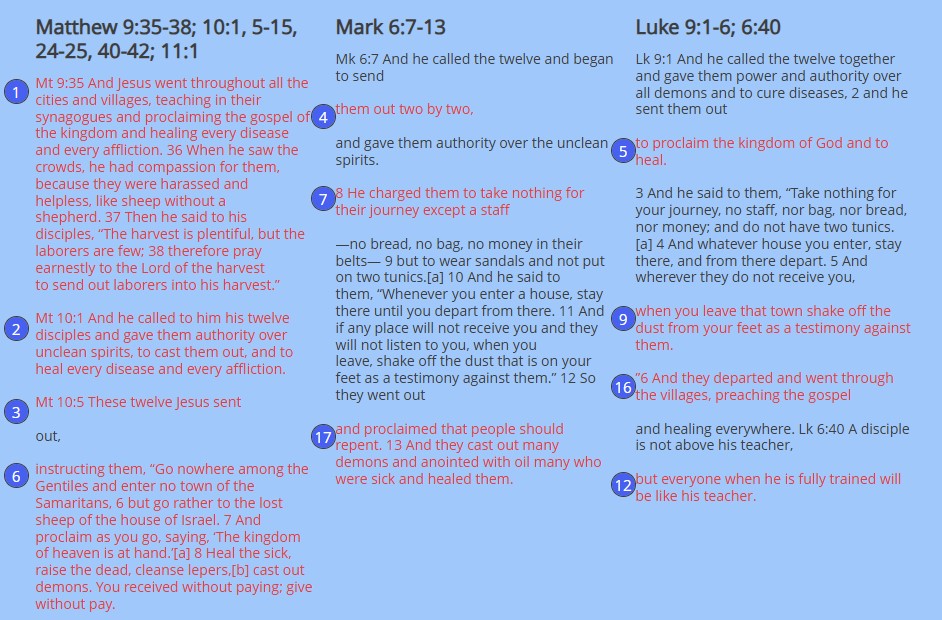

From the above worksheet photos, following the numbers and the text in red, the following narrative is produced.
Mt 9:35 And Jesus went throughout all the cities and villages, teaching in their synagogues and proclaiming the gospel of the kingdom and healing every disease and every affliction. 36 When he saw the crowds, he had compassion for them, because they were harassed and helpless, like sheep without a shepherd. 37 Then he said to his disciples, “The harvest is plentiful, but the laborers are few; 38 therefore pray earnestly to the Lord of the harvest to send out laborers into his harvest.”
Mt 10:1 And he called to him his twelve disciples and gave them authority over unclean spirits, to cast them out, and to heal every disease and every affliction. Mt 10:5 These twelve Jesus sent Mk 6:7 out two by two, Lk 9:2 to proclaim the kingdom of God and to heal.
Mt 10:5 [Jesus] instructing them, “Go nowhere among the Gentiles and enter no town of the Samaritans, 6 but go rather to the lost sheep of the house of Israel. 7 And proclaim as you go, saying, ‘The kingdom of heaven is at hand.’ 8 Heal the sick, raise the dead, cleanse lepers, cast out demons. You received without paying; give without pay.
Mk 6:8 He charged them to take nothing for their journey except a staff. 9 Acquire no gold or silver or copper for your belts, 10 no bag for your journey, or two tunics or sandals or a staff, for the laborer deserves his food.
Mk 10:11 And whatever town or village you enter, find out who is worthy in it and stay there until you depart. 12 As you enter the house, greet it. 13 And if the house is worthy, let your peace come upon it, but if it is not worthy, let your peace return to you. 14 And if anyone will not receive you or listen to your words, Lk 9:5 when you leave that town shake off the dust from your feet as a testimony against them. Mt 10:15 Truly, I say to you, it will be more bearable on the day of judgment for the land of Sodom and Gomorrah than for that town.
Mt 10:24 “A disciple is not above his teacher, nor a servant above his master. 25 It is enough for the disciple to be like his teacher, and the servant like his master, Lk 6:40 but everyone when he is fully trained will be like his teacher. Mt 6:25 If they have called the master of the house Beelzebul, how much more will they malign those of his household.
Mt 10:40 “Whoever receives you receives me, and whoever receives me receives him who sent me. 41 The one who receives a prophet because he is a prophet will receive a prophet’s reward, and the one who receives a righteous person because he is a righteous person will receive a righteous person’s reward. 42 And whoever gives one of these little ones even a cup of cold water because he is a disciple, truly, I say to you, he will by no means lose his reward.”
Mt 11:1 When Jesus had finished instructing his twelve disciples, he went on from there to teach and preach in their cities.
Lk 9:6 And they departed and went through the villages, preaching the gospel Mt 6:12 and proclaimed that people should repent. 13 And they cast out many demons and anointed with oil many who were sick and healed them.
Bible Lessons for this event:
H285 Sheep, Shepherd, Harvest, Workers (Matthew 9:35-38)
H286 The Disciples Sent Out Two by Two (Matthew 10:1, 5; Mark 6:7; Luke 9:2)
H287 Ministry Instructions (Matthew 10:5-8)
H288 Travel Instructions (Matthew 10:9-11; Mark 6:8)
H289 Rejection Results in Judgment (Matthew 10:12-15; Luke 9:5)
H290 Jesus and the Disciples Departed (Matthew 6:12-13, 10:24-25, 10:40-42, 11:1; Lk 6:40, 9:6)
Event Summary:
TThis event, describes Jesus commissioning his disciples for ministry, giving them authority to heal, cast out demons, and proclaim the kingdom of God. The instructions focus on compassion, dependence on God, humility in service, and the challenges of discipleship. The key themes are mission, trust in God, the cost of discipleship, and the rewards of faithful service.
Key points of this event are:
(1) Jesus, moved by compassion for the crowds, describes them as “harassed and helpless, like sheep without a shepherd.” He calls for his disciples to pray for more workers to bring in the harvest. (On the above worksheet see circle 1) Ministry begins with recognizing the deep needs of people and responding with compassion. Believers are called to pray for and participate in God’s work of bringing people into his kingdom.
(2) Jesus gives His disciples authority over unclean spirits and the power to heal diseases. He sends them out in pairs to proclaim the kingdom of God and demonstrate its power through healing and deliverance. (On the above worksheet see circles 2 – 5) Jesus equips His followers for the mission, giving them the authority and power they need to carry out His work. Their mission reflects the presence and power of God’s kingdom.
(3) Jesus instructs the disciples to travel lightly, taking no extra provisions, and to rely on the hospitality of those who receive them. If a town rejects them, they are to shake the dust off their feet as a testimony against it. (On the above worksheet see circles 6 – 10) Trusting God for provision is central to the mission. Disciples are called to live simply and focus on the task of proclaiming the kingdom, relying on God and the generosity of others.
(4) Jesus warns his disciples that as his followers, they should expect to face the same challenges and rejection he faces: “A disciple is not above his teacher.” They may be treated with hostility, just as he is. (On the above worksheet see circle 11) Discipleship involves imitating Jesus in both his mission and his suffering. Believers should expect opposition but remain steadfast in their commitment to him.
(5) Jesus emphasizes that welcoming his disciples is equivalent to welcoming him and the one who sent him. Even small acts of kindness, such as offering a cup of water, will not go unrewarded. (On the above worksheet see circle 14) Those who support and show hospitality to God’s messengers share in the blessings of the kingdom. Small, faithful acts of service have eternal significance.
(6) The disciples go out, preaching repentance, healing the sick, and casting out demons. Their actions demonstrate the arrival of God’s kingdom and the power of Jesus’ name. (On the above worksheet see circles 15 – 17) The mission of the disciples reflects the kingdom of God breaking into the world. Proclaiming repentance and demonstrating God’s power are central to their work.
The mission of the disciples reflects the compassion, authority, and kingdom purposes of Jesus. They are called to trust in God’s provision, embrace the challenges of discipleship, and live simply and boldly as they proclaim the kingdom of God. Faithful service, even in the face of rejection, is rewarded by God, and those who show hospitality to his messengers participate in his mission. These passages challenge believers to embody humility, dependence on God, and steadfastness in proclaiming and living out the gospel.ext
Discussion Questions with Extended Answers:
1. What was the condition of the crowds that moved Jesus with compassion?
Answer:
Jesus saw the crowds as “harassed and helpless, like sheep without a shepherd.” This description reveals both spiritual confusion and vulnerability. The people lacked true spiritual leadership, leaving them exposed to false teaching and without guidance toward God. Jesus’ compassion was not merely emotional; it was rooted in His recognition of their spiritual need. This compassion becomes the foundation for mission: the need of the people drives the sending of workers into the harvest.
2. What does Jesus mean by “the harvest is plentiful, but the workers are few”?
Answer:
The “harvest” represents people ready to receive the message of the kingdom. It implies urgency; harvests must be gathered at the right time or they are lost. The shortage is not in opportunity but in laborers willing and prepared to engage. Jesus shifts the disciples’ perspective from passive observation to active participation, emphasizing that God’s work requires human involvement under divine direction.
3. Why does Jesus instruct His disciples to pray for laborers before sending them out?
Answer:
Prayer acknowledges that mission originates with God, not human initiative. By commanding prayer first, Jesus teaches dependence on the Lord of the harvest. The disciples themselves become part of the answer to their own prayers, demonstrating that those who pray for God’s work must be willing to participate in it. This establishes a pattern: prayer precedes mission, and mission flows from God’s authority.
4. What authority did Jesus give to the Twelve, and why is it significant?
Answer:
Jesus gave them authority over unclean spirits and the power to heal diseases and afflictions. This authority validates their message; demonstrating that the kingdom of heaven is not merely spoken but manifested. It also shows that their mission is an extension of Jesus’ own ministry; they act under His authority, not independently. The miracles confirm both the truth of their message and the presence of God’s power.
5. Why were the disciples initially sent only to “the lost sheep of Israel”?
Answer:
This instruction reflects God’s redemptive order. Israel was the covenant people to whom the promises were first given. The mission begins with them as a fulfillment of prophecy and covenant faithfulness. However, this is not exclusionary but sequential; later, the mission expands to all nations. It highlights God’s faithfulness to His promises while preparing the way for a global mission.
6. What was the central message the disciples were to proclaim?
Answer:
They were to proclaim, “The kingdom of heaven is at hand.” This message announces that God’s reign is breaking into human history through Jesus. It calls for repentance and faith, urging listeners to respond to God’s nearness. The accompanying miracles reinforce that this kingdom is active and transformative, not theoretical.
7. Why did Jesus instruct them to take no extra provisions for their journey?
Answer:
By limiting what they carried, Jesus taught them dependence on God’s provision through others. Their needs would be met by those who received their message, reinforcing the principle that those who serve the gospel are supported by it. This also kept their mission focused and urgent, free from distractions and self-reliance.
8. What is the significance of staying in one house and not moving from place to place?
Answer:
Remaining in one house demonstrated contentment and integrity. It prevented the appearance of seeking better accommodations or material gain. The disciples’ mission was not about personal comfort but faithful proclamation. This instruction also strengthened relationships with those who welcomed them, fostering genuine ministry rather than opportunism.
9. What does shaking the dust off their feet symbolize?
Answer:
Shaking the dust off their feet was a symbolic act of judgment. It indicated that those who rejected the message were responsible for their decision and would face consequences. This act freed the disciples from responsibility for rejection while underscoring the seriousness of refusing the gospel.
10. How does Jesus prepare the disciples for opposition and rejection?
Answer:
Jesus teaches that “a disciple is not above his teacher.” If He faces rejection, so will they. This prepares them emotionally and spiritually for hardship, aligning their expectations with reality. It also reassures them that opposition is not failure but participation in the same path Jesus walks.
11. What does it mean that “whoever receives you receives me”?
Answer:
This statement shows the deep connection between Jesus and His messengers. To receive the disciples is to receive Christ Himself, and ultimately the Father who sent Him. It elevates the significance of their mission—people’s response to them reflects their response to God. This also affirms the authority and dignity of those sent by Christ.
12. What rewards are associated with receiving God’s messengers?
Answer:
Jesus teaches that even small acts of kindness, such as giving a cup of cold water, are noticed and rewarded by God. This emphasizes that participation in God’s mission is not limited to preaching; supporting and encouraging those who serve is equally valuable. God honors even the smallest acts done in faith.
13. What does Luke 6:40 teach about the goal of discipleship?
Answer:
“A disciple is not above his teacher, but everyone when he is fully trained will be like his teacher.” The goal of discipleship is transformation into the likeness of Christ. The mission is not just about activity but about becoming like Jesus in character, purpose, and obedience.
14. How did the disciples respond to Jesus’ command in practice?
Answer:
According to Mark and Luke, they went out preaching repentance, casting out demons, anointing the sick with oil, and healing many. Their obedience demonstrates faith in Jesus’ authority and instructions. It also shows that the mission was effective; God worked through them as they followed His command.
15. What does Matthew 11:1 reveal about Jesus after sending the disciples?
Answer:
After instructing the Twelve, Jesus continued teaching and preaching in the cities. This shows that the mission expands through multiplication; Jesus sends others while continuing His own work. The kingdom advances through both the sending of disciples and the ongoing ministry of Christ.
16. What overarching lesson about mission can be drawn from these passages?
Answer:
Mission begins with compassion, is empowered by Christ’s authority, requires dependence on God, and involves both proclamation and demonstration of the kingdom. It includes both acceptance and rejection, but remains faithful regardless of response. Ultimately, it is about extending Jesus’ work through His followers, who are called to become like Him and represent Him to the world.


Leave a comment