
Photo: Wim Van D (Bridge to spring)
Previous Lesson
Next Lesson
Author: Stephen Weller
1,892 words, 10 minutes read time
Herod Confuses Jesus with John the Baptist
Scripture Reference: Matthew 14:1-2; Mark 6:14-16; Luke 9:7-9
Context:
The parallel accounts of Gospel of Matthew 14:1–2, Gospel of Mark 6:14–16, and Gospel of Luke 9:7–9 occur at a pivotal moment in Jesus’ Galilean ministry, when His fame had spread widely through teaching, miracles, and the recent sending out of the Twelve. News of His mighty works reaches Herod Antipas, the tetrarch of Galilee, a ruler burdened by guilt and superstition. Having previously executed John the Baptist, a prophet who had boldly confronted him over his unlawful relationship with Herodias, Herod now fears that Jesus is John raised from the dead, attributing Jesus’ miraculous power to this supposed resurrection. Mark’s account highlights the variety of public speculation, with some suggesting Jesus is Elijah or another prophet, reflecting Jewish expectations of prophetic return and messianic anticipation. Luke emphasizes Herod’s perplexity, showing a ruler troubled not only by rumor but by an uneasy conscience, even expressing a desire to see Jesus. Together, these passages reveal the growing impact of Jesus’ ministry, the confusion of the crowds regarding His identity, and the spiritual blindness of political power, as Herod interprets divine activity through fear rather than faith. This moment also foreshadows the increasing tension between Jesus and earthly authorities, while contrasting the bold witness of John the Baptist with the uncertainty and curiosity of Herod, setting the stage for future encounters between Jesus and the ruling powers.
Event Narrative:
The narrative for this section was obtained from three similar texts, using the highlighted material shown below. The selection was determined by Jerry Peyton and copyrighted in 2015 by Jerry Peyton and Biblical Studies Press L.L.C.
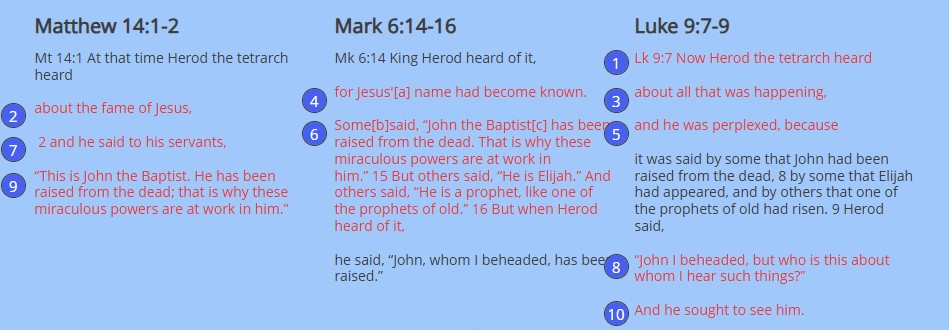
From the above worksheet photo, following the numbers and the text in red, the following narrative is produced.
Lk 9:7 Now Herod the tetrarch heard Mt 14:1 about the fame of Jesus, Lk 9:7 about all that was happening, Mk 6:14 for Jesus’ name had become known. Lk 9:7 [Herod] was perplexed, because Mk 6:14 some [people were saying], “John the Baptist has been raised from the dead. That is why these miraculous powers are at work in him.” 15 Others said, “He is Elijah” and others said, “He is a prophet, like one of the prophets of old.”
Mk 6:16 But when Herod heard of it, Mt 14:2 and he said to his servants, Lk 9:9 “John I beheaded, but who is this about whom I hear such things? Mt 14:2 This is John the Baptist. He has been raised from the dead; that is why these miraculous powers are at work in him.” Lk 9:9 [So Herod] sought to see him.
Bible Lessons for this event:
H291 Confusion and Three Beliefs (Matthew 14:1-2; Mark 6:14-16; Luke 9:7, 9)
Event Summary:
This event describes Herod Antipas’ reaction to Jesus’ growing fame and his confusion about Jesus’ identity. They reflect themes of misunderstanding about Jesus, fear, guilt, and the broader question of who Jesus truly is.
Key points of this event are:
(1) News of Jesus’ miraculous works spreads throughout the region, reaching even Herod Antipas, the ruler of Galilee. People speculate about Jesus’ identity, suggesting He might be John the Baptist raised from the dead, Elijah, or another great prophet. (On the above worksheet see circles 1 – 4) Jesus’ ministry and miracles provoke questions about His identity, showing that His works demand a response. The growing awareness of Jesus highlights His profound impact and the challenge of understanding who He truly is.
(2) Herod, who had John the Baptist executed, becomes paranoid, believing Jesus is John raised from the dead. This reaction reveals Herod’s lingering guilt over John’s death and his fear of divine retribution. On the above worksheet see circle 6) Guilt and fear can distort one’s perception of Jesus. Herod’s reaction shows how unresolved sin and fear of judgment can prevent people from seeing Jesus clearly and responding to Him rightly.
(3) While some suggest Jesus is John the Baptist resurrected, others propose he is Elijah or another prophet. This confusion underscores the growing curiosity and differing opinions about Jesus’ identity. Herod expresses his desire to see Jesus, not out of faith or repentance but likely out of curiosity or fear. (On the above worksheet see circle 6) People often form opinions about Jesus based on incomplete understanding or personal biases. This passage challenges readers to seek the truth about who Jesus is rather than relying on speculation.
(4) These accounts foreshadow the tension between worldly powers, like Herod, and Jesus’ mission. Herod’s reaction highlights how leaders often perceive Jesus as a threat to their authority. Jesus’ ministry reveals the conflict between God’s kingdom and worldly powers. His mission challenges both personal and political systems, prompting varied and often fearful reactions.
The message of this event is that Jesus’ identity and mission provoke curiosity, confusion, and fear, especially among those who feel threatened by him or carry guilt for their actions. Herod’s reaction reflects how unresolved sin and fear of judgment can cloud one’s understanding of Jesus. These verses invite readers to move beyond speculation and fear to seek the truth about who Jesus is, recognizing His authority and significance in their lives.
Discussion Questions with Extended Answers:
1. Who is Herod in these passages, and what is his role?
Answer:
Herod in these accounts is Herod Antipas, the tetrarch (ruler) of Galilee and Perea. He was a son of Herod the Great, who ruled at the time of Jesus’ birth. As tetrarch, Herod Antipas had political authority under Roman oversight but was not a king in the full sense, though he was often referred to as one. His role in these passages is that of a regional ruler hearing reports about Jesus’ ministry. His reaction reveals both political concern and personal unease, especially given his past actions, most notably his involvement in the execution of John the Baptist.
2. Why was Herod perplexed or troubled when he heard about Jesus?
Answer:
Herod was troubled because he heard conflicting reports about Jesus’ identity. Some said Jesus was John the Baptist raised from the dead, others suggested Elijah, and still others believed He was one of the ancient prophets returned. This confusion stirred fear and curiosity in Herod. His troubled state was not simply intellectual uncertainty; it was deeply tied to his guilty conscience. Having ordered the execution of John the Baptist, Herod feared that John had returned in some supernatural way. His perplexity reveals how unresolved guilt can distort one’s understanding of truth and lead to irrational conclusions.
3. Why did Herod think Jesus might be John the Baptist raised from the dead?
Answer:
Herod’s conclusion reflects both superstition and guilt. In the ancient world, it was not uncommon to associate miraculous power with someone who had returned from the dead. Since Jesus was performing mighty works, Herod assumed such power must come from a resurrected figure. More importantly, Herod’s personal history with John the Baptist shaped this belief. He had imprisoned and executed John, a righteous and holy man. Now, hearing of Jesus’ powerful ministry, Herod interpreted these events through the lens of his own wrongdoing, fearing divine retribution or the return of the one he had wronged.
4. What different explanations about Jesus’ identity were circulating among the people?
Answer:
The passages reveal three primary views circulating among the people:
- Jesus as John the Baptist raised from the dead
- Jesus as Elijah, the prophet expected to return (based on Old Testament prophecy, such as Malachi 4:5)
- Jesus as one of the prophets of old who had come back
These varying opinions show that people recognized something extraordinary about Jesus, but they did not yet fully understand His true identity as the Messiah and Son of God. Their interpretations were shaped by familiar categories from Israel’s history, demonstrating both spiritual awareness and limitation.
5. How does Herod’s response contrast with that of faithful followers of Jesus?
Answer:
Herod’s response is marked by fear, confusion, and guilt, while faithful followers respond with faith, understanding, and obedience. Herod hears about Jesus but does not seek truth with humility; instead, he interprets events through his own troubled conscience. In contrast, Jesus’ disciples and true followers come to recognize Him not as a resurrected prophet, but as the Christ. Herod represents those who are intrigued by Jesus yet unwilling to repent or believe, whereas faithful followers move from curiosity to conviction and commitment.
6. What does Luke’s account add about Herod’s intentions?
Answer:
Luke specifically notes that Herod “sought to see Him” (Luke 9:9). This detail reveals that Herod’s curiosity led him to desire a personal encounter with Jesus. However, this desire was not necessarily rooted in genuine faith or repentance; it may have been driven by fascination, fear, or a desire to witness miracles. Later in Luke’s Gospel (Luke 23:8), Herod finally sees Jesus but treats Him with mockery rather than reverence. This shows that curiosity alone is not enough; without a heart of repentance, even direct exposure to Christ does not produce true faith.
7. What role does guilt play in Herod’s interpretation of events?
Answer:
Guilt plays a central role in shaping Herod’s thinking. His fear that Jesus is John the Baptist risen from the dead reflects a conscience that has not been reconciled. Rather than leading him to repentance, his guilt leads to anxiety and superstition. This demonstrates a broader spiritual principle: when sin is not confessed and addressed, it distorts perception and hinders clear understanding of God’s work. Herod’s response serves as a warning about the consequences of ignoring conviction and resisting truth.
8. What theological lesson can be drawn from the confusion surrounding Jesus’ identity?
Answer:
The confusion about Jesus’ identity highlights the necessity of divine revelation for true understanding. While many recognized Jesus as extraordinary, only those who received spiritual insight understood who He truly was. This underscores the theme that human reasoning alone cannot fully grasp the identity of Christ; it must be revealed by God and received in faith. The passage also emphasizes that partial truth, such as recognizing Jesus as a prophet, is insufficient. True faith requires acknowledging Him as the Son of God and Savior.
9. How do these passages prepare the reader for what follows in the Gospel narrative?
Answer:
These verses serve as a transition into the account of John the Baptist’s death (especially in Matthew and Mark), providing context for Herod’s guilty reaction. They also build anticipation for the growing revelation of Jesus’ identity, which will become clearer to the disciples in subsequent passages (such as Peter’s confession in Matthew 16:16). Additionally, they highlight increasing public awareness of Jesus, setting the stage for both greater acceptance and stronger opposition.
10. What application can believers draw from Herod’s reaction to Jesus?
Answer:
Believers can learn the importance of responding rightly to the truth about Jesus. Herod heard about Jesus but allowed fear, guilt, and speculation to shape his response rather than repentance and faith. This challenges believers to examine their own hearts: do they respond to Christ with humility and trust, or do they allow distractions, fears, or unresolved sin to cloud their understanding? The passage calls for a sincere pursuit of truth and a willingness to respond to Jesus with genuine faith and obedience.


Leave a comment