
Photo: Unknown
Previous Lesson
Next Lesson
Author: Stephen Weller
2,524 words, 13 minutes read time
Feeding the 5,000+ – Bethsaida, North side Sea of Galilee, East of Jordan River
Scripture Reference: Matthew 14:13-23; Mark 6:30-46; Luke 9:10-17; John 6:1-15
Context:
The accounts in Matthew 14:13–23; Mark 6:30–46; Luke 9:10–17; and John 6:1–15 describe the miraculous feeding of the five thousand, set against a backdrop of both rising popularity and growing opposition to Jesus. Just prior to this event, Jesus had received news of the death of John the Baptist, prompting Him to withdraw to a secluded place for rest and reflection with His disciples, who themselves had just returned from a demanding ministry journey. Despite this intention for solitude, large crowds followed Him, drawn by His teaching and healing power. Moved with compassion, Jesus ministered to their needs rather than sending them away, demonstrating both His pastoral heart and divine authority. As evening approached, the disciples focused on the practical problem of feeding such a vast crowd in a remote location, but Jesus used the situation to test and strengthen their faith. With only five loaves and two fish, He performed a creative miracle, multiplying the food to abundantly supply all present, with twelve baskets of leftovers remaining: symbolizing both provision and completeness. This event not only revealed Jesus as the divine provider, echoing God’s provision of manna in the wilderness, but also pointed forward to deeper spiritual truths emphasized particularly in John’s Gospel, where the miracle leads into the discourse on Jesus as the Bread of Life. The people’s reaction—seeking to make Him king by force—highlighted their misunderstanding of His mission, focusing on physical provision rather than spiritual salvation. Jesus therefore withdrew again, dismissing the crowd and sending His disciples ahead, reinforcing the pattern of ministry balanced with intentional solitude and communion with the Father.
Event Narrative:
The narrative for this section was obtained from four similar texts, using the highlighted material shown below. The selection was determined by Jerry Peyton and copyrighted in 2015 by Jerry Peyton and Biblical Studies Press L.L.C.
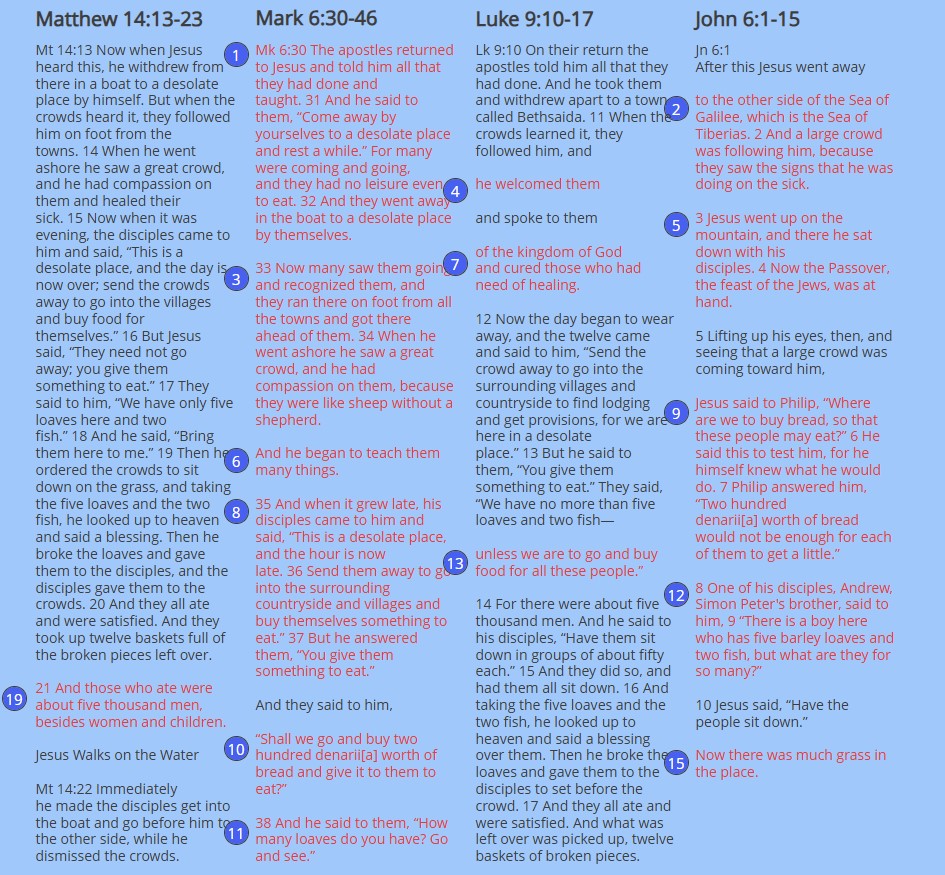
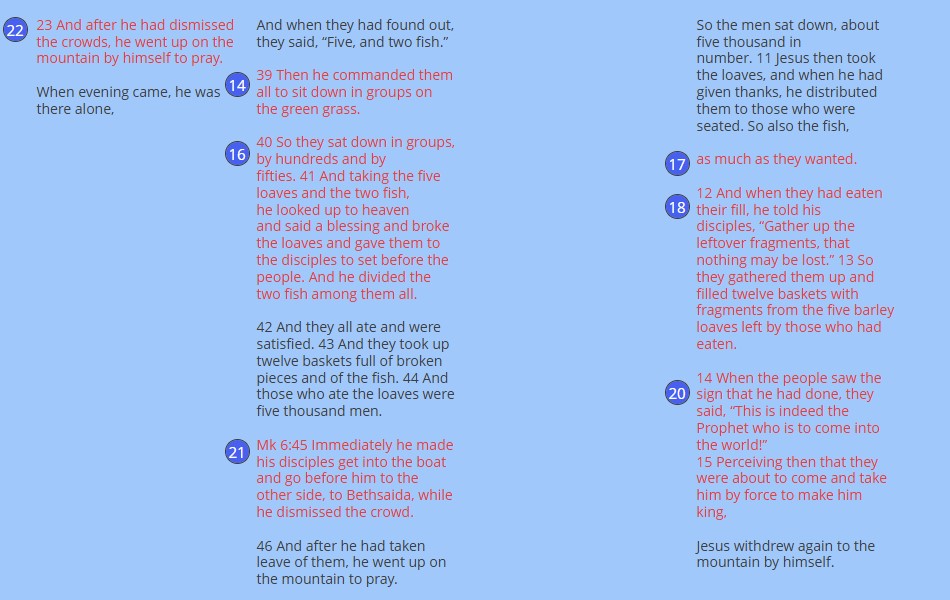
From the above worksheet photo, following the numbers and the text in red, the following narrative is produced.
A Hungry Crowd
Mk 6:30 The apostles returned to Jesus and told him all that they had done and taught. 31 And he said to them, “Come away by yourselves to a desolate place and rest a while.” For many were coming and going, and they had no leisure even to eat.
Mk 6:32 And they went away in the boat to a desolate place by themselves, Jn 6:1 to the other side of the Sea of Galilee, which is the Sea of Tiberias. 2 And a large crowd was following him, because they saw the signs that he was doing on the sick. Mk 6:33 Now many saw them going and recognized them, and they ran there on foot from all the towns and got there ahead of them.
Mk 6:34 When he went ashore, he saw a great crowd, and he had compassion on them, because they were like sheep without a shepherd. Lk 9:11 [Jesus] welcomed them Jn 6:3 [and then] went up on the mountain, and there he sat down with his disciples. 4 (Now the Passover, the feast of the Jews, was at hand.) Mk 6:34 And he began to teach them many things Lk 9:11 [about] the kingdom of God and cured those who had need of healing.
Mk 6:35 And when it grew late, his disciples came to him and said, “This is a desolate place, and the hour is now late. 36 Send them away to go into the surrounding countryside and villages and buy themselves something to eat.”
Mk 6:37 But [Jesus] answered them, “You give them something to eat.” Jn 6:5 Jesus said to Philip, “Where are we to buy bread, so that these people may eat?” 6 (He said this to test him, for he himself knew what he would do.)
Jn 6:7 Philip answered him, “Two hundred denarii worth of bread would not be enough for each of them to get a little.” Mk 6:37 “Shall we go and buy two hundred denarii worth of bread and give it to them to eat?”
Jesus Creates Food
Mk 6:38 And he said to them, “How many loaves do you have? Go and see.”
Jn 6:8 One of his disciples, Andrew, Simon Peter’s brother, said to him, 9 “There is a boy here who has five barley loaves and two fish, but what are they for so many – Lk 9:13 unless we are to go and buy food for all these people.”
Mk 6:39 Then he commanded them all to sit down in groups on the green grass. Jn 6:11 (Now there was much grass in the place.) Mk 6:40 So they sat down in groups, by hundreds and by fifties. 41 And taking the five loaves and the two fish, he looked up to heaven and said a blessing and broke the loaves and gave them to the disciples to set before the people. And he divided the two fish among them all, Jn 6:11 as much as they wanted.
Jn 6:12 And when they had eaten their fill, he told his disciples, “Gather up the leftover fragments, that nothing may be lost.” 13 So they gathered them up and filled twelve baskets with fragments from the five barley loaves left by those who had eaten. Mt 14:21 And those who ate were about five thousand men, besides women and children.
Jn 6:14 When the people saw the sign that he had done, they said, “This is indeed the Prophet who is to come into the world!”
Jn 6:15 Perceiving then that they were about to come and take him by force to make him king. Mk 6:45 Immediately he made his disciples get into the boat and go before him to the other side, to Bethsaida, while he dismissed the crowd. Mt 4:23 And after he had dismissed the crowds, he went up on the mountain by himself to pray.
Bible Lessons for this event:
H292 The Disciples Return from Their Mission Trip (Mark 6:30-33; John 6:1-2)
H293 Jesus Shows Compassion (Mark 6:34; Luke 9:11; John 6:3)
H294 The Need for Food (Mark 6:35-38; John 6:5-7)
H295 Jesus Provides the Food (Matthew 14:21; Mark 6:39-41; Luke 9:13; John 6:8-9, 11-13)
H296 The Crowds Want Jesus as King (Matthew 4:23; Mark 6:45; Jn 6:14-15)
Event Summary:
This event recounts the story of Jesus feeding the five thousand, one of the most significant miracles in the Gospels. The event emphasizes themes of Jesus’ compassion, divine provision, trust in his power, and the foreshadowing of his spiritual sustenance.
Key points of this event are:
(1) After the disciples’ report of their ministry, Jesus is moved by compassion for the large crowd that follows him. He heals the sick and teaches them about the kingdom of God. (On the above worksheet see circles 1 – 2) Jesus prioritizes compassion and service, meeting both the physical and spiritual needs of people. His care for the crowd reflects God’s boundless mercy and love.
(2) The disciples are overwhelmed by the large crowd and lack sufficient food to feed them. Jesus takes the small offering of five loaves and two fish and multiplies it to feed everyone, with abundant leftovers. (On the above worksheet see circles 3 – 8) Human resources may seem inadequate, but in Jesus’ hands, even the smallest offerings can accomplish great things. This miracle teaches reliance on God’s power rather than human limitations.
(3) Jesus involves the disciples in distributing the food, requiring them to trust His instructions despite the impossibility of the situation. The crowd, too, sits in groups as instructed, waiting to receive what Jesus provides. (On the above worksheet see circles 9 – 19) Faith and obedience are crucial for experiencing God’s provision. Trusting in Jesus leads to abundance and satisfaction.
(4) In John’s account, the crowd’s amazement leads to their recognition of Jesus as a prophet. This miracle sets the stage for Jesus’ teaching about being the Bread of Life (John 6:35), indicating that he offers spiritual nourishment and eternal life. (On the above worksheet see circle 20) The feeding of the five thousand symbolizes Jesus’ role as the ultimate provider, offering not only physical sustenance but also spiritual life and satisfaction through faith in him.
(5) After the miracle, Jesus withdraws to a solitary place to pray. This highlights the importance of communion with God, even in the midst of ministry demands. (On the above worksheet see circle 21) Seeking God in prayer is essential for sustaining spiritual strength and focus. Jesus models the balance between serving others and nurturing one’s relationship with God.
(6) The twelve baskets of leftover food emphasize the abundance of God’s provision, which not only meets immediate needs but exceeds them. (On the above worksheet see circle 18) God’s grace is overflowing, providing more than enough for those who trust in him. His blessings are not limited or scarce but abundant and generous.
This event contains the story of Jesus feeding the five thousand demonstrates his compassion, divine power, and ability to provide abundantly for both physical and spiritual needs. It teaches believers to trust in God’s provision, offer their resources in faith, and participate in his work. The miracle also foreshadows Jesus as the Bread of Life, offering eternal sustenance to those who believe in him. Finally, it emphasizes the importance of balancing service with time for prayer and communion with God.
Discussion Questions with Extended Answers:
1. What prompted Jesus to withdraw to a desolate place, and what does this reveal about His ministry?
Answer:
Jesus withdrew after hearing of John the Baptist’s death (Matthew) and after the disciples returned from ministry (Mark and Luke). This moment reflects both grief and intentional rest. Yet when the crowds followed Him, Jesus responded not with irritation but with compassion. He healed the sick and taught them. This reveals that while Jesus valued solitude and reflection, His mission was always driven by compassion. Even in moments of personal sorrow or needed rest, He prioritized the spiritual and physical needs of the people.
2. How did Jesus respond to the crowd’s physical needs, and why is this significant?
Answer:
Jesus did not dismiss the crowd despite the late hour and remote location. Instead, He instructed the disciples to feed them. This is significant because it demonstrates that Jesus cares for both spiritual and physical needs. The miracle shows that God’s provision is not limited to spiritual salvation alone but extends to daily sustenance. It also reveals that Jesus invites His followers to participate in meeting needs, even when the task seems impossible.
3. Why did the disciples initially resist Jesus’ instruction to feed the crowd?
Answer:
The disciples focused on their limitations: insufficient food, lack of money, and the impracticality of feeding such a large crowd. From a human perspective, their response was logical. However, their resistance highlights a lack of understanding of Jesus’ power. They had witnessed miracles, yet they still defaulted to human reasoning. This moment exposes a common spiritual struggle, seeing circumstances through limitation rather than through faith in God’s ability.
4. What is the significance of the five loaves and two fish?
Answer:
The small amount of food emphasizes the magnitude of the miracle. It shows that God does not require abundance to accomplish His purposes; He multiplies what is surrendered to Him. In John’s account, the food comes from a boy, highlighting that even the smallest offering, when given to Christ, can be used for great purposes. The miracle teaches dependence on God rather than reliance on human resources.
5. What role did Jesus’ actions (taking, blessing, breaking, giving) play in the miracle?
Answer:
Jesus took the loaves, blessed them, broke them, and gave them to the disciples to distribute. These actions demonstrate a pattern of divine provision and foreshadow the Last Supper. The blessing acknowledges God as the source, the breaking signifies distribution, and the giving involves the disciples in the work. This pattern shows that provision flows from God, is mediated through Christ, and is shared through His followers.
6. Why were there twelve baskets of leftovers, and what does this symbolize?
Answer:
The twelve baskets signify more than just abundance; they likely represent the twelve tribes of Israel, showing that Jesus is sufficient for all of God’s people. The leftovers demonstrate that God’s provision is not merely adequate but overflowing. This reinforces the truth that when God provides, He does so generously and beyond immediate need.
7. How does John’s Gospel add depth to the understanding of this event?
Answer:
John includes Jesus’ question to Philip (“Where are we to buy bread?”) as a test of faith. He also records the crowd’s reaction, recognizing Jesus as “the Prophet” and attempting to make Him king by force. This adds a theological layer: the miracle is a sign pointing to Jesus as the true bread from heaven (expanded later in John 6). It also reveals a misunderstanding among the people—they sought a political provider rather than a spiritual Savior.
8. What does this miracle reveal about Jesus’ identity?
Answer:
This miracle reveals Jesus as the divine provider, echoing God’s provision of manna in the wilderness. It demonstrates His authority over creation and His role as the sustainer of life. The event points forward to His identity as the “bread of life,” emphasizing that He alone satisfies the deepest needs of humanity.
9. Why did Jesus send the disciples away and dismiss the crowd after the miracle?
Answer:
After the miracle, the crowd’s desire to make Jesus king (John) shows a misunderstanding of His mission. Jesus withdrew to prevent this political distortion of His purpose. Sending the disciples away also protected them from being influenced by the crowd’s expectations. This highlights Jesus’ commitment to God’s plan rather than human agendas.
10. What is the importance of Jesus going up on the mountain to pray?
Answer:
After ministering to the crowd, Jesus withdrew to pray alone. This underscores His dependence on the Father and the importance of communion with God. Even after performing a great miracle, Jesus prioritized prayer. This serves as a model for believers: spiritual effectiveness flows from a life grounded in prayer and fellowship with God.
11. How does this event connect to Old Testament themes?
Answer:
The feeding of the five thousand echoes God providing manna in the wilderness under Moses. It also recalls Elisha’s miracle of multiplying bread (2 Kings 4:42–44). These connections show continuity in God’s work and point to Jesus as greater than Moses and the prophets. He is not just a provider of bread but the ultimate source of life.
12. What key lesson should believers take from this passage?
Answer:
Believers are called to trust in God’s provision, offer what they have to Him, and participate in His work. The passage teaches that God can multiply even the smallest resources when surrendered in faith. It also reminds believers that Jesus is the true source of life, and that spiritual nourishment in Him is greater than any physical provision.


Leave a comment